
Isaiah 57:13

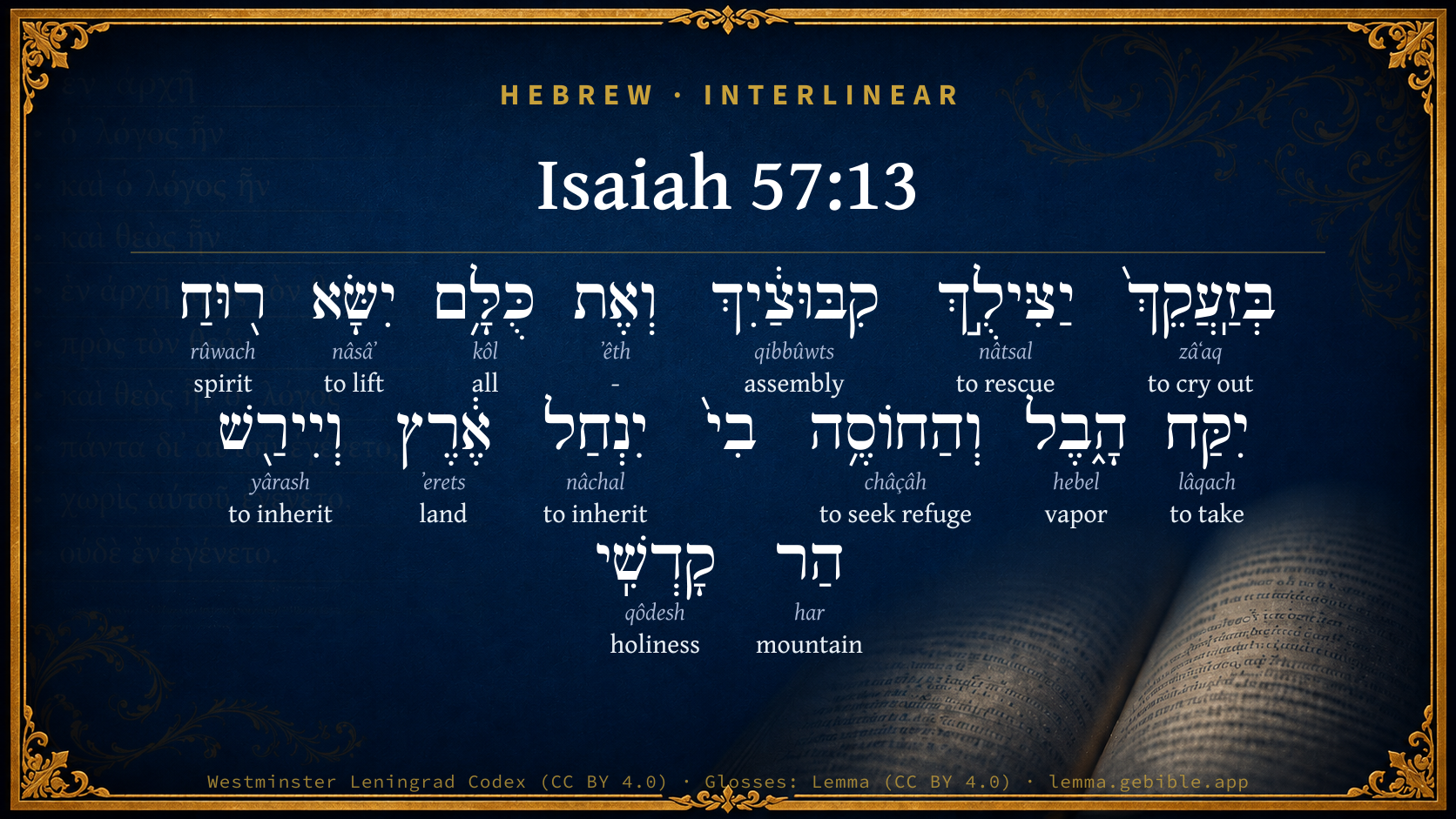
Hebrew (Westminster Leningrad Codex) Isaiah 57:13 appears in the Hebrew Old Testament. The text above is from the Westminster Leningrad Codex. Each word links to its Strong’s number, a concise gloss, and parsing drawn from the Open Scriptures Hebrew Bible morphology. Click any word for its full Brown-Driver-Briggs (BDB) entry.
Download image
Cite this verse

Isaiah 57:13 (World English Bible). Public Domain. Lemma interlinear Bible study tool, https://lemma.gebible.app/v/isaiah/57/13.

Show BibTeX & RIS
BibTeX
RIS
English Translation
When you cry, let those who you have gathered deliver you; but the wind shall take them, a breath shall carry them all away: but he who takes refuge in me shall possess the land, and shall inherit my holy mountain.
World English Bible · Public Domain
Highlights
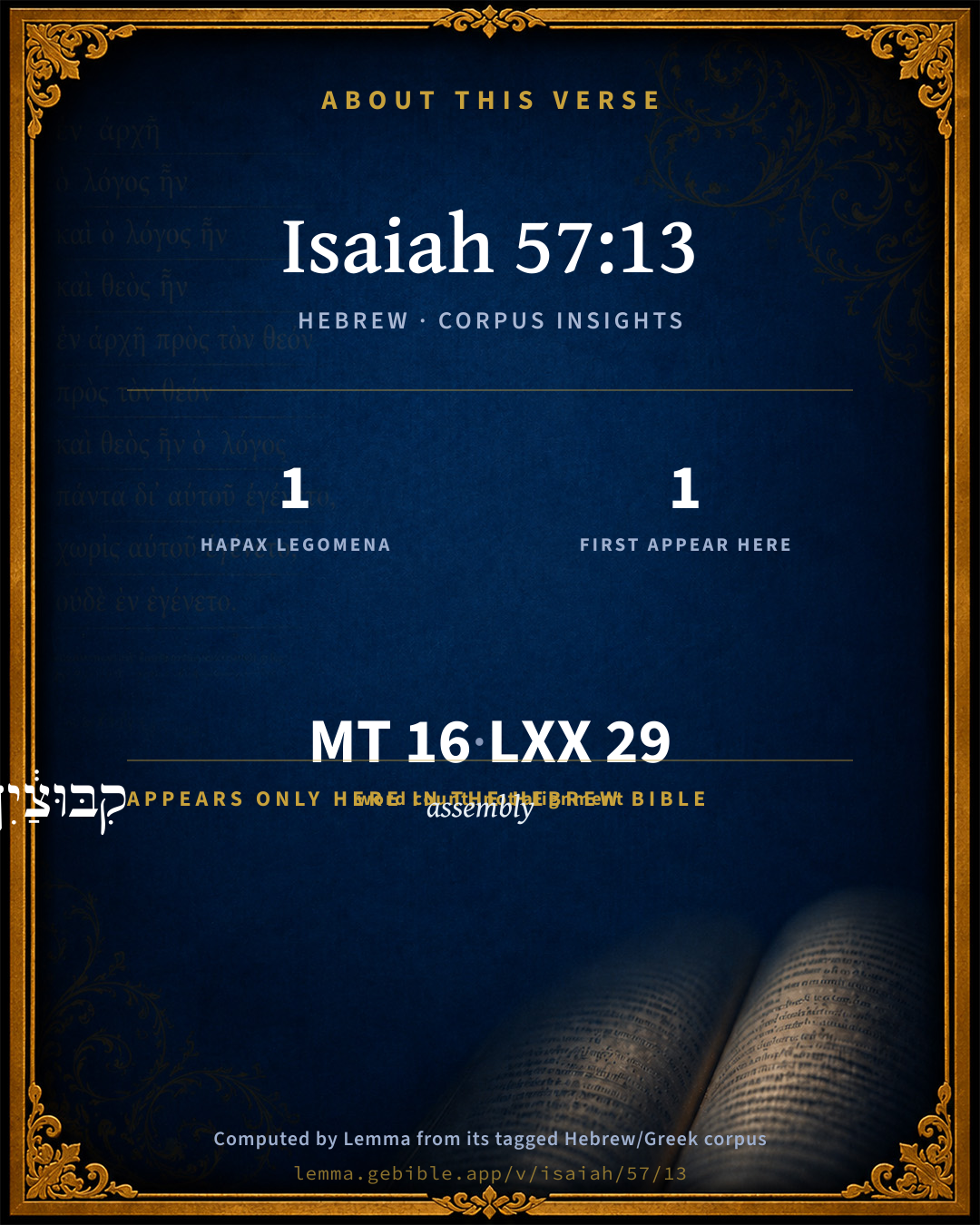
  • 1 hapax legomenon — only here in the Hebrew Bible
  • 1 first appearance in the Hebrew Bible
Full analysis ↓
Download a study sheet

One document with this verse’s original text, its word-by-word gloss line, the meaning frame, cross-references with their text, attributed commentary, and full source and license credits — printable, and it pastes into notes with its structure intact.

This verse Autodidact and up

Study sheet (.html) Plain text (.txt)

A passage Seminary Student

Up to 50 verses in one chapter. A passage sheet keeps up to 6 commentary sources and 12 cross-references per verse, in the order this page ranks them, and says so on the sheet whenever that leaves anything out. Ask for a single verse and you get the Autodidact verse sheet above.

Everything on this page stays free to read, with no account — the sheet is a download of what is already on screen, not access to it.

Want to remove ads? Support Godless Engineer
Compare translations 3

The same verse in 3 English versions, stacked beneath the original-language interlinear above. Click any original word for its lexicon entry.

Each is an independent rendering of the whole verse — the interlinear is not word-aligned to these translations.

Highlighted words mark where these versions differ — a whole-verse word diff, not a word-by-word alignment.

  • World English Bible Public Domain
    When you cry, let those who you have gathered deliver you; but the wind shall take them, a breath shall carry them all away: but he who takes refuge in me shall possess the land, and shall inherit my holy mountain.
  • King James Version Public Domain
    When thou criest, let thy companies deliver thee; but the wind shall carry them all away; vanity shall take them: but he that putteth his trust in me shall possess the land, and shall inherit my holy mountain;
  • unfoldingWord Literal Text CC BY-SA 4.0
    When you cry out, let your collection deliver you! But the wind will carry all of them away, a breath will take. But the one taking refuge in me will inherit the land, and he will possess the mountain of my holiness.”

unfoldingWord Literal Text — © unfoldingWord, licensed CC BY-SA 4.0. Word-aligned USFM3 via Door43 (git.door43.org/unfoldingWord/en_ult).

Versions to compare (up to 4)

3 of 4 selected

Show all 18 translations

Every available English version of this verse, each an independent rendering of the whole verse.

  • World English Bible Public Domain
    When you cry, let those who you have gathered deliver you; but the wind shall take them, a breath shall carry them all away: but he who takes refuge in me shall possess the land, and shall inherit my holy mountain.
  • Berean Standard Bible Public Domain
    When you cry out, let your companies of idols deliver you! Yet the wind will carry off all of them, a breath will take them away. But he who seeks refuge in Me will inherit the land and possess My holy mountain.”
  • Majority Standard Bible Public Domain
    When you cry out, let your companies of idols deliver you! Yet the wind will carry off all of them, a breath will take them away. But he who seeks refuge in Me will inherit the land and possess My holy mountain.”
  • King James Version Public Domain
    When thou criest, let thy companies deliver thee; but the wind shall carry them all away; vanity shall take them: but he that putteth his trust in me shall possess the land, and shall inherit my holy mountain;
  • American Standard Version (1901) Public Domain
    When thou criest, let them that thou hast gathered deliver thee; but the wind shall take them, a breath shall carry them all away: but he that taketh refuge in me shall possess the land, and shall inherit my holy mountain.
  • Revised Version (1885) Public Domain
    When thou criest, let them which thou hast gathered deliver thee; but the wind shall take them, a breath shall carry them all away: but he that putteth his trust in me shall possess the land, and shall inherit my holy mountain.
  • Geneva Bible (1599) Public Domain
    When thou cryest, let them that thou hast gathered together deliuer thee: but the winde shall take them all away: vanitie shall pull them away: but he that trusteth in me, shall inherite the lande, and shall possesse mine holy Mountaine.
  • Douay-Rheims (1899) Public Domain
    When thou shalt cry, let thy companies deliver thee, but the wind shall carry them all off, a breeze shall take them away, but he that putteth his trust in me, shall inherit the land, and shall possess my holy mount.
  • Young's Literal Translation Public Domain
    When thou criest, let thy gatherings deliver thee, And all of them carry away doth wind, Take away doth vanity, And whoso is trusting in Me inheriteth the land, And doth possess My holy mountain.
  • Literal Standard Version CC BY-SA 4.0
    When you cry, let your gatherings deliver you, || And wind carries all of them away, || Vanity takes away, || And whoever is trusting in Me inherits the land, || And possesses My holy mountain.”
  • Unlocked Literal Bible CC BY-SA 4.0
    When you cry out, let your collection of idols rescue you. Instead the wind will carry them all away, a breath will carry them all away. Yet he who takes refuge in me will inherit the land and will take possession of my holy mountain.
  • unfoldingWord Literal Text CC BY-SA 4.0
    When you cry out, let your collection deliver you! But the wind will carry all of them away, a breath will take. But the one taking refuge in me will inherit the land, and he will possess the mountain of my holiness.”
  • Darby Bible Public Domain
    When thou criest, let them that are gathered by thee deliver thee! But a wind shall carry them all away, a breath shall take them; but he that putteth his trust in me shall inherit the land, and possess my holy mountain.
  • World Messianic Bible Public Domain
    When you cry, let those whom you have gathered deliver you, but the wind will take them. A breath will carry them all away, but he who takes refuge in me will possess the land, and will inherit my holy mountain.”
  • Webster's Bible Public Domain
    When thou criest, let thy companies deliver thee; but the wind shall carry them all away; vanity shall take them: but he that putteth his trust in me shall possess the land, and shall inherit my holy mountain;
  • Free Bible Version CC BY-SA 4.0
    When you cry out for help, let's see if your collection of idols will save you! The wind will blow them all away, just a breath and they're gone! But whoever comes to me for help will own the land and possess my holy mountain.
  • Bible in Basic English Public Domain
    Your false gods will not keep you safe in answer to your cry; but the wind will take them, they will be gone like a breath: but he who puts his hope in me will take the land, and will have my holy mountain as his heritage.
  • JPS Tanakh (1917) Public Domain
    When thou criest, let them that thou hast gathered deliver thee; but the wind shall carry them all away, a breath shall bear them off; but he that taketh refuge in Me shall possess the land, and shall inherit My holy mountain.

Literal Standard Version (2020), Covenant Press — licensed CC BY-SA 4.0. Text via the HelloAO Bible API (eBible.org). Unlocked Literal Bible (unfoldingWord) — licensed CC BY-SA 4.0. Text via the HelloAO Bible API (eBible.org). unfoldingWord Literal Text — © unfoldingWord, licensed CC BY-SA 4.0. Word-aligned USFM3 via Door43 (git.door43.org/unfoldingWord/en_ult). Free Bible Version, Dr. Jonathan Gallagher — licensed CC BY-SA 4.0. Text via the HelloAO Bible API (eBible.org).

Word by word

More ways to search: Search by grammar → Find every occurrence → Compare this word →

Practice this passage: Drill this verse → Learn its vocabulary →

קִבּוּצַ֔יִךְ
qibbûwts
H6899
“assemblies · your”
Noun, Common, Masculine, Plural, Construct + Suffix, Personal, 2nd Person, Feminine, Singular
Part of Speech
Noun
Type
Common
Gender
Masculine
Number
Plural
State
Construct
Full BDB Definition

Origin: from H6908

TWOT: 1983a

assemblage, assembly, gathering - (BDB) heap
  1. בְּזַֽעֲקֵךְ֙ zâʻaq H2199 “in/at · to cry out · you” Preposition + Verb, Qal, Infinitive Construct + Suffix, Personal, 2nd Person, Feminine, Singular
  2. יַצִּילֻ֣ךְ nâtsal H5337 “to rescue · you” Verb, Hiphil, Imperfect, 3rd Person, Masculine, Plural + Suffix, Personal, 2nd Person, Feminine, Singular
  3. וְאֶת ʼêth H853 “and · -” Conjunction + Particle, Direct Object
  4. כֻּלָּ֥ם kôl H3605 “all · their” Noun, Common, Masculine, Singular, Construct + Suffix, Personal, 3rd Person, Masculine, Plural
  5. יִשָּׂא nâsâʼ H5375 “to lift” Verb, Qal, Imperfect, 3rd Person, Masculine, Singular
  6. ר֖וּחַ rûwach H7307 “spirit” Noun, Common, Both, Singular, Absolute
  7. יִקַּח lâqach H3947 “to take” Verb, Qal, Imperfect, 3rd Person, Masculine, Singular
  8. הָ֑בֶל hebel H1892 “vapor” Noun, Common, Masculine, Singular, Absolute
  9. וְהַחוֹסֶ֥ה châçâh H2620 “and · the · seeking refuge” Conjunction + Particle, Definite Article + Verb, Qal, Participle Active, Masculine, Singular, Absolute
  10. יִנְחַל nâchal H5157 “to inherit” Verb, Qal, Imperfect, 3rd Person, Masculine, Singular
  11. אֶ֔רֶץ ʼerets H776 “land” Noun, Common, Both, Singular, Absolute
  12. וְיִירַ֖שׁ yârash H3423 “and · to inherit” Conjunction + Verb, Qal, Imperfect, 3rd Person, Masculine, Singular
  13. הַר har H2022 “mountain of” Noun, Common, Masculine, Singular, Construct
  14. קָדְשִֽׁי qôdesh H6944 “holiness · my” Noun, Common, Masculine, Singular, Construct + Suffix, Personal, 1st Person, Common, Singular

About this verse

These counts appear in no published source. They are computed here, from the morphology-tagged text and Lemma’s own curated glosses. What Lemma adds →

16
words
15
distinct lemmas
Prophets
section

Notable vocabulary

1 hapax legomenon — a word that appears only here in the entire Hebrew Bible:

  • קִבּוּצַ֔יִךְ assembly H6899

First appearance in Scripture

This word makes its first canonical appearance in the Hebrew Bible here:

  • קִבּוּצַ֔יִךְ assembly H6899

Shared distinctive vocabulary

וְהַחוֹסֶ֥ה to seek refuge H2620 occurs in 36 verses of the Hebrew Bible. Also found in:

Grammatical profile

  • 7 verbs
  • 7 nouns
  • 1 preposition
  • 1 particle

Verb forms

  • בְּזַֽעֲקֵךְ֙ Qal · Infinitive Construct
  • יַצִּילֻ֣ךְ Hiphil · Imperfect
  • יִשָּׂא Qal · Imperfect
  • יִקַּח Qal · Imperfect
  • וְהַחוֹסֶ֥ה Qal · Participle Active
  • יִנְחַל Qal · Imperfect
  • וְיִירַ֖שׁ Qal · Imperfect

Hebrew & Septuagint length

In English translation the verse runs 41 words from the Hebrew and 41 from the Septuagint (LXX English) — the same length.

A rough comparison of the two English renderings, which tokenize alike — not a word-level alignment.

Word counts can differ between the Hebrew and the Greek without any difference in meaning — e.g. the Hebrew direct-object marker אֵת has no separate Greek word, and Greek often adds the article ὁ.

In the original languages it is 16 Hebrew tokens and 29 Greek tokens — but the two are counted differently (Hebrew bundles its prefixes and suffixes into one token; the Greek is in lemma form), so that isn’t a like-for-like length.

Cross-references

27

Topical passages linked to Isaiah 57:13 in the Treasury of Scripture Knowledge — connected by theme and wording, ordered by reader-vote popularity; previews shown in the World English Bible.

  • Psalms 37:9 For evildoers shall be cut off, But those who wait for Yahweh shall inherit the land.
  • Psalms 37:3 Trust in Yahweh, and do good. Dwell in the land, and enjoy safe pasture.
  • Isaiah 56:7 even them will I bring to my holy mountain, and make them joyful in my house of prayer: their burnt offerings and their sacrifices shall be accepted on my altar; for my house shall be called a house of prayer for all peoples.
  • Isaiah 65:25 The wolf and the lamb shall feed together, and the lion shall eat straw like the ox; and dust shall be the serpent's food. They shall not hurt nor destroy in all my holy mountain, says Yahweh.
  • Judges 10:14 Go and cry to the gods which you have chosen; let them save you in the time of your distress.
  • Psalms 125:1 Those who trust in Yahweh are as Mount Zion, Which can't be moved, but remains forever.
  • Isaiah 11:9 They shall not hurt nor destroy in all my holy mountain; for the earth shall be full of the knowledge of Yahweh, as the waters cover the sea.
  • Isaiah 65:9 I will bring forth a seed out of Jacob, and out of Judah an inheritor of my mountains; and my chosen shall inherit it, and my servants shall dwell there.
  • Isaiah 66:20 They shall bring all your brothers out of all the nations for an offering to Yahweh, on horses, and in chariots, and in litters, and on mules, and on dromedaries, to my holy mountain Jerusalem, says Yahweh, as the children of Israel bring their offering in a clean vessel into the house of Yahweh.
  • Ezekiel 20:40 For in my holy mountain, in the mountain of the height of Israel, says the Lord Yahweh, there shall all the house of Israel, all of them, serve me in the land: there will I accept them, and there will I require your offerings, and the first fruits of your offerings, with all your holy things.
  • Joel 3:17 "So you will know that I am Yahweh, your God, Dwelling in Zion, my holy mountain. Then Jerusalem will be holy, And no strangers will pass through her any more.
  • Zechariah 7:13 It has come to pass that, as he called, and they refused to listen, so they will call, and I will not listen," said Yahweh of Hosts;
  • 2 Kings 3:13 Elisha said to the king of Israel, What have I to do with you? get you to the prophets of your father, and to the prophets of your mother. The king of Israel said to him, No; for Yahweh has called these three kings together to deliver them into the hand of Moab.
  • Job 21:18 That they are as stubble before the wind, As chaff that the storm carries away?
  • Psalms 1:4 The wicked are not so, But are like the chaff which the wind drives away.
  • Psalms 58:9 Before your pots can feel the heat of the thorns, He will sweep away the green and the burning alike.
  • Psalms 84:12 Yahweh of Hosts, Blessed is the man who trusts in you.
  • Proverbs 28:25 One who is greedy stirs up strife; But one who trusts in Yahweh will prosper.
  • Isaiah 26:3–4 You will keep [him] in perfect peace, [whose] mind [is] stayed [on you]; because he trusts in you.
  • Isaiah 40:24 Yes, they have not been planted; yes, they have not been sown; yes, their stock has not taken root in the earth: moreover he blows on them, and they wither, and the whirlwind takes them away as stubble.
  • Isaiah 41:16 You shall winnow them, and the wind shall carry them away, and the whirlwind shall scatter them; and you shall rejoice in Yahweh, you shall glory in the Holy One of Israel.
  • Isaiah 57:9–10 You went to the king with oil, and did increase your perfumes, and did send your ambassadors far off, and did debase yourself even to Sheol.
  • Isaiah 65:11 But you who forsake Yahweh, who forget my holy mountain, who prepare a table for Fortune, and who fill up mixed wine to Destiny;
  • Jeremiah 17:7–8 Blessed is the man who trusts in Yahweh, and whose trust Yahweh is.
  • Jeremiah 22:20 Go up to Lebanon, and cry; and lift up your voice in Bashan, and cry from Abarim; for all your lovers are destroyed.
  • Jeremiah 22:22 The wind shall feed all your shepherds, and your lovers shall go into captivity: surely then shall you be ashamed and confounded for all your wickedness.
  • Hosea 13:3 Therefore they will be like the morning cloud, And like the dew that passes away early, Like the chaff that is driven with the whirlwind out of the threshing floor, And like the smoke out of the chimney.

Cross-references courtesy of OpenBible.info (CC BY 4.0).

Hebrew and Greek witnesses Masoretic Hebrew ↔ Greek Septuagint

The same verse in the two great witnesses to the Old Testament, shown verse-for-verse.

These are two independent witnesses, not word-aligned to each other, and the Septuagint is shown in lemma (dictionary) form.

Hebrew Isaiah 57:13 Masoretic · Westminster Leningrad Codex

בְּזַֽעֲקֵךְ֙ יַצִּילֻ֣ךְ קִבּוּצַ֔יִךְ וְאֶת כֻּלָּ֥ם יִשָּׂא ר֖וּחַ יִקַּח הָ֑בֶל וְהַחוֹסֶ֥ה בִי֙ יִנְחַל אֶ֔רֶץ וְיִירַ֖שׁ הַר קָדְשִֽׁי

When you cry, let those who you have gathered deliver you; but the wind shall take them, a breath shall carry them all away: but he who takes refuge in me shall possess the land, and shall inherit my holy mountain.

World English Bible · Public Domain

Greek LXX Isaiah 57:13 Septuagint · lemma form

ὅταν ἀναβοάω ἐκαἱρέω σύ ἐν ὁ θλῖψις σύ οὗτος γάρ πᾶς ἄνεμος λαμβάνω καί ἀποφέρω καταιγίς ὁ δέ ἀντιἔχω ἐγώ κτάομαι γῆ καί κληρονομέω ὁ ὄρος ὁ ἅγιος ἐγώ

When you cry out, let them deliver you in your affliction: for all these the wind shall take, and the tempest shall carry them away: but they that cleave to me shall possess the land, and shall inherit my holy mountain.

LXX2012 (modern English Septuagint) · Public Domain

Hebrew: Westminster Leningrad Codex (CC BY 4.0). Greek: Septuagint (public domain); English from LXX2012 (modern English Septuagint) (Public Domain). How the Septuagint differs from the Hebrew →

Targum (Aramaic paraphrase)

1

The Targum is the ancient Jewish Aramaic paraphrase of the Hebrew Scriptures — an interpretive translation, not the Hebrew text itself. Onkelos (literal) and Pseudo-Jonathan (expansive) render the Torah, and Jonathan the Prophets. Coverage is partial: where no permissively-licensed English translation exists for a verse, only the Aramaic is shown. This is verse-level text, not a word-by-word alignment to the Hebrew.

  1. Targum Jonathan Prophets (Joshua–Malachi)
    אַצְוָחִי כְעַן אִם יִפְרְקוּנִיךְ עוֹבָדֵי שִׁקְרִין דַהֲוֵית מִתְעַסְקָא בְהוֹן מִיַנְקוּתִיךְ וְיַת כּוּלְהוֹן יִטוֹל רוּחָא יְהוֹן כִּלְמָא וּדְרָחֵיץ עַל מֵימְרִי יַחְסִין אַרְעָא וְיֵירַת טוּרָא דְקוּדְשִׁי:

    Proclaim aloud, whether thy deceitful works will save thee, in which thou hast been occupied from thy youth? the wind shall carry away all of them, they shall be as nothing: but he that putteth his trust in my WORD shall possess the earth, and shall inherit my holy mountain.

    Targum Jonathan — Aramaic: “Mikraot Gedolot” (public domain). English: “Sefaria Community Translation” (CC0 1.0 (public-domain dedication)); “London "Chaldee Paraphrase," 1871” (public domain). Text via Sefaria.

Commentary

Notes on Isaiah 57:13 from classic Christian and Jewish commentators (each source and its license shown beneath its notes). The classic Christian expositions comment on the surrounding passage and are grouped to its opening verse, so a note may address several verses; the Jewish commentaries on the Tanakh (Rashi and others) are per-verse, so they appear only where the commentator wrote on this verse.

Lemma curates 59 commentaries, every one of them public domain or Creative Commons licensed, each selected and text-cleaned for this edition rather than reprinted as found. About our sources →

Matthew Henry's Commentary

Here, I. God shows how insufficient idols and creatures were to relieve and succour those that worshipped them and confided in them (Isa 57:13): "When thou criest in thy distress and anguish, lamentest thy misery and callest for help, let thy companies deliver thee, thy idol-gods which thou hast heaped to thyself companies of, the troops of the confederate forces which thou hast relied so much upon, let them deliver thee if they can; expect no other relief than what they can give." Thus God said to Israel, when in their trouble they called upon him (Jdg 10:14), Go, and cry to the gods which you have chosen, let them deliver you. But in vain is salvation hoped for from them: The wind shall carry them all away, the wind of God's wrath, that breath of his mouth which shall slay the wicked; they have made themselves as chaff, and therefore the wind will of course hurry them away. Vanity they are, and vanity shall take them away, to vanity they shall be reduced, and vanity shall be their recompence. Both the idols and their worshippers shall come to nothing.

II. He shows that there was a sufficiency, an all-sufficiency, in him for the comfort and deliverance of all those that put their confidence in him and made their application to him. Their safety and satisfaction appear the more comfortable because their hopes are crowned with fruition, when those that seek to other helpers have their hopes frustrated: "He that puts his trust in me, and in me only, he shall be happy, both for soul and body, for this world and the other."

1. Observe, in general, (1.) Those that trust in God's providence take the best course to secure their secular interests. They shall possess the land, as much of it as is good for them, and what they have they shall have it from a good hand and hold it by a good title. Psa 37:3, They shall dwell in the land, and verily they shall be fed. (2.) Those that trust in God's grace take the best course to secure their sacred interests. They shall inherit my holy mountain. They shall enjoy the privileges of the church on earth, and be brought at length to the joys of heaven; and no wind shall carry them away.

2. More particularly,

(1.) The captives, that trust in God, shall be released (Isa 57:14): They shall say (that is, the messengers of his providence, in that great event shall say), Cast you up, cast you up, prepare the way. When God's time shall have come for their deliverance the way of bringing it about shall be made plain and easy, obstacles shall be removed, difficulties that seemed insuperable shall be speedily got over, and all things shall concur both to accelerate and facilitate their return. See Isa 40:3, Isa 40:4. This refers to the provision which the gospel, and the grace of it, have made for our ready passage through this world to a better. The way of religion is now cast up; it is a highway; ministers' business is to direct people in it, and to help them over the discouragements they meet with, that nothing may offend them.

(2.) The contrite, that trust in God, shall be revived, Isa 57:15. Those that trusted to idols and creatures for help went with their ointments and perfumes (Isa 57:9); but here God shows that those who may expect help from him are such as are destitute of, and set themselves at a distance from, the gaieties of the world and the delights of sense. God's glory appears here very bright, [1.] In his greatness and majesty: He is the high and lofty One that inhabits eternity. Let this inspire us with very high and honourable thoughts of the God with whom we have to do, First, That his being and perfections are exalted infinitely above every creature, not only above what they have themselves, but above what they can conceive concerning him, far above all their blessing and praise, Neh 9:5. He is the high and lofty One, and there is no creature like him, nor any to be compared with him. The language likewise intimates his sovereign dominion over all and the incontestable right he has to give both law and judgment to all. He is higher than the highest (Ecc 5:8), than the highest heavens, Psa 113:4. Secondly, That with him there is neither beginning of days nor end of life, nor change of time; he is both immortal and immutable. He only has immortality, Ti1 6:16. He has it of himself, and he has it constantly; he inhabits it, and cannot be dispossessed of it. We must shortly remove into eternity, but God always inhabits it. Thirdly, That there is an infinite rectitude in his nature, and an exact conformity with himself and a steady design of his own glory in all that he does; and this appears in every thing by which he has made himself known, for his name is holy, and all that desire to be acquainted with him must know him as a holy God. Fourthly, That the peculiar residence and manifestation of his glory are in the mansions of light and bliss above: "I dwell in the high and holy place, and will have all the world to know it." Whoever have any business with God must direct to him as their Father in heaven, for there he dwells. These great things are here said of God to inspire us with a holy reverence of him, to encourage our confidence in him, and to magnify his compassion and condescension to us, that though he is thus high yet he has respect unto the lowly; he that rides on the heavens by his name JAH stoops to concern himself for poor widows and fatherless, Psa 68:4, Psa 68:5. [2.] In his grace and mercy. He has a tender pity for the humble and contrite, for those that are so in respect of their state. If they be his people, he will not overlook them though they are poor and low in the world, and despised and trampled upon by men; but he here refers to the temper of their mind; he will have a tender regard to those who, being in affliction, accommodate themselves to their affliction, and bring their mind to their condition, be it ever so low and ever so sad and sorely broken - those that are truly penitent for sin, who mourn in secret for it, and have a dread of the wrath of God, which they have made themselves obnoxious to, and are submissive under all his rebukes. Now, First, With these God will dwell. He will visit them graciously, will converse familiarly with them by his word and Spirit, as a man does with those of his own family; he will be always nigh to them and present with them. He that dwells in the highest heavens dwells in the lowest hearts and inhabits sincerity as surely as he inhabits eternity. In these he delights. Secondly, He will revive their heart and spirit, will speak that to them, and work that in them by the word and Spirit of his grace, which will be reviving to them, as a cordial to one that is ready to faint. He will give them reviving joys and hopes sufficient to counterbalance all the griefs and fears that break their spirits. He dwells with them, and his presence is reviving.

(3.) Those with whom he contends, if they trust in him, shall be relieved, and received into favour, Isa 57:16. He will revive the heart of the contrite ones, for he will not contend for ever. Nothing makes a soul contrite so much as God's contending, and therefore nothing revives it so much as his ceasing his controversy. Here is, [1.] A gracious promise. It is not promised that he will never be angry with his people, for their sins are displeasing to him, or that he will never contend with them, for they must expect the rod; but he will not contend for ever, nor be always wroth. As he is not soon angry, so he is not long angry. He will not always chide. Though he contend with them by convictions of sin, he will not contend for ever; but, instead of the spirit of bondage, they shall receive the Spirit of adoption. He has torn, but he will heal. Though eh contend with them by the rebukes of providence, yet the correction shall not last always, shall not last long, shall last no longer than there is need (Pe1 1:6), no longer than they can bear, no longer than till it has done its work. Though their whole life be calamitous, yet their end will be peace, and so will their eternity be. [2.] A very compassionate consideration, upon which this promise is grounded: "If I should contend for ever, the spirit would fail before me, ever the souls which I have made." Note, First, God is the Father of spirits, Heb 12:9. Those with whom he will not always contend are the souls that he has made, that he gave being to by creation and a new being to by regeneration. Secondly, Though the Lord is for the body, yet he concerns himself chiefly for the souls of his people, that the spirit do not fail, and its graces and comforts. Thirdly, When troubles last long, the spirit even of good men is apt to fail. They are tempted to entertain hard thoughts of God, to think it in vain to serve him; they are ready to put comfort away from them, and to despair of relief, and then the spirit fails. Fourthly, It is in consideration of this that God will not contend for ever; for he will not forsake the work of his own hands nor defeat the purchase of his Son's blood. The reason is taken not from our merit, but from our weakness and infirmity; for he remembers that we are flesh (Psa 78:39) and that flesh is weak.

Matthew Henry's Commentary on the Whole Bible (1708–1710) — public domain (CC PDM 1.0). Text via the HelloAO Bible API.

Trapp's Complete Commentary

John Trapp

Isa 57:13 When thou criest, let thy companies deliver thee; but the wind shall carry them all away; vanity shall take [them]: but he that putteth his trust in me shall possess the land, and shall inherit my holy mountain;

Ver. 13. When thou criest, let thy companies deliver thee.] "Thy companies"; Heb., Thy gathered ones, or troops. See Deu 32:37-38 Jdg 10:13-14. {See Trapp on "Jdg 10:14"}

But the wind shall carry them all away.] The wind of God’s power shall scatter them, quisquiliarum in morem.

John Trapp, A Commentary or Exposition upon All the Books of the Old and New Testament (1647–1656) — public domain. Text from a community e-Sword module.

Tyndale Open Study Notes

Tyndale Open Resources

57:13 your idols . . . fall over: See study note on 40:18. • inherit the land: The Hebrew word translated land can also signify the whole earth (see Pss 25:13; 37:9, 11, 22, 29, 34; Matt 5:5). • my holy mountain: God’s servants will enjoy God’s presence in Zion (see Isa 2:2; 56:7).

Tyndale Open Study Notes — © Tyndale Open Resources, licensed CC BY-SA 4.0. Text via the HelloAO Bible API.

Geneva Bible (1599)

Geneva Bible translators

Meaning, the Assyrians and others, whose help they looked for.

Geneva Bible (1599) marginal notes — public domain. Text via Bolls.life.

Jamieson, Fausset & Brown

Robert Jamieson, A. R. Fausset & David Brown

When thou criest--In the time of thy trouble.

companies--namely, of idols, collected by thee from every quarter; or else, of foreigners, summoned to thy aid.

wind . . . carry . . . away-- (Job 21:18; Mat 7:27).

vanity--rather, "a breath" [LOWTH].

possess . . . land . . . inherit--that is, the literal land of Judea and Mount Zion; the believing remnant of Israel shall return and inherit the land. Secondarily, the heavenly inheritance, and the spiritual Zion (Isa 49:8; Psa 37:9, Psa 37:11; Psa 69:35-36; Mat 5:5; Heb 12:22). "He that putteth his trust in Me," of whatever extraction, shall succeed to the spiritual patrimony of the apostate Jew [HORSLEY].

Jamieson, Fausset & Brown — Commentary Critical and Explanatory on the Whole Bible (1871) — public domain (CC PDM 1.0). Text via the HelloAO Bible API.

Adam Clarke's Commentary

Verse 13. Let thy companies deliver thee - "Let thine associates deliver thee"] Thirty-nine MSS. (ten ancient) of Dr. Kennicott's, and two of my own, and the two oldest editions have יצילכו yatstsiluchu, plural.

Adam Clarke's Commentary on the Bible (1810–1826) — public domain. Text from a community e-Sword/MySword module.

Ellicott's Commentary for English Readers

(13) Let thy companies . . .—The word is used contemptuously of the crowd of gods introduced by the confluent idolatry of Manasseh. (Comp. 2Ch_33:3-7.) The prophet taunts the worshipper with their impotence, “Let them save thee, if they can,” but that taunt is followed by a declaration that true help and strength will be given to all who trust in Jehovah.

A Bible Commentary for English Readers, edited by Charles John Ellicott (1878–1897) — public domain. Text from a community e-Sword module.

The Cambridge Bible for Schools and Colleges

gen. ed. J. J. S. Perowne

13. When thou criest, let thy companies deliver thee] Cf. Jer_2:28. The word for “companies” does not occur elsewhere; it means them which thou hast gathered (R.V.): thy rabble of idols (R.V. marg.) (see Mic_1:7).

vanity] R.V. a breath.

The second half of the verse forms a transition to the next section, which is a promise of salvation to the true Israel.

The Cambridge Bible for Schools and Colleges (gen. ed. J. J. S. Perowne; Cambridge University Press, 1878–1918) — public domain. Text from a community e-Sword module.

John Gill's Exposition

When thou criest, let thy companies deliver thee,.... From distress and impending ruin, if they can; meaning not the allies and auxiliaries of the Jews, the Egyptians and Assyrians, they sent to for help, as Kimchi, and others; rather, as Jarchi, their idols and graven images they worshipped, angels and saints departed, the Papists pray unto; let them now, in the time of Rome's ruin, renew their addresses to them for help and deliverance, if they can give it: or, "thy gathered ones" (z); the kings of the earth the whore of Rome has gathered unto her to commit fornication with her: and who, by her emissaries, will be gathered together to the battle of the Lord God Almighty, and to make war with the Lamb, but will be overcome; as also her many religious societies and convents of Jesuits, friars, priests, &c.; these will stand afar off, and lament her in her distress; even the kings and merchants of the earth, ship masters, and all company in ships, but will not be able to relieve her, Rev 18:9,

but the wind shall carry them all away; vanity shall take them; so far will they be from helping her in the time of her calamity, that the wind of God's power and wrath shall carry them away as chaff; a puff of his "breath", or the least breath of air (a), shall dissipate them, and bring them to nothing; they will be no more able to stand before him than the lightest thing that can be thought of can stand before a blustering wind or tempest. The phrase denotes an utter and easy destruction of the whole jurisdiction and hierarchy of the church of Rome:

but he that putteth his trust in me shall possess the land, and shall inherit my holy mountain; such of God's people as will be in Babylon a little before its fall, and will be called out of it, who shall betake themselves to the Lord as their only refuge, and put their trust and confidence in him, rejecting all idolatry and superstitious worship, shall enjoy the communion of the true church of Christ, and partake of all the ordinances of it: it may be this may have also a particular respect unto the Jews, who will be called about this time; who, upon their believing in Christ, will return to their own land, and dwell in Jerusalem, God's holy mountain, as it used to be called. Hence it follows:

(z) "collectitii tui", Tigurine version; "congregati a te", Vatablus; "copiae tuae collectae", Vitringa. (a) "halitus" Cocceius; "aura" V. L. "aura levisima" Vitringa.

John Gill's Exposition of the Whole Bible (1746–1763) — public domain (CC PDM 1.0). Text via the HelloAO Bible API.

Albert Barnes' Notes on the Bible

When thou criest - That is, when you are in trouble, and feel your need of help.

Let thy companies deliver thee - The word used here (קבוּץ qibûts) means, properly, “a gathering; a throng; a collection.” Here it refers either to the throngs of the idols which they had collected. and on which they relied; or to the collection of foreigners which they had summoned to their assistance. The idea is, that if people trust to other objects for aid than the arm of God, they will be left in the day of trial to such assistance as they can render them.

But the wind shall carry - They shall be like the protection which the wind sweeps away. The Saviour expresses a similar sentiment in Mat 7:26-27.

Vanity shall take them - Lowth and Noyes, ‘A breath shall take them off.’ The word הבל hebel, properly means a breath; and probably denotes here a gentle breeze, the slightest breath of air, denoting the entire instability of the objects on which they trusted, when they could be so easily swept off.

Shall possess the land - The assurances of the favor and friendship of God are usually expressed in this way (compare the notes at Isa 49:8). See Psa 37:11; ‘The meek shall inherit the earth.’ Compare Psa 69:35-36; Mat 5:5.

And shall inherit my holy mountain - In Jerusalem. That is, they shall be admitted to elevated spiritual privileges and joys - as great as if they had possession of a portion of the mount on which the temple was built, and were permitted to dwell there.

Albert Barnes' Notes on the Bible (1834–1885) — public domain. Text from a community e-Sword/MySword module.

Haydock's Catholic Bible Commentary

Companies, or princes, in whom thou hast confided. Assyria and Egypt cannot save themselves. (Calmet)

George Leo Haydock (1774–1849), Haydock's Catholic Family Bible and Commentary, 1859 edition — public domain. Excludes Psalms (Douay-Rheims chapter numbering differs from Protestant) and Deuterocanonical books (Catholic canon only).

Matthew Poole's English Annotations

When thou criest, to wit, unto me for deliverance,

let thy companies deliver thee; expect it not from me, whom thou hast forsaken and despised, but from those foreign troops to whom thou hast sought and trusted for succour.

But the wind shall carry them all away; but they shall be so far from saving thee, that they shall not be able to deliver themselves, but shall be carried away suddenly and violently by the blast of mine anger.

Vanity; a vapour or puff of breath which quickly vanisheth away. It is the same thing in effect with the wind. Shall take them; or, take them away, as this verb signifies, Hos 4:11, and elsewhere.

Shall inherit my holy mountain; shall enjoy my favour and presence in my temple.

Matthew Poole's English Annotations on the Holy Bible (1683–1685) — public domain. Text from a community e-Sword/MySword module.

The Pulpit Commentary

When thou criest, let thy companies deliver thee. Then, when she thus cries, let her mixture of gods (ver. 8), if they can, deliver her; they will fail utterly to do so. The wind or rather, a breath shall carry them all away; vanity shall take them. The idol gods shall be shown to be wholly futile, unable to save, incapable of rendering any the slightest assistance. But he that putteth his trust in me shall possess the land. If, however, at that dread hour, there be any among the people who are not idolaters, but "trust in Jehovah," the crisis shall turn to their advantage. They shall "possess the land," i.e. have the promised land for their inheritance; (Deu_4:1 Deu_5:33 Psa_37:11-29, etc.) and inherit Zion, God"s holy mountain. (see Isa_11:9 Isa_27:13; Isa 27:567,etc.)

The Pulpit Commentary (1880–1919), ed. H.D.M. Spence-Jones & Joseph S. Exell — public domain. Text from a community e-Sword module.

John Wesley's Explanatory Notes

But - But they shall be carried away suddenly and violently by the blast of mine anger. Vanity - A vapor which quickly vanishes away. Inherit - Shall enjoy my favour and presence in my temple.

John Wesley, Explanatory Notes Upon the Whole Bible (1754–1765) — public domain. Text via the GEBible commentary corpus.

J. A. Alexander on Isaiah

Joseph Addison Alexander

“In thy crying (i.e., when thou criest for help), let thy gatherings save thee! And (yet) all of them the wind shall take up and a breath shall take away, and the (one) trusting in me shall inherit the land and possess my holy mountain.” This is merely a strong contrast between the impotence of idols and the power of Jehovah to protect their followers respectively. Some understand the word translated ‘gatherings’ generically, as denoting all that they could scrape together for their own security, including idols, armies, and all other objects of reliance. Those who restrict the passage to the Babylonish exile must of course explain the promise as relating merely to the restoration; but the context and the usage of the Scriptures is in favor of a wider explanation, in which the possession of the land is an appointed symbol of the highest blessings which are in reserve for true believers here and hereafter

Joseph Addison Alexander, The Prophecies of Isaiah (1846–1847; New York: Scribner, 1870–1878) — public domain. Text from a community e-Sword module.

Scofield Reference Notes

C. I. Scofield

trust

(See Scofield "Psa 2:12").

The Scofield Reference Bible (1917 edition), notes by C. I. Scofield — public domain. Text from a community e-Sword module.

unfoldingWord translationNotes

Door43 World Missions Community

General Information:

Yahweh continues speaking to the unfaithful people of Israel.

let your collection of idols rescue you

Yahweh is mocking the people and their idols. He tells the idols to save the people though he knows they cannot. (See: Irony)

the wind will carry them all away, a breath will carry them all away

This is saying the same thing in two ways to emphasize that idols are helpless and worthless. AT: "the wind, or even a breath, will blow them away" (See: Parallelism)

holy mountain

The "holy mountain" is Mount Zion, in Jerusalem. See how you translated this in Isaiah 11:9.

translationWords

false god

refuge

inherit

holy

unfoldingWord translationNotes — © Distant Shores Media and the Door43 World Missions Community, licensed CC BY-SA 4.0. Source: git.door43.org/Door43/en_tn.

Rashi

Rabbi Shlomo Yitzchaki (Rashi)

When you cry out, let your collections save you Let the collection of your idols and your graven images [and those who deny the Torah] that you collected, rise and save you when you cry out from your distress. Indeed, wind will carry all of them off, and they will not rise, neither will they be able to save.

Rashi on the Tanakh — English translations: “The Judaica Press complete Tanach with Rashi, translated by A. J. Rosenberg” (CC BY 4.0); “Pentateuch with Rashi's commentary by M. Rosenbaum and A.M. Silbermann, 1929-1934” (public domain); “The Metsudah Tanach series, Lakewood, N.J” (CC BY 4.0); and “The Book of Joshua, Metsudah Publications, 1997” (CC BY 4.0). Text via Sefaria.

Ibn Ezra

Rabbi Abraham ibn Ezra

קבוציך Thy companies, which thou hast brought together for thy assistance. קבוציך lit., those gathered by thee, is an adjective, in form like למודי taught of (54:13).

But the wind shall carry them all away, etc. This is a figurative expression for they will perish and not see the salvation which is coming from the Lord.

And he that putteth his trust, etc. We see here how this chapter is connected with the preceding; comp. whosoever keepeth the Sabbath etc. (56:6).

Ibn Ezra on the Tanakh — English translations: “Sefaria Community Translation” (CC0 1.0 (public-domain dedication)); “Yalkut, Sifsei Chachomim Chumash, Metsudah Publications, 2009” (CC BY 4.0); and “Commentary of Ibn Ezra on Isaiah - trans. by M. Friedlander, 1873” (public domain). Text via Sefaria.

Lesson kit

Teaching starters — assembled from the data on this page, not authored interpretation. Every prompt links to the verse data it draws on. Edit before teaching.

Isaiah, in the Prophets, opens this verse with 16 words (15 distinct Hebrew lemmas). Its most distinctive word is qibbûwts (“assembly”). A historical commentator’s framing appears above. Read the whole chapter for the surrounding context.

Discussion questions

  1. How does “assembly” (qibbûwts) shape what this verse is saying?
  2. 1 word here appears nowhere else in the Hebrew Bible. Why might the author reach for such rare wording?
  3. This is the first place “assembly” appears in Scripture (first appears here). What does its debut here establish?
  4. How does Deuteronomy 32:37, which shares the word «to seek refuge», read alongside this verse?
  5. The translations on this page render this verse differently — a whole-verse word diff, not a word-by-word alignment. What might account for the different wordings?
  6. «בְּזַֽעֲקֵךְ֙» is a Qal Infinitive Construct verb. How does that grammatical form shape the action described?
  7. Compare how Matthew Henry's Commentary and Trapp's Complete Commentary read this verse. Where do they agree or differ?

Things to notice

Reading settings

Reading text

Shown beneath each verse's original-language words.

Old Testament
Old Testament edition

Read the OT as the Masoretic Hebrew (MT) or the Greek Septuagint (LXX).

English shown for the Greek Septuagint (in the Hebrew ↔ Greek comparison).

Comparing translations? Open the Compare panel on any verse page to stack up to four side by side.