
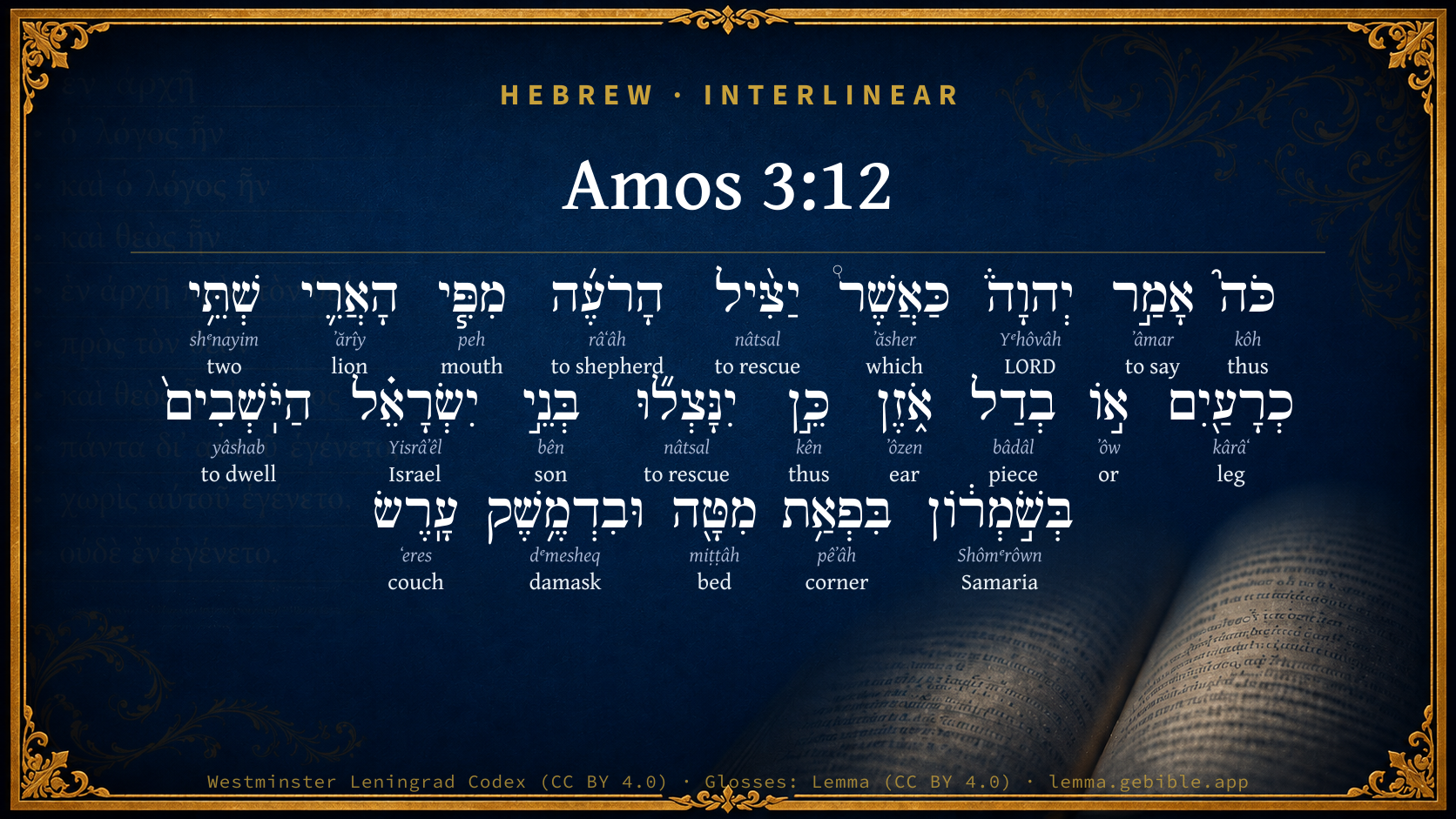
Amos 3:12

Hebrew (Westminster Leningrad Codex) Amos 3:12 appears in the Hebrew Old Testament. The text above is from the Westminster Leningrad Codex. Each word links to its Strong’s number, a concise gloss, and parsing drawn from the Open Scriptures Hebrew Bible morphology. Click any word for its full Brown-Driver-Briggs (BDB) entry.
Download image
Cite this verse

Amos 3:12 (World English Bible). Public Domain. Lemma interlinear Bible study tool, https://lemma.gebible.app/v/amos/3/12.

Show BibTeX & RIS
BibTeX
RIS
English Translation
Thus says Yahweh: "As the shepherd rescues out of the mouth of the lion two legs, Or a piece of an ear, So shall the children of Israel be rescued who sit in Samaria on the corner of a couch, And on the silken cushions of a bed."
World English Bible · Public Domain
Highlights
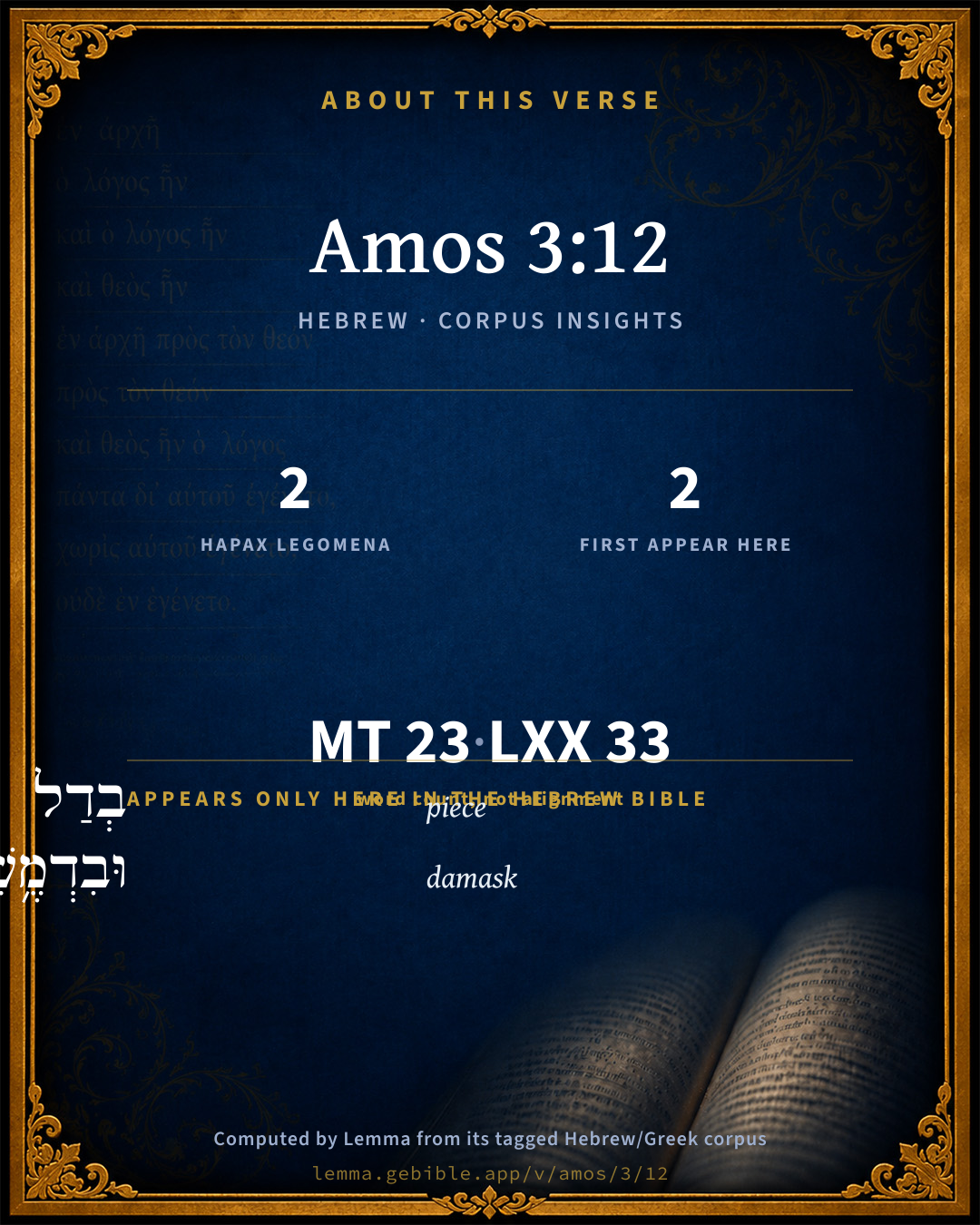
  • 2 hapax legomena — only here in the Hebrew Bible
  • 2 first appearances in the Hebrew Bible
Full analysis ↓
Download a study sheet

One document with this verse’s original text, its word-by-word gloss line, the meaning frame, cross-references with their text, attributed commentary, and full source and license credits — printable, and it pastes into notes with its structure intact.

This verse Autodidact and up

Study sheet (.html) Plain text (.txt)

A passage Seminary Student

Up to 50 verses in one chapter. A passage sheet keeps up to 6 commentary sources and 12 cross-references per verse, in the order this page ranks them, and says so on the sheet whenever that leaves anything out. Ask for a single verse and you get the Autodidact verse sheet above.

Everything on this page stays free to read, with no account — the sheet is a download of what is already on screen, not access to it.

Want to remove ads? Support Godless Engineer
Compare translations 3

The same verse in 3 English versions, stacked beneath the original-language interlinear above. Click any original word for its lexicon entry.

Each is an independent rendering of the whole verse — the interlinear is not word-aligned to these translations.

Highlighted words mark where these versions differ — a whole-verse word diff, not a word-by-word alignment.

  • World English Bible Public Domain
    Thus says Yahweh: "As the shepherd rescues out of the mouth of the lion two legs, Or a piece of an ear, So shall the children of Israel be rescued who sit in Samaria on the corner of a couch, And on the silken cushions of a bed."
  • King James Version Public Domain
    Thus saith the LORD; As the shepherd taketh out of the mouth of the lion two legs, or a piece of an ear; so shall the children of Israel be taken out that dwell in Samaria in the corner of a bed, and in Damascus in a couch.
  • unfoldingWord Literal Text CC BY-SA 4.0
    This is what Yahweh says: “As the shepherd rescues out of the mouth of the lion two legs only, or a piece of an ear; so will the sons of Israel who live in Samaria be rescued with only the corner of a couch or a piece of a bed.”

unfoldingWord Literal Text — © unfoldingWord, licensed CC BY-SA 4.0. Word-aligned USFM3 via Door43 (git.door43.org/unfoldingWord/en_ult).

Versions to compare (up to 4)

3 of 4 selected

Show all 18 translations

Every available English version of this verse, each an independent rendering of the whole verse.

  • World English Bible Public Domain
    Thus says Yahweh: "As the shepherd rescues out of the mouth of the lion two legs, Or a piece of an ear, So shall the children of Israel be rescued who sit in Samaria on the corner of a couch, And on the silken cushions of a bed."
  • Berean Standard Bible Public Domain
    This is what the LORD says: “As the shepherd snatches from the mouth of the lion two legs or a piece of an ear, so the Israelites dwelling in Samaria will be rescued having just the corner of a bed or the cushion of a couch.
  • Majority Standard Bible Public Domain
    This is what the LORD says: “As the shepherd snatches from the mouth of the lion two legs or a piece of an ear, so the Israelites dwelling in Samaria will be rescued having just the corner of a bed or the cushion of a couch.
  • King James Version Public Domain
    Thus saith the LORD; As the shepherd taketh out of the mouth of the lion two legs, or a piece of an ear; so shall the children of Israel be taken out that dwell in Samaria in the corner of a bed, and in Damascus in a couch.
  • American Standard Version (1901) Public Domain
    Thus saith Jehovah: As the shepherd rescueth out of the mouth of the lion two legs, or a piece of an ear, so shall the children of Israel be rescued that sit in Samaria in the corner of a couch, and on the silken cushions of a bed.
  • Revised Version (1885) Public Domain
    Thus saith the LORD: As the shepherd rescueth out of the mouth of the lion two legs, or a piece of an ear; so shall the children of Israel be rescued that sit in Samaria in the corner of a couch, and on the silken cushions of a bed.
  • Geneva Bible (1599) Public Domain
    Thus saieth the Lord, As the shephearde taketh out of the mouth of the lyon two legges, or a piece of an eare: so shall the children of Israel be taken out that dwell in Samaria in the corner of a bed, and in Damascus, as in a couche.
  • Douay-Rheims (1899) Public Domain
    Thus saith the Lord: As if a shepherd should get out of the lion's mouth two legs, or the tip of the ear: so shall the children of Israel be taken out that dwell in Samaria, in a piece of a bed, and in the couch of Damascus.
  • Young's Literal Translation Public Domain
    Thus said Jehovah: As the shepherd delivereth from the lion's mouth Two legs, or a piece of an ear, So delivered are the sons of Israel, Who are sitting in Samaria on the corner of a bed, And in Damascus `on that of' a couch.
  • Literal Standard Version CC BY-SA 4.0
    Thus said YHWH: “As the shepherd delivers from the lion’s mouth || Two legs, or a piece of an ear, || So the sons of Israel are delivered, || Who are sitting in Samaria on the corner of a bed, || And in Damascus [on that of] a couch.
  • Unlocked Literal Bible CC BY-SA 4.0
    This is what Yahweh says: “As the shepherd rescues out of the mouth of the lion two legs only, or a piece of an ear; so will the people of Israel who live in Samaria be rescued; they will be left with only the corner of a couch or a piece of a bed.”
  • unfoldingWord Literal Text CC BY-SA 4.0
    This is what Yahweh says: “As the shepherd rescues out of the mouth of the lion two legs only, or a piece of an ear; so will the sons of Israel who live in Samaria be rescued with only the corner of a couch or a piece of a bed.”
  • Darby Bible Public Domain
    Thus saith Jehovah: Like as the shepherd rescueth out of the jaw of the lion two legs, or a piece of an ear; so shall the children of Israel be rescued that sit in Samaria in the corner of a couch, and upon the damask of a bed.
  • World Messianic Bible Public Domain
    The LORD says: “As the shepherd rescues out of the mouth of the lion two legs, or a piece of an ear, so shall the children of Israel be rescued who sit in Samaria on the corner of a couch, and on the silken cushions of a bed.”
  • Webster's Bible Public Domain
    Thus saith the LORD: As the shepherd taketh out of the mouth of the lion two legs, or a piece of an ear; so shall the children of Israel be taken out that dwell in Samaria in the corner of a bed, and in Damascus in a couch.
  • Free Bible Version CC BY-SA 4.0
    This is what the Lord says: Just as a shepherd tries to rescue a sheep from a lion's mouth, but only saves a couple of legs or a piece of an ear, so it will be for the people of Israel living in Samaria—all that will be “saved” will be the corner of a couch and a piece of a leg from a bed.
  • Bible in Basic English Public Domain
    These are the words of the Lord: As the keeper of sheep takes out of the mouth of the lion two legs or part of an ear; so will the children of Israel be made safe, who are resting in Samaria on seats of honour or on the silk cushions of a bed.
  • JPS Tanakh (1917) Public Domain
    Thus saith the LORD: As the shepherd rescueth out of the mouth of the lion two legs, or a piece of an ear, so shall the children of Israel that dwell in Samaria escape with the corner of a couch, and the leg of a bed.

Literal Standard Version (2020), Covenant Press — licensed CC BY-SA 4.0. Text via the HelloAO Bible API (eBible.org). Unlocked Literal Bible (unfoldingWord) — licensed CC BY-SA 4.0. Text via the HelloAO Bible API (eBible.org). unfoldingWord Literal Text — © unfoldingWord, licensed CC BY-SA 4.0. Word-aligned USFM3 via Door43 (git.door43.org/unfoldingWord/en_ult). Free Bible Version, Dr. Jonathan Gallagher — licensed CC BY-SA 4.0. Text via the HelloAO Bible API (eBible.org).

Word by word

More ways to search: Search by grammar → Find every occurrence → Compare this word →

Practice this passage: Drill this verse → Learn its vocabulary →

בְדַל
bâdâl
H915
“piece of”
Noun, Common, Masculine, Singular, Construct
Part of Speech
Noun
Type
Common
Gender
Masculine
Number
Singular
State
Construct
Full BDB Definition

Origin: from H914

TWOT: 203a

a piece, severed piece, a piece (of an ear)
  1. כֹּה֮ kôh H3541 “thus” Adverb
  2. אָמַ֣ר ʼâmar H559 “to say” Verb, Qal, Perfect, 3rd Person, Masculine, Singular
  3. יְהוָה֒ Yᵉhôvâh H3068 “LORD” Noun, Proper
  4. כַּאֲשֶׁר֩ ʼăsher H834 “like/as · which” Preposition + Particle, Relative
  5. יַצִּ֨יל nâtsal H5337 “to rescue” Verb, Hiphil, Imperfect, 3rd Person, Masculine, Singular
  6. הָרֹעֶ֜ה râʻâh H7462 “the · shepherding” Particle, Definite Article + Verb, Qal, Participle Active, Masculine, Singular, Absolute
  7. מִפִּ֧י peh H6310 “from · mouth of” Preposition + Noun, Common, Masculine, Singular, Construct
  8. הָאֲרִ֛י ʼărîy H738 “the · lion” Particle, Definite Article + Noun, Common, Masculine, Singular, Absolute
  9. שְׁתֵּ֥י shᵉnayim H8147 “two” Adjective, Cardinal number, Feminine, Dual, Construct
  10. כְרָעַ֖יִם kârâʻ H3767 “legs” Noun, Common, Both, Dual, Absolute
  11. א֣וֹ ʼôw H176 “or” Conjunction
  12. אֹ֑זֶן ʼôzen H241 “ear” Noun, Common, Feminine, Singular, Absolute
  13. כֵּ֣ן kên H3651 “thus” Particle, Demonstrative
  14. יִנָּצְל֞וּ nâtsal H5337 “to rescue” Verb, Niphal, Imperfect, 3rd Person, Masculine, Plural
  15. בְּנֵ֣י bên H1121 “sons of” Noun, Common, Masculine, Plural, Construct
  16. יִשְׂרָאֵ֗ל Yisrâʼêl H3478 “Israel” Noun, Proper
  17. הַיֹּֽשְׁבִים֙ yâshab H3427 “the · dwelling” Particle, Definite Article + Verb, Qal, Participle Active, Masculine, Plural, Absolute
  18. בְּשֹׁ֣מְר֔וֹן Shômᵉrôwn H8111 “in/at · Samaria” Preposition + Noun, Proper
  19. בִּפְאַ֥ת pêʼâh H6285 “in/at · corner of” Preposition + Noun, Common, Feminine, Singular, Construct
  20. מִטָּ֖ה miṭṭâh H4296 “bed” Noun, Common, Feminine, Singular, Absolute
  21. וּבִדְמֶ֥שֶׁק dᵉmesheq H1833 “and · in/at · damask” Conjunction + Preposition + Noun, Proper
  22. עָֽרֶשׂ ʻeres H6210 “couch” Noun, Common, Feminine, Singular, Absolute

About this verse

These counts appear in no published source. They are computed here, from the morphology-tagged text and Lemma’s own curated glosses. What Lemma adds →

23
words
22
distinct lemmas
Prophets
section

Notable vocabulary

2 hapax legomena — words that appear only here in the entire Hebrew Bible:

  • בְדַל piece H915
  • וּבִדְמֶ֥שֶׁק damask H1833

First appearance in Scripture

These words make their first canonical appearance in the Hebrew Bible here:

  • בְדַל piece H915
  • וּבִדְמֶ֥שֶׁק damask H1833

Shared distinctive vocabulary

כְרָעַ֖יִם leg H3767 occurs in 9 verses of the Hebrew Bible. Also found in:

Grammatical profile

  • 5 verbs
  • 13 nouns
  • 1 adjective
  • 1 conjunction
  • 1 adverb
  • 2 particles

Verb forms

  • אָמַ֣ר Qal · Perfect
  • יַצִּ֨יל Hiphil · Imperfect
  • הָרֹעֶ֜ה Qal · Participle Active
  • יִנָּצְל֞וּ Niphal · Imperfect
  • הַיֹּֽשְׁבִים֙ Qal · Participle Active

Repetition

A word recurs within this verse — often emphatic in Hebrew:

  • יַצִּ֨יל to rescue H5337 ×2

Hebrew & Septuagint length

In English translation the verse runs 48 words from the Hebrew and 46 from the Septuagint (LXX English) — closely comparable.

A rough comparison of the two English renderings, which tokenize alike — not a word-level alignment.

Word counts can differ between the Hebrew and the Greek without any difference in meaning — e.g. the Hebrew direct-object marker אֵת has no separate Greek word, and Greek often adds the article ὁ.

In the original languages it is 23 Hebrew tokens and 33 Greek tokens — but the two are counted differently (Hebrew bundles its prefixes and suffixes into one token; the Greek is in lemma form), so that isn’t a like-for-like length.

Cross-references

11

Topical passages linked to Amos 3:12 in the Treasury of Scripture Knowledge — connected by theme and wording, ordered by reader-vote popularity; previews shown in the World English Bible.

  • 1 Samuel 17:34–37 David said to Saul, Your servant was keeping his father's sheep; and when there came a lion, or a bear, and took a lamb out of the flock,
  • Romans 11:4–5 But how does God answer him? "I have reserved for myself seven thousand men, who have not bowed the knee to Baal."
  • Isaiah 31:4 For thus says Yahweh to me, As the lion and the young lion growling over his prey, if a multitude of shepherds are called forth against him, will not be dismayed at their voice, nor abase himself for the noise of them: so will Yahweh of Hosts come down to fight on Mount Zion, and on the hill of it.
  • 1 Kings 20:30 But the rest fled to Aphek, into the city; and the wall fell on twenty-seven thousand men who were left. Ben Hadad fled, and came into the city, into an inner chamber.
  • 1 Kings 20:34 [Ben Hadad] said to him, The cities which my father took from your father I will restore; and you shall make streets for you in Damascus, as my father made in Samaria. I, [said Ahab], will let you go with this covenant. So he made a covenant with him, and let him go.
  • 1 Kings 22:25 Micaiah said, Behold, you shall see on that day, when you shall go into an inner chamber to hide yourself.
  • 2 Kings 16:9 The king of Assyria listened to him; and the king of Assyria went up against Damascus, and took it, and carried [the people of] it captive to Kir, and killed Rezin.
  • Amos 9:2–3 Though they dig into Sheol, there my hand will take them; and though they climb up to heaven, there I will bring them down.
  • Isaiah 8:4 For before the child shall have knowledge to cry, My father, and, My mother, the riches of Damascus and the spoil of Samaria shall be carried away before the king of Assyria.
  • Isaiah 17:1–4 The burden of Damascus. Behold, Damascus is taken away from being a city, and it shall be a ruinous heap.
  • Amos 6:4 Who lie on beds of ivory, And stretch themselves on their couches, And eat the lambs out of the flock, And the calves out of the midst of the stall;

Cross-references courtesy of OpenBible.info (CC BY 4.0).

Hebrew and Greek witnesses Masoretic Hebrew ↔ Greek Septuagint

The same verse in the two great witnesses to the Old Testament, shown verse-for-verse.

These are two independent witnesses, not word-aligned to each other, and the Septuagint is shown in lemma (dictionary) form.

Hebrew Amos 3:12 Masoretic · Westminster Leningrad Codex

כֹּה֮ אָמַ֣ר יְהוָה֒ כַּאֲשֶׁר֩ יַצִּ֨יל הָרֹעֶ֜ה מִפִּ֧י הָאֲרִ֛י שְׁתֵּ֥י כְרָעַ֖יִם א֣וֹ בְדַל אֹ֑זֶן כֵּ֣ן יִנָּצְל֞וּ בְּנֵ֣י יִשְׂרָאֵ֗ל הַיֹּֽשְׁבִים֙ בְּשֹׁ֣מְר֔וֹן בִּפְאַ֥ת מִטָּ֖ה וּבִדְמֶ֥שֶׁק עָֽרֶשׂ

Thus says Yahweh: "As the shepherd rescues out of the mouth of the lion two legs, Or a piece of an ear, So shall the children of Israel be rescued who sit in Samaria on the corner of a couch, And on the silken cushions of a bed."

World English Bible · Public Domain

Greek LXX Amos 3:12 Septuagint · lemma form

ὅδε λέγω κύριος ὅς τρόπος ὅταν ἐκσπάω ὁ ποιμήν ἐκ στόμα ὁ λέων δύο σκέλος ἤ λοβός ὠτίον οὕτως ἐκσπάω ὁ υἱός ἰσραήλ ὁ καταοἰκέω ἐν σαμαρεία κατέναντι φυλή καί ἐν δαμασκός ἱερεύς

Thus says the Lord; As when a shepherd rescues from the mouth of a lion two legs or a piece of an ear, so shall be drawn forth the children of Israel who dwell in Samaria in the presence of a foreign tribe, and in Damascus.

LXX2012 (modern English Septuagint) · Public Domain

On this verse, Jamieson, Fausset & Brown discusses the Septuagint’s reading. Read the note in Commentary ↓

Hebrew: Westminster Leningrad Codex (CC BY 4.0). Greek: Septuagint (public domain); English from LXX2012 (modern English Septuagint) (Public Domain). How the Septuagint differs from the Hebrew →

Targum (Aramaic paraphrase)

1

The Targum is the ancient Jewish Aramaic paraphrase of the Hebrew Scriptures — an interpretive translation, not the Hebrew text itself. Onkelos (literal) and Pseudo-Jonathan (expansive) render the Torah, and Jonathan the Prophets. Coverage is partial: where no permissively-licensed English translation exists for a verse, only the Aramaic is shown. This is verse-level text, not a word-by-word alignment to the Hebrew.

  1. Targum Jonathan Prophets (Joshua–Malachi)
    כִּדְנַן אֲמַר יְיָ כְּמָא דִמְשֵׁיזֵיב רַעֲיָא מִפּוּמָא דְאַרְיָא תַּרְתֵּין כַּרְעִין אוֹ חַסְחוֹס דְאוֹדָן כֵּן יִשְׁתֵּיזְבוּן בְּנֵי יִשְׂרָאֵל דְיָתְבִין בְּשֹׁמְרוֹן בִּתְקוֹף שׁוּלְטַן וְעַל דַמֶשֶׂק רְחִיצִין:

    (no public-domain English translation for this verse)

    Targum Jonathan — Aramaic: “Mikraot Gedolot” (public domain). English: “Sefaria Community Translation” (CC0 1.0 (public-domain dedication)); “London "Chaldee Paraphrase," 1871” (public domain). Text via Sefaria.

Commentary

Notes on Amos 3:12 from classic Christian and Jewish commentators (each source and its license shown beneath its notes). The classic Christian expositions comment on the surrounding passage and are grouped to its opening verse, so a note may address several verses; the Jewish commentaries on the Tanakh (Rashi and others) are per-verse, so they appear only where the commentator wrote on this verse.

Lemma curates 59 commentaries, every one of them public domain or Creative Commons licensed, each selected and text-cleaned for this edition rather than reprinted as found. About our sources →

Trapp's Complete Commentary

John Trapp

Amo 3:12 Thus saith the LORD; As the shepherd taketh out of the mouth of the lion two legs, or a piece of an ear; so shall the children of Israel be taken out that dwell in Samaria in the corner of a bed, and in Damascus [in] a couch.

Ver. 12. As the shepherd taketh out of the mouth of the lion] By a country comparison (as before often) the prophet sets forth the fewness of such as shall escape the enemy’s hands. It is but a little that a shepherd dare pull out of the jaws of a lion. 1Sa 17:35. Few Davids or Lysimachuses, that dare look such fierce creatures in the face. Something a shepherd in this case may adventure to do, that he may not be made to stand to the loss, Exo 22:13 Gen 31:39. But it is not much; neither are they many that shall make escape, and those few shall be of the poorer sort too, that have scarcely a corner of a bed to lie on ( quibus non est lectus integer, Tarnov.): or such as are sick in bed and not cared for by the enemy, not counted worth the killing. Or such as are in good health, but glad to hide themselves for fear of the enemy under any bed or bench hole, as is usual in the sack of a city.

And in Damascus in a couch] Or in the corner of a couch. Now Samaria and Damascus are joined together, because they were both desolated about the same time, by the same enemy, and for the same cause, viz. their invading Judaea in a hostile manner, 2Ki 16:7; 2Ki 16:9 Isa 7:4; Isa 8:4; Isa 17:3.

John Trapp, A Commentary or Exposition upon All the Books of the Old and New Testament (1647–1656) — public domain. Text from a community e-Sword module.

The Biblical Illustrator

Joseph S. Exell

Amo_3:12

The shepherd taketh out of the mouth of the lion two legs or a piece of an ear.

The destroyer and the rescuer

I. There is a destroying power at work in the world.

1. Variously represented. Here, the lion devouring the sheep. In New Testament, the roaring, etc.; in Old Testament, the serpent beguiling, etc.; in New Testament, that old serpent, etc.

2. His doings are described. Paradise ruined; Abel murdered; the old world destroyed; Sodom and Gomorrah burned; mankind desolated by pestilence, plague, war, famine, physical tortures, burning anxieties--souls lost.

3. He possesses mighty power. Called prince of the power of the air; ruler of the darkness, etc. Unites an angels strength with a fiends malignity. Has great power, but not all power.

4. Possessed of supreme subtlety. An angel of light, a lurking beast, a hidden serpent. Marvellously skilful in adapting temptation and detecting opportunities. Persuades those in most danger that they are most safe.

II. There is a rescuing power at work in the world. He is possessed of all power, and of all wisdom.

III. God is ready to receive even the fragments. Nothing was left but two legs and a piece of an ear, vet the shepherd rescues and accepts these.

1. Total destruction was very near:

2. None need despair.

3. None may presume.

IV. That which is rescued is for active service. Two legs --motion, activity. Piece of an ear. Faith cometh by hearing, etc. God speaks to the heart through the ear. (R. Berry.)

A miserable remnant

Here we have an illustration borrowed from scenes with which Amos was familiar. A part of the shepherds office in those regions consists in defending the flock against the attacks of wild beasts, as well as the depredations of robbers. As a check against carelessness about the loss of the sheep in either of these ways, it was a part of the shepherds duty to rescue what he could from the beast that had torn a sheep. Such remains would prove the truth of his account of the matter; and show, perhaps, on some occasions, that he had not refused to attack the beast which had seized the prey. Jacob could say, in respect of his care of Labans sheep, that he had not availed himself of any immunity which such a custom conferred on the shepherd. That which was torn of beasts I brought not unto thee; I bare the loss of it; of my hand didst thou require it. And his wicked sons were but speaking a language in common use, when they showed their father the bloody garment of Joseph. Layard has the following passage in his book on Nineveh. Violent altercations arose on the subject of missing beasts. Heavy responsibilities which the Effendi did not seem to admit, were thrown upon the wolves. Some time elapsed before these questions were satisfactorily settled; ears having been produced, oaths taken, and witnesses called, with the assistance of wolves and the rot, the diminution in the flock was fully accounted for. The prophets language conveys the meaning, that after Gods righteous vengeance had wrought out its purposes amongst the sinful people of Israel, their condition would be that of a miserable remnant, without any of the glory which once belonged to them as a nation: with just enough evidence left to show that they had been a part of it, and with marks upon that remnant which would show how they had been exposed to violence and spoil. (Vincent W. Ryan, M. A.)

The Biblical Illustrator, edited by Joseph S. Exell (c. 1880s–1900s) — public domain. Text from a community e-Sword module.

Joseph Benson's Commentary

Amo 3:12. As the shepherd taketh out of the mouth of the lion two legs, &c. — When a lion hath for some time ravaged the flock, but is at last frighted away by the noise of the shepherds and their dogs, or by darts and other offensive weapons thrown at him, then all that, in such a case, the shepherd can hope to save will be but some poor remains of the prey that the lion hath seized. And thus shall it be at the taking of Samaria: only a small remainder of the inhabitants shall escape the search of their enemies, though they try to hide themselves in their most retired apartments. In the corner of a bed — In some dark corner behind a bed; and in Damascus — Supposing some of them have fled thither; in a couch — Some few of the poor may escape when the enemy finds them sick upon their couches. But the marginal reading, on the bed’s feet, is thought by some to give a better sense: or, as the word rendered Damascus also signifies a corner, the clause may be properly rendered, In the side or corner of a couch, an interpretation approved by Aben Ezra. See Buxtorf.

Joseph Benson's Commentary on the Old and New Testaments (1811–1818) — public domain. Text from a community e-Sword module.

Tyndale Open Study Notes

Tyndale Open Resources

3:12 A shepherd who tries to rescue: The people of both Israel and Judah believed that, because of their chosen status, God would intervene to rescue them and never let them perish. The prophet’s words are ironic: Their rescue would be like a shepherd who arrives too late to save the sheep, and who can pull only two legs or a piece of an ear from the mouth of the lion. • So it will be . . . reclining on couches: Some have interpreted this statement to mean that only the fabric of a few couches would survive the Assyrian siege of Samaria. Accordingly, the last two lines of this verse could be translated So it will be when the Israelites in Samaria are rescued / with only a broken bed and a tattered pillow.

Tyndale Open Study Notes — © Tyndale Open Resources, licensed CC BY-SA 4.0. Text via the HelloAO Bible API.

Geneva Bible (1599)

Geneva Bible translators

Where they thought to have had a sure hold, and to have been in safety.

When the lion hath satiate his hunger, the shepherd findeth a leg or a rip of an ear, to show that the sheep have been worried.

Geneva Bible (1599) marginal notes — public domain. Text via Bolls.life.

Jamieson, Fausset & Brown

Robert Jamieson, A. R. Fausset & David Brown

shepherd--a pastoral image, appropriately used by Amos, a shepherd himself.

piece of . . . ear--brought by the shepherd to the owner of the sheep, so as not to have to pay for the loss (Gen 31:39; Exo 22:13). So if aught of Israel escapes, it shall be a miracle of God's goodness. It shall be but a scanty remnant. There is a kind of goat in the East the ears of which are a foot long, and proportionally broad. Perhaps the reference is to this. Compare on the image Sa1 17:34-35; Ti2 4:17.

that dwell in Samaria in the corner of a bed--that is, that live luxuriously in Samaria (compare Amo 6:1, Amo 6:4). "A bed" means here the Oriental divan, a raised part of the room covered with cushions.

in Damascus in a couch--Jeroboam II had lately restored Damascus to Israel (Kg2 14:25, Kg2 14:28). So the Israelites are represented as not merely in "the corner of a bed," as in Samaria, but "in a (whole) couch," at Damascus, living in luxurious ease. Of these, now so luxurious, soon but a remnant shall be left by the foe. The destruction of Damascus and that of Samaria shall be conjoined; as here their luxurious lives, and subsequently under Pekah and Rezin their inroads on Judah, were combined (Isa 7:1-8; Isa 8:4, Isa 8:9; Isa 17:3). The parallelism of "Samaria" to "Damascus," and the Septuagint favor English Version rather than GESENIUS: "on a damask couch." The Hebrew pointing, though generally expressing damask, may express the city "Damascus"; and many manuscripts point it so. Compare for Israel's overthrow, Kg2 17:5-6; Kg2 18:9-12.

Jamieson, Fausset & Brown — Commentary Critical and Explanatory on the Whole Bible (1871) — public domain (CC PDM 1.0). Text via the HelloAO Bible API.

Adam Clarke's Commentary

Verse 12. As the shepherd taketh out of the mouth of the lion] Scarcely any of you shall escape; and those that do shall do so with extreme difficulty, just as a shepherd, of a whole sheep carried away by a lion, can recover no more than two of its legs, or a piece of its ear, just enough to prove by the marks on those parts, that they belonged to a sheep which was his own.

So shall the children of Israel be taken out] Those of them that escape these judgments shall escape with as great difficulty, and be of as little worth, as the two legs and piece of an ear that shall be snatched out of the lion's mouth. We know that when the Babylonians carried away the people into Chaldea they left behind only a few, and those the refuse of the land.

In the corner of a bed] As the corner is the most honourable place in the East, and a couch in the corner of a room is the place of the greatest distinction; so the words in the text may mean, that even the metropolitan cities, which are in the corner - in the most honourable place - of the land, whether Samaria in Israel, or Damascus in Syria, shall not escape these judgments; and if any of the distinguished persons who dwell in them escape, it must be with as great difficulty as the fragments above-mentioned have been recovered from a lion. The passage is obscure. Mr. Harmer has taken great pains to illustrate it; but I fear with but little success. A general sense is all we can arrive at.

Adam Clarke's Commentary on the Bible (1810–1826) — public domain. Text from a community e-Sword/MySword module.

John Calvin's Commentaries

In the next verse he leaves some hope, though this is not avowedly done. For when he says that some would be saved, as when a shepherd snatches from the jaws of a lion the ear of a sheep or two legs, it is not the Prophet’s design to mitigate the severe judgment of which he had before spoken; but shows, on the contrary, that when any should be saved, it would not be because the people would defend themselves, or were able to resist; but that it would be as when a trembling shepherd snatches some small portion of a spoil from the lion’s mouth. We must bear in mind what I have just said of the proud confidence of the people; for the Israelites thought that they were safe enough from danger; and therefore despised all threatenings. But what does Amos say? “Think not,” he says, “that there will be any defense for you, for your enemies will be like lions, and there will be no more strength in you to resist them than in sheep when not only wolves but lions, seize them and take them as their prey.” When any thing is then saved, it is as it were by a miracle; the shepherd may perhaps take a part of the ear or two legs from the lion’s mouth when he is satisfied. The shepherd dares not to contend with the lion; he always runs away from him, but the lion will have his prey and devour it at his pleasure; when he leaves a part of the ear or two legs, the shepherd will then seize on them, and say, “See, how many sheep have been devoured by lions:” and these will be the proof’s of his loss. So now the Prophet says, “The Lord will expose you as a prey to your enemies, and their rapacity will not be less dreaded by you than that of a lion: in vain then ye think yourselves defended by your forces; for what is a sheep to a lion? But if any part of you should remain, it will be like an ear or a leg: and still more, — as when a lion devours a sheep, and leaves nothing after having taken his prey until he is satisfied, so shall it happen to you”.

They are then mistaken who think that the preceding commination is here designedly mitigated; for the Prophet does not do this, but continues the same subject, and shows that the whole people would become a prey, that their enemies would be like lions, and that they would have no strength to resist. Some hope, I indeed allow, is here given to the people; for, as it has been before seen, God intended that there should ever be some remnant as a seed among that chosen people. This, I admit, is true: but we must yet regard what the Prophet treats of; and what he had in view. He then did not intend here expressly to console the Israelites; though incidentally he says, that some would remain, yet his object was to show that the whole kingdom was now given up as a prey to lions, and that nothing would be saved except a very small portion, as when a shepherd carries away an ear when the wolves and lions had been satiated. It follows —

John Calvin's Commentaries (1540-1563) — public domain. Text from the Calvin Translation Society English edition (1840s-50s) via the Christian Classics Ethereal Library (ccel.org). Calvin's coverage is partial (roughly two-thirds of the Bible); uncommented books and verses are honest gaps, never fabricated. The 19th-century editor's footnotes and remarks are omitted so the notes are faithfully Calvin's own voice.

Ellicott's Commentary for English Readers

(12) Taketh out . . . taken out.—Should be (as in margin) delivereth . . . be delivered. The agricultural image, used by Amos, is very impressive. The shanks and pieces of the ear, worthless portions, saved from the lion’s jaws, represent the remnants of Samaria’s population that shall escape.

In Damascus in a couch.—Some would render “in Damascus on that of (i.e., corner of) a couch,” Damascus corresponding to Samaria in the parallel clause. But this construction is very questionable, and it would be much simpler and safer to adopt the reading of most Hebrew texts, and render on a couch’s damask (so Gesenius and Ewald), referring to the silken (?) or white woollen fabric for which Damascus, even in that early age, was famous. The relations between Syria and Israel at this moment were intimate. The meaning is that even the noblest and wealthiest will be regarded, if saved, as worthless salvage.

A Bible Commentary for English Readers, edited by Charles John Ellicott (1878–1897) — public domain. Text from a community e-Sword module.

The Cambridge Bible for Schools and Colleges

gen. ed. J. J. S. Perowne

12. So sudden will be the surprise, so overwhelming the numbers of the foe, that of the luxurious nobles of Samaria only an insignificant remnant will escape with their bare lives: all the rest will be swept away by the foe.

As the shepherd taketh &c.] better, rescueth (R.V.). A shepherd would bring such remains of a missing animal to his master, as evidence that it had really been torn by beasts (Exo_22:13; cf. Gen_31:39). The comparison, which is suggested no doubt by the experiences of Amos’ shepherd life, illustrates forcibly both the scant numbers and the shattered condition of the survivors, besides hinting at the formidable powers of the assailant.

be taken out] be rescued.

that sit in Samaria in the corner of a divan] The grandees of Samaria are represented as sitting luxuriously in the cushioned corners of their divans. In Assyria the king reclined, or sat up, on a couch beside the table, leaning his weight upon his left elbow, and having his right hand free and disposable (see the representation in Rawlinson’s Anc. Monarchies, ed. 4, i. 493). In the modern oriental houses of the wealthy (Van Lennep, Bible Customs in Bible Lands, p. 460, referred to by Mitchell), ‘a divan,’ or cushioned seat, about a yard in width, extends along three sides of the principal room, while a row of richly woven stuffed cushions lines the wall behind, and forms a support for the back: the seat of honour is the inmost corner of the divan, opposite the door. In some such luxurious state the magnates of Samaria sat in Amos’s day. The framework of the seat was often inlaid with ivory (Amo_6:4).

and in Damascus in a couch] The Hebrew text can hardly be right; nor, as pointed, is the Heb. word here found (d’mésheḳ) identical with that for Damascus (damméseḳ). Most moderns render and on the damask (whence R.V. silken cushions) of a couch. This rendering yields an excellent sense; but it cannot be regarded as certain: for (1) it is doubtful whether, in the time of Amos, Damascus was yet celebrated for the manufacture which in modern European languages is called after it: (2) in Arabic also, the name of the material (dimaḳs), which has been appealed to in support of this explanation, differs from that of the city (Dimaḳsh); hence it is very questionable whether it really derives its name from it. It is considered by Fränkel, Aram. Fremdwörter im Arabischen, p. 40, to be varied by metathesis from midaḳs, a form which also occurs, and which in its turn is derived from the Syr. mîtaḳs, which is the Greek μέταξα. Whatever uncertainty there may be about the word, it must, however, either be, or be the corrupt representative of, a term either synonymous or parallel with corner, in the preceding clause.

The Cambridge Bible for Schools and Colleges (gen. ed. J. J. S. Perowne; Cambridge University Press, 1878–1918) — public domain. Text from a community e-Sword module.

John Gill's Exposition

Hear ye, and testify in the house of Jacob,.... The prophets and priests, whose business it was to speak to the people from the Lord, and declare his will to them, and to admonish them of their sin and danger, are here called upon to hearken to what the Lord was about to say, and to testify and publish it to the people of Israel, the posterity of Jacob, though sadly degenerated:

saith the Lord God, the God of hosts; the eternal Jehovah, the Being of beings, the God of the whole earth, the God of the armies above and below; and, being so great, ought to be heard with the greatest attention and reverence in what follows.

John Gill's Exposition of the Whole Bible (1746–1763) — public domain (CC PDM 1.0). Text via the HelloAO Bible API.

Albert Barnes' Notes on the Bible

As the shepherd taketh - (Rather, rescueth) out of the mouth of the lion two legs (Properly, the shank, the lower part of the leg below the knee, which in animals is dry, and bone only and worthless) “or apiece” (the tip) “of an ear, so” (that is, so few and weak, so bared and spoiled, a mere remnant,) “shall the children of Israel be taken out” (rather, “rescued”) “that” now “dwell” at ease “in Samaria in the corner of a bed, and in Damascus” , in “a couch,” or rather “in Damascus, a couch.” Now, that soft, rounded, oblong, hill of Samaria, was one large luxurious couch, in which its rich and great rested securely, propped and cushioned up on both sides, in, what is still the place of dignity, “the corner of a bed,” or “Divan,” that is, the inner corner where the two sides meet. Damascus also, which Jeroboam had won for Israel, was a canopied couch to them, in which they stayed themselves. It is an image of listless ease and security, like that of these whom the false prophetesses lulled into careless stupidity as to their souls; “sewing pillows to all armholes,” or “wrists” Eze 13:18, whereon to lean in a dull inertness.

In vain! Of all those who then dwelt at ease and in luxury, the Good Shepherd Himself should rescue from “the lion,” (the enemy, in the first instance the Assyrian,) a small remnant, in the sight of the enemy and of man of little account, but precious in the sight of God. The enemy would leave them perhaps, as not worth removing, just as, when the lion has devoured the fat and the strong, the shepherd may recover from him some slight piece of skin or extremity of the bones. Amos then, as well as Joel (see the note at Joe 2:32), preaches that same solemn sentence, so repeated throughout the prophets, “a reimnant” only “shall be saved.” So doubtless it was in the captivity of the ten tribes, as in the rest. So it was in Judah, when certain “of the poor of the land” only were “left behind vinedessers and for farmers” 2Ki 25:12; Jer 52:16. In the Gospel, “not many wise men after the flesh not many mighty, not many noble were called” 1Co 1:26, but “God chose the poor of this world, rich in faith Jam 2:5, and the Good Shepherd rescued from the mouth of the lion those whom man despised, yet who “had ears to hear.”

After the destruction of Jerusalem by the Romans, a poor remnant only escaped. Rup.: “The spirit of prophecy foresaw both captivities, the end whereof was to confirm the faith, not in one place only but in all the earth, and so a slight remnant was “rescued from the mouth of the lion,” that is, from the slaughter of the destroyers, and permitted to live, that through them, as a witness and monument, the justice of God might be known from age to age, and the truth of the Scriptures might be everywhere, borne about by them, still witnessing to Christ the Son of God, who is known by the law and the prophets. Hapness remnants, so “taken out” for the good of others, not their own!” As these remnants of the animal show what it was which the lion destroyed, yet are of no further profit, so are they now a memorial of what they once were, what grace through their sins they have lost.

Rib.: “Many souls will perish because they trust in their own strength, and no more call on God to have mercy on them than if they could rise of themselves and enter the way of salvation without God. They trust in the power of their friends, or the friendship of princes, or the doctrines of philophers, and repose in them as in a couch of Damascus. But Christ, the Good Shepherd, will rescue out of the mouth of “the lion,” who “goeth about seeking, whom he may devour,” what is last and of least esteem in this world, who have anything whereby the Good Shepherd can hold them. The “legs” signify the desire to go to hear the Word of God; the extremity of the ear, that obedience was not wholly lost. For if any begin even in part to obey the word of God which he hath heard, God, of His fatherly mercy, will help him and lead him on to perfect obedience. The legs also denote desire , whereby, as by certain steps, the soul approacheth to God or departeth from Him. Yet if a soul would be saved, desires suffice not; but if to these obedience to the heavenly commands be added, it shall be rescued from the mouth of the lion.”

Albert Barnes' Notes on the Bible (1834–1885) — public domain. Text from a community e-Sword/MySword module.

Haydock's Catholic Bible Commentary

Ear: things of small value. Thus few even of the poor will escape the Assyrians. (Menochius) --- Damascus. Some render "couch side." But there is no proof of this being accurate. Jeroboam II subdued Damascus, and reigned in prosperity. Who would then have thought that Israel should so soon be removed into Media? (Calmet) --- Septuagint, "over-against the tribe of Juda, and in Damascus, priests hear," &c. They probably left hares, (Haydock) "couches," (Aquila) untranslated, and some person has substituted "priests." (St. Jerome) --- Only the miserable (Menochius) or fugitives escape the enemy. (Haydock)

George Leo Haydock (1774–1849), Haydock's Catholic Family Bible and Commentary, 1859 edition — public domain. Excludes Psalms (Douay-Rheims chapter numbering differs from Protestant) and Deuterocanonical books (Catholic canon only).

Matthew Poole's English Annotations

In brief, this verse foretells how few and with what difficulty they shall escape who are not swallowed up of the approaching judgments, and it is elegantly expressed in the following similitude.

As the shepherd taketh out of the mouth; as the shepherd doth hardly rescue a small part of a sheep or lamb, when the lion hath seized and torn it.

The lion; the fiercest, strongest, and boldest creature, not a bear or wolf.

Two legs; which are parts the ravening lion less regardeth and last eateth;

or a piece of an ear, less considerable than the legs.

So shall the children of Israel, some of the children of Israel, or some of the ten tribes, but the poorer, meaner, and more worthless of them,

be taken out that dwell in Samaria; shall escape when Samaria is taken.

In the corner of a bed; lying in some dark corner, and on a piece of a bed, as the poor do in most places.

In Damascus; the chiefest city of Syria, taken by Tiglath-pileser much about the time when he wasted Israel in aid of Ahaz against Rezin and Pekah.

In a couch; some few of the poorer among them also shall escape, pitied by the enemy when he findeth them weakly and sick upon their couch.

Matthew Poole's English Annotations on the Holy Bible (1683–1685) — public domain. Text from a community e-Sword/MySword module.

The Pulpit Commentary

The prophet shows that the chastisement is inevitable, and that only the smallest remnant, the most worthless among the inhabitants, and they with much difficulty, can escape. The illustration from a common incident in a shepherd"s life is very natural in Amos. Taketh; better, rescueth. So below, shall be taken out; shall be rescued. The usual explanation is that a shepherd attacks the lion which has seized one of his sheep, (comp. 1Sa_17:34, etc.) and rescues from it the most worthless parts couple of shank bones or a bit, or tip, of an ear." But as an attack on a lion would be an abnormal act of courage on the part of a shepherd, and the comparison is with things likely and usual, it is probable that the meaning is that the shepherd finds only these poor remnants after the lion has left his prey. So such a poor remnant shall be rescued from the ten tribes of Israel. That dwell in Samaria in the corner of a bed; that sit at ease, lounging in the cosiest corner of the divan, an image of indolent ease and careless security in the face of impending judgment. And in Damascus in a couch; LXX, kai ejn Damaskw: Vulgate, et in Damasci grabato. The Syriac and Jewish Versions agree in considering the word "Damascus" to be a proper name. The other modern rendering takes it to mean the material which we call "damask," or something similar. Hence our Revised Version gives, "on the silken cushions of a bed;" and others, "on the damask of a couch." Dr. Pusey retains the old rendering, on the grounds that there is no evidence to prove that the manufactures for which Damascus was celebrated in after time existed at this period, its exports being then wine and white wool, (Eze_27:18) and that the Arabic word dimakso (which critics have cited as connected with the term "damask") has nothing to do with Damascus, and meant raw, not manufactured, "silk." He translates, "in Damascus, a couch," and explains this to mean that Damascus, which Jeroboam II had won for Israel, (2Ki_14:28) "was a canopied couch to them, in which they stayed themselves." This agrees with the ancient Jewish interpretation, which explains the clause to mean that the Israelites would some day depend for help on the Syrians represented by Damascus A third exposition, favoured by the Latin Vulgate, makes the words to mean, "on a couch of Damascus;" i.e. a Syrian couch of a costly and luxurious nature. This comes to the same as the modern rendering given, above and seems to be the easiest explanation of the expression. The difficulty depends chiefly on the punctuation of the word or them may be some corruption in the text. What the LXX meant by their rendering is Problematical,katenanti thv fulhv kai ejn Damaskw, "The children of Israel who dwell in Samaria in the presence of the tribe and in Damascus."

The Pulpit Commentary (1880–1919), ed. H.D.M. Spence-Jones & Joseph S. Exell — public domain. Text from a community e-Sword module.

John Wesley's Explanatory Notes

As the shepherd - As the shepherd doth hardly rescue a small part of a sheep or lamb from the lion, so a small part of the children of Israel, shall escape when Samaria is taken. The corner of a bed - Lying in some dark corner. Damascus - The chief city of Syria taken by Tiglath-Pilneser about the time when he wasted Israel. In a couch - Some few of the poor, shall escape, pitied by the enemy, when he finds them sick upon their couch.

John Wesley, Explanatory Notes Upon the Whole Bible (1754–1765) — public domain. Text via the GEBible commentary corpus.

Rashi

Rabbi Shlomo Yitzchaki (Rashi)

As the shepherd saves—I.e, he saves little.

the cartilage of an ear Heb. בְּדַל. [from Jonathan]

so will the children of Israel... be saved I.e, very few people.

in the corner of a bed or in the corner of a couch Heb. בִּפְאַת מִטָּה וּבִדְמֶשֶׁק עֶרֶשׂ. Jonathan renders: with the strength of rule and trusting in Damascus. I say that the interpretation of the Targum is as follows: Since, in the days of Jehoahaz son of Jehu it is written. (II Kings 13:7) “For the king of Aram had destroyed them,” and Jeroboam his grandson saved them partially, as it is said. (ibid. 14:27) “And the Lord did not speak to eradicate the name of Israel from under the heavens, and He saved them through Jeroboam the son of Joash.” (ibid. verse 25) “He restored the boundary of Israel.” And that is the meaning of ‘in the corner of a bed.’ The corner of a house is the strongest part of the house. Therefore, he translates. ‘with the strength of rule’ of Jeroboam, and Amos prophesied in the days of Jeroboam. He further prophesied that they would eventually rely on the kings of Aram, and so they did in the days of Pekah son of Remaliah. This is the meaning of וּבִדְמֶשֶׁק עֶרֶשׂ, and their couch will be Damascus. Their rest and trust will be on Damascus. And our Sages said in Seder Olam (ch. 22) Rabbi Nehorai said in the name of Rabbi Joshua: These are the ten tribes, which relied on Hezekiah, and on Judah, and escaped with them.

in the corner of a bed—This teaches us that only one eighth of them was left. And the rest of the couch -where was it? In Damascus, to fulfill what is stated: (below 5:27) “And I will exile you beyond Damascus.” And I heard in the name of Rabbi Menahem of blessed memory, that he explained. This is one eighth, since it is not stated. “the corner of;” but “in the corner of a bed,” in part of it, in one of the two ends of a corner. That is an eighth of the bed, for it has four corners, and two ends of each corner. [This is Rabbi Menahem’s explanation of Seder Olam ch. 22. This is probably Rabbi Menahem ben Helbo, the author of Pithronim.] Another explanation I found in the words of Rabbi Meir of blessed memory, as follows: In the corner of a bed—Because of the sin of Ahaziah son of Ahab, who sent to inquire “of Baal-zebub, the god of Ekron, whether I will recover from this illness” (I Kings 1:2). and in Damascus is the couch—Ben-hadad, king of Aram, sent to inquire of the God of Israel (ibid. ch. 8).

Rashi on the Tanakh — English translations: “The Judaica Press complete Tanach with Rashi, translated by A. J. Rosenberg” (CC BY 4.0); “Pentateuch with Rashi's commentary by M. Rosenbaum and A.M. Silbermann, 1929-1934” (public domain); “The Metsudah Tanach series, Lakewood, N.J” (CC BY 4.0); and “The Book of Joshua, Metsudah Publications, 1997” (CC BY 4.0). Text via Sefaria.

Lesson kit

Teaching starters — assembled from the data on this page, not authored interpretation. Every prompt links to the verse data it draws on. Edit before teaching.

Amos, in the Prophets, opens this verse with 23 words (22 distinct Hebrew lemmas). Its most distinctive word is bâdâl (“piece”). A historical commentator’s framing appears above. Read the whole chapter for the surrounding context.

Discussion questions

  1. What does “piece” (bâdâl) contribute to the verse as a whole?
  2. This verse holds 2 words here found nowhere else in the Hebrew Bible. What might the rare words draw attention to?
  3. 2 words here appear for the first time in Scripture. What is being introduced at this debut?
  4. Exodus 12:9 shares the word «leg» with this verse. How do the two illuminate each other?
  5. “to rescue” occurs 2× in this one verse. What is the effect of the repetition?
  6. The translations on this page render this verse differently — a whole-verse word diff, not a word-by-word alignment. What might account for the different wordings?
  7. The verb «אָמַ֣ר» is Qal Perfect. How does its form color the action?
  8. Reading how Trapp's Complete Commentary and The Biblical Illustrator read this verse, where do the two commentators agree and where do they part?

Things to notice

  • 2 words in this verse appear nowhere else in the Hebrew Bible.
  • 2 words make their first canonical appearance in Scripture here.
  • This verse counts 23 Hebrew ↔ 33 Greek words.
  • These translations choose different wording for 21 words in this verse.
  • “to rescue” occurs 2× in this single verse.

Reading settings

Reading text

Shown beneath each verse's original-language words.

Old Testament
Old Testament edition

Read the OT as the Masoretic Hebrew (MT) or the Greek Septuagint (LXX).

English shown for the Greek Septuagint (in the Hebrew ↔ Greek comparison).

Comparing translations? Open the Compare panel on any verse page to stack up to four side by side.