
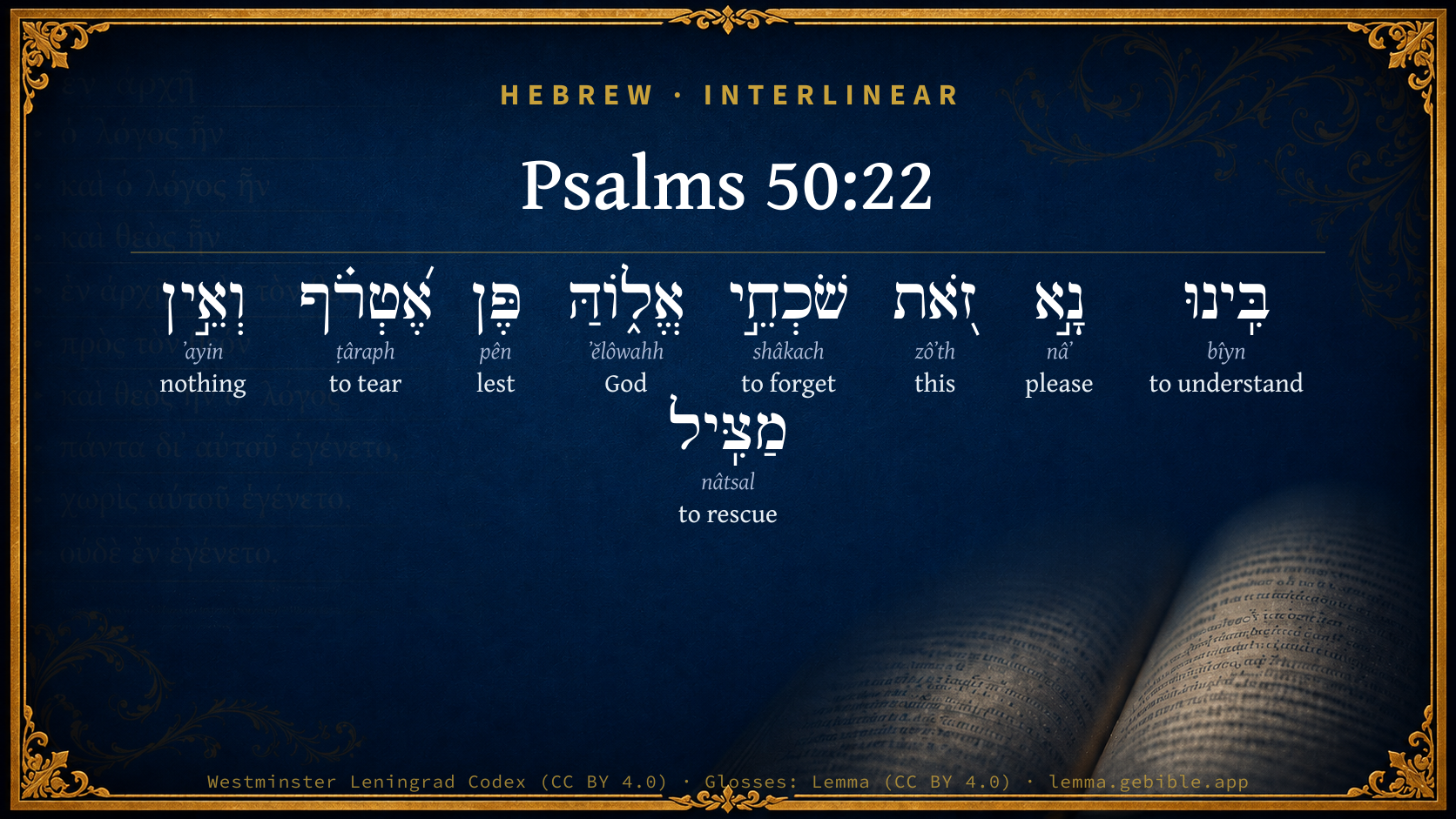
Psalms 50:22

Hebrew (Westminster Leningrad Codex) Psalms 50:22 appears in the Hebrew Old Testament. The text above is from the Westminster Leningrad Codex. Each word links to its Strong’s number, a concise gloss, and parsing drawn from the Open Scriptures Hebrew Bible morphology. Click any word for its full Brown-Driver-Briggs (BDB) entry.
Download image
Cite this verse

Psalms 50:22 (World English Bible). Public Domain. Lemma interlinear Bible study tool, https://lemma.gebible.app/v/psalms/50/22.

Show BibTeX & RIS
BibTeX
RIS
English Translation
"Now consider this, you who forget God, Lest I tear you into pieces, and there be none to deliver.
World English Bible · Public Domain
Download a study sheet

One document with this verse’s original text, its word-by-word gloss line, the meaning frame, cross-references with their text, attributed commentary, and full source and license credits — printable, and it pastes into notes with its structure intact.

This verse Autodidact and up

Study sheet (.html) Plain text (.txt)

A passage Seminary Student

Up to 50 verses in one chapter. A passage sheet keeps up to 6 commentary sources and 12 cross-references per verse, in the order this page ranks them, and says so on the sheet whenever that leaves anything out. Ask for a single verse and you get the Autodidact verse sheet above.

Everything on this page stays free to read, with no account — the sheet is a download of what is already on screen, not access to it.

Want to remove ads? Support Godless Engineer
Compare translations 3

The same verse in 3 English versions, stacked beneath the original-language interlinear above. Click any original word for its lexicon entry.

Each is an independent rendering of the whole verse — the interlinear is not word-aligned to these translations.

Highlighted words mark where these versions differ — a whole-verse word diff, not a word-by-word alignment.

  • World English Bible Public Domain
    "Now consider this, you who forget God, Lest I tear you into pieces, and there be none to deliver.
  • King James Version Public Domain
    Now consider this, ye that forget God, lest I tear you in pieces, and there be none to deliver.
  • unfoldingWord Literal Text CC BY-SA 4.0
    Consider this now, forgetters of God, lest I tear and none be delivering!

unfoldingWord Literal Text — © unfoldingWord, licensed CC BY-SA 4.0. Word-aligned USFM3 via Door43 (git.door43.org/unfoldingWord/en_ult).

Versions to compare (up to 4)

3 of 4 selected

Show all 18 translations

Every available English version of this verse, each an independent rendering of the whole verse.

  • World English Bible Public Domain
    "Now consider this, you who forget God, Lest I tear you into pieces, and there be none to deliver.
  • Berean Standard Bible Public Domain
    Now consider this, you who forget God, lest I tear you to pieces, with no one to rescue you:
  • Majority Standard Bible Public Domain
    Now consider this, you who forget God, lest I tear you to pieces, with no one to rescue you:
  • King James Version Public Domain
    Now consider this, ye that forget God, lest I tear you in pieces, and there be none to deliver.
  • American Standard Version (1901) Public Domain
    Now consider this, ye that forget God, Lest I tear you in pieces, and there be none to deliver:
  • Revised Version (1885) Public Domain
    Now consider this, ye that forget God, lest I tear you in pieces, and there be none to deliver:
  • Geneva Bible (1599) Public Domain
    Oh cosider this, ye that forget God, least I teare you in pieces, and there be none that can deliuer you.
  • Douay-Rheims (1899) Public Domain
    Understand these things, you that forget God; lest he snatch you away, and there be none to deliver you.
  • Young's Literal Translation Public Domain
    Understand this, I pray you, Ye who are forgetting God, Lest I tear, and there is no deliverer.
  • Literal Standard Version CC BY-SA 4.0
    Now understand this, || You who are forgetting God, || Lest I tear, and there is no deliverer.
  • Unlocked Literal Bible CC BY-SA 4.0
    Give this careful consideration, you who forget God, otherwise I will tear you to pieces, and there will be no one to come to help you!
  • unfoldingWord Literal Text CC BY-SA 4.0
    Consider this now, forgetters of God, lest I tear and none be delivering!
  • Darby Bible Public Domain
    Now consider this, ye that forget +God, lest I tear in pieces, and there be no deliverer.
  • World Messianic Bible Public Domain
    “Now consider this, you who forget God, lest I tear you into pieces, and there be no one to deliver.
  • Webster's Bible Public Domain
    Now consider this, ye that forget God, lest I tear you in pieces, and there be none to deliver.
  • Free Bible Version CC BY-SA 4.0
    Think again, you people who dismiss God, or I will tear you apart, and no one will be able to save you.
  • Bible in Basic English Public Domain
    Now keep this in mind, you who have no memory of God, for fear that you may be crushed under my hand, with no one to give you help:
  • JPS Tanakh (1917) Public Domain
    Now consider this, ye that forget God, lest I tear in pieces, and there be none to deliver.

Literal Standard Version (2020), Covenant Press — licensed CC BY-SA 4.0. Text via the HelloAO Bible API (eBible.org). Unlocked Literal Bible (unfoldingWord) — licensed CC BY-SA 4.0. Text via the HelloAO Bible API (eBible.org). unfoldingWord Literal Text — © unfoldingWord, licensed CC BY-SA 4.0. Word-aligned USFM3 via Door43 (git.door43.org/unfoldingWord/en_ult). Free Bible Version, Dr. Jonathan Gallagher — licensed CC BY-SA 4.0. Text via the HelloAO Bible API (eBible.org).

Word by word

More ways to search: Search by grammar → Find every occurrence → Compare this word →

Practice this passage: Drill this verse → Learn its vocabulary →

About this verse

These counts appear in no published source. They are computed here, from the morphology-tagged text and Lemma’s own curated glosses. What Lemma adds →

9
words
9
distinct lemmas
Wisdom
section

Notable vocabulary

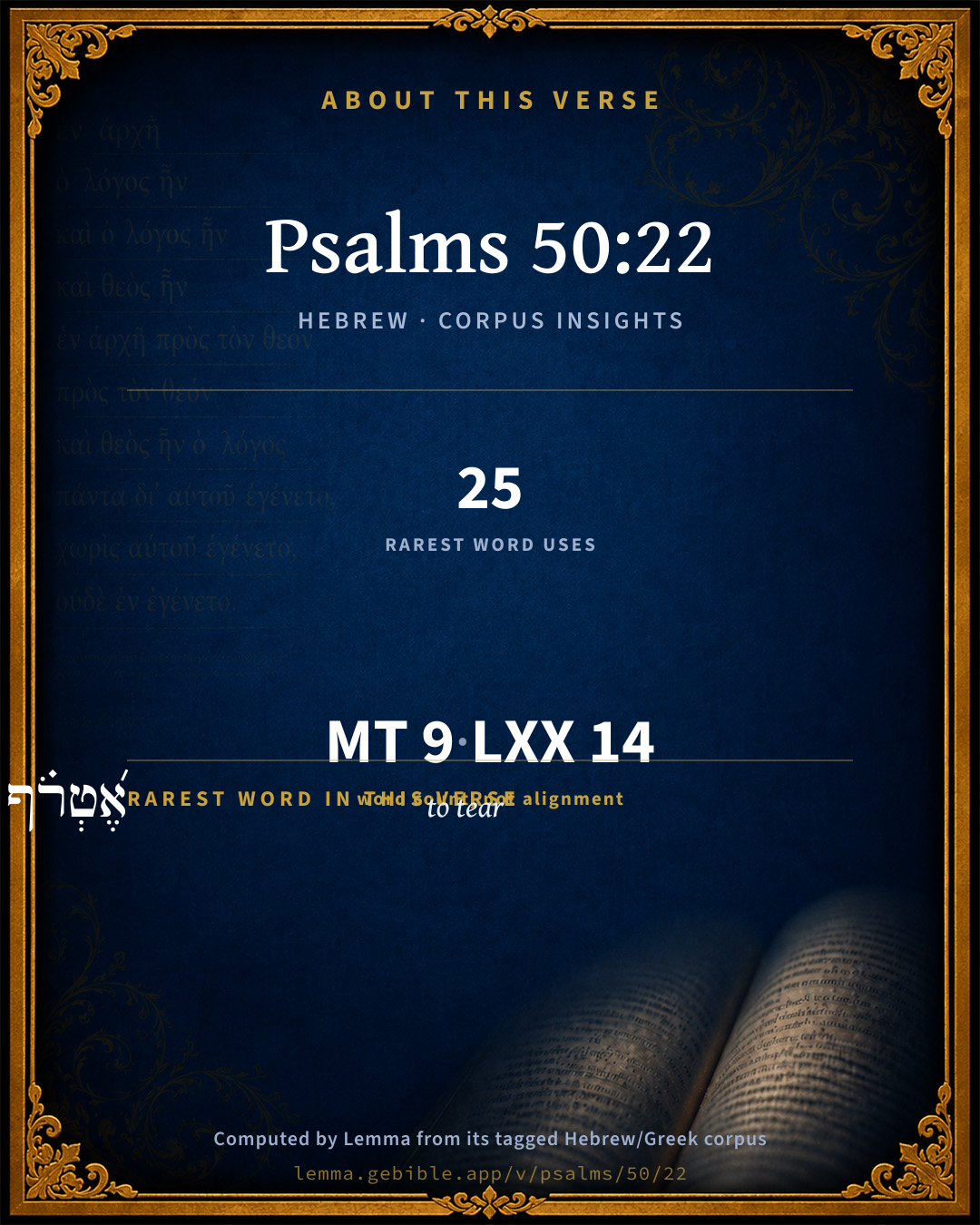
The rarest word here is אֶ֝טְרֹ֗ף to tear H2963 — appearing just 25 times in the whole Hebrew Bible.

Shared distinctive vocabulary

אֶ֝טְרֹ֗ף to tear H2963 occurs in 22 verses of the Hebrew Bible. Also found in:

Grammatical profile

  • 4 verbs
  • 1 noun
  • 1 pronoun
  • 1 conjunction
  • 2 particles

Verb forms

  • בִּֽינוּ Qal · Imperative
  • שֹׁכְחֵ֣י Qal · Participle Active
  • אֶ֝טְרֹ֗ף Qal · Imperfect
  • מַצִּֽיל Hiphil · Participle Active

Hebrew & Septuagint length

In English translation the verse runs 19 words from the Hebrew and 17 from the Septuagint (LXX English) — closely comparable.

A rough comparison of the two English renderings, which tokenize alike — not a word-level alignment.

Word counts can differ between the Hebrew and the Greek without any difference in meaning — e.g. the Hebrew direct-object marker אֵת has no separate Greek word, and Greek often adds the article ὁ.

In the original languages it is 9 Hebrew tokens and 14 Greek tokens — but the two are counted differently (Hebrew bundles its prefixes and suffixes into one token; the Greek is in lemma form), so that isn’t a like-for-like length.

Cross-references

18

Topical passages linked to Psalms 50:22 in the Treasury of Scripture Knowledge — connected by theme and wording, ordered by reader-vote popularity; previews shown in the World English Bible.

  • Job 8:13 So are the paths of all who forget God. The hope of the godless man shall perish,
  • Psalms 9:17 The wicked shall be turned back to Sheol, Even all the nations that forget God.
  • Hosea 4:6 My people are destroyed for lack of knowledge. Because you have rejected knowledge, I will also reject you, That you may be no priest to me. Because you have your God's law, I will also forget your children.
  • Psalms 7:2 Lest they tear apart my soul like a lion, Ripping it in pieces, while there is none to deliver.
  • Deuteronomy 32:18 Of the Rock that became your father, you are unmindful, Have forgotten God who gave you birth.
  • Psalms 10:4 The wicked, in the pride of his face, Has no room in his thoughts for God.
  • Jeremiah 2:32 Can a virgin forget her ornaments, or a bride her attire? yet my people have forgotten me days without number.
  • Hosea 13:8 I will meet them like a bear that is bereaved of her cubs, And will tear the covering of their heart. And there I will devour them like a lioness. The wild animal will tear them.
  • 2 Samuel 22:42 They looked, but there was none to save; Even to Yahweh, but he didn't answer them.
  • Isaiah 51:13 and have forgotten Yahweh your Maker, who stretched forth the heavens, and laid the foundations of the earth; and fear continually all the day because of the fury of the oppressor, when he makes ready to destroy? and where is the fury of the oppressor?
  • Amos 2:14 Flight will perish from the swift; And the strong won't strengthen his force; Neither shall the mighty deliver himself;
  • Haggai 1:5 Now therefore this is what Yahweh of Hosts says: Consider your ways.
  • Revelation 6:16–17 They told the mountains and the rocks, "Fall on us, and hide us from the face of him who sits on the throne, and from the wrath of the Lamb,
  • Ezekiel 18:28 Because he considers, and turns away from all his transgressions that he has committed, he shall surely live, he shall not die.
  • Hosea 5:14 For I will be to Ephraim like a lion, And like a young lion to the house of Judah. I myself will tear in pieces and go away. I will carry off, and there will be no one to deliver.
  • Micah 5:8 The remnant of Jacob will be among the nations, In the midst of many peoples, Like a lion among the animals of the forest, Like a young lion among the flocks of sheep; Who, if he goes through, treads down and tears in pieces, And there is no one to deliver.
  • Luke 15:17 But when he came to himself he said, 'How many hired servants of my father's have bread enough to spare, and I'm dying with hunger!
  • Ecclesiastes 7:14 In the day of prosperity be joyful, and in the day of adversity consider; yes, God has made the one side by side with the other, to the end that man should not find out anything after him.

Cross-references courtesy of OpenBible.info (CC BY 4.0).

Hebrew and Greek witnesses Masoretic Hebrew ↔ Greek Septuagint

The same verse in the two great witnesses to the Old Testament, shown verse-for-verse.

You’re reading Greek Psalm 49 (Hebrew Psalm 50). The Septuagint counts the superscription, so verse numbers can differ from the Hebrew — chapter-level alignment, not verse-by-verse. Numbering follows Rahlfs.

These are two independent witnesses, not word-aligned to each other, and the Septuagint is shown in lemma (dictionary) form.

Hebrew Psalms 50:22 Masoretic · Westminster Leningrad Codex

בִּֽינוּ נָ֣א זֹ֭את שֹׁכְחֵ֣י אֱל֑וֹהַּ פֶּן אֶ֝טְרֹ֗ף וְאֵ֣ין מַצִּֽיל

"Now consider this, you who forget God, Lest I tear you into pieces, and there be none to deliver.

World English Bible · Public Domain

Greek LXX Greek Psalm 49:22 Septuagint · lemma form

συνἵημι δή οὗτος ὁ ἐπιλανθάνω ὁ θεός μήποτε ἁρπάζω καί μή εἰμί ὁ ῥύομαι

Now consider these things, you⌃ that forget God, lest he rend you, and there is no deliverer.

LXX2012 (modern English Septuagint) · Public Domain

On this verse, Keil & Delitzsch discusses the Septuagint’s reading. Read the note in Commentary ↓

Hebrew: Westminster Leningrad Codex (CC BY 4.0). Greek: Septuagint (public domain); English from LXX2012 (modern English Septuagint) (Public Domain). How the Septuagint differs from the Hebrew →

Commentary

Notes on Psalms 50:22 from classic Christian and Jewish commentators (each source and its license shown beneath its notes). The classic Christian expositions comment on the surrounding passage and are grouped to its opening verse, so a note may address several verses; the Jewish commentaries on the Tanakh (Rashi and others) are per-verse, so they appear only where the commentator wrote on this verse.

Lemma curates 59 commentaries, every one of them public domain or Creative Commons licensed, each selected and text-cleaned for this edition rather than reprinted as found. About our sources →

Trapp's Complete Commentary

John Trapp

Psa 50:22 Now consider this, ye that forget God, lest I tear [you] in pieces, and [there be] none to deliver.

Ver. 22. Now consider this, ye that forget God] That cast him and his counsels behind your backs, before he awaken your drowsy consciences, and rouse up the lion that lieth sleeping in your bosoms, like Cain’s dog, Gen 4:7, with his dog-sleep; and before you come to answer for all, with flames about your ears.

Lest I tear you in pieces, and there be none to deliver you] From the wolf a shepherd may rescue his lamb, not so from the hungry lion, Amo 3:12 Isa 31:4. God’s power is irresistible, his punishments unavoidable.

John Trapp, A Commentary or Exposition upon All the Books of the Old and New Testament (1647–1656) — public domain. Text from a community e-Sword module.

The Biblical Illustrator

Joseph S. Exell

Psa_50:22

Now consider this, ye that forget God.

Forgetfulness of God: Its Evil

Forget God!--is this possible? What! when we see His eternal power and Godhead in all things above us and about us? If we look up to the heavens, the heavens declare the glory of God, and the firmament showeth His handy-work. If we look around us here, the earth is full of His goodness. But men, notwithstanding, do forget God. Forgetfulness of God is the source of their wickedness, and should this sinful conduct be persisted in, it will induce a sorer punishment than all created power could remedy.

I. An evil.

II. Its punishment.

III. A means whereby to correct the evil and to avoid the punishment. (W. Mudge, B. A.)

The Biblical Illustrator, edited by Joseph S. Exell (c. 1880s–1900s) — public domain. Text from a community e-Sword module.

Joseph Benson's Commentary

Psa 50:22. Now consider this, ye that forget God — Ye hypocritical and ungodly Israelites, who have forgotten (as Moses foretold ye would do, Deu 32:18) the God that formed you, and made you his people, and have forgotten his mercies and judgments, by which you should have been instructed, and the covenant which you made with him, and by which you stand obliged to obey and serve him. Lest I tear you in pieces — Lest my patience be turned into fury, and I proceed to take vengeance on you; and there be none, or, for there is none to deliver — None that can rescue you from the power of mine anger.

Joseph Benson's Commentary on the Old and New Testaments (1811–1818) — public domain. Text from a community e-Sword module.

Tyndale Open Study Notes

Tyndale Open Resources

50:22-23 The wicked will experience God’s justice, while the godly will see God’s everlasting salvation.

50:22 God will tear the wicked apart like a lion tearing its prey (Isa 5:29; 31:4; Ezek 19:3; cp. Pss 7:2; 22:13).

Tyndale Open Study Notes — © Tyndale Open Resources, licensed CC BY-SA 4.0. Text via the HelloAO Bible API.

Jamieson, Fausset & Brown

Robert Jamieson, A. R. Fausset & David Brown

forget God--This denotes unmindfulness of His true character.

Jamieson, Fausset & Brown — Commentary Critical and Explanatory on the Whole Bible (1871) — public domain (CC PDM 1.0). Text via the HelloAO Bible API.

Adam Clarke's Commentary

Verse 22. Now consider this] Ye have forgotten your God, and sinned against him. He has marked down all your iniquities, and has them in order to exhibit against you. Beware, therefore, lest he tear you to pieces, when there is none to deliver; for none can deliver you but the Christ you reject. And how can ye escape, if ye neglect so great a salvation?

Adam Clarke's Commentary on the Bible (1810–1826) — public domain. Text from a community e-Sword/MySword module.

John Calvin's Commentaries

22 Now consider this, ye that forget God Here we have more of that severe expostulation which is absolutely necessary in dealing with hardened hypocrites, who otherwise will only deride all instruction. While, however, the Psalmist threatens and intends to alarm them, he would, at the same time, hold out to them the hope of pardon, upon their hastening to avail themselves of it. But to prevent them from giving way to delay, he warns them of the severity, as well as the suddenness, of the divine judgments. He also charges them with base ingratitude, in having forgotten God. And here what a remarkable proof have we of the grace of God in extending the hope of mercy to those corrupt men, who had so impiously profaned his worship, who had so audaciously and sacrilegiously mocked at his forbearance, and who had abandoned themselves to such scandalous crimes! In calling them to repentance, without all doubt he extends to them the hope of God being reconciled to them, that they may venture to appear in the presence of his majesty. And can we conceive of greater clemency than this, thus to invite to himself, and into the bosom of the Church, such perfidious apostates and violators of his covenant, who had departed from the doctrine of godliness in which they had been brought up? Great as it is, we would do well to reflect that it is no greater than what we have ourselves experienced. We, too, had apostatized from the Lord, and in his singular mercy has he brought us again into his fold. It should not escape our notice, that the Psalmist urges them to hasten their return, as the door of mercy will not always stand open for their admission — a needful lesson to us all! lest we allow the day of our merciful visitation to pass by, and be left, like Esau, to indulge in unavailing lamentations, (Genesis 27:34.) So much is implied when it is said, God shall seize upon you, and there shall be none to deliver

John Calvin's Commentaries (1540-1563) — public domain. Text from the Calvin Translation Society English edition (1840s-50s) via the Christian Classics Ethereal Library (ccel.org). Calvin's coverage is partial (roughly two-thirds of the Bible); uncommented books and verses are honest gaps, never fabricated. The 19th-century editor's footnotes and remarks are omitted so the notes are faithfully Calvin's own voice.

The Cambridge Bible for Schools and Colleges

gen. ed. J. J. S. Perowne

22. ye that forget God] Elôah: see note on Psa_50:1. For the phrase cp. Psa_9:17; Job_8:13; and for the thought, Psa_10:4.

lest I tear &c.] Like a lion. Cp. Hos_5:14.

22, 23. Practical conclusion, addressed to both classes: to the formal worshippers who ‘forget God’ by ignoring the spiritual character of the worship which He desires, as well as to the hypocrites whose conduct proves that they “refuse to have Him in their knowledge.”

The Cambridge Bible for Schools and Colleges (gen. ed. J. J. S. Perowne; Cambridge University Press, 1878–1918) — public domain. Text from a community e-Sword module.

John Gill's Exposition

Whoso offereth praise,...., Which is exhorted to; See Gill on Psa 50:14;

glorifieth me; celebrates the divine perfections, gives God the glory of all mercies; which honours him, and is more grateful and well pleasing to him than all burnt offerings and sacrifices;

and to him that ordereth his conversation aright; according to the rule of God's word, and as becomes the Gospel of Christ; who walks inoffensively to all, circumspectly and wisely in the world, and in love to the saints; in wisdom towards them that are without, and in peace with them that are within; who is a follower of God, of Christ, and of his people; and who lives so as to glorify God, and cause others to glorify him likewise: or that chooses for himself the right way, as Aben Ezra, the right way to eternal life; and the sense is, he that puts or sets his heart upon it, and is in pursuit after the evangelical way of life. To him

will I show the salvation of God; or, "cause to see" or "enjoy it" (b); not only temporal salvation from time to time, but spiritual and eternal salvation; to see interest in it, and to possess it; and particularly Christ, the author of it, who is the salvation of God's providing, appointing, and sending, and whose glory is greatly concerned therein; see Isa 52:10.

(b) "videre faciam eum", Montanus; "faciam ut is fruatur", Junius & Tremellius, Piscator.

Next: Psalms Chapter 51

John Gill's Exposition of the Whole Bible (1746–1763) — public domain (CC PDM 1.0). Text via the HelloAO Bible API.

Albert Barnes' Notes on the Bible

Now consider this - Understand this; give attention to this. The word “now” does not well express the force of the original. The Hebrew word is not an adverb of “time,” but a particle denoting “entreaty,” and would be better rendered by, “Oh, consider this;” or, “Consider this, I beseech you.” The matter is presented to them as that which deserved their most solemn attention.

Ye that forget God - Who really forget him though you are professedly engaged in his worship; who, amidst the forms of religion, are actually living in entire forgetfulness of the just claims and of the true character of God.

Lest I tear you in pieces - Language derived from the fury of a ravenous beast tearing his victim from limb to limb.

And there be none to deliver - As none can do when God rises up in his wrath to inflict vengeance. None would “venture” to Interpose; none “could” rescue from his hand. There “is” a point of time in relation to all sinners when no one, not even the Redeemer - the great and merciful Mediator - will interpose to save; when the sinner will be left to be dealt with by simple, pure, unmixed and unmitigated “justice;” when mercy and kindness will have done their work in regard to them in vain; and when they will be left to the “mere desert” of their sins. At that point there is no power that can deliver them.

Albert Barnes' Notes on the Bible (1834–1885) — public domain. Text from a community e-Sword/MySword module.

Matthew Poole's English Annotations

Ye that forget God; ye hypocritical and ungodly Israelites, who have forgotten (as Moses foretold you would do, Deu 32:18) the God that formed you, and made you his people, and forgotten his mercies and judgments, by which you should have been instructed, and the covenant which you made with him, and by which you stand obliged to him.

Lest I tear you in pieces; lest my patience be turned into fury, and I proceed to take vengeance on you.

And there be none to deliver; or, for (as the Hebrew particle is oft rendered) there is none that can or will deliver you. None can rescue you from the power of mine anger.

Matthew Poole's English Annotations on the Holy Bible (1683–1685) — public domain. Text from a community e-Sword/MySword module.

The Treasury of David

Charles H. Spurgeon

Ver. 22. Now or oh! it is a word of entreaty, for the Lord is loath even to let the most ungodly run on to destruction. Consider this; take these truths to heart, ye who trust in ceremonies and ye who live in vice, for both of you sin in that ye forget God. Bethink you how unaccepted you are, and turn unto the Lord. See how you have mocked the eternal, and repent of your iniquities. Lest I tear you in pieces, as the lion rends his prey, and there be none to deliver, no Saviour, no refuge, no hope. Ye reject the Mediator: beware, for ye will sorely need one in the day of wrath, and none will be near to plead for you. How terrible, how complete, how painful, how humiliating, will be the destruction of the wicked! God uses no soft words, or velvet metaphors, nor may his servants do so when they speak of the wrath to come. O reader, consider this.

Ver. 22. Now consider this, ye that forget God, etc. What is less than a grain of sand? Yet when it comes to be multiplied, what is heavier than the sands of the sea? A little sum multiplied rises high; so a little sin unrepented of will damn us, as one leak in the ship, if it be not well looked to, will drown us. "Little sins" as the world calls them, but great sins against the majesty of God Almighty, whose majesty, against which they are committed, doth accent and enhance them, if not repented of, will damn. One would think it no great matter to forget God, yet it has a heavy doom attending on it. The non improvement of talents, the non exercise of grace, the world looks upon as a small thing; yet we read of him who hid his talent in the earthhe had not spent it, only not trading it is sentenced. Thomas Watson.

Ver. 22. Lest I tear you in pieces. This is a metamorphic expression, taken from the strength and irresistible fury of a lion, from which the interference of the shepherd can supply no protection, or defence, for his flock. William Walford.

Ver. 22.

1. The accusation"Ye that forget God, "his omniscience, his power, his justice, his goodness, his mercy, his word, his great salvation.

2. The admonition"Consider this, "rouse yourselves from your forgetfulness into serious reflection.

3. The condemnation"Lest, "etc.

1. The awfulness. "Tear, "as a lion or eagle its prey tear body and soul.

2. Its irresistibleness"None to deliver." G. R.

Psalms 50:23*

Charles H. Spurgeon's The Treasury of David (1869–1885) — public domain. Psalms only. Text from a community e-Sword/MySword module.

The Pulpit Commentary

Now consider this, ye that forget God. Having been "reproved," the wicked are now, in conclusion, exhorted and warned. "Consider this;" i.e. take it to heart, reflect upon it, let it sink deeply into your minds and consciences, and act upon it. Lest I tear you in pieces, and there be none to deliver. A most awful threat. To "tear in pieces" is the act of a wild beast. (Psa_7:2) Job declares that God "teareth him;" but otherwise the expression is scarcely used of Divine chastisements. Certainly, if God, in his anger, lays hold upon a man to punish him, there is no possible deliverance at the hand of any other man. (Psa_49:7, Psa_49:8) Deliverance, if it comes at all, must come from the Redeemer within the Godhead.

Forgetfulness of God.

"Now consider," etc. The prevailing character of the Book of Psalms is that Divine truth is clothed in the language of human experience. But in this psalm God alone speaks. The personality of the psalmist vanishes. Man"s voice is hushed. We are called into the very presence of God, like Israel at the foot of Sinai. It is God"s voice that summons us to judgment, and sets our sins in order before our eyes. Yet it is the voice of merciful warning. "Consider!". (Isa_1:18) The sin here rebuked is forgetfulness of God.

I IT Is NOT DIFFICULT TO FORGET GOD. God might have made it impossible. He might have surrounded us with symbols of his presence which the dullest could not mistake. Voices from the sky might thunder his Name in our ears. An inward irresistible consciousness of his being and presence might have been an inseparable part of our nature. But no! A mysterious veil hangs between our soul and our Creator. We have no direct knowledge of God. He has left us at liberty, if we please, to forget him. We can bury ourselves in things around us, and forget him in whom we "live and nacre and have our being.

II It seems wonderful that it is possible, and not difficult; but more wonderful still that FORGETFULNESS OF GOD IS COMMON. Who are they who are here charged with forgetting God? Not idolaters. Not atheists. Not the openly profane and irreligious. Those (ver. 16) who "declare God"s statutes, and take his covenant in their mouth." Of such St. Paul speaks, (Rom_2:17-23) and our Saviour. (Mat_7:21-23) They forget God. It is the description (alas!) of the daily life of thousands of habitual attendants on public worship. Hearers, but not doers; forgetful hearers. (Jam_1:22-25)

III FORGETFULNESS OF GOD IS A HUGE INGRATITUDE; A DEADLY SIN. How can you account for it? Men may dislike the Scripture doctrine of the sinfulness of human nature. They may deny it. But this fact stares us in the face prevailing forgetfulness of God. How explain it, except as the Scriptures explain it? men do not like to retain God in their knowledge. (Rom_1:28 Rom_8:7)

IV FORGETFULNESS OF GOD MUST NEEDS BE VERY DANGEROUS; IF PERSISTED IN, FATAL. Your forgetfulness does not affect the reality of things. It banishes God from your thought and affection; not from his universe. He cannot forget. He must deal with you, and deal justly. He must take account of your forgetting him. "Consider!" Consider the folly, ingratitude, sin, danger, of forgetting God. His mercies are new every morning. "He will ever be mindful of his covenant;" "He is faithful and just to forgive sins;" and promises (Isa_43:25) to "remember them no more." Can there be forgetfulness in the infinite mind? Can God cease to be omniscient? Not literally; but by this intensely strong figure the Bible sets forth the generous and loving completeness of Divine forgiveness. It is an act of oblivion. "Consider!" We have forgotten God, but he has not forgotten us. He remembered us in our low estate; for his mercy endureth for ever". (Psa_136:23) He beseeches you to be reconciled!

The Pulpit Commentary (1880–1919), ed. H.D.M. Spence-Jones & Joseph S. Exell — public domain. Text from a community e-Sword module.

Keil & Delitzsch

C. F. Keil & F. Delitzsch

Epilogue of the divine discourse. Under the name שׁכחי אלוהּ are comprehended the decent or honourable whose sanctity relies upon outward works, and those who know better but give way to licentiousness; and they are warned of the final execution of the sentence which they have deserved. In dead works God delighteth not, but whoso offereth thanksgiving (viz., not shelamim-tôda, but the tôda of the heart), he praises Him

(Note: In Vedic jag', old Bactrian jaz (whence jag'jas, the primitive word of ἅγιος), the notions of offering and of praising lie one within the other.)

and שׂם דּרך. It is unnecessary with Luther, following the lxx, Vulgate, and Syriac versions, to read שׁם. The Talmudic remark אל תקרי ושׂם אלא ושׁם [do not read ושׂם, but ושׁם] assumes ושׂם to be the traditional reading. If we take שׂם דּרך as a thought complete in itself, - which is perfectly possible in a certain sense (vid., Isa 43:19), - then it is best explained according to the Vulgate (qui ordinat viam), with Bצttcher, Maurer, and Hupfeld: viam h. e. recta incedere (legel agere) parans; but the expression is inadequate to express this ethical sense (cf. Pro 4:26), and consequently is also without example. The lxx indicates the correct idea in the rendering καὶ ἐκεῖ ὁδὸς ᾗ δείξω αὐτῷ τὸ σωτήριον Θεοῦ. The ושׂם דוך (designedly not pointed דּרך), which standing entirely by itself has no definite meaning, receives its requisite supplement by means of the attributive clause that follows. Such an one prepares a way along which I will grant to him to see the salvation of Elohim, i.e., along which I will grant him a rapturous vision of the full reality of My salvation. The form יכבּדנני is without example elsewhere. It sounds like the likewise epenthetical יקראנני, Pro 1:28, cf. Pro 8:17, Hos 5:15, and may be understood as an imitation of it as regards sound. יכבּדנני (= יכבּדני) is in the writer's mind as the form out of pause (Ges. ֗58, 4). With Psa 50:23 the Psalm recurs to its central point and climax, Psa 50:14. What Jahve here discourses in a post-Sinaitic appearing, is the very same discourse concerning the worthlessness of dead works and concerning the true will of God that Jesus addresses to the assembled people when He enters upon His ministry. The cycle of the revelation of the Gospel is linked to the cycle of the revelation of the Law by the Sermon on the Mount; this is the point at which both cycles touch.

Keil & Delitzsch — Biblical Commentary on the Old Testament (1861–1891) — public domain (CC PDM 1.0). Text via the HelloAO Bible API. (Old Testament only.)

Lesson kit

Teaching starters — assembled from the data on this page, not authored interpretation. Every prompt links to the verse data it draws on. Edit before teaching.

Psalms, in the Wisdom, opens this verse with 9 words (9 distinct Hebrew lemmas). Its most distinctive word is ṭâraph (“to tear”). A historical commentator’s framing appears above. Read the whole chapter for the surrounding context.

Discussion questions

  1. What does “to tear” (ṭâraph) contribute to the verse as a whole?
  2. How does Genesis 37:33, which shares the word «to tear», read alongside this verse?
  3. These translations render this verse differently. What is at stake in choosing one wording over another?
  4. «בִּֽינוּ» is a Qal Imperative verb. How does that grammatical form shape the action described?
  5. Compare how Trapp's Complete Commentary and The Biblical Illustrator read this verse. Where do they agree or differ?

Things to notice

Reading settings

Reading text

Shown beneath each verse's original-language words.

Old Testament
Old Testament edition

Read the OT as the Masoretic Hebrew (MT) or the Greek Septuagint (LXX).

English shown for the Greek Septuagint (in the Hebrew ↔ Greek comparison).

Comparing translations? Open the Compare panel on any verse page to stack up to four side by side.