
Proverbs 11:6

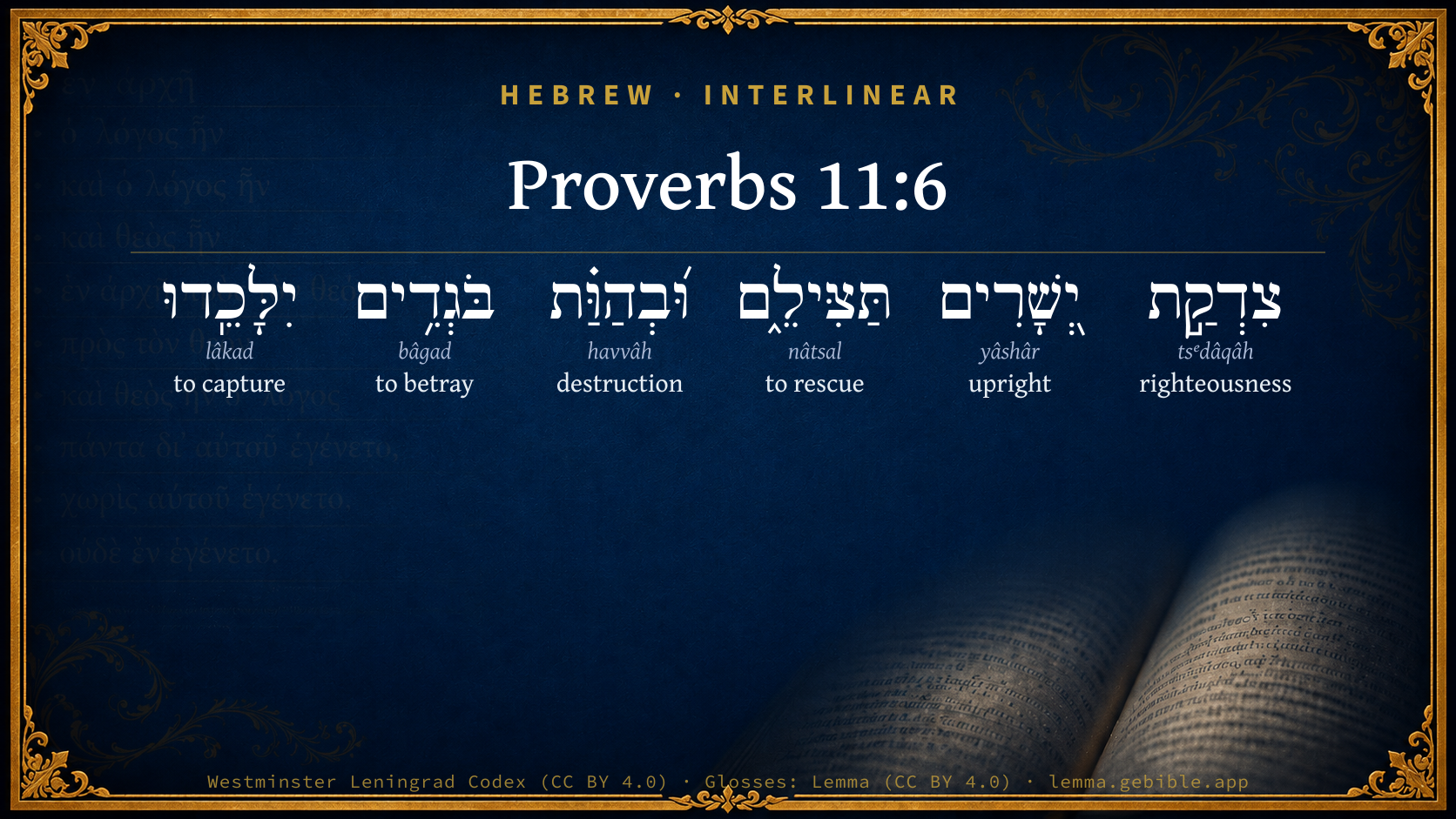
Hebrew (Westminster Leningrad Codex) Proverbs 11:6 appears in the Hebrew Old Testament. The text above is from the Westminster Leningrad Codex. Each word links to its Strong’s number, a concise gloss, and parsing drawn from the Open Scriptures Hebrew Bible morphology. Click any word for its full Brown-Driver-Briggs (BDB) entry.
Download image
Cite this verse

Proverbs 11:6 (World English Bible). Public Domain. Lemma interlinear Bible study tool, https://lemma.gebible.app/v/proverbs/11/6.

Show BibTeX & RIS
BibTeX
RIS
English Translation
The righteousness of the upright shall deliver them, But the unfaithful will be trapped by evil desires.
World English Bible · Public Domain
Download a study sheet

One document with this verse’s original text, its word-by-word gloss line, the meaning frame, cross-references with their text, attributed commentary, and full source and license credits — printable, and it pastes into notes with its structure intact.

This verse Autodidact and up

Study sheet (.html) Plain text (.txt)

A passage Seminary Student

Up to 50 verses in one chapter. A passage sheet keeps up to 6 commentary sources and 12 cross-references per verse, in the order this page ranks them, and says so on the sheet whenever that leaves anything out. Ask for a single verse and you get the Autodidact verse sheet above.

Everything on this page stays free to read, with no account — the sheet is a download of what is already on screen, not access to it.

Want to remove ads? Support Godless Engineer
Compare translations 3

The same verse in 3 English versions, stacked beneath the original-language interlinear above. Click any original word for its lexicon entry.

Each is an independent rendering of the whole verse — the interlinear is not word-aligned to these translations.

Highlighted words mark where these versions differ — a whole-verse word diff, not a word-by-word alignment.

  • World English Bible Public Domain
    The righteousness of the upright shall deliver them, But the unfaithful will be trapped by evil desires.
  • King James Version Public Domain
    The righteousness of the upright shall deliver them: but transgressors shall be taken in their own naughtiness.
  • unfoldingWord Literal Text CC BY-SA 4.0
    The righteousness of the upright will deliver them, but by the desire of treacherous they will be captured.

unfoldingWord Literal Text — © unfoldingWord, licensed CC BY-SA 4.0. Word-aligned USFM3 via Door43 (git.door43.org/unfoldingWord/en_ult).

Versions to compare (up to 4)

3 of 4 selected

Show all 18 translations

Every available English version of this verse, each an independent rendering of the whole verse.

  • World English Bible Public Domain
    The righteousness of the upright shall deliver them, But the unfaithful will be trapped by evil desires.
  • Berean Standard Bible Public Domain
    The righteousness of the upright delivers them, but the faithless are trapped by their own desires.
  • Majority Standard Bible Public Domain
    The righteousness of the upright delivers them, but the faithless are trapped by their own desires.
  • King James Version Public Domain
    The righteousness of the upright shall deliver them: but transgressors shall be taken in their own naughtiness.
  • American Standard Version (1901) Public Domain
    The righteousness of the upright shall deliver them; But the treacherous shall be taken in their own iniquity.
  • Revised Version (1885) Public Domain
    The righteousness of the upright shall deliver them: but they that deal treacherously shall be taken in their own mischief.
  • Geneva Bible (1599) Public Domain
    The righteousnesse of the iust shall deliuer them: but the transgressers shall be taken in their owne wickednes.
  • Douay-Rheims (1899) Public Domain
    The justice of the righteous shall deliver them: and the unjust shall be caught in their own snares.
  • Young's Literal Translation Public Domain
    The righteousness of the upright delivereth them, And in mischief the treacherous are captured.
  • Literal Standard Version CC BY-SA 4.0
    The righteousness of the upright delivers them, || And in mischief the treacherous are captured.
  • Unlocked Literal Bible CC BY-SA 4.0
    The right conduct of those who please God keeps them safe, but the treacherous are trapped by their cravings.
  • unfoldingWord Literal Text CC BY-SA 4.0
    The righteousness of the upright will deliver them, but by the desire of treacherous they will be captured.
  • Darby Bible Public Domain
    The righteousness of the upright delivereth them; but the treacherous are taken in their own craving.
  • World Messianic Bible Public Domain
    The righteousness of the upright shall deliver them, but the unfaithful will be trapped by evil desires.
  • Webster's Bible Public Domain
    The righteousness of the upright shall deliver them: but transgressors shall be taken in their own naughtiness.
  • Free Bible Version CC BY-SA 4.0
    The goodness of those who live right will save them, but the dishonest are trapped by their own desires.
  • Bible in Basic English Public Domain
    The righteousness of the upright will be their salvation, but the false will themselves be taken in their evil designs.
  • JPS Tanakh (1917) Public Domain
    The righteousness of the upright shall deliver them; but the faithless shall be trapped in their own crafty device.

Literal Standard Version (2020), Covenant Press — licensed CC BY-SA 4.0. Text via the HelloAO Bible API (eBible.org). Unlocked Literal Bible (unfoldingWord) — licensed CC BY-SA 4.0. Text via the HelloAO Bible API (eBible.org). unfoldingWord Literal Text — © unfoldingWord, licensed CC BY-SA 4.0. Word-aligned USFM3 via Door43 (git.door43.org/unfoldingWord/en_ult). Free Bible Version, Dr. Jonathan Gallagher — licensed CC BY-SA 4.0. Text via the HelloAO Bible API (eBible.org).

Word by word

More ways to search: Search by grammar → Find every occurrence → Compare this word →

Practice this passage: Drill this verse → Learn its vocabulary →

About this verse

These counts appear in no published source. They are computed here, from the morphology-tagged text and Lemma’s own curated glosses. What Lemma adds →

6
words
6
distinct lemmas
Wisdom
section

Notable vocabulary

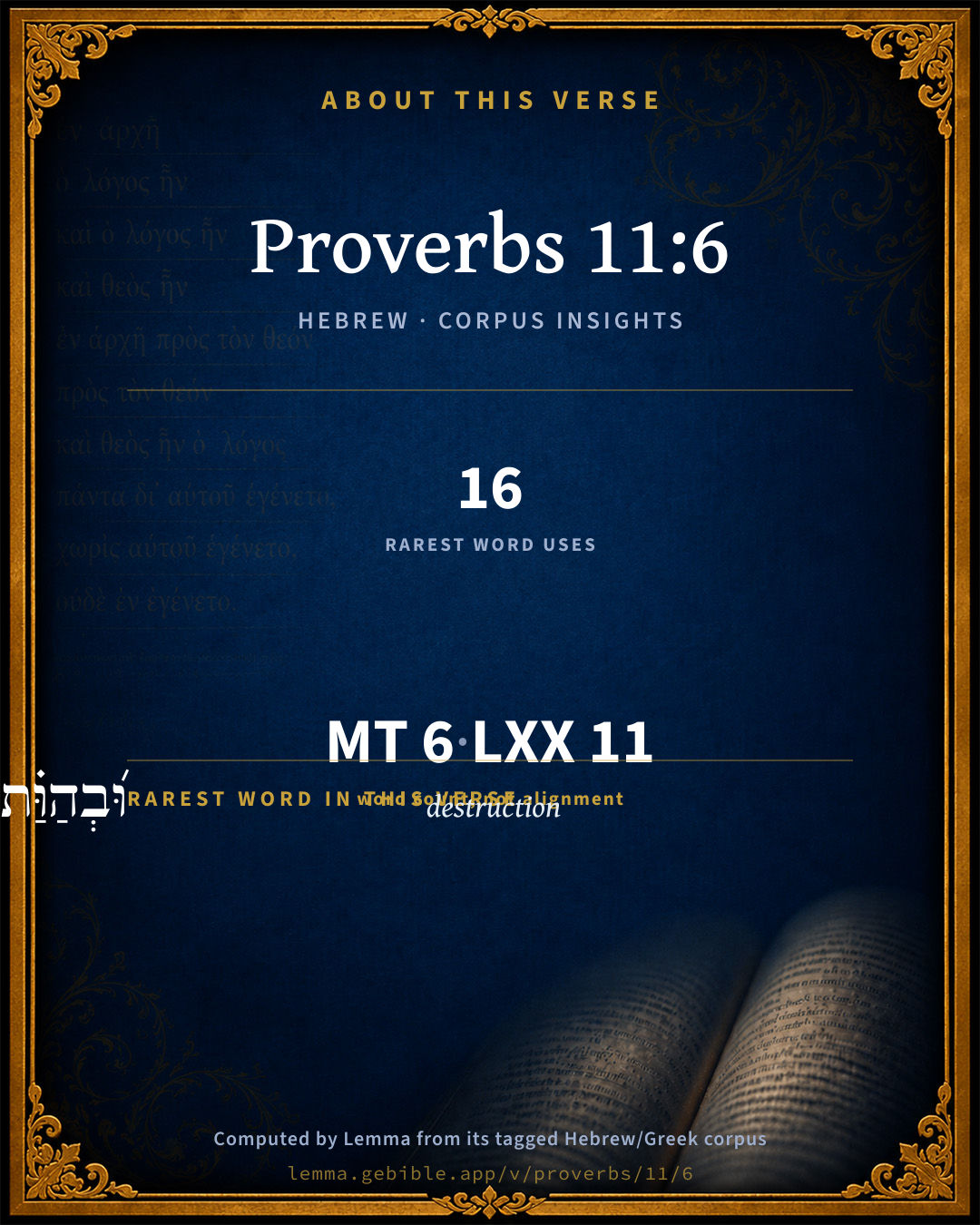
The rarest word here is וּ֝בְהַוַּ֗ת destruction H1942 — appearing just 16 times in the whole Hebrew Bible.

Shared distinctive vocabulary

וּ֝בְהַוַּ֗ת destruction H1942 occurs in 16 verses of the Hebrew Bible. Also found in:

Grammatical profile

  • 3 verbs
  • 2 nouns
  • 1 adjective

Verb forms

  • תַּצִּילֵ֑ם Hiphil · Imperfect
  • בֹּגְדִ֥ים Qal · Participle Active
  • יִלָּכֵֽדוּ Niphal · Imperfect

Hebrew & Septuagint length

In English translation the verse runs 17 words from the Hebrew and 15 from the Septuagint (LXX English) — closely comparable.

A rough comparison of the two English renderings, which tokenize alike — not a word-level alignment.

Word counts can differ between the Hebrew and the Greek without any difference in meaning — e.g. the Hebrew direct-object marker אֵת has no separate Greek word, and Greek often adds the article ὁ.

In the original languages it is 6 Hebrew tokens and 11 Greek tokens — but the two are counted differently (Hebrew bundles its prefixes and suffixes into one token; the Greek is in lemma form), so that isn’t a like-for-like length.

Cross-references

8

Topical passages linked to Proverbs 11:6 in the Treasury of Scripture Knowledge — connected by theme and wording, ordered by reader-vote popularity; previews shown in the World English Bible.

  • Ecclesiastes 10:8 He who digs a pit may fall into it; and whoever breaks through a wall may be bitten by a snake.
  • 1 Samuel 12:3–4 Here I am: witness against me before Yahweh, and before his anointed: whose ox have I taken? or whose donkey have I taken? or whom have I defrauded? whom have I oppressed? or of whose hand have I taken a ransom to blind my eyes therewith? and I will restore it you.
  • 1 Kings 2:44 The king said moreover to Shimei, You know all the wickedness which your heart is privy to, that you did to David my father: therefore Yahweh shall return your wickedness on your own head.
  • Psalms 7:15–16 He has dug a hole, And has fallen into the pit which he made.
  • Proverbs 5:22 The evil deeds of the wicked ensnare him. The cords of his sin hold him firmly.
  • 1 Kings 2:32–33 Yahweh will return his blood on his own head, because he fell on two men more righteous and better than he, and killed them with the sword, and my father David didn't know it, [to wit], Abner the son of Ner, captain of the host of Israel, and Amasa the son of Jether, captain of the host of Judah.
  • Genesis 30:33 So my righteousness will answer for me hereafter, when you come concerning my hire that is before you. Everyone that is not speckled and spotted among the goats, and black among the sheep, that might be with me, will be counted stolen."
  • Genesis 31:37 Now that you have felt around in all my stuff, what have you found of all your household stuff? Set it here before my relatives and your relatives, that they may judge between us two.

Cross-references courtesy of OpenBible.info (CC BY 4.0).

Hebrew and Greek witnesses Masoretic Hebrew ↔ Greek Septuagint

The same verse in the two great witnesses to the Old Testament, shown verse-for-verse.

These are two independent witnesses, not word-aligned to each other, and the Septuagint is shown in lemma (dictionary) form.

Hebrew Proverbs 11:6 Masoretic · Westminster Leningrad Codex

צִדְקַ֣ת יְ֭שָׁרִים תַּצִּילֵ֑ם וּ֝בְהַוַּ֗ת בֹּגְדִ֥ים יִלָּכֵֽדוּ

The righteousness of the upright shall deliver them, But the unfaithful will be trapped by evil desires.

World English Bible · Public Domain

Greek LXX Proverbs 11:6 Septuagint · lemma form

δικαιοσύνη ἀνήρ ὀρθός ῥύομαι αὐτός ὁ δέ ἀπώλεια αὐτός ἁλίσκω παράνομος

The righteousness of upright men delivers them: but transgressors are caught in their own destruction.

LXX2012 (modern English Septuagint) · Public Domain

On this verse, The Cambridge Bible for Schools and Colleges discusses the Septuagint’s reading. Read the note in Commentary ↓

Hebrew: Westminster Leningrad Codex (CC BY 4.0). Greek: Septuagint (public domain); English from LXX2012 (modern English Septuagint) (Public Domain). How the Septuagint differs from the Hebrew →

Commentary

Notes on Proverbs 11:6 from classic Christian and Jewish commentators (each source and its license shown beneath its notes). The classic Christian expositions comment on the surrounding passage and are grouped to its opening verse, so a note may address several verses; the Jewish commentaries on the Tanakh (Rashi and others) are per-verse, so they appear only where the commentator wrote on this verse.

Lemma curates 59 commentaries, every one of them public domain or Creative Commons licensed, each selected and text-cleaned for this edition rather than reprinted as found. About our sources →

Trapp's Complete Commentary

John Trapp

Pro 11:6 The righteousness of the upright shall deliver them: but transgressors shall be taken in [their own] naughtiness.

Ver. 6. The righteousness of the upright shall deliver them.] As Noah’s integrity prevailed for his safety. Many are the troubles of the righteous, but out of them all they are sure to be delivered. No country hath more venomous creatures than Egypt - none more antidotes. So godliness hath many troubles, and as many helps against trouble. As Moses’ hand, it turns a serpent into a rod; and as the tree that Moses cast into the waters of Marsh, it sweeteneth the bitter waters of affliction. Well may it be called the divine nature, for as God brings light out of darkness, &c., so doth grace.

But transgressors shall be taken in their own naughtiness.] Taken by their own consciences (those bloodhounds), and by the just judgments of God, which they shall never be able to avoid or abide, though now they carry themselves as if they were out of the reach of his rod, or had gotten a protection.

John Trapp, A Commentary or Exposition upon All the Books of the Old and New Testament (1647–1656) — public domain. Text from a community e-Sword module.

The Expositor's Bible

CHAPTER 12

GOODNESS

"The righteousness of the upright shall deliver them." Pro_11:6

"An unjust man is the abomination of the righteous, and he who goes right in his way is the abomination of the wicked."- Pro_29:27

THE book of Proverbs abounds with sayings which have the sound of truisms, sayings which repeat, with innumerable variations and shades of coloring, that wickedness is an evil, hateful to God and to men, and that righteousness is a blessing not only to the righteous themselves, but to all with whom they are connected. We are disposed to say, surely no reasonable person can question such an obvious truth; but on reflection we remember that the truth was not perceived by the great religions of antiquity, is not recognized now by the vast majority of the human race, and even where it is theoretically admitted without question is too frequently forgotten in the hurry and the pressure of practical life. There is good reason therefore why the truism, as we are inclined to call it, should be thrown into the form of maxims which will find a hold in the memory, and readily occur to the mind on occasions of trial And as we pass in review what Proverbial Religion has to say upon the subject, we shall perhaps be surprised to find how imperfectly we have apprehended the supreme importance of goodness, and how insidiously teachings, which were originally meant to enforce it, have usurped its place and treated it with contumely. It will begin to dawn upon us that the truth is a truism, not because it is carried out in practice, but only because no one has the hardihood to question it; and perhaps we shall receive some impulse towards transforming the conviction which we cannot dispute into a mode of conduct which we cannot decline.

To begin with, our book is most unflinching in its assertions that, notwithstanding all appearances to the contrary, wickedness is a mistake, a source of perpetual weakness and insecurity, always in the long run producing ruin and death; while righteousness is in itself a perpetual blessing, and is weighted with beautiful and unexpected fruits. The very reiteration becomes most impressive.

The hope of the righteous shall be gladness; but the expectation of the wicked shall perish. {Pro_10:28} The righteous shall never be removed, but the wicked shall not dwell in the land. {Pro_10:30} The house of the wicked shall be overthrown, but the tent of the upright shall flourish. The wicked earneth deceitful wages, but he that soweth righteousness hath a sure reward. {Pro_11:18} A man shall not be established by wickedness, while the root of the righteous shall never be moved. {Pro_13:3} The wicked really falls by his own wickedness, and is swept away by his own violence. {Pro_11:5; Pro_6:2, Pro_1:7} He sows iniquity and reaps calamity. {Pro_22:8} His crooked way, his malignant thoughts, the hatred against his neighbor, the guile in his heart, and the flood of evil things which comes out of his lips, have one issue-destruction. {Pro_21:7-8; Pro_21:10; Pro_21:15, Pro_26:24-26, Pro_15:28} When he comes to die, his expectation perishes, all the hope of iniquity ends in disappointment. {Pro_11:7} His lamp goes out not to be relit. {Pro_13:9, Pro_24:20} Meanwhile, the light of the righteous man rejoices, because he attains unto life as surely as the wicked works towards death. {Pro_11:19}

It is true that the appearance of things is different. Hand joins in hand to promote evil. {Pro_11:21} Men follow out what seems right in their own hearts, evil as they are. {Pro_14:12, Pro_16:5; Proverbs 25, Pro_21:2} Success seems to attend them, and one is tempted to envy the sinners, and to fret at their way. {Pro_23:17; Proverbs 18, Pro_24:1; Pro_24:19} But the envy is misplaced; the evil man does not go unpunished; the wicked are overthrown and are not. {Pro_12:7} The way which seemed right in a mans eyes proves to be the way of death. {Pro_14:12, Pro_16:25} A righteous man falleth seven times and riseth up again; but the wicked are overthrown by calamity, {Pro_24:15-16} and the righteous are obliged to look upon their fall. {Pro_29:16}

On the other hand, goodness is its own continual reward. While treacherous men are destroyed by their perverseness, the upright are guided by their own integrity. {Pro_11:3} While the sinner is overthrown by his wickedness, righteousness guardeth him that is upright in the way. If the righteous gets into trouble he is delivered, while the wicked falls into his place: there is a kind of substitution; a ransom is paid to enable the righteous to escape, and the ransom is the person of the wicked. {Pro_21:18} Not only does the righteous come out of trouble, {Pro_12:13} but, strictly speaking, no mischief really happens to him; it is only the wicked that is filled with evil. {Pro_12:21} The righteous eats to the satisfying of his own soul, but the belly of the wicked shall want. {Pro_13:25} The good man walks on a highway and so preserves his soul. {Pro_16:17, Pro_19:16} If Mercy and truth shine upon him because he devises good. {Pro_14:22} He only followed after righteousness and mercy, but he found life, righteousness, and honor. {Pro_21:21} His heart is flooded with joy, he actually sings as he journeys on. He seems like a tree in the green leaf, a tree of life, the fruits of which cannot fail to be attractive; so that he unconsciously wins favor. {Pro_11:27; Pro_11:30} The fruit does not fail, because the root is alive. {Pro_12:12} And if in actual life this blessedness of the good man does not appear, if by reason of the evil in the world the righteous seem to be punished, and the noble to be smitten, that only creates a conviction that the fruit will grow in another life; for when we have closely observed the inseparable connection between goodness and blessedness, we cannot avoid the conviction that "the righteous hath hope in his death." {Pro_14:32} Yes, practical goodness is the source of perpetual blessing, and it cannot be altogether hidden. Even a child maketh himself known by his doings, whether his work be pure and right. {Pro_20:11} To the good we must assign the supremacy; the evil must bow before them and wait at their gates. {Pro_14:19} And it is easy to understand why it appears so incongruous-so abnormal, like a troubled fountain and a corrupted spring, when the righteous give way to the wicked. {Pro_25:26}

Nor is the blessing of goodness at all limited to the good man himself. It falls on his children too. A just man that walketh in his integrity, blessed are his children after him. It reaches even to the third generation. A good man leaveth an inheritance to his childrens children. {Pro_13:22} The righteous is a guide to his neighbor also. {Pro_12:26} He is a joy to his sovereign; he that loveth pureness of heart, for the grace of his lips the king shall be his friend. His character and his well-being are a matter of public, even of national concern, for there is something winning in him; he acts as a saving influence upon those who are around him. {Pro_11:31} Therefore, when the righteous increase the people rejoice, {Pro_29:2} when they triumph there is great glory. {Pro_28:12} When it goeth well with the righteous the city rejoiceth, just as when the wicked perish there is shouting. By the blessing of the upright the city is exalted, just as it is overthrown by the mouth of the wicked. {Pro_11:10-11} Yes, righteousness exalteth a nation, while sin is a reproach to the whole people. {Pro_14:34}

It is the grand public interest to see the wicked perish in order that the righteous may increase {Pro_28:28} for the way of the wicked causes other people to err. {Pro_12:26} His lips are like a scorching fire; {Pro_16:27} his presence brings a general atmosphere of contempt, ignominy, and shame. {Pro_18:3} When the wicked rise men hide themselves, {Pro_28:28} when they bear rule the people sigh. {Pro_29:2} Well may the national feeling be severe on all those who encourage the wicked in any way. He that saith unto the wicked, Thou art righteous, peoples shall curse him, nations shall abhor him; but to them that rebuke him shall be delight, and a good blessing shall come upon them. {Pro_24:24-25} It is a sure sign that one is forsaking the law when one ceases to contend with the wicked and begins to praise them. {Pro_28:4}

Blessing to himself, blessing to his children, his neighbors, his country, is the beautiful reward of the good man; ruin to himself, a spreading contagion of evil to others, and general execration, is the lot of the wicked. Well may the former be bold as a lion, and well may the latter flee when no man pursues, for conscience makes cowards of us all. {Pro_28:1}

But at present we have not touched on the chief blessedness of the good, and the chief curse of the evil, on that which is really the spring and fountain-head of all. It is the great fact that God is with the righteous and against the wicked, that He judges men according to their integrity or perverseness, and accepts them or rejects them simply upon that principle. By looking at this lofty truth we get all our conceptions on the subject cleared. The perverse in heart are an abomination to the Lord; such as are perfect in their way are His delight. {Pro_11:20} A good man shall obtain favor of the Lord, but a man of wicked devices will he condemn. {Pro_12:2} Evil devices are an abomination to the Lord, {Pro_15:26} and so is the wicked, but He loveth the righteous. {Pro_15:9} To justify the wicked or to condemn the righteous is equally abominable to Him. {Pro_17:15; Proverbs 26, Pro_18:5} He considers the house of the wicked, how the wicked are overthrown to their ruin. He overthrows the words of the treacherous man, while His eyes preserve him that hath knowledge. {Pro_22:12} He weighs the heart and keeps the soul and renders to every man according to his work. {Pro_24:12} Thus his way is a stronghold to the upright, but a destruction to the workers of iniquity. {Pro_10:29} He does not regard prayer so much as righteousness; he that turneth away his ear from hearing the law, even his prayer is an abomination. {Pro_28:9}

Sacrifice goes for nothing in His sight if the life is not holy. To do justice and judgment is more acceptable to the Lord than sacrifice. {Pro_21:3} The sacrifice of the wicked is an abomination: how much more when he bringeth it with a wicked mind? {Pro_21:27} Yes, it is an abomination to the Lord, just as the prayer of the upright is His delight. The Lord is far from the wicked, but He heareth the prayer of the righteous. {Pro_15:8; Pro_15:29} When the foolish sinner offers a sin-offering instead of relinquishing his sin, the very offering mocks him, for it is only the righteous who find favor with the Lord.

It is this solemn truth, the truth of Gods own way of regarding goodness and wickedness, which makes earnestness on the subject essential. If goodness were only pleasing to man, if sin were only an offence against creatures like ourselves, ordinary prudence would require us to be good and to avoid evil, but higher sanction would be wanting. When, however, the matter is taken up into the Divine presence, and we begin to understand that the Supreme Ruler of all things loves righteousness and hates iniquity, visits the one with favor and the other with reprobation, quite a new sanction is introduced. The wicked man, who makes light of evil, to whom it is as a sport, appears to be nothing short of an absolute fool. {Pro_10:23} In Gods presence it is not difficult to perceive that goodness is wisdom, the only wisdom, the perfect wisdom.

But now it may occur to some of us that it is surely nothing very wonderful to lay this stress upon the close connection between goodness and God-pleasing. Is it not, we are inclined to say, the most obvious and unquestioned of facts that God requires goodness at our hands, and is angry with the wicked every day? It is not very wonderful to us, because Revelation has made it familiar, but none the less it is a truth of Revelation, and if we were to ask in what the Inspiration of this book consists, no simpler and truer answer could be given than that it teaches, as we have just seen, the alliance of God with righteousness and the abhorrence in which He holds wickedness.

Yes, a truism, but it was a discovery which the world was very slow to make, and it is still a principle on which the world is very unwilling to act.

The main characteristic of all heathen religions is that their gods do not demand righteousness, but certain outward and formal observances; sacrifices must be offered to them, their vindictive temper must be propitiated, their anger averted; if the dues of the gods are paid, the stipulated quantity of corn and wine and oil, the tithes, the firstfruits, the animals for the altar, the tribute for the temple, then the worshipper who has thus discharged his obligations may feel himself free to follow out his own tastes and inclinations. In the Roman religion, for example, every dealing with the gods was a strictly legal contract; the Roman general agreed with Jupiter or with Mars that if the battle should be won a temple should be built. It was not necessary that the cause should be right, or that the general should be good; the sacrifice of the wicked, though offered with an evil intent, was as valid as the sacrifice of the good. In either case the same amount of marble and stone, of silver and gold, would come to the god.

In the Eastern religions not only were goodness and righteousness dissociated from the idea of the gods, but evil of the grossest kinds was definitely associated with them. The Phoenician deities, like those of the Hindoos, were actually worshipped with rites of murder and lust. Every vice had its patron god or goddess, and it was forgotten by priest and people that goodness could be the way of pleasing God, or moral evil a cause of offense to Him.

Even in Israel, where the teaching of Revelation was current in the proverbs of the people, the practice generally followed the heathen conceptions. All the burning protests of the inspired prophets could not avail to convince the Israelite that what God required was not sacrifice and offering, but to do justice, to love mercy, and to walk humbly with Him. Again and again we find that the high places were frequented and the ritual supported by men who were sensual, unjust, and cruel. The Sabbath Day was kept, the feasts were duly observed, the priests were handsomely maintained, and there, it was supposed, the legitimate claims of Jehovah ceased. What more could He desire?

This is surely the most impressive proof that the Truth which is under consideration is far from being obvious. Israel himself, the chosen channel for communicating this truth to the world, was so slow to understand and to grasp it, that his religious observances were constantly degenerating into lifeless ceremonies devoid of all moral significance, and his religious teachers were mainly occupied in denouncing his conduct as wholly inconsistent with the truth.

So far from treating the truth as a truism, our Lord in all His teaching labored to bring it out in greater clearness, and to set it in the forefront of His message to men. He made it the very keynote of the Gospel that not everyone who says, Lord, Lord, shall enter into the kingdom of heaven, but he that doeth the will of His Father in heaven. He painted with exquisite simplicity and clearness the right life, the conduct which God requires of us, and then likened everyone who practiced this life to a man who builds his house on a rock, and everyone who does not practice it to a man who builds his house on the sand. He declared, in the spirit of all that we have just read from the book of Proverbs, that teachers were to be judged by their fruits, and that God would estimate our lives not by what we professed to do, but by what we did; and He took up the very language of the book in declaring that every man should be judged according to his. {Mat_16:27} In every word He spoke He made it plain that goodness is what God loves, and that wickedness is what He judges and destroys. In the same way every one of the Apostles insists on this truth with a new earnestness. St. John more especially reiterates it, in words which sound even more like a truism than the sayings of this book: "He that doeth righteousness is righteous even as He is righteous"; and, "If ye know that He is righteous, ye know that everyone also that doeth righteousness is begotten of Him." {1Jn_3:7; 1Jn_2:29}

The Gospel itself is accompanied by a new and more earnest assertion of this cardinal truth, that God loves goodness, and that He judges men according to their works. And even now, after many centuries of Christian faith, and notwithstanding all the teachings of the Bible and the witness of the Spirit, it is very difficult for many of us to understand that religion is goodness, and religion without goodness is impiety of the worst kind. It is supposed by some, in face of all the accumulated truth and wisdom of the ages which have passed since this book was written, that Gods last and highest message is a dispensation from practical righteousness-that the Gospel of Grace means Gods willingness to accept men because they believe, apart from the actual goodness to which all faith is calculated to lead; as if the Gospel were an announcement that God had entirely changed His nature, and that all the best and noblest teachings of His Spirit in the past were set aside by His final revelation. Behind some figment or other, some perverted notion of imputed righteousness, men try to hide their guilty countenance, and to persuade themselves that now, in virtue of the Cross, they can see God without holiness, without purity of heart. Heaven has been treated as a place where men can enter who work abomination and make a lie; and in order to secure a full acceptance for our dogma we try to depreciate goodness as if it were a thing of little worth, and even come to look with some suspicion upon those who are only good-only moral, I think we call it-and do not hold our own views of speculative truth. Meanwhile religious teachers "tell the wicked they are righteous," and earn the curse of the nation, because they thereby enable men to be hard and cruel and unjust and selfish and proud and contemptuous, and yet to esteem themselves as justified by faith. Others "justify the wicked," accepting a verbal profession in place of a virtuous practice; and that, as we have seen, is abominable to the Lord.

Justification by faith loses all its meaning and all its value unless it is fully admitted that to be just is the great end and aim of religion. Salvation becomes a delusion unless it is perceived that it means righteousness. Heaven, and the saints everlasting rest, become worthless and misleading ideas unless we recognize that it is the abode of goodness, and that saints are not, as we sometimes seem to imply, bad people regarded as holy by a legal fiction, but people who are made good and are actually holy.

Strong as the language of our book is upon the subject, it is not possible to bring out in mere proverbial sayings the eternal necessity of this great truth. Goodness and blessedness are actually identical, the reverse and the obverse sides of the same coin. If a man is made good life is made blessed; but if he is made blessed to all appearance, and not good, the blessedness proves to be an illusion. It could not possibly avail to be justified by faith, unless we were made just by faith; a sore body is not healed by covering it up, a dead man is not quickened by a smiling mask. There have been many people who counted themselves the elect, and made no question that they were saved, though they remained all the time inwardly wicked; they were miserable, sour, discontented, censorious, a burden to themselves, an eyesore to others; they were persuaded that they would be happy in heaven, and they supposed that their constant wretchedness was due to their being pilgrims in a strange land: but the fact was they would be more wretched still in heaven, for nowhere is evil such a curse as in a place where good prevails; their misery arose from their own wicked hearts, and in the next world, their hearts still being wicked, their misery must continue and increase.

May God grant us a clear vision in this matter, that we may see the due relation of things! Goodness is the principal thing for by it faith itself and all religion exists. God is goodness-man is evil; what God means by saving us is to make us good like Himself. That we must be saved by faith means that we must be made good by faith, not that we must take faith in place of goodness. That righteousness is imputed to us by the goodness of God means that the goodness of Christ is reckoned as ours for the purpose of making us good, not in order to spare us the necessity of being good.

And in this way, and this only, we must estimate one another. What a man believes in his heart we can never fully know; but whether he is good or not is a matter plain as the day. It is easy to bandy words of reproach, to call men unbelievers, skeptics, atheists; but there is only one wise way of speaking and thinking. If we see goodness, let us thank God, for there, be sure, His Spirit is; if we see the lovely graces which shine in our Lord Jesus Christ gleaming, however fitfully, in our fellow-men, let us recognize Christ there. And where we see wickedness, let no consideration of outward Christian profession or orthodoxy of belief restrain us from fully recognizing that it is evil, or from courageously contending against it:

William Robertson Nicoll, ed., The Expositor's Bible (London: Hodder & Stoughton, 1887–1910) — public domain. 65 of 66 books (1 Corinthians is not separately keyed, as that volume carries no machine-parseable verse references); section-level commentary keyed to the opening verse. Introductory and overview sections not keyed to a specific passage are excluded.

Jamieson, Fausset & Brown

Robert Jamieson, A. R. Fausset & David Brown

deliver them--that is, from evil, which the wicked suffer by their own doings (Pro 5:22; Psa 9:16).

Jamieson, Fausset & Brown — Commentary Critical and Explanatory on the Whole Bible (1871) — public domain (CC PDM 1.0). Text via the HelloAO Bible API.

Ellicott's Commentary for English Readers

(6) In their own naughtiness.—Rather, passionate desire, as at Pro_10:3. Their own strong passions are their ruin.

His expectation.—What he hoped for, worldly prosperity. (Comp. Wis_5:14.)

A Bible Commentary for English Readers, edited by Charles John Ellicott (1878–1897) — public domain. Text from a community e-Sword module.

The Cambridge Bible for Schools and Colleges

gen. ed. J. J. S. Perowne

6. naughtiness] mischief, R.V., ἀπωλεία, LXX. But desires (as the same Heb. word is rendered in Pro_10:3, R.V.), or aims gives a good sense: “in insidiis suis capiuntur iniqui.” Vulg.

The Cambridge Bible for Schools and Colleges (gen. ed. J. J. S. Perowne; Cambridge University Press, 1878–1918) — public domain. Text from a community e-Sword module.

John Gill's Exposition

The righteousness of the upright shall deliver them,.... From death, as in Pro 11:4; and from falling by sin, totally and finally; or into it, so as to perish eternally; as well as it shall deliver those out of Babylon, who are the Lord's people, that will be found therein when that is about to fall; see Rev 18:4;

but transgressors shall be taken in their own naughtiness; in the very act of sin, and be punished for it; taken in it as in a net, and which they have spread for others, or as in a pit, which they have dug for others; taken as wild beasts are taken, to be destroyed; and that in the very midst of their wickedness, when fighting against God and the Lamb, as the beast and false prophet will, Rev 19:20.

John Gill's Exposition of the Whole Bible (1746–1763) — public domain (CC PDM 1.0). Text via the HelloAO Bible API.

Matthew Poole's English Annotations

Shall deliver them from many snares and dangers.

Matthew Poole's English Annotations on the Holy Bible (1683–1685) — public domain. Text from a community e-Sword/MySword module.

Whedon's Commentary on the Bible

Daniel D. Whedon

6. Upright… transgressors — This seems a repetition of the sentiment of the previous verse in a little different form.

Naughtiness — Badness; might also be rendered desire (so Miller and Stuart) and wickedness. A literal reading would be, by the wickedness (or greedy desire) of the perfidious shall they be captured: that is, their own bad propensities shall lead them into the snare. Comp. Pro_11:3; Pro_10:3; Gen_9:6.

Daniel D. Whedon (gen. ed.), Commentary on the Old and New Testaments (1874–1909) — public domain. Text from a community e-Sword module.

The Pulpit Commentary

An emphatic reiteration of the preceding sentences. Naughtiness; "strong desire," as Pro_10:3, which leads to sin. (Pro_5:22 Mic_7:3) The indulgence of their passions destroys sinners. Septuagint," Transgressors are taken by lack of counsel."

The Pulpit Commentary (1880–1919), ed. H.D.M. Spence-Jones & Joseph S. Exell — public domain. Text from a community e-Sword module.

Keil & Delitzsch

C. F. Keil & F. Delitzsch

6 The rectitude of the upright saveth them,

And in their own covetousness are the faithless taken.

The integrity of those who go straight forward and straight through, without permitting themselves to turn aside on crooked ways, delivers them from the snares which are laid for them, the dangers they encounter; while, on the contrary, the faithless, though they mask their intentions ever so cunningly, are ensnared in their passionate covetousness: the mask is removed, they are convicted, and are caught and lost. Regarding הוּה, abyss, overthrow, also stumbling against anything = covetousness, vid., at Pro 10:3, and under Psa 5:10. The form of the expression 6b follows the scheme, "in the image of God created He man," Gen 9:6. The subject is to be taken from the genitive, as is marked by the accentuation, for it gives Mugrash to the וּבהוּת, as if it were the principal form, for וּבהוּה.

Keil & Delitzsch — Biblical Commentary on the Old Testament (1861–1891) — public domain (CC PDM 1.0). Text via the HelloAO Bible API. (Old Testament only.)

Kretzmann's Popular Commentary

Paul E. Kretzmann

v. 6. The righteousness of the upright shall deliver them, being accepted as an adequate defense in the court of God; but transgressors shall be taken in their own naughtiness, caught in the trap which they set for others.

Paul E. Kretzmann, Popular Commentary of the Bible (1921–1924) — public domain. Text from a community e-Sword module.

Rashi

Rabbi Shlomo Yitzchaki (Rashi)

but in the destruction In the destruction that they perpetrate, they are caught; the verse is transposed. [It means] “and the treacherous in the destruction will be caught.”

Rashi on the Tanakh — English translations: “The Judaica Press complete Tanach with Rashi, translated by A. J. Rosenberg” (CC BY 4.0); “Pentateuch with Rashi's commentary by M. Rosenbaum and A.M. Silbermann, 1929-1934” (public domain); “The Metsudah Tanach series, Lakewood, N.J” (CC BY 4.0); and “The Book of Joshua, Metsudah Publications, 1997” (CC BY 4.0). Text via Sefaria.

Lesson kit

Teaching starters — assembled from the data on this page, not authored interpretation. Every prompt links to the verse data it draws on. Edit before teaching.

Proverbs, in the Wisdom, opens this verse with 6 words (6 distinct Hebrew lemmas). Its most distinctive word is havvâh (“destruction”). A historical commentator’s framing appears above. Read the whole chapter for the surrounding context.

Discussion questions

  1. What does “destruction” (havvâh) contribute to the verse as a whole?
  2. How does Job 6:2, which shares the word «destruction», read alongside this verse?
  3. These translations render this verse differently. What is at stake in choosing one wording over another?
  4. «תַּצִּילֵ֑ם» is a Hiphil Imperfect verb. How does that grammatical form shape the action described?
  5. Compare how Trapp's Complete Commentary and The Expositor's Bible read this verse. Where do they agree or differ?

Things to notice

Reading settings

Reading text

Shown beneath each verse's original-language words.

Old Testament
Old Testament edition

Read the OT as the Masoretic Hebrew (MT) or the Greek Septuagint (LXX).

English shown for the Greek Septuagint (in the Hebrew ↔ Greek comparison).

Comparing translations? Open the Compare panel on any verse page to stack up to four side by side.