
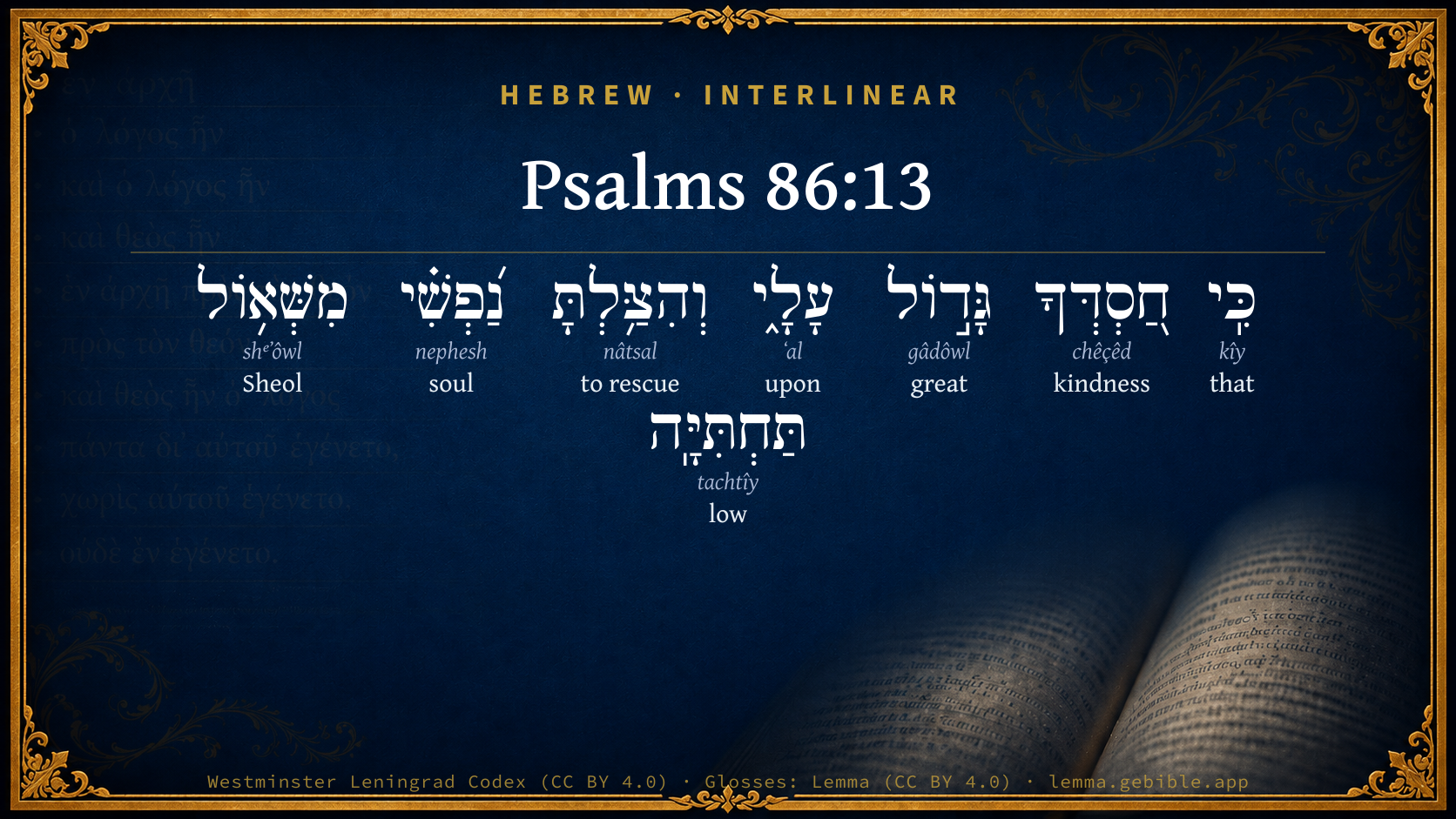
Psalms 86:13

Hebrew (Westminster Leningrad Codex) Psalms 86:13 appears in the Hebrew Old Testament. The text above is from the Westminster Leningrad Codex. Each word links to its Strong’s number, a concise gloss, and parsing drawn from the Open Scriptures Hebrew Bible morphology. Click any word for its full Brown-Driver-Briggs (BDB) entry.
Download image
Cite this verse

Psalms 86:13 (World English Bible). Public Domain. Lemma interlinear Bible study tool, https://lemma.gebible.app/v/psalms/86/13.

Show BibTeX & RIS
BibTeX
RIS
English Translation
For your loving kindness is great toward me. You have delivered my soul from the lowest Sheol.
World English Bible · Public Domain
Download a study sheet

One document with this verse’s original text, its word-by-word gloss line, the meaning frame, cross-references with their text, attributed commentary, and full source and license credits — printable, and it pastes into notes with its structure intact.

This verse Autodidact and up

Study sheet (.html) Plain text (.txt)

A passage Seminary Student

Up to 50 verses in one chapter. A passage sheet keeps up to 6 commentary sources and 12 cross-references per verse, in the order this page ranks them, and says so on the sheet whenever that leaves anything out. Ask for a single verse and you get the Autodidact verse sheet above.

Everything on this page stays free to read, with no account — the sheet is a download of what is already on screen, not access to it.

Want to remove ads? Support Godless Engineer
Compare translations 3

The same verse in 3 English versions, stacked beneath the original-language interlinear above. Click any original word for its lexicon entry.

Each is an independent rendering of the whole verse — the interlinear is not word-aligned to these translations.

Highlighted words mark where these versions differ — a whole-verse word diff, not a word-by-word alignment.

  • World English Bible Public Domain
    For your loving kindness is great toward me. You have delivered my soul from the lowest Sheol.
  • King James Version Public Domain
    For great is thy mercy toward me: and thou hast delivered my soul from the lowest hell.
  • unfoldingWord Literal Text CC BY-SA 4.0
    For your covenant faithfulness great toward me, and you have delivered my soul from lowest Sheol.

unfoldingWord Literal Text — © unfoldingWord, licensed CC BY-SA 4.0. Word-aligned USFM3 via Door43 (git.door43.org/unfoldingWord/en_ult).

Versions to compare (up to 4)

3 of 4 selected

Show all 18 translations

Every available English version of this verse, each an independent rendering of the whole verse.

  • World English Bible Public Domain
    For your loving kindness is great toward me. You have delivered my soul from the lowest Sheol.
  • Berean Standard Bible Public Domain
    For great is Your loving devotion to me; You have delivered me from the depths of Sheol.
  • Majority Standard Bible Public Domain
    For great is Your loving devotion to me; You have delivered me from the depths of Sheol.
  • King James Version Public Domain
    For great is thy mercy toward me: and thou hast delivered my soul from the lowest hell.
  • American Standard Version (1901) Public Domain
    For great is thy lovingkindness toward me; And thou hast delivered my soul from the lowest Sheol.
  • Revised Version (1885) Public Domain
    For great is thy mercy toward me; and thou hast delivered my soul from the lowest pit.
  • Geneva Bible (1599) Public Domain
    For great is thy mercie toward me, and thou hast deliuered my soule from the lowest graue.
  • Douay-Rheims (1899) Public Domain
    For thy mercy is great towards me: and thou hast delivered my soul out of the lower hell.
  • Young's Literal Translation Public Domain
    For Thy kindness `is' great toward me, And Thou hast delivered my soul from the lowest Sheol.
  • Literal Standard Version CC BY-SA 4.0
    For Your kindness [is] great toward me, || And You have delivered my soul from the lowest Sheol.
  • Unlocked Literal Bible CC BY-SA 4.0
    For great is your covenant faithfulness toward me; you have rescued my life from the depths of Sheol.
  • unfoldingWord Literal Text CC BY-SA 4.0
    For your covenant faithfulness great toward me, and you have delivered my soul from lowest Sheol.
  • Darby Bible Public Domain
    For great is thy loving-kindness toward me, and thou hast delivered my soul from the lowest Sheol.
  • World Messianic Bible Public Domain
    For your loving kindness is great toward me. You have delivered my soul from the lowest Sheol.
  • Webster's Bible Public Domain
    For great is thy mercy towards me: and thou hast delivered my soul from the lowest hell.
  • Free Bible Version CC BY-SA 4.0
    For your trustworthy love for me is so great; you have saved me from death.
  • Bible in Basic English Public Domain
    For your mercy to me is great; you have taken my soul up from the deep places of the underworld.
  • JPS Tanakh (1917) Public Domain
    For great is Thy mercy toward me; and Thou hast delivered my soul from the lowest nether-world.

Literal Standard Version (2020), Covenant Press — licensed CC BY-SA 4.0. Text via the HelloAO Bible API (eBible.org). Unlocked Literal Bible (unfoldingWord) — licensed CC BY-SA 4.0. Text via the HelloAO Bible API (eBible.org). unfoldingWord Literal Text — © unfoldingWord, licensed CC BY-SA 4.0. Word-aligned USFM3 via Door43 (git.door43.org/unfoldingWord/en_ult). Free Bible Version, Dr. Jonathan Gallagher — licensed CC BY-SA 4.0. Text via the HelloAO Bible API (eBible.org).

Word by word

More ways to search: Search by grammar → Find every occurrence → Compare this word →

Practice this passage: Drill this verse → Learn its vocabulary →

About this verse

These counts appear in no published source. They are computed here, from the morphology-tagged text and Lemma’s own curated glosses. What Lemma adds →

8
words
8
distinct lemmas
Wisdom
section

Notable vocabulary

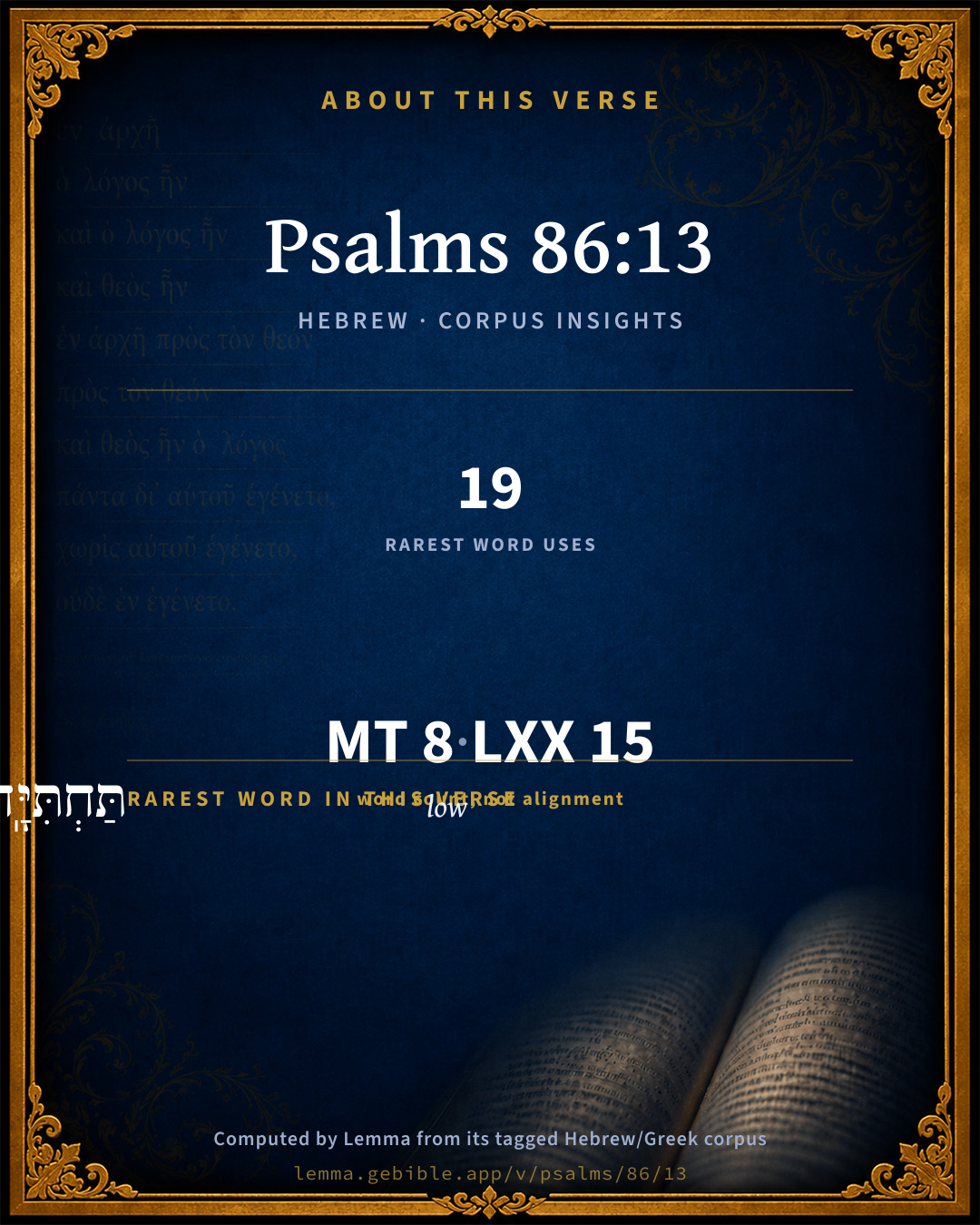
The rarest word here is תַּחְתִּיָּֽה low H8482 — appearing just 19 times in the whole Hebrew Bible.

Shared distinctive vocabulary

תַּחְתִּיָּֽה low H8482 occurs in 19 verses of the Hebrew Bible. Also found in:

Grammatical profile

  • 1 verb
  • 3 nouns
  • 2 adjectives
  • 1 preposition
  • 1 conjunction

Verb forms

  • וְהִצַּ֥לְתָּ Hiphil · Perfect

Hebrew & Septuagint length

In English translation the verse runs 17 words from the Hebrew and 17 from the Septuagint (LXX English) — the same length.

A rough comparison of the two English renderings, which tokenize alike — not a word-level alignment.

Word counts can differ between the Hebrew and the Greek without any difference in meaning — e.g. the Hebrew direct-object marker אֵת has no separate Greek word, and Greek often adds the article ὁ.

In the original languages it is 8 Hebrew tokens and 15 Greek tokens — but the two are counted differently (Hebrew bundles its prefixes and suffixes into one token; the Greek is in lemma form), so that isn’t a like-for-like length.

Cross-references

16

Topical passages linked to Psalms 86:13 in the Treasury of Scripture Knowledge — connected by theme and wording, ordered by reader-vote popularity; previews shown in the World English Bible.

  • Psalms 103:8–12 Yahweh is merciful and gracious, Slow to anger, and abundant in loving kindness.
  • Psalms 56:13 For you have delivered my soul from death, And prevented my feet from falling, That I may walk before God in the light of the living.
  • Luke 1:58 Her neighbors and her relatives heard that the Lord had magnified his mercy towards her, and they rejoiced with her.
  • Job 33:28 He has redeemed my soul from going into the pit, My life shall see the light.'
  • Psalms 57:10 For your great loving kindness reaches to the heavens, And your truth to the skies.
  • Psalms 116:8 For you have delivered my soul from death, My eyes from tears, And my feet from falling.
  • Psalms 16:10 For you will not leave my soul in Sheol, Neither will you allow your holy one to see corruption.
  • Psalms 30:3 Yahweh, you have brought up my soul from Sheol. You have kept me alive, that I should not go down to the pit.
  • 1 Thessalonians 1:10 and to wait for his Son from heaven, whom he raised from the dead-- Jesus, who delivers us from the wrath to come.
  • Job 33:24 Then God is gracious to him, and says, 'Deliver him from going down to the pit, I have found a ransom.'
  • Psalms 88:6 You have laid me in the lowest pit, In the darkest depths.
  • Job 33:18 He keeps back his soul from the pit, And his life from perishing by the sword.
  • Isaiah 38:17 Behold, [it was] for [my] peace [that] I had great bitterness: But you have in love to my soul delivered it from the pit of corruption; For you have cast all my sins behind your back.
  • Job 33:22 Yes, his soul draws near to the pit, And his life to the destroyers.
  • Psalms 108:4 For your loving kindness is great above the heavens. Your faithfulness reaches to the skies.
  • Jonah 2:3–6 For you threw me into the depths, In the heart of the seas. The flood was all around me. All your waves and your billows passed over me.

Cross-references courtesy of OpenBible.info (CC BY 4.0).

Hebrew and Greek witnesses Masoretic Hebrew ↔ Greek Septuagint

The same verse in the two great witnesses to the Old Testament, shown verse-for-verse.

You’re reading Greek Psalm 85 (Hebrew Psalm 86). The Septuagint counts the superscription, so verse numbers can differ from the Hebrew — chapter-level alignment, not verse-by-verse. Numbering follows Rahlfs.

These are two independent witnesses, not word-aligned to each other, and the Septuagint is shown in lemma (dictionary) form.

Hebrew Psalms 86:13 Masoretic · Westminster Leningrad Codex

כִּֽי חַ֭סְדְּךָ גָּד֣וֹל עָלָ֑י וְהִצַּ֥לְתָּ נַ֝פְשִׁ֗י מִשְּׁא֥וֹל תַּחְתִּיָּֽה

For your loving kindness is great toward me. You have delivered my soul from the lowest Sheol.

World English Bible · Public Domain

Greek LXX Greek Psalm 85:13 Septuagint · lemma form

ὅτι ὁ ἔλεος σύ μέγας ἐπί ἐγώ καί ῥύομαι ὁ ψυχή ἐγώ ἐκ ᾅδης κατώτατος

For your mercy is great toward me; and you have delivered my soul from the lowest hell.

LXX2012 (modern English Septuagint) · Public Domain

Hebrew: Westminster Leningrad Codex (CC BY 4.0). Greek: Septuagint (public domain); English from LXX2012 (modern English Septuagint) (Public Domain). How the Septuagint differs from the Hebrew →

Commentary

Notes on Psalms 86:13 from classic Christian and Jewish commentators (each source and its license shown beneath its notes). The classic Christian expositions comment on the surrounding passage and are grouped to its opening verse, so a note may address several verses; the Jewish commentaries on the Tanakh (Rashi and others) are per-verse, so they appear only where the commentator wrote on this verse.

Lemma curates 59 commentaries, every one of them public domain or Creative Commons licensed, each selected and text-cleaned for this edition rather than reprinted as found. About our sources →

Trapp's Complete Commentary

John Trapp

Psa 86:13 For great [is] thy mercy toward me: and thou hast delivered my soul from the lowest hell.

Ver. 13. Thou hast delivered my soul from the lowest hell] That is, from deadly and desperate dangers. Some understand it to be the damnation of hell which David had deserved by his sins. The Rabbis’ gloss is, A loco adulteris appropriato.

John Trapp, A Commentary or Exposition upon All the Books of the Old and New Testament (1647–1656) — public domain. Text from a community e-Sword module.

The Biblical Illustrator

Joseph S. Exell

Psa_86:13

Thou hast delivered my soul from the lowest hell

Saved from the depths

A plan has lately been proposed and successfully employed for raising the cargoes of sunken vessels.

A huge electro-magnet, operated from the deck of a vessel, is lowered to the submerged cargo; and if it be of a character subject to the influence of magnetism, it is attracted and lifted by this power, and thus easily saved. There is a power from on high which came to seek and save that which was lost. Down in the murky depths of the waters of sin, this magnet of love draws to itself sinful souls, and lifts them by its power to the bright sunlight and pure air above. Not by any virtue or power of their own--simply by the love that passeth understanding and the saving power of the Divine Redeemer--they are uplifted from the depths and made to stand among the rescued ones of the Lord. (Cora S. Day.)

The Biblical Illustrator, edited by Joseph S. Exell (c. 1880s–1900s) — public domain. Text from a community e-Sword module.

J. A. Alexander on Psalms

Joseph Addison Alexander

13. (Psa 86:13) For thy mercy (has been) great towards me, and thou hast freed my soul from the lowest hell. The most natural explanation of these words is that which makes them an appeal to former mercies as a reason for expecting new ones. If the psalm belongs to the period of Absalom's rebellion (see above, on Psa 86:1), the reference here may be to David's dangers and deliverances from Saul. Towards me, literally on me, with an implication of descent from above. Hell, in the wide sense of death or the state of the dead. See above, on Psa 6:5. Lowest, or lower, lying under, subterraneous. The expression is derived from Deu 32:22. With this verse compare Psa 18:5; Psa 56:13.

Joseph Addison Alexander, The Psalms Translated and Explained (1850) — public domain. Text from a community e-Sword module.

Geneva Bible (1599)

Geneva Bible translators

That is, from most great danger of death: out of the which none but only the almighty hand of God could deliver him.

Geneva Bible (1599) marginal notes — public domain. Text via Bolls.life.

Adam Clarke's Commentary

Verse 13. Thou hast delivered my soul from the lowest hell.] This must mean more than the grave; a hell below hell-a place of perdition for the soul, as the grave is a place of corruption for the body.

Adam Clarke's Commentary on the Bible (1810–1826) — public domain. Text from a community e-Sword/MySword module.

John Calvin's Commentaries

In the 13th verse, he sets forth the reason of this, which is, because, in delivering him, God had given a singular and remarkable proof of his mercy. To place in a stronger light the greatness of this benefit, he describes the dangers from which he had been delivered, by the expression, the lower grave; as if he had said, I have not been held down by one death only, but have been thrust down into the lowest depths of the grave, so that my circumstances required the hand of God to be stretched out to me in a wonderful manner. By the grace of the Lord Jesus Christ we are delivered from a still deeper abyss of death; and such being the case, our ingratitude will be inexcusable, unless each of us exercise himself to the utmost of his power in celebrating this deliverance. If David so highly magnified the name of God merely on account of the prolongation of his life for a short time, what praises are due for this unparalleled redemption by which we are drawn from the depths of hell and elevated to heaven? The Papists attempt to found an argument on this passage in support of their doctrine of Purgatory, as if that were an upper hell, while there was another lower; but this argument is too rotten to stand in need of refutation.

John Calvin's Commentaries (1540-1563) — public domain. Text from the Calvin Translation Society English edition (1840s-50s) via the Christian Classics Ethereal Library (ccel.org). Calvin's coverage is partial (roughly two-thirds of the Bible); uncommented books and verses are honest gaps, never fabricated. The 19th-century editor's footnotes and remarks are omitted so the notes are faithfully Calvin's own voice.

Ellicott's Commentary for English Readers

(13) Lowest hell.—Literally, sheôl, beneath, a fuller expression for the usual sheôl, underworld. (See Note, Psa_6:5.) There is no comparison implied as in the Authorised Version. It is evident from the next verse that what is meant is danger of death from violence.

A Bible Commentary for English Readers, edited by Charles John Ellicott (1878–1897) — public domain. Text from a community e-Sword module.

John Gill's Exposition

For great is thy mercy toward me,.... Both in things temporal and spiritual; an instance of which follows:

and thou hast delivered my soul from the lowest hell; from a very distressed and disconsolate condition, being almost in despair, under a deep sense of sin, and a fearful apprehension of the wrath of God, as, particularly, when he was charged by Nathan; or from hell itself, and the severest punishment in it; from the second and eternal death, which every man is deserving of, and are only delivered from by the grace of God, and blood of Christ: this shows the sense the psalmist had of the just demerit of sin, and his thankfulness for deliverance from it; see Psa 56:13. Kimchi interprets it of the grave; but says, there are some that interpret it of the judgment, or condemnation of hell: such who have escaped great dangers in long and perilous journeys, or have been delivered from threatening diseases, are said to be saved from hell (r).

(r) Vide Heraclit. de Incredib. c. 21. p. 86.

John Gill's Exposition of the Whole Bible (1746–1763) — public domain (CC PDM 1.0). Text via the HelloAO Bible API.

Albert Barnes' Notes on the Bible

For great is thy mercy toward me - In respect to me; or, Thou hast manifested great mercy to me; to wit, in past times. He makes use of this now as an argument or reason why God should interpose again.

(a) He had shown on former occasions that he had power to save;

(b) the fact that he had thus treated him as his friend was a reason why he should now befriend him.

And thou hast delivered my soul - My life. The meaning is, that he had kept him alive in times of imminent danger. At the same time David could say, as every child of God can say, that God had delivered his soul in the strict and proper sense of the term - from sin, and death, and hell itself.

From the lowest hell - Margin, grave; Hebrew, שׁאול she'ôl; Greek, ᾅδης Hadēs. See the word explained in the notes at Isa 14:9. Compare the notes at Job 10:21-22. The word rendered “lowest” means simply under, or beneath: the grave or hades beneath. The idea of lowest, or the superlative degree, is not necessarily implied in the word. The idea of the grave as deep, or as under us, however, is implied, and the psalmist means to say that he had been saved from that deep dwelling-place - from the abode of departed spirits, to which the dead descend under ground. The meaning is, that he had been kept alive; but the greatness of the mercy is designed to be set forth by having before the mind a vivid idea of the darkness, the horror, and the gloom of the world to which the dead descend, and where they dwell.

Albert Barnes' Notes on the Bible (1834–1885) — public domain. Text from a community e-Sword/MySword module.

Matthew Poole's English Annotations

My soul; my person or life, as in the next verse.

From the lowest hell; either,

1. From hell properly so called. Or rather,

2. From extreme and desperate dangers and miseries, by comparing this with Deu 32:22, and with Psa 88:6. Thou hast laid me in the lowest (the same word in the Hebrew which is here) pit; where by the pit he means, as is evident and confessed, the grave, which is commonly called sheol, the word here used.

Matthew Poole's English Annotations on the Holy Bible (1683–1685) — public domain. Text from a community e-Sword/MySword module.

The Treasury of David

Charles H. Spurgeon

Ver. 13. For great is thy mercy toward me. Personal experience is ever the master singer. Whatever thou art to others, to me thy mercy is most notable. The psalmist claims to sing among the loudest, because his debt to divine mercy is among the greatest.

And thou hast delivered my soul from the lowest hell. From the direst death and the deepest dishonour David had been kept by God, for his enemies would have done more than send him to hell had they been able. His sense of sin also made him feel as if the most overwhelming destruction would have been his portion had not grace prevented, therefore does he speak of deliverance from the nethermost abode of lost spirits. There are some alive now who can use this language unfeignedly, and he who pens these lines most humbly confesses that he is one. Left to myself to indulge my passions, to rush onward with my natural vehemence, and defy the Lord with recklessness of levity, what a candidate for the lowest abyss should I have made myself by this time. For me, there was but one alternative, great mercy, or the lowest hell. With my whole heart do I sing, "Great is thy mercy towards me, and thou hast delivered my soul from the lowest hell."

The psalmist here again touches a bold and joyful note, but soon he exchanges it for the mournful string.

Ver. 13. Hell is put metaphorically for great and extreme dangers, or miseries which seem irrecoverable and remediless; these are figuratively called hell, because hell, properly taken, is a place from whence there is no recovery. There's no release from the chains of darkness: all changes are on earth; heaven and hell know none. When David praises the Lord for delivering his soul from the lowest hell, he meaneth an estate on earth of the lowest and deepest danger imaginable: mercy helped him at the worst. To be as low as hell, is to be at the lowest. Joseph Caryl.

Ver. 13. The lowest hell. According to Jewish traditions, there are seven different regions, in the abode of departed souls. Daniel Creswell.

Ver. 13. Thou hast delivered my soul from the lowest hell. Someone having a troublesome cause was to be sent to prison: another comes and defends him; what does he say when he thanks him? Thou hast delivered my soul out of prison. A debtor was to be tortured: his debt is paid; he is said to be delivered from being tortured. They were not in all these evils; but because they were in such due course towards them, that unless aid had been brought, they would have been in them, they rightly say that they are delivered from thence, whither they were not suffered by their deliverers to be taken. Augustine.

Ver. 13,16. There is no stronger argument of God's infallible readiness to grant our requests, than the experience of his former concessions. So David reasons, "The Lord that delivered me out of the paw of the lion, and out of the paw of the bear, he will deliver me out of the hand of this Philistine", 1Sa 17:37. This is the argument a priori, the voice of a strong faith, that persuades the conscience God will be gracious to him, because he hath been gracious. The prophet thus often comforted his soul: "Thou hast enlarged me when I was in distress"; therefore, "have mercy upon me, and hear my prayer", Ps 4:1. So, Thou hast delivered my soul from the lowest hell; therefore, O turn unto me, and have mercy upon me. Let the justiciaries deduce arguments from their own present merits, my soul from God's former mercies. Thou, O Lord, madest me good, restoredst me when I was evil; therefore have mercy upon me, miserable sinner, and give me thy salvation. Thus Paul grounded his assurance: because the Lord had stood with him, and delivered him out of the lion's mouth; therefore the Lord shall deliver me still, from every evil work, and preserve me unto his heavenly kingdom. 2Ti 4:17-18. Thomas Adams.

Ver. 13.

1. Where I might have been"the lowest hell".

2. What thou hast done for me"hast delivered".

3. What thou art doing"great is thy mercy."

Ver. 13. (first clause). God's mercy great in election, redemption, calling, pardon, upholding, etc. It is so, at this very moment, in supplying my needs, preserving from danger, consoling in sorrow, etc. Great is thy mercy towards me so great a sinner, with such needs, so provoking, so full of doubts, etc.

Ver. 13-15. The three verses describe salvation, consequent persecution, and all sufficient consolation.

Psalms 86:14*

Charles H. Spurgeon's The Treasury of David (1869–1885) — public domain. Psalms only. Text from a community e-Sword/MySword module.

Whedon's Commentary on the Bible

Daniel D. Whedon

13. Lowest hell—The lowest grave, or pit. שׁאול, (sheol,) is generally used in this sense, and the same form of confession as in the text occurs Psa_30:3, where the common version has grave— “Thou hast brought up my soul from the grave.” And in Hos_13:14, “I will ransom them from the power of the grave… O grave I will be thy destruction.” This deliverance from “the deepest sheol” (grave) was a rescue from imminent and terrible destruction; it was as a resurrection from the dead. The remembrance of it now comes up to the psalmist, and becomes a ground of hope and pledge of renewed mercy.

Daniel D. Whedon (gen. ed.), Commentary on the Old and New Testaments (1874–1909) — public domain. Text from a community e-Sword module.

The Pulpit Commentary

For great is thy mercy toward me (see ver. 5). And thou hast delivered my soul from the lowest hell. The actual deliverance was from death (ver. 14); but death involved descent into Hades, so that those who were delivered from the one were at the same time delivered from the other. The expression translated "the lowest hell" means no more than "Hades which is beneath the earth." No comparison is made of one part of Hades with another.

The plea for more grace.

What God has done is made into a ground for pleading that he would do even more abundantly. A psalmist can ask great things when he is well assured that he who has given much grace can give more grace. The plea based on what God has done is made to include two things soul redemption, life benediction. These are well expressed in the Revised Version of Psa_56:13, "For thou hast delivered my soul from death: hast thou not delivered my feet from falling?" The review is more complete in Psa_116:8, "For thou hast delivered my soul from death, mine eyes from tears, and my feet from falling.

I WHAT GOD HAS DONE FOR US SHOWS US WHAT HE CAN DO.

II WHAT GOD HAS DONE FOR US SHOWS US WHAT HE WILL DO.

III WHAT GOD HAS DONE FOR US GIVES US AN ARGUMENT TO URGE WITH HIM.

IV WHAT GOD HAS DONE SETS US UPON MAINTAINING THE CONDITIONS ON WHICH THE BLESSINGS HAVE COME TO US. For we are not straitened either in God"s power or God"s will. If straitened, it can only be because we fail to respond to the Divine conditions. R.T.

The Pulpit Commentary (1880–1919), ed. H.D.M. Spence-Jones & Joseph S. Exell — public domain. Text from a community e-Sword module.

John Wesley's Explanatory Notes

Hell - From extreme dangers and miseries.

John Wesley, Explanatory Notes Upon the Whole Bible (1754–1765) — public domain. Text via the GEBible commentary corpus.

Scofield Reference Notes

C. I. Scofield

hell

Heb. "Sheol," (See Scofield "Hab 2:5").

The Scofield Reference Bible (1917 edition), notes by C. I. Scofield — public domain. Text from a community e-Sword module.

unfoldingWord translationNotes

Door43 World Missions Community

For great is your covenant faithfulness toward me

The abstract noun "faithfulness" can be stated as an adjective. AT: "For you are very faithful to me because of your covenant" (See: Abstract Nouns)

you have rescued my life from the depths of Sheol

This does not mean God brought him back to life after he died. It means God saved him when he was about to die.

the arrogant

This nominal adjective can be stated as an adjective. AT: "arrogant people" (See: Nominal Adjectives)

have risen up against me

"are coming together to harm me"

seek my life

This is a way of saying they want to kill him. (See: Idiom)

translationWords

covenant faithfulness

Hades

arrogant

raise

life

unfoldingWord translationNotes — © Distant Shores Media and the Door43 World Missions Community, licensed CC BY-SA 4.0. Source: git.door43.org/Door43/en_tn.

Rashi

Rabbi Shlomo Yitzchaki (Rashi)

from the lowest depths of the grave It is customary for adulterers to be put into the depth of the grave, and from there You saved me, for Nathan the prophet said to me (II Sam. 12:13): “Also the Lord has removed your sin.”

Rashi on the Tanakh — English translations: “The Judaica Press complete Tanach with Rashi, translated by A. J. Rosenberg” (CC BY 4.0); “Pentateuch with Rashi's commentary by M. Rosenbaum and A.M. Silbermann, 1929-1934” (public domain); “The Metsudah Tanach series, Lakewood, N.J” (CC BY 4.0); and “The Book of Joshua, Metsudah Publications, 1997” (CC BY 4.0). Text via Sefaria.

Lesson kit

Teaching starters — assembled from the data on this page, not authored interpretation. Every prompt links to the verse data it draws on. Edit before teaching.

Psalms, in the Wisdom, opens this verse with 8 words (8 distinct Hebrew lemmas). Its most distinctive word is tachtîy (“low”). A historical commentator’s framing appears above. Read the whole chapter for the surrounding context.

Discussion questions

  1. How does “low” (tachtîy) shape what this verse is saying?
  2. Genesis 6:16 shares the word «low» with this verse. How do the two illuminate each other?
  3. These translations render this verse differently. What is at stake in choosing one wording over another?
  4. The verb «וְהִצַּ֥לְתָּ» is Hiphil Perfect. How does its form color the action?
  5. Reading how Trapp's Complete Commentary and The Biblical Illustrator read this verse, where do the two commentators agree and where do they part?

Things to notice

Reading settings

Reading text

Shown beneath each verse's original-language words.

Old Testament
Old Testament edition

Read the OT as the Masoretic Hebrew (MT) or the Greek Septuagint (LXX).

English shown for the Greek Septuagint (in the Hebrew ↔ Greek comparison).

Comparing translations? Open the Compare panel on any verse page to stack up to four side by side.