Exodus 5:23

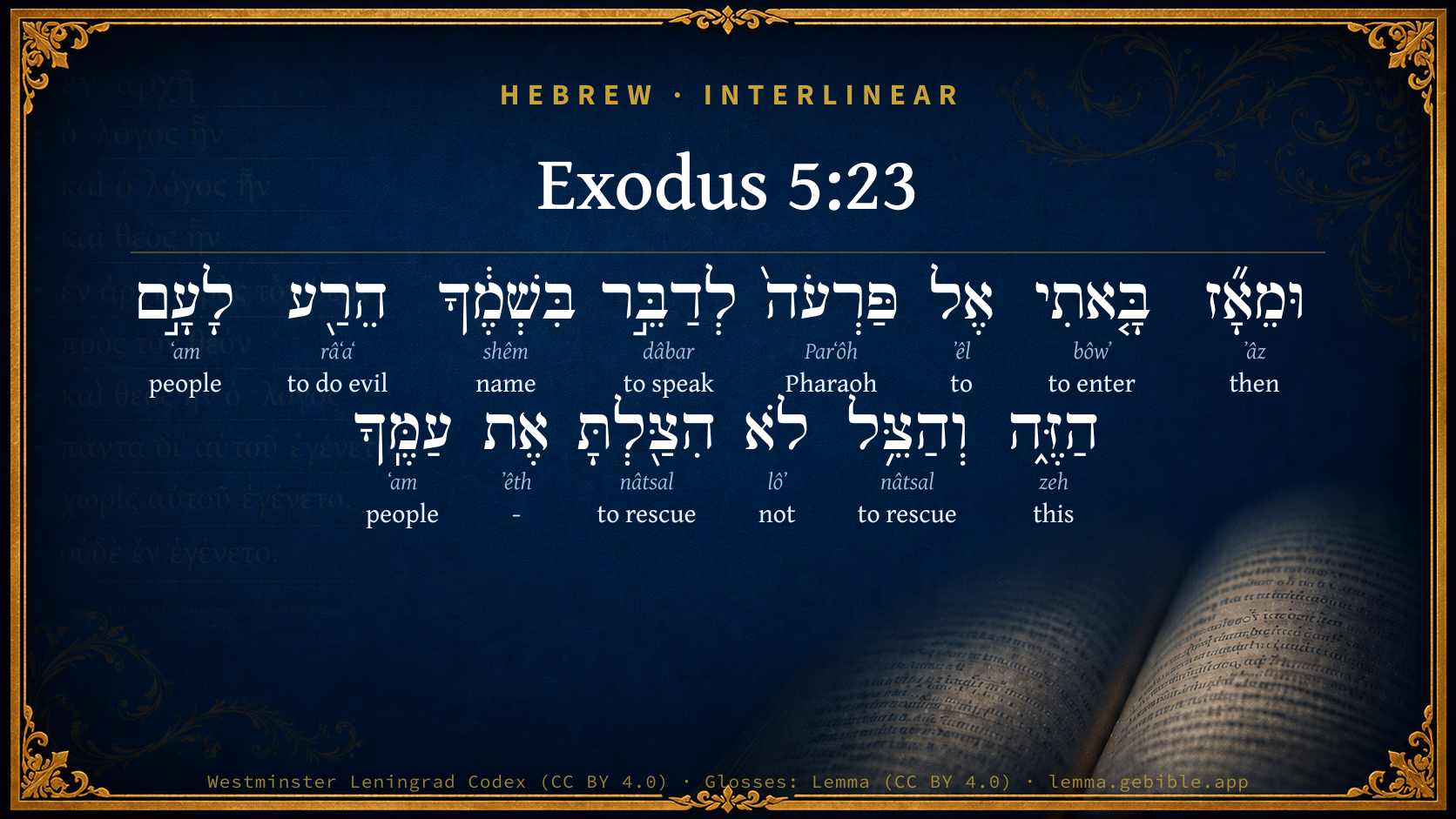
Hebrew (Westminster Leningrad Codex) Exodus 5:23 appears in the Hebrew Old Testament. The text above is from the Westminster Leningrad Codex. Each word links to its Strong’s number, a concise gloss, and parsing drawn from the Open Scriptures Hebrew Bible morphology. Click any word for its full Brown-Driver-Briggs (BDB) entry.
Download image
Cite this verse

Exodus 5:23 (World English Bible). Public Domain. Lemma interlinear Bible study tool, https://lemma.gebible.app/v/exodus/5/23.

Show BibTeX & RIS
BibTeX
RIS
English Translation
For since I came to Pharaoh to speak in your name, he has brought trouble on this people; neither have you delivered your people at all."
World English Bible · Public Domain
Download a study sheet

One document with this verse’s original text, its word-by-word gloss line, the meaning frame, cross-references with their text, attributed commentary, and full source and license credits — printable, and it pastes into notes with its structure intact.

This verse Autodidact and up

Study sheet (.html) Plain text (.txt)

A passage Seminary Student

Up to 50 verses in one chapter. A passage sheet keeps up to 6 commentary sources and 12 cross-references per verse, in the order this page ranks them, and says so on the sheet whenever that leaves anything out. Ask for a single verse and you get the Autodidact verse sheet above.

Everything on this page stays free to read, with no account — the sheet is a download of what is already on screen, not access to it.

Want to remove ads? Support Godless Engineer
Compare translations 3

The same verse in 3 English versions, stacked beneath the original-language interlinear above. Click any original word for its lexicon entry.

Each is an independent rendering of the whole verse — the interlinear is not word-aligned to these translations.

Highlighted words mark where these versions differ — a whole-verse word diff, not a word-by-word alignment.

  • World English Bible Public Domain
    For since I came to Pharaoh to speak in your name, he has brought trouble on this people; neither have you delivered your people at all."
  • King James Version Public Domain
    For since I came to Pharaoh to speak in thy name, he hath done evil to this people; neither hast thou delivered thy people at all.
  • unfoldingWord Literal Text CC BY-SA 4.0
    And since I came to Pharaoh to speak in your name, he has afflicted this people. And you have certainly not rescued your people.”

unfoldingWord Literal Text — © unfoldingWord, licensed CC BY-SA 4.0. Word-aligned USFM3 via Door43 (git.door43.org/unfoldingWord/en_ult).

Versions to compare (up to 4)

3 of 4 selected

Show all 18 translations

Every available English version of this verse, each an independent rendering of the whole verse.

  • World English Bible Public Domain
    For since I came to Pharaoh to speak in your name, he has brought trouble on this people; neither have you delivered your people at all."
  • Berean Standard Bible Public Domain
    Ever since I went to Pharaoh to speak in Your name, he has brought trouble on this people, and You have not delivered Your people in any way.”
  • Majority Standard Bible Public Domain
    Ever since I went to Pharaoh to speak in Your name, he has brought trouble on this people, and You have not delivered Your people in any way.”
  • King James Version Public Domain
    For since I came to Pharaoh to speak in thy name, he hath done evil to this people; neither hast thou delivered thy people at all.
  • American Standard Version (1901) Public Domain
    For since I came to Pharaoh to speak in thy name, he hath dealt ill with this people; neither hast thou delivered thy people at all.
  • Revised Version (1885) Public Domain
    For since I came to Pharaoh to speak in thy name, he hath evil entreated this people; neither hast thou delivered thy people at all.
  • Geneva Bible (1599) Public Domain
    For since I came to Pharaoh to speake in thy Name, he hath vexed this people, and yet thou hast not deliuered thy people.
  • Douay-Rheims (1899) Public Domain
    For since the time that I went in to Pharao to speak in thy name, he hath afflicted thy people: and thou hast not delivered them.
  • Young's Literal Translation Public Domain
    and since I have come unto Pharaoh, to speak in Thy name, he hath done evil to this people, and Thou hast not at all delivered Thy people.'
  • Literal Standard Version CC BY-SA 4.0
    And since I have come to Pharaoh to speak in Your Name, he has done evil to this people, and You have not delivered Your people at all.”
  • Unlocked Literal Bible CC BY-SA 4.0
    Ever since I came to Pharaoh to speak to him in your name, he has caused trouble for this people, and you have not set your people free at all.”
  • unfoldingWord Literal Text CC BY-SA 4.0
    And since I came to Pharaoh to speak in your name, he has afflicted this people. And you have certainly not rescued your people.”
  • Darby Bible Public Domain
    For ever since I came to Pharaoh to speak in thy name, he hath done evil to this people; neither hast thou delivered thy people at all!
  • World Messianic Bible Public Domain
    For since I came to Pharaoh to speak in your name, he has brought trouble on this people. You have not rescued your people at all!”
  • Webster's Bible Public Domain
    For since I came to Pharaoh to speak in thy name, he hath done evil to this people; neither hast thou delivered thy people at all.
  • Free Bible Version CC BY-SA 4.0
    Ever since I went to Pharaoh to speak for you, he has been even harder on your people, and you haven't done anything to save them!”
  • Bible in Basic English Public Domain
    For from the time when I came to Pharaoh to put your words before him, he has done evil to this people, and you have given them no help.
  • JPS Tanakh (1917) Public Domain
    For since I came to Pharaoh to speak in Thy name, he hath dealt ill with this people; neither hast Thou delivered Thy people at all.'

Literal Standard Version (2020), Covenant Press — licensed CC BY-SA 4.0. Text via the HelloAO Bible API (eBible.org). Unlocked Literal Bible (unfoldingWord) — licensed CC BY-SA 4.0. Text via the HelloAO Bible API (eBible.org). unfoldingWord Literal Text — © unfoldingWord, licensed CC BY-SA 4.0. Word-aligned USFM3 via Door43 (git.door43.org/unfoldingWord/en_ult). Free Bible Version, Dr. Jonathan Gallagher — licensed CC BY-SA 4.0. Text via the HelloAO Bible API (eBible.org).

Word by word

More ways to search: Search by grammar → Find every occurrence → Compare this word →

Practice this passage: Drill this verse → Learn its vocabulary →

הֵרַ֖ע
râʻaʻ
H7489
“to do evil”
Verb, Hiphil, Perfect, 3rd Person, Masculine, Singular
Part of Speech
Verb
Stem
Hiphil
Form
Perfect
Person
3rd Person
Gender
Masculine
Number
Singular
Full BDB Definition

Origin: a primitive root

TWOT: 2191 , 2192

to be bad, be evil - (Qal) - to be displeasing - to be sad - to be injurious, be evil - to be wicked, be evil (ethically) - (Hiphil) - to do an injury or hurt - to do evil or wickedly - mischief (participle) - to break, shatter - (Qal) - to break - broken (participle) - to be broken - (Hithpolel) to be broken, be broken in pieces, be broken asunder
  1. וּמֵאָ֞ז ʼâz H227 “and · from · then” Conjunction + Preposition + Adverb
  2. בָּ֤אתִי bôwʼ H935 “to enter” Verb, Qal, Perfect, 1st Person, Common, Singular
  3. אֶל ʼêl H413 “to” Preposition
  4. פַּרְעֹה֙ Parʻôh H6547 “Pharaoh” Noun, Proper
  5. לְדַבֵּ֣ר dâbar H1696 “to speak” Preposition + Verb, Piel, Infinitive Construct
  6. בִּשְׁמֶ֔ךָ shêm H8034 “in/at · name · your” Preposition + Noun, Common, Masculine, Singular, Construct + Suffix, Personal, 2nd Person, Masculine, Singular
  7. לָעָ֣ם ʻam H5971 “to/for the · people” Preposition, Determined + Noun, Common, Masculine, Singular, Absolute
  8. הַזֶּ֑ה zeh H2088 “the · this” Particle, Definite Article + Pronoun, Demonstrative, Masculine, Singular
  9. וְהַצֵּ֥ל nâtsal H5337 “and · to rescue” Conjunction + Verb, Hiphil, Infinitive Absolute
  10. לֹא lôʼ H3808 “not” Particle, Negative
  11. הִצַּ֖לְתָּ nâtsal H5337 “to rescue” Verb, Hiphil, Perfect, 2nd Person, Masculine, Singular
  12. אֶת ʼêth H853 “-” Particle, Direct Object
  13. עַמֶּֽךָ ʻam H5971 “people · your” Noun, Common, Masculine, Singular, Construct + Suffix, Personal, 2nd Person, Masculine, Singular

About this verse

These counts appear in no published source. They are computed here, from the morphology-tagged text and Lemma’s own curated glosses. What Lemma adds →

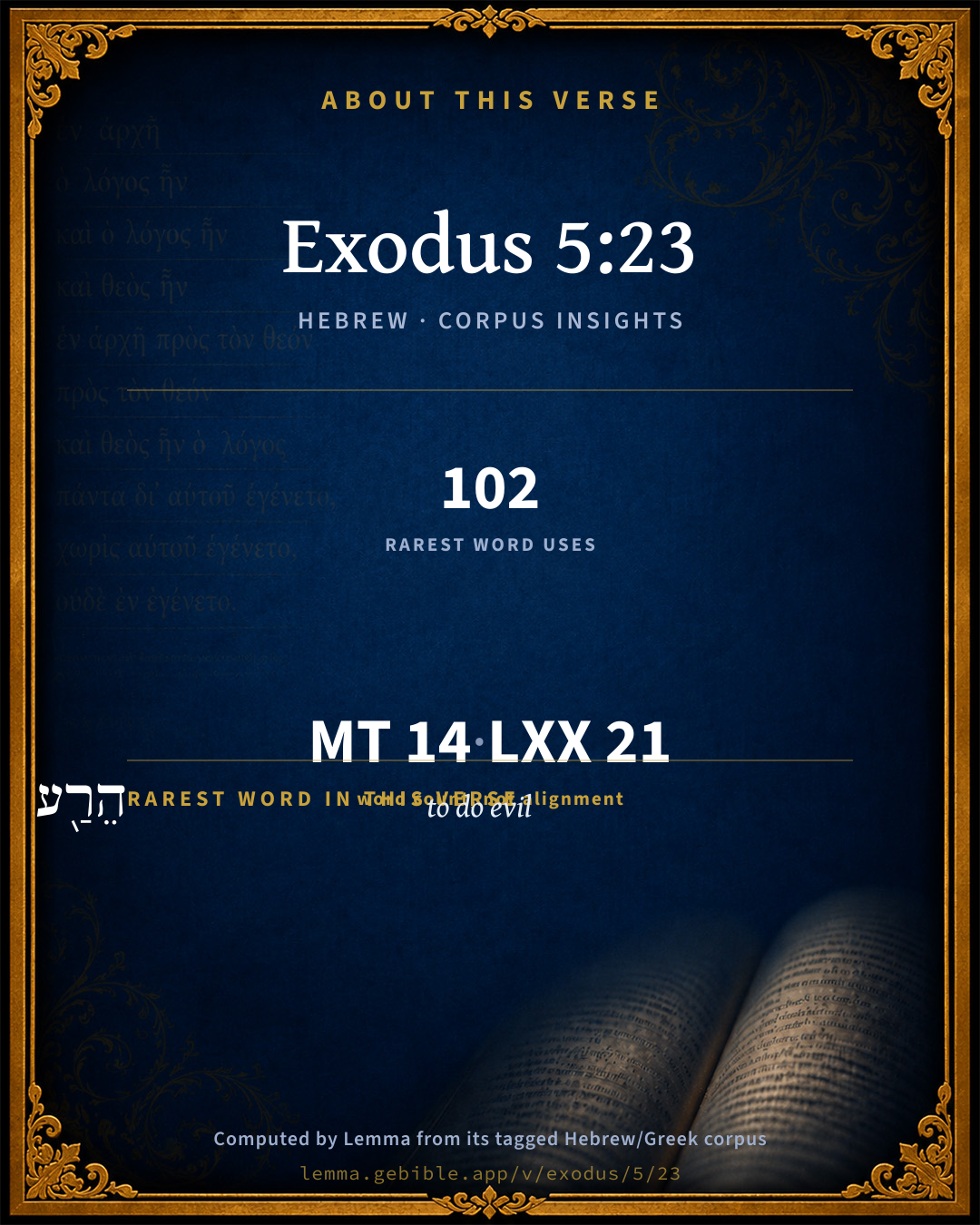
14
words
12
distinct lemmas
Pentateuch
section

Grammatical profile

  • 5 verbs
  • 4 nouns
  • 1 pronoun
  • 1 preposition
  • 1 adverb
  • 2 particles

Verb forms

  • בָּ֤אתִי Qal · Perfect
  • לְדַבֵּ֣ר Piel · Infinitive Construct
  • הֵרַ֖ע Hiphil · Perfect
  • וְהַצֵּ֥ל Hiphil · Infinitive Absolute
  • הִצַּ֖לְתָּ Hiphil · Perfect

Repetition

Words recur within this verse — often emphatic in Hebrew:

  • לָעָ֣ם people H5971 ×2
  • וְהַצֵּ֥ל to rescue H5337 ×2

Hebrew & Septuagint length

In English translation the verse runs 26 words from the Hebrew and 26 from the Septuagint (LXX English) — the same length.

A rough comparison of the two English renderings, which tokenize alike — not a word-level alignment.

Word counts can differ between the Hebrew and the Greek without any difference in meaning — e.g. the Hebrew direct-object marker אֵת has no separate Greek word, and Greek often adds the article ὁ.

In the original languages it is 14 Hebrew tokens and 21 Greek tokens — but the two are counted differently (Hebrew bundles its prefixes and suffixes into one token; the Greek is in lemma form), so that isn’t a like-for-like length.

Cross-references

6

Topical passages linked to Exodus 5:23 in the Treasury of Scripture Knowledge — connected by theme and wording, ordered by reader-vote popularity; previews shown in the World English Bible.

  • Psalms 118:26 Blessed is he who comes in the name of Yahweh! We have blessed you out of the house of Yahweh.
  • Isaiah 26:17–18 Like as a woman with child, who draws near the time of her delivery, is in pain and cries out in her pangs; so we have been before you, Yahweh.
  • Isaiah 28:16 therefore thus says the Lord Yahweh, Behold, I lay in Zion for a foundation a stone, a tried stone, a precious corner -[stone] of sure foundation: he who believes shall not be in haste.
  • Jeremiah 11:21 Therefore thus says Yahweh concerning the men of Anathoth, who seek your life, saying, You shall not prophesy in the name of Yahweh, that you not die by our hand;
  • Hebrews 10:36–37 For you need endurance so that, having done the will of God, you may receive the promise.
  • John 5:43 I have come in my Father's name, and you don't receive me. If another comes in his own name, you will receive him.

Cross-references courtesy of OpenBible.info (CC BY 4.0).

Hebrew and Greek witnesses Masoretic Hebrew ↔ Greek Septuagint

The same verse in the two great witnesses to the Old Testament, shown verse-for-verse.

These are two independent witnesses, not word-aligned to each other, and the Septuagint is shown in lemma (dictionary) form.

Hebrew Exodus 5:23 Masoretic · Westminster Leningrad Codex

וּמֵאָ֞ז בָּ֤אתִי אֶל פַּרְעֹה֙ לְדַבֵּ֣ר בִּשְׁמֶ֔ךָ הֵרַ֖ע לָעָ֣ם הַזֶּ֑ה וְהַצֵּ֥ל לֹא הִצַּ֖לְתָּ אֶת עַמֶּֽךָ

For since I came to Pharaoh to speak in your name, he has brought trouble on this people; neither have you delivered your people at all."

World English Bible · Public Domain

Greek LXX Exodus 5:23 Septuagint · lemma form

καί ἀπό ὅς πορεύομαι πρός φαραώ λαλέω ἐπί ὁ σός ὄνομα κακόω ὁ λαός οὗτος καί οὐ ῥύομαι ὁ λαός σύ

For from the time that I went to Pharao to speak in your name, he has afflicted this people, and you have not delivered your people.

LXX2012 (modern English Septuagint) · Public Domain

Hebrew: Westminster Leningrad Codex (CC BY 4.0). Greek: Septuagint (public domain); English from LXX2012 (modern English Septuagint) (Public Domain). How the Septuagint differs from the Hebrew →

Targum (Aramaic paraphrase)

2

The Targum is the ancient Jewish Aramaic paraphrase of the Hebrew Scriptures — an interpretive translation, not the Hebrew text itself. Onkelos (literal) and Pseudo-Jonathan (expansive) render the Torah, and Jonathan the Prophets. Coverage is partial: where no permissively-licensed English translation exists for a verse, only the Aramaic is shown. This is verse-level text, not a word-by-word alignment to the Hebrew.

  1. Targum Onkelos Torah (Genesis–Deuteronomy)
    וּמֵעִדַן עַלִית לְוָת פַּרְעֹה לְמַלָלָא בִשְׁמָךְ אַבְאֵשׁ לְעַמָּא הָדֵין וְשֵׁזָבָא לָא שֵׁזַבְתָּא יָת עַמָךְ:

    (no public-domain English translation for this verse)

    Targum Onkelos — Aramaic: “Onkelos Genesis” (public domain); “Onkelos Exodus” (public domain); “Onkelos Leviticus” (public domain); “Onkelos Numbers” (public domain); “Onkelos Deuteronomy” (public domain). English: “Sefaria Community Translation” (CC0 1.0 (public-domain dedication)); “J.W. Etheridge. The Targums of Onkelos and Jonathan Ben Uzziel on the Pentateuch. London: Longmans, Green, 1862” (public domain). Text via Sefaria.

  2. Targum Pseudo-Jonathan Torah (Genesis–Deuteronomy)
    וּמִן שַׁעְתָּא דְעָלִית לְוַת פַּרְעה לְמַלָלָא בִשְׁמָךְ אִתְבְּאֵשׁ לְעַמָא הָדֵין וְשֵׁיזְבָא לָא שֵׁיזַבְתָּא יַת עַמָךְ

    From the hour that I went in unto Pharoh to speak in Thy name, this people hath suffered evil, and delivering Thou hast not delivered them.

    Targum Pseudo-Jonathan — Aramaic: “Targum Jonathan on Genesis” (public domain); “Targum Jonathan on Exodus” (public domain); “Targum Jonathan on Leviticus” (public domain); “Targum Jonathan on Numbers” (public domain); “Targum Jonathan on Deuteronomy” (public domain). English: “The Targum of Jonathan ben Uzziel, trans. J. W. Etheridge, London, 1862” (public domain). Text via Sefaria.

Commentary

Notes on Exodus 5:23 from classic Christian and Jewish commentators (each source and its license shown beneath its notes). The classic Christian expositions comment on the surrounding passage and are grouped to its opening verse, so a note may address several verses; the Jewish commentaries on the Tanakh (Rashi and others) are per-verse, so they appear only where the commentator wrote on this verse.

Lemma curates 59 commentaries, every one of them public domain or Creative Commons licensed, each selected and text-cleaned for this edition rather than reprinted as found. About our sources →

Trapp's Complete Commentary

John Trapp

Exo 5:23 For since I came to Pharaoh to speak in thy name, he hath done evil to this people; neither hast thou delivered thy people at all.

Ver. 23. Neither hast thou delivered.] Here Moses himself was too short spirited. He considered not, belike, that God’s promises do many times bear a long date, neither is it fit to set him a time, or to awaken him whom our soul loveth, until he please. Do but "wait," saith the Lord. {Hab 2:3} You shall be delivered, you shall be delivered, you shall be delivered; you shall, you shall. So much that text in effect soundeth and assureth.

John Trapp, A Commentary or Exposition upon All the Books of the Old and New Testament (1647–1656) — public domain. Text from a community e-Sword module.

Adam Clarke's Commentary

Verse 23. He hath done evil to this people] Their misery is increased instead of being diminished.

Neither hast thou delivered thy people at all.] The marginal reading is both literal and correct: And delivering thou hast not delivered. Thou hast begun the work by giving us counsels and a commission, but thou hast not brought the people from under their bondage. Thou hast signified thy pleasure relative to their deliverance, but thou hast not brought them out of the hands of their enemies.

1. IT is no certain proof of the displeasure of God that a whole people, or an individual, may be found in a state of great oppression and distress; nor are affluence and prosperity any certain signs of his approbation. God certainly loved the Israelites better than he did the Egyptians; yet the former were in the deepest adversity, while the latter were in the height of prosperity. Luther once observed, that if secular prosperity were to be considered as a criterion of the Divine approbation, then the grand Turk must be the highest in the favour of God, as he was at that time the most prosperous sovereign on the earth. An observation of this kind, on a case so obvious, was really well calculated to repress hasty conclusions drawn from these external states, and to lay down a correct rule of judgment for all such occasions.

2. In all our addresses to God we should ever remember that we have sinned against him, and deserve nothing but punishment from his hand. We should therefore bow before him with the deepest humiliation of soul, and take that caution of the wise man, "Be not rash with thy mouth, and let not thine heart be hasty to utter any thing before God; for God is in heaven, and thou upon earth; therefore let thy words be few," Ec 5:2. There is the more need to attend to this caution, because many ignorant though well-meaning people use very improper, not to say indecent, freedoms in their addresses to the throne of grace. With such proceedings God cannot be well pleased; and he who has not a proper impression of the dignity and excellence of the Divine Nature, is not in such a disposition as it is essentially necessary to feel in order to receive help from God. He who knows he has sinned, and feels that he is less than the least of all God's mercies, will pray with the deepest humility, and even rejoice before God with trembling. A solemn AWE of the Divine Majesty is not less requisite to successful praying, than faith in our Lord Jesus Christ. When we have such a commission as that of Moses, we may make use of his freedom of speech; but till then, the publican's prayer will best suit the generality of those who are even dignified by the name of Christian - Lord, be merciful to ME, a SINNER!

Adam Clarke's Commentary on the Bible (1810–1826) — public domain. Text from a community e-Sword/MySword module.

The Cambridge Bible for Schools and Colleges

gen. ed. J. J. S. Perowne

23. neither, &c.] according to the promise, Exo Exo_3:8.

The Cambridge Bible for Schools and Colleges (gen. ed. J. J. S. Perowne; Cambridge University Press, 1878–1918) — public domain. Text from a community e-Sword module.

John Gill's Exposition

For since I came to Pharaoh to speak in thy name,.... Had he come in his own name, it needed not be wondered at if he should not succeed, but coming in the name of God, it might have been expected he would, and that Pharaoh would have been prevailed upon, or obliged to use the people well, and let them go; but instead of that:

he hath done evil to this people; afflicted and oppressed them more than ever: see Exo 5:7, &c.

neither hast thou delivered thy people at all; there was not the least thing done towards their deliverance, their affliction was not at all mitigated, but increased: Moses expected that God would have made a beginning as soon as he had delivered his message to Pharaoh; that his mind would have been disposed in favour of the people, and he would have made their bondage lighter and easier, if he did not dismiss them at once; but, instead of that, more work was laid upon them, and their burdens were heavier: now this was a stumbling and a temptation to Moses, to wish he had never been sent; but if he had called to mind, which he seems to have forgotten, that Pharaoh would not let the people go at first, until all the wonders were wrought he had given him power to do, Exo 4:2 it would have relieved him, and removed his objections, and put a stop to his expostulation with God, who gives an answer to them in the following chapter, without expressing any displeasure at them.

Next: Exodus Chapter 6

John Gill's Exposition of the Whole Bible (1746–1763) — public domain (CC PDM 1.0). Text via the HelloAO Bible API.

Albert Barnes' Notes on the Bible

The earnestness of this remonstrance, and even its approach to irreverence, are quite in keeping with other notices of Moses’ naturally impetuous character. See Exo 3:13.

Albert Barnes' Notes on the Bible (1834–1885) — public domain. Text from a community e-Sword/MySword module.

Matthew Poole's English Annotations

In thy name; not of my own head, but by thy command and commission.

Neither hast thou delivered thy people, according to thy promise and mine, and thy people’s just expectation.

Matthew Poole's English Annotations on the Holy Bible (1683–1685) — public domain. Text from a community e-Sword/MySword module.

The Pulpit Commentary

He hath done evil to this people. See above, vers. 7-9, and ver. 14. Pharaoh had increased the burdens of the whole nation, and in this way "done evil" to them. He had also brought the punishment of scourging on a number of the chiefs. Neither hast thou delivered thy people at all. The promised deliverance (Exo_3:8, Exo_3:20) had not come there was no sign of it the people was suffering under a more cruel bondage than ever.

The Pulpit Commentary (1880–1919), ed. H.D.M. Spence-Jones & Joseph S. Exell — public domain. Text from a community e-Sword module.

Rashi

Rabbi Shlomo Yitzchaki (Rashi)

הרע This is an expression denoting “he has caused something to happen” — he (Pharaoh) has brought even more evil upon them. It must be translated in the Targum by אבאיש “he has treated badly”.

Rashi on the Tanakh — English translations: “The Judaica Press complete Tanach with Rashi, translated by A. J. Rosenberg” (CC BY 4.0); “Pentateuch with Rashi's commentary by M. Rosenbaum and A.M. Silbermann, 1929-1934” (public domain); “The Metsudah Tanach series, Lakewood, N.J” (CC BY 4.0); and “The Book of Joshua, Metsudah Publications, 1997” (CC BY 4.0). Text via Sefaria.

Lesson kit

Teaching starters — assembled from the data on this page, not authored interpretation. Every prompt links to the verse data it draws on. Edit before teaching.

Exodus, in the Pentateuch, opens this verse with 14 words (12 distinct Hebrew lemmas). Its most distinctive word is râʻaʻ (“to do evil”). A historical commentator’s framing appears above. Read the whole chapter for the surrounding context.

Discussion questions

  1. What does “to do evil” (râʻaʻ) contribute to the verse as a whole?
  2. Psalms 118:26 shares this passage’s theme. How do the two illuminate each other?
  3. “people” occurs 2× in this one verse. What is the effect of the repetition?
  4. The translations on this page render this verse differently — a whole-verse word diff, not a word-by-word alignment. What might account for the different wordings?
  5. The verb «בָּ֤אתִי» is Qal Perfect. How does its form color the action?
  6. Reading how Trapp's Complete Commentary and Adam Clarke's Commentary read this verse, where do the two commentators agree and where do they part?

Things to notice

Reading settings

Reading text

Shown beneath each verse's original-language words.

Old Testament
Old Testament edition

Read the OT as the Masoretic Hebrew (MT) or the Greek Septuagint (LXX).

English shown for the Greek Septuagint (in the Hebrew ↔ Greek comparison).

Comparing translations? Open the Compare panel on any verse page to stack up to four side by side.