Exodus 18:9

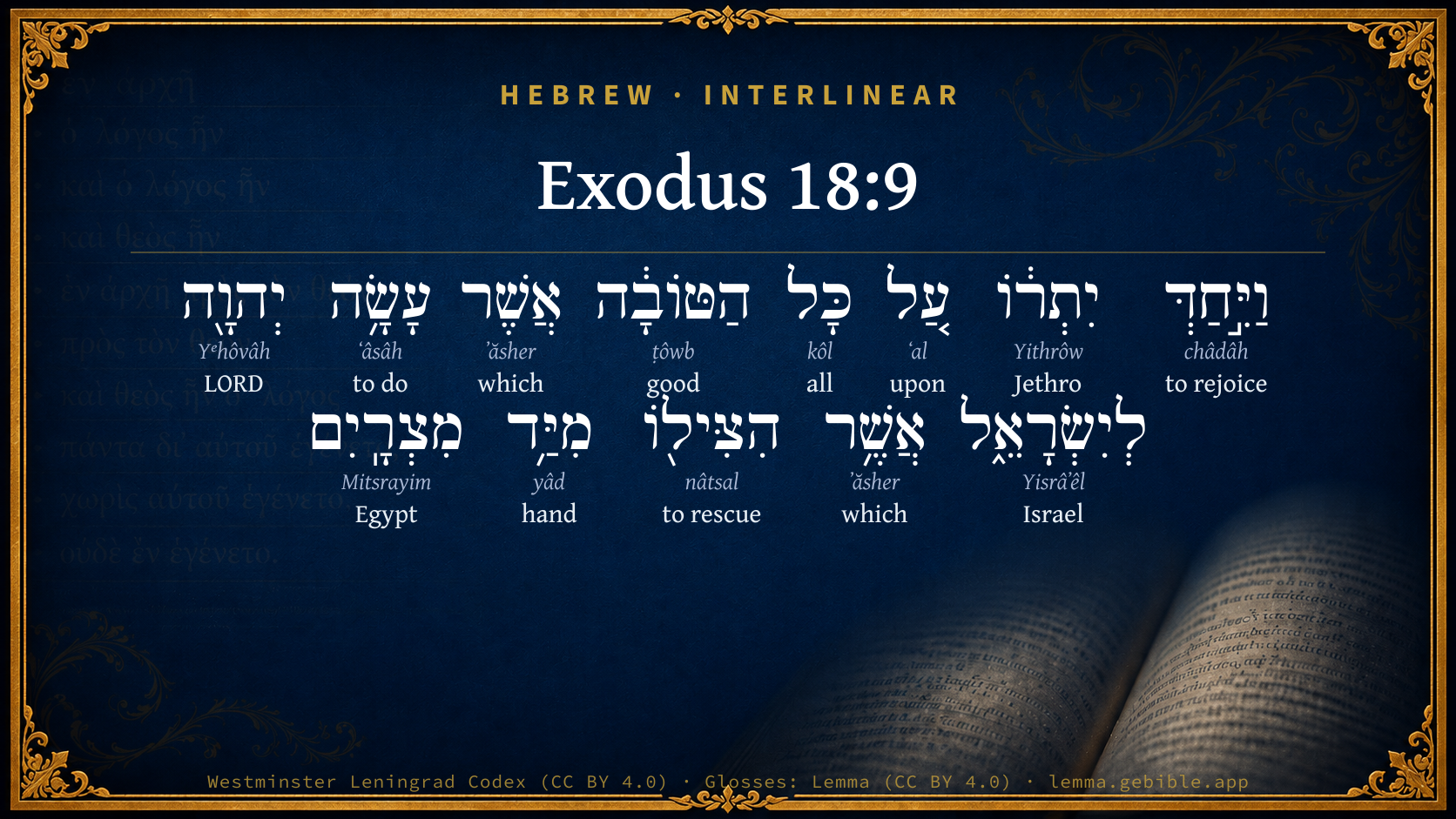
Hebrew (Westminster Leningrad Codex) Exodus 18:9 appears in the Hebrew Old Testament. The text above is from the Westminster Leningrad Codex. Each word links to its Strong’s number, a concise gloss, and parsing drawn from the Open Scriptures Hebrew Bible morphology. Click any word for its full Brown-Driver-Briggs (BDB) entry.
Download image
Cite this verse

Exodus 18:9 (World English Bible). Public Domain. Lemma interlinear Bible study tool, https://lemma.gebible.app/v/exodus/18/9.

Show BibTeX & RIS
BibTeX
RIS
English Translation
Jethro rejoiced for all the goodness which Yahweh had done to Israel, in that he had delivered them out of the hand of the Egyptians.
World English Bible · Public Domain
Highlights
  • 1 first appearance in the Hebrew Bible
Full analysis ↓
Download a study sheet

One document with this verse’s original text, its word-by-word gloss line, the meaning frame, cross-references with their text, attributed commentary, and full source and license credits — printable, and it pastes into notes with its structure intact.

This verse Autodidact and up

Study sheet (.html) Plain text (.txt)

A passage Seminary Student

Up to 50 verses in one chapter. A passage sheet keeps up to 6 commentary sources and 12 cross-references per verse, in the order this page ranks them, and says so on the sheet whenever that leaves anything out. Ask for a single verse and you get the Autodidact verse sheet above.

Everything on this page stays free to read, with no account — the sheet is a download of what is already on screen, not access to it.

Want to remove ads? Support Godless Engineer
Compare translations 3

The same verse in 3 English versions, stacked beneath the original-language interlinear above. Click any original word for its lexicon entry.

Each is an independent rendering of the whole verse — the interlinear is not word-aligned to these translations.

Highlighted words mark where these versions differ — a whole-verse word diff, not a word-by-word alignment.

  • World English Bible Public Domain
    Jethro rejoiced for all the goodness which Yahweh had done to Israel, in that he had delivered them out of the hand of the Egyptians.
  • King James Version Public Domain
    And Jethro rejoiced for all the goodness which the LORD had done to Israel, whom he had delivered out of the hand of the Egyptians.
  • unfoldingWord Literal Text CC BY-SA 4.0
    And Jethro rejoiced over all the good that Yahweh had done for Israel, whom he rescued from the hand of Egypt.

unfoldingWord Literal Text — © unfoldingWord, licensed CC BY-SA 4.0. Word-aligned USFM3 via Door43 (git.door43.org/unfoldingWord/en_ult).

Versions to compare (up to 4)

3 of 4 selected

Show all 18 translations

Every available English version of this verse, each an independent rendering of the whole verse.

  • World English Bible Public Domain
    Jethro rejoiced for all the goodness which Yahweh had done to Israel, in that he had delivered them out of the hand of the Egyptians.
  • Berean Standard Bible Public Domain
    And Jethro rejoiced over all the good things the LORD had done for Israel, whom He had rescued from the hand of the Egyptians.
  • Majority Standard Bible Public Domain
    And Jethro rejoiced over all the good things the LORD had done for Israel, whom He had rescued from the hand of the Egyptians.
  • King James Version Public Domain
    And Jethro rejoiced for all the goodness which the LORD had done to Israel, whom he had delivered out of the hand of the Egyptians.
  • American Standard Version (1901) Public Domain
    And Jethro rejoiced for all the goodness which Jehovah had done to Israel, in that he had delivered them out of the hand of the Egyptians.
  • Revised Version (1885) Public Domain
    And Jethro rejoiced for all the goodness which the LORD had done to Israel, in that he had delivered them out of the hand of the Egyptians.
  • Geneva Bible (1599) Public Domain
    And Iethro reioyced at all the goodnesse, which the Lord had shewed to Israel, and because he had deliuered them out of the hande of the Egyptians.
  • Douay-Rheims (1899) Public Domain
    And Jethro rejoiced for all the good things that the Lord had done to Israel, because he had delivered them out of the hands of the Egyptians.
  • Young's Literal Translation Public Domain
    And Jethro rejoiceth for all the good which Jehovah hath done to Israel, whom He hath delivered from the hand of the Egyptians;
  • Literal Standard Version CC BY-SA 4.0
    And Jethro rejoices for all the good which YHWH has done to Israel, whom He has delivered from the hand of the Egyptians;
  • Unlocked Literal Bible CC BY-SA 4.0
    Jethro rejoiced over all the good that Yahweh had done for Israel, in that he had rescued them from the hand of the Egyptians.
  • unfoldingWord Literal Text CC BY-SA 4.0
    And Jethro rejoiced over all the good that Yahweh had done for Israel, whom he rescued from the hand of Egypt.
  • Darby Bible Public Domain
    And Jethro rejoiced for all the goodness that Jehovah had done to Israel; that he had delivered them out of the hand of the Egyptians.
  • World Messianic Bible Public Domain
    Jethro rejoiced for all the goodness which the LORD had done to Israel, in that he had delivered them out of the hand of the Egyptians.
  • Webster's Bible Public Domain
    And Jethro rejoiced for all the goodness which the LORD had done to Israel, whom he had delivered out of the hand of the Egyptians.
  • Free Bible Version CC BY-SA 4.0
    Jethro was delighted to hear about all the good things the Lord had done for Israel when he'd saved them from the Egyptians.
  • Bible in Basic English Public Domain
    And Jethro was glad because the Lord had been good to Israel, freeing them from the power of the Egyptians.
  • JPS Tanakh (1917) Public Domain
    And Jethro rejoiced for all the goodness which the LORD had done to Israel, in that He had delivered them out of the hand of the Egyptians.

Literal Standard Version (2020), Covenant Press — licensed CC BY-SA 4.0. Text via the HelloAO Bible API (eBible.org). Unlocked Literal Bible (unfoldingWord) — licensed CC BY-SA 4.0. Text via the HelloAO Bible API (eBible.org). unfoldingWord Literal Text — © unfoldingWord, licensed CC BY-SA 4.0. Word-aligned USFM3 via Door43 (git.door43.org/unfoldingWord/en_ult). Free Bible Version, Dr. Jonathan Gallagher — licensed CC BY-SA 4.0. Text via the HelloAO Bible API (eBible.org).

Word by word

More ways to search: Search by grammar → Find every occurrence → Compare this word →

Practice this passage: Drill this verse → Learn its vocabulary →

וַיִּ֣חַדְּ
châdâh
H2302
“and · to rejoice”
Conjunction + Verb, Qal, Sequential Imperfect, 3rd Person, Masculine, Singular
Part of Speech
Conjunction + Verb
Stem
Qal
Form
Sequential Imperfect
Person
3rd Person
Gender
Masculine
Number
Singular
Full BDB Definition

Origin: a primitive root

TWOT: 607

to rejoice - (Qal) to rejoice - (Piel) to make glad, gladden
  1. יִתְר֔וֹ Yithrôw H3503 “Jethro” Noun, Proper
  2. עַ֚ל ʻal H5921 “upon” Preposition
  3. כָּל kôl H3605 “all of” Noun, Common, Masculine, Singular, Construct
  4. הַטּוֹבָ֔ה ṭôwb H2896 “the · good” Particle, Definite Article + Adjective, Adjective, Feminine, Singular, Absolute
  5. אֲשֶׁר ʼăsher H834 “which” Particle, Relative
  6. עָשָׂ֥ה ʻâsâh H6213 “to do” Verb, Qal, Perfect, 3rd Person, Masculine, Singular
  7. יְהוָ֖ה Yᵉhôvâh H3068 “LORD” Noun, Proper
  8. לְיִשְׂרָאֵ֑ל Yisrâʼêl H3478 “to/for · Israel” Preposition + Noun, Proper
  9. אֲשֶׁ֥ר ʼăsher H834 “which” Particle, Relative
  10. הִצִּיל֖וֹ nâtsal H5337 “to rescue · him” Verb, Hiphil, Perfect, 3rd Person, Masculine, Singular + Suffix, Personal, 3rd Person, Masculine, Singular
  11. מִיַּ֥ד yâd H3027 “from · hand of” Preposition + Noun, Common, Both, Singular, Construct
  12. מִצְרָֽיִם Mitsrayim H4714 “Egypt” Noun, Proper

About this verse

These counts appear in no published source. They are computed here, from the morphology-tagged text and Lemma’s own curated glosses. What Lemma adds →

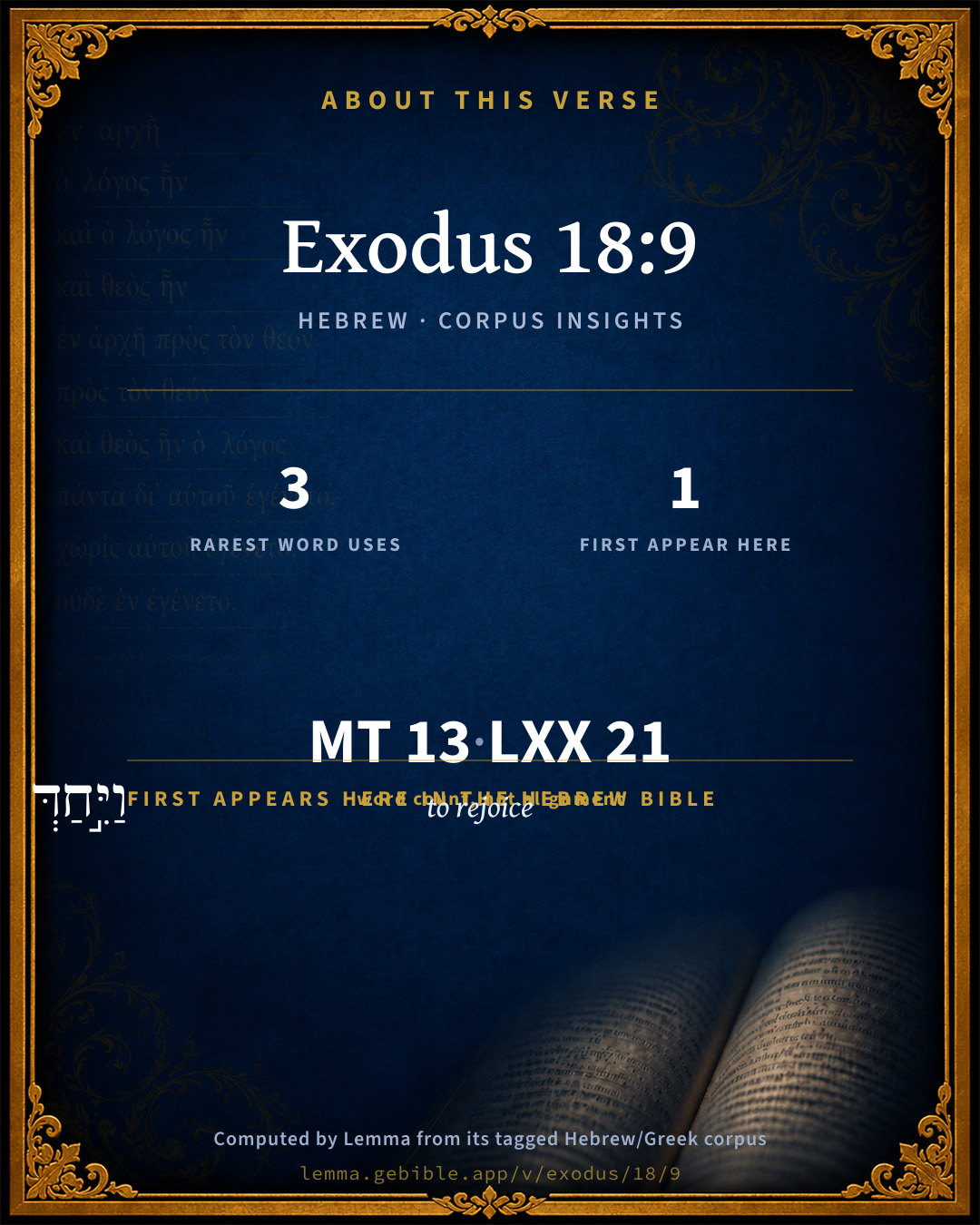
13
words
12
distinct lemmas
Pentateuch
section

Notable vocabulary

The rarest word here is וַיִּ֣חַדְּ to rejoice H2302 — appearing just 3 times in the whole Hebrew Bible.

First appearance in Scripture

This word makes its first canonical appearance in the Hebrew Bible here:

  • וַיִּ֣חַדְּ to rejoice H2302

Shared distinctive vocabulary

וַיִּ֣חַדְּ to rejoice H2302 occurs in 3 verses of the Hebrew Bible. Also found in:

Grammatical profile

  • 3 verbs
  • 6 nouns
  • 1 adjective
  • 1 preposition
  • 2 particles

Verb forms

  • וַיִּ֣חַדְּ Qal · Sequential Imperfect
  • עָשָׂ֥ה Qal · Perfect
  • הִצִּיל֖וֹ Hiphil · Perfect

Repetition

A word recurs within this verse — often emphatic in Hebrew:

  • אֲשֶׁר which H834 ×2

Hebrew & Septuagint length

In English translation the verse runs 25 words from the Hebrew and 34 from the Septuagint (LXX English) — closely comparable.

A rough comparison of the two English renderings, which tokenize alike — not a word-level alignment.

Word counts can differ between the Hebrew and the Greek without any difference in meaning — e.g. the Hebrew direct-object marker אֵת has no separate Greek word, and Greek often adds the article ὁ.

In the original languages it is 13 Hebrew tokens and 21 Greek tokens — but the two are counted differently (Hebrew bundles its prefixes and suffixes into one token; the Greek is in lemma form), so that isn’t a like-for-like length.

Cross-references

5

Topical passages linked to Exodus 18:9 in the Treasury of Scripture Knowledge — connected by theme and wording, ordered by reader-vote popularity; previews shown in the World English Bible.

  • Romans 12:15 Rejoice with those who rejoice. Weep with those who weep.
  • 1 Corinthians 12:26 When one member suffers, all the members suffer with it. Or when one member is honored, all the members rejoice with it.
  • Isaiah 66:10 Rejoice you with Jerusalem, and be glad for her, all you who love her: rejoice for joy with her, all you who mourn over her;
  • Romans 12:10 In love of the brothers be tenderly affectionate one to another; in honor preferring one another;
  • Isaiah 44:23 Sing, you heavens, for Yahweh has done it; shout, you lower parts of the earth; break forth into singing, you mountains, O forest, and every tree therein: for Yahweh has redeemed Jacob, and will glorify himself in Israel.

Cross-references courtesy of OpenBible.info (CC BY 4.0).

Hebrew and Greek witnesses Masoretic Hebrew ↔ Greek Septuagint

The same verse in the two great witnesses to the Old Testament, shown verse-for-verse.

These are two independent witnesses, not word-aligned to each other, and the Septuagint is shown in lemma (dictionary) form.

Hebrew Exodus 18:9 Masoretic · Westminster Leningrad Codex

וַיִּ֣חַדְּ יִתְר֔וֹ עַ֚ל כָּל הַטּוֹבָ֔ה אֲשֶׁר עָשָׂ֥ה יְהוָ֖ה לְיִשְׂרָאֵ֑ל אֲשֶׁ֥ר הִצִּיל֖וֹ מִיַּ֥ד מִצְרָֽיִם

Jethro rejoiced for all the goodness which Yahweh had done to Israel, in that he had delivered them out of the hand of the Egyptians.

World English Bible · Public Domain

Greek LXX Exodus 18:9 Septuagint · lemma form

ἐκἵστημι δέ ιοθορ ἐπί πᾶς ὁ ἀγαθός ὅς ποιέω αὐτός κύριος ὅτι ἐκαἱρέω αὐτός ἐκ χείρ αἰγύπτιος καί ἐκ χείρ φαραώ

And Jothor was amazed at all the good things which the Lord did to them, forasmuch as he rescued them out of the hand of the Egyptians and out of the hand of Pharao.

LXX2012 (modern English Septuagint) · Public Domain

On this verse, Haydock's Catholic Bible Commentary discusses the Septuagint’s reading. Read the note in Commentary ↓

Hebrew: Westminster Leningrad Codex (CC BY 4.0). Greek: Septuagint (public domain); English from LXX2012 (modern English Septuagint) (Public Domain). How the Septuagint differs from the Hebrew →

Targum (Aramaic paraphrase)

2

The Targum is the ancient Jewish Aramaic paraphrase of the Hebrew Scriptures — an interpretive translation, not the Hebrew text itself. Onkelos (literal) and Pseudo-Jonathan (expansive) render the Torah, and Jonathan the Prophets. Coverage is partial: where no permissively-licensed English translation exists for a verse, only the Aramaic is shown. This is verse-level text, not a word-by-word alignment to the Hebrew.

  1. Targum Onkelos Torah (Genesis–Deuteronomy)
    וַחֲדִי יִתְרוֹ עַל כָּל טַבְתָא דִי עֲבַד יְיָ לְיִשְׂרָאֵל דִי שֵׁזְבָנוּן מִידָא דְמִצְרָאֵי:

    (no public-domain English translation for this verse)

    Targum Onkelos — Aramaic: “Onkelos Genesis” (public domain); “Onkelos Exodus” (public domain); “Onkelos Leviticus” (public domain); “Onkelos Numbers” (public domain); “Onkelos Deuteronomy” (public domain). English: “Sefaria Community Translation” (CC0 1.0 (public-domain dedication)); “J.W. Etheridge. The Targums of Onkelos and Jonathan Ben Uzziel on the Pentateuch. London: Longmans, Green, 1862” (public domain). Text via Sefaria.

  2. Targum Pseudo-Jonathan Torah (Genesis–Deuteronomy)
    וּבְדַח יִתְרוֹ עַל כָּל טַבְתָא דְעָבַד יְיָ לְיִשְרָאֵל דִּיהַב לְהוֹן מַנָא וּבֵירָא וְדִי שֵׁיזְבִינִין מִן יְדָא דְמִצְרָאֵי

    And Jethro rejoiced over all the good which the Lord had done unto Israel, and that He had given them manna, and the well, and that he had saved them from the hand of the Mizraee.

    Targum Pseudo-Jonathan — Aramaic: “Targum Jonathan on Genesis” (public domain); “Targum Jonathan on Exodus” (public domain); “Targum Jonathan on Leviticus” (public domain); “Targum Jonathan on Numbers” (public domain); “Targum Jonathan on Deuteronomy” (public domain). English: “The Targum of Jonathan ben Uzziel, trans. J. W. Etheridge, London, 1862” (public domain). Text via Sefaria.

Commentary

Notes on Exodus 18:9 from classic Christian and Jewish commentators (each source and its license shown beneath its notes). The classic Christian expositions comment on the surrounding passage and are grouped to its opening verse, so a note may address several verses; the Jewish commentaries on the Tanakh (Rashi and others) are per-verse, so they appear only where the commentator wrote on this verse.

Lemma curates 59 commentaries, every one of them public domain or Creative Commons licensed, each selected and text-cleaned for this edition rather than reprinted as found. About our sources →

Trapp's Complete Commentary

John Trapp

Exo 18:9 And Jethro rejoiced for all the goodness which the LORD had done to Israel, whom he had delivered out of the hand of the Egyptians.

Ver. 9. And Jethro rejoiced.] So must all Sion’s sons. {Isa 66:10}

John Trapp, A Commentary or Exposition upon All the Books of the Old and New Testament (1647–1656) — public domain. Text from a community e-Sword module.

The Biblical Illustrator

Joseph S. Exell

Exo_18:9-12

Jethro rejoiced for all the goodness.

Lessons

1. The Churchs friends rejoice in all the good done for it, and deliverance of it.

2. As Jehovah is the cause of good and deliverance to His Church, so He is the object of their joy (Exo_18:9).

3. Joyful hearts for the Churchs good are thankful hearts to God for the same.

4. Deliverance of special relations, but especially of the Church, from powers of enemies is just matter of thanksgiving (Exo_18:10).

5. Experience of the mighty works of God perfects the knowledge of Himself.

6. The great works of God set Him above all that are so called.

7. The pride of enemies exalts the power of God above them (Exo_18:11).

8. Knowledge of God is best expressed in sacrificing and worship of Him.

9. Holy feasting is consistent with Gods holy worship.

10. Gods glory must terminate all sacrificing and eating among His people.

11. Eminent members of the Church may not disdain communion with true proselytes (Exo_18:12). (G. Hughes, B. D.)

The Biblical Illustrator, edited by Joseph S. Exell (c. 1880s–1900s) — public domain. Text from a community e-Sword module.

Adam Clarke's Commentary

Verse 9. And Jethro rejoiced for all the goodness] Every part of Jethro's conduct proves him to have been a religious man and a true believer. His thanksgiving to Jehovah (Ex 18:10) is a striking proof of it; he first blesses God for the preservation of Moses, and next for the deliverance of the people from their bondage.

Adam Clarke's Commentary on the Bible (1810–1826) — public domain. Text from a community e-Sword/MySword module.

The Cambridge Bible for Schools and Colleges

gen. ed. J. J. S. Perowne

9. rejoiced] A very rare word in Heb., occurring besides only Job_3:6, and (in the causative conj.) Psa_21:6 b; but common in Aramaic.

delivered them out of the hand of the Egyptians] cf. Exo_3:8.

The Cambridge Bible for Schools and Colleges (gen. ed. J. J. S. Perowne; Cambridge University Press, 1878–1918) — public domain. Text from a community e-Sword module.

John Gill's Exposition

And Jethro rejoiced for all the goodness which the Lord had done to Israel,.... In giving them the manna and the well, as the above Targum, bread to eat when hungry, and water to drink when thirsty; to which Jarchi adds, and the law, for he supposes the meeting of Jethro and Moses was after the law was given on Mount Sinai, though here recorded; but this goodness may be extended to other things, as the saving of their firstborn at the time of the Lord's passover, giving them favour in the sight of the Egyptians, of whom they borrowed or asked things of value, of gold, silver, and jewels, bringing them out of Egypt with an high hand, going before them in a pillar of cloud and fire by day and night, dividing the waters of the sea for them to pass through as on dry land, and doing for them the above things related, and giving them victory over Amalek; and it may be observed that the joy of Jethro was not merely on account of the goodness of God done to Moses, a relation of his, having married his daughter; but because of the great and good things God had done for Israel, his special and peculiar people, the worshippers of the true and living God, for whom Jethro had an affection, because they were so, and therefore rejoiced in their prosperity: whom he had delivered out of the hand of the Egyptians; whom he had wrought upon to give them leave to depart from them, and destroyed them when they pursued after them, first delivered them from their bondage, and then from their rage and wrath.

And Jethro rejoiced for all the goodness which the Lord had done to Israel,.... In giving them the manna and the well, as the above Targum, bread to eat when hungry, and water to drink when thirsty; to which Jarchi adds, and the law, for he supposes the meeting of Jethro and Moses was after the law was given on Mount Sinai, though here recorded; but this goodness may be extended to other things, as the saving of their firstborn at the time of the Lord's passover, giving them favour in the sight of the Egyptians, of whom they borrowed or asked things of value, of gold, silver, and jewels, bringing them out of Egypt with an high hand, going before them in a pillar of cloud and fire by day and night, dividing the waters of the sea for them to pass through as on dry land, and doing for them the above things related, and giving them victory over Amalek; and it may be observed that the joy of Jethro was not merely on account of the goodness of God done to Moses, a relation of his, having married his daughter; but because of the great and good things God had done for Israel, his special and peculiar people, the worshippers of the true and living God, for whom Jethro had an affection, because they were so, and therefore rejoiced in their prosperity: whom he had delivered out of the hand of the Egyptians; whom he had wrought upon to give them leave to depart from them, and destroyed them when they pursued after them, first delivered them from their bondage, and then from their rage and wrath.

Exodus 18:10

exo 18:10

exo 18:10

exo 18:10And Jethro said,.... Like a truly good man, as one that knew the Lord and feared him, and was desirous of giving him the praise and glory of all the wonderful things he had done:

blessed be the Lord, who hath delivered you out of the hand of the Egyptians: and out of the hand of Pharaoh; meaning particularly Moses and Aaron, the messengers of God, as Aben Ezra observes, who went to Pharaoh in the peril of their lives, and whom he sometimes threatened with death; but the Lord delivered them both out of his hands, and out of the hands of his ministers and people, who, doubtless, must be at times enraged at them for the plagues they brought upon them; for the persons here pointed at are manifestly distinguished from the body of the people of Israel next mentioned:

who hath delivered the people from the hand of the Egyptians: the people of Israel, from the hard bondage and cruel slavery they were held under by the Egyptians; which, as it was the Lord's doing, Jethro gives him the glory of it, and blesses him for it, or ascribes to him, on account of it, blessing, honour, glory, and praise.

John Gill's Exposition of the Whole Bible (1746–1763) — public domain (CC PDM 1.0). Text via the HelloAO Bible API.

Haydock's Catholic Bible Commentary

Rejoiced. Septuagint, "was in an ecstacy," of admiration, mixed with joy. (Menochius)

George Leo Haydock (1774–1849), Haydock's Catholic Family Bible and Commentary, 1859 edition — public domain. Excludes Psalms (Douay-Rheims chapter numbering differs from Protestant) and Deuterocanonical books (Catholic canon only).

Whedon's Commentary on the Bible

Daniel D. Whedon

9. Jethro rejoiced — For he was possessed of that high, reverent spirit which gladly accepts the lessons of God’s mighty works. Although outside of the chosen people, he joyfully accepts and profits by their higher revelations.

Daniel D. Whedon (gen. ed.), Commentary on the Old and New Testaments (1874–1909) — public domain. Text from a community e-Sword module.

unfoldingWord translationNotes

Door43 World Missions Community

the hand of the Egyptians ... the hand of Pharaoh

The hand represents the power of someone to do something. AT: "the power of the Egyptians ... the power of Pharaoh" or "what the Egyptians were doing to you ... what Pharaoh was doing to you" (See: Metonymy)

translationWords

joy

Israel

unfoldingWord translationNotes — © Distant Shores Media and the Door43 World Missions Community, licensed CC BY-SA 4.0. Source: git.door43.org/Door43/en_tn.

Rashi

Rabbi Shlomo Yitzchaki (Rashi)

ויחד יתרו AND JETHRO REJOICED — This is its literal meaning. A Midrashic comment is: his flesh became full of prickles (חדודין — his flesh crept with horror) — he felt grieved at the destruction of Egypt. That is what people say (what the common proverb says): A proselyte even though his heathen descent dates from as far back as the tenth generation, do not speak slightingly of an Aramean (any non-Jew) in his presence (Sanhedrin 94a).

על כל הטובה FOR ALL THE GOODNESS — the goodness in giving the Manna and the well and the Torah — and he rejoiced above all these (more especially), אשר הצילו מיד מצרים THAT HE HAD DELIVERED THEM OUT OF THE HAND OF EGYPT — Until now no slave had ever been able to escape from Egypt because that land was closely shut in on all sides, but these had gone forth six hundred thousand in number (cf. Mekhilta).

Rashi on the Tanakh — English translations: “The Judaica Press complete Tanach with Rashi, translated by A. J. Rosenberg” (CC BY 4.0); “Pentateuch with Rashi's commentary by M. Rosenbaum and A.M. Silbermann, 1929-1934” (public domain); “The Metsudah Tanach series, Lakewood, N.J” (CC BY 4.0); and “The Book of Joshua, Metsudah Publications, 1997” (CC BY 4.0). Text via Sefaria.

Lesson kit

Teaching starters — assembled from the data on this page, not authored interpretation. Every prompt links to the verse data it draws on. Edit before teaching.

Exodus, in the Pentateuch, opens this verse with 13 words (12 distinct Hebrew lemmas). Its most distinctive word is châdâh (“to rejoice”). A historical commentator’s framing appears above. Read the whole chapter for the surrounding context.

Discussion questions

  1. How does “to rejoice” (châdâh) shape what this verse is saying?
  2. The word “to rejoice” first appears here in Scripture. What is being introduced at this debut?
  3. Job 3:6 shares the word «to rejoice» with this verse. How do the two illuminate each other?
  4. “which” occurs 2× in this one verse. What is the effect of the repetition?
  5. These translations render this verse differently. What is at stake in choosing one wording over another?
  6. The verb «וַיִּ֣חַדְּ» is Qal Sequential Imperfect. How does its form color the action?
  7. Reading how Trapp's Complete Commentary and The Biblical Illustrator read this verse, where do the two commentators agree and where do they part?

Things to notice

Reading settings

Reading text

Shown beneath each verse's original-language words.

Old Testament
Old Testament edition

Read the OT as the Masoretic Hebrew (MT) or the Greek Septuagint (LXX).

English shown for the Greek Septuagint (in the Hebrew ↔ Greek comparison).

Comparing translations? Open the Compare panel on any verse page to stack up to four side by side.