
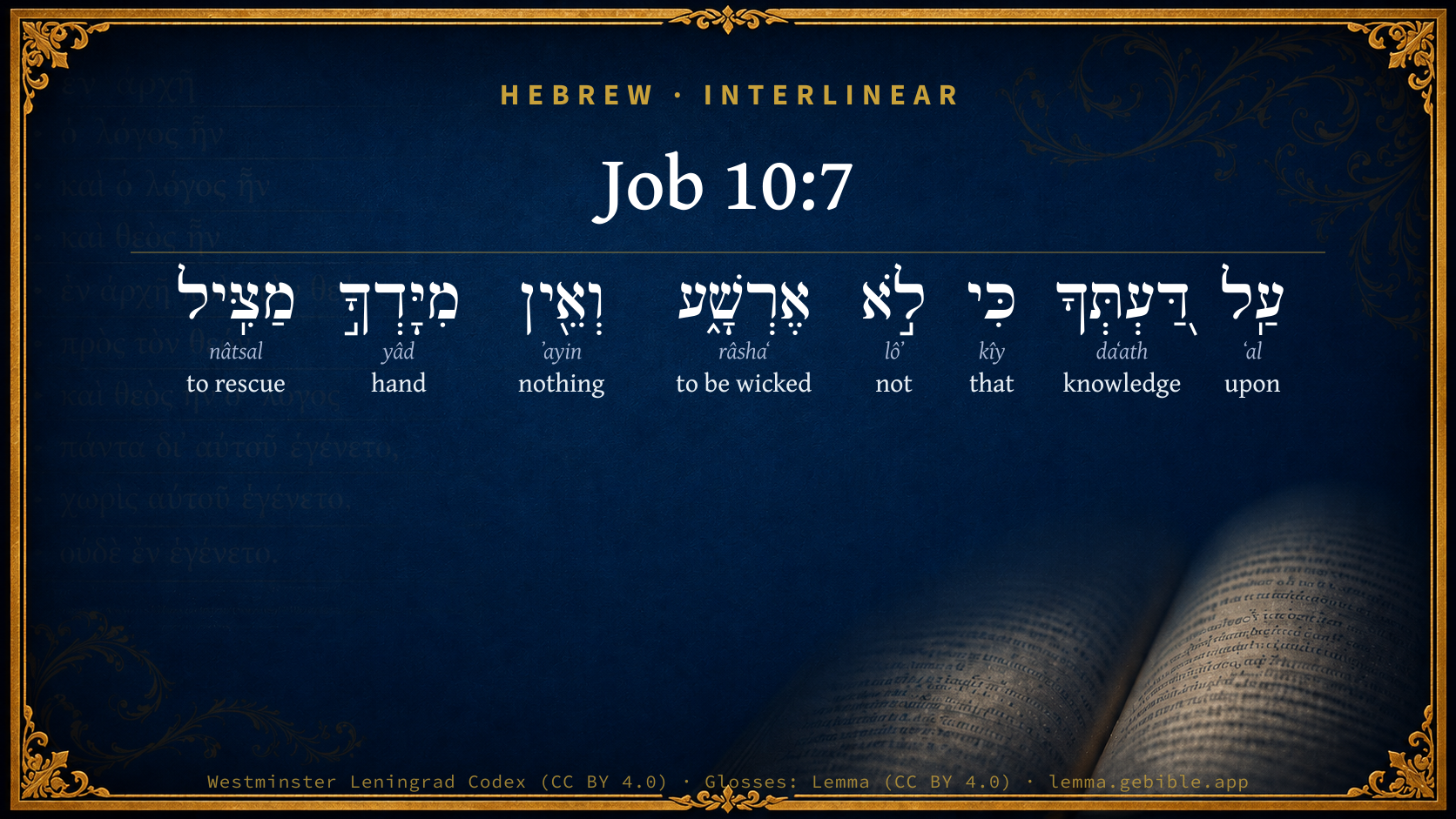
Job 10:7

Hebrew (Westminster Leningrad Codex) Job 10:7 appears in the Hebrew Old Testament. The text above is from the Westminster Leningrad Codex. Each word links to its Strong’s number, a concise gloss, and parsing drawn from the Open Scriptures Hebrew Bible morphology. Click any word for its full Brown-Driver-Briggs (BDB) entry.
Download image
Cite this verse

Job 10:7 (World English Bible). Public Domain. Lemma interlinear Bible study tool, https://lemma.gebible.app/v/job/10/7.

Show BibTeX & RIS
BibTeX
RIS
English Translation
Although you know that I am not wicked, There is no one who can deliver out of your hand.
World English Bible · Public Domain
Download a study sheet

One document with this verse’s original text, its word-by-word gloss line, the meaning frame, cross-references with their text, attributed commentary, and full source and license credits — printable, and it pastes into notes with its structure intact.

This verse Autodidact and up

Study sheet (.html) Plain text (.txt)

A passage Seminary Student

Up to 50 verses in one chapter. A passage sheet keeps up to 6 commentary sources and 12 cross-references per verse, in the order this page ranks them, and says so on the sheet whenever that leaves anything out. Ask for a single verse and you get the Autodidact verse sheet above.

Everything on this page stays free to read, with no account — the sheet is a download of what is already on screen, not access to it.

Want to remove ads? Support Godless Engineer
Compare translations 3

The same verse in 3 English versions, stacked beneath the original-language interlinear above. Click any original word for its lexicon entry.

Each is an independent rendering of the whole verse — the interlinear is not word-aligned to these translations.

Highlighted words mark where these versions differ — a whole-verse word diff, not a word-by-word alignment.

  • World English Bible Public Domain
    Although you know that I am not wicked, There is no one who can deliver out of your hand.
  • King James Version Public Domain
    Thou knowest that I am not wicked; and there is none that can deliver out of thine hand.
  • unfoldingWord Literal Text CC BY-SA 4.0
    above your knowledge that I am not wicked and there is no one rescuing from your hand?

unfoldingWord Literal Text — © unfoldingWord, licensed CC BY-SA 4.0. Word-aligned USFM3 via Door43 (git.door43.org/unfoldingWord/en_ult).

Versions to compare (up to 4)

3 of 4 selected

Show all 18 translations

Every available English version of this verse, each an independent rendering of the whole verse.

  • World English Bible Public Domain
    Although you know that I am not wicked, There is no one who can deliver out of your hand.
  • Berean Standard Bible Public Domain
    though You know that I am not guilty, and there is no deliverance from Your hand?
  • Majority Standard Bible Public Domain
    though You know that I am not guilty, and there is no deliverance from Your hand?
  • King James Version Public Domain
    Thou knowest that I am not wicked; and there is none that can deliver out of thine hand.
  • American Standard Version (1901) Public Domain
    Although thou knowest that I am not wicked, And there is none that can deliver out of thy hand?
  • Revised Version (1885) Public Domain
    Although thou knowest that I am not wicked; and there is none that can deliver out of thine hand?
  • Geneva Bible (1599) Public Domain
    Thou knowest that I can not do wickedly: for none can deliuer me out of thine hand.
  • Douay-Rheims (1899) Public Domain
    And shouldst know that I have done no wicked thing, whereas there is no man that can deliver out of thy hand.
  • Young's Literal Translation Public Domain
    For Thou knowest that I am not wicked, And there is no deliverer from Thy hand.
  • Literal Standard Version CC BY-SA 4.0
    For You know that I am not wicked, || And there is no deliverer from Your hand.
  • Unlocked Literal Bible CC BY-SA 4.0
    although you know I am not guilty and there is no one who can rescue me from your hand?
  • unfoldingWord Literal Text CC BY-SA 4.0
    above your knowledge that I am not wicked and there is no one rescuing from your hand?
  • Darby Bible Public Domain
    Since thou knowest that I am not wicked, and that there is none that delivereth out of thy hand?
  • World Messianic Bible Public Domain
    Although you know that I am not wicked, there is no one who can deliver out of your hand.
  • Webster's Bible Public Domain
    Thou knowest that I am not wicked; and there is none that can deliver out of thy hand.
  • Free Bible Version CC BY-SA 4.0
    Even though you know I'm not guilty, no one can save me from you.
  • Bible in Basic English Public Domain
    Though you see that I am not an evil-doer; and there is no one who is able to take a man out of your hands?
  • JPS Tanakh (1917) Public Domain
    Although Thou knowest that I shall not be condemned; and there is none that can deliver out of Thy hand?

Literal Standard Version (2020), Covenant Press — licensed CC BY-SA 4.0. Text via the HelloAO Bible API (eBible.org). Unlocked Literal Bible (unfoldingWord) — licensed CC BY-SA 4.0. Text via the HelloAO Bible API (eBible.org). unfoldingWord Literal Text — © unfoldingWord, licensed CC BY-SA 4.0. Word-aligned USFM3 via Door43 (git.door43.org/unfoldingWord/en_ult). Free Bible Version, Dr. Jonathan Gallagher — licensed CC BY-SA 4.0. Text via the HelloAO Bible API (eBible.org).

Word by word

More ways to search: Search by grammar → Find every occurrence → Compare this word →

Practice this passage: Drill this verse → Learn its vocabulary →

About this verse

These counts appear in no published source. They are computed here, from the morphology-tagged text and Lemma’s own curated glosses. What Lemma adds →

8
words
8
distinct lemmas
Wisdom
section

Shared distinctive vocabulary

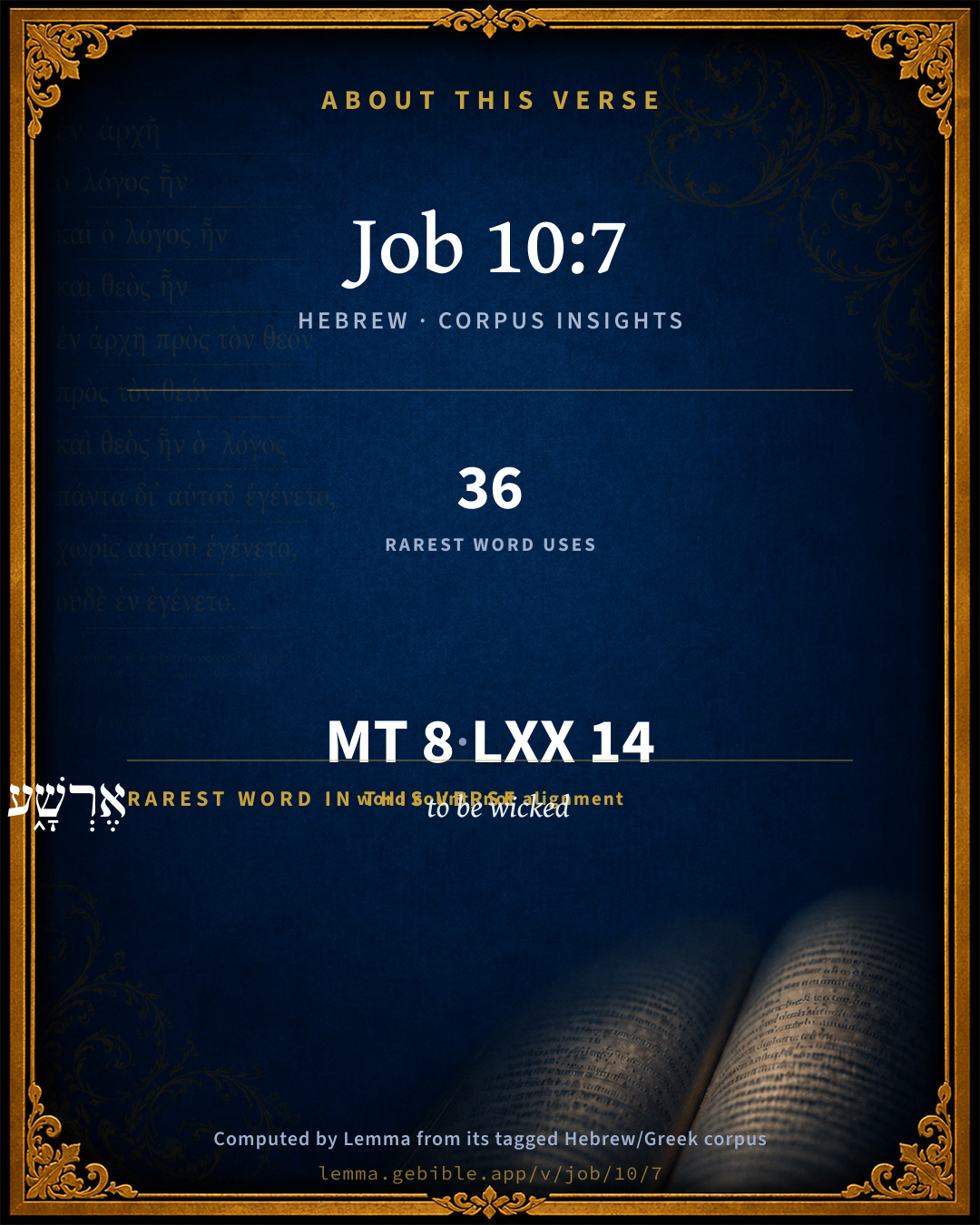
אֶרְשָׁ֑ע to be wicked H7561 occurs in 35 verses of the Hebrew Bible. Also found in:

Grammatical profile

  • 2 verbs
  • 2 nouns
  • 1 preposition
  • 1 conjunction
  • 2 particles

Verb forms

  • אֶרְשָׁ֑ע Qal · Imperfect
  • מַצִּֽיל Hiphil · Participle Active

Hebrew & Septuagint length

In English translation the verse runs 19 words from the Hebrew and 20 from the Septuagint (LXX English) — closely comparable.

A rough comparison of the two English renderings, which tokenize alike — not a word-level alignment.

Word counts can differ between the Hebrew and the Greek without any difference in meaning — e.g. the Hebrew direct-object marker אֵת has no separate Greek word, and Greek often adds the article ὁ.

In the original languages it is 8 Hebrew tokens and 14 Greek tokens — but the two are counted differently (Hebrew bundles its prefixes and suffixes into one token; the Greek is in lemma form), so that isn’t a like-for-like length.

Cross-references

21

Topical passages linked to Job 10:7 in the Treasury of Scripture Knowledge — connected by theme and wording, ordered by reader-vote popularity; previews shown in the World English Bible.

  • Deuteronomy 32:39 See now that I, even I, am he, There is no god with me: I kill, and I make alive; I wound, and I heal; There is none who can deliver out of my hand.
  • Job 42:7 It was so, that after Yahweh had spoken these words to Job, Yahweh said to Eliphaz the Temanite, "My wrath is kindled against you, and against your two friends; for you have not spoken of me the thing that is right, as my servant Job has.
  • Psalms 139:1–2 Yahweh, you have searched me, And you know me.
  • Daniel 3:15 Now if you are ready whenever you hear the sound of the horn, flute, zither, lyre, harp, pipe, and all kinds of music to you fall down and worship the image which I have made, [well]: but if you don't worship, you shall be cast the same hour into the midst of a burning fiery furnace; and who is that god that shall deliver you out of my hands?
  • John 10:28–30 I give eternal life to them. They will never perish, and no one will snatch them out of my hand.
  • Job 23:10 But he knows the way that I take. When he has tried me, I shall come forth like gold.
  • Job 23:13–14 But he stands alone, and who can oppose him? What his soul desires, even that he does.
  • Job 31:6 (Let me be weighed in an even balance, That God may know my integrity);
  • Job 31:14 What then shall I do when God rises up? When he visits, what shall I answer him?
  • Job 31:35 Oh that I had one to hear me! (Behold, here is my signature, let the Almighty answer me); Let the accuser write my indictment!
  • Psalms 1:6 For Yahweh knows the way of the righteous, But the way of the wicked shall perish.
  • Psalms 7:3 Yahweh, my God, if I have done this, If there is iniquity in my hands,
  • Psalms 7:8–9 Yahweh administers judgment to the peoples. Judge me, Yahweh, according to my righteousness, And to my integrity that is in me.
  • Psalms 17:3 You have proved my heart; you have visited me in the night; You have tried me, and found nothing; I have resolved that my mouth shall not disobey.
  • Psalms 26:1–5 Judge me, Yahweh, for I have walked in my integrity. I have trusted also in Yahweh without wavering.
  • Psalms 50:22 "Now consider this, you who forget God, Lest I tear you into pieces, and there be none to deliver.
  • Psalms 139:21–24 Yahweh, don't I hate those who hate you? Am I not grieved with those who rise up against you?
  • Hosea 2:10 Now I will uncover her lewdness in the sight of her lovers, And no one will deliver her out of my hand.
  • John 21:17 He said to him the third time, "Simon, son of Jonah, do you have affection for me?" Peter was grieved because he asked him the third time, "Do you have affection for me?" He said to him, "Lord, you know everything. You know that I have affection for you." Jesus said to him, "Feed my sheep.
  • 1 Thessalonians 2:10 You are witnesses with God, how holy, righteously, and blamelessly we behaved ourselves toward you who believe.
  • 2 Corinthians 1:12 For our boasting is this: the testimony of our conscience, that in holiness and sincerity of God, not in fleshly wisdom but in the grace of God we behaved ourselves in the world, and more abundantly toward you.

Cross-references courtesy of OpenBible.info (CC BY 4.0).

Hebrew and Greek witnesses Masoretic Hebrew ↔ Greek Septuagint

The same verse in the two great witnesses to the Old Testament, shown verse-for-verse.

These are two independent witnesses, not word-aligned to each other, and the Septuagint is shown in lemma (dictionary) form.

Hebrew Job 10:7 Masoretic · Westminster Leningrad Codex

עַֽל דַּ֭עְתְּךָ כִּי לֹ֣א אֶרְשָׁ֑ע וְאֵ֖ין מִיָּדְךָ֣ מַצִּֽיל

Although you know that I am not wicked, There is no one who can deliver out of your hand.

World English Bible · Public Domain

Greek LXX Job 10:7 Septuagint · lemma form

οἶδα γάρ ὅτι οὐ ἀσεβέω ἀλλά τίς εἰμί ὁ ἐκ ὁ χείρ σύ ἐκαἱρέω

For you know that I have not committed iniquity: but who is he that can deliver out of your hands?

LXX2012 (modern English Septuagint) · Public Domain

On this verse, Haydock's Catholic Bible Commentary discusses the Septuagint’s reading. Read the note in Commentary ↓

Hebrew: Westminster Leningrad Codex (CC BY 4.0). Greek: Septuagint (public domain); English from LXX2012 (modern English Septuagint) (Public Domain). How the Septuagint differs from the Hebrew →

Commentary

Notes on Job 10:7 from classic Christian and Jewish commentators (each source and its license shown beneath its notes). The classic Christian expositions comment on the surrounding passage and are grouped to its opening verse, so a note may address several verses; the Jewish commentaries on the Tanakh (Rashi and others) are per-verse, so they appear only where the commentator wrote on this verse.

Lemma curates 59 commentaries, every one of them public domain or Creative Commons licensed, each selected and text-cleaned for this edition rather than reprinted as found. About our sources →

Trapp's Complete Commentary

John Trapp

Job 10:7 Thou knowest that I am not wicked; and [there is] none that can deliver out of thine hand.

Ver. 7. Thou knowest that I am not wicked] A lewd liver, and a rank hypocrite, as these men would make of me. A sinner I am, but I allow not, wallow not in any known sin; there is no way of wickedness found in me; hypocrisy reigns not in my heart: Haeret in regenitis peccatum, saith one, sin abideth in the best; yet they may not, they must not be called wicked. Julian, the apostate, affirmed that Peter’s halting at Antioch was so taxed by Paul that Peter must needs be a hypocrite (Cyril, lib. 9, in Julian); but this cavil and calumny can never be proved from Paul’s words, for not every one that through infirmity dissembleth sometimes is presently a hypocrite. It is upon thy knowledge, saith Job, that however I am weak, yet wicked I am not; my great scum is not in me, Eze 24:11-12. The good heart admits not the mixture of any sin; like right wine or honey, as the scum ariseth, it ever casteth it out; as spring water worketh itself clean; as the sea will endure no poisonous thing, but casts it up upon the shore; so a Christian cleareth himself of sin. Well, it may cleave to it for a while, as dross doth to silver, but it entereth not into the frame and constitution; Job is confident of that, and will venture all upon it.

And there is none (or nothing) that can deliver out of thine hand] q.d. Thus thou, Lord, knowest it to be with me, that I have no wicked heart; but for this I expect not to be delivered, for thou canst still find matter in me for which to lay thine hand upon me: but the more I submit myself the more mild shouldest thou surely be in thy dealings toward me; as a lion to a man crouching to him. As Paul said, "I know nothing by myself; yet am I not thereby justified," 1Co 4:4; so Job saith, Lord, thou knowest nothing by me, yet hereby I cannot be delivered (Junius).

John Trapp, A Commentary or Exposition upon All the Books of the Old and New Testament (1647–1656) — public domain. Text from a community e-Sword module.

Geneva Bible (1599)

Geneva Bible translators

By affliction thou keepest me as in a prison, and restrainest me from doing evil, neither can any set me at liberty.

Geneva Bible (1599) marginal notes — public domain. Text via Bolls.life.

Jamieson, Fausset & Brown

Robert Jamieson, A. R. Fausset & David Brown

"Although Thou (the Omniscient) knowest," &c. (connected with Job 10:6), "Thou searchest after my sin."

and . . . that none that can deliver out of thine hand--Therefore Thou hast no need to deal with me with the rapid violence which man would use (see Job 10:6).

Jamieson, Fausset & Brown — Commentary Critical and Explanatory on the Whole Bible (1871) — public domain (CC PDM 1.0). Text via the HelloAO Bible API.

Adam Clarke's Commentary

Verse 7. Thou knowest that I am not wicked] While thou hast this knowledge of me and my conduct, why appear to be sifting me as if in order to find out sin; and though none can be found, treating me as though I were a transgressor?

Adam Clarke's Commentary on the Bible (1810–1826) — public domain. Text from a community e-Sword/MySword module.

Ellicott's Commentary for English Readers

(7) That I am not wicked.—The meaning is rather, that I shall not be found guilty. It is not like the appeal of Peter (Joh_21:17). See the language borrowed by the Psalmist (Psa_119:73).

A Bible Commentary for English Readers, edited by Charles John Ellicott (1878–1897) — public domain. Text from a community e-Sword module.

The Cambridge Bible for Schools and Colleges

gen. ed. J. J. S. Perowne

7. thou knowest] Rather, though thou knowest. All these suppositions are vain; for as to the first (Job_10:4), God knew that Job was guiltless, and as to the other, none could rescue from His hand. The suppositions are but a subtle mode of appealing from God to God Himself, from God’s dealing in providence to God’s inner heart and being.

The Cambridge Bible for Schools and Colleges (gen. ed. J. J. S. Perowne; Cambridge University Press, 1878–1918) — public domain. Text from a community e-Sword module.

John Gill's Exposition

Thine hands have made me, and fashioned together round about,.... This and what follow are an illustration of and an enlargement upon, the work of God's hands, made mention of in Job 10:3; and suggest reasons why it should not be despised by him, as well as confirm what was just now said, that none could deliver him out of his hands; since his hands had made him, and therefore had such power over him as none else had: and the whole seems designed to move to pity and compassion of him; for not he himself, nor his parents, but God only had made him; he was his workmanship only, and a curious piece it was, which his hands of power and wisdom had nicely formed; for, though the Son and Spirit of God are not to be excluded from the formation of man, yet it seems a too great strain of the words to interpret "hands" of them, as some do; and much less are they to be understood literally of the hands of the Son of God appearing in an human form at the creation of man, since such an appearance is not certain; nor is Job speaking of the formation of the first man, but of himself: the first word (c), rendered "made", has the signification of labour, trouble, grief, and care; and is used of God after the manner of men, who, when things are done well by them, take a great deal of pains, and are very solicitous and careful in doing them; and from hence is a word which is sometimes used for an idol, as Gersom observes, because much labour and skill are exercised to form it in the most curious and pleasing manner; many interpreters, as Aben Ezra observes, from the use of the word in the Arabic language, explain it of God's creating the body of man with nerves, by which it is bound, compacted, and strengthened (d); and the latter word denotes the form and configuration of it, the beautiful order and proportion in which every part is set; and the whole is intended to observe the perfection of the human body, and the exquisite skill of the author of it; and what pity is it that it should be so marred and spoiled! and this is said to be made and fashioned "together", or all at once; the several parts of it being in the seed, in the embryo, all together, though gradually formed or brought into order; or rather this denotes the unity and compactness of the several members of the body, which are set in their proper place, and joined and fitted together, by joints and bands, and by that which every joint supplieth: and this is done "round about", on all sides, in every part; or, as Mr. Broughton renders it, "in every point"; the whole of it, and every member, even the most extreme and minute, are curiously formed and fashioned by the Lord; or rather, thine hands are together round about me; embracing, sustaining, and preserving him ever since he was made:

yet thou dost destroy me; this body, so extremely well wrought, by boils or ulcers; or "swallow me" (e), as a lion, to which he compares him, Job 10:16; or any other ravenous and large creature, see Lam 2:2; some connect the words more agreeably to the accents, "yet thou dost destroy me together round about" (f); or on every side, as in Job 19:10; having smitten him with boils from the crown of the head to the sole of the feet, and stripped him of his substance and his family all at once; and so it denotes utter destruction: some read the words interrogatively, "and wilt thou destroy or swallow me?" (g) after thou hast taken so much pains, and been at such labour and trouble, speaking after the manner of men, to make such a curious piece of work, and yet with one stroke destroy it and dash it in pieces, or swallow it up as a morsel at once.

(c) "elaboraverunt me", Tigurine version, Montanus, Vatablus, Drusius, Codurcus, Mercerus, Cocceius, Michaelis. (d) "Nervis colligarunt", Schultens. (e) "et degluties me", Montanus, Bolducius; "et tamen absorbeas me", Schmidt; "absorbes me", Schultens, Michaelis. (f) So Junius & Tremellius, Piscator, Mercerus, Cocceius. (g) "Absorbes me?" Beza, Mariana.

John Gill's Exposition of the Whole Bible (1746–1763) — public domain (CC PDM 1.0). Text via the HelloAO Bible API.

Albert Barnes' Notes on the Bible

Thou knowest that I am not wicked - That is, that I am not a hypocrite, or an impenitent sinner. Job did not claim perfection (see the note at Job 9:20), but he maintained through all this argument that he was not a wicked man, in the sense in which his friends regarded him as such, and for the truth of this he could boldly appeal to God. The margin is, “It is upon thy knowledge.” This is a literal translation of the Hebrew, but the sense is well expressed in the text. The meaning of the verse is, “Why dost thou thus afflict me, when thou knowest that I am not wicked? Why am I treated as if I were the worst of men? Why is occasion thus furnished for my friends to construct an argument as if I were a man of singular depravity?”

There is none that can deliver out of thine hand - I have no power to release myself. Job felt hat God had almighty power; and he seems to have felt that his sufferings were rather the simple exertion of power, than the exercise of justice. It was this that laid the foundation for his complaint.

Albert Barnes' Notes on the Bible (1834–1885) — public domain. Text from a community e-Sword/MySword module.

Haydock's Catholic Bible Commentary

Shouldst. Hebrew and Septuagint, "Thou knowest that....and there," &c. (Haydock) --- It would be vain for me to appeal to any other. (Calmet)

George Leo Haydock (1774–1849), Haydock's Catholic Family Bible and Commentary, 1859 edition — public domain. Excludes Psalms (Douay-Rheims chapter numbering differs from Protestant) and Deuterocanonical books (Catholic canon only).

Matthew Poole's English Annotations

I am not wicked, i.e. a hypocrite, or an ungodly man, as my friends account me; and therefore deal not with me as such.

There is none that can deliver out of thine hand: the sense is, either,

1. Thou dost not need to keep me fast in thy prison, lest I should make an escape, or any should rescue me out of thy hands, which none can do; therefore take off thy hand from me. Or,

2. If thou dost not help and deliver me, none else can do it; therefore do not thou fail me; which, considering God’s merciful nature, is a good argument. If any man oppress another, he may have relief from thee, who art higher than his oppressor, Ecc 5:8; but thou art the supreme and uncontrollable Ruler of the world, and therefore thou must needs do right, Gen 18:25; and therefore do not thou oppress me. See Poole "Job 10:3". above, Job 10:4.

Matthew Poole's English Annotations on the Holy Bible (1683–1685) — public domain. Text from a community e-Sword/MySword module.

Whedon's Commentary on the Bible

Daniel D. Whedon

7. Thou knowest — Literally, upon (that is, notwithstanding) thy knowledge. Read, although thou knowest.

I am not wicked — Job had before confessed himself a sinner. He must mean here, either some specific heinous sin, or the more gross overt life, such as marks those technically called the wicked.

Daniel D. Whedon (gen. ed.), Commentary on the Old and New Testaments (1874–1909) — public domain. Text from a community e-Sword module.

The Pulpit Commentary

Thou knowest that I am not wicked; rather, although thou knowest (see the Revised Version). Conscious of his own integrity and faithfulness, Job feels that God too must know them; wherefore it seems to him all the harder that he should be made to suffer as if he were a "chief sinner." And there is none that can deliver out of thine hand. "Tis excellent to have a giant"s strength; But tyrannous to use it like a giant. Job"s last ground of appeal is, that he is wholly at God s mercy, can look for no other deliverer, no other support or stay. Will not God, then, have pity, and "spare him a little, that he may recover his strength before he goes hence, and is no more seen"? (see Psa_39:1-5; and comp. below, ver. 20)

The Pulpit Commentary (1880–1919), ed. H.D.M. Spence-Jones & Joseph S. Exell — public domain. Text from a community e-Sword module.

John Wesley's Explanatory Notes

Wicked - An hypocrite, as my friends account me. Deliver - But thou art the supreme ruler of the world; therefore I must wait thy time, and throw myself on thy mercy, in submission to thy sovereign will.

John Wesley, Explanatory Notes Upon the Whole Bible (1754–1765) — public domain. Text via the GEBible commentary corpus.

Rashi

Rabbi Shlomo Yitzchaki (Rashi)

It is in Your knowledge You know.

Rashi on the Tanakh — English translations: “The Judaica Press complete Tanach with Rashi, translated by A. J. Rosenberg” (CC BY 4.0); “Pentateuch with Rashi's commentary by M. Rosenbaum and A.M. Silbermann, 1929-1934” (public domain); “The Metsudah Tanach series, Lakewood, N.J” (CC BY 4.0); and “The Book of Joshua, Metsudah Publications, 1997” (CC BY 4.0). Text via Sefaria.

Lesson kit

Teaching starters — assembled from the data on this page, not authored interpretation. Every prompt links to the verse data it draws on. Edit before teaching.

Job, in the Wisdom, opens this verse with 8 words (8 distinct Hebrew lemmas). Its most distinctive word is râshaʻ (“to be wicked”). A historical commentator’s framing appears above. Read the whole chapter for the surrounding context.

Discussion questions

  1. The word râshaʻ carries the sense “to be wicked.” How does it shape the verse?
  2. How does Exodus 22:9, which shares the word «to be wicked», read alongside this verse?
  3. These translations render this verse differently. What is at stake in choosing one wording over another?
  4. «אֶרְשָׁ֑ע» is a Qal Imperfect verb. How does that grammatical form shape the action described?
  5. Compare how Trapp's Complete Commentary and Geneva Bible (1599) read this verse. Where do they agree or differ?

Things to notice

Reading settings

Reading text

Shown beneath each verse's original-language words.

Old Testament
Old Testament edition

Read the OT as the Masoretic Hebrew (MT) or the Greek Septuagint (LXX).

English shown for the Greek Septuagint (in the Hebrew ↔ Greek comparison).

Comparing translations? Open the Compare panel on any verse page to stack up to four side by side.