
Jeremiah 21:12

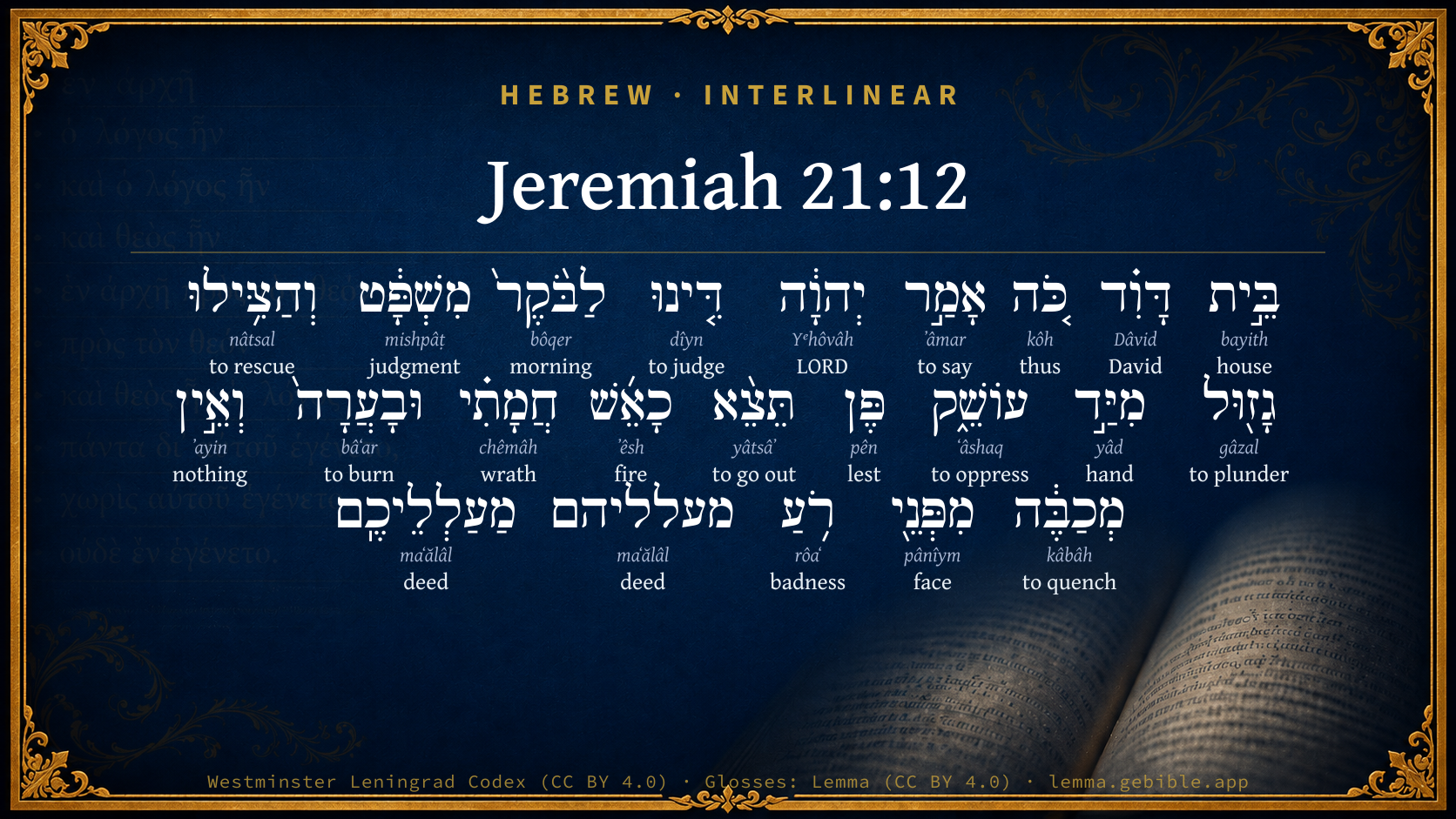
Hebrew (Westminster Leningrad Codex) Jeremiah 21:12 appears in the Hebrew Old Testament. The text above is from the Westminster Leningrad Codex. Each word links to its Strong’s number, a concise gloss, and parsing drawn from the Open Scriptures Hebrew Bible morphology. Click any word for its full Brown-Driver-Briggs (BDB) entry.
Download image
Cite this verse

Jeremiah 21:12 (World English Bible). Public Domain. Lemma interlinear Bible study tool, https://lemma.gebible.app/v/jeremiah/21/12.

Show BibTeX & RIS
BibTeX
RIS
English Translation
House of David, thus says Yahweh, Execute justice in the morning, and deliver him who is robbed out of the hand of the oppressor, lest my wrath go forth like fire, and burn so that none can quench it, because of the evil of your doings.
World English Bible · Public Domain
Download a study sheet

One document with this verse’s original text, its word-by-word gloss line, the meaning frame, cross-references with their text, attributed commentary, and full source and license credits — printable, and it pastes into notes with its structure intact.

This verse Autodidact and up

Study sheet (.html) Plain text (.txt)

A passage Seminary Student

Up to 50 verses in one chapter. A passage sheet keeps up to 6 commentary sources and 12 cross-references per verse, in the order this page ranks them, and says so on the sheet whenever that leaves anything out. Ask for a single verse and you get the Autodidact verse sheet above.

Everything on this page stays free to read, with no account — the sheet is a download of what is already on screen, not access to it.

Want to remove ads? Support Godless Engineer
Compare translations 3

The same verse in 3 English versions, stacked beneath the original-language interlinear above. Click any original word for its lexicon entry.

Each is an independent rendering of the whole verse — the interlinear is not word-aligned to these translations.

Highlighted words mark where these versions differ — a whole-verse word diff, not a word-by-word alignment.

  • World English Bible Public Domain
    House of David, thus says Yahweh, Execute justice in the morning, and deliver him who is robbed out of the hand of the oppressor, lest my wrath go forth like fire, and burn so that none can quench it, because of the evil of your doings.
  • King James Version Public Domain
    O house of David, thus saith the LORD; Execute judgment in the morning, and deliver him that is spoiled out of the hand of the oppressor, lest my fury go out like fire, and burn that none can quench it, because of the evil of your doings.
  • unfoldingWord Literal Text CC BY-SA 4.0
    House of David, thus says Yahweh, “Execute judgement justice in the morning, and rescue the one who is being robbed from the hand of the oppressor, lest my wrath go out like fire and burn, and there is no one quenching from the face of the evil of their deeds.

unfoldingWord Literal Text — © unfoldingWord, licensed CC BY-SA 4.0. Word-aligned USFM3 via Door43 (git.door43.org/unfoldingWord/en_ult).

Versions to compare (up to 4)

3 of 4 selected

Show all 18 translations

Every available English version of this verse, each an independent rendering of the whole verse.

  • World English Bible Public Domain
    House of David, thus says Yahweh, Execute justice in the morning, and deliver him who is robbed out of the hand of the oppressor, lest my wrath go forth like fire, and burn so that none can quench it, because of the evil of your doings.
  • Berean Standard Bible Public Domain
    O house of David, this is what the LORD says: ‘Administer justice every morning, and rescue the victim of robbery from the hand of his oppressor, or My wrath will go forth like fire and burn with no one to extinguish it because of their evil deeds.
  • Majority Standard Bible Public Domain
    O house of David, this is what the LORD says: ‘Administer justice every morning, and rescue the victim of robbery from the hand of his oppressor, or My wrath will go forth like fire and burn with no one to extinguish it because of their evil deeds.
  • King James Version Public Domain
    O house of David, thus saith the LORD; Execute judgment in the morning, and deliver him that is spoiled out of the hand of the oppressor, lest my fury go out like fire, and burn that none can quench it, because of the evil of your doings.
  • American Standard Version (1901) Public Domain
    O house of David, thus saith Jehovah, Execute justice in the morning, and deliver him that is robbed out of the hand of the oppressor, lest my wrath go forth like fire, and burn so that none can quench it, because of the evil of your doings.
  • Revised Version (1885) Public Domain
    O house of David, thus saith the LORD, Execute judgment in the morning, and deliver the spoiled out of the hand of the oppressor, lest my fury go forth like fire, and burn that none can quench it, because of the evil of your doings.
  • Geneva Bible (1599) Public Domain
    O house of Dauid, thus saith the Lord, Execute iudgement in the morning, and deliuer the oppressed out of the hande of the oppressor, lest my wrath go out like fire and burne, that none can quench it, because of the wickednes of your workes.
  • Douay-Rheims (1899) Public Domain
    O house of David, this saith the Lord: Judge ye judgement in the morning, and deliver him that is oppressed by violence out of the hand of the oppressor: lest my indignation go forth like a fire, and be kindled, and there be none to quench it, because of the evil of your ways.
  • Young's Literal Translation Public Domain
    O house of David, thus said Jehovah: Decide ye judgment at morning, And deliver the plundered from the hand of the oppressor, Lest My fury go forth as fire, And hath burned, and none is quenching, Because of the evil of your doings.
  • Literal Standard Version CC BY-SA 4.0
    O house of David, thus said YHWH: “Decide judgment in the morning, || And deliver the plundered from the hand of the oppressor, || Lest My fury go forth as fire, || And has burned, and none is quenching, || Because of the evil of your doings.
  • Unlocked Literal Bible CC BY-SA 4.0
    House of David, Yahweh says, 'Bring about justice in the morning. Rescue the one who has been robbed by the hand of the oppressor, or my fury will go out like fire and burn, and there is no one who can quench it, because of your evil deeds.
  • unfoldingWord Literal Text CC BY-SA 4.0
    House of David, thus says Yahweh, “Execute judgement justice in the morning, and rescue the one who is being robbed from the hand of the oppressor, lest my wrath go out like fire and burn, and there is no one quenching from the face of the evil of their deeds.
  • Darby Bible Public Domain
    House of David, thus saith Jehovah: Judge with justice in the morning, and deliver him that is spoiled out of the hand of the oppressor, lest my fury go forth like fire and burn, and there be none to quench it, because of the evil of your doings.
  • World Messianic Bible Public Domain
    House of David, the LORD says, ‘Execute justice in the morning, and deliver him who is robbed out of the hand of the oppressor, lest my wrath go out like fire, and burn so that no one can quench it, because of the evil of your doings.
  • Webster's Bible Public Domain
    O house of David, thus saith the LORD; Execute judgment in the morning, and deliver him that is made desolate out of the hand of the oppressor, lest my fury go out like fire, and burn that none can quench it, because of the evil of your doings.
  • Free Bible Version CC BY-SA 4.0
    Descendants of David, this is what the Lord says: Make sure you judge fairly every day. Protect those who are being unjustly treated from those corrupt people, otherwise because of their evil actions my anger will blaze out like fire that can't be put out.
  • Bible in Basic English Public Domain
    O family of David, this is what the Lord has said: Do what is right in the morning, and make free from the hands of the cruel one him whose goods have been violently taken away, or my wrath will go out like fire, burning so that no one may put it out, because of the evil of your doings.
  • JPS Tanakh (1917) Public Domain
    O house of David, thus saith the LORD: Execute justice in the morning, and deliver the spoiled out of the hand of the oppressor, lest My fury go forth like fire, and burn that none can quench it, because of the evil of your doings.

Literal Standard Version (2020), Covenant Press — licensed CC BY-SA 4.0. Text via the HelloAO Bible API (eBible.org). Unlocked Literal Bible (unfoldingWord) — licensed CC BY-SA 4.0. Text via the HelloAO Bible API (eBible.org). unfoldingWord Literal Text — © unfoldingWord, licensed CC BY-SA 4.0. Word-aligned USFM3 via Door43 (git.door43.org/unfoldingWord/en_ult). Free Bible Version, Dr. Jonathan Gallagher — licensed CC BY-SA 4.0. Text via the HelloAO Bible API (eBible.org).

Word by word

More ways to search: Search by grammar → Find every occurrence → Compare this word →

Practice this passage: Drill this verse → Learn its vocabulary →

רֹ֥עַ
rôaʻ
H7455
“badness of”
Noun, Common, Masculine, Singular, Construct
Part of Speech
Noun
Type
Common
Gender
Masculine
Number
Singular
State
Construct
Full BDB Definition

Origin: from H7489

TWOT: 2191b

badness, evil - badness, bad quality - wilfulness - evil, badness (ethical) - sadness
  1. בֵּ֣ית bayith H1004 “house of” Noun, Common, Masculine, Singular, Construct
  2. דָּוִ֗ד Dâvid H1732 “David” Noun, Proper
  3. כֹּ֚ה kôh H3541 “thus” Adverb
  4. אָמַ֣ר ʼâmar H559 “to say” Verb, Qal, Perfect, 3rd Person, Masculine, Singular
  5. יְהוָ֔ה Yᵉhôvâh H3068 “LORD” Noun, Proper
  6. דִּ֤ינוּ dîyn H1777 “judge” Verb, Qal, Imperative, 2nd Person, Masculine, Plural
  7. לַבֹּ֨קֶר֙ bôqer H1242 “to/for the · morning” Preposition, Determined + Noun, Common, Masculine, Singular, Absolute
  8. מִשְׁפָּ֔ט mishpâṭ H4941 “judgment” Noun, Common, Masculine, Singular, Absolute
  9. וְהַצִּ֥ילוּ nâtsal H5337 “and · rescue” Conjunction + Verb, Hiphil, Imperative, 2nd Person, Masculine, Plural
  10. גָז֖וּל gâzal H1497 “plundered” Verb, Qal, Participle Passive, Masculine, Singular, Absolute
  11. מִיַּ֣ד yâd H3027 “from · hand of” Preposition + Noun, Common, Both, Singular, Construct
  12. עוֹשֵׁ֑ק ʻâshaq H6231 “oppressing” Verb, Qal, Participle Active, Masculine, Singular, Absolute
  13. פֶּן pên H6435 “lest” Conjunction
  14. תֵּצֵ֨א yâtsâʼ H3318 “to go out” Verb, Qal, Imperfect, 3rd Person, Feminine, Singular
  15. כָאֵ֜שׁ ʼêsh H784 “like/as the · fire” Preposition, Determined + Noun, Common, Both, Singular, Absolute
  16. חֲמָתִ֗י chêmâh H2534 “wrath · my” Noun, Common, Feminine, Singular, Construct + Suffix, Personal, 1st Person, Common, Singular
  17. וּבָעֲרָה֙ bâʻar H1197 “and · to burn” Conjunction + Verb, Qal, Sequential Perfect, 3rd Person, Feminine, Singular
  18. וְאֵ֣ין ʼayin H369 “and · nothing” Conjunction + Particle, Negative
  19. מְכַבֶּ֔ה kâbâh H3518 “quenching” Verb, Piel, Participle Active, Masculine, Singular, Absolute
  20. מִפְּנֵ֖י pânîym H6440 “from · face(s) of” Preposition + Noun, Common, Both, Plural, Construct
  21. מעלליהם maʻălâl H4611 “deeds · their” Noun, Common, Masculine, Plural, Construct + Suffix, Personal, 3rd Person, Masculine, Plural
  22. מַעַלְלֵיכֶֽם maʻălâl H4611 “deeds · your” Noun, Common, Masculine, Plural, Construct + Suffix, Personal, 2nd Person, Masculine, Plural

About this verse

These counts appear in no published source. They are computed here, from the morphology-tagged text and Lemma’s own curated glosses. What Lemma adds →

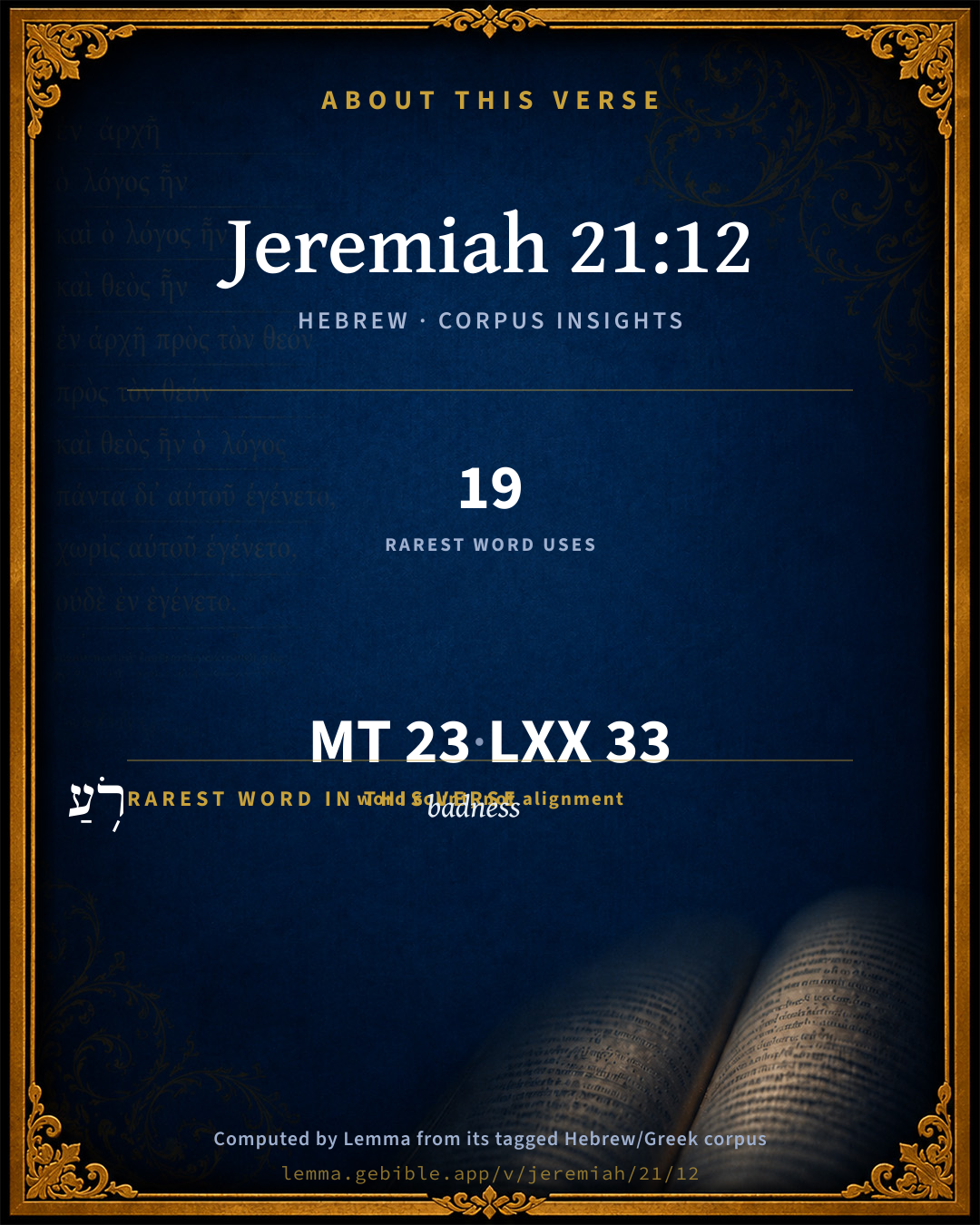
23
words
22
distinct lemmas
Prophets
section

Notable vocabulary

The rarest word here is רֹ֥עַ badness H7455 — appearing just 19 times in the whole Hebrew Bible.

Shared distinctive vocabulary

רֹ֥עַ badness H7455 occurs in 19 verses of the Hebrew Bible. Also found in:

Grammatical profile

  • 8 verbs
  • 12 nouns
  • 1 conjunction
  • 1 adverb
  • 1 particle

Verb forms

  • אָמַ֣ר Qal · Perfect
  • דִּ֤ינוּ Qal · Imperative
  • וְהַצִּ֥ילוּ Hiphil · Imperative
  • גָז֖וּל Qal · Participle Passive
  • עוֹשֵׁ֑ק Qal · Participle Active
  • תֵּצֵ֨א Qal · Imperfect
  • וּבָעֲרָה֙ Qal · Sequential Perfect
  • מְכַבֶּ֔ה Piel · Participle Active

Repetition

A word recurs within this verse — often emphatic in Hebrew:

  • מעלליהם deed H4611 ×2

Hebrew & Septuagint length

In the original languages it is 23 Hebrew tokens and 33 Greek tokens — but the two are counted differently (Hebrew bundles its prefixes and suffixes into one token; the Greek is in lemma form), so that isn’t a like-for-like length.

Cross-references

43

Topical passages linked to Jeremiah 21:12 in the Treasury of Scripture Knowledge — connected by theme and wording, ordered by reader-vote popularity; previews shown in the World English Bible.

  • Isaiah 1:17 Learn to do well. Seek justice, Relieve the oppressed, Judge the fatherless, Plead for the widow."
  • Proverbs 31:8–9 Open your mouth for the mute, In the cause of all who are left desolate.
  • Jeremiah 4:4 Circumcise yourselves to Yahweh, and take away the foreskins of your heart, you men of Judah and inhabitants of Jerusalem; lest my wrath go forth like fire, and burn so that none can quench it, because of the evil of your doings.
  • Isaiah 1:31 The strong will be like tinder, And his work like a spark. They will both burn together, And no one will quench them."
  • Jeremiah 22:2–3 Say, Hear the word of Yahweh, king of Judah, who sits on the throne of David, you, and your servants, and your people who enter in by these gates.
  • Zechariah 7:9–11 "Thus has Yahweh of Hosts spoken, saying, 'Execute true judgment, and show kindness and compassion every man to his brother.
  • Jeremiah 5:28 They are grew fat, they shine: yes, they overpass in deeds of wickedness; they don't plead the cause, the cause of the fatherless, that they may prosper; and the right of the needy they don't judge.
  • Jeremiah 7:20 Therefore thus says the Lord Yahweh: Behold, my anger and my wrath shall be poured out on this place, on man, and on animal, and on the trees of the field, and on the fruit of the ground; and it shall burn, and shall not be quenched.
  • Jeremiah 17:4 You, even of yourself, shall discontinue from your heritage that I gave you; and I will cause you to serve your enemies in the land which you don't know: for you have kindled a fire in my anger which shall burn forever.
  • Jeremiah 36:7 It may be they will present their supplication before Yahweh, and will return everyone from his evil way; for great is the anger and the wrath that Yahweh has pronounced against this people.
  • Ezekiel 20:47–48 and tell the forest of the South, Hear the word of Yahweh: Thus says the Lord Yahweh, Behold, I will kindle a fire in you, and it shall devour every green tree in you, and every dry tree: the flaming flame shall not be quenched, and all faces from the south to the north shall be burnt thereby.
  • Nahum 1:6 Who can stand before his indignation? Who can endure the fierceness of his anger? His wrath is poured out like fire, and the rocks are broken apart by him.
  • Zephaniah 3:5 Yahweh, in the midst of her, is righteous. He will do no wrong. Every morning he brings his justice to light. He doesn't fail, but the unjust know no shame.
  • Psalms 101:8 Morning by morning, I will destroy all the wicked of the land; To cut off all the workers of iniquity from Yahweh's city.
  • Isaiah 7:2 It was told the house of David, saying, "Syria is allied with Ephraim." His heart trembled, and the heart of his people, as the trees of the forest tremble with the wind.
  • Isaiah 7:13 He said, "Listen now, house of David: Is it not enough for you to try the patience of men, that you will try the patience of my God also?
  • Jeremiah 5:14 Therefore thus says Yahweh, the God of hosts, Because you speak this word, behold, I will make my words in your mouth fire, and this people wood, and it shall devour them.
  • Jeremiah 22:15–17 Shall you reign, because you strive to excel in cedar? Didn't your father eat and drink, and do justice and righteousness? then it was well with him.
  • Jeremiah 23:19 Behold, the tempest of Yahweh, [even his] wrath, is gone forth, yes, a whirling tempest: it shall burst on the head of the wicked.
  • Lamentations 2:3–4 He has cut off in fierce anger all the horn of Israel; He has drawn back his right hand from before the enemy: He has burned up Jacob like a flaming fire, which devours round about.
  • Lamentations 4:11 Yahweh has accomplished his wrath, he has poured out his fierce anger; He has kindled a fire in Zion, which has devoured the foundations of it.
  • Ezekiel 22:18–22 Son of man, the house of Israel is become dross to me: all of them are brass and tin and iron and lead, in the midst of the furnace; they are the dross of silver.
  • Ezekiel 22:31 Therefore have I poured out my indignation on them; I have consumed them with the fire of my wrath: their own way have I brought on their heads, says the Lord Yahweh.
  • Mark 9:43–48 If your hand causes you to stumble, cut it off. It is better for you to enter into life maimed, rather than having your two hands to go into Gehenna, into the unquenchable fire,
  • Luke 1:69 And has raised up a horn of salvation for us in the house of his servant David
  • Luke 18:3–5 A widow was in that city, and she often came to him, saying, 'Defend me from my adversary!'
  • Romans 13:4 for he is a servant of God to you for good. But if you do that which is evil, be afraid, for he doesn't bear the sword in vain; for he is a minister of God, an avenger for wrath to him who does evil.
  • Exodus 18:13 It happened on the next day, that Moses sat to judge the people, and the people stood around Moses from the morning to the evening.
  • Leviticus 26:28 then I will walk contrary to you in wrath; and I also will chastise you seven times for your sins.
  • Deuteronomy 32:22 For a fire is kindled in my anger, Burns to the lowest Sheol, Devours the earth with its increase, Sets on fire the foundations of the mountains.
  • 2 Samuel 8:15 David reigned over all Israel; and David executed justice and righteousness to all his people.
  • Job 29:17 I broke the jaws of the unrighteous, And plucked the prey out of his teeth.
  • Psalms 72:1–4 God, give the king your justice; Your righteousness to the royal son.
  • Psalms 72:12–14 For he will deliver the needy when he cries; The poor, who has no helper.
  • Psalms 82:2–4 "How long will you judge unjustly, And show partiality to the wicked?" Selah.
  • Proverbs 24:11–12 Rescue those who are being led away to death! Indeed, hold back those who are staggering to the slaughter!
  • Ecclesiastes 10:16–17 Woe to you, land, when your king is a child, And your princes eat in the morning!
  • Isaiah 16:3–5 Give counsel, execute justice; make your shade as the night in the midst of the noonday; hide the outcasts; don't betray the fugitive.
  • Isaiah 31:1–2 Woe to those who go down to Egypt for help, and rely on horses, and trust in chariots because they are many, and in horsemen because they are very strong, but they don't look to the Holy One of Israel, neither seek Yahweh!
  • Jeremiah 21:5 I myself will fight against you with an outstretched hand and with a strong arm, even in anger, and in wrath, and in great indignation.
  • Jeremiah 23:5 Behold, the days come, says Yahweh, that I will raise to David a righteous Branch, and he shall reign as king and deal wisely, and shall execute justice and righteousness in the land.
  • Ezekiel 24:8–14 That it may cause wrath to come up to take vengeance, I have set her blood on the bare rock, that it should not be covered.
  • Zephaniah 1:18 Neither their silver nor their gold will be able to deliver them in the day of Yahweh's wrath, but the whole land will be devoured by the fire of his jealousy; for he will make an end, yes, a terrible end, of all those who dwell in the land.

Cross-references courtesy of OpenBible.info (CC BY 4.0).

Hebrew and Greek witnesses Masoretic Hebrew ↔ Greek Septuagint

The same verse in the two great witnesses to the Old Testament, shown verse-for-verse.

These are two independent witnesses, not word-aligned to each other, and the Septuagint is shown in lemma (dictionary) form.

Hebrew Jeremiah 21:12 Masoretic · Westminster Leningrad Codex

בֵּ֣ית דָּוִ֗ד כֹּ֚ה אָמַ֣ר יְהוָ֔ה דִּ֤ינוּ לַבֹּ֨קֶר֙ מִשְׁפָּ֔ט וְהַצִּ֥ילוּ גָז֖וּל מִיַּ֣ד עוֹשֵׁ֑ק פֶּן תֵּצֵ֨א כָאֵ֜שׁ חֲמָתִ֗י וּבָעֲרָה֙ וְאֵ֣ין מְכַבֶּ֔ה מִפְּנֵ֖י רֹ֥עַ מעלליהם מַעַלְלֵיכֶֽם

House of David, thus says Yahweh, Execute justice in the morning, and deliver him who is robbed out of the hand of the oppressor, lest my wrath go forth like fire, and burn so that none can quench it, because of the evil of your doings.

World English Bible · Public Domain

Greek LXX Structure differs

In the Septuagint, Jeremiah is about an eighth shorter than the Hebrew and arranges its material differently — the Oracles Against the Nations (Hebrew chapters 46–51) appear in the middle of the Greek book, after 25:13. Because the chapter and verse boundaries do not line up, a verse-for-verse comparison with the Hebrew is not shown.

A verse-for-verse comparison isn’t shown here because the chapters and verses don’t line up. Switch to the LXX edition with the MT / LXX toggle above to read the Greek directly.

Hebrew: Westminster Leningrad Codex (CC BY 4.0). Greek: Septuagint (public domain); English from a public-domain English Septuagint. How the Septuagint differs from the Hebrew →

Targum (Aramaic paraphrase)

1

The Targum is the ancient Jewish Aramaic paraphrase of the Hebrew Scriptures — an interpretive translation, not the Hebrew text itself. Onkelos (literal) and Pseudo-Jonathan (expansive) render the Torah, and Jonathan the Prophets. Coverage is partial: where no permissively-licensed English translation exists for a verse, only the Aramaic is shown. This is verse-level text, not a word-by-word alignment to the Hebrew.

  1. Targum Jonathan Prophets (Joshua–Malachi)
    בֵּית דָּוִד כִּדְנַן אֲמַר יְיָ דִינוּ לְצַפְרָא דִינָא וְשֵׁיזִיבוּ אֲנִיסָא מִיַד דְאָנֵיס לֵיהּ דִלְמָא יִדְלַק כְּאֶשְׁתָּא רוּגְזִי וִישֵׁיצֵי וְלָא יְהֵי חָיֵס מִן קֳדָם בִּישׁוּת עוֹבָדֵיכוֹן:

    (no public-domain English translation for this verse)

    Targum Jonathan — Aramaic: “Mikraot Gedolot” (public domain). English: “Sefaria Community Translation” (CC0 1.0 (public-domain dedication)); “London "Chaldee Paraphrase," 1871” (public domain). Text via Sefaria.

Commentary

Notes on Jeremiah 21:12 from classic Christian and Jewish commentators (each source and its license shown beneath its notes). The classic Christian expositions comment on the surrounding passage and are grouped to its opening verse, so a note may address several verses; the Jewish commentaries on the Tanakh (Rashi and others) are per-verse, so they appear only where the commentator wrote on this verse.

Lemma curates 59 commentaries, every one of them public domain or Creative Commons licensed, each selected and text-cleaned for this edition rather than reprinted as found. About our sources →

Trapp's Complete Commentary

John Trapp

Jer 21:12 O house of David, thus saith the LORD; Execute judgment in the morning, and deliver [him that is] spoiled out of the hand of the oppressor, lest my fury go out like fire, and burn that none can quench [it], because of the evil of your doings.

Ver. 12. O house of David.] But much degenerated from the piety of David. So Mic 2:7, "O thou that art named the house of Jacob - are these his doings," &c. {See Trapp on "Mic 2:7"} To be a degenerate plant of so noble a vine is no small discommendation.

Thus saith the Lord.] After that the court had sent to him, he is sent to the court with these instructions.

Execute justice in the morning.] As David your progenitor and pattern did. {Psa 101:8} Be up and at it early, and make quick despatch of causes that poor men may go home about their businesses who have other things to do besides going to law. It is a lamentable thing that a suit should depend ten or twenty years in some courts, Quo saturentur avarissimi rabulae, omnia bona pauperum exugentes, {a} through the avarice of some pleaders, to the utter undoing of their poor clients. This made one such (when he was persuaded to patience by the example of Job) to reply, What do ye tell me of Job? Job never had any suits in chancery. Jethro adviseth Moses {Exo 18:14-23} to dismiss those timely, {b} whom he cannot despatch presently.

{a} Oecolamp.

{b} Mane, i.e., Mature.

John Trapp, A Commentary or Exposition upon All the Books of the Old and New Testament (1647–1656) — public domain. Text from a community e-Sword module.

The Biblical Illustrator

Joseph S. Exell

Jer_21:12

Execute Judgment ill the morning.

Justice must be prompt

Execute judgment in the morning, as David your progenitor and pattern did (Psa_101:8). Be up and be at it bedtime, and make quick despatch of causes, that poor men may go home about their business, who have other things to do besides going to law. It is a lamentable thing that a suit should depend ten or twenty years in some courts through the avarice of some pleaders, to the utter undoing of their poor clients. This made one such (when he was persuaded to patience by the example of Job) to reply, What do you tell me of Job? Job never had suits in chancery. Jethro adviseth Moses (Exo_18:1-27) to dismiss those timely, whom he cannot despatch presently. (John Trapp.)

.

The Biblical Illustrator, edited by Joseph S. Exell (c. 1880s–1900s) — public domain. Text from a community e-Sword module.

Geneva Bible (1599)

Geneva Bible translators

Be diligent to do justice.

Geneva Bible (1599) marginal notes — public domain. Text via Bolls.life.

Jamieson, Fausset & Brown

Robert Jamieson, A. R. Fausset & David Brown

house of David--the royal family and all in office about the king. He calls them so, because it was the greater disgrace that they had so degenerated from the piety of their forefather, David; and to repress their glorying in their descent from him, as if they were therefore inviolable; but God will not spare them as apostates.

in the morning--alluding to the time of dispensing justice (Job 24:17; Psa 101:8); but the sense is mainly proverbial, for "with promptness" (Psa 90:14; Psa 143:8). MAURER translates, "every morning."

lest my fury . . . like fire--Already it was kindled, and the decree of God gone forth against the city (Jer 21:4-5), but the king and his house may yet be preserved by repentance and reformation. God urges to righteousness, not as if they can thereby escape punishment wholly, but as the condition of a mitigation of it.

Jamieson, Fausset & Brown — Commentary Critical and Explanatory on the Whole Bible (1871) — public domain (CC PDM 1.0). Text via the HelloAO Bible API.

Adam Clarke's Commentary

Verse 12. Execute judgment in the morning] Probably the time for dispensing judgment was the morning, when the people were going to their work; but the words may mean, Do justice promptly, do not delay. Let justice be administered as soon as required.

Adam Clarke's Commentary on the Bible (1810–1826) — public domain. Text from a community e-Sword/MySword module.

John Calvin's Commentaries

Thus saith Jehovah, he adds, Judge ye judgment There was no doubt a great liberty taken by the king and his courtiers in committing plunder, for the Prophet would not have here recommended justice to them had they not wholly neglected what was just and right. As, then, there was no care to administer justice, the Prophet bade them to recognize what was due to God and to his people. But it was a most grievous trial to all the godly to see that the sacred house, in which the living image of God ought to have shone forth brightly, was become a house of spoils, where robbers dwelt, who with impunity plundered all around them. When, therefore, the state of things is in such a disorder that the very judges, whom God has set over his Church, are like robbers, let us know that such a thing happened formerly; nor is there a doubt but that God thus took vengeance on the impiety and wickedness of the people, for he would have never suffered that house to be so contaminated and so filled with so many crimes, had not the people been unworthy of a good and faithful king and of upright counsellors. Let us, then, know that the Prophet exhorted the king and his counsellors to execute justice, because they had forgotten their office, and were become like rapacious wolves.

He specifies one act, Free ye the spoiled from the hand of his oppressor Some read, “from the hand of the fraudulent,” as though עשק, oshek, should mean to oppress by calumny and malice, or by fraudulent means; but it is to be taken otherwise here. Some distinguish between the two words עשק, oshek, and גזל, gesal, and say that the first means to retain a deposit or wages, or anything that belongs to another, and that the latter signifies to take a thing by force, to plunder. But this difference, as it appears, is not observed by the Prophet, for he says, “Free ye the plundered or the spoiled.” From whose hand? from “the hand of the oppressor.” As, then, these two words correspond, I doubt not but that גזל, gesal, means both to take by force and to plunder; and that though עשק, oshek, means often fraudulently to oppress, yet not always. However this may be, God intimates that neither the king nor his counsellors had any care for the poor, so as to repress violence, and robbery, and plunder. Then the very judges themselves were the associates of robbers, for they allowed them with impunity to rob and plunder without affording any aid to helpless men when they were thus wickedly harassed. There is, however, no doubt but that God would have them to perform their duties towards all, both rich and poor, without exception; but as injustice in this particular was especially seen, this is the reason why by stating a part for the whole he specified only one thing.

He then adds, Lest my indignation go forth like fire, and burn, and there be none to extinguish it Here the Prophet intimates, that except the king and his courtiers repented, it was all over with them. There is then a contrast to be understood here between that paternal correction of which he had spoken, and the destruction of which the Prophet now speaks. God’s indignation had been already kindled, nor could it be immediately extinguished; and though they had to suffer, yet the issue would have been happy and according to their wishes: but he here declares that there would be an irreconcilable war with God, except they labored to return to his favor. He adds, On account of the wickedness of their doings There is here a change of person, except we read כם, cam, “you;” but this sort of change often occurs in Scripture. The Prophet, after having addressed them, says now, “on account of the wickedness of their doings,” as though having finished his discourse, he spoke of them as being absent, or as though God, after having given orders to his Prophet, then added, “I denounce this on them, because they have so deserved.”

John Calvin's Commentaries (1540-1563) — public domain. Text from the Calvin Translation Society English edition (1840s-50s) via the Christian Classics Ethereal Library (ccel.org). Calvin's coverage is partial (roughly two-thirds of the Bible); uncommented books and verses are honest gaps, never fabricated. The 19th-century editor's footnotes and remarks are omitted so the notes are faithfully Calvin's own voice.

Ellicott's Commentary for English Readers

(12) Execute judgment in the morning.—The words point to one of the chief duties of the ideal Eastern king. To rise at dawn of day, to sit in the gate and listen to the complaints of those who had been wronged, was the surest way to gain the affection of his people. It was David’s neglect of this that gave an opening for the rebellion of Absalom (2Sa_15:2). Solomon’s early fame for wisdom rested on his discharge of this duty (1Ki_3:28). If the king remained slothfully in his palace in those golden hours of morning, the noon-tide heat made it impossible for him to retrieve the lost opportunity. (Comp. 2Sa_4:5.) Still worse was it when, as with luxurious and sensual kings, the morning hours were given to revelry and feasting (Ecc_10:16-17).

A Bible Commentary for English Readers, edited by Charles John Ellicott (1878–1897) — public domain. Text from a community e-Sword module.

The Cambridge Bible for Schools and Colleges

gen. ed. J. J. S. Perowne

12. Execute judgement in the morning] An important part of the king’s duties was personally to hear and adjudicate upon cases in the open space at the city gate. Cp. 2Sa_15:2-4.

in the morning] probably, every morning; so Amo_4:4, and cp. Psa_101:8. It was the ordinary time for business, while it was still cool.

The Cambridge Bible for Schools and Colleges (gen. ed. J. J. S. Perowne; Cambridge University Press, 1878–1918) — public domain. Text from a community e-Sword module.

John Gill's Exposition

O house of David, thus saith the Lord,.... This appellation is made use of to put them in mind of their descent, and to observe to them how much it became them to follow the example of so illustrious an ancestor, from whom they had the honour to descend; by doing judgment and justice as he did, Sa2 8:15; or, otherwise, their being his seed would not secure them from ruin and destruction:

execute judgment in the morning; be at it early, and dispatch it speedily; show a hearty regard for it; prefer it to eating and drinking; and do not delay it to the prejudice of persons concerned. The power of judgment with the Jews belonged to the king; he was supreme judge in their courts; they judged, and were judged, the Jews say (q); by whom judgment was executed in a morning, and not in any other part of the day; and the case judged ought, as they say, to be as clear as the morning (r):

and deliver him that is spoiled out of the hand of the oppressor; that had anything taken from him by force or fraud; that was either robbed or cheated of his substance; or was refused what he had lent to or entrusted another with; or was by any ways and means wronged and injured by another in his person or property. This suggests that things of this kind were not done, and were the reason why the Lord would deliver them up into the hands of their enemies, or cause his judgments to fall upon them:

lest my fury go out like fire, and burn that none can quench it; or put a stop to it, by all their prayers and entreaties, or by all that they can say or do:

because of the evil of your doings; it is a sad thing when princes set bad examples; it is highly provoking to God, whose deputies they are; and it becomes them to begin a reformation, and lead it on, or they cannot expect safety for themselves and their people.

(q) T. Bab. Sanhedrin, fol. 19. 1. (r) Ib. fol. 7. 2.

John Gill's Exposition of the Whole Bible (1746–1763) — public domain (CC PDM 1.0). Text via the HelloAO Bible API.

Albert Barnes' Notes on the Bible

Execute judgment - As the administration of justice was performed in old time in person, the weal of the people depended to a great degree upon the personal qualities of the king (see 2Sa 15:4). And as “the oppressor” was generally some powerful noble, it was especially the king’s duty to see that the weaker members of the community were not wronged.

Albert Barnes' Notes on the Bible (1834–1885) — public domain. Text from a community e-Sword/MySword module.

Matthew Poole's English Annotations

He calls these the

house of David, either checking them, who were indeed so in a lineal descent, or minding them what they ought to be in imitation of their father, David. The only way they had to keep off those Divine judgments which now hanged over their heads was to

execute judgment, that is, justice, without partiality; the prophet’s advice to them

to execute judgment in the morning either lets them know they must do it quickly, or else it hath respect to the time when the courts of justice sat. One species of justice was the deliverance of the oppressed from the hands, that is, from the power and malice, of the oppressors; which if it were not done, God threateneth certain ruin and destruction to them, which none should be able to hinder or avoid. The cause of which was, their wicked doings; for that God who doth people good, and showeth them favour, not for their sake, but for his own name’s sake, yet never punisheth them but for a cause found in them.

Matthew Poole's English Annotations on the Holy Bible (1683–1685) — public domain. Text from a community e-Sword/MySword module.

The Pulpit Commentary

O house of David. The "house of David" here, as in Isa_7:13, means the various branches of the royal family, the same, in fact, which are called by courtesy "kings of Judah" in Jer_17:20 (see note). They appear from the present passage to have monopolized the judicial function. Deliver him that is spoiled, etc. The poor man would have no advocate to plead for him; in this case the judge was to see that he suffered no injustice in consequence.

The Pulpit Commentary (1880–1919), ed. H.D.M. Spence-Jones & Joseph S. Exell — public domain. Text from a community e-Sword module.

John Wesley's Explanatory Notes

Execute judgment - That is, justice, without partiality, and do it quickly.

John Wesley, Explanatory Notes Upon the Whole Bible (1754–1765) — public domain. Text via the GEBible commentary corpus.

Rashi

Rabbi Shlomo Yitzchaki (Rashi)

from the hand of the robber Its accent is below for it is not a noun but a noun denoting the robber who robs others.

with no one to extinguish [it] that no one of you will escape as a survivor.

Rashi on the Tanakh — English translations: “The Judaica Press complete Tanach with Rashi, translated by A. J. Rosenberg” (CC BY 4.0); “Pentateuch with Rashi's commentary by M. Rosenbaum and A.M. Silbermann, 1929-1934” (public domain); “The Metsudah Tanach series, Lakewood, N.J” (CC BY 4.0); and “The Book of Joshua, Metsudah Publications, 1997” (CC BY 4.0). Text via Sefaria.

Lesson kit

Teaching starters — assembled from the data on this page, not authored interpretation. Every prompt links to the verse data it draws on. Edit before teaching.

Jeremiah, in the Prophets, opens this verse with 23 words (22 distinct Hebrew lemmas). Its most distinctive word is rôaʻ (“badness”). A historical commentator’s framing appears above. Read the whole chapter for the surrounding context.

Discussion questions

  1. What does “badness” (rôaʻ) contribute to the verse as a whole?
  2. How does Genesis 41:19, which shares the word «badness», read alongside this verse?
  3. What does the repetition of “deed” (2× in this one verse) do in this verse?
  4. These translations render this verse differently; the difference is in the English rendering, not the original. What questions does that raise?
  5. «אָמַ֣ר» is a Qal Perfect verb. How does that grammatical form shape the action described?
  6. Compare how Trapp's Complete Commentary and The Biblical Illustrator read this verse. Where do they agree or differ?

Things to notice

Reading settings

Reading text

Shown beneath each verse's original-language words.

Old Testament
Old Testament edition

Read the OT as the Masoretic Hebrew (MT) or the Greek Septuagint (LXX).

English shown for the Greek Septuagint (in the Hebrew ↔ Greek comparison).

Comparing translations? Open the Compare panel on any verse page to stack up to four side by side.