
Exodus 12:27

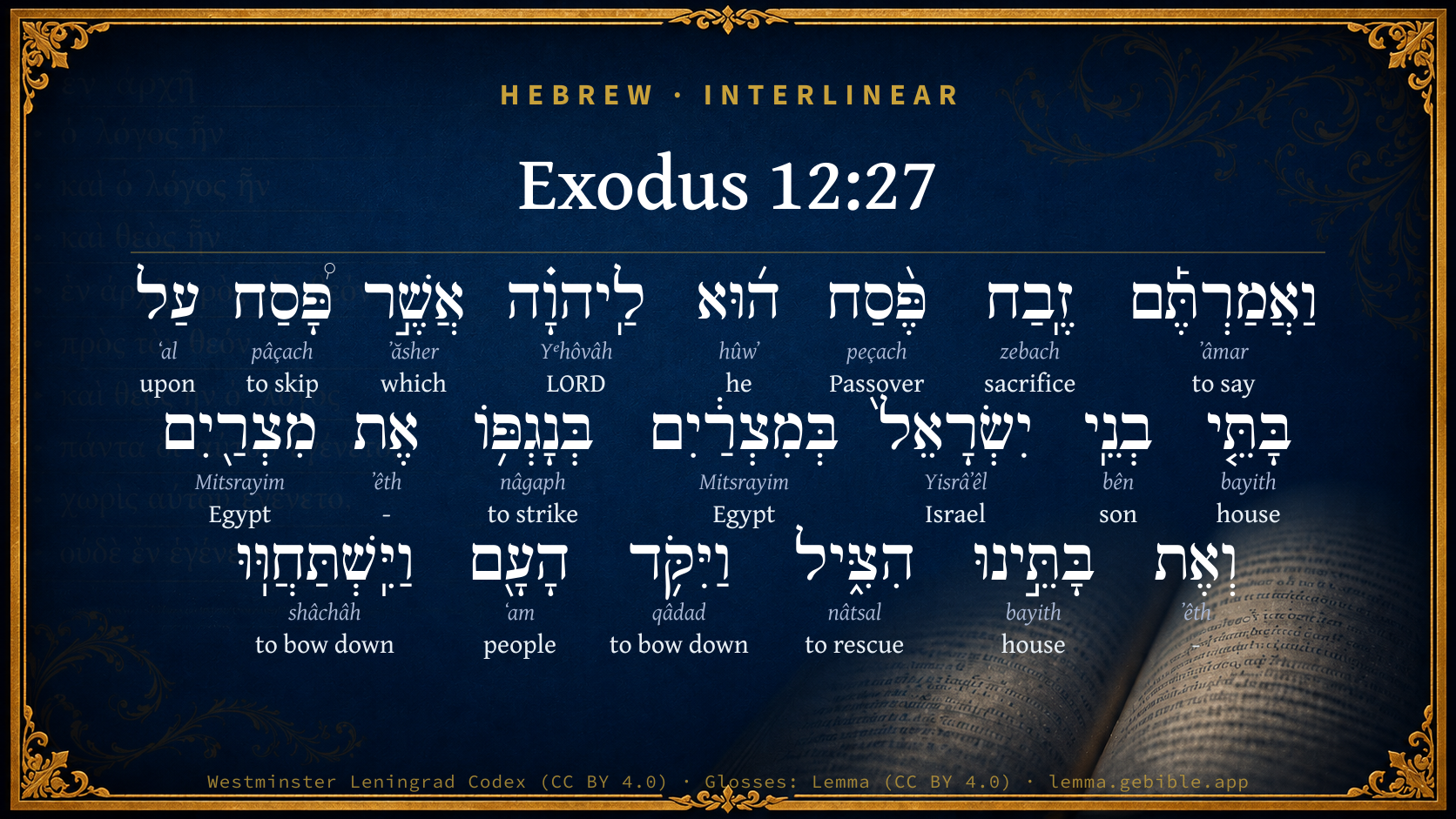
Hebrew (Westminster Leningrad Codex) Exodus 12:27 appears in the Hebrew Old Testament. The text above is from the Westminster Leningrad Codex. Each word links to its Strong’s number, a concise gloss, and parsing drawn from the Open Scriptures Hebrew Bible morphology. Click any word for its full Brown-Driver-Briggs (BDB) entry.
Download image
Cite this verse

Exodus 12:27 (World English Bible). Public Domain. Lemma interlinear Bible study tool, https://lemma.gebible.app/v/exodus/12/27.

Show BibTeX & RIS
BibTeX
RIS
English Translation
that you shall say, 'It is the sacrifice of Yahweh's Passover, who passed over the houses of the children of Israel in Egypt, when he struck the Egyptians, and spared our houses.'" The people bowed their heads and worshiped.
World English Bible · Public Domain
Download a study sheet

One document with this verse’s original text, its word-by-word gloss line, the meaning frame, cross-references with their text, attributed commentary, and full source and license credits — printable, and it pastes into notes with its structure intact.

This verse Autodidact and up

Study sheet (.html) Plain text (.txt)

A passage Seminary Student

Up to 50 verses in one chapter. A passage sheet keeps up to 6 commentary sources and 12 cross-references per verse, in the order this page ranks them, and says so on the sheet whenever that leaves anything out. Ask for a single verse and you get the Autodidact verse sheet above.

Everything on this page stays free to read, with no account — the sheet is a download of what is already on screen, not access to it.

Want to remove ads? Support Godless Engineer
Compare translations 3

The same verse in 3 English versions, stacked beneath the original-language interlinear above. Click any original word for its lexicon entry.

Each is an independent rendering of the whole verse — the interlinear is not word-aligned to these translations.

Highlighted words mark where these versions differ — a whole-verse word diff, not a word-by-word alignment.

  • World English Bible Public Domain
    that you shall say, 'It is the sacrifice of Yahweh's Passover, who passed over the houses of the children of Israel in Egypt, when he struck the Egyptians, and spared our houses.'" The people bowed their heads and worshiped.
  • King James Version Public Domain
    That ye shall say, It is the sacrifice of the LORD's passover, who passed over the houses of the children of Israel in Egypt, when he smote the Egyptians, and delivered our houses. And the people bowed the head and worshipped.
  • unfoldingWord Literal Text CC BY-SA 4.0
    then you shall say, ‘It is the sacrifice of Passover to Yahweh, who passed over the houses of the sons of Israel in Egypt in striking the Egyptians. And he rescued our households.’” And the people bowed their heads and prostrated themselves.

unfoldingWord Literal Text — © unfoldingWord, licensed CC BY-SA 4.0. Word-aligned USFM3 via Door43 (git.door43.org/unfoldingWord/en_ult).

Versions to compare (up to 4)

3 of 4 selected

Show all 18 translations

Every available English version of this verse, each an independent rendering of the whole verse.

  • World English Bible Public Domain
    that you shall say, 'It is the sacrifice of Yahweh's Passover, who passed over the houses of the children of Israel in Egypt, when he struck the Egyptians, and spared our houses.'" The people bowed their heads and worshiped.
  • Berean Standard Bible Public Domain
    you are to reply, ‘It is the Passover sacrifice to the LORD, who passed over the houses of the Israelites in Egypt when He struck down the Egyptians and spared our homes.’” Then the people bowed down and worshiped.
  • Majority Standard Bible Public Domain
    you are to reply, ‘It is the Passover sacrifice to the LORD, who passed over the houses of the Israelites in Egypt when He struck down the Egyptians and spared our homes.’” Then the people bowed down and worshiped.
  • King James Version Public Domain
    That ye shall say, It is the sacrifice of the LORD's passover, who passed over the houses of the children of Israel in Egypt, when he smote the Egyptians, and delivered our houses. And the people bowed the head and worshipped.
  • American Standard Version (1901) Public Domain
    that ye shall say, It is the sacrifice of Jehovah's passover, who passed over the houses of the children of Israel in Egypt, when he smote the Egyptians, and delivered our houses. And the people bowed the head and worshipped.
  • Revised Version (1885) Public Domain
    that ye shall say, It is the sacrifice of the LORD’S passover, who passed over the houses of the children of Israel in Egypt, when he smote the Egyptians, and delivered our houses. And the people bowed the head and worshipped.
  • Geneva Bible (1599) Public Domain
    Then ye shall saye, It is the sacrifice of the Lordes Passeouer, which passed ouer the houses of the children of Israel in Egypt, when he smote the Egyptians, and preserued our houses. Then the people bowed them selues, and worshipped.
  • Douay-Rheims (1899) Public Domain
    You shall say to them: It is the victim of the passage of the Lord, when he passed over the houses of the children of Israel in Egypt, striking the Egyptians, and saving our houses. And the people bowing themselves, adored.
  • Young's Literal Translation Public Domain
    that ye have said, A sacrifice of passover it `is' to Jehovah, who passed over the houses of the sons of Israel in Egypt, in His smiting the Egyptians, and our houses He delivered.'
  • Literal Standard Version CC BY-SA 4.0
    That you have said, It [is] a sacrifice of Passover to YHWH, who passed over the houses of the sons of Israel in Egypt, in His striking the Egyptians, and our houses He delivered.”
  • Unlocked Literal Bible CC BY-SA 4.0
    then you must say, 'It is the sacrifice of Yahweh's Passover, because Yahweh passed over the Israelites' houses in Egypt when he attacked the Egyptians. He set our households free.'” Then the people bowed down and worshiped Yahweh.
  • unfoldingWord Literal Text CC BY-SA 4.0
    then you shall say, ‘It is the sacrifice of Passover to Yahweh, who passed over the houses of the sons of Israel in Egypt in striking the Egyptians. And he rescued our households.’” And the people bowed their heads and prostrated themselves.
  • Darby Bible Public Domain
    that ye shall say, It is a sacrifice of passover to Jehovah, who passed over the houses of the children of Israel in Egypt when he smote the Egyptians and delivered our houses. And the people bowed their heads and worshipped.
  • World Messianic Bible Public Domain
    that you shall say, ‘It is the sacrifice of the LORD’s Passover, who passed over the houses of the children of Israel in Egypt, when he struck the Egyptians, and spared our houses.’” The people bowed their heads and worshiped.
  • Webster's Bible Public Domain
    That ye shall say, It is the sacrifice of the LORD'S passover, who passed over the houses of the children of Israel in Egypt, when he smote the Egyptians, and delivered our houses. And the people bowed the head and worshiped.
  • Free Bible Version CC BY-SA 4.0
    you are to tell them, ‘This is the Passover sacrifice to the Lord. He was the one who passed over the houses of the Israelites in Egypt when he killed the Egyptians but spared our households.’” The people bowed down in worship.
  • Bible in Basic English Public Domain
    Then you will say, This is the offering of the Lord's Passover; for he went over the houses of the children of Israel in Egypt, when he sent death on the Egyptians, and kept our families safe. And the people gave worship with bent heads.
  • JPS Tanakh (1917) Public Domain
    that ye shall say: It is the sacrifice of the LORD'S passover, for that He passed over the houses of the children of Israel in Egypt, when He smote the Egyptians, and delivered our houses.' And the people bowed the head and worshipped.

Literal Standard Version (2020), Covenant Press — licensed CC BY-SA 4.0. Text via the HelloAO Bible API (eBible.org). Unlocked Literal Bible (unfoldingWord) — licensed CC BY-SA 4.0. Text via the HelloAO Bible API (eBible.org). unfoldingWord Literal Text — © unfoldingWord, licensed CC BY-SA 4.0. Word-aligned USFM3 via Door43 (git.door43.org/unfoldingWord/en_ult). Free Bible Version, Dr. Jonathan Gallagher — licensed CC BY-SA 4.0. Text via the HelloAO Bible API (eBible.org).

Word by word

More ways to search: Search by grammar → Find every occurrence → Compare this word →

Practice this passage: Drill this verse → Learn its vocabulary →

פָּ֠סַח
pâçach
H6452
“to skip”
Verb, Qal, Perfect, 3rd Person, Masculine, Singular
Part of Speech
Verb
Stem
Qal
Form
Perfect
Person
3rd Person
Gender
Masculine
Number
Singular
Full BDB Definition

Origin: a primitive root

TWOT: 1786 , 1787

to pass over, spring over - (Qal) to pass over - (Piel) to skip, pass over - to limp - (Qal) to limp - (Niphal) to be lame - (Piel) to limp
  1. וַאֲמַרְתֶּ֡ם ʼâmar H559 “and · to say” Conjunction + Verb, Qal, Sequential Perfect, 2nd Person, Masculine, Plural
  2. זֶֽבַח zebach H2077 “sacrifice of” Noun, Common, Masculine, Singular, Construct
  3. פֶּ֨סַח peçach H6453 “Passover” Noun, Common, Masculine, Singular, Absolute
  4. ה֜וּא hûwʼ H1931 “he” Pronoun, Personal, 3rd Person, Masculine, Singular
  5. לַֽיהוָ֗ה Yᵉhôvâh H3068 “to/for · LORD” Preposition + Noun, Proper
  6. אֲשֶׁ֣ר ʼăsher H834 “which” Particle, Relative
  7. עַל ʻal H5921 “upon” Preposition
  8. בָּתֵּ֤י bayith H1004 “houses of” Noun, Common, Masculine, Plural, Construct
  9. בְנֵֽי bên H1121 “sons of” Noun, Common, Masculine, Plural, Construct
  10. יִשְׂרָאֵל֙ Yisrâʼêl H3478 “Israel” Noun, Proper
  11. בְּמִצְרַ֔יִם Mitsrayim H4714 “in/at · Egypt” Preposition + Noun, Proper
  12. בְּנָגְפּ֥וֹ nâgaph H5062 “in/at · to strike · him” Preposition + Verb, Qal, Infinitive Construct + Suffix, Personal, 3rd Person, Masculine, Singular
  13. אֶת ʼêth H853 “-” Particle, Direct Object
  14. מִצְרַ֖יִם Mitsrayim H4714 “Egypt” Noun, Proper
  15. וְאֶת ʼêth H853 “and · -” Conjunction + Particle, Direct Object
  16. בָּתֵּ֣ינוּ bayith H1004 “houses · our” Noun, Common, Masculine, Plural, Construct + Suffix, Personal, 1st Person, Common, Plural
  17. הִצִּ֑יל nâtsal H5337 “to rescue” Verb, Hiphil, Perfect, 3rd Person, Masculine, Singular
  18. וַיִּקֹּ֥ד qâdad H6915 “and · to bow down” Conjunction + Verb, Qal, Sequential Imperfect, 3rd Person, Masculine, Singular
  19. הָעָ֖ם ʻam H5971 “the · people” Particle, Definite Article + Noun, Common, Masculine, Singular, Absolute
  20. וַיִּֽשְׁתַּחֲוּֽוּ shâchâh H7812 “and · to bow down” Conjunction + Verb, Hithpael, Sequential Imperfect, 3rd Person, Masculine, Plural

About this verse

These counts appear in no published source. They are computed here, from the morphology-tagged text and Lemma’s own curated glosses. What Lemma adds →

21
words
18
distinct lemmas
Pentateuch
section

Notable vocabulary

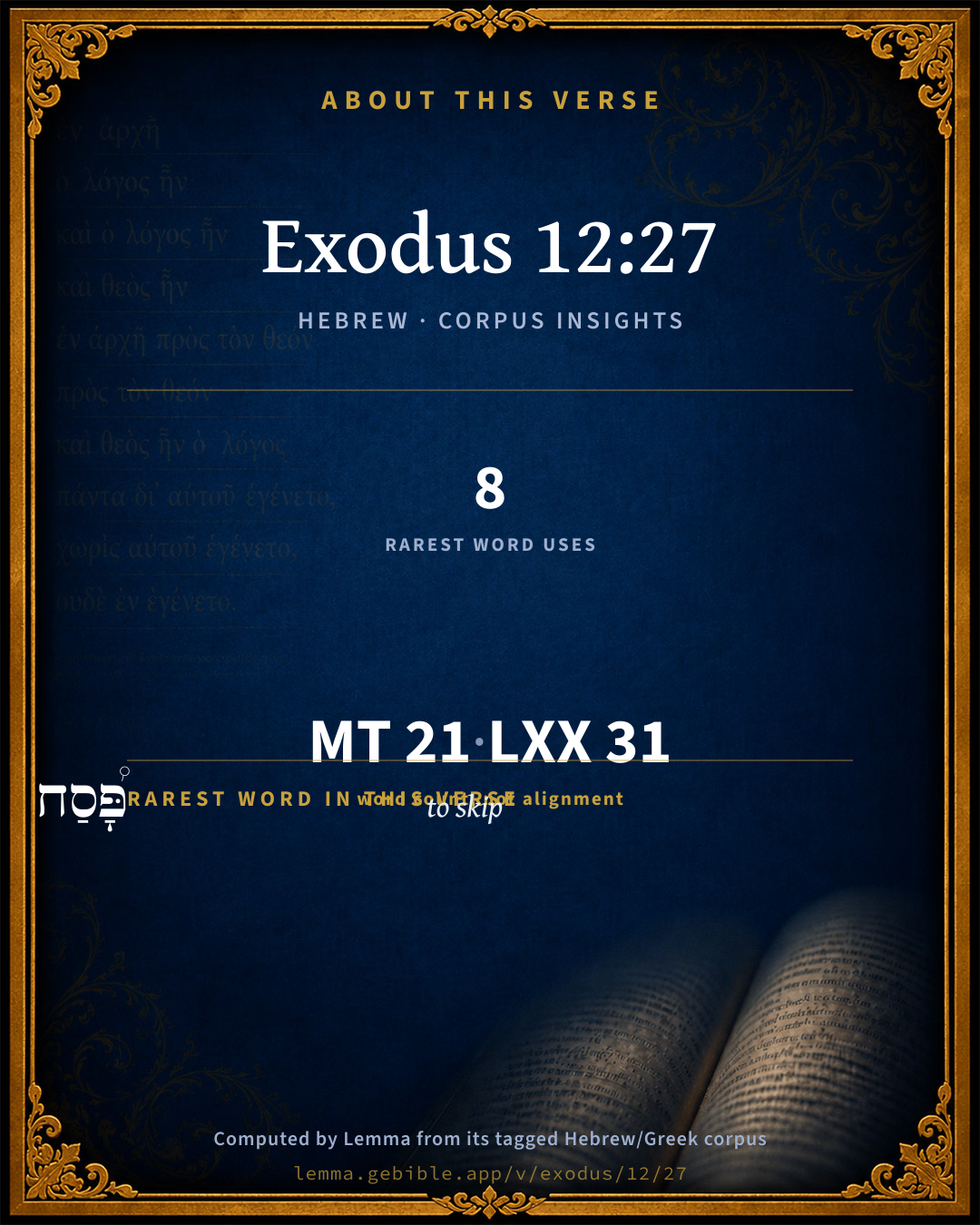
The rarest word here is פָּ֠סַח to skip H6452 — appearing just 8 times in the whole Hebrew Bible.

Shared distinctive vocabulary

פָּ֠סַח to skip H6452 occurs in 8 verses of the Hebrew Bible. Also found in:

Grammatical profile

  • 6 verbs
  • 10 nouns
  • 1 pronoun
  • 1 preposition
  • 3 particles

Verb forms

  • וַאֲמַרְתֶּ֡ם Qal · Sequential Perfect
  • פָּ֠סַח Qal · Perfect
  • בְּנָגְפּ֥וֹ Qal · Infinitive Construct
  • הִצִּ֑יל Hiphil · Perfect
  • וַיִּקֹּ֥ד Qal · Sequential Imperfect
  • וַיִּֽשְׁתַּחֲוּֽוּ Hithpael · Sequential Imperfect

Repetition

Words recur within this verse — often emphatic in Hebrew:

  • בָּתֵּ֤י house H1004 ×2
  • בְּמִצְרַ֔יִם Egypt H4714 ×2

Hebrew & Septuagint length

In English translation the verse runs 39 words from the Hebrew and 35 from the Septuagint (LXX English) — closely comparable.

A rough comparison of the two English renderings, which tokenize alike — not a word-level alignment.

Word counts can differ between the Hebrew and the Greek without any difference in meaning — e.g. the Hebrew direct-object marker אֵת has no separate Greek word, and Greek often adds the article ὁ.

In the original languages it is 21 Hebrew tokens and 31 Greek tokens — but the two are counted differently (Hebrew bundles its prefixes and suffixes into one token; the Greek is in lemma form), so that isn’t a like-for-like length.

Cross-references

12

Topical passages linked to Exodus 12:27 in the Treasury of Scripture Knowledge — connected by theme and wording, ordered by reader-vote popularity; previews shown in the World English Bible.

  • Exodus 4:31 The people believed, and when they heard that Yahweh had visited the children of Israel, and that he had seen their affliction, then they bowed their heads and worshiped.
  • Exodus 12:11 This is how you shall eat it: with your loins girded, your shoes on your feet, and your staff in your hand; and you shall eat it in haste: it is Yahweh's Passover.
  • Exodus 12:23 For Yahweh will pass through to strike the Egyptians; and when he sees the blood on the lintel, and on the two side-posts, Yahweh will pass over the door, and will not allow the destroyer to come in to your houses to strike you.
  • 1 Corinthians 5:7 Purge out the old yeast, that you may be a new lump, even as you are unleavened. For indeed Christ, our Passover, has been sacrificed in our place.
  • Exodus 34:8 Moses hurried and bowed his head toward the earth, and worshiped.
  • Exodus 34:25 "You shall not offer the blood of my sacrifice with leavened bread; neither shall the sacrifice of the feast of the Passover be left to the morning.
  • Deuteronomy 16:2 You shall sacrifice the Passover to Yahweh your God, of the flock and the herd, in the place which Yahweh shall choose, to cause his name to dwell there.
  • Deuteronomy 16:5 You may not sacrifice the Passover within any of your gates, which Yahweh your God gives you;
  • 1 Chronicles 29:20 David said to all the assembly, Now bless Yahweh your God. All the assembly blessed Yahweh, the God of their fathers, and bowed down their heads, and worshiped Yahweh, and the king.
  • 2 Chronicles 20:18 Jehoshaphat bowed his head with his face to the ground; and all Judah and the inhabitants of Jerusalem fell down before Yahweh, worshipping Yahweh.
  • 2 Chronicles 29:30 Moreover Hezekiah the king and the princes commanded the Levites to sing praises to Yahweh with the words of David, and of Asaph the seer. They sang praises with gladness, and they bowed their heads and worshiped.
  • Nehemiah 8:6 and Ezra blessed Yahweh, the great God. All the people answered, Amen, Amen, with the lifting up of their hands: and they bowed their heads, and worshiped Yahweh with their faces to the ground.

Cross-references courtesy of OpenBible.info (CC BY 4.0).

Hebrew and Greek witnesses Masoretic Hebrew ↔ Greek Septuagint

The same verse in the two great witnesses to the Old Testament, shown verse-for-verse.

These are two independent witnesses, not word-aligned to each other, and the Septuagint is shown in lemma (dictionary) form.

Hebrew Exodus 12:27 Masoretic · Westminster Leningrad Codex

וַאֲמַרְתֶּ֡ם זֶֽבַח פֶּ֨סַח ה֜וּא לַֽיהוָ֗ה אֲשֶׁ֣ר פָּ֠סַח עַל בָּתֵּ֤י בְנֵֽי יִשְׂרָאֵל֙ בְּמִצְרַ֔יִם בְּנָגְפּ֥וֹ אֶת מִצְרַ֖יִם וְאֶת בָּתֵּ֣ינוּ הִצִּ֑יל וַיִּקֹּ֥ד הָעָ֖ם וַיִּֽשְׁתַּחֲוּֽוּ

that you shall say, 'It is the sacrifice of Yahweh's Passover, who passed over the houses of the children of Israel in Egypt, when he struck the Egyptians, and spared our houses.'" The people bowed their heads and worshiped.

World English Bible · Public Domain

Greek LXX Exodus 12:27 Septuagint · lemma form

καί εἶπον αὐτός θυσία ὁ πασχα οὗτος κύριος ὡς σκεπάζω ὁ οἶκος ὁ υἱός ἰσραήλ ἐν αἴγυπτος ἡνίκα πατάσσω ὁ αἰγύπτιος ὁ δέ οἶκος ἐγώ ῥύομαι καί κύπτω ὁ λαός προςκυνέω

that you⌃ shall say to them, This passover is a sacrifice to the Lord, as he defended the houses of the children of Israel in Egypt, when he struck the Egyptians, but delivered our houses.

LXX2012 (modern English Septuagint) · Public Domain

Hebrew: Westminster Leningrad Codex (CC BY 4.0). Greek: Septuagint (public domain); English from LXX2012 (modern English Septuagint) (Public Domain). How the Septuagint differs from the Hebrew →

Targum (Aramaic paraphrase)

2

The Targum is the ancient Jewish Aramaic paraphrase of the Hebrew Scriptures — an interpretive translation, not the Hebrew text itself. Onkelos (literal) and Pseudo-Jonathan (expansive) render the Torah, and Jonathan the Prophets. Coverage is partial: where no permissively-licensed English translation exists for a verse, only the Aramaic is shown. This is verse-level text, not a word-by-word alignment to the Hebrew.

  1. Targum Onkelos Torah (Genesis–Deuteronomy)
    וְתֵימְרוּן דַבַּח חֲיָס הוּא קֳדָם יְיָ דִי חָס עַל בָּתֵּי בְנֵי יִשְׂרָאֵל בְּמִצְרַיִם כַּד הֲוָה מָחֵי יָת מִצְרָאֵי וְיָת בָּתָּנָא שֵׁזִיב וּכְרַע עַמָא וּסְגִידוּ:

    (no public-domain English translation for this verse)

    Targum Onkelos — Aramaic: “Onkelos Genesis” (public domain); “Onkelos Exodus” (public domain); “Onkelos Leviticus” (public domain); “Onkelos Numbers” (public domain); “Onkelos Deuteronomy” (public domain). English: “Sefaria Community Translation” (CC0 1.0 (public-domain dedication)); “J.W. Etheridge. The Targums of Onkelos and Jonathan Ben Uzziel on the Pentateuch. London: Longmans, Green, 1862” (public domain). Text via Sefaria.

  2. Targum Pseudo-Jonathan Torah (Genesis–Deuteronomy)
    וְתֵימְרוּן נִכְסַת חַיְיסָא הוּא קֳדָם יְיָ דְחַס בְּמֵימְרֵיהּ עַל בָּתֵּי בְּנֵי יִשְרָאֵל בְּמִצְרַיִם בְּחַבְּלוּתֵיהּ יַת מִצְרָאֵי וְיַת בָּתָּנָא שֵׁיזִיב וְכַד שָׁמְעוּ בֵּית יִשְרָאֵל יַת פִּתְגָמָא הָדֵין מִפּוּם משֶׁה גָּחְנוּ וּסְגִידוּ

    You shall say, It is the sacrifice of mercy before the Lord, who had mercy in His Word upon the houses of the sons of Israel in Mizraim, when He destroyed the Mizraee, and spared our houses. And when the house of Israel heard this word from the mouth of Mosheh, they bowed and worshipped.

    Targum Pseudo-Jonathan — Aramaic: “Targum Jonathan on Genesis” (public domain); “Targum Jonathan on Exodus” (public domain); “Targum Jonathan on Leviticus” (public domain); “Targum Jonathan on Numbers” (public domain); “Targum Jonathan on Deuteronomy” (public domain). English: “The Targum of Jonathan ben Uzziel, trans. J. W. Etheridge, London, 1862” (public domain). Text via Sefaria.

Commentary

Notes on Exodus 12:27 from classic Christian and Jewish commentators (each source and its license shown beneath its notes). The classic Christian expositions comment on the surrounding passage and are grouped to its opening verse, so a note may address several verses; the Jewish commentaries on the Tanakh (Rashi and others) are per-verse, so they appear only where the commentator wrote on this verse.

Lemma curates 59 commentaries, every one of them public domain or Creative Commons licensed, each selected and text-cleaned for this edition rather than reprinted as found. About our sources →

Trapp's Complete Commentary

John Trapp

Exo 12:27 That ye shall say, It [is] the sacrifice of the LORD’S passover, who passed over the houses of the children of Israel in Egypt, when he smote the Egyptians, and delivered our houses. And the people bowed the head and worshipped.

Ver. 27. Bowed the head.] In token of submission to the command, and thankfulness for such a salvation.

John Trapp, A Commentary or Exposition upon All the Books of the Old and New Testament (1647–1656) — public domain. Text from a community e-Sword module.

Joseph Benson's Commentary

Exo 12:27. The people bowed the head and worshipped — They hereby signified their submission to this institution as a law, and their thankfulness for it as a privilege.

Joseph Benson's Commentary on the Old and New Testaments (1811–1818) — public domain. Text from a community e-Sword module.

The Preacher's Complete Homiletical Commentary

Joseph S. Exell (gen. ed.)

MAIN HOMILETICS OF THE PARAGRAPH.—Exo_12:29-32

THE DEATH OF THE FIRST-BORN OF EGYPT

I. We see here that God’s vengeance is as certainly executed upon the rebellious as it is threatened. The death of the first-born was threatened to Pharaoh some time ago, and he had had ample opportunity of obeying the Divine command, and of averting the dread penalty. But no, he still remains obstinate in heart, and will not yield to the will of God; hence the time of destruction has come. The first-born of Egypt are slain, in every house they are dead. There is great mourning in the nation. Nor has the household of the king escaped the common woe. This is not occasioned by pestilence or plague, but by the sudden stroke of Heaven. And thus are the threats of God against the sinner abundantly executed. They may be delayed, but they will not be forgotten. They are awfully certain. The greatness of the calamity will not prevent its final execution; even though it require the death of a vast multitude, the threat of Heaven will come to pass. Let not the sinner imagine that he can escape the retributions of God, either through the inability or unwillingness of God to inflict them, or through his own ability to resist them. Men cannot elude the stroke of Heaven.

II. We see here that God’s vengeance is upon all sinners, no matter what their social position, whether king or beggar. There was death in the palace as well as in the dungeon, in the family of the king as well as in the midst of the slaves. The judgments of God are characterised by equity; they are without partiality. They are no respector of persons. They are not turned aside by social accidents, nor are they bribed by cunning and winning arrangements. Moral considerations determine the retributions of human life. There is no impediment in the way of Divine justice and the execution of its sentence upon all men. God can send His messengers into the palace as well as into the dungeon; bolts and bars, guards and sentinels, cannot keep out the subtle angel of death. Death has many doors into the homes of men. He takes the rich from their wealth, the poor from their misery; and perhaps in the next life the relations of men may be inverted—the poor man may be the prince and the prince, the slave in the dungeon.

III. We see here that God’s vengeance comes upon sinners when they least expect it, and in their moments of fancied security. It was night. All Egypt was in slumber. Men were not even dreaming of approaching ill. There was nothing to disturb their usual repose; when suddenly a cry arose, which every moment gathered volume until it became a piercing wail. Mothers were attending to their loved ones, and watching them pass into the silence of death. And this was the scene throughout the homes of Egypt. And so, the judgments of Heaven often come upon sinners when least anticipated, in the midst of carnal repose and fancied security. Then they awake, but for a moment, and too late, to find that the stern messenger of eternal justice has seized upon them. It often happens that when men are the most insensible to the retributions of Heaven, they are the nearest to it. God sometimes comes to the wicked soul in the midnight hour. The darkness cannot hide from Him. We know not what will be in the approaching night.

IV. We see here that God’s vengeance may make the most obstinate sinners yield to the demands of Heaven.

1. We see that Pharaoh called for Moses and Aaron. The terrible stroke of death had indeed done its sad work; and the Monarch of Egypt, alarmed, was glad to get rid of those who. had occasioned him and his nation so much calamity. And thus the purpose of Heaven is at last accomplished. Israel is free; and the two servants of God are rejoiced to see the glad result of their long and anxious toil. It was a moment of deep humility for the king; it was a moment of triumph for Moses and Aaron. How strangely are the scenes of life blended in this world, even at one and the same time! This midnight hour was to Egypt the hour of death, but to Israel it was the hour of freedom. The same hour brings different and varied events and emotions even to the same people.

2. We see that Pharaoh yielded to the demand of Heaven. He gave the Israelites their freedom, and so regarded the claim of God as enforced by severe retribution. True there was not much virtue in the obedience of Pharaoh as it was occasioned by awful plague. But do we not in this incident see the supreme folly of sin and rebellion against God? The sinner will have to yield to the demands of Heaven, and hence the wisdom of an immediate compliance thereto. Why suffer so many dreadful plagues to no purpose? Surely it is better to fall in with the Divine arrangement at first, than to have such painful visitations of vengeance only to yield at last. It is well to avoid the penalties of sin, though this is the very lowest motive for obedience to the will of Heaven. The submission of Pharaoh:—

(1) It was immediate upon the plague.

(2) It was complete in its obedience.

(3) It was comprehensive in its injunction.

(4) It was welcomed by the Egyptians. And thus culminated the judgments of Heaven upon the land of Pharaoh; the sufferings of Israel in a cruel bondage; and the toils of His devoted ministers in reference to a proud king.

SUGGESTIVE COMMENTS ON THE VERSES

Exo_12:29-30. It is God’s miraculous distinguishing judgment to kill the first-born only.

Choice of beasts, as well as men, God strikes for man’s sin.

Vengeance makes a terrible rousing to the wicked from their midnight rest.

God’s wrath makes the wicked howl in their midnight wakings.

It is God’s eminent stroke when no house escapes without the slaughter of some.

ILLUSTRATIONS

BY

REV. WM. ADAMSON

Religions Tuition! Exo_12:27. Moses might well have been daunted in his mission to instruct Israel in Religion. To teach a set of wild, ignorant boys is no easy matter. The teacher may have received many hints and practical suggestions from his pastor; but the task will still be arduous. Just so with Moses: God had counselled him in many points, and furnished him with useful data of instruction; still it would prove up-hill work. We find, however, that he grappled to the difficulty With spirit. Arthur Madden did the same, when divinely sent to instruct a class of roughs in the hamlet where he lived. The most discouraging feeling to him was that he was only breaking up fallow ground for another to sow in; that he was only commencing a work which another would be privileged to complete. And if Moses thus felt, he was able to grasp the fact that his was a great mission of instructing Israel, one great work to be carried on from age to age, employing many generations of workers; and that therefore his duty was to work with might and main, uprearing in the midst of Israel’s vast host an edifice or temple of religions principle, which would last longer than the pyramids, those gray piles of hieroglyphic grandeur beneath whose shadows they were then in slavery, and which have survived the language which the Pharaohs spoke—

“Preserving its dead emblems to the eye,

Yet hiding from the mind what these reveal.”

—Montgomery.

Divine Dealings! Exo_12:29. It is no use to coax or flatter the tiger, which has seized your babe, and whose teeth have met in its little thigh. You must thrust the flaming brand or the glittering spear into its face; then it will howl and drop its victim in the shock of sudden pain. How fondly will you staunch the bleeding wounds, and undo the cruel injury inflicted on your child! God found that mild measures would not influence Pharaoh to release his prey, that he only snarled, and bit all the more cruelly. No wonder that He hurled His flaming brand or glittering sword in the Egyptian lion’s face, and forced him to let go his bruised and palpitating victim. How tenderly God bound up Israel’s wounds when He had allured their host into the wilderness! So does He deal with our oppressors and ourselves. On them He pours His righteous judgments; while on His own He showers deliverances: Why? That we may become holy as He is holy—

“Complete thy purpose, that we may become

Thy perfect image, O our God and Lord.”

Divine Distinctions! Exo_12:30. Israel’s first-born were unharmed. Side by side stood two houses. The one was that of a publican of worthless character, who took pleasure in giving every annoyance to God’s people, and inflicting injuries upon those who were earnest Christians. The other was that of a family which honoured God—hallowed their roof-tree and daily life with prayer, and hoped for an inheritance in heaven. One night, the publican’s house caught fire, and being chiefly of wood, it burnt like tinder. The family at the castle and the people of the village gathered in groups to arrest, if possible, the progress of the flames. It was soon apparent that their efforts were fruitless, and that the fire would speedily spread its ravages to the neighbour’s cottage. When all were anxiously watching the fiery element, which had now almost wholly consumed the publican’s haunt, suddenly a tremendous torrent of pelting rain fell, hissing and steaming on the burning wreck and the fire-cracked ground, and soon driving many of the crowd to seek shelter within their hornet. That Providence saved the next house from sharing the fate of its neighbour; and thus, as God preserved Israel while He punished Pharaoh, so was the home of Abner Stone protected, whilst that of the godless Dan Ford was wholly destroyed—

“Angels of life and death alike are His;

Without His leave they pass no threshold o’er.”

—Lowell.

Moral Freedom! Exo_12:31. A traveller, who was both a scholar and a high-born gentleman, fell into the hands of pirates, and was carried off to some robber nest on the Barbary shore. There for the rest of his life was he left to languish, rowing the galley, grooming the charger, and tending the cattle of his Moslem master. Could ought be more bitter and heartbreaking! He had tastes which could no longer be cultivated, longings which could no longer be gratified, relations who could no longer be visited, and spiritual emotions which could be confessed only to incur taunts and mockery. Something like this was the experience of free-born Israel, and how welcome freedom! Certainly similar to this was the condition of Adam when he fell into the bondage of sin, until he became familiarised with his serfdom. Even then, there comes across the human mind a longing to taste the sweets of the glorious liberty of the children of God. The Paschal Lamb pledges our deliverance from sin-tyranny. The Blood of Sprinkling gives a happy exodus from the Egypt of Satan’s domination. We have redemption through His blood—

“Dearly are we bought, for God

Bought us with His own heart’s blood.”

—Hart.

The Preacher's Complete Homiletical Commentary (gen. ed. Joseph S. Exell; Funk & Wagnalls, c. 1892) — public domain (pre-1929). A full-Bible homiletical/sermon-outline anthology covering 65 of 66 books (2 John is absent from the source module). Text from a community e-Sword module.

Geneva Bible (1599)

Geneva Bible translators

They gave God thanks for so great a benefit.

Geneva Bible (1599) marginal notes — public domain. Text via Bolls.life.

Jamieson, Fausset & Brown

Robert Jamieson, A. R. Fausset & David Brown

the people bowed the head, and worshipped--All the preceding directions were communicated through the elders, and the Israelites, being deeply solemnized by the influence of past and prospective events, gave prompt and faithful obedience.

Jamieson, Fausset & Brown — Commentary Critical and Explanatory on the Whole Bible (1871) — public domain (CC PDM 1.0). Text via the HelloAO Bible API.

Adam Clarke's Commentary

Verse 27. It is the sacrifice of the Lord's passover] We have already intimated that the paschal lamb was an illustrious type of Christ; and we shall find that every thing in this account is typical or representative. The bondage and affliction of the people of Israel may be considered as emblems of the hard slavery and wretchedness consequent on a state of sinfulness. Satan reigns over both body and soul, bringing the whole into subjection to the law of sin and death; while various evil tempers, passions, lusts, and irregular appetites, act as subordinate tormentors, making the lives of the vassals of sin bitter, because of the rigour by which they are obliged to serve. Reader, is this thy case? The mercy of God projects the redemption of man from this cruel bondage and oppression; and a sacrifice is appointed for the occasion by God himself, to be offered with particular and significant rites and ceremonies, all of which represent the passion and death of our blessed Lord, and the great end for which he became a sacrifice, viz., the redemption of a lost world from the power, the guilt, and the pollution of sin, c. And it is worthy of remark,

1. That the anniversary or annual commemoration of the passover was strictly and religiously kept by the Jews on the day, and hour of the day, on which the original transaction took place, throughout all their succeeding generations.

2. That on one of these anniversaries, and, as many suppose, on the very day and hour on which the paschal lamb was originally offered, our blessed Lord expired on the cross for the salvation of the world.

3. That after the destruction of Jerusalem the paschal lamb ceased to be offered by the Jews throughout the world, though they continue to hold the anniversary of the passover, but without any sacrifice, notwithstanding their deep-rooted, inveterate antipathy against the author and grace of the Gospel.

4. That the sacrament of the Lord's Supper was instituted to keep this true paschal sacrifice in commemoration, and that this has been religiously observed by the whole Christian world (one very small class of Christians excepted) from the foundation of Christianity to the present day!

5. That the Jews were commanded to eat the paschal lamb and our Lord, commemorating the passover, commanded his disciples, saying, Take, eat, THIS is my body, which is given for you; do this in remembrance of ME. In the communion service of the Church of England, the spirit and design both of the type and antitype are most expressly condensed into one point of view, in the address to the communicant: "Take and eat this in remembrance that Christ died for THEE; and FEED upon HIM, in thy heart, by FAITH with THANKSGIVING. Thus God continues the memorial of that grand transaction which he has said should be an ordinance for ever; evidently meaning thereby, that the paschal lamb should be the significator till the passion and death of Christ; and that afterwards bread and wine taken sacramentally, in commemoration of his crucifixion, should be the continual representatives of that sacrifice till the end of the world. Thus the passover in itself, and in its reference, is an ordinance for ever; and thus the words of the Lord are literally fulfilled.

Reader, learn from this,

1. That if thou art not rescued from the thraldom of sin, thou must perish for ever.

2. That nothing less than the power and mercy of God can set thee free.

3. That God will save thee in no other way than by bringing thee out of thy sinful state, and from thy wicked practices and companions.

4. That in order to thy redemption it was absolutely necessary that the Son of God should take thy nature upon him, and die in thy stead.

5. That unless the blood of this sacrifice be sprinkled, in its atoning efficacy and merits, on thy heart and conscience, the guilt and power of thy sin cannot be taken away.

6. That as the blood of the paschal lamb must be sprinkled on every house, in order to the preservation of its inhabitants, so there must be a personal application of the blood of the cross to thy conscience, to take away thy sins.

7. As it was not enough that the passover was instituted, but the blood must be sprinkled on the lintels and door posts of every house to make the rite effectual to the salvation of each individual, so it is not enough that Christ should have taken human nature upon him, and died for the sin of the world; for no man who has the opportunity of hearing the Gospel is saved by that death, who does not, by faith, get a personal application of it to his own heart.

8. That those who wish for an application of the atoning blood, must receive this spiritual passover with a perfect readiness to depart from the land of their captivity, and travel to the rest that remains for the people of God; it being impossible, not only to a gross sinner, continuing such, to be finally saved, (however he may presume upon the mercy of God,) but also to a worldly-minded man to get to the kingdom of God; for Christ died to save us from the present evil world, according to the will of God.

9. That in order to commemorate aright, in the sacrament of the Lord's Supper, the great atonement made for the sin of the world, all leaven of malice, bitterness, and insincerity, must be put away; as God will have no man to partake of this mystery who does not fully enter into its spirit and meaning. See 1Co 5:7-8.

Adam Clarke's Commentary on the Bible (1810–1826) — public domain. Text from a community e-Sword/MySword module.

Ellicott's Commentary for English Readers

(27) It is the sacrifice of the Lord’s passover.—Heb., This is a passover-sacrifice to Jehovah. The emphatic word is “Passover;” and it was the meaning of this term which was especially to be explained. The explanation would involve an historical account of the circumstances of the institution, such as would be apt to call forth feelings of gratitude and devotion.

A Bible Commentary for English Readers, edited by Charles John Ellicott (1878–1897) — public domain. Text from a community e-Sword module.

John Gill's Exposition

And it came to pass, that at midnight the Lord smote all the firstborn in the land of Egypt,.... The midnight of the fifteenth of Nisan, as the Targum of Jonathan, when fast asleep, and thoughtless of any danger; and it being at such a time must strike with a greater horror and terror, when sensible of the blow, which might be attended with a great noise, that might awaken the rest:

from the firstborn of Pharaoh that sat on his throne; the heir to his crown, who was to have sat upon his throne, or already did, being taken a partner with him in it:

unto the firstborn of the captive that was in the dungeon; or prison, that was grinding at the mill there, Exo 11:5 which was the work and business the prisoners were often put to, as appears from the case of Samson, Jdg 16:21,

and all the firstborn of cattle; which were left of the other plagues, which had consumed great numbers of them.

John Gill's Exposition of the Whole Bible (1746–1763) — public domain (CC PDM 1.0). Text via the HelloAO Bible API.

Albert Barnes' Notes on the Bible

It is the sacrifice of the Lord’s passover - or This is the sacrifice of the Passover to Yahweh. The most formal and exact designation of the festival is thus given: but “the Passover” may mean either the act of God’s mercy in sparing the Israelites, or the lamb which is offered in sacrifice: more probably the latter, as in Exo 12:21. This gives a clear sense to the expression “to Yahweh;” the Passover lamb was a sacrifice offered to Yahweh by His ordinance.

Albert Barnes' Notes on the Bible (1834–1885) — public domain. Text from a community e-Sword/MySword module.

Haydock's Catholic Bible Commentary

Victim, sacrificed upon the altar, in honour of the passage, &c. It was a true "sacrifice of propitiation," as the Arabic translates, and of thanksgiving. (Calmet)

George Leo Haydock (1774–1849), Haydock's Catholic Family Bible and Commentary, 1859 edition — public domain. Excludes Psalms (Douay-Rheims chapter numbering differs from Protestant) and Deuterocanonical books (Catholic canon only).

Matthew Poole's English Annotations

The passover was both a sacrifice, as it was offered to God, as it appears from Exo 23:18; 34:25; Num 9:7,13; Deu 16:2,5; and because there was in it the shedding and sprinkling of blood, wherein the essence of a sacrifice consists, 2Ch 30:16; 35:11,13; and also a sacrament, as it was received and eaten by men. The people bowed the head, in token of their thankful acknowledgment of God’s favours, and of their cheerful submission to God’s command and ordinance. See 2Ch 29:30.

Matthew Poole's English Annotations on the Holy Bible (1683–1685) — public domain. Text from a community e-Sword/MySword module.

The Pulpit Commentary

It is the sacrifice. It has been denied that the Paschal lamb was, in the true sense of the word, a sacrifice (Carpzov and others). But this passage alone is decisive on the question, and proves that it was. Moreover, it was offered in the holy place; (Deu_16:5, Deu_16:6) the blood of it was sprinkled upon the altar, and the fat was burnt. (2Ch_30:16 2Ch_35:11) Compare also Exo_23:18; Num_9:7; Deu_16:2. The people bowed the head and worshipped. Rather, "and made obeisance." Compare Exo_4:31. By "the people" seems to be meant "the elders of the people." (See ver. 21.)

The Pulpit Commentary (1880–1919), ed. H.D.M. Spence-Jones & Joseph S. Exell — public domain. Text from a community e-Sword module.

John Wesley's Explanatory Notes

The people bowed the head and worshipped - They hereby signified their submission to this institution as a law, and their thankfulness for it as a favour and privilege.

John Wesley, Explanatory Notes Upon the Whole Bible (1754–1765) — public domain. Text via the GEBible commentary corpus.

Rashi

Rabbi Shlomo Yitzchaki (Rashi)

ויקד העם AND THE PEOPLE BOWED THE HEAD in thanksgiving for the tidings of the approaching deliverance and for the promise of their coming into the land, and for the tidings regarding the children whom they would have (since v. 26 implies that they would be blessed with children).

Rashi on the Tanakh — English translations: “The Judaica Press complete Tanach with Rashi, translated by A. J. Rosenberg” (CC BY 4.0); “Pentateuch with Rashi's commentary by M. Rosenbaum and A.M. Silbermann, 1929-1934” (public domain); “The Metsudah Tanach series, Lakewood, N.J” (CC BY 4.0); and “The Book of Joshua, Metsudah Publications, 1997” (CC BY 4.0). Text via Sefaria.

Lesson kit

Teaching starters — assembled from the data on this page, not authored interpretation. Every prompt links to the verse data it draws on. Edit before teaching.

Exodus, in the Pentateuch, opens this verse with 21 words (18 distinct Hebrew lemmas). Its most distinctive word is pâçach (“to skip”). A historical commentator’s framing appears above. Read the whole chapter for the surrounding context.

Discussion questions

  1. The word pâçach carries the sense “to skip.” How does it shape the verse?
  2. Exodus 12:13 shares the word «to skip» with this verse. How do the two illuminate each other?
  3. “house” occurs 2× in this one verse. What is the effect of the repetition?
  4. These translations render this verse differently. What is at stake in choosing one wording over another?
  5. The verb «וַאֲמַרְתֶּ֡ם» is Qal Sequential Perfect. How does its form color the action?
  6. Reading how Trapp's Complete Commentary and Joseph Benson's Commentary read this verse, where do the two commentators agree and where do they part?

Things to notice

Reading settings

Reading text

Shown beneath each verse's original-language words.

Old Testament
Old Testament edition

Read the OT as the Masoretic Hebrew (MT) or the Greek Septuagint (LXX).

English shown for the Greek Septuagint (in the Hebrew ↔ Greek comparison).

Comparing translations? Open the Compare panel on any verse page to stack up to four side by side.