Psalms 144:11

Hebrew (Westminster Leningrad Codex) Psalms 144:11 appears in the Hebrew Old Testament. The text above is from the Westminster Leningrad Codex. Each word links to its Strong’s number, a concise gloss, and parsing drawn from the Open Scriptures Hebrew Bible morphology. Click any word for its full Brown-Driver-Briggs (BDB) entry.
Download image
Cite this verse

Psalms 144:11 (World English Bible). Public Domain. Lemma interlinear Bible study tool, https://lemma.gebible.app/v/psalms/144/11.

Show BibTeX & RIS
BibTeX
RIS
English Translation
Rescue me, and deliver me out of the hands of foreigners, Whose mouths speak deceit, Whose right hand is a right hand of falsehood.
World English Bible · Public Domain
Download a study sheet

One document with this verse’s original text, its word-by-word gloss line, the meaning frame, cross-references with their text, attributed commentary, and full source and license credits — printable, and it pastes into notes with its structure intact.

This verse Autodidact and up

Study sheet (.html) Plain text (.txt)

A passage Seminary Student

Up to 50 verses in one chapter. A passage sheet keeps up to 6 commentary sources and 12 cross-references per verse, in the order this page ranks them, and says so on the sheet whenever that leaves anything out. Ask for a single verse and you get the Autodidact verse sheet above.

Everything on this page stays free to read, with no account — the sheet is a download of what is already on screen, not access to it.

Want to remove ads? Support Godless Engineer
Compare translations 3

The same verse in 3 English versions, stacked beneath the original-language interlinear above. Click any original word for its lexicon entry.

Each is an independent rendering of the whole verse — the interlinear is not word-aligned to these translations.

Highlighted words mark where these versions differ — a whole-verse word diff, not a word-by-word alignment.

  • World English Bible Public Domain
    Rescue me, and deliver me out of the hands of foreigners, Whose mouths speak deceit, Whose right hand is a right hand of falsehood.
  • King James Version Public Domain
    Rid me, and deliver me from the hand of strange children, whose mouth speaketh vanity, and their right hand is a right hand of falsehood:
  • unfoldingWord Literal Text CC BY-SA 4.0
    Break me free and deliver me from the hand of the sons of a foreigner, who, their mouth speaks worthlessness, and their right hand a right hand of falsehood,

unfoldingWord Literal Text — © unfoldingWord, licensed CC BY-SA 4.0. Word-aligned USFM3 via Door43 (git.door43.org/unfoldingWord/en_ult).

Versions to compare (up to 4)

3 of 4 selected

Show all 18 translations

Every available English version of this verse, each an independent rendering of the whole verse.

  • World English Bible Public Domain
    Rescue me, and deliver me out of the hands of foreigners, Whose mouths speak deceit, Whose right hand is a right hand of falsehood.
  • Berean Standard Bible Public Domain
    Set me free and rescue me from the grasp of foreigners, whose mouths speak falsehood, whose right hands are deceitful.
  • Majority Standard Bible Public Domain
    Set me free and rescue me from the grasp of foreigners, whose mouths speak falsehood, whose right hands are deceitful.
  • King James Version Public Domain
    Rid me, and deliver me from the hand of strange children, whose mouth speaketh vanity, and their right hand is a right hand of falsehood:
  • American Standard Version (1901) Public Domain
    Rescue me, and deliver me out of the hand of aliens, Whose mouth speaketh deceit, And whose right hand is a right hand of falsehood.
  • Revised Version (1885) Public Domain
    Rescue me, and deliver me out of the hand of strangers, whose mouth speaketh vanity, and their right hand is a right hand of falsehood.
  • Geneva Bible (1599) Public Domain
    Rescue me, and deliuer me from the hand of strangers, whose mouth talketh vanitie, and their right hand is a right hand of falshood:
  • Douay-Rheims (1899) Public Domain
    for thy name's sake, O Lord, thou wilt quicken me in thy justice. Thou wilt bring my soul out of trouble:
  • Young's Literal Translation Public Domain
    Free me, and deliver me From the hand of sons of a stranger, Because their mouth hath spoken vanity, And their right hand `is' a right hand of falsehood,
  • Literal Standard Version CC BY-SA 4.0
    Free me, and deliver me || From the hand of sons of a stranger, || Because their mouth has spoken vanity, || And their right hand [is] a right hand of falsehood,
  • Unlocked Literal Bible CC BY-SA 4.0
    Rescue me and free me from the hand of foreigners. Their mouths speak lies, and their right hand is falsehood.
  • unfoldingWord Literal Text CC BY-SA 4.0
    Break me free and deliver me from the hand of the sons of a foreigner, who, their mouth speaks worthlessness, and their right hand a right hand of falsehood,
  • Darby Bible Public Domain
    Rescue me, and deliver me from the hand of aliens, whose mouth speaketh vanity, and their right hand is a right hand of falsehood.
  • World Messianic Bible Public Domain
    Rescue me, and deliver me out of the hands of foreigners, whose mouths speak deceit, whose right hand is a right hand of falsehood.
  • Webster's Bible Public Domain
    Rid me, and deliver me from the hand of strange children, whose mouth speaketh vanity, and their right hand is a right hand of falsehood:
  • Free Bible Version CC BY-SA 4.0
    Set me free. Rescue me from the oppression of foreign enemies. They are such liars, even telling lies under oath.
  • Bible in Basic English Public Domain
    Make me free, and take me out of the hands of strange men, in whose mouths are false words, and whose right hand is a right hand of deceit.
  • JPS Tanakh (1917) Public Domain
    Rescue me, and deliver me out of the hand of strangers, whose mouth speaketh falsehood, and their right hand is a right hand of lying.

Literal Standard Version (2020), Covenant Press — licensed CC BY-SA 4.0. Text via the HelloAO Bible API (eBible.org). Unlocked Literal Bible (unfoldingWord) — licensed CC BY-SA 4.0. Text via the HelloAO Bible API (eBible.org). unfoldingWord Literal Text — © unfoldingWord, licensed CC BY-SA 4.0. Word-aligned USFM3 via Door43 (git.door43.org/unfoldingWord/en_ult). Free Bible Version, Dr. Jonathan Gallagher — licensed CC BY-SA 4.0. Text via the HelloAO Bible API (eBible.org).

Word by word

More ways to search: Search by grammar → Find every occurrence → Compare this word →

Practice this passage: Drill this verse → Learn its vocabulary →

פְּצֵ֥נִי
pâtsâh
H6475
“open · me”
Verb, Qal, Imperative, 2nd Person, Masculine, Singular + Suffix, Personal, 1st Person, Common, Singular
Part of Speech
Verb
Stem
Qal
Form
Imperative
Person
2nd Person
Gender
Masculine
Number
Singular
Full BDB Definition

Origin: a primitive root

TWOT: 1795

to part, open, separate, set free - (Qal) - to open (mouth), utter - to snatch away, set free
  1. וְהַצִּילֵנִי֮ nâtsal H5337 “and · rescue · me” Conjunction + Verb, Hiphil, Imperative, 2nd Person, Masculine, Singular + Suffix, Personal, 1st Person, Common, Singular
  2. מִיַּ֪ד yâd H3027 “from · hand of” Preposition + Noun, Common, Both, Singular, Construct
  3. בְּֽנֵי bên H1121 “sons of” Noun, Common, Masculine, Plural, Construct
  4. נֵ֫כָ֥ר nêkâr H5236 “foreign” Noun, Common, Masculine, Singular, Absolute
  5. אֲשֶׁ֣ר ʼăsher H834 “which” Particle, Relative
  6. פִּ֭יהֶם peh H6310 “mouth · their” Noun, Common, Masculine, Singular, Construct + Suffix, Personal, 3rd Person, Masculine, Plural
  7. דִּבֶּר dâbar H1696 “to speak” Verb, Piel, Perfect, 3rd Person, Masculine, Singular
  8. שָׁ֑וְא shâvᵉʼ H7723 “vanity” Noun, Common, Masculine, Singular, Absolute
  9. וִֽ֝ימִינָ֗ם yâmîyn H3225 “and · right hand · their” Conjunction + Noun, Common, Feminine, Singular, Construct + Suffix, Personal, 3rd Person, Masculine, Plural
  10. יְמִ֣ין yâmîyn H3225 “right hand of” Noun, Common, Feminine, Singular, Construct
  11. שָֽׁקֶר sheqer H8267 “lie” Noun, Common, Masculine, Singular, Absolute

About this verse

These counts appear in no published source. They are computed here, from the morphology-tagged text and Lemma’s own curated glosses. What Lemma adds →

12
words
11
distinct lemmas
Wisdom
section

Notable vocabulary

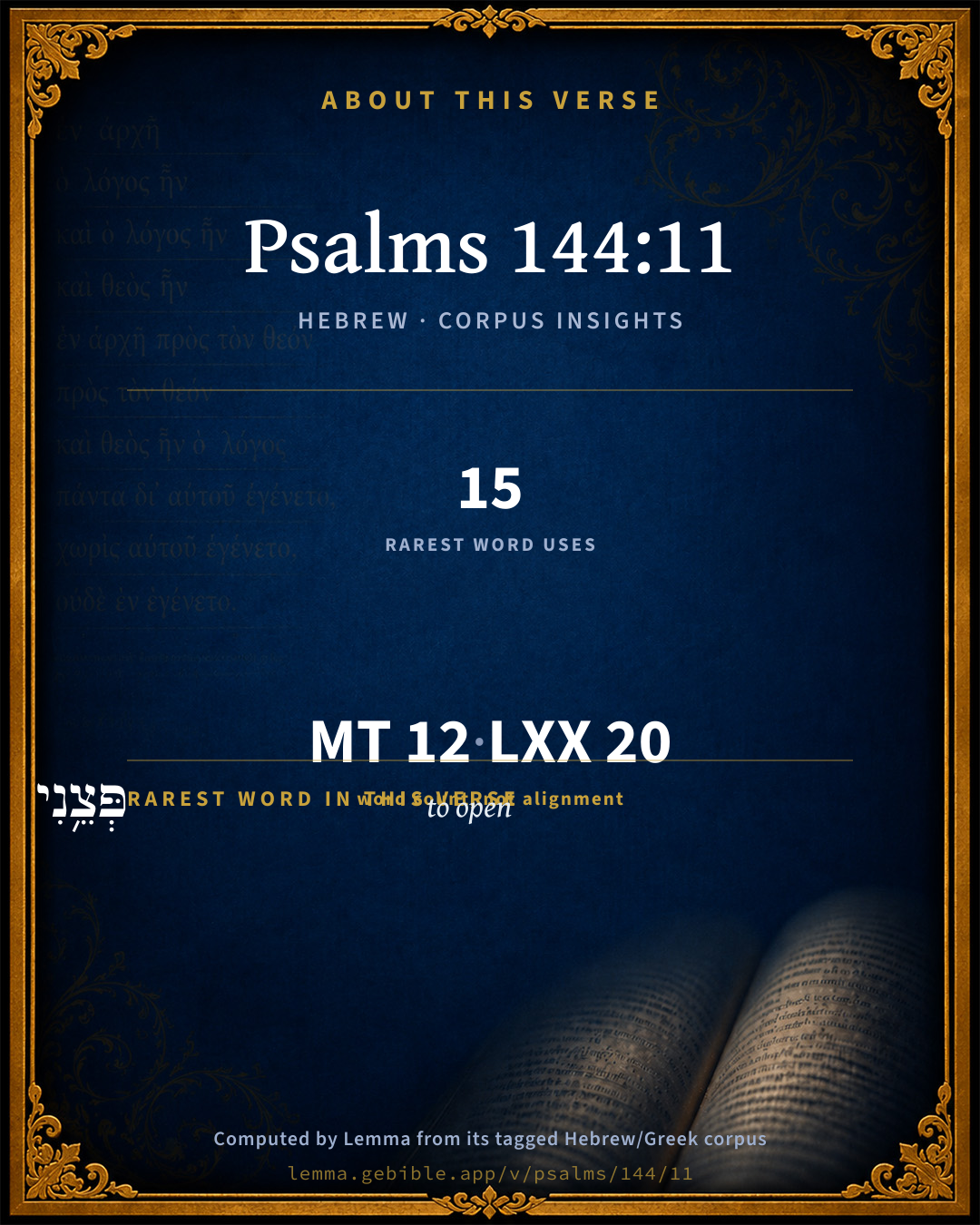
The rarest word here is פְּצֵ֥נִי to open H6475 — appearing just 15 times in the whole Hebrew Bible.

Shared distinctive vocabulary

פְּצֵ֥נִי to open H6475 occurs in 15 verses of the Hebrew Bible. Also found in:

Grammatical profile

  • 3 verbs
  • 8 nouns
  • 1 particle

Verb forms

  • פְּצֵ֥נִי Qal · Imperative
  • וְהַצִּילֵנִי֮ Hiphil · Imperative
  • דִּבֶּר Piel · Perfect

Repetition

A word recurs within this verse — often emphatic in Hebrew:

  • וִֽ֝ימִינָ֗ם right hand H3225 ×2

Hebrew & Septuagint length

In English translation the verse runs 24 words from the Hebrew and 26 from the Septuagint (LXX English) — closely comparable.

A rough comparison of the two English renderings, which tokenize alike — not a word-level alignment.

Word counts can differ between the Hebrew and the Greek without any difference in meaning — e.g. the Hebrew direct-object marker אֵת has no separate Greek word, and Greek often adds the article ὁ.

In the original languages it is 12 Hebrew tokens and 20 Greek tokens — but the two are counted differently (Hebrew bundles its prefixes and suffixes into one token; the Greek is in lemma form), so that isn’t a like-for-like length.

Cross-references

6

Topical passages linked to Psalms 144:11 in the Treasury of Scripture Knowledge — connected by theme and wording, ordered by reader-vote popularity; previews shown in the World English Bible.

  • Psalms 144:7–8 Stretch out your hand from above, Rescue me, and deliver me out of great waters, Out of the hands of foreigners;
  • Isaiah 44:20 He feeds on ashes; a deceived heart has turned him aside; and he can't deliver his soul, nor say, Is there not a lie in my right hand?
  • Psalms 12:2 Everyone lies to his neighbor. They speak with flattering lips, and with a double heart.
  • 2 Samuel 10:6–19 When the children of Ammon saw that they were become odious to David, the children of Ammon sent and hired the Syrians of Beth Rehob, and the Syrians of Zobah, twenty thousand footmen, and the king of Maacah with one thousand men, and the men of Tob twelve thousand men.
  • 2 Samuel 16:5–14 When king David came to Bahurim, behold, a man of the family of the house of Saul came out, whose name was Shimei, the son of Gera. He came out, and cursed still as he came.
  • 2 Samuel 17:1–14 Moreover Ahithophel said to Absalom, Let me now choose out twelve thousand men, and I will arise and pursue after David this night:

Cross-references courtesy of OpenBible.info (CC BY 4.0).

Hebrew and Greek witnesses Masoretic Hebrew ↔ Greek Septuagint

The same verse in the two great witnesses to the Old Testament, shown verse-for-verse.

You’re reading Greek Psalm 143 (Hebrew Psalm 144). The Septuagint counts the superscription, so verse numbers can differ from the Hebrew — chapter-level alignment, not verse-by-verse. Numbering follows Rahlfs.

These are two independent witnesses, not word-aligned to each other, and the Septuagint is shown in lemma (dictionary) form.

Hebrew Psalms 144:11 Masoretic · Westminster Leningrad Codex

פְּצֵ֥נִי וְהַצִּילֵנִי֮ מִיַּ֪ד בְּֽנֵי נֵ֫כָ֥ר אֲשֶׁ֣ר פִּ֭יהֶם דִּבֶּר שָׁ֑וְא וִֽ֝ימִינָ֗ם יְמִ֣ין שָֽׁקֶר

Rescue me, and deliver me out of the hands of foreigners, Whose mouths speak deceit, Whose right hand is a right hand of falsehood.

World English Bible · Public Domain

Greek LXX Greek Psalm 143:11 Septuagint · lemma form

ῥύομαι ἐγώ καί ἐκαἱρέω ἐγώ ἐκ χείρ υἱός ἀλλότριος ὅς ὁ στόμα λαλέω ματαιότης καί ὁ δεξιός αὐτός δεξιός ἀδικία

Deliver me, and rescue me from the hand of strange children, whose mouth has spoken vanity, and their right hand is a right hand of iniquity;

LXX2012 (modern English Septuagint) · Public Domain

On this verse, Joseph Benson's Commentary discusses the Septuagint’s reading. Read the note in Commentary ↓

Hebrew: Westminster Leningrad Codex (CC BY 4.0). Greek: Septuagint (public domain); English from LXX2012 (modern English Septuagint) (Public Domain). How the Septuagint differs from the Hebrew →

Commentary

Notes on Psalms 144:11 from classic Christian and Jewish commentators (each source and its license shown beneath its notes). The classic Christian expositions comment on the surrounding passage and are grouped to its opening verse, so a note may address several verses; the Jewish commentaries on the Tanakh (Rashi and others) are per-verse, so they appear only where the commentator wrote on this verse.

Lemma curates 59 commentaries, every one of them public domain or Creative Commons licensed, each selected and text-cleaned for this edition rather than reprinted as found. About our sources →

Trapp's Complete Commentary

John Trapp

Psa 144:11 Rid me, and deliver me from the hand of strange children, whose mouth speaketh vanity, and their right hand [is] a right hand of falsehood:

Ver. 11. Rid me, and deliver me] He repeateth his former petition, Psa 144:7-8, for an utter riddance of those ill members that stood in the way of Israel’s welfare, and broke off David’s new song or psalmody, Psa 144:9.

John Trapp, A Commentary or Exposition upon All the Books of the Old and New Testament (1647–1656) — public domain. Text from a community e-Sword module.

The Biblical Illustrator

Joseph S. Exell

Psa_144:11-15

Rid me, and deliver me from the hand of strange children.

A wise, patriotic prayer

I. The cultivation of moral worth amongst young people is of vast importance to a state. The moral character which the patriot here desiderates for the young people of his country is presented in two ways.

1. By a moral contrast (verse 11).

2. By a metaphorical description (verse 12).

(1) Growth.

(2) Strength.

(3) Beauty.

II. The connection between the moral worth of young people and the physical prosperity of a country. The patriot prays for the moral excellence of the young people, not merely for their own sake, but also for the sake of the prosperity of the state (Psa_144:13-15).

1. All the provisions necessary to the material happiness of mankind must come from the earth. All the food we require--vegetable and animal--and all the clothing we require, God has shut up in the earth, as in a chest, for our use. There in their rudimental elements are the corn and the cattle, the costumes to screen us from the scorching sun and protect us from the cold winds.

2. These provisions require for their development the suitable agency of man. It is for man to unlock the chest, to bring out the germs and to cultivate them into fruition. Even Paradise would not yield provisions without the tilling hand of Adam.

3. This suitable agency can only be guaranteed by the moral rectitude of the population. A high moral tone of character will stimulate the study of agricultural science, ensure industry, economy and temperance. Thus godliness is profitable to all things. Thus, and thus only, can a state prosper (verse 15). (David Thomas, D. D.)

That our sons may be as plants grown up in their youth.--

Moral reform essential to national prosperity

I. What are the elements of national prosperity?

1. Independence.

2. Competent affluence.

3. Sufficient and suitable means of employment for all classes.

4. Freedom.

5. Good laws, well administered.

6. Peace--internal and external.

7. A government and magistrates of a good and excellent kind.

8. A revenue competent to all the purposes of a wise and righteous government.

II. These elements of national prosperity and happiness cannot be obtained or preserved except by the influence of true religion.

1. The nature and tendency of what is opposed to religion.

(1) Selfishness, which makes the heart hard.

(2) Indolence and improvidence.

(3) Intemperance.

(4) Impurity.

(5) Disregard to God.

2. True religion produces all those qualities which are the immediate spring and cause of prosperity and happiness.

(1) A regard for God.

(2) Thoughtfulness.

(3) Truth.

(4) A deep sense of the value of time, and the end of human existence.

(5) Industry and diligence.

6. Attention to duty.

7. Temperance, chastity, etc. (J. P. Smith, D. D.)

Ideal youthhood: -

I. Its elements.

1. Strength.

(1) Moral.

(2) Intellectual.

(3) Physical.

2. Beauty. Not veneered impotency, but polished power.

3. Religiousness. All must be inspired by the Divine.

4. Usefulness. No indolent living for oneself, but a self-sacrificing devotion to the good of others.

II. Its realization. Three things necessary.

1. Original capacity.

(1) Religious instincts.

(2) Moral capabilities.

(3) Intellectual faculties.

(4) Physical powers.

2. Appropriate culture.

(1) Based on a radical moral change.

(2) Suited to the varied constituents of our being.

Our religious nature must be cultured, by forming us to habits of worship. Our moral nature must be cultured, by forming us to habits of truthfulness, purity, honesty, and love. Our intellectual nature must be cultured, by forming us to habits of study. The mind must be disciplined and stored with useful knowledge. Our physical nature must be cultured, by forming us to habits of health. Suitable food, pure air, due exercise, and avoidance of sensual indulgence.

3. Voluntary co-operation.

(1) Realize the true object of life. Why are you here? Why are you to be cultured?

(2) Make the most of your opportunities. Yours, as English-born in this century, are very great. See that they are eagerly seized and diligently used.

(3) Be actuated by the highest motives. Not selfish, but benevolent and pious motives wilt lead you on to ideal youthhood and ideal manhood. (T. Baron.)

The ideal young man and young woman

1. The young man is compared to a tree which is, of course, not inside the house, but out in the open; not sheltered within the walls, but exposed to all the vicissitudes of the atmosphere and to changes of climate. He has gone forth to battle with the forces of the world, and to do his work in it. Firmly rooted in the ground, he grows up (as the psalm says) in his youth. He throws out his faculties and powers freely in every direction. The rough winds of life blow around him, but he wrestles with them, and heeds them not: indeed, the blast of difficulty only serves to fix him more deeply in the soil, and contributes to his courage and his strength. He grows upward: there is nothing interposing itself between him and heaven itself--no overhanging vice, no deadening sin or stiffing worldliness, to stunt and dwarf his development. He expands because he reaches out towards the sky. What a graphic picture of the ideal Christian gentleman in the prime vigour of his youth! with nothing squalid, or mean, or miserable, or petty, or unclean, or false about him; but with all his thoughts pure, and all his aims noble, and all his tendencies in the right direction: his life an example and a blessing, a help and a strength to those who come in contact with him.

2. Now turn to the other side and observe the contrast. Here we have something in the house, and not outside of it. It is not a tree: it is a graceful column. It is not intended for rough contact with the crowd. It is rather the ornament and the blessing of the house itself. And it is sculptured into forms of exquisite beauty. You will observe that no clumsy workman has been engaged in producing it, but that, although it may be intended for an ordinary household, it is hewn and fashioned in such a way as to be fit for a palace. The daughter--that is, the young woman here depicted--is spoken of as a column. Not characterized, as some columns are, by sturdy, massive strength, but rather marked by gracefulness; rather a slender-shafted column than anything else, she is yet no mere piece of ornamentation, but does her part in the sustaining and upholding of the household. If a girl cannot go out into the world and labour, so as to be able to contribute by her earnings to the maintenance of the family (and few can do that), at least there are many conceivable ways in which she may contrive to lighten the burden laid upon the shoulders of her parents. Parents grow old; and what in their younger days was easily borne becomes (occasionally, at least) irksome, and sometimes almost intolerable, to their failing strength and their clouded faculties. Or sickness comes into the household, and calls for patient nursing. Or little brothers and sisters require management, and perhaps teaching. Or it may be a blight falls upon the family prosperity; and then there must be a curtailing of accustomed comforts, and a necessary taking up of somewhat uncongenial occupations. But the imagery points net only, I think, to the work done, but also to the manner in which it is done. A pillar may support a rock, or help to support it, and yet be a coarse and clumsy sort of affair after all. It may be rough, instead of being polished. But this pillar spoken of by the psalmist is polished; and not only polished, but adorned with lovely sculptures. And there it stands before us, in its quiet gracefulness and beauty, a most engaging and most attractive object. Now, what is meant by this? External accomplishment? Well, yes, perhaps--nay, probably yes--the grace of a self-possessed and ladylike manner, the charm of a cultivated taste, of a musical voice, of a pure style--all the advantages, in fact, of a well-used education. These are things by no means to be despised. And, indeed, it were much to be wished that the girls of our ordinary English families, when their course of instruction is over, would take up, if only for their own sakes, some definite study--some branch of science, or some field of literature, or some period of history, or some foreign language, or some department of music, or of painting--something which shall find them occupation, and furnish a sphere for the faculties which God has bestowed upon them, and which at the same time shall not interfere with their duties, but rather make them more fit for any higher work for God and their fellow-creatures in which they may be called upon to engage. However, the polish and the gracefulness of which I speak is rather that of inward life and character, than that of outward accomplishments. It is the ornament of a meek and quiet spirit, which is, in the sight of God, of great price. It is the tender consideration, the loving sympathy, the unselfish regard, the purity, and the gentleness, and the compassion which, if they are to be found anywhere in their highest perfection, are surely to be found in the women who are true followers and disciples of the Lord Jesus Christ. (G. Calthrop, M. A.)

Plants grown up in their youth

The ancients, in their building arrangements, did just the opposite of what we do. We construct our houses with the garden in front or behind. They build them with the garden inside. And so when you entered the porch you found yourself in a court, with the rooms all round. In the houses of the wealthy this court was laid out with wonderful taste, adorned with shrubs and trees, with fountains and fishponds, and elegant statuary. In some instances it was paved with coloured marbles, shadowed by olive and acacia trees, and surrounded by a piazza, whoso entablature rested on columns or pilasters (called by the Greeks caryatides), which were commonly carved after the figure of a woman dressed in long robes. Now, I think I catch the idea in my mind of the sacred poet. Two objects in that central court specially arrest his eye; the one being the young but sturdy trees that grow up so vigorous within the enclosure, and the other the polished pillars or pilasters that stand so gracefully around; and to his mind they are respectively the suggestive emblems of the sons and daughters of a pious and prosperous household. For young men David desired--

I. A healthful frame; a strong, robust, vigorous physique. It has been said that, as righteousness is the health of the soul, so health is the righteousness of the body. You who have a sound and well-disciplined body, with the appetite and elasticity that go along with it--even though you cannot boast of more than a mediocrity of talent, and are unpossessed of wit and imagination--will outstrip, in the race for real happiness and usefulness, those nervous and morbid creatures whose only compensation is the occasional gleam of a fitful and spasmodic genius.

II. A solid character. The figure in the text is tropical, and certainly the writer had in his minds eye some such tall and stately species of growth as he refers to by name in another psalm, where he says, The righteous shall flourish as a palm-tree; he shall grow like a cedar in Lebanon. Character, says Foster, should retain the upright vigour of manliness; nor let itself be bent and fixed in any specific form. It should be like an upright elastic tree, which, though it may accommodate itself a little to the wind, never loses its spring and self-dependent vigour. I have often seen mere youths whose dignity of bearing was like a coat of mail to them, and to others was a perpetual sermon. Under whose preaching were you converted? said one young man to another. Under no ones preaching, was the reply, but under my cousins practising. Ah! a consistent life, whose manifest aim is not the pursuit of pleasure, but the performance of duty, is mightier in its testimony than all the eloquence of the pulpit. In like manner you may be lifted above the common level, notwithstanding all the natural difficulties which would keep you down; aye, these very difficulties may be ultimately the means of your elevation.

III. A hidden life. Doubtless, what chiefly struck the eye of the psalmist as he looked on those young trees was their exuberant vitality. Whence the height of their stems, the extension of their branches, the greenness of their foliage, the fulness of their bloom? There was a life within, which, springing from the root, made itself felt to the remotest leaf and fibre. Under the warm and genial influence of a tropical climate, sheltered within the enclosure, yet open to the light and rain and dew, those trees were no doubt pictures of full luxuriant life. That life came from God. It is equally so in the spiritual domain. Each of you needs that which no human power can communicate, and without which the fairest religious profession is only a painted corpse. Personal and saving religion is no development from within, no product of moral evolution; it is something whose germ must be imparted to you by the Holy Spirit; and without which germ you are, in the sight of God, absolutely dead. (J. T. Davidson, D. D.)

The education of character

1. Let me speak, first, to parents and to teachers. What ideals have we as parents for our children; and what ideals have we as to the kind of education which will best secure these ideals? I think it is true that we as a nation have an unreasoning distrust of ideals. We know ourselves strictly practical, and we condemn ideals as visionary and futile. But is it visionary, is it useless to try to form some notion of the best and truest and completest life possible for our children, and the best means of attaining it? What would we wish their lives to be? How may they best be trained for such lives? Knowledge, we say, is power; and too often it seems to be that the acquisition of knowledge is the goal of education. Our ideas of education are shaped by the periodical visit of the examiner or the inspector. The temptation is to aim at immediate results and plant the kind of crop which will spring up quickly and be easily harvested, rather than at such patient development and training of powers as will produce solid and permanent results, though we may have to wait for the harvest. But there is a greater power than knowledge--it is character. What tells in the long run is character. True education will be such a training as will draw out, develop, strengthen the faculties which each child possesses to fit it for its duty in life. It will aim at awakening intelligence and stimulating the growth of character. It will take account of the mysterious complexity of our nature--body, mind, soul, spirit--with their mysterious correlation and interaction, so that a due balance may be preserved; the flesh help soul, and the soul help flesh. It will remember, too, that each human being is a distinct personality, and true education is the individuals development according to the truth of his own personality, or for the action which lies within range of his capacity. Such education of the character must be religious education--that is to say, it must be carried on in a religious atmosphere by teachers who regard it as a religious work and connect their teaching by their own examples. Religious education is not merely or mainly instruction in religious subjects, in Bible or Catechism for a certain time in the day, but education carried on in a religious spirit. If I were to have to choose, said Bishop Creighton, between two systems of education, in one of which purely secular teaching was to be given by a religious man, and in the other religious teaching by a secular man, I should have no hesitation in saying which system I would choose in the interest of religion as well as education. I would rather have the religious-minded leader though the subject he taught were secular, because I know that the devotion of his heart would penetrate whatever he did, and perchance the fire that was in him might fall on others with whom he came in contact, and kindle a corresponding flame in their hearts. Our ideal, then, will be an education which will develop the individual personality of each separate child for the action which lies within the range of its capacity, which will aim, above all, at the development of worthy character, and which will find its sanction and obligation for conduct in the relation of the child to its Father in heaven, who has taken it into covenant with Him.

2. I want to say a word, next, to those who, though not yet in a position of responsibility towards others, have left school and are emancipated from the discipline of education imposed upon them from outside. You are responsible for self-education. To each of us is entrusted the building up of our own character; to fulfil that duty we must not only guard against moral faults, we must improve every talent we possess, we must widen our interests, we must sharpen our faculties careful effort. And why? For your own sake. Many a life has been wrecked for want of taking a chart and setting a course and steering steadily along it with steady purpose instead of passing hither and thither, the sport of every wind and circumstance, until it was driven upon some sandbank, where it stuck fast hopelessly or was dashed to pieces against the rocks, which if they had known they might have avoided.

3. I just want to say one word to those who are still under the discipline of school life. Boys and girls, use your opportunities. It matters quite as much how you learn as what you learn; perhaps more. By the way in which you do your lessons you are surely acquiring, mentally and morally, habits of attention, concentration, thoughtfulness, industry, trustworthiness principally, or habits of carelessness, desultoriness, slackness, indolence, indifference. There are plenty of lessons which will not be of any direct use to you in after life; there are none which will not have served some useful purpose in developing intelligence and building up character. (Prof. Kirkpatrick.)

Plants and corner stones

This is a weighty prayer expressed in a poetical way. Poetry, it is scarcely needful to say, is not inconsistent with the deepest earnestness and the greatest solidity of thought. Indeed, it may be said that the highest degree both of solidity and earnestness finds its fit utterance in terms of the imagination. You will observe that this verse depends upon the preceding one--Rid me and deliver me from the hand of strange children that our sons may be as plants. It is implied that the separating of the strange and false is necessary to the true welfare of the others. Strange children are those of an alien spirit, who had a tendency and purpose entirely foreign to that of Israel. Their pleasure was in the unreal, the hollow, the false. Their life was not controlled by the truth of God, but swayed by caprice, passion, and false ideas. The young are peculiarly susceptible to such influences. They are sometimes absolute slaves of those of their own age who are more vigorous, confident, and aggressive than themselves. Hence the force of the prayer, Rid me from strange children that our sons may be as plants. This connection also shows, if anything were needed to show it, that the psalmist has in view the qualities of the soul.

I. Both figures express, in different ways, the notions of fixity and substance. Both plant and column are fixed and steady. The plant is fixed by its roots into the earth: the column fixed into the building. Fixity is essential to both. Young men and young women, will you remember this: fixity of root, of foundation, is the first necessity? Be rooted. Strike into the great truths and remain there; else there is no reality, no substance. All men acknowledge the need of fixed principles and beliefs. You must have a fixed belief about the rising of the sun and its setting. There must be a fixed belief in the seasons, in the coming of winter and spring and summer and autumn. If men did not hold these beliefs fixed as the basis of their activity the human world would come to a stop. So life must be rooted in fixed belief in God, and the way of reconciliation and fellowship with Him. This belief alone gives meaning and purpose and substance to life. The more you are rooted and fixed in great truths the stronger and more substantial you will be.

II. Growth and permanence are both set forth in the text. Growth belongs just as necessarily to the conception of a plant as permanence does to that of a column. I have been speaking of the necessity of fixity, of having the root fixed in great truths. Does this seem to any one inconsistent with growth? How can we be growing and changing if we are fixed? If we are indissolubly bound to anything how can we grow? I ask, how can the plant grow, immovably fixed to one spot? How does it grow but by being fixed? Growth of soul and spirit is the result of holding firmly to great central truths and drawing the very pith of them into the being. With the strength of these in him one lays hold of more. These great truths lead the soul to more. They cry for more; they guide and direct and clear the horizon, and give man a spirit, courage, and impulse for more. Growth and permanence must go together.

III. In the plant and the column we have represented individualism, separateness, independence, and, on the other hand, combination, unity, mutual help, and support. The true conception of human life is the union of these two tendencies. He is the best and strongest man who is individual, self-reliant, independent, and yet has the womans love for the general reason, generous trust, wide sympathies; and who trusts above all things the deep feelings which he has in common with all men.

IV. The text spears of two different kinds of beauty--that of the plant, the beauty of nature; that of the sculptured column, the beauty of culture. These are two sides of the same: the one is not to be attributed to man specially, and the other specially to woman. We are reminded that all beauty of soul must be the result both of nature and of cultivation. That the soul may be beautiful, it must be a living soul, living by contact with the infinite, in fellowship with God. This is truly the beauty of nature, the deepest nature. Young men and young women, let us think that we have a God who delights in our happiness, a loving God. And let this make us glad. Such a gladness has a powerful influence. The gladness of a devout heart has a healing, sweetening, purifying influence on the whole being. Remember also that you owe it to the world and to God to cultivate your mind and heart. This is your time to grow. Your first duty is to grow mentally, morally, spiritually yourselves. Your fresh enthusiasm is given you for the purpose of growth. Try both how devout you can be, and how well stored and educated your mind can be made, and you will be a mighty force in the world for good. (J. Leckie, D. D.)

Plants and stones

(To children): This verse is very easy to understand, because it teaches us what boys and girls ought to be like.

I. Boys. God wishes to see them like plants grown up in their youth. Like plants, not like weeds. Do you know the difference between plants and weeds? I will only name one or two. Weeds are not wanted; plants are prized. Some boys grow up like weeds. A whole wagonload of weeds is not worth anything. The best thing that can be clone with the weeds is to burn them up out of the way. Now, there are some boys who grow up like thistles, or like nettles, or like docks; there is no demand for them. They are not wanted in offices, nor in shops, nor on ships, nor in factories, or warehouses, or schools, or colleges. They are not wanted in America, or Australia, or New Zealand, or, in fact, in any part of the world beside. But plants are valued in many ways. Some are prized for their beauty and fragrance, as the flowers; some are healing, medicinal plants; and some are valued, like the strawberry plants, for the good fruit they bear. Boys may, if they will, be valued in all these ways at once. Now, boys, what will you be? Plants or weeds? This is the time in which to make your choice. Like Samuel, know the Lord from your boyhood; for (Job_28:28). The voice of Wisdom says to you (Pro_8:17).

II. Girls. Let us now see what message the text has for them. It desires that they may be like corner stones, polished after the similitude of a palace. What does that mean? First, it teaches that girls should have in their characters great firmness and strength. Like a rock, or a massive corner stone, they must never be moved from the place God has appointed for them. There is a great deal of difference between a rock and a sponge or an india-rubber ball. One is solid, firm, and unyielding, the others are soft, pliable, and may be pressed into any shape whatever. Some girls are like sponges; they will be persuaded to do almost anything, without thinking whether it is right or wrong; while others, having chosen the right way, are like a splendid corner stone that has been placed in the wall of a building, there to abide as long as the edifice lasts. Nothing can move them from their foundation. But a corner stone also unites two sides of a building. It looks along both sides of a wall, and joins them both together. In this way sisters may be the bonds of a household. In many homes that are commonly very happy little differences do sometimes occur. Let it be your special work to soothe and heal them. It is almost impossible to say how great is the power of gentle sisterly love in any home. There is one thing more for you in the text, and that is the phrase, polished after the similitude of a palace. This is a very beautiful figure. The daughters of the Church are not only to be firm and immovable in all that is good, and like bonds of union in their homes and everywhere else, but they ere to have a finish, a smoothness, and perfection of character about them that will make them fit to be placed in the palace of the King. (R. Brewin.)

Plants and cornices

If we alter corner stones into cornices we get a clearer meaning; and as one of our most eminent scholars prefers this rendering, reminding us that Syrian architecture still delights in ornamenting corners of rooms with variegated carved work, we may accept the charge without misgiving. (A. H. Vine.)

Soul culture

A piece of marble blasted from the quarry may stand as a symbol of strength, but when transformed by the skilful hand of the sculptor it changes into a thing of exquisite beauty. Education in its highest form blends strength with beauty. The higher life abounds in attractive graces. Soul culture develops and blooms into beauty. One of the poets of Israel, with the vision of palaces before him, offers a prayer that the daughters of Judah might be as corner stones, polished into brilliant beauty after the similitude of a palace. (R. Venting.)

That our daughters may be as corner stones, polished after the similitude of a palace.--

The model young woman

The charming young woman is one of the most useful and beautiful objects of earth; Gods improvement on man; His masterpiece; a being inspiring those who meet her with all good desires, and worthy of all reverential admiration when one beholds her adorned with the perfections that her Creator has ordained for her glory; Jehovahs choicest gift to Adam was such a maiden.

1. The charming young woman whom we all know was a girl as long as she could be, and when she passed to the stature of womanhood she put on strength, but not a bit of coarseness or mannishness. She became a womanly woman. Now she is proud of her sex and makes others so. She is sincere and frank. There is no mask on her face and no humbug in her make-up. She loves truth for its own sweet sake. She is full of conscious moral power, and never feels the need of having recourse to that common weapon of weaker feminines--falsehood. Out of such materials the brave Deborah, the virtuous Vashti, the consecrated Esther, and the patient Virgin Mary were composed.

2. The charming young woman is full of fine feelings. She loves and cultivates the beautiful, and her soul naturally clings to the elegant in nature, as it does also to the spiritual splendours of God. Her fine feelings recoil from unreined gush and lawless sentiment, but easily run into the ways of generous charity. She has tears for suffering and kindly ministries for those who need. Yet in peril or necessity there are principles to guard, or to nerve to heroic effort. The days she tenderly played mother to her dolls were true forerunners of the devoted services of her maturer years. She may be beautiful of features, but is generally not so. Beauty is vain. Flattery or worshipping self before a mirrored shrine usually spoils our handsome girls.

3. The charming young woman does not rest her power of fascination upon her shapeliness nor her array of second-hand clothes borrowed from the ostrich and silk-worm. Her charm-power is from within. Her ideal is industrious. She abhors a sublimation of herself into a mere fitness to occupy a glass case, too fragile to move, too mightily fine for any vigorous use. She is a princely one, after the style of Rebecca the water-drawer; Rachel the shepherdess, and Tamar the maiden baker. These were all worthy daughters of kings. Our model is independent in the superior sense, not in the I dont care far any one import of the term. She cares for everybody. She cares too much on the one hand to be a dead weight on any one, and on the other band she cares too much for herself to be the slave of a capricious They say.

4. Our charmer is pure in heart; the racy jest or double-meaning pun is quickly scouted out of her presence, even when she is among the intimates of her own sex. Her purity is her panoply; a glance of her sincere eye would be to the insinuating rake like a section of the day of judgment. She has principles, and lots of them. She knows why she has them, and keeps them for constant use and not for parlour dress-parade or donation to other people. She is pious. Religion and women were made for each other, and each needs the other. A young woman with no bent easily to accept the Saviour gives evidence of a radical defect in her nature. (A. S. Walsh, D. D.)

The Biblical Illustrator, edited by Joseph S. Exell (c. 1880s–1900s) — public domain. Text from a community e-Sword module.

Joseph Benson's Commentary

Psa 144:11-14. Rid me, and deliver me, &c. — “Prayer is again made for a continuance of God’s favour, and a complete victory over every enemy; the happy consequences of which, in the establishment of Israel and the prosperity of Jerusalem, are described.” That our sons, &c. — This mercy I ask not only for my own sake, but for the sake of thy people, that thine and our enemies being subdued, and peace established in the land, thy people may enjoy those blessings which thou hast promised them. That our sons — Who are the strength, safety, and hopes of our nation; may be as plants — Flourishing and thriving, and growing in strength and stature, as plants do in their youth; that our daughters — Upon whom the hope of posterity depends; may be as corner-stones, &c. — Strong and beautiful, and adorned with all the ornaments belonging to their sex. That our garners may be full — That our storehouses may be well replenished with the fruits and products of the earth. That our sheep may bring forth thousands, &c., in our streets — So that they may fill our streets, being brought in great numbers to our towns and cities to furnish meat for the inhabitants. Or, in our folds, or stables, as the Chaldee, Dr. Waterland, and others, render חוצותינו, or, as the LXX. translate the word, εν τοις εξοδοις αυτων, in their outlets, out-goings, or walks; that is, in the fields where they abide. That our oxen may be strong to labour — The oxen are not described by number, as the sheep, but very properly by their firmness and usefulness for tillage; Hebrew, מסבלים, portare facti, formed to bear, namely, the yoke. Some, indeed, interpret the expression, laden, burdened, with flesh and fat. But the former seems the more probable sense of the word. That there be no breaking in — Namely, of enemies, invading our land, or assaulting our cities, and making breaches in our walls; nor going out — Namely, of our people, either out of the towns and cities to fight with an invading enemy, or out of the land into captivity. No complaining — Hebrew, צוחה, no outcry, or howling, or lamentation on account of any sad tidings, or public calamities, or grievances; in our streets — ברחבתינו, a very different word from that rendered streets in the preceding verse. This properly means the broad, spacious ways of cities and towns, but the former word out-places, as out-buildings, folds, or fields. Kimchi observes of these verses, that all those three blessings, namely, of the womb, of the earth, and of cattle, which are mentioned in Deu 28:4, are specified here.

Joseph Benson's Commentary on the Old and New Testaments (1811–1818) — public domain. Text from a community e-Sword module.

J. A. Alexander on Psalms

Joseph Addison Alexander

11. (Psa 144:11) Rid me and free me from the hand of aliens, whose mouth, speaks fraud and whose right hand (is) a right hand of falsehood. In resuming the language of direct petition, the terms of Psa 144:7-8, are studiously repeated, as if to shew that this prayer is parallel to that, and not an addition to it.

Joseph Addison Alexander, The Psalms Translated and Explained (1850) — public domain. Text from a community e-Sword module.

The Cambridge Bible for Schools and Colleges

gen. ed. J. J. S. Perowne

11. The repetition of the prayer of Psa_144:7-8 follows naturally upon the mention of Jehovah’s attributes in Psa_144:10.

The Cambridge Bible for Schools and Colleges (gen. ed. J. J. S. Perowne; Cambridge University Press, 1878–1918) — public domain. Text from a community e-Sword module.

John Gill's Exposition

Rid me, and deliver me from the hand of strange children,.... This is repeated from Psa 144:7; and is done to show the vehemency and importunity of the request, and the danger David was in, and his sense of it; See Gill on Psa 144:7;

whose mouth speaketh vanity, and their right hand is a right hand of falsehood. See Gill on Psa 144:8.

John Gill's Exposition of the Whole Bible (1746–1763) — public domain (CC PDM 1.0). Text via the HelloAO Bible API.

Albert Barnes' Notes on the Bible

Rid me, and deliver me ... - See the notes at Psa 144:7-8. The language is here repeated. The prayer had been interrupted by the thought that the answer to it would lay the foundation for praise, and by an acknowledgment of entire dependence on God. The psalmist now, after repeating the prayer, suggests what would result from the answer to it, and dwells on the happy consequences which must follow; the bright scenes in his own reign, in the prosperity of the people, in the happiness of the nation, in domestic comforts, and in the abundance which the land would produce when these dangers should pass away, when people now engaged in the conflict of arms might return to the peaceful pursuits of life, when families would be safe in their dwellings, and when the earth cultivated in time of peace would again produce abundance, Psa 144:12-14.

Albert Barnes' Notes on the Bible (1834–1885) — public domain. Text from a community e-Sword/MySword module.

Matthew Poole's English Annotations

And upon these accounts grant me the mercy which I desired before, and now again do repeat.

Matthew Poole's English Annotations on the Holy Bible (1683–1685) — public domain. Text from a community e-Sword/MySword module.

The Treasury of David

Charles H. Spurgeon

Ver. 11. Because of what the Lord had done, David returns to his pleading. He begs deliverance from him who is ever delivering him.

Rid me, and deliver me from the hand of strange children. This is in measure the refrain of the song, and the burden of the prayer. He desired to be delivered from his open and foreign adversaries, who had broken compacts, and treated treaties as vain things.

Whose mouth speaketh vanity, and their right hand is a right hand of falsehood. He would not strike hands with those who carried a lie in their right hand: he would be quit of such at once, if possible. Those who are surrounded by such serpents know not how to deal with them, and the only available method seems to be prayer to God for a riddance and deliverance. David in Ps 144:7, according to the original, had sought the help of both the Lord's hands, and well he might, for his deceitful enemies, with remarkable unanimity, were with one mouth and one hand seeking his destruction.

Riddance from the wicked and the gracious presence of the Lord are sought with a special eye to the peace and prosperity which will follow thereupon. The sparing of David's life would mean the peace and happiness of a whole nation. We can scarcely judge how much of happiness may hang upon the Lord's favour to one man.

Ver. 11. This psalm is the language of a prince who wished his people's prosperity: that their "garners might be full of all manner of stores"; that their "sheep might bring forth thousands and ten thousands in their streets"; that their "oxen" might be fat for slaughter, or "strong for labour"; that there might be neither robbery nor beggary in their streets: no oppressive magistrates, nor complaining people: and as if all these blessings were to be derived from the character of the people, and the character of the people from the education they had received, our text is a prayer for the youth of Judea. Robert Robinson (1735-1790), in "The Nature and Necessity of Early Piety."

Ver. 11. Persons from whom it is a mercy to escape: those alien to God, vain in conversation, false in deed.

Ver. 11-12. The Nature and Necessity of early Piety. A Sermon preached to a Society of Young People, at Willingham, Cambridgeshire, on the First Day of the Year 1772. Robert Robinson.

Psalms 144:12*

Charles H. Spurgeon's The Treasury of David (1869–1885) — public domain. Psalms only. Text from a community e-Sword/MySword module.

The Pulpit Commentary

Rid me, and deliver me from the hand of strange children, whose mouth speaketh vanity, and their right hand is a right hand of falsehood (see above, vers. 7, 8). The passage is made a refrain, to terminate stanzas 2 and 3.

Vers. 11, 12. Children who are a sorrow and shame, and those who are our unspeakable joy.

In these verses we have contrasted the children concerning whom we pray, "Rid and deliver us," with those who are such as every godly man desires and craves of God that his own sons and daughters may be. The prayer of our text, it has been repeatedly remarked, is the prayer which may well come from every prince, patriot, and parent. The interests and well-being of each depend upon its being answered. As is the character of our sons and daughters, so will be the happiness of the throne, the nation, the home. But especially is it the godly parents" prayer. Consider

I THE STRANGE CHILDREN HERE SPOKEN OF. (Ver. 11) From them the psalmist prays, "Rid and deliver us.

1. Who are they?

(1) The children of foreigners, or the foreigners themselves; the heathen peoples around them, and especially those with whom they were in conflict; these may be meant.

(2) Or the evil children of God-fearing parents. There are, alas! such children, and many a home is saddened and shamed by them. They are rightly called "strange children." Literally they are so, if the children of strangers; but rightly too, if they are the offspring of saintly parents. For they are strangers to their father"s God, their father"s thoughts and ways, their father"s joys and blessed anticipations, their father"s holy character. They are out of sympathy with the spirit of their home, and their influence in it is of a hostile and most hurtful nature.

(3) Or wicked children generally.

2. Their characteristics are given. "Their mouth speaketh vanity." No wholesome, helpful speech is heard from their lips, but only that which is worthless or worse, and which comes from and leads to no good. What a miserable amount of such speech there is in one day, heard or read, spoken, written, or printed! and what incalculable mischief it has worked, and must ever work! The strange children, the foreign speech as read in their literature what an amount of uncleanness and ungodliness is not that responsible for! And "their right hand is a right hand of falsehood." This is another of the characteristics of the "strange children." The meaning seems to be that they are unfaithful to their covenants, false in their dealings; they cannot be trusted or relied upon at all. Further, their conduct is such as, by its influence upon men, leads to the denial of God"s existence, authority, and Word, and to the belief of the falsehood that this world is everything, and is alone worthy of our care. They are utterly ungodly both in speech and deed.

3. Bible instances of such strange children. Cain, Esau, Jacob"s sons, Absalom, and apparently all David"s sons, and many more.

4. The motives that should lead to the prayer in our text concerning them. We would not have such children, for we remember what their end must be; what the sorrow they bring upon those who love them (see David"s sorrow about Absalom); what the disastrous influence they exert upon others; what the dishonor they bring upon God. Let all this quicken our prayers, as parents, for our children"s real conversion to God, and our endeavors to bring them up in the nurture and admonition of the Lord.

II THE CHILDREN THAT ARE LIKE THE TRIBES AND THE POLISHED PILLARS OR CORNER-STONES. (Ver. 12) These are the sons and daughters that the psalmist longed to behold and to possess; and such may well be our longing likewise. Note the imagery employed. In both, the metaphors here, though they are manifestly unlike, as a stone is unlike a plant, yet they have some common characteristics, and these seem to have been in the psalmist"s mind.

1. The grown-up plant. As such, so it is prayed, may our sons be in their youth that is, whilst yet young. It is the grown-up plant, not the root; because that is out of sight, and the psalmist would have their godly character a visible thing. And not the tender plant, for that would be wanting in strength, and strength of character is another blessing desired. Hence the ideas suggested by the metaphor seem to be these that, as the grown-up plant, the moral character of their sons may have root. Rootless plants never abide or come to full maturity; therefore there must be the inward principle and spring of life. Then, visibility. All can see the grown-up plant; it attracts attention is evident to all. So should our son"s character be not only inward, but outward and visible. Beautiful, too, as the grown-up plant, whether tree, or herb, or flower. There should be about the godly character what too often is conspicuous only by its absence symmetry, attractiveness, loveliness, and spiritual beauty. The matured flower, how beautiful it is! "So," etc. Then, further, there should be strength. The vigor of the plant is when it is grown up. And how essential is it that our children"s character should be strengthened with all might by the Spirit in the inner man! (Eph_3:16) "Be strong " is a perpetual charge in the apostolic writings, and they ever point us to the one Source of strength. And there is yet one other idea suggested light of God. The plant is no man-made or man-matured thing; it is of God. And so with that character which we so crave it must be of God. He must create, he must sustain, he must perfect it. Character that is simply man-made, that relies on self alone, what a sad contrast it offers to that which is depicted here! how much it always and inevitably lacks!

2. The polished pillar or cornerstone. This is the other metaphor. In the courts of the Lord"s house we know there were trees. Josephus plainly tells us so, and Psalm 84, implies it when it speaks of the home of the birds there. And in the palaces of the great, in the quadrangles around which they were built, there were generally many beautiful plants; and there would be also conspicuous the beautifully worked and decorated stones, placed at the angles of the building, or the polished pillars on which they rested. So, prays the psalm, may our daughters be. Here the same ideas are suggested by this metaphor as by the other. The cornerstone rests on its foundation as the plant springs from its root. St. Paul speaks in Ephesians as if he had these verses in his memory, of "being rooted and grounded in love;" rooted like the plant, grounded as is the foundation of a building. So must character be based on firm foundation. Then the idea of visibility is common both to the matured plant and the polished pillar. Beauty also is even more suggested by this second figure than by the first. St. Paul teaches the same lesson when he speaks of our comprehending "with all saints what is the breath, and length, and depth, and height." It is the fair proportion and the beautiful comeliness and completeness of the Christian character which he desiderates so earnestly. Strength, again, is in this metaphor, as in the other. Both pillar and corner-stone would alike need to be strong. Some have regarded the word as pointing to "the Caryatides, the exquisitely sculptured forms of maidens which adorned the corners of some magnificent hall or chamber of a palace" (Perowne). But, with all their beauty, these pillars supporting the angles, of the building must have strength. But inasmuch as the Prayer-book Version, and other authorities beside, give the meaning of "temple" rather than "palace," and as such rendering is more in harmony with this devout utterance, we accept it, and find in it that suggestion of God in the character here spoken of which is also found in the emblem of the plant. (Psa_92:13) Added on to the idea of strength and beauty which belonged to the temple of God there is that of godliness consecration and devotion to him, without which no character is perfect and complete.

III How WHAT IS SO DESIRED MAY BE SECURED.

1. Parents, and all who have charge of children, must pray for it; and the prayer must be endorsed by appropriate action.

2. Believe in Gods willingness to bestow this. He would not have inspired such prayer else.

3. Our young people must yield themselves up to God. They must renounce sin, and surrender their all to him, and then continually trust and expect the blessing sought.

IV THE GREAT EXAMPLE OF THIS BEAUTIFUL CHARACTER. Our Lord Jesus Christ.

V WHY YOU, OUR SONS AND DAUGHTERS, SHOULD THUS PRAY.

1. For the sake of the Lord, who calls you to this blessed life.

2. And for the sake of those who love you, and long that you may be the Lord"s.

3. And of those whom you must influence for good or ill.

4. And for your own sake. Oh, how many have mourned, and are mourning now, that they have not lived this true life! But never one who did so live has done other than be profoundly grateful for God"s grace that led him thereto. S.C.

The Pulpit Commentary (1880–1919), ed. H.D.M. Spence-Jones & Joseph S. Exell — public domain. Text from a community e-Sword module.

Rashi

Rabbi Shlomo Yitzchaki (Rashi)

Deliver me and rescue me As You delivered me then, so shall You deliver me now.

Rashi on the Tanakh — English translations: “The Judaica Press complete Tanach with Rashi, translated by A. J. Rosenberg” (CC BY 4.0); “Pentateuch with Rashi's commentary by M. Rosenbaum and A.M. Silbermann, 1929-1934” (public domain); “The Metsudah Tanach series, Lakewood, N.J” (CC BY 4.0); and “The Book of Joshua, Metsudah Publications, 1997” (CC BY 4.0). Text via Sefaria.

Lesson kit

Teaching starters — assembled from the data on this page, not authored interpretation. Every prompt links to the verse data it draws on. Edit before teaching.

Psalms, in the Wisdom, opens this verse with 12 words (11 distinct Hebrew lemmas). Its most distinctive word is pâtsâh (“to open”). A historical commentator’s framing appears above. Read the whole chapter for the surrounding context.

Discussion questions

  1. What does “to open” (pâtsâh) contribute to the verse as a whole?
  2. How does Genesis 4:11, which shares the word «to open», read alongside this verse?
  3. What does the repetition of “right hand” (2× in this one verse) do in this verse?
  4. The translations on this page render this verse differently — a whole-verse word diff, not a word-by-word alignment. What might account for the different wordings?
  5. «פְּצֵ֥נִי» is a Qal Imperative verb. How does that grammatical form shape the action described?
  6. Compare how Trapp's Complete Commentary and The Biblical Illustrator read this verse. Where do they agree or differ?

Things to notice

Reading settings

Reading text

Shown beneath each verse's original-language words.

Old Testament
Old Testament edition

Read the OT as the Masoretic Hebrew (MT) or the Greek Septuagint (LXX).

English shown for the Greek Septuagint (in the Hebrew ↔ Greek comparison).

Comparing translations? Open the Compare panel on any verse page to stack up to four side by side.