
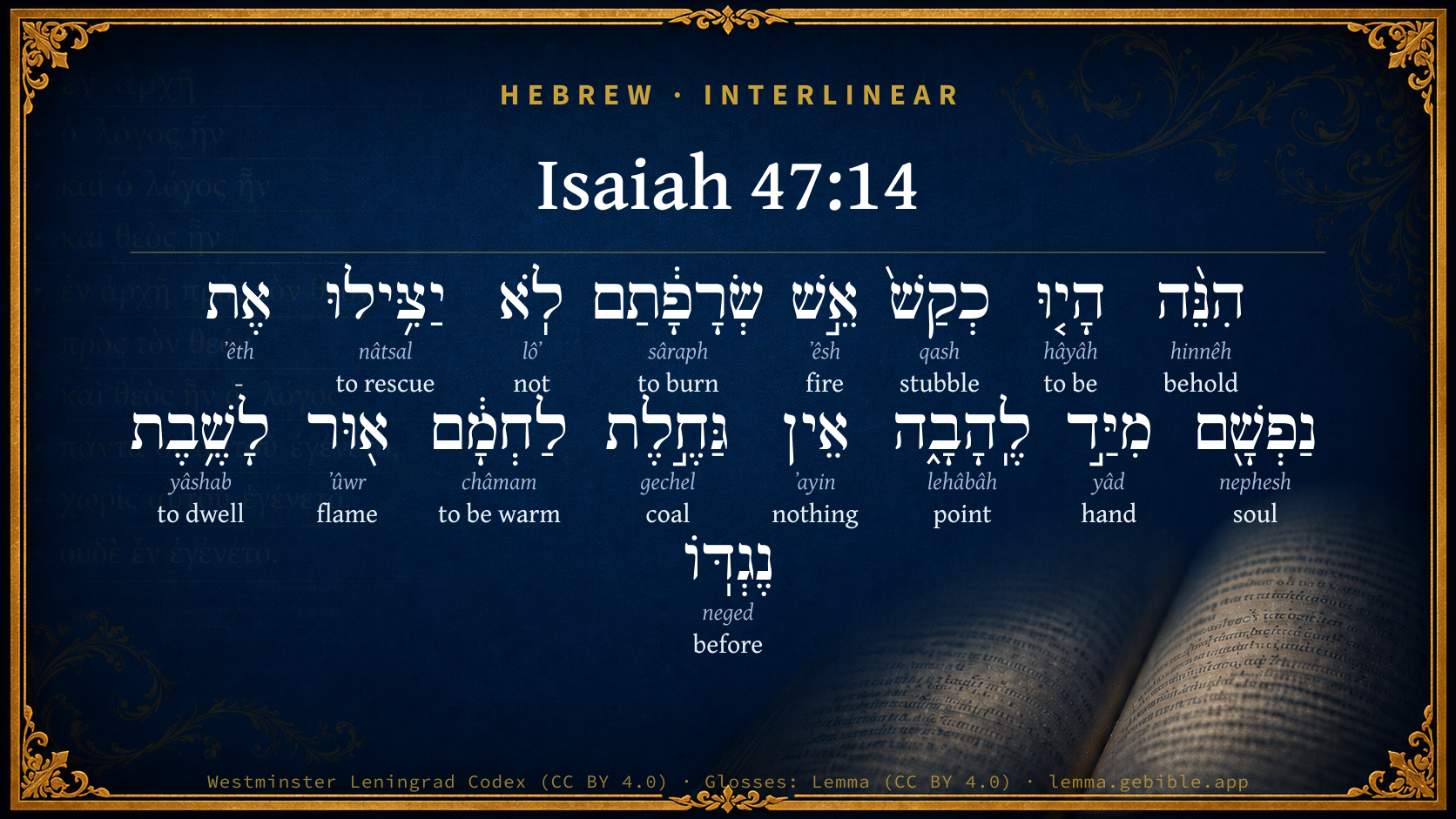
Isaiah 47:14

Hebrew (Westminster Leningrad Codex) Isaiah 47:14 appears in the Hebrew Old Testament. The text above is from the Westminster Leningrad Codex. Each word links to its Strong’s number, a concise gloss, and parsing drawn from the Open Scriptures Hebrew Bible morphology. Click any word for its full Brown-Driver-Briggs (BDB) entry.
Download image
Cite this verse

Isaiah 47:14 (World English Bible). Public Domain. Lemma interlinear Bible study tool, https://lemma.gebible.app/v/isaiah/47/14.

Show BibTeX & RIS
BibTeX
RIS
English Translation
Behold, they shall be as stubble; the fire shall burn them; they shall not deliver themselves from the power of the flame: it shall not be a coal to warm at, nor a fire to sit before.
World English Bible · Public Domain
Download a study sheet

One document with this verse’s original text, its word-by-word gloss line, the meaning frame, cross-references with their text, attributed commentary, and full source and license credits — printable, and it pastes into notes with its structure intact.

This verse Autodidact and up

Study sheet (.html) Plain text (.txt)

A passage Seminary Student

Up to 50 verses in one chapter. A passage sheet keeps up to 6 commentary sources and 12 cross-references per verse, in the order this page ranks them, and says so on the sheet whenever that leaves anything out. Ask for a single verse and you get the Autodidact verse sheet above.

Everything on this page stays free to read, with no account — the sheet is a download of what is already on screen, not access to it.

Want to remove ads? Support Godless Engineer
Compare translations 3

The same verse in 3 English versions, stacked beneath the original-language interlinear above. Click any original word for its lexicon entry.

Each is an independent rendering of the whole verse — the interlinear is not word-aligned to these translations.

Highlighted words mark where these versions differ — a whole-verse word diff, not a word-by-word alignment.

  • World English Bible Public Domain
    Behold, they shall be as stubble; the fire shall burn them; they shall not deliver themselves from the power of the flame: it shall not be a coal to warm at, nor a fire to sit before.
  • King James Version Public Domain
    Behold, they shall be as stubble; the fire shall burn them; they shall not deliver themselves from the power of the flame: there shall not be a coal to warm at, nor fire to sit before it.
  • unfoldingWord Literal Text CC BY-SA 4.0
    Behold, they will become like stubble; fire will burn them up. They will not deliver their souls from the hand of the flame. There is no coal to warm them, light to sit before it.

unfoldingWord Literal Text — © unfoldingWord, licensed CC BY-SA 4.0. Word-aligned USFM3 via Door43 (git.door43.org/unfoldingWord/en_ult).

Versions to compare (up to 4)

3 of 4 selected

Show all 18 translations

Every available English version of this verse, each an independent rendering of the whole verse.

  • World English Bible Public Domain
    Behold, they shall be as stubble; the fire shall burn them; they shall not deliver themselves from the power of the flame: it shall not be a coal to warm at, nor a fire to sit before.
  • Berean Standard Bible Public Domain
    Surely they are like stubble; the fire will burn them up. They cannot deliver themselves from the power of the flame. There will be no coals to warm them or fire to sit beside.
  • Majority Standard Bible Public Domain
    Surely they are like stubble; the fire will burn them up. They cannot deliver themselves from the power of the flame. There will be no coals to warm them or fire to sit beside.
  • King James Version Public Domain
    Behold, they shall be as stubble; the fire shall burn them; they shall not deliver themselves from the power of the flame: there shall not be a coal to warm at, nor fire to sit before it.
  • American Standard Version (1901) Public Domain
    Behold, they shall be as stubble; the fire shall burn them; they shall not deliver themselves from the power of the flame: it shall not be a coal to warm at, nor a fire to sit before.
  • Revised Version (1885) Public Domain
    Behold, they shall be as stubble; the fire shall burn them; they shall not deliver themselves from the power of the flame: it shall not be a coal to warm at, nor a fire to sit before.
  • Geneva Bible (1599) Public Domain
    Beholde, they shall be as stubble: the fire shall burne them: they shall not deliuer their owne liues from the power of the flame: there shalbe no coles to warme at, nor light to sit by.
  • Douay-Rheims (1899) Public Domain
    Behold they are as stubble, fire hath burnt them, they shall not deliver them- selves from the power of the dames: there are no coals wherewith they may be warmed, nor fire, that they may sit thereat.
  • Young's Literal Translation Public Domain
    Lo, they have been as stubble! Fire hath burned them, They deliver not themselves from the power of the flame, There is not a coal to warm them, a light to sit before it.
  • Literal Standard Version CC BY-SA 4.0
    Behold, they have been as stubble! Fire has burned them, || They do not deliver themselves from the power of the flame, || There is not a coal to warm them, a light to sit before it.
  • Unlocked Literal Bible CC BY-SA 4.0
    See, they will become like stubble. The fire will burn them up. They will not save themselves from the hand of the flame. There are no coals to warm them and no fire for them to sit by!
  • unfoldingWord Literal Text CC BY-SA 4.0
    Behold, they will become like stubble; fire will burn them up. They will not deliver their souls from the hand of the flame. There is no coal to warm them, light to sit before it.
  • Darby Bible Public Domain
    Behold, they shall be as stubble, the fire shall burn them; they shall not deliver themselves from the power of the flame: there shall not be a coal to warm at, [nor] fire to sit before it.
  • World Messianic Bible Public Domain
    Behold, they are like stubble. The fire will burn them. They won’t deliver themselves from the power of the flame. It won’t be a coal to warm at or a fire to sit by.
  • Webster's Bible Public Domain
    Behold, they shall be as stubble; the fire shall burn them; they shall not deliver themselves from the power of the flame: there shall not be a coal to warm at, nor fire to sit before it.
  • Free Bible Version CC BY-SA 4.0
    But look at them! They're like stubble that fire burns up completely—they can't even save their own lives from the flames. This is no fire to sit beside and grow warm!
  • Bible in Basic English Public Domain
    Truly, they have become like dry stems, they have been burned in the fire; they are not able to keep themselves safe from the power of the flame: it is not a coal for warming them, or a fire by which a man may be seated.
  • JPS Tanakh (1917) Public Domain
    Behold, they shall be as stubble; the fire shall burn them; they shall not deliver themselves from the power of the flame; it shall not be a coal to warm at, nor a fire to sit before.

Literal Standard Version (2020), Covenant Press — licensed CC BY-SA 4.0. Text via the HelloAO Bible API (eBible.org). Unlocked Literal Bible (unfoldingWord) — licensed CC BY-SA 4.0. Text via the HelloAO Bible API (eBible.org). unfoldingWord Literal Text — © unfoldingWord, licensed CC BY-SA 4.0. Word-aligned USFM3 via Door43 (git.door43.org/unfoldingWord/en_ult). Free Bible Version, Dr. Jonathan Gallagher — licensed CC BY-SA 4.0. Text via the HelloAO Bible API (eBible.org).

Word by word

More ways to search: Search by grammar → Find every occurrence → Compare this word →

Practice this passage: Drill this verse → Learn its vocabulary →

א֖וּר
ʼûwr
H217
“flame”
Noun, Common, Masculine, Singular, Absolute
Part of Speech
Noun
Type
Common
Gender
Masculine
Number
Singular
State
Absolute
Full BDB Definition

Origin: from H215

TWOT: 52d

flame, light of fire
  1. הִנֵּ֨ה hinnêh H2009 “behold” Particle, Demonstrative
  2. הָי֤וּ hâyâh H1961 “to be” Verb, Qal, Perfect, 3rd Person, Common, Plural
  3. כְקַשׁ֙ qash H7179 “like/as · stubble” Preposition + Noun, Common, Masculine, Singular, Absolute
  4. אֵ֣שׁ ʼêsh H784 “fire” Noun, Common, Both, Singular, Absolute
  5. שְׂרָפָ֔תַם sâraph H8313 “to burn · them” Verb, Qal, Perfect, 3rd Person, Feminine, Singular + Suffix, Personal, 3rd Person, Masculine, Plural
  6. לֹֽא lôʼ H3808 “not” Particle, Negative
  7. יַצִּ֥ילוּ nâtsal H5337 “to rescue” Verb, Hiphil, Imperfect, 3rd Person, Masculine, Plural
  8. אֶת ʼêth H853 “-” Particle, Direct Object
  9. נַפְשָׁ֖ם nephesh H5315 “soul · their” Noun, Common, Both, Singular, Construct + Suffix, Personal, 3rd Person, Masculine, Plural
  10. מִיַּ֣ד yâd H3027 “from · hand of” Preposition + Noun, Common, Both, Singular, Construct
  11. לֶֽהָבָ֑ה lehâbâh H3852 “point” Noun, Common, Feminine, Singular, Absolute
  12. אֵין ʼayin H369 “nothing” Particle, Negative
  13. גַּחֶ֣לֶת gechel H1513 “coal” Noun, Common, Both, Singular, Absolute
  14. לַחְמָ֔ם châmam H2552 “to be warm” Preposition + Verb, Qal, Infinitive Construct
  15. לָשֶׁ֥בֶת yâshab H3427 “to dwell” Preposition + Verb, Qal, Infinitive Construct
  16. נֶגְדּֽוֹ neged H5048 “before · him” Preposition + Suffix, Personal, 3rd Person, Masculine, Singular

About this verse

These counts appear in no published source. They are computed here, from the morphology-tagged text and Lemma’s own curated glosses. What Lemma adds →

17
words
17
distinct lemmas
Prophets
section

Notable vocabulary

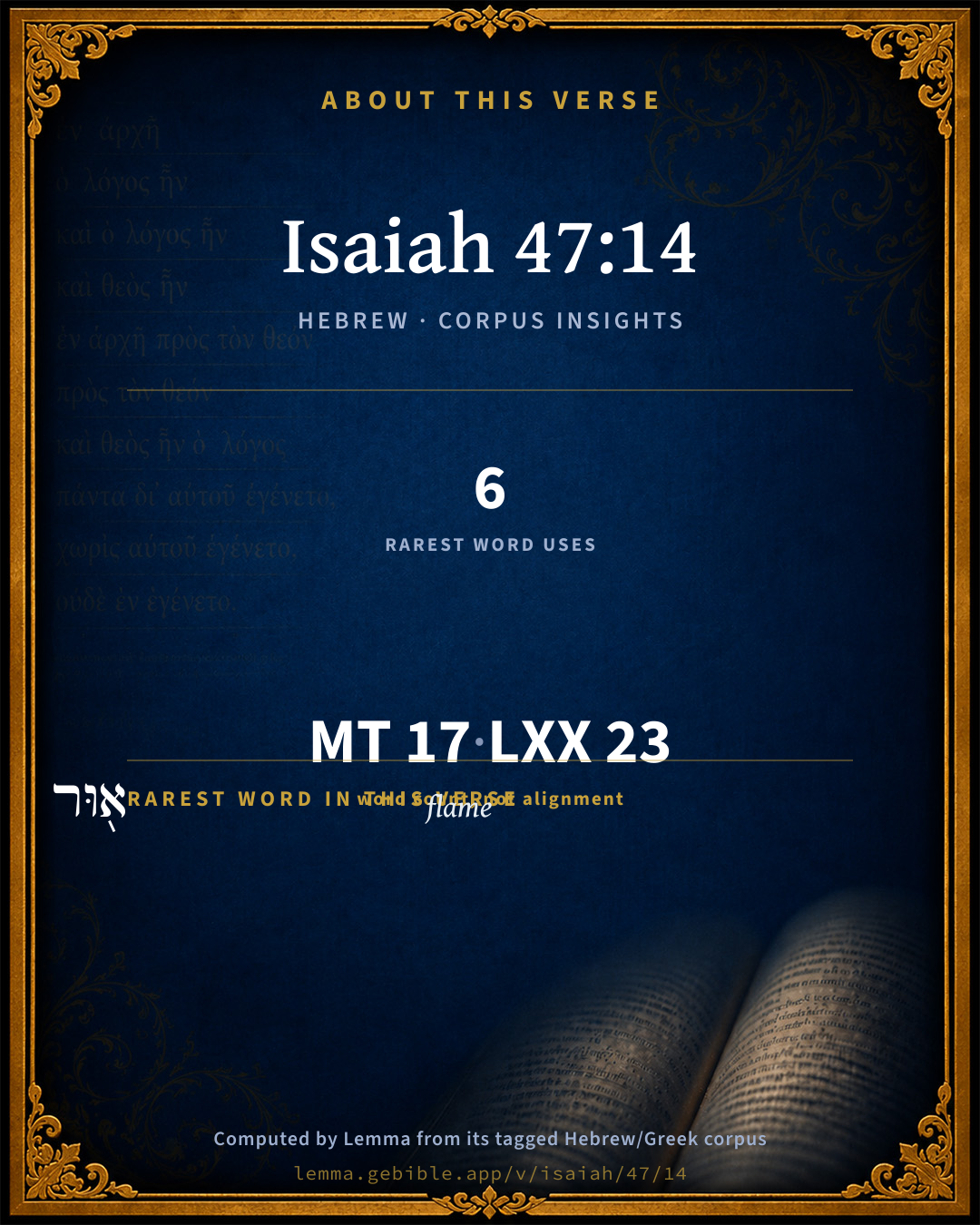
The rarest word here is א֖וּר flame H217 — appearing just 6 times in the whole Hebrew Bible.

Shared distinctive vocabulary

א֖וּר flame H217 occurs in 6 verses of the Hebrew Bible. Also found in:

Grammatical profile

  • 5 verbs
  • 7 nouns
  • 1 preposition
  • 4 particles

Verb forms

  • הָי֤וּ Qal · Perfect
  • שְׂרָפָ֔תַם Qal · Perfect
  • יַצִּ֥ילוּ Hiphil · Imperfect
  • לַחְמָ֔ם Qal · Infinitive Construct
  • לָשֶׁ֥בֶת Qal · Infinitive Construct

Hebrew & Septuagint length

In English translation the verse runs 37 words from the Hebrew and 33 from the Septuagint (LXX English) — closely comparable.

A rough comparison of the two English renderings, which tokenize alike — not a word-level alignment.

Word counts can differ between the Hebrew and the Greek without any difference in meaning — e.g. the Hebrew direct-object marker אֵת has no separate Greek word, and Greek often adds the article ὁ.

In the original languages it is 17 Hebrew tokens and 23 Greek tokens — but the two are counted differently (Hebrew bundles its prefixes and suffixes into one token; the Greek is in lemma form), so that isn’t a like-for-like length.

Cross-references

18

Topical passages linked to Isaiah 47:14 in the Treasury of Scripture Knowledge — connected by theme and wording, ordered by reader-vote popularity; previews shown in the World English Bible.

  • Nahum 1:10 For entangled like thorns, and drunken as with their drink, they are consumed utterly like dry stubble.
  • Malachi 4:1 "For, behold, the day comes, it burns as a furnace; and all the proud, and all who work wickedness, will be stubble; and the day that comes will burn them up," says Yahweh of Hosts, "that it shall leave them neither root nor branch.
  • Isaiah 10:17 The light of Israel will be for a fire, and his Holy One for a flame; and it will burn and devour his thorns and his briers in one day.
  • Ezekiel 15:7 I will set my face against them; they shall go forth from the fire, but the fire shall devour them; and you shall know that I am Yahweh, when I set my face against them.
  • Isaiah 41:2 Who has raised up one from the east, whom he calls in righteousness to his foot? he gives nations before him, and makes him rule over kings; he gives them as the dust to his sword, as the driven stubble to his bow.
  • Matthew 10:28 Don't be afraid of those who kill the body, but are not able to kill the soul. Rather, fear him who is able to destroy both soul and body in Gehenna.
  • Psalms 83:13–15 My God, make them like tumbleweed; Like chaff before the wind.
  • Isaiah 5:24 Therefore as the tongue of fire devours the stubble, And as the dry grass sinks down in the flame, So their root shall be as rottenness, And their blossom shall go up as dust; Because they have rejected the law of Yahweh of Hosts, And despised the word of the Holy One of Israel.
  • Isaiah 30:14 He shall break it as a potter's vessel is broken, breaking it in pieces without sparing; so that there shall not be found among the pieces of it a broken piece with which to take fire from the hearth, or to dip up water out of the cistern."
  • Isaiah 40:24 Yes, they have not been planted; yes, they have not been sown; yes, their stock has not taken root in the earth: moreover he blows on them, and they wither, and the whirlwind takes them away as stubble.
  • Jeremiah 51:25–26 Behold, I am against you, destroying mountain, says Yahweh, which destroy all the earth; and I will stretch out my hand on you, and roll you down from the rocks, and will make you a burnt mountain.
  • Jeremiah 51:30 The mighty men of Babylon have forborne to fight, they remain in their strongholds; their might has failed; they are become as women: her dwelling-places are set on fire; her bars are broken.
  • Jeremiah 51:32 and the passages are seized, and the reeds they have burned with fire, and the men of war are frightened.
  • Jeremiah 51:58 Thus says Yahweh of hosts: The broad walls of Babylon shall be utterly overthrown, and her high gates shall be burned with fire; and the peoples shall labor for vanity, and the nations for the fire; and they shall be weary.
  • Joel 2:5 Like the noise of chariots on the tops of the mountains do they leap, Like the noise of a flame of fire that devours the stubble, As a strong people set in battle array.
  • Obadiah 1:18 The house of Jacob will be a fire, the house of Joseph a flame, and the house of Esau for stubble. They will burn among them, and devour them. There will not be any remaining to the house of Esau." Indeed, Yahweh has spoken.
  • Matthew 16:26 For what will it profit a man, if he gains the whole world, and forfeits his life? Or what will a man give in exchange for his life?
  • Revelation 18:21 A mighty angel took up a stone like a great millstone and cast it into the sea, saying, "Thus with violence will Babylon, the great city, be thrown down, and will be found no more at all.

Cross-references courtesy of OpenBible.info (CC BY 4.0).

Hebrew and Greek witnesses Masoretic Hebrew ↔ Greek Septuagint

The same verse in the two great witnesses to the Old Testament, shown verse-for-verse.

These are two independent witnesses, not word-aligned to each other, and the Septuagint is shown in lemma (dictionary) form.

Hebrew Isaiah 47:14 Masoretic · Westminster Leningrad Codex

הִנֵּ֨ה הָי֤וּ כְקַשׁ֙ אֵ֣שׁ שְׂרָפָ֔תַם לֹֽא יַצִּ֥ילוּ אֶת נַפְשָׁ֖ם מִיַּ֣ד לֶֽהָבָ֑ה אֵין גַּחֶ֣לֶת לַחְמָ֔ם א֖וּר לָשֶׁ֥בֶת נֶגְדּֽוֹ

Behold, they shall be as stubble; the fire shall burn them; they shall not deliver themselves from the power of the flame: it shall not be a coal to warm at, nor a fire to sit before.

World English Bible · Public Domain

Greek LXX Isaiah 47:14 Septuagint · lemma form

ἰδού πᾶς ὡς φρύγανον ἐπί πῦρ καταλαίω καί οὐ μή ἐκαἱρέω ὁ ψυχή αὐτός ἐκ φλόξ ὅτι ἔχω ἄνθραξ πῦρ καταἵζω ἐπί αὐτός

Behold, they all shall be burnt up as sticks in the fire; neither shall they at all deliver their life from the flame. Because you have coals of fire, sit you upon them;

LXX2012 (modern English Septuagint) · Public Domain

Hebrew: Westminster Leningrad Codex (CC BY 4.0). Greek: Septuagint (public domain); English from LXX2012 (modern English Septuagint) (Public Domain). How the Septuagint differs from the Hebrew →

Targum (Aramaic paraphrase)

1

The Targum is the ancient Jewish Aramaic paraphrase of the Hebrew Scriptures — an interpretive translation, not the Hebrew text itself. Onkelos (literal) and Pseudo-Jonathan (expansive) render the Torah, and Jonathan the Prophets. Coverage is partial: where no permissively-licensed English translation exists for a verse, only the Aramaic is shown. This is verse-level text, not a word-by-word alignment to the Hebrew.

  1. Targum Jonathan Prophets (Joshua–Malachi)
    הָא הֲווֹ חֲלָשִׁין כְּקַשָׁא עַמְמַיָא דְתַקִיפִין כְּאֶשְׁתָּא שֵׁיצִיאוּנוּן לָא יְשֵׁיזְבוּן יַת נַפְשְׁהוֹן מִיַד קָטוֹלִין לֵית שְׁאָר וּמְשֵׁיזֵיב אַף לָא אֲתַר לְאִשְׁתֵּיזָבָא בֵיהּ:

    Behold, they shall be weak as stubble. The nations which are as strong as fire shall consume them, they shall not deliver themselves from the hand of the slayers: there shall be no remnant nor escaped of them, yea, not a place, in which one might deliver himself.

    Targum Jonathan — Aramaic: “Mikraot Gedolot” (public domain). English: “Sefaria Community Translation” (CC0 1.0 (public-domain dedication)); “London "Chaldee Paraphrase," 1871” (public domain). Text via Sefaria.

Commentary

Notes on Isaiah 47:14 from classic Christian and Jewish commentators (each source and its license shown beneath its notes). The classic Christian expositions comment on the surrounding passage and are grouped to its opening verse, so a note may address several verses; the Jewish commentaries on the Tanakh (Rashi and others) are per-verse, so they appear only where the commentator wrote on this verse.

Lemma curates 59 commentaries, every one of them public domain or Creative Commons licensed, each selected and text-cleaned for this edition rather than reprinted as found. About our sources →

Trapp's Complete Commentary

John Trapp

Isa 47:14 Behold, they shall be as stubble; the fire shall burn them; they shall not deliver themselves from the power of the flame: [there shall] not [be] a coal to warm at, [nor] fire to sit before it.

Ver. 14. Behold, they shall be as stubble.] As dried stubble. {Nah 1:10} {See Trapp on "Nah 1:10"}

They shall not deliver themselves.] Much less others.

There shall not be a coal to warm at.] Like a fire of flax, which is soon extinct, and leaves no embers or cinders behind it. In a spiritual sense, it may be said of most of our hearts and houses as here, There is not a coal to warm at. Deest ignis, as Father Latimer was wont to say; the fire of zeal is wanting, that flame of God. {Son 8:6}

John Trapp, A Commentary or Exposition upon All the Books of the Old and New Testament (1647–1656) — public domain. Text from a community e-Sword module.

The Biblical Illustrator

Joseph S. Exell

Isa_47:14

Behold, they shall be as stubble

Gods judgment as consuming fire

The flame is no comfortable fire for warmth, no hearth-fire (Isa_44:16) to sit in front of; but, on thecontrary, consuming, eternal, i.annihilating flames (Isa_33:14). (F. Delitzsch, D. D.)

The portion of the ungodly

I. With reference to the FIRST SENTENCE.

1. One of the most striking thoughts which it conveys to the mind is this, that the punishment of the wicked will be easily inflicted. They shall be as stubble. Nothing can be more easy than to kindle stubble when it is fully dry. Oh, ungodly and impenitent man, there is that in thyself to-day which, let alone and permitted to ripen, will bring a hell upon thee. Thou hast in thyself the power of memory, and that power shall become a vehicle of sorrow to thee. Thou hast, beside thy memory, a conscience; a con science which thou hast striven to silence; but, even drugged and gagged as it is, it sometimes makes thee feel unhappy. You will then find that you cannot palliate the guilt of sin. Thy memory and thy conscience shall be as two great millstones grinding thee to powder. Then, added to thy memory and to thy conscience, there shall come thy increased knowledge. Thou knowest enough now to leave thee without excuse, but then thy knowledge shall increase so as to leave thee without pretence of apology. Thou shalt then perceive the craft of the tempter who deluded thee. Thou shalt then see the blackness and the filthiness of sin as thou dost not see it now. Then shalt thou understand the greatness and the goodness of the God whom thou hast despised; thou shalt then discern the glory of the heaven which thou hast lost; thou shalt then begin to get an idea of that eternity which shall roll over thy head for ever. Beside, think of thy companions. Shut up fifty drunkards and profane men together, and would they not soon make a hell for themselves without any interposition of Divine power? What will it be when they are bound up in bundles; when the tens of thousands of those who obey not Christ shall find themselves in their own place?

2. This punishment shall be most searching and terrible. The metaphor of fire is used in Scripture because it is that which of all things causeth the most pain, and is the most searching and trying. As fire consumes, and so reaches to the very essence of things, so shall the wrath to come reach to the very essence and subsistence of the soul.

3. This destruction will be most inevitable. They shall not deliver themselves from the power of the flame. There is hope now; there shall be no hope then. The Lord Jesus, though the most loving of spirits, was the most awful of preachers; and in His sermons, while there is everything that could melt and woo, there is no lack of the great and terrible thunderbolt, and the sounding forth of wrath to come, and the judgment which must await the impenitent.

II. BUT OUR TEXT NOW CHANGES ITS FIGURE. Thus saith the Lord, There shall not be a coal to warm at, nor fire to sit before it; by which is meant that there shall be nothing in hell that can give the sinner a moments comfort; nothing.

III. And now our text bids us BEHOLD, therefore I pray ye turn not away your eyes from this meditation.

1. Children of God, behold it; it will make you grateful. Does not the thought of the misery from which you have escaped make you love your Saviour? And oh, will it not make you love poor sinners too?

2. But specially, you that are unconverted, the text says, Behold. It is a gloomy subject for you to think upon, but better to think of it now than to think of it for ever. (C. H. Spurgeon.)

The Biblical Illustrator, edited by Joseph S. Exell (c. 1880s–1900s) — public domain. Text from a community e-Sword module.

Geneva Bible (1599)

Geneva Bible translators

They shall utterly perish, and no part of them remain.

Geneva Bible (1599) marginal notes — public domain. Text via Bolls.life.

Jamieson, Fausset & Brown

Robert Jamieson, A. R. Fausset & David Brown

(Isa 29:6; Isa 30:30).

not . . . a coal--Like stubble, they shall burn to a dead ash, without leaving a live coal or cinder (compare Isa 30:14), so utterly shall they be destroyed.

Jamieson, Fausset & Brown — Commentary Critical and Explanatory on the Whole Bible (1871) — public domain (CC PDM 1.0). Text via the HelloAO Bible API.

Ellicott's Commentary for English Readers

(14) There shall not be a coal to warm at.—Better, it shall not be . . . The destroying flame shall be altogether other than the fire on the hearth, at which a man can sit and warm himself.

A Bible Commentary for English Readers, edited by Charles John Ellicott (1878–1897) — public domain. Text from a community e-Sword module.

The Cambridge Bible for Schools and Colleges

gen. ed. J. J. S. Perowne

14. They cannot even save their own lives, much less the State. themselves] their (own) life.

there shall not be a coal &c.] Better: It is no (glowing) coal to warm oneself withal; no fire to sit before! i.e. no genial hearth for comfort, but an all-consuming fire! The sentence is prosaic and unnecessary, and might readily be sacrificed (with Duhm) to the exigencies of the strophe and the elegiac measure.

The Cambridge Bible for Schools and Colleges (gen. ed. J. J. S. Perowne; Cambridge University Press, 1878–1918) — public domain. Text from a community e-Sword module.

John Gill's Exposition

Behold, they shall be as stubble, the fire shall burn them,.... That is, these astrologers and diviners shall be like stubble; weak as that, as the Targum; they shall be no more able to stand before the fire of divine wrath, or before the judgments of God, by the hands of the Medes and Persians, than stubble can stand before a consuming fire:

they shall not deliver themselves from the power of the flame; from those dreadful calamities that shall come upon them like flames of fire; and if they cannot deliver themselves by their art and skill, how should they deliver others?

there shall not be a coal to warm, nor fire to sit before it; stubble, when burnt, leaves no coals to warm a man with; and though it gives a blaze for a short time, while burning, it is quickly out, and gives no light nor heat for a man to sit by, so that there is little or no profit by it; which signifies that there were no hope, or help, or comfort, to be expected from those sorts of persons.

John Gill's Exposition of the Whole Bible (1746–1763) — public domain (CC PDM 1.0). Text via the HelloAO Bible API.

Albert Barnes' Notes on the Bible

Behold, they shall be as stubble - They shall be no more able to resist the judgments which are coming upon the city, than dry stubble can resist the action of the fire. A similar figure is used in Isa 1:31 (see the notes at that verse). Compare also Isa 29:6; Isa 30:30, where fire is a symbol of the devouring judgments of God.

They shall not deliver themselves - Margin, as Hebrew, ‘Their souls.’ The meaning is, that they would be unable to protect themselves from the calamities which would come upon them and the city.

There shall not be a coal to warm at - The meaning is, that they would be entirely consumed - so completely, that not even a coal or spark would be left, as when stubble, or a piece of wood, is entirely burned up. According to this interpretation, the sense is, that the judgments of God would come upon them and the city, so that entire destruction would ensue. Rosenmuller, however, Cocceius, and some others, suppose this should be rendered, ‘there shall not remain a coal so that bread could be baked by it.’ But the more common, and more correct interpretation, is that suggested above. Compare Gesenius and Rosenmuller on the place.

Albert Barnes' Notes on the Bible (1834–1885) — public domain. Text from a community e-Sword/MySword module.

Haydock's Catholic Bible Commentary

Thereat, to warm themselves, (Haydock) or to adore. (Calmet) --- In Cappadocia are to be seen "Pyratheia,...in which the magi keep a perpetual fire, and sing hymns about the space of an hour." (Strabo xv.) --- These were a sort of open temples. (Calmet)

George Leo Haydock (1774–1849), Haydock's Catholic Family Bible and Commentary, 1859 edition — public domain. Excludes Psalms (Douay-Rheims chapter numbering differs from Protestant) and Deuterocanonical books (Catholic canon only).

Matthew Poole's English Annotations

They shall not deliver themselves, and much less thee,

from the power of the flame; they shall be totally consumed, and all the comfort which thou didst expect from them shall utterly vanish.

Matthew Poole's English Annotations on the Holy Bible (1683–1685) — public domain. Text from a community e-Sword/MySword module.

Whedon's Commentary on the Bible

Daniel D. Whedon

14. The prophet further says,

They shall be as stubble — All the astrologers, or wise men, in whom Babylon trusted, and Babylon itself. Fire shall consume them; not, indeed, material fire, but what will be as destructive. The whole power of Babylon shall be consumed, as fire consumes stubble, and there shall be no help for them.

Not… a coal to warm at, nor fire to sit before it — The original is somewhat obscure, but the sense appears to be: The consumption of every thing shall be so complete that not a coal nor cinder shall be left to warm one by, or to bake one’s bread before it.

Daniel D. Whedon (gen. ed.), Commentary on the Old and New Testaments (1874–1909) — public domain. Text from a community e-Sword module.

The Pulpit Commentary

Behold, they shall be as stubble. (comp. Isa_5:24 Isa_40:24 Isa_41:2) A favourite metaphor with Isaiah for extreme weakness and incapacity of resistance. In Isa_5:24 it is connected, as here, with fire. No doubt in Palestine, as elsewhere, an accidental fire from time to time caught hold of a stubble-field, and speedily reduced it to a mass of blackened ashes. The threat here is that God"s wrath shall similarly sweep over Babylon. They shall not deliver themselves from the power of the flame. Mr. Cheyne translates, with much spirit, "They cannot rescue their soul from the clutch of the flame." Like those who are caught in the midst of a fire in a prairie or jungle, they have no escape the flame is on all sides and they cannot but perish. There shall not be a coal to warm at; rather, it is not a charcoal-fire to warm one"s self at. A return to the sarcastic tone of vers. 12, 13. The conflagration which spreads around is something more than a fire to warm one"s self at it is an awful widespread devastation.

The Pulpit Commentary (1880–1919), ed. H.D.M. Spence-Jones & Joseph S. Exell — public domain. Text from a community e-Sword module.

J. A. Alexander on Isaiah

Joseph Addison Alexander

“Behold they are like stubble, fire has burned them (the Babylonian astrologers).” Behold brings their destruction into view as something present. He not only prophesies that they shall be burnt, but sees them burning. The comparison with stubble seems intended to suggest that they are worthless and combustible, whose end is to be burned (Heb 6:8). At the same time a contrast is designed between the burning of stubble and the burning of wood, the former being more complete and rapid than the latter. “They cannot deliver themselves from the hand (i.e., the power) of the flame.” The last clause contains a negative description of the fire mentioned in the first. Of this description there are two interpretations. Some understand it to mean that the destruction of the fuel will be so complete that nothing will be left at which a man can sit and warm himself. Others explain it to mean, (this fire) is not a coal (at which) to warm one’s self, a fire to sit before, but a devouring and consuming conflagration. With either of these expositions of the whole clause may be reconciled a different interpretation of the word proposed by some writers, who give the word the sense which it invariably has in every other place where it occurs, viz. their bread. (See Job 30:4; Pro 30:25; Eze 4:13; Eze 12:19; Hos 9:4). The whole expression then means that it is not a common fire for baking bread, or, on the other supposition, that there are not coals enough left for that purpose. The phrase ‘coal of their bread’ presents a harsh and unusual combination, rendered less so however by the use of both words in Isa 44:19. The general sense of sudden, rapid, and complete destruction, is not affected by these minor questions of grammatical analysis.

Joseph Addison Alexander, The Prophecies of Isaiah (1846–1847; New York: Scribner, 1870–1878) — public domain. Text from a community e-Sword module.

unfoldingWord translationNotes

Door43 World Missions Community

Connecting Statement:

Yahweh continues to speak to Babylon about her downfall as if she were a queen who is humiliated. (See: Metaphor and Personification)

they will become like stubble. The fire will burn them up

Yahweh compares the magicians and sorcerers to straw that burns quickly in a fire. This means that Yahweh will destroy them as easily as fire burns stubble, and so they are powerless to save Babylon. (See: Simile)

the hand of the flame

Here the word "hand" represents strength. AT: "the power of the flame" (See: Metonymy)

There are no coals to warm them and no fire for them to sit by

Yahweh emphasizes that this is a destructive fire by stating that it is not one that people will use to warm themselves.

translationWords

fire

hand

save

unfoldingWord translationNotes — © Distant Shores Media and the Door43 World Missions Community, licensed CC BY-SA 4.0. Source: git.door43.org/Door43/en_tn.

Rashi

Rabbi Shlomo Yitzchaki (Rashi)

Behold they were Your stargazers were like stubble.

there is no coal by which to warm oneself They have no remnant, like stubble, the fire of which does not leave over coals by whose fire one can warm himself.

Rashi on the Tanakh — English translations: “The Judaica Press complete Tanach with Rashi, translated by A. J. Rosenberg” (CC BY 4.0); “Pentateuch with Rashi's commentary by M. Rosenbaum and A.M. Silbermann, 1929-1934” (public domain); “The Metsudah Tanach series, Lakewood, N.J” (CC BY 4.0); and “The Book of Joshua, Metsudah Publications, 1997” (CC BY 4.0). Text via Sefaria.

Ibn Ezra

Rabbi Abraham ibn Ezra

Fire. The host of the enemy. Comp., There is a fire gone out of Heshbon (Num. 21:28).

לחמם To warm at. It is infinitive of a verb (חמם) ע״ע, written in full, and similar in form to לשכב to lie (Gen. 34:7).—The meaning of the whole sentence is: they will perish and no remnant will be left of them.

Ibn Ezra on the Tanakh — English translations: “Sefaria Community Translation” (CC0 1.0 (public-domain dedication)); “Yalkut, Sifsei Chachomim Chumash, Metsudah Publications, 2009” (CC BY 4.0); and “Commentary of Ibn Ezra on Isaiah - trans. by M. Friedlander, 1873” (public domain). Text via Sefaria.

Lesson kit

Teaching starters — assembled from the data on this page, not authored interpretation. Every prompt links to the verse data it draws on. Edit before teaching.

Isaiah, in the Prophets, opens this verse with 17 words (17 distinct Hebrew lemmas). Its most distinctive word is ʼûwr (“flame”). A historical commentator’s framing appears above. Read the whole chapter for the surrounding context.

Discussion questions

  1. What does “flame” (ʼûwr) contribute to the verse as a whole?
  2. How does Isaiah 24:15, which shares the word «flame», read alongside this verse?
  3. These translations render this verse differently. What is at stake in choosing one wording over another?
  4. «הָי֤וּ» is a Qal Perfect verb. How does that grammatical form shape the action described?
  5. Compare how Trapp's Complete Commentary and The Biblical Illustrator read this verse. Where do they agree or differ?

Things to notice

Reading settings

Reading text

Shown beneath each verse's original-language words.

Old Testament
Old Testament edition

Read the OT as the Masoretic Hebrew (MT) or the Greek Septuagint (LXX).

English shown for the Greek Septuagint (in the Hebrew ↔ Greek comparison).

Comparing translations? Open the Compare panel on any verse page to stack up to four side by side.