
Isaiah 37:12

Hebrew (Westminster Leningrad Codex) Isaiah 37:12 appears in the Hebrew Old Testament. The text above is from the Westminster Leningrad Codex. Each word links to its Strong’s number, a concise gloss, and parsing drawn from the Open Scriptures Hebrew Bible morphology. Click any word for its full Brown-Driver-Briggs (BDB) entry.
Download image
Cite this verse

Isaiah 37:12 (World English Bible). Public Domain. Lemma interlinear Bible study tool, https://lemma.gebible.app/v/isaiah/37/12.

Show BibTeX & RIS
BibTeX
RIS
English Translation
Have the gods of the nations delivered them, which my fathers have destroyed, Gozan, and Haran, and Rezeph, and the children of Eden who were in Telassar?
World English Bible · Public Domain
Download a study sheet

One document with this verse’s original text, its word-by-word gloss line, the meaning frame, cross-references with their text, attributed commentary, and full source and license credits — printable, and it pastes into notes with its structure intact.

This verse Autodidact and up

Study sheet (.html) Plain text (.txt)

A passage Seminary Student

Up to 50 verses in one chapter. A passage sheet keeps up to 6 commentary sources and 12 cross-references per verse, in the order this page ranks them, and says so on the sheet whenever that leaves anything out. Ask for a single verse and you get the Autodidact verse sheet above.

Everything on this page stays free to read, with no account — the sheet is a download of what is already on screen, not access to it.

Want to remove ads? Support Godless Engineer
Compare translations 3

The same verse in 3 English versions, stacked beneath the original-language interlinear above. Click any original word for its lexicon entry.

Each is an independent rendering of the whole verse — the interlinear is not word-aligned to these translations.

Highlighted words mark where these versions differ — a whole-verse word diff, not a word-by-word alignment.

  • World English Bible Public Domain
    Have the gods of the nations delivered them, which my fathers have destroyed, Gozan, and Haran, and Rezeph, and the children of Eden who were in Telassar?
  • King James Version Public Domain
    Have the gods of the nations delivered them which my fathers have destroyed, as Gozan, and Haran, and Rezeph, and the children of Eden which were in Telassar?
  • unfoldingWord Literal Text CC BY-SA 4.0
    Did the gods of the nations that my fathers destroyed deliver them, Gozan or Haran or Rezeph or the sons of Eden who in Tel Assar?

unfoldingWord Literal Text — © unfoldingWord, licensed CC BY-SA 4.0. Word-aligned USFM3 via Door43 (git.door43.org/unfoldingWord/en_ult).

Versions to compare (up to 4)

3 of 4 selected

Show all 18 translations

Every available English version of this verse, each an independent rendering of the whole verse.

  • World English Bible Public Domain
    Have the gods of the nations delivered them, which my fathers have destroyed, Gozan, and Haran, and Rezeph, and the children of Eden who were in Telassar?
  • Berean Standard Bible Public Domain
    Did the gods of the nations destroyed by my fathers rescue those nations—the gods of Gozan, Haran, and Rezeph, and of the people of Eden in Telassar?
  • Majority Standard Bible Public Domain
    Did the gods of the nations destroyed by my fathers rescue those nations—the gods of Gozan, Haran, and Rezeph, and of the people of Eden in Telassar?
  • King James Version Public Domain
    Have the gods of the nations delivered them which my fathers have destroyed, as Gozan, and Haran, and Rezeph, and the children of Eden which were in Telassar?
  • American Standard Version (1901) Public Domain
    Have the gods of the nations delivered them, which my fathers have destroyed, Gozan, and Haran, and Rezeph, and the children of Eden that were in Telassar?
  • Revised Version (1885) Public Domain
    Have the gods of the nations delivered them, which my fathers have destroyed, Gozan, and Haran, and Rezeph, and the children of Eden which were in Telassar?
  • Geneva Bible (1599) Public Domain
    Haue the gods of the nations deliuered them, which my fathers haue destroyed? as Gozan, and Haran, and Rezeph, and the children of Eden, which were at Telassar?
  • Douay-Rheims (1899) Public Domain
    Have the gods of the nations delivered them whom my fathers have destroyed, Gozam, and Haram, and Reseph, and the children of Eden, that were in Thalassar?
  • Young's Literal Translation Public Domain
    Did the gods of the nations deliver them whom my fathers destroyed -- Gozan, and Haran, and Rezeph, and the sons of Eden, who `are' in Telassar?
  • Literal Standard Version CC BY-SA 4.0
    Did the gods of the nations deliver them whom my fathers destroyed—Gozan, and Haran, and Rezeph, and the sons of Eden, who [are] in Telassar?
  • Unlocked Literal Bible CC BY-SA 4.0
    Have the gods of the nations rescued them, the nations that my fathers destroyed: Gozan, Haran, Rezeph, and the people of Eden in Tel Assar?
  • unfoldingWord Literal Text CC BY-SA 4.0
    Did the gods of the nations that my fathers destroyed deliver them, Gozan or Haran or Rezeph or the sons of Eden who in Tel Assar?
  • Darby Bible Public Domain
    Have the gods of the nations which my fathers have destroyed delivered them, Gozan, and Haran, and Rezeph, and the children of Eden that were in Thelassar?
  • World Messianic Bible Public Domain
    Have the gods of the nations delivered them, which my fathers have destroyed, Gozan, Haran, Rezeph, and the children of Eden who were in Telassar?
  • Webster's Bible Public Domain
    Have the gods of the nations delivered them which my fathers have destroyed, as Gozan, and Haran, and Rezeph, and the children of Eden who were in Telassar?
  • Free Bible Version CC BY-SA 4.0
    Did the gods of the nations my forefathers destroyed save them—the gods of Gozan, Haran, Rezeph, and the people of Eden who lived in Telassar?
  • Bible in Basic English Public Domain
    Did the gods of the nations keep safe those on whom my fathers sent destruction, Gozan and Haran and Rezeph, and the children of Eden who were in Telassar?
  • JPS Tanakh (1917) Public Domain
    Have the gods of the nations delivered them, which my fathers have destroyed, Gozan, and Haran, and Rezeph, and the children of Eden that were in Telassar?

Literal Standard Version (2020), Covenant Press — licensed CC BY-SA 4.0. Text via the HelloAO Bible API (eBible.org). Unlocked Literal Bible (unfoldingWord) — licensed CC BY-SA 4.0. Text via the HelloAO Bible API (eBible.org). unfoldingWord Literal Text — © unfoldingWord, licensed CC BY-SA 4.0. Word-aligned USFM3 via Door43 (git.door43.org/unfoldingWord/en_ult). Free Bible Version, Dr. Jonathan Gallagher — licensed CC BY-SA 4.0. Text via the HelloAO Bible API (eBible.org).

Word by word

More ways to search: Search by grammar → Find every occurrence → Compare this word →

Practice this passage: Drill this verse → Learn its vocabulary →

וְרֶ֥צֶף
Retseph
H7530
“and · Rezeph”
Conjunction + Noun, Proper
Part of Speech
Conjunction + Noun
Type
Proper
Full BDB Definition

Origin: the same as H7529

TWOT: None

Rezeph = "a hot stone" - a place conquered by Assyria
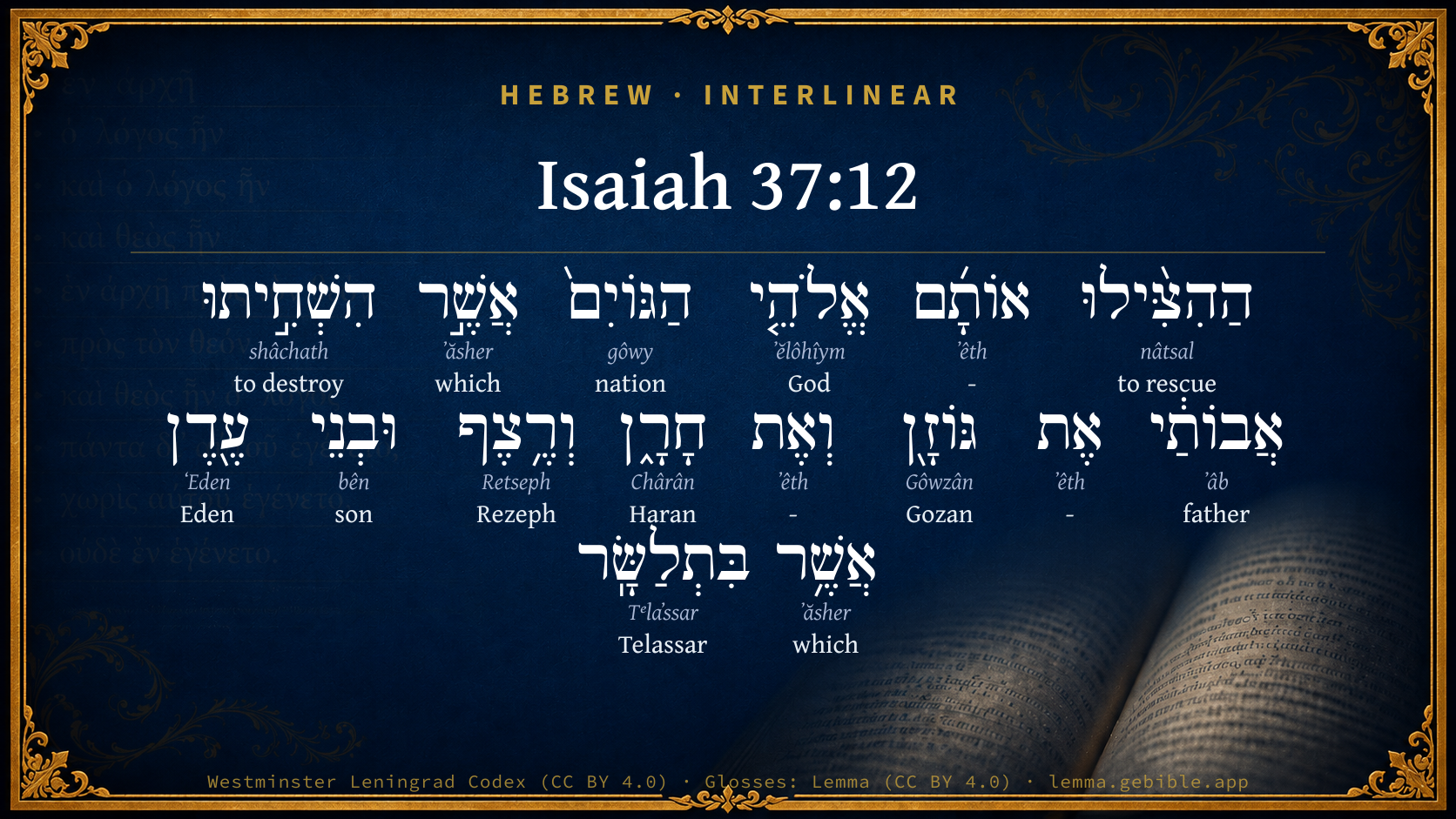
  1. הַהִצִּ֨ילוּ nâtsal H5337 “to rescue” Particle, Interrogative + Verb, Hiphil, Perfect, 3rd Person, Common, Plural
  2. אוֹתָ֜ם ʼêth H853 “- · them” Particle, Direct Object + Suffix, Personal, 3rd Person, Masculine, Plural
  3. אֱלֹהֵ֤י ʼĕlôhîym H430 “God(s) of” Noun, Common, Masculine, Plural, Construct
  4. הַגּוֹיִם֙ gôwy H1471 “the · nations” Particle, Definite Article + Noun, Common, Masculine, Plural, Absolute
  5. אֲשֶׁ֣ר ʼăsher H834 “which” Particle, Relative
  6. הִשְׁחִ֣יתוּ shâchath H7843 “to destroy” Verb, Hiphil, Perfect, 3rd Person, Common, Plural
  7. אֲבוֹתַ֔י ʼâb H1 “fathers · my” Noun, Common, Masculine, Plural, Construct + Suffix, Personal, 1st Person, Common, Singular
  8. אֶת ʼêth H853 “-” Particle, Direct Object
  9. גּוֹזָ֖ן Gôwzân H1470 “Gozan” Noun, Proper
  10. וְאֶת ʼêth H853 “and · -” Conjunction + Particle, Direct Object
  11. חָרָ֑ן Chârân H2771 “Haran” Noun, Proper
  12. וּבְנֵי bên H1121 “and · sons of” Conjunction + Noun, Common, Masculine, Plural, Construct
  13. עֶ֖דֶן ʻEden H5729 “Eden” Noun, Proper
  14. אֲשֶׁ֥ר ʼăsher H834 “which” Particle, Relative
  15. בִּתְלַשָּֽׂר Tᵉlaʼssar H8515 “in/at · Telassar” Preposition + Noun, Proper

About this verse

These counts appear in no published source. They are computed here, from the morphology-tagged text and Lemma’s own curated glosses. What Lemma adds →

16
words
13
distinct lemmas
Prophets
section

Notable vocabulary

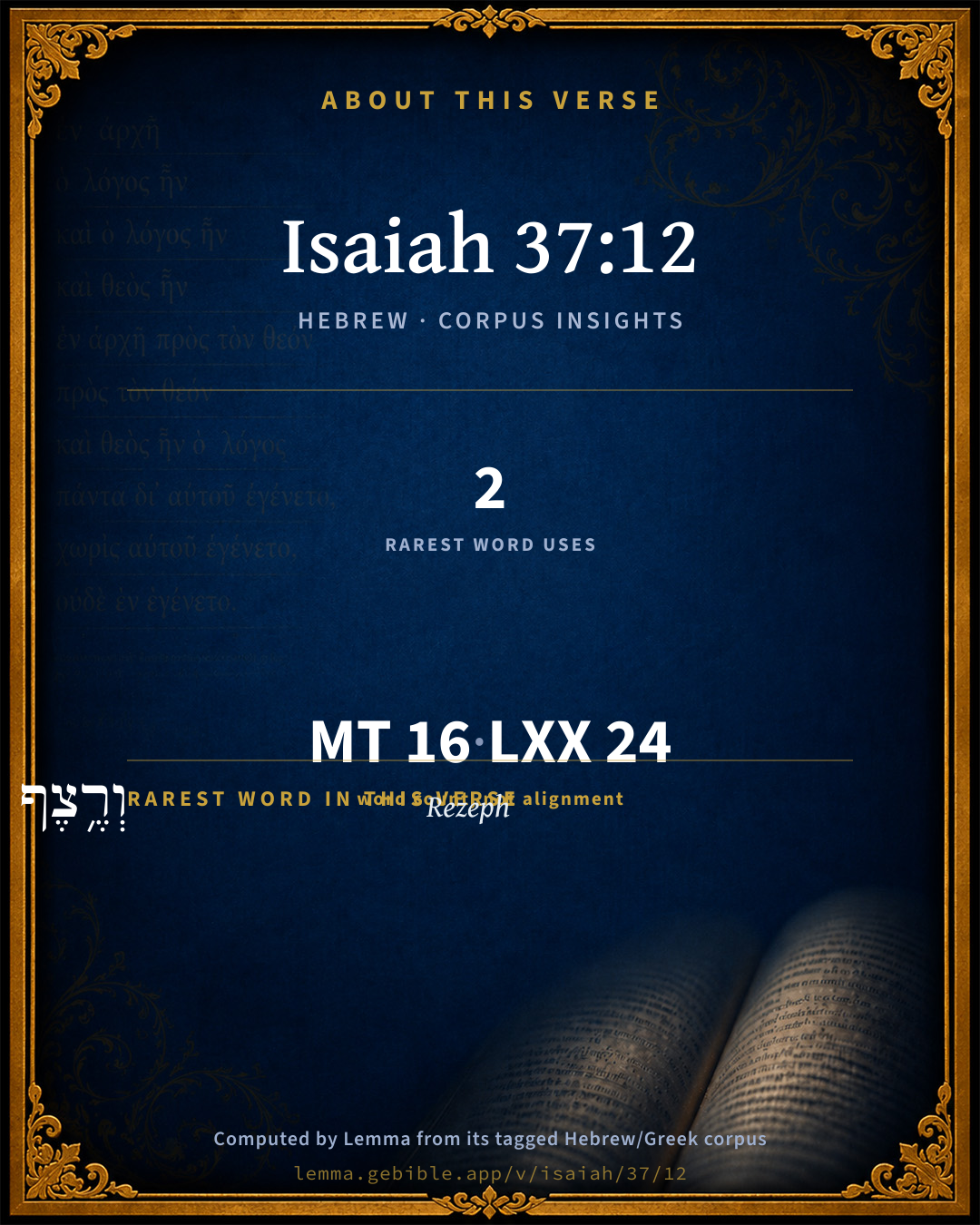
The rarest word here is וְרֶ֥צֶף Rezeph H7530 — appearing just 2 times in the whole Hebrew Bible.

Shared distinctive vocabulary

וְרֶ֥צֶף Rezeph H7530 occurs in 2 verses of the Hebrew Bible. Also found in:

Grammatical profile

  • 2 verbs
  • 9 nouns
  • 5 particles

Verb forms

  • הַהִצִּ֨ילוּ Hiphil · Perfect
  • הִשְׁחִ֣יתוּ Hiphil · Perfect

Repetition

A word recurs within this verse — often emphatic in Hebrew:

  • אֲשֶׁ֣ר which H834 ×2

Hebrew & Septuagint length

In English translation the verse runs 27 words from the Hebrew and 25 from the Septuagint (LXX English) — closely comparable.

A rough comparison of the two English renderings, which tokenize alike — not a word-level alignment.

Word counts can differ between the Hebrew and the Greek without any difference in meaning — e.g. the Hebrew direct-object marker אֵת has no separate Greek word, and Greek often adds the article ὁ.

In the original languages it is 16 Hebrew tokens and 24 Greek tokens — but the two are counted differently (Hebrew bundles its prefixes and suffixes into one token; the Greek is in lemma form), so that isn’t a like-for-like length.

Cross-references

15

Topical passages linked to Isaiah 37:12 in the Treasury of Scripture Knowledge — connected by theme and wording, ordered by reader-vote popularity; previews shown in the World English Bible.

  • Genesis 11:31 Terah took Abram his son, Lot the son of Haran, his son's son, and Sarai his daughter-in-law, his son Abram's wife. They went forth from Ur of the Chaldees, to go into the land of Canaan. They came to Haran, and lived there.
  • 2 Kings 17:6 In the ninth year of Hoshea the king of Assyria took Samaria, and carried Israel away to Assyria, and placed them in Halah, and on the Habor, the river of Gozan, and in the cities of the Medes.
  • 2 Kings 18:11 The king of Assyria carried Israel away to Assyria, and put them in Halah, and on the Habor, the river of Gozan, and in the cities of the Medes,
  • 2 Kings 19:12 Have the gods of the nations delivered them, which my fathers have destroyed, Gozan, and Haran, and Rezeph, and the children of Eden that were in Telassar?
  • Acts 7:2 He said, "Brothers and fathers, listen. The God of glory appeared to our father Abraham, when he was in Mesopotamia, before he lived in Haran,
  • Genesis 2:8 Yahweh God planted a garden eastward, in Eden, and there he put the man whom he had formed.
  • Genesis 12:1–4 Now Yahweh said to Abram, "Get out of your country, and from your relatives, and from your father's house, to the land that I will show you.
  • Genesis 12:14 It happened that when Abram had come into Egypt, the Egyptians saw that the woman was very beautiful.
  • Genesis 28:10 Jacob went out from Beersheba, and went toward Haran.
  • Genesis 29:4 Jacob said to them, "My relatives, where are you from?" They said, "We are from Haran."
  • Isaiah 36:20 Who are they among all the gods of these countries, that have delivered their country out of my hand, that Yahweh should deliver Jerusalem out of my hand?
  • Isaiah 46:5–7 To whom will you liken me, and make me equal, and compare me, that we may be like?
  • Ezekiel 27:23 Haran and Canneh and Eden, the traffickers of Sheba, Asshur [and] Chilmad, were your traffickers.
  • Ezekiel 28:13 You were in Eden, the garden of God; every precious stone adorned you: ruby, topaz, emerald, chrysolite, onx, jasper, sapphire, turquoise, and beryl. Gold work of tambourines and of pipes was in you. In the day that you were created they were prepared.
  • Amos 1:5 I will break the bar of Damascus, And cut off the inhabitant from the valley of Aven, And him who holds the scepter from the house of Eden; And the people of Syria shall go into captivity to Kir," says Yahweh.

Cross-references courtesy of OpenBible.info (CC BY 4.0).

Hebrew and Greek witnesses Masoretic Hebrew ↔ Greek Septuagint

The same verse in the two great witnesses to the Old Testament, shown verse-for-verse.

These are two independent witnesses, not word-aligned to each other, and the Septuagint is shown in lemma (dictionary) form.

Hebrew Isaiah 37:12 Masoretic · Westminster Leningrad Codex

הַהִצִּ֨ילוּ אוֹתָ֜ם אֱלֹהֵ֤י הַגּוֹיִם֙ אֲשֶׁ֣ר הִשְׁחִ֣יתוּ אֲבוֹתַ֔י אֶת גּוֹזָ֖ן וְאֶת חָרָ֑ן וְרֶ֥צֶף וּבְנֵי עֶ֖דֶן אֲשֶׁ֥ר בִּתְלַשָּֽׂר

Have the gods of the nations delivered them, which my fathers have destroyed, Gozan, and Haran, and Rezeph, and the children of Eden who were in Telassar?

World English Bible · Public Domain

Greek LXX Isaiah 37:12 Septuagint · lemma form

μή ῥύομαι αὐτός ὁ θεός ὁ ἔθνος ὅς ὁ πατήρ ἐγώ ἀποὀλλύω ὁ τε γωζα καί χαρραν καί ραφες ὅς εἰμί ἐν χώρα θεμαδ

Have the gods of the nations which my fathers destroyed delivered them, both Gozan, and Charrhan, and Rapheth, which are in the land of Theemath?

LXX2012 (modern English Septuagint) · Public Domain

Hebrew: Westminster Leningrad Codex (CC BY 4.0). Greek: Septuagint (public domain); English from LXX2012 (modern English Septuagint) (Public Domain). How the Septuagint differs from the Hebrew →

Targum (Aramaic paraphrase)

1

The Targum is the ancient Jewish Aramaic paraphrase of the Hebrew Scriptures — an interpretive translation, not the Hebrew text itself. Onkelos (literal) and Pseudo-Jonathan (expansive) render the Torah, and Jonathan the Prophets. Coverage is partial: where no permissively-licensed English translation exists for a verse, only the Aramaic is shown. This is verse-level text, not a word-by-word alignment to the Hebrew.

  1. Targum Jonathan Prophets (Joshua–Malachi)
    הֲשֵׁיזָבָא יַתְהוֹן דַחֲלַת עַמְמַיָא דְחַבִּילוּ אֲבָהָתִי יַת גוֹזָן וְיַת חָרָן וְרֶצֶף וּבְנֵי עֶדֶן דְבִתְלַשָׂר:

    Have the gods of the nations delivered those whom my fathers have destroyed, as Gozan, and Haran, and Rezeph, and the inhabitants of Eden which were in Telassar?

    Targum Jonathan — Aramaic: “Mikraot Gedolot” (public domain). English: “Sefaria Community Translation” (CC0 1.0 (public-domain dedication)); “London "Chaldee Paraphrase," 1871” (public domain). Text via Sefaria.

Commentary

Notes on Isaiah 37:12 from classic Christian and Jewish commentators (each source and its license shown beneath its notes). The classic Christian expositions comment on the surrounding passage and are grouped to its opening verse, so a note may address several verses; the Jewish commentaries on the Tanakh (Rashi and others) are per-verse, so they appear only where the commentator wrote on this verse.

Lemma curates 59 commentaries, every one of them public domain or Creative Commons licensed, each selected and text-cleaned for this edition rather than reprinted as found. About our sources →

Tyndale Open Study Notes

Tyndale Open Resources

37:12 The argument was that Judah’s god, like the gods of other nations already conquered by Assyria, would be unable to save Judah (see also 36:18-20). • Gozan, Haran, Rezeph, . . . Eden, and Tel-assar were cities in Mesopotamia.

Tyndale Open Study Notes — © Tyndale Open Resources, licensed CC BY-SA 4.0. Text via the HelloAO Bible API.

Geneva Bible (1599)

Geneva Bible translators

Which was a city of the Medes.

Called also Charre a city in Mesopotamia, whence Abraham came after his father’s death.

Geneva Bible (1599) marginal notes — public domain. Text via Bolls.life.

Jamieson, Fausset & Brown

Robert Jamieson, A. R. Fausset & David Brown

Gozan--in Mesopotamia, on the Chabour (Kg2 17:6; Kg2 18:11). Gozan is the name of the district, Chabour of the river.

Haran--more to the west. Abraham removed to it from Ur (Gen 11:31); the Carroe of the Romans.

Rezeph--farther west, in Syria.

Eden--There is an ancient village, Adna, north of Baghdad. Some think Eden to be the name of a region (of Mesopotamia or its vicinity) in which was Paradise; Paradise was not Eden itself (Gen 2:8). "A garden in Eden."

Telassar--now Tel-afer, west of Mosul [LAYARD]. Tel means a "hill" in Arabic and Assyrian names.

Jamieson, Fausset & Brown — Commentary Critical and Explanatory on the Whole Bible (1871) — public domain (CC PDM 1.0). Text via the HelloAO Bible API.

Adam Clarke's Commentary

Verse 12. As Gozan, and Haran] חרן Charan: but הרן Haran is the reading of four of Kennicott's MSS. and one of De Rossi's.

Adam Clarke's Commentary on the Bible (1810–1826) — public domain. Text from a community e-Sword/MySword module.

Ellicott's Commentary for English Readers

(12) Gozan . . .—The induction drawn from the enumeration of conquered nations is continued. Strictly speaking, Sargon, the father of Sennacherib, was the founder of a new dynasty; but the “fathers” are, as commonly in the formulæ of Eastern kings, the predecessors of the reigning king. The position of Gozan is defined by 2Ki_17:6 as being on the Habor, or Khabûr, which flows into the Tigris from the east, above Mosul. Haran is probably identical with Abraham’s resting-place (Gen_11:31), and the Charran of Josephus and St. Stephen’s speech (Act_7:4). “Rezeph” is identified with the Rhesepher of Ptolemy (Isa_5:13; Isa_5:6) below Thapeacus, between the ’Euphrates and Tadmor (= Palmyra). Telassar is probably an altered form of Tel-Assur (the hill of Assur), and was probably a new name given to a conquered city, after the manner in which Shalmaneser records that he gave names to cities that he had taken belonging to Akhuni, the son of Adini (Records of the Past, iii. 87, v. 30). In the patronymic we may trace the sons of Eden of this verse. In Amo_1:5 we have a Beth-Eden named as connected with Damascus; and in Eze_27:23 an “Eden” connected with Haran and Asshur, as carrying on traffic with Tyre. The latter is probably identical with that named by Sennacherib.

A Bible Commentary for English Readers, edited by Charles John Ellicott (1878–1897) — public domain. Text from a community e-Sword module.

The Cambridge Bible for Schools and Colleges

gen. ed. J. J. S. Perowne

12. my fathers here means “my predecessors”; for the dynasty to which Sennacherib belonged had been founded by his father Sargon. The place-names in this verse are all found on the Assyrian monuments. (See Schrader, Cuneiform Inscriptions, on 2Ki_19:12.) Gozan (Assyr. Guzana) is one of the places to which the Northern Israelites were exiled (2Ki_17:6; 2Ki_18:11); it lay on the river Chaboras, a northern affluent of the Euphrates. Haran is the well-known commercial emporium of northern Mesopotamia, on another tributary (the Belikh) west of the Chaboras. Rezeph (Assyr. Raṣappa) is about 20 miles south of the Euphrates on the route from Haran to Palmyra. Telassar is in Assyrian Til-Assuri (“Hill of Asshur”), a name likely to be of frequent occurrence. The place here can hardly be the Babylonian Til-Assuri mentioned in the monuments; it may rather have been one of the cities of Eden, i.e. the small kingdom called Bit-Adini on the Upper Euphrates.

The Cambridge Bible for Schools and Colleges (gen. ed. J. J. S. Perowne; Cambridge University Press, 1878–1918) — public domain. Text from a community e-Sword module.

John Gill's Exposition

Where is the king of Hamath, and the king of Arphad, and the king of the city of Sepharvaim,.... The same, as some think, with the gods or idols of those places; see Gill on Isa 36:19; though it may be the princes that ruled over those cities are meant, who were either slain, or become tributary to the king of Assyria. It is added,

Henah and Ivah: which some take to be the names of the gods or kings of Sepharvaim; but rather, since Sepharvaim is of the dual number, it was a double city, the river Euphrates passing between them; and these, as Musculus conjectures, were the names of them; or it may be, these were distinct cities from that, but what or where they were is not certain. Ptolemy makes mention of a place called Ingine, near Gausanitis or Gozan, supposed to be Henah; though others rather think it to be Ange, which he places in Arabia (i), which I think is not so probable. Ivah perhaps is the same with Avah, in Kg2 17:24. The Targum does not take them for names or places, but translates them,

"hath he not removed them, and carried them captive?''

and so Jarchi's note is,

"the king of Assyria hath moved and overthrown them, and destroyed them, and removed them out of their place;''

referring to the other cities.

(i) Geograph. l. 6. c. 7.

John Gill's Exposition of the Whole Bible (1746–1763) — public domain (CC PDM 1.0). Text via the HelloAO Bible API.

Albert Barnes' Notes on the Bible

My fathers - My predecessors on the throne.

Gozan - This was a region or country in the northern part of Mesopotamia, and on the river Chaboras. There was a river of the name of Gozan in Media, which ran through the province, and gave it its name. The river fell probably into the Chaboras. This region is known to have been under the dominion of Assyria, for Shalmaneser, when he had subdued the ten tribes, carried them away beyond the Euphrates to a country bordering on the river Gozan 2Ki 17:6. According to Gesenius, the river which is referred to, is the Chaboras itself. He translates the passage in 2Ki 17:6, thus: ‘And placed them in Chaleitis (Halah), and on the Chabor (Habor), a river of Gozan, and in the cities of the Medes.’ According to this, the river was the Chaboras, the Chabor of Ezekiel, and the region was situated on the Chaboras. This river falls into the Euphrates from the east. Ptolemy calls the region lying between the Chaboras and Laocoras by the name of Gauzanitis, which is doubtless the same as the Hebrew Gozan. Gozan is usually mentioned in connection with cities of Mesopotamia 2Ki 19:12; 1Ch 5:26.

And Haran - This was a city of Mesopotamia, to which Abraham went after he left Ur of the Chaldees. His father died here; and from this place he was called to go into the land of promise (Gen 11:31-32; compare the notes at Act 7:4). It is now called Harran, and is situated in latitude 36 degree 52 minutes north; longitude 39 degrees 5 minutes east, in a flat and sandy plain, and is only populated by a few wandering Arabs, who select it as the place of residence on account of the delicious waters it contains. It belonged by conquest to the Assyrian Empire.

And Rezeph - According to Abulfeda, there were many towns of this name. One, however, was more celebrated than the others, and is probably the one here referred to. It was situated about a day’s journey west of the Euphrates, and is mentioned by Ptolemy by the name of Ῥησαφα Rēsapha (Resapha).

And the children of Eden - Eden was evidently a country well known in the time of Isaiah, and was, doubtless, the tract within which man was placed when he was created. The garden or Paradise was in Eden, and was not properly itself called Eden Gen 2:8. It is probable that Eden was a region or tract of country of considerable extent. Its situation has been a subject of anxious inquiry. It is not proper here to go into an examination of this subject. It is evident from the passage before us that it was either in Mesopotamia, or in the neighborhood of that country, since it is mentioned in connection with cities and towns of that region. It is mentioned by Amos (787 b.c.), as a country then well known, and as a part of Syria, not far from Damascus:

I will break also the bar of Damascus,

And cut off the inhabitant from the plain of Aven,

And him that holdeth the scepter from the house of Eden,

And the people of Syria shall go into captivity to Kir,

Saith the Lord.

Amo 1:5.

In Isa 51:8, Eden is referred to as a country well known, and as distinguished for its fertility:

For Yahweh shall comfort Zion;

He will comfort all her waste places,

And he will make her wilderness like Eden,

And her desert like the garden of Yahweh.

Thus also in Eze 27:23, we find Eden mentioned in connection with Haran and Canneh. Canneh was probably the same as Calneh Gen 10:10, the Calno of Isaiah Isa 10:9, and was, doubtless, situated in Mesopotamia, since it is joined with cities that are known to have been there (compare also Eze 31:9, Eze 31:16, Eze 31:18). All these passages demonstrate that there was such a country, and prove also that it was either in Mesopotamia, or in a country adjacent to Mesopotamia. It is not, however, possible now to designate its exact boundaries.

In Telassar - This place is nowhere else mentioned in the Scriptures. Nothing, therefore, is known of its situation. The connection demands that it should be in Mesopotamia. The names of ancient places were so often lost or changed that it is often impossible to fix their exact locality.

Albert Barnes' Notes on the Bible (1834–1885) — public domain. Text from a community e-Sword/MySword module.

The Pulpit Commentary

My fathers. The Assyrian monarchs call all those who have preceded them upon the throne their "fathers," without intending to claim any blood-relation-ship. Sargon, Sennacherib"s father, though a usurper and the first king of a new dynasty, frequently speaks of "the kings his fathers" ("Records of the Past," ch. 7. pp. 39, 51, etc.). Gozan... Haran ... Rezeph... Telassar. "Gozan" is, beyond all doubt, the region known to the Greeks as Gauzanitis, which was the eastern portion of Upper Mesopotamia, or the country about the sources of the Khabour river. The Assyrian conquest of this tract is indicated by the settlement of the Israelites in the region. (2Ki_17:6 2Ki_18:11 1Ch_5:26) "Harsh" is the well-known "city of Nahor", (Gen_24:10) called in Act_7:2 Charran," and by the Greeks and Romans, Carrhae. It has now recovered its old designation, and is known as Hurrah. "Rezeph" was in the neighborhood of Haran, and is mentioned as belonging to Assyria as early as B.C. 775 ("Eponym Canon," p. 82). It had probably revolted and been reduced at a later date. "Telassar," "the Hill of Asshur," is not mentioned in the Assyrian inscriptions, but was probably the Assyrian name of a town on or near the Euphrates, in the country of the Bent-Eden, which was not far from Carche-mish (see "Records of the Past," ch. 3. pp. 90-92). The children of Eden. The Assyrian inscriptions mention a "Bit-Adini" (comp. Amo_1:5), and a chief who is called "the son of Adini;" both belonging to the Middle Euphrates region. The "children of Eden" (Beni-Eden) were probably the people of the tract about Bit-Adini.

The Pulpit Commentary (1880–1919), ed. H.D.M. Spence-Jones & Joseph S. Exell — public domain. Text from a community e-Sword module.

J. A. Alexander on Isaiah

Joseph Addison Alexander

“Did the gods of the nations deliver them, which my fathers destroyed, (to wit) Gozan, and Haran, and Rezeph, and the children of Eden which is (or who were) in Telassar?” Here again the collocation of the words makes the construction doubtful, though the general sense is clear. With respect to the places mentioned in the second clause, all that is absolutely necessary to the just understanding of the sentence, is that they were well known, both to speaker and hearer, as Assyrian conquests. The difficulty of identifying some of them affords an incidental argument in favor of the antiquity and genuineness of the passage. Gozan is probably the modern Kaushan, the Gauzanitis of Ptolemy, a region of Mesopotamia, situated on the Chaboras, to which a portion of the ten tribes were transferred by Shalmaneser. Haran was a city of Mesopotamia, where Abraham’s father died, the Carrae of the Romans, and famous for the great defeat of Crassus. Rezeph, a common name in oriental geography, here denotes probably the Rhessapha of Ptolemy, a town and province in Palmyrene Syria. Eden means pleasure or delight, and seems to have been given as a name to various places. Having been thus applied to a district in the region of Mount Lebanon the native Christians have been led to regard that as the site of the terrestrial paradise. Equally groundless are the conclusions of some learned critics as to the identity of the place here mentioned with the garden of Eden. Such allusions prove no more, as to the site of the garden, than the similar allusions of modern orators and poets to any delightful region as an Eden or Paradise. Even the continued application of the name, in prose, as a geographical term, proves no more than the use of such a name as Mount Pleasant in American geography. The inference, in this place, is especially untenable, because the word sons or children, prefixed to Eden, leaves it doubtful whether the latter is the name of a place at all, and not rather that of a person, whose descendants were among the races conquered by Assyria. The relative pronoun may agree grammatically either with sons or Eden, and the form of the verb to be supplied must be varied accordingly. Telassar, which some think may be identical with the Ellasar of Gen 14:1, appears to be analogous in form to the Babylonian names, Tel-abib, Tel-melah, Tel-hasha, in all which tel means hill and corresponds to the English mount in names of places.

Joseph Addison Alexander, The Prophecies of Isaiah (1846–1847; New York: Scribner, 1870–1878) — public domain. Text from a community e-Sword module.

Rashi

Rabbi Shlomo Yitzchaki (Rashi)

Eden the name of a kingdom, as it is stated (Ezekiel 27:23): “Haran and Canneh and Eden.”

Rashi on the Tanakh — English translations: “The Judaica Press complete Tanach with Rashi, translated by A. J. Rosenberg” (CC BY 4.0); “Pentateuch with Rashi's commentary by M. Rosenbaum and A.M. Silbermann, 1929-1934” (public domain); “The Metsudah Tanach series, Lakewood, N.J” (CC BY 4.0); and “The Book of Joshua, Metsudah Publications, 1997” (CC BY 4.0). Text via Sefaria.

Lesson kit

Teaching starters — assembled from the data on this page, not authored interpretation. Every prompt links to the verse data it draws on. Edit before teaching.

Isaiah, in the Prophets, opens this verse with 16 words (13 distinct Hebrew lemmas). Its most distinctive word is Retseph (“Rezeph”). A historical commentator’s framing appears above. Read the whole chapter for the surrounding context.

Discussion questions

  1. What does “Rezeph” (Retseph) contribute to the verse as a whole?
  2. 2 Kings 19:12 shares the word «Rezeph» with this verse. How do the two illuminate each other?
  3. “which” occurs 2× in this one verse. What is the effect of the repetition?
  4. These translations render this verse differently. What is at stake in choosing one wording over another?
  5. The verb «הַהִצִּ֨ילוּ» is Hiphil Perfect. How does its form color the action?
  6. Reading how Tyndale Open Study Notes and Geneva Bible (1599) read this verse, where do the two commentators agree and where do they part?

Things to notice

Reading settings

Reading text

Shown beneath each verse's original-language words.

Old Testament
Old Testament edition

Read the OT as the Masoretic Hebrew (MT) or the Greek Septuagint (LXX).

English shown for the Greek Septuagint (in the Hebrew ↔ Greek comparison).

Comparing translations? Open the Compare panel on any verse page to stack up to four side by side.