
Isaiah 42:22

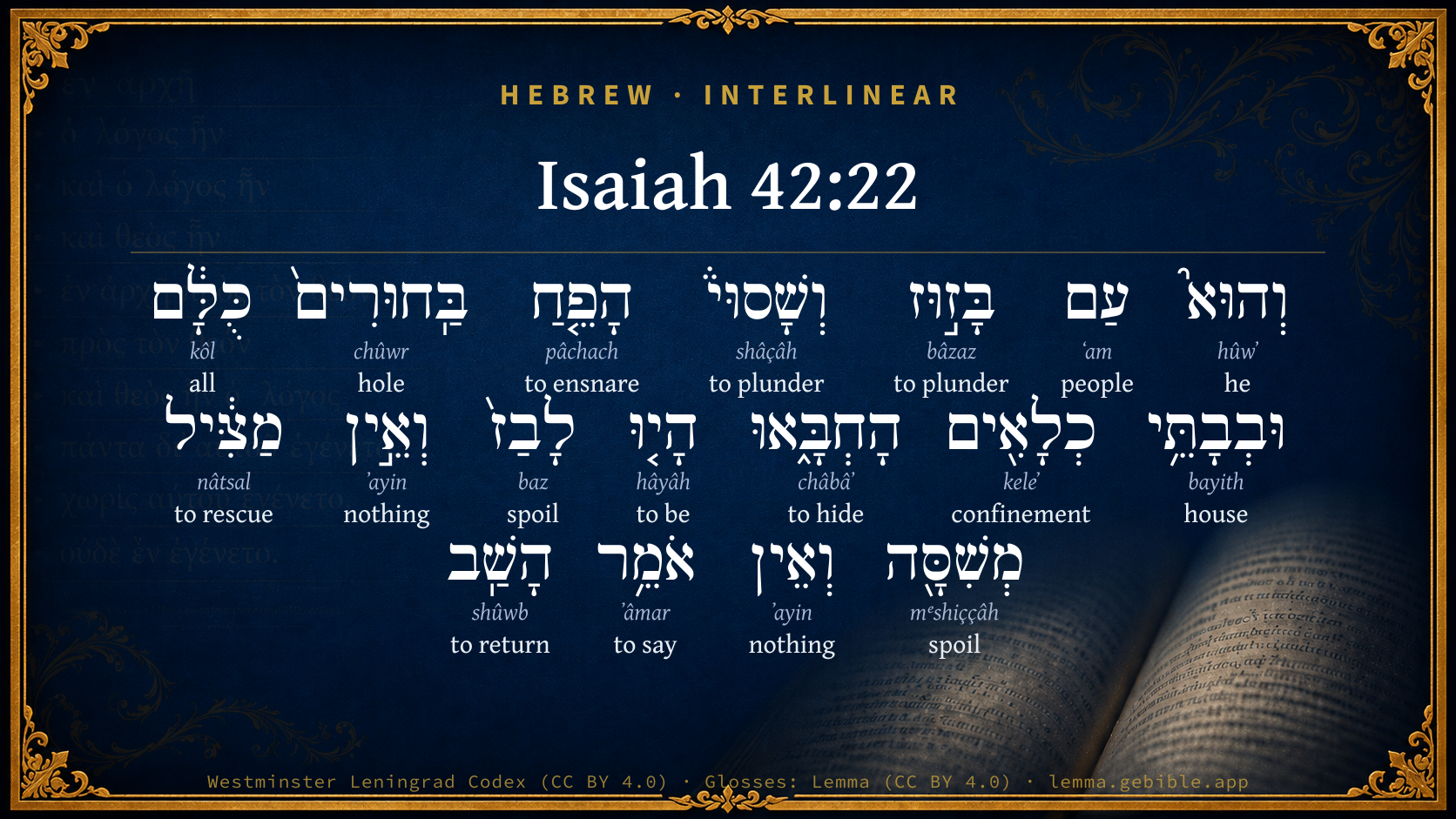
Hebrew (Westminster Leningrad Codex) Isaiah 42:22 appears in the Hebrew Old Testament. The text above is from the Westminster Leningrad Codex. Each word links to its Strong’s number, a concise gloss, and parsing drawn from the Open Scriptures Hebrew Bible morphology. Click any word for its full Brown-Driver-Briggs (BDB) entry.
Download image
Cite this verse

Isaiah 42:22 (World English Bible). Public Domain. Lemma interlinear Bible study tool, https://lemma.gebible.app/v/isaiah/42/22.

Show BibTeX & RIS
BibTeX
RIS
English Translation
But this is a people robbed and plundered; they are all of them snared in holes, and they are hid in prison-houses: they are for a prey, and none delivers; for a spoil, and none says, Restore.
World English Bible · Public Domain
Highlights
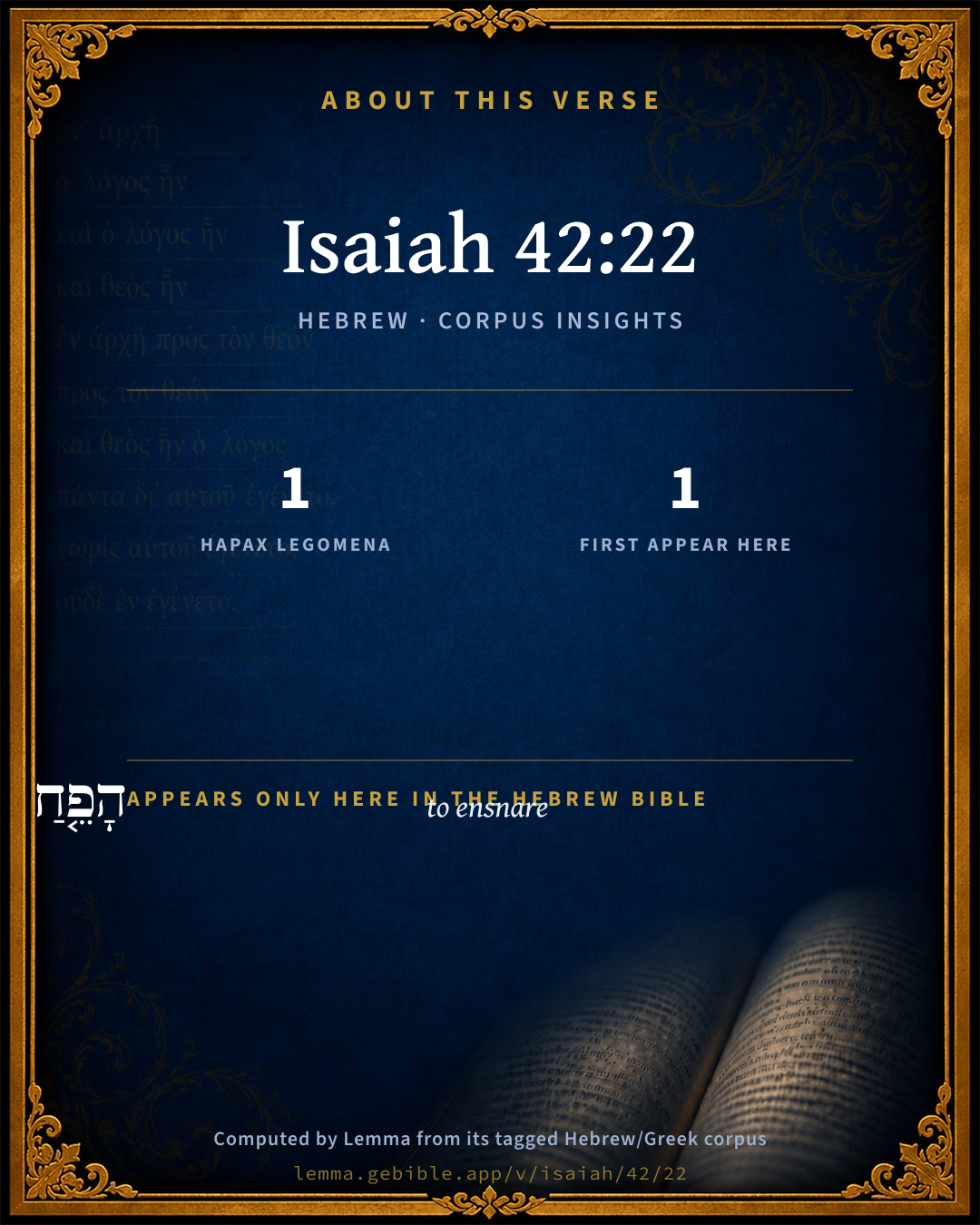
  • 1 hapax legomenon — only here in the Hebrew Bible
  • 1 first appearance in the Hebrew Bible
Full analysis ↓
Download a study sheet

One document with this verse’s original text, its word-by-word gloss line, the meaning frame, cross-references with their text, attributed commentary, and full source and license credits — printable, and it pastes into notes with its structure intact.

This verse Autodidact and up

Study sheet (.html) Plain text (.txt)

A passage Seminary Student

Up to 50 verses in one chapter. A passage sheet keeps up to 6 commentary sources and 12 cross-references per verse, in the order this page ranks them, and says so on the sheet whenever that leaves anything out. Ask for a single verse and you get the Autodidact verse sheet above.

Everything on this page stays free to read, with no account — the sheet is a download of what is already on screen, not access to it.

Want to remove ads? Support Godless Engineer
Compare translations 3

The same verse in 3 English versions, stacked beneath the original-language interlinear above. Click any original word for its lexicon entry.

Each is an independent rendering of the whole verse — the interlinear is not word-aligned to these translations.

Highlighted words mark where these versions differ — a whole-verse word diff, not a word-by-word alignment.

  • World English Bible Public Domain
    But this is a people robbed and plundered; they are all of them snared in holes, and they are hid in prison-houses: they are for a prey, and none delivers; for a spoil, and none says, Restore.
  • King James Version Public Domain
    But this is a people robbed and spoiled; they are all of them snared in holes, and they are hid in prison houses: they are for a prey, and none delivereth; for a spoil, and none saith, Restore.
  • unfoldingWord Literal Text CC BY-SA 4.0
    But it a people plundered and looted, all of them trapped in pits, and in houses of confinement they are hidden. They have become plunder, and none is delivering; loot, and none is saying, “Give back!”

unfoldingWord Literal Text — © unfoldingWord, licensed CC BY-SA 4.0. Word-aligned USFM3 via Door43 (git.door43.org/unfoldingWord/en_ult).

Versions to compare (up to 4)

3 of 4 selected

Show all 18 translations

Every available English version of this verse, each an independent rendering of the whole verse.

  • World English Bible Public Domain
    But this is a people robbed and plundered; they are all of them snared in holes, and they are hid in prison-houses: they are for a prey, and none delivers; for a spoil, and none says, Restore.
  • Berean Standard Bible Public Domain
    But this is a people plundered and looted, all trapped in caves or imprisoned in dungeons. They have become plunder with no one to rescue them, and loot with no one to say, “Send them back!”
  • Majority Standard Bible Public Domain
    But this is a people plundered and looted, all trapped in caves or imprisoned in dungeons. They have become plunder with no one to rescue them, and loot with no one to say, “Send them back!”
  • King James Version Public Domain
    But this is a people robbed and spoiled; they are all of them snared in holes, and they are hid in prison houses: they are for a prey, and none delivereth; for a spoil, and none saith, Restore.
  • American Standard Version (1901) Public Domain
    But this is a people robbed and plundered; they are all of them snared in holes, and they are hid in prison-houses: they are for a prey, and none delivereth; for a spoil, and none saith, Restore.
  • Revised Version (1885) Public Domain
    But this is a people robbed and spoiled; they are all of them snared in holes, and they are hid in prison houses: they are for a prey, and none delivereth; for a spoil, and none saith, Restore.
  • Geneva Bible (1599) Public Domain
    But this people is robbed and spoiled, and shalbe all snared in dungeons, and they shalbe hid in prison houses: they shall be for a pray, and none shall deliuer: a spoile, and none shall say, Restore.
  • Douay-Rheims (1899) Public Domain
    But this is a people that is robbed and wasted: they are all the snare of young men, and they are hid in the houses of prisons: they are made a prey, and there is none to deliver them: a spoil, and there is none that saith: Restore.
  • Young's Literal Translation Public Domain
    And this `is' a people seized and spoiled, Snared in holes -- all of them, And in houses of restraint they were hidden, They have been for a prey, And there is no deliverer, A spoil, and none is saying, `Restore.'
  • Literal Standard Version CC BY-SA 4.0
    And this [is] a people seized and spoiled, || Snared in holes—all of them, || And they were hidden in houses of restraint, || They have been for a prey, || And there is no deliverer, || A spoil, and none is saying, “Restore.”
  • Unlocked Literal Bible CC BY-SA 4.0
    But this is a people robbed and plundered; they are all trapped in pits, held captive in prisons; they have become a plunder with no one to rescue them, and no one says, “Bring them back!”
  • unfoldingWord Literal Text CC BY-SA 4.0
    But it a people plundered and looted, all of them trapped in pits, and in houses of confinement they are hidden. They have become plunder, and none is delivering; loot, and none is saying, “Give back!”
  • Darby Bible Public Domain
    But this is a people robbed and spoiled; they are all of them snared in holes, and hidden in prison-houses; they are become a prey, and none delivereth, -- a spoil, and none saith, Restore.
  • World Messianic Bible Public Domain
    But this is a robbed and plundered people. All of them are snared in holes, and they are hidden in prisons. They have become captives, and no one delivers, and a plunder, and no one says, ‘Restore them!’
  • Webster's Bible Public Domain
    But this is a people robbed and pillaged; they are all of them snared in holes, and they are hid in prison-houses; they are for a prey, and none delivereth; for a spoil, and none saith, Restore.
  • Free Bible Version CC BY-SA 4.0
    But this people ended up robbed and raided, all of them trapped in holes or hidden in prisons. They have been stolen like loot, with no one to save them from being someone's prize, no one to say “Give them back!”
  • Bible in Basic English Public Domain
    But this is a people whose property has been taken away from them by force; they are all taken in holes, and shut up in prisons: they are made prisoners, and no one makes them free; they are taken by force and no one says, Give them back.
  • JPS Tanakh (1917) Public Domain
    But this is a people robbed and spoiled, they are all of them snared in holes, and they are hid in prison-houses; they are for a prey, and none delivereth, for a spoil, and none saith: 'Restore.'

Literal Standard Version (2020), Covenant Press — licensed CC BY-SA 4.0. Text via the HelloAO Bible API (eBible.org). Unlocked Literal Bible (unfoldingWord) — licensed CC BY-SA 4.0. Text via the HelloAO Bible API (eBible.org). unfoldingWord Literal Text — © unfoldingWord, licensed CC BY-SA 4.0. Word-aligned USFM3 via Door43 (git.door43.org/unfoldingWord/en_ult). Free Bible Version, Dr. Jonathan Gallagher — licensed CC BY-SA 4.0. Text via the HelloAO Bible API (eBible.org).

Word by word

More ways to search: Search by grammar → Find every occurrence → Compare this word →

Practice this passage: Drill this verse → Learn its vocabulary →

הָפֵ֤חַ
pâchach
H6351
“to ensnare”
Verb, Hiphil, Infinitive Absolute
Part of Speech
Verb
Stem
Hiphil
Form
Infinitive Absolute
Full BDB Definition

Origin: a primitive root

TWOT: 1759

(Hiphil) to ensnare, trap
  1. וְהוּא֮ hûwʼ H1931 “and · he” Conjunction + Pronoun, Personal, 3rd Person, Masculine, Singular
  2. עַם ʻam H5971 “people” Noun, Common, Masculine, Singular, Absolute
  3. בָּז֣וּז bâzaz H962 “plundered” Verb, Qal, Participle Passive, Masculine, Singular, Absolute
  4. וְשָׁסוּי֒ shâçâh H8154 “and · plundered” Conjunction + Verb, Qal, Participle Passive, Masculine, Singular, Absolute
  5. בַּֽחוּרִים֙ chûwr H2352 “in/at the · holes” Preposition, Determined + Noun, Common, Masculine, Plural, Absolute
  6. כֻּלָּ֔ם kôl H3605 “all · their” Noun, Common, Masculine, Singular, Construct + Suffix, Personal, 3rd Person, Masculine, Plural
  7. וּבְבָתֵּ֥י bayith H1004 “and · in/at · houses of” Conjunction + Preposition + Noun, Common, Masculine, Plural, Construct
  8. כְלָאִ֖ים keleʼ H3608 “confinement” Noun, Common, Masculine, Plural, Absolute
  9. הָחְבָּ֑אוּ châbâʼ H2244 “to hide” Verb, Hophal, Perfect, 3rd Person, Common, Plural
  10. הָי֤וּ hâyâh H1961 “to be” Verb, Qal, Perfect, 3rd Person, Common, Plural
  11. לָבַז֙ baz H957 “to/for · spoil” Preposition + Noun, Common, Masculine, Singular, Absolute
  12. וְאֵ֣ין ʼayin H369 “and · nothing” Conjunction + Particle, Negative
  13. מַצִּ֔יל nâtsal H5337 “rescuing” Verb, Hiphil, Participle Active, Masculine, Singular, Absolute
  14. מְשִׁסָּ֖ה mᵉshiççâh H4933 “spoil” Noun, Common, Feminine, Singular, Absolute
  15. וְאֵין ʼayin H369 “and · nothing” Conjunction + Particle, Negative
  16. אֹמֵ֥ר ʼâmar H559 “saying” Verb, Qal, Participle Active, Masculine, Singular, Absolute
  17. הָשַֽׁב shûwb H7725 “return” Verb, Hiphil, Imperative, 2nd Person, Masculine, Singular

About this verse

These counts appear in no published source. They are computed here, from the morphology-tagged text and Lemma’s own curated glosses. What Lemma adds →

18
words
17
distinct lemmas
Prophets
section

Notable vocabulary

1 hapax legomenon — a word that appears only here in the entire Hebrew Bible:

  • הָפֵ֤חַ to ensnare H6351

First appearance in Scripture

This word makes its first canonical appearance in the Hebrew Bible here:

  • הָפֵ֤חַ to ensnare H6351

Shared distinctive vocabulary

בַּֽחוּרִים֙ hole H2352 occurs in 2 verses of the Hebrew Bible. Also found in:

Grammatical profile

  • 8 verbs
  • 7 nouns
  • 1 pronoun
  • 2 particles

Verb forms

  • בָּז֣וּז Qal · Participle Passive
  • וְשָׁסוּי֒ Qal · Participle Passive
  • הָפֵ֤חַ Hiphil · Infinitive Absolute
  • הָחְבָּ֑אוּ Hophal · Perfect
  • הָי֤וּ Qal · Perfect
  • מַצִּ֔יל Hiphil · Participle Active
  • אֹמֵ֥ר Qal · Participle Active
  • הָשַֽׁב Hiphil · Imperative

Repetition

A word recurs within this verse — often emphatic in Hebrew:

  • וְאֵ֣ין nothing H369 ×2

Hebrew & Septuagint length

In English translation the verse runs 37 words from the Hebrew and 50 from the Septuagint (LXX English) — closely comparable.

A rough comparison of the two English renderings, which tokenize alike — not a word-level alignment.

Word counts can differ between the Hebrew and the Greek without any difference in meaning — e.g. the Hebrew direct-object marker אֵת has no separate Greek word, and Greek often adds the article ὁ.

Cross-references

20

Topical passages linked to Isaiah 42:22 in the Treasury of Scripture Knowledge — connected by theme and wording, ordered by reader-vote popularity; previews shown in the World English Bible.

  • Psalms 102:20 To hear the groans of the prisoner; To free those who are condemned to death;
  • Jeremiah 50:17 Israel is a hunted sheep; the lions have driven him away: first, the king of Assyria devoured him; and now at last Nebuchadrezzar king of Babylon has broken his bones.
  • Isaiah 51:23 and I will put it into the hand of those who afflict you, who have said to your soul, Bow down, that we may go over; and you have laid your back as the ground, and as the street, to those who go over.
  • Psalms 50:22 "Now consider this, you who forget God, Lest I tear you into pieces, and there be none to deliver.
  • Isaiah 24:22 They shall be gathered together, as prisoners are gathered in the pit, and shall be shut up in the prison; and after many days shall they be visited.
  • Isaiah 42:7 to open the blind eyes, to bring out the prisoners from the dungeon, and those who sit in darkness out of the prison-house.
  • Isaiah 52:4–5 For thus says the Lord Yahweh, My people went down at the first into Egypt to sojourn there: and the Assyrian has oppressed them without cause.
  • Jeremiah 51:34–35 Nebuchadrezzar the king of Babylon has devoured me, he has crushed me, he has made me an empty vessel, he has, like a monster, swallowed me up, he has filled his maw with my delicacies; he has cast me out.
  • Luke 19:41–44 When he drew near, he saw the city and wept over it,
  • Isaiah 18:2 that sends ambassadors by the sea, even in vessels of papyrus on the waters, [saying], Go, you swift messengers, to a nation tall and smooth, to a people awesome from their beginning onward, a nation that measures out and treads down, whose land the rivers divide!
  • Isaiah 24:18 It shall happen, that he who flees from the noise of the fear shall fall into the pit; and he who comes up out of the midst of the pit shall be taken in the snare: for the windows on high are opened, and the foundations of the earth tremble.
  • Isaiah 1:7 Your country is desolate. Your cities are burned with fire. Strangers devour your land in your presence, And it is desolate, As overthrown by strangers.
  • Isaiah 14:17 who made the world as a wilderness, and overthrew the cities of it; who didn't let loose his prisoners to their home?"
  • Deuteronomy 28:29–33 and you shall grope at noonday, as the blind gropes in darkness, and you shall not prosper in your ways: and you shall be only oppressed and robbed always, and there shall be none to save you.
  • Isaiah 36:1 Now it happened in the fourteenth year of king Hezekiah, that Sennacherib king of Assyria came up against all the fortified cities of Judah, and took them.
  • Isaiah 45:13 I have raised him up in righteousness, and I will make straight all his ways: he shall build my city, and he shall let my exiles go free, not for price nor reward, says Yahweh of Hosts.
  • Isaiah 56:9 All you animals of the field, come to devour, [yes], all you animals in the forest.
  • Jeremiah 52:4–11 It happened in the ninth year of his reign, in the tenth month, in the tenth day of the month, that Nebuchadrezzar king of Babylon came, he and all his army, against Jerusalem, and encamped against it; and they built forts against it round about.
  • Jeremiah 52:31 It happened in the seven and thirtieth year of the captivity of Jehoiachin king of Judah, in the twelfth month, in the five and twentieth day of the month, that Evilmerodach king of Babylon, in the [first] year of his reign, lifted up the head of Jehoiachin king of Judah, and brought him forth out of prison;
  • Luke 21:20–24 "But when you see Jerusalem surrounded by armies, then know that its desolation is at hand.

Cross-references courtesy of OpenBible.info (CC BY 4.0).

Hebrew and Greek witnesses Masoretic Hebrew ↔ Greek Septuagint

The same verse in the two great witnesses to the Old Testament, shown verse-for-verse.

These are two independent witnesses, not word-aligned to each other, and the Septuagint is shown in lemma (dictionary) form.

Hebrew Isaiah 42:22 Masoretic · Westminster Leningrad Codex

וְהוּא֮ עַם בָּז֣וּז וְשָׁסוּי֒ הָפֵ֤חַ בַּֽחוּרִים֙ כֻּלָּ֔ם וּבְבָתֵּ֥י כְלָאִ֖ים הָחְבָּ֑אוּ הָי֤וּ לָבַז֙ וְאֵ֣ין מַצִּ֔יל מְשִׁסָּ֖ה וְאֵין אֹמֵ֥ר הָשַֽׁב

But this is a people robbed and plundered; they are all of them snared in holes, and they are hid in prison-houses: they are for a prey, and none delivers; for a spoil, and none says, Restore.

World English Bible · Public Domain

Greek LXX Isaiah 42:22 Septuagint · lemma form

καί γίγνομαι ὁ λαός προνομεύω καί διαἁρπάζω ὁ γάρ παγίς ἐν ὁ ταμιεῖον πανταχοῦ καί ἐν οἶκος ἅμα ὅπου κρύπτω αὐτός γίγνομαι εἰς προνομή καί οὐ εἰμί ὁ ἐκαἱρέω ἅρπαγμα καί οὐ εἰμί ὁ λέγω ἀποδίδωμι

And I saw, and the people were spoiled and plundered: for there is a snare in the secret chambers everywhere, and in the houses also, where they have hidden them: they became a spoil, and there was no one that delivered the prey, and there was none who said, Restore.

LXX2012 (modern English Septuagint) · Public Domain

On this verse, Albert Barnes' Notes on the Bible discusses the Septuagint’s reading. Read the note in Commentary ↓

Hebrew: Westminster Leningrad Codex (CC BY 4.0). Greek: Septuagint (public domain); English from LXX2012 (modern English Septuagint) (Public Domain). How the Septuagint differs from the Hebrew →

Targum (Aramaic paraphrase)

1

The Targum is the ancient Jewish Aramaic paraphrase of the Hebrew Scriptures — an interpretive translation, not the Hebrew text itself. Onkelos (literal) and Pseudo-Jonathan (expansive) render the Torah, and Jonathan the Prophets. Coverage is partial: where no permissively-licensed English translation exists for a verse, only the Aramaic is shown. This is verse-level text, not a word-by-word alignment to the Hebrew.

  1. Targum Jonathan Prophets (Joshua–Malachi)
    וְהוּא עַם בָּזִיז וַאֲנִיס אִתְחַפִיאוּ בַהֲתָא עוּלֵימִין כּוּלְהוֹן וּבְבָתֵּי יְסוּרִין עֲנִינִין הֲווֹ לַעֲדִי וְלֵית דִמְשֵׁיזֵיב לְבִזָא וְלֵית דַאֲמַר אֲתֵיב:

    But this is a people robbed, and spoiled, and all their young men are covered with confusion, and shut up in prison-houses: they are for a prey, and there is none who delivereth; for a spoil, and none saith, Restore.

    Targum Jonathan — Aramaic: “Mikraot Gedolot” (public domain). English: “Sefaria Community Translation” (CC0 1.0 (public-domain dedication)); “London "Chaldee Paraphrase," 1871” (public domain). Text via Sefaria.

Commentary

Notes on Isaiah 42:22 from classic Christian and Jewish commentators (each source and its license shown beneath its notes). The classic Christian expositions comment on the surrounding passage and are grouped to its opening verse, so a note may address several verses; the Jewish commentaries on the Tanakh (Rashi and others) are per-verse, so they appear only where the commentator wrote on this verse.

Lemma curates 59 commentaries, every one of them public domain or Creative Commons licensed, each selected and text-cleaned for this edition rather than reprinted as found. About our sources →

Trapp's Complete Commentary

John Trapp

Isa 42:22 But this [is] a people robbed and spoiled; [they are] all of them snared in holes, and they are hid in prison houses: they are for a prey, and none delivereth; for a spoil, and none saith, Restore.

Ver. 22. But this is a people robbed and spoiled.] And all too little, unless they were better. Jerome expoundeth this of the destruction of the Jews by the Romans, after their voluntary blindness and malice showed against Christ, at what time they were pulled out of holes and privies, spoiled, slaved, sold thirty a penny.

John Trapp, A Commentary or Exposition upon All the Books of the Old and New Testament (1647–1656) — public domain. Text from a community e-Sword module.

Joseph Benson's Commentary

Isa 42:22-24. But this is a people robbed and spoiled — Notwithstanding the great respect which God hath had, and still hath, for his people, it is evident he hath severely scourged them for their sins. They are all of them snared in holes, &c. — They have been taken in snares made by their own hands, and, by God’s just judgment, delivered into the hands of their enemies, and by them cast into pits, or dungeons, and prisons. And none saith, Restore — None afforded them either pity or help in their extremities. Who will give ear to this — O that you would learn from your former and dear-bought experience to be wiser for the future, and not to provoke God to your own total and final ruin. Who gave Jacob for a spoil? Did not the Lord? — Do not flatter yourselves with a conceit of impunity, because you are a people whom God hath favoured with many and great privileges; for as God hath punished you formerly, be assured, if you continue to sin, he will punish you more and more. “It was reasonably to be expected that the Jews, blessed with such great privileges, would have been greatly honoured and respected; but, abusing those privileges, their case and situation have been, in various periods, what the prophet describes in these verses; broken, plundered, spoiled, despised by other nations, subject to the insolence of conquerors, shut up in prison, trod upon, abused and punished in such a manner as may justly raise the greatest commiseration. Their history, since the crucifixion of the Redeemer, supplies us with one continued detail of their miseries and afflictions; yet, which is most astonishing, who among them giveth ear? who heareth for the time to come? — Who among them considereth the cause of their sufferings, and becometh obedient to the law of Christ?” — Dodd.

Joseph Benson's Commentary on the Old and New Testaments (1811–1818) — public domain. Text from a community e-Sword module.

The Preacher's Complete Homiletical Commentary

Joseph S. Exell (gen. ed.)

SIN A SPOILER

Isa_42:22. But this is a people robbed and spoiled.

When the unsuspecting traveller is waylaid, overcome by superior force and plundered; when a house is broken into and all its valuables carried off; when a country is overrun by hostile armies, devastated and pillaged, we cry out against such outrages, and pity the poor victims. Shall we be moved by wrongs like these, and yet be indifferent to the far more fearful robbery and spoliation which we have suffered through sin? Shall we continue to harbour and encourage the spoiler, who is snatching from us our most valuable possessions, nay, is even making a prey of ourselves? It is sad to contemplate the havoc which sin has made upon our nature. But it is necessary to have a right estimate of the extent to which we have suffered. Deep convictions of the reality, nature, and consequences of sin are essential to a proper appreciation of the blessings of the gospel.

We are not left in doubt as to the cause of Israel’s degradation. The question is put and answered in Isa_42:24. There is the explanation of the misery and ruin in which the people were involved. It would have been a small matter had the invaders only spoiled them of their possessions, but they themselves became a prey. The condition to which they were reduced is a good example and representation of the consequences of sin. Let us contemplate the ravages of this spoiler in the light of the words before us:—

I. Sin robs us of peace. It is a truth which we cannot evade, that as soon as a man commits a sinful act he has introduced into his life an element of unrest and misery. He has broken down the walls which protected him on every side, and now the forces of evil assail him unopposed. In this respect every sin bears a resemblance to the first sin. The guilty pair in Eden sought concealment among the trees, but it was an unavailing refuge. God brought them forth for conviction and sentence. There is no peace to the wicked. He has leagued against himself penal forces which cannot be resisted. What is here said of Israel is true of him, “they are snared in holes.” In the false refuges to which the guilt-stricken soul betakes itself, it is “snared and taken.” Sin most surely finds out the sinner. He becomes a prey to the wicked deeds which he has committed. We have heard of man-traps and spring-guns being fixed with wires in such a manner that when a wire was trod upon, a gun wheeled round, and shot or wounded the intruder. Such are the dangers which beset the sinner as he pursues his lawless course. How can there be any peace or security in such a case? The moment we sin, God delivers us over to the spoilers, who track our steps, and give us no peace (H. E. I. 4603–4612).

II. Sin robs us of liberty. Under the plausible pretext of giving us liberty, it takes it from us. (2Pe_2:19.) Men think that by indulging evil desires they widen the bounds of their freedom, but soon they find themselves degraded slaves (H. E. I. 4482–4484). They think it a fine thing to be allowed to do as they like, but ere long they become the captives of their sinful likings. We all know the enchaining power of habit. Sin is a hardening thing, but it is also cunning, deceitful, insidious (Heb_3:13). “Surely in vain is the net spread in the sight of any bird,” but foolish man rushes into the net. He harbours the thief who will plunder him of his choicest treasures, and deprives him of his liberty. He dallies with the deceiver, till he is fast in its clutches. Priding himself on his freedom, he finds it only a freedom to do evil, a freedom from law, while he has lost the power of doing good. Milton speak of those

“Who bawl for freedom in their senseless mood,

And still revolt when truth would set them free:

License they mean when they cry Liberty!”

III. Sin robs us of moral power and influence. Righteousness is bold, fearless, strong; but disobedience is weak and cowardly. A holy and upright life is an influence for good. The man who walks with God, who is much with Him in secret communion, reflects the heavenly rays that fall upon his own soul, and becomes a light and a guide to others. But once admit sin into the heart, and his moral power is so far lost. He no longer looks with reproving eye on the sins of other men, for he has allowed the spoiler to enter his own heart and to sap his spiritual strength. Take Samson as an example. Revealing to his temptress the secret of his strength, and suffering his locks to be shorn, he thought he might go forth as at other times and shake himself free of his assailants; but he wist not that the Lord was departed from him. He is a type of thousands who have been spoiled through sinful indulgence of their moral power. This result is brought about in a gradual, imperceptible way, just as a disease may for long have its seat in the system before it reveals itself outwardly; but meanwhile the man’s strength is declining. The sin you indulge may be unknown to the world, but there will be a something in your life and demeanour which will betray a hidden weakness, a waning power, a flagging zeal (H. E. I. 4491–4495).

IV. Sin robs us of sensibility. A long course of wickedness deadens the moral sense, makes men think lightly of sin, and even disregard the divine threatenings and judgments (Isa_42:21.). What spiritual blindness sin has wrought! what gross insensibility! The fire closes round him, yet he cares not. God contends with him, but conscience is so seared and deadened that nothing can rouse it. See, then, what sin can do. It can so rob and spoil us as to leave us destitute of any feeling to which either God’s love or wrath can appeal.

These are some of the treasures of which sin robs us. It opens so many doors by which spoilers enter. The theft may be perpetrated in a stealthy, secret way, so that for a time the sinner is not aware of his loss, nay, may be deluded with the notion that he is a gainer, and not a loser; but soon the deception is discovered when he finds that for a few glittering toys he has bartered away his choicest endowments, that the prowlers whom he never suspected have made off with his most precious treasures. Our subject presents a true picture of man’s state; but a man may be robbed and not be aware of it. Some precious article may be surreptitiously taken from his house, and not be missed for a long time. So it is with the unawakened sinner. He knows not that he has been harbouring thieves who have carried off his substance and robbed him of his spiritual possessions. If he set any value on these things, he would soon see his destitution; but, pleased with trifles, he knows not his loss (Rev_3:17).

Our first need, then, is to be convinced that we have been robbed and spoiled. Reflect, O sinner, on the state to which Satan has reduced you, the prey which sin has made of you. Look up to God—no peace, no communion, but a sentence ready at any moment to be carried into execution. Look into your own heart, where corruption is weaving its cords around you.

But can the stolen goods be recovered? So far as human help goes we are helpless; “none saith, Restore.” But there is One who can arrest the spoiler and bring back the lost treasures. If stung by the nettle, you have not far to look for the leaf that eases the pain (Isa_42:21). Christ has said, “Restore: stop thief,” and invites us to the enjoyment of the dignity and riches we have forfeited (Rom_5:1; Col_1:20; Rom_3:22-26; Joh_8:32; Gal_5:1; Zec_12:10).—William Guthrie, M.A.

The Preacher's Complete Homiletical Commentary (gen. ed. Joseph S. Exell; Funk & Wagnalls, c. 1892) — public domain (pre-1929). A full-Bible homiletical/sermon-outline anthology covering 65 of 66 books (2 John is absent from the source module). Text from a community e-Sword module.

Tyndale Open Study Notes

Tyndale Open Resources

42:22-25 Throughout its history, Israel’s sin (42:24) made Israel fair game for foreign oppressors. Many nations, Assyria and Babylon in particular, became instruments God used to pour out his fury (42:25) on his rebellious people.

Tyndale Open Study Notes — © Tyndale Open Resources, licensed CC BY-SA 4.0. Text via the HelloAO Bible API.

Geneva Bible (1599)

Geneva Bible translators

Because they will not acknowledge this benefit of the Lord, who is ready to deliver them, he suffereth them to be spoiled of their enemies through their own fault and incredulity.

There shall be none to succor them, or to will the enemy to restore that which he hath spoiled.

Geneva Bible (1599) marginal notes — public domain. Text via Bolls.life.

Jamieson, Fausset & Brown

Robert Jamieson, A. R. Fausset & David Brown

holes--caught by their foes in the caverns where they had sought refuge [BARNES]. Or bound in subterranean dungeons [BARNES].

prison-houses--either literal prisons, or their own houses, whence they dare not go forth for fear of the enemy. The connection is: Notwithstanding God's favor to His people for His righteousness' sake (Isa 42:21), they have fallen into misery (the Babylonish and Romish captivities and their present dispersion), owing to their disregard of the divine law: spiritual imprisonment is included (Isa 42:7).

none saith, Restore--There is no deliverer (Isa 63:5).

Jamieson, Fausset & Brown — Commentary Critical and Explanatory on the Whole Bible (1871) — public domain (CC PDM 1.0). Text via the HelloAO Bible API.

Adam Clarke's Commentary

Verse 22. They are all of them snared in holes - "All their chosen youths are taken in the toils"] For הפח hapheach read הופחו huphachu, in the plural number, hophal; as החבאו hochbau, which answers to it in the following member of the sentence. Le Clerc, Houbigant. הפח huppach, Secker.

Adam Clarke's Commentary on the Bible (1810–1826) — public domain. Text from a community e-Sword/MySword module.

Ellicott's Commentary for English Readers

(22) But this is a people robbed and spoiled . . .—It is hard to say whether the prophet contemplates the state of the exiles in Babylon, or sees far off yet another exile, consequent on a second and more fatal falling off from the true ideal.

None delivereth . . . none saith, Restore.—The tone of despondency seems to come in strangely after the glorious promise of deliverance. On the whole, therefore, the second view seems the more probable; and, so taken, the verse finds its best commentary in Romans 9-11, which is permeated through and through with the thoughts of 2 Isaiah. The “holes” are, primarily, rock-caves, used, not as places of refuge (Isa_2:19), but as dungeons.

A Bible Commentary for English Readers, edited by Charles John Ellicott (1878–1897) — public domain. Text from a community e-Sword module.

John Gill's Exposition

Who among you will give ear to this?.... To this prophecy of your destruction, and to what follows concerning it:

who will hearken and hear for the time to come? and receive instruction from hence, and repent and reform? none at all; so blind, and deaf, and stupid, were they both before, and at their destruction, and even ever since; they take no notice of the hand of God upon them, nor hearken to the rod, any more than to the word of God; which seems to be what is meant by "the time to come", or "hereafter"; and this will be their case till the veil is taken away, and then they shall see and hear, and turn to the Lord.

John Gill's Exposition of the Whole Bible (1746–1763) — public domain (CC PDM 1.0). Text via the HelloAO Bible API.

Albert Barnes' Notes on the Bible

But this is a people robbed and spoiled - The Jewish people, though highly favored, have been so unmindful of the goodness of God to them, that he has given them into the hand of their enemies to plunder them. This is to be conceived as spoken after the captivity, and while the Jews were in exile. Their being robbed and spoiled, therefore, refers to the invasion of the Chaldeans, and is to be regarded as spoken propheticly of the exiled and oppressed Jews while in Babylon.

They are all of them snared in holes - This passage has been variously rendered. Lowth renders it, ‘All their chosen youth are taken in the toils;’ following in this the translation of Jerome, and rendering it as Le Clerc and Houbigant do. The Septuagint read it, ‘And I saw, and the people were plundered and scattered, and the snare was in all their private chambers, and in their houses where they hid themselves;’ - meaning, evidently, that they had been taken by their invaders from the places where they had secreted themselves in their own city and country. The Chaldee renders it, ‘All their youth were covered with confusion, and shut up in prison.’ The Syriac, ‘All their youth are snared, and they have hid them bound in their houses.’ This variety of interpretation has arisen in part, because the Hebrew which is rendered in our version, ‘in holes’ (בחוּרים bachûrı̂ym) may be either the plural form of the word בצוּר bachûr (“chosen, selected”); and thence “youths” - selected for their beauty or strength; or it may be the plural form of the word חוּר chûr, “a hole” or “cavern,” with the preposition בּ (b) prefixed. Our translation prefers the latter; and this is probably the correct interpretation, as the parallel expression, ‘they are hid in prison-houses,’ seems to demand this. The literal interpretation of the passage is, therefore, that they were snared, or secured in the caverns, holes, or places of refuge where they sought security.

And they are hid in prison-houses - They were concealed in their houses as in prisons, so that they could not go out with safety, or without exposing themselves to the danger of being taken captive. The land was filled with their enemies, and they were obliged to conceal themselves, if possible, from their foes.

And none saith, Restore - There is no deliverer - no one who can interpose, and compel the foe to give up his captives. The sense is, the Jewish captives were so strictly confined in Babylon, and under a government so powerful, that there was no one who could rescue them, or that they were so much the object of contempt, that there were none who would feel so much interest in them as to demand them from their foes.

Albert Barnes' Notes on the Bible (1834–1885) — public domain. Text from a community e-Sword/MySword module.

Haydock's Catholic Bible Commentary

Men, whom they corrupt by their bad example. (Haydock) --- Hebrew, "their young men are in chains," during the last wars, and the captivity of Juda. (Calmet)

George Leo Haydock (1774–1849), Haydock's Catholic Family Bible and Commentary, 1859 edition — public domain. Excludes Psalms (Douay-Rheims chapter numbering differs from Protestant) and Deuterocanonical books (Catholic canon only).

Matthew Poole's English Annotations

But this is a people robbed and spoiled: but notwithstanding this great respect which God hath to his law, and to his people for the sake of his law, it is apparent that God hath severely scourged you for your sins; and therefore take heed that you do not provoke him by your obstinate infidelity, lest he cast you off for ever.

They are all of them snared in holes, and they are hid in prison-houses; they are, or have been, taken in snares made by their own hands, and by God’s just judgment delivered into the hands of their enemies, and by them cast into pits, or dungeons, and prisons.

None delivereth; none saith, Restore; none afford them either pity or help in their extremities.

Matthew Poole's English Annotations on the Holy Bible (1683–1685) — public domain. Text from a community e-Sword/MySword module.

Whedon's Commentary on the Bible

Daniel D. Whedon

22. But — Better, notwithstanding.

This is a people robbed and spoiled — They leave the worship of Jehovah; then enemies are sent among them, who unwittingly are God’s instruments of chastisement. All this is in glaring contrast with that condition which Jehovah’s mercies were intended to produce.

Snared in holes — Possibly caves, whither, when pursued, fugitives fled.

In prison houses — Perhaps they were often kept in their own houses by a besieging enemy.

None saith, Restore — No one who can interfere says this; in other words there is no deliverer.

23-25

Who will… give ear to this? Who… hearken — Calvin and Stier explain this clause as a reproachful exclamation; but Birks, with much truth, says: “It is rather a wondering search after the small remnant who will lay the message to heart amidst the general unbelief.”

Who gave Jacob for a spoil… did not the Lord? — Jacob, having splendid opportunities, and using them properly, could have saved himself, but he did not so use them, and has himself wrought the “spoil and the plunder.”

In retribution the Lord has sent the Chaldean as his instrument. The masses of Israel, down to and even through the Captivity, have suffered fury of God’s anger. The nation is overturned; temple and city are destroyed; exile and its mortifications are gloomily endured; but these have been a purifying fire to the remnant few only, while the masses still heed not the desolations thus made upon them as a whole people. In Isa_42:19-25 Israel is still the servant of Jehovah, chosen, yet unfaithful to his trust; instructed, yet dark minded; and at best improving but imperfectly the divine lessons given.

Daniel D. Whedon (gen. ed.), Commentary on the Old and New Testaments (1874–1909) — public domain. Text from a community e-Sword module.

The Pulpit Commentary

But this is a people, etc.; i.e. yet, notwithstanding all that has been done for it, see the condition into which this people has brought itself. For their sins, here they are in Babylonia, robbed and spoiled i.e., suffering oppression and wrongsnared in holes, or taken in their enemies" pits, (Psa_119:85) and, some of them, hid in prison-houses, (2Ki_25:27) expiating by their punishments the long series of their offences.

The Pulpit Commentary (1880–1919), ed. H.D.M. Spence-Jones & Joseph S. Exell — public domain. Text from a community e-Sword module.

John Wesley's Explanatory Notes

But - But not withstanding this respect which God hath to his people, he hath severely scourged you for your sins. Hid - They have been taken in snares made by their own hands, and by God's just judgment cast into dungeons and prisons. None - None afforded them help.

John Wesley, Explanatory Notes Upon the Whole Bible (1754–1765) — public domain. Text via the GEBible commentary corpus.

J. A. Alexander on Isaiah

Joseph Addison Alexander

“And (yet) it (is) a people spoiled and robbed, ensnared in holes all of them, and in houses of confinement they are hidden. They have become a spoil, and there is none delivering; a prey, and there is none saying, Restore.” Here another contrast is brought into view. As the conduct of the people did not answer to their high vocation, so their treatment does not answer to the preceding declaration of God’s purpose. If He still designed to honor them, though not for their own sake, how was this to be reconciled with what they suffered at the hands of their enemies. The terms are no doubt metaphorical, and therefore not exclusively descriptive of literal captivity. At the same time it may be admitted that the sufferings of Israel in exile furnished one of the most memorable instances of what is here described in general.

Joseph Addison Alexander, The Prophecies of Isaiah (1846–1847; New York: Scribner, 1870–1878) — public domain. Text from a community e-Sword module.

unfoldingWord translationNotes

Door43 World Missions Community

General Information:

Yahweh continues speaking.

But this is a people robbed and plundered

This can be stated in active form. AT: "But the enemy has robbed and plundered this people" (See: Active or Passive)

robbed and plundered

These two words mean basically the same thing and emphasize how badly the enemy had plundered them. (See: Doublet)

they are all trapped in pits, held captive in prisons

These two phrases mean basically the same thing. This can be stated in active form. AT: "the enemy has trapped them all in pits and held them captive in prisons" (See: Parallelism and Active or Passive)

translationWords

people group

pit

captive

prison

unfoldingWord translationNotes — © Distant Shores Media and the Door43 World Missions Community, licensed CC BY-SA 4.0. Source: git.door43.org/Door43/en_tn.

Rashi

Rabbi Shlomo Yitzchaki (Rashi)

And it This people is despised and pillaged, and the end of the section is (infra v. 25) “And they laid not to heart” all of this to say, “Why did this befall me?” (v. 24) “Who subjected Jacob to plunder?”

all their youths are grieved Heb. הָפֵחַ בַּחוּרִים, all their youths are grieved. (Addendum: Another explanation of הָפֵח בַּחוּרִים כֻּלָם They will put themselves into snares (פַּחֵי) of the earth and into pits. [The clause,] “And they are hidden in dungeons,” proves that this is so.)

and no one says, “Return.” Heb. הָשַׁב, like הָשֵׁב [the imperative]. Therefore, it is not punctuated with a dagesh, but (Gen. 43:17) “That returned (הַשָּׁב) in our sacks,” is punctuated with a ‘dagesh.’

Rashi on the Tanakh — English translations: “The Judaica Press complete Tanach with Rashi, translated by A. J. Rosenberg” (CC BY 4.0); “Pentateuch with Rashi's commentary by M. Rosenbaum and A.M. Silbermann, 1929-1934” (public domain); “The Metsudah Tanach series, Lakewood, N.J” (CC BY 4.0); and “The Book of Joshua, Metsudah Publications, 1997” (CC BY 4.0). Text via Sefaria.

Ibn Ezra

Rabbi Abraham ibn Ezra

שסוי Spoiled. This is a verb.שסה) ל׳׳ה) Comp. שוסים spoiling (1 Sam. 23:1).

הפח Breathing. It is infinitive and has the same meaning as נפח, though of a different root (פוח).

בחורים In holes. Comp. חור hole (11:8). They are imprisoned, occupying the lowest dungeons of all the captives.

הׇשַׁב The Pathah is substituted for Zeré because the word is the end of the verse; השב is transitive, and means restore, namely the spoil.

Who among you will tell this, will tell things like those which the prophet, whom you declared to be blind, proclaimed. לאחור For the time to come. Comp. תאחרו you keep me waiting (Gen. 24:56);

לפנים in former time is derived from פנה it has turned away; it is gone.

Ibn Ezra on the Tanakh — English translations: “Sefaria Community Translation” (CC0 1.0 (public-domain dedication)); “Yalkut, Sifsei Chachomim Chumash, Metsudah Publications, 2009” (CC BY 4.0); and “Commentary of Ibn Ezra on Isaiah - trans. by M. Friedlander, 1873” (public domain). Text via Sefaria.

Lesson kit

Teaching starters — assembled from the data on this page, not authored interpretation. Every prompt links to the verse data it draws on. Edit before teaching.

Isaiah, in the Prophets, opens this verse with 18 words (17 distinct Hebrew lemmas). Its most distinctive word is pâchach (“to ensnare”). A historical commentator’s framing appears above. Read the whole chapter for the surrounding context.

Discussion questions

  1. The word pâchach carries the sense “to ensnare.” How does it shape the verse?
  2. 1 word here appears nowhere else in the Hebrew Bible. Why might the author reach for such rare wording?
  3. This is the first place “to ensnare” appears in Scripture (first appears here). What does its debut here establish?
  4. How does Isaiah 11:8, which shares the word «hole», read alongside this verse?
  5. What does the repetition of “nothing” (2× in this one verse) do in this verse?
  6. The translations on this page render this verse differently — a whole-verse word diff, not a word-by-word alignment. What might account for the different wordings?
  7. «בָּז֣וּז» is a Qal Participle Passive verb. How does that grammatical form shape the action described?
  8. Compare how Trapp's Complete Commentary and Joseph Benson's Commentary read this verse. Where do they agree or differ?

Things to notice

  • 1 word in this verse appears nowhere else in the Hebrew Bible.
  • 1 word makes its first canonical appearance in Scripture here.
  • These translations choose different wording for 28 words in this verse.
  • “nothing” occurs 2× in this single verse.
  • 17 distinct Hebrew lemmas span 18 words in this verse.

Reading settings

Reading text

Shown beneath each verse's original-language words.

Old Testament
Old Testament edition

Read the OT as the Masoretic Hebrew (MT) or the Greek Septuagint (LXX).

English shown for the Greek Septuagint (in the Hebrew ↔ Greek comparison).

Comparing translations? Open the Compare panel on any verse page to stack up to four side by side.