
Psalms 39:8

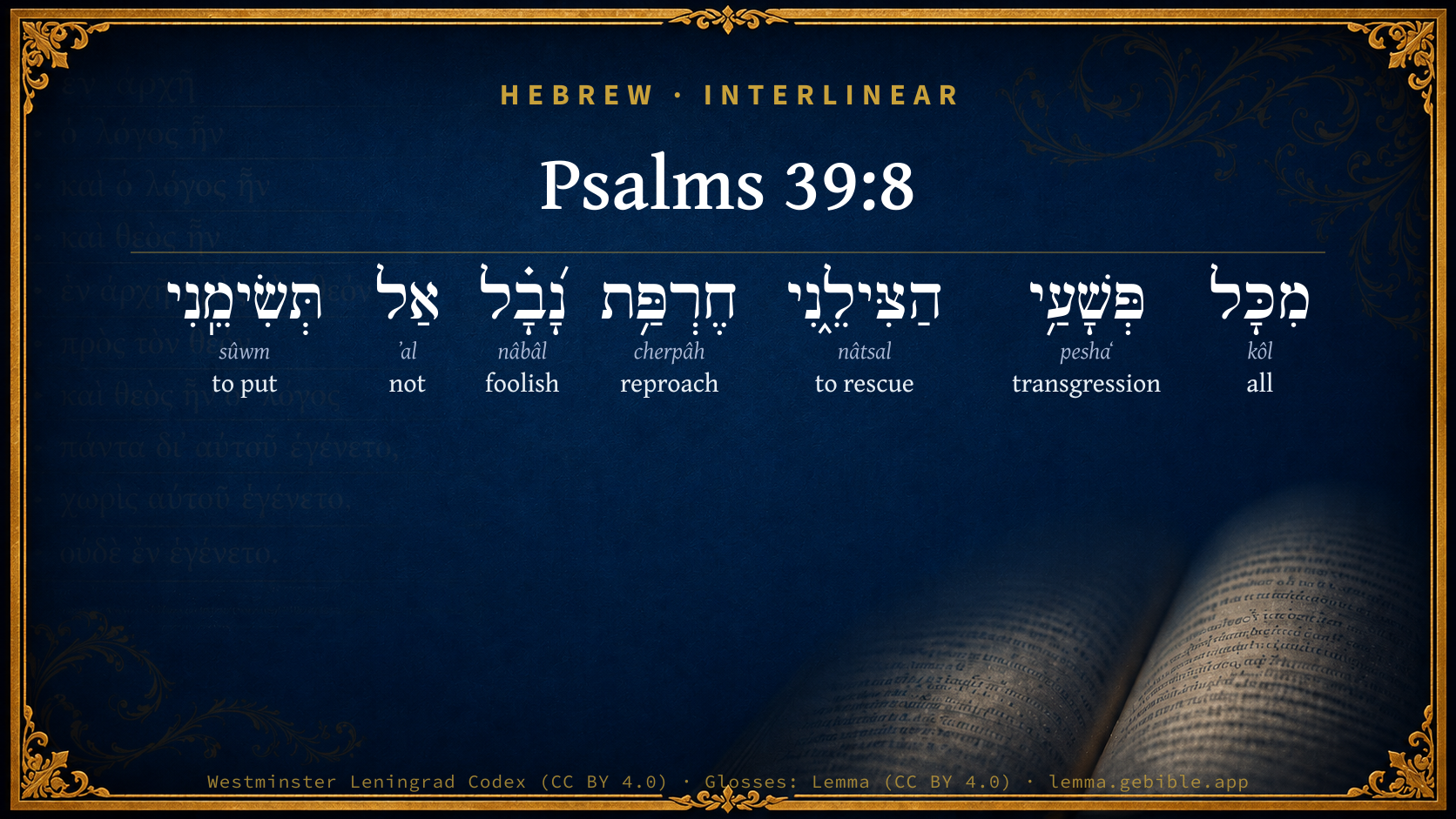
Hebrew (Westminster Leningrad Codex) Psalms 39:8 appears in the Hebrew Old Testament. The text above is from the Westminster Leningrad Codex. Each word links to its Strong’s number, a concise gloss, and parsing drawn from the Open Scriptures Hebrew Bible morphology. Click any word for its full Brown-Driver-Briggs (BDB) entry.
Download image
Cite this verse

Psalms 39:8 (World English Bible). Public Domain. Lemma interlinear Bible study tool, https://lemma.gebible.app/v/psalms/39/8.

Show BibTeX & RIS
BibTeX
RIS
English Translation
Deliver me from all my transgressions. Don't make me the reproach of the foolish.
World English Bible · Public Domain
Download a study sheet

One document with this verse’s original text, its word-by-word gloss line, the meaning frame, cross-references with their text, attributed commentary, and full source and license credits — printable, and it pastes into notes with its structure intact.

This verse Autodidact and up

Study sheet (.html) Plain text (.txt)

A passage Seminary Student

Up to 50 verses in one chapter. A passage sheet keeps up to 6 commentary sources and 12 cross-references per verse, in the order this page ranks them, and says so on the sheet whenever that leaves anything out. Ask for a single verse and you get the Autodidact verse sheet above.

Everything on this page stays free to read, with no account — the sheet is a download of what is already on screen, not access to it.

Want to remove ads? Support Godless Engineer
Compare translations 3

The same verse in 3 English versions, stacked beneath the original-language interlinear above. Click any original word for its lexicon entry.

Each is an independent rendering of the whole verse — the interlinear is not word-aligned to these translations.

Highlighted words mark where these versions differ — a whole-verse word diff, not a word-by-word alignment.

  • World English Bible Public Domain
    Deliver me from all my transgressions. Don't make me the reproach of the foolish.
  • King James Version Public Domain
    Deliver me from all my transgressions: make me not the reproach of the foolish.
  • unfoldingWord Literal Text CC BY-SA 4.0
    Deliver me from all my transgressions; do not make me the reproach of a fool.

unfoldingWord Literal Text — © unfoldingWord, licensed CC BY-SA 4.0. Word-aligned USFM3 via Door43 (git.door43.org/unfoldingWord/en_ult).

Versions to compare (up to 4)

3 of 4 selected

Show all 18 translations

Every available English version of this verse, each an independent rendering of the whole verse.

  • World English Bible Public Domain
    Deliver me from all my transgressions. Don't make me the reproach of the foolish.
  • Berean Standard Bible Public Domain
    Deliver me from all my transgressions; do not make me the reproach of fools.
  • Majority Standard Bible Public Domain
    Deliver me from all my transgressions; do not make me the reproach of fools.
  • King James Version Public Domain
    Deliver me from all my transgressions: make me not the reproach of the foolish.
  • American Standard Version (1901) Public Domain
    Deliver me from all my transgressions: Make me not the reproach of the foolish.
  • Revised Version (1885) Public Domain
    Deliver me from all my transgressions: make me not the reproach of the foolish.
  • Geneva Bible (1599) Public Domain
    Deliuer me from all my transgressions, and make me not a rebuke vnto the foolish.
  • Douay-Rheims (1899) Public Domain
    And now what is my hope? is it not the Lord? and my substance is with thee.
  • Young's Literal Translation Public Domain
    From all my transgressions deliver me, A reproach of the fool make me not.
  • Literal Standard Version CC BY-SA 4.0
    Deliver me from all my transgressions, || Do not make me a reproach of the fool.
  • Unlocked Literal Bible CC BY-SA 4.0
    Rescue me from my sins; do not make me the reproach of fools.
  • unfoldingWord Literal Text CC BY-SA 4.0
    Deliver me from all my transgressions; do not make me the reproach of a fool.
  • Darby Bible Public Domain
    Deliver me from all my transgressions; make me not the reproach of the foolish.
  • World Messianic Bible Public Domain
    Deliver me from all my transgressions. Don’t make me the reproach of the foolish.
  • Webster's Bible Public Domain
    \\39:7\\And now, Lord, what wait I for? my hope is in thee.
  • Free Bible Version CC BY-SA 4.0
    Save me from my rebellion. Don't let me be mocked by fools.
  • Bible in Basic English Public Domain
    Make me free from all my sins; do not let me be shamed by the man of evil behaviour.
  • JPS Tanakh (1917) Public Domain
    (39-9) Deliver me from all my transgressions; make me not the reproach of the base.

Literal Standard Version (2020), Covenant Press — licensed CC BY-SA 4.0. Text via the HelloAO Bible API (eBible.org). Unlocked Literal Bible (unfoldingWord) — licensed CC BY-SA 4.0. Text via the HelloAO Bible API (eBible.org). unfoldingWord Literal Text — © unfoldingWord, licensed CC BY-SA 4.0. Word-aligned USFM3 via Door43 (git.door43.org/unfoldingWord/en_ult). Free Bible Version, Dr. Jonathan Gallagher — licensed CC BY-SA 4.0. Text via the HelloAO Bible API (eBible.org).

Word by word

More ways to search: Search by grammar → Find every occurrence → Compare this word →

Practice this passage: Drill this verse → Learn its vocabulary →

About this verse

These counts appear in no published source. They are computed here, from the morphology-tagged text and Lemma’s own curated glosses. What Lemma adds →

7
words
7
distinct lemmas
Wisdom
section

Notable vocabulary

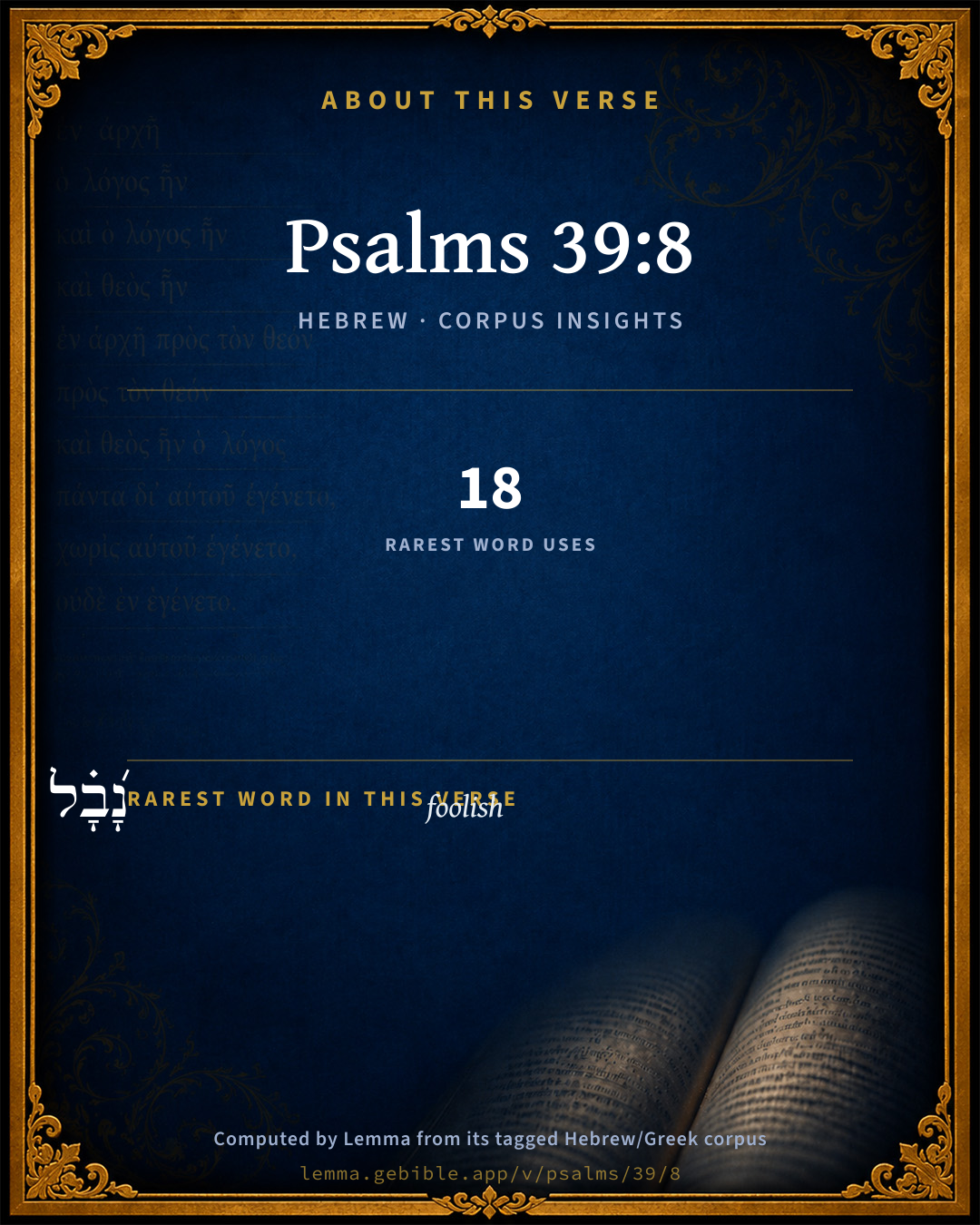
The rarest word here is נָ֝בָ֗ל foolish H5036 — appearing just 18 times in the whole Hebrew Bible.

Shared distinctive vocabulary

נָ֝בָ֗ל foolish H5036 occurs in 18 verses of the Hebrew Bible. Also found in:

Grammatical profile

  • 2 verbs
  • 3 nouns
  • 1 adjective
  • 1 particle

Verb forms

  • הַצִּילֵ֑נִי Hiphil · Imperative
  • תְּשִׂימֵֽנִי Qal · Jussive

Hebrew & Septuagint length

In English translation the verse runs 14 words from the Hebrew and 15 from the Septuagint (LXX English) — closely comparable.

A rough comparison of the two English renderings, which tokenize alike — not a word-level alignment.

Word counts can differ between the Hebrew and the Greek without any difference in meaning — e.g. the Hebrew direct-object marker אֵת has no separate Greek word, and Greek often adds the article ὁ.

Cross-references

18

Topical passages linked to Psalms 39:8 in the Treasury of Scripture Knowledge — connected by theme and wording, ordered by reader-vote popularity; previews shown in the World English Bible.

  • Psalms 44:13 You make us a reproach to our neighbors, A scoffing and a derision to those who are around us.
  • Psalms 51:14 Deliver me from bloodguiltiness, O God, the God of my salvation. My tongue shall sing aloud of your righteousness.
  • Joel 2:17 Let the priests, the ministers of Yahweh, weep between the porch and the altar, And let them say, "Spare your people, Yahweh, And don't give your heritage to reproach, That the nations should rule over them. Why should they say among the peoples, 'Where is their God?'"
  • Micah 7:19 He will again have compassion on us. He will tread our iniquities under foot; And you will cast all their sins into the depths of the sea.
  • Psalms 51:7–10 Purify me with hyssop, and I will be clean. Wash me, and I will be whiter than snow.
  • Psalms 57:3 He will send from heaven, and save me, He rebukes the one who is pursuing me. Selah. God will send out his loving kindness and his truth.
  • Psalms 65:3 Sins overwhelmed me, But you atoned for our transgressions.
  • Psalms 79:4 We have become a reproach to our neighbors, A scoffing and derision to those who are around us.
  • Psalms 130:8 He will redeem Israel from all their sins.
  • Joel 2:19 Yahweh answered his people, "Behold, I will send you grain, new wine, and oil, And you will be satisfied with them; And I will no more make you a reproach among the nations.
  • 2 Samuel 16:7–8 Thus said Shimei when he cursed, Be gone, be gone, you man of blood, and base fellow:
  • Psalms 25:11 For your name's sake, Yahweh, Pardon my iniquity, for it is great.
  • Psalms 25:18 Consider my affliction and my travail. Forgive all my sins.
  • Psalms 35:21 Yes, they opened their mouth wide against me. They said, "Aha! Aha! Our eye has seen it!"
  • Psalms 119:39 Take away my disgrace that I dread, For your ordinances are good.
  • Matthew 1:21 She shall bring forth a son. You shall call his name Jesus, for it is he who shall save his people from their sins."
  • Romans 2:23–24 You who glory in the law, through your disobedience of the law do you dishonor God?
  • Titus 2:14 who gave himself for us, that he might redeem us from all iniquity, and purify for himself a people for his own possession, zealous for good works.

Cross-references courtesy of OpenBible.info (CC BY 4.0).

Hebrew and Greek witnesses Masoretic Hebrew ↔ Greek Septuagint

The same verse in the two great witnesses to the Old Testament, shown verse-for-verse.

You’re reading Greek Psalm 38 (Hebrew Psalm 39). The Septuagint counts the superscription, so verse numbers can differ from the Hebrew — chapter-level alignment, not verse-by-verse. Numbering follows Rahlfs.

These are two independent witnesses, not word-aligned to each other, and the Septuagint is shown in lemma (dictionary) form.

Hebrew Psalms 39:8 Masoretic · Westminster Leningrad Codex

מִכָּל פְּשָׁעַ֥י הַצִּילֵ֑נִי חֶרְפַּ֥ת נָ֝בָ֗ל אַל תְּשִׂימֵֽנִי

Deliver me from all my transgressions. Don't make me the reproach of the foolish.

World English Bible · Public Domain

Greek LXX Greek Psalm 38:8 Septuagint · lemma form

καί νῦν τίς ὁ ὑπομονή ἐγώ οὐ ὁ κύριος καί ὁ ὑπόστασις ἐγώ παρά σύ εἰμί

Deliver me from all my transgressions: you have made me a reproach to the foolish.

LXX2012 (modern English Septuagint) · Public Domain

Hebrew: Westminster Leningrad Codex (CC BY 4.0). Greek: Septuagint (public domain); English from LXX2012 (modern English Septuagint) (Public Domain). How the Septuagint differs from the Hebrew →

Commentary

Notes on Psalms 39:8 from classic Christian and Jewish commentators (each source and its license shown beneath its notes). The classic Christian expositions comment on the surrounding passage and are grouped to its opening verse, so a note may address several verses; the Jewish commentaries on the Tanakh (Rashi and others) are per-verse, so they appear only where the commentator wrote on this verse.

Lemma curates 59 commentaries, every one of them public domain or Creative Commons licensed, each selected and text-cleaned for this edition rather than reprinted as found. About our sources →

Trapp's Complete Commentary

John Trapp

Psa 39:8 Deliver me from all my transgressions: make me not the reproach of the foolish.

Ver. 8. Deliver me from all my transgressions] But especially from that of impatiently desiring to die out of discontent, Psa 39:4. The sense of this one sin brought many more to remembrance; as a man, by looking over his debt book for one thing, meets with more. God giveth the penitent general discharges; neither calleth he any to an after reckoning.

Make me not the reproach of the foolish] Let not any wicked one (for such are all fools in God’s dictionary) lay this folly in my dish, that I so foolishly desired death in a pet.

John Trapp, A Commentary or Exposition upon All the Books of the Old and New Testament (1647–1656) — public domain. Text from a community e-Sword module.

The Biblical Illustrator

Joseph S. Exell

Psa_39:8

While I was musing the fire burned.

The place of feeling in religion

David was one who felt, thought and acted strongly. There were no neutral tints about him. And he felt that he needed to restrain himself, lest his strong feeling should hurry him into sin. Hence he said, I will take heed to nay ways that I sin not with my tongue, etc. But feeling is a thing to be desired. As with David, thinking often prompts it: the two should ever be in just proportion. But it is better to have too much than too little feeling. We cannot love an unfeeling man. Tim feeling heart is the most human as well as the most humane part of our humanity. But we admire it only when it leans upon a clear judgment, and is thereby controlled. But it is difficult to say which is the stronger force. Both should be found in religion. But we are to remember that some natures have small capacity for emotion, and we do wrong in that account to doubt their Christianity. It is a sad misconception to look upon emotion as salvation. Salvation rests upon our willing Lord. God forgives, although a man may never weep. (J. B. Aitken.)

Quiet musing

I. Let us say something in praise of musing. We do not do much of this in these days. We prefer what is amusing to musing, by a great deal. But--

1. It is well to muse on the things of God because thus we get the nutriment out of them. Mere hearing or reading without this will not serve.

2. It fixes the truth in the memory. If we would have truth photographed upon our hearts, we must keep it long before the spiritual lens.

3. It lends us into the secrets of truth.

4. It ministers joy. My meditation of him shall be sweet.

5. And it becomes easier by practice. A man has never a slack hand or a cold heart who is much in meditation. It is a blessed art.

II. Put some fuel on the fire of meditation, How many are the topics which might be suggested. Eternal love. Dying love. Salvation. Heaven. Hell. And to you who are unregenerate I would urge your musing on your present state. What your end must be if you continue as you are. Of the Lord Jesus Christ. Beware lest the day come when thou wilt have to muse without hope. (C. H. Spurgeon.)

Man musing, burning, speaking

I. The dignity of human nature.

1. Thought. While I was musing. What a wonderful power is the power of thought!

(1) By thought man can turn the universe to his service.

(2) By thought man can rise to the Creator, rise to some knowledge of Him, resemblance to Him, fellowship with Him.

(3) By thought he can regulate his own destiny. By it he can change his character. Thought is the helmsman of the soul.

2. Moral emotion. The fire burned. It was the fire of moral feeling. All the sentient existences we know of have some kind of feeling, but man alone has moral feeling--feeling in relation to sin, to duty, and to God. This feeling is kindled by thought.

3. Speech. I spake. What a wonderful power is the power of speech. By it we reveal ourselves, we achieve conquests over souls, and win them to our wishes and our ways. How great is man!

II. The process of repentance. But how is this fire to be kindled? Here is the method. By musing. Upon the inconvenience of sin, its consequences, or its punishment? Thought must dwell upon Gods mercy, not merely in nature and providence, but in the mission, sufferings, and death of Gods only begotten Son.

III. The philosophy of true eloquence. While I was musing the fire burned, then spake I with my tongue. When is the tongue eloquent?

1. When it is used as a relief to the soul.

2. When it is used as a vehicle of strongest moral emotions. Moral emotions are electric. (Homilist.)

Motives

When we witness the performance of a noble deed, when we become acquainted with a noble character, when we read the life of a great and good man, we are tempted to ascribe his superiority, in great measure at least, to a difference of circumstances. He has had facilities, incentives, motives, we are apt to say, such as have not fallen to the lot of most men. Give us the same facilities, give us the same incentives and motives to virtue, and we should be glad to do as he has done. Undoubtedly there is a sense in which this is true. He has felt motives which we have not. But why has he felt them? To answer this question, we must begin by answering several others on which it depends. What are motives? The motive, externally considered, is the reason for acting or not acting, in a particular way; which, of course, will be attended to very differently by different persons, and so affect them very differently. Let us next consider what gives efficacy to one motive over another in particular cases? It is not enough that the quality exists; the individual must feel, must perceive that it exists, or else to him it does not exist. And now we are prepared to take up the third question, Why is it, that while one man is alive to the higher motives of human conduct, another is alive only to the lower motives? Something doubtless is attributable to difference of organization and temperament, but not the whole. If it were, how should we be able to account for material and essential changes in moral and religious sensibility, which the same individual often undergoes? In the case of repentance, involving a real change of heart, it will hardly be pretended that this alters a mans organization or temperament; and yet how entirely it alters his sensibility to moral and religious motives. These motives were always before him; but he did not see them, or at least he did not feel them, as he does now. In this respect he differs from his former self, just as all good men differ from all bad men; nevertheless, organically considered, he is the same man he always has been. So likewise of acquired habits, considered as predisposing men to be affected by certain motives. Why is it that motives have more influence over the mind in proportion as it is in any way predisposed to be affected by them? The chief, if not the sole reason, is, that such a mind gives them more attention and thought, enters into them more fully and entirely as realities, returns to them more frequently, and dwells upon them to the exclusion of other things. Hence it follows, that earnest attention to the highest motives of human conduct awakens the best affections of the soul; and again, it is only by renewing this attention from day to day that these affections are kept alive and rendered more and more intense. In the words of the text: While I was musing the fire burned. For this reason the Scriptures everywhere lay great stress on meditation and holy contemplation, on communing with God and our own souls, and having our conversation in heaven, as the conditions of newness of life. Taking this principle along with us, we shall not find much difficulty in explaining some of the greatest perplexities of the Christian life. In the first place, it will help us to define, with sufficient distinctness at least for all practical purposes, the office of free will. Whatever may be true in theory, there can be no doubt that, in practice, we are generally disappointed, when we expect a great deal from mans self-determining power. The reason is, not that this power does not exist, but that it is not applied at the right time, and in the right place. Again, the same principle will help to explain why it is, that when men become decidedly religious it is often in consequence of some startling or impressive event--the death of a friend, a remarkable escape, a pungent discourse, a striking remark, a dream, a thought. It may be said that such an occurrence does not add one iota to the number or the strength of the motives to a Christian life which these persons had, and which they knew they had, before. And this is true; but it calls attention to those motives; and this, as we have seen, is all that was wanted. Once more, the view here taken of the manner in which men become alive to the highest motives will also account satisfactorily for local and temporary excitements in morals and religion. These are sometimes referred to sympathy and imitation, and even to causes less pure. Much of what is transient in them, and many of the attendant circumstances, are doubtless to be explained in this way; but not the whole. What is real and lasting in these movements has its origin in the general attention to the subject which, somehow or other, has been awakened. It is not pretended that any new motives are discovered or invented. Let me, then, revert once more to the plea so often set up by the undevout, the indifferent, the worldly-minded: to wit, that they do not feel the motives to virtue and piety which good men do. The fact is admitted; but when we come to analyze it, we find that, in most cases at least, it turns out to be, not an excuse, but a part of the wrong. As we have seen, they do not distinguish, they do not believe, they do not feel because they do not attend. But attention is pre-eminently a voluntary act, and one, therefore, in respect to which all are pre-eminently free and responsible. (J. Walker, D. D.)

The uses of solitude

The subject of solitude has been a favourite theme for romantic declamation and sentimental insipidity; and, on this account, many sensible people are inclined to avoid it. It will but be doing justice to its real importance and dignity, to state its connection with some of our highest duties, and its influence over our most spiritual affections; to speak of it in seriousness and simplicity, as a necessary discipline of the mental faculties, as a valuable monitor of our real situation and destiny, as a choice opportunity for impartial self-examination, profitable reflection, and heavenly communion.

I. As a preparative for society and for action,

1. It is so, in one respect, simply as it furnishes repose to weariness. We return to our work with more vigour when our flagging forces have had time to recover their spring, and our ebbing spirits have received a new supply of sustenance and force. The attractions of deserted things are renewed; a fresh impulse is given to the race, and a fresh beauty to the prize.

2. But our capacity of duty is not merely animated by an addition of power; it is enlarged by the acquisition of knowledge. We see the world at an advantage, as it were, when we see it as spectators, and not as actors. We can observe with more exactness the passions which agitate the bosoms of men when we ourselves are without the reach of their influence. We can trace with more precision their actions to their motives, when we are standing aloof, and can take in, as from an eminence, both the fountain and the stream.

3. Yet in another way are we fitted by solitude to go back again into society, better qualified than before for its duties and demands. We are made more kind, more gentle, more forbearing.

4. We are taught, also, in the seasons of occasional solitude, a more correct knowledge of ourselves than we should otherwise possess. We are thus in the way of exercising more candour in the scrutiny of our neighbours opinions, feelings and actions, and more diffidence in the defence Of our own.

II. As favourable to the most exalted feelings of devotion.

1. Man holds the most intimate communion with his Maker when no being but his Maker is near him. The most fervent aspirations of his heart rise up from the temple of solitude; for they rise up without witness, without restraint, and without contamination.

2. Solitude is favourable to devotion because its tendency is to render devotion consistent, rational and ennobling. When we are alone with God, we see Him with a clearer vision, and seem to be endowed with a more intimate perception of His character. We draw nearer to His presence, and drink more directly and copiously of His Spirit.

III. Its tendency to inspire serious reflections on the great concerns of existence--life, death, eternity.

1. There is something in the essential vigour, and the regenerated freshness, and the long duration natural objects, which often impresses us most forcibly with a feeling of the shortness and uncertainty of our own earthly existence. No sentiment offers itself more naturally to him who meditates alone among the silent works of God, than that they are renewing their strength while he is wearing away, and that they will remain when he is gone. The sun seems to say to him, I shall rise in splendour, and set in glory; and the moon, I shall walk on in my brightness; and the hills, We shall abide in our majesty; and the streams, We shall flow in all our fulness--when thou shalt be no longer known to us, nor numbered with us. The intimation is melancholy, hut it is not unkind, nor is it received unkindly--for the voice of Nature is not as the voice of men. It is always a sound of soothing and sympathy, and never of contempt or indifference.

2. It remains to point out a connection between thoughts of this nature, and a source still higher. When we are engaged in secret communion with that eternal Being in whose hands our life and breath are, and whose are all our ways, we are necessarily reminded of our own frailty and dependence, of the brevity of our mortal term, and of our deep responsibility. (F. W. P. Greenwood.)

The Biblical Illustrator, edited by Joseph S. Exell (c. 1880s–1900s) — public domain. Text from a community e-Sword module.

Joseph Benson's Commentary

Psa 39:8. Deliver me from all my transgressions — That I may not be disappointed of my hopes of enjoying thee and thy favour, which is the chief thing I desire, pardon and deliver me from all my sins, which stand like a thick cloud between thee and me, and even fill me with fears about my condition both here and hereafter. Make me not the reproach of the foolish — Of the ungodly. Let not my remaining under the guilt, and power of my transgressions give them reason to reproach me as a hypocrite, and a person whose life is not consistent with his profession. And let not their prosperity and my misery give them occasion to deride me, for my serving of thee, and trusting in thee to so little purpose or advantage. He terms the ungodly foolish, because though they profess and think themselves to be wise, yet they are indeed fools, as is manifest from their eager pursuit of fruitless vanities, Psa 39:6, and from their gross neglect of God and his service, who only is able to make men happy.

Joseph Benson's Commentary on the Old and New Testaments (1811–1818) — public domain. Text from a community e-Sword module.

J. A. Alexander on Psalms

Joseph Addison Alexander

9. (Psa 39:8). From all my transgressions free me; the reproach of the fool do not make me. The first clause contains an implicit acknowledgment that his error was a sinful one. Transgressions, treasons, or apostasies, committed against God. The Hebrew word is much stronger than its English equivalent. In asking to be freed from his transgressions, he asks to be delivered from their consequences, one of which is then particularly mentioned. A reproach, an object of derision and contempt. See above, on Psa 12:7 (6). The fool, by way of eminence, the impious unbeliever. See above, on Psa 14:1. Do not make me, literally place (or put) me, i.e. set me up, exhibit, or expose me, as a mark for their invective or their ridicule.

Joseph Addison Alexander, The Psalms Translated and Explained (1850) — public domain. Text from a community e-Sword module.

Tyndale Open Study Notes

Tyndale Open Resources

39:8 The idea that rebellion brings on suffering is a common thread in Pss 32, 38–41.

Tyndale Open Study Notes — © Tyndale Open Resources, licensed CC BY-SA 4.0. Text via the HelloAO Bible API.

Geneva Bible (1599)

Geneva Bible translators

Make me not a mocking stock to the wicked, or wrap me not up with the wicked, when they are put to shame.

Geneva Bible (1599) marginal notes — public domain. Text via Bolls.life.

Jamieson, Fausset & Brown

Robert Jamieson, A. R. Fausset & David Brown

Patiently submissive, he prays for the removal of his chastisement, and that he may not be a reproach.

Jamieson, Fausset & Brown — Commentary Critical and Explanatory on the Whole Bible (1871) — public domain (CC PDM 1.0). Text via the HelloAO Bible API.

Adam Clarke's Commentary

Verse 8. Deliver one from all my transgressions] I seek the pardon of my sins; I expect it from thy mercy. Grant it, "that I be not the reproach of the foolish," (the godless and the profane,) who deride my expectation, and say no such blessings can be had. Let them know, by thy saving me, that there is a God who heareth prayer, and giveth his Holy Spirit to all them that ask him.

Adam Clarke's Commentary on the Bible (1810–1826) — public domain. Text from a community e-Sword/MySword module.

John Calvin's Commentaries

8. Deliver me from all my sins. In this verse the Psalmist still continues his godly and holy prayer. He is now no longer carried away by the violence of his grief to murmur against God, but, humbly acknowledging himself guilty before God, he has recourse to his mercy. In asking to be delivered from his transgressions, he ascribes the praise of righteousness to God, while he charges upon himself the blame of all the misery which he endures; and he blames himself, not only on account of one sin, but acknowledges that he is justly chargeable with manifold transgressions. By this rule we must be guided, if we would wish to obtain an alleviation of our miseries; for, until the very source of them has been dried up, they will never cease to follow one another in rapid succession. David unquestionably wished an alleviation of his miseries, but, as he expected that, as soon as he should be reconciled to God, the chastisement of his sins would also cease, he only here asks that his sins may be forgiven him. We are thus taught by the example of David, not merely to seek deliverance from the miseries which afflict and trouble us, but to trace them to their cause and source, entreating God that he would not lay our sins to our charge, but blot out our guilt. What follows concerning the reproach or scorn of the foolish may be understood in an active as well as a passive signification, denoting, either that God would not abandon him to the mockery of the wicked, or that he would not involve him in the same disgrace to which the ungodly are given over. As, however, either of these senses will agree very well with the design of the Psalmist, I leave it to the reader to adopt the one which he prefers. Besides, the word נבל, nabal, signifies not only a foolish person, but also a contemptible man, one who is utterly worthless and base. It is at least certain, that by this word the reprobate, whom the Scriptures condemn for their folly, are intended; because, being deprived of their reason and understanding, they break forth into every excess in contemning and reproaching God.

John Calvin's Commentaries (1540-1563) — public domain. Text from the Calvin Translation Society English edition (1840s-50s) via the Christian Classics Ethereal Library (ccel.org). Calvin's coverage is partial (roughly two-thirds of the Bible); uncommented books and verses are honest gaps, never fabricated. The 19th-century editor's footnotes and remarks are omitted so the notes are faithfully Calvin's own voice.

Ellicott's Commentary for English Readers

(8) Here the psalmist recurs to his initial thought, but lets us see deeper down into his heart. It was no mere fancy that if he gave vent to his feelings the wicked might find cause for reproach; the cause was there in his own consciousness of transgression.

The reproach of the foolish.—Better, The scorn of the fool. (Comp. Psa_22:6.)

A Bible Commentary for English Readers, edited by Charles John Ellicott (1878–1897) — public domain. Text from a community e-Sword module.

The Cambridge Bible for Schools and Colleges

gen. ed. J. J. S. Perowne

8. The Psalmist prays to be delivered not merely from his present afflictions but from the power of the sins which he recognises as the cause of them. Sin gets hold of its victim and brings him into punishment. Cp. Psa_40:12; Job_8:4.

the reproach of the foolish] The fool (Psa_14:1 note) regards the sufferings of the godly as a mark of God’s wrath, and taunts him accordingly (Psa_38:16; Psa_22:8; Psa_31:11). Cp. the plea of the nation, Psa_44:13 ff.; Psa_74:18; Psa_74:22.

The Cambridge Bible for Schools and Colleges (gen. ed. J. J. S. Perowne; Cambridge University Press, 1878–1918) — public domain. Text from a community e-Sword module.

John Gill's Exposition

Deliver me from all my transgressions,.... Which were the cause and occasion of all his distresses, inward and outward; and the deliverance prayed for includes a freedom from the dominion of sin, which is by the power of efficacious grace; and from the guilt of sin, which is by the application of the blood of Christ; and from obligation to punishment for it, or deliverance from wrath to come, which is through Christ's being made a curse, and enduring wrath in the room and stead of his people; and from the very being of sin, which, though it cannot be expected in this life, is desirable: and the psalmist prays that he might be delivered from "all" his transgressions; knowing: that if one of them was left to have dominion over him, or the guilt of it to lie upon him, and he be obliged to undergo due punishment for it, he must be for ever miserable;

make me not the reproach of the foolish; of a Nabal; meaning not any particular person; as Esau, according to Jarchi; or Absalom, as others; but every foolish man, that is, a wicked man; such who deny the being and providence of God, make a mock at sin, and scoff at the saints: and the sense of the psalmist is, that the Lord would keep him from sinning, and deliver him out of all his afflictions, on account of which he was reproached by wicked men.

John Gill's Exposition of the Whole Bible (1746–1763) — public domain (CC PDM 1.0). Text via the HelloAO Bible API.

Albert Barnes' Notes on the Bible

Deliver me from all my transgressions - Recognising, as in Psa 38:3-5, his sins as the source of all his troubles and sorrows. If his transgressions were forgiven, he felt assured that his trouble would be removed. His first petition, therefore, is, that his sins might be pardoned, with the implied conscious assurance that then it would be consistent and proper for God to remove his calamity, and deliver him from the evils which had come upon him.

Make me not the reproach of the foolish - Of the wicked; of those who are foolish, because they are wicked. See the notes at Psa 14:1. The prayer here is, that God would not suffer him to become an object of reproach to wicked and foolish men; that is, as the passage implies, that God would not so continue to treat him as if he were a sinner as to justify to themselves their reproaches of him as a wicked man. In other words, he prays that God would forgive his sin, and would withdraw his hand of affliction, so that even the wicked might see that he was not angry with him, but that he was an object of the divine favor.

Albert Barnes' Notes on the Bible (1834–1885) — public domain. Text from a community e-Sword/MySword module.

Matthew Poole's English Annotations

Deliver me from all my transgressions; that I may not be disappointed of my hopes of enjoying thee and thy favour, which is the only thing that I desire, pardon all my sins, which stand like a thick cloud between thee and me, and fill me with fears about my condition both here and hereafter.

Make me not the reproach; let not their prosperity and my misery give them occasion to deride and reproach me for my serving of thee, and trusting in thee, to so little purpose or advantage.

Of the foolish, i.e. of wicked men, who though they profess and think themselves to be wise, yet indeed are fools, as is manifest from their eager pursuit of fruitless vanities, Psa 39:6, and from their gross neglect of God, and of his service, who only is able to make them happy.

Matthew Poole's English Annotations on the Holy Bible (1683–1685) — public domain. Text from a community e-Sword/MySword module.

The Treasury of David

Charles H. Spurgeon

Ver. 8. Deliver me from all my transgressions. How fair a sign it is when the psalmist no longer harps upon his sorrows, but begs freedom from his sins! What is sorrow when compared with sin! Let but the poison of sin be gone from the cup, and we need not fear its gall, for the bitter will act medicinally. None can deliver a man from his transgression but the blessed One who is called Jesus, because he saves his people from their sins; and when he once works this great deliverance for a man from the cause, the consequences are sure to disappear too. The thorough cleansing desired is well worthy of note: to be saved from some transgressions would be of small benefit; total and perfect deliverance is needed. Make me not the reproach of the foolish. The wicked are the foolish here meant: such are always on the watch for the faults of saints, and at once make them the theme of ridicule. It is a wretched thing for a man to be suffered to make himself the butt of unholy scorn by apostasy from the right way. Alas, how many have thus exposed themselves to well deserved reproach! Sin and shame go together, and from both David would fain be preserved.

Ver. 8. Make me not the reproach of the foolish. Let not their prosperity and my misery give them occasion to deride and reproach me for my serving of thee and trusting in thee to so little purpose. Matthew Pool.

Ver. 8. Make me not the reproach of the foolish. Doubt not this; that of all the bitter agony which will be the portion of the lost soul at that, "Depart, ye cursed, "not the least will be the bitter reproaches and derision of those evil spirits who have seduced him to his ruin. "For this morsel of meat to have sold thy birthright! For the fleshly pleasures of a few days to have bartered thine eternal jewel! For a few grains of yellow earth to have missed the city with streets of gold, and gates of several pearls! O fool, beyond all folly! O madman, beyond all insanity! Truly we have need to pray with all earnestness, Make me not the reproach of the foolish." Origen, quoted by J. M. Neale.

Ver. 8.

1. Prayer should be general:Deliver me from all my transgressions. We often need anew to say, "God be merciful to me a sinner." Afflictions should remind us of our sins. If we pray to be delivered from all transgressions, we are sure to be delivered from the one for which affliction was sent.

2. Prayer should be particular:Make me not the reproach of the foolish. Suffer me not so to speak or show impatience in affliction as to give occasion even to the foolish to blaspheme. The thought that many watch for our halting should be a preservative from sin.

G. Rogers.

Psalms 39:9*

Charles H. Spurgeon's The Treasury of David (1869–1885) — public domain. Psalms only. Text from a community e-Sword/MySword module.

Whedon's Commentary on the Bible

Daniel D. Whedon

8. Another painful calling up of his sin in a prayer for forgiveness, and a deprecation of the dreaded scorn of wicked men.

Daniel D. Whedon (gen. ed.), Commentary on the Old and New Testaments (1874–1909) — public domain. Text from a community e-Sword module.

The Pulpit Commentary

Deliver me from all my transgressions. The approach to God quickens in every God-fearing man the sense of sin and the longing for pardon. So the psalmist has no sooner thrown himself upon God as his one Hope, than the thought of his sin occurs to him the sin which has brought upon him all his misery; and his first prayer is to be "delivered" from it. Make me not the reproach of the foolish. So long as his afflictions continued, the psalmist would be an object of scorn to the fool and the ungodly. He prays, therefore, secondly, that the punishment of his sin may cease.

The Pulpit Commentary (1880–1919), ed. H.D.M. Spence-Jones & Joseph S. Exell — public domain. Text from a community e-Sword module.

unfoldingWord translationNotes

Door43 World Missions Community

I am silent ... cannot open my mouth

These phrases mean basically the same thing. (See: Parallelism)

because it is you who has done it

"because my punishment comes from you"

translationWords

sin

fool

unfoldingWord translationNotes — © Distant Shores Media and the Door43 World Missions Community, licensed CC BY-SA 4.0. Source: git.door43.org/Door43/en_tn.

Rashi

Rabbi Shlomo Yitzchaki (Rashi)

And now, what have I hoped What is the request that I ask and hope from You? It is only that You save me from my transgressions.

Rashi on the Tanakh — English translations: “The Judaica Press complete Tanach with Rashi, translated by A. J. Rosenberg” (CC BY 4.0); “Pentateuch with Rashi's commentary by M. Rosenbaum and A.M. Silbermann, 1929-1934” (public domain); “The Metsudah Tanach series, Lakewood, N.J” (CC BY 4.0); and “The Book of Joshua, Metsudah Publications, 1997” (CC BY 4.0). Text via Sefaria.

Lesson kit

Teaching starters — assembled from the data on this page, not authored interpretation. Every prompt links to the verse data it draws on. Edit before teaching.

Psalms, in the Wisdom, opens this verse with 7 words (7 distinct Hebrew lemmas). Its most distinctive word is nâbâl (“foolish”). A historical commentator’s framing appears above. Read the whole chapter for the surrounding context.

Discussion questions

  1. How does “foolish” (nâbâl) shape what this verse is saying?
  2. Deuteronomy 32:6 shares the word «foolish» with this verse. How do the two illuminate each other?
  3. These translations render this verse differently. What is at stake in choosing one wording over another?
  4. The verb «הַצִּילֵ֑נִי» is Hiphil Imperative. How does its form color the action?
  5. Reading how Trapp's Complete Commentary and The Biblical Illustrator read this verse, where do the two commentators agree and where do they part?

Things to notice

Reading settings

Reading text

Shown beneath each verse's original-language words.

Old Testament
Old Testament edition

Read the OT as the Masoretic Hebrew (MT) or the Greek Septuagint (LXX).

English shown for the Greek Septuagint (in the Hebrew ↔ Greek comparison).

Comparing translations? Open the Compare panel on any verse page to stack up to four side by side.