Isaiah 38:6

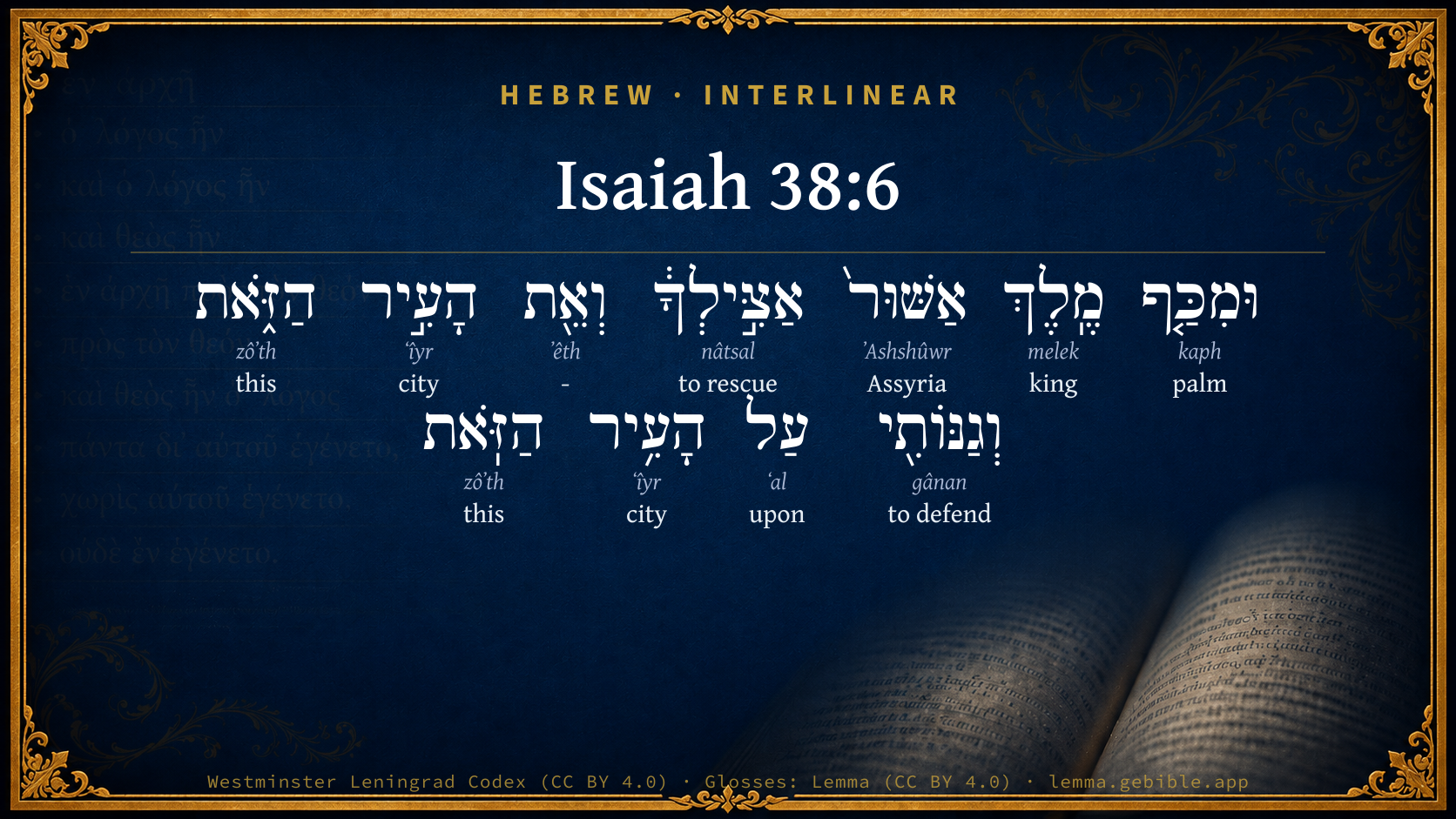
Hebrew (Westminster Leningrad Codex) Isaiah 38:6 appears in the Hebrew Old Testament. The text above is from the Westminster Leningrad Codex. Each word links to its Strong’s number, a concise gloss, and parsing drawn from the Open Scriptures Hebrew Bible morphology. Click any word for its full Brown-Driver-Briggs (BDB) entry.
Download image
Cite this verse

Isaiah 38:6 (World English Bible). Public Domain. Lemma interlinear Bible study tool, https://lemma.gebible.app/v/isaiah/38/6.

Show BibTeX & RIS
BibTeX
RIS
English Translation
I will deliver you and this city out of the hand of the king of Assyria; and I will defend this city.
World English Bible · Public Domain
Download a study sheet

One document with this verse’s original text, its word-by-word gloss line, the meaning frame, cross-references with their text, attributed commentary, and full source and license credits — printable, and it pastes into notes with its structure intact.

This verse Autodidact and up

Study sheet (.html) Plain text (.txt)

A passage Seminary Student

Up to 50 verses in one chapter. A passage sheet keeps up to 6 commentary sources and 12 cross-references per verse, in the order this page ranks them, and says so on the sheet whenever that leaves anything out. Ask for a single verse and you get the Autodidact verse sheet above.

Everything on this page stays free to read, with no account — the sheet is a download of what is already on screen, not access to it.

Want to remove ads? Support Godless Engineer
Compare translations 3

The same verse in 3 English versions, stacked beneath the original-language interlinear above. Click any original word for its lexicon entry.

Each is an independent rendering of the whole verse — the interlinear is not word-aligned to these translations.

Highlighted words mark where these versions differ — a whole-verse word diff, not a word-by-word alignment.

  • World English Bible Public Domain
    I will deliver you and this city out of the hand of the king of Assyria; and I will defend this city.
  • King James Version Public Domain
    And I will deliver thee and this city out of the hand of the king of Assyria: and I will defend this city.
  • unfoldingWord Literal Text CC BY-SA 4.0
    And I will deliver you and this city from the palm of the king of Assyria. And I will cover over this city.

unfoldingWord Literal Text — © unfoldingWord, licensed CC BY-SA 4.0. Word-aligned USFM3 via Door43 (git.door43.org/unfoldingWord/en_ult).

Versions to compare (up to 4)

3 of 4 selected

Show all 18 translations

Every available English version of this verse, each an independent rendering of the whole verse.

  • World English Bible Public Domain
    I will deliver you and this city out of the hand of the king of Assyria; and I will defend this city.
  • Berean Standard Bible Public Domain
    And I will deliver you and this city from the hand of the king of Assyria. I will defend this city.
  • Majority Standard Bible Public Domain
    And I will deliver you and this city from the hand of the king of Assyria. I will defend this city.
  • King James Version Public Domain
    And I will deliver thee and this city out of the hand of the king of Assyria: and I will defend this city.
  • American Standard Version (1901) Public Domain
    And I will deliver thee and this city out of the hand of the king of Assyria; and I will defend this city.
  • Revised Version (1885) Public Domain
    And I will deliver thee and this city out of the hand of the king of Assyria: and I will defend this city.
  • Geneva Bible (1599) Public Domain
    And I will deliuer thee out of the hand of the King of Asshur, and this citie: for I will defende this citie.
  • Douay-Rheims (1899) Public Domain
    And I will deliver thee and this city out of the hand of the king of the Assyrians, and I will protect it.
  • Young's Literal Translation Public Domain
    and out of the hand of the king of Asshur I deliver thee and this city, and have covered over this city.
  • Literal Standard Version CC BY-SA 4.0
    and out of the hand of the king of Asshur I deliver you and this city, and have covered over this city.
  • Unlocked Literal Bible CC BY-SA 4.0
    Then I will rescue you and this city from the hand of the king of Assyria, and I will defend this city.
  • unfoldingWord Literal Text CC BY-SA 4.0
    And I will deliver you and this city from the palm of the king of Assyria. And I will cover over this city.
  • Darby Bible Public Domain
    And I will deliver thee and this city out of the hand of the king of Assyria, and I will defend this city.
  • World Messianic Bible Public Domain
    I will deliver you and this city out of the hand of the king of Assyria, and I will defend this city.
  • Webster's Bible Public Domain
    And I will deliver thee and this city from the hand of the king of Assyria: and I will defend this city.
  • Free Bible Version CC BY-SA 4.0
    I will save you and this city from the king of Assyria. I will defend this city.
  • Bible in Basic English Public Domain
    And I will keep you and this town safe from the hands of the king of Assyria: and I will keep watch over this town.
  • JPS Tanakh (1917) Public Domain
    And I will deliver thee and this city out of the hand of the king of Assyria; and I will defend this city.

Literal Standard Version (2020), Covenant Press — licensed CC BY-SA 4.0. Text via the HelloAO Bible API (eBible.org). Unlocked Literal Bible (unfoldingWord) — licensed CC BY-SA 4.0. Text via the HelloAO Bible API (eBible.org). unfoldingWord Literal Text — © unfoldingWord, licensed CC BY-SA 4.0. Word-aligned USFM3 via Door43 (git.door43.org/unfoldingWord/en_ult). Free Bible Version, Dr. Jonathan Gallagher — licensed CC BY-SA 4.0. Text via the HelloAO Bible API (eBible.org).

Word by word

More ways to search: Search by grammar → Find every occurrence → Compare this word →

Practice this passage: Drill this verse → Learn its vocabulary →

וְגַנּוֹתִ֖י
gânan
H1598
“and · to defend”
Conjunction + Verb, Qal, Sequential Perfect, 1st Person, Common, Singular
Part of Speech
Conjunction + Verb
Stem
Qal
Form
Sequential Perfect
Person
1st Person
Gender
Common
Number
Singular
Full BDB Definition

Origin: a primitive root

TWOT: 367

to defend, cover, surround - (Qal) to defend - (Hiphil) to defend
  1. וּמִכַּ֤ף kaph H3709 “and · from · palm of” Conjunction + Preposition + Noun, Common, Feminine, Singular, Construct
  2. מֶֽלֶךְ melek H4428 “king of” Noun, Common, Masculine, Singular, Construct
  3. אַשּׁוּר֙ ʼAshshûwr H804 “Assyria” Noun, Proper
  4. אַצִּ֣ילְךָ֔ nâtsal H5337 “to rescue · you” Verb, Hiphil, Imperfect, 1st Person, Common, Singular + Suffix, Personal, 2nd Person, Masculine, Singular
  5. וְאֵ֖ת ʼêth H853 “and · -” Conjunction + Particle, Direct Object
  6. הָעִ֣יר ʻîyr H5892 “the · city” Particle, Definite Article + Noun, Common, Feminine, Singular, Absolute
  7. הַזֹּ֑את zôʼth H2063 “the · this” Particle, Definite Article + Pronoun, Demonstrative, Feminine, Singular
  8. עַל ʻal H5921 “upon” Preposition
  9. הָעִ֥יר ʻîyr H5892 “the · city” Particle, Definite Article + Noun, Common, Feminine, Singular, Absolute
  10. הַזֹּֽאת zôʼth H2063 “the · this” Particle, Definite Article + Pronoun, Demonstrative, Feminine, Singular

About this verse

These counts appear in no published source. They are computed here, from the morphology-tagged text and Lemma’s own curated glosses. What Lemma adds →

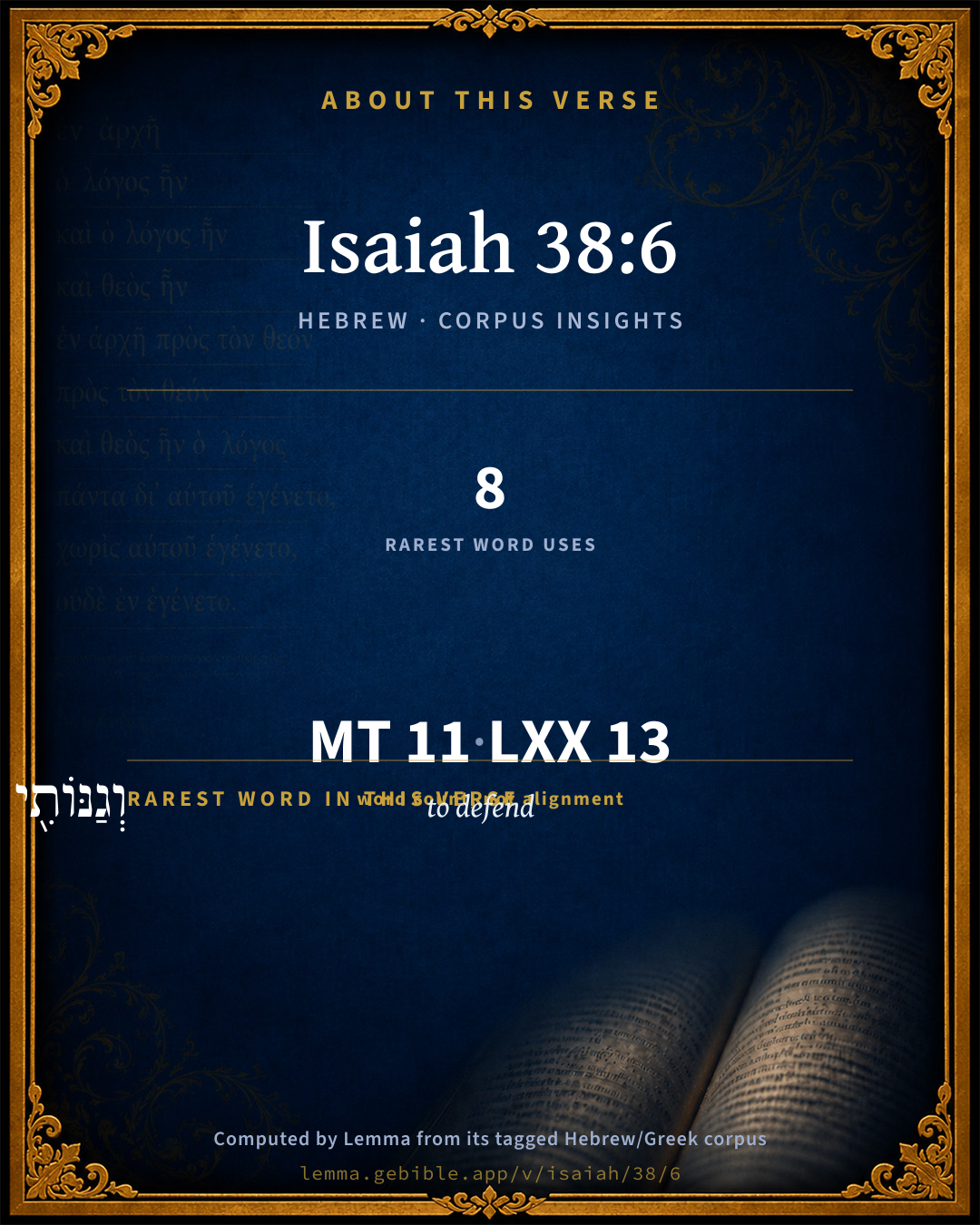
11
words
9
distinct lemmas
Prophets
section

Notable vocabulary

The rarest word here is וְגַנּוֹתִ֖י to defend H1598 — appearing just 8 times in the whole Hebrew Bible.

Shared distinctive vocabulary

וְגַנּוֹתִ֖י to defend H1598 occurs in 7 verses of the Hebrew Bible. Also found in:

Grammatical profile

  • 2 verbs
  • 5 nouns
  • 2 pronouns
  • 1 preposition
  • 1 particle

Verb forms

  • אַצִּ֣ילְךָ֔ Hiphil · Imperfect
  • וְגַנּוֹתִ֖י Qal · Sequential Perfect

Repetition

Words recur within this verse — often emphatic in Hebrew:

  • הָעִ֣יר city H5892 ×2
  • הַזֹּ֑את this H2063 ×2

Hebrew & Septuagint length

In English translation the verse runs 22 words from the Hebrew and 24 from the Septuagint (LXX English) — closely comparable.

A rough comparison of the two English renderings, which tokenize alike — not a word-level alignment.

Word counts can differ between the Hebrew and the Greek without any difference in meaning — e.g. the Hebrew direct-object marker אֵת has no separate Greek word, and Greek often adds the article ὁ.

In the original languages it is 11 Hebrew tokens and 13 Greek tokens — but the two are counted differently (Hebrew bundles its prefixes and suffixes into one token; the Greek is in lemma form), so that isn’t a like-for-like length.

Cross-references

5

Topical passages linked to Isaiah 38:6 in the Treasury of Scripture Knowledge — connected by theme and wording, ordered by reader-vote popularity; previews shown in the World English Bible.

  • Isaiah 37:35 For I will defend this city to save it, for my own sake, and for my servant David's sake.
  • Isaiah 12:6 Cry aloud and shout, you inhabitant of Zion; for great in the midst of you is the Holy One of Israel!"
  • Isaiah 31:4–5 For thus says Yahweh to me, As the lion and the young lion growling over his prey, if a multitude of shepherds are called forth against him, will not be dismayed at their voice, nor abase himself for the noise of them: so will Yahweh of Hosts come down to fight on Mount Zion, and on the hill of it.
  • 2 Chronicles 32:22 Thus Yahweh saved Hezekiah and the inhabitants of Jerusalem from the hand of Sennacherib the king of Assyria, and from the hand of all [others], and guided them on every side.
  • 2 Timothy 4:17 But the Lord stood by me, and strengthened me, that through me the message might be fully proclaimed, and that all the Gentiles might hear; and I was delivered out of the mouth of the lion.

Cross-references courtesy of OpenBible.info (CC BY 4.0).

Hebrew and Greek witnesses Masoretic Hebrew ↔ Greek Septuagint

The same verse in the two great witnesses to the Old Testament, shown verse-for-verse.

These are two independent witnesses, not word-aligned to each other, and the Septuagint is shown in lemma (dictionary) form.

Hebrew Isaiah 38:6 Masoretic · Westminster Leningrad Codex

וּמִכַּ֤ף מֶֽלֶךְ אַשּׁוּר֙ אַצִּ֣ילְךָ֔ וְאֵ֖ת הָעִ֣יר הַזֹּ֑את וְגַנּוֹתִ֖י עַל הָעִ֥יר הַזֹּֽאת

I will deliver you and this city out of the hand of the king of Assyria; and I will defend this city.

World English Bible · Public Domain

Greek LXX Isaiah 38:6 Septuagint · lemma form

καί ἐκ χείρ βασιλεύς ἀσσύριος σώζω σύ καί ὑπέρ ὁ πόλις οὗτος ὑπερἀσπίζω

And I will deliver you and this city out of the hand of the king of the Assyrians: and I will defend this city.

LXX2012 (modern English Septuagint) · Public Domain

Hebrew: Westminster Leningrad Codex (CC BY 4.0). Greek: Septuagint (public domain); English from LXX2012 (modern English Septuagint) (Public Domain). How the Septuagint differs from the Hebrew →

Targum (Aramaic paraphrase)

1

The Targum is the ancient Jewish Aramaic paraphrase of the Hebrew Scriptures — an interpretive translation, not the Hebrew text itself. Onkelos (literal) and Pseudo-Jonathan (expansive) render the Torah, and Jonathan the Prophets. Coverage is partial: where no permissively-licensed English translation exists for a verse, only the Aramaic is shown. This is verse-level text, not a word-by-word alignment to the Hebrew.

  1. Targum Jonathan Prophets (Joshua–Malachi)
    וּמִיַד מַלְכָּא דְאַתּוּר אֲשֵׁיזְבִינָךְ וְיַת קַרְתָּא הָדָא וְאַגִין עַל קַרְתָּא הָדָא:

    And I will deliver thee and this city out of the hand of the king of Assyria: and I will defend this city.

    Targum Jonathan — Aramaic: “Mikraot Gedolot” (public domain). English: “Sefaria Community Translation” (CC0 1.0 (public-domain dedication)); “London "Chaldee Paraphrase," 1871” (public domain). Text via Sefaria.

Commentary

Notes on Isaiah 38:6 from classic Christian and Jewish commentators (each source and its license shown beneath its notes). The classic Christian expositions comment on the surrounding passage and are grouped to its opening verse, so a note may address several verses; the Jewish commentaries on the Tanakh (Rashi and others) are per-verse, so they appear only where the commentator wrote on this verse.

Lemma curates 59 commentaries, every one of them public domain or Creative Commons licensed, each selected and text-cleaned for this edition rather than reprinted as found. About our sources →

Trapp's Complete Commentary

John Trapp

Isa 38:6 And I will deliver thee and this city out of the hand of the king of Assyria: and I will defend this city.

Ver. 6. See 2Ki 20:6-7 {See Trapp on "2Ki 20:6"} {See Trapp on "2Ki 20:7"}

John Trapp, A Commentary or Exposition upon All the Books of the Old and New Testament (1647–1656) — public domain. Text from a community e-Sword module.

Tyndale Open Study Notes

Tyndale Open Resources

38:6 I will rescue you . . . I will defend this city: This promise refers to the rescue of Jerusalem (chs 36–37); it also provides a greater context for understanding Hezekiah’s sickness and healing. Just as Hezekiah received another fifteen years, Jerusalem also received a temporary reprieve (see ch 39).

Tyndale Open Study Notes — © Tyndale Open Resources, licensed CC BY-SA 4.0. Text via the HelloAO Bible API.

Geneva Bible (1599)

Geneva Bible translators

He doth not only promise to prolong his life, but to give him rest and quietness from the Assyrians, who might have renewed their army to revenge their former discomfiture.

Geneva Bible (1599) marginal notes — public domain. Text via Bolls.life.

Jamieson, Fausset & Brown

Robert Jamieson, A. R. Fausset & David Brown

In Kg2 20:8, after this verse comes the statement which is put at the end, in order not to interrupt God's message (Isa 38:21-22) by Isaiah (Isa 38:5-8).

will deliver--The city was already delivered, but here assurance is given, that Hezekiah shall have no more to fear from the Assyrians.

Jamieson, Fausset & Brown — Commentary Critical and Explanatory on the Whole Bible (1871) — public domain (CC PDM 1.0). Text via the HelloAO Bible API.

Adam Clarke's Commentary

Verse 6. I will defend this city.] The other copy, 2Kg 20:6, adds: "for mine own sake, and for the sake of David my servant;" and the sentence seems somewhat abrupt without it.

Adam Clarke's Commentary on the Bible (1810–1826) — public domain. Text from a community e-Sword/MySword module.

The Cambridge Bible for Schools and Colleges

gen. ed. J. J. S. Perowne

6. This is the only verse which would lead us to suppose that the events synchronised with Sennacherib’s invasion; but its genuineness is doubtful. An unqualified assurance of deliverance is hardly consistent with the prophet’s attitude to the king’s policy at the time supposed. Hezekiah was deeply committed to projects of rebellion in the first years of Sennacherib’s reign, and a political message from Isaiah in those circumstances could hardly fail to be accompanied by a warning against the tendency which prevailed at the court. Since the verse breaks the connexion between Isa_38:5; Isa_38:7, and since the latter part is a reproduction (in 2 Kings an exact reproduction) of ch. Isa_37:35, there are some grounds for supposing that it has been inserted by the compiler of the books of Kings.

The Cambridge Bible for Schools and Colleges (gen. ed. J. J. S. Perowne; Cambridge University Press, 1878–1918) — public domain. Text from a community e-Sword module.

John Gill's Exposition

And this shall be a sign unto thee from the Lord,.... And which it seems Hezekiah asked, and it was put to him which he would choose, whether the shadow on the sundial should go forward or backward ten degrees, and he chose the latter, Kg2 20:8, which was a token confirming and assuring

that the Lord will do this thing that he hath spoken; recover Hezekiah from his sickness, so that on the third day he should go up to the temple; have fifteen years added to his days; and the city of Jerusalem protected from the attempts of the Assyrian monarch.

John Gill's Exposition of the Whole Bible (1746–1763) — public domain (CC PDM 1.0). Text via the HelloAO Bible API.

Albert Barnes' Notes on the Bible

And I will deliver thee and this city - The purport of this promise is, that he and the city should be finally and entirely delivered from all danger of invasion from the Assyrians. It might be apprehended that Sennacherib would collect a large army, and return; or that his successor would prosecute the war which he had commenced. But the assurance here is given to Hezekiah that he had nothing more to fear from the Assyrians (see the notes at Isa 31:4-5; Isa 37:35). In the parallel place in 2Ki 20:6, it is added. ‘I will defend this city for mine own sake, and for my servant David’s sake.’ In the parallel passage also, in 2Ki 20:7-8, there is inserted the statement which occurs in Isaiah at the end of the chapter Isa 38:21-22. It is evident that those two verses more appropriately come in here. Lowth conjectures that the abridger of the history omitted those verses, and when he had transcribed the song of Hezekiah, he saw that they were necessary to complete the narrative, and placed them at the end of the chapter, with proper marks to have them inserted in the right place, which marks were overlooked by transcribers. It is, however, immaterial where the statement is made; and it is now impossible to tell in what manner the transposition occurred.

Albert Barnes' Notes on the Bible (1834–1885) — public domain. Text from a community e-Sword/MySword module.

Whedon's Commentary on the Bible

Daniel D. Whedon

6. This verse has been taken by some to imply that Hezekiah’s sickness was at the beginning of the Assyrian invasion. This seems gratuitous, or assumed without adequate support. See Isa_39:1.

I will deliver thee and this city out of the hand of the king of Assyria — This is a promise of assured protection from Assyria forever hereafter, as comments further on will show.

Daniel D. Whedon (gen. ed.), Commentary on the Old and New Testaments (1874–1909) — public domain. Text from a community e-Sword module.

J. A. Alexander on Isaiah

Joseph Addison Alexander

“And out of the hand of the king of Assyria I will save thee and this city, and I will cover over (or protect) this city.” This probably refers to subsequent attacks or apprehensions. The parallel passage (2Ki 20:6) adds, ‘for my own sake and for the sake of David my servant,’ as in Isa 37:35.

Joseph Addison Alexander, The Prophecies of Isaiah (1846–1847; New York: Scribner, 1870–1878) — public domain. Text from a community e-Sword module.

Rashi

Rabbi Shlomo Yitzchaki (Rashi)

And from the hand of the king of Assyria will I save you We deduce that he became ill before the downfall of Sennacherib.

Rashi on the Tanakh — English translations: “The Judaica Press complete Tanach with Rashi, translated by A. J. Rosenberg” (CC BY 4.0); “Pentateuch with Rashi's commentary by M. Rosenbaum and A.M. Silbermann, 1929-1934” (public domain); “The Metsudah Tanach series, Lakewood, N.J” (CC BY 4.0); and “The Book of Joshua, Metsudah Publications, 1997” (CC BY 4.0). Text via Sefaria.

Lesson kit

Teaching starters — assembled from the data on this page, not authored interpretation. Every prompt links to the verse data it draws on. Edit before teaching.

Isaiah, in the Prophets, opens this verse with 11 words (9 distinct Hebrew lemmas). Its most distinctive word is gânan (“to defend”). A historical commentator’s framing appears above. Read the whole chapter for the surrounding context.

Discussion questions

  1. How does “to defend” (gânan) shape what this verse is saying?
  2. 2 Kings 19:34 shares the word «to defend» with this verse. How do the two illuminate each other?
  3. “city” occurs 2× in this one verse. What is the effect of the repetition?
  4. The translations on this page render this verse differently — a whole-verse word diff, not a word-by-word alignment. What might account for the different wordings?
  5. The verb «אַצִּ֣ילְךָ֔» is Hiphil Imperfect. How does its form color the action?
  6. Reading how Trapp's Complete Commentary and Tyndale Open Study Notes read this verse, where do the two commentators agree and where do they part?

Things to notice

Reading settings

Reading text

Shown beneath each verse's original-language words.

Old Testament
Old Testament edition

Read the OT as the Masoretic Hebrew (MT) or the Greek Septuagint (LXX).

English shown for the Greek Septuagint (in the Hebrew ↔ Greek comparison).

Comparing translations? Open the Compare panel on any verse page to stack up to four side by side.