
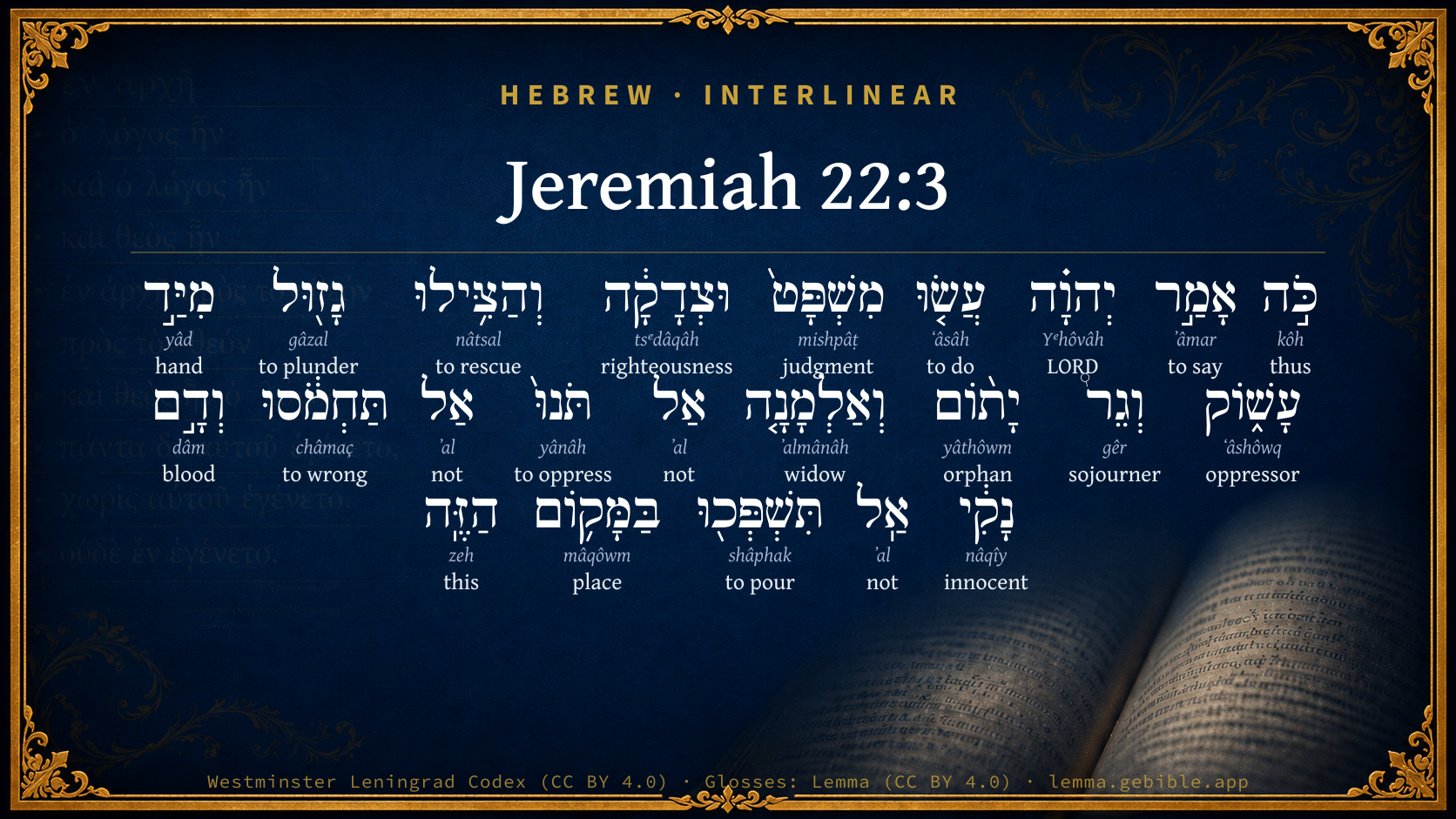
Jeremiah 22:3

Hebrew (Westminster Leningrad Codex) Jeremiah 22:3 appears in the Hebrew Old Testament. The text above is from the Westminster Leningrad Codex. Each word links to its Strong’s number, a concise gloss, and parsing drawn from the Open Scriptures Hebrew Bible morphology. Click any word for its full Brown-Driver-Briggs (BDB) entry.
Download image
Cite this verse

Jeremiah 22:3 (World English Bible). Public Domain. Lemma interlinear Bible study tool, https://lemma.gebible.app/v/jeremiah/22/3.

Show BibTeX & RIS
BibTeX
RIS
English Translation
Thus says Yahweh: Execute you justice and righteousness, and deliver him who is robbed out of the hand of the oppressor: and do no wrong, do no violence, to the foreigner, the fatherless, nor the widow; neither shed innocent blood in this place.
World English Bible · Public Domain
Highlights
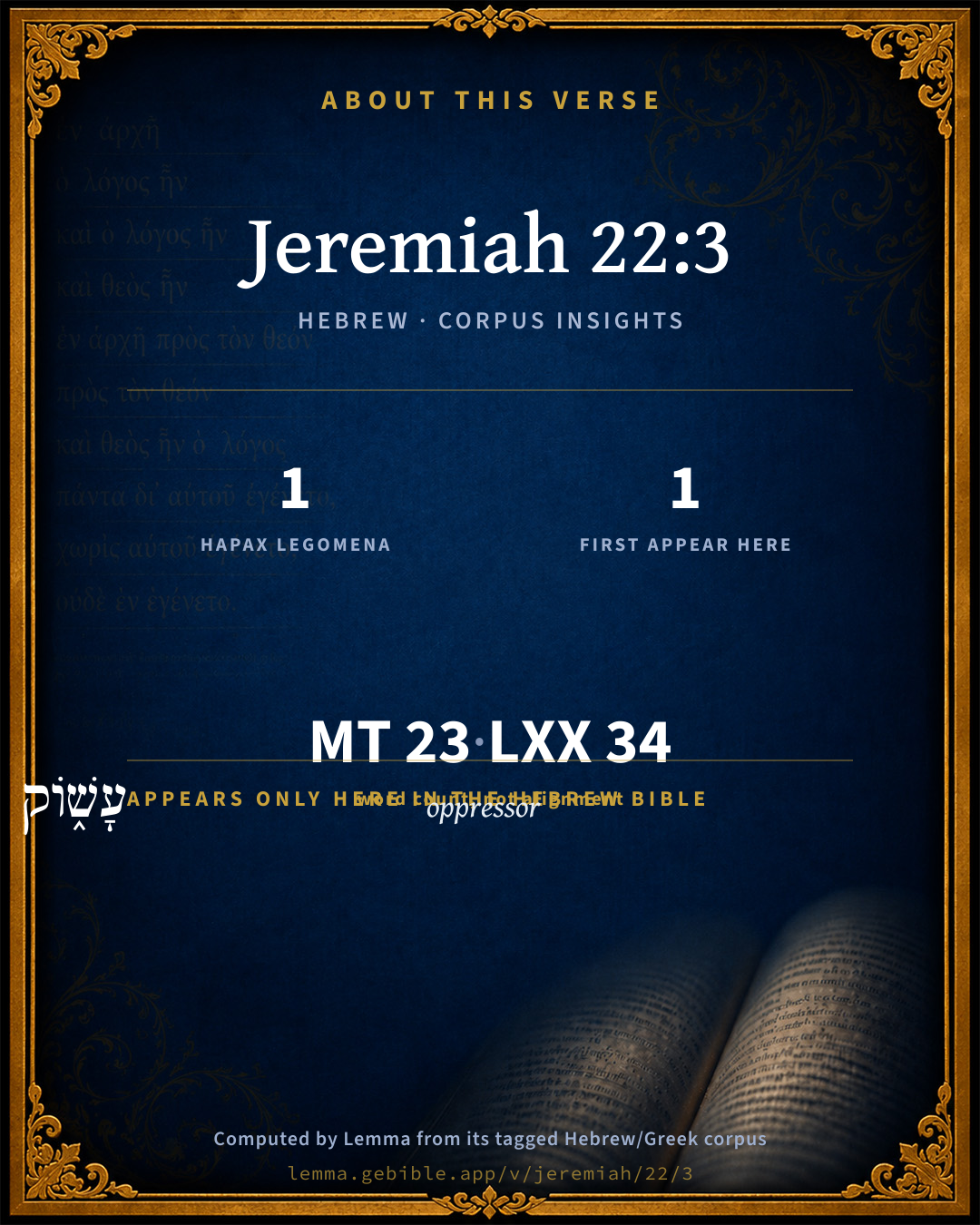
  • 1 hapax legomenon — only here in the Hebrew Bible
  • 1 first appearance in the Hebrew Bible
Full analysis ↓
Download a study sheet

One document with this verse’s original text, its word-by-word gloss line, the meaning frame, cross-references with their text, attributed commentary, and full source and license credits — printable, and it pastes into notes with its structure intact.

This verse Autodidact and up

Study sheet (.html) Plain text (.txt)

A passage Seminary Student

Up to 50 verses in one chapter. A passage sheet keeps up to 6 commentary sources and 12 cross-references per verse, in the order this page ranks them, and says so on the sheet whenever that leaves anything out. Ask for a single verse and you get the Autodidact verse sheet above.

Everything on this page stays free to read, with no account — the sheet is a download of what is already on screen, not access to it.

Want to remove ads? Support Godless Engineer
Compare translations 3

The same verse in 3 English versions, stacked beneath the original-language interlinear above. Click any original word for its lexicon entry.

Each is an independent rendering of the whole verse — the interlinear is not word-aligned to these translations.

Highlighted words mark where these versions differ — a whole-verse word diff, not a word-by-word alignment.

  • World English Bible Public Domain
    Thus says Yahweh: Execute you justice and righteousness, and deliver him who is robbed out of the hand of the oppressor: and do no wrong, do no violence, to the foreigner, the fatherless, nor the widow; neither shed innocent blood in this place.
  • King James Version Public Domain
    Thus saith the LORD; Execute ye judgment and righteousness, and deliver the spoiled out of the hand of the oppressor: and do no wrong, do no violence to the stranger, the fatherless, nor the widow, neither shed innocent blood in this place.
  • unfoldingWord Literal Text CC BY-SA 4.0
    Thus says Yahweh: Do justice and righteousness, and rescue the one who has been robbed from the hand of the oppressor. And do not oppress the sojourner, the fatherless, or the widow. Do not do violence, and do not shed innocent blood in this place.

unfoldingWord Literal Text — © unfoldingWord, licensed CC BY-SA 4.0. Word-aligned USFM3 via Door43 (git.door43.org/unfoldingWord/en_ult).

Versions to compare (up to 4)

3 of 4 selected

Show all 18 translations

Every available English version of this verse, each an independent rendering of the whole verse.

  • World English Bible Public Domain
    Thus says Yahweh: Execute you justice and righteousness, and deliver him who is robbed out of the hand of the oppressor: and do no wrong, do no violence, to the foreigner, the fatherless, nor the widow; neither shed innocent blood in this place.
  • Berean Standard Bible Public Domain
    This is what the LORD says: Administer justice and righteousness. Rescue the victim of robbery from the hand of his oppressor. Do no wrong or violence to the foreigner, the fatherless, or the widow. Do not shed innocent blood in this place.
  • Majority Standard Bible Public Domain
    This is what the LORD says: Administer justice and righteousness. Rescue the victim of robbery from the hand of his oppressor. Do no wrong or violence to the foreigner, the fatherless, or the widow. Do not shed innocent blood in this place.
  • King James Version Public Domain
    Thus saith the LORD; Execute ye judgment and righteousness, and deliver the spoiled out of the hand of the oppressor: and do no wrong, do no violence to the stranger, the fatherless, nor the widow, neither shed innocent blood in this place.
  • American Standard Version (1901) Public Domain
    Thus saith Jehovah: Execute ye justice and righteousness, and deliver him that is robbed out of the hand of the oppressor: and do no wrong, do no violence, to the sojourner, the fatherless, nor the widow; neither shed innocent blood in this place.
  • Revised Version (1885) Public Domain
    Thus saith the LORD: Execute ye judgment and righteousness, and deliver the spoiled out of the hand of the oppressor: and do no wrong, do no violence, to the stranger, the fatherless, nor the widow, neither shed innocent blood in this place.
  • Geneva Bible (1599) Public Domain
    Thus saith the Lord, Execute ye iudgement and righteousnes, and deliuer the oppressed from the hande of the oppressor, and vexe not the stranger, the fatherlesse, nor the widowe: doe no violence, nor sheade innocent blood in this place.
  • Douay-Rheims (1899) Public Domain
    Thus saith the Lord: Execute judgement and justice, and deliver him that is oppressed out of the hand of the oppressor: and afflict not the stranger, the fatherless, nor the widow, nor oppress them unjustly: and shed not innocent blood in this place.
  • Young's Literal Translation Public Domain
    Thus said Jehovah: Do ye judgment and righteousness, And deliver the plundered from the hand of the oppressor, And sojourner, orphan, and widow, ye do not oppress nor wrong, And innocent blood ye do not shed in this place.
  • Literal Standard Version CC BY-SA 4.0
    Thus said YHWH: “Do judgment and righteousness, || And deliver the plundered from the hand of the oppressor, || And sojourner, orphan, and widow, you do not oppress nor wrong, || And innocent blood you do not shed in this place.
  • Unlocked Literal Bible CC BY-SA 4.0
    Yahweh says this, “Perform justice and righteousness, and anyone who has been robbed—rescue him from the hand of the oppressor. Do not mistreat any foreigner in your land, or any orphan or widow. Do not commit violence or pour out innocent blood in this place.
  • unfoldingWord Literal Text CC BY-SA 4.0
    Thus says Yahweh: Do justice and righteousness, and rescue the one who has been robbed from the hand of the oppressor. And do not oppress the sojourner, the fatherless, or the widow. Do not do violence, and do not shed innocent blood in this place.
  • Darby Bible Public Domain
    Thus saith Jehovah: Execute judgment and righteousness, and deliver the spoiled out of the hand of the oppressor; and do no wrong, do no violence to the stranger, the fatherless, or the widow, and shed not innocent blood in this place.
  • World Messianic Bible Public Domain
    The LORD says: “Execute justice and righteousness, and deliver him who is robbed out of the hand of the oppressor. Do no wrong. Do no violence to the foreigner, the fatherless, or the widow. Don’t shed innocent blood in this place.
  • Webster's Bible Public Domain
    Thus saith the LORD; Execute ye judgment and righteousness, and deliver him that is laid waste out of the hand of the oppressor: and do no wrong, do no violence to the stranger, the fatherless, nor the widow, neither shed innocent blood in this place.
  • Free Bible Version CC BY-SA 4.0
    This is what the Lord says: Do what is fair and right. Protect those who are being unjustly treated by corrupt people. Don't do anything wrong to foreigners, orphans, or the widows. Don't use violence against them. Don't kill innocent people.
  • Bible in Basic English Public Domain
    This is what the Lord has said: Do what is right, judging uprightly, and make free from the hands of the cruel one him whose goods have been violently taken away: do no wrong and be not violent to the man from a strange country and the child without a father and the widow, and let not those who have done no wrong be put to death in this place.
  • JPS Tanakh (1917) Public Domain
    Thus saith the LORD: Execute ye justice and righteousness, and deliver the spoiled out of the hand of the oppressor; and do no wrong, do no violence, to the stranger, the fatherless, nor the widow, neither shed innocent blood in this place.

Literal Standard Version (2020), Covenant Press — licensed CC BY-SA 4.0. Text via the HelloAO Bible API (eBible.org). Unlocked Literal Bible (unfoldingWord) — licensed CC BY-SA 4.0. Text via the HelloAO Bible API (eBible.org). unfoldingWord Literal Text — © unfoldingWord, licensed CC BY-SA 4.0. Word-aligned USFM3 via Door43 (git.door43.org/unfoldingWord/en_ult). Free Bible Version, Dr. Jonathan Gallagher — licensed CC BY-SA 4.0. Text via the HelloAO Bible API (eBible.org).

Word by word

More ways to search: Search by grammar → Find every occurrence → Compare this word →

Practice this passage: Drill this verse → Learn its vocabulary →

עָשׁ֑וֹק
ʻâshôwq
H6216
“oppressor”
Noun, Common, Masculine, Singular, Absolute
Part of Speech
Noun
Type
Common
Gender
Masculine
Number
Singular
State
Absolute
Full BDB Definition

Origin: from H6231

TWOT: 1713c

oppressor, extortioner
  1. כֹּ֣ה kôh H3541 “thus” Adverb
  2. אָמַ֣ר ʼâmar H559 “to say” Verb, Qal, Perfect, 3rd Person, Masculine, Singular
  3. יְהוָ֗ה Yᵉhôvâh H3068 “LORD” Noun, Proper
  4. עֲשׂ֤וּ ʻâsâh H6213 “do” Verb, Qal, Imperative, 2nd Person, Masculine, Plural
  5. מִשְׁפָּט֙ mishpâṭ H4941 “judgment” Noun, Common, Masculine, Singular, Absolute
  6. וּצְדָקָ֔ה tsᵉdâqâh H6666 “and · righteousness” Conjunction + Noun, Common, Feminine, Singular, Absolute
  7. וְהַצִּ֥ילוּ nâtsal H5337 “and · rescue” Conjunction + Verb, Hiphil, Imperative, 2nd Person, Masculine, Plural
  8. גָז֖וּל gâzal H1497 “plundered” Verb, Qal, Participle Passive, Masculine, Singular, Absolute
  9. מִיַּ֣ד yâd H3027 “from · hand of” Preposition + Noun, Common, Both, Singular, Construct
  10. וְגֵר֩ gêr H1616 “and · sojourner” Conjunction + Noun, Common, Masculine, Singular, Absolute
  11. יָת֨וֹם yâthôwm H3490 “orphan” Noun, Common, Masculine, Singular, Absolute
  12. וְאַלְמָנָ֤ה ʼalmânâh H490 “and · widow” Conjunction + Noun, Common, Feminine, Singular, Absolute
  13. אַל ʼal H408 “not” Particle, Negative
  14. תֹּנוּ֙ yânâh H3238 “to oppress” Verb, Hiphil, Jussive, 2nd Person, Masculine, Plural
  15. אַל ʼal H408 “not” Particle, Negative
  16. תַּחְמֹ֔סוּ châmaç H2554 “to wrong” Verb, Qal, Jussive, 2nd Person, Masculine, Plural
  17. וְדָ֣ם dâm H1818 “and · blood” Conjunction + Noun, Common, Masculine, Singular, Absolute
  18. נָקִ֔י nâqîy H5355 “innocent” Adjective, Adjective, Masculine, Singular, Absolute
  19. אַֽל ʼal H408 “not” Particle, Negative
  20. תִּשְׁפְּכ֖וּ shâphak H8210 “to pour” Verb, Qal, Jussive, 2nd Person, Masculine, Plural
  21. בַּמָּק֥וֹם mâqôwm H4725 “in/at the · place” Preposition, Determined + Noun, Common, Masculine, Singular, Absolute
  22. הַזֶּֽה zeh H2088 “the · this” Particle, Definite Article + Pronoun, Demonstrative, Masculine, Singular

About this verse

These counts appear in no published source. They are computed here, from the morphology-tagged text and Lemma’s own curated glosses. What Lemma adds →

23
words
21
distinct lemmas
Prophets
section

Notable vocabulary

1 hapax legomenon — a word that appears only here in the entire Hebrew Bible:

  • עָשׁ֑וֹק oppressor H6216

First appearance in Scripture

This word makes its first canonical appearance in the Hebrew Bible here:

  • עָשׁ֑וֹק oppressor H6216

Shared distinctive vocabulary

תַּחְמֹ֔סוּ to wrong H2554 occurs in 8 verses of the Hebrew Bible. Also found in:

Grammatical profile

  • 7 verbs
  • 10 nouns
  • 1 adjective
  • 1 pronoun
  • 1 adverb
  • 3 particles

Verb forms

  • אָמַ֣ר Qal · Perfect
  • עֲשׂ֤וּ Qal · Imperative
  • וְהַצִּ֥ילוּ Hiphil · Imperative
  • גָז֖וּל Qal · Participle Passive
  • תֹּנוּ֙ Hiphil · Jussive
  • תַּחְמֹ֔סוּ Qal · Jussive
  • תִּשְׁפְּכ֖וּ Qal · Jussive

Repetition

A word recurs within this verse — often emphatic in Hebrew:

  • אַל not H408 ×3

Hebrew & Septuagint length

In the original languages it is 23 Hebrew tokens and 34 Greek tokens — but the two are counted differently (Hebrew bundles its prefixes and suffixes into one token; the Greek is in lemma form), so that isn’t a like-for-like length.

Cross-references

35

Topical passages linked to Jeremiah 22:3 in the Treasury of Scripture Knowledge — connected by theme and wording, ordered by reader-vote popularity; previews shown in the World English Bible.

  • Jeremiah 21:12 House of David, thus says Yahweh, Execute justice in the morning, and deliver him who is robbed out of the hand of the oppressor, lest my wrath go forth like fire, and burn so that none can quench it, because of the evil of your doings.
  • Jeremiah 22:17 But your eyes and your heart are not but for your covetousness, and for shedding innocent blood, and for oppression, and for violence, to do it.
  • Micah 6:8 He has shown you, O man, what is good. What does Yahweh require of you, but to act justly, To love mercy, and to walk humbly with your God?
  • James 1:27 Pure religion and undefiled before our God and Father is this: to visit the fatherless and widows in their affliction, and to keep oneself unstained by the world.
  • Ezekiel 22:7 In you have they set light by father and mother; in the midst of you have they dealt by oppression with the foreigner; in you have they wronged the fatherless and the widow.
  • Isaiah 1:15–20 When you spread forth your hands, I will hide my eyes from you; Yes, when you make many prayers, I will not hear. Your hands are full of blood.
  • Zechariah 7:9–11 "Thus has Yahweh of Hosts spoken, saying, 'Execute true judgment, and show kindness and compassion every man to his brother.
  • Malachi 3:5 I will come near to you to judgment; and I will be a swift witness against the sorcerers, and against the adulterers, and against the perjurers, and against those who oppress the hireling in his wages, the widow, and the fatherless, and who deprive the foreigner of justice, and don't fear me," says Yahweh of Hosts.
  • Deuteronomy 19:10–13 that innocent blood not be shed in the midst of your land, which Yahweh your God gives you for an inheritance, and so blood be on you.
  • Deuteronomy 24:7 If a man be found stealing any of his brothers of the children of Israel, and he deal with him as a slave, or sell him; then that thief shall die: so shall you put away the evil from the midst of you.
  • 2 Kings 24:4 and also for the innocent blood that he shed; for he filled Jerusalem with innocent blood: and Yahweh would not pardon.
  • Psalms 68:5 A father of the fatherless, and a defender of the widows, Is God in his holy habitation.
  • Psalms 72:2–4 He will judge your people with righteousness, And your poor with justice.
  • Proverbs 23:10 Don't move the ancient boundary stone. Don't encroach on the fields of the fatherless:
  • Isaiah 1:23 Your princes are rebellious, and companions of thieves. Everyone loves bribes, and follows after rewards. They don't judge the fatherless, Neither does the cause of the widow come to them.
  • Jeremiah 5:28 They are grew fat, they shine: yes, they overpass in deeds of wickedness; they don't plead the cause, the cause of the fatherless, that they may prosper; and the right of the needy they don't judge.
  • Jeremiah 7:5–6 For if you thoroughly amend your ways and your doings; if you thoroughly execute justice between a man and his neighbor;
  • Jeremiah 9:24 but let him who glories glory in this, that he has understanding, and knows me, that I am Yahweh who exercises loving kindness, justice, and righteousness, in the earth: for in these things I delight, says Yahweh.
  • Joel 3:19 Egypt will be a desolation, And Edom will be a desolate wilderness, For the violence done to the children of Judah, Because they have shed innocent blood in their land.
  • Exodus 23:6–9 "You shall not deny justice to your poor people in their lawsuits.
  • Leviticus 19:15 "'You shall do no injustice in judgment: you shall not be partial to the poor, nor show favoritism to the great; but in righteousness shall you judge your neighbor.
  • Deuteronomy 10:18 He does execute justice for the fatherless and widow, and loves the foreigner, in giving him food and clothing.
  • Deuteronomy 16:18–20 Judges and officers shall you make you in all your gates, which Yahweh your God gives you, according to your tribes; and they shall judge the people with righteous judgment.
  • Deuteronomy 25:1 If there be a controversy between men, and they come to judgment, and [the judges] judge them; then they shall justify the righteous, and condemn the wicked;
  • Deuteronomy 27:19 Cursed be he who wrests the justice [due] to the foreigner, fatherless, and widow. All the people shall say, Amen.
  • 2 Samuel 23:3 The God of Israel said, The Rock of Israel spoke to me: One who rules over men righteously, Who rules in the fear of God,
  • Job 22:9 You have sent widows away empty, And the arms of the fatherless have been broken.
  • Job 24:9 There are those who pluck the fatherless from the breast, And take a pledge of the poor,
  • Job 29:7–17 When I went forth to the city gate, When I prepared my seat in the street,
  • Psalms 94:6 They kill the widow and the alien, And murder the fatherless.
  • Psalms 94:21 They gather themselves together against the soul of the righteous, And condemn the innocent blood.
  • Proverbs 6:17 Haughty eyes, a lying tongue, Hands that shed innocent blood;
  • Jeremiah 26:16 Then said the princes and all the people to the priests and to the prophets: This man is not worthy of death; for he has spoken to us in the name of Yahweh our God.
  • Exodus 22:22 "You shall not take advantage of any widow or fatherless child.
  • Micah 3:11 Her leaders judge for bribes, And her priests teach for a price, And her prophets of it tell forturnes for money: Yet they lean on Yahweh, and say, Isn't Yahweh in the midst of us? No disaster will come on us.

Cross-references courtesy of OpenBible.info (CC BY 4.0).

Hebrew and Greek witnesses Masoretic Hebrew ↔ Greek Septuagint

The same verse in the two great witnesses to the Old Testament, shown verse-for-verse.

These are two independent witnesses, not word-aligned to each other, and the Septuagint is shown in lemma (dictionary) form.

Hebrew Jeremiah 22:3 Masoretic · Westminster Leningrad Codex

כֹּ֣ה אָמַ֣ר יְהוָ֗ה עֲשׂ֤וּ מִשְׁפָּט֙ וּצְדָקָ֔ה וְהַצִּ֥ילוּ גָז֖וּל מִיַּ֣ד עָשׁ֑וֹק וְגֵר֩ יָת֨וֹם וְאַלְמָנָ֤ה אַל תֹּנוּ֙ אַל תַּחְמֹ֔סוּ וְדָ֣ם נָקִ֔י אַֽל תִּשְׁפְּכ֖וּ בַּמָּק֥וֹם הַזֶּֽה

Thus says Yahweh: Execute you justice and righteousness, and deliver him who is robbed out of the hand of the oppressor: and do no wrong, do no violence, to the foreigner, the fatherless, nor the widow; neither shed innocent blood in this place.

World English Bible · Public Domain

Greek LXX Structure differs

In the Septuagint, Jeremiah is about an eighth shorter than the Hebrew and arranges its material differently — the Oracles Against the Nations (Hebrew chapters 46–51) appear in the middle of the Greek book, after 25:13. Because the chapter and verse boundaries do not line up, a verse-for-verse comparison with the Hebrew is not shown.

A verse-for-verse comparison isn’t shown here because the chapters and verses don’t line up. Switch to the LXX edition with the MT / LXX toggle above to read the Greek directly.

Hebrew: Westminster Leningrad Codex (CC BY 4.0). Greek: Septuagint (public domain); English from a public-domain English Septuagint. How the Septuagint differs from the Hebrew →

Targum (Aramaic paraphrase)

1

The Targum is the ancient Jewish Aramaic paraphrase of the Hebrew Scriptures — an interpretive translation, not the Hebrew text itself. Onkelos (literal) and Pseudo-Jonathan (expansive) render the Torah, and Jonathan the Prophets. Coverage is partial: where no permissively-licensed English translation exists for a verse, only the Aramaic is shown. This is verse-level text, not a word-by-word alignment to the Hebrew.

  1. Targum Jonathan Prophets (Joshua–Malachi)
    כִּדְנַן אֲמַר יְיָ עֲבִידוּ דִינָא וּצְדַקְתָּא וְשֵׁיזִיבוּ אֲנִיסָא מִיַד דְאָנִיס לֵיהּ וְגִיוֹר יִתַּם וְאַרְמְלָא לָא תוֹנוּן וְלָא תֵינְסוּן וְדַם זַכָּאֵי לָא תֵישְׁדוּן בְּאַתְרָא הָדֵין:

    (no public-domain English translation for this verse)

    Targum Jonathan — Aramaic: “Mikraot Gedolot” (public domain). English: “Sefaria Community Translation” (CC0 1.0 (public-domain dedication)); “London "Chaldee Paraphrase," 1871” (public domain). Text via Sefaria.

Commentary

Notes on Jeremiah 22:3 from classic Christian and Jewish commentators (each source and its license shown beneath its notes). The classic Christian expositions comment on the surrounding passage and are grouped to its opening verse, so a note may address several verses; the Jewish commentaries on the Tanakh (Rashi and others) are per-verse, so they appear only where the commentator wrote on this verse.

Lemma curates 59 commentaries, every one of them public domain or Creative Commons licensed, each selected and text-cleaned for this edition rather than reprinted as found. About our sources →

Trapp's Complete Commentary

John Trapp

Jer 22:3 Thus saith the LORD; Execute ye judgment and righteousness, and deliver the spoiled out of the hand of the oppressor: and do no wrong, do no violence to the stranger, the fatherless, nor the widow, neither shed innocent blood in this place.

Ver. 3. Execute ye judgment and righteousness.] Make good laws, and see that they be well executed. This the prophet presseth quasi ad fastidium, ever and anon, over and over, as the likeliest means to prevent future judgments; so Phineas found it. See Jer 21:12.

John Trapp, A Commentary or Exposition upon All the Books of the Old and New Testament (1647–1656) — public domain. Text from a community e-Sword module.

The Biblical Illustrator

Joseph S. Exell

Jer_22:3

Do no wrong.

Wrong

The meaning of the word wrong is, something that is twisted from the straight line. Do you say you have not done wrong? When you set yourself up as a pattern of goodness, and at the same time turn up your nose at your erring acquaintance, it leads one to think that your angelic profession may cover the filthy rags of human sin. Some people profess too much. If they would acknowledge to some fault and confess that occasionally they are common metal like everybody else, we should respect them. People who will not permit you to think that they have ever done wrong, are often very unfeeling in their dealings with a person that has made a fool of himself. The man who feels himself to be a wrong-doer, is the most compassionately helpful to those that have fallen. When I hear anybody speaking harshly or ridiculing somebody who has done wrong and been found out, I fear that the only way to save them is for God to let them also fall into the mire of iniquity. Bear patiently with wrong-doers, and give them time to repent. Had they possessed your light, your education, your good parents and your virtuous surroundings, they might have lived a nobler life. When a man or a woman has done wrong, do not cast a stone at them; let us, if we can, lead them on to the path of right.

1. Let me urge that you do no wrong in your intentions. Let us weigh well our motives. Before doing any act, we should consider its intent, and ask ourselves, What is my intention? Is it the glory of God, the good of man, or only my own advantage--my own indulgence? When the intention is wholly selfish it is pretty sure to cause disappointment and misery; but when the intention is unselfish, it is likely to result in happiness both to ourselves and others.

2. It is also a matter of course that every true Christian should do no wrong in his practice. We profess much; let us seek to practise what we profess. I do not suppose that we are at present on such a high level as that shown in the spirit of the life of Christ; but let us aim at it, and though we fall, let us rise and try again. A farmer one day went to his landlord, Earl Fitzwilliam, saying, Please, your lordship, the horses and hounds last week quite destroyed my field of wheat. The earl said I am very sorry; how much damage do you think they did? The farmer replied, Well, your lordship, I dont think £50 would make it right. The earl immediately wrote out his order for £50 and handed it to the farmer, saying, I hope it will not be so bad as you think. So they parted. Months afterwards, the same old farmer came to the hall again, and when admitted into the library, said, Please, your lordship, I have brought back that £50. The earl exclaimed, Why, what for? The farmer said, Well, because I find that the trodden field of wheat has turned out to be a better crop than any of the others. So I have brought the money back. The earl exclaimed, This is as it should be; it is doing right between man and man. He tore up the order and wrote another, saying, Here, my good friend, is an order for a hundred pounds; keep it by you till your eldest son is twenty-one and then give it him as a present from me, and tell him how it arose. Now I think the honest farmer sets a good example to us all No doubt the tempter whispered in the ear of his soul, The earl will never miss that £50. Why, farmer, you dont mean to say you are going to give the morley back! But the honest old John Bull of a farmer replied, It would be wrong, you know, for me to keep that £50. Do no wrong to your neighbour, either in competition of business, or in your social and political relationship. Every man has a weak side to his character, and a tendency to do wrong in some direction. In other words, every man is a spiritual invalid who wants a heavenly prescription to restore him to health. Now, when your body is ill, you send for a doctor who counts your pulse and asks where your pain is, and how you feel. If you do not tell him all the truth, he does not know how to treat you. In the same way, when we are spiritually sick, we should confess all the symptoms of our sin-disease to the Great Physician of heaven. Let us be humble and honest enough to tell Him our sins. (W. Birch.)

The Biblical Illustrator, edited by Joseph S. Exell (c. 1880s–1900s) — public domain. Text from a community e-Sword module.

Joseph Benson's Commentary

Jer 22:3-5. Thus saith the Lord, Execute ye judgment, &c. — That is, administer justice to all your subjects. The stranger, the fatherless, and the widow are particularly named, as persons who have the fewest friends, and therefore are the most exposed to the tyranny, injustice, and oppression of the great. And do no wrong, do no violence, &c. — Compare Jer 22:17, where we find Jehoiakim charged with these sins. For if ye do this thing indeed — If ye will, not in pretence, but reality, do what is just and right to every one, and see that inferior magistrates, acting under you do so too; then shall there enter, &c. — See the note on Jer 17:25, where, instead of the gates of this house, the text reads, the gates of this city. And the context here shows, that the prophecy is directed, not only to the king’s court in particular, but likewise to the whole city of Jerusalem, one part of which was called the city of David; and the whole looked upon as a royal city, and the place of their king’s residence. Kings sitting upon the throne of David, &c. — There shall then be a succession of kings, and that uninterrupted, reigning in Judah, of David’s line, kings who shall enjoy a perfect tranquillity, and live in great state and dignity. But if ye will not hear these words — That is, if ye will not so hear as to obey them. I swear by myself, saith the Lord — That is, I resolve absolutely upon it; for God is not in Scripture said to swear, unless as speaking after the manner of men, and according to the actions of men; so that whenever this expression is employed, it is only to signify, that God would not revoke the thing spoken of, but that it should be immutable. Here, therefore, it implies that the sentence pronounced should certainly be executed, and that nothing could reverse it but the people’s sincere repentance, which condition is expressed in the foregoing part of the verse. See Heb 6:17. This house shall become a desolation — This palace, of the kings of Judah shall fare no better than other habitations in Jerusalem, sin as certainly effecting the ruin of the houses of princes as those of mean men.

Joseph Benson's Commentary on the Old and New Testaments (1811–1818) — public domain. Text from a community e-Sword module.

Tyndale Open Study Notes

Tyndale Open Resources

22:3 The evil deeds of Judah’s leaders included not being right or fair-minded and just. They had also refused to help those who had been robbed or to rescue the oppressed, and they mistreated foreigners, orphans, and widows (see Isa 58:6-7; Mic 6:8; Zech 7:9-10; 8:16-17; Matt 23:23).

Tyndale Open Study Notes — © Tyndale Open Resources, licensed CC BY-SA 4.0. Text via the HelloAO Bible API.

Geneva Bible (1599)

Geneva Bible translators

This was his ordinary manner of preaching before the Kings, from Josiah unto Zedekiah, which was about forty years.

Geneva Bible (1599) marginal notes — public domain. Text via Bolls.life.

Jamieson, Fausset & Brown

Robert Jamieson, A. R. Fausset & David Brown

Jehoiakim is meant here especially: he, by oppression, levied the tribute imposed on him by Pharaoh-necho, king of Egypt (Ch2 36:3), and taxed his people, and took their labor without pay, to build gorgeous palaces for himself (Jer 22:13-17), and shed innocent blood, for example, that of Urijah the prophet (Jer 26:20-24; Kg2 23:35; Kg2 24:4).

Jamieson, Fausset & Brown — Commentary Critical and Explanatory on the Whole Bible (1871) — public domain (CC PDM 1.0). Text via the HelloAO Bible API.

John Calvin's Commentaries

He says, first, Do judgment and justice This belonged especially to the king and his judges and governors; for private individuals, we know, had no power to protect their property; for though every one ought to resist wrongs and evil doings, yet this was the special duty of the judges whom God had armed with the sword for this purpose. To do judgment, means to render to every one according to his right; but when the two words, judgment and justice, are connected together, by justice we are to understand equity, so that every one has his own right; and by judgment is to be understood the execution of due punishment; for it is not enough for the judge to decide what is right, except he restrains the wicked when they audaciously resist. To do judgment, then, is to defend the weak and the innocent, as it were, with an armed hand.

He then adds, Rescue the spoiled from the hand of the oppressor He repeats what we observed in the last chapter; and here under one thing he includes the duty of judges, even that they are ever to oppose what is wrong and to check the audacity of the wicked, for they can never be induced willingly to conduct themselves with moderation and quietness. As, then, they are to be restrained by force, he says, “Rescue the spoiled from the hand of the oppressor.” Of the word גזול, gesul, we have spoken before; but by this form of speaking God intimates that it is not enough for the judge to abstain from tyranny and cruelty, and not to stimulate the wicked nor favor them, except he also acknowledges that he has been appointed by God for this end — to rescue the spoiled from the hand of the oppressor, and not to hesitate to face hatred and danger in the discharge of his office.

The Prophet now adds other things which he had not mentioned in the preceding chapter; defraud not, he says, the stranger and the orphan and the widow It is what is often said in Scripture, that it is not right to defraud any one; for God would exempt all from wrong, and not only strangers, orphans, and widows; but as orphans have no knowledge or wisdom, they are exposed, as it were, to plunder; and also widows, because they are in themselves helpless; and strangers, because they have no friends to undertake their cause; hence God, in an especial mannel, requires a regard to be had to strangers, orphans, and widows. There is also another reason; for when their right is rendered to strangers, orphans, and widows, equity no doubt shines forth more conspicuously. When any one brings friends with him, and employs them in the defense of his cause, the judge is thereby influenced; and he who is a native will have his relations and neighbors to support his cause; and he who is rich and possessing power will also influence the judge, so that he dares not do anything notoriously wrong; but when the stranger, or the orphan, or the widow comes before the judge, he can with impunity oppress them all. Hence if he judges rightly, it is no doubt a conspicuous proof of his integrity and uprightness. This, then, is the reason why God everywhere enumerates these cases when he speaks of right and equitable judgments. He further adds, Exercise no violence, nor shed innocent blood in this place These things also were matters belonging to the judges. But it was a horribly monstrous thing for the throne of David to have been so defiled as to have become, as it were, a den of robbers. Wherever there is any pretense to justice, there ought to be there some fear or shame; but as we have said, that tribunal was in a peculiar manner sacred to God. As, then, the king and his counsellors were become like robbers, and as they so occupied the throne of David that all impiety prevailed, and they hesitated not to plunder on every side, as though they lived in a house of plunder; this was, as I have said, a sad and shameful spectacle.

But we ought the more carefully to notice this passage, that we may learn to strengthen ourselves against bad examples, lest the impiety of men should overturn our faith; when we see in God’s Church things in such a disorder, that those who glory in the name of God are become like robbers, we must beware lest we become, on this account, alienated from true religion. We must, indeed, detest such monsters, but we must take care lest God’s word, through men’s wickedness, should lose its value in our esteem. We ought, then, to remember the admonition of Christ, to hear the Scribes and Pharisees who sat in Moses’ seat. (Matthew 23:2.) Thus it behoved the Jews to venerate that royal throne, on which God had inscribed certain marks of his glory. Though they saw that it was polluted by the crimes and evil deeds of men, yet they ought to have retained some regard for it on account of that expression, “This is my rest for ever.”

But we yet see that the king was sharply and severely reproved, as he deserved. Hence most foolishly does the Pope at the present day seek to exempt himself from all reproof, because he occupies the apostolic throne. Were we to grant what is claimed, (though that is frivolous and childish,) that the Roman throne is apostolic, (which I think has never been occupied by Peter,) surely the throne of David was much more venerable than the chair of Peter? and yet the descendants of David who succeeded him, being types and representatives of Christ, were not on that account, as we here see, exempt from reproof.

It might, however, be asked, why the Prophet said that he was sent to the whole people, when his doctrine was addressed only to the king and the public judges? for it belonged not to the people or to private individuals. But I have said already that it was easy for the common people to gather how God’s judgment ought to have been dreaded, for they had heard that punishment was denounced even on the house of David, which was yet considered sacred. When, therefore, they saw that those were summoned before God’s tribunal who were, in a manner, not subject to laws, what were they to think but that every one of them ought to have thought of himself, and to examine his own life? for they must at length be called to give an account, since the king himself and his counsellors had been summoned to do so. It now follows, —

John Calvin's Commentaries (1540-1563) — public domain. Text from the Calvin Translation Society English edition (1840s-50s) via the Christian Classics Ethereal Library (ccel.org). Calvin's coverage is partial (roughly two-thirds of the Bible); uncommented books and verses are honest gaps, never fabricated. The 19th-century editor's footnotes and remarks are omitted so the notes are faithfully Calvin's own voice.

Ellicott's Commentary for English Readers

(3) Execute ye judgment.—As the Hebrew verb is not identical with that in Jer_21:12, and implies a less formal act, it might be better to render it, do ye judgment . . .

Do no wrong . . .—The Hebrew order connects both verbs with the substantives—to the stranger, the fatherless, and the widow, do no wrong, no violence—and gives the latter the emphasis of position. The whole verse paints but too vividly a reign which presented the very reverse of all that the prophet describes as belonging to a righteous king.

A Bible Commentary for English Readers, edited by Charles John Ellicott (1878–1897) — public domain. Text from a community e-Sword module.

John Gill's Exposition

Thus saith the Lord, execute ye judgment and righteousness,.... Judge righteous Judgment; give the cause to whom it belongs, without respect of persons, and without a bribe or corruption; do no unrighteousness to any, by withholding from them what is due unto them, which was what this prince was chargeable with, Jer 22:13;

and deliver the spoiled out of the hand of the oppressor; that was robbed or wronged of his property by one superior to him in power or cunning; See Gill on Jer 21:12;

and do no wrong, do no violence to the stranger, the fatherless, nor the widow: who are not in a situation, and in such a condition and circumstances, as to defend themselves; and whom God has a peculiar regard unto; and therefore they who are his deputies and vicegerents, as kings and civil magistrates are, ought to protect such persons, and neither grieve and injure them themselves, nor suffer others to do it:

neither shed innocent blood in this place; to grieve and wrong the above persons is a very great evil, but to shed the blood of innocent per tons is a greater still; and this is aggravated by being committed by such who are set over men to secure and preserve their properties and their lives; and such heinous sins as these the present reigning king of Judah was guilty of; which is the reason of their being mentioned; see Jer 22:17.

John Gill's Exposition of the Whole Bible (1746–1763) — public domain (CC PDM 1.0). Text via the HelloAO Bible API.

Matthew Poole's English Annotations

That is, Administer justice to all your subjects.

The stranger, the fatherless, and the widow are particularly named, as persons who have fewest friends, and so are most exposed to the lusts of great men, who have a power to oppress them. Two things are observable:

1. That the terms upon which God promiseth mercy to them are such as were in their power to perform.

2. They are the due performance of relative duties, to teach us how much lieth upon men’s just performance of the duties of their relations, and more particularly, how much God loveth justice and judgment, without the impartial execution of which no princes, no magistrates, can promise themselves security from temporal judgments; which much commendeth the love of God to human society, injustice being the greatest enemy to it, and justice the great foundation and pillar of it.

Matthew Poole's English Annotations on the Holy Bible (1683–1685) — public domain. Text from a community e-Sword/MySword module.

Whedon's Commentary on the Bible

Daniel D. Whedon

3. Execute… judgment — The original here is not the same as in Jer_21:12. The phrase there has an official import; here the sense is, do right — a command of universal application.

Daniel D. Whedon (gen. ed.), Commentary on the Old and New Testaments (1874–1909) — public domain. Text from a community e-Sword module.

Rashi

Rabbi Shlomo Yitzchaki (Rashi)

do no wrong This means taunting with words.

Rashi on the Tanakh — English translations: “The Judaica Press complete Tanach with Rashi, translated by A. J. Rosenberg” (CC BY 4.0); “Pentateuch with Rashi's commentary by M. Rosenbaum and A.M. Silbermann, 1929-1934” (public domain); “The Metsudah Tanach series, Lakewood, N.J” (CC BY 4.0); and “The Book of Joshua, Metsudah Publications, 1997” (CC BY 4.0). Text via Sefaria.

Lesson kit

Teaching starters — assembled from the data on this page, not authored interpretation. Every prompt links to the verse data it draws on. Edit before teaching.

Jeremiah, in the Prophets, opens this verse with 23 words (21 distinct Hebrew lemmas). Its most distinctive word is ʻâshôwq (“oppressor”). A historical commentator’s framing appears above. Read the whole chapter for the surrounding context.

Discussion questions

  1. How does “oppressor” (ʻâshôwq) shape what this verse is saying?
  2. This verse holds 1 word here found nowhere else in the Hebrew Bible. What might the rare word draw attention to?
  3. The word “oppressor” first appears here in Scripture. What is being introduced at this debut?
  4. Job 15:33 shares the word «to wrong» with this verse. How do the two illuminate each other?
  5. “not” occurs 3× in this one verse. What is the effect of the repetition?
  6. These translations render this verse differently; the difference is in the English rendering, not the original. What questions does that raise?
  7. The verb «אָמַ֣ר» is Qal Perfect. How does its form color the action?
  8. Reading how Trapp's Complete Commentary and The Biblical Illustrator read this verse, where do the two commentators agree and where do they part?

Things to notice

  • 1 word in this verse appears nowhere else in the Hebrew Bible.
  • 1 word makes its first canonical appearance in Scripture here.
  • This verse counts 23 Hebrew ↔ 34 Greek words.
  • These translations choose different wording for 23 words in this verse.
  • “not” occurs 3× in this single verse.

Reading settings

Reading text

Shown beneath each verse's original-language words.

Old Testament
Old Testament edition

Read the OT as the Masoretic Hebrew (MT) or the Greek Septuagint (LXX).

English shown for the Greek Septuagint (in the Hebrew ↔ Greek comparison).

Comparing translations? Open the Compare panel on any verse page to stack up to four side by side.