

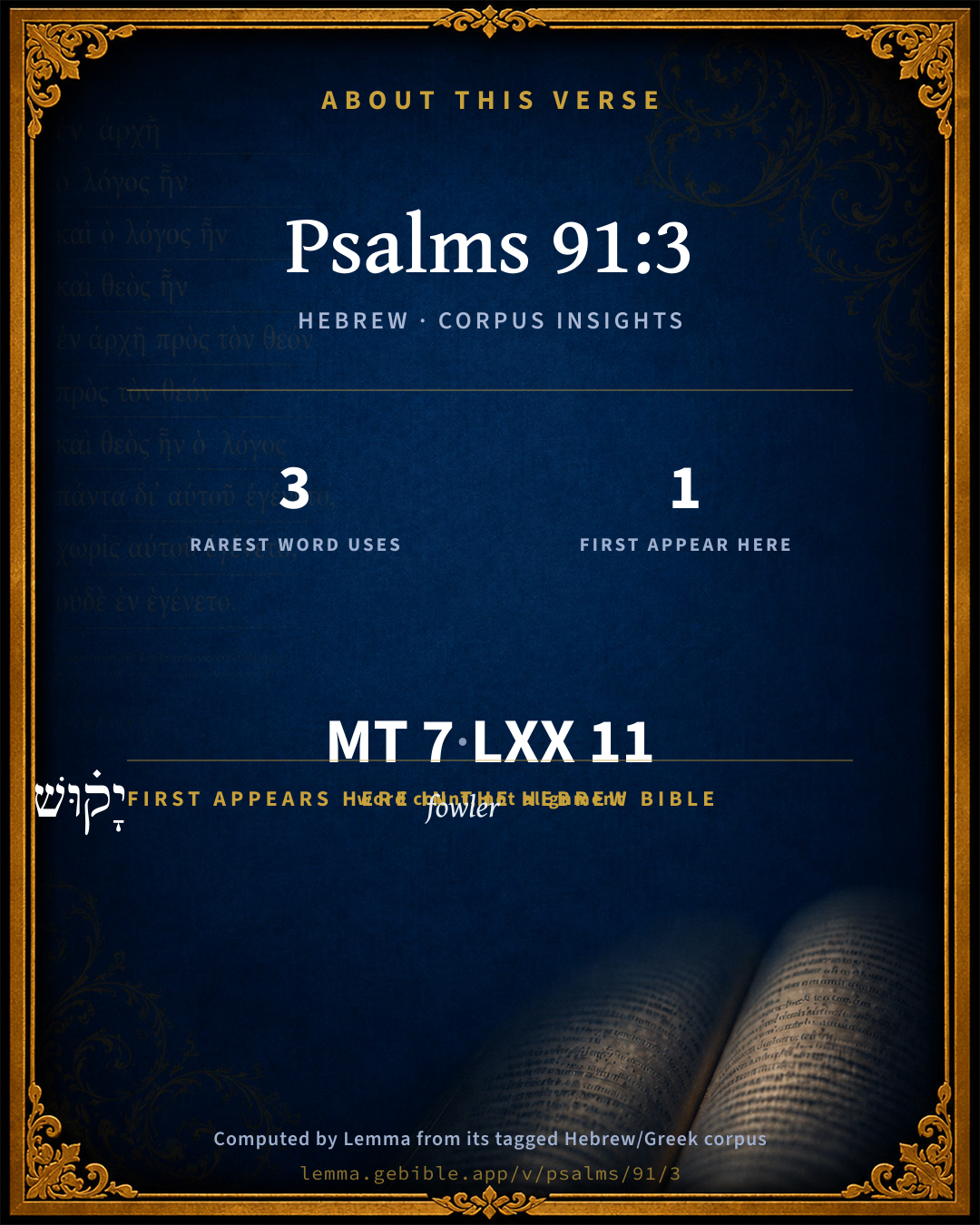
Psalms 91:3

Hebrew (Westminster Leningrad Codex) Psalms 91:3 appears in the Hebrew Old Testament. The text above is from the Westminster Leningrad Codex. Each word links to its Strong’s number, a concise gloss, and parsing drawn from the Open Scriptures Hebrew Bible morphology. Click any word for its full Brown-Driver-Briggs (BDB) entry.
Download image
Cite this verse

Psalms 91:3 (World English Bible). Public Domain. Lemma interlinear Bible study tool, https://lemma.gebible.app/v/psalms/91/3.

Show BibTeX & RIS
BibTeX
RIS
English Translation
For he will deliver you from the snare of the fowler, And from the deadly pestilence.
World English Bible · Public Domain
Highlights
  • 1 first appearance in the Hebrew Bible
Full analysis ↓
Download a study sheet

One document with this verse’s original text, its word-by-word gloss line, the meaning frame, cross-references with their text, attributed commentary, and full source and license credits — printable, and it pastes into notes with its structure intact.

This verse Autodidact and up

Study sheet (.html) Plain text (.txt)

A passage Seminary Student

Up to 50 verses in one chapter. A passage sheet keeps up to 6 commentary sources and 12 cross-references per verse, in the order this page ranks them, and says so on the sheet whenever that leaves anything out. Ask for a single verse and you get the Autodidact verse sheet above.

Everything on this page stays free to read, with no account — the sheet is a download of what is already on screen, not access to it.

Want to remove ads? Support Godless Engineer
Compare translations 3

The same verse in 3 English versions, stacked beneath the original-language interlinear above. Click any original word for its lexicon entry.

Each is an independent rendering of the whole verse — the interlinear is not word-aligned to these translations.

Highlighted words mark where these versions differ — a whole-verse word diff, not a word-by-word alignment.

  • World English Bible Public Domain
    For he will deliver you from the snare of the fowler, And from the deadly pestilence.
  • King James Version Public Domain
    Surely he shall deliver thee from the snare of the fowler, and from the noisome pestilence.
  • unfoldingWord Literal Text CC BY-SA 4.0
    For he will rescue you from the snare of the trapper, from the plague of calamities.

unfoldingWord Literal Text — © unfoldingWord, licensed CC BY-SA 4.0. Word-aligned USFM3 via Door43 (git.door43.org/unfoldingWord/en_ult).

Versions to compare (up to 4)

3 of 4 selected

Show all 18 translations

Every available English version of this verse, each an independent rendering of the whole verse.

  • World English Bible Public Domain
    For he will deliver you from the snare of the fowler, And from the deadly pestilence.
  • Berean Standard Bible Public Domain
    Surely He will deliver you from the snare of the fowler, and from the deadly plague.
  • Majority Standard Bible Public Domain
    Surely He will deliver you from the snare of the fowler, and from the deadly plague.
  • King James Version Public Domain
    Surely he shall deliver thee from the snare of the fowler, and from the noisome pestilence.
  • American Standard Version (1901) Public Domain
    For he will deliver thee from the snare of the fowler, And from the deadly pestilence.
  • Revised Version (1885) Public Domain
    For he shall deliver thee from the snare of the fowler, and from the noisome pestilence.
  • Geneva Bible (1599) Public Domain
    Surely he will deliuer thee from the snare of the hunter, and from the noysome pestilence.
  • Douay-Rheims (1899) Public Domain
    For he hath delivered me from the snare of the hunters: and from the sharp word.
  • Young's Literal Translation Public Domain
    For He delivereth thee from the snare of a fowler, From a calamitous pestilence.
  • Literal Standard Version CC BY-SA 4.0
    For He delivers you from the snare of a fowler, || From a calamitous pestilence.
  • Unlocked Literal Bible CC BY-SA 4.0
    For he will rescue you from the snare of the hunter and from the deadly plague.
  • unfoldingWord Literal Text CC BY-SA 4.0
    For he will rescue you from the snare of the trapper, from the plague of calamities.
  • Darby Bible Public Domain
    Surely *he* shall deliver thee from the snare of the fowler, [and] from the destructive pestilence.
  • World Messianic Bible Public Domain
    For he will deliver you from the snare of the fowler, and from the deadly pestilence.
  • Webster's Bible Public Domain
    Surely he shall deliver thee from the snare of the fowler, and from the noisome pestilence.
  • Free Bible Version CC BY-SA 4.0
    For he will save you from hidden traps and deadly diseases.
  • Bible in Basic English Public Domain
    He will take you out of the bird-net, and keep you safe from wasting disease.
  • JPS Tanakh (1917) Public Domain
    That He will deliver thee from the snare of the fowler, and from the noisome pestilence.

Literal Standard Version (2020), Covenant Press — licensed CC BY-SA 4.0. Text via the HelloAO Bible API (eBible.org). Unlocked Literal Bible (unfoldingWord) — licensed CC BY-SA 4.0. Text via the HelloAO Bible API (eBible.org). unfoldingWord Literal Text — © unfoldingWord, licensed CC BY-SA 4.0. Word-aligned USFM3 via Door43 (git.door43.org/unfoldingWord/en_ult). Free Bible Version, Dr. Jonathan Gallagher — licensed CC BY-SA 4.0. Text via the HelloAO Bible API (eBible.org).

Word by word

More ways to search: Search by grammar → Find every occurrence → Compare this word →

Practice this passage: Drill this verse → Learn its vocabulary →

About this verse

These counts appear in no published source. They are computed here, from the morphology-tagged text and Lemma’s own curated glosses. What Lemma adds →

7
words
7
distinct lemmas
Wisdom
section

Notable vocabulary

The rarest word here is יָק֗וּשׁ fowler H3353 — appearing just 3 times in the whole Hebrew Bible.

First appearance in Scripture

This word makes its first canonical appearance in the Hebrew Bible here:

  • יָק֗וּשׁ fowler H3353

Shared distinctive vocabulary

יָק֗וּשׁ fowler H3353 occurs in 3 verses of the Hebrew Bible. Also found in:

Grammatical profile

  • 1 verb
  • 4 nouns
  • 1 pronoun
  • 1 conjunction

Verb forms

  • יַ֭צִּֽילְךָ Hiphil · Imperfect

Hebrew & Septuagint length

In English translation the verse runs 16 words from the Hebrew and 15 from the Septuagint (LXX English) — closely comparable.

A rough comparison of the two English renderings, which tokenize alike — not a word-level alignment.

Word counts can differ between the Hebrew and the Greek without any difference in meaning — e.g. the Hebrew direct-object marker אֵת has no separate Greek word, and Greek often adds the article ὁ.

In the original languages it is 7 Hebrew tokens and 11 Greek tokens — but the two are counted differently (Hebrew bundles its prefixes and suffixes into one token; the Greek is in lemma form), so that isn’t a like-for-like length.

Cross-references

15

Topical passages linked to Psalms 91:3 in the Treasury of Scripture Knowledge — connected by theme and wording, ordered by reader-vote popularity; previews shown in the World English Bible.

  • Psalms 124:7 Our soul has escaped like a bird out of the fowler's snare. The snare is broken, and we have escaped.
  • Psalms 141:9 Keep me from the snare which they have laid for me, From the traps of the workers of iniquity.
  • Job 5:10–22 Who gives rain on the earth, And sends waters on the fields;
  • Proverbs 7:23 Until an arrow strikes through his liver, As a bird hurries to the snare, And doesn't know that it will cost his life.
  • Proverbs 6:5 Free yourself, like a gazelle from the hand of the hunter, Like a bird from the snare of the fowler.
  • Ecclesiastes 9:12 For man also doesn't know his time. As the fish that are taken in an evil net, and as the birds that are caught in the snare, even so are the sons of men snared in an evil time, when it falls suddenly on them.
  • 2 Timothy 2:26 and they may recover themselves out of the devil's snare, having been taken captive by him to his will.
  • Numbers 16:46–48 Moses said to Aaron, Take your censer, and put fire therein from off the altar, and lay incense thereon, and carry it quickly to the congregation, and make atonement for them: for there is wrath gone out from Yahweh; the plague is begun.
  • 2 Samuel 24:15 So Yahweh sent a pestilence on Israel from the morning even to the time appointed; and there died of the people from Dan even to Beersheba seventy thousand men.
  • Psalms 91:6 Nor of the pestilence that walks in darkness, Nor of the destruction that wastes at noonday.
  • 1 Timothy 6:9 But those who are determined to be rich fall into a temptation and a snare and many foolish and harmful lusts, such as drown men in ruin and destruction.
  • Numbers 14:37–38 even those men who did bring up an evil report of the land, died by the plague before Yahweh.
  • Hosea 9:8 A prophet watches over Ephraim with my God. A fowler's snare is on all of his paths, And hostility in the house of his God.
  • Amos 3:5 Can a bird fall in a trap on the earth, Where no snare is set for him? Does a snare spring up from the ground, When there is nothing to catch?
  • 1 Kings 8:37 If there be in the land famine, if there be pestilence, if there be blasting [or] mildew, locust [or] caterpillar; if their enemy besiege them in the land of their cities; whatever plague, whatever sickness there be;

Cross-references courtesy of OpenBible.info (CC BY 4.0).

Hebrew and Greek witnesses Masoretic Hebrew ↔ Greek Septuagint

The same verse in the two great witnesses to the Old Testament, shown verse-for-verse.

You’re reading Greek Psalm 90 (Hebrew Psalm 91). The Septuagint counts the superscription, so verse numbers can differ from the Hebrew — chapter-level alignment, not verse-by-verse. Numbering follows Rahlfs.

These are two independent witnesses, not word-aligned to each other, and the Septuagint is shown in lemma (dictionary) form.

Hebrew Psalms 91:3 Masoretic · Westminster Leningrad Codex

כִּ֤י ה֣וּא יַ֭צִּֽילְךָ מִפַּ֥ח יָק֗וּשׁ מִדֶּ֥בֶר הַוּֽוֹת

For he will deliver you from the snare of the fowler, And from the deadly pestilence.

World English Bible · Public Domain

Greek LXX Greek Psalm 90:3 Septuagint · lemma form

ὅτι αὐτός ῥύομαι ἐγώ ἐκ παγίς θηρευτής καί ἀπό λόγος ταραχώδης

For he shall deliver you from the snare of the hunters, from every troublesome matter.

LXX2012 (modern English Septuagint) · Public Domain

On this verse, The Treasury of David discusses the Septuagint’s reading. Read the note in Commentary ↓

Hebrew: Westminster Leningrad Codex (CC BY 4.0). Greek: Septuagint (public domain); English from LXX2012 (modern English Septuagint) (Public Domain). How the Septuagint differs from the Hebrew →

Commentary

Notes on Psalms 91:3 from classic Christian and Jewish commentators (each source and its license shown beneath its notes). The classic Christian expositions comment on the surrounding passage and are grouped to its opening verse, so a note may address several verses; the Jewish commentaries on the Tanakh (Rashi and others) are per-verse, so they appear only where the commentator wrote on this verse.

Lemma curates 59 commentaries, every one of them public domain or Creative Commons licensed, each selected and text-cleaned for this edition rather than reprinted as found. About our sources →

Trapp's Complete Commentary

John Trapp

Psa 91:3 Surely he shall deliver thee from the snare of the fowler, [and] from the noisome pestilence.

Ver. 3. Surely he shall deliver thee from the snare of the fowler] i.e. Of the devil and his emissaries, 2Ti 2:26, who, by force and fraud, seek to ensnare the saints. Gratiae privativae multo plures sunt quam positivae, saith Gerson. God daily delivereth his from innumerable deaths and dangers. By fowler here some understand the punishing angel, 2Sa 24:15-17, and conceive that this psalm was penned upon occasion of that great plague that followed upon David’s numbering the people; for then, if ever, both prince and people stood in need of special comfort, and here they have it. Divine consolations are therefore sweet, because seasonable and suitable.

And from the noisome pestilence] That uncomfortable and contagious disease. The Vulgate rendereth it, and from rough words. In Hebrew Dabhar signifieth a word, Debher, a pest; an evil tongue hath the pestilence in it, Ab excidio exitiorum.

John Trapp, A Commentary or Exposition upon All the Books of the Old and New Testament (1647–1656) — public domain. Text from a community e-Sword module.

The Treasury of David

Charles H. Spurgeon

Ver. 3. He shall deliver thee from the snare of the fowler. Are we therefore beasts? Beasts doubtless. When man was in honour he understood not, but was like the foolish beasts. (Ps 49:12) Men are certainly beasts, wandering sheep, having no shepherd. Why art thou proud, O man? Why dost thou boast thyself, O smatterer? See what a beast thou art, for whom the snares of the fowler are being prepared. But who are these fowlers? The fowlers indeed are the worst and most wicked, the cleverest and the most cruel. The fowlers are they who sound no horn, that they may not be heard, but shoot their arrows in secret places at the innocent... But lo! since we know the fowlers and the beasts, our further enquiry must be, what this snare may be. I wish not myself to invent it, nor to deliver to you what is subject to doubt. The Apostle shows us this snare, for he was not ignorant of the devices of these fowlers. Tell us, I pray, blessed Paul, what this snare of the devil is, from which the faithful soul rejoices that it is delivered? They that will be rich (in this world?) says he, fall into temptation and the snare (of the devil?) (1Ti 6:9-10). Are not the riches of this world, then, the snare of the devil?. Alas! how few we find who can boast of freedom from this snare, how many who grieve that they seem to themselves too little enmeshed in the net, and who still labour and toil with all their strength to involve and entangle themselves more and more. Ye who have left all and followed the Son of man who has not where to lay his head, rejoice and say, He hath delivered we from the snare of the fowlers. Bernard.

Ver. 3. Surely he shall deliver thee from the noisome pestilence. Lord Craven lived in London when that sad calamity, the plague, raged. His house was in that part of the town called Craven Buildings. On the plague growing epidemic, his Lordship, to avoid the danger, resolved to go to his seat in the country. His coach and six were accordingly at the door, his baggage put up, and all things in readiness for the journey. As he was walking through his hall with his hat on, his cane under his arm, and putting on his gloves, in order to step into his carriage, he overheard his negro, who served him as postillion, saying to another servant. "I suppose, by my Lord's quitting London to avoid the plague, that his God lives in the country, and not in town." The poor negro said this in the simplicity of his heart, as really believing a plurality of gods. The speech, however, struck Lord Craven very sensibly, and made him pause. "My God, "thought he, "lives everywhere, and can preserve me in town as well as in the country. I will even stay where I am. The ignorance of that negro has just now preached to me a very useful sermon. Lord, pardon this unbelief, and that distrust of thy providence, which made me think of running from thy hand." He immediately ordered his horses to be taken from the coach, and the baggage to be taken in. He continued in London, was remarkably useful among his sick neighbours, and never caught the infection. Whitecross's Anecdotes.

Ver. 3, 6. Pestilence. It is from a word (rkd) that signifies to speak, and speak out; the pestilence is a speaking thing, it proclaims the wrath of God amongst a people. Drusius fetches it from the same root, but in piel, which is to decree; showing that the pestilence is a thing decreed in heaven, not casual. Kirker thinks it is called rkd, because it keeps order, and spares neither great nor small. The Hebrew root signifies to destroy, to cut off, and hence may the plague or pestilence have its name. The Septuagint renders it yanatos, death, for ordinarily it is death; and it is expressed by "Death, "Re 6:8, he sat on the pale horse, and killed with sword, hunger, death, and beasts of the earth; it refers to Eze 14:21, where the pestilence is mentioned. Pestilence may be from a word which signifies to spread, spoil, rush upon, for it doth so; 2Sa 24:15, seventy thousand slain in three days; and plague, a plhgh from plhssw, to smite, to wound, for it smites suddenly, and wounds mortally; hence it is in Nu 14:12, "I will smite them with the pestilence." This judgment is very grievous, it is called in Ps 91:3 the "noisome pestilence, "because it is infectious, contagious; and therefore the French read it, "de la peste dangereuse, "from the dangerous pestilence, it doth endanger those that come near it: and Musculus hath it, a peste omnium pessima, from the worst pestilence of all: and others, the woeful pestilence; it brings a multitude of woes with it to any place or person it comes unto, it is a messenger of woeful fears, sorrows, distractions, terrors, and death itself. William Greenhill.

Ver. 3. Invisible protection from invisible dangers; wisdom to meet cunning, love to war with cruelty, omnipresence to match mystery, life to baffle death.

Ver. 3. SURELY, or reasons for assured confidence in God's protection.

Ver. 3-7. Pestilence, panic, and peace; (for times of widespread disease). Charles A. Davis.

Ver. 3,8-9.

1. Saints are safe "surely, "(Ps 91:3).

2. The evil is bounded"only, "(Ps 91:8).

3. The Lord has reasons for preserving his own "because, "(Ps 91:9).

Psalms 91:4*

Charles H. Spurgeon's The Treasury of David (1869–1885) — public domain. Psalms only. Text from a community e-Sword/MySword module.

Whedon's Commentary on the Bible

Daniel D. Whedon

3. Surely he shall deliver thee—The change from the first person in Psa_91:2, to the second in Psa_91:3, is abrupt and perplexing. We must either adopt the dramatic theory respecting the structure of this psalm, (see the introduction,) making three speakers, and assigning Psa_91:3 and part of Psa_91:9 to the second, Psa_91:14-16 to the third, (namely, to Jehovah,) and the rest to the first; or, we must suppose in Psa_91:3; Psa_91:9 the same speaker adopts the I instead of thou, for the purpose of speaking from his own heart, and for greater pathos.

Snare of the fowler—In the enumeration of evils from which the righteous shall be delivered by his single trust in God, he properly begins with the “trap of the fowler”—the dangers arising from the secret wickedness of men.

Noisome pestilence— Fatal pestilence, or pestilence of wickedness. The words are not specific of any bodily disease, or class of destructive diseases, but apply to any causes by which men are swept away suddenly—often those which come from the crafty wickedness of men, and is parallel to “snare of the fowler” in the previous member. It is one of the four great judgments of God, enumerated Eze_14:21; Rev_6:8. The word “noisome” means calamitous, ruinous, as Psa_57:1, where Psa_91:4-6 show it was brought only against wicked men. So Psa_94:20, where it is rendered iniquity, and Proverbs 19:30, rendered calamity. But see on Psa_91:6

Daniel D. Whedon (gen. ed.), Commentary on the Old and New Testaments (1874–1909) — public domain. Text from a community e-Sword module.

J. A. Alexander on Psalms

Joseph Addison Alexander

3. (Psa 91:3) For lo, he will free thee from the .fowler's snare, from the plague of mischiefs. The confiding soul is now addressed directly in the tone of promise. The supposition of responsive choirs is a gratuitous refinement. The fowler's snare is a figure for insidious and complicated dangers. See above, on Psa 18:5, and below, on Psa 124:7, and compare 2Ti 2:26. The parallelism requires plague or pestilence to be taken as a metaphor, no less than snare. Both probably denote dangers arising from the craft of wicked enemies, to which the word translated mischiefs is peculiarly appropriate. See above, on Psa 5:9; Psa 52:2; Psa 52:7; Psa 57:1.

Joseph Addison Alexander, The Psalms Translated and Explained (1850) — public domain. Text from a community e-Sword module.

Tyndale Open Study Notes

Tyndale Open Resources

91:3-4 The psalmist invites the godly to trust in the Lord and find protection in him.

91:3 God protects the godly from deadly disease and even a destructive word.

Tyndale Open Study Notes — © Tyndale Open Resources, licensed CC BY-SA 4.0. Text via the HelloAO Bible API.

Geneva Bible (1599)

Geneva Bible translators

That is, God’s help is most ready for us, whether Satan assail us secretly, which he calleth a snare: or openly, which is here meant by the pestilence.

Geneva Bible (1599) marginal notes — public domain. Text via Bolls.life.

Adam Clarke's Commentary

Verse 3. Surely he shall deliver thee] If thou wilt act thus, then the God in whom thou trustest will deliver thee from the snare of the fowler, from all the devices of Satan, and from all dangerous maladies. As the original word, דבר dabar, signifies a word spoken, and deber, the same letters, signifies pestilence; so some translate one way, and some another: he shall deliver thee from the evil and slanderous word; he shall deliver thee from the noisome pestilence - all blasting and injurious winds, effluvia, &c.

Adam Clarke's Commentary on the Bible (1810–1826) — public domain. Text from a community e-Sword/MySword module.

John Calvin's Commentaries

In verse third the Psalmist expresses his assurance that the trust of which he had spoken would not be vain and delusory, but that God would prove at all times the deliverer of his people. He is evidently to be considered as addressing himself, and in this way encouraging his own heart to hope in the Lord. Some think that by the snare of the fowler, spoken of here in connection with the pestilence, is to be understood hidden mischief as distinguished from open aggression, and that the Psalmist declares the Divine protection to be sufficient for him, whether Satan should attack him openly and violently or by more secret and subtle methods. I would not reject this interpretation; for though some may think that the words should be taken in their simpler acceptation, the Psalmist most probably intended under these terms to denote all different kinds of evil, and to teach us that God was willing and able to deliver us from any of them.

John Calvin's Commentaries (1540-1563) — public domain. Text from the Calvin Translation Society English edition (1840s-50s) via the Christian Classics Ethereal Library (ccel.org). Calvin's coverage is partial (roughly two-thirds of the Bible); uncommented books and verses are honest gaps, never fabricated. The 19th-century editor's footnotes and remarks are omitted so the notes are faithfully Calvin's own voice.

Ellicott's Commentary for English Readers

(3) Snare of the fowler.—The image of the net has occurred frequently before. (See Psa_10:15, &c) Here, as in Ecc_9:12, it is used generally of any unexpected peril to life.

Noisome pestilence.—Literally, pestilence of calamities, i.e., fatal. (See Psa_57:1, where the same word “calamities” occurs.)

A Bible Commentary for English Readers, edited by Charles John Ellicott (1878–1897) — public domain. Text from a community e-Sword module.

The Cambridge Bible for Schools and Colleges

gen. ed. J. J. S. Perowne

3. Surely he &c.] For HE &c. The pronoun is emphatic.

the snare of the fowler] All insidious attempts against life or welfare (Psa_124:7; Psa_141:9, &c.; 2Ti_2:26).

and from the noisome pestilence] from [omit and] the destroying pestilence. But pestilence comes later in Psa_91:6, and the LXX, Symm., and Syr., give a better parallel to the snare of the fowler by the reading, which involves only a change of vocalisation, from the destroying word of malignant calumny and slander. Cp. the same parallel in Psa_38:12, and the numerous complaints of slander, and prayers to be delivered from it; e.g. Psa_5:9; Psa_120:2-3.

3–8. The providential care of God described in detail. The Psalmist, if the interpretation advocated above is correct, now addresses Israel; or, it may be, any godly Israelite.

The Cambridge Bible for Schools and Colleges (gen. ed. J. J. S. Perowne; Cambridge University Press, 1878–1918) — public domain. Text from a community e-Sword module.

John Gill's Exposition

Surely he shall deliver thee from the snare of the fowler,.... These are the words of the psalmist, either speaking to himself, for the encouragement of his own faith and trust in the Lord; or to the man that dwells in the secret place, and under the shadow of the most High; which latter seems most agreeable; though Cocceius thinks they are the words of God in one of his Persons, speaking of another divine Person that should deliver such that trust in him: the Targum makes them to be the words of David to Solomon his son. By the "fowler" and his "snare" may be meant either Saul, who laid wait for David, spread snares for him, and hunted him as a partridge on the mountains, from whom he was delivered; or rather any tyrannical enemy and persecutor of the saints, who lay snares for them; and these are broken by the Lord, and so they escape, as a bird out of the hands of the fowler, Psa 124:6 or it may, best of all, be understood of Satan and his temptations, which are as snares that he lays to catch the people of God in, and from which they are delivered by the power and grace of God; see Ti1 3:7.

and from the noisome pestilence; the most pernicious and destructive one; which may be literally understood of any pestilential distemper; from which the Lord, by his powerful providence, sometimes protects his people, when in danger of it: or, spiritually, of the pestilential disease of sin, that noisome and deadly one, the plague of the heart, which is the worst of all plagues; and from the ruinous and destructive effects and consequences of which the Lord saves his saints.

John Gill's Exposition of the Whole Bible (1746–1763) — public domain (CC PDM 1.0). Text via the HelloAO Bible API.

Albert Barnes' Notes on the Bible

Surely he shall deliver thee from the snare of the fowler - The snare or gin set for catching birds; meaning, here, that God would save him from the purposes of wicked people; such purposes as might be compared with the devices employed to catch birds. On the meaning of the figure used here, see the notes at Psa 18:5.

And from the noisome pestilence - The “fatal” pestilence; the pestilence that spreads death in its march. That is, he can prevent its coming upon you; or, he can save you from its ravages, while others are dying around you. This promise is not to be understood as absolute, or as meaning that no one who fears God will ever fall by the pestilence - for good people “do” die at such times as well as bad people; but the idea is, that God “can” preserve us at such a time and that, as a great law, he will be thus the protector of those who trust him. It is to be remembered that in times of pestilence (as was the case during the prevalence of the Asiatic cholera in 1832 and 1848), very many of the victims are the intemperate, the sensual, the debased, and that a life of this kind is a predisposing cause of death in such visitations of judgment. A large part of those who die are of that number. From the danger arising from this cause, of course the virtuous, the temperate, the pious are exempt; and this is one of the methods by which God saves those who trust in him from the “noisome pestilence.” Religion, therefore, to a considerable extent, constitutes a ground of security at such times; nor is there any reason to doubt that, in many cases also, there may be a special interposition protecting the friends of God from danger, and sparing them for future usefulness. The promise here is substantially that general promise which we have in the Scriptures everywhere, that God is the Protector of his people, and that they may put their trust in him.

Albert Barnes' Notes on the Bible (1834–1885) — public domain. Text from a community e-Sword/MySword module.

Matthew Poole's English Annotations

O thou believing, pious soul, who after my example shalt make God thy refuge, thou shalt partake of the same privilege which I enjoy.

He shall deliver thee from the pestilence, which like a fowler’s snare taketh men suddenly and unexpectedly, and holdeth them fast, and commonly delivers them up to death.

Matthew Poole's English Annotations on the Holy Bible (1683–1685) — public domain. Text from a community e-Sword/MySword module.

The Pulpit Commentary

Surely he shall deliver thee. The second speaker takes up the word, and naturally changes the person. Addressing the first speaker, he says Yes, assuredly, God shall deliver thee from whatever dangers beset thee: as, first, from the snare of the fowler; (comp. Psa_124:7 Pro_6:5) and, secondly, from the noisome pestilence (comp. ver. 6), i.e. from all dangers whatsoever not more from these than from others.

The fowler"s snare.

It is a frequent usage of the psalmist"s to compare the soul of man to a bird. (cf. Ps 11 Ps 84 etc.) In the next verse God himself is likened to the mother bird that shelters her young under her wings. And, like a bird, the soul of man is exposed to many dangers. Not alone such as are open and known, but such as are bidden, secret, and subtle; not alone from the hovering hawk, but also from the crafty snare of the fowler. And with such souls as are contemplated in this psalm, it is this latter peril which is the true image of that against which they need to guard, and from which God alone can deliver them. The snare of the fowler it is a very suggestive similitude. Consider, therefore

I THE DANGER THAT THREATENS THE BELIEVER. It is as a snare.

1. A concealed peril. For the fowler to show himself, or to spread his snare in the sight of any bird, would be to defeat the very object he has in view. Hence he conceals himself and his snare both. And so also doth that crafty hunter who seeks for souls that he may destroy them"Satan, the fowler, who betrays Unguarded souls a thousand ways he does not venture to display openly the evil which he intends by the suggestions be plies us with and the temptations which he puts in our way. Rather he transforms himself into an angel of light. (2Co_11:14) Thus craftily does he hide away from us the real nature of the sin into which he would betray us.

2. Adapted to our nature. The fowler does not seek to snare all birds in the same way, but he studies their nature and likings and haunts, and so sets his snare. And is it not just thus with our great adversary? He knows our weak points, where the chink in our armour is through which his darts may enter. He knows where we are vulnerable, how we may be best ensnared. That which would tempt one man would have no attraction, or but little, for another. And Satan knows that. Ah! where should we be were it not for the safe keeping of God?

3. Attractively baited. How the devil lured Saul to persecute the Church, by persuading him that he was "doing God service"! How Christian people are often led to mingle in strange scenes, and to associate with those who are no friends to Christ in their amusements and ways, on the pretext that so they may bring these ungodly ones under good influence, and thus lead them on to something better! The result is generally the reverse of what was expected. Satan has a vast variety of these baits, and the souls are not a few that he has snared by means of them. "It is only for once;" "Don"t listen to narrow, prejudiced people;" "You can"t help your nature and disposition;" "You can repent, and get forgiveness; these are some of the fowler"s baits with which he tempts us into his snare.

4. Sometimes he uses decoys. "Religious people do such things: why shouldn"t you?

5. Sometimes he employs several of them together. Old Master Quarles says"The close pursuers" busy hands do plant Snares in thy substance; snares attend thy want Snares in thy credit; snares in thy disgrace; Snares in thy high estate; snares in thy base; Snares tuck thy bed, and snares surround thy board; Snares watch thy thoughts; snares attack thy word; Snares in thy quiet; snares in thy commotion; Snares in thy diet; snares in thy devotion; Snares lurk in thy resolves, snares in thy doubts; Snares lie within thy heart, and snares without; Snares are above thy head, and snares beneath; Snares in thy sickness; snares are in thy death.

There is not a place in which a believer walks that is free from them. Therefore let us watch and pray.

II OUR RICH CONSOLATION IN VIEW OF THESE DANGERS. God will "surely" deliver us from them.

1. He has promised to do so.

2. He has done so for his people in all ages who have sought such deliverance.

3. Christ came to destroy the works of the devil; therefore, certainly, these snares.

III THE NATURE OF HIS DELIVERANCE. How does the Lord fulfil this word?

1. By not letting us fall into them. He keeps us from the evil, that it shall not touch us. This is very blessed more blessed than to be delivered out of the snare when we have fallen therein. The eider brother was, after all, more to be envied than the restored prodigal. We too much forget this. God has many means of holding us back from sin. Chief of all, by the indwelling of the Holy Spirit, giving us, as to Joseph, a holy fear and an abiding love of God.

2. By rescuing us out of the snare. Yes, he stands ready to do this. You fallen ones, he will do this for you. S.C.

Limitations of temporal protection.

The fact is patent. It demands consideration. God does not always give protection from bodily evils to his saints. On a house at Chester, that was spared in the time of plague, is the inscription, "God"s providence is mine inheritance." But the man who lived there was not the only good man in Chester at the time. Other good men were not thus protected. Evidently the psalmist "accepts in all simplicity the belief in that which, but for sin and its consequences, would be the law of human life that visible blessing, and obedience to the Supreme Ruler of the world, must always go together. To us the faith is rather that whatever betides us of outward fortune cannot touch the true life which is hid in God." What we need to see is that the psalmist asserts the ever working law, and leaves us to find the limitations and exceptions that arise in its practical working.

I THE EVER WORKING LAW. Temporal good attends upon piety. The world is constructed and arranged to give this law a sphere. Just so far as natural relations are kept simple, the law does work. "Honesty is the best policy." Goodness does bring reward. Chastity does secure health. The fear of God does prove to he practical wisdom. The man of wise and restrained habits does stand the best chance in time of epidemic disease. The diligent in business do succeed. "Right is right." Right comes right. "Godliness has the promise of the life that now is.

II THE EVER MANIFEST EXCEPTIONS. These occasion the distress of men like Asaph, who are too keen to detect the dark side of things. Righteous Job suffers. The wicked are in great power. The exceptions come through the disturbance of Divine arrangements by man"s wilfulness and sin. He makes his law cross the Divine law. Then arises the necessity for modifications in the working of the Divine law.

1. The allegiance of the good must be tested.

2. The results of that testing must be used as persuasive example to others. The Book of Job really wrestles with this difficulty. The man who is "upright, fears God, and eschews evil" does not find himself protected from all harm. And yet it is still true, Job in trouble was abiding in "the shadow of the Almighty. R.T.

The Pulpit Commentary (1880–1919), ed. H.D.M. Spence-Jones & Joseph S. Exell — public domain. Text from a community e-Sword module.

John Wesley's Explanatory Notes

Pestilence - From the pestilence, which like a fowler's snare takes men suddenly and unexpectedly.

John Wesley, Explanatory Notes Upon the Whole Bible (1754–1765) — public domain. Text via the GEBible commentary corpus.

Keil & Delitzsch

C. F. Keil & F. Delitzsch

יקושׁ, as in Pro 6:5; Jer 5:26, is the dullest toned from for יקושׁ or יוקשׁ, Psa 124:7. What is meant is death, or "he who has the power of death," Heb 2:14, cf. Ti2 2:26. "The snare of the fowler" is a figure for the peril of one's life, Ecc 9:12. In connection with Psa 91:4 we have to call to mind Deu 32:11 : God protects His own as an eagle with its large strong wing. אברה is nom. unitatis, a pinion, to אבר, Isa 40:31; and the Hiph. הסך, from סכך, with the dative of the object, like the Kal in Psa 140:8, signifies to afford covering, protection. The ἅπαξ λεγ. סחרה, according to its stem-word, is that which encompasses anything round about, and here beside צנּה, a weapon of defence surrounding the body on all sides; therefore not corresponding to the Syriac sḥārtā', a stronghold (סהר, מסגּרת), but to Syriac sabrā', a shield. The Targum translates צנּה with תּריסא, θυρεός, and סחרה with עגילא, which points to the round parma. אמתּו is the truth of the divine promises. This is an impregnable defence (a) in war-times, Psa 91:5, against nightly surprises, and in the battle by day; (b) in times of pestilence, Psa 91:6, when the destroying angel, who passes through and destroys the people (Exo 11:4), can do no harm to him who has taken refuge in God, either in the midnight or the noontide hours. The future יהלך is a more rhythmical and, in the signification to rage (as of disease) and to vanish away, a more usual form instead of ילך. The lxx, Aquila, and Symmachus erroneously associate the demon name שׁד with ישׁוּד. It is a metaplastic (as if formed from שׁוּד morf de) future for ישׁד, cf. Pro 29:6, ירוּן, and Isa 42:4, ירוּץ, frangetur. Psa 91:7 a hypothetical protasis: si cadant; the preterite would signify cediderint, Ew. 357, b. With רק that which will solely and exclusively take place is introduced. Burk correctly renders: nullam cum peste rem habebis, nisi ut videas. Only a spectator shalt thou be, and that with thine own eyes, being they self inaccessible and left to survive, conscious that thou thyself art a living one in contrast with those who are dying. And thou shalt behold, like Israel on the night of the Passover, the just retribution to which the evil-doers fall a prey. שׁלּמה, recompense, retribution, is a hapaxlegomenon, cf. שׁלּמים, Isa 34:8. Ascribing the glory to God, the second voice confirms or ratifies these promises.

Keil & Delitzsch — Biblical Commentary on the Old Testament (1861–1891) — public domain (CC PDM 1.0). Text via the HelloAO Bible API. (Old Testament only.)

unfoldingWord translationNotes

Door43 World Missions Community

For he will rescue you from the snare of the hunter and from the deadly plague

The words that have been left out can be put in. AT: "For God will rescue you from the snare of the hunter and he will rescue you from the plagues that can kill" (See: Ellipsis)

the snare of the hunter

"from the snare that the hunter has set to catch you"

He will cover you with his wings, and under his wings you will find refuge

God's protection is here referred to as "wings" which a bird uses to cover its' young from danger. "Cover you with his wings" and "under his wings" mean basically the same thing. AT: "He will keep you safe and protect you" (See: Metaphor and Parallelism)

His trustworthiness is a shield and protection

God's trustworthiness is here referred to as a "shield" which can protect people who rely on him. The abstract noun "trustworthiness" can be stated as "trust." AT: "You can trust him to protect you" (See: Metaphor and Abstract Nouns)

protection

No one knows for sure what this word means. Possible meanings are 1) a small shield strapped to the forearm that soldiers used to defend themselves against arrows and swords or 2) a wall of stones set in a circle inside which soldiers could hide and shoot arrows.

translationWords

die

plague

refuge

trust

shield

unfoldingWord translationNotes — © Distant Shores Media and the Door43 World Missions Community, licensed CC BY-SA 4.0. Source: git.door43.org/Door43/en_tn.

Rashi

Rabbi Shlomo Yitzchaki (Rashi)

For He will save you from the snare that traps, etc. To everyone he says, “He who dwells in the covert of the Most High.”

Rashi on the Tanakh — English translations: “The Judaica Press complete Tanach with Rashi, translated by A. J. Rosenberg” (CC BY 4.0); “Pentateuch with Rashi's commentary by M. Rosenbaum and A.M. Silbermann, 1929-1934” (public domain); “The Metsudah Tanach series, Lakewood, N.J” (CC BY 4.0); and “The Book of Joshua, Metsudah Publications, 1997” (CC BY 4.0). Text via Sefaria.

Lesson kit

Teaching starters — assembled from the data on this page, not authored interpretation. Every prompt links to the verse data it draws on. Edit before teaching.

Psalms, in the Wisdom, opens this verse with 7 words (7 distinct Hebrew lemmas). Its most distinctive word is yâqûwsh (“fowler”). A historical commentator’s framing appears above. Read the whole chapter for the surrounding context.

Discussion questions

  1. What does “fowler” (yâqûwsh) contribute to the verse as a whole?
  2. This is the first place “fowler” appears in Scripture (first appears here). What does its debut here establish?
  3. How does Proverbs 6:5, which shares the word «fowler», read alongside this verse?
  4. These translations render this verse differently; the difference is in the English rendering, not the original. What questions does that raise?
  5. «יַ֭צִּֽילְךָ» is a Hiphil Imperfect verb. How does that grammatical form shape the action described?
  6. Compare how Trapp's Complete Commentary and The Treasury of David read this verse. Where do they agree or differ?

Things to notice

Reading settings

Reading text

Shown beneath each verse's original-language words.

Old Testament
Old Testament edition

Read the OT as the Masoretic Hebrew (MT) or the Greek Septuagint (LXX).

English shown for the Greek Septuagint (in the Hebrew ↔ Greek comparison).

Comparing translations? Open the Compare panel on any verse page to stack up to four side by side.