
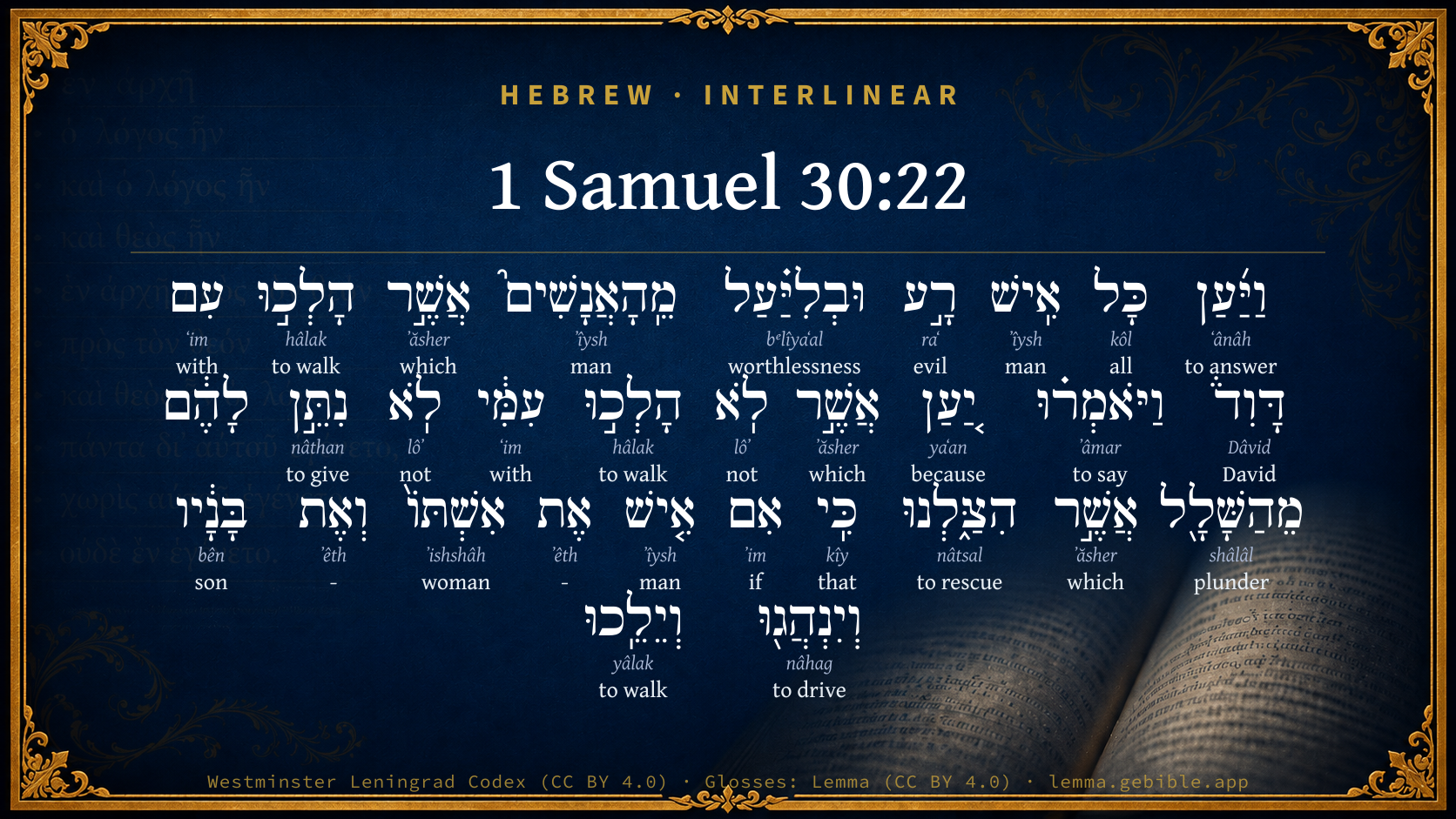
1 Samuel 30:22

Hebrew (Westminster Leningrad Codex) 1 Samuel 30:22 appears in the Hebrew Old Testament. The text above is from the Westminster Leningrad Codex. Each word links to its Strong’s number, a concise gloss, and parsing drawn from the Open Scriptures Hebrew Bible morphology. Click any word for its full Brown-Driver-Briggs (BDB) entry.
Download image
Cite this verse

1 Samuel 30:22 (World English Bible). Public Domain. Lemma interlinear Bible study tool, https://lemma.gebible.app/v/1-samuel/30/22.

Show BibTeX & RIS
BibTeX
RIS
English Translation
Then answered all the wicked men and base fellows, of those who went with David, and said, Because they didn't go with us, we will not give them anything of the spoil that we have recovered, except to every man his wife and his children, that he may lead them away, and depart.
World English Bible · Public Domain
Download a study sheet

One document with this verse’s original text, its word-by-word gloss line, the meaning frame, cross-references with their text, attributed commentary, and full source and license credits — printable, and it pastes into notes with its structure intact.

This verse Autodidact and up

Study sheet (.html) Plain text (.txt)

A passage Seminary Student

Up to 50 verses in one chapter. A passage sheet keeps up to 6 commentary sources and 12 cross-references per verse, in the order this page ranks them, and says so on the sheet whenever that leaves anything out. Ask for a single verse and you get the Autodidact verse sheet above.

Everything on this page stays free to read, with no account — the sheet is a download of what is already on screen, not access to it.

Want to remove ads? Support Godless Engineer
Compare translations 3

The same verse in 3 English versions, stacked beneath the original-language interlinear above. Click any original word for its lexicon entry.

Each is an independent rendering of the whole verse — the interlinear is not word-aligned to these translations.

Highlighted words mark where these versions differ — a whole-verse word diff, not a word-by-word alignment.

  • World English Bible Public Domain
    Then answered all the wicked men and base fellows, of those who went with David, and said, Because they didn't go with us, we will not give them anything of the spoil that we have recovered, except to every man his wife and his children, that he may lead them away, and depart.
  • King James Version Public Domain
    Then answered all the wicked men and men of Belial, of those that went with David, and said, Because they went not with us, we will not give them ought of the spoil that we have recovered, save to every man his wife and his children, that they may lead them away, and depart.
  • unfoldingWord Literal Text CC BY-SA 4.0
    But all of the evil and wicked men from the men who had gone with David answered and said, “Because they did not go with us, we will not give to them from the plunder that we have rescued except a man, his wife and his sons, that they may lead away and go.”

unfoldingWord Literal Text — © unfoldingWord, licensed CC BY-SA 4.0. Word-aligned USFM3 via Door43 (git.door43.org/unfoldingWord/en_ult).

Versions to compare (up to 4)

3 of 4 selected

Show all 18 translations

Every available English version of this verse, each an independent rendering of the whole verse.

  • World English Bible Public Domain
    Then answered all the wicked men and base fellows, of those who went with David, and said, Because they didn't go with us, we will not give them anything of the spoil that we have recovered, except to every man his wife and his children, that he may lead them away, and depart.
  • Berean Standard Bible Public Domain
    but all the wicked and worthless men among those who had gone with David said, “Because they did not go with us, we will not share with them the plunder we recovered, except for each man’s wife and children. They may take them and go.”
  • Majority Standard Bible Public Domain
    but all the wicked and worthless men among those who had gone with David said, “Because they did not go with us, we will not share with them the plunder we recovered, except for each man’s wife and children. They may take them and go.”
  • King James Version Public Domain
    Then answered all the wicked men and men of Belial, of those that went with David, and said, Because they went not with us, we will not give them ought of the spoil that we have recovered, save to every man his wife and his children, that they may lead them away, and depart.
  • American Standard Version (1901) Public Domain
    Then answered all the wicked men and base fellows, of those that went with David, and said, Because they went not with us, we will not give them aught of the spoil that we have recovered, save to every man his wife and his children, that he may lead them away, and depart.
  • Revised Version (1885) Public Domain
    Then answered all the wicked men and men of Belial, of those that went with David, and said, Because they went not with us, we will not give them aught of the spoil that we have recovered, save to every man his wife and his children, that they may lead them away and depart.
  • Geneva Bible (1599) Public Domain
    Then answered all the euill and wicked of the men that went with Dauid, and saide, Because they went not with vs, therefore will wee giue them none of the pray that wee haue recouered, saue to euery man his wife and his children: therefore let them carie them away and depart.
  • Douay-Rheims (1899) Public Domain
    Then all the wicked and unjust men that had gone with David answering, said: Because they came not with us, we will not give them any thing of the prey which we have recovered: but let every man take his wife and his children, and be contented with them, and go his way.
  • Young's Literal Translation Public Domain
    And every bad and worthless man, of the men who have gone with David, answereth, yea, they say, `Because that they have not gone with us we do not give to them of the spoil which we have delivered, except each his wife and his children, and they lead away and go.
  • Literal Standard Version CC BY-SA 4.0
    And every bad and worthless man, of the men who have gone with David, answers, indeed, they say, “Because that they have not gone with us we do not give to them of the spoil which we have delivered, except each his wife and his children, and they lead away and go.”
  • Unlocked Literal Bible CC BY-SA 4.0
    Then all the wicked men and worthless fellows among those who had gone with David said, “Because these men did not go with us, we will not give them any of the booty that we have recovered. Except that each man may take his wife and children, lead them away, and go.”
  • unfoldingWord Literal Text CC BY-SA 4.0
    But all of the evil and wicked men from the men who had gone with David answered and said, “Because they did not go with us, we will not give to them from the plunder that we have rescued except a man, his wife and his sons, that they may lead away and go.”
  • Darby Bible Public Domain
    And all the wicked men, and [men] of Belial, of those that had gone with David, answered and said, Because they went not with us, we will not give them [aught] of the spoil that we have recovered, save to every man his wife and his children, that they may lead [them] away and depart.
  • World Messianic Bible Public Domain
    Then all the wicked men and worthless fellows of those who went with David answered and said, “Because they didn’t go with us, we will not give them anything of the plunder that we have recovered, except to every man his wife and his children, that he may lead them away and depart.”
  • Webster's Bible Public Domain
    Then answered all the wicked men, and men of Belial, of those that went with David, and said, Because they went not with us, we will not give them aught of the spoil that we have recovered, save to every man his wife and his children, that they may lead them away, and depart.
  • Free Bible Version CC BY-SA 4.0
    all the unpleasant, good-for-nothing men of those who had gone with David said, “They weren't with us, so we won't share the plunder that we took, except to give them back their wives and children. They can take them and leave.”
  • Bible in Basic English Public Domain
    Then the bad and good-for-nothing men among those who went with David said, Because they did not go with us, we will give them nothing of the goods which we have got back, but only to every man his wife and children, so that he may take them and go.
  • JPS Tanakh (1917) Public Domain
    Then answered all the wicked men and base fellows, of those that went with David, and said: 'Because they went not with us, we will not give them aught of the spoil that we have recovered, save to every man his wife and his children, that they may lead them away, and depart.'

Literal Standard Version (2020), Covenant Press — licensed CC BY-SA 4.0. Text via the HelloAO Bible API (eBible.org). Unlocked Literal Bible (unfoldingWord) — licensed CC BY-SA 4.0. Text via the HelloAO Bible API (eBible.org). unfoldingWord Literal Text — © unfoldingWord, licensed CC BY-SA 4.0. Word-aligned USFM3 via Door43 (git.door43.org/unfoldingWord/en_ult). Free Bible Version, Dr. Jonathan Gallagher — licensed CC BY-SA 4.0. Text via the HelloAO Bible API (eBible.org).

Word by word

More ways to search: Search by grammar → Find every occurrence → Compare this word →

Practice this passage: Drill this verse → Learn its vocabulary →

וּבְלִיַּ֗עַל
bᵉlîyaʻal
H1100
“and · worthlessness”
Conjunction + Noun, Common, Masculine, Singular, Absolute
Part of Speech
Conjunction + Noun
Type
Common
Gender
Masculine
Number
Singular
State
Absolute
Full BDB Definition

Origin: from H1097 and H3276

TWOT: 246g

worthlessness - worthless, good for nothing, unprofitable, base fellow - wicked - ruin, destruction (construct)
  1. וַיַּ֜עַן ʻânâh H6030 “and · to answer” Conjunction + Verb, Qal, Sequential Imperfect, 3rd Person, Masculine, Singular
  2. כָּל kôl H3605 “all of” Noun, Common, Masculine, Singular, Construct
  3. אִֽישׁ ʼîysh H376 “man” Noun, Common, Masculine, Singular, Absolute
  4. רָ֣ע raʻ H7451 “evil” Adjective, Adjective, Masculine, Singular, Absolute
  5. מֵֽהָאֲנָשִׁים֮ ʼîysh H376 “from · the · men” Preposition + Particle, Definite Article + Noun, Common, Masculine, Plural, Absolute
  6. אֲשֶׁ֣ר ʼăsher H834 “which” Particle, Relative
  7. הָלְכ֣וּ hâlak H1980 “to walk” Verb, Qal, Perfect, 3rd Person, Common, Plural
  8. עִם ʻim H5973 “with” Preposition
  9. דָּוִד֒ Dâvid H1732 “David” Noun, Proper
  10. וַיֹּאמְר֗וּ ʼâmar H559 “and · to say” Conjunction + Verb, Qal, Sequential Imperfect, 3rd Person, Masculine, Plural
  11. יַ֚עַן yaʻan H3282 “because” Conjunction
  12. אֲשֶׁ֣ר ʼăsher H834 “which” Particle, Relative
  13. לֹֽא lôʼ H3808 “not” Particle, Negative
  14. הָלְכ֣וּ hâlak H1980 “to walk” Verb, Qal, Perfect, 3rd Person, Common, Plural
  15. עִמִּ֔י ʻim H5973 “with · me” Preposition + Suffix, Personal, 1st Person, Common, Singular
  16. לֹֽא lôʼ H3808 “not” Particle, Negative
  17. נִתֵּ֣ן nâthan H5414 “to give” Verb, Qal, Imperfect, 1st Person, Common, Plural
  18. מֵהַשָּׁלָ֖ל shâlâl H7998 “from · the · plunder” Preposition + Particle, Definite Article + Noun, Common, Masculine, Singular, Absolute
  19. אֲשֶׁ֣ר ʼăsher H834 “which” Particle, Relative
  20. הִצַּ֑לְנוּ nâtsal H5337 “to rescue” Verb, Hiphil, Perfect, 1st Person, Common, Plural
  21. כִּֽי kîy H3588 “that” Conjunction
  22. אִם ʼim H518 “if” Conjunction
  23. אִ֤ישׁ ʼîysh H376 “man” Noun, Common, Masculine, Singular, Absolute
  24. אֶת ʼêth H853 “-” Particle, Direct Object
  25. אִשְׁתּוֹ֙ ʼishshâh H802 “woman · his” Noun, Common, Feminine, Singular, Construct + Suffix, Personal, 3rd Person, Masculine, Singular
  26. וְאֶת ʼêth H853 “and · -” Conjunction + Particle, Direct Object
  27. בָּנָ֔יו bên H1121 “sons · his” Noun, Common, Masculine, Plural, Construct + Suffix, Personal, 3rd Person, Masculine, Singular
  28. וְיִנְהֲג֖וּ nâhag H5090 “and · to drive” Conjunction + Verb, Qal, Imperfect, 3rd Person, Masculine, Plural
  29. וְיֵלֵֽכוּ yâlak H3212 “and · to walk” Conjunction + Verb, Qal, Imperfect, 3rd Person, Masculine, Plural

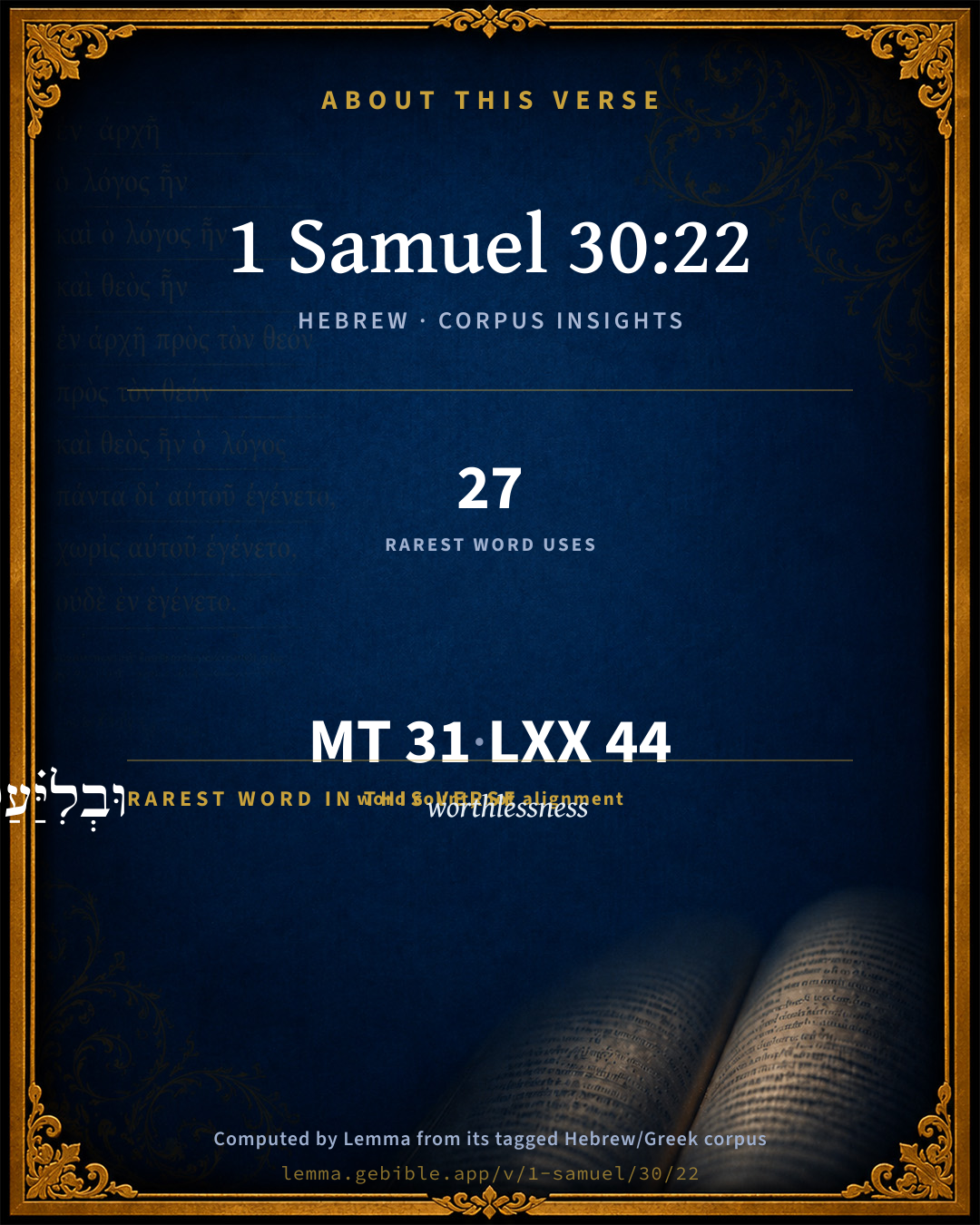
About this verse

These counts appear in no published source. They are computed here, from the morphology-tagged text and Lemma’s own curated glosses. What Lemma adds →

31
words
22
distinct lemmas
Historical
section

Shared distinctive vocabulary

וּבְלִיַּ֗עַל worthlessness H1100 occurs in 26 verses of the Hebrew Bible. Also found in:

Grammatical profile

  • 8 verbs
  • 9 nouns
  • 1 adjective
  • 3 prepositions
  • 3 conjunctions
  • 7 particles

Verb forms

  • וַיַּ֜עַן Qal · Sequential Imperfect
  • הָלְכ֣וּ Qal · Perfect
  • וַיֹּאמְר֗וּ Qal · Sequential Imperfect
  • הָלְכ֣וּ Qal · Perfect
  • נִתֵּ֣ן Qal · Imperfect
  • הִצַּ֑לְנוּ Hiphil · Perfect
  • וְיִנְהֲג֖וּ Qal · Imperfect
  • וְיֵלֵֽכוּ Qal · Imperfect

Repetition

Words recur within this verse — often emphatic in Hebrew:

  • אִֽישׁ man H376 ×3
  • הָלְכ֣וּ to walk H1980 ×2
  • אֲשֶׁ֣ר which H834 ×3
  • עִם with H5973 ×2
  • לֹֽא not H3808 ×2

Hebrew & Septuagint length

In English translation the verse runs 53 words from the Hebrew and 54 from the Septuagint (LXX English) — closely comparable.

A rough comparison of the two English renderings, which tokenize alike — not a word-level alignment.

Word counts can differ between the Hebrew and the Greek without any difference in meaning — e.g. the Hebrew direct-object marker אֵת has no separate Greek word, and Greek often adds the article ὁ.

In the original languages it is 31 Hebrew tokens and 44 Greek tokens — but the two are counted differently (Hebrew bundles its prefixes and suffixes into one token; the Greek is in lemma form), so that isn’t a like-for-like length.

Cross-references

8

Topical passages linked to 1 Samuel 30:22 in the Treasury of Scripture Knowledge — connected by theme and wording, ordered by reader-vote popularity; previews shown in the World English Bible.

  • Deuteronomy 13:13 Certain base fellows are gone out from the midst of you, and have drawn away the inhabitants of their city, saying, Let us go and serve other gods, which you have not known;
  • Matthew 7:12 Therefore whatever you desire for men to do to you, you shall also do to them; for this is the law and the prophets.
  • Judges 19:22 As they were making their hearts merry, behold, the men of the city, certain base fellows, beset the house round about, beating at the door; and they spoke to the master of the house, the old man, saying, Bring forth the man who came into your house, that we may know him.
  • 1 Samuel 22:2 Everyone who was in distress, and everyone who was in debt, and everyone who was discontented, gathered themselves to him; and he became captain over them: and there were with him about four hundred men.
  • 1 Samuel 25:17 Now therefore know and consider what you will do; for evil is determined against our master, and against all his house: for he is such a worthless fellow that one can't speak to him.
  • 1 Samuel 25:25 Please don't let my lord regard this worthless fellow, even Nabal; for as his name is, so is he; Nabal is his name, and folly is with him: but I your handmaid didn't see the young men of my lord, whom you did send.
  • 1 Kings 21:10 and set two men, base fellows, before him, and let them testify against him, saying, You did curse God and the king. Then carry him out, and stone him to death.
  • 1 Kings 21:13 The two men, the base fellows, came in and sat before him: and the base fellows bore witness against him, even against Naboth, in the presence of the people, saying, Naboth did curse God and the king. Then they carried him forth out of the city, and stoned him to death with stones.

Cross-references courtesy of OpenBible.info (CC BY 4.0).

Hebrew and Greek witnesses Masoretic Hebrew ↔ Greek Septuagint

The same verse in the two great witnesses to the Old Testament, shown verse-for-verse.

These are two independent witnesses, not word-aligned to each other, and the Septuagint is shown in lemma (dictionary) form.

Hebrew 1 Samuel 30:22 Masoretic · Westminster Leningrad Codex

וַיַּ֜עַן כָּל אִֽישׁ רָ֣ע וּבְלִיַּ֗עַל מֵֽהָאֲנָשִׁים֮ אֲשֶׁ֣ר הָלְכ֣וּ עִם דָּוִד֒ וַיֹּאמְר֗וּ יַ֚עַן אֲשֶׁ֣ר לֹֽא הָלְכ֣וּ עִמִּ֔י לֹֽא נִתֵּ֣ן לָהֶ֔ם מֵהַשָּׁלָ֖ל אֲשֶׁ֣ר הִצַּ֑לְנוּ כִּֽי אִם אִ֤ישׁ אֶת אִשְׁתּוֹ֙ וְאֶת בָּנָ֔יו וְיִנְהֲג֖וּ וְיֵלֵֽכוּ

Then answered all the wicked men and base fellows, of those who went with David, and said, Because they didn't go with us, we will not give them anything of the spoil that we have recovered, except to every man his wife and his children, that he may lead them away, and depart.

World English Bible · Public Domain

Greek LXX 1 Samuel 30:22 Septuagint · lemma form

καί ἀποκρίνω πᾶς ἀνήρ λοιμός καί πονηρός ὁ ἀνήρ ὁ πολεμιστής ὁ πορεύομαι μετά δαυίδ καί εἶπον ὅτι οὐ καταδιώκω μετά ἐγώ οὐ δίδωμι αὐτός ἐκ ὁ σκῦλον ὅς ἐκαἱρέω ὅτι ἀλλά ἤ ἕκαστος ὁ γυνή αὐτός καί ὁ τέκνον αὐτός ἀποἄγω καί ἀποστρέφω

Then every ill-disposed and bad man of the soldiers who had gone with David, answered and said, Because they did not pursue together with us, we will not give them of the spoils which we have recovered, only let each one lead away with him his wife and his children, and let them return.

LXX2012 (modern English Septuagint) · Public Domain

Hebrew: Westminster Leningrad Codex (CC BY 4.0). Greek: Septuagint (public domain); English from LXX2012 (modern English Septuagint) (Public Domain). How the Septuagint differs from the Hebrew →

Targum (Aramaic paraphrase)

1

The Targum is the ancient Jewish Aramaic paraphrase of the Hebrew Scriptures — an interpretive translation, not the Hebrew text itself. Onkelos (literal) and Pseudo-Jonathan (expansive) render the Torah, and Jonathan the Prophets. Coverage is partial: where no permissively-licensed English translation exists for a verse, only the Aramaic is shown. This is verse-level text, not a word-by-word alignment to the Hebrew.

  1. Targum Jonathan Prophets (Joshua–Malachi)
    וַאֲתֵיב כָּל גְבַר בִּישׁ וְרַשִׁיעָא מִגַבְרַיָא דַאֲזַלוּ עִם דָוִד וַאֲמַר חֲלַף דְלָא אֲזַלוּ עִמִי לָא נִתַּן לְהוֹן מֵעֲדָאָה דְשֵׁיזַבְנָא אֱלָהֵין גְבַר יַת אִתְּתֵיהּ וְיַת בְּנוֹהִי וְיִדְבְּרוּן וְיֵזְלוּן:

    (no public-domain English translation for this verse)

    Targum Jonathan — Aramaic: “Mikraot Gedolot” (public domain). English: “Sefaria Community Translation” (CC0 1.0 (public-domain dedication)); “London "Chaldee Paraphrase," 1871” (public domain). Text via Sefaria.

Commentary

Notes on 1 Samuel 30:22 from classic Christian and Jewish commentators (each source and its license shown beneath its notes). The classic Christian expositions comment on the surrounding passage and are grouped to its opening verse, so a note may address several verses; the Jewish commentaries on the Tanakh (Rashi and others) are per-verse, so they appear only where the commentator wrote on this verse.

Lemma curates 59 commentaries, every one of them public domain or Creative Commons licensed, each selected and text-cleaned for this edition rather than reprinted as found. About our sources →

Trapp's Complete Commentary

John Trapp

1Sa 30:22 Then answered all the wicked men and [men] of Belial, of those that went with David, and said, Because they went not with us, we will not give them [ought] of the spoil that we have recovered, save to every man his wife and his children, that they may lead [them] away, and depart.

Ver. 22. Of those that went with David.] As good as he was, he had bad men and Belialists in his retinue: although he had done his part by them to make them better. {Psa 34:11; Psa 34:1, with title}

Because they went not with us.] But did they not as good service in staying behind, and guarding the carriages? which if it had not been done, you would have fought but faintly.

We will not give them aught.] A man had as good deal with a cannibal, as with a truly covetous captive.

John Trapp, A Commentary or Exposition upon All the Books of the Old and New Testament (1647–1656) — public domain. Text from a community e-Sword module.

Tyndale Open Study Notes

Tyndale Open Resources

30:22 tell them to be gone: This heartless group wanted to drive away the nonparticipants with no reward.

Tyndale Open Study Notes — © Tyndale Open Resources, licensed CC BY-SA 4.0. Text via the HelloAO Bible API.

Geneva Bible (1599)

Geneva Bible translators

Under these are comprehended the cattle and goods, which appertained to every man.

Geneva Bible (1599) marginal notes — public domain. Text via Bolls.life.

Adam Clarke's Commentary

Verse 22. Men of Belial] This is a common expression to denote the sour, the rugged, the severe, the idle, and the profane.

Adam Clarke's Commentary on the Bible (1810–1826) — public domain. Text from a community e-Sword/MySword module.

Ellicott's Commentary for English Readers

(22) Then answered all the wicked men and men of Belial.—The scene here related chronicles an act of greed and of heartless covetousness—an act that has been many times repeated in the world’s history. The wise compiler of the book chose it as part of the memoirs of David, which were to be preserved in the sacred volume, because it was another authoritative declaration on the part of the beloved king respecting a question which would crop up again and again on the conclusion of a campaign. The chronicler was justified in his selection, for this famous decision of David continued in force until the time of the Maccabees. (See 2Ma_8:28-30.) A somewhat similar law was enacted by Moses. (See Num_31:27.) The dispute arose thus: The victorious troop with their enormous booty quickly re turned to the brook Besor, where the 200 that had broken down on the rapid march had been left to guard the baggage. David salutes these with all kindly courtesy; but the harmony which prevailed in the little camp is speedily broken owing to the highhanded claims of the 400 who had actually taken part in the rescue. These refused to share the booty with their comrades who had been left behind, only proposing just to restore to them their wives and those things of their own which had been recovered from the Amalekites. David, however, refused to listen to these iniquitous claims, and decided that all the fighting part of the force, and those men who had stayed behind and guarded the baggage at the brook Besor, should share alike.

A Bible Commentary for English Readers, edited by Charles John Ellicott (1878–1897) — public domain. Text from a community e-Sword module.

The Cambridge Bible for Schools and Colleges

gen. ed. J. J. S. Perowne

21–25. The division of the spoil

22. Then answered, &c.] Then answered every wicked man and every worthless man … Because they went not with me. Each spoke for himself, in the true spirit of selfishness.

The Cambridge Bible for Schools and Colleges (gen. ed. J. J. S. Perowne; Cambridge University Press, 1878–1918) — public domain. Text from a community e-Sword module.

John Gill's Exposition

Then answered all the wicked men, and men of Belial, of those that went with David,.... Who were ill natured men, and of covetous dispositions, as what is called their answer shows; and it seems by that as if the two hundred men had moved that they might have their share in the spoil, or that David had given some intimation that they should:

and said, because they went not with us, we will not give, them ought of the spoil that we have recovered: which was very unreasonable not to let them have what was before their own which was recovered; and indeed it was but right they should have their share in the spoil that was taken which was of others, as will appear hereafter: but they were of opinion and were come to a resolution, they should have no more:

save to every man his wife and his children; which was very unkind and ungenerous:

that they may lead them away, and depart; but whither? Ziklag was burnt, the land of Israel they would not return unto, where they must fall a sacrifice to Saul; these men cared not where they went, so that they were rid of them, that they might not have any share with them in the spoil.

John Gill's Exposition of the Whole Bible (1746–1763) — public domain (CC PDM 1.0). Text via the HelloAO Bible API.

Haydock's Catholic Bible Commentary

Unjust. Hebrew Belial. See Deuteronomy xiii. 13. (Calmet) --- David saluted those who had remained at Besor, to shew that he approved of their conduct, unless we may attribute it to his great clemency. (Menochius)

George Leo Haydock (1774–1849), Haydock's Catholic Family Bible and Commentary, 1859 edition — public domain. Excludes Psalms (Douay-Rheims chapter numbering differs from Protestant) and Deuterocanonical books (Catholic canon only).

Matthew Poole's English Annotations

Then answered all the wicked men; when those two hundred men required or expected a part of the spoil; and they gathered from David’s words and carriage that he intended to give it to them.

Wicked men and men of Belial; so he calls them, for their covetousness, and injustice, and churlishness to their brethren; by which expressions we may judge how heinous and odious those sins are in God’s sight.

Because they went not with us; which was from their impotency; not by choice or design. Herein therefore was their iniquity and unreasonableness, they would punish them for no fault.

Matthew Poole's English Annotations on the Holy Bible (1683–1685) — public domain. Text from a community e-Sword/MySword module.

Whedon's Commentary on the Bible

Daniel D. Whedon

22. All the wicked men — Envious, avaricious, selfish persons, who wished to appropriate all the booty among themselves.

Daniel D. Whedon (gen. ed.), Commentary on the Old and New Testaments (1874–1909) — public domain. Text from a community e-Sword module.

Lesson kit

Teaching starters — assembled from the data on this page, not authored interpretation. Every prompt links to the verse data it draws on. Edit before teaching.

1 Samuel, in the Historical, opens this verse with 31 words (22 distinct Hebrew lemmas). Its most distinctive word is bᵉlîyaʻal (“worthlessness”). A historical commentator’s framing appears above. Read the whole chapter for the surrounding context.

Discussion questions

  1. The word bᵉlîyaʻal carries the sense “worthlessness.” How does it shape the verse?
  2. How does Deuteronomy 13:13, which shares the word «worthlessness», read alongside this verse?
  3. What does the repetition of “man” (3× in this one verse) do in this verse?
  4. The translations on this page render this verse differently — a whole-verse word diff, not a word-by-word alignment. What might account for the different wordings?
  5. «וַיַּ֜עַן» is a Qal Sequential Imperfect verb. How does that grammatical form shape the action described?
  6. Compare how Trapp's Complete Commentary and Tyndale Open Study Notes read this verse. Where do they agree or differ?

Things to notice

Reading settings

Reading text

Shown beneath each verse's original-language words.

Old Testament
Old Testament edition

Read the OT as the Masoretic Hebrew (MT) or the Greek Septuagint (LXX).

English shown for the Greek Septuagint (in the Hebrew ↔ Greek comparison).

Comparing translations? Open the Compare panel on any verse page to stack up to four side by side.