
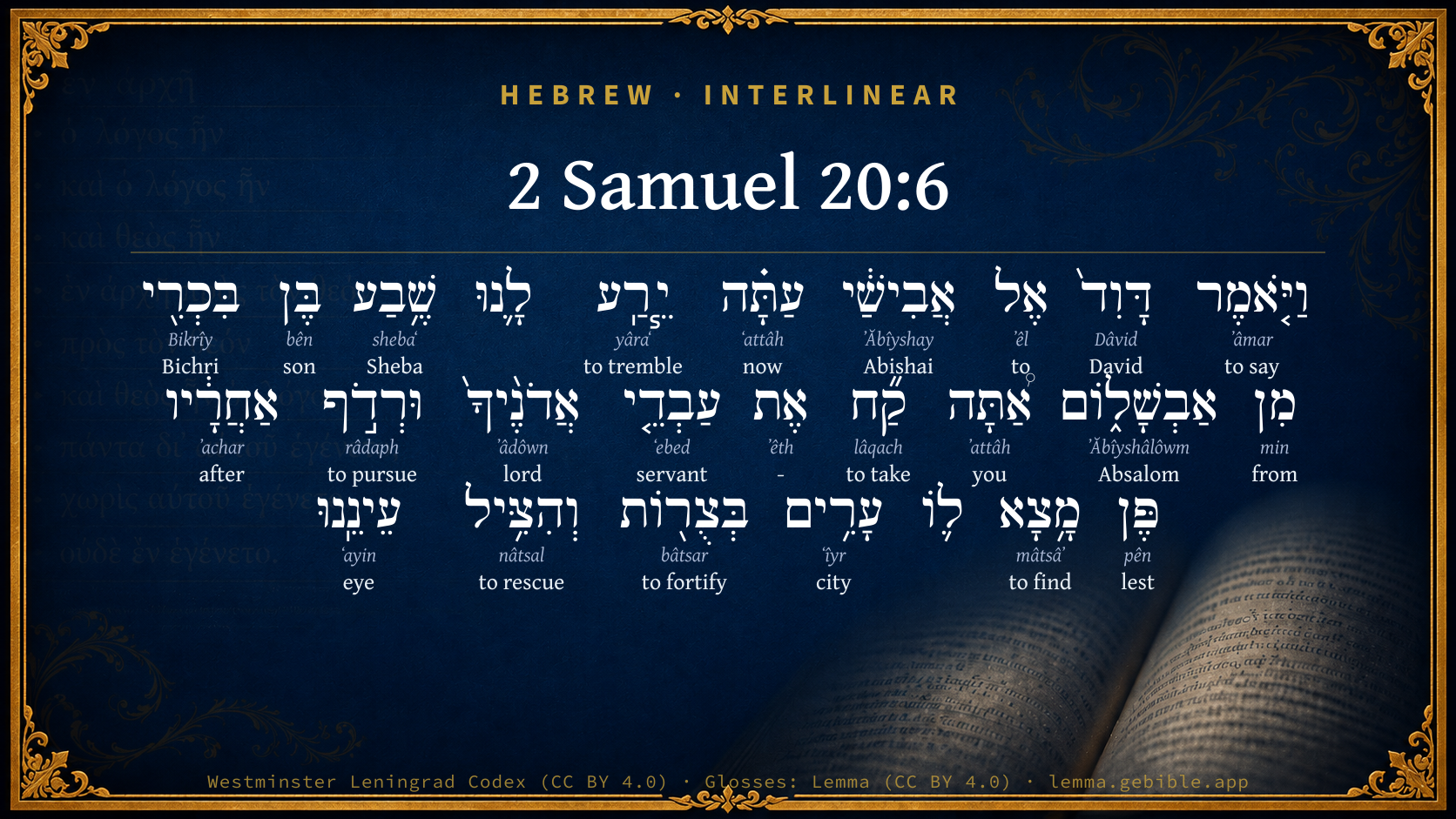
2 Samuel 20:6

Hebrew (Westminster Leningrad Codex) 2 Samuel 20:6 appears in the Hebrew Old Testament. The text above is from the Westminster Leningrad Codex. Each word links to its Strong’s number, a concise gloss, and parsing drawn from the Open Scriptures Hebrew Bible morphology. Click any word for its full Brown-Driver-Briggs (BDB) entry.
Download image
Cite this verse

2 Samuel 20:6 (World English Bible). Public Domain. Lemma interlinear Bible study tool, https://lemma.gebible.app/v/2-samuel/20/6.

Show BibTeX & RIS
BibTeX
RIS
English Translation
David said to Abishai, Now will Sheba the son of Bichri do us more harm than did Absalom: take your lord's servants, and pursue after him, lest he get him fortified cities, and escape out of our sight.
World English Bible · Public Domain
Download a study sheet

One document with this verse’s original text, its word-by-word gloss line, the meaning frame, cross-references with their text, attributed commentary, and full source and license credits — printable, and it pastes into notes with its structure intact.

This verse Autodidact and up

Study sheet (.html) Plain text (.txt)

A passage Seminary Student

Up to 50 verses in one chapter. A passage sheet keeps up to 6 commentary sources and 12 cross-references per verse, in the order this page ranks them, and says so on the sheet whenever that leaves anything out. Ask for a single verse and you get the Autodidact verse sheet above.

Everything on this page stays free to read, with no account — the sheet is a download of what is already on screen, not access to it.

Want to remove ads? Support Godless Engineer
Compare translations 3

The same verse in 3 English versions, stacked beneath the original-language interlinear above. Click any original word for its lexicon entry.

Each is an independent rendering of the whole verse — the interlinear is not word-aligned to these translations.

Highlighted words mark where these versions differ — a whole-verse word diff, not a word-by-word alignment.

  • World English Bible Public Domain
    David said to Abishai, Now will Sheba the son of Bichri do us more harm than did Absalom: take your lord's servants, and pursue after him, lest he get him fortified cities, and escape out of our sight.
  • King James Version Public Domain
    And David said to Abishai, Now shall Sheba the son of Bichri do us more harm than did Absalom: take thou thy lord's servants, and pursue after him, lest he get him fenced cities, and escape us.
  • unfoldingWord Literal Text CC BY-SA 4.0
    And David said to Abishai, “Now Sheba, the son of Bichri, will harm us more than Absalom. You, take the servants of your lord and pursue after him, lest he find fortified cities for himself and remove our eyes.”

unfoldingWord Literal Text — © unfoldingWord, licensed CC BY-SA 4.0. Word-aligned USFM3 via Door43 (git.door43.org/unfoldingWord/en_ult).

Versions to compare (up to 4)

3 of 4 selected

Show all 18 translations

Every available English version of this verse, each an independent rendering of the whole verse.

  • World English Bible Public Domain
    David said to Abishai, Now will Sheba the son of Bichri do us more harm than did Absalom: take your lord's servants, and pursue after him, lest he get him fortified cities, and escape out of our sight.
  • Berean Standard Bible Public Domain
    And David said to Abishai, “Now Sheba the son of Bichri will do us more harm than Absalom. Take your lord’s servants and pursue him, or he will find fortified cities and elude us.”
  • Majority Standard Bible Public Domain
    And David said to Abishai, “Now Sheba the son of Bichri will do us more harm than Absalom. Take your lord’s servants and pursue him, or he will find fortified cities and elude us.”
  • King James Version Public Domain
    And David said to Abishai, Now shall Sheba the son of Bichri do us more harm than did Absalom: take thou thy lord's servants, and pursue after him, lest he get him fenced cities, and escape us.
  • American Standard Version (1901) Public Domain
    And David said to Abishai, Now will Sheba the son of Bichri do us more harm than did Absalom: take thou thy lord's servants, and pursue after him, lest he get him fortified cities, and escape out of our sight.
  • Revised Version (1885) Public Domain
    And David said to Abishai, Now shall Sheba the son of Bichri do us more harm than did Absalom: take thou thy lord’s servants, and pursue after him, lest he get him fenced cities, and escape out of our sight.
  • Geneva Bible (1599) Public Domain
    Then Dauid sayd to Abishai, Now shall Sheba the sonne of Bichri doe vs more harme then did Absalom: take thou therefore thy lords seruants and follow after him, lest he get him walled cities, and escape vs.
  • Douay-Rheims (1899) Public Domain
    And David said to Abisai: Now will Seba the son of Bochri do us more harm than did Absalom: take thou therefore the servants of thy lord, and pursue after him, lest he find fenced cities, and escape us.
  • Young's Literal Translation Public Domain
    and David saith unto Abishai, `Now doth Sheba son of Bichri do evil to us more than Absalom; thou, take the servants of thy lord, and pursue after him, lest he have found for himself fenced cities, and delivered himself `from' our eye.'
  • Literal Standard Version CC BY-SA 4.0
    and David says to Abishai, “Now Sheba son of Bichri does evil to us more than Absalom; you, take the servants of your lord, and pursue after him, lest he has found fortified cities for himself, and delivered himself [from] our eye.”
  • Unlocked Literal Bible CC BY-SA 4.0
    So David said to Abishai, “Now Sheba son of Bikri will do us more harm than Absalom did. Take your master's servants, my soldiers, and pursue after him, or he will find fortified cities and escape out of our sight.”
  • unfoldingWord Literal Text CC BY-SA 4.0
    And David said to Abishai, “Now Sheba, the son of Bichri, will harm us more than Absalom. You, take the servants of your lord and pursue after him, lest he find fortified cities for himself and remove our eyes.”
  • Darby Bible Public Domain
    And David said to Abishai, Now shall Sheba the son of Bichri do us more harm than did Absalom. Take thou thy lord's servants, and pursue after him, lest he get him fortified cities and escape our sight.
  • World Messianic Bible Public Domain
    David said to Abishai, “Now Sheba the son of Bichri will do us more harm than Absalom did. Take your lord’s servants and pursue after him, lest he get himself fortified cities, and escape out of our sight.”
  • Webster's Bible Public Domain
    And David said to Abishai, Now shall Sheba the son of Bichri do us more harm than did Absalom: take thou thy lord's servants, and pursue him, lest he get for himself fortified cities, and escape us.
  • Free Bible Version CC BY-SA 4.0
    David then spoke to Abishai, saying, “Now Sheba the son of Bichri is going to cause us more trouble than Absalom did. Take the king's men and chase him down, or he will take over fortified towns and get away from us.”
  • Bible in Basic English Public Domain
    And David said to Abishai, Sheba, the son of Bichri, will do us more damage than Absalom did; so take some of your lord's servants and go after him, before he makes himself safe in the walled towns, and gets away before our eyes.
  • JPS Tanakh (1917) Public Domain
    And David said to Abishai: 'Now will Sheba the son of Bichri do us more harm than did Absalom; take thou thy lord's servants, and pursue after him, lest he get him fortified cities, and escape out of our sight.'

Literal Standard Version (2020), Covenant Press — licensed CC BY-SA 4.0. Text via the HelloAO Bible API (eBible.org). Unlocked Literal Bible (unfoldingWord) — licensed CC BY-SA 4.0. Text via the HelloAO Bible API (eBible.org). unfoldingWord Literal Text — © unfoldingWord, licensed CC BY-SA 4.0. Word-aligned USFM3 via Door43 (git.door43.org/unfoldingWord/en_ult). Free Bible Version, Dr. Jonathan Gallagher — licensed CC BY-SA 4.0. Text via the HelloAO Bible API (eBible.org).

Word by word

More ways to search: Search by grammar → Find every occurrence → Compare this word →

Practice this passage: Drill this verse → Learn its vocabulary →

יֵ֧רַֽע
yâraʻ
H3415
“to tremble”
Verb, Qal, Imperfect, 3rd Person, Masculine, Singular
Part of Speech
Verb
Stem
Qal
Form
Imperfect
Person
3rd Person
Gender
Masculine
Number
Singular
Full BDB Definition

Origin: a primitive root

TWOT: 917

(Qal) to tremble, quiver
  1. וַיֹּ֤אמֶר ʼâmar H559 “and · to say” Conjunction + Verb, Qal, Sequential Imperfect, 3rd Person, Masculine, Singular
  2. דָּוִד֙ Dâvid H1732 “David” Noun, Proper
  3. אֶל ʼêl H413 “to” Preposition
  4. אֲבִישַׁ֔י ʼĂbîyshay H52 “Abishai” Noun, Proper
  5. עַתָּ֗ה ʻattâh H6258 “now” Adverb
  6. שֶׁ֥בַע shebaʻ H7652 “Sheba” Adjective, Cardinal number, Feminine, Singular, Absolute
  7. בֶּן bên H1121 “son of” Noun, Common, Masculine, Singular, Construct
  8. בִּכְרִ֖י Bikrîy H1075 “Bichri” Noun, Proper
  9. מִן min H4480 “from” Preposition
  10. אַבְשָׁל֑וֹם ʼĂbîyshâlôwm H53 “Absalom” Noun, Proper
  11. אַ֠תָּה ʼattâh H859 “you” Pronoun, Personal, 2nd Person, Masculine, Singular
  12. קַ֞ח lâqach H3947 “take” Verb, Qal, Imperative, 2nd Person, Masculine, Singular
  13. אֶת ʼêth H853 “-” Particle, Direct Object
  14. עַבְדֵ֤י ʻebed H5650 “servants of” Noun, Common, Masculine, Plural, Construct
  15. אֲדֹנֶ֨יךָ֙ ʼâdôwn H113 “lords · your” Noun, Common, Masculine, Plural, Construct + Suffix, Personal, 2nd Person, Masculine, Singular
  16. וּרְדֹ֣ף râdaph H7291 “and · pursue” Conjunction + Verb, Qal, Imperative, 2nd Person, Masculine, Singular
  17. אַחֲרָ֔יו ʼachar H310 “after · him” Preposition + Suffix, Personal, 3rd Person, Masculine, Singular
  18. פֶּן pên H6435 “lest” Conjunction
  19. מָ֥צָא mâtsâʼ H4672 “to find” Verb, Qal, Perfect, 3rd Person, Masculine, Singular
  20. עָרִ֥ים ʻîyr H5892 “cities” Noun, Common, Feminine, Plural, Absolute
  21. בְּצֻר֖וֹת bâtsar H1219 “fortified” Adjective, Adjective, Feminine, Plural, Absolute
  22. וְהִצִּ֥יל nâtsal H5337 “and · to rescue” Conjunction + Verb, Hiphil, Sequential Perfect, 3rd Person, Masculine, Singular
  23. עֵינֵֽנוּ ʻayin H5869 “eye · our” Noun, Common, Both, Singular, Construct + Suffix, Personal, 1st Person, Common, Plural

About this verse

These counts appear in no published source. They are computed here, from the morphology-tagged text and Lemma’s own curated glosses. What Lemma adds →

26
words
24
distinct lemmas
Historical
section

Notable vocabulary

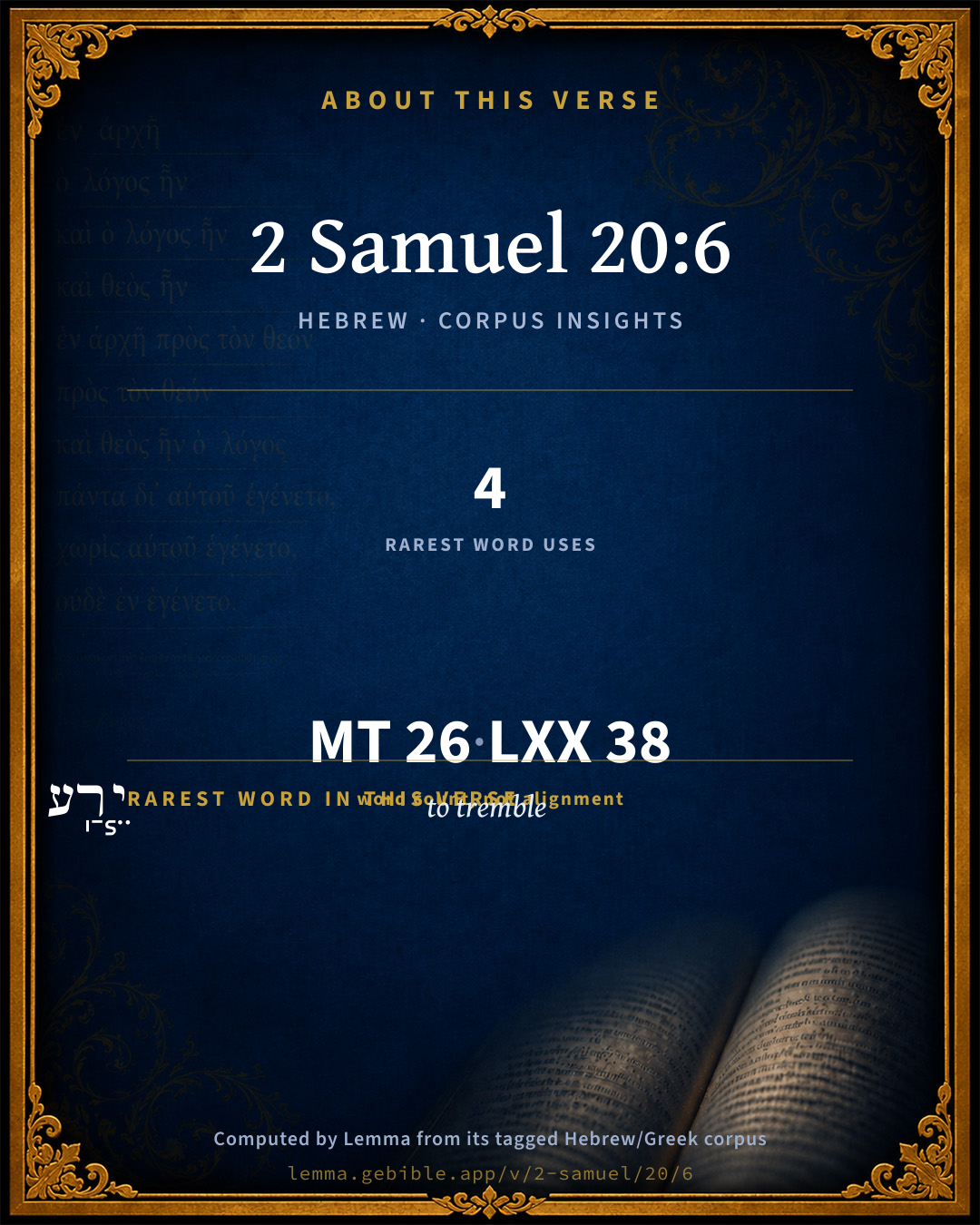
The rarest word here is יֵ֧רַֽע to tremble H3415 — appearing just 4 times in the whole Hebrew Bible.

Shared distinctive vocabulary

יֵ֧רַֽע to tremble H3415 occurs in 4 verses of the Hebrew Bible. Also found in:

Grammatical profile

  • 6 verbs
  • 9 nouns
  • 2 adjectives
  • 1 pronoun
  • 5 prepositions
  • 1 conjunction
  • 1 adverb
  • 1 particle

Verb forms

  • וַיֹּ֤אמֶר Qal · Sequential Imperfect
  • יֵ֧רַֽע Qal · Imperfect
  • קַ֞ח Qal · Imperative
  • וּרְדֹ֣ף Qal · Imperative
  • מָ֥צָא Qal · Perfect
  • וְהִצִּ֥יל Hiphil · Sequential Perfect

Hebrew & Septuagint length

In English translation the verse runs 38 words from the Hebrew and 46 from the Septuagint (LXX English) — closely comparable.

A rough comparison of the two English renderings, which tokenize alike — not a word-level alignment.

Word counts can differ between the Hebrew and the Greek without any difference in meaning — e.g. the Hebrew direct-object marker אֵת has no separate Greek word, and Greek often adds the article ὁ.

In the original languages it is 26 Hebrew tokens and 38 Greek tokens — but the two are counted differently (Hebrew bundles its prefixes and suffixes into one token; the Greek is in lemma form), so that isn’t a like-for-like length.

Cross-references

15

Topical passages linked to 2 Samuel 20:6 in the Treasury of Scripture Knowledge — connected by theme and wording, ordered by reader-vote popularity; previews shown in the World English Bible.

  • 2 Samuel 11:11 Uriah said to David, The ark, and Israel, and Judah, abide in booths; and my lord Joab, and the servants of my lord, are encamped in the open field; shall I then go into my house, to eat and to drink, and to lie with my wife? as you live, and as your soul lives, I will not do this thing.
  • 2 Samuel 21:17 But Abishai the son of Zeruiah helped him, and struck the Philistine, and killed him. Then the men of David swore to him, saying, You shall go no more out with us to battle, that you don't quench the lamp of Israel.
  • 1 Kings 1:33 The king said to them, Take with you the servants of your lord, and cause Solomon my son to ride on my own mule, and bring him down to Gihon:
  • 1 Samuel 26:6 Then answered David and said to Ahimelech the Hittite, and to Abishai the son of Zeruiah, brother to Joab, saying, Who will go down with me to Saul to the camp? Abishai said, I will go down with you.
  • 2 Samuel 2:18 The three sons of Zeruiah were there, Joab, and Abishai, and Asahel: and Asahel was as light of foot as a wild gazelle.
  • 2 Samuel 3:30 So Joab and Abishai his brother killed Abner, because he had killed their brother Asahel at Gibeon in the battle.
  • 2 Samuel 3:39 I am this day weak, though anointed king; and these men the sons of Zeruiah are too hard for me. May Yahweh reward the evil-doer according to his wickedness."
  • 2 Samuel 10:9–10 Now when Joab saw that the battle was set against him before and behind, he chose of all the choice men of Israel, and put them in array against the Syrians:
  • 2 Samuel 10:14 When the children of Ammon saw that the Syrians were fled, they likewise fled before Abishai, and entered into the city. Then Joab returned from the children of Ammon, and came to Jerusalem.
  • 2 Samuel 18:2 David sent forth the people, a third part under the hand of Joab, and a third part under the hand of Abishai the son of Zeruiah, Joab's brother, and a third part under the hand of Ittai the Gittite. The king said to the people, I will surely go forth with you myself also.
  • 2 Samuel 18:12 The man said to Joab, Though I should receive a thousand [pieces of] silver in my hand, I still wouldn't put forth my hand against the king's son; for in our hearing the king charged you and Abishai and Ittai, saying, Beware that none touch the young man Absalom.
  • 2 Samuel 19:7 Now therefore arise, go forth, and speak comfortably to your servants; for I swear by Yahweh, if you don't go forth, there will not stay a man with you this night: and that will be worse to you than all the evil that has happened to you from your youth until now.
  • 2 Samuel 23:18 Abishai, the brother of Joab, the son of Zeruiah, was chief of the three. He lifted up his spear against three hundred and killed them, and had a name among the three.
  • 1 Chronicles 11:20 Abishai, the brother of Joab, he was chief of the three; for he lifted up his spear against three hundred and killed them, and had a name among the three.
  • 1 Chronicles 18:12 Moreover Abishai the son of Zeruiah struck of the Edomites in the Valley of Salt eighteen thousand.

Cross-references courtesy of OpenBible.info (CC BY 4.0).

Hebrew and Greek witnesses Masoretic Hebrew ↔ Greek Septuagint

The same verse in the two great witnesses to the Old Testament, shown verse-for-verse.

These are two independent witnesses, not word-aligned to each other, and the Septuagint is shown in lemma (dictionary) form.

Hebrew 2 Samuel 20:6 Masoretic · Westminster Leningrad Codex

וַיֹּ֤אמֶר דָּוִד֙ אֶל אֲבִישַׁ֔י עַתָּ֗ה יֵ֧רַֽע לָ֛נוּ שֶׁ֥בַע בֶּן בִּכְרִ֖י מִן אַבְשָׁל֑וֹם אַ֠תָּה קַ֞ח אֶת עַבְדֵ֤י אֲדֹנֶ֨יךָ֙ וּרְדֹ֣ף אַחֲרָ֔יו פֶּן מָ֥צָא ל֛וֹ עָרִ֥ים בְּצֻר֖וֹת וְהִצִּ֥יל עֵינֵֽנוּ

David said to Abishai, Now will Sheba the son of Bichri do us more harm than did Absalom: take your lord's servants, and pursue after him, lest he get him fortified cities, and escape out of our sight.

World English Bible · Public Domain

Greek LXX 2 Samuel 20:6 Septuagint · lemma form

καί εἶπον δαυίδ πρός αβεσσα νῦν κακοποιέω ἐγώ σαβεε υἱός βοχορι ὑπέρ αβεσσαλωμ καί νῦν σύ λαμβάνω μετά σεαυτοῦ ὁ παῖς ὁ κύριος σύ καί καταδιώκω ὀπίσω αὐτός μήποτε ἑαυτοῦ εὑρίσκω πόλις ὀχυρός καί σκιάζω ὁ ὀφθαλμός ἐγώ

And David said to Amessai, Now shall Sabee the son of Bochori do us more harm than Abessalom: now then take you with you the servants of your lord, and follow after him, lest he find for himself strong cities, so will he blind our eyes.

LXX2012 (modern English Septuagint) · Public Domain

On this verse, Ellicott's Commentary for English Readers discusses the Septuagint’s reading. Read the note in Commentary ↓

Hebrew: Westminster Leningrad Codex (CC BY 4.0). Greek: Septuagint (public domain); English from LXX2012 (modern English Septuagint) (Public Domain). How the Septuagint differs from the Hebrew →

Targum (Aramaic paraphrase)

1

The Targum is the ancient Jewish Aramaic paraphrase of the Hebrew Scriptures — an interpretive translation, not the Hebrew text itself. Onkelos (literal) and Pseudo-Jonathan (expansive) render the Torah, and Jonathan the Prophets. Coverage is partial: where no permissively-licensed English translation exists for a verse, only the Aramaic is shown. This is verse-level text, not a word-by-word alignment to the Hebrew.

  1. Targum Jonathan Prophets (Joshua–Malachi)
    וַאֲמַר דָוִד לַאֲבִישַׁי כְּעַן יַבְאֵישׁ לָנָא שֶׁבַע בַּר בִּכְרִי מִן אַבְשָׁלוֹם אַתְּ דְבַר יַת עַבְדֵי רִבּוֹנָךְ וּרְדַף בַּתְרוֹהִי דִלְמָא יַשְׁכַּח לֵיהּ קִרְוִין כְּרִיכָן וְיָעִיק לָנָא:

    (no public-domain English translation for this verse)

    Targum Jonathan — Aramaic: “Mikraot Gedolot” (public domain). English: “Sefaria Community Translation” (CC0 1.0 (public-domain dedication)); “London "Chaldee Paraphrase," 1871” (public domain). Text via Sefaria.

Commentary

Notes on 2 Samuel 20:6 from classic Christian and Jewish commentators (each source and its license shown beneath its notes). The classic Christian expositions comment on the surrounding passage and are grouped to its opening verse, so a note may address several verses; the Jewish commentaries on the Tanakh (Rashi and others) are per-verse, so they appear only where the commentator wrote on this verse.

Lemma curates 59 commentaries, every one of them public domain or Creative Commons licensed, each selected and text-cleaned for this edition rather than reprinted as found. About our sources →

Trapp's Complete Commentary

John Trapp

2Sa 20:6 And David said to Abishai, Now shall Sheba the son of Bichri do us more harm than [did] Absalom: take thou thy lord’s servants, and pursue after him, lest he get him fenced cities, and escape us.

Ver. 6. Do us more harm than did Absalom.] David’s endless troubles kept his body still in action, his mind in passions, and his prowess in use, as one speaketh of our King John. {a} Affliction, saith another, so held in the Saxon kings in the Danish wars, that, having little outlets and leisure for ease and luxury, they were made the more pious, just, and careful in their government. {b}

Take thou thy lord’s servants.] That is, My guard, and those other that are in readiness, as 2Sa 20:7.

{a} Speed.

{b} Daniel.

John Trapp, A Commentary or Exposition upon All the Books of the Old and New Testament (1647–1656) — public domain. Text from a community e-Sword module.

Joseph Benson's Commentary

2Sa 20:6-7. Then David said to Abishai — Not to Joab; lest by this means he should recover his place, and Amasa be discontented, and David’s fidelity in making good his promise to Amasa be questioned. Now shall Sheba do us more harm than Absalom — If he have time to gather an army; the people being highly incensed by the provocation which the men of Judah had given them. Take thy lord’s servants — The guards that attended David, and the standing forces which were always kept in readiness. There went out after him Joab’s men — A body of men whom he particularly commanded, with whom Joab also might go in some character, watching an opportunity to do what he designed.

Joseph Benson's Commentary on the Old and New Testaments (1811–1818) — public domain. Text from a community e-Sword module.

Geneva Bible (1599)

Geneva Bible translators

Either them which had been under Joab or David’s men.

Geneva Bible (1599) marginal notes — public domain. Text via Bolls.life.

Ellicott's Commentary for English Readers

(6) David said to Abishai.—David is determined to pass over Joab, and, therefore, when Amasa fails in this crisis, requiring immediate action, he summons Abishai, and puts him in command of such forces as were at hand in Jerusalem, and gives him orders for the rapid pursuit of Sheba. The clause “escape us” is difficult, and doubtful in the original, and the English follows the Vulg. Others translate “pluck out our eye,” i.e., do us great harm; others as the LXX., “over shadow our eye,” meaning either cause us anxiety, or hide where we cannot find him.

A Bible Commentary for English Readers, edited by Charles John Ellicott (1878–1897) — public domain. Text from a community e-Sword module.

The Cambridge Bible for Schools and Colleges

gen. ed. J. J. S. Perowne

6. to Abishai] David now gave his orders to Abishai, being determined at any rate to supersede Joab. For the moment Joab seemed to acquiesce, and marched out under his brother’s command (2Sa_20:7), intending to wait his opportunity. This speedily presented itself: without scruple he murdered his rival, and then by Abishai’s consent, resumed his old position as commander-in-chief (2Sa_20:10-11).

thy lord’s servants] The bodies of troops mentioned in 2Sa_20:7, which formed a small standing army.

escape us] A phrase of doubtful meaning, found nowhere else. Either as E. V. following the Vulg. escape us: or pluck out our eye = do us serious injury: or as the Sept. overshadow our eyes = cause us anxiety.

The Cambridge Bible for Schools and Colleges (gen. ed. J. J. S. Perowne; Cambridge University Press, 1878–1918) — public domain. Text from a community e-Sword module.

John Gill's Exposition

And David said to Abishai,.... For it seems he would have nothing to say to Joab, being displeased with him for slaying Absalom, and having removed him from his posts; and therefore speaks to the next officer in his army, Abishai; though Josephus (p) says, he addressed himself to Joab, contrary to the express words of the text:

now shall Sheba the son of Bichri do us more harm than did Absalom; gain a greater party, and give more trouble to subdue him, unless suppressed in time:

take thou thy lord's servants, and pursue after him; without waiting for Amasa, and the troops he was assembling; delays in such a case as an insurrection being dangerous, which ought to be nipped in the bud, and crushed as soon as possible; in order to which, he bids him take his servants that were about him, his bodyguards, and pursue Sheba:

lest he get him fenced cities; where he may secure himself, and hold out a siege a long time, and give a great deal of trouble:

and escape us; for the present; or "escape our eyes", as the "Keri", or marginal reading is; we shall lose sight of him, and not know which way he is gone, if he is not pursued quickly.

(p) Antiqu. l. 7. c. 11. sect. 6.

John Gill's Exposition of the Whole Bible (1746–1763) — public domain (CC PDM 1.0). Text via the HelloAO Bible API.

Albert Barnes' Notes on the Bible

To Abishai - Probably, as the king was on bad terms with Joab, and wished to deprive him of his post as Captain of the host, he gave his orders to Abishai, and weakly connived at the execution of them by Joab, which was inevitable.

Albert Barnes' Notes on the Bible (1834–1885) — public domain. Text from a community e-Sword/MySword module.

Haydock's Catholic Bible Commentary

Lord, the king; or perhaps Joab. (Menochius) --- A select company always attended the king; and some of these he sent, for greater expedition, to attack Seba, before he had become too strong.

George Leo Haydock (1774–1849), Haydock's Catholic Family Bible and Commentary, 1859 edition — public domain. Excludes Psalms (Douay-Rheims chapter numbering differs from Protestant) and Deuterocanonical books (Catholic canon only).

Matthew Poole's English Annotations

David said to Abishai; not to Joab, lest by this means he should recover his place, and Amasa be discontented, and David’s fidelity in making good his promise to Amasa be questioned.

Thy lord’s servants, i.e. my guards that attend upon my person, and the other soldiers who are now present with me. He speaks of himself in the third person, as is very frequent. For it is not probable he would now call Joab his lord, whom he had lately deposed; nor Amasa, who had not yet taken actual possession of his place, nor had the command over the king’s guards.

Matthew Poole's English Annotations on the Holy Bible (1683–1685) — public domain. Text from a community e-Sword/MySword module.

Whedon's Commentary on the Bible

Daniel D. Whedon

6. David said to Abishai — He grew impatient over the slow movements of Amasa, and, knowing that every day might add new strength to the rebellion, he sent forth Joab’s brother; for he could not now safely or consistently send Joab, who had been superseded in office, and might himself be strongly tempted to join the insurgents.

Thy lord’s servants — The mighty men and faithful adherents who had returned to Jerusalem with the king, and ever kept near his person. They are called David’s men in 2Sa_19:41, and included the Cherethites and Pelethites.

Escape us — Margin, correctly: deliver himself from our eyes; that is, elude all our search and effort to overcome him. Keil translates, tear out our eye, that is, do us a serious injury.

Daniel D. Whedon (gen. ed.), Commentary on the Old and New Testaments (1874–1909) — public domain. Text from a community e-Sword module.

The Pulpit Commentary

David said to Abishai. David thus gives the command to the younger brother, and we find in ver. 7 that even "Joab"s men," his own special troop, were placed under Abishai"s command. There seems always to have been a firm friendship between the brothers, and at first Joab acquiesces. The king was, in fact, in so grim a humour that he probably felt that he had better keep with his men, who would protect him, instead of remaining at Jerusalem, where he would be in David"s power. When Amasa joined them, Abishai would have to resign to him the command; and David probably expected that, after a successful campaign, and with the aid of the men of Judah, who were rebels like himself, Amasa would be able to crush Joab. But Joab did not intend to wait for this; and immediately on meeting his rival he murders him, and assumes the command. Thy lord"s servants. These are the men enumerated in ver. 7, and formed David"s usual military attendants. When war broke out, they were reinforced by a levy of the people. And escape us. The meaning of the Hebrew is uncertain. It may signify, "and withdraw himself from our eyes," which gives the sense of the Authorized Version, and is supported by the Vulgate. The Septuagint renders, "and overshadow our eyes," which might have the same meaning, but, as others think, may signify, "and cause us anxiety." Many modern commentators render, "and pluck out our eye;" that is, do us painful damage. Either this or the Authorized Version gives a good sense, and, anyhow, rapid action was necessary, or Sheba"s revolt might become dangerous.

The Pulpit Commentary (1880–1919), ed. H.D.M. Spence-Jones & Joseph S. Exell — public domain. Text from a community e-Sword module.

John Wesley's Explanatory Notes

Abishai - Not to Joab; lest by this means he should recover his place, and Amasa be discontented, and David's fidelity in making good his promise to Amasa be questioned.

John Wesley, Explanatory Notes Upon the Whole Bible (1754–1765) — public domain. Text via the GEBible commentary corpus.

unfoldingWord translationNotes

Door43 World Missions Community

Abishai

This is another commander of David's army. See how you translated his name in 2 Samuel 2:18. (See: How to Translate Names)

do us more harm

"hurt us more"

your master's servants, my soldiers

The phrase "my soldiers" clarifies which "servants." David refers to himself as "your master" as a formal way of speaking to someone with less authority.

pursue after

"chase after"

he will find fortified cities

This means that Sheba and his men will enter these cities to hide from David's army. The word "he" represents Sheba but refers to both him and his men. AT: "he and his men will hide in fortified cities" or "he and his men will take refuge in fortified cities" (See: Assumed Knowledge and Implicit Information and Synecdoche)

out of our sight

Here David refers to his army by their sight to emphasize that Sheba and his men would be hidden and David's army would be unable to capture them. AT: "from us" (See: Metonymy)

Kerethites ... Pelethites

These are the names of people groups who helped to protect King David. See how you translated this man's name in 2 Samuel 8:18. (See: How to Translate Names)

translationWords

Sheba

Absalom

lord

servant

stronghold

Joab

might

soldier

unfoldingWord translationNotes — © Distant Shores Media and the Door43 World Missions Community, licensed CC BY-SA 4.0. Source: git.door43.org/Door43/en_tn.

Rashi

Rabbi Shlomo Yitzchaki (Rashi)

Take your master's servants. Now that Amosoh, the commanding officer was delayed and had not yet brought the soldiers of Yehudah, you take from the men in my entourage and chase after him.

To escape to out of our sight. And he will escape right before our eyes, this is an abbreviated verse.

Rashi on the Tanakh — English translations: “The Judaica Press complete Tanach with Rashi, translated by A. J. Rosenberg” (CC BY 4.0); “Pentateuch with Rashi's commentary by M. Rosenbaum and A.M. Silbermann, 1929-1934” (public domain); “The Metsudah Tanach series, Lakewood, N.J” (CC BY 4.0); and “The Book of Joshua, Metsudah Publications, 1997” (CC BY 4.0). Text via Sefaria.

Lesson kit

Teaching starters — assembled from the data on this page, not authored interpretation. Every prompt links to the verse data it draws on. Edit before teaching.

2 Samuel, in the Historical, opens this verse with 26 words (24 distinct Hebrew lemmas). Its most distinctive word is yâraʻ (“to tremble”). A historical commentator’s framing appears above. Read the whole chapter for the surrounding context.

Discussion questions

  1. What does “to tremble” (yâraʻ) contribute to the verse as a whole?
  2. How does 1 Samuel 1:8, which shares the word «to tremble», read alongside this verse?
  3. These translations render this verse differently. What is at stake in choosing one wording over another?
  4. «וַיֹּ֤אמֶר» is a Qal Sequential Imperfect verb. How does that grammatical form shape the action described?
  5. Compare how Trapp's Complete Commentary and Joseph Benson's Commentary read this verse. Where do they agree or differ?

Things to notice

Reading settings

Reading text

Shown beneath each verse's original-language words.

Old Testament
Old Testament edition

Read the OT as the Masoretic Hebrew (MT) or the Greek Septuagint (LXX).

English shown for the Greek Septuagint (in the Hebrew ↔ Greek comparison).

Comparing translations? Open the Compare panel on any verse page to stack up to four side by side.