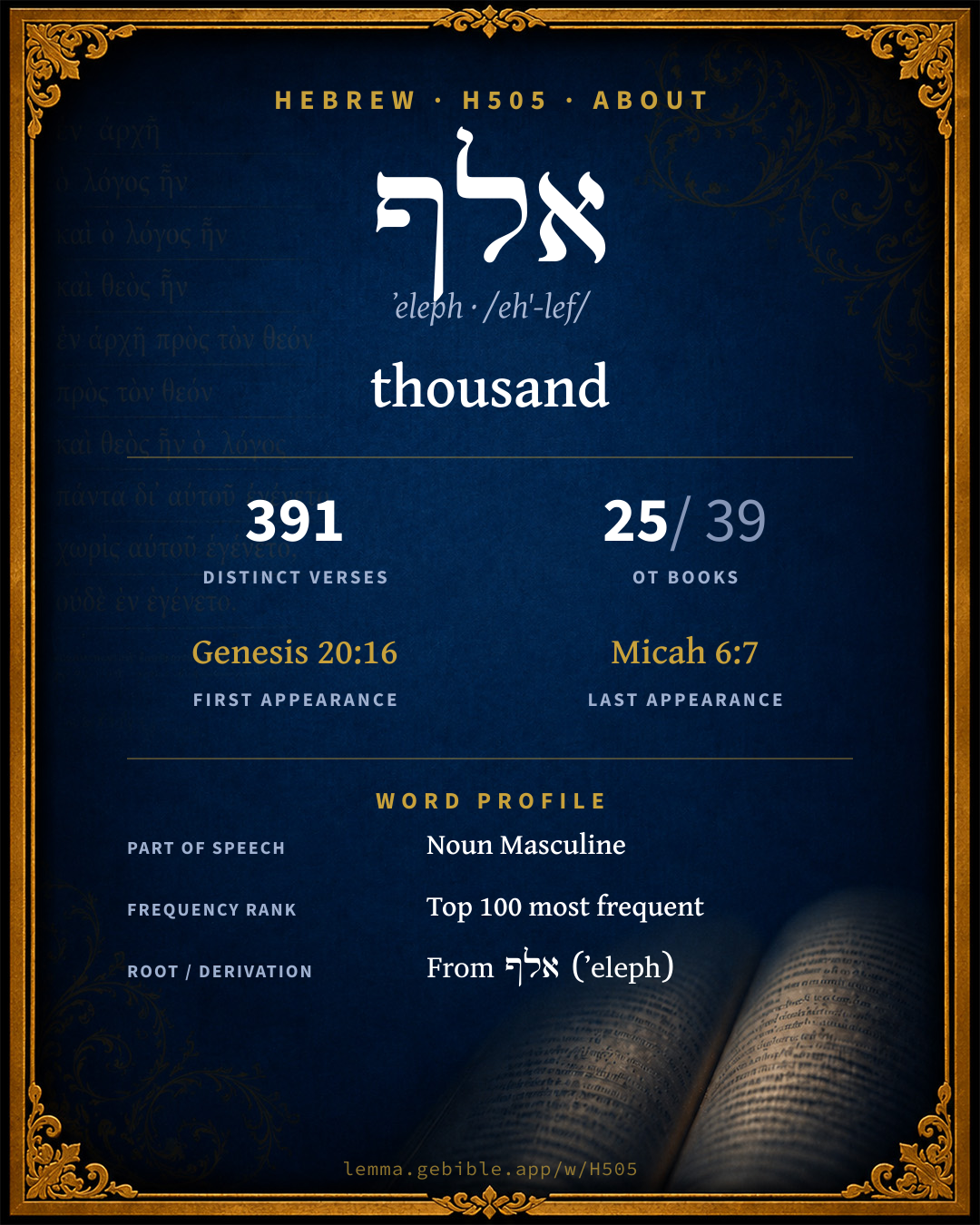
אֶ֫לֶף
thousand
‘thousand’ is one of 2 main senses fuller range ↓
Full lexicon entry — Brown-Driver-Briggs (BDB)
From Brown-Driver-Briggs (BDB)
Where this word appears
See every Absolute-state word in the Hebrew Bible →
Grammar key — what these labels mean
Part of speech
- Adjective
- A word that describes or qualifies a noun.
State
- Absolute
- The independent form of a noun, not bound to a following word.
- Construct
- A noun bound to a following noun in a possessive / “of” relationship (the construct chain).
Gender
- Both
- Attested as both masculine and feminine.
Number
- Singular
- One.
- Plural
- More than one (in Hebrew, generally three or more).
Grammatical forms
- Adjective, Cardinal number, Both, Singular, Absolute 312 times (61%)
- Adjective, Cardinal number, Both, Plural, Absolute 171 times (34%)
- Adjective, Cardinal number, Both, Plural, Construct 25 times (5%)
Parsed forms decoded from the imported morphology (morphhb / Westminster Leningrad Codex — WLC text public domain, morphhb tagging CC BY 4.0), counted across 508 parsed occurrences — not distinct verses.
Page 1 of 2 — showing verses 1–200 of 391 distinct verses where H505 appears, across 25 books. Click any verse to open its interlinear word-by-word view. Verse text shown in the World English Bible for context — . Each verse’s Hebrew form is shown with its reference; the English is not keyword-highlighted, since the data carries no word-level English alignment. Use “Compare translations” on any verse to read it across multiple English versions. This concordance covers the Hebrew Bible; Septuagint (Greek Old Testament) occurrences are not indexed here.
Genesis 2 verses
- Genesis 20:16 אֶ֤לֶף adj Cardinal number bs To Sarah he said, "Behold, I have given your brother a thousand pieces of silver. Behold, it is for you a covering of the eyes to all that are with you. In front of all you are vindicated."
- Genesis 24:60 לְ/אַלְפֵ֣י prep + Adjective Cardinal number bp cs They blessed Rebekah, and said to her, "Our sister, may you be the mother of thousands of ten thousands, and let your seed possess the gate of those who hate them."
Exodus 10 verses
- Exodus 12:37 אֶ֧לֶף adj Cardinal number bs The children of Israel traveled from Rameses to Succoth, about six hundred thousand on foot who were men, besides children.
- Exodus 18:21 אֲלָפִים֙ adj Cardinal number bp Moreover you shall provide out of all the people able men, such as fear God: men of truth, hating unjust gain; and place such over them, to be rulers of thousands, rulers of hundreds, rulers of fifties, and rulers of tens.
- Exodus 18:25 אֲלָפִים֙ adj Cardinal number bp Moses chose able men out of all Israel, and made them heads over the people, rulers of thousands, rulers of hundreds, rulers of fifties, and rulers of tens.
- Exodus 20:6 לַ/אֲלָפִ֑ים prep det + Adjective Cardinal number bp and showing loving kindness to thousands of those who love me and keep my commandments.
- Exodus 32:28 אַלְפֵ֖י adj Cardinal number bp cs The sons of Levi did according to the word of Moses: and there fell of the people that day about three thousand men.
- Exodus 34:7 לָ/אֲלָפִ֔ים prep det + Adjective Cardinal number bp keeping loving kindness for thousands, forgiving iniquity and disobedience and sin; and that will by no means clear the guilty, visiting the iniquity of the fathers on the children, and on the children's children, on the third and on the fourth generation."
- Exodus 38:25 וְ/אֶלֶף֩ conj + Adjective Cardinal number bs The silver of those who were numbered of the congregation was one hundred talents, and one thousand seven hundred seventy-five shekels, after the shekel of the sanctuary:
- Exodus 38:26 אֶ֨לֶף֙ אֲלָפִ֔ים adj Cardinal number bs adj Cardinal number bp a beka a head, that is, half a shekel, after the shekel of the sanctuary, for everyone who passed over to those who were numbered, from twenty years old and upward, for six hundred three thousand five hundred fifty men.
- Exodus 38:28 הָ/אֶ֜לֶף ptcl def.art + Adjective Cardinal number bs Of the one thousand seven hundred seventy-five shekels he made hooks for the pillars, overlaid their capitals, and made fillets for them.
- Exodus 38:29 וְ/אַלְפַּ֥יִם conj + Adjective Cardinal number bp The brass of the offering was seventy talents, and two thousand four hundred shekels.
Numbers 82 verses
- Numbers 1:16 אַלְפֵ֥י adj Cardinal number bp cs These are those who were called of the congregation, the princes of the tribes of their fathers; they were the heads of the thousands of Israel.
- Numbers 1:21 אֶ֖לֶף adj Cardinal number bs those who were numbered of them, of the tribe of Reuben, were forty-six thousand five hundred.
- Numbers 1:23 אֶ֖לֶף adj Cardinal number bs those who were numbered of them, of the tribe of Simeon, were fifty-nine thousand three hundred.
- Numbers 1:25 אֶ֔לֶף adj Cardinal number bs those who were numbered of them, of the tribe of Gad, were forty-five thousand six hundred fifty.
- Numbers 1:27 אֶ֖לֶף adj Cardinal number bs those who were numbered of them, of the tribe of Judah, were sixty-four thousand six hundred.
- Numbers 1:29 אֶ֖לֶף adj Cardinal number bs those who were numbered of them, of the tribe of Issachar, were fifty-four thousand four hundred.
- Numbers 1:31 אֶ֖לֶף adj Cardinal number bs those who were numbered of them, of the tribe of Zebulun, were fifty-seven thousand four hundred.
- Numbers 1:33 אֶ֖לֶף adj Cardinal number bs those who were numbered of them, of the tribe of Ephraim, were forty thousand five hundred.
- Numbers 1:35 אֶ֖לֶף adj Cardinal number bs those who were numbered of them, of the tribe of Manasseh, were thirty-two thousand two hundred.
- Numbers 1:37 אֶ֖לֶף adj Cardinal number bs those who were numbered of them, of the tribe of Benjamin, were thirty-five thousand four hundred.
- Numbers 1:39 אֶ֖לֶף adj Cardinal number bs those who were numbered of them, of the tribe of Dan, were sixty-two thousand seven hundred.
- Numbers 1:41 אֶ֖לֶף adj Cardinal number bs those who were numbered of them, of the tribe of Asher, were forty-one thousand five hundred.
- Numbers 1:43 אֶ֖לֶף adj Cardinal number bs those who were numbered of them, of the tribe of Naphtali, were fifty-three thousand four hundred.
- Numbers 1:46 אֶ֖לֶף אֲלָפִ֑ים adj Cardinal number bs adj Cardinal number bp even all those who were numbered were six hundred three thousand five hundred fifty.
- Numbers 2:4 אֶ֖לֶף adj Cardinal number bs His division, and those who were numbered of them, were seventy-four thousand six hundred.
- Numbers 2:6 אֶ֖לֶף adj Cardinal number bs His division, and those who were numbered of it, were fifty-four thousand four hundred.
- Numbers 2:8 אֶ֖לֶף adj Cardinal number bs His division, and those who were numbered of it, were fifty-seven thousand four hundred.
- Numbers 2:9 אֶ֜לֶף אֶ֛לֶף אֲלָפִ֥ים adj Cardinal number bs adj Cardinal number bs adj Cardinal number bp All who were numbered of the camp of Judah were one hundred eighty-six thousand four hundred, according to their divisions. They shall set out first.
- Numbers 2:11 אֶ֖לֶף adj Cardinal number bs His division, and those who were numbered of it, were forty-six thousand five hundred.
- Numbers 2:13 אֶ֖לֶף adj Cardinal number bs His division, and those who were numbered of them, were fifty-nine thousand three hundred.
- Numbers 2:15 אֶ֔לֶף adj Cardinal number bs His division, and those who were numbered of them, were forty-five thousand six hundred fifty.
- Numbers 2:16 אֶ֜לֶף אֶ֛לֶף adj Cardinal number bs adj Cardinal number bs "All who were numbered of the camp of Reuben were one hundred fifty-one thousand four hundred fifty, according to their hosts. They shall set out second.
- Numbers 2:19 אֶ֖לֶף adj Cardinal number bs His division, and those who were numbered of them, were forty thousand five hundred.
- Numbers 2:21 אֶ֖לֶף adj Cardinal number bs His division, and those who were numbered of them, were thirty-two thousand two hundred.
- Numbers 2:23 אֶ֖לֶף adj Cardinal number bs His host, and those who were numbered of them, were thirty-five thousand four hundred.
- Numbers 2:24 אֶ֛לֶף אֲלָפִ֥ים adj Cardinal number bs adj Cardinal number bp "All who were numbered of the camp of Ephraim were one hundred eight thousand one hundred, according to their divisions. They shall set out third.
- Numbers 2:26 אֶ֖לֶף adj Cardinal number bs His division, and those who were numbered of them, were sixty-two thousand seven hundred.
- Numbers 2:28 אֶ֖לֶף adj Cardinal number bs His division, and those who were numbered of them, were forty-one thousand and five hundred.
- Numbers 2:30 אֶ֖לֶף adj Cardinal number bs His division, and those who were numbered of them, were fifty-three thousand four hundred.
- Numbers 2:31 אֶ֗לֶף אֶ֖לֶף adj Cardinal number bs adj Cardinal number bs "All who were numbered of the camp of Dan were one hundred fifty-seven thousand six hundred. They shall set out last by their standards."
- Numbers 2:32 אֶ֨לֶף֙ אֲלָפִ֔ים adj Cardinal number bs adj Cardinal number bp These are those who were numbered of the children of Israel by their fathers' houses. All who were numbered of the camps according to their hosts were six hundred three thousand five hundred fifty.
- Numbers 3:22 אֲלָפִ֖ים adj Cardinal number bp Those who were numbered of them, according to the number of all the males, from a month old and upward, even those who were numbered of them were seven thousand five hundred.
- Numbers 3:28 אֲלָפִים֙ adj Cardinal number bp According to the number of all the males, from a month old and upward, there were eight thousand six hundred, keeping the charge of the sanctuary.
- Numbers 3:34 אֲלָפִ֖ים adj Cardinal number bp Those who were numbered of them, according to the number of all the males, from a month old and upward, were six thousand two hundred.
- Numbers 3:39 אָֽלֶף adj Cardinal number bs All who were numbered of the Levites, whom Moses and Aaron numbered at the commandment of Yahweh, by their families, all the males from a month old and upward, were twenty-two thousand.
- Numbers 3:43 אֶ֔לֶף adj Cardinal number bs All the firstborn males according to the number of names, from a month old and upward, of those who were numbered of them, were twenty-two thousand two hundred seventy-three.
- Numbers 3:50 וָ/אֶ֖לֶף conj + Adjective Cardinal number bs from the firstborn of the children of Israel he took the money, one thousand three hundred sixty-five shekels, after the shekel of the sanctuary:
- Numbers 4:36 אַלְפַּ֕יִם adj Cardinal number bp Those who were numbered of them by their families were two thousand seven hundred fifty.
- Numbers 4:40 אַלְפַּ֕יִם adj Cardinal number bp even those who were numbered of them, by their families, by their fathers' houses, were two thousand six hundred thirty.
- Numbers 4:44 אֲלָפִ֖ים adj Cardinal number bp even those who were numbered of them by their families, were three thousand two hundred.
- Numbers 4:48 אֲלָפִ֔ים adj Cardinal number bp even those who were numbered of them, were eight thousand five hundred eighty.
- Numbers 7:85 אַלְפַּ֥יִם adj Cardinal number bp each silver platter weighing one hundred thirty shekels, and each bowl seventy; all the silver of the vessels two thousand four hundred shekels, after the shekel of the sanctuary;
- Numbers 10:4 אַלְפֵ֥י adj Cardinal number bp cs If they blow but one, then the princes, the heads of the thousands of Israel, shall gather themselves to you.
- Numbers 10:36 אַלְפֵ֥י adj Cardinal number bp cs When it rested, he said, Return, Yahweh, to the ten thousands of the thousands of Israel.
- Numbers 11:21 אֶ֨לֶף֙ adj Cardinal number bs Moses said, The people, among whom I am, are six hundred thousand footmen; and you have said, I will give them flesh, that they may eat a whole month.
- Numbers 16:49 אֶ֖לֶף adj Cardinal number bs Now those who died by the plague were fourteen thousand and seven hundred, besides those who died about the matter of Korah.
- Numbers 25:9 אָֽלֶף adj Cardinal number bs Those who died by the plague were twenty-four thousand.
- Numbers 26:7 אֶ֔לֶף adj Cardinal number bs These are the families of the Reubenites; and those who were numbered of them were forty-three thousand seven hundred thirty.
- Numbers 26:14 אֶ֖לֶף adj Cardinal number bs These are the families of the Simeonites, twenty-two thousand two hundred.
- Numbers 26:18 אֶ֖לֶף adj Cardinal number bs These are the families of the sons of Gad according to those who were numbered of them, forty thousand and five hundred.
- Numbers 26:22 אֶ֖לֶף adj Cardinal number bs These are the families of Judah according to those who were numbered of them, seventy-six thousand five hundred.
- Numbers 26:25 אֶ֖לֶף adj Cardinal number bs These are the families of Issachar according to those who were numbered of them, sixty-four thousand three hundred.
- Numbers 26:27 אֶ֖לֶף adj Cardinal number bs These are the families of the Zebulunites according to those who were numbered of them, sixty thousand five hundred.
- Numbers 26:34 אֶ֖לֶף adj Cardinal number bs These are the families of Manasseh; and those who were numbered of them were fifty-two thousand seven hundred.
- Numbers 26:37 אֶ֖לֶף adj Cardinal number bs These are the families of the sons of Ephraim according to those who were numbered of them, thirty-two thousand five hundred. These are the sons of Joseph after their families.
- Numbers 26:41 אֶ֖לֶף adj Cardinal number bs These are the sons of Benjamin after their families; and those who were numbered of them were forty-five thousand six hundred.
- Numbers 26:43 אֶ֖לֶף adj Cardinal number bs All the families of the Shuhamites, according to those who were numbered of them, were sixty-four thousand four hundred.
- Numbers 26:47 אֶ֖לֶף adj Cardinal number bs These are the families of the sons of Asher according to those who were numbered of them, fifty-three thousand and four hundred.
- Numbers 26:50 אֶ֖לֶף adj Cardinal number bs These are the families of Naphtali according to their families; and those who were numbered of them were forty-five thousand four hundred.
- Numbers 26:51 אֶ֖לֶף וָ/אָ֑לֶף adj Cardinal number bs conj + Adjective Cardinal number bs These are those who were numbered of the children of Israel, six hundred one thousand seven hundred thirty.
- Numbers 26:62 אֶ֔לֶף adj Cardinal number bs Those who were numbered of them were twenty-three thousand, every male from a month old and upward: for they were not numbered among the children of Israel, because there was no inheritance given them among the children of Israel.
- Numbers 31:4 אֶ֚לֶף אֶ֖לֶף adj Cardinal number bs adj Cardinal number bs Of every tribe one thousand, throughout all the tribes of Israel, shall you send to the war.
- Numbers 31:5 מֵ/אַלְפֵ֣י אֶ֖לֶף אֶ֖לֶף prep + Adjective Cardinal number bp cs adj Cardinal number bs adj Cardinal number bs So there were delivered, out of the thousands of Israel, a thousand of every tribe, twelve thousand armed for war.
- Numbers 31:6 אֶ֥לֶף adj Cardinal number bs Moses sent them, one thousand of every tribe, to the war, them and Phinehas the son of Eleazar the priest, to the war, with the vessels of the sanctuary and the trumpets for the alarm in his hand.
- Numbers 31:14 הָ/אֲלָפִים֙ ptcl def.art + Adjective Cardinal number bp Moses was angry with the officers of the host, the captains of thousands and the captains of hundreds, who came from the service of the war.
- Numbers 31:32 אֶ֛לֶף אֶ֖לֶף אֲלָפִֽים adj Cardinal number bs adj Cardinal number bs adj Cardinal number bp Now the prey, over and above the booty which the men of war took, was six hundred seventy-five thousand sheep,
- Numbers 31:33 אָֽלֶף adj Cardinal number bs and seventy-two thousand oxen,
- Numbers 31:34 אָֽלֶף adj Cardinal number bs and seventy-one thousand donkeys,
- Numbers 31:35 אָֽלֶף adj Cardinal number bs and thirty-two thousand persons in all, of the women who had not known man by lying with him.
- Numbers 31:36 אֶ֨לֶף֙ אֶ֔לֶף אֲלָפִ֖ים adj Cardinal number bs adj Cardinal number bs adj Cardinal number bp The half, which was the portion of those who went out to war, was in number three hundred thirty-seven thousand five hundred sheep:
- Numbers 31:38 אָ֑לֶף adj Cardinal number bs The oxen were thirty-six thousand; of which Yahweh's tribute was seventy-two.
- Numbers 31:39 אֶ֖לֶף adj Cardinal number bs The donkeys were thirty thousand five hundred; of which Yahweh's tribute was sixty-one.
- Numbers 31:40 אָ֑לֶף adj Cardinal number bs The persons were sixteen thousand; of whom Yahweh's tribute was thirty-two persons.
- Numbers 31:43 אֶ֨לֶף֙ אֶ֔לֶף אֲלָפִ֖ים adj Cardinal number bs adj Cardinal number bs adj Cardinal number bp (now the congregation's half was three hundred thirty-seven thousand five hundred sheep,
- Numbers 31:44 אָֽלֶף adj Cardinal number bs and thirty-six thousand oxen,
- Numbers 31:45 אֶ֖לֶף adj Cardinal number bs and thirty thousand five hundred donkeys,
- Numbers 31:46 אָֽלֶף adj Cardinal number bs and sixteen thousand persons),
- Numbers 31:48 לְ/אַלְפֵ֣י הָ/אֲלָפִ֖ים prep + Adjective Cardinal number bp cs ptcl def.art + Adjective Cardinal number bp The officers who were over the thousands of the host, the captains of thousands, and the captains of hundreds, came near to Moses;
- Numbers 31:52 אֶ֛לֶף הָֽ/אֲלָפִ֔ים adj Cardinal number bs ptcl def.art + Adjective Cardinal number bp All the gold of the heave-offering that they offered up to Yahweh, of the captains of thousands, and of the captains of hundreds, was sixteen thousand seven hundred fifty shekels.
- Numbers 31:54 הָ/אֲלָפִ֖ים ptcl def.art + Adjective Cardinal number bp Moses and Eleazar the priest took the gold of the captains of thousands and of hundreds, and brought it into the tent of meeting, for a memorial for the children of Israel before Yahweh.
- Numbers 35:4 אֶ֥לֶף adj Cardinal number bs The suburbs of the cities, which you shall give to the Levites, shall be from the wall of the city and outward one thousand cubits round about.
- Numbers 35:5 אַלְפַּ֪יִם אַלְפַּ֨יִם אַלְפַּ֣יִם אַלְפַּ֥יִם adj Cardinal number bp adj Cardinal number bp adj Cardinal number bp adj Cardinal number bp You shall measure outside of the city for the east side two thousand cubits, and for the south side two thousand cubits, and for the west side two thousand cubits, and for the north side two thousand cubits, the city being in the midst. This shall be to them the suburbs of the cities.
Deuteronomy 6 verses
- Deuteronomy 1:11 אֶ֣לֶף adj Cardinal number bs Yahweh, the God of your fathers, make you a thousand times as many as you are, and bless you, as he has promised you!
- Deuteronomy 1:15 אֲלָפִ֜ים adj Cardinal number bp So I took the heads of your tribes, wise men, and known, and made them heads over you, captains of thousands, and captains of hundreds, and captains of fifties, and captains of tens, and officers, according to your tribes.
- Deuteronomy 5:10 לַֽ/אֲלָפִ֑ים prep det + Adjective Cardinal number bp and showing loving kindness to thousands of those who love me and keep my commandments.
- Deuteronomy 7:9 לְ/אֶ֥לֶף prep + Adjective Cardinal number bs Know therefore that Yahweh your God, he is God, the faithful God, who keeps covenant and loving kindness with them who love him and keep his commandments to a thousand generations,
- Deuteronomy 32:30 אֶ֔לֶף adj Cardinal number bs How should one chase a thousand, Two put ten thousand to flight, Except their Rock had sold them, Yahweh had delivered them up?
- Deuteronomy 33:17 אַלְפֵ֥י adj Cardinal number bp cs The firstborn of his herd, majesty is his; His horns are the horns of the wild-ox: With them he shall push the peoples all of them, [even] the ends of the earth: They are the ten thousands of Ephraim, They are the thousands of Manasseh.
Joshua 11 verses
- Joshua 3:4 כְּ/אַלְפַּ֥יִם prep + Adjective Cardinal number bp Yet there shall be a space between you and it, about two thousand cubits by measure: don't come near to it, that you may know the way by which you must go; for you have not passed this way heretofore.
- Joshua 4:13 אֶ֖לֶף adj Cardinal number bs about forty thousand ready armed for war passed over before Yahweh to battle, to the plains of Jericho.
- Joshua 7:3 כְּ/אַלְפַּ֣יִם אֲלָפִ֣ים prep + Adjective Cardinal number bp adj Cardinal number bp They returned to Joshua, and said to him, Don't let all the people go up; but let about two or three thousand men go up and strike Ai; don't make all the people to toil there; for they are but few.
- Joshua 7:4 אֲלָפִ֖ים adj Cardinal number bp So there went up there of the people about three thousand men: and they fled before the men of Ai.
- Joshua 8:3 אֶ֤לֶף adj Cardinal number bs So Joshua arose, and all the people of war, to go up to Ai: and Joshua chose out thirty thousand men, the mighty men of valor, and sent them forth by night.
- Joshua 8:12 אֲלָפִ֖ים adj Cardinal number bp He took about five thousand men, and set them in ambush between Bethel and Ai, on the west side of the city.
- Joshua 8:25 אָ֑לֶף adj Cardinal number bs All that fell that day, both of men and women, were twelve thousand, even all the men of Ai.
- Joshua 22:14 לְ/אַלְפֵ֥י prep + Adjective Cardinal number bp cs and with him ten princes, one prince of a fathers' house for each of the tribes of Israel; and they were everyone of them head of their fathers' houses among the thousands of Israel.
- Joshua 22:21 אַלְפֵ֥י adj Cardinal number bp cs Then the children of Reuben and the children of Gad and the half-tribe of Manasseh answered, and spoke to the heads of the thousands of Israel,
- Joshua 22:30 אַלְפֵ֤י adj Cardinal number bp cs When Phinehas the priest, and the princes of the congregation, even the heads of the thousands of Israel that were with him, heard the words that the children of Reuben and the children of Gad and the children of Manasseh spoke, it pleased them well.
- Joshua 23:10 אָ֑לֶף adj Cardinal number bs One man of you shall chase a thousand; for Yahweh your God, he it is who fights for you, as he spoke to you.
Judges 30 verses
- Judges 1:4 אֲלָפִ֖ים adj Cardinal number bp Judah went up; and Yahweh delivered the Canaanites and the Perizzites into their hand: and they struck of them in Bezek ten thousand men.
- Judges 3:29 אֲלָפִים֙ adj Cardinal number bp They struck of Moab at that time about ten thousand men, every lusty man, and every man of valor; and there escaped not a man.
- Judges 4:6 אֲלָפִים֙ adj Cardinal number bp She sent and called Barak the son of Abinoam out of Kedesh-naphtali, and said to him, Hasn't Yahweh, the God of Israel, commanded, [saying], Go and draw to Mount Tabor, and take with you ten thousand men of the children of Naphtali and of the children of Zebulun?
- Judges 4:10 אַלְפֵ֖י adj Cardinal number bp cs Barak called Zebulun and Naphtali together to Kedesh; and there went up ten thousand men at his feet: and Deborah went up with him.
- Judges 4:14 אֲלָפִ֛ים adj Cardinal number bp Deborah said to Barak, Up; for this is the day in which Yahweh has delivered Sisera into your hand; hasn't Yahweh gone out before you? So Barak went down from Mount Tabor, and ten thousand men after him.
- Judges 5:8 אֶ֖לֶף adj Cardinal number bs They chose new gods; Then was war in the gates: Was there a shield or spear seen Among forty thousand in Israel?
- Judges 7:3 אֶ֔לֶף אֲלָפִ֖ים adj Cardinal number bs adj Cardinal number bp Now therefore proclaim in the ears of the people, saying, Whoever is fearful and trembling, let him return and depart from Mount Gilead. There returned of the people twenty-two thousand; and there remained ten thousand.
- Judges 8:10 אֶ֔לֶף אֶ֛לֶף adj Cardinal number bs adj Cardinal number bs Now Zebah and Zalmunna were in Karkor, and their hosts with them, about fifteen thousand men, all who were left of all the host of the children of the east; for there fell one hundred twenty thousand men who drew sword.
- Judges 8:26 אֶ֥לֶף adj Cardinal number bs The weight of the golden ear-rings that he requested was one thousand and seven hundred [shekels] of gold, besides the crescents, and the pendants, and the purple clothing that was on the kings of Midian, and besides the chains that were about their camels' necks.
- Judges 9:49 כְּ/אֶ֖לֶף prep + Adjective Cardinal number bs All the people likewise cut down every man his bough, and followed Abimelech, and put them to the stronghold, and set the stronghold on fire on them; so that all the men of the tower of Shechem died also, about a thousand men and women.
- Judges 12:6 אָֽלֶף adj Cardinal number bs then said they to him, Say now Shibboleth; and he said Sibboleth; for he couldn't manage to pronounce it right: then they laid hold on him, and killed him at the fords of the Jordan. There fell at that time of Ephraim forty-two thousand.
- Judges 15:11 אֲלָפִ֨ים adj Cardinal number bp Then three thousand men of Judah went down to the cleft of the rock of Etam, and said to Samson, "Don't you know that the Philistines are rulers over us? What then is this that you have done to us?" He said to them, As they did to me, so have I done to them.
- Judges 15:15 אֶ֥לֶף adj Cardinal number bs He found a fresh jawbone of a donkey, and put forth his hand, and took it, and struck a thousand men therewith.
- Judges 15:16 אֶ֥לֶף adj Cardinal number bs Samson said, With the jawbone of a donkey, heaps on heaps, With the jawbone of a donkey I have struck a thousand men.
- Judges 16:5 אֶ֥לֶף adj Cardinal number bs The lords of the Philistines came up to her, and said to her, Entice him, and see in which his great strength lies, and by what means we may prevail against him, that we may bind him to afflict him: and we will each give you of us eleven hundred [pieces] of silver.
- Judges 16:27 אֲלָפִים֙ adj Cardinal number bp Now the house was full of men and women; and all the lords of the Philistines were there; and there were on the roof about three thousand men and women, who saw while Samson made sport.
- Judges 17:2 אֶלֶף֩ adj Cardinal number bs He said to his mother, The eleven hundred [pieces] of silver that were taken from you, about which you did utter a curse, and did also speak it in my ears, behold, the silver is with me; I took it. His mother said, Blessed be my son of Yahweh.
- Judges 17:3 אֶֽלֶף adj Cardinal number bs He restored the eleven hundred [pieces] of silver to his mother; and his mother said, I most assuredly dedicate the silver to Yahweh from my hand for my son, to make an engraved image and a molten image: now therefore I will restore it to you.
- Judges 20:2 אֶ֛לֶף adj Cardinal number bs The chiefs of all the people, even of all the tribes of Israel, presented themselves in the assembly of the people of God, four hundred thousand footmen who drew sword.
- Judges 20:10 לָ/אֶ֨לֶף֙ וְ/אֶ֣לֶף prep det + Adjective Cardinal number bs conj + Adjective Cardinal number bs and we will take ten men of one hundred throughout all the tribes of Israel, and one hundred of one thousand, and a thousand out of ten thousand, to get food for the people, that they may do, when they come to Gibeah of Benjamin, according to all the folly that they have worked in Israel.
- Judges 20:15 אֶ֛לֶף adj Cardinal number bs The children of Benjamin were numbered on that day out of the cities twenty-six thousand men who drew the sword, besides the inhabitants of Gibeah, who were numbered seven hundred chosen men.
- Judges 20:17 אֶ֛לֶף adj Cardinal number bs The men of Israel, besides Benjamin, were numbered four hundred thousand men who drew sword: all these were men of war.
- Judges 20:21 אֶ֛לֶף adj Cardinal number bs The children of Benjamin came forth out of Gibeah, and destroyed down to the ground of the Israelites on that day Twenty-two thousand men.
- Judges 20:25 אֶ֛לֶף adj Cardinal number bs Benjamin went forth against them out of Gibeah the second day, and destroyed down to the ground of the children of Israel again eighteen thousand men; all these drew the sword.
- Judges 20:34 אֲלָפִ֨ים adj Cardinal number bp There came over against Gibeah ten thousand chosen men out of all Israel, and the battle was sore; but they didn't know that evil was close on them.
- Judges 20:35 אֶ֛לֶף adj Cardinal number bs Yahweh struck Benjamin before Israel; and the children of Israel destroyed of Benjamin that day twenty-five thousand one hundred men: all these drew the sword.
- Judges 20:44 אֶ֖לֶף adj Cardinal number bs There fell of Benjamin eighteen thousand men; all these [were] men of valor.
- Judges 20:45 אֲלָפִ֖ים אַלְפַּ֥יִם adj Cardinal number bp adj Cardinal number bp They turned and fled toward the wilderness to the rock of Rimmon: and they gleaned of them in the highways five thousand men, and followed hard after them to Gidom, and struck of them two thousand men.
- Judges 20:46 אֶ֥לֶף adj Cardinal number bs So that all who fell that day of Benjamin were twenty-five thousand men who drew the sword; all these [were] men of valor.
- Judges 21:10 אֶ֛לֶף adj Cardinal number bs The congregation sent there twelve thousand men of the most valiant, and commanded them, saying, Go and strike the inhabitants of Jabesh Gilead with the edge of the sword, with the women and the little ones.
1 Samuel 22 verses
- 1 Samuel 4:2 אֲלָפִ֖ים adj Cardinal number bp The Philistines put themselves in array against Israel: and when they joined battle, Israel was struck before the Philistines; and they killed of the army in the field about four thousand men.
- 1 Samuel 4:10 אֶ֖לֶף adj Cardinal number bs The Philistines fought, and Israel was struck, and they fled every man to his tent: and there was a very great slaughter; for there fell of Israel thirty thousand footmen.
- 1 Samuel 6:19 אֶ֖לֶף adj Cardinal number bs He struck of the men of Beth-shemesh, because they had looked into the ark of Yahweh, he struck of the people fifty thousand seventy men; and the people mourned, because Yahweh had struck the people with a great slaughter.
- 1 Samuel 8:12 אֲלָפִ֖ים adj Cardinal number bp and he will appoint them to him for captains of thousands, and captains of fifties; and [he will set some] to plow his ground, and to reap his harvest, and to make his instruments of war, and the instruments of his chariots.
- 1 Samuel 10:19 וּ/לְ/אַלְפֵי/כֶֽם conj + prep + Adjective Cardinal number bp cs + sfx pers 2mp but you have this day rejected your God, who himself saves you out of all your calamities and your distresses; and you have said to him, [No], but set a king over us. Now therefore present yourselves before Yahweh by your tribes, and by your thousands.
- 1 Samuel 11:8 אֶ֔לֶף אָֽלֶף adj Cardinal number bs adj Cardinal number bs He numbered them in Bezek; and the children of Israel were three hundred thousand, and the men of Judah thirty thousand.
- 1 Samuel 13:2 אֲלָפִים֮ אַלְפַּ֗יִם וְ/אֶ֗לֶף adj Cardinal number bp adj Cardinal number bp conj + Adjective Cardinal number bs Saul chose him three thousand men of Israel, of which two thousand were with Saul in Michmash and in the Mount of Bethel, and one thousand were with Jonathan in Gibeah of Benjamin: and the rest of the people he sent every man to his tent.
- 1 Samuel 13:5 אֶ֤לֶף אֲלָפִים֙ adj Cardinal number bs adj Cardinal number bp The Philistines assembled themselves together to fight with Israel, thirty thousand chariots, and six thousand horsemen, and people as the sand which is on the sea-shore in multitude: and they came up, and encamped in Michmash, eastward of Beth Aven.
- 1 Samuel 15:4 אֶ֖לֶף אֲלָפִ֖ים adj Cardinal number bs adj Cardinal number bp Saul summoned the people, and numbered them in Telaim, two hundred thousand footmen, and ten thousand men of Judah.
- 1 Samuel 17:5 אֲלָפִ֥ים adj Cardinal number bp He had a helmet of brass on his head, and he was clad with a coat of mail; and the weight of the coat was five thousand shekels of brass.
- 1 Samuel 17:18 הָ/אָ֑לֶף ptcl def.art + Adjective Cardinal number bs and bring these ten cheeses to the captain of their thousand, and look how your brothers fare, and take their pledge.
- 1 Samuel 18:7 ב/אלפ/ו בַּ/אֲלָפָ֔י/ו prep + Adjective Cardinal number bp cs + sfx pers 3ms prep + Adjective Cardinal number bp cs + sfx pers 3ms The women sang one to another as they played, and said, Saul has slain his thousands, David his ten thousands.
- 1 Samuel 18:8 הָ/אֲלָפִ֑ים ptcl def.art + Adjective Cardinal number bp Saul was very angry, and this saying displeased him; and he said, They have ascribed to David ten thousands, and to me they have ascribed but thousands: and what can he have more but the kingdom?
- 1 Samuel 18:13 אָ֑לֶף adj Cardinal number bs Therefore Saul removed him from him, and made him his captain over a thousand; and he went out and came in before the people.
- 1 Samuel 21:11 ב/אלפ/ו בַּ/אֲלָפָ֔י/ו prep + Adjective Cardinal number bp cs + sfx pers 3ms prep + Adjective Cardinal number bp cs + sfx pers 3ms The servants of Achish said to him, "Isn't this David the king of the land? Didn't they sing one to another about him in dances, saying, 'Saul has slain his thousands, David his ten thousands?'"
- 1 Samuel 22:7 אֲלָפִ֖ים adj Cardinal number bp Saul said to his servants who stood about him, Hear now, you Benjamites; will the son of Jesse give everyone of you fields and vineyards, will he make you all captains of thousands and captains of hundreds,
- 1 Samuel 23:23 אַלְפֵ֥י adj Cardinal number bp cs See therefore, and take knowledge of all the lurking-places where he hides himself, and come you again to me of a certainty, and I will go with you: and it shall happen, if he be in the land, that I will search him out among all the thousands of Judah.
- 1 Samuel 24:2 אֲלָפִ֛ים adj Cardinal number bp Then Saul took three thousand chosen men out of all Israel, and went to seek David and his men on the rocks of the wild goats.
- 1 Samuel 25:2 אֲלָפִ֖ים וְ/אֶ֣לֶף adj Cardinal number bp conj + Adjective Cardinal number bs There was a man in Maon, whose possessions were in Carmel; and the man was very great, and he had three thousand sheep, and a thousand goats: and he was shearing his sheep in Carmel.
- 1 Samuel 26:2 אֲלָפִ֥ים adj Cardinal number bp Then Saul arose, and went down to the wilderness of Ziph, having three thousand chosen men of Israel with him, to seek David in the wilderness of Ziph.
- 1 Samuel 29:2 וְ/לַ/אֲלָפִ֑ים conj + prep + Adjective Cardinal number bp The lords of the Philistines passed on by hundreds, and by thousands; and David and his men passed on in the rearward with Achish.
- 1 Samuel 29:5 בַּֽ/אֲלָפָ֔י/ו prep + Adjective Cardinal number bp cs + sfx pers 3ms Is not this David, of whom they sang one to another in dances, saying, Saul has slain his thousands, David his ten thousands?
2 Samuel 15 verses
- 2 Samuel 6:1 אָֽלֶף adj Cardinal number bs David again gathered together all the chosen men of Israel, thirty thousand.
- 2 Samuel 8:4 אֶ֤לֶף אֶ֖לֶף adj Cardinal number bs adj Cardinal number bs David took from him one thousand seven hundred horsemen, and twenty thousand footmen: and David hamstrung all the chariot horses, but reserved of them for one hundred chariots.
- 2 Samuel 8:5 אֶ֖לֶף adj Cardinal number bs When the Syrians of Damascus came to help Hadadezer king of Zobah, David struck of the Syrians two and twenty thousand men.
- 2 Samuel 8:13 אָֽלֶף adj Cardinal number bs David got him a name when he returned from smiting the Syrians in the Valley of Salt, even eighteen thousand men.
- 2 Samuel 10:6 אֶ֨לֶף֙ אֶ֣לֶף אֶ֖לֶף adj Cardinal number bs adj Cardinal number bs adj Cardinal number bs When the children of Ammon saw that they were become odious to David, the children of Ammon sent and hired the Syrians of Beth Rehob, and the Syrians of Zobah, twenty thousand footmen, and the king of Maacah with one thousand men, and the men of Tob twelve thousand men.
- 2 Samuel 10:18 אֶ֖לֶף adj Cardinal number bs The Syrians fled before Israel; and David killed of the Syrians [the men of] seven hundred chariots, and forty thousand horsemen, and struck Shobach the captain of their host, so that he died there.
- 2 Samuel 17:1 אֶ֨לֶף֙ adj Cardinal number bs Moreover Ahithophel said to Absalom, Let me now choose out twelve thousand men, and I will arise and pursue after David this night:
- 2 Samuel 18:1 אֲלָפִ֖ים adj Cardinal number bp David numbered the people who were with him, and set captains of thousands and captains of hundreds over them.
- 2 Samuel 18:3 אֲלָפִ֑ים adj Cardinal number bp But the people said, You shall not go forth: for if we flee away, they will not care for us; neither if half of us die, will they care for us: but you are worth ten thousand of us; therefore now it is better that you are ready to help us out of the city.
- 2 Samuel 18:4 וְ/לַ/אֲלָפִֽים conj + prep + Adjective Cardinal number bp The king said to them, What seems you best I will do. The king stood by the gate-side, and all the people went out by hundreds and by thousands.
- 2 Samuel 18:7 אָֽלֶף adj Cardinal number bs The people of Israel were struck there before the servants of David, and there was a great slaughter there that day of twenty thousand men.
- 2 Samuel 18:12 אֶ֣לֶף adj Cardinal number bs The man said to Joab, Though I should receive a thousand [pieces of] silver in my hand, I still wouldn't put forth my hand against the king's son; for in our hearing the king charged you and Abishai and Ittai, saying, Beware that none touch the young man Absalom.
- 2 Samuel 19:17 וְ/אֶ֨לֶף conj + Adjective Cardinal number bs There were a thousand men of Benjamin with him, and Ziba the servant of the house of Saul, and his fifteen sons and his twenty servants with him; and they went through the Jordan in the presence of the king.
- 2 Samuel 24:9 אֶ֤לֶף אֶ֖לֶף adj Cardinal number bs adj Cardinal number bs Joab gave up the sum of the numbering of the people to the king: and there were in Israel eight hundred thousand valiant men who drew the sword; and the men of Judah were five hundred thousand men.
- 2 Samuel 24:15 אֶ֖לֶף adj Cardinal number bs So Yahweh sent a pestilence on Israel from the morning even to the time appointed; and there died of the people from Dan even to Beersheba seventy thousand men.
1 Kings 16 verses
- 1 Kings 3:4 אֶ֤לֶף adj Cardinal number bs The king went to Gibeon to sacrifice there; for that was the great high place: a thousand burnt offerings did Solomon offer on that altar.
- 1 Kings 4:26 אֶ֛לֶף אֶ֖לֶף adj Cardinal number bs adj Cardinal number bs Solomon had forty thousand stalls of horses for his chariots, and twelve thousand horsemen.
- 1 Kings 4:32 אֲלָפִ֖ים וָ/אָֽלֶף adj Cardinal number bp conj + Adjective Cardinal number bs He spoke three thousand proverbs; and his songs were one thousand five.
- 1 Kings 5:11 אֶ֨לֶף adj Cardinal number bs Solomon gave Hiram twenty thousand measures of wheat for food to his household, and twenty measures of pure oil: thus gave Solomon to Hiram year by year.
- 1 Kings 5:13 אֶ֖לֶף adj Cardinal number bs King Solomon raised a levy out of all Israel; and the levy was thirty thousand men.
- 1 Kings 5:14 אֲלָפִ֤ים adj Cardinal number bp He sent them to Lebanon, ten thousand a month by courses; a month they were in Lebanon, and two months at home; and Adoniram was over the men subject to forced labor.
- 1 Kings 5:15 אֶ֖לֶף אֶ֖לֶף adj Cardinal number bs adj Cardinal number bs Solomon had seventy thousand who bore burdens, and eighty thousand who were stone cutters in the mountains;
- 1 Kings 5:16 אֲלָפִ֖ים adj Cardinal number bp besides Solomon's chief officers who were over the work, three thousand and three hundred, who bore rule over the people who labored in the work.
- 1 Kings 7:26 אַלְפַּ֥יִם adj Cardinal number bp It was a handbreadth thick: and the brim of it was worked like the brim of a cup, like the flower of a lily: it held two thousand baths.
- 1 Kings 8:63 אֶ֔לֶף אָ֑לֶף adj Cardinal number bs adj Cardinal number bs Solomon offered for the sacrifice of peace-offerings, which he offered to Yahweh, two and twenty thousand oxen, and one hundred twenty thousand sheep. So the king and all the children of Israel dedicated the house of Yahweh.
- 1 Kings 10:26 אֶ֤לֶף אֶ֖לֶף adj Cardinal number bs adj Cardinal number bs Solomon gathered together chariots and horsemen: and he had a thousand and four hundred chariots, and twelve thousand horsemen, that he bestowed in the chariot cities, and with the king at Jerusalem.
- 1 Kings 12:21 אֶ֛לֶף adj Cardinal number bs When Rehoboam was come to Jerusalem, he assembled all the house of Judah, and the tribe of Benjamin, a hundred and eighty thousand chosen men, who were warriors, to fight against the house of Israel, to bring the kingdom again to Rehoboam the son of Solomon.
- 1 Kings 19:18 אֲלָפִ֑ים adj Cardinal number bp Yet will I leave [me] seven thousand in Israel, all the knees which have not bowed to Baal, and every mouth which has not kissed him.
- 1 Kings 20:15 אֲלָפִֽים adj Cardinal number bp Then he mustered the young men of the princes of the provinces, and they were two hundred and thirty-two: and after them he mustered all the people, even all the children of Israel, being seven thousand.
- 1 Kings 20:29 אֶ֥לֶף adj Cardinal number bs They encamped one over against the other seven days. So it was, that in the seventh day the battle was joined; and the children of Israel killed of the Syrians one hundred thousand footmen in one day.
- 1 Kings 20:30 אֶ֛לֶף adj Cardinal number bs But the rest fled to Aphek, into the city; and the wall fell on twenty-seven thousand men who were left. Ben Hadad fled, and came into the city, into an inner chamber.
2 Kings 9 verses
- 2 Kings 3:4 אֶ֣לֶף אֶ֖לֶף adj Cardinal number bs adj Cardinal number bs Now Mesha king of Moab was a sheep-master; and he rendered to the king of Israel the wool of one hundred thousand lambs, and of one hundred thousand rams.
- 2 Kings 5:5 אֲלָפִים֙ adj Cardinal number bp The king of Syria said, Go now, and I will send a letter to the king of Israel. He departed, and took with him ten talents of silver, and six thousand [pieces] of gold, and ten changes of clothing.
- 2 Kings 13:7 אֲלָפִ֖ים adj Cardinal number bp For he didn't leave to Jehoahaz of the people save fifty horsemen, and ten chariots, and ten thousand footmen; for the king of Syria destroyed them, and made them like the dust in threshing.
- 2 Kings 14:7 אֲלָפִ֔ים adj Cardinal number bp He killed of Edom in the Valley of Salt ten thousand, and took Sela by war, and called the name of it Joktheel, to this day.
- 2 Kings 15:19 אֶ֖לֶף adj Cardinal number bs There came against the land Pul the king of Assyria; and Menahem gave Pul one thousand talents of silver, that his hand might be with him to confirm the kingdom in his hand.
- 2 Kings 18:23 אַלְפַּ֣יִם adj Cardinal number bp Now therefore, Please give pledges to my master the king of Assyria, and I will give you two thousand horses, if you are able on your part to set riders on them.
About this entry
At a glance — auto-summarized from this page’s data, not written by a person. Every figure links to its source below. This summary describes the numbers; it doesn’t interpret them.
אלף — transliterated ʼeleph — is a Hebrew noun carrying the sense “thousand.” Older and newer Bibles part ways — “thousand” in the King James Version, “were” (unfoldingWord Literal Text) in modern versions. See the renderings breakdown. It appears 391 verses across 25 books of the Hebrew Bible, among its common vocabulary. Its earliest occurrence is Genesis 20:16. The lexicon spreads it across several senses; see its full sense range. See the sense tree, 391-verse concordance, and the renderings breakdown below.
Gloss history
Strong's 1890 vs modern scholarship
About this word
Strong's H505 catalogs a Hebrew word from the Hebrew Old Testament.
These counts are not copied from any lexicon or concordance. They are computed here, from the morphology-tagged Hebrew Old Testament. What Lemma adds →
- 391
- distinct verses
- The word appears in 391 distinct verses.
- 25 / 39
- OT books
- The word appears in 25 of 39 Old Testament books.
- #97
- by frequency
- Top 100 most frequent Hebrew words (rank 97 of 8,640 Hebrew words by occurrence).
View all 391 occurrences in the concordance →
Most concentrated in
- Numbers 82 verses 21%
- 1 Chronicles 60 verses 15%
- 2 Chronicles 38 verses 10%
By section of the Old Testament
By traditional corpus
Conventional, traditional groupings — biblical authorship is debated, so this is a traditional corpus grouping, not an authorship claim. Each share is this word’s portion of its verses in that division of the Hebrew canon. Each figure is a share of the word’s 391 distinct verses.
- Writings (Ketuvim) 156 verses · 40%
- Prophets (Nevi'im) 135 verses · 35%
- Torah (Pentateuch) 100 verses · 26%
How translations render this word
Counts come from each version’s own published word-to-Strong’s tagging or interlinear alignment — an approximate guide to how each version renders this word, not a word-level alignment the data otherwise carries. Because each total is that version’s own tagged count, the per-version totals vary from one another and need not match the appearance or distinct-verse counts above. These counts may also differ from a printed concordance because Lemma counts each distinctly tagged rendering and does not collapse phrase taggings into a single head-word total. This is a fixed set of word-tagged versions (KJV, ASV, BSB, ULT) and does not change with the reading translation you choose elsewhere. Each version’s license is shown beside its name below (and on Sources).
BDB lists this Strong’s number as 3 distinct words (homographs). Each count above pools all of them and is not split by sense — see the Senses section below. A low-frequency rendering may belong to a different one of those words, not the primary meaning.
- King James Version†: Thousand 406×, Thousands 32×, Two thousand 19×
- American Standard Version†: Thousand 389×, Thousands 35×, Two thousand 19×
- Berean Standard Bible†: Thousand 114×, Thousands 31×, Two thousand 9×
- unfoldingWord Literal Text†: Were 61×, Thousand 58×, And 35×
King James Version Public Domain
Renders H505 across 502† tagged occurrences — most commonly:
Plus 19 renderings that appear only once — usually multi-word phrases or single function words the recovered tagging swept in, not distinct renderings. Not rendered by a distinct English word in 3 further occurrences.
American Standard Version Public Domain
Renders H505 across 501† tagged occurrences — most commonly:
Plus 36 renderings that appear only once — usually multi-word phrases or single function words the recovered tagging swept in, not distinct renderings.
Berean Standard Bible Public Domain
Renders H505 across 200† tagged occurrences — most commonly:
Plus 22 renderings that appear only once — usually multi-word phrases or single function words the recovered tagging swept in, not distinct renderings. Not rendered by a distinct English word in 306 further occurrences.
unfoldingWord Literal Text CC BY-SA 4.0
Renders H505 across 294† tagged occurrences — most commonly:
Plus 22 renderings that appear only once — usually multi-word phrases or single function words the recovered tagging swept in, not distinct renderings. Not rendered by a distinct English word in 239 further occurrences.
Senses in the full BDB
What do BDB’s symbols mean?
BDB uses these scholarly abbreviations:
| Symbol | Meaning |
|---|---|
| 𝔊 | the Septuagint (the ancient Greek translation, LXX) |
| 𝔙 | the Vulgate (the Latin translation) |
| 𝔖 | the Syriac version (the Peshitta) |
| 𝔗 | the Targum (the Aramaic translation) |
| ψ | the Psalms |
| √ | root (the underlying root or stem) |
| ‖ | parallel passage (a synonymous or contrasted parallel) |
| † | the dagger: every passage where the word occurs is cited |
The 6 senses and sub-senses the full Brown-Driver-Briggs lexicon distinguishes for this word, in lexicon order (not ranked by frequency), with BDB’s own verbatim wording and sub-sense lettering. Shown in Hebrew script with BDB’s own scholarly abbreviations. The condensed entry is in the Lexicon Entry tab. See also the Forms in the corpus table below.
אלף I
- 1. numeral:
- a. used with noun alone; mostly before noun Nu 35:4 Jos 7:3 Ne 3:13 1 Ch 18:4 +; after noun (late) 1 Ch 12:35 + 6 times Ch Ezr Ne; א׳ בָּאַמָּה Nu 35:5(×4) Ez 47:3 (del. Co); the noun always pl. when preceding, sometimes when following, 1 S 25:2 1 K 3:4 2 K 18:23 = Is 36:8 2 Ch 30:24 ψ 90:4 Jb 42:12 Ec 6:6; elsewhere sg. אישׁ Ju 9:49; 15:15, 16 Jos 7:3 +; אַמָּה Nu 35:4 + (so SI); דּוֹר Dt 7:9 +, cf. 1 Ch 18:4; 19:6 2 K 15:19 Jb 42:12 Ct 4:4 Is 7:23, noun sometimes coll.; א׳ pl. cstr. Mi 6:7 ψ 119:72 Gn 24:60; noun not expr. (or not fully) Gn 20:16 Nu 31:5, 6 +; distrib. אֶלֶף … אֶלָף Nu 31:4; multipl. Dt 1:11 א׳ פְּעָמִים; indef. for great no. (pl.) Ex 20:6; 34:7 Dt 5:10 Je 32:18, (sg.) Dt 32:30 Ec 6:6 +. e.g. Numbers 35:4
- b. א׳ + other num. usually precedes it Ex 38:25 + often; but foll. רִבּוֹא Ezr 2:64 + 2 times; it follows also smaller no. Nu 3:50 1 K 5:12 (so SI); the noun foll. in sg. Ex 38:25 + 8 times; pl. 2 S 8:4 + 2 times; noun precedes, in pl. (late) Dn 12:12 + 2 times; noun not expr. Ex 38:28 + often e.g. Exodus 38:25
- c. א׳ × other no. always foll. Ex 12:37 +; usual order is no. × א׳ + additional no. (if any) + noun (ifexpr.) Nu. 31:52 Ju 20:35 cf. Ex 12:37 2 K 3:4(×2) +; less often noun + no. × א׳ Nu 31:33 1 K 8:63 +; (other combin. v. Ex 38:26 Nu 26:51; 31:32 Ez 48:30 1 Ch 29:7 etc.); א׳ usually sg. Nu 11:21 +; except after units, where pl. abs. Nu 1:46 Ju 20:34 + (so MI); seld. pl. cstr. Ex 32:28 Ju 4:10 Jb 1:3(×2); (noun mostly sg. when foll. Ju 4:10 1 K 12:21 +, yet pl. Jos 4:13 1 S 13:5 +; when preceding it is pl. 1 Ch 5:21 +, or coll. Nu 31:33 1 S 25:2 1 K 8:63 2 Ch 7:5 +); אֶלָף אֲלָפִים 1 Ch 21:5; 22:14 2 Ch 14:8; אַלְפֵי שִׁנְאָן ψ 68:18, cf. שִׁנְאָן; בְּהַרְרֵי אָ֑לֶף ψ 50:10, read אֵל cf. ψ 36:7, Ol Bi Che; yet v. Hup De.— e.g. Exodus 12:37
- 10,000 = עֲשֶׂרֶת אֲלָפִים etc. Ju 1:4; 3:29 1 K 5:28 1 Ch 29:7 +; less often רִבּוֹ, רְבָבָה etc. q.v. e.g. Judges 1:4
- 2. a thousand, a company of 1000 men, as united under one superior, or leader, hence שַׂר א׳ (שָׂרֵי) Ex 18:21, 25 cf. Nu 31:14 +; cf. רָאשֵׁי א׳ יִשְׂרָאֵל Nu 1:16; 10:4 Jos 22:21, 30 & v. infr.; cf. also 1 S 29:2; especially family, etc. Ju 6:15 1 S 10:19 (‖ שֵׁבֶט & cf. מִשְׁפַּחַת v 21); cf. Mi 5:1;—Nu 10:36 (רִבְבוֹת אַלְפֵי יִשְׂרָאֵל) 31:5 Jos 22:14 1 S 23:23 apparently shew transit. to this technical use. e.g. Exodus 18:21
אלף II loc. city in Benj., הָא׳ Jos 18
Senses from the full Brown-Driver-Briggs lexicon (Brown, Driver, Briggs; Oxford 1906 — public domain), digitized via Sefaria, supplemented by the OpenScriptures HebrewLexicon (CC BY 4.0). Full attribution on Sources.
Word origin
I. n.m. ψ 8:8; only pl. cattle (Ph. אלף, Assyrian alpu, COTGloss.)—אֲלָפִים Pr 14:4 Is 30:24 used in tillage; subject to man ψ 8:8 (‖ צֹנֶה); their increase שְׁגַר אֲלָפֶיךָ a blessing Dt 7:13; 28:4, 18, 51 (‖ all עַשְׁתְּרֹת צֹאנֶ֑ךָ).
II. n.m. Ju 6:15 thousand (אלף MI, SI, Sab. DHMZMG 1875, 615; Arabic أَلْفٌ, Aramaic ܐܳܠܶܦ, אֲלַף, אלפיא; cf. Ethiopic እልፍ mille, myrias)*.—(אָ֑׳)א׳ Gn 20:16 +; sf. אַלְפִּי †Ju 6:15; du. אַלְפַּיִם Nu 4:36 +; pl. אֲלָפִים Ex 18:21 +; cstr. אַלְפֵי Ex 32:28 +; אֲלָפֶיךָ Dt 7:13 + 2 times; אֲלָפָיו Qr 1 S 18:7 + 2 times (Kt ־פו)—a thousand.
III. n.pr.loc. city in Benj., הָא׳ Jos 18:28; perhaps Lifta NW. from Jerus. Surveyiii. 18.
— Brown-Driver-Briggs (Oxford 1906, public domain), digitized via Sefaria, supplemented by the OpenScriptures HebrewLexicon (CC BY 4.0). See Sources.
Derived from אלף (ʼeleph) (H504) — cattle.
Jastrow Dictionary
A second Hebrew/Aramaic lexicon for comparison, covering Aramaic and post-biblical (Talmudic, Targumic, Midrashic) usage that the biblical-Hebrew BDB does not. Matched by lemma rather than by Strong’s number, so a lemma may carry more than one Jastrow headword (shown separately below), and the entries cover usage well beyond the Bible.
אֶלֶף
- (b. h.) thousand. Du. אַלְפַּיִם.—Pl. אֲלָפִים.—א׳ אלפים a million. Gen. R. s. 8 שני א׳; a. fr.—Ex. R. s. 5 אַלְפַּיִם two thousand (men); a. e.
אֲלַף I
- Targ. O. Ex. XXXVIII, 25 אַלַּף ed. Berl. (Y. אלפא); a. fr.—Snh. 95ᵇ חד א׳ one thousand. Bekh. 8ᵇ מאה א׳ זוזי one hundred thousand zuz; a. fr.—Pl. אַלְפִין, אַלְפַיָּא. Targ. Ex. XXXVIII, 26; a. fr. Targ. I Sam. XVIII, 8; a. fr.—Y. Dem. VII, 26ᵇ bot.; a. fr.
אֲלַף II
- , √לף to join, be joined) to become used; to learn, study, train one’s self.—אֲלִיף accustomed, used to. Targ. I Sam. XVII, 39. Targ. O. Num. XXII, 30.—Targ. Deut. V, 1; a. fr. (v. also יְלֵיף).—Cant. R. to II, 2 צבי רבי דייליף would you like to study? B. Bath. 111ᵇ top גוד לית דין צבי למילף take me away from here, this man has no desire to learn (but only to argue). Taan. 4ᵃ man is bound למֵילַף נפשיה בניחותא [prob. למַלֵּיף, v. infra] to train himself to be gentle; a. fr.
- to train, teach. Targ. Ps. XVIII, 35 מַלֵּיף (= מְאַלֵּף). Targ. Prov. XI, 25; a. fr.—Koh. R. to IX, 10 thou didst emigrate למילף for the sake of studying, והוא גלי לאַלָּפָא but he emigrated for the sake of teaching. Y. Dem. I, 22ᵃ top ולא כן אַלְּפָן רבי (not איל׳) did you not teach us thus?—א׳ זכו, v. infra.
- as Pa. Lev. R. s. 30 (מַלֵּיף) מוֹלִיף עלי זכו offers arguments in my favor.
- to exercise, practice, exert one’s self. Targ. Is. II, 4; XXVI, 9.
A Dictionary of the Targumim, the Talmud Babli and Yerushalmi, and the Midrashic Literature (Marcus Jastrow; London, Luzac, 1903) — Public Domain. Digitized via Sefaria. Digitized via Sefaria. Full attribution on Sources.
Forms in the corpus
The 100 distinct written forms H505 takes in the Hebrew Bible, most frequent first — each parse links to that state’s occurrences in the concordance. Hebrew forms include their vowel points and cantillation, so a single lemma takes many written forms.
The 60 most common forms are shown; 40 rarer forms follow in the full concordance.
Same root — word family
Other BDB entries built from the same root as H505, grouped by Strong’s listed origin. These share a root / origin per the lexicon — not necessarily a shared meaning. Each links to that word’s own entry.
Derives from
Derived from this word
Proper names from this root
People and places named from this root — a name, not an additional meaning of the word.
Compare all same-root words → Showing 4 of 5 — not the complete family. 1 of the same-root words is a proper name (a person or place). They share a root, not necessarily a meaning.
Septuagint verse parallels
This word appears in 363 verses that also exist in the Greek Old Testament (Septuagint), out of the 391 Hebrew verses it occurs in. You can read those verses in Greek by switching the Old Testament edition to the Septuagint.
Read these verses in the Septuagint
- Genesis 20:16
- Exodus 12:37
- Numbers 1:16
- Deuteronomy 1:11
- Joshua 3:4
- Judges 1:4
- 1 Samuel 4:2
- 2 Samuel 6:1
- 1 Kings 3:4
- 2 Kings 3:4
- 1 Chronicles 5:18
- 2 Chronicles 1:2
This is a verse-level parallel only — the same verses exist in both the Hebrew and Greek Old Testaments. No word-level Hebrew↔Greek correspondence is claimed: the data carries no such alignment, so no Greek word is shown as this Hebrew word’s translation. Coverage is not total — the Septuagint omits the deuterocanon and renumbers the Psalms, so some Hebrew verses have no direct Greek parallel.