1 Kings 4:26

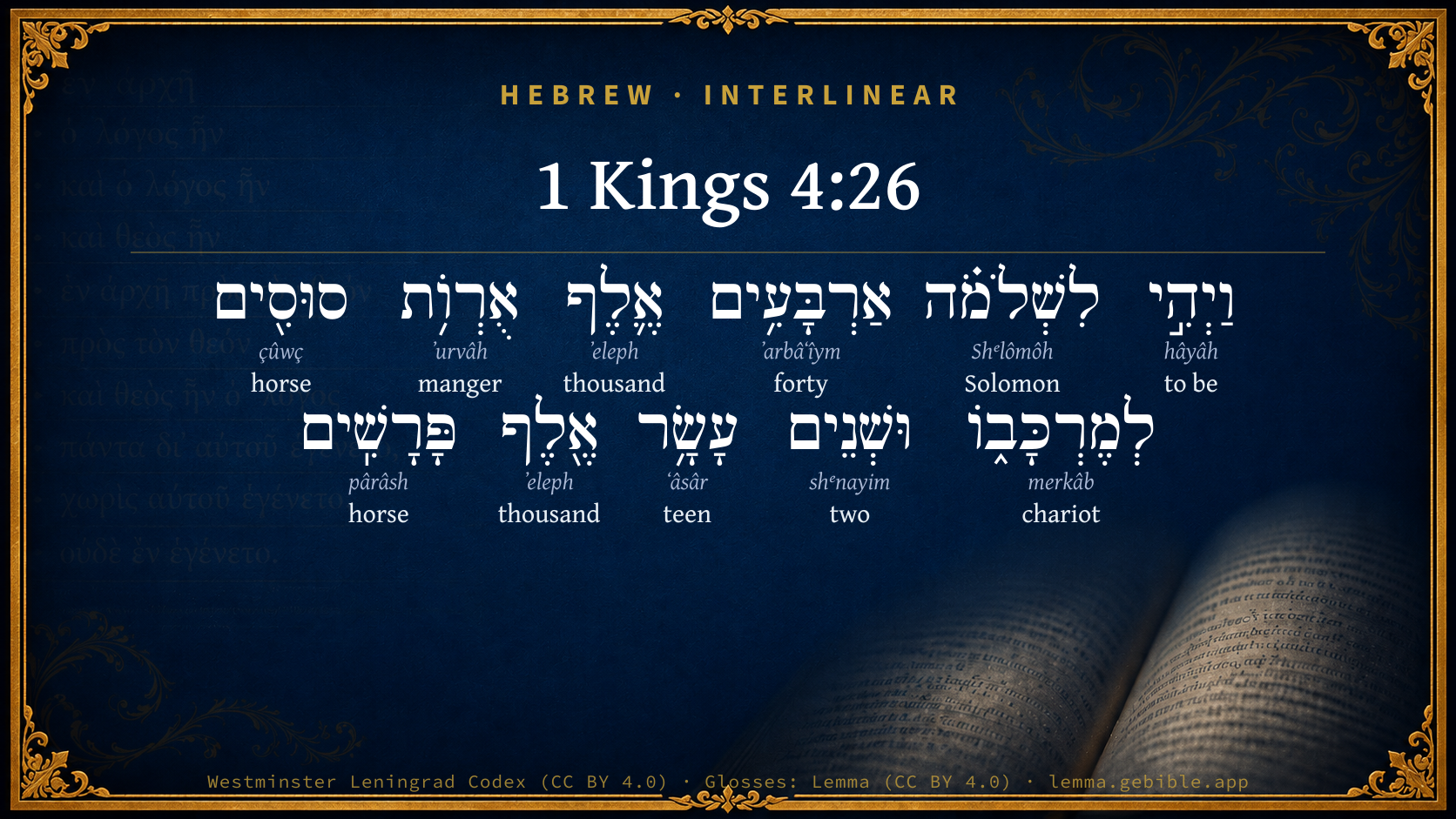
Hebrew (Westminster Leningrad Codex) 1 Kings 4:26 appears in the Hebrew Old Testament. The text above is from the Westminster Leningrad Codex. Each word links to its Strong’s number, a concise gloss, and parsing drawn from the Open Scriptures Hebrew Bible morphology. Click any word for its full Brown-Driver-Briggs (BDB) entry.
Download image
Cite this verse

1 Kings 4:26 (World English Bible). Public Domain. Lemma interlinear Bible study tool, https://lemma.gebible.app/v/1-kings/4/26.

Show BibTeX & RIS
BibTeX
RIS
English Translation
Solomon had forty thousand stalls of horses for his chariots, and twelve thousand horsemen.
World English Bible · Public Domain
Highlights
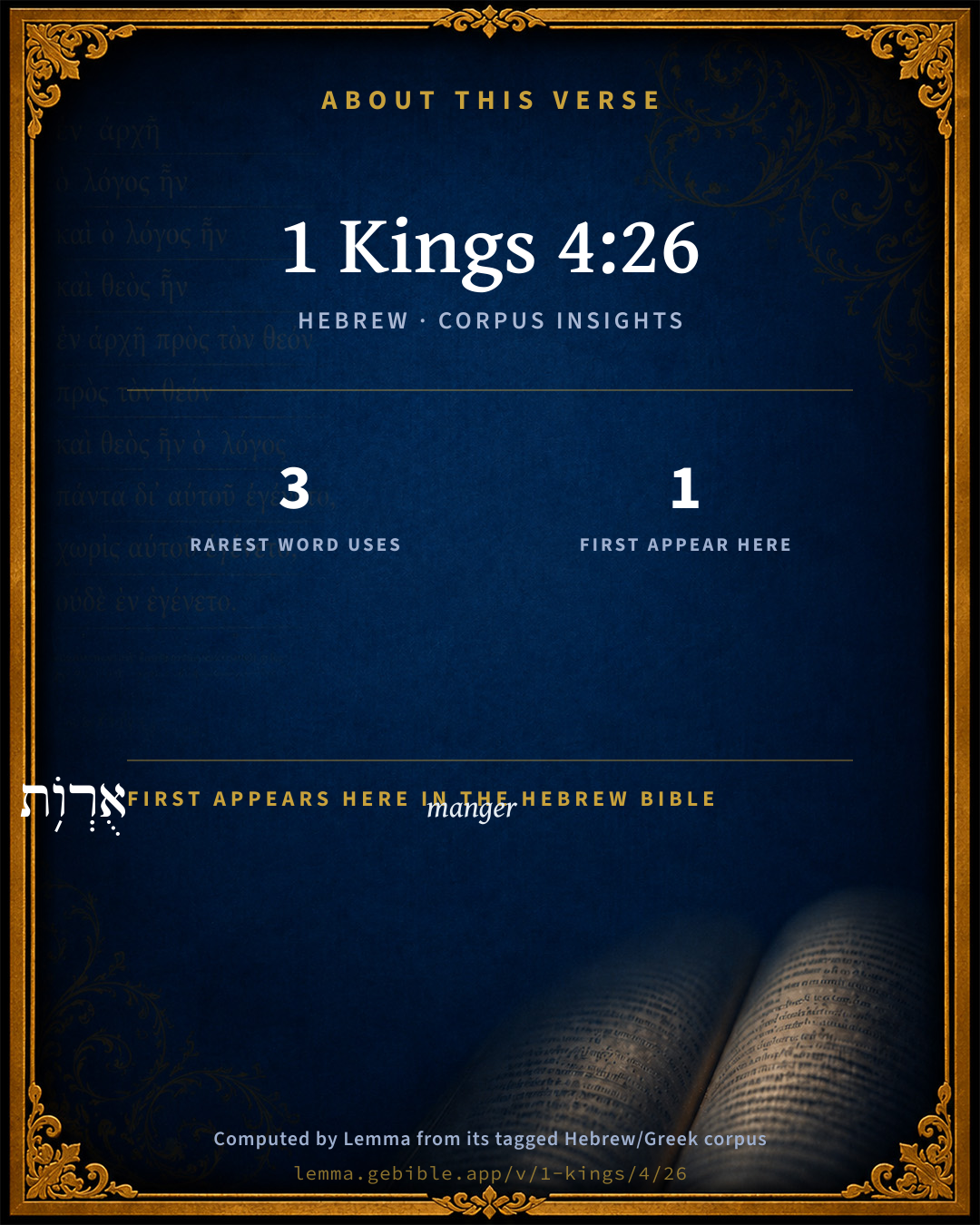
  • 1 first appearance in the Hebrew Bible
Full analysis ↓
Download a study sheet

One document with this verse’s original text, its word-by-word gloss line, the meaning frame, cross-references with their text, attributed commentary, and full source and license credits — printable, and it pastes into notes with its structure intact.

This verse Autodidact and up

Study sheet (.html) Plain text (.txt)

A passage Seminary Student

Up to 50 verses in one chapter. A passage sheet keeps up to 6 commentary sources and 12 cross-references per verse, in the order this page ranks them, and says so on the sheet whenever that leaves anything out. Ask for a single verse and you get the Autodidact verse sheet above.

Everything on this page stays free to read, with no account — the sheet is a download of what is already on screen, not access to it.

Want to remove ads? Support Godless Engineer
Compare translations 3

The same verse in 3 English versions, stacked beneath the original-language interlinear above. Click any original word for its lexicon entry.

Each is an independent rendering of the whole verse — the interlinear is not word-aligned to these translations.

Highlighted words mark where these versions differ — a whole-verse word diff, not a word-by-word alignment.

  • World English Bible Public Domain
    Solomon had forty thousand stalls of horses for his chariots, and twelve thousand horsemen.
  • King James Version Public Domain
    And Solomon had forty thousand stalls of horses for his chariots, and twelve thousand horsemen.
  • unfoldingWord Literal Text CC BY-SA 4.0
    And 40,000 stalls of horses were to Solomon for his chariotry, and 12,000 horsemen.

unfoldingWord Literal Text — © unfoldingWord, licensed CC BY-SA 4.0. Word-aligned USFM3 via Door43 (git.door43.org/unfoldingWord/en_ult).

Versions to compare (up to 4)

3 of 4 selected

Show all 18 translations

Every available English version of this verse, each an independent rendering of the whole verse.

  • World English Bible Public Domain
    Solomon had forty thousand stalls of horses for his chariots, and twelve thousand horsemen.
  • Berean Standard Bible Public Domain
    Solomon had 4,000 stalls for his chariot horses and 12,000 horses.
  • Majority Standard Bible Public Domain
    Solomon had 4,000 stalls for his chariot horses and 12,000 horses.
  • King James Version Public Domain
    And Solomon had forty thousand stalls of horses for his chariots, and twelve thousand horsemen.
  • American Standard Version (1901) Public Domain
    And Solomon had forty thousand stalls of horses for his chariots, and twelve thousand horsemen.
  • Revised Version (1885) Public Domain
    And Solomon had forty thousand stalls of horses for his chariots, and twelve thousand horsemen.
  • Geneva Bible (1599) Public Domain
    And Salomon had fourtie thousande stalles of horses for his charets, and twelue thousand horsemen.
  • Douay-Rheims (1899) Public Domain
    And Solomon had forty thousand stalls of chariot horses, and twelve thou- sand for the saddle.
  • Young's Literal Translation Public Domain
    And Solomon hath forty thousand stalls of horses for his chariots, and twelve thousand horsemen.
  • Literal Standard Version CC BY-SA 4.0
    And Solomon has forty thousand stalls of horses for his chariots, and twelve thousand horsemen.
  • Unlocked Literal Bible CC BY-SA 4.0
    Solomon had forty thousand stalls of horses for his chariots, and twelve thousand horsemen.
  • unfoldingWord Literal Text CC BY-SA 4.0
    And 40,000 stalls of horses were to Solomon for his chariotry, and 12,000 horsemen.
  • Darby Bible Public Domain
    And Solomon had forty thousand stalls of horses for his chariots, and twelve thousand horsemen.
  • World Messianic Bible Public Domain
    Solomon had forty thousand stalls of horses for his chariots, and twelve thousand horsemen.
  • Webster's Bible Public Domain
    And Solomon had forty thousand stalls of horses for his chariots, and twelve thousand horsemen.
  • Free Bible Version CC BY-SA 4.0
    Solomon had 40,000 stalls for his chariot horses, and 12,000 charioteers.
  • Bible in Basic English Public Domain
    And Solomon had four thousand boxed-off spaces for horses for his carriages, and twelve thousand horsemen.
  • JPS Tanakh (1917) Public Domain
    (5-6) And Solomon had forty thousand stalls of horses for his chariots, and twelve thousand horsemen.

Literal Standard Version (2020), Covenant Press — licensed CC BY-SA 4.0. Text via the HelloAO Bible API (eBible.org). Unlocked Literal Bible (unfoldingWord) — licensed CC BY-SA 4.0. Text via the HelloAO Bible API (eBible.org). unfoldingWord Literal Text — © unfoldingWord, licensed CC BY-SA 4.0. Word-aligned USFM3 via Door43 (git.door43.org/unfoldingWord/en_ult). Free Bible Version, Dr. Jonathan Gallagher — licensed CC BY-SA 4.0. Text via the HelloAO Bible API (eBible.org).

Word by word

More ways to search: Search by grammar → Find every occurrence → Compare this word →

Practice this passage: Drill this verse → Learn its vocabulary →

אֻרְוֺ֥ת
ʼurvâh
H723
“mangers of”
Noun, Common, Feminine, Plural, Construct
Part of Speech
Noun
Type
Common
Gender
Feminine
Number
Plural
State
Construct
Full BDB Definition

Origin: from H717 (in the sense of feeding)

TWOT: 158b

manger, crib, stall (for animals)
  1. וַיְהִ֣י hâyâh H1961 “and · to be” Conjunction + Verb, Qal, Sequential Imperfect, 3rd Person, Masculine, Singular
  2. לִשְׁלֹמֹ֗ה Shᵉlômôh H8010 “to/for · Solomon” Preposition + Noun, Proper
  3. אַרְבָּעִ֥ים ʼarbâʻîym H705 “forty” Adjective, Cardinal number, Both, Plural, Absolute
  4. אֶ֛לֶף ʼeleph H505 “thousand” Adjective, Cardinal number, Both, Singular, Absolute
  5. סוּסִ֖ים çûwç H5483 “horses” Noun, Common, Masculine, Plural, Absolute
  6. לְמֶרְכָּב֑וֹ merkâb H4817 “to/for · chariot · his” Preposition + Noun, Common, Masculine, Singular, Construct + Suffix, Personal, 3rd Person, Masculine, Singular
  7. וּשְׁנֵים shᵉnayim H8147 “and · two” Conjunction + Adjective, Cardinal number, Masculine, Dual, Absolute
  8. עָשָׂ֥ר ʻâsâr H6240 “teen” Adjective, Cardinal number, Masculine, Singular, Absolute
  9. אֶ֖לֶף ʼeleph H505 “thousand” Adjective, Cardinal number, Both, Singular, Absolute
  10. פָּרָשִֽׁים pârâsh H6571 “horses” Noun, Common, Masculine, Plural, Absolute

About this verse

These counts appear in no published source. They are computed here, from the morphology-tagged text and Lemma’s own curated glosses. What Lemma adds →

11
words
10
distinct lemmas
Historical
section

Notable vocabulary

The rarest word here is אֻרְוֺ֥ת manger H723 — appearing just 3 times in the whole Hebrew Bible.

First appearance in Scripture

This word makes its first canonical appearance in the Hebrew Bible here:

  • אֻרְוֺ֥ת manger H723

Shared distinctive vocabulary

אֻרְוֺ֥ת manger H723 occurs in 3 verses of the Hebrew Bible. Also found in:

Grammatical profile

  • 1 verb
  • 5 nouns
  • 5 adjectives

Verb forms

  • וַיְהִ֣י Qal · Sequential Imperfect

Repetition

A word recurs within this verse — often emphatic in Hebrew:

  • אֶ֛לֶף thousand H505 ×2

Cross-references

6

Topical passages linked to 1 Kings 4:26 in the Treasury of Scripture Knowledge — connected by theme and wording, ordered by reader-vote popularity; previews shown in the World English Bible.

  • 2 Chronicles 1:14 Solomon gathered chariots and horsemen: and he had one thousand four hundred chariots, and twelve thousand horsemen, that he placed in the chariot cities, and with the king at Jerusalem.
  • 2 Chronicles 9:25 Solomon had four thousand stalls for horses and chariots, and twelve thousand horsemen, that he bestowed in the chariot cities, and with the king at Jerusalem.
  • 2 Samuel 8:4 David took from him one thousand seven hundred horsemen, and twenty thousand footmen: and David hamstrung all the chariot horses, but reserved of them for one hundred chariots.
  • Deuteronomy 17:16 Only he shall not multiply horses to himself, nor cause the people to return to Egypt, to the end that he may multiply horses; because Yahweh has said to you, You shall henceforth return no more that way.
  • 1 Kings 10:25–26 They brought every man his tribute, vessels of silver, and vessels of gold, and clothing, and armor, and spices, horses, and mules, a rate year by year.
  • Psalms 20:7 Some trust in chariots, and some in horses, But we trust the name of Yahweh our God.

Cross-references courtesy of OpenBible.info (CC BY 4.0).

Hebrew and Greek witnesses Masoretic Hebrew ↔ Greek Septuagint

The same verse in the two great witnesses to the Old Testament, shown verse-for-verse.

These are two independent witnesses, not word-aligned to each other, and the Septuagint is shown in lemma (dictionary) form.

Hebrew 1 Kings 4:26 Masoretic · Westminster Leningrad Codex

וַיְהִ֣י לִשְׁלֹמֹ֗ה אַרְבָּעִ֥ים אֶ֛לֶף אֻרְוֺ֥ת סוּסִ֖ים לְמֶרְכָּב֑וֹ וּשְׁנֵים עָשָׂ֥ר אֶ֖לֶף פָּרָשִֽׁים

Solomon had forty thousand stalls of horses for his chariots, and twelve thousand horsemen.

World English Bible · Public Domain

On this verse, Adam Clarke's Commentary discusses the Septuagint’s reading. Read the note in Commentary ↓

Hebrew: Westminster Leningrad Codex (CC BY 4.0). Greek: Septuagint (public domain); English from a public-domain English Septuagint. How the Septuagint differs from the Hebrew →

Commentary

Notes on 1 Kings 4:26 from classic Christian and Jewish commentators (each source and its license shown beneath its notes). The classic Christian expositions comment on the surrounding passage and are grouped to its opening verse, so a note may address several verses; the Jewish commentaries on the Tanakh (Rashi and others) are per-verse, so they appear only where the commentator wrote on this verse.

Lemma curates 59 commentaries, every one of them public domain or Creative Commons licensed, each selected and text-cleaned for this edition rather than reprinted as found. About our sources →

Trapp's Complete Commentary

John Trapp

1Ki 4:26 And Solomon had forty thousand stalls of horses for his chariots, and twelve thousand horsemen.

Ver. 26. Forty thousand stalls of horses.] In his four thousand stables, {2Ch 9:25} each of which had ten stalls or partitions, for ten horses at least. And this might be a piece of that yoke the people groaned under: which they ought not to have done, living in such a golden age.

John Trapp, A Commentary or Exposition upon All the Books of the Old and New Testament (1647–1656) — public domain. Text from a community e-Sword module.

Joseph Benson's Commentary

1Ki 4:26. Solomon had forty thousand stalls of horses for chariots — In 2Ch 9:25, it is said, he had but four thousand. And Bochart thinks that the Hebrew word here used should be rendered four, not forty, or that some error has crept into the text in regard to the number here mentioned. It is justly observed, however, by Poole, that the Hebrew word translated stalls here, is not exactly the same word which is used, and so translated, in Chronicles; and that, therefore, there may well be allowed some difference in the signification; the one signifying, properly, stables; of such there were four thousand; the other stalls, or partitions for each horse, which were forty thousand. For his chariots — Both for his military chariots, which seem to be those fourteen hundred, 1Ki 10:26, and for divers other uses, as respecting his great and various buildings, and merchandises, and other occasions, which might require some thousands of other chariots. And twelve thousand horsemen — Appointed partly for the defence of his people in peace, and partly for attendance upon his person, and for the splendour of his government.

Joseph Benson's Commentary on the Old and New Testaments (1811–1818) — public domain. Text from a community e-Sword module.

Tyndale Open Study Notes

Tyndale Open Resources

4:26 4,000 stalls: The number 4,000 reflects the parallel text in 2 Chr 9:25, a suitable number for Solomon’s 1,400 chariots (1 Kgs 10:26; 2 Chr 1:14). • 12,000 horses: The Hebrew can be translated as “horsemen” (Exod 15:19-21) or “horses” (Joel 2:4). To be prepared for battles, Solomon built towns to accommodate his forces (1 Kgs 9:19).

Tyndale Open Study Notes — © Tyndale Open Resources, licensed CC BY-SA 4.0. Text via the HelloAO Bible API.

Jamieson, Fausset & Brown

Robert Jamieson, A. R. Fausset & David Brown

forty thousand stalls--for the royal mews (see on Ch2 9:25).

Jamieson, Fausset & Brown — Commentary Critical and Explanatory on the Whole Bible (1871) — public domain (CC PDM 1.0). Text via the HelloAO Bible API.

Adam Clarke's Commentary

Verse 26. Solomon had forty thousand stalls of horses - and twelve thousand horsemen.] In 2Ch 9:25, instead of forty thousand stalls, we read four thousand; and even this number might be quite sufficient to hold horses for twelve thousand horsemen; for stalls and stables may be here synonymous. In 1Kg 10:26 it is said he had one thousand four hundred chariots, and twelve thousand horsemen; and this is the reading in 2Ch 1:14. In 2Ch 9:25, already quoted, instead of forty thousand stalls for horses, the Septuagint has τεσσαρες χιλιαδες θηλειαι ἱπποι, four thousand mares; and in this place the whole verse is omitted both by the Syriac and Arabic. In the Targum of Rabbi Joseph on this book we have ארבע מאה arba meah, four hundred, instead of the four thousand in Chronicles, and the forty thousand in the text. From this collation of parallel places we may rest satisfied that there is a corruption in the numbers somewhere; and as a sort of medium, we may take for the whole four thousand stalls, one thousand four hundred chariots, and twelve thousand horsemen.

Adam Clarke's Commentary on the Bible (1810–1826) — public domain. Text from a community e-Sword/MySword module.

Ellicott's Commentary for English Readers

(26) Forty thousand.—By comparison with the parallel passage in 2Ch_9:25, and with the notice in 1Ki_10:26 (one thousand four hundred), it seems clear that for “forty thousand” “four thousand” should be read. They were kept in various “chariot cities,” as well as at Jerusalem. This multiplication of horses and horsemen—forbidden to the future king in Deu_17:16, but foretold by Samuel at the inauguration of the kingdom (1Sa_8:11-12)—is significant of military conquest and an extended empire. The Israelite armies, in frequent contradistinction from their enemies, had been hitherto mainly of infantry; and in Jos_11:9 the chariots and horses captured were not used, but destroyed, “as the Lord bade Joshua.” Such armies were powerful for defence, not for invasion. Now, as it would seem for the first time, this provision of the ancient law, like many others, was set aside, and Solomon’s empire assumed the character of other great Oriental monarchies.

A Bible Commentary for English Readers, edited by Charles John Ellicott (1878–1897) — public domain. Text from a community e-Sword module.

The Cambridge Bible for Schools and Colleges

gen. ed. J. J. S. Perowne

26. horses for his chariots] This is one of the passages which make clear the meaning of the Hebrew sus, a horse to go in a chariot, and parash, a saddle-horse. In 2Ch_9:25 the number of stalls is 4000 instead of 40000 as here.

The Cambridge Bible for Schools and Colleges (gen. ed. J. J. S. Perowne; Cambridge University Press, 1878–1918) — public domain. Text from a community e-Sword module.

John Gill's Exposition

And God gave Solomon wisdom and understanding exceeding much,.... In things natural, moral, divine, and spiritual, and that not slight and superficial, but exceeding deep, and large beyond expression; and this he had not from the acuteness of his genius merely, nor from his industry and diligence; but by the gift of God, as whatsoever solid wisdom and understanding is in any man, it is from the liberal hand of God, the fountain of wisdom, Jam 1:5;

and largeness of heart, even as sand that is on the seashore; he had a genius and capacity to receive anything; his knowledge was vast and comprehensive; it reached to and included things innumerable, as the sand of the sea; there was scarce anything under the heavens, or on the earth, and in the sea, but came within the compass of it, as what are later mentioned show.

John Gill's Exposition of the Whole Bible (1746–1763) — public domain (CC PDM 1.0). Text via the HelloAO Bible API.

Albert Barnes' Notes on the Bible

In 2Ch 9:25, the number of stalls for Solomon’s chariot horses is stated at 4,000, instead of 40,000. The number in the present passage is probably a corruption. Solomon’s chariots were but 1,400 1Ki 10:26; 2Ch 1:14, for which 40,000 horses could not possibly be required. The Assyrian chariots had at most three horses apiece, while some had only two. 4,000 horses would supply the full team of three to 1,200, and the smaller team of two to 200 chariots. The number 4,000 is in due proportion to the 12,000 horses for cavalry, and is in accordance with all that we know of the military establishments of the time and country. Compare 2Ch 12:3; 2Sa 8:4.

Albert Barnes' Notes on the Bible (1834–1885) — public domain. Text from a community e-Sword/MySword module.

Haydock's Catholic Bible Commentary

Forty: 2 Paralipomenon ix. 25., has four in the Hebrew. Septuagint read in both places 40,000 mares, for chariots, and 12,000 horses. (Calmet) --- The Alexandrian copy has 40 here, and 4000 in the latter place; where, instead of horses, it gives horsemen, with the Vulgate. These two words are often used as synonymous by the best authors. But it is more difficult to reconcile the number; (Calmet) as (2 Paralipomenon xiv.) we read again differently, he had 1400 chariots, and 12,000 horsemen. (Haydock) --- Forty might easily be mistaken for four, by only adding im at the end of arba. (Bochart) (Grotius) --- Instead of stalls, Calmet supposes stables to be understood, and in each he would place ten horses, which completes the number here assigned. If this be admitted, no change is necessary: but, as præsepe signifies "a stall," we may adhere to the Vulgate, which has 40,000 in both places; whereas the Hebrew varies, though the sense may be the same. The number of Solomon’s chariots was 1400. As two horses were usually employed to draw them, 2800; or, allowing for accidents, changes, &c., 4000 horses would have been amply sufficient. It seems, therefore, that we should admit only so many horses or stalls. (Haydock) --- "Vignoles conjectures, that the Jews formerly used marks analogous to our common figures; as the Arabians have done for many hundred years. And, if so, the corruption" of hundreds for tens, &c., "may be easily accounted for, by the transcriber’s carelessly adding or omitting a single cypher." (Kennicott, Diss. ii.) --- Yet, if 40,000 horses must be admitted, we may say that they were not all intended for the chariots of war, but some for draught-horses, to convey the stones and other materials for the numerous buildings, which Solomon carried on. This might serve to excuse him for having so many horses, (Haydock) contrary to the letter of the law, and the example of Josue and of David. His subjects were thus, perhaps, engaged in too much commerce with the Egyptians: and the king was forced to burden them with taxes, which at last proved so fatal. (Serarius) (Pineda) (Calmet) --- Yet some undertake his defence, by saying that he did not act against the spirit of the law; that many of the horses were imposed as a tribute, and Solomon did not place his trust in them, Proverbs xxi. 31., and 2 Paralipomenon ix. 24. (Tostat) (Bochart, B. ii. 9.) --- His empire was become more extensive, and his works more splendid; so that what might appear an useless parade in some, might be worthy of praise in Solomon. The law is not so precise. He shall not multiply horses to himself, nor lead back the people into Egypt, being lifted up with the number of his horsemen, Deuteronomy xvii. 16. There is a like prohibition of many wives and treasures.

George Leo Haydock (1774–1849), Haydock's Catholic Family Bible and Commentary, 1859 edition — public domain. Excludes Psalms (Douay-Rheims chapter numbering differs from Protestant) and Deuterocanonical books (Catholic canon only).

Matthew Poole's English Annotations

Forty thousand stalls of horses. In 2Ch 9:25, it is but four thousand. Answ. First, Some acknowledge an error of the transcriber, writing arbahim, forty, for arbah, four, which was an easy mistake. And such mistakes in some copies, in these lesser matters, God might permit, for the trial and exercise of our faith, without any prejudice to the authority of the sacred Scriptures in the great doctrines of faith and good life. Secondly, It is not exactly the same Hebrew word which is here and there, though we translate both stalls; and therefore there may well be allowed some difference in the signification, the one signifying properly stables, of which there were 4000, the other stalls or partitions for each horse, which were 40,000; which great number seems directly forbidden, Deu 17:16, except Solomon had some particular dispensation from God, which might be, though it be not recorded.

For his chariots; both for his military chariots, which seem to be those 1400, 1Ki 10:26, and for divers other uses, as about his great and various buildings, and merchandises, and other occasions, which might require some thousands of other chariots.

Twelve thousand horsemen; appointed partly for the defence and preservation of his people in peace; and partly for attendance upon his person, and for the splendour of his government. Compare 1Ki 10:26. But the words may be otherwise rendered,

and twelve thousand horses, for parash manifestly signifies both a horse and horsemen. And these might be a better sort of horses than most of those which were designed for the chariots. Or thus, and for (which particle is easily understood and borrowed from the foregoing clause) twelve thousand horsemen; and so he means that the 40,000 horses were in part appointed for his chariots, and in part for his 12,000 horsemen.

Matthew Poole's English Annotations on the Holy Bible (1683–1685) — public domain. Text from a community e-Sword/MySword module.

Whedon's Commentary on the Bible

Daniel D. Whedon

26. Forty thousand stalls of horses — Most interpreters have regarded this as a corruption in the text, and have thought to emend it by substituting the reading of 2Ch_9:25, four thousand. But this is a doubtful emendation. True, 40,000 seems a very large number, and may be an error; but 4,000 seems too small a number to require 12,000 horsemen. Then the reading in Chronicles is somewhat different from this. There it says he had 4,000 stalls for horses and chariots, which may mean that each stall that contained a chariot might also have several horses. But while at this late day it may be impossible to settle this question of numbers, it is still clear that Solomon multiplied horses in Israel, and thereby transgressed the law prescribed for kings in Deu_17:16.

Twelve thousand horsemen — The word פרשׁים, here and often elsewhere rendered horsemen, is also used in the sense of steeds; riding horses. It usually means cavalry, including both horse and rider.

Daniel D. Whedon (gen. ed.), Commentary on the Old and New Testaments (1874–1909) — public domain. Text from a community e-Sword module.

The Pulpit Commentary

And Solomon had forty thousand stalls of horses 40, 000 is certainly a clerical error, probably for 4000 (i.e., for hBra). For

(1) in the parallel passage in Chronicles the number is stated as 4000.

(2) 4000 agrees, and 40, 000 does not, with the other numbers here given.

The chariots, e.g., numbered 1400; the horsemen 12, 000. Now for 1400 chariots the proper allowance of horses would be about 4000. We see from the monuments that it was customary to yoke two horses (seldom three) to a chariot; but a third or supernumerary horse was provided to meet emergencies or accidents. 4000 horses would hence be a liberal provision for Solomon"s chariots, and it would also agree well with the number of his cavalry. 12, 000 cavalry and 40, 000 chariot horses are out of all proportion. As to stalls, it seems clear that in ancient, as in modern times, each horse had a separate crib (Vegetins in Bochart, quoted by Keil). Gesenius, however, understands by twOrau, not stalls, but teams, or pairs for his chariots or chariotry: the word is singular and collective and twelve hundred horsemen rather, horses, i.e., riding or cavalry, as distinguished from chariot horses above. See note on 1Ki_1:5. It has been supposed that this warlike provision is mentioned to account for the peace (si vis pacem, para bellum) of Solomon"s reign, and was designed to overawe the tributary kings. But it is more probable that the idea of the historian was, partly to exhibit the pomp and circumstance of Israel"s greatest king, and partly to record a contravention of the law, (Deu_17:16) which was one of the precursors of his fall.

The Pulpit Commentary (1880–1919), ed. H.D.M. Spence-Jones & Joseph S. Exell — public domain. Text from a community e-Sword module.

John Wesley's Explanatory Notes

Forty thousand - In 2 Chron. ix, 25, it is but four thousand. But it is not exactly the same Hebrew word which is here and there, though we translate both stalls; and therefore there may well be allowed some difference in the signification, the one signifying properly stables, of which there were four thousand, the other stalls or partitions for each horse, which were forty thousand. Chariots - Both for his military chariots, which seem to be those fourteen hundred, chap. x, 26, and for divers other uses, as about his great and various buildings, and merchandises, and other occasions, which might require some thousands of other chariots. Horsemen - Appointed partly for the defense of his people in peace; and partly for attendance upon his person, and for the splendour of his government.

John Wesley, Explanatory Notes Upon the Whole Bible (1754–1765) — public domain. Text via the GEBible commentary corpus.

unfoldingWord translationNotes

Door43 World Missions Community

stalls of horses

A stall is a place where an animal such as a horse is kept and cared for.

who came to King Solomon's table

"who ate with King Solomon" or "whom King Solomon invited to eat with him"

every man in his month

Solomon had assigned each of the 12 officials in 1 Kings 4:7-19 to bring him food in a different month.

They let nothing be lacking

This can be expressed positively. AT: "They provided everything that Solomon needed" (See: Litotes)

translationWords

horse

chariot

king

unfoldingWord translationNotes — © Distant Shores Media and the Door43 World Missions Community, licensed CC BY-SA 4.0. Source: git.door43.org/Door43/en_tn.

Lesson kit

Teaching starters — assembled from the data on this page, not authored interpretation. Every prompt links to the verse data it draws on. Edit before teaching.

1 Kings, in the Historical, opens this verse with 11 words (10 distinct Hebrew lemmas). Its most distinctive word is ʼurvâh (“manger”). A historical commentator’s framing appears above. Read the whole chapter for the surrounding context.

Discussion questions

  1. What does “manger” (ʼurvâh) contribute to the verse as a whole?
  2. This is the first place “manger” appears in Scripture (first appears here). What does its debut here establish?
  3. How does 2 Chronicles 9:25, which shares the word «manger», read alongside this verse?
  4. What does the repetition of “thousand” (2× in this one verse) do in this verse?
  5. These translations render this verse differently. What is at stake in choosing one wording over another?
  6. «וַיְהִ֣י» is a Qal Sequential Imperfect verb. How does that grammatical form shape the action described?
  7. Compare how Trapp's Complete Commentary and Joseph Benson's Commentary read this verse. Where do they agree or differ?

Things to notice

  • 1 word makes its first canonical appearance in Scripture here.
  • These translations choose different wording for 8 words in this verse.
  • “thousand” occurs 2× in this single verse.
  • 10 distinct Hebrew lemmas span 11 words in this verse.

Reading settings

Reading text

Shown beneath each verse's original-language words.

Old Testament
Old Testament edition

Read the OT as the Masoretic Hebrew (MT) or the Greek Septuagint (LXX).

English shown for the Greek Septuagint (in the Hebrew ↔ Greek comparison).

Comparing translations? Open the Compare panel on any verse page to stack up to four side by side.