
1 Kings 5:13

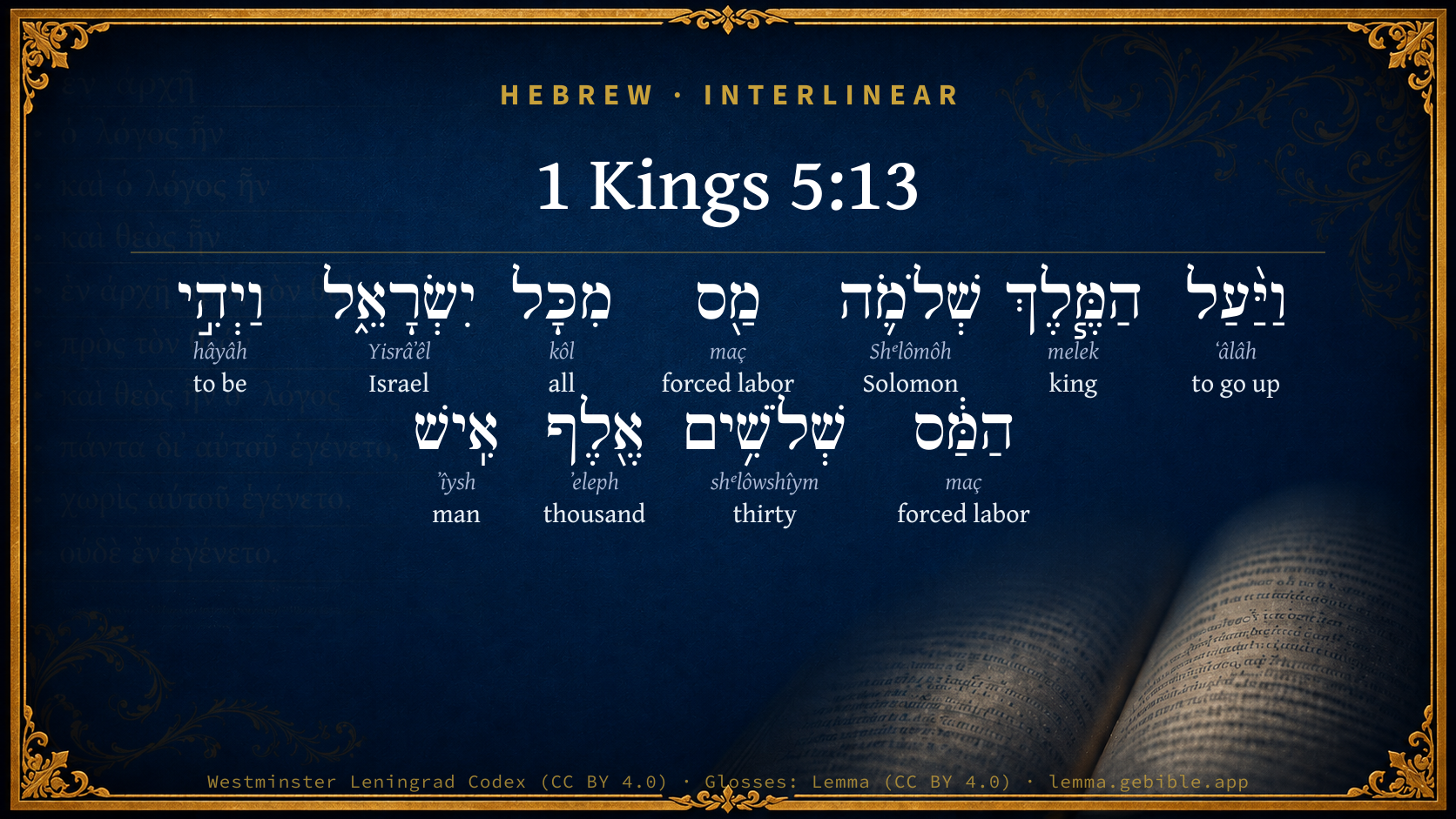
Hebrew (Westminster Leningrad Codex) 1 Kings 5:13 appears in the Hebrew Old Testament. The text above is from the Westminster Leningrad Codex. Each word links to its Strong’s number, a concise gloss, and parsing drawn from the Open Scriptures Hebrew Bible morphology. Click any word for its full Brown-Driver-Briggs (BDB) entry.
Download image
Cite this verse

1 Kings 5:13 (World English Bible). Public Domain. Lemma interlinear Bible study tool, https://lemma.gebible.app/v/1-kings/5/13.

Show BibTeX & RIS
BibTeX
RIS
English Translation
King Solomon raised a levy out of all Israel; and the levy was thirty thousand men.
World English Bible · Public Domain
Download a study sheet

One document with this verse’s original text, its word-by-word gloss line, the meaning frame, cross-references with their text, attributed commentary, and full source and license credits — printable, and it pastes into notes with its structure intact.

This verse Autodidact and up

Study sheet (.html) Plain text (.txt)

A passage Seminary Student

Up to 50 verses in one chapter. A passage sheet keeps up to 6 commentary sources and 12 cross-references per verse, in the order this page ranks them, and says so on the sheet whenever that leaves anything out. Ask for a single verse and you get the Autodidact verse sheet above.

Everything on this page stays free to read, with no account — the sheet is a download of what is already on screen, not access to it.

Want to remove ads? Support Godless Engineer
Compare translations 3

The same verse in 3 English versions, stacked beneath the original-language interlinear above. Click any original word for its lexicon entry.

Each is an independent rendering of the whole verse — the interlinear is not word-aligned to these translations.

Highlighted words mark where these versions differ — a whole-verse word diff, not a word-by-word alignment.

  • World English Bible Public Domain
    King Solomon raised a levy out of all Israel; and the levy was thirty thousand men.
  • King James Version Public Domain
    And king Solomon raised a levy out of all Israel; and the levy was thirty thousand men.
  • unfoldingWord Literal Text CC BY-SA 4.0
    And King Solomon brought up forced labor from all of Israel. And the forced labor was 30,000 men.

unfoldingWord Literal Text — © unfoldingWord, licensed CC BY-SA 4.0. Word-aligned USFM3 via Door43 (git.door43.org/unfoldingWord/en_ult).

Versions to compare (up to 4)

3 of 4 selected

Show all 18 translations

Every available English version of this verse, each an independent rendering of the whole verse.

  • World English Bible Public Domain
    King Solomon raised a levy out of all Israel; and the levy was thirty thousand men.
  • Berean Standard Bible Public Domain
    Then King Solomon conscripted a labor force of 30,000 men from all Israel.
  • Majority Standard Bible Public Domain
    Then King Solomon conscripted a labor force of 30,000 men from all Israel.
  • King James Version Public Domain
    And king Solomon raised a levy out of all Israel; and the levy was thirty thousand men.
  • American Standard Version (1901) Public Domain
    And king Solomon raised a levy out of all Israel; and the levy was thirty thousand men.
  • Revised Version (1885) Public Domain
    And king Solomon raised a levy out of all Israel; and the levy was thirty thousand men.
  • Geneva Bible (1599) Public Domain
    And King Salomon raised a summe out of all Israel, and the summe was thirtie thousand men:
  • Douay-Rheims (1899) Public Domain
    And king Solomon chose workmen cut of all Israel, and the levy was of thirty thousand men.
  • Young's Literal Translation Public Domain
    And king Solomon lifteth up a tribute out of all Israel, and the tribute is thirty thousand men,
  • Literal Standard Version CC BY-SA 4.0
    And King Solomon lifts up a tribute out of all Israel, and the tribute is thirty thousand men,
  • Unlocked Literal Bible CC BY-SA 4.0
    King Solomon conscripted labor out of all Israel. The forced laborers numbered thirty thousand men.
  • unfoldingWord Literal Text CC BY-SA 4.0
    And King Solomon brought up forced labor from all of Israel. And the forced labor was 30,000 men.
  • Darby Bible Public Domain
    And king Solomon raised a levy out of all Israel; and the levy was thirty thousand men.
  • World Messianic Bible Public Domain
    King Solomon raised a levy out of all Israel; and the levy was thirty thousand men.
  • Webster's Bible Public Domain
    And king Solomon raised a levy out of all Israel; and the levy was thirty thousand men.
  • Free Bible Version CC BY-SA 4.0
    King Solomon drafted a labor force of 30,000 from all of Israel.
  • Bible in Basic English Public Domain
    Then King Solomon got together men for the forced work through all Israel, thirty thousand men in number;
  • JPS Tanakh (1917) Public Domain
    (5-27) And king Solomon raised a levy out of all Israel; and the levy was thirty thousand men.

Literal Standard Version (2020), Covenant Press — licensed CC BY-SA 4.0. Text via the HelloAO Bible API (eBible.org). Unlocked Literal Bible (unfoldingWord) — licensed CC BY-SA 4.0. Text via the HelloAO Bible API (eBible.org). unfoldingWord Literal Text — © unfoldingWord, licensed CC BY-SA 4.0. Word-aligned USFM3 via Door43 (git.door43.org/unfoldingWord/en_ult). Free Bible Version, Dr. Jonathan Gallagher — licensed CC BY-SA 4.0. Text via the HelloAO Bible API (eBible.org).

Word by word

More ways to search: Search by grammar → Find every occurrence → Compare this word →

Practice this passage: Drill this verse → Learn its vocabulary →

מַ֖ס
maç
H4522
“forced labor”
Noun, Common, Masculine, Singular, Absolute
Part of Speech
Noun
Type
Common
Gender
Masculine
Number
Singular
State
Absolute
Full BDB Definition

Origin: from H4549

TWOT: 1218

gang or body of forced labourers, task-workers, labour band or gang, forced service, task-work, serfdom, tributary, tribute, levy, taskmasters, discomfited - labour-band, labour-gang, slave gang - gang-overseers - forced service, serfdom, tribute, enforced payment
  1. וַיַּ֨עַל ʻâlâh H5927 “and · to go up” Conjunction + Verb, Hiphil, Sequential Imperfect, 3rd Person, Masculine, Singular
  2. הַמֶּ֧לֶךְ melek H4428 “the · king” Particle, Definite Article + Noun, Common, Masculine, Singular, Absolute
  3. שְׁלֹמֹ֛ה Shᵉlômôh H8010 “Solomon” Noun, Proper
  4. מִכָּל kôl H3605 “from · all of” Preposition + Noun, Common, Masculine, Singular, Construct
  5. יִשְׂרָאֵ֑ל Yisrâʼêl H3478 “Israel” Noun, Proper
  6. וַיְהִ֣י hâyâh H1961 “and · to be” Conjunction + Verb, Qal, Sequential Imperfect, 3rd Person, Masculine, Singular
  7. הַמַּ֔ס maç H4522 “the · forced labor” Particle, Definite Article + Noun, Common, Masculine, Singular, Absolute
  8. שְׁלֹשִׁ֥ים shᵉlôwshîym H7970 “thirty” Adjective, Cardinal number, Both, Plural, Absolute
  9. אֶ֖לֶף ʼeleph H505 “thousand” Adjective, Cardinal number, Both, Singular, Absolute
  10. אִֽישׁ ʼîysh H376 “man” Noun, Common, Masculine, Singular, Absolute

About this verse

These counts appear in no published source. They are computed here, from the morphology-tagged text and Lemma’s own curated glosses. What Lemma adds →

11
words
10
distinct lemmas
Historical
section

Notable vocabulary

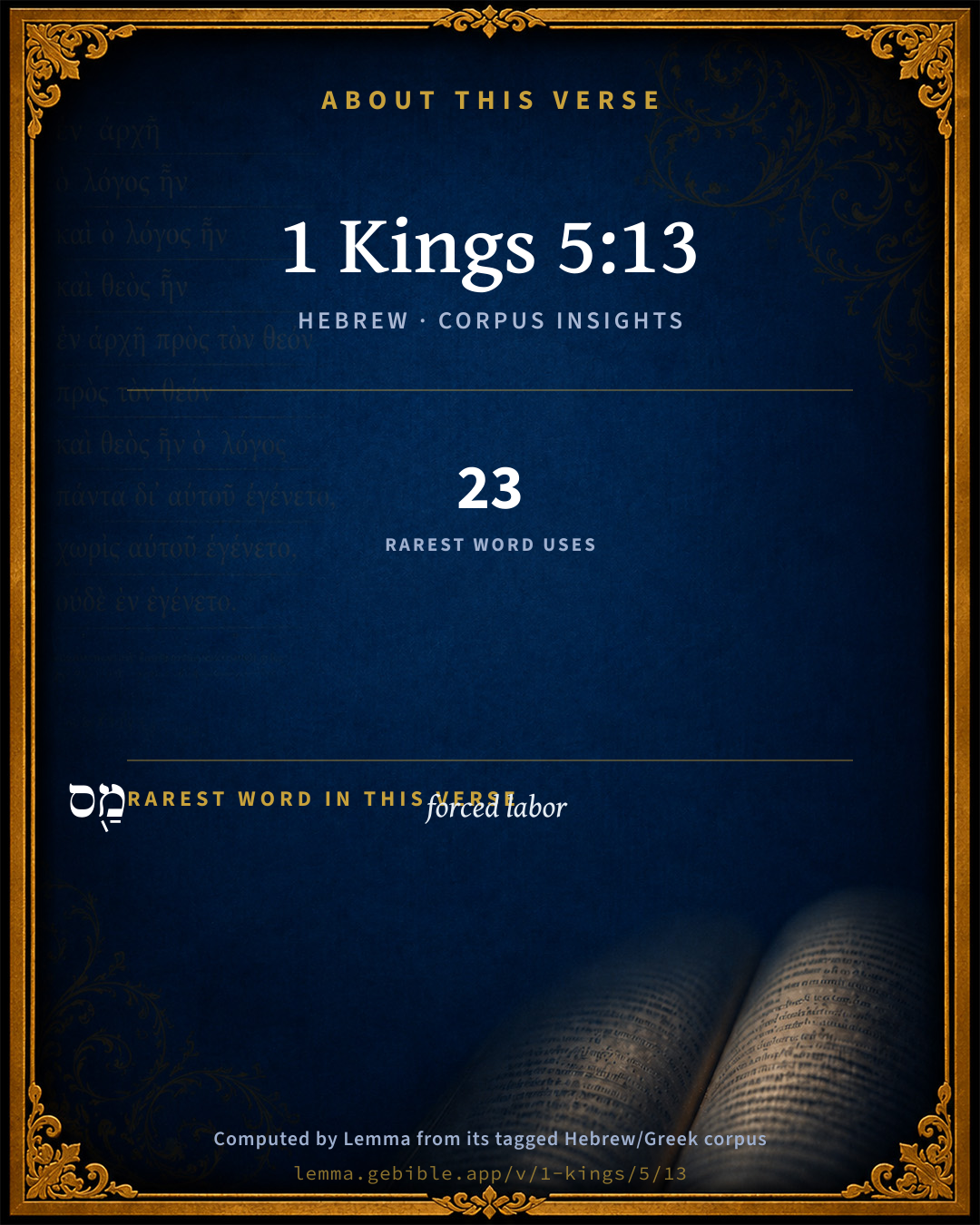
The rarest word here is מַ֖ס forced labor H4522 — appearing just 23 times in the whole Hebrew Bible.

Shared distinctive vocabulary

מַ֖ס forced labor H4522 occurs in 22 verses of the Hebrew Bible. Also found in:

Grammatical profile

  • 2 verbs
  • 7 nouns
  • 2 adjectives

Verb forms

  • וַיַּ֨עַל Hiphil · Sequential Imperfect
  • וַיְהִ֣י Qal · Sequential Imperfect

Repetition

A word recurs within this verse — often emphatic in Hebrew:

  • מַ֖ס forced labor H4522 ×2

Hebrew & Septuagint length

In English translation the verse runs 16 words from the Hebrew and 17 from the Septuagint (LXX English) — closely comparable.

A rough comparison of the two English renderings, which tokenize alike — not a word-level alignment.

Word counts can differ between the Hebrew and the Greek without any difference in meaning — e.g. the Hebrew direct-object marker אֵת has no separate Greek word, and Greek often adds the article ὁ.

Cross-references

2

Topical passages linked to 1 Kings 5:13 in the Treasury of Scripture Knowledge — connected by theme and wording, ordered by reader-vote popularity; previews shown in the World English Bible.

  • 1 Kings 9:15 This is the reason of the levy which king Solomon raised, to build the house of Yahweh, and his own house, and Millo, and the wall of Jerusalem, and Hazor, and Megiddo, and Gezer.
  • 1 Kings 4:6 and Ahishar was over the household; and Adoniram the son of Abda was over the men subject to forced labor.

Cross-references courtesy of OpenBible.info (CC BY 4.0).

Hebrew and Greek witnesses Masoretic Hebrew ↔ Greek Septuagint

The same verse in the two great witnesses to the Old Testament, shown verse-for-verse.

These are two independent witnesses, not word-aligned to each other, and the Septuagint is shown in lemma (dictionary) form.

Hebrew 1 Kings 5:13 Masoretic · Westminster Leningrad Codex

וַיַּ֨עַל הַמֶּ֧לֶךְ שְׁלֹמֹ֛ה מַ֖ס מִכָּל יִשְׂרָאֵ֑ל וַיְהִ֣י הַמַּ֔ס שְׁלֹשִׁ֥ים אֶ֖לֶף אִֽישׁ

King Solomon raised a levy out of all Israel; and the levy was thirty thousand men.

World English Bible · Public Domain

Greek LXX 1 Kings 5:13 Septuagint · lemma form

καί λαλέω περί ὁ ξύλον ἀπό ὁ κέδρος ὁ ἐν ὁ λίβανος καί ἕως ὁ ὕσσωπος ὁ ἐκπορεύομαι διά ὁ τοῖχος καί λαλέω περί ὁ κτῆνος καί περί ὁ πετεινόν καί περί ὁ ἑρπετόν καί περί ὁ ἰχθύς

And the king raised a levy out of all Israel, and the levy was thirty thousand men.

LXX2012 (modern English Septuagint) · Public Domain

Hebrew: Westminster Leningrad Codex (CC BY 4.0). Greek: Septuagint (public domain); English from LXX2012 (modern English Septuagint) (Public Domain). How the Septuagint differs from the Hebrew →

Targum (Aramaic paraphrase)

1

The Targum is the ancient Jewish Aramaic paraphrase of the Hebrew Scriptures — an interpretive translation, not the Hebrew text itself. Onkelos (literal) and Pseudo-Jonathan (expansive) render the Torah, and Jonathan the Prophets. Coverage is partial: where no permissively-licensed English translation exists for a verse, only the Aramaic is shown. This is verse-level text, not a word-by-word alignment to the Hebrew.

  1. Targum Jonathan Prophets (Joshua–Malachi)
    וְאִתְנַבֵּי עַל מַלְכֵי בֵית דָוִד דַעֲתִידִין לְמִשְׁלַט בְּעַלְמָא הָדֵין וּבְעַלְמָא דְאָתֵי דִמְשִׁיחָא וְאִתְנַבֵּי עַל בְּעִירָא וְעַל עוֹפָא וְעַל רִיחֲשָׁא וְעַל נוּנַיָא:

    (no public-domain English translation for this verse)

    Targum Jonathan — Aramaic: “Mikraot Gedolot” (public domain). English: “Sefaria Community Translation” (CC0 1.0 (public-domain dedication)); “London "Chaldee Paraphrase," 1871” (public domain). Text via Sefaria.

Commentary

Notes on 1 Kings 5:13 from classic Christian and Jewish commentators (each source and its license shown beneath its notes). The classic Christian expositions comment on the surrounding passage and are grouped to its opening verse, so a note may address several verses; the Jewish commentaries on the Tanakh (Rashi and others) are per-verse, so they appear only where the commentator wrote on this verse.

Lemma curates 59 commentaries, every one of them public domain or Creative Commons licensed, each selected and text-cleaned for this edition rather than reprinted as found. About our sources →

Jamieson, Fausset & Brown

Robert Jamieson, A. R. Fausset & David Brown

SOLOMON'S WORKMEN AND LABORERS. (Kg1 5:13-18)

Solomon raised a levy out of all Israel--The renewed notice of Solomon's divine gift of wisdom (Kg1 5:12) is evidently introduced to prepare for this record of the strong but prudent measures he took towards the accomplishment of his work. So great a stretch of arbitrary power as is implied in this compulsory levy would have raised great discontent, if not opposition, had not his wise arrangement of letting the laborers remain at home two months out of three, added to the sacredness of the work, reconciled the people to this forced labor. The carrying of burdens and the irksome work of excavating the quarries was assigned to the remnant of the Canaanites (Kg1 9:20; Ch2 8:7-9) and war prisoners made by David--amounting to 153,600. The employment of persons of that condition in Eastern countries for carrying on any public work, would make this part of the arrangements the less thought of.

Jamieson, Fausset & Brown — Commentary Critical and Explanatory on the Whole Bible (1871) — public domain (CC PDM 1.0). Text via the HelloAO Bible API.

Trapp's Complete Commentary

John Trapp

1Ki 5:13 And king Solomon raised a levy out of all Israel; and the levy was thirty thousand men.

Ver. 13. And king Solomon raised a levy.] Heb., A tribute of men, perhaps of aliens, or such as the Gibeonites were in Israel.

John Trapp, A Commentary or Exposition upon All the Books of the Old and New Testament (1647–1656) — public domain. Text from a community e-Sword module.

Joseph Benson's Commentary

1Ki 5:13. Solomon raised a levy — Which were to be employed in the most honourable and easy parts of the work relating to the temple, in the manner expressed 1Ki 5:14; and these were Israelites; but those one hundred and fifty thousand mentioned 1Ki 5:15 were strangers. if it seem strange that so many thousands should be employed about so small a building as the temple was, it must be considered, 1st, That the temple, all its parts being considered, was far larger than men imagine: 2d, That it is probable they were employed by turns, as the thirty thousand were, (1Ki 5:13,) else they had been oppressed with hard and uninterrupted labours: 3d, That the timber and stone hewed and carried by them were designed, not only for the temple, but also for Solomon’s own houses and buildings; because we read of no other levy of men, nor of any care and pains taken, after the building of the temple, for the procurement or preparation of materials for his own houses, or his other buildings; nay, that this very levy of men was made and employed for the building of the Lord’s house, and Solomon’s house, and Millo, and the wall of Jerusalem, and Hazor, and Megiddo, and Gezer, is expressed chap. 1Ki 9:15.

Joseph Benson's Commentary on the Old and New Testaments (1811–1818) — public domain. Text from a community e-Sword module.

Whedon's Commentary on the Bible

Daniel D. Whedon

THE LABORERS AT LEBANON, 1Ki_5:13-18.

13. Levy — See note on 1Ki_4:6, and 2Sa_20:24.

Daniel D. Whedon (gen. ed.), Commentary on the Old and New Testaments (1874–1909) — public domain. Text from a community e-Sword module.

Keil & Delitzsch

C. F. Keil & F. Delitzsch

The tributary labourers out of Israel. - Kg1 5:13, Kg1 5:14. Solomon raised a tribute (מס, tribute-labourers, as in Kg1 4:6) out of all Israel, i.e., out of the whole nation (not "out of the whole territory of Israel," as Ewald supposes), 30,000 men, and sent them up to Lebanon, 10,000 a month in rotation; one month they were on Lebanon (doing tribute work), two months at home (looking after the cultivation of their own ground). ויּעל, from העלה, does not mean in tabulas referre, in support of which appeal is made to Ch1 27:24, though on insufficient ground, but ascendere fecit, corresponding to the German ausheben (to raise). He raised them out of the nation, to send the up Lebanon (cf. Kg1 9:25). These 30,000 Israelitish labourers must be distinguished from the remnants of the Canaanites who were made into tribute-slaves (Kg1 5:15 and Kg1 9:20). The latter are called עבד מס, tribute-slaves, in Kg1 9:21 as in Jos 16:10. That the Israelites were not to render the service of bondsmen is evident from the fact, that they only rendered tribute for four months of the year, and were at home for eight months; and the use of the epithet מס is not at variance with this. For even if this word is applied elsewhere to the Canaanitish bondsmen (e.g., Jos 17:13; Jdg 1:28, Jdg 1:30, and Ch2 8:8), a distinction is decidedly made in our account of Solomon between מס and עבד מס, inasmuch as in Kg1 9:22, after the Canaanitish bondsmen have been mentioned, it is expressly stated that "of Israel Solomon made no one a slave" (עגלים). The 30,000 Israelitish tribute-servants are "to be thought of as free Israelites, who simply performed the less severe work of felling trees in fellowship with and under the direction of the subjects of Hiram _(see at Kg1 5:6), according to the command of the king, and probably not even that without remuneration" (Thenius). For Adoniram see at Kg1 4:6.

Keil & Delitzsch — Biblical Commentary on the Old Testament (1861–1891) — public domain (CC PDM 1.0). Text via the HelloAO Bible API. (Old Testament only.)

Tyndale Open Study Notes

Tyndale Open Resources

5:13-18 This passage describes Solomon’s work force and the division of labor. Forced labor was a common practice in the ancient Near East (see study note on 4:6).

5:13 Aliens with permanent residency in Israel comprised the bulk of Solomon’s labor force. Native Israelites were apparently temporary supervisors for Solomon’s building projects (9:22-23; 11:28).

Tyndale Open Study Notes — © Tyndale Open Resources, licensed CC BY-SA 4.0. Text via the HelloAO Bible API.

Adam Clarke's Commentary

Verse 13. The levy was thirty thousand men.] We find from the following verse that only ten thousand were employed at once, and those only for one month at a time; and having rested two months, they again resumed their labour. These were the persons over whom Adoniram was superintendent, and were all Israelites.

Adam Clarke's Commentary on the Bible (1810–1826) — public domain. Text from a community e-Sword/MySword module.

Ellicott's Commentary for English Readers

(13) Levy out of all Israel.—This, though far from being onerous, appears to have been at this time exceptional. For in 1Ki_9:22 we read that “of the children of Israel did Solomon make no bondmen: but they were men of war, and his servants, and his princes, and his captains.” Thus exceptionally introduced at first for the special service of God, it may have been the beginning of what was hereafter an oppressive despotism over the Israelites themselves. Probably even now the Israelite labourers were (under the chief officers) put in authority over the great mass of 150,000 bondmen, evidently drawn from the native races. (See 2Ch_2:17.) But the whole description suggests to us—what the history of Exodus, the monuments of Egypt, and the description by Herodotus of the building of the Pyramids confirm—the vast sacrifice of human labour and life, at which (in the absence of machinery to spare labour) the great monuments of ancient splendour were reared.

A Bible Commentary for English Readers, edited by Charles John Ellicott (1878–1897) — public domain. Text from a community e-Sword module.

The Cambridge Bible for Schools and Colleges

gen. ed. J. J. S. Perowne

13–18. Solomon’s levy of forced labourers for the work on Lebanon (2Ch_2:1-2; 2Ch_2:17-18)

13. a levy] The men selected had to give their labour. Such compulsory service has been a not unusual demand of Oriental monarchs. If we take the census of the people as it is given in 2Sa_24:9 we find that the 30,000 labourers required for this work were rather more than 2 per cent. of the numbers given in by Joab to David. Of course this levy only lasted so long as the work on Lebanon was in hand. The levy of bondservice mentioned in 1Ki_9:21 was of a different kind. The strangers there spoken of were made perpetually to do forced labour. Josephus considers the present levy to have been no hardship. He says that Solomon ἄπονον τὴν ἐργασίαν κατέστησε. And probably the object for which the work was done would lend some enthusiasm to the labourers. Samuel (1Sa_8:16) had given the people warning that their kings would make such demands upon their service.

The Cambridge Bible for Schools and Colleges (gen. ed. J. J. S. Perowne; Cambridge University Press, 1878–1918) — public domain. Text from a community e-Sword module.

John Gill's Exposition

And King Solomon raised a levy out of all Israel,.... Not of money, but of men, as follows:

and the levy was thirty thousand men; for what purpose, and how they were employed, Kg1 5:14 shows.

John Gill's Exposition of the Whole Bible (1746–1763) — public domain (CC PDM 1.0). Text via the HelloAO Bible API.

Albert Barnes' Notes on the Bible

A levy out of all Israel - This was, apparently, the first time that the Israelites had been called upon to perform forced labor, though it had been prophesied 1Sa 8:16. David had bound to forced service “the strangers” 1Ch 22:2; but hitherto the Israelites had escaped. Solomon now, in connection with his proposed work of building the temple, with the honor of God as an excuse, laid this burden upon them. Out of the 1,300, 000 able-bodied Israelites 2Sa 24:9, a band of 30,000 - one in forty-four - was raised, of whom one-third was constantly at work in Lebanon, while two-thirds remained at home, and pursued their usual occupations. This, though a very light form of task work, was felt as a great oppression, and was the chief cause of the revolt of the ten tribes at Solomon’s death 1Ki 12:4.

Albert Barnes' Notes on the Bible (1834–1885) — public domain. Text from a community e-Sword/MySword module.

Matthew Poole's English Annotations

Which were to be employed in the most honourable and easy parts of the work relating to the temple, in manner expressed, 1Ki 5:14. And these were Israelites; but those 150,000, mentioned 1Ki 5:15, were strangers, by comparing this with 1Ki 9:21,22. If it seem strange to any man that so many thousands should be employed about so small a building as the temple was, it must be considered,

1. That the temple, all its parts being considered, was far larger than men imagine, of which more hereafter.

2. That it is probable, that they were employed by turns, as the 30,000 were, 1Ki 5:14, else they had been oppressed with hard and uninterrupted labours.

3. That the timber and stone hewed and carried by them was designed, not only (though principally) for the temple, but also for Solomon’s own houses and buildings; because we read of no other levy of men, nor of any great care and pains taken, after the building of the temple, for the procurement or preparation of materials for his own houses, or his other buildings; which implies, that that work was done before; nay, that this very levy of men was made and employed for the building of the Lord’s house, and Solomon’s house, and Millo, and the wall of Jerusalem, and Hazor and Megiddo, and Gezer, is expressed 1Ki 9:15, which may fully satisfy that scruple.

Matthew Poole's English Annotations on the Holy Bible (1683–1685) — public domain. Text from a community e-Sword/MySword module.

The Pulpit Commentary

And King Solomon raised a levy Marg., tribute of men, i.e., conscription out of all Israel (i.e. , the people, not the land Ewald) and the levy was thirty thousand men. That is, if we may trust the figures of the census given in 2Sa_24:9 which do not agree, however, with those of, (1Ch_21:5) the conscription only affected one in forty of the male population. But even the lower estimate of Samuel is regarded with some suspicion. Such a levy was predicted. (1Sa_8:16)

The Pulpit Commentary (1880–1919), ed. H.D.M. Spence-Jones & Joseph S. Exell — public domain. Text from a community e-Sword module.

John Wesley's Explanatory Notes

The levy - Which were to be employed in the most honourable and easy parts of the work relating to the temple; and these were Israelites; but those fifteen hundred thousand mentioned ver. 15, were strangers. If it seem strange, that so many thousands should be employed about so small a building as the temple was; it must be considered,

1. that the temple, all its parts being considered, was far larger than men imagine;

2. that it is probable, they were employed by turns, as the thirty thousand were, ver. 14, else they had been oppressed with hard and uninterrupted labours.

3. that the timber and stone hewed and carried by them, was designed, not only for the temple, but also for Solomon's own houses, and buildings; because we read of no other levy of men, nor of any care and pains taken after the building of the temple, for the procurement, or preparation of materials for his own houses, or his other buildings; nay, that this very levy of men was made and employed for the building of the Lord's house, and Solomon's house, and Millo, and the wall of Jerusalem, and Hazor, and Megiddo, and Gezer, is expressed chap. ix, 15.

John Wesley, Explanatory Notes Upon the Whole Bible (1754–1765) — public domain. Text via the GEBible commentary corpus.

unfoldingWord translationNotes

Door43 World Missions Community

General Information:

Solomon forces men to build the Temple.

conscripted labor out of all Israel

"forced men from all over Israel to work"

in shifts

That is, there were three groups that took turns spending one month in Lebanon and two months at home.

One month they were in Lebanon and two months at home

Each of the three groups spent one month working in Lebanon and then two months at home in Israel.

the men who were subjected to forced labor

This can be translated in active form. AT: "the men whom Solomon was forcing to work for him" (See: Active or Passive)

translationWords

labor

unfoldingWord translationNotes — © Distant Shores Media and the Door43 World Missions Community, licensed CC BY-SA 4.0. Source: git.door43.org/Door43/en_tn.

Rashi

Rabbi Shlomo Yitzchaki (Rashi)

He spoke of trees. Which medical remedy is derived from each [tree], and that a particular tree is best suited for that type of building or to be planted in a particular field. And similarly regarding to animals, what is its cure and the vital elements needed for its development and its food. The Midrash Aggadah [expounds]: Why did God see [fit] that a leper becomes ritually clean with the tallest of the tall [trees] and the lowest of the low [trees]? “And of the animals and the fowl,” why did God see fit that this one should become permissible through Shechitah, by severing one organ, the esophagus. and this one, by [severing] both [organs], the esophagus. and fish and grasshoppers without anything [i.e., slaughtering].

Rashi on the Tanakh — English translations: “The Judaica Press complete Tanach with Rashi, translated by A. J. Rosenberg” (CC BY 4.0); “Pentateuch with Rashi's commentary by M. Rosenbaum and A.M. Silbermann, 1929-1934” (public domain); “The Metsudah Tanach series, Lakewood, N.J” (CC BY 4.0); and “The Book of Joshua, Metsudah Publications, 1997” (CC BY 4.0). Text via Sefaria.

Lesson kit

Teaching starters — assembled from the data on this page, not authored interpretation. Every prompt links to the verse data it draws on. Edit before teaching.

1 Kings, in the Historical, opens this verse with 11 words (10 distinct Hebrew lemmas). Its most distinctive word is maç (“forced labor”). A historical commentator’s framing appears above. Read the whole chapter for the surrounding context.

Discussion questions

  1. How does “forced labor” (maç) shape what this verse is saying?
  2. Genesis 49:15 shares the word «forced labor» with this verse. How do the two illuminate each other?
  3. “forced labor” occurs 2× in this one verse. What is the effect of the repetition?
  4. These translations render this verse differently; the difference is in the English rendering, not the original. What questions does that raise?
  5. The verb «וַיַּ֨עַל» is Hiphil Sequential Imperfect. How does its form color the action?
  6. Reading how Jamieson, Fausset & Brown and Trapp's Complete Commentary read this verse, where do the two commentators agree and where do they part?

Things to notice

  • These translations choose different wording for 10 words in this verse.
  • “forced labor” occurs 2× in this single verse.
  • 10 distinct Hebrew lemmas span 11 words in this verse.

Reading settings

Reading text

Shown beneath each verse's original-language words.

Old Testament
Old Testament edition

Read the OT as the Masoretic Hebrew (MT) or the Greek Septuagint (LXX).

English shown for the Greek Septuagint (in the Hebrew ↔ Greek comparison).

Comparing translations? Open the Compare panel on any verse page to stack up to four side by side.