
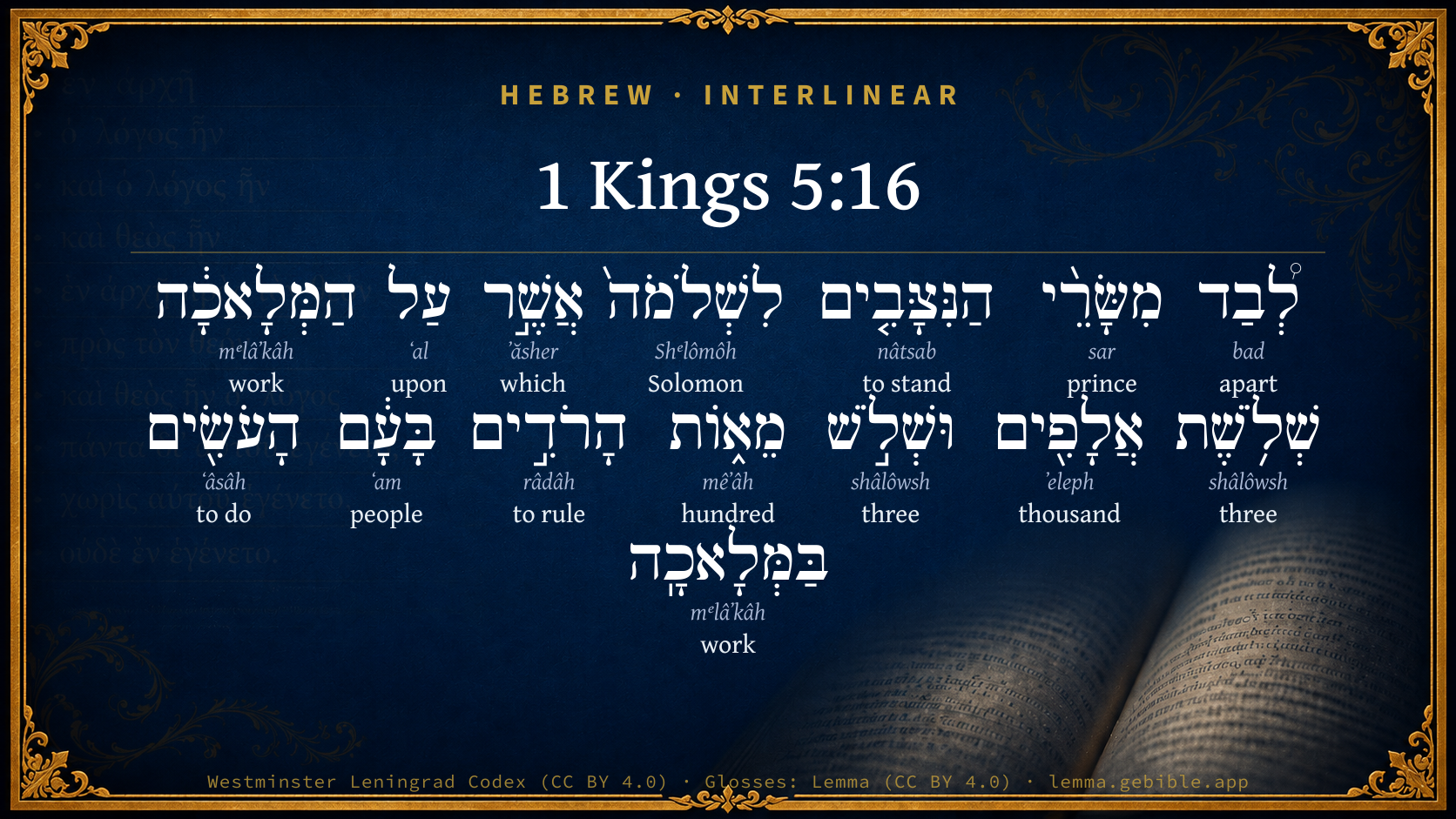
1 Kings 5:16

Hebrew (Westminster Leningrad Codex) 1 Kings 5:16 appears in the Hebrew Old Testament. The text above is from the Westminster Leningrad Codex. Each word links to its Strong’s number, a concise gloss, and parsing drawn from the Open Scriptures Hebrew Bible morphology. Click any word for its full Brown-Driver-Briggs (BDB) entry.
Download image
Cite this verse

1 Kings 5:16 (World English Bible). Public Domain. Lemma interlinear Bible study tool, https://lemma.gebible.app/v/1-kings/5/16.

Show BibTeX & RIS
BibTeX
RIS
English Translation
besides Solomon's chief officers who were over the work, three thousand and three hundred, who bore rule over the people who labored in the work.
World English Bible · Public Domain
Download a study sheet

One document with this verse’s original text, its word-by-word gloss line, the meaning frame, cross-references with their text, attributed commentary, and full source and license credits — printable, and it pastes into notes with its structure intact.

This verse Autodidact and up

Study sheet (.html) Plain text (.txt)

A passage Seminary Student

Up to 50 verses in one chapter. A passage sheet keeps up to 6 commentary sources and 12 cross-references per verse, in the order this page ranks them, and says so on the sheet whenever that leaves anything out. Ask for a single verse and you get the Autodidact verse sheet above.

Everything on this page stays free to read, with no account — the sheet is a download of what is already on screen, not access to it.

Want to remove ads? Support Godless Engineer
Compare translations 3

The same verse in 3 English versions, stacked beneath the original-language interlinear above. Click any original word for its lexicon entry.

Each is an independent rendering of the whole verse — the interlinear is not word-aligned to these translations.

Highlighted words mark where these versions differ — a whole-verse word diff, not a word-by-word alignment.

  • World English Bible Public Domain
    besides Solomon's chief officers who were over the work, three thousand and three hundred, who bore rule over the people who labored in the work.
  • King James Version Public Domain
    Beside the chief of Solomon's officers which were over the work, three thousand and three hundred, which ruled over the people that wrought in the work.
  • unfoldingWord Literal Text CC BY-SA 4.0
    apart from the commanders of the deputies of Solomon who over the work, 3,300 the ones ruling over the people doing the work.

unfoldingWord Literal Text — © unfoldingWord, licensed CC BY-SA 4.0. Word-aligned USFM3 via Door43 (git.door43.org/unfoldingWord/en_ult).

Versions to compare (up to 4)

3 of 4 selected

Show all 18 translations

Every available English version of this verse, each an independent rendering of the whole verse.

  • World English Bible Public Domain
    besides Solomon's chief officers who were over the work, three thousand and three hundred, who bore rule over the people who labored in the work.
  • Berean Standard Bible Public Domain
    not including his 3,300 foremen who supervised the workers.
  • Majority Standard Bible Public Domain
    not including his 3,300 foremen who supervised the workers.
  • King James Version Public Domain
    Beside the chief of Solomon's officers which were over the work, three thousand and three hundred, which ruled over the people that wrought in the work.
  • American Standard Version (1901) Public Domain
    besides Solomon's chief officers that were over the work, three thousand and three hundred, who bare rule over the people that wrought in the work.
  • Revised Version (1885) Public Domain
    besides Solomon’s chief officers that were over the work, three thousand and three hundred, which bare rule over the people that wrought in the work.
  • Geneva Bible (1599) Public Domain
    Besides the princes, whome Salomon appoynted ouer the worke, euen three thousande and three hundreth, which ruled the people that wrought in the worke.
  • Douay-Rheims (1899) Public Domain
    Besides the overseers who were over every work, in number three thousand, and three hundred that ruled over the people, and them that did the work.
  • Young's Literal Translation Public Domain
    apart from the heads of the officers of Solomon, who `are' over the work, three thousand and three hundred, those ruling over the people who are working in the business.
  • Literal Standard Version CC BY-SA 4.0
    apart from the three thousand and three hundred heads of the officers of Solomon who [are] over the work—those ruling over the people who are working in the business.
  • Unlocked Literal Bible CC BY-SA 4.0
    besides Solomon's 3,300 chief officers who were over the work and who supervised the workers.
  • unfoldingWord Literal Text CC BY-SA 4.0
    apart from the commanders of the deputies of Solomon who over the work, 3,300 the ones ruling over the people doing the work.
  • Darby Bible Public Domain
    besides the overseers whom Solomon had set over the work, three thousand three hundred, who ruled over the people that wrought in the work.
  • World Messianic Bible Public Domain
    besides Solomon’s chief officers who were over the work: three thousand three hundred who ruled over the people who labored in the work.
  • Webster's Bible Public Domain
    Besides the chief of Solomon's officers who were over the work, three thousand and three hundred, who ruled over the people that wrought in the work.
  • Free Bible Version CC BY-SA 4.0
    as well as 3,300 foremen he placed in charge of the workers.
  • Bible in Basic English Public Domain
    In addition to the chiefs of the responsible men put by Solomon to oversee the work, three thousand and three hundred in authority over the workmen.
  • JPS Tanakh (1917) Public Domain
    (5-30) besides Solomon's chief officers that were over the work, three thousand and three hundred, who bore rule over the people that wrought in the work.

Literal Standard Version (2020), Covenant Press — licensed CC BY-SA 4.0. Text via the HelloAO Bible API (eBible.org). Unlocked Literal Bible (unfoldingWord) — licensed CC BY-SA 4.0. Text via the HelloAO Bible API (eBible.org). unfoldingWord Literal Text — © unfoldingWord, licensed CC BY-SA 4.0. Word-aligned USFM3 via Door43 (git.door43.org/unfoldingWord/en_ult). Free Bible Version, Dr. Jonathan Gallagher — licensed CC BY-SA 4.0. Text via the HelloAO Bible API (eBible.org).

Word by word

More ways to search: Search by grammar → Find every occurrence → Compare this word →

Practice this passage: Drill this verse → Learn its vocabulary →

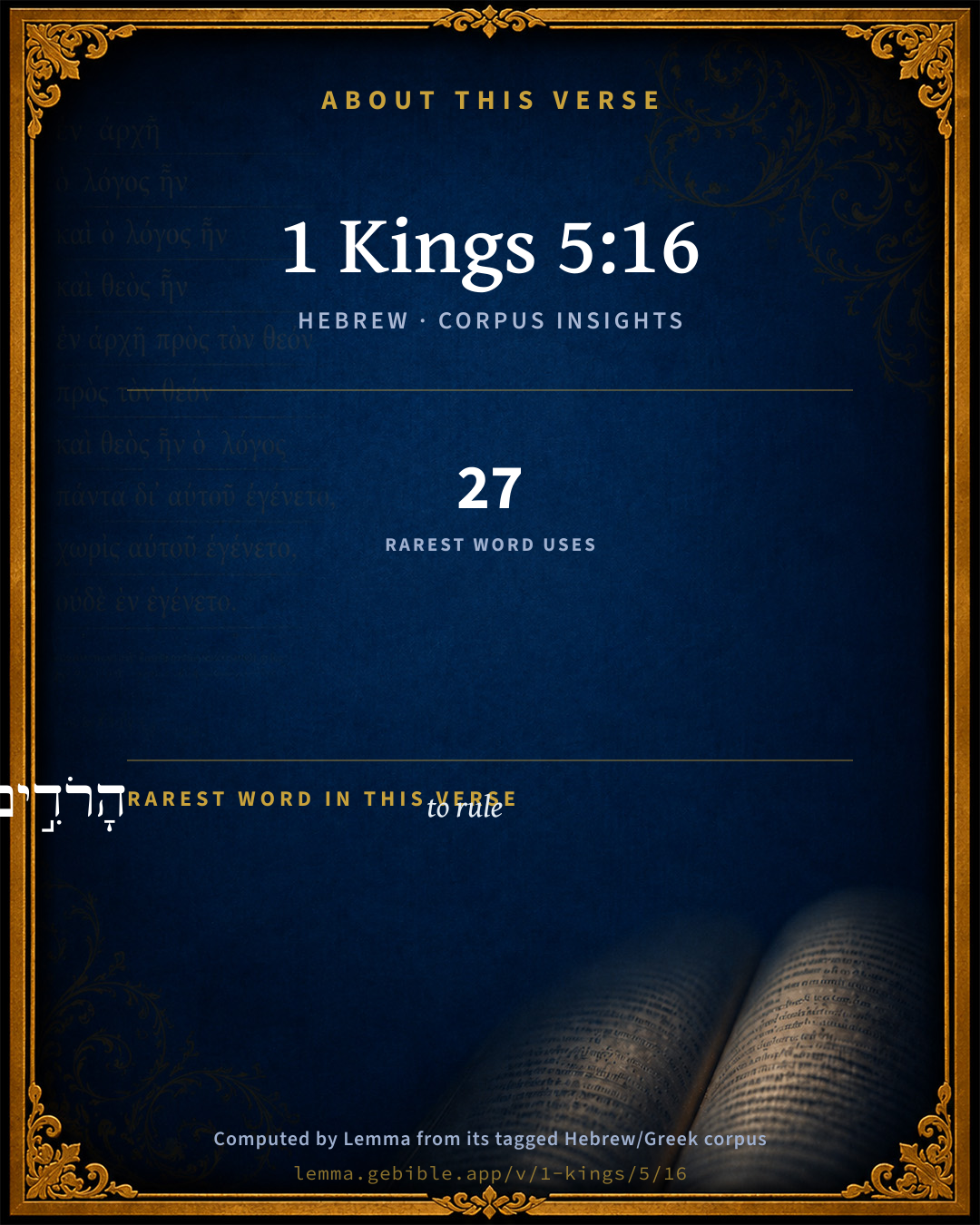
הָרֹדִ֣ים
râdâh
H7287
“the · ruling”
Particle, Definite Article + Verb, Qal, Participle Active, Masculine, Plural, Absolute
Part of Speech
Particle + Verb
Stem
Qal
Form
Participle Active
Gender
Masculine
Number
Plural
State
Absolute
Full BDB Definition

Origin: a primitive root

TWOT: 2121 , 2122

to rule, have dominion, dominate, tread down - (Qal) to have dominion, rule, subjugate - (Hiphil) to cause to dominate - to scrape out - (Qal) to scrape, scrape out
  1. לְ֠בַד bad H905 “to/for · apart” Preposition + Noun, Common, Masculine, Singular, Absolute
  2. מִשָּׂרֵ֨י sar H8269 “from · princes of” Preposition + Noun, Common, Masculine, Plural, Construct
  3. הַנִּצָּבִ֤ים nâtsab H5324 “the · standing” Particle, Definite Article + Verb, Niphal, Participle Active, Masculine, Plural, Absolute
  4. לִשְׁלֹמֹה֙ Shᵉlômôh H8010 “to/for · Solomon” Preposition + Noun, Proper
  5. אֲשֶׁ֣ר ʼăsher H834 “which” Particle, Relative
  6. עַל ʻal H5921 “upon” Preposition
  7. הַמְּלָאכָ֔ה mᵉlâʼkâh H4399 “the · work” Particle, Definite Article + Noun, Common, Feminine, Singular, Absolute
  8. שְׁלֹ֥שֶׁת shâlôwsh H7969 “three” Adjective, Cardinal number, Masculine, Singular, Construct
  9. אֲלָפִ֖ים ʼeleph H505 “thousand” Adjective, Cardinal number, Both, Plural, Absolute
  10. וּשְׁלֹ֣שׁ shâlôwsh H7969 “and · three” Conjunction + Adjective, Cardinal number, Feminine, Singular, Absolute
  11. מֵא֑וֹת mêʼâh H3967 “hundred” Adjective, Cardinal number, Both, Plural, Absolute
  12. בָּעָ֔ם ʻam H5971 “in/at the · people” Preposition, Determined + Noun, Common, Masculine, Singular, Absolute
  13. הָעֹשִׂ֖ים ʻâsâh H6213 “the · doing” Particle, Definite Article + Verb, Qal, Participle Active, Masculine, Plural, Absolute
  14. בַּמְּלָאכָֽה mᵉlâʼkâh H4399 “in/at the · work” Preposition, Determined + Noun, Common, Feminine, Singular, Absolute

About this verse

These counts appear in no published source. They are computed here, from the morphology-tagged text and Lemma’s own curated glosses. What Lemma adds →

15
words
13
distinct lemmas
Historical
section

Shared distinctive vocabulary

הָרֹדִ֣ים to rule H7287 occurs in 25 verses of the Hebrew Bible. Also found in:

Grammatical profile

  • 3 verbs
  • 6 nouns
  • 4 adjectives
  • 1 preposition
  • 1 particle

Verb forms

  • הַנִּצָּבִ֤ים Niphal · Participle Active
  • הָרֹדִ֣ים Qal · Participle Active
  • הָעֹשִׂ֖ים Qal · Participle Active

Repetition

Words recur within this verse — often emphatic in Hebrew:

  • הַמְּלָאכָ֔ה work H4399 ×2
  • שְׁלֹ֥שֶׁת three H7969 ×2

Hebrew & Septuagint length

In English translation the verse runs 25 words from the Hebrew and 23 from the Septuagint (LXX English) — closely comparable.

A rough comparison of the two English renderings, which tokenize alike — not a word-level alignment.

Word counts can differ between the Hebrew and the Greek without any difference in meaning — e.g. the Hebrew direct-object marker אֵת has no separate Greek word, and Greek often adds the article ὁ.

Cross-references

2

Topical passages linked to 1 Kings 5:16 in the Treasury of Scripture Knowledge — connected by theme and wording, ordered by reader-vote popularity; previews shown in the World English Bible.

  • 1 Kings 9:23 These were the chief officers who were over Solomon's work, five hundred fifty, who bore rule over the people who labored in the work.
  • 2 Chronicles 2:2 Solomon counted out seventy thousand men to bear burdens, and eighty thousand men who were stone cutters in the mountains, and three thousand and six hundred to oversee them.

Cross-references courtesy of OpenBible.info (CC BY 4.0).

Hebrew and Greek witnesses Masoretic Hebrew ↔ Greek Septuagint

The same verse in the two great witnesses to the Old Testament, shown verse-for-verse.

These are two independent witnesses, not word-aligned to each other, and the Septuagint is shown in lemma (dictionary) form.

Hebrew 1 Kings 5:16 Masoretic · Westminster Leningrad Codex

לְ֠בַד מִשָּׂרֵ֨י הַנִּצָּבִ֤ים לִשְׁלֹמֹה֙ אֲשֶׁ֣ר עַל הַמְּלָאכָ֔ה שְׁלֹ֥שֶׁת אֲלָפִ֖ים וּשְׁלֹ֣שׁ מֵא֑וֹת הָרֹדִ֣ים בָּעָ֔ם הָעֹשִׂ֖ים בַּמְּלָאכָֽה

besides Solomon's chief officers who were over the work, three thousand and three hundred, who bore rule over the people who labored in the work.

World English Bible · Public Domain

Greek LXX 1 Kings 5:16 Septuagint · lemma form

καί ἀποστέλλω σαλωμών πρός χιραμ λέγω

besides the rulers that were appointed over the works of Solomon, there were three thousand six hundred masters who wrought in the works.

LXX2012 (modern English Septuagint) · Public Domain

On this verse, Adam Clarke's Commentary discusses the Septuagint’s reading. Read the note in Commentary ↓

Hebrew: Westminster Leningrad Codex (CC BY 4.0). Greek: Septuagint (public domain); English from LXX2012 (modern English Septuagint) (Public Domain). How the Septuagint differs from the Hebrew →

Targum (Aramaic paraphrase)

1

The Targum is the ancient Jewish Aramaic paraphrase of the Hebrew Scriptures — an interpretive translation, not the Hebrew text itself. Onkelos (literal) and Pseudo-Jonathan (expansive) render the Torah, and Jonathan the Prophets. Coverage is partial: where no permissively-licensed English translation exists for a verse, only the Aramaic is shown. This is verse-level text, not a word-by-word alignment to the Hebrew.

  1. Targum Jonathan Prophets (Joshua–Malachi)
    וּשְׁלַח שְׁלֹמֹה לְוַת חִירָם לְמֵימָר:

    (no public-domain English translation for this verse)

    Targum Jonathan — Aramaic: “Mikraot Gedolot” (public domain). English: “Sefaria Community Translation” (CC0 1.0 (public-domain dedication)); “London "Chaldee Paraphrase," 1871” (public domain). Text via Sefaria.

Commentary

Notes on 1 Kings 5:16 from classic Christian and Jewish commentators (each source and its license shown beneath its notes). The classic Christian expositions comment on the surrounding passage and are grouped to its opening verse, so a note may address several verses; the Jewish commentaries on the Tanakh (Rashi and others) are per-verse, so they appear only where the commentator wrote on this verse.

Lemma curates 59 commentaries, every one of them public domain or Creative Commons licensed, each selected and text-cleaned for this edition rather than reprinted as found. About our sources →

Trapp's Complete Commentary

John Trapp

1Ki 5:16 Beside the chief of Solomon’s officers which [were] over the work, three thousand and three hundred, which ruled over the people that wrought in the work.

Ver. 16. Which ruled over the people.] And three hundred more to rule over these rulers, {2Ch 2:2} and all little enough to make the work to go forward as it should.

John Trapp, A Commentary or Exposition upon All the Books of the Old and New Testament (1647–1656) — public domain. Text from a community e-Sword module.

Keil & Delitzsch

C. F. Keil & F. Delitzsch

"Beside (לבד), i.e., without reckoning, the princes, Solomon's officers, who were over the work (i.e., the chiefs appointed by Solomon as overlookers of the work), 3300, who ruled over the people who laboured at the work." הנּצּבים שׂרי, as Thenius correctly observes, cannot be the chief of the overlookers, i.e., the head inspectors, as there is no allusion made to subordinate inspectors, and the number given is much too large for head inspectors. נצּבים, which is governed by שׂרי in the construct state, is to be taken as defining the substantive: principes qui praefecti erant (Vatabl.; cf. Ewald, 287, a.). Moreover, at the close of the account of the whole of Solomon's buildings (Kg1 9:23), 550 more הנּצּבים שׂרי are mentioned as presiding over the people who did the work. The accounts in the Chronicles differ from these in a very peculiar manner, the number of overseers being given in Ch2 2:17 and 3600, and in Ch2 8:10 as 250. Now, however natural it may be, with the multiplicity of errors occurring in numerical statements, to assume that these differences have arisen from copyists' errors through the confounding together of numerical letters resembling one another, this explanation is overthrown as an improbable one, by the fact that the sum-total of the overseers is the same in both accounts (3300 + 550 = 3850 in the books of Kings, and 3600 + 250 = 3850 in the Chronicles); and we must therefore follow J. H. Michaelis, an explain the differences as resulting from a different method of classification, namely, from the fact that in the Chronicles. the Canaanitish overseers are distinguished from the Israelitish (viz., 3600 Canaanites and 250 Israelites), whereas in the books of Kings the inferiores et superiores praefecti are distinguished. Consequently Solomon had 3300 inferior overseers and 550 superior (or superintendents), of whom 250 were selected from the Israelites and 300 from the Canaanites. In Ch2 2:16-17, it is expressly stated that the 3600 were taken from the גּרים, i.e., the Canaanites who were left in the land of Israel. And it is equally certain that the number given in Kg1 9:23 and Ch2 8:10 (550 and 250) simply comprises the superintendents over the whole body of builders, notwithstanding the fact that in both passages (Kg1 5:16 and Kg1 9:23) the same epithet הנּצּבים שׂרי is used. If, then, the number of overseers is given in Kg1 9:23 and 550, i.e., 300 more than in the parallel passage of the Chronicles, there can hardly be any doubt that the number 550 includes the 300, in which the number given in our chapter falls short of that in the Chronicles, and that in the 3300 of our chapter the superintendents of Canaanitish descent are not included.

(Note: Ewald (Gesch. iii. p. 292) assumes that "by the 550 (Kg1 9:23) we are to understand the actual superintendents, whereas the 3300 (Kg1 5:13) include inferior inspectors as well; and of the 550 superintendents, 300 were taken from the Canaanaeans, so that only 250 (Ch2 8:10) were native Hebrews;" though he pronounces the number 3600 (Ch2 2:17) erroneous. Bertheau, on the other hand, in his notes in Ch2 8:10, has rather complicated than elucidated the relation in which the two accounts stand to one another.)

Keil & Delitzsch — Biblical Commentary on the Old Testament (1861–1891) — public domain (CC PDM 1.0). Text via the HelloAO Bible API. (Old Testament only.)

Tyndale Open Study Notes

Tyndale Open Resources

5:16 3,600 foremen: In 2 Chronicles (2 Chr 2:2, 17-18; 8:10) the foremen total 3,600 non-Israelite and 250 Israelite chief supervisors. The numbers in the Hebrew text of 1 Kgs 5:16 and 9:23 are 3,300 foremen and 550 chief supervisors. It is possible that 250 of the chief supervisors were Israelites, with 300 non-Israelites holding the same rank.

Tyndale Open Study Notes — © Tyndale Open Resources, licensed CC BY-SA 4.0. Text via the HelloAO Bible API.

Geneva Bible (1599)

Geneva Bible translators

Or, masters of the work.

Geneva Bible (1599) marginal notes — public domain. Text via Bolls.life.

Adam Clarke's Commentary

Verse 16. Besides - three thousand and three hundred which ruled over the people] In the parallel place, 2Ch 2:18, it is three thousand six hundred. The Septuagint has here the same number.

Adam Clarke's Commentary on the Bible (1810–1826) — public domain. Text from a community e-Sword/MySword module.

Ellicott's Commentary for English Readers

(16) The chief of Solomon’s officers we should certainly have supposed to have been taken from the Israelites (as clearly were the 550 named in 1Ki_9:23). But the passage in Chronicles (2Ch_2:18)—reckoning them at 3,600—seems to imply that they were, like the overseers of Israel in the Egyptian bondage (Exo_5:14-15), taken from the subject races.

A Bible Commentary for English Readers, edited by Charles John Ellicott (1878–1897) — public domain. Text from a community e-Sword module.

The Cambridge Bible for Schools and Colleges

gen. ed. J. J. S. Perowne

16. three thousand and three hundred] This number differs by 300 from that given in the Chronicles. If the total of the census of the strangers there given be correct, then we ought to read 3600 as the number of the overseers. The LXX. has τρεῖς χιλιάδες καὶ ἑξακόσιοι, and adds that they were employed for 3 years in preparing the stones and the wood.

The stone work was most probably given to the levy of strangers and the work of cutting and dressing timber to the 10,000 Israelites who came month and month about. The word rendered ‘hewers’ in 1Ki_5:15 is so regularly used of workers in stone, that the LXX. nearly always renders the verb by λατομέω and its participle by λατόμοι (stone cutters).

which ruled over the people] The root-sense of the verb, which is ‘to trample on,’ or ‘break down,’ gives the idea that the ruling was after the fashion of taskmasters.

The Cambridge Bible for Schools and Colleges (gen. ed. J. J. S. Perowne; Cambridge University Press, 1878–1918) — public domain. Text from a community e-Sword module.

John Gill's Exposition

Besides the chief of Solomon's officers which were over the work,.... Over the whole work, preparatory for the building of the temple; though it seems chiefly to have respect to that of hewing the stones, and bringing them to the city:

three thousand and three hundred which ruled over the people that wrought in the work; to keep them to their work, and to see that they performed it well: in Ch2 2:18; they are said to be 3600, which is three hundred more than here; those three hundred are the chief officers mentioned in the former part of this verse, which were over the whole work, and even over the 3600 overseers, and with them made up the sum of 3600; so Jacob Leon (h) observes there were 3300 master workmen, and three hundred commanders over them all.

(h) Relation of Memorable Things in the Temple, ch. 3. p. 14.

John Gill's Exposition of the Whole Bible (1746–1763) — public domain (CC PDM 1.0). Text via the HelloAO Bible API.

Albert Barnes' Notes on the Bible

Comparing this verse and 1Ki 9:23 with 2Ch 2:18; 2Ch 8:10, the entire number of the overseers will be seen to be stated by both writers at 3,850; but in the one case nationality, in the other degree of authority, is made the principle of the division.

Albert Barnes' Notes on the Bible (1834–1885) — public domain. Text from a community e-Sword/MySword module.

Haydock's Catholic Bible Commentary

Three hundred. In 2 Paralipomenon (ii. 2., and 18,) we read six hundred; (Haydock) as there are 300 superior officers included. (Calmet) (Menochius) (Sa, &c.) --- But these 3600 are all overseers. (Haydock)

George Leo Haydock (1774–1849), Haydock's Catholic Family Bible and Commentary, 1859 edition — public domain. Excludes Psalms (Douay-Rheims chapter numbering differs from Protestant) and Deuterocanonical books (Catholic canon only).

Matthew Poole's English Annotations

Whereof 3000 were set over the 150,000, expressed 1Ki 5:15, each of these over 50 of them, and the odd 300 were set ever these 3000, each of these to have the oversight of ten of them, to take an account of the work from them. But in 2Ch 2:18, these overseers are said to be 3600.

Answ. The 300 added in 2Ch 2 might be a reserve, to supply the places of the other 3000; yea, or of the 3300; as any of them should be taken off from the work by death, or sickness, or weakness, or necessary occasions; which was a prudent provision, and not unusual in such-like cases. And so there were 3600 commissioned for the work, but only 3300 employed at one time; and therefore both computations may fairly stand together. Some learned men add, that those 3600 were strangers, which indeed is manifest from 2Ch 2:17; and that those 3330 were a distinct number of men, and Israelites, which were set over all the rest, both strangers and Israelites; who therefore are here called the

chief of Solomon’s officers, and are said to rule over the workmen; whereas all that is said of those 3600, 2Ch 2:18, is, that they were overseers to set the people a work; which may deserve further consideration. Others say, that the 300 added in 2 Chron. were overseers of the Tyrian workmen in Mount Lebanon, and the rest in all other places; or that they were set over some particular and more curious and considerable parts of the work.

Matthew Poole's English Annotations on the Holy Bible (1683–1685) — public domain. Text from a community e-Sword/MySword module.

Whedon's Commentary on the Bible

Daniel D. Whedon

16. Besides the chief of Solomon’s officers — Which numbered in all 550, (chap. 1Ki_9:23,) of which, however, 250 seem to have been Israelites, (2Ch_8:9-10,) and the other 300 foreigners. These last, added to the 3,300 mentioned in this verse, make up the 3,600 of 2Ch_2:18.

Daniel D. Whedon (gen. ed.), Commentary on the Old and New Testaments (1874–1909) — public domain. Text from a community e-Sword module.

The Pulpit Commentary

Beside without counting the chief of Solomon"s officers Heb. the princes of the overseers, i.e., the princes who acted as overseers, principes qui praefecti erant (Vatabl.) which were over the work three thousand and three hundred This large number proves that the "chiefs of the overseers" cannot be meant. Were all the 3, 300 superior officers, there must have been quite an army of subalterns. But we read of none. In 1Ki_9:23, an additional number of 550 "princes of the overseers" (same expression) is mentioned, making a total of 3, 850 superintendents, which agrees with the total stated in the Book of Chronicles. It is noteworthy, however, that the details differ from those of the Kings. In 2Ch_2:17 we read of a body of 3, 600 "overseers to set the people a work," whilst in. 1Ki_8:10 mention is made of 250 "princes of the overseers." These differences result, no doubt, from difference of classification and arrangement (J.H. Michaelis) In Chronicles the arrangement is one of race, i.e., 3, 600 aliens (cf. 2Ch_2:18) and 250 Israelites, whilst in Kings it is one of status, i.e., 3, 300 inferior and 550 superior officers. It follows consequently that all the inferior and 300 of the superior overseers were Canaanites which ruled over the people that wrought in the work.

The Pulpit Commentary (1880–1919), ed. H.D.M. Spence-Jones & Joseph S. Exell — public domain. Text from a community e-Sword module.

John Wesley's Explanatory Notes

Three thousand &c. - Whereof three thousand were set over the fifteen hundred thousand, expressed ver. 15, each of these, over fifty of them, and the odd three hundred were set over these three thousand, each of these to have the oversight of ten of them, to take an account of the work for them. But in 2 Chron. ii, 18, these overseers are said to be thirty-six hundred. The three thousand added in 2 Chron. ii, 2, might be a reserve, to supply the places of the other three thousand: yea, or of the thirty-three hundred, as any of them should be taken off from the work by death, or sickness, or weakness, or necessary occasions; which was a prudent provision, and not unusual in like cases. And so there were thirty-six hundred commissioned for the work, but only thirty-three hundred employed at one time; and therefore both computations fairly stand together.

John Wesley, Explanatory Notes Upon the Whole Bible (1754–1765) — public domain. Text via the GEBible commentary corpus.

Lesson kit

Teaching starters — assembled from the data on this page, not authored interpretation. Every prompt links to the verse data it draws on. Edit before teaching.

1 Kings, in the Historical, opens this verse with 15 words (13 distinct Hebrew lemmas). Its most distinctive word is râdâh (“to rule”). A historical commentator’s framing appears above. Read the whole chapter for the surrounding context.

Discussion questions

  1. How does “to rule” (râdâh) shape what this verse is saying?
  2. How does Genesis 1:26, which shares the word «to rule», read alongside this verse?
  3. What does the repetition of “work” (2× in this one verse) do in this verse?
  4. These translations render this verse differently. What is at stake in choosing one wording over another?
  5. «הַנִּצָּבִ֤ים» is a Niphal Participle Active verb. How does that grammatical form shape the action described?
  6. Compare how Trapp's Complete Commentary and Keil & Delitzsch read this verse. Where do they agree or differ?

Things to notice

Reading settings

Reading text

Shown beneath each verse's original-language words.

Old Testament
Old Testament edition

Read the OT as the Masoretic Hebrew (MT) or the Greek Septuagint (LXX).

English shown for the Greek Septuagint (in the Hebrew ↔ Greek comparison).

Comparing translations? Open the Compare panel on any verse page to stack up to four side by side.