
Judges 20:45

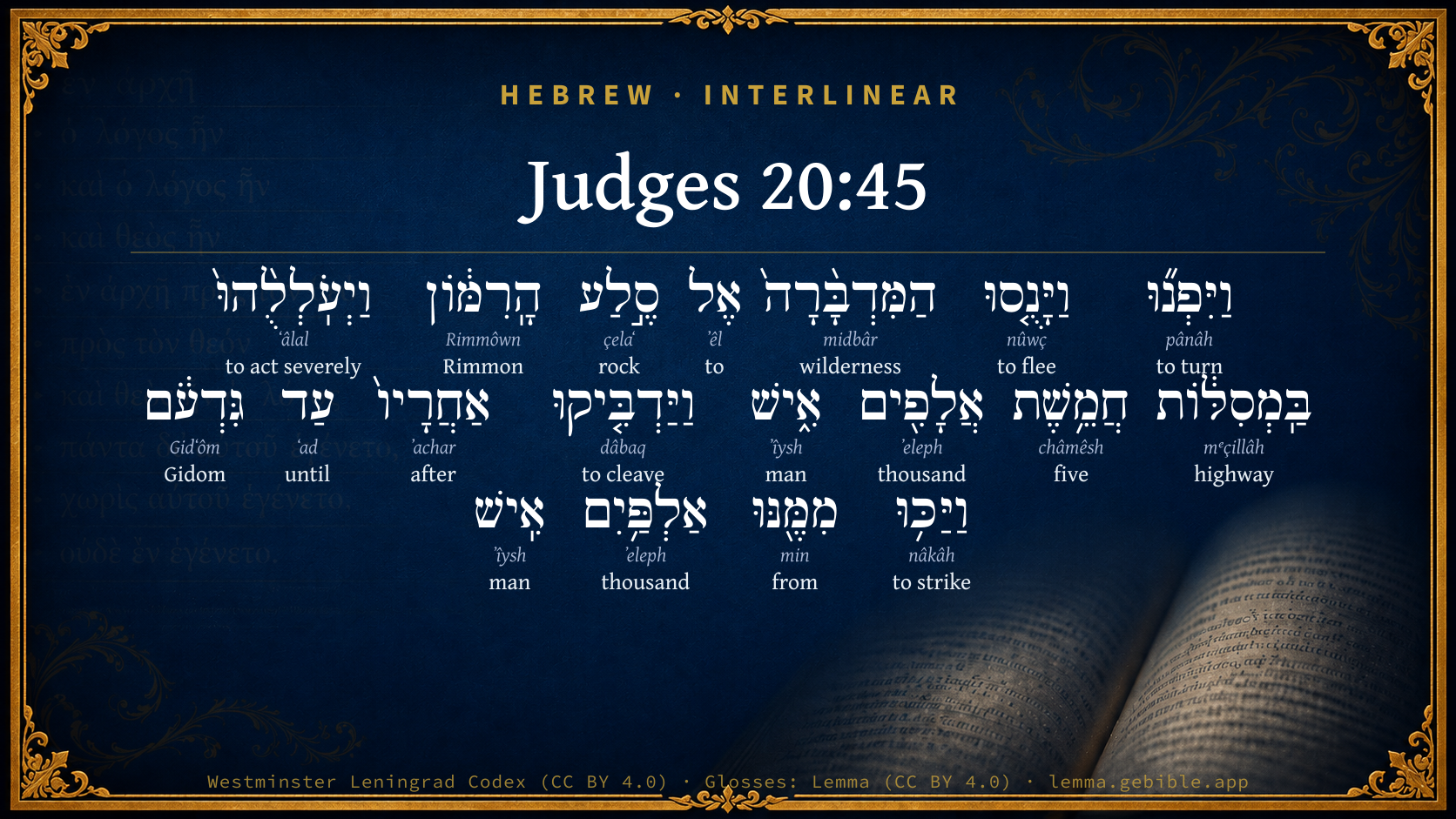
Hebrew (Westminster Leningrad Codex) Judges 20:45 appears in the Hebrew Old Testament. The text above is from the Westminster Leningrad Codex. Each word links to its Strong’s number, a concise gloss, and parsing drawn from the Open Scriptures Hebrew Bible morphology. Click any word for its full Brown-Driver-Briggs (BDB) entry.
Download image
Cite this verse

Judges 20:45 (World English Bible). Public Domain. Lemma interlinear Bible study tool, https://lemma.gebible.app/v/judges/20/45.

Show BibTeX & RIS
BibTeX
RIS
English Translation
They turned and fled toward the wilderness to the rock of Rimmon: and they gleaned of them in the highways five thousand men, and followed hard after them to Gidom, and struck of them two thousand men.
World English Bible · Public Domain
Highlights
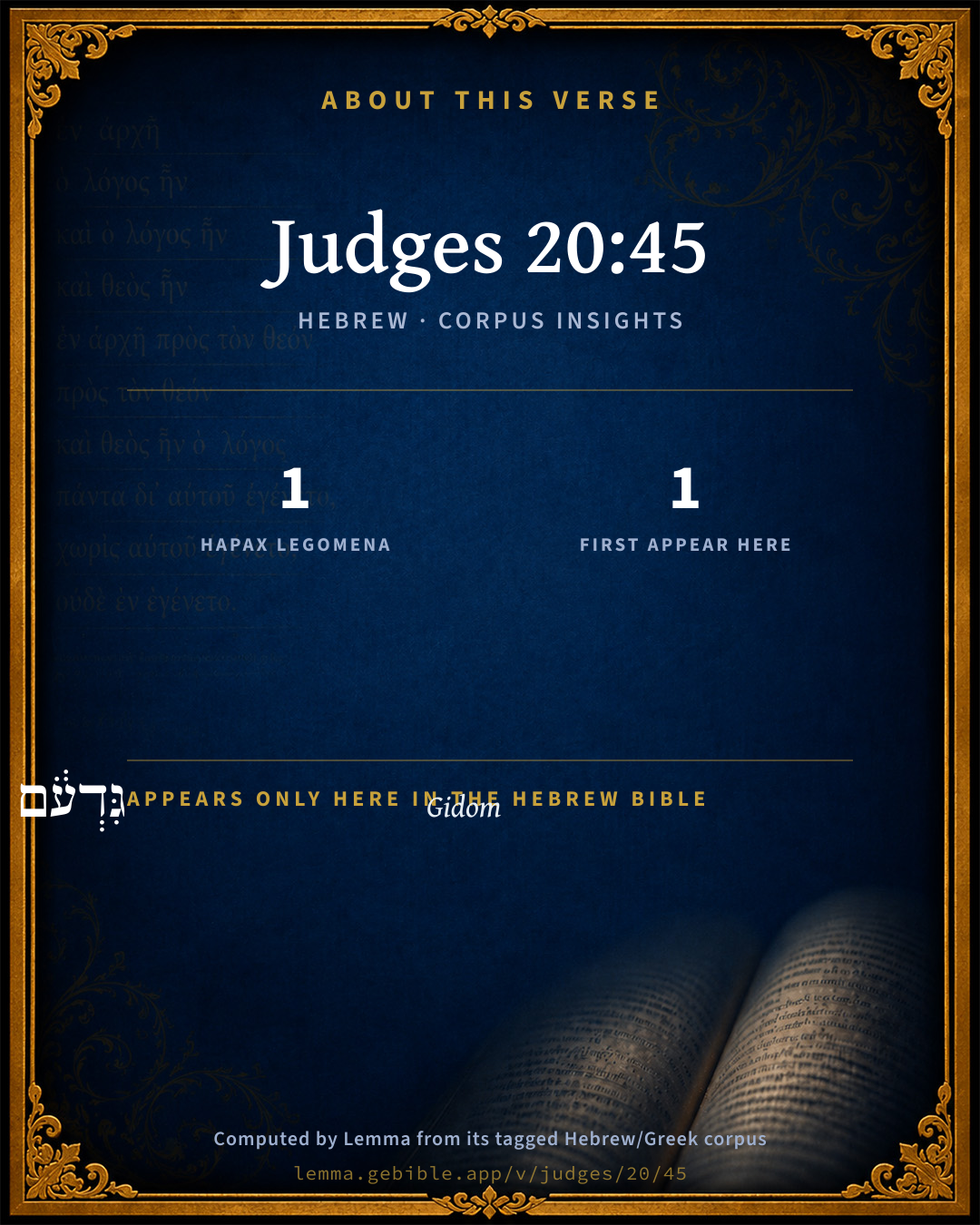
  • 1 hapax legomenon — only here in the Hebrew Bible
  • 1 first appearance in the Hebrew Bible
Full analysis ↓
Download a study sheet

One document with this verse’s original text, its word-by-word gloss line, the meaning frame, cross-references with their text, attributed commentary, and full source and license credits — printable, and it pastes into notes with its structure intact.

This verse Autodidact and up

Study sheet (.html) Plain text (.txt)

A passage Seminary Student

Up to 50 verses in one chapter. A passage sheet keeps up to 6 commentary sources and 12 cross-references per verse, in the order this page ranks them, and says so on the sheet whenever that leaves anything out. Ask for a single verse and you get the Autodidact verse sheet above.

Everything on this page stays free to read, with no account — the sheet is a download of what is already on screen, not access to it.

Want to remove ads? Support Godless Engineer
Compare translations 3

The same verse in 3 English versions, stacked beneath the original-language interlinear above. Click any original word for its lexicon entry.

Each is an independent rendering of the whole verse — the interlinear is not word-aligned to these translations.

Highlighted words mark where these versions differ — a whole-verse word diff, not a word-by-word alignment.

  • World English Bible Public Domain
    They turned and fled toward the wilderness to the rock of Rimmon: and they gleaned of them in the highways five thousand men, and followed hard after them to Gidom, and struck of them two thousand men.
  • King James Version Public Domain
    And they turned and fled toward the wilderness unto the rock of Rimmon: and they gleaned of them in the highways five thousand men; and pursued hard after them unto Gidom, and slew two thousand men of them.
  • unfoldingWord Literal Text CC BY-SA 4.0
    And they turned and fled to the wilderness, to the rock of Rimmon. And they gleaned along the pathways 5,000 men. And they pursued closely after him unto Gidom, and they struck from him 2,000 men.

unfoldingWord Literal Text — © unfoldingWord, licensed CC BY-SA 4.0. Word-aligned USFM3 via Door43 (git.door43.org/unfoldingWord/en_ult).

Versions to compare (up to 4)

3 of 4 selected

Show all 18 translations

Every available English version of this verse, each an independent rendering of the whole verse.

  • World English Bible Public Domain
    They turned and fled toward the wilderness to the rock of Rimmon: and they gleaned of them in the highways five thousand men, and followed hard after them to Gidom, and struck of them two thousand men.
  • Berean Standard Bible Public Domain
    Then the Benjamites turned and fled toward the wilderness to the rock of Rimmon, and Israel cut down 5,000 men on the roads. And they overtook them at Gidom and struck down 2,000 more.
  • Majority Standard Bible Public Domain
    Then the Benjamites turned and fled toward the wilderness to the rock of Rimmon, and Israel cut down 5,000 men on the roads. And they overtook them at Gidom and struck down 2,000 more.
  • King James Version Public Domain
    And they turned and fled toward the wilderness unto the rock of Rimmon: and they gleaned of them in the highways five thousand men; and pursued hard after them unto Gidom, and slew two thousand men of them.
  • American Standard Version (1901) Public Domain
    And they turned and fled toward the wilderness unto the rock of Rimmon: and they gleaned of them in the highways five thousand men, and followed hard after them unto Gidom, and smote of them two thousand men.
  • Revised Version (1885) Public Domain
    And they turned and fled toward the wilderness unto the rock of Rimmon: and they gleaned of them in the highways five thousand men; and followed hard after them unto Gidom, and smote of them two thousand men.
  • Geneva Bible (1599) Public Domain
    And they turned and fled to the wildernes vnto the rocke of Rimmon: and the Israelites glayned of them by the way fiue thousand men, and pursued after them vnto Gidom, and slewe two thousand men of them,
  • Douay-Rheims (1899) Public Domain
    And when they that remained of Benjamin saw this, they fled into the wilderness and made towards the rock that is called Remmon. In that flight, also as they were straggling and going different ways, they slew of them five thousand men. And as they went farther, they still pursued them, and slew also other two thousand.
  • Young's Literal Translation Public Domain
    and they turn and flee toward the wilderness, unto the rock of Rimmon; and they glean of them in the highways five thousand men, and follow after them unto Gidom, and smite of them two thousand men.
  • Literal Standard Version CC BY-SA 4.0
    and they turn and flee toward the wilderness, to the rock of Rimmon; and they glean five thousand of their men in the highways, and follow after them to Gidom, and strike two thousand [more] of their men.
  • Unlocked Literal Bible CC BY-SA 4.0
    They turned and fled toward the wilderness to the rock of Rimmon. The Israelites killed five thousand more of them along the roads. They kept going after them, following them closely all the way to Gidom, and there they killed two thousand more.
  • unfoldingWord Literal Text CC BY-SA 4.0
    And they turned and fled to the wilderness, to the rock of Rimmon. And they gleaned along the pathways 5,000 men. And they pursued closely after him unto Gidom, and they struck from him 2,000 men.
  • Darby Bible Public Domain
    And they turned and fled toward the wilderness to the rock of Rimmon; five thousand men of them were cut down in the highways, and they were pursued hard to Gidom, and two thousand men of them were slain.
  • World Messianic Bible Public Domain
    They turned and fled toward the wilderness to the rock of Rimmon. They gleaned five thousand men of them in the highways, and followed hard after them to Gidom, and struck two thousand men of them.
  • Webster's Bible Public Domain
    And they turned and fled towards the wilderness to the rock of Rimmon: and they gleaned of them in the highways five thousand men; and pursued hard after them to Gidom, and slew two thousand men of them.
  • Free Bible Version CC BY-SA 4.0
    Some of the Benjamites that were left ran towards Pomegranate Rock in the desert, and the Israelites killed another five thousand men on the way. They chased another group of Benjamites as far as Gidom and killed another thousand.
  • Bible in Basic English Public Domain
    And turning, they went in flight to the rock of Rimmon in the waste land: and on the highways five thousand of them were cut off by the men of Israel, who, pushing on hard after them to Geba, put to death two thousand more.
  • JPS Tanakh (1917) Public Domain
    And they turned and fled toward the wilderness unto the rock of Rimmon; and they gleaned of them in the highways five thousand men; and followed hard after them unto Gidom, and smote of them two thousand men.

Literal Standard Version (2020), Covenant Press — licensed CC BY-SA 4.0. Text via the HelloAO Bible API (eBible.org). Unlocked Literal Bible (unfoldingWord) — licensed CC BY-SA 4.0. Text via the HelloAO Bible API (eBible.org). unfoldingWord Literal Text — © unfoldingWord, licensed CC BY-SA 4.0. Word-aligned USFM3 via Door43 (git.door43.org/unfoldingWord/en_ult). Free Bible Version, Dr. Jonathan Gallagher — licensed CC BY-SA 4.0. Text via the HelloAO Bible API (eBible.org).

Word by word

More ways to search: Search by grammar → Find every occurrence → Compare this word →

Practice this passage: Drill this verse → Learn its vocabulary →

גִּדְעֹ֔ם
Gidʻôm
H1440
“Gidom”
Noun, Proper
Part of Speech
Noun
Type
Proper
Full BDB Definition

Origin: from H1438

TWOT: None

Gidom = "a cutting down" - the place where the Israelites ceased pursuing Benjamin, apparently situated between Gibeah and the cliffs of Rimmon
  1. וַיִּפְנ֞וּ pânâh H6437 “and · to turn” Conjunction + Verb, Qal, Sequential Imperfect, 3rd Person, Masculine, Plural
  2. וַיָּנֻ֤סוּ nûwç H5127 “and · to flee” Conjunction + Verb, Qal, Sequential Imperfect, 3rd Person, Masculine, Plural
  3. הַמִּדְבָּ֨רָה֙ midbâr H4057 “the · wilderness · toward” Particle, Definite Article + Noun, Common, Masculine, Singular, Absolute + Suffix, Demonstrative
  4. אֶל ʼêl H413 “to” Preposition
  5. סֶ֣לַע çelaʻ H5553 “rock of” Noun, Common, Masculine, Singular, Construct
  6. הָֽרִמּ֔וֹן Rimmôwn H7417 “the · Rimmon” Particle, Definite Article + Noun, Proper
  7. וַיְעֹֽלְלֻ֨הוּ֙ ʻâlal H5953 “and · to act severely · him” Conjunction + Verb, Poel, Sequential Imperfect, 3rd Person, Masculine, Plural + Suffix, Personal, 3rd Person, Masculine, Singular
  8. בַּֽמְסִלּ֔וֹת mᵉçillâh H4546 “in/at the · highways” Preposition, Determined + Noun, Common, Feminine, Plural, Absolute
  9. חֲמֵ֥שֶׁת châmêsh H2568 “five” Adjective, Cardinal number, Masculine, Singular, Construct
  10. אֲלָפִ֖ים ʼeleph H505 “thousand” Adjective, Cardinal number, Both, Plural, Absolute
  11. אִ֑ישׁ ʼîysh H376 “man” Noun, Common, Masculine, Singular, Absolute
  12. וַיַּדְבִּ֤יקוּ dâbaq H1692 “and · to cleave” Conjunction + Verb, Hiphil, Sequential Imperfect, 3rd Person, Masculine, Plural
  13. אַחֲרָיו֙ ʼachar H310 “after · him” Preposition + Suffix, Personal, 3rd Person, Masculine, Singular
  14. עַד ʻad H5704 “until” Preposition
  15. וַיַּכּ֥וּ nâkâh H5221 “and · to strike” Conjunction + Verb, Hiphil, Sequential Imperfect, 3rd Person, Masculine, Plural
  16. מִמֶּ֖נּוּ min H4480 “from · us” Preposition + Suffix, Personal, 1st Person, Common, Plural
  17. אַלְפַּ֥יִם ʼeleph H505 “thousand” Adjective, Cardinal number, Both, Plural, Absolute
  18. אִֽישׁ ʼîysh H376 “man” Noun, Common, Masculine, Singular, Absolute

About this verse

These counts appear in no published source. They are computed here, from the morphology-tagged text and Lemma’s own curated glosses. What Lemma adds →

19
words
17
distinct lemmas
Historical
section

Notable vocabulary

1 hapax legomenon — a word that appears only here in the entire Hebrew Bible:

  • גִּדְעֹ֔ם Gidom H1440

First appearance in Scripture

This word makes its first canonical appearance in the Hebrew Bible here:

  • גִּדְעֹ֔ם Gidom H1440

Shared distinctive vocabulary

הָֽרִמּ֔וֹן Rimmon H7417 occurs in 13 verses of the Hebrew Bible. Also found in:

Grammatical profile

  • 5 verbs
  • 7 nouns
  • 3 adjectives
  • 4 prepositions

Verb forms

  • וַיִּפְנ֞וּ Qal · Sequential Imperfect
  • וַיָּנֻ֤סוּ Qal · Sequential Imperfect
  • וַיְעֹֽלְלֻ֨הוּ֙ Poel · Sequential Imperfect
  • וַיַּדְבִּ֤יקוּ Hiphil · Sequential Imperfect
  • וַיַּכּ֥וּ Hiphil · Sequential Imperfect

Repetition

Words recur within this verse — often emphatic in Hebrew:

  • אֲלָפִ֖ים thousand H505 ×2
  • אִ֑ישׁ man H376 ×2

Hebrew & Septuagint length

In English translation the verse runs 37 words from the Hebrew and 47 from the Septuagint (LXX English) — closely comparable.

A rough comparison of the two English renderings, which tokenize alike — not a word-level alignment.

Word counts can differ between the Hebrew and the Greek without any difference in meaning — e.g. the Hebrew direct-object marker אֵת has no separate Greek word, and Greek often adds the article ὁ.

Cross-references

4

Topical passages linked to Judges 20:45 in the Treasury of Scripture Knowledge — connected by theme and wording, ordered by reader-vote popularity; previews shown in the World English Bible.

  • Joshua 15:32 and Lebaoth, and Shilhim, and Ain, and Rimmon: all the cities are twenty-nine, with their villages.
  • Judges 21:13 The whole congregation sent and spoke to the children of Benjamin who were in the rock of Rimmon, and proclaimed peace to them.
  • 1 Chronicles 6:77 To the rest of [the Levites], the sons of Merari, [were given], out of the tribe of Zebulun, Rimmono with its suburbs, Tabor with its suburbs;
  • Zechariah 14:10 All the land will be made like the Arabah, from Geba to Rimmon south of Jerusalem; and she will be lifted up, and will dwell in her place, from Benjamin's gate to the place of the first gate, to the corner gate, and from the tower of Hananel to the king's wine-presses.

Cross-references courtesy of OpenBible.info (CC BY 4.0).

Hebrew and Greek witnesses Masoretic Hebrew ↔ Greek Septuagint

The same verse in the two great witnesses to the Old Testament, shown verse-for-verse.

These are two independent witnesses, not word-aligned to each other, and the Septuagint is shown in lemma (dictionary) form.

Hebrew Judges 20:45 Masoretic · Westminster Leningrad Codex

וַיִּפְנ֞וּ וַיָּנֻ֤סוּ הַמִּדְבָּ֨רָה֙ אֶל סֶ֣לַע הָֽרִמּ֔וֹן וַיְעֹֽלְלֻ֨הוּ֙ בַּֽמְסִלּ֔וֹת חֲמֵ֥שֶׁת אֲלָפִ֖ים אִ֑ישׁ וַיַּדְבִּ֤יקוּ אַחֲרָיו֙ עַד גִּדְעֹ֔ם וַיַּכּ֥וּ מִמֶּ֖נּוּ אַלְפַּ֥יִם אִֽישׁ

They turned and fled toward the wilderness to the rock of Rimmon: and they gleaned of them in the highways five thousand men, and followed hard after them to Gidom, and struck of them two thousand men.

World English Bible · Public Domain

Greek LXX Judges 20:45 Septuagint · lemma form

καί ἐπιβλέπω ὁ λοιπός καί φεύγω εἰς ὁ ἔρημος πρός ὁ πέτρα ὁ ρεμμων καί καλαμάομαι ἐκ αὐτός ὁ υἱός ἰσραήλ πεντακισχίλιοι ἀνήρ καί καταβαίνω ὀπίσω αὐτός ὁ υἱός ἰσραήλ ἕως γεδαν καί πατάσσω ἐκ αὐτός δισχίλιοι ἀνήρ

And the rest turned, and fled to the wilderness to the rock of Remmon; and the children of Israel picked off of them five thousand men; and the children of Israel went down after them as far as Gedan, and they struck of them two thousand men.

LXX2012 (modern English Septuagint) · Public Domain

On this verse, The Cambridge Bible for Schools and Colleges discusses the Septuagint’s reading. Read the note in Commentary ↓

Hebrew: Westminster Leningrad Codex (CC BY 4.0). Greek: Septuagint (public domain); English from LXX2012 (modern English Septuagint) (Public Domain). How the Septuagint differs from the Hebrew →

Targum (Aramaic paraphrase)

1

The Targum is the ancient Jewish Aramaic paraphrase of the Hebrew Scriptures — an interpretive translation, not the Hebrew text itself. Onkelos (literal) and Pseudo-Jonathan (expansive) render the Torah, and Jonathan the Prophets. Coverage is partial: where no permissively-licensed English translation exists for a verse, only the Aramaic is shown. This is verse-level text, not a word-by-word alignment to the Hebrew.

  1. Targum Jonathan Prophets (Joshua–Malachi)
    וְאִתְפְּנִיאוּ וְאַפִּיכוּ לְמַדְבְּרָא לְכֵיף רִמוֹן וְאִטַמָרוּ בְּכִיבְשַׁיָא חַמְשָׁא אַלְפִין גַבְרָא וְאַדְבִּיקוּ בַתְרֵיהוֹן עַד גִדְעֹם וּקְטִילוּ מִנְהוֹן תְּרֵין אַלְפִין גַבְרָא:

    (no public-domain English translation for this verse)

    Targum Jonathan — Aramaic: “Mikraot Gedolot” (public domain). English: “Sefaria Community Translation” (CC0 1.0 (public-domain dedication)); “London "Chaldee Paraphrase," 1871” (public domain). Text via Sefaria.

Commentary

Notes on Judges 20:45 from classic Christian and Jewish commentators (each source and its license shown beneath its notes). The classic Christian expositions comment on the surrounding passage and are grouped to its opening verse, so a note may address several verses; the Jewish commentaries on the Tanakh (Rashi and others) are per-verse, so they appear only where the commentator wrote on this verse.

Lemma curates 59 commentaries, every one of them public domain or Creative Commons licensed, each selected and text-cleaned for this edition rather than reprinted as found. About our sources →

Trapp's Complete Commentary

John Trapp

Jdg 20:45 And they turned and fled toward the wilderness unto the rock of Rimmon: and they gleaned of them in the highways five thousand men; and pursued hard after them unto Gidom, and slew two thousand men of them.

Ver. 45. Unto Gidom.] Or, Unto their occasion, destruction.

John Trapp, A Commentary or Exposition upon All the Books of the Old and New Testament (1647–1656) — public domain. Text from a community e-Sword module.

Geneva Bible (1599)

Geneva Bible translators

They slew them by one and one, as they were scattered abroad.

Geneva Bible (1599) marginal notes — public domain. Text via Bolls.life.

Jamieson, Fausset & Brown

Robert Jamieson, A. R. Fausset & David Brown

they turned and fled toward the wilderness unto the rock of Rimmon--Many of the fugitives found refuge in the caves of this rocky mountain, which is situated to the northeast of Beth-el. Such places are still sought as secure retreats in times of danger; and until the method of blowing up rocks by gunpowder became known, a few men could in such caves sustain a siege for months.

Jamieson, Fausset & Brown — Commentary Critical and Explanatory on the Whole Bible (1871) — public domain (CC PDM 1.0). Text via the HelloAO Bible API.

Adam Clarke's Commentary

Verse 45. Unto the rock of Rimmon] This was some strong place, but where situated is not known. Here they maintained themselves four months, and it was by these alone that the tribe of Benjamin was preserved from utter extermination. See the following chapter.

IT is scarcely possible to imagine any thing more horrid than the indiscriminate and relentless slaughter of both innocent and guilty mentioned in this chapter. The crime of the men of Gibeah was great, but there was no adequate cause for this relentless extermination of a whole tribe. There was neither justice nor judgment in this case; they were on all sides brutal, cruel, and ferocious: and no wonder; there was no king in Israel - no effective civil government, and every man did what was right in his own eyes. There was no proper leader; no man that had authority and influence to repress the disorderly workings of the pell-mell mob.

Adam Clarke's Commentary on the Bible (1810–1826) — public domain. Text from a community e-Sword/MySword module.

Ellicott's Commentary for English Readers

(45) Unto the rock of Rimmon—i.e., of the pomegranate. As the tree is common in Palestine (Num_20:25; Deu_8:8. &c.), the name is naturally common. There was one Rimmon in Zebulon (Jos_19:13), another in Judah (Jos_15:32), south of Jerusalem (Zec_14:10; and see Jos_21:25; Neh_11:29). This Rimmon is a steep conical hill of white limestone (Robinson, 1:440), not far from Gibeah, and fifteen miles north of Jerusalem, six miles east of Bethel (“towards the sun-rising”). It is still called Rimmon.

They gleaned.—A metaphor from the vintage, like the “trode down” of Jdg_20:43. (See Jer_6:9 : “They shall glean the remnant of Israel as a vine.”)

Unto Gidom.—A place entirely unknown, and hence omitted in the Vulg.

A Bible Commentary for English Readers, edited by Charles John Ellicott (1878–1897) — public domain. Text from a community e-Sword module.

The Cambridge Bible for Schools and Colleges

gen. ed. J. J. S. Perowne

45. the rock of Rimmon] now Rammôn, rises from the plateau due E. of Beth-el, visible from all sides; it lies rather more than 8 m. N.E. of Tell el-Fûl.

gleaned of them] For the figure cf. Jdg_8:2.

unto Gidom] Site unknown; the Versions therefore guess, LXX. cod. A Gilead, Syr Gibeon. With the change of a vowel, we may read until they cut them off (gid‘âm), the word used in Jdg_21:6.

The Cambridge Bible for Schools and Colleges (gen. ed. J. J. S. Perowne; Cambridge University Press, 1878–1918) — public domain. Text from a community e-Sword module.

John Gill's Exposition

So that all which fell that day of Benjamin were twenty and thousand men,.... It is before said 25,100 Jdg 20:35 here the one hundred are omitted, and the round number of thousands given, which is no unusual way of speaking and writing; the whole army of Benjamin consisted of 26,700 of which 18,000 were slain in the field of battle, 5000 in the highways, and 2000 at Gidom, in all 25,000; and we may suppose one hundred as they were straggling in the road, or found in by places, or are not mentioned with either of the thousands for the sake of a round number, and six hundred fled to the rock Rimmon; as for the other 1000, it is highly probable, they fell in the two first battles, as Ben Gersom and Abarbinel rightly suppose; for it is not credible, that though they got such amazing victories, it was without the loss of men, and these are as few as well can be imagined. Jarchi thinks these thousand fled to the cities of Benjamin, and were slain when the Israelites entered them, as after related, Jdg 20:48 which is much more probable than a tradition they have, that they went into the land of Romania, and dwelt there. Now all those that were slain were men

that drew the sword; soldiers, not husbandmen, artificers, &c. but armed men:

all these were men of valour; even those that fled, who chose rather to lose their lives than ask for quarter.

John Gill's Exposition of the Whole Bible (1746–1763) — public domain (CC PDM 1.0). Text via the HelloAO Bible API.

Albert Barnes' Notes on the Bible

Rimmon - A village named “Rummon”, situated on the summit of a conical chalky hill, still exists, and forms a remarkable object in the landscape, visible in all directions. It lies 15 miles north of Jerusalem. It is a different place from Rimmon in the south of Judah Jos 15:32, and Remmon in Zebulon Jos 19:13. Gidom, mentioned nowhere else, was evidently close to Rimmon.

Albert Barnes' Notes on the Bible (1834–1885) — public domain. Text from a community e-Sword/MySword module.

Haydock's Catholic Bible Commentary

In that. Hebrew, "and they gleaned of them in the highways 5000 men, and pursued them close to Giddom," of which the Vulgate takes no notice. The Roman Septuagint reads "Gedan;" the rest have "Galaad."

George Leo Haydock (1774–1849), Haydock's Catholic Family Bible and Commentary, 1859 edition — public domain. Excludes Psalms (Douay-Rheims chapter numbering differs from Protestant) and Deuterocanonical books (Catholic canon only).

Matthew Poole's English Annotations

They gleaned, i.e. they cut off the remainders in the pursuit, and spared none; a metaphor from those who gather grapes or corn so clearly and fitly, that they leave no relics for those who come after them.

Matthew Poole's English Annotations on the Holy Bible (1683–1685) — public domain. Text from a community e-Sword/MySword module.

Whedon's Commentary on the Bible

Daniel D. Whedon

45. Rock of Rimmon — “About ten miles north of Jerusalem, and nearly four east of Beth-el, is a very conspicuous white limestone tell, rising like a cone above the neighbouring hilltops, and overlooking the whole wilderness down to the Jordan valley. Upon it stands a large modern village called Rummon. This is unquestionably the rock Rimmon, on which the Benjamites took refuge. It is admirably adapted for the purpose. A deep and wild ravine cuts off the approach from the south, and others skirt its western and northern sides, rendering it a natural fortress of great strength. The sides of the tell are steep, bare, and rocky, and could be defended by a few resolute men against a host. The top is rounded, affording ample space for the refugees, while along the sides are some large caverns.” — J.L. Porter.

Gleaned of them in the highways — That is, they discovered many small companies of men fleeing or seeking to defend themselves here and there along the roads, and they at once enclosed them and cut them off; like gleaning scattered stalks of grain which the reapers had overlooked.

Gidom — Another place northeast of Gibeah, whose exact site is now unknown.

Daniel D. Whedon (gen. ed.), Commentary on the Old and New Testaments (1874–1909) — public domain. Text from a community e-Sword module.

John Wesley's Explanatory Notes

Gleaned - That is, a metaphor from those who gather grapes or corn so clearly and fully, that they leave no relicks for those who come after them.

John Wesley, Explanatory Notes Upon the Whole Bible (1754–1765) — public domain. Text via the GEBible commentary corpus.

unfoldingWord translationNotes

Door43 World Missions Community

They turned and fled

"The remaining Benjamites turned and fled"

five thousand ... two thousand

"5,000 ... 2,000" (See: Numbers)

Gidom

This is the name of a place. (See: How to Translate Names)

twenty-five thousand

"25,000" (See: Numbers)

translationWords

Rimmon

sword

unfoldingWord translationNotes — © Distant Shores Media and the Door43 World Missions Community, licensed CC BY-SA 4.0. Source: git.door43.org/Door43/en_tn.

Rashi

Rabbi Shlomo Yitzchaki (Rashi)

They gleaned them. Killing constantly, like plucking gleanings after reaping.

Five thousand troops. Thus totaling twenty three thousand.

Until Gid'om. The name of a place.

Striking down, of them, two thousand troops. Thus totaling twenty-five thousand mentioned above. The remaining one hundred recorded above fell at unnamed locations.

Rashi on the Tanakh — English translations: “The Judaica Press complete Tanach with Rashi, translated by A. J. Rosenberg” (CC BY 4.0); “Pentateuch with Rashi's commentary by M. Rosenbaum and A.M. Silbermann, 1929-1934” (public domain); “The Metsudah Tanach series, Lakewood, N.J” (CC BY 4.0); and “The Book of Joshua, Metsudah Publications, 1997” (CC BY 4.0). Text via Sefaria.

Lesson kit

Teaching starters — assembled from the data on this page, not authored interpretation. Every prompt links to the verse data it draws on. Edit before teaching.

Judges, in the Historical, opens this verse with 19 words (17 distinct Hebrew lemmas). Its most distinctive word is Gidʻôm (“Gidom”). A historical commentator’s framing appears above. Read the whole chapter for the surrounding context.

Discussion questions

  1. How does “Gidom” (Gidʻôm) shape what this verse is saying?
  2. 1 word here appears nowhere else in the Hebrew Bible. Why might the author reach for such rare wording?
  3. This is the first place “Gidom” appears in Scripture (first appears here). What does its debut here establish?
  4. How does Joshua 15:32, which shares the word «Rimmon», read alongside this verse?
  5. What does the repetition of “thousand” (2× in this one verse) do in this verse?
  6. The translations on this page render this verse differently — a whole-verse word diff, not a word-by-word alignment. What might account for the different wordings?
  7. «וַיִּפְנ֞וּ» is a Qal Sequential Imperfect verb. How does that grammatical form shape the action described?
  8. Compare how Trapp's Complete Commentary and Geneva Bible (1599) read this verse. Where do they agree or differ?

Things to notice

  • 1 word in this verse appears nowhere else in the Hebrew Bible.
  • 1 word makes its first canonical appearance in Scripture here.
  • These translations choose different wording for 16 words in this verse.
  • “thousand” occurs 2× in this single verse.
  • 17 distinct Hebrew lemmas span 19 words in this verse.

Reading settings

Reading text

Shown beneath each verse's original-language words.

Old Testament
Old Testament edition

Read the OT as the Masoretic Hebrew (MT) or the Greek Septuagint (LXX).

English shown for the Greek Septuagint (in the Hebrew ↔ Greek comparison).

Comparing translations? Open the Compare panel on any verse page to stack up to four side by side.