
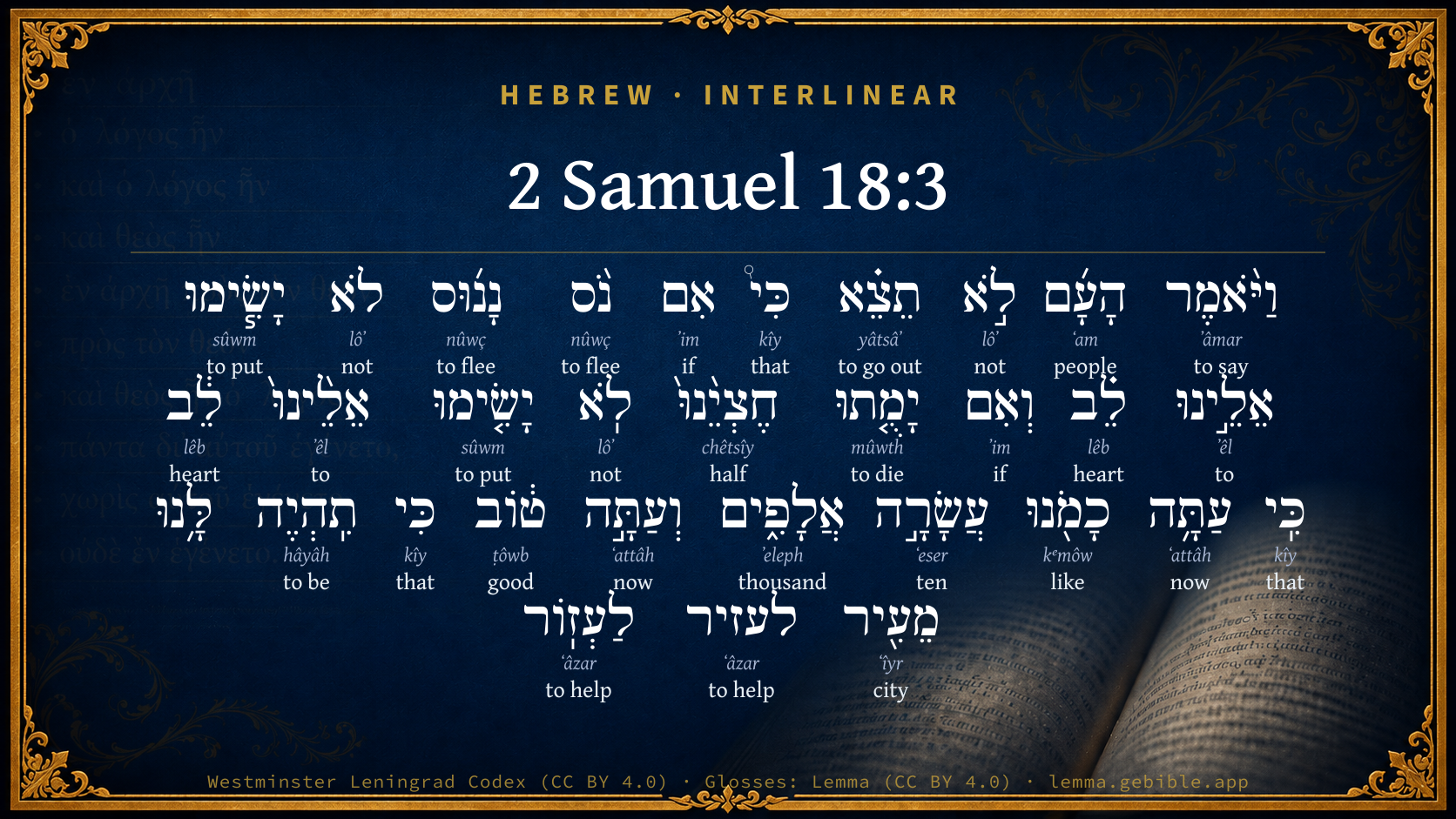
2 Samuel 18:3

Hebrew (Westminster Leningrad Codex) 2 Samuel 18:3 appears in the Hebrew Old Testament. The text above is from the Westminster Leningrad Codex. Each word links to its Strong’s number, a concise gloss, and parsing drawn from the Open Scriptures Hebrew Bible morphology. Click any word for its full Brown-Driver-Briggs (BDB) entry.
Download image
Cite this verse

2 Samuel 18:3 (World English Bible). Public Domain. Lemma interlinear Bible study tool, https://lemma.gebible.app/v/2-samuel/18/3.

Show BibTeX & RIS
BibTeX
RIS
English Translation
But the people said, You shall not go forth: for if we flee away, they will not care for us; neither if half of us die, will they care for us: but you are worth ten thousand of us; therefore now it is better that you are ready to help us out of the city.
World English Bible · Public Domain
Download a study sheet

One document with this verse’s original text, its word-by-word gloss line, the meaning frame, cross-references with their text, attributed commentary, and full source and license credits — printable, and it pastes into notes with its structure intact.

This verse Autodidact and up

Study sheet (.html) Plain text (.txt)

A passage Seminary Student

Up to 50 verses in one chapter. A passage sheet keeps up to 6 commentary sources and 12 cross-references per verse, in the order this page ranks them, and says so on the sheet whenever that leaves anything out. Ask for a single verse and you get the Autodidact verse sheet above.

Everything on this page stays free to read, with no account — the sheet is a download of what is already on screen, not access to it.

Want to remove ads? Support Godless Engineer
Compare translations 3

The same verse in 3 English versions, stacked beneath the original-language interlinear above. Click any original word for its lexicon entry.

Each is an independent rendering of the whole verse — the interlinear is not word-aligned to these translations.

Highlighted words mark where these versions differ — a whole-verse word diff, not a word-by-word alignment.

  • World English Bible Public Domain
    But the people said, You shall not go forth: for if we flee away, they will not care for us; neither if half of us die, will they care for us: but you are worth ten thousand of us; therefore now it is better that you are ready to help us out of the city.
  • King James Version Public Domain
    But the people answered, Thou shalt not go forth: for if we flee away, they will not care for us; neither if half of us die, will they care for us: but now thou art worth ten thousand of us: therefore now it is better that thou succor us out of the city.
  • unfoldingWord Literal Text CC BY-SA 4.0
    But the people said, “You shall not go out, for if fleeing, we flee, they will not set a heart to us. Even if half of us die, they will not set a heart to us. For now ten thousand like us. And now, better that you be help for us from the city.”

unfoldingWord Literal Text — © unfoldingWord, licensed CC BY-SA 4.0. Word-aligned USFM3 via Door43 (git.door43.org/unfoldingWord/en_ult).

Versions to compare (up to 4)

3 of 4 selected

Show all 18 translations

Every available English version of this verse, each an independent rendering of the whole verse.

  • World English Bible Public Domain
    But the people said, You shall not go forth: for if we flee away, they will not care for us; neither if half of us die, will they care for us: but you are worth ten thousand of us; therefore now it is better that you are ready to help us out of the city.
  • Berean Standard Bible Public Domain
    But the people pleaded, “You must not go out! For if we have to flee, they will pay no attention to us. Even if half of us die, they will not care; but you are worth ten thousand of us. It is better for now if you support us from the city.”
  • Majority Standard Bible Public Domain
    But the people pleaded, “You must not go out! For if we have to flee, they will not care about us. Even if half of us die, they will not care. But you are worth ten thousand of us. It is better now if you support us from the city.”
  • King James Version Public Domain
    But the people answered, Thou shalt not go forth: for if we flee away, they will not care for us; neither if half of us die, will they care for us: but now thou art worth ten thousand of us: therefore now it is better that thou succor us out of the city.
  • American Standard Version (1901) Public Domain
    But the people said, Thou shalt not go forth: for if we flee away, they will not care for us; neither if half of us die, will they care for us: but thou art worth ten thousand of us; therefore now it is better that thou be ready to succor us out of the city.
  • Revised Version (1885) Public Domain
    But the people said, Thou shalt not go forth: for if we flee away, they will not care for us; neither if half of us die, will they care for us: but thou art worth ten thousand of us: therefore now it is better that thou be ready to succour us out of the city.
  • Geneva Bible (1599) Public Domain
    But the people answered, Thou shalt not goe foorth: for if we flee away, they will not regarde vs, neither will they passe for vs, though halfe of vs were slaine: but thou art now worth ten thousande of vs: therefore nowe it is better that thou succour vs out of the citie.
  • Douay-Rheims (1899) Public Domain
    And the people answered: Thou shalt not go forth: for if we flee away, they will not much mind us: or if half of us should fall, they will not greatly care: for thou alone art accounted for ten thousand: it is better therefore that thou shouldst be in the city to succour us.
  • Young's Literal Translation Public Domain
    And the people say, `Thou dost not go out, for if we utterly flee, they do not set `their' heart upon us; and if half of us die, they do not set `their' heart unto us -- for now like us `are' ten thousand; and now, better that thou be to us from the city for an helper.'
  • Literal Standard Version CC BY-SA 4.0
    And the people say, “You do not go out, for if we utterly flee, they do not set [their] heart on us; and if half of us die, they do not set [their] heart to us—for [you are] now like ten thousand of us; and now, [it is] better that you are for a helper to us from the city.”
  • Unlocked Literal Bible CC BY-SA 4.0
    But the men said, “You must not go to battle, for if we flee away they will not care about us, or if half of us die they will not care. But you are worth ten thousand of us! Therefore it is better that you be ready to help us from the city.”
  • unfoldingWord Literal Text CC BY-SA 4.0
    But the people said, “You shall not go out, for if fleeing, we flee, they will not set a heart to us. Even if half of us die, they will not set a heart to us. For now ten thousand like us. And now, better that you be help for us from the city.”
  • Darby Bible Public Domain
    But the people said, Thou shalt not go forth, for if we should in any case flee, they will not care for us; neither if half of us die, will they care for us; for *thou* art worth ten thousand of us; and now it is better that thou succour us out of the city.
  • World Messianic Bible Public Domain
    But the people said, “You shall not go out, for if we flee away, they will not care for us, neither if half of us die, will they care for us. But you are worth ten thousand of us. Therefore now it is better that you are ready to help us out of the city.”
  • Webster's Bible Public Domain
    But the people answered, Thou shalt not go forth: for if we flee away, they will not care for us; neither if half of us die, will they care for us: but now thou art worth ten thousand of us: therefore now it is better that thou shouldst succor us out of the city.
  • Free Bible Version CC BY-SA 4.0
    But the men replied, “No, you must not go out into battle! For if we have to run away, they won't care about us. Even if half of us die, they won't care about that either. But you are worth ten thousand of us, so it's better if you stay here and send us help from the town.”
  • Bible in Basic English Public Domain
    But the people said, It is better for you not to go out: for if we are put to flight, they will not give a thought to us, and if death overtakes half of us, it will be nothing to them: but you are of more value than ten thousand of us: so it is better for you to be ready to come to our help from this town.
  • JPS Tanakh (1917) Public Domain
    But the people said: 'Thou shalt not go forth; for if we flee away, they will not care for us; neither if half of us die, will they care for us; but thou art worth ten thousand of us: therefore now it is better that thou be ready to succour us out of the city.'

Literal Standard Version (2020), Covenant Press — licensed CC BY-SA 4.0. Text via the HelloAO Bible API (eBible.org). Unlocked Literal Bible (unfoldingWord) — licensed CC BY-SA 4.0. Text via the HelloAO Bible API (eBible.org). unfoldingWord Literal Text — © unfoldingWord, licensed CC BY-SA 4.0. Word-aligned USFM3 via Door43 (git.door43.org/unfoldingWord/en_ult). Free Bible Version, Dr. Jonathan Gallagher — licensed CC BY-SA 4.0. Text via the HelloAO Bible API (eBible.org).

Word by word

More ways to search: Search by grammar → Find every occurrence → Compare this word →

Practice this passage: Drill this verse → Learn its vocabulary →

לעזיר
ʻâzar
H5826
“to help”
Preposition + Verb, Hiphil, Infinitive Construct
Part of Speech
Preposition + Verb
Stem
Hiphil
Form
Infinitive Construct
Full BDB Definition

Origin: a primitive root

TWOT: 1598

to help, succour, support - (Qal) to help - (Niphal) to be helped - (Hiphil) to help
  1. וַיֹּ֨אמֶר ʼâmar H559 “and · to say” Conjunction + Verb, Qal, Sequential Imperfect, 3rd Person, Masculine, Singular
  2. הָעָ֜ם ʻam H5971 “the · people” Particle, Definite Article + Noun, Common, Masculine, Singular, Absolute
  3. לֹ֣א lôʼ H3808 “not” Particle, Negative
  4. תֵצֵ֗א yâtsâʼ H3318 “to go out” Verb, Qal, Imperfect, 2nd Person, Masculine, Singular
  5. כִּי֩ kîy H3588 “that” Conjunction
  6. אִם ʼim H518 “if” Conjunction
  7. נֹ֨ס nûwç H5127 “to flee” Verb, Qal, Infinitive Absolute
  8. נָנ֜וּס nûwç H5127 “to flee” Verb, Qal, Imperfect, 1st Person, Common, Plural
  9. לֹא lôʼ H3808 “not” Particle, Negative
  10. יָשִׂ֧ימוּ sûwm H7760 “to put” Verb, Qal, Imperfect, 3rd Person, Masculine, Plural
  11. אֵלֵ֣ינוּ ʼêl H413 “to · us” Preposition + Suffix, Personal, 1st Person, Common, Plural
  12. לֵ֗ב lêb H3820 “heart” Noun, Common, Masculine, Singular, Absolute
  13. וְאִם ʼim H518 “and · if” Conjunction + Conjunction
  14. יָמֻ֤תוּ mûwth H4191 “to die” Verb, Qal, Imperfect, 3rd Person, Masculine, Plural
  15. חֶצְיֵ֨נוּ֙ chêtsîy H2677 “half · our” Noun, Common, Masculine, Singular, Construct + Suffix, Personal, 1st Person, Common, Plural
  16. לֹֽא lôʼ H3808 “not” Particle, Negative
  17. יָשִׂ֤ימוּ sûwm H7760 “to put” Verb, Qal, Imperfect, 3rd Person, Masculine, Plural
  18. אֵלֵ֨ינוּ֙ ʼêl H413 “to · us” Preposition + Suffix, Personal, 1st Person, Common, Plural
  19. לֵ֔ב lêb H3820 “heart” Noun, Common, Masculine, Singular, Absolute
  20. כִּֽי kîy H3588 “that” Conjunction
  21. עַתָּ֥ה ʻattâh H6258 “now” Adverb
  22. כָמֹ֖נוּ kᵉmôw H3644 “like · us” Preposition + Suffix, Personal, 1st Person, Common, Plural
  23. עֲשָׂרָ֣ה ʻeser H6235 “ten” Adjective, Cardinal number, Masculine, Singular, Absolute
  24. אֲלָפִ֑ים ʼeleph H505 “thousand” Adjective, Cardinal number, Both, Plural, Absolute
  25. וְעַתָּ֣ה ʻattâh H6258 “and · now” Conjunction + Adverb
  26. ט֔וֹב ṭôwb H2896 “good” Adjective, Adjective, Masculine, Singular, Absolute
  27. כִּי kîy H3588 “that” Conjunction
  28. תִֽהְיֶה hâyâh H1961 “to be” Verb, Qal, Imperfect, 2nd Person, Masculine, Singular
  29. מֵעִ֖יר ʻîyr H5892 “from · city” Preposition + Noun, Common, Feminine, Singular, Absolute
  30. לַעְזֽוֹר ʻâzar H5826 “to help” Preposition + Verb, Qal, Infinitive Construct

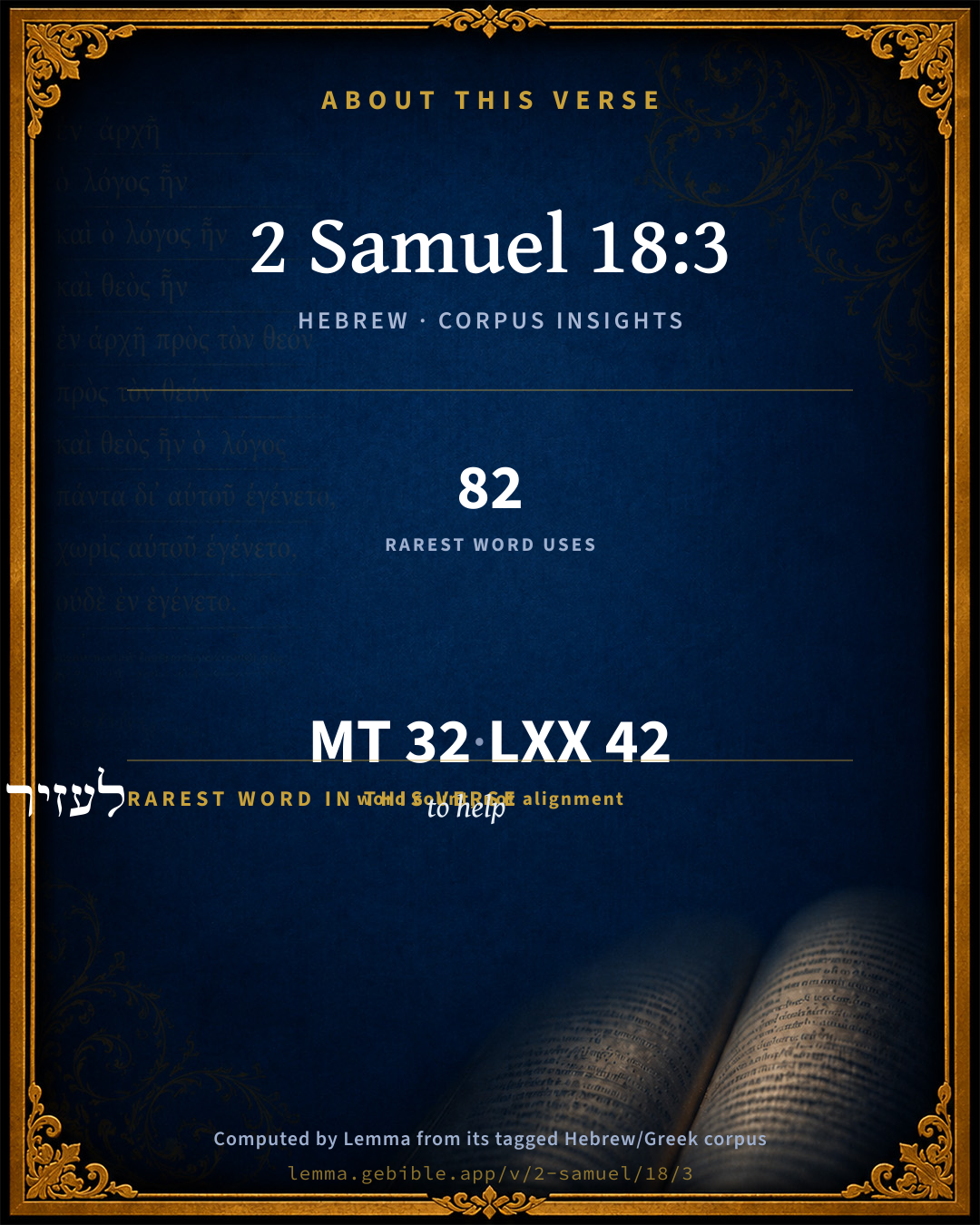
About this verse

These counts appear in no published source. They are computed here, from the morphology-tagged text and Lemma’s own curated glosses. What Lemma adds →

32
words
20
distinct lemmas
Historical
section

Grammatical profile

  • 10 verbs
  • 5 nouns
  • 3 adjectives
  • 4 prepositions
  • 5 conjunctions
  • 2 adverbs
  • 3 particles

Verb forms

  • וַיֹּ֨אמֶר Qal · Sequential Imperfect
  • תֵצֵ֗א Qal · Imperfect
  • נֹ֨ס Qal · Infinitive Absolute
  • נָנ֜וּס Qal · Imperfect
  • יָשִׂ֧ימוּ Qal · Imperfect
  • יָמֻ֤תוּ Qal · Imperfect
  • יָשִׂ֤ימוּ Qal · Imperfect
  • תִֽהְיֶה Qal · Imperfect
  • לעזיר Hiphil · Infinitive Construct
  • לַעְזֽוֹר Qal · Infinitive Construct

Repetition

Words recur within this verse — often emphatic in Hebrew:

  • נֹ֨ס to flee H5127 ×2
  • יָשִׂ֧ימוּ to put H7760 ×2
  • לֵ֗ב heart H3820 ×2
  • עַתָּ֥ה now H6258 ×2
  • לעזיר to help H5826 ×2
  • לֹ֣א not H3808 ×3
  • כִּי֩ that H3588 ×3
  • אִם if H518 ×2
  • אֵלֵ֣ינוּ to H413 ×2

Hebrew & Septuagint length

In English translation the verse runs 55 words from the Hebrew and 59 from the Septuagint (LXX English) — closely comparable.

A rough comparison of the two English renderings, which tokenize alike — not a word-level alignment.

Word counts can differ between the Hebrew and the Greek without any difference in meaning — e.g. the Hebrew direct-object marker אֵת has no separate Greek word, and Greek often adds the article ὁ.

In the original languages it is 32 Hebrew tokens and 42 Greek tokens — but the two are counted differently (Hebrew bundles its prefixes and suffixes into one token; the Greek is in lemma form), so that isn’t a like-for-like length.

Cross-references

7

Topical passages linked to 2 Samuel 18:3 in the Treasury of Scripture Knowledge — connected by theme and wording, ordered by reader-vote popularity; previews shown in the World English Bible.

  • 2 Samuel 21:17 But Abishai the son of Zeruiah helped him, and struck the Philistine, and killed him. Then the men of David swore to him, saying, You shall go no more out with us to battle, that you don't quench the lamp of Israel.
  • Exodus 17:10–12 So Joshua did as Moses had told him, and fought with Amalek; and Moses, Aaron, and Hur went up to the top of the hill.
  • 2 Samuel 10:11 He said, If the Syrians be too strong for me, then you shall help me; but if the children of Ammon be too strong for you, then I will come and help you.
  • 2 Samuel 17:2 and I will come on him while he is weary and weak-handed, and will make him afraid; and all the people who are with him shall flee; and I will strike the king only;
  • 1 Kings 22:31 Now the king of Syria had commanded the thirty-two captains of his chariots, saying, Fight neither with small nor great, save only with the king of Israel.
  • Lamentations 4:20 The breath of our nostrils, the anointed of Yahweh, was taken in their pits; Of whom we said, Under his shadow we shall live among the nations.
  • Zechariah 13:7 "Awake, sword, against my shepherd, And against the man who is close to me," says Yahweh of Hosts. Strike the shepherd, and the sheep will be scattered; And I will turn my hand against the little ones.

Cross-references courtesy of OpenBible.info (CC BY 4.0).

Hebrew and Greek witnesses Masoretic Hebrew ↔ Greek Septuagint

The same verse in the two great witnesses to the Old Testament, shown verse-for-verse.

These are two independent witnesses, not word-aligned to each other, and the Septuagint is shown in lemma (dictionary) form.

Hebrew 2 Samuel 18:3 Masoretic · Westminster Leningrad Codex

וַיֹּ֨אמֶר הָעָ֜ם לֹ֣א תֵצֵ֗א כִּי֩ אִם נֹ֨ס נָנ֜וּס לֹא יָשִׂ֧ימוּ אֵלֵ֣ינוּ לֵ֗ב וְאִם יָמֻ֤תוּ חֶצְיֵ֨נוּ֙ לֹֽא יָשִׂ֤ימוּ אֵלֵ֨ינוּ֙ לֵ֔ב כִּֽי עַתָּ֥ה כָמֹ֖נוּ עֲשָׂרָ֣ה אֲלָפִ֑ים וְעַתָּ֣ה ט֔וֹב כִּי תִֽהְיֶה לָּ֥נוּ מֵעִ֖יר לעזיר לַעְזֽוֹר

But the people said, You shall not go forth: for if we flee away, they will not care for us; neither if half of us die, will they care for us: but you are worth ten thousand of us; therefore now it is better that you are ready to help us out of the city.

World English Bible · Public Domain

Greek LXX 2 Samuel 18:3 Septuagint · lemma form

καί εἶπον οὐ ἐκἔρχομαι ὅτι ἐάν φυγή φεύγω οὐ τίθημι ἐπί ἐγώ καρδία καί ἐάν ἀποθνήσκω ὁ ἥμισυς ἐγώ οὐ τίθημι ἐπί ἐγώ καρδία ὅτι σύ ὡς ἐγώ δέκα χιλίας καί νῦν ἀγαθός ὅτι εἰμί ἐγώ ἐν ὁ πόλις βοήθεια ὁ βοηθέω

And they said, You shall not go out: for if we should indeed flee, they will not care for us; and if half of us should die, they will not mind us; for you are as ten thousand of us: and now it is well that you shall be to us an aid to help us in the city.

LXX2012 (modern English Septuagint) · Public Domain

On this verse, Adam Clarke's Commentary discusses the Septuagint’s reading. Read the note in Commentary ↓

Hebrew: Westminster Leningrad Codex (CC BY 4.0). Greek: Septuagint (public domain); English from LXX2012 (modern English Septuagint) (Public Domain). How the Septuagint differs from the Hebrew →

Targum (Aramaic paraphrase)

1

The Targum is the ancient Jewish Aramaic paraphrase of the Hebrew Scriptures — an interpretive translation, not the Hebrew text itself. Onkelos (literal) and Pseudo-Jonathan (expansive) render the Torah, and Jonathan the Prophets. Coverage is partial: where no permissively-licensed English translation exists for a verse, only the Aramaic is shown. This is verse-level text, not a word-by-word alignment to the Hebrew.

  1. Targum Jonathan Prophets (Joshua–Malachi)
    וַאֲמַר עַמָא לָא תִפּוֹק אֲרֵי אִם מֶעֱרֹק נַעֲרוֹק לָא יְשַׁווּן עֲלָנָא לִבָּא וְאִם יִתְקַטְלוּן פַּלְגָנָא לָא יְשַׁווּן עֲלָנָא לִבָּא אֲרֵי כְעַן אַתְּ יָכִיל לְמִסְעַד כְּוָתָנָא עַסְרָא אַלְפִין וּכְעַן טַב אֲרֵי תְצַלֵי עֲלָנָא מִקַרְתָּא לְמִסְעַד:

    (no public-domain English translation for this verse)

    Targum Jonathan — Aramaic: “Mikraot Gedolot” (public domain). English: “Sefaria Community Translation” (CC0 1.0 (public-domain dedication)); “London "Chaldee Paraphrase," 1871” (public domain). Text via Sefaria.

Commentary

Notes on 2 Samuel 18:3 from classic Christian and Jewish commentators (each source and its license shown beneath its notes). The classic Christian expositions comment on the surrounding passage and are grouped to its opening verse, so a note may address several verses; the Jewish commentaries on the Tanakh (Rashi and others) are per-verse, so they appear only where the commentator wrote on this verse.

Lemma curates 59 commentaries, every one of them public domain or Creative Commons licensed, each selected and text-cleaned for this edition rather than reprinted as found. About our sources →

Trapp's Complete Commentary

John Trapp

2Sa 18:3 But the people answered, Thou shalt not go forth: for if we flee away, they will not care for us; neither if half of us die, will they care for us: but now [thou art] worth ten thousand of us: therefore now [it is] better that thou succour us out of the city.

Ver. 3. But now thou art worth ten thousand of us.] Christ, of whom David was a type, is "the chief of ten thousand": and so every good heart holdeth him. When David was in danger of being slain by Ishbibenob the giant, Abishai interposed and rescued him. {2Sa 21:17} When our Henry II was in imminent peril of his life at the siege of Bridgenorth, A.D. 1155, Hubert de St Clare preserved his sovereign’s life with the loss of his own. {a} When Mauricius, the young Saxon prince, valiantly charging the Turks at the siege of Pesth, had his horse slain under him, and was in danger to have been there lost himself, Nicholas Ribische, one of his own followers, covered him with his own body, till such time as he was rescued by others, Ribische himself presently dying of his wounds. {b} A commen soldier at Musselburgh field, in Edward VI’s time, finding the Earl of Huntly assaulted by the English, and without his helmet, took off his own headpiece, and put it on the earl’s head. The earl was therewith taken prisoner, but the soldier, for want thereof, was presently struck down. {c} John Careless, martyr, in a letter to Mr Bradford in prison, writeth thus, ‘Oh that my life, and a thousand such wretches’ lives more, might go for yours! Oh, why doth God suffer me and such other caterpillars to live, that can do nothing but consume the alms of the Church, and take away so worthy a workman and labourer in the Lord’s vineyard! But woe be to our sins and great unthankfulness,’ &c. {d} A public spirited man is all for Christ; and can drown all self-respects in his glory. Vivat et regnet Christus, Let Christ live and rule, is his motto. He is also much taken up with the care of community, and will venture his own particular good for the general: as heavy things will ascend to keep out vacuity, and to preserve the universe.

Therefore now it is better that thou succour us out of the city.] Si fueris nostra causa, pervigil, so Tremellius rendereth; Si fueris nobis praesto civitate, so Piscator. Thou thence shalt help us, or cause us to be helped; thy prayers shall prevail with God for our assistance, - so others, - that God may send us in the supplies of his Spirit, {Php 1:19} and thou also may help us with fresh supplies of men and victuals, as there shall be occasion.

{a} Speed, 501.

{b} Turk. Hist., 730.

{c} Life of Edward VI, by Sir J. Heywood.

{d} Act. and Mon., 1744.

John Trapp, A Commentary or Exposition upon All the Books of the Old and New Testament (1647–1656) — public domain. Text from a community e-Sword module.

The Biblical Illustrator

Joseph S. Exell

2Sa_18:3

Thou art worth ton thousand of us.

What are you worth

King David was loved doubtless as much for the amiability and manliness of his character as for the throne on which he sat.

I. True worth should be reckoned by character and not by money. In the civilised world, money is an idol served by many people. If a man possess plenty of gold, he carries a key which unlocks doors that are closed against one that is poorer but more worthy. The world, of course, respects honour and genius, bug it loves money. When you ask, What is that man worth? people do not say that he possesses an amiable yet manly character, or a vain and cowardly nature; they tell you he is worth so much a year, or that he is somebodys son. A man is valued from what he has, rather than for what he is. An Atheist one day said to me, You talk of Christian people being true friends! Why, the best friend anybody can have is a five-pound note; and my aim is not to get religion, but to get money; for if a man can always have a few of these handy, he will find friends on whom he can rely in every time of need! Money, in itself, is a gift of God; for it is not money that is the root of evil, but the love of it that harms men and ruins women.

II. Do not be too anxious to possess that wealth which is not your true worth. Our trade is suffering from the madness of people who, in their eagerness for money, have speculated recklessly, and brought themselves and others to ruin. Some people try to get money at all hazards. Have any of you obtained money in a wrong way? If so, I am sure your experience has been that such ill-gotten gains never blesses you. It is easy come, easy go. An angler employs many kinds of bait and fishing tackle. The trout is a sharp, suspicious, and dainty fish, and to catch it the angler uses a very fine silk line which cannot be seen in the water, and chooses his sharpest hook, baiting it with the greatest care; and the trout, seeing the bait only, swallows it and the hidden hook. So, when you grab at money wrongfully, the devil is angling for you skilfully with the rod and line of covetousness, baited with great wealth, sudden riches, worldly honour, and other tempting flies to catch gudgeons.

III. Seer the true riches of contentment and manhood. Do you say you are poor and in trouble? Well, you can exhibit the highest qualities in your poverty. When trees are planted they are often protected with a prop; but when each tree has grown a little, the prop is taken away, and it stands firmly amidst the storms. So God would have you who are trees of His planting to stand firmly in your simple manhood. Why do you need the prop of gold, or the fence of possessions? Stand firmly grounded in Gospel righteousness. Men and women, what are you worth? Be possessed of Jesus Christ and His Spirit; be possessed of pardon, holiness, and heaven. May God give us these true riches. Amen. (W. Birch.)

The Biblical Illustrator, edited by Joseph S. Exell (c. 1880s–1900s) — public domain. Text from a community e-Sword module.

Tyndale Open Study Notes

Tyndale Open Resources

18:3 You are worth 10,000 of us: Although David’s men flattered him, their insistence that he stay behind might actually suggest David’s advancing frailty (see 21:15-17).

Tyndale Open Study Notes — © Tyndale Open Resources, licensed CC BY-SA 4.0. Text via the HelloAO Bible API.

Geneva Bible (1599)

Geneva Bible translators

Signifying, that a good governor ought to be so dear unto his people, that they will rather lose their lives, than that ought should come unto him.

Geneva Bible (1599) marginal notes — public domain. Text via Bolls.life.

Adam Clarke's Commentary

Verse 3. But now thou art worth ten thousand of us] The particle יתה attah, now, is doubtless a mistake for the pronoun אתה attah, thou; and so it appears to have been read by the Septuagint, the Vulgate, and the Chaldee, and by two of Kennicott's and De Rossi's MSS.

Adam Clarke's Commentary on the Bible (1810–1826) — public domain. Text from a community e-Sword/MySword module.

Ellicott's Commentary for English Readers

(3) Now thou art worth ten thousand of us.—The Hebrew text reads now, but without thou, and as it stands must be translated, now there are ten thousand like us; but the change of a single letter alters the word now into thou, and this change should unquestionably be made in accordance with the LXX. and Vulg., followed by the English. The people urge truly that David is the very centre of their whole cause, and suggest that, even while avoiding unnecessary exposure, he may yet be equally helpful by keeping a reserve in the city to help them in case of need.

A Bible Commentary for English Readers, edited by Charles John Ellicott (1878–1897) — public domain. Text from a community e-Sword module.

The Cambridge Bible for Schools and Colleges

gen. ed. J. J. S. Perowne

3. Thou shalt not go forth] Compare the protest of David’s followers on an earlier occasion (ch. 2Sa_21:17).

but now thou art worth ten thousand of us] As the Heb. text stands it must be rendered, and now there are ten thousand like us; but, it is implied, none besides like thee. But if we follow the Sept. and Vulg. in reading thou for now, the sense will be that given by the E. V., which seems best.

that thou succour us out of the city] By sending reinforcements, and securing their retreat in case of a defeat.

The Cambridge Bible for Schools and Colleges (gen. ed. J. J. S. Perowne; Cambridge University Press, 1878–1918) — public domain. Text from a community e-Sword module.

John Gill's Exposition

But the people answered, thou shalt not go forth,.... They were as resolute as David:

for if we flee away, they will not care for us; to pursue after us:

neither if half of us die, will they care for us; they will make no account of the victory; but if they could slay David, or get him into their hands, it would be more to them than if the whole army was routed:

but now thou art worth ten thousand of us; not only in our own esteem, but in the account of the enemy, who had rather thou shouldest fall into their hands than ten thousand of us; and as the advantage to them, so the loss to us would be more than ten thousand men:

therefore now it is better that thou succour us out of the city; either by sending them provisions or recruits, that might be there in reserve, if necessary; or by being ready to receive them into it should they be repulsed; or rather by his prayers to God for them; so the Targum,"now it is better that thou pray for us out of the city;''that is, that the Lord would help us; and so most of the Jewish commentators understand it of helping them by his prayers and counsels.

John Gill's Exposition of the Whole Bible (1746–1763) — public domain (CC PDM 1.0). Text via the HelloAO Bible API.

Albert Barnes' Notes on the Bible

Succour us out of the city - David, with a reserve, would hold the city, and either support the bands in case of need, or receive them within the walls should they be compelled to flee.

Albert Barnes' Notes on the Bible (1834–1885) — public domain. Text from a community e-Sword/MySword module.

Haydock's Catholic Bible Commentary

Ten thousand, "like us." (Hebrew) (Calmet) --- Succour us, "by praying for us." (Chaldean) or by sending reinforcements, where they may be necessary. (Menochius) --- David was persuaded "to reserve himself (like Otho) for the interest of the state, at a distance from the danger of battle." (Tacitus, An. ii.)

George Leo Haydock (1774–1849), Haydock's Catholic Family Bible and Commentary, 1859 edition — public domain. Excludes Psalms (Douay-Rheims chapter numbering differs from Protestant) and Deuterocanonical books (Catholic canon only).

Matthew Poole's English Annotations

Thou shalt not go forth; for this was Absalom’s great error, into which he was drawn by a Divine infatuation, and by Hushai’s craft, to go to battle in his own person, which was the utter ruin of him and of his cause.

Thou art worth ten thousand of us; not only for the dignity of thy person, but also for the importance of our common cause and concern, which, if thou art slain, is irrecoverably lost.

That thou succour us out of the city, by sending us supplies of men, and provisions of all sorts, as we have occasion; and by securing our retreat, if we be defeated. Or thus, Not go along to the battle with us, but only go out with us, or accompany us out of the city, (to encourage the company,) slid then retire for thy own safety. And so it seems by the next verse.

Matthew Poole's English Annotations on the Holy Bible (1683–1685) — public domain. Text from a community e-Sword/MySword module.

Whedon's Commentary on the Bible

Daniel D. Whedon

3. The man whom thou seekest — David.

As if all returned — Only remove David, and all the people will submit to thee.

3. Better that thou succour us out of the city — Better for thee to remain here at Mahanaim, with a strong force with thee, and thus be able to come forth with reinforcements to our help in case of need.

Daniel D. Whedon (gen. ed.), Commentary on the Old and New Testaments (1874–1909) — public domain. Text from a community e-Sword module.

The Pulpit Commentary

It is better that thou succour us out of the city. David thought it to be his duty to go out with the men who were risking their lives in his cause, but they felt not only how painful it would be for a father to fight against his son; but also that there would certainly be a picked body of men who would try to bring the battle to a rapid end by slaying David. But while they partly urge personal considerations, their chief argument is that David would be of more use if, posted with a body of troops at the city, he held himself in reserve to succour any division that might be in danger. And David, seeing how earnest their wish was, yielded to this representation, feeling that it would give steadiness to his men if they knew that so experienced a general was watching the fight, and was ready to succour them if they needed aid. As the people say that it would not matter "if half of us die," and that David "is worth ten thousand of us," Ewald draws the reasonable conclusion that their whole number was about twenty thousand men. The Hebrew literally is, "For now ("attah) as us are ten thousand," which might mean, "There are ten thousand such as we are, but no one like thee." But the Septuagint and Vulgate read, "But thou (attah) art as ten thousand of us." The Syriac, however, like the Hebrew, reads "now.

HOMILIES BY G. WOOD Ver. 3.

The surpassing worth of Christ.

art worth ten thousand of us." The doctrine that all men are equal is true in some important respects, but its application and use are very limited. It is equally true that all men are unequal, that no man is of exactly the same weight and worth as any other man. Men differ infinitely in body and mind, in intelligence and goodness, in position and influence, in their value to society; and so in the degrees of their responsibility to God. In domestic and social, civic, national, and Church life, one man is often worth many others. David"s "people" felt this now that they were going forth to meet the forces of Absalom in battle; and they give as a reason why he should be content to remain in the city instead of exposing himself to the dangers of the battlefield, that he was worth ten thousand of them; that it was better that ten thousand of them should be slain than he, though he was only one. This sentiment underlies and justifies the natural feeling of loyalty to a sovereign, the willingness to protect him at the cost of many lives. In personal worth he may not be equal to many a single soldier or subject; but he represents the state; in his life may be involved the welfare of a nation, to protect which it is worth while for many to die. Such thoughts might well console the private soldier dying in obscurity on the field or in hospital. His king, his country, is worth a multitude of such as he. His life is worthily sacrificed for them. The same sentiment is applicable to the commanders of an army in contrast with common soldiers; to great statesmen and other leaders of men in contrast with the multitude. It is no disparagement of these to say that it would require many of them to equal in value to society one of those; and that, if necessary, it would be better that the many should die rather than the one. We may use the words emphatically in reference to our great King and Captain, the Lord Jesus Christ. True, he is no longer in personal peril from his enemies. "He lives beyond their utmost rage" (Watts). But his cause, influence, hold of mankind, place in their esteem and affection, in a word, his kingdom, may be endangered; and his true disciples will be ready to die in thousands rather than he should in these respects perish or even suffer loss. And the justification of their feeling is that he, personally and in his cause, "is worth ten thousand of them.

I THE SURPASSING WORTH OF CHRIST.

1. In personal excellence. It is well when the monarch of a country is distinguished for mental and moral endowments. Even when the personality of the ruler is of less account in the actual government, it adds much to the welfare of the state that he is noble in the qualities of his mind and heart. This has been made manifest in the long reign of our beloved and honoured queen. Where the power of government is very largely trusted to the will of the sovereign, it is of incalculable importance that he should be both wise and good. David"s kingdom sprang very mainly from, and was maintained by, his personal qualities. And this is more emphatically true of his great Son Jesus. He is "chiefest among ten thousand," chiefest among and above all creation. The perfections of God and the perfections of man are combined in this one glorious Person. In himself he is worthy of the utmost love and self-devotion.

2. In position and dignity. As "King of kings and Lord of lords;" "Lord of all;" King of souls; "Head of the Church" "Head over all things." These are not empty titles; but represent facts, actual glory and power. To serve such a King may well be esteemed the highest possible honour; to die for him, a great glory.

3. In relation to the good of men. Who shall say how much Christ is "worth" in this view? of how much value his work for and amongst men? how essentially their welfare in time and in eternity is bound up with his unchanging existence and power, and the manifestation of himself in the world through his Church? Every believer experiences his preciousness, (1Pe_2:7) and desires that all should have a like experience, through a "like precious faith"; (2Pe_1:1) and to keep him living in the memory of men, and secure the wider exercise of his saving power, would cheerfully sacrifice himself. We are insignificant, and if we die it matters little; but for him to perish from the life of men, or become feeble in his influence among them, would be disastrous indeed.

1. In power to succour and aid his servants. David was requested to remain in the city with the reserves, that, if it were required, he might send them to the succour of those fighting in the field. Our Lord can, "out of the city" in which he dwells, aid his servants in more effectual manner. Not only has he numberless reserves eager to do his bidding, but he is able to

2. gather around him, from the very ranks of his foes, fresh hosts to fight his battles. And, beyond all this, he can himself be yea, he is with his people everywhere and evermore, to inspirit them by his presence, and render them victorious. Who of them, what "ten thousand" of them, could fill his place?

3. In power to reward those who die in his service. Earthly rulers are powerless to recompense the soldiers who are slain in fighting their battles. Not so our great King. He is able to promise eternal life and glory to his faithful followers; and what he promises he performs (see Mar_8:35; Joh_12:25)

II THE EFFECT WHICH CONTEMPLATION OF THE SURPASSING WORTH OF CHRIST SHOULD HAVE UPON US.

1. Satisfaction that he lives safe above all the hostility of his enemies. Lives, not in heaven only, but on earth in spirit and power, working in and, with his people and confirming his Word (Joh_14:19; Mar_16:20) Human leaders and teachers die, but "Jesus Christ is the same yesterday, and today, and forever". (Heb_13:8) That One of so much worth to men, and so needful to them, should be thus immortal and immutable, is matter for joy and thankfulness. He needs not, like David, the plans and efforts of his servants to preserve him; but we can and should rejoice that he lives and reigns, and "mast reign till he hath put all enemies under his. (1Co_15:25)

1. Devoted loyalty to him even unto death. The readiness with which David"s friends hazarded and gave up their lives for him, nay, the similar devotedness of many a common soldier, may well put most Christians to the blush.

2. Contentment in view of the enormous sacrifice of human lives which has been made for his sake. It is not waste; the willing deaths of martyrs, missionaries, Christian workers of all grades, have not been unreasonable. He and his cause are worthy of it all.

3. Confidence in respect to ultimate victory over all his foes. With such a King and Captain, final defeat is impossible.

4. Assurance of ample recompense for whatever we lose, were it life itself, in his service.

5. Concern to be on the side of Christ rather than of a multitude inopposition to him. We are tempted to follow the crowd, and (with or without thinking) to esteem that to be the right course which the greater number pursue. But truth goes not necessarily, or even ordinarily, with the majority. With the one Person, the Lord Jesus Christ, are truth, safety, victory, ultimate gain. His judgment is worth more than that of "ten thousand" others; his favour of infinitely more value than theirs. If adherence to him were to lead to the separation from us of all besides, and we were to find ourselves alone, we might say after his manner, "I am not alone, because the Master is with me". G.W. (Joh_16:32)

The Pulpit Commentary (1880–1919), ed. H.D.M. Spence-Jones & Joseph S. Exell — public domain. Text from a community e-Sword module.

unfoldingWord translationNotes

Door43 World Missions Community

half of us

The word "half" refers to one out of two equal parts. (See: Numbers)

you are worth ten thousand of us

This means that the enemy army considering killing David of greater worth than killing 10,000 of the other men. The number 10,000 here is an exaggeration used to emphasize a very great number of people. AT: "they would rather kill you than to kill 10,000 of us" or "killing you is worth more to them than killing a great number of us" (See: Assumed Knowledge and Implicit Information and Hyperbole and Generalization)

ten thousand

"10,000" (See: Numbers)

that you be ready to help us from the city

David could help them from the city by advising them and sending men to help them. This can be stated clearly. AT: "that you stay here in the city and send help to us" (See: Assumed Knowledge and Implicit Information)

translationWords

die

gate

unfoldingWord translationNotes — © Distant Shores Media and the Door43 World Missions Community, licensed CC BY-SA 4.0. Source: git.door43.org/Door43/en_tn.

Rashi

Rabbi Shlomo Yitzchaki (Rashi)

They will not pay us any attention. It will not be important in their eyes to overpower and to boast [[victoriously] now that you are not in the war.

Because now. While you are in your glory [uncaptured] you are as important as all of us [together].

Ten thousand. Like us ten thousand men.

If you help us from the city. [Yonoson translates:] "It will be better if you pray for us from the city for help.

Rashi on the Tanakh — English translations: “The Judaica Press complete Tanach with Rashi, translated by A. J. Rosenberg” (CC BY 4.0); “Pentateuch with Rashi's commentary by M. Rosenbaum and A.M. Silbermann, 1929-1934” (public domain); “The Metsudah Tanach series, Lakewood, N.J” (CC BY 4.0); and “The Book of Joshua, Metsudah Publications, 1997” (CC BY 4.0). Text via Sefaria.

Lesson kit

Teaching starters — assembled from the data on this page, not authored interpretation. Every prompt links to the verse data it draws on. Edit before teaching.

2 Samuel, in the Historical, opens this verse with 32 words (20 distinct Hebrew lemmas). Its most distinctive word is ʻâzar (“to help”). A historical commentator’s framing appears above. Read the whole chapter for the surrounding context.

Discussion questions

  1. How does “to help” (ʻâzar) shape what this verse is saying?
  2. How does 2 Samuel 21:17, which shares this passage’s theme, read alongside this verse?
  3. What does the repetition of “to flee” (2× in this one verse) do in this verse?
  4. These translations render this verse differently. What is at stake in choosing one wording over another?
  5. «וַיֹּ֨אמֶר» is a Qal Sequential Imperfect verb. How does that grammatical form shape the action described?
  6. Compare how Trapp's Complete Commentary and The Biblical Illustrator read this verse. Where do they agree or differ?

Things to notice

Reading settings

Reading text

Shown beneath each verse's original-language words.

Old Testament
Old Testament edition

Read the OT as the Masoretic Hebrew (MT) or the Greek Septuagint (LXX).

English shown for the Greek Septuagint (in the Hebrew ↔ Greek comparison).

Comparing translations? Open the Compare panel on any verse page to stack up to four side by side.