
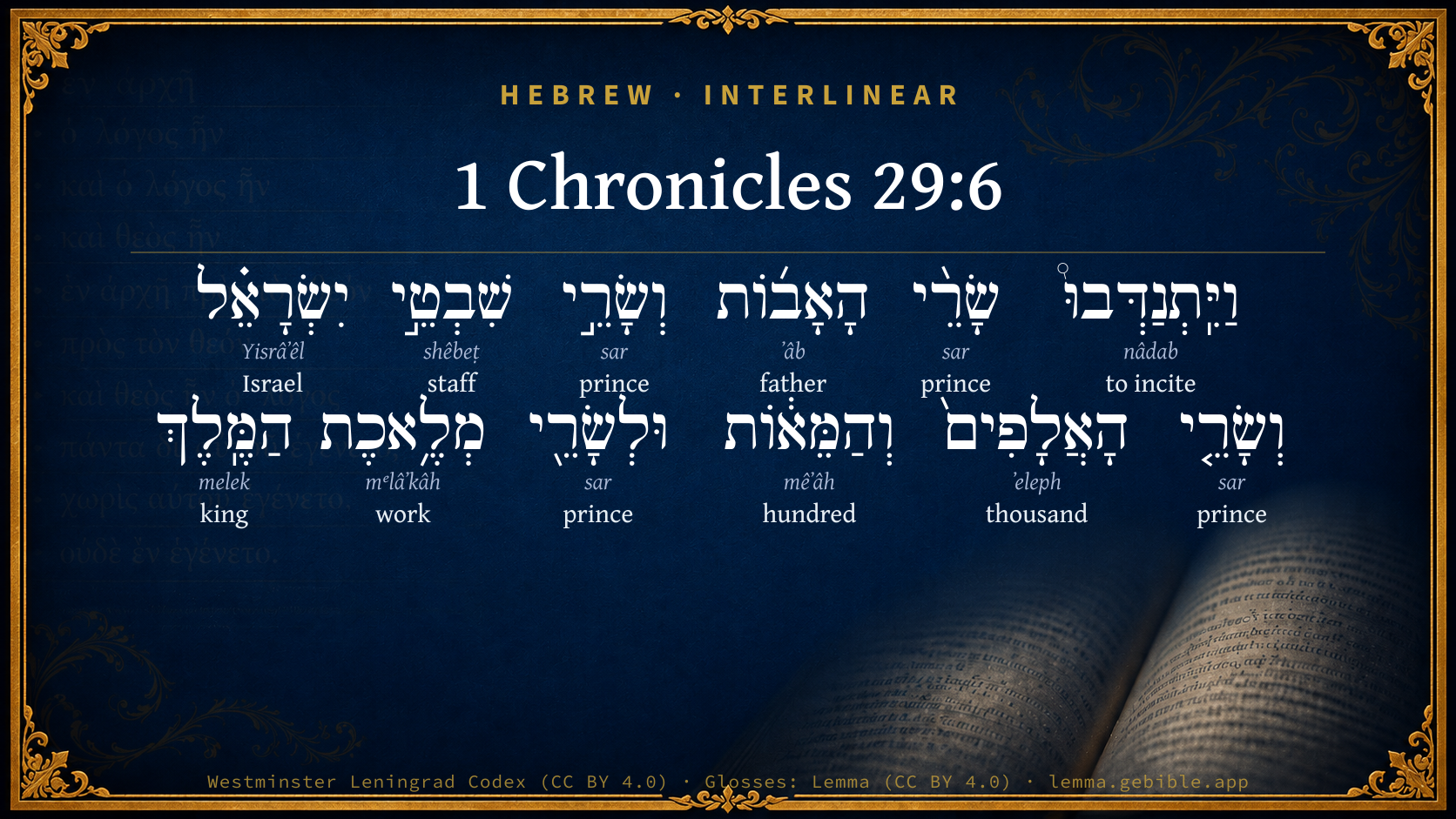
1 Chronicles 29:6

Hebrew (Westminster Leningrad Codex) 1 Chronicles 29:6 appears in the Hebrew Old Testament. The text above is from the Westminster Leningrad Codex. Each word links to its Strong’s number, a concise gloss, and parsing drawn from the Open Scriptures Hebrew Bible morphology. Click any word for its full Brown-Driver-Briggs (BDB) entry.
Download image
Cite this verse

1 Chronicles 29:6 (World English Bible). Public Domain. Lemma interlinear Bible study tool, https://lemma.gebible.app/v/1-chronicles/29/6.

Show BibTeX & RIS
BibTeX
RIS
English Translation
Then the princes of the fathers' [houses], and the princes of the tribes of Israel, and the captains of thousands and of hundreds, with the rulers over the king's work, offered willingly;
World English Bible · Public Domain
Download a study sheet

One document with this verse’s original text, its word-by-word gloss line, the meaning frame, cross-references with their text, attributed commentary, and full source and license credits — printable, and it pastes into notes with its structure intact.

This verse Autodidact and up

Study sheet (.html) Plain text (.txt)

A passage Seminary Student

Up to 50 verses in one chapter. A passage sheet keeps up to 6 commentary sources and 12 cross-references per verse, in the order this page ranks them, and says so on the sheet whenever that leaves anything out. Ask for a single verse and you get the Autodidact verse sheet above.

Everything on this page stays free to read, with no account — the sheet is a download of what is already on screen, not access to it.

Want to remove ads? Support Godless Engineer
Compare translations 3

The same verse in 3 English versions, stacked beneath the original-language interlinear above. Click any original word for its lexicon entry.

Each is an independent rendering of the whole verse — the interlinear is not word-aligned to these translations.

Highlighted words mark where these versions differ — a whole-verse word diff, not a word-by-word alignment.

  • World English Bible Public Domain
    Then the princes of the fathers' [houses], and the princes of the tribes of Israel, and the captains of thousands and of hundreds, with the rulers over the king's work, offered willingly;
  • King James Version Public Domain
    Then the chief of the fathers and princes of the tribes of Israel and the captains of thousands and of hundreds, with the rulers of the king's work, offered willingly,
  • unfoldingWord Literal Text CC BY-SA 4.0
    Then the leaders of the fathers offered freely, and the leaders of the tribes of Israel and the commanders of thousands and hundreds and the commanders of the work of the king.

unfoldingWord Literal Text — © unfoldingWord, licensed CC BY-SA 4.0. Word-aligned USFM3 via Door43 (git.door43.org/unfoldingWord/en_ult).

Versions to compare (up to 4)

3 of 4 selected

Show all 18 translations

Every available English version of this verse, each an independent rendering of the whole verse.

  • World English Bible Public Domain
    Then the princes of the fathers' [houses], and the princes of the tribes of Israel, and the captains of thousands and of hundreds, with the rulers over the king's work, offered willingly;
  • Berean Standard Bible Public Domain
    Then the leaders of the households, the officers of the tribes of Israel, the commanders of thousands and of hundreds, and the officials in charge of the king’s work gave willingly.
  • Majority Standard Bible Public Domain
    Then the leaders of the families, the officers of the tribes of Israel, the commanders of thousands and of hundreds, and the officials in charge of the king’s work gave willingly.
  • King James Version Public Domain
    Then the chief of the fathers and princes of the tribes of Israel and the captains of thousands and of hundreds, with the rulers of the king's work, offered willingly,
  • American Standard Version (1901) Public Domain
    Then the princes of the fathers' `houses', and the princes of the tribes of Israel, and the captains of thousands and of hundreds, with the rulers over the king's work, offered willingly;
  • Revised Version (1885) Public Domain
    Then the princes of the fathers’ houses, and the princes of the tribes of Israel, and the captains of thousands and of hundreds, with the rulers over the king’s work, offered willingly;
  • Geneva Bible (1599) Public Domain
    So the princes of the families, and the princes of the tribes of Israel, and the captaines of thousands and of hundreths, with the rulers of the Kings worke, offred willingly,
  • Douay-Rheims (1899) Public Domain
    Then the heads of the families, and the princes of the tribes of Israel, and the captains of thousands, and of hundreds, and the overseers of the king's possessions promised,
  • Young's Literal Translation Public Domain
    And the heads of the fathers, and the heads of the tribes of Israel, and the heads of the thousands, and of the hundreds, even to the heads of the work of the king, offer willingly.
  • Literal Standard Version CC BY-SA 4.0
    And the heads of the fathers, and the heads of the tribes of Israel, and the heads of the thousands, and of the hundreds, and of the heads of the work of the king, offer willingly.
  • Unlocked Literal Bible CC BY-SA 4.0
    Then freewill offerings were made by the leaders of their ancestors' families, the leaders of the tribes of Israel, the commanders of thousands and hundreds, and by the officials over the king's work.
  • unfoldingWord Literal Text CC BY-SA 4.0
    Then the leaders of the fathers offered freely, and the leaders of the tribes of Israel and the commanders of thousands and hundreds and the commanders of the work of the king.
  • Darby Bible Public Domain
    And the chief fathers and princes of the tribes of Israel, and the captains of thousands and of hundreds, and the comptrollers of the king's business, offered willingly.
  • World Messianic Bible Public Domain
    Then the princes of the fathers’ households, and the princes of the tribes of Israel, and the captains of thousands and of hundreds, with the rulers over the king’s work, offered willingly;
  • Webster's Bible Public Domain
    Then the chief of the fathers and princes of the tribes of Israel, and the captains of thousands and of hundreds, with the rulers over the king's work, offered willingly,
  • Free Bible Version CC BY-SA 4.0
    They gave willingly—the family leaders, those in charge of the tribes of Israel, the commanders of thousands and of hundreds, and the officials in charge of the king's work.
  • Bible in Basic English Public Domain
    Then the heads of families and the chiefs of the tribes of Israel, and the captains of thousands and of hundreds, with the controllers of the king's business, freely gave themselves;
  • JPS Tanakh (1917) Public Domain
    Then the princes of the fathers' houses, and the princes of the tribes of Israel, and the captains of thousands and of hundreds, with the rulers over the king's work, offered willingly;

Literal Standard Version (2020), Covenant Press — licensed CC BY-SA 4.0. Text via the HelloAO Bible API (eBible.org). Unlocked Literal Bible (unfoldingWord) — licensed CC BY-SA 4.0. Text via the HelloAO Bible API (eBible.org). unfoldingWord Literal Text — © unfoldingWord, licensed CC BY-SA 4.0. Word-aligned USFM3 via Door43 (git.door43.org/unfoldingWord/en_ult). Free Bible Version, Dr. Jonathan Gallagher — licensed CC BY-SA 4.0. Text via the HelloAO Bible API (eBible.org).

Word by word

More ways to search: Search by grammar → Find every occurrence → Compare this word →

Practice this passage: Drill this verse → Learn its vocabulary →

וַיִּֽתְנַדְּבוּ֩
nâdab
H5068
“and · to incite”
Conjunction + Verb, Hithpael, Sequential Imperfect, 3rd Person, Masculine, Plural
Part of Speech
Conjunction + Verb
Stem
Hithpael
Form
Sequential Imperfect
Person
3rd Person
Gender
Masculine
Number
Plural
Full BDB Definition

Origin: a primitive root

TWOT: 1299

to incite, impel, make willing - (Qal) to incite, impel - (Hithpael) - to volunteer - to offer free-will offerings
  1. שָׂרֵ֨י sar H8269 “princes of” Noun, Common, Masculine, Plural, Construct
  2. הָאָב֜וֹת ʼâb H1 “the · fathers” Particle, Definite Article + Noun, Common, Masculine, Plural, Absolute
  3. וְשָׂרֵ֣י sar H8269 “and · princes of” Conjunction + Noun, Common, Masculine, Plural, Construct
  4. שִׁבְטֵ֣י shêbeṭ H7626 “staffs of” Noun, Common, Masculine, Plural, Construct
  5. יִשְׂרָאֵ֗ל Yisrâʼêl H3478 “Israel” Noun, Proper
  6. וְשָׂרֵ֤י sar H8269 “and · princes of” Conjunction + Noun, Common, Masculine, Plural, Construct
  7. הָאֲלָפִים֙ ʼeleph H505 “the · thousand” Particle, Definite Article + Adjective, Cardinal number, Both, Plural, Absolute
  8. וְהַמֵּא֔וֹת mêʼâh H3967 “and · the · hundred” Conjunction + Particle, Definite Article + Adjective, Cardinal number, Both, Plural, Absolute
  9. וּלְשָׂרֵ֖י sar H8269 “and · to/for · princes of” Conjunction + Preposition + Noun, Common, Masculine, Plural, Construct
  10. מְלֶ֥אכֶת mᵉlâʼkâh H4399 “work of” Noun, Common, Feminine, Singular, Construct
  11. הַמֶּֽלֶךְ melek H4428 “the · king” Particle, Definite Article + Noun, Common, Masculine, Singular, Absolute

About this verse

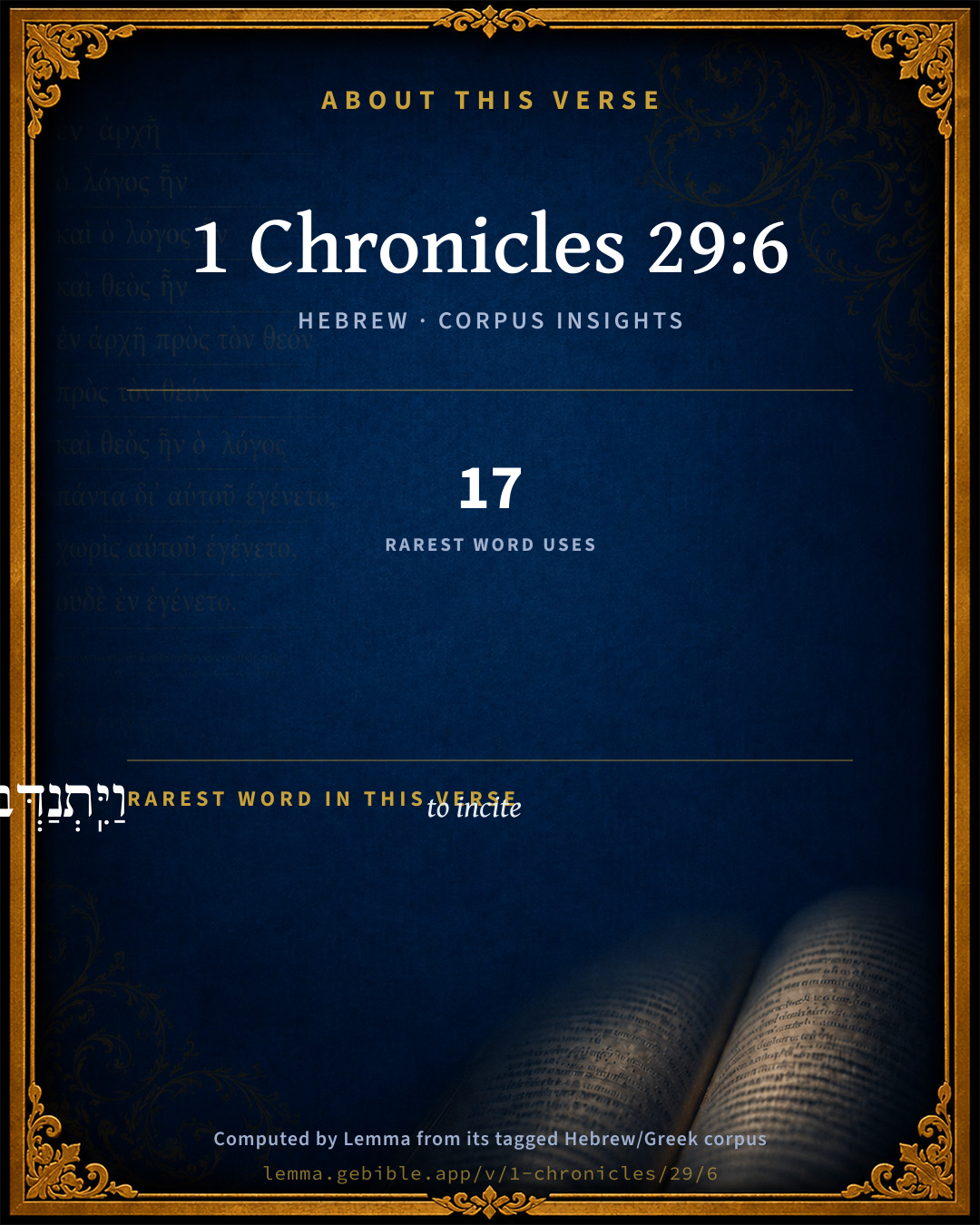
These counts appear in no published source. They are computed here, from the morphology-tagged text and Lemma’s own curated glosses. What Lemma adds →

12
words
9
distinct lemmas
Historical
section

Notable vocabulary

The rarest word here is וַיִּֽתְנַדְּבוּ֩ to incite H5068 — appearing just 17 times in the whole Hebrew Bible.

Shared distinctive vocabulary

וַיִּֽתְנַדְּבוּ֩ to incite H5068 occurs in 15 verses of the Hebrew Bible. Also found in:

Grammatical profile

  • 1 verb
  • 9 nouns
  • 2 adjectives

Verb forms

  • וַיִּֽתְנַדְּבוּ֩ Hithpael · Sequential Imperfect

Repetition

A word recurs within this verse — often emphatic in Hebrew:

  • שָׂרֵ֨י prince H8269 ×4

Hebrew & Septuagint length

In English translation the verse runs 32 words from the Hebrew and 34 from the Septuagint (LXX English) — closely comparable.

A rough comparison of the two English renderings, which tokenize alike — not a word-level alignment.

Word counts can differ between the Hebrew and the Greek without any difference in meaning — e.g. the Hebrew direct-object marker אֵת has no separate Greek word, and Greek often adds the article ὁ.

Cross-references

4

Topical passages linked to 1 Chronicles 29:6 in the Treasury of Scripture Knowledge — connected by theme and wording, ordered by reader-vote popularity; previews shown in the World English Bible.

  • 2 Corinthians 9:7 Let each man give according as he has determined in his heart; not grudgingly, or under compulsion; for God loves a cheerful giver.
  • 1 Chronicles 27:25–28:1 Over the king's treasures was Azmaveth the son of Adiel: and over the treasures in the fields, in the cities, and in the villages, and in the towers, was Jonathan the son of Uzziah:
  • Isaiah 60:3–10 Nations shall come to your light, and kings to the brightness of your rising.
  • 1 Chronicles 27:1–15 Now the children of Israel after their number, the heads of fathers' [houses] and the captains of thousands and of hundreds, and their officers who served the king, in any matter of the divisions which came in and went out month by month throughout all the months of the year--of every division were twenty-four thousand.

Cross-references courtesy of OpenBible.info (CC BY 4.0).

Hebrew and Greek witnesses Masoretic Hebrew ↔ Greek Septuagint

The same verse in the two great witnesses to the Old Testament, shown verse-for-verse.

These are two independent witnesses, not word-aligned to each other, and the Septuagint is shown in lemma (dictionary) form.

Hebrew 1 Chronicles 29:6 Masoretic · Westminster Leningrad Codex

וַיִּֽתְנַדְּבוּ֩ שָׂרֵ֨י הָאָב֜וֹת וְשָׂרֵ֣י שִׁבְטֵ֣י יִשְׂרָאֵ֗ל וְשָׂרֵ֤י הָאֲלָפִים֙ וְהַמֵּא֔וֹת וּלְשָׂרֵ֖י מְלֶ֥אכֶת הַמֶּֽלֶךְ

Then the princes of the fathers' [houses], and the princes of the tribes of Israel, and the captains of thousands and of hundreds, with the rulers over the king's work, offered willingly;

World English Bible · Public Domain

Greek LXX 1 Chronicles 29:6 Septuagint · lemma form

καί προθυμέομαι ἄρχων ὁ πατριά καί ὁ ἄρχων ὁ υἱός ἰσραήλ καί ὁ χιλίαρχος καί ὁ ἑκατόνταρχος καί ὁ προστάτης ὁ ἔργον καί ὁ οἰκονόμος ὁ βασιλεύς

Then the heads of families, and the princes of the children of Israel, and the captains of thousands and captains of hundreds, and the overseers of the works, and the king's builders, offered willingly.

LXX2012 (modern English Septuagint) · Public Domain

Hebrew: Westminster Leningrad Codex (CC BY 4.0). Greek: Septuagint (public domain); English from LXX2012 (modern English Septuagint) (Public Domain). How the Septuagint differs from the Hebrew →

Commentary

Notes on 1 Chronicles 29:6 from classic Christian and Jewish commentators (each source and its license shown beneath its notes). The classic Christian expositions comment on the surrounding passage and are grouped to its opening verse, so a note may address several verses; the Jewish commentaries on the Tanakh (Rashi and others) are per-verse, so they appear only where the commentator wrote on this verse.

Lemma curates 59 commentaries, every one of them public domain or Creative Commons licensed, each selected and text-cleaned for this edition rather than reprinted as found. About our sources →

Trapp's Complete Commentary

John Trapp

1Ch 29:6 Then the chief of the fathers and princes of the tribes of Israel, and the captains of thousands and of hundreds, with the rulers of the king’s work, offered willingly,

Ver. 6. Offered willingly.] Liberales se exhibuerunt operas et opes sponte conferentes, Their obedience was prompt and present, their contribution large and liberal.

John Trapp, A Commentary or Exposition upon All the Books of the Old and New Testament (1647–1656) — public domain. Text from a community e-Sword module.

Tyndale Open Study Notes

Tyndale Open Resources

29:6 Israel’s leaders gave willingly, as had been the case with the Tabernacle (Exod 25:1-7).

Tyndale Open Study Notes — © Tyndale Open Resources, licensed CC BY-SA 4.0. Text via the HelloAO Bible API.

Jamieson, Fausset & Brown

Robert Jamieson, A. R. Fausset & David Brown

Then the chief of the fathers--or heads of the fathers (Ch1 24:31; Ch1 27:1).

princes of the tribes-- (Ch1 27:16-22).

rulers of the king's work--those who had charge of the royal demesnes and other possessions (Ch1 27:25-31).

offered willingly--Influenced by the persuasive address and example of the king, they acted according to their several abilities, and their united contributions amounted to the gross sum--of gold 5,000 talents and 10,000 drams; and of silver, 10,000 talents, besides brass and iron.

Jamieson, Fausset & Brown — Commentary Critical and Explanatory on the Whole Bible (1871) — public domain (CC PDM 1.0). Text via the HelloAO Bible API.

Ellicott's Commentary for English Readers

(6) Then the chief of the fathers.—And the princes of the clans, &c., volunteered, showed themselves liberal (nâdîb: 1Ch_28:21; comp. Pro_19:6).

Chief . . . princes . . . captains . . . rulers.—All these words represent a single Hebrew term (sârîm). Princes of the clans or houses = heads of the houses elsewhere.

With the rulers of the king’s work.—The stewards or bailiffs of the royal domains (1Ch_27:25-31). The construction here is like that in 1Ch_28:21. The particle rendered “with” (le) appears to mean much the same as ‘ãd, “even unto,” assigning an inclusive limit.

A Bible Commentary for English Readers, edited by Charles John Ellicott (1878–1897) — public domain. Text from a community e-Sword module.

The Cambridge Bible for Schools and Colleges

gen. ed. J. J. S. Perowne

6–9. The Offerings of the Chiefs of Israel

6. the chief of the fathers] R.V. the princes of the fathers’ houses.

over the king’s work] See 1Ch_27:25-31.

The Cambridge Bible for Schools and Colleges (gen. ed. J. J. S. Perowne; Cambridge University Press, 1878–1918) — public domain. Text from a community e-Sword module.

John Gill's Exposition

Then the chief of the fathers and princes of the tribes of Israel,.... The princes of the twelve tribes:

and the captains of thousands, and of hundreds, with the rulers over the king's work; who were now assembled, Ch1 28:1.

offered willingly; and cheerfully; needed no more arguments to press them to it, but at once readily communicated.

John Gill's Exposition of the Whole Bible (1746–1763) — public domain (CC PDM 1.0). Text via the HelloAO Bible API.

Haydock's Catholic Bible Commentary

Possessions, mentioned [in] chap. xxvii. 25.

George Leo Haydock (1774–1849), Haydock's Catholic Family Bible and Commentary, 1859 edition — public domain. Excludes Psalms (Douay-Rheims chapter numbering differs from Protestant) and Deuterocanonical books (Catholic canon only).

The Pulpit Commentary

The response was hearty; it comprised voluntary gifts from the most of those mentioned in 1Ch_28:1; and described in 1Ch_27:16-31. For the rulers of the king"s work, see Chronicles 27:26; 28:1. As the more general term "work" is employed, we are not bound to confine the expression to include only those who managed "the substance and cattle" of 1Ch_28:1.

The Pulpit Commentary (1880–1919), ed. H.D.M. Spence-Jones & Joseph S. Exell — public domain. Text from a community e-Sword module.

Keil & Delitzsch

C. F. Keil & F. Delitzsch

Then the chief of the fathers and princes of the tribes of Israel,.... The princes of the twelve tribes:

and the captains of thousands, and of hundreds, with the rulers over the king's work; who were now assembled, Ch1 28:1.

offered willingly; and cheerfully; needed no more arguments to press them to it, but at once readily communicated.

Keil & Delitzsch — Biblical Commentary on the Old Testament (1861–1891) — public domain (CC PDM 1.0). Text via the HelloAO Bible API. (Old Testament only.)

unfoldingWord translationNotes

Door43 World Missions Community

General Information:

(See: Numbers)

Then freewill offerings were made by the leaders ... and by the officials over the king's work.

This can be stated in active form. AT: "Then the leaders ... and the officials over the king's work made freewill offerings" (See: Active or Passive)

the commanders of thousands and hundreds

Possible meanings are 1) these numbers represent the exact amount of soldiers that these commanders led. AT: "the commanders of 1,000 soldiers and the commanders of 100 soldiers" or 2) the words translated as "thousands" and "hundreds" do not represent exact numbers, but are the names of larger and smaller military divisions. AT: "the commanders of large military divisions and the commanders of smaller military divisions" See how you translated this in 1 Chronicles 13:1. (See: Numbers)

the officials over the king's work

Here the word "over" is used as an idiom. AT: "the officials in charge of the king's work" (See: Idiom)

five thousand talents ... and 100,000 talents of iron

"5,000 talents and 10,000 darics of gold, 10,000 talents of silver, 18,000 talents of bronze, and 100,000 talents of iron." These may be written in modern measurements. AT: "165 metric tons and 84 kilograms of gold, 330 metric tons of silver, 600 metric tons of bronze, and 3,300 metric tons of iron" (See: Biblical Money)

100,000 talents

"one hundred thousand talents" (See: Numbers)

translationWords

freewill offering

family

tribe

Israel

commander

works

servant

gold

unfoldingWord translationNotes — © Distant Shores Media and the Door43 World Missions Community, licensed CC BY-SA 4.0. Source: git.door43.org/Door43/en_tn.

Rashi

Rabbi Shlomo Yitzchaki (Rashi)

And the leaders of the fathers’ [houses], etc., gave willingly those about whom it is written above (27:16): “And over the tribes of Israel,” and so it is written above (verse 1): “And the Children of Israel to their number: the heads of the fathers’ [houses], etc.”

and with the leaders of the work of the king And also the leaders of the work of the soil of the king, (verse 27): “... and over what was in the vineyards of the king, etc.”

Rashi on the Tanakh — English translations: “The Judaica Press complete Tanach with Rashi, translated by A. J. Rosenberg” (CC BY 4.0); “Pentateuch with Rashi's commentary by M. Rosenbaum and A.M. Silbermann, 1929-1934” (public domain); “The Metsudah Tanach series, Lakewood, N.J” (CC BY 4.0); and “The Book of Joshua, Metsudah Publications, 1997” (CC BY 4.0). Text via Sefaria.

Lesson kit

Teaching starters — assembled from the data on this page, not authored interpretation. Every prompt links to the verse data it draws on. Edit before teaching.

1 Chronicles, in the Historical, opens this verse with 12 words (9 distinct Hebrew lemmas). Its most distinctive word is nâdab (“to incite”). A historical commentator’s framing appears above. Read the whole chapter for the surrounding context.

Discussion questions

  1. How does “to incite” (nâdab) shape what this verse is saying?
  2. Exodus 25:2 shares the word «to incite» with this verse. How do the two illuminate each other?
  3. “prince” occurs 4× in this one verse. What is the effect of the repetition?
  4. The translations on this page render this verse differently — a whole-verse word diff, not a word-by-word alignment. What might account for the different wordings?
  5. The verb «וַיִּֽתְנַדְּבוּ֩» is Hithpael Sequential Imperfect. How does its form color the action?
  6. Reading how Trapp's Complete Commentary and Tyndale Open Study Notes read this verse, where do the two commentators agree and where do they part?

Things to notice

Reading settings

Reading text

Shown beneath each verse's original-language words.

Old Testament
Old Testament edition

Read the OT as the Masoretic Hebrew (MT) or the Greek Septuagint (LXX).

English shown for the Greek Septuagint (in the Hebrew ↔ Greek comparison).

Comparing translations? Open the Compare panel on any verse page to stack up to four side by side.