Numbers 35:4

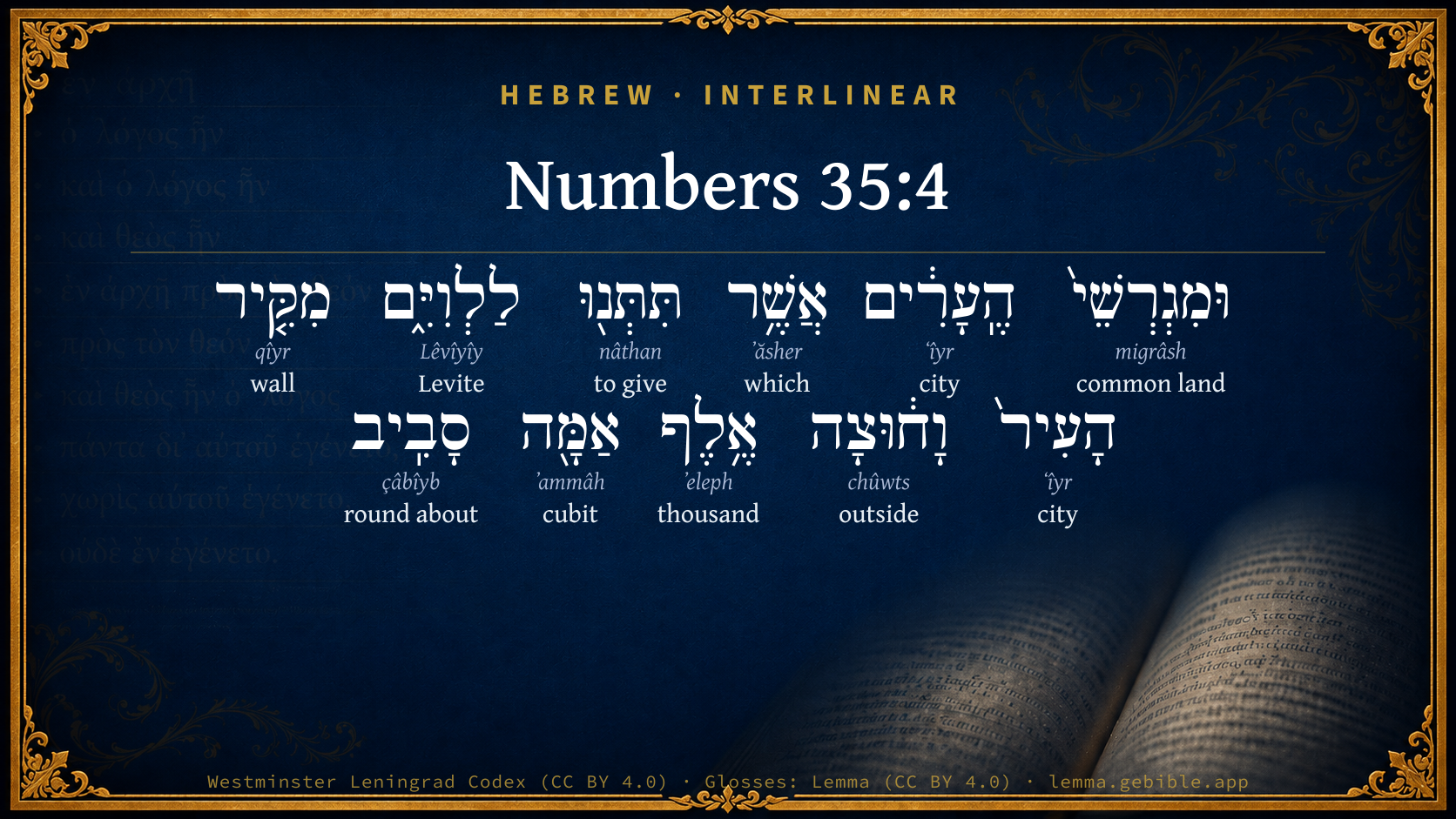
Hebrew (Westminster Leningrad Codex) Numbers 35:4 appears in the Hebrew Old Testament. The text above is from the Westminster Leningrad Codex. Each word links to its Strong’s number, a concise gloss, and parsing drawn from the Open Scriptures Hebrew Bible morphology. Click any word for its full Brown-Driver-Briggs (BDB) entry.
Download image
Cite this verse

Numbers 35:4 (World English Bible). Public Domain. Lemma interlinear Bible study tool, https://lemma.gebible.app/v/numbers/35/4.

Show BibTeX & RIS
BibTeX
RIS
English Translation
The suburbs of the cities, which you shall give to the Levites, shall be from the wall of the city and outward one thousand cubits round about.
World English Bible · Public Domain
Download a study sheet

One document with this verse’s original text, its word-by-word gloss line, the meaning frame, cross-references with their text, attributed commentary, and full source and license credits — printable, and it pastes into notes with its structure intact.

This verse Autodidact and up

Study sheet (.html) Plain text (.txt)

A passage Seminary Student

Up to 50 verses in one chapter. A passage sheet keeps up to 6 commentary sources and 12 cross-references per verse, in the order this page ranks them, and says so on the sheet whenever that leaves anything out. Ask for a single verse and you get the Autodidact verse sheet above.

Everything on this page stays free to read, with no account — the sheet is a download of what is already on screen, not access to it.

Want to remove ads? Support Godless Engineer
Compare translations 3

The same verse in 3 English versions, stacked beneath the original-language interlinear above. Click any original word for its lexicon entry.

Each is an independent rendering of the whole verse — the interlinear is not word-aligned to these translations.

Highlighted words mark where these versions differ — a whole-verse word diff, not a word-by-word alignment.

  • World English Bible Public Domain
    The suburbs of the cities, which you shall give to the Levites, shall be from the wall of the city and outward one thousand cubits round about.
  • King James Version Public Domain
    And the suburbs of the cities, which ye shall give unto the Levites, shall reach from the wall of the city and outward a thousand cubits round about.
  • unfoldingWord Literal Text CC BY-SA 4.0
    And the pasturelands of the cities that you shall give to the Levites shall be from the wall of the city and outward 1, 000 cubits all around.

unfoldingWord Literal Text — © unfoldingWord, licensed CC BY-SA 4.0. Word-aligned USFM3 via Door43 (git.door43.org/unfoldingWord/en_ult).

Versions to compare (up to 4)

3 of 4 selected

Show all 18 translations

Every available English version of this verse, each an independent rendering of the whole verse.

  • World English Bible Public Domain
    The suburbs of the cities, which you shall give to the Levites, shall be from the wall of the city and outward one thousand cubits round about.
  • Berean Standard Bible Public Domain
    The pasturelands around the cities you are to give the Levites will extend a thousand cubits from the wall on every side.
  • Majority Standard Bible Public Domain
    The pasturelands around the cities you are to give the Levites will extend a thousand cubits from the wall on every side.
  • King James Version Public Domain
    And the suburbs of the cities, which ye shall give unto the Levites, shall reach from the wall of the city and outward a thousand cubits round about.
  • American Standard Version (1901) Public Domain
    And the suburbs of the cities, which ye shall give unto the Levites, shall be from the wall of the city and outward a thousand cubits round about.
  • Revised Version (1885) Public Domain
    And the suburbs of the cities, which ye shall give unto the Levites, shall be from the wall of the city and outward a thousand cubits round about.
  • Geneva Bible (1599) Public Domain
    And the suburbes of the cities, which ye shall giue vnto the Leuites, from the wall of the citie outward, shalbe a thousand cubites round about.
  • Douay-Rheims (1899) Public Domain
    Which suburbs shall reach from the walls of the cities outward, a thousand paces on every side:
  • Young's Literal Translation Public Domain
    `And the suburbs of the cities which ye give to the Levites `are', from the wall of the city and without, a thousand cubits round about.
  • Literal Standard Version CC BY-SA 4.0
    And the outskirts of the cities which you give to the Levites [are], from the wall of the city and outside, one thousand cubits around.
  • Unlocked Literal Bible CC BY-SA 4.0
    The pasturelands around the cities that you will give to the Levites must extend from the city walls for one thousand cubits in every direction.
  • unfoldingWord Literal Text CC BY-SA 4.0
    And the pasturelands of the cities that you shall give to the Levites shall be from the wall of the city and outward 1, 000 cubits all around.
  • Darby Bible Public Domain
    And the suburbs of the cities that ye shall give unto the Levites shall be from the walls of the city outward, a thousand cubits round about.
  • World Messianic Bible Public Domain
    “The pasture lands of the cities, which you shall give to the Levites, shall be from the wall of the city and outward one thousand cubits around it.
  • Webster's Bible Public Domain
    And the suburbs of the cities which ye shall give to the Levites, shall reach from the wall of the city and outward a thousand cubits on all sides.
  • Free Bible Version CC BY-SA 4.0
    The pastures around the towns you give to the Levites are to extend out from the wall a thousand cubits on all sides.
  • Bible in Basic English Public Domain
    Stretching from the wall of the towns a distance of a thousand cubits all round.
  • JPS Tanakh (1917) Public Domain
    And the open land about the cities, which ye shall give unto the Levites, shall be from the wall of the city and outward a thousand cubits round about.

Literal Standard Version (2020), Covenant Press — licensed CC BY-SA 4.0. Text via the HelloAO Bible API (eBible.org). Unlocked Literal Bible (unfoldingWord) — licensed CC BY-SA 4.0. Text via the HelloAO Bible API (eBible.org). unfoldingWord Literal Text — © unfoldingWord, licensed CC BY-SA 4.0. Word-aligned USFM3 via Door43 (git.door43.org/unfoldingWord/en_ult). Free Bible Version, Dr. Jonathan Gallagher — licensed CC BY-SA 4.0. Text via the HelloAO Bible API (eBible.org).

Word by word

More ways to search: Search by grammar → Find every occurrence → Compare this word →

Practice this passage: Drill this verse → Learn its vocabulary →

מִקִּ֤יר
qîyr
H7023
“from · wall of”
Preposition + Noun, Common, Masculine, Singular, Construct
Part of Speech
Preposition + Noun
Type
Common
Gender
Masculine
Number
Singular
State
Construct
Full BDB Definition

Origin: from H6979

TWOT: 2022

wall, side - wall (of house or chamber) - the sides (of the altar)
  1. וּמִגְרְשֵׁי֙ migrâsh H4054 “and · common lands of” Conjunction + Noun, Common, Masculine, Plural, Construct
  2. הֶֽעָרִ֔ים ʻîyr H5892 “the · cities” Particle, Definite Article + Noun, Common, Feminine, Plural, Absolute
  3. אֲשֶׁ֥ר ʼăsher H834 “which” Particle, Relative
  4. תִּתְּנ֖וּ nâthan H5414 “to give” Verb, Qal, Imperfect, 2nd Person, Masculine, Plural
  5. לַלְוִיִּ֑ם Lêvîyîy H3881 “to/for the · Levites” Preposition, Determined + Noun, Gentilic, Masculine, Plural, Absolute
  6. הָעִיר֙ ʻîyr H5892 “the · city” Particle, Definite Article + Noun, Common, Feminine, Singular, Absolute
  7. וָח֔וּצָה chûwts H2351 “and · outside · toward” Conjunction + Noun, Common, Masculine, Singular, Absolute + Suffix, Demonstrative
  8. אֶ֥לֶף ʼeleph H505 “thousand” Adjective, Cardinal number, Both, Singular, Absolute
  9. אַמָּ֖ה ʼammâh H520 “cubit” Noun, Common, Feminine, Singular, Absolute
  10. סָבִֽיב çâbîyb H5439 “round about” Noun, Common, Both, Singular, Absolute

About this verse

These counts appear in no published source. They are computed here, from the morphology-tagged text and Lemma’s own curated glosses. What Lemma adds →

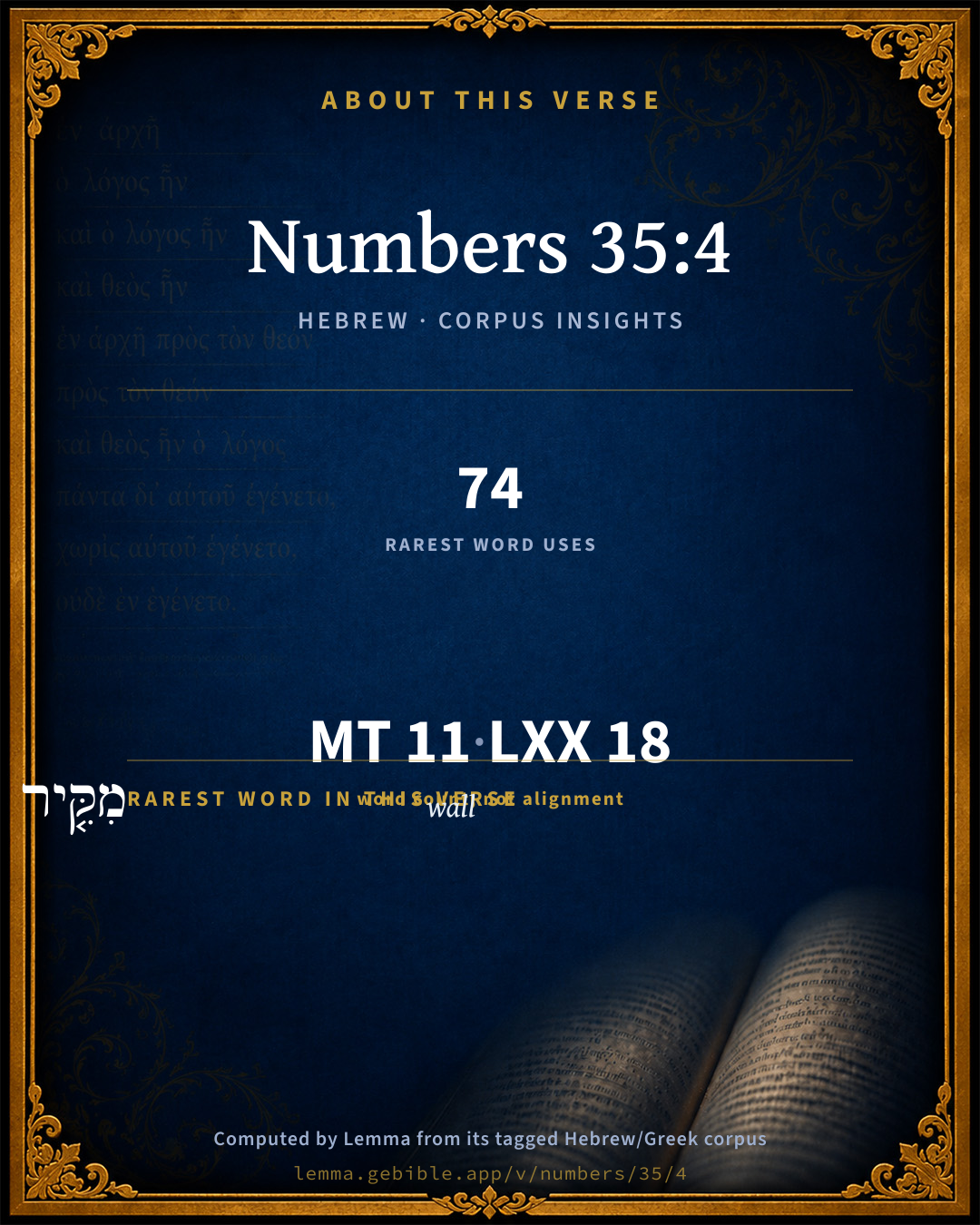
11
words
10
distinct lemmas
Pentateuch
section

Grammatical profile

  • 1 verb
  • 8 nouns
  • 1 adjective
  • 1 particle

Verb forms

  • תִּתְּנ֖וּ Qal · Imperfect

Repetition

A word recurs within this verse — often emphatic in Hebrew:

  • הֶֽעָרִ֔ים city H5892 ×2

Hebrew & Septuagint length

In English translation the verse runs 27 words from the Hebrew and 28 from the Septuagint (LXX English) — closely comparable.

A rough comparison of the two English renderings, which tokenize alike — not a word-level alignment.

Word counts can differ between the Hebrew and the Greek without any difference in meaning — e.g. the Hebrew direct-object marker אֵת has no separate Greek word, and Greek often adds the article ὁ.

In the original languages it is 11 Hebrew tokens and 18 Greek tokens — but the two are counted differently (Hebrew bundles its prefixes and suffixes into one token; the Greek is in lemma form), so that isn’t a like-for-like length.

Hebrew and Greek witnesses Masoretic Hebrew ↔ Greek Septuagint

The same verse in the two great witnesses to the Old Testament, shown verse-for-verse.

These are two independent witnesses, not word-aligned to each other, and the Septuagint is shown in lemma (dictionary) form.

Hebrew Numbers 35:4 Masoretic · Westminster Leningrad Codex

וּמִגְרְשֵׁי֙ הֶֽעָרִ֔ים אֲשֶׁ֥ר תִּתְּנ֖וּ לַלְוִיִּ֑ם מִקִּ֤יר הָעִיר֙ וָח֔וּצָה אֶ֥לֶף אַמָּ֖ה סָבִֽיב

The suburbs of the cities, which you shall give to the Levites, shall be from the wall of the city and outward one thousand cubits round about.

World English Bible · Public Domain

Greek LXX Numbers 35:4 Septuagint · lemma form

καί ὁ συνκυρόω ὁ πόλις ὅς δίδωμι ὁ λευίτης ἀπό τεῖχος ὁ πόλις καί ἔξω δισχίλιοι πῆχυς κύκλος

And the suburbs of the cities which you⌃ shall give to the Levites, shall be from the wall of the city and outwards two thousand cubits round about.

LXX2012 (modern English Septuagint) · Public Domain

On this verse, Matthew Poole's English Annotations discusses the Septuagint’s reading. Read the note in Commentary ↓

Hebrew: Westminster Leningrad Codex (CC BY 4.0). Greek: Septuagint (public domain); English from LXX2012 (modern English Septuagint) (Public Domain). How the Septuagint differs from the Hebrew →

Targum (Aramaic paraphrase)

2

The Targum is the ancient Jewish Aramaic paraphrase of the Hebrew Scriptures — an interpretive translation, not the Hebrew text itself. Onkelos (literal) and Pseudo-Jonathan (expansive) render the Torah, and Jonathan the Prophets. Coverage is partial: where no permissively-licensed English translation exists for a verse, only the Aramaic is shown. This is verse-level text, not a word-by-word alignment to the Hebrew.

  1. Targum Onkelos Torah (Genesis–Deuteronomy)
    וּרְוָחֵי קִרְוַיָא דִי תִתְּנוּן לְלֵוָאֵי מִכּוֹתֵל קַרְתָּא וּלְבָרָא אֲלַף אַמִין סְחוֹר סְחוֹר

    (no public-domain English translation for this verse)

    Targum Onkelos — Aramaic: “Onkelos Genesis” (public domain); “Onkelos Exodus” (public domain); “Onkelos Leviticus” (public domain); “Onkelos Numbers” (public domain); “Onkelos Deuteronomy” (public domain). English: “Sefaria Community Translation” (CC0 1.0 (public-domain dedication)); “J.W. Etheridge. The Targums of Onkelos and Jonathan Ben Uzziel on the Pentateuch. London: Longmans, Green, 1862” (public domain). Text via Sefaria.

  2. Targum Pseudo-Jonathan Torah (Genesis–Deuteronomy)
    וּפְדוֹרְוִילֵי קִרְוַיָא דְתִתְּנוּן לְלֵיוָאֵי חֲזוֹר קַרְתָּא וּלְבַר אַלְפָא גַרְמִידֵי חֲזוֹר חֲזוֹר

    But of the cities which you give to the Levites the suburbs round the city shalt be one thousand cubits without the city round about.

    Targum Pseudo-Jonathan — Aramaic: “Targum Jonathan on Genesis” (public domain); “Targum Jonathan on Exodus” (public domain); “Targum Jonathan on Leviticus” (public domain); “Targum Jonathan on Numbers” (public domain); “Targum Jonathan on Deuteronomy” (public domain). English: “The Targum of Jonathan ben Uzziel, trans. J. W. Etheridge, London, 1862” (public domain). Text via Sefaria.

Commentary

Notes on Numbers 35:4 from classic Christian and Jewish commentators (each source and its license shown beneath its notes). The classic Christian expositions comment on the surrounding passage and are grouped to its opening verse, so a note may address several verses; the Jewish commentaries on the Tanakh (Rashi and others) are per-verse, so they appear only where the commentator wrote on this verse.

Lemma curates 59 commentaries, every one of them public domain or Creative Commons licensed, each selected and text-cleaned for this edition rather than reprinted as found. About our sources →

Matthew Poole's English Annotations

Object. In the next verse it is

two thousand. How do these agree?

Answ. 1. LXX. interpreters read both here and Num 35:5 two thousand cubits, whence some suppose this to be an error in the Hebrew text, which, being in a matter neither concerning faith nor good manners, is not prejudicial to the authority of the Holy Scriptures.

Answ. 2. The one thousand cubits may be in length from the city, and the two thousand cubits in breadth on each side of the city, and so they well agree; for a line of a thousand cubits being draw in length eastward, and another westward, and another northward, and another southward, a line drawn at a thousand cubits distance from the city, from east to west, must needs contain two thousand cubits, and so must the other line from north to south, and so on every side of the city there must be two thousand cubits.

Answ. 3. This verse and the next do not speak to the same thing: this speaks of the space or place from whence the suburbs shall be measured, the next verse speaks of the space unto which that measure shall be extended; and the words may very well be read thus, And the suburbs—shall be (so it is only an ellipsis of the verb substantive, which is most frequent, and the meaning is, shall be taken or accounted)

from the wall of the city, and from (that particle being supplied or understood from the foregoing words, which is very usual) without it, or, from the outward parts of it, (which being a general and indefinite expression is limited and explained by the following words,) even from

a thousand cubits round about; which are mentioned not as the thing measured, for as yet there is not a word of measuring, but as the term or space from which the measuring line should begin. And then it follows, Num 35:5, And ye shall measure from without the city (not from the wall of the city, as was said before, Num 35:4, but from without it, i.e. from the said outward part or space of a thousand cubits without the wall of the city round about) on the east side two thousand cubits, &c. So in truth there were three thousand cubits from the wall of the city, whereof one thousand probably were for out-houses, stalls for cattle, gardens, vineyards, and olive-yards, and the like, and the other two thousand for pasture, which are therefore called the field of the suburbs, Lev 25:34, by way of distinction from the suburbs themselves, which consist of the first thousand cubits from the wall of the city.

Matthew Poole's English Annotations on the Holy Bible (1683–1685) — public domain. Text from a community e-Sword/MySword module.

Joseph Benson's Commentary

Num 35:4-5. From the wall of the city a thousand cubits — It appears, by comparing these two verses together, that there were three thousand cubits allowed them from the wall of the city; the first thousand, properly called the suburbs, probably for outhouses, gardens, vineyards, and olive-yards; and the other two for pasturage, which are therefore called the field of the suburbs, (Lev 25:34,) by way of distinction from the suburbs themselves.

Joseph Benson's Commentary on the Old and New Testaments (1811–1818) — public domain. Text from a community e-Sword module.

Tyndale Open Study Notes

Tyndale Open Resources

35:4-5 Readers have long attempted to explain the alleged contradiction between the 1,500 feet and the 3,000 feet. If the Hebrews conceived of a town as a fixed point, then the square of territory around each town would measure 3,000 feet on each side. Another solution is to see a distinction between pastureland (35:4) and larger pastureland (35:5) around the town. On the basis of this text, some Jewish interpreters restricted the distance that one could walk on the Sabbath to 3,000 feet (2,000 cubits) from home.

Tyndale Open Study Notes — © Tyndale Open Resources, licensed CC BY-SA 4.0. Text via the HelloAO Bible API.

Adam Clarke's Commentary

Verse 4. And the suburbs of the cities - shall reach from the wall of the city and outward a thousand cubits round about.

Adam Clarke's Commentary on the Bible (1810–1826) — public domain. Text from a community e-Sword/MySword module.

John Gill's Exposition

And the suburbs of the cities which ye shall give unto the Levites,.... The dimensions and bounds of them were not left to the Israelites, to give what ground they pleased for this purpose, but were fixed to what length they should be: these

shall reach from the walls of the city, and outward, a thousand cubits round about; which was half a sabbath day's journey, and pretty near half a mile, which all around a city must contain a considerable quantity of ground, if the city was of any size, as it is certain that some of them given them at least were.

John Gill's Exposition of the Whole Bible (1746–1763) — public domain (CC PDM 1.0). Text via the HelloAO Bible API.

Haydock's Catholic Bible Commentary

Paces. This is equivalent to 2000 cubits, (ver. 5,) or a sabbath day’s journey. (Selden, Jur. iii. 9.; St. Jerome, q. 9. ad algas.) Hebrew retains the same word, amma, "cubit," in both verses: but some copies of the Septuagint, Philo, and Josephus, have "2000 cubits," (Calmet) which Dr. Wall and Kennicott deem to be the original reading. (Haydock) --- Bonfrere would also correct the Hebrew by the Vulgate as a pace among the Greeks consisted of three feet, and a cubit of half that quantity. The geometric pace of the Romans contained five feet, and the sacred cubit of Villalpand half as much; so that 2000 sacred cubits make 1000 geometric paces. Thus the Vulgate is perfectly consistent with itself. (Menochius) --- Some imagine that Moses speaks of the common cubit here and of the sacred one, which was doubly as large, ver 5. But this is not probable; and the distinction of cubits, (Calmet) at least in his days, (Haydock) is very uncertain. Perhaps Moses may first specify the depth of this space of ground from the wall, and afterwards its length, which would be doubly greater. (Calmet) See Sevius on Jos. xxi. q. 8, &c. --- The semidiameter was probably 1000 cubits. (Du Hamel)

George Leo Haydock (1774–1849), Haydock's Catholic Family Bible and Commentary, 1859 edition — public domain. Excludes Psalms (Douay-Rheims chapter numbering differs from Protestant) and Deuterocanonical books (Catholic canon only).

Whedon's Commentary on the Bible

Daniel D. Whedon

4, 5. Suburbs… a thousand cubits — There would be no perplexity in making a diagram fulfilling this requirement if it were not added that a distance of two thousand cubits must be measured from without the city on each of the four sides. Eight different kinds of diagrams have been devised to meet the requirements of the text, one of which will be found in Jos_21:2, note. The Seventy, Josephus, and Philo cut this knot by reading two thousand in both verses. In the summer of 1878 two stones bearing the inscription in old Hebrew and Greek characters, “The limit or boundary of Geser,” were found near Abou-Shushek, the ancient Levitical city of Gezer, (Jos_21:21,) taken from the Philistines by the king of Egypt, and given by Pharaoh to his daughter, Solomon’s wife. 1Ki_9:16. This discovery will go far toward fixing the standard of the Jewish cubit, and in determining the shape and extent of the suburbs of these cities. The limit of the inner suburb was one thousand cubits from the wall round about the city, which was probably circular. The outer precincts were two thousand cubits beyond the inner, according to the Hebrew text, to the east, west, north, and south corners; so the boundary of the outlying fields could not have been circular, but diagonal. The suburbs did not measure three thousand cubits in all directions, only the angles at the four cardinal points. The first thousand cubits were to be measured “from the wall of the city,” not from the center of it, the city being “in the midst.” This discovery corrects the diagram of Keil. See Jos_21:2, note.

Daniel D. Whedon (gen. ed.), Commentary on the Old and New Testaments (1874–1909) — public domain. Text from a community e-Sword module.

John Wesley's Explanatory Notes

A thousand cubits - In the next verse it is two thousand. But this verse and the next do not speak to the same thing; this speaks of the space from whence the suburbs shall be measured, the next speaks of the space unto which that measure shall be extended; and the words may very well be read thus. And the suburbs - Shall be from the wall of the city and from without it, or, from the outward parts of it, even from a thousand cubits round about. Which are mentioned not as the thing measured, but as the space from which the measuring line should begin. And then it follows, ver. 5. And ye shall measure from without the city, (not from the wall of the city, as said before ver. 4, but from without it, that is, from the said outward space of a thousand cubits without the wall of the city round about) on the east side two thousand cubits. So in truth there were three thousand cubits from the wall of the city, whereof one thousand probably were for out-houses, stalls for cattle, gardens, vineyards and olive-yards, and the other two thousand for pasture, which are therefore called the field of the suburbs, Lev. xxv, 34, by way of distinction from the suburbs themselves, which consist of the first thousand cubits from the wall of the city.

John Wesley, Explanatory Notes Upon the Whole Bible (1754–1765) — public domain. Text via the GEBible commentary corpus.

Keil & Delitzsch

C. F. Keil & F. Delitzsch

The pasture lands of the different towns were to measure "from the town wall outwards a thousand cubits round about," i.e., on each of the four sides. "And measure from without the city, the east side 2000 cubits, and the south side 2000 cubits, and the west side 2000 cubits, and the north side 2000 cubits, and the city in the middle," i.e., so that the town stood in the middle of the measured lines, and the space which they occupied was not included in the 2000 cubits. The meaning of these instructions, which have caused great perplexity to commentators, and have latterly been explained by Saalschtz (Mos. R. pp. 100, 101) in a marvellously erroneous manner, was correctly expounded by J. D. Michaelis in the notes to his translation. We must picture the towns and the surrounding fields as squares, the pasturage as stretching 1000 cubits from the city wall in every direction, as the accompanying figures show, and the length of each outer side as 2000 cubits, apart from the length of the city wall: so that, if the town itself occupied a square of 1000 cubits (see fig. a), the outer side of the town fields would measure 2000 + 1000 cubits in every direction; but if each side of the city wall was only 500 cubits long (see fig. b), the outer side of the town fields would measure 2000 + 500 cubits in every direction.

Keil & Delitzsch — Biblical Commentary on the Old Testament (1861–1891) — public domain (CC PDM 1.0). Text via the HelloAO Bible API. (Old Testament only.)

Rashi

Rabbi Shlomo Yitzchaki (Rashi)

אלף אמה סביב A THOUSAND CUBITS ROUND ABOUT — But afterwards, (v. 5) it says, “two thousand cubits”!? How can that be? They assign two thousand for them (for the Levites) round about their cities, and of these, the innermost thousand serves as the “open space” and the outermost is for fields and vineyards (Sotah 27b).

Rashi on the Tanakh — English translations: “The Judaica Press complete Tanach with Rashi, translated by A. J. Rosenberg” (CC BY 4.0); “Pentateuch with Rashi's commentary by M. Rosenbaum and A.M. Silbermann, 1929-1934” (public domain); “The Metsudah Tanach series, Lakewood, N.J” (CC BY 4.0); and “The Book of Joshua, Metsudah Publications, 1997” (CC BY 4.0). Text via Sefaria.

Lesson kit

Teaching starters — assembled from the data on this page, not authored interpretation. Every prompt links to the verse data it draws on. Edit before teaching.

Numbers, in the Pentateuch, opens this verse with 11 words (10 distinct Hebrew lemmas). Its most distinctive word is qîyr (“wall”). A historical commentator’s framing appears above. Read the whole chapter for the surrounding context.

Discussion questions

  1. The word qîyr carries the sense “wall.” How does it shape the verse?
  2. “city” occurs 2× in this one verse. What is the effect of the repetition?
  3. These translations render this verse differently. What is at stake in choosing one wording over another?
  4. The verb «תִּתְּנ֖וּ» is Qal Imperfect. How does its form color the action?
  5. Reading how Matthew Poole's English Annotations and Joseph Benson's Commentary read this verse, where do the two commentators agree and where do they part?

Things to notice

Reading settings

Reading text

Shown beneath each verse's original-language words.

Old Testament
Old Testament edition

Read the OT as the Masoretic Hebrew (MT) or the Greek Septuagint (LXX).

English shown for the Greek Septuagint (in the Hebrew ↔ Greek comparison).

Comparing translations? Open the Compare panel on any verse page to stack up to four side by side.