Judges 15:16

Hebrew (Westminster Leningrad Codex) Judges 15:16 appears in the Hebrew Old Testament. The text above is from the Westminster Leningrad Codex. Each word links to its Strong’s number, a concise gloss, and parsing drawn from the Open Scriptures Hebrew Bible morphology. Click any word for its full Brown-Driver-Briggs (BDB) entry.
Download image
Cite this verse

Judges 15:16 (World English Bible). Public Domain. Lemma interlinear Bible study tool, https://lemma.gebible.app/v/judges/15/16.

Show BibTeX & RIS
BibTeX
RIS
English Translation
Samson said, With the jawbone of a donkey, heaps on heaps, With the jawbone of a donkey I have struck a thousand men.
World English Bible · Public Domain
Highlights
  • 1 first appearance in the Hebrew Bible
Full analysis ↓
Download a study sheet

One document with this verse’s original text, its word-by-word gloss line, the meaning frame, cross-references with their text, attributed commentary, and full source and license credits — printable, and it pastes into notes with its structure intact.

This verse Autodidact and up

Study sheet (.html) Plain text (.txt)

A passage Seminary Student

Up to 50 verses in one chapter. A passage sheet keeps up to 6 commentary sources and 12 cross-references per verse, in the order this page ranks them, and says so on the sheet whenever that leaves anything out. Ask for a single verse and you get the Autodidact verse sheet above.

Everything on this page stays free to read, with no account — the sheet is a download of what is already on screen, not access to it.

Want to remove ads? Support Godless Engineer
Compare translations 3

The same verse in 3 English versions, stacked beneath the original-language interlinear above. Click any original word for its lexicon entry.

Each is an independent rendering of the whole verse — the interlinear is not word-aligned to these translations.

Highlighted words mark where these versions differ — a whole-verse word diff, not a word-by-word alignment.

  • World English Bible Public Domain
    Samson said, With the jawbone of a donkey, heaps on heaps, With the jawbone of a donkey I have struck a thousand men.
  • King James Version Public Domain
    And Samson said, With the jawbone of an ass, heaps upon heaps, with the jaw of an ass have I slain a thousand men.
  • unfoldingWord Literal Text CC BY-SA 4.0
    And Samson said, “With the jawbone of a donkey, a heap, two heaps, with the jawbone of a donkey I have struck 1,000 men.”

unfoldingWord Literal Text — © unfoldingWord, licensed CC BY-SA 4.0. Word-aligned USFM3 via Door43 (git.door43.org/unfoldingWord/en_ult).

Versions to compare (up to 4)

3 of 4 selected

Show all 18 translations

Every available English version of this verse, each an independent rendering of the whole verse.

  • World English Bible Public Domain
    Samson said, With the jawbone of a donkey, heaps on heaps, With the jawbone of a donkey I have struck a thousand men.
  • Berean Standard Bible Public Domain
    Then Samson said: “With the jawbone of a donkey I have piled them into heaps. With the jawbone of a donkey I have slain a thousand men.”
  • Majority Standard Bible Public Domain
    Then Samson said: “With the jawbone of a donkey I have piled them into heaps. With the jawbone of a donkey I have slain a thousand men.”
  • King James Version Public Domain
    And Samson said, With the jawbone of an ass, heaps upon heaps, with the jaw of an ass have I slain a thousand men.
  • American Standard Version (1901) Public Domain
    And Samson said, With the jawbone of an ass, heaps upon heaps, With the jawbone of an ass have I smitten a thousand men.
  • Revised Version (1885) Public Domain
    And Samson said, With the jawbone of an ass, heaps upon heaps, with the jawbone of an ass have I smitten a thousand men.
  • Geneva Bible (1599) Public Domain
    Then Samson sayd, With the iaw of an asse are heapes vpon heapes: with the iawe of an asse haue I slaine a thousand men.
  • Douay-Rheims (1899) Public Domain
    And he said: With the jawbone of an ass, with the jaw of the colt of asses I have destroyed them, and have slain a thousand men.
  • Young's Literal Translation Public Domain
    And Samson saith, `With a jaw-bone of the ass -- an ass upon asses -- with a jaw-bone of the ass I have smitten a thousand men.'
  • Literal Standard Version CC BY-SA 4.0
    And Samson says, “With the jawbone of a donkey, heap on heaps—I have struck down one thousand men with the jawbone of a donkey!”
  • Unlocked Literal Bible CC BY-SA 4.0
    Samson said, “With the jawbone of a donkey, heaps upon heaps, with the jawbone of a donkey I have killed a thousand men.”
  • unfoldingWord Literal Text CC BY-SA 4.0
    And Samson said, “With the jawbone of a donkey, a heap, two heaps, with the jawbone of a donkey I have struck 1,000 men.”
  • Darby Bible Public Domain
    And Samson said, "With the jawbone of an ass, heaps upon heaps, with the jawbone of an ass have I slain a thousand men."
  • World Messianic Bible Public Domain
    Samson said, “With the jawbone of a donkey, heaps on heaps; with the jawbone of a donkey I have struck a thousand men.”
  • Webster's Bible Public Domain
    And Samson said, With the jaw-bone of an ass, heaps upon heaps, with the jaw of an ass have I slain a thousand men.
  • Free Bible Version CC BY-SA 4.0
    Then Samson declared, “With a donkey's jawbone I have piled the dead into heaps. With a donkey's jawbone I have killed a thousand men.”
  • Bible in Basic English Public Domain
    And Samson said, With a red ass's mouth-bone I have made them red with blood, with a red ass's mouth-bone I have sent destruction on a thousand men.
  • JPS Tanakh (1917) Public Domain
    And Samson said: With the jawbone of an ass, heaps upon heaps, with the jawbone of an ass have I smitten a thousand men.

Literal Standard Version (2020), Covenant Press — licensed CC BY-SA 4.0. Text via the HelloAO Bible API (eBible.org). Unlocked Literal Bible (unfoldingWord) — licensed CC BY-SA 4.0. Text via the HelloAO Bible API (eBible.org). unfoldingWord Literal Text — © unfoldingWord, licensed CC BY-SA 4.0. Word-aligned USFM3 via Door43 (git.door43.org/unfoldingWord/en_ult). Free Bible Version, Dr. Jonathan Gallagher — licensed CC BY-SA 4.0. Text via the HelloAO Bible API (eBible.org).

Word by word

More ways to search: Search by grammar → Find every occurrence → Compare this word →

Practice this passage: Drill this verse → Learn its vocabulary →

חֲמ֖וֹר
chămôrâh
H2565
“heap”
Noun, Common, Masculine, Singular, Absolute
Part of Speech
Noun
Type
Common
Gender
Masculine
Number
Singular
State
Absolute
Full BDB Definition

Origin: from H2560 [compare H2563 ]

TWOT: TWOT- 684c

heap
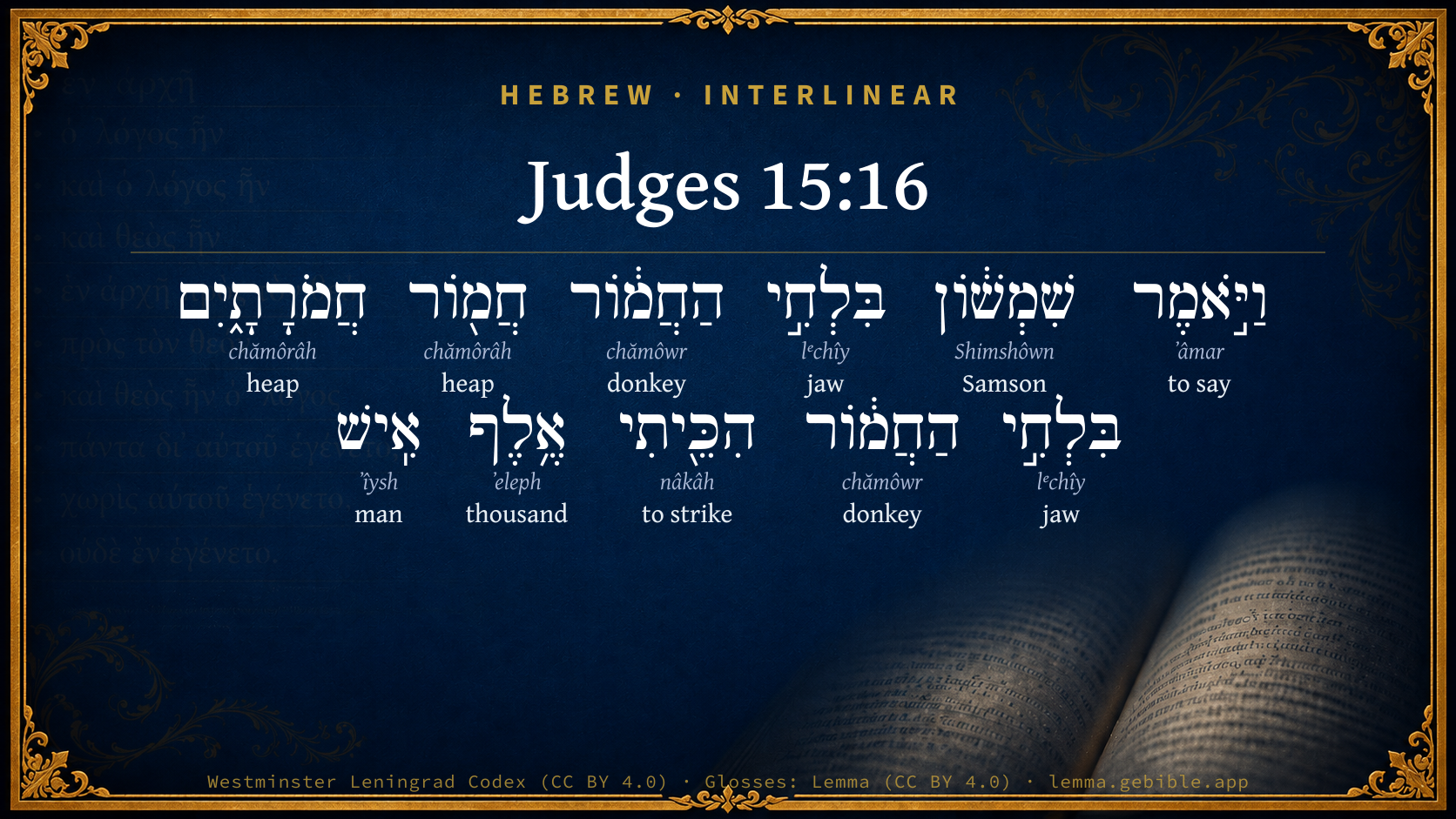
  1. וַיֹּ֣אמֶר ʼâmar H559 “and · to say” Conjunction + Verb, Qal, Sequential Imperfect, 3rd Person, Masculine, Singular
  2. שִׁמְשׁ֔וֹן Shimshôwn H8123 “Samson” Noun, Proper
  3. בִּלְחִ֣י lᵉchîy H3895 “in/at · jaw of” Preposition + Noun, Common, Both, Singular, Construct
  4. הַחֲמ֔וֹר chămôwr H2543 “the · donkey” Particle, Definite Article + Noun, Common, Both, Singular, Absolute
  5. חֲמֹרָתָ֑יִם chămôrâh H2565 “heaps” Noun, Common, Masculine, Dual, Absolute
  6. בִּלְחִ֣י lᵉchîy H3895 “in/at · jaw of” Preposition + Noun, Common, Both, Singular, Construct
  7. הַחֲמ֔וֹר chămôwr H2543 “the · donkey” Particle, Definite Article + Noun, Common, Both, Singular, Absolute
  8. הִכֵּ֖יתִי nâkâh H5221 “to strike” Verb, Hiphil, Perfect, 1st Person, Common, Singular
  9. אֶ֥לֶף ʼeleph H505 “thousand” Adjective, Cardinal number, Both, Singular, Absolute
  10. אִֽישׁ ʼîysh H376 “man” Noun, Common, Masculine, Singular, Absolute

About this verse

These counts appear in no published source. They are computed here, from the morphology-tagged text and Lemma’s own curated glosses. What Lemma adds →

11
words
8
distinct lemmas
Historical
section

Notable vocabulary

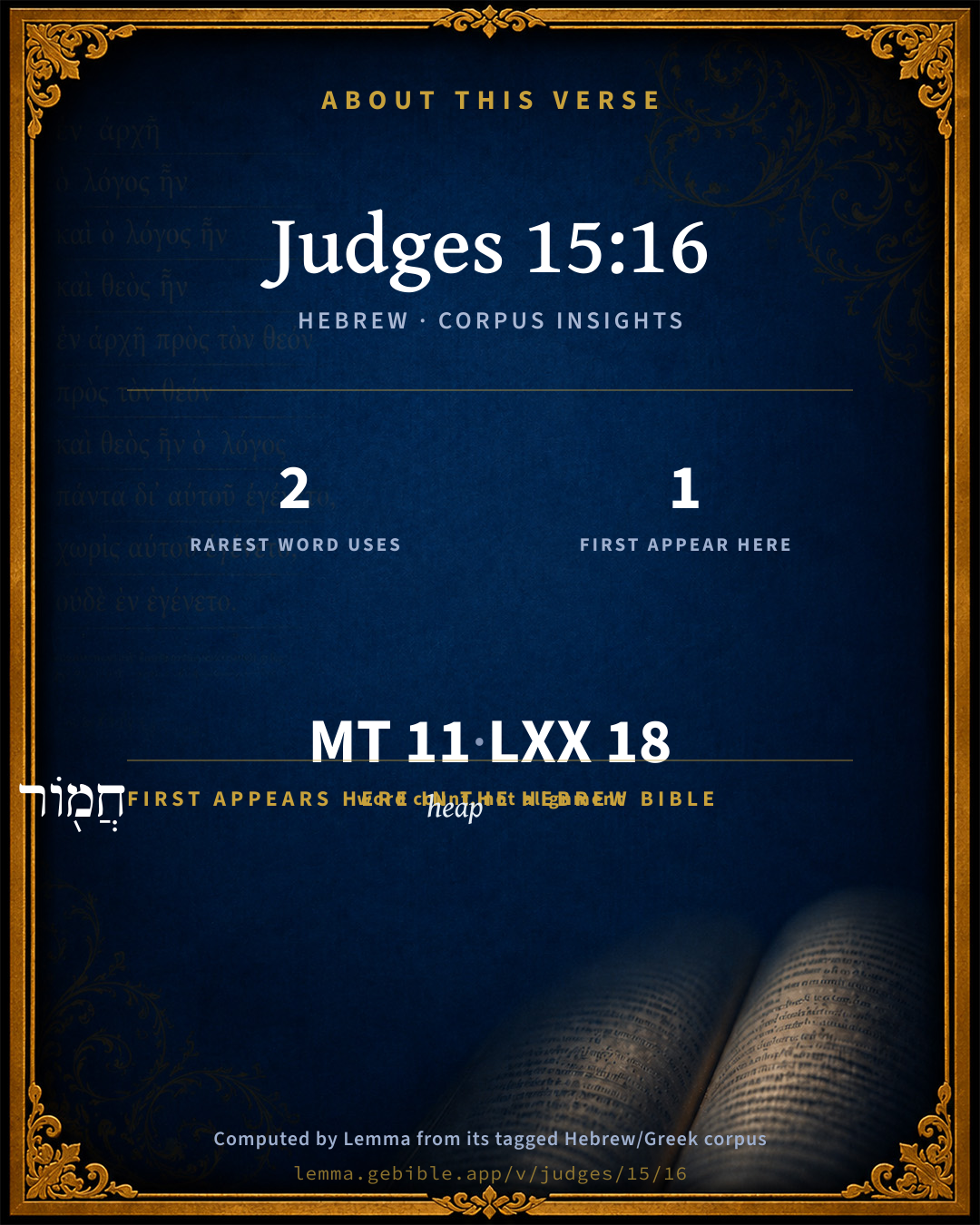
The rarest word here is חֲמ֖וֹר heap H2565 — appearing just 2 times in the whole Hebrew Bible.

First appearance in Scripture

This word makes its first canonical appearance in the Hebrew Bible here:

  • חֲמ֖וֹר heap H2565

Grammatical profile

  • 2 verbs
  • 8 nouns
  • 1 adjective

Verb forms

  • וַיֹּ֣אמֶר Qal · Sequential Imperfect
  • הִכֵּ֖יתִי Hiphil · Perfect

Repetition

Words recur within this verse — often emphatic in Hebrew:

  • בִּלְחִ֣י jaw H3895 ×2
  • הַחֲמ֔וֹר donkey H2543 ×2
  • חֲמ֖וֹר heap H2565 ×2

Hebrew & Septuagint length

In English translation the verse runs 23 words from the Hebrew and 27 from the Septuagint (LXX English) — closely comparable.

A rough comparison of the two English renderings, which tokenize alike — not a word-level alignment.

Word counts can differ between the Hebrew and the Greek without any difference in meaning — e.g. the Hebrew direct-object marker אֵת has no separate Greek word, and Greek often adds the article ὁ.

In the original languages it is 11 Hebrew tokens and 18 Greek tokens — but the two are counted differently (Hebrew bundles its prefixes and suffixes into one token; the Greek is in lemma form), so that isn’t a like-for-like length.

Hebrew and Greek witnesses Masoretic Hebrew ↔ Greek Septuagint

The same verse in the two great witnesses to the Old Testament, shown verse-for-verse.

These are two independent witnesses, not word-aligned to each other, and the Septuagint is shown in lemma (dictionary) form.

Hebrew Judges 15:16 Masoretic · Westminster Leningrad Codex

וַיֹּ֣אמֶר שִׁמְשׁ֔וֹן בִּלְחִ֣י הַחֲמ֔וֹר חֲמ֖וֹר חֲמֹרָתָ֑יִם בִּלְחִ֣י הַחֲמ֔וֹר הִכֵּ֖יתִי אֶ֥לֶף אִֽישׁ

Samson said, With the jawbone of a donkey, heaps on heaps, With the jawbone of a donkey I have struck a thousand men.

World English Bible · Public Domain

Greek LXX Judges 15:16 Septuagint · lemma form

καί εἶπον σαμψων ἐν σιαγών ὄνος ἐκἀλείφω ἐκἀλείφω αὐτός ὅτι ἐν ὁ σιαγών ὁ ὄνος πατάσσω χίλιοι ἀνήρ

And Sampson said, With the jaw-bone of an ass I have utterly destroyed them, for with the jaw-bone of an ass I have struck a thousand men.

LXX2012 (modern English Septuagint) · Public Domain

On this verse, The Cambridge Bible for Schools and Colleges discusses the Septuagint’s reading. Read the note in Commentary ↓

Hebrew: Westminster Leningrad Codex (CC BY 4.0). Greek: Septuagint (public domain); English from LXX2012 (modern English Septuagint) (Public Domain). How the Septuagint differs from the Hebrew →

Targum (Aramaic paraphrase)

1

The Targum is the ancient Jewish Aramaic paraphrase of the Hebrew Scriptures — an interpretive translation, not the Hebrew text itself. Onkelos (literal) and Pseudo-Jonathan (expansive) render the Torah, and Jonathan the Prophets. Coverage is partial: where no permissively-licensed English translation exists for a verse, only the Aramaic is shown. This is verse-level text, not a word-by-word alignment to the Hebrew.

  1. Targum Jonathan Prophets (Joshua–Malachi)
    וַאֲמַר שִׁמְשׁוֹן בְּלוֹעָא דַחֲמָרָא רְמִיתִנוּן דְגוֹרִין בְּלוֹעָא דַחֲמָרָא קְטָלִית אֲלַף גַבְרָא:

    (no public-domain English translation for this verse)

    Targum Jonathan — Aramaic: “Mikraot Gedolot” (public domain). English: “Sefaria Community Translation” (CC0 1.0 (public-domain dedication)); “London "Chaldee Paraphrase," 1871” (public domain). Text via Sefaria.

Commentary

Notes on Judges 15:16 from classic Christian and Jewish commentators (each source and its license shown beneath its notes). The classic Christian expositions comment on the surrounding passage and are grouped to its opening verse, so a note may address several verses; the Jewish commentaries on the Tanakh (Rashi and others) are per-verse, so they appear only where the commentator wrote on this verse.

Lemma curates 59 commentaries, every one of them public domain or Creative Commons licensed, each selected and text-cleaned for this edition rather than reprinted as found. About our sources →

Trapp's Complete Commentary

John Trapp

Jdg 15:16 And Samson said, With the jawbone of an ass, heaps upon heaps, with the jaw of an ass have I slain a thousand men.

Ver. 16. With the jaw bone of an ass, heaps upon heaps.] Heb., A heap, two heaps. Here is an elegancy (antanaclasis) in the original; for the same word Chamor signifieth both an ass and a heap. And this was Samson’s epinicion, or song of thanksgiving to God; not a vain vaunt of his own strength and achievements, as Josephus and Ambrose will have it, for which cause also God punished him afterwards with so great thirst, say they.

John Trapp, A Commentary or Exposition upon All the Books of the Old and New Testament (1647–1656) — public domain. Text from a community e-Sword module.

Joseph Benson's Commentary

Jdg 15:16. Heaps upon heaps, &c. — Hebrew, a heap, two heaps. As much as to say, I have not only slain enow to make one heap, but two or more. I have slain a thousand men — What could be too hard for him to do, on whom the Spirit of the Lord came mightily? This seems like a short hymn or song of triumph, which Samson uttered after he had routed the Philistines. It is strange that the men of Judah did not now, at least, come to his assistance. But he was to be a type of him who trod the wine-press alone.

Joseph Benson's Commentary on the Old and New Testaments (1811–1818) — public domain. Text from a community e-Sword module.

Jamieson, Fausset & Brown

Robert Jamieson, A. R. Fausset & David Brown

With the jawbone of an ass, heaps upon heaps, with the jaw of an ass have I slain a thousand men--The inadequacy of the weapon plainly shows this to have been a miraculous feat, "a case of supernatural strength," just as the gift of prophecy is a case of supernatural knowledge [CHALMERS].

Jamieson, Fausset & Brown — Commentary Critical and Explanatory on the Whole Bible (1871) — public domain (CC PDM 1.0). Text via the HelloAO Bible API.

Ellicott's Commentary for English Readers

(16) And Samson said, With the jawbone of an ass.—Here we once more find ourselves in very primitive regions of poetry and paronomasia. Samson’s exultation over his extraordinary achievement finds vent in a sort of punning couplet, which turns entirely on the identity of sound between chamor, a heap, and chamor, an ass, and the play of meaning between aleph, a thousand, and aleph, an ox. In the Hebrew the couplet runs:—

“Bi-lechi ha-chamor chamor chamorathaim.

Bi-lechi ha-chamor hicceythî eleph eesh.”

Literally, with some attempt, however clumsy, to keep up the play of words,

“With jaw of the ass, a (m)ass two (m) asses,

With jaw of the ass I smote an ox-load of men.”

The versions are, of course, unable to preserve these rough paronomasias, which are characteristic of the age. It would be quite a mistake to infer that they show any levity of spirit in Samson. On the contrary, such peculiarities of expression often arise out of deep emotion. When John of Gaunt begins his dying speech to Richard II. with—

“Old Gaunt, indeed! and gaunt in being old,” &c.,

the king asks:—

“Can sick men play so nicely with their names?”

and the dying prince makes the striking answer:—

“No; misery makes sport to mock herself.”

I have fully examined the whole subject in Chapters on Language, pp. 227-238. These sallies of playful fancy tended no less than the flashes of military prowess to prepare the nation for better times by keeping up their buoyant mood. “The nation felt unsubdued in mind and body, while its sons could flow out in such health and vivacity;” and thus Samson began to deliver them, though his actual deeds were casual—“a sort of teasing, reiterated mark of mortifying humiliation” (Ewald).

A Bible Commentary for English Readers, edited by Charles John Ellicott (1878–1897) — public domain. Text from a community e-Sword module.

The Cambridge Bible for Schools and Colleges

gen. ed. J. J. S. Perowne

16. heaps upon heaps] See marg., and cf. Exo_8:14 [Hebrews 10, lit. heaps, heaps]. But a verb is wanted to complete the parallelism with clause b; and, simply pronouncing the words differently, we may render heaping I have heaped them, i. e. I have heaped them high. The verb ḥamar was chosen for its similarity to ḥamôr = ‘ass.’ The Verss. give a verb, LXX, Vulgate delevi, Peshitto ‘I have heaped heaps of them.’

The Cambridge Bible for Schools and Colleges (gen. ed. J. J. S. Perowne; Cambridge University Press, 1878–1918) — public domain. Text from a community e-Sword module.

John Gill's Exposition

And Samson said,.... In a kind of triumphant song:

with the jawbone of an ass, heaps upon heaps; that is, with such an instrument he had slain heaps of men, who lay dead in heaps upon one another; in the words for an "ass", and for an "heap", is an elegant "paronomosia", not easy to be expressed in our language:

with the jaw of an ass have I slain a thousand men: this he said not in a proud and haughty manner, ascribing it to himself, as Josephus suggests (m), since he takes notice of the mean instrument he used; which showed that he was sensible it was not done by his own power, but by the power of God, which enabled him by such weak means to do such wonderful things.

(m) Antiqu. l. 5. c. 8. sect. 9.

John Gill's Exposition of the Whole Bible (1746–1763) — public domain (CC PDM 1.0). Text via the HelloAO Bible API.

Albert Barnes' Notes on the Bible

There is a play upon the word, three times repeated, which means both “an ass” and also “a heap.” The spirit of riddle-making Jdg 14:12, Jdg 14:18 is apparent in this song of triumph (compare Jdg 5:1; Exo 15:1; 1Sa 18:6-7).

Albert Barnes' Notes on the Bible (1834–1885) — public domain. Text from a community e-Sword/MySword module.

Haydock's Catholic Bible Commentary

Asses. He insists on this particular, as such an unusual weapon rendering his victory more astonishing, and he would not leave any room for doubt. Hebrew is variously translated, "with the jaw-bone of an ass, I have made a heap, yea two heaps; with the jaw-bone of an ass, I have defeated a thousand men." (Syriac, &c.) Castalion and Bonfrere defend the Vulgate. The Septuagint have, "with the jaw-bone of an ass I have entirely taken them off, (Haydock; defending them) with," &c. They have explained chamorathayim, as the first person of emor, rubefecit, or Chaldean destruxit, "I have covered them with blood;" and indeed to understand it of "two she asses," is impossible. (Calmet) --- This verse formed the chorus of Samson’s song. (Haydock) --- He did not take the glory to himself, as Josephus ([Antiquities?] v. 10,) would insinuate, but attributed the victory to God, ver. 18. (Salien, in the year before Christ 1172.) This miracle of strength can no more be accounted for by reason, than many others. (Worthington)

George Leo Haydock (1774–1849), Haydock's Catholic Family Bible and Commentary, 1859 edition — public domain. Excludes Psalms (Douay-Rheims chapter numbering differs from Protestant) and Deuterocanonical books (Catholic canon only).

Matthew Poole's English Annotations

This, though it might seem difficult, yet is not at all impossible or incredible; especially seeing the learned affirm of the asses of Syria, that they were larger and stronger than ours, and so consequently were their bones. And withal, it must be acknowledged that there was something extraordinary and miraculous in this, as there was unquestionably in Samson’s strength, and so all the difficulty vanisheth.

Matthew Poole's English Annotations on the Holy Bible (1683–1685) — public domain. Text from a community e-Sword/MySword module.

Whedon's Commentary on the Bible

Daniel D. Whedon

16. Samson said — Samson’s words form a short poetical distich, and contain, in the Hebrew, a noticeable paronomasia, which may be thus presented in English:

With a jawbone of the ass, a mass, two masses, With a jawbone of the ass have I slain a thousand men.

It deserves notice, also, that the Hebrew word for mass or heaps is the same as that for ass and the word for thousand means also an ox; so that a further idea of Samson’s pun may be given by rendering:

With a jawbone of the ass, an ass, two asses, With a jawbone of the ass have I slain an ox of men.

This saying, like the method devised to burn the Philistines’ corn, shows us the extent of Samson’s humour. “His most valiant, his most cruel actions, are done with a smile on his face and a jest in his mouth. It relieves his character from the sternness of Phenician fanaticism. As a peal of hearty laughter often breaks in upon the despondency of individual sorrow, so the joviality of Samson becomes a pledge of the revival of the greatness of his nation. The whole point of the massacre of the thousand Philistines lies in the cleverness with which their clumsy triumph is suddenly turned into discomfiture; and their discomfiture is celebrated by the punning turn of the hero, not forgotten even in the exultation or the weariness of victory.” — Stanley.

Daniel D. Whedon (gen. ed.), Commentary on the Old and New Testaments (1874–1909) — public domain. Text from a community e-Sword module.

The Pulpit Commentary

And Samson said, etc. The exploit gave birth to one of Sam son"s punning, enigmatical, sayings: "With the jawbone of the ass, one heap, two heads of slain." Hamor, an ass, means also a heap . If one were to imitate the passage in English, supposing that the jaw of a sheep had been the implement, it might run something like this By the jaw of a sheep they fell heap upon heap. A Latin imitation is, Maxilla cervi, acervum acervos (Bochart). He adds, as if in explanation, With the jaw of an ass have I slain a thousand men. So the women sang, Saul hath slain his thousands, and David his ten thousands, (1Sa_18:7) And a Latin song is quoted, in which Aurelian is made to say after the Sarmatic war Sarmatas, mille Frances, Semel et semel occidimus, Mille Persas quaerimus" (Bp. Patrick on Judges 15).

The Pulpit Commentary (1880–1919), ed. H.D.M. Spence-Jones & Joseph S. Exell — public domain. Text from a community e-Sword module.

John Wesley's Explanatory Notes

Slain a thousand men - What could be too hard for him to do, on whom the Spirit of the Lord came mightily? It was strange the men of Judah did now at least come in to his assistance. But he was to be a type of him, who trod the wine-press alone.

John Wesley, Explanatory Notes Upon the Whole Bible (1754–1765) — public domain. Text via the GEBible commentary corpus.

Rashi

Rabbi Shlomo Yitzchaki (Rashi)

I amassed mounds with the jawbone of a donkey, amassing numerous mounds. "With the jawbone of a donkey I hurled them into mounds."

Rashi on the Tanakh — English translations: “The Judaica Press complete Tanach with Rashi, translated by A. J. Rosenberg” (CC BY 4.0); “Pentateuch with Rashi's commentary by M. Rosenbaum and A.M. Silbermann, 1929-1934” (public domain); “The Metsudah Tanach series, Lakewood, N.J” (CC BY 4.0); and “The Book of Joshua, Metsudah Publications, 1997” (CC BY 4.0). Text via Sefaria.

Lesson kit

Teaching starters — assembled from the data on this page, not authored interpretation. Every prompt links to the verse data it draws on. Edit before teaching.

Judges, in the Historical, opens this verse with 11 words (8 distinct Hebrew lemmas). Its most distinctive word is chămôrâh (“heap”). A historical commentator’s framing appears above. Read the whole chapter for the surrounding context.

Discussion questions

  1. The word chămôrâh carries the sense “heap.” How does it shape the verse?
  2. This is the first place “heap” appears in Scripture (first appears here). What does its debut here establish?
  3. What does the repetition of “jaw” (2× in this one verse) do in this verse?
  4. The translations on this page render this verse differently — a whole-verse word diff, not a word-by-word alignment. What might account for the different wordings?
  5. «וַיֹּ֣אמֶר» is a Qal Sequential Imperfect verb. How does that grammatical form shape the action described?
  6. Compare how Trapp's Complete Commentary and Joseph Benson's Commentary read this verse. Where do they agree or differ?

Things to notice

Reading settings

Reading text

Shown beneath each verse's original-language words.

Old Testament
Old Testament edition

Read the OT as the Masoretic Hebrew (MT) or the Greek Septuagint (LXX).

English shown for the Greek Septuagint (in the Hebrew ↔ Greek comparison).

Comparing translations? Open the Compare panel on any verse page to stack up to four side by side.