Numbers 10:4

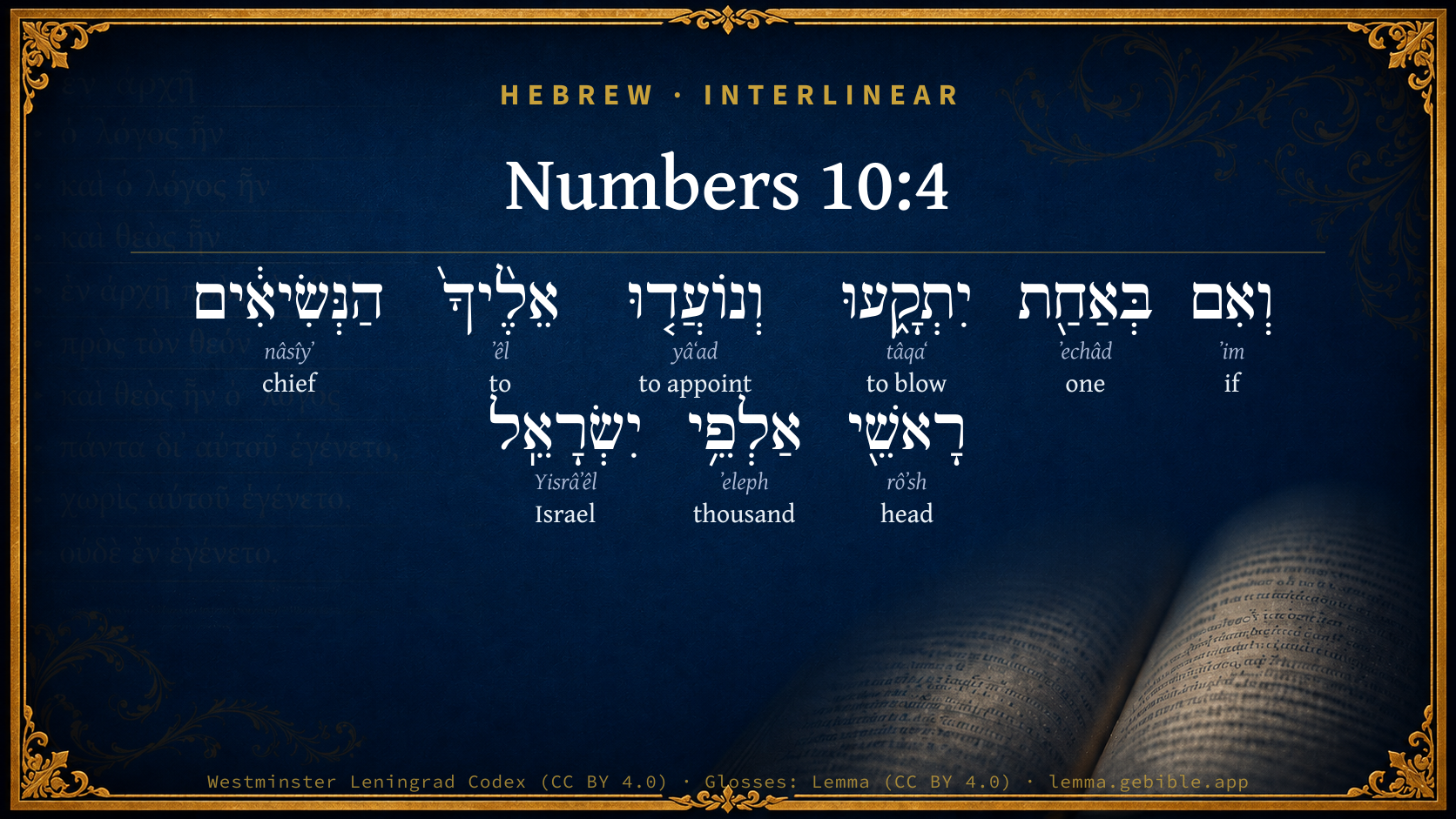
Hebrew (Westminster Leningrad Codex) Numbers 10:4 appears in the Hebrew Old Testament. The text above is from the Westminster Leningrad Codex. Each word links to its Strong’s number, a concise gloss, and parsing drawn from the Open Scriptures Hebrew Bible morphology. Click any word for its full Brown-Driver-Briggs (BDB) entry.
Download image
Cite this verse

Numbers 10:4 (World English Bible). Public Domain. Lemma interlinear Bible study tool, https://lemma.gebible.app/v/numbers/10/4.

Show BibTeX & RIS
BibTeX
RIS
English Translation
If they blow but one, then the princes, the heads of the thousands of Israel, shall gather themselves to you.
World English Bible · Public Domain
Download a study sheet

One document with this verse’s original text, its word-by-word gloss line, the meaning frame, cross-references with their text, attributed commentary, and full source and license credits — printable, and it pastes into notes with its structure intact.

This verse Autodidact and up

Study sheet (.html) Plain text (.txt)

A passage Seminary Student

Up to 50 verses in one chapter. A passage sheet keeps up to 6 commentary sources and 12 cross-references per verse, in the order this page ranks them, and says so on the sheet whenever that leaves anything out. Ask for a single verse and you get the Autodidact verse sheet above.

Everything on this page stays free to read, with no account — the sheet is a download of what is already on screen, not access to it.

Want to remove ads? Support Godless Engineer
Compare translations 3

The same verse in 3 English versions, stacked beneath the original-language interlinear above. Click any original word for its lexicon entry.

Each is an independent rendering of the whole verse — the interlinear is not word-aligned to these translations.

Highlighted words mark where these versions differ — a whole-verse word diff, not a word-by-word alignment.

  • World English Bible Public Domain
    If they blow but one, then the princes, the heads of the thousands of Israel, shall gather themselves to you.
  • King James Version Public Domain
    And if they blow but with one trumpet, then the princes, which are heads of the thousands of Israel, shall gather themselves unto thee.
  • unfoldingWord Literal Text CC BY-SA 4.0
    And if they blow one, then the leaders, the heads of the thousands of Israel, shall congregate to you.

unfoldingWord Literal Text — © unfoldingWord, licensed CC BY-SA 4.0. Word-aligned USFM3 via Door43 (git.door43.org/unfoldingWord/en_ult).

Versions to compare (up to 4)

3 of 4 selected

Show all 18 translations

Every available English version of this verse, each an independent rendering of the whole verse.

  • World English Bible Public Domain
    If they blow but one, then the princes, the heads of the thousands of Israel, shall gather themselves to you.
  • Berean Standard Bible Public Domain
    But if only one is sounded, then the leaders, the heads of the clans of Israel, are to gather before you.
  • Majority Standard Bible Public Domain
    But if only one is sounded, then the leaders, the heads of the clans of Israel, are to gather before you.
  • King James Version Public Domain
    And if they blow but with one trumpet, then the princes, which are heads of the thousands of Israel, shall gather themselves unto thee.
  • American Standard Version (1901) Public Domain
    And if they blow but one, then the princes, the heads of the thousands of Israel, shall gather themselves unto thee.
  • Revised Version (1885) Public Domain
    And if they blow but with one, then the princes, the heads of the thousands of Israel, shall gather themselves unto thee.
  • Geneva Bible (1599) Public Domain
    But if they blowe with one, then the princes, or heades ouer the thousandes of Israel shall come vnto thee.
  • Douay-Rheims (1899) Public Domain
    If thou sound but once, the princes and the heads of the multitude of Israel shall come to thee.
  • Young's Literal Translation Public Domain
    And if with one they blow, then have the princes, heads of the thousands of Israel, met together unto thee;
  • Literal Standard Version CC BY-SA 4.0
    And if they blow with one, then the princes, heads of the thousands of Israel, have assembled to you;
  • Unlocked Literal Bible CC BY-SA 4.0
    If the priests blow only one trumpet, then the leaders, the heads of the clans of Israel, must gather to you.
  • unfoldingWord Literal Text CC BY-SA 4.0
    And if they blow one, then the leaders, the heads of the thousands of Israel, shall congregate to you.
  • Darby Bible Public Domain
    And if they blow with one, then the princes, the heads of the thousands of Israel, shall gather unto thee.
  • World Messianic Bible Public Domain
    If they blow just one, then the princes, the heads of the thousands of Israel, shall gather themselves to you.
  • Webster's Bible Public Domain
    And if they blow but with one trumpet, then the princes, who are heads of the thousands of Israel, shall assemble themselves to thee.
  • Free Bible Version CC BY-SA 4.0
    But if only one is blown, then only the tribal leaders are to gather before you.
  • Bible in Basic English Public Domain
    If only one of them is sounded, then the chiefs, the heads of the thousands of Israel, are to come to you.
  • JPS Tanakh (1917) Public Domain
    And if they blow but with one, then the princes, the heads of the thousands of Israel, shall gather themselves unto thee.

Literal Standard Version (2020), Covenant Press — licensed CC BY-SA 4.0. Text via the HelloAO Bible API (eBible.org). Unlocked Literal Bible (unfoldingWord) — licensed CC BY-SA 4.0. Text via the HelloAO Bible API (eBible.org). unfoldingWord Literal Text — © unfoldingWord, licensed CC BY-SA 4.0. Word-aligned USFM3 via Door43 (git.door43.org/unfoldingWord/en_ult). Free Bible Version, Dr. Jonathan Gallagher — licensed CC BY-SA 4.0. Text via the HelloAO Bible API (eBible.org).

Word by word

More ways to search: Search by grammar → Find every occurrence → Compare this word →

Practice this passage: Drill this verse → Learn its vocabulary →

וְנוֹעֲד֤וּ
yâʻad
H3259
“and · to appoint”
Conjunction + Verb, Niphal, Sequential Perfect, 3rd Person, Common, Plural
Part of Speech
Conjunction + Verb
Stem
Niphal
Form
Sequential Perfect
Person
3rd Person
Gender
Common
Number
Plural
Full BDB Definition

Origin: a primitive root

TWOT: 878

to fix, appoint, assemble, meet, set, betroth - (Qal) to appoint, assign, designate - (Niphal) - to meet - to meet by appointment - to gather, assemble by appointment - (Hiphil) to cause to meet - (Hophal) to be set, be placed before, be fixed
  1. וְאִם ʼim H518 “and · if” Conjunction + Conjunction
  2. בְּאַחַ֖ת ʼechâd H259 “in/at · one” Preposition + Adjective, Cardinal number, Feminine, Singular, Absolute
  3. יִתְקָ֑עוּ tâqaʻ H8628 “to blow” Verb, Qal, Imperfect, 3rd Person, Masculine, Plural
  4. אֵלֶ֨יךָ֙ ʼêl H413 “to · you” Preposition + Suffix, Personal, 2nd Person, Masculine, Singular
  5. הַנְּשִׂיאִ֔ים nâsîyʼ H5387 “the · chiefs” Particle, Definite Article + Noun, Common, Masculine, Plural, Absolute
  6. רָאשֵׁ֖י rôʼsh H7218 “heads of” Noun, Common, Masculine, Plural, Construct
  7. אַלְפֵ֥י ʼeleph H505 “thousand” Adjective, Cardinal number, Both, Plural, Construct
  8. יִשְׂרָאֵֽל Yisrâʼêl H3478 “Israel” Noun, Proper

About this verse

These counts appear in no published source. They are computed here, from the morphology-tagged text and Lemma’s own curated glosses. What Lemma adds →

9
words
9
distinct lemmas
Pentateuch
section

Shared distinctive vocabulary

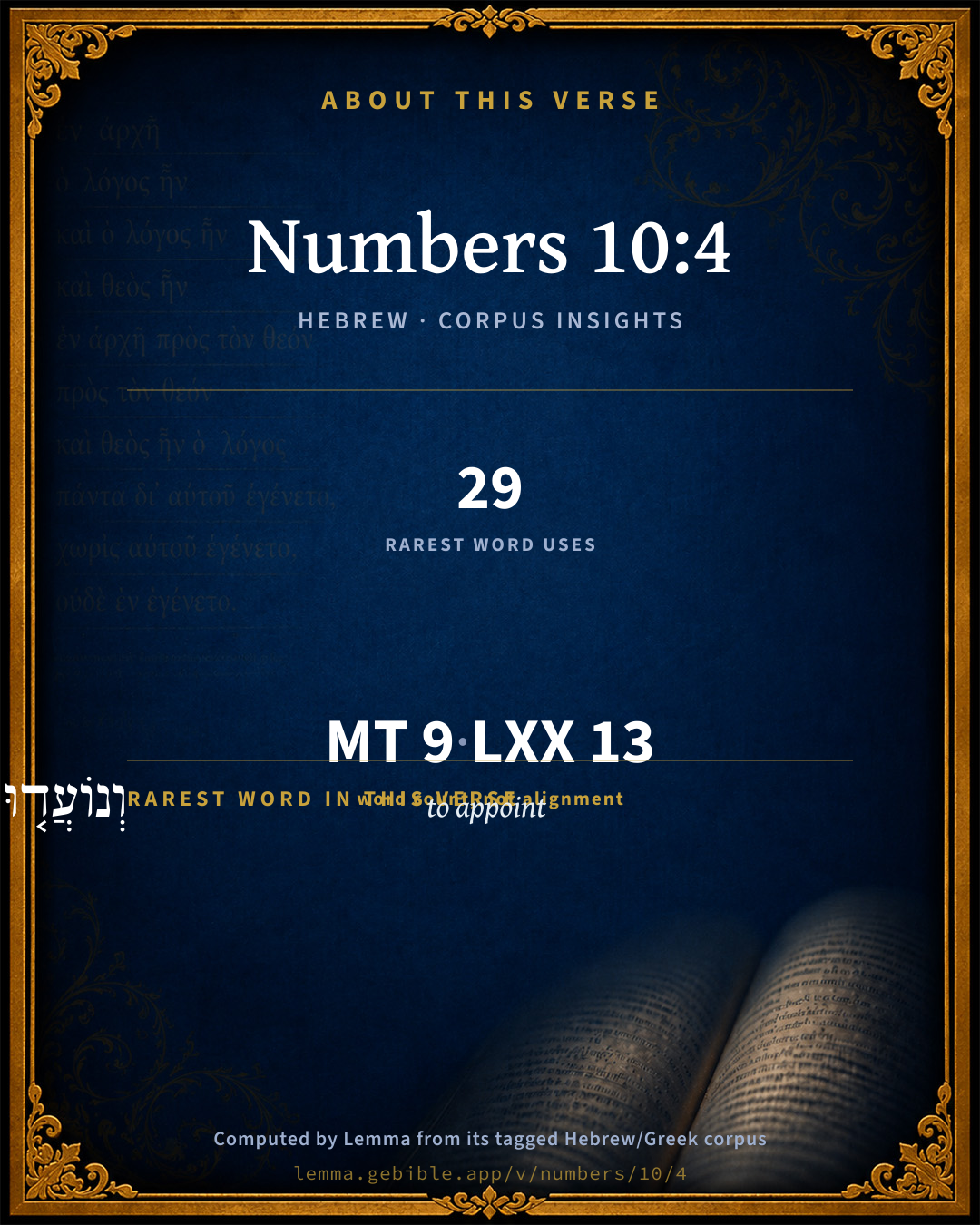
וְנוֹעֲד֤וּ to appoint H3259 occurs in 29 verses of the Hebrew Bible. Also found in:

Grammatical profile

  • 2 verbs
  • 3 nouns
  • 2 adjectives
  • 1 preposition
  • 1 conjunction

Verb forms

  • יִתְקָ֑עוּ Qal · Imperfect
  • וְנוֹעֲד֤וּ Niphal · Sequential Perfect

Hebrew & Septuagint length

In English translation the verse runs 20 words from the Hebrew and 19 from the Septuagint (LXX English) — closely comparable.

A rough comparison of the two English renderings, which tokenize alike — not a word-level alignment.

Word counts can differ between the Hebrew and the Greek without any difference in meaning — e.g. the Hebrew direct-object marker אֵת has no separate Greek word, and Greek often adds the article ὁ.

In the original languages it is 9 Hebrew tokens and 13 Greek tokens — but the two are counted differently (Hebrew bundles its prefixes and suffixes into one token; the Greek is in lemma form), so that isn’t a like-for-like length.

Cross-references

4

Topical passages linked to Numbers 10:4 in the Treasury of Scripture Knowledge — connected by theme and wording, ordered by reader-vote popularity; previews shown in the World English Bible.

  • Exodus 18:21 Moreover you shall provide out of all the people able men, such as fear God: men of truth, hating unjust gain; and place such over them, to be rulers of thousands, rulers of hundreds, rulers of fifties, and rulers of tens.
  • Numbers 7:2 that the princes of Israel, the heads of their fathers' houses, offered. These were the princes of the tribes. These are they who were over those who were numbered:
  • Numbers 1:4–16 With you there shall be a man of every tribe; everyone head of his fathers' house.
  • Deuteronomy 1:15 So I took the heads of your tribes, wise men, and known, and made them heads over you, captains of thousands, and captains of hundreds, and captains of fifties, and captains of tens, and officers, according to your tribes.

Cross-references courtesy of OpenBible.info (CC BY 4.0).

Hebrew and Greek witnesses Masoretic Hebrew ↔ Greek Septuagint

The same verse in the two great witnesses to the Old Testament, shown verse-for-verse.

These are two independent witnesses, not word-aligned to each other, and the Septuagint is shown in lemma (dictionary) form.

Hebrew Numbers 10:4 Masoretic · Westminster Leningrad Codex

וְאִם בְּאַחַ֖ת יִתְקָ֑עוּ וְנוֹעֲד֤וּ אֵלֶ֨יךָ֙ הַנְּשִׂיאִ֔ים רָאשֵׁ֖י אַלְפֵ֥י יִשְׂרָאֵֽל

If they blow but one, then the princes, the heads of the thousands of Israel, shall gather themselves to you.

World English Bible · Public Domain

Greek LXX Numbers 10:4 Septuagint · lemma form

ἐάν δέ ἐν εἷς σαλπίζω προςἔρχομαι πρός σύ πᾶς ὁ ἄρχων ἀρχηγός ἰσραήλ

And if they shall sound with one, all the rulers even the princes of Israel shall come to you.

LXX2012 (modern English Septuagint) · Public Domain

Hebrew: Westminster Leningrad Codex (CC BY 4.0). Greek: Septuagint (public domain); English from LXX2012 (modern English Septuagint) (Public Domain). How the Septuagint differs from the Hebrew →

Targum (Aramaic paraphrase)

2

The Targum is the ancient Jewish Aramaic paraphrase of the Hebrew Scriptures — an interpretive translation, not the Hebrew text itself. Onkelos (literal) and Pseudo-Jonathan (expansive) render the Torah, and Jonathan the Prophets. Coverage is partial: where no permissively-licensed English translation exists for a verse, only the Aramaic is shown. This is verse-level text, not a word-by-word alignment to the Hebrew.

  1. Targum Onkelos Torah (Genesis–Deuteronomy)
    וְאִם בַּחֲדָא יִתְקְעוּן וְיִזְדַמְנוּן לְוָתָךְ רַבְרְבַיָא רֵישֵׁי אַלְפַיָא דְיִשְׂרָאֵל

    (no public-domain English translation for this verse)

    Targum Onkelos — Aramaic: “Onkelos Genesis” (public domain); “Onkelos Exodus” (public domain); “Onkelos Leviticus” (public domain); “Onkelos Numbers” (public domain); “Onkelos Deuteronomy” (public domain). English: “Sefaria Community Translation” (CC0 1.0 (public-domain dedication)); “J.W. Etheridge. The Targums of Onkelos and Jonathan Ben Uzziel on the Pentateuch. London: Longmans, Green, 1862” (public domain). Text via Sefaria.

  2. Targum Pseudo-Jonathan Torah (Genesis–Deuteronomy)
    וְאִין בְּחָדָא יִתְקְעוּן וְיִזְדַמְנוּן לְוָתָךְ רַבְרְבַיָא רֵישֵׁי אַלְפַיָא דְיִשְרָאֵל

    If they blow upon one (only), the princes of the heads of the thousands of Israel shall assemble to thee.

    Targum Pseudo-Jonathan — Aramaic: “Targum Jonathan on Genesis” (public domain); “Targum Jonathan on Exodus” (public domain); “Targum Jonathan on Leviticus” (public domain); “Targum Jonathan on Numbers” (public domain); “Targum Jonathan on Deuteronomy” (public domain). English: “The Targum of Jonathan ben Uzziel, trans. J. W. Etheridge, London, 1862” (public domain). Text via Sefaria.

Commentary

Notes on Numbers 10:4 from classic Christian and Jewish commentators (each source and its license shown beneath its notes). The classic Christian expositions comment on the surrounding passage and are grouped to its opening verse, so a note may address several verses; the Jewish commentaries on the Tanakh (Rashi and others) are per-verse, so they appear only where the commentator wrote on this verse.

Lemma curates 59 commentaries, every one of them public domain or Creative Commons licensed, each selected and text-cleaned for this edition rather than reprinted as found. About our sources →

Ellicott's Commentary for English Readers

(4) With one trumpet.—Or, but once (or, at the same time). (Comp. Job_33:14; Pro_28:18; Jer_10:8.) Some suppose that the meaning is that the trumpets were to be blown at the same time with one even or uniform sound, and that not a continuous one.

A Bible Commentary for English Readers, edited by Charles John Ellicott (1878–1897) — public domain. Text from a community e-Sword module.

John Gill's Exposition

And if they blow but with one trumpet,.... With only one of them, or but once, with one sounding, and that an even one as before:

then the princes, which are the heads of the thousands of Israel,

shall gather themselves unto thee: and they only or alone, as Aben Ezra: by this token, or by this difference of blowing both trumpets, or only one, it was, easily known when the whole congregation or when the princes only were to meet Moses at the same place, the door of the tabernacle of the congregation; and all are to attend divine service, and the ministry of the word, even the whole church of God, and all the members of it, high and low, rich and poor, princes and people.

John Gill's Exposition of the Whole Bible (1746–1763) — public domain (CC PDM 1.0). Text via the HelloAO Bible API.

Haydock's Catholic Bible Commentary

Once. Hebrew, "with one trumpet." If both sounded together uniformly, the people assembled, ver. 7.

George Leo Haydock (1774–1849), Haydock's Catholic Family Bible and Commentary, 1859 edition — public domain. Excludes Psalms (Douay-Rheims chapter numbering differs from Protestant) and Deuterocanonical books (Catholic canon only).

Whedon's Commentary on the Bible

Daniel D. Whedon

4. Heads of the thousands — Num_1:16, note.

Daniel D. Whedon (gen. ed.), Commentary on the Old and New Testaments (1874–1909) — public domain. Text from a community e-Sword module.

Rashi

Rabbi Shlomo Yitzchaki (Rashi)

ואם באחת יתקעו AND IF THEY BLOW BUT WITH ONE TRUMPET (i.e. a “Tekiah” on one trumpet) — it is a sign to summon the princes, as it is said here, “then the princes shall gather themselves unto thee”. Their meeting place, too, was at the entrance of the tent of meeting. This is derived from a ג"ש in the Sifrei (Sifrei Bamidbar 73:1 from the use in both cases of the same expression ותקעו and יתקעו: not from ונועדו — ונועדו as erroneously stated.)

Rashi on the Tanakh — English translations: “The Judaica Press complete Tanach with Rashi, translated by A. J. Rosenberg” (CC BY 4.0); “Pentateuch with Rashi's commentary by M. Rosenbaum and A.M. Silbermann, 1929-1934” (public domain); “The Metsudah Tanach series, Lakewood, N.J” (CC BY 4.0); and “The Book of Joshua, Metsudah Publications, 1997” (CC BY 4.0). Text via Sefaria.

Lesson kit

Teaching starters — assembled from the data on this page, not authored interpretation. Every prompt links to the verse data it draws on. Edit before teaching.

Numbers, in the Pentateuch, opens this verse with 9 words (9 distinct Hebrew lemmas). Its most distinctive word is yâʻad (“to appoint”). A historical commentator’s framing appears above. Read the whole chapter for the surrounding context.

Discussion questions

  1. The word yâʻad carries the sense “to appoint.” How does it shape the verse?
  2. How does Exodus 21:8, which shares the word «to appoint», read alongside this verse?
  3. These translations render this verse differently; the difference is in the English rendering, not the original. What questions does that raise?
  4. «יִתְקָ֑עוּ» is a Qal Imperfect verb. How does that grammatical form shape the action described?
  5. Compare how Ellicott's Commentary for English Readers and John Gill's Exposition read this verse. Where do they agree or differ?

Things to notice

Reading settings

Reading text

Shown beneath each verse's original-language words.

Old Testament
Old Testament edition

Read the OT as the Masoretic Hebrew (MT) or the Greek Septuagint (LXX).

English shown for the Greek Septuagint (in the Hebrew ↔ Greek comparison).

Comparing translations? Open the Compare panel on any verse page to stack up to four side by side.