
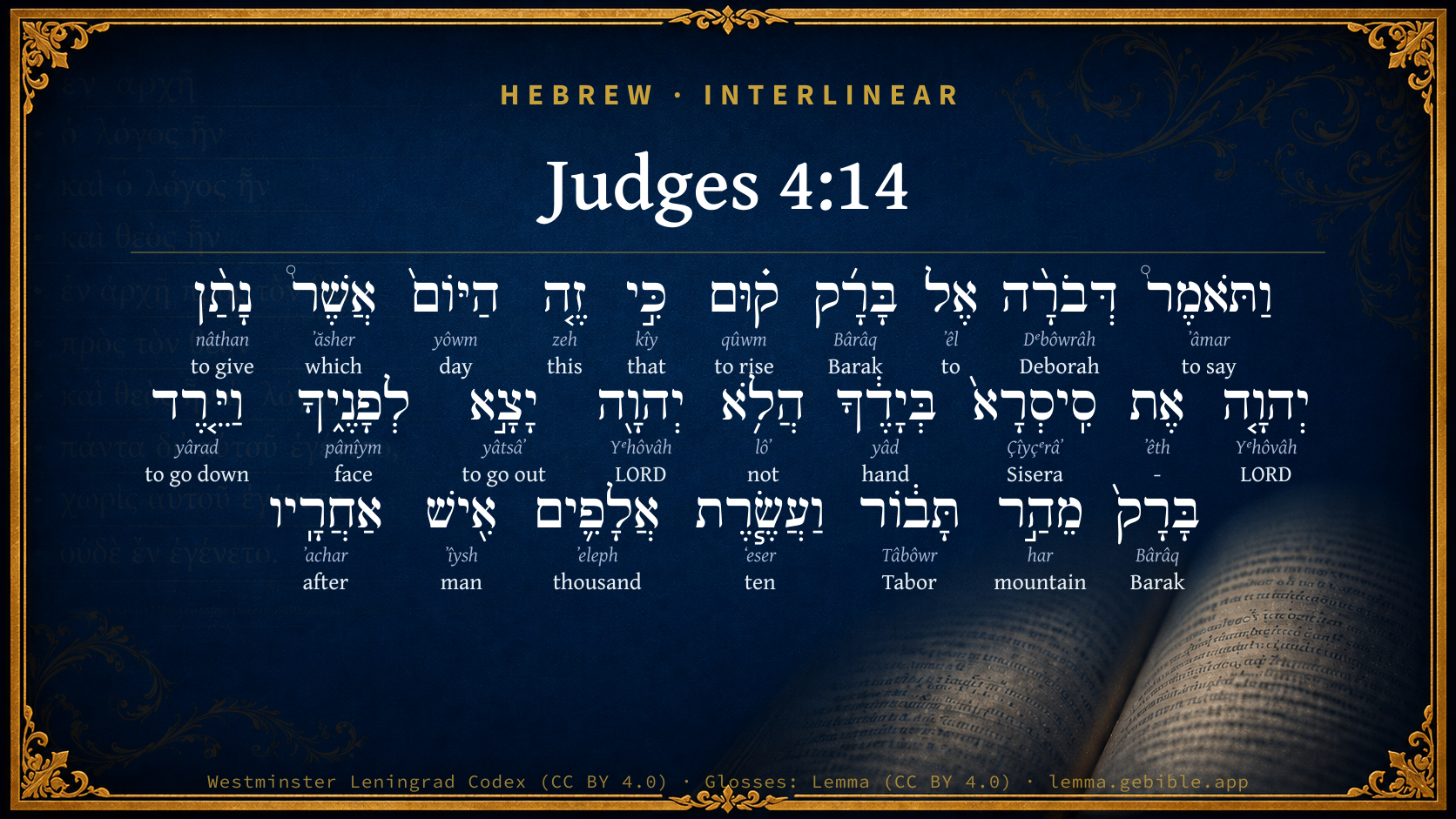
Judges 4:14

Hebrew (Westminster Leningrad Codex) Judges 4:14 appears in the Hebrew Old Testament. The text above is from the Westminster Leningrad Codex. Each word links to its Strong’s number, a concise gloss, and parsing drawn from the Open Scriptures Hebrew Bible morphology. Click any word for its full Brown-Driver-Briggs (BDB) entry.
Download image
Cite this verse

Judges 4:14 (World English Bible). Public Domain. Lemma interlinear Bible study tool, https://lemma.gebible.app/v/judges/4/14.

Show BibTeX & RIS
BibTeX
RIS
English Translation
Deborah said to Barak, Up; for this is the day in which Yahweh has delivered Sisera into your hand; hasn't Yahweh gone out before you? So Barak went down from Mount Tabor, and ten thousand men after him.
World English Bible · Public Domain
Download a study sheet

One document with this verse’s original text, its word-by-word gloss line, the meaning frame, cross-references with their text, attributed commentary, and full source and license credits — printable, and it pastes into notes with its structure intact.

This verse Autodidact and up

Study sheet (.html) Plain text (.txt)

A passage Seminary Student

Up to 50 verses in one chapter. A passage sheet keeps up to 6 commentary sources and 12 cross-references per verse, in the order this page ranks them, and says so on the sheet whenever that leaves anything out. Ask for a single verse and you get the Autodidact verse sheet above.

Everything on this page stays free to read, with no account — the sheet is a download of what is already on screen, not access to it.

Want to remove ads? Support Godless Engineer
Compare translations 3

The same verse in 3 English versions, stacked beneath the original-language interlinear above. Click any original word for its lexicon entry.

Each is an independent rendering of the whole verse — the interlinear is not word-aligned to these translations.

Highlighted words mark where these versions differ — a whole-verse word diff, not a word-by-word alignment.

  • World English Bible Public Domain
    Deborah said to Barak, Up; for this is the day in which Yahweh has delivered Sisera into your hand; hasn't Yahweh gone out before you? So Barak went down from Mount Tabor, and ten thousand men after him.
  • King James Version Public Domain
    And Deborah said unto Barak, Up; for this is the day in which the LORD hath delivered Sisera into thine hand: is not the LORD gone out before thee? So Barak went down from mount Tabor, and ten thousand men after him.
  • unfoldingWord Literal Text CC BY-SA 4.0
    Then Deborah said to Barak, “Arise! For this the day when Yahweh has given Sisera into your hand. Has not Yahweh gone out to the face of you?” So Barak went down from Mount Tabor, and 10,000 men after him.

unfoldingWord Literal Text — © unfoldingWord, licensed CC BY-SA 4.0. Word-aligned USFM3 via Door43 (git.door43.org/unfoldingWord/en_ult).

Versions to compare (up to 4)

3 of 4 selected

Show all 18 translations

Every available English version of this verse, each an independent rendering of the whole verse.

  • World English Bible Public Domain
    Deborah said to Barak, Up; for this is the day in which Yahweh has delivered Sisera into your hand; hasn't Yahweh gone out before you? So Barak went down from Mount Tabor, and ten thousand men after him.
  • Berean Standard Bible Public Domain
    Then Deborah said to Barak, “Arise, for this is the day that the LORD has delivered Sisera into your hand. Has not the LORD gone before you?” So Barak came down from Mount Tabor with ten thousand men following him.
  • Majority Standard Bible Public Domain
    Then Deborah said to Barak, “Arise, for this is the day that the LORD has delivered Sisera into your hand. Has not the LORD gone before you?” So Barak came down from Mount Tabor with ten thousand men following him.
  • King James Version Public Domain
    And Deborah said unto Barak, Up; for this is the day in which the LORD hath delivered Sisera into thine hand: is not the LORD gone out before thee? So Barak went down from mount Tabor, and ten thousand men after him.
  • American Standard Version (1901) Public Domain
    And Deborah said unto Barak, Up; for this is the day in which Jehovah hath delivered Sisera into thy hand; is not Jehovah gone out before thee? So Barak went down from mount Tabor, and ten thousand men after him.
  • Revised Version (1885) Public Domain
    And Deborah said unto Barak, Up; for this is the day in which the LORD hath delivered Sisera into thine hand: is not the LORD gone out before thee? So Barak went down from mount Tabor, and ten thousand men after him.
  • Geneva Bible (1599) Public Domain
    Then Deborah sayd vnto Barak, Vp: for this is the day that the Lord hath deliuered Sisera into thine hand. Is not the Lord gone out before thee? So Barak went downe from mount Tabor, and ten thousand men after him.
  • Douay-Rheims (1899) Public Domain
    And Debbora said to Barac: Arise, for this is the day wherein the Lord hath delivered Sisara into thy hands: behold he is thy leader. And Barac went down from mount Thabor, and ten thousand fighting men with him.
  • Young's Literal Translation Public Domain
    And Deborah saith unto Barak, `Rise, for this `is' the day in which Jehovah hath given Sisera into thy hand; hath not Jehovah gone out before thee?' And Barak goeth down from mount Tabor, and ten thousand men after him.
  • Literal Standard Version CC BY-SA 4.0
    And Deborah says to Barak, “Rise, for this [is] the day in which YHWH has given Sisera into your hand; has YHWH not gone out before you?” And Barak goes down from Mount Tabor, and ten thousand men after him.
  • Unlocked Literal Bible CC BY-SA 4.0
    Deborah said to Barak, “Go! For this is the day in which Yahweh has given you victory over Sisera. Is not Yahweh leading you?” So Barak went down from Mount Tabor with ten thousand men following him.
  • unfoldingWord Literal Text CC BY-SA 4.0
    Then Deborah said to Barak, “Arise! For this the day when Yahweh has given Sisera into your hand. Has not Yahweh gone out to the face of you?” So Barak went down from Mount Tabor, and 10,000 men after him.
  • Darby Bible Public Domain
    And Deb'orah said to Barak, "Up! For this is the day in which the LORD has given Sis'era into your hand. Does not the LORD go out before you?" So Barak went down from Mount Tabor with ten thousand men following him.
  • World Messianic Bible Public Domain
    Deborah said to Barak, “Go; for this is the day in which the LORD has delivered Sisera into your hand. Hasn’t the LORD gone out before you?” So Barak went down from Mount Tabor, and ten thousand men after him.
  • Webster's Bible Public Domain
    And Deborah said to Barak, Arise, for this is the day in which the LORD hath delivered Sisera into thy hand: hath not the LORD gone out before thee? So Barak went down from mount Tabor, and ten thousand men after him.
  • Free Bible Version CC BY-SA 4.0
    Then Deborah told Barak, “Get going! Today the Lord has handed Sisera to you. Didn't the Lord march out ahead of you?” So Barak went down from Mount Tabor, accompanied by ten thousand men.
  • Bible in Basic English Public Domain
    Then Deborah said to Barak, Up! for today the Lord has given Sisera into your hands: has not the Lord gone out before you? So Barak went down from Mount Tabor and ten thousand men after him.
  • JPS Tanakh (1917) Public Domain
    And Deborah said unto Barak: 'Up; for this is the day in which the LORD hath delivered Sisera into thy hand; is not the LORD gone out before thee?' So Barak went down from mount Tabor, and ten thousand men after him.

Literal Standard Version (2020), Covenant Press — licensed CC BY-SA 4.0. Text via the HelloAO Bible API (eBible.org). Unlocked Literal Bible (unfoldingWord) — licensed CC BY-SA 4.0. Text via the HelloAO Bible API (eBible.org). unfoldingWord Literal Text — © unfoldingWord, licensed CC BY-SA 4.0. Word-aligned USFM3 via Door43 (git.door43.org/unfoldingWord/en_ult). Free Bible Version, Dr. Jonathan Gallagher — licensed CC BY-SA 4.0. Text via the HelloAO Bible API (eBible.org).

Word by word

More ways to search: Search by grammar → Find every occurrence → Compare this word →

Practice this passage: Drill this verse → Learn its vocabulary →

דְּבֹרָ֨ה
Dᵉbôwrâh
H1683
“Deborah”
Noun, Proper
Part of Speech
Noun
Type
Proper
Full BDB Definition

Origin: the same as H1682

TWOT: None

Deborah = "bee" - the nurse of Rebekah who accompanied her from the house of Bethuel - a prophetess who judged Israel
  1. וַתֹּאמֶר֩ ʼâmar H559 “and · to say” Conjunction + Verb, Qal, Sequential Imperfect, 3rd Person, Feminine, Singular
  2. אֶל ʼêl H413 “to” Preposition
  3. בָּרָ֜ק Bârâq H1301 “Barak” Noun, Proper
  4. ק֗וּם qûwm H6965 “rise” Verb, Qal, Imperative, 2nd Person, Masculine, Singular
  5. כִּ֣י kîy H3588 “that” Conjunction
  6. זֶ֤ה zeh H2088 “this” Pronoun, Demonstrative, Masculine, Singular
  7. הַיּוֹם֙ yôwm H3117 “the · day” Particle, Definite Article + Noun, Common, Masculine, Singular, Absolute
  8. אֲשֶׁר֩ ʼăsher H834 “which” Particle, Relative
  9. נָתַ֨ן nâthan H5414 “to give” Verb, Qal, Perfect, 3rd Person, Masculine, Singular
  10. יְהוָ֤ה Yᵉhôvâh H3068 “LORD” Noun, Proper
  11. אֶת ʼêth H853 “-” Particle, Direct Object
  12. סִֽיסְרָא֙ Çîyçᵉrâʼ H5516 “Sisera” Noun, Proper
  13. בְּיָדֶ֔ךָ yâd H3027 “in/at · hand · your” Preposition + Noun, Common, Both, Singular, Construct + Suffix, Personal, 2nd Person, Masculine, Singular
  14. הֲלֹ֥א lôʼ H3808 “not” Particle, Interrogative + Particle, Negative
  15. יְהוָ֖ה Yᵉhôvâh H3068 “LORD” Noun, Proper
  16. יָצָ֣א yâtsâʼ H3318 “to go out” Verb, Qal, Perfect, 3rd Person, Masculine, Singular
  17. לְפָנֶ֑יךָ pânîym H6440 “to/for · face(s) · your” Preposition + Noun, Common, Both, Plural, Construct + Suffix, Personal, 2nd Person, Masculine, Singular
  18. וַיֵּ֤רֶד yârad H3381 “and · to go down” Conjunction + Verb, Qal, Sequential Imperfect, 3rd Person, Masculine, Singular
  19. בָּרָק֙ Bârâq H1301 “Barak” Noun, Proper
  20. מֵהַ֣ר har H2022 “from · mountain of” Preposition + Noun, Common, Masculine, Singular, Construct
  21. תָּב֔וֹר Tâbôwr H8396 “Tabor” Noun, Proper
  22. וַעֲשֶׂ֧רֶת ʻeser H6235 “and · ten” Conjunction + Adjective, Cardinal number, Masculine, Singular, Construct
  23. אֲלָפִ֛ים ʼeleph H505 “thousand” Adjective, Cardinal number, Both, Plural, Absolute
  24. אִ֖ישׁ ʼîysh H376 “man” Noun, Common, Masculine, Singular, Absolute
  25. אַחֲרָֽיו ʼachar H310 “after · him” Preposition + Suffix, Personal, 3rd Person, Masculine, Singular

About this verse

These counts appear in no published source. They are computed here, from the morphology-tagged text and Lemma’s own curated glosses. What Lemma adds →

26
words
24
distinct lemmas
Historical
section

Notable vocabulary

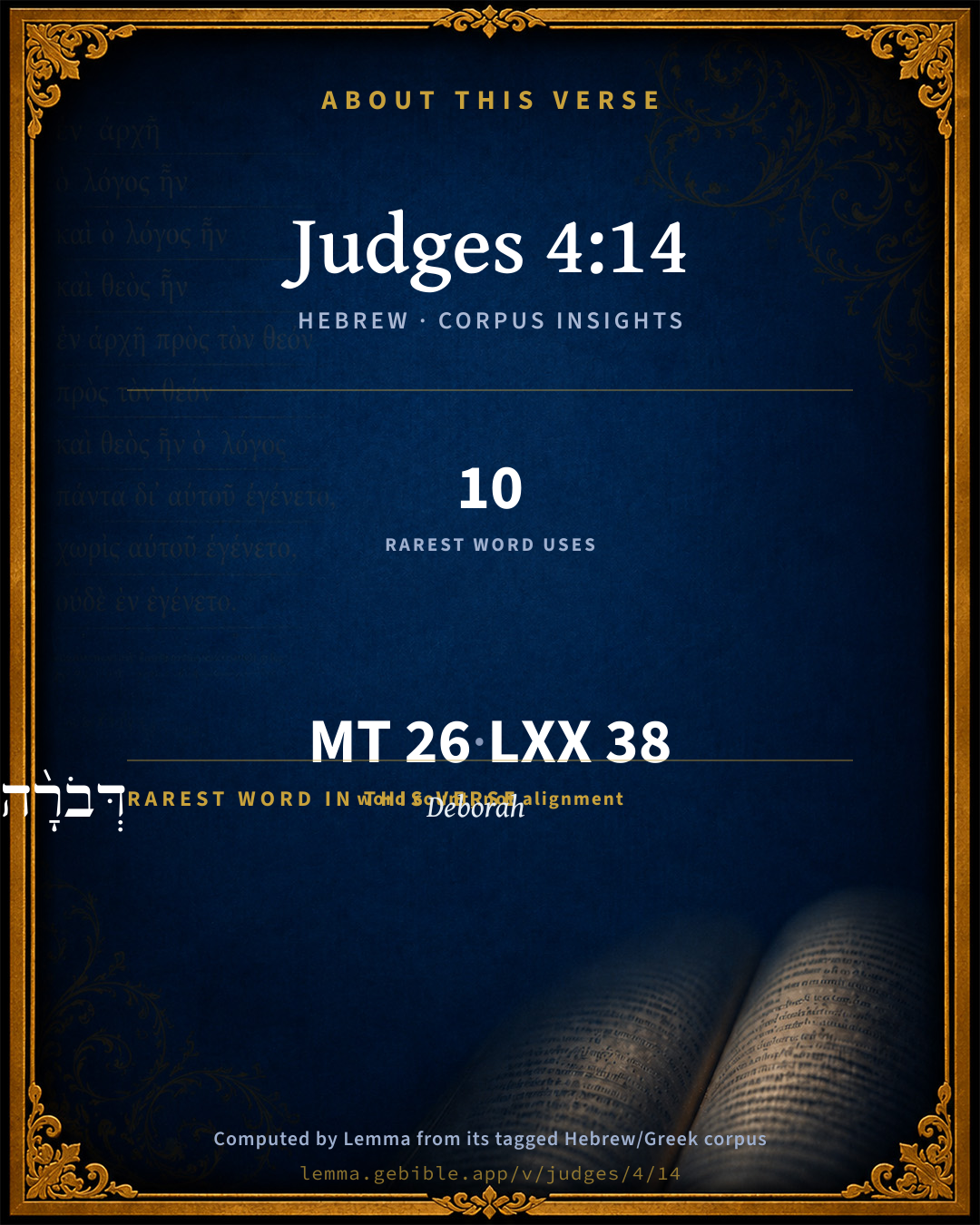
The rarest word here is דְּבֹרָ֨ה Deborah H1683 — appearing just 10 times in the whole Hebrew Bible.

Shared distinctive vocabulary

דְּבֹרָ֨ה Deborah H1683 occurs in 10 verses of the Hebrew Bible. Also found in:

Grammatical profile

  • 5 verbs
  • 12 nouns
  • 2 adjectives
  • 1 pronoun
  • 2 prepositions
  • 1 conjunction
  • 3 particles

Verb forms

  • וַתֹּאמֶר֩ Qal · Sequential Imperfect
  • ק֗וּם Qal · Imperative
  • נָתַ֨ן Qal · Perfect
  • יָצָ֣א Qal · Perfect
  • וַיֵּ֤רֶד Qal · Sequential Imperfect

Repetition

Words recur within this verse — often emphatic in Hebrew:

  • בָּרָ֜ק Barak H1301 ×2
  • יְהוָ֤ה LORD H3068 ×2

Hebrew & Septuagint length

In English translation the verse runs 38 words from the Hebrew and 43 from the Septuagint (LXX English) — closely comparable.

A rough comparison of the two English renderings, which tokenize alike — not a word-level alignment.

Word counts can differ between the Hebrew and the Greek without any difference in meaning — e.g. the Hebrew direct-object marker אֵת has no separate Greek word, and Greek often adds the article ὁ.

In the original languages it is 26 Hebrew tokens and 38 Greek tokens — but the two are counted differently (Hebrew bundles its prefixes and suffixes into one token; the Greek is in lemma form), so that isn’t a like-for-like length.

Cross-references

10

Topical passages linked to Judges 4:14 in the Treasury of Scripture Knowledge — connected by theme and wording, ordered by reader-vote popularity; previews shown in the World English Bible.

  • 2 Samuel 5:24 It shall be, when you hear the sound of marching in the tops of the mulberry trees, that then you shall bestir yourself; for then is Yahweh gone out before you to strike the host of the Philistines.
  • Deuteronomy 9:3 Know therefore this day, that Yahweh your God is he who goes over before you as a devouring fire; he will destroy them, and he will bring them down before you: so shall you drive them out, and make them to perish quickly, as Yahweh has spoken to you.
  • Isaiah 52:12 For you shall not go out in haste, neither shall you go by flight: for Yahweh will go before you; and the God of Israel will be your rearward.
  • Psalms 68:7–8 God, when you went forth before your people, When you marched through the wilderness... Selah.
  • Genesis 44:4 When they had gone out of the city, and were not yet far off, Joseph said to his steward, "Up, follow after the men. When you overtake them, ask them, 'Why have you rewarded evil for good?
  • 1 Samuel 9:26 They arose early: and it happened about the spring of the day, that Samuel called to Saul on the housetop, saying, Up, that I may send you away. Saul arose, and they went out both of them, he and Samuel, abroad.
  • Micah 2:13 He who breaks open the way goes up before them. They break through the gate, and go out. And their king passes on before them, With Yahweh at their head."
  • Genesis 19:14 Lot went out, and spoke to his sons-in-law, who were pledged to marry his daughters, and said, "Get up! Get out of this place, for Yahweh will destroy the city." But he seemed to his sons-in-law to be joking.
  • Joshua 7:13 Up, sanctify the people, and say, Sanctify yourselves against tomorrow: for thus says Yahweh, the God of Israel, There is a devoted thing in the midst of you, Israel; you can not stand before your enemies, until you take away the devoted thing from among you.
  • Judges 19:28 He said to her, Up, and let us be going; but none answered: then he took her up on the donkey; and the man rose up, and got him to his place.

Cross-references courtesy of OpenBible.info (CC BY 4.0).

Hebrew and Greek witnesses Masoretic Hebrew ↔ Greek Septuagint

The same verse in the two great witnesses to the Old Testament, shown verse-for-verse.

These are two independent witnesses, not word-aligned to each other, and the Septuagint is shown in lemma (dictionary) form.

Hebrew Judges 4:14 Masoretic · Westminster Leningrad Codex

וַתֹּאמֶר֩ דְּבֹרָ֨ה אֶל בָּרָ֜ק ק֗וּם כִּ֣י זֶ֤ה הַיּוֹם֙ אֲשֶׁר֩ נָתַ֨ן יְהוָ֤ה אֶת סִֽיסְרָא֙ בְּיָדֶ֔ךָ הֲלֹ֥א יְהוָ֖ה יָצָ֣א לְפָנֶ֑יךָ וַיֵּ֤רֶד בָּרָק֙ מֵהַ֣ר תָּב֔וֹר וַעֲשֶׂ֧רֶת אֲלָפִ֛ים אִ֖ישׁ אַחֲרָֽיו

Deborah said to Barak, Up; for this is the day in which Yahweh has delivered Sisera into your hand; hasn't Yahweh gone out before you? So Barak went down from Mount Tabor, and ten thousand men after him.

World English Bible · Public Domain

Greek LXX Judges 4:14 Septuagint · lemma form

καί εἶπον δεββωρα πρός βαρακ ἀναἵστημι ὅτι οὗτος ὁ ἡμέρα ἐν ὅς παραδίδωμι κύριος ὁ σισαρα ἐν ὁ χείρ σύ ὅτι κύριος ἐκἔρχομαι ἔμπροσθεν σύ καί καταβαίνω βαρακ ἀπό ὁ ὄρος θαβωρ καί δέκα χιλιάς ἀνήρ ὀπίσω αὐτός

And Debbora said to Barac, Rise up, for this is the day on which the Lord has delivered Sisara into your hand, for the Lord shall go forth before you: and Barac went down from mount Thabor, and ten thousand men after him.

LXX2012 (modern English Septuagint) · Public Domain

On this verse, Adam Clarke's Commentary discusses the Septuagint’s reading. Read the note in Commentary ↓

Hebrew: Westminster Leningrad Codex (CC BY 4.0). Greek: Septuagint (public domain); English from LXX2012 (modern English Septuagint) (Public Domain). How the Septuagint differs from the Hebrew →

Targum (Aramaic paraphrase)

1

The Targum is the ancient Jewish Aramaic paraphrase of the Hebrew Scriptures — an interpretive translation, not the Hebrew text itself. Onkelos (literal) and Pseudo-Jonathan (expansive) render the Torah, and Jonathan the Prophets. Coverage is partial: where no permissively-licensed English translation exists for a verse, only the Aramaic is shown. This is verse-level text, not a word-by-word alignment to the Hebrew.

  1. Targum Jonathan Prophets (Joshua–Malachi)
    וַאֲמַרַת דְבוֹרָה לְבָרָק קוּם אֲרֵי דֵין יוֹמָא דִמְסַר יְיָ יַת סִיסְרָא בִּידָךְ הֲלָא מַלְאָכָא דַייָ נְפַק לְאַצְלָחָא קֳדָמָךְ וּנְחַת בָּרָק מִטוּרָא דְתָבוֹר וְעַסְרָא אַלְפִין גַבְרָא בַּתְרוֹהִי:

    (no public-domain English translation for this verse)

    Targum Jonathan — Aramaic: “Mikraot Gedolot” (public domain). English: “Sefaria Community Translation” (CC0 1.0 (public-domain dedication)); “London "Chaldee Paraphrase," 1871” (public domain). Text via Sefaria.

Commentary

Notes on Judges 4:14 from classic Christian and Jewish commentators (each source and its license shown beneath its notes). The classic Christian expositions comment on the surrounding passage and are grouped to its opening verse, so a note may address several verses; the Jewish commentaries on the Tanakh (Rashi and others) are per-verse, so they appear only where the commentator wrote on this verse.

Lemma curates 59 commentaries, every one of them public domain or Creative Commons licensed, each selected and text-cleaned for this edition rather than reprinted as found. About our sources →

Trapp's Complete Commentary

John Trapp

Jdg 4:14 And Deborah said unto Barak, Up; for this [is] the day in which the LORD hath delivered Sisera into thine hand: is not the LORD gone out before thee? So Barak went down from mount Tabor, and ten thousand men after him.

Ver. 14. Is not the Lord gone out before thee?] As general of the army: yea, he alone is a whole army of men, van and rear both. {Isa 52:12}

John Trapp, A Commentary or Exposition upon All the Books of the Old and New Testament (1647–1656) — public domain. Text from a community e-Sword module.

Joseph Benson's Commentary

Jdg 4:14. Deborah said unto Barak, Up — Hebrew, Arise, Delay not. If we have ground to believe that God goes before us, we may well go on with courage and cheerfulness. Is not the Lord gone before thee? — Namely, as general of thine army, to fight for thee. So Barak went down — He did not make use of the advantage which he had of the hill, where he might have been out of the reach of Sisera’s iron chariots, but boldly marched down into the valley, to give him the opportunity of using all his horses and chariots, that so the victory might be more glorious. Jdg 4:15. The Lord discomfited Sisera — The particulars of the battle are not recorded in the sacred text; but it evidently appears from thence that there was something extraordinary and miraculous in this defeat of Jabin’s host. The Hebrew word יהם, jaham, imports that they were discomfited with great terror and noise, probably with thunder, lightning, and hail- stones, poured upon them from heaven, as is implied Jdg 5:20; and as the same word is used Jos 10:10; and 1Sa 7:10. Josephus confirms this opinion, assuring us that “as soon as the armies were engaged, there arose a prodigious tempest of hail and rain, which drove in the faces of the Canaanites, and occasioned a total rout of them.” — Antiq., lib. 5. cap. 5. The heavens, therefore, had the principal share in this great overthrow. With the edge of the sword — That is, by the sword of Barak and his army, whose ministry God used; but so, it seems, that they had little else to do but to kill those whom God, by more powerful arms, had put to flight. And fled away on his feet — He thought his chariot not swift enough to carry him out of danger, and imagined he should be less exposed to observation, and less liable to be discovered, when he fled like a common soldier. To which we may add, that in ancient times valiant men were wonderfully swift of foot; as is observed of Asahel, 2Sa 2:18; and every one knows it was the character of Achilles among the Greeks.

Joseph Benson's Commentary on the Old and New Testaments (1811–1818) — public domain. Text from a community e-Sword module.

Geneva Bible (1599)

Geneva Bible translators

She still encourageth him to this enterprise by assuring him of God’s favor and aid.

Geneva Bible (1599) marginal notes — public domain. Text via Bolls.life.

Jamieson, Fausset & Brown

Robert Jamieson, A. R. Fausset & David Brown

Barak went down from mount Tabor--It is a striking proof of the full confidence Barak and his troops reposed in Deborah's assurance of victory, that they relinquished their advantageous position on the hill and rushed into the plain in face of the iron chariots they so much dreaded.

Jamieson, Fausset & Brown — Commentary Critical and Explanatory on the Whole Bible (1871) — public domain (CC PDM 1.0). Text via the HelloAO Bible API.

Adam Clarke's Commentary

Verse 14. Up; for this is the day] This is exactly the purpose for which the Septuagint state, Jdg 4:8, that Barak wished Deborah to accompany him. "I know not," says he, "THE DAY in which God will send his angel to give me prosperity: come thou with we that thou mayest direct me in this respect." She went, and told him the precise time in which he was to make the attack: Up, for THIS is the DAY in which the Lord hath delivered Sisera into thine hand.

Went down from Mount Tabor] He had probably encamped his men on and near the summit of this mount. See Clarke on Jdg 4:6.

Adam Clarke's Commentary on the Bible (1810–1826) — public domain. Text from a community e-Sword/MySword module.

Ellicott's Commentary for English Readers

(14) This is the day.—See the addition of the LXX. to Jdg_4:8. The ancients attached the utmost importance to fortunate and unfortunate days, and Barak was guided by a prophetess, not by idle auguries.

Is not the Lord gone out before thee?—“Then shall the Lord go forth and fight against those nations, as when He fought in the day of battle” (Zec_14:3; comp. Deu_9:3).

Went down from mount Tabor.—As he had neither cavalry nor chariots it required no little faith in Barak to abandon his strong post and assume the aggressive against the kind of forces which struck most terror into the Israelites (Heb_11:32). Hence the emphatic addition, “at his feet” (Heb., and see Jdg_4:10). If the beginning of the battle was at Taanach, the Israelites had to march thirteen miles along the caravan road. Probably the Canaanites watched this bold and unexpected movement with as much astonishment as the huge Persian host saw the handful of Athenians charge down from the hill-sides into the plain of Marathon.

A Bible Commentary for English Readers, edited by Charles John Ellicott (1878–1897) — public domain. Text from a community e-Sword module.

The Cambridge Bible for Schools and Colleges

gen. ed. J. J. S. Perowne

14. is not the Lord gone out before thee?] i.e. to battle. Jehovah was believed to ‘come forth’ from His place on Sinai to fight for Israel (Jdg_5:4 f.), or to march against Israel’s enemies with the ark as His symbol (Num_10:35), or to be Israel’s leader in battle (2Sa_5:24; cf. Hab_3:13; Zec_14:3; Psa_44:9). The belief in Jehovah as ‘a man of war’ was characteristic of this period, Exo_15:3; cf. Psa_24:8.

went down front mount Tabor] The sudden rush down the hill threw Sisera’s forces into confusion and rendered his chariots useless. The Jews of a later day (a.d. 67) attempted by the same means to overwhelm the Roman cavalry dispatched by Vespasian, but without success; Jos., War iv. 1, 8. In the Song, the river Kishon plays a part in the tragedy not mentioned in the tradition as given here.

The Cambridge Bible for Schools and Colleges (gen. ed. J. J. S. Perowne; Cambridge University Press, 1878–1918) — public domain. Text from a community e-Sword module.

John Gill's Exposition

And Deborah said unto Barak, up,.... Not go up higher for they were upon the top of a mountain; but rise, bestir thyself, prepare for battle, put the army in rank and file, and march and meet the enemy without delay:

for this is the day in which the Lord hath delivered Sisera into thine hand; by a spirit of prophecy she knew this was the precise day, the exact time in which it was the will of God this deliverance should be wrought; and she speaks of it as if it was past, because of the certainty of it, and the full assurance she had of it, and Barak might have; nor is what she says any contradiction to what she had said before, that Sisera should be sold or delivered into the hands of a woman, Jdg 4:9; for both were true, Sisera first fell into the hands of Jael, a woman, and then into the hands of Barak, and into the hands of both on the same day:

is not the Lord gone out before thee? it was manifest he was, at least to Deborah, who was fully assured of it, and therefore it became Barak and his men, and great encouragement they had, to follow, since as the Lord went before them as their Generalissimo, they might be sure of victory: perhaps there might be some visible appearance, some shining lustre and splendour of the Shekinah, or divine Majesty; the Targum is,"is not the angel of the Lord gone out before thee, to prosper thee?"

so Barak went from Mount Tabor, and ten thousand men after him; no mention is made of Deborah's coming down with them, perhaps she stayed on the mountain till the battle was over: nor might Barak be urgent upon her now to go with him, being confident of success, and having all the ends answered by her presence he could wish for.

John Gill's Exposition of the Whole Bible (1746–1763) — public domain (CC PDM 1.0). Text via the HelloAO Bible API.

Matthew Poole's English Annotations

Up, Heb. arise, delay not, fall to thy work. Gone out before thee, to wit, as General of thine army, to fight for thee: see Jdg 5:20; 2Sa 5:24.

Barak went down from Mount Tabor he doth not make use of the advantage which he had of the hill, where he might have been out of the reach of his iron chariots, Jos 17:16, but boldly marcheth down into the valley, to give Sisera the opportunity of using all his horses and chariots, that so the victory might be more glorious and wonderful.

Matthew Poole's English Annotations on the Holy Bible (1683–1685) — public domain. Text from a community e-Sword/MySword module.

The Pulpit Commentary

And Deborah, etc. Observe how throughout Deborah takes the lead as the inspired prophetess.

The Pulpit Commentary (1880–1919), ed. H.D.M. Spence-Jones & Joseph S. Exell — public domain. Text from a community e-Sword module.

John Wesley's Explanatory Notes

Up - Hebrew. arise, delay not. If we have ground to believe, that God goes before us, we may well go on with courage and cheerfulness. Gone before thee - Namely, as general of thine army, to fight for thee. Went down - He doth not make use of the advantage which he had of the hill, where he might have been out of the reach of his iron chariots, but boldly marcheth down into the valley, to give Sisera the opportunity of using all his horses and chariots, that so the victory might he more glorious.

John Wesley, Explanatory Notes Upon the Whole Bible (1754–1765) — public domain. Text via the GEBible commentary corpus.

unfoldingWord translationNotes

Door43 World Missions Community

Yahweh has given you victory

Because Deborah is certain of victory, she speaks as if Barak had already won the battle. AT: "Yahweh will give you victory" (See: Predictive Past)

Is not Yahweh leading you?

Deborah asks this question to remind Barak that they fight on the side of Yahweh. AT: "Remember, Yahweh is leading you." (See: Rhetorical Question)

with ten thousand

"with 10,000" (See: Numbers)

translationWords

Yahweh

unfoldingWord translationNotes — © Distant Shores Media and the Door43 World Missions Community, licensed CC BY-SA 4.0. Source: git.door43.org/Door43/en_tn.

Radak

Rabbi David Kimhi (Radak)

Has not the Lord gone out before you: It is like its translation (in the Targum) - "did not the angel of the Lord go out before you to make you successful."

Radak on the Tanakh — English translations: “Sefaria Community Translation” (CC0 1.0 (public-domain dedication)); “Eliyahu Munk, HaChut Hameshulash” (CC BY 4.0); “Rabbi Mike Feuer, Jerusalem Anthology” (CC BY 4.0); and “R. David Kimhi on the first book of Psalms, Translated by R.G. Finch, London, 1919” (public domain). Text via Sefaria.

Lesson kit

Teaching starters — assembled from the data on this page, not authored interpretation. Every prompt links to the verse data it draws on. Edit before teaching.

Judges, in the Historical, opens this verse with 26 words (24 distinct Hebrew lemmas). Its most distinctive word is Dᵉbôwrâh (“Deborah”). A historical commentator’s framing appears above. Read the whole chapter for the surrounding context.

Discussion questions

  1. How does “Deborah” (Dᵉbôwrâh) shape what this verse is saying?
  2. How does Genesis 35:8, which shares the word «Deborah», read alongside this verse?
  3. What does the repetition of “Barak” (2× in this one verse) do in this verse?
  4. These translations render this verse differently; the difference is in the English rendering, not the original. What questions does that raise?
  5. «וַתֹּאמֶר֩» is a Qal Sequential Imperfect verb. How does that grammatical form shape the action described?
  6. Compare how Trapp's Complete Commentary and Joseph Benson's Commentary read this verse. Where do they agree or differ?

Things to notice

Reading settings

Reading text

Shown beneath each verse's original-language words.

Old Testament
Old Testament edition

Read the OT as the Masoretic Hebrew (MT) or the Greek Septuagint (LXX).

English shown for the Greek Septuagint (in the Hebrew ↔ Greek comparison).

Comparing translations? Open the Compare panel on any verse page to stack up to four side by side.