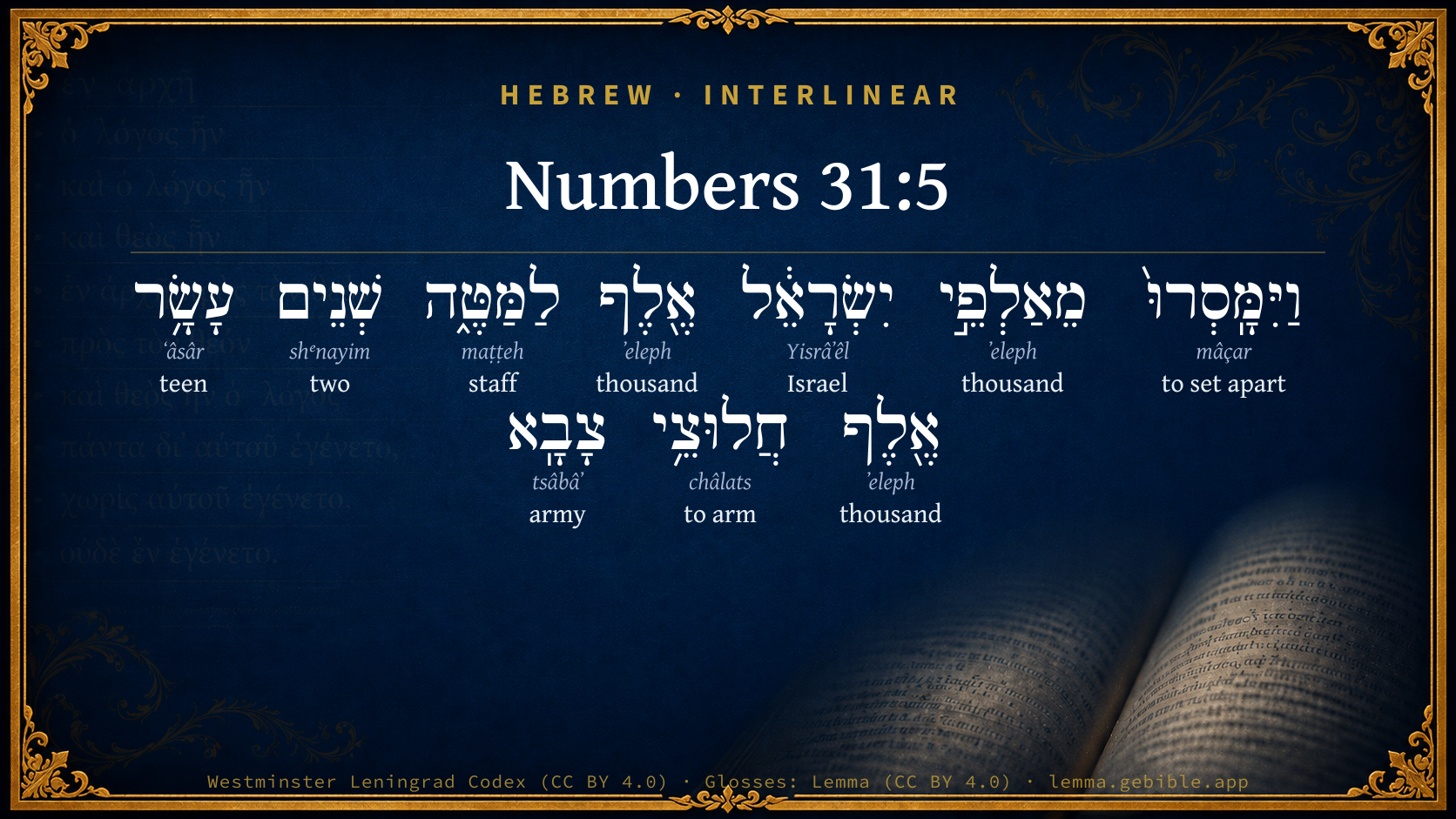
Numbers 31:5

Hebrew (Westminster Leningrad Codex) Numbers 31:5 appears in the Hebrew Old Testament. The text above is from the Westminster Leningrad Codex. Each word links to its Strong’s number, a concise gloss, and parsing drawn from the Open Scriptures Hebrew Bible morphology. Click any word for its full Brown-Driver-Briggs (BDB) entry.
Download image
Cite this verse

Numbers 31:5 (World English Bible). Public Domain. Lemma interlinear Bible study tool, https://lemma.gebible.app/v/numbers/31/5.

Show BibTeX & RIS
BibTeX
RIS
English Translation
So there were delivered, out of the thousands of Israel, a thousand of every tribe, twelve thousand armed for war.
World English Bible · Public Domain
Highlights
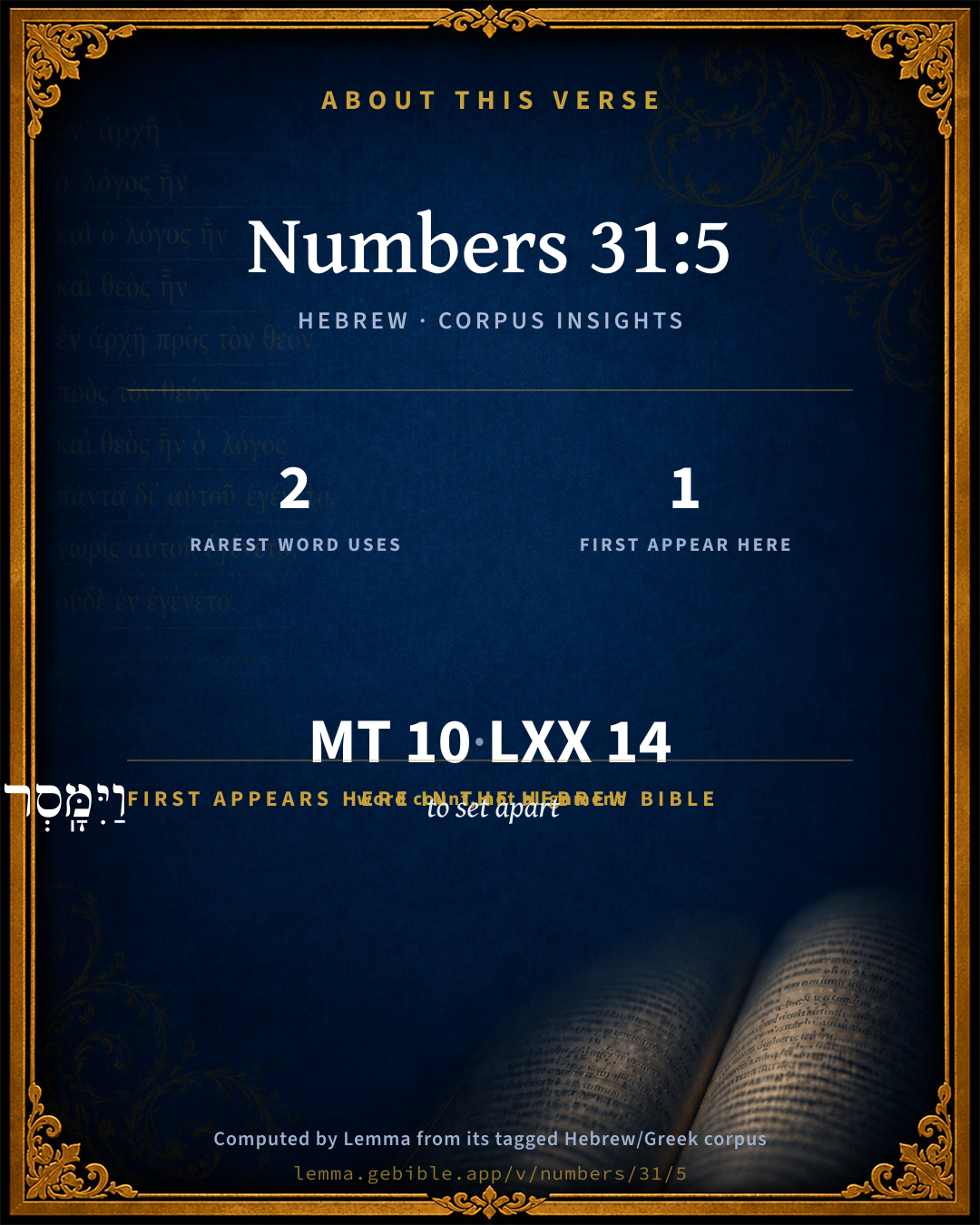
  • 1 first appearance in the Hebrew Bible
Full analysis ↓
Download a study sheet

One document with this verse’s original text, its word-by-word gloss line, the meaning frame, cross-references with their text, attributed commentary, and full source and license credits — printable, and it pastes into notes with its structure intact.

This verse Autodidact and up

Study sheet (.html) Plain text (.txt)

A passage Seminary Student

Up to 50 verses in one chapter. A passage sheet keeps up to 6 commentary sources and 12 cross-references per verse, in the order this page ranks them, and says so on the sheet whenever that leaves anything out. Ask for a single verse and you get the Autodidact verse sheet above.

Everything on this page stays free to read, with no account — the sheet is a download of what is already on screen, not access to it.

Want to remove ads? Support Godless Engineer
Compare translations 3

The same verse in 3 English versions, stacked beneath the original-language interlinear above. Click any original word for its lexicon entry.

Each is an independent rendering of the whole verse — the interlinear is not word-aligned to these translations.

Highlighted words mark where these versions differ — a whole-verse word diff, not a word-by-word alignment.

  • World English Bible Public Domain
    So there were delivered, out of the thousands of Israel, a thousand of every tribe, twelve thousand armed for war.
  • King James Version Public Domain
    So there were delivered out of the thousands of Israel, a thousand of every tribe, twelve thousand armed for war.
  • unfoldingWord Literal Text CC BY-SA 4.0
    And a thousand for a tribe were provided from the thousands of Israel, 12, 000 equipped for battle.

unfoldingWord Literal Text — © unfoldingWord, licensed CC BY-SA 4.0. Word-aligned USFM3 via Door43 (git.door43.org/unfoldingWord/en_ult).

Versions to compare (up to 4)

3 of 4 selected

Show all 18 translations

Every available English version of this verse, each an independent rendering of the whole verse.

  • World English Bible Public Domain
    So there were delivered, out of the thousands of Israel, a thousand of every tribe, twelve thousand armed for war.
  • Berean Standard Bible Public Domain
    So a thousand men were recruited from each tribe of Israel—twelve thousand armed for war.
  • Majority Standard Bible Public Domain
    So a thousand men were recruited from each tribe of Israel—twelve thousand armed for war.
  • King James Version Public Domain
    So there were delivered out of the thousands of Israel, a thousand of every tribe, twelve thousand armed for war.
  • American Standard Version (1901) Public Domain
    So there were delivered, out of the thousands of Israel, a thousand of every tribe, twelve thousand armed for war.
  • Revised Version (1885) Public Domain
    So there were delivered, out of the thousands of Israel, a thousand of every tribe, twelve thousand armed for war.
  • Geneva Bible (1599) Public Domain
    So there were taken out of the thousands of Israel, twelue thousande prepared vnto warre, of euery tribe a thousand.
  • Douay-Rheims (1899) Public Domain
    And they gave a thousand of every tribe, that is to say, twelve thousand men well appointed for battle.
  • Young's Literal Translation Public Domain
    And there are given out of the thousands of Israel a thousand for a tribe, twelve thousand armed ones of the host;
  • Literal Standard Version CC BY-SA 4.0
    And there are given out of the thousands of Israel one thousand for a tribe—twelve thousand armed ones [for] war;
  • Unlocked Literal Bible CC BY-SA 4.0
    So out of Israel's thousands of men, one thousand was provided from each tribe, twelve thousand men armed for war.
  • unfoldingWord Literal Text CC BY-SA 4.0
    And a thousand for a tribe were provided from the thousands of Israel, 12, 000 equipped for battle.
  • Darby Bible Public Domain
    And there were levied out of the thousands of Israel, a thousand by tribe, twelve thousand armed for war.
  • World Messianic Bible Public Domain
    So there were delivered, out of the thousands of Israel, a thousand from every tribe, twelve thousand armed for war.
  • Webster's Bible Public Domain
    So there were delivered out of the thousands of Israel, a thousand of every tribe, twelve thousand armed for war.
  • Free Bible Version CC BY-SA 4.0
    So one thousand men were chosen from each Israelite tribe, making twelve thousand troops ready for battle.
  • Bible in Basic English Public Domain
    So from the thousands of Israel a thousand were taken from every tribe, twelve thousand men armed for war.
  • JPS Tanakh (1917) Public Domain
    So there were delivered, out of the thousands of Israel, a thousand of every tribe, twelve thousand armed for war.

Literal Standard Version (2020), Covenant Press — licensed CC BY-SA 4.0. Text via the HelloAO Bible API (eBible.org). Unlocked Literal Bible (unfoldingWord) — licensed CC BY-SA 4.0. Text via the HelloAO Bible API (eBible.org). unfoldingWord Literal Text — © unfoldingWord, licensed CC BY-SA 4.0. Word-aligned USFM3 via Door43 (git.door43.org/unfoldingWord/en_ult). Free Bible Version, Dr. Jonathan Gallagher — licensed CC BY-SA 4.0. Text via the HelloAO Bible API (eBible.org).

Word by word

More ways to search: Search by grammar → Find every occurrence → Compare this word →

Practice this passage: Drill this verse → Learn its vocabulary →

וַיִּמָּֽסְרוּ֙
mâçar
H4560
“and · to set apart”
Conjunction + Verb, Niphal, Sequential Imperfect, 3rd Person, Masculine, Plural
Part of Speech
Conjunction + Verb
Stem
Niphal
Form
Sequential Imperfect
Person
3rd Person
Gender
Masculine
Number
Plural
Full BDB Definition

Origin: a primitive root

TWOT: 1224

to set apart, deliver up, offer - (Qal) to set apart - (Niphal) to be delivered over, be assigned to, be set apart
  1. מֵאַלְפֵ֣י ʼeleph H505 “from · thousand” Preposition + Adjective, Cardinal number, Both, Plural, Construct
  2. יִשְׂרָאֵ֔ל Yisrâʼêl H3478 “Israel” Noun, Proper
  3. אֶ֖לֶף ʼeleph H505 “thousand” Adjective, Cardinal number, Both, Singular, Absolute
  4. לַמַּטֶּ֑ה maṭṭeh H4294 “to/for the · staff” Preposition, Determined + Noun, Common, Masculine, Singular, Absolute
  5. שְׁנֵים shᵉnayim H8147 “two” Adjective, Cardinal number, Masculine, Dual, Absolute
  6. עָשָׂ֥ר ʻâsâr H6240 “teen” Adjective, Cardinal number, Masculine, Singular, Absolute
  7. אֶ֖לֶף ʼeleph H505 “thousand” Adjective, Cardinal number, Both, Singular, Absolute
  8. חֲלוּצֵ֥י châlats H2502 “armed” Verb, Qal, Participle Passive, Masculine, Plural, Construct
  9. צָבָֽא tsâbâʼ H6635 “army” Noun, Common, Both, Singular, Absolute

About this verse

These counts appear in no published source. They are computed here, from the morphology-tagged text and Lemma’s own curated glosses. What Lemma adds →

10
words
8
distinct lemmas
Pentateuch
section

Notable vocabulary

The rarest word here is וַיִּמָּֽסְרוּ֙ to set apart H4560 — appearing just 2 times in the whole Hebrew Bible.

First appearance in Scripture

This word makes its first canonical appearance in the Hebrew Bible here:

  • וַיִּמָּֽסְרוּ֙ to set apart H4560

Shared distinctive vocabulary

וַיִּמָּֽסְרוּ֙ to set apart H4560 occurs in 2 verses of the Hebrew Bible. Also found in:

Grammatical profile

  • 2 verbs
  • 3 nouns
  • 5 adjectives

Verb forms

  • וַיִּמָּֽסְרוּ֙ Niphal · Sequential Imperfect
  • חֲלוּצֵ֥י Qal · Participle Passive

Repetition

A word recurs within this verse — often emphatic in Hebrew:

  • מֵאַלְפֵ֣י thousand H505 ×3

Hebrew & Septuagint length

In English translation the verse runs 20 words from the Hebrew and 20 from the Septuagint (LXX English) — the same length.

A rough comparison of the two English renderings, which tokenize alike — not a word-level alignment.

Word counts can differ between the Hebrew and the Greek without any difference in meaning — e.g. the Hebrew direct-object marker אֵת has no separate Greek word, and Greek often adds the article ὁ.

In the original languages it is 10 Hebrew tokens and 14 Greek tokens — but the two are counted differently (Hebrew bundles its prefixes and suffixes into one token; the Greek is in lemma form), so that isn’t a like-for-like length.

Hebrew and Greek witnesses Masoretic Hebrew ↔ Greek Septuagint

The same verse in the two great witnesses to the Old Testament, shown verse-for-verse.

These are two independent witnesses, not word-aligned to each other, and the Septuagint is shown in lemma (dictionary) form.

Hebrew Numbers 31:5 Masoretic · Westminster Leningrad Codex

וַיִּמָּֽסְרוּ֙ מֵאַלְפֵ֣י יִשְׂרָאֵ֔ל אֶ֖לֶף לַמַּטֶּ֑ה שְׁנֵים עָשָׂ֥ר אֶ֖לֶף חֲלוּצֵ֥י צָבָֽא

So there were delivered, out of the thousands of Israel, a thousand of every tribe, twelve thousand armed for war.

World English Bible · Public Domain

Greek LXX Numbers 31:5 Septuagint · lemma form

καί ἐκἀριθμέω ἐκ ὁ χιλιάς ἰσραήλ χίλιοι ἐκ φυλή δώδεκα χιλιάς ἐνὁπλίζω εἰς παράταξις

And they numbered of the thousands of Israel a thousand of each tribe, twelve thousands; these were armed for war.

LXX2012 (modern English Septuagint) · Public Domain

On this verse, The Cambridge Bible for Schools and Colleges discusses the Septuagint’s reading. Read the note in Commentary ↓

Hebrew: Westminster Leningrad Codex (CC BY 4.0). Greek: Septuagint (public domain); English from LXX2012 (modern English Septuagint) (Public Domain). How the Septuagint differs from the Hebrew →

Targum (Aramaic paraphrase)

2

The Targum is the ancient Jewish Aramaic paraphrase of the Hebrew Scriptures — an interpretive translation, not the Hebrew text itself. Onkelos (literal) and Pseudo-Jonathan (expansive) render the Torah, and Jonathan the Prophets. Coverage is partial: where no permissively-licensed English translation exists for a verse, only the Aramaic is shown. This is verse-level text, not a word-by-word alignment to the Hebrew.

  1. Targum Onkelos Torah (Genesis–Deuteronomy)
    וְאִתְבְּחָרוּ מֵאַלְפַיָא דְיִֹשְׂרָאֵל אַלְפָא לְשִׁבְטָא תְּרֵי עֲֹשַׂר אַלְפִין מְזָרְזֵי חֵילָא

    (no public-domain English translation for this verse)

    Targum Onkelos — Aramaic: “Onkelos Genesis” (public domain); “Onkelos Exodus” (public domain); “Onkelos Leviticus” (public domain); “Onkelos Numbers” (public domain); “Onkelos Deuteronomy” (public domain). English: “Sefaria Community Translation” (CC0 1.0 (public-domain dedication)); “J.W. Etheridge. The Targums of Onkelos and Jonathan Ben Uzziel on the Pentateuch. London: Longmans, Green, 1862” (public domain). Text via Sefaria.

  2. Targum Pseudo-Jonathan Torah (Genesis–Deuteronomy)
    וְאִתְבְּחָרוּ גוּבְרִין צַדִיקִין וּמְסָרוּן נַפְשְׁהוֹן מֵאַלְפַיָא דְיִשְרָאֵל אַלְפָא לְשִׁבְטָא תְּרֵיסַר אַלְפִין מְזַרְזֵי חֵילָא

    And of the thousands of Israel fit men were chosen who gave up themselves, a thousand of a tribe, twelve thousand, armed for the war.

    Targum Pseudo-Jonathan — Aramaic: “Targum Jonathan on Genesis” (public domain); “Targum Jonathan on Exodus” (public domain); “Targum Jonathan on Leviticus” (public domain); “Targum Jonathan on Numbers” (public domain); “Targum Jonathan on Deuteronomy” (public domain). English: “The Targum of Jonathan ben Uzziel, trans. J. W. Etheridge, London, 1862” (public domain). Text via Sefaria.

Commentary

Notes on Numbers 31:5 from classic Christian and Jewish commentators (each source and its license shown beneath its notes). The classic Christian expositions comment on the surrounding passage and are grouped to its opening verse, so a note may address several verses; the Jewish commentaries on the Tanakh (Rashi and others) are per-verse, so they appear only where the commentator wrote on this verse.

Lemma curates 59 commentaries, every one of them public domain or Creative Commons licensed, each selected and text-cleaned for this edition rather than reprinted as found. About our sources →

Trapp's Complete Commentary

John Trapp

Num 31:5 So there were delivered out of the thousands of Israel, a thousand of [every] tribe, twelve thousand armed for war.

Ver. 5. Twelve thousand.] This was no great army, but they were Deo armati, with whom "there is no restraint to save by many or by few." {1Sa 14:6} How wondrously did God work by that handful of Hussites in Bohemia, when all Germany was up in arms against them by the Pope’s instigation! And may it not be said of that small remnant, that now fighteth the Lord’s battles in Ireland, "The Lord hath done great things for them, whereof we are glad?" Have they not been "helped with a little help indeed?" {Dan 11:34} The more is our shame, that send them no more.

John Trapp, A Commentary or Exposition upon All the Books of the Old and New Testament (1647–1656) — public domain. Text from a community e-Sword module.

Joseph Benson's Commentary

Num 31:5. Twelve thousand — God would send no more, though it is apparent the Midianites were numerous and strong, because he would exercise their trust in him, and give them an earnest of their conquests in Canaan.

Joseph Benson's Commentary on the Old and New Testaments (1811–1818) — public domain. Text from a community e-Sword module.

Jamieson, Fausset & Brown

Robert Jamieson, A. R. Fausset & David Brown

there were delivered--that is, drafted, chosen, an equal amount from each tribe, to prevent the outbreak of mutual jealousy or strife. Considering the numerical force of the enemy, this was a small quota to furnish. But the design was to exercise their faith and animate them to the approaching invasion of Canaan.

Jamieson, Fausset & Brown — Commentary Critical and Explanatory on the Whole Bible (1871) — public domain (CC PDM 1.0). Text via the HelloAO Bible API.

The Cambridge Bible for Schools and Colleges

gen. ed. J. J. S. Perowne

5. and there were delivered] The use of this verb וַיִמָּסְרוּ would, if the reading were certain, mark the chapter as a late composition. It occurs in Num_31:16 (see, however, note), but not elsewhere in the O.T., while it is frequent in post-Biblical Heb. and in Aramaic. But LXX. has καὶ ἐξηρίθμησαν, and perhaps the true reading is וַיִמָּפְרוּ ‘and there were numbered.’

The Cambridge Bible for Schools and Colleges (gen. ed. J. J. S. Perowne; Cambridge University Press, 1878–1918) — public domain. Text from a community e-Sword module.

John Gill's Exposition

So they were delivered out of the thousands of Israel,.... Several thousands very probably offered themselves voluntarily to go to the war, or however were summoned together on this account, and out of them the following number was delivered of picked and chosen men:

a thousand of every tribe, twelve thousand armed for war; which was but a small number to go against so considerable a nation and people; but this was done to show that the war was of the Lord, he would fight the battle, and give them victory, it being the same to him to do it with few as with many; and to encourage the people of Israel to believe the Lord would give them success against their many and powerful enemies in the land of Canaan, on the borders of which they now were.

John Gill's Exposition of the Whole Bible (1746–1763) — public domain (CC PDM 1.0). Text via the HelloAO Bible API.

Albert Barnes' Notes on the Bible

Were delivered - Or, “were told off.”

Albert Barnes' Notes on the Bible (1834–1885) — public domain. Text from a community e-Sword/MySword module.

Matthew Poole's English Annotations

A thousand of every tribe, to prevent emulations or divisions. God would send no more, though it is apparent that the Midianites were numerous and strong, because he would try and exercise their trust in him, and because he would hereby give them an earnest of their Canaanitish conquests.

Matthew Poole's English Annotations on the Holy Bible (1683–1685) — public domain. Text from a community e-Sword/MySword module.

Whedon's Commentary on the Bible

Daniel D. Whedon

5-7. Twelve thousand — The conscription of so small a number against the hosts of Midian; the appointment, as commander, of Phinehas, who had recently so greatly signalized himself by his zeal against the sin to which Midian had decoyed Israel; the holy instruments, the trumpets, and other furniture of the tabernacle borne with the army — all indicate that the arm of Jehovah is to be made bare in victory; and the indication is strikingly confirmed by the miraculous preservation from death of every Israelite sent to the war.

The trumpets — These were for the double purpose of giving an alarm blast and of a memorial or pledge that Israel should be remembered by Jehovah in the day of battle. Num_10:9, note.

And they warred — There is no record of the decisive battles and brave deeds of this campaign; only the results are noted. Since Jehovah signally fought on this occasion, it is fitting that little or no mention should be made of his humble human allies.

Slew all the males — The adults were slain on the field of battle and in the sacking of cities, since it was a war of vengeance.

Daniel D. Whedon (gen. ed.), Commentary on the Old and New Testaments (1874–1909) — public domain. Text from a community e-Sword module.

The Pulpit Commentary

There were delivered, or "levied." WrsMyi. Septuagint, exhriymhsan The Hebrew word is only used here and in verse 16 (see note there), and in these two places not in the same sense. The context, however, leaves little or no doubt as to the meaning which it must bear.

The Pulpit Commentary (1880–1919), ed. H.D.M. Spence-Jones & Joseph S. Exell — public domain. Text from a community e-Sword module.

John Wesley's Explanatory Notes

Twelve thousand - God would send no more, though it is apparent the Midianites were numerous and strong, because he would exercise their trust in him, and give them an earnest of their Canaanitish conquests.

John Wesley, Explanatory Notes Upon the Whole Bible (1754–1765) — public domain. Text via the GEBible commentary corpus.

Rashi

Rabbi Shlomo Yitzchaki (Rashi)

וימסרו SO THERE WERE HANDED OVER … [A THOUSAND OF EVERY TRIBE] — This serves to tell you in what high esteem the shepherds of Israel were really held — how dear they were to Israel. Up until they had heard of his approaching death what does it state? That Moses felt constrained to exclaim about them, “They are almost ready to stone me”! (Exodus 17:14). But when they heard that Moses’ death was associated with the execution of vengeance upon Midian (cf. v. 2), they refused to go to war until they were “handed over” against their own will (Sifrei Bamidbar 157:3).

Rashi on the Tanakh — English translations: “The Judaica Press complete Tanach with Rashi, translated by A. J. Rosenberg” (CC BY 4.0); “Pentateuch with Rashi's commentary by M. Rosenbaum and A.M. Silbermann, 1929-1934” (public domain); “The Metsudah Tanach series, Lakewood, N.J” (CC BY 4.0); and “The Book of Joshua, Metsudah Publications, 1997” (CC BY 4.0). Text via Sefaria.

Lesson kit

Teaching starters — assembled from the data on this page, not authored interpretation. Every prompt links to the verse data it draws on. Edit before teaching.

Numbers, in the Pentateuch, opens this verse with 10 words (8 distinct Hebrew lemmas). Its most distinctive word is mâçar (“to set apart”). A historical commentator’s framing appears above. Read the whole chapter for the surrounding context.

Discussion questions

  1. The word mâçar carries the sense “to set apart.” How does it shape the verse?
  2. This is the first place “to set apart” appears in Scripture (first appears here). What does its debut here establish?
  3. How does Numbers 31:16, which shares the word «to set apart», read alongside this verse?
  4. What does the repetition of “thousand” (3× in this one verse) do in this verse?
  5. These translations render this verse differently. What is at stake in choosing one wording over another?
  6. «וַיִּמָּֽסְרוּ֙» is a Niphal Sequential Imperfect verb. How does that grammatical form shape the action described?
  7. Compare how Trapp's Complete Commentary and Joseph Benson's Commentary read this verse. Where do they agree or differ?

Things to notice

Reading settings

Reading text

Shown beneath each verse's original-language words.

Old Testament
Old Testament edition

Read the OT as the Masoretic Hebrew (MT) or the Greek Septuagint (LXX).

English shown for the Greek Septuagint (in the Hebrew ↔ Greek comparison).

Comparing translations? Open the Compare panel on any verse page to stack up to four side by side.