

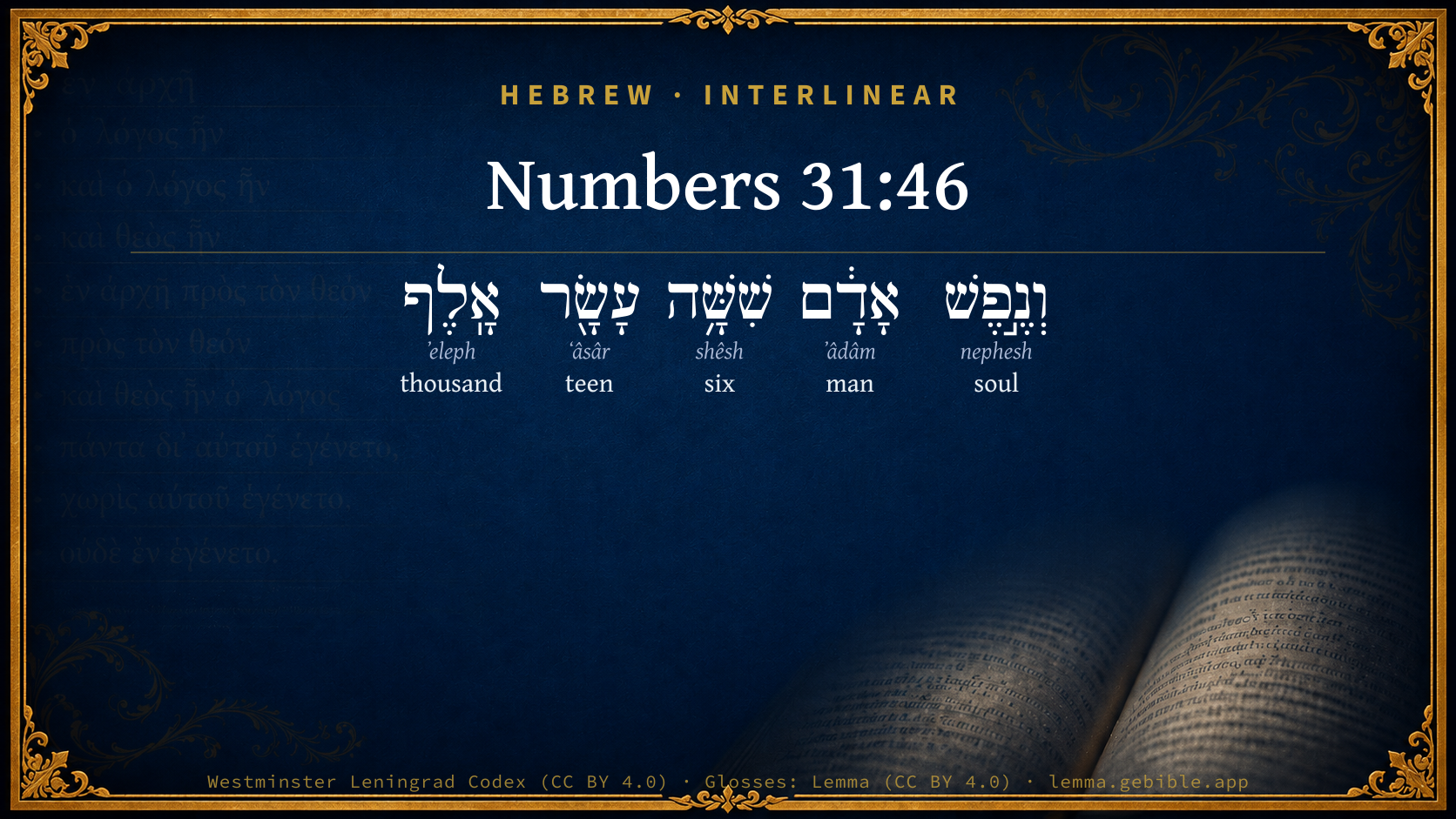
וְנֶ֣פֶשׁ אָדָ֔ם שִׁשָּׁ֥ה עָשָׂ֖ר אָֽלֶף
and sixteen thousand persons),
World English Bible · Public Domain
and sixteen thousand persons),
One document with this verse’s original text, its word-by-word gloss line, the meaning frame, cross-references with their text, attributed commentary, and full source and license credits — printable, and it pastes into notes with its structure intact.
This verse Autodidact and up
A passage Seminary Student
Up to 50 verses in one chapter. A passage sheet keeps up to 6 commentary sources and 12 cross-references per verse, in the order this page ranks them, and says so on the sheet whenever that leaves anything out. Ask for a single verse and you get the Autodidact verse sheet above.
Everything on this page stays free to read, with no account — the sheet is a download of what is already on screen, not access to it.
The same verse in 3 English versions, stacked beneath the original-language interlinear above. Click any original word for its lexicon entry.
Each is an independent rendering of the whole verse — the interlinear is not word-aligned to these translations.
Highlighted words mark where these versions differ — a whole-verse word diff, not a word-by-word alignment.
and sixteen thousand persons),
And sixteen thousand persons;)
and 16, 000 human lives.
unfoldingWord Literal Text — © unfoldingWord, licensed CC BY-SA 4.0. Word-aligned USFM3 via Door43 (git.door43.org/unfoldingWord/en_ult).
Every available English version of this verse, each an independent rendering of the whole verse.
and sixteen thousand persons),
and 16,000 people.
and 16,000 people.
And sixteen thousand persons;)
and sixteen thousand persons),
and sixteen thousand persons;)
And sixteene thousande persons)
And out of the sixteen thousand persons,
and of human beings sixteen thousand --
and sixteen thousand of mankind—
and sixteen thousand women.
and 16, 000 human lives.
and sixteen thousand human persons,)
and sixteen thousand persons),
And sixteen thousand persons;)
and 16,000 people.
And sixteen thousand persons;)
and sixteen thousand persons —
Literal Standard Version (2020), Covenant Press — licensed CC BY-SA 4.0. Text via the HelloAO Bible API (eBible.org). Unlocked Literal Bible (unfoldingWord) — licensed CC BY-SA 4.0. Text via the HelloAO Bible API (eBible.org). unfoldingWord Literal Text — © unfoldingWord, licensed CC BY-SA 4.0. Word-aligned USFM3 via Door43 (git.door43.org/unfoldingWord/en_ult). Free Bible Version, Dr. Jonathan Gallagher — licensed CC BY-SA 4.0. Text via the HelloAO Bible API (eBible.org).
More ways to search: Search by grammar → Find every occurrence → Compare this word →
Practice this passage: Drill this verse → Learn its vocabulary →
These counts appear in no published source. They are computed here, from the morphology-tagged text and Lemma’s own curated glosses. What Lemma adds →
Grammatical profile
Hebrew & Septuagint length
In English translation the verse runs 4 words from the Hebrew and 4 from the Septuagint (LXX English) — the same length.
A rough comparison of the two English renderings, which tokenize alike — not a word-level alignment.
Word counts can differ between the Hebrew and the Greek without any difference in meaning — e.g. the Hebrew direct-object marker אֵת has no separate Greek word, and Greek often adds the article ὁ.
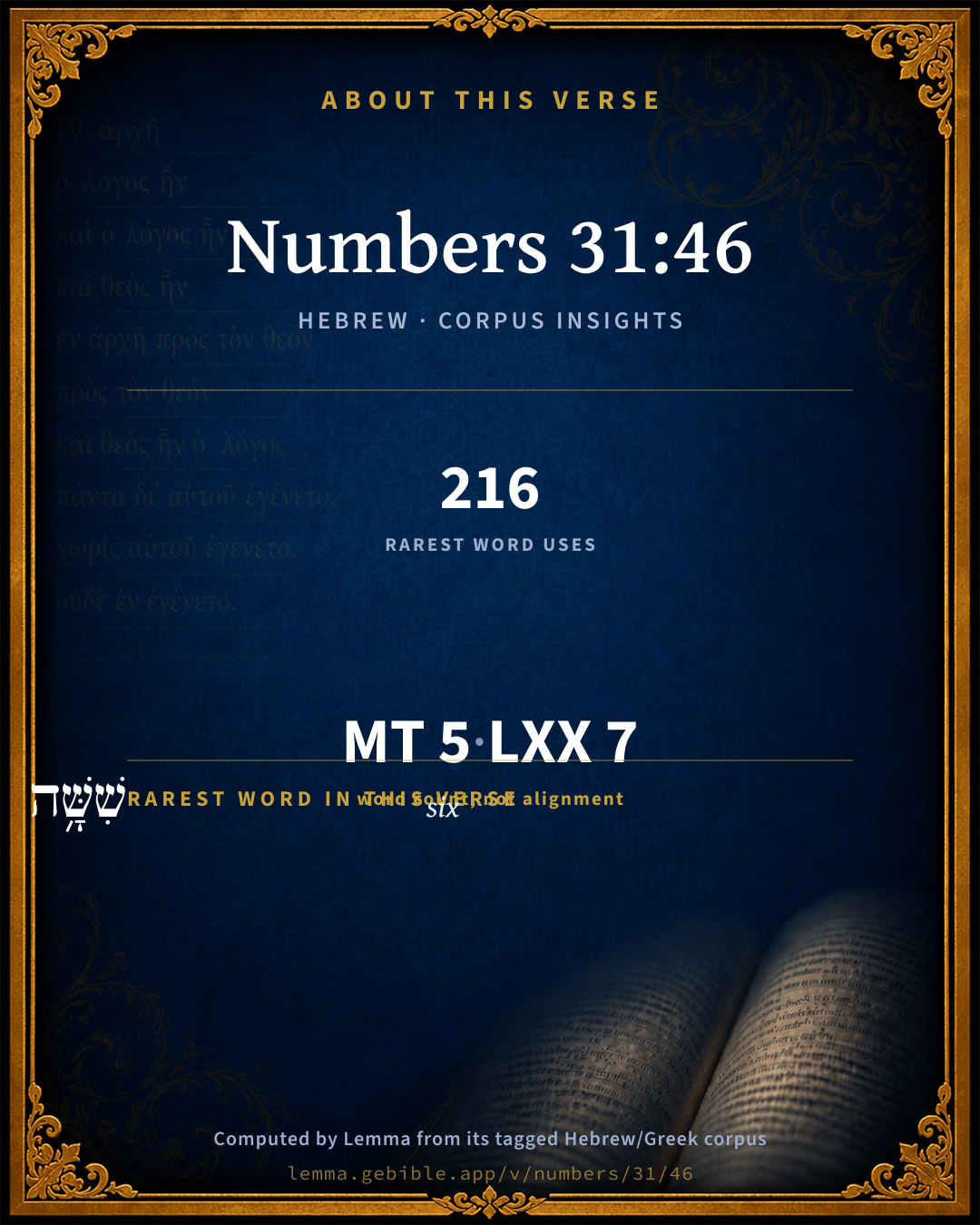
In the original languages it is 5 Hebrew tokens and 7 Greek tokens — but the two are counted differently (Hebrew bundles its prefixes and suffixes into one token; the Greek is in lemma form), so that isn’t a like-for-like length.
The same verse in the two great witnesses to the Old Testament, shown verse-for-verse.
These are two independent witnesses, not word-aligned to each other, and the Septuagint is shown in lemma (dictionary) form.
וְנֶ֣פֶשׁ אָדָ֔ם שִׁשָּׁ֥ה עָשָׂ֖ר אָֽלֶף
and sixteen thousand persons),
World English Bible · Public Domain
καί ψυχή ἄνθρωπος ἕξ καί δέκα χιλιάς
and persons, sixteen thousand.
LXX2012 (modern English Septuagint) · Public Domain
Hebrew: Westminster Leningrad Codex (CC BY 4.0). Greek: Septuagint (public domain); English from LXX2012 (modern English Septuagint) (Public Domain). How the Septuagint differs from the Hebrew →
The Targum is the ancient Jewish Aramaic paraphrase of the Hebrew Scriptures — an interpretive translation, not the Hebrew text itself. Onkelos (literal) and Pseudo-Jonathan (expansive) render the Torah, and Jonathan the Prophets. Coverage is partial: where no permissively-licensed English translation exists for a verse, only the Aramaic is shown. This is verse-level text, not a word-by-word alignment to the Hebrew.
וְנַפְשָׁא דְאֱנָשָׁא שִׁתָּא עֲשַׂר אַלְפִין
(no public-domain English translation for this verse)
Targum Onkelos — Aramaic: “Onkelos Genesis” (public domain); “Onkelos Exodus” (public domain); “Onkelos Leviticus” (public domain); “Onkelos Numbers” (public domain); “Onkelos Deuteronomy” (public domain). English: “Sefaria Community Translation” (CC0 1.0 (public-domain dedication)); “J.W. Etheridge. The Targums of Onkelos and Jonathan Ben Uzziel on the Pentateuch. London: Longmans, Green, 1862” (public domain). Text via Sefaria.
וּבְנַת נְשָׁא שִׁיתְּסַר אַלְפִין
and sixteen thousand women.
Targum Pseudo-Jonathan — Aramaic: “Targum Jonathan on Genesis” (public domain); “Targum Jonathan on Exodus” (public domain); “Targum Jonathan on Leviticus” (public domain); “Targum Jonathan on Numbers” (public domain); “Targum Jonathan on Deuteronomy” (public domain). English: “The Targum of Jonathan ben Uzziel, trans. J. W. Etheridge, London, 1862” (public domain). Text via Sefaria.