Judges 4:10

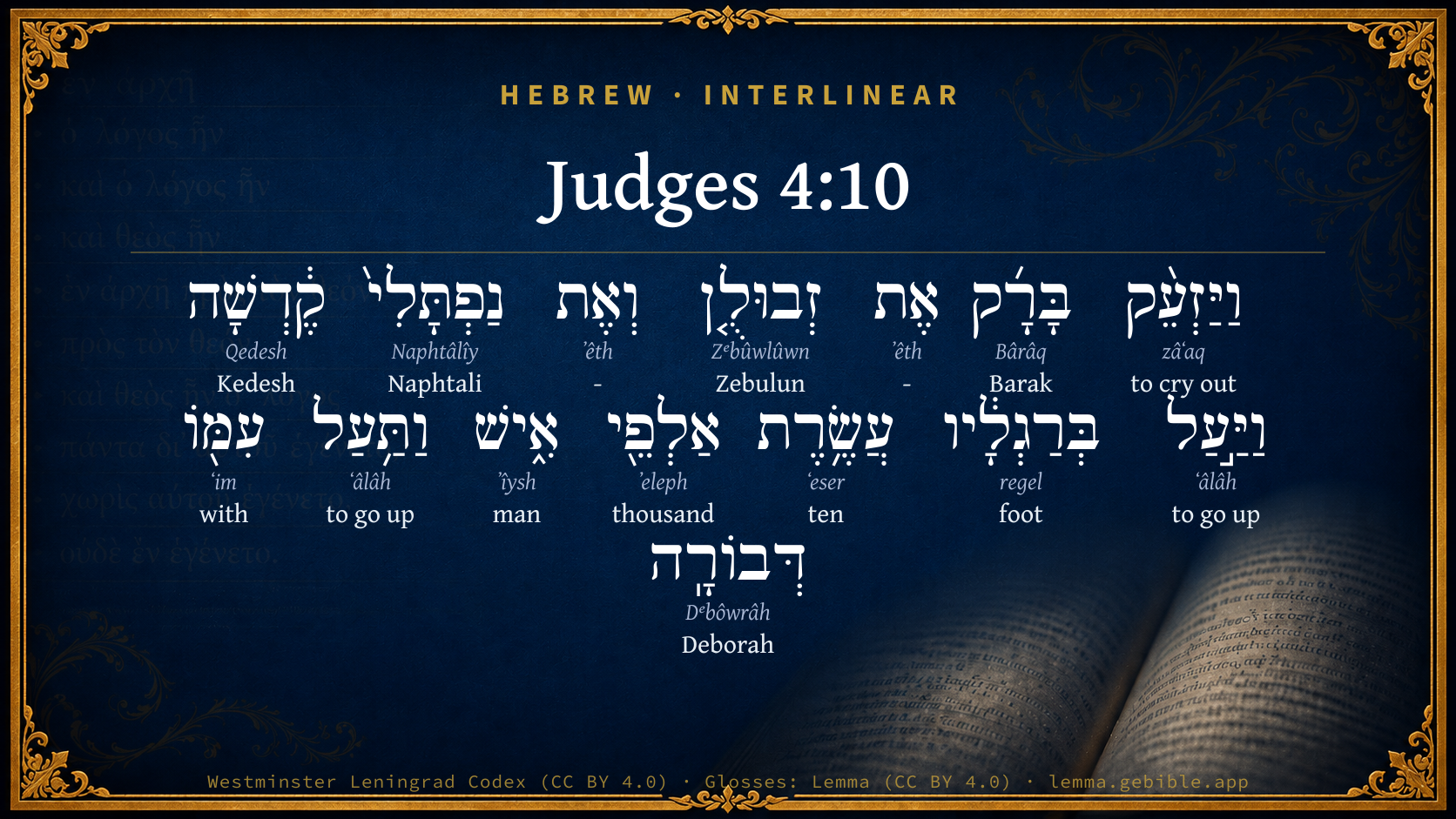
Hebrew (Westminster Leningrad Codex) Judges 4:10 appears in the Hebrew Old Testament. The text above is from the Westminster Leningrad Codex. Each word links to its Strong’s number, a concise gloss, and parsing drawn from the Open Scriptures Hebrew Bible morphology. Click any word for its full Brown-Driver-Briggs (BDB) entry.
Download image
Cite this verse

Judges 4:10 (World English Bible). Public Domain. Lemma interlinear Bible study tool, https://lemma.gebible.app/v/judges/4/10.

Show BibTeX & RIS
BibTeX
RIS
English Translation
Barak called Zebulun and Naphtali together to Kedesh; and there went up ten thousand men at his feet: and Deborah went up with him.
World English Bible · Public Domain
Download a study sheet

One document with this verse’s original text, its word-by-word gloss line, the meaning frame, cross-references with their text, attributed commentary, and full source and license credits — printable, and it pastes into notes with its structure intact.

This verse Autodidact and up

Study sheet (.html) Plain text (.txt)

A passage Seminary Student

Up to 50 verses in one chapter. A passage sheet keeps up to 6 commentary sources and 12 cross-references per verse, in the order this page ranks them, and says so on the sheet whenever that leaves anything out. Ask for a single verse and you get the Autodidact verse sheet above.

Everything on this page stays free to read, with no account — the sheet is a download of what is already on screen, not access to it.

Want to remove ads? Support Godless Engineer
Compare translations 3

The same verse in 3 English versions, stacked beneath the original-language interlinear above. Click any original word for its lexicon entry.

Each is an independent rendering of the whole verse — the interlinear is not word-aligned to these translations.

Highlighted words mark where these versions differ — a whole-verse word diff, not a word-by-word alignment.

  • World English Bible Public Domain
    Barak called Zebulun and Naphtali together to Kedesh; and there went up ten thousand men at his feet: and Deborah went up with him.
  • King James Version Public Domain
    And Barak called Zebulun and Naphtali to Kedesh; and he went up with ten thousand men at his feet: and Deborah went up with him.
  • unfoldingWord Literal Text CC BY-SA 4.0
    Then Barak summoned Zebulun and Naphtali to Kedesh. And 10,000 men went up at his feet, and Deborah went up with him.

unfoldingWord Literal Text — © unfoldingWord, licensed CC BY-SA 4.0. Word-aligned USFM3 via Door43 (git.door43.org/unfoldingWord/en_ult).

Versions to compare (up to 4)

3 of 4 selected

Show all 18 translations

Every available English version of this verse, each an independent rendering of the whole verse.

  • World English Bible Public Domain
    Barak called Zebulun and Naphtali together to Kedesh; and there went up ten thousand men at his feet: and Deborah went up with him.
  • Berean Standard Bible Public Domain
    where he summoned Zebulun and Naphtali. Ten thousand men followed him, and Deborah also went with him.
  • Majority Standard Bible Public Domain
    where he summoned Zebulun and Naphtali. Ten thousand men followed him, and Deborah also went with him.
  • King James Version Public Domain
    And Barak called Zebulun and Naphtali to Kedesh; and he went up with ten thousand men at his feet: and Deborah went up with him.
  • American Standard Version (1901) Public Domain
    And Barak called Zebulun and Naphtali together to Kedesh; and there went up ten thousand men at his feet: and Deborah went up with him.
  • Revised Version (1885) Public Domain
    And Barak called Zebulun and Naphtali together to Kedesh; and there went up ten thousand men at his feet: and Deborah went up with him.
  • Geneva Bible (1599) Public Domain
    And Barak called Zebulun and Naphtali to Kedesh, and he went vp on his feete with ten thousand men, and Deborah went vp with him.
  • Douay-Rheims (1899) Public Domain
    And he called unto him Zabulon and Nepbtali, and went up with ten thousand fighting men, having Debbora in his company.
  • Young's Literal Translation Public Domain
    And Barak calleth Zebulun and Naphtali to Kedesh, and he goeth up -- at his feet `are' ten thousand men -- and Deborah goeth up with him.
  • Literal Standard Version CC BY-SA 4.0
    And Barak calls Zebulun and Naphtali to Kedesh, and he goes up—ten thousand men [are] at his feet—and Deborah goes up with him.
  • Unlocked Literal Bible CC BY-SA 4.0
    Barak called for the men of Zebulun and Naphtali to come together at Kedesh. Ten thousand men followed him, and Deborah went along with him.
  • unfoldingWord Literal Text CC BY-SA 4.0
    Then Barak summoned Zebulun and Naphtali to Kedesh. And 10,000 men went up at his feet, and Deborah went up with him.
  • Darby Bible Public Domain
    And Barak summoned Zeb'ulun and Naph'tali to Kedesh; and ten thousand men went up at his heels; and Deb'orah went up with him.
  • World Messianic Bible Public Domain
    Barak called Zebulun and Naphtali together to Kedesh. Ten thousand men followed him; and Deborah went up with him.
  • Webster's Bible Public Domain
    And Barak called Zebulun and Naphtali to Kedesh; and he went up with ten thousand men at his feet: and Deborah went up with him.
  • Free Bible Version CC BY-SA 4.0
    Barak called up the armies of Zebulun and Naphtali, and ten thousand men assembled under his command. Deborah was also there with him.
  • Bible in Basic English Public Domain
    Then Barak sent for Zebulun and Naphtali to come to Kedesh; and ten thousand men went up after him, and Deborah went up with him.
  • JPS Tanakh (1917) Public Domain
    And Barak called Zebulun and Naphtali together to Kedesh; and there went up ten thousand men at his feet; and Deborah went up with him.

Literal Standard Version (2020), Covenant Press — licensed CC BY-SA 4.0. Text via the HelloAO Bible API (eBible.org). Unlocked Literal Bible (unfoldingWord) — licensed CC BY-SA 4.0. Text via the HelloAO Bible API (eBible.org). unfoldingWord Literal Text — © unfoldingWord, licensed CC BY-SA 4.0. Word-aligned USFM3 via Door43 (git.door43.org/unfoldingWord/en_ult). Free Bible Version, Dr. Jonathan Gallagher — licensed CC BY-SA 4.0. Text via the HelloAO Bible API (eBible.org).

Word by word

More ways to search: Search by grammar → Find every occurrence → Compare this word →

Practice this passage: Drill this verse → Learn its vocabulary →

דְּבוֹרָֽה
Dᵉbôwrâh
H1683
“Deborah”
Noun, Proper
Part of Speech
Noun
Type
Proper
Full BDB Definition

Origin: the same as H1682

TWOT: None

Deborah = "bee" - the nurse of Rebekah who accompanied her from the house of Bethuel - a prophetess who judged Israel
  1. וַיַּזְעֵ֨ק zâʻaq H2199 “and · to cry out” Conjunction + Verb, Hiphil, Sequential Imperfect, 3rd Person, Masculine, Singular
  2. בָּרָ֜ק Bârâq H1301 “Barak” Noun, Proper
  3. אֶת ʼêth H853 “-” Particle, Direct Object
  4. זְבוּלֻ֤ן Zᵉbûwlûwn H2074 “Zebulun” Noun, Proper
  5. וְאֶת ʼêth H853 “and · -” Conjunction + Particle, Direct Object
  6. נַפְתָּלִי֙ Naphtâlîy H5321 “Naphtali” Noun, Proper
  7. קֶ֔דְשָׁה Qedesh H6943 “Kedesh · toward” Noun, Proper + Suffix, Demonstrative
  8. וַיַּ֣עַל ʻâlâh H5927 “and · to go up” Conjunction + Verb, Qal, Sequential Imperfect, 3rd Person, Masculine, Singular
  9. בְּרַגְלָ֔יו regel H7272 “in/at · feet · his” Preposition + Noun, Common, Feminine, Dual, Construct + Suffix, Personal, 3rd Person, Masculine, Singular
  10. עֲשֶׂ֥רֶת ʻeser H6235 “ten” Adjective, Cardinal number, Masculine, Singular, Construct
  11. אַלְפֵ֖י ʼeleph H505 “thousand” Adjective, Cardinal number, Both, Plural, Construct
  12. אִ֑ישׁ ʼîysh H376 “man” Noun, Common, Masculine, Singular, Absolute
  13. וַתַּ֥עַל ʻâlâh H5927 “and · to go up” Conjunction + Verb, Qal, Sequential Imperfect, 3rd Person, Feminine, Singular
  14. עִמּ֖וֹ ʻim H5973 “with · him” Preposition + Suffix, Personal, 3rd Person, Masculine, Singular

About this verse

These counts appear in no published source. They are computed here, from the morphology-tagged text and Lemma’s own curated glosses. What Lemma adds →

15
words
13
distinct lemmas
Historical
section

Notable vocabulary

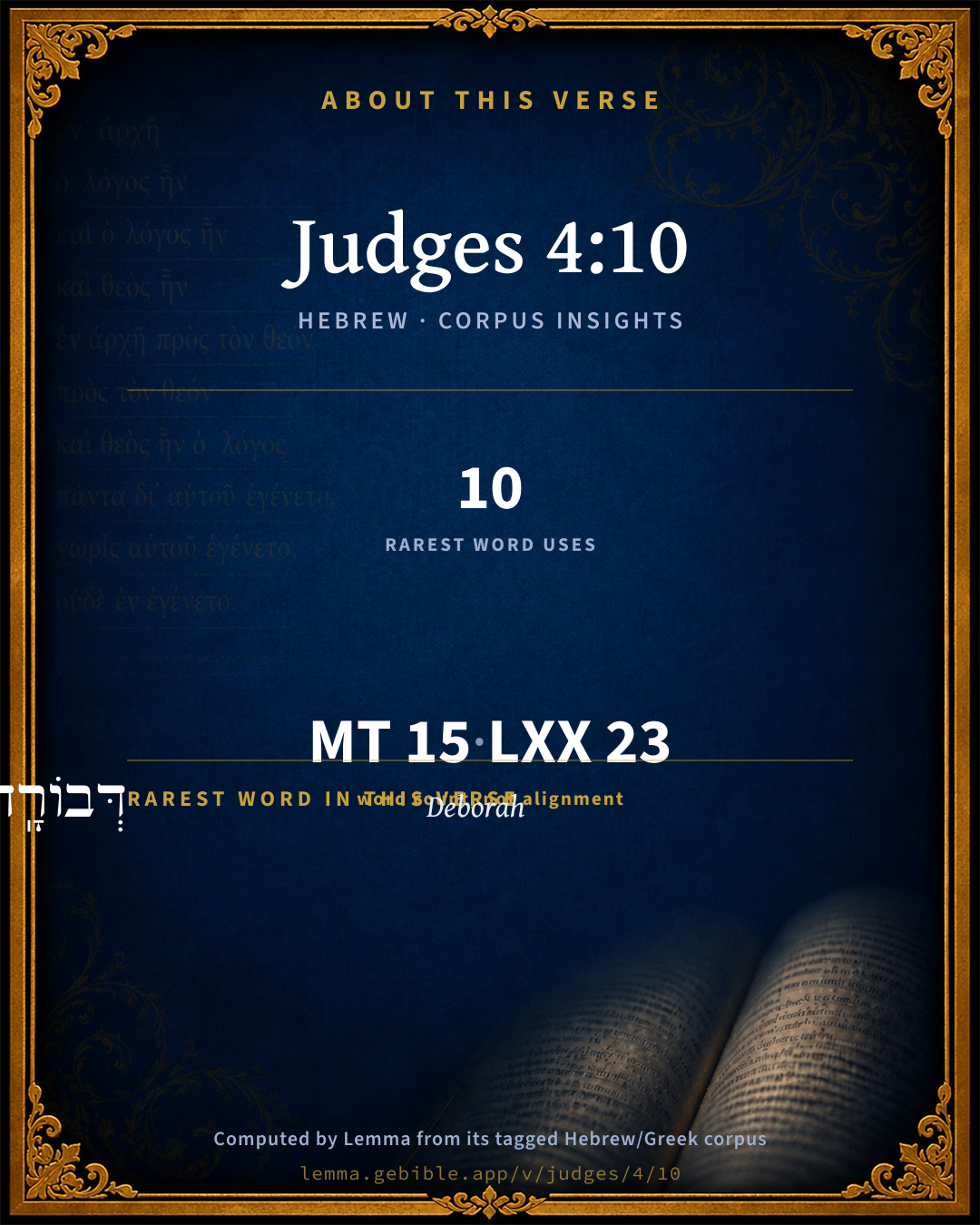
The rarest word here is דְּבוֹרָֽה Deborah H1683 — appearing just 10 times in the whole Hebrew Bible.

Shared distinctive vocabulary

דְּבוֹרָֽה Deborah H1683 occurs in 10 verses of the Hebrew Bible. Also found in:

Grammatical profile

  • 3 verbs
  • 7 nouns
  • 2 adjectives
  • 1 preposition
  • 2 particles

Verb forms

  • וַיַּזְעֵ֨ק Hiphil · Sequential Imperfect
  • וַיַּ֣עַל Qal · Sequential Imperfect
  • וַתַּ֥עַל Qal · Sequential Imperfect

Repetition

A word recurs within this verse — often emphatic in Hebrew:

  • וַיַּ֣עַל to go up H5927 ×2

Hebrew & Septuagint length

In English translation the verse runs 24 words from the Hebrew and 25 from the Septuagint (LXX English) — closely comparable.

A rough comparison of the two English renderings, which tokenize alike — not a word-level alignment.

Word counts can differ between the Hebrew and the Greek without any difference in meaning — e.g. the Hebrew direct-object marker אֵת has no separate Greek word, and Greek often adds the article ὁ.

In the original languages it is 15 Hebrew tokens and 23 Greek tokens — but the two are counted differently (Hebrew bundles its prefixes and suffixes into one token; the Greek is in lemma form), so that isn’t a like-for-like length.

Cross-references

7

Topical passages linked to Judges 4:10 in the Treasury of Scripture Knowledge — connected by theme and wording, ordered by reader-vote popularity; previews shown in the World English Bible.

  • Judges 5:18 Zebulun was a people that jeopardized their lives to the death, Naphtali, on the high places of the field.
  • Judges 5:15 The princes of Issachar were with Deborah; As was Issachar, so was Barak; Into the valley they rushed forth at his feet. By the watercourses of Reuben There were great resolves of heart.
  • Exodus 11:8 All these your servants shall come down to me, and bow down themselves to me, saying, 'Get out, and all the people who follow you; and after that I will go out.'" He went out from Pharaoh in hot anger.
  • Judges 4:14 Deborah said to Barak, Up; for this is the day in which Yahweh has delivered Sisera into your hand; hasn't Yahweh gone out before you? So Barak went down from Mount Tabor, and ten thousand men after him.
  • 1 Samuel 25:27 Now this present which your servant has brought to my lord, let it be given to the young men who follow my lord.
  • Judges 4:6 She sent and called Barak the son of Abinoam out of Kedesh-naphtali, and said to him, Hasn't Yahweh, the God of Israel, commanded, [saying], Go and draw to Mount Tabor, and take with you ten thousand men of the children of Naphtali and of the children of Zebulun?
  • 1 Kings 20:11 The king of Israel answered, Tell him, Don't let him who girds on [his armor] boast himself as he who puts it off.

Cross-references courtesy of OpenBible.info (CC BY 4.0).

Hebrew and Greek witnesses Masoretic Hebrew ↔ Greek Septuagint

The same verse in the two great witnesses to the Old Testament, shown verse-for-verse.

These are two independent witnesses, not word-aligned to each other, and the Septuagint is shown in lemma (dictionary) form.

Hebrew Judges 4:10 Masoretic · Westminster Leningrad Codex

וַיַּזְעֵ֨ק בָּרָ֜ק אֶת זְבוּלֻ֤ן וְאֶת נַפְתָּלִי֙ קֶ֔דְשָׁה וַיַּ֣עַל בְּרַגְלָ֔יו עֲשֶׂ֥רֶת אַלְפֵ֖י אִ֑ישׁ וַתַּ֥עַל עִמּ֖וֹ דְּבוֹרָֽה

Barak called Zebulun and Naphtali together to Kedesh; and there went up ten thousand men at his feet: and Deborah went up with him.

World English Bible · Public Domain

Greek LXX Judges 4:10 Septuagint · lemma form

καί βοάω βαρακ ὁ ζαβουλων καί ὁ νεφθαλι ἐκ καδης καί ἀναβαίνω κατά πούς αὐτός δέκα χιλιάς ἀνήρ καί ἀναβαίνω μετά αὐτός δεββωρα

And Barac called Zabulon and Nephthali out of Cades, and there went up at his feet ten thousand men, and Debbora went up with him.

LXX2012 (modern English Septuagint) · Public Domain

Hebrew: Westminster Leningrad Codex (CC BY 4.0). Greek: Septuagint (public domain); English from LXX2012 (modern English Septuagint) (Public Domain). How the Septuagint differs from the Hebrew →

Targum (Aramaic paraphrase)

1

The Targum is the ancient Jewish Aramaic paraphrase of the Hebrew Scriptures — an interpretive translation, not the Hebrew text itself. Onkelos (literal) and Pseudo-Jonathan (expansive) render the Torah, and Jonathan the Prophets. Coverage is partial: where no permissively-licensed English translation exists for a verse, only the Aramaic is shown. This is verse-level text, not a word-by-word alignment to the Hebrew.

  1. Targum Jonathan Prophets (Joshua–Malachi)
    וּכְנַשׁ בָּרָק יַת שִׁבְטָא דִזְבוּלֻן וְיַת שִׁבְטָא דְנַפְתָּלִי לְקֶדֶשׁ וּסְלִיקוּ עִמֵיהּ עַסְרָא אַלְפִין גַבְרָא וּסְלִיקַת עִמֵיהּ דְבוֹרָה:

    (no public-domain English translation for this verse)

    Targum Jonathan — Aramaic: “Mikraot Gedolot” (public domain). English: “Sefaria Community Translation” (CC0 1.0 (public-domain dedication)); “London "Chaldee Paraphrase," 1871” (public domain). Text via Sefaria.

Commentary

Notes on Judges 4:10 from classic Christian and Jewish commentators (each source and its license shown beneath its notes). The classic Christian expositions comment on the surrounding passage and are grouped to its opening verse, so a note may address several verses; the Jewish commentaries on the Tanakh (Rashi and others) are per-verse, so they appear only where the commentator wrote on this verse.

Lemma curates 59 commentaries, every one of them public domain or Creative Commons licensed, each selected and text-cleaned for this edition rather than reprinted as found. About our sources →

Matthew Henry's Commentary

Here, I. Barak beats up for volunteers, and soon has his quota of men ready, Jdg 4:10. Deborah had appointed him to raise an army of 10,000 men (Jdg 4:6), and so many he has presently at his feet, following him, and subject to his command. God is said to call us to his feet (Isa 41:2), that is, into obedience to him. Some think it intimates that they were all footmen, and so the armies of the Jews generally were, which made the disproportion of strength between them and the enemy (who had horses and chariots) very great, and the victory the more illustrious; but the presence of God and his prophetess was abundantly sufficient to balance that disproportion. Barak had his men at his feet, which intimates their cheerfulness and readiness to attend him whithersoever he went, Rev 14:4. Though the tribes of Zebulun and Naphtali were chiefly depended on, yet it appears by Deborah's song that some had come in to him from other tribes (Manasseh and Issachar), and more were expected that came not, from Reuben, Dan, and Asher, Jdg 5:14-17. But these are overlooked here; and we are only told that to make his 10,000 men effective indeed Deborah went up with him. The Jdg 4:11, concerning the removal of Heber, one of the families of the Kenites, out of the wilderness of Judah, in the south, where those families had fixed themselves (Jdg 1:16), into the northern country, comes in for the sake of what was to follow concerning the exploit of Jael, a wife of that family.

II. Sisera, upon notice of Barak's motions, takes the field with a very numerous and powerful army (Jdg 4:12, Jdg 4:13): They showed Sisera, that is, it was shown to him. Yet some think it refers to the Kenites, mentioned immediately before, Jdg 4:11. They gave Sisera notice of Barak's rendezvous, there being peace at this time between Jabin and that family, Jdg 4:17. Whether they intended it as a kindness to him or no, it served to accomplish what God had said by Deborah (Jdg 4:7): I will draw unto thee Sisera. Sisera's confidence was chiefly in his chariots; therefore particular notice is taken of them, 900 chariots of iron, which, with the scythes fastened to their axle-trees, when they were driven into an army of footmen, did terrible execution. So ingenious have men been in inventing methods of destroying one another, to gratify those lusts from which come wars and fightings.

III. Deborah gives orders to engage the enemy, Jdg 4:14. Josephus says that when Barak saw Sisera's army drawn up, and attempting to surround the mountain on the top of which he and his forces lay encamped, his heart quite failed him, and he determined to retire to a place of greater safety; but Deborah animated him to make a descent upon Sisera, assuring him that this was the day marked out in the divine counsels for his defeat. "Now they appear most threatening they are ripe for ruin. The thing is as sure to be done as if it were done already: The Lord hath delivered Sisera into thy hand." See how the work and honour of this great action are divided between Deborah and Barak; she, as the head, gives the word, he, as the hand, does the work. Thus does God dispense his gifts variously, Co1 12:4, etc. But, though ordinarily the head of the woman is the man (Co1 11:3), he that has the residue of the Spirit was pleased to cross hands, and to put the head upon the woman's shoulders, choosing the weak things of the world to shame the mighty, that no flesh might glory in his presence. It was well for Barak that he had Deborah with him; for she made up what was defective, 1. In his conduct, by telling him, This is the day. 2. In his courage, by assuring him of God's presence: "Has not the Lord gone out before thee? Darest not thou follow when thou hast God himself for thy leader?" Note, (1.) In every undertaking it is good to be satisfied that God goes before us, that we are in the way of our duty and under his direction. (2.) If we have ground to hope that God goes before us, we ought to go on with courage and cheerfulness. Be not dismayed at the difficulties thou meetest with in resisting Satan, in serving God, or suffering for him; for has not the Lord gone out before thee? Follow him fully then.

IV. God himself routs the enemy's army, Jdg 4:15. Barak, in obedience to Deborah's orders, went down into the valley, though there upon the plain the iron chariots would have so much the more advantage against him, quitting his fastnesses upon the mountain in dependence upon the divine power; for in vain is salvation hoped for from hills and mountains; in the Lord alone is the salvation of his people, Jer 3:23. And he was not deceived in his confidence: The Lord discomfited Sisera. It was not so much the bold and surprising alarm which Barak gave their camp that dispirited and dispersed them, but God's terror seized their spirits and put them into an unaccountable confusion. The stars, it seems, fought against them, Jdg 5:20. Josephus says that a violent storm of hail which beat in their faces gave them this rout, disabled them, and drove them back; so that they became a very easy prey to the army of Israel, and Deborah's words were made good: "The Lord has delivered them into thy hand; it is now in thy power to do what thou wilt with them."

V. Barak bravely improves his advantage, follows the blow with undaunted resolution and unwearied diligence, prosecutes the victory, pursues the scattered forces, even to their general's head-quarters at Harosheth (Jdg 4:16), and spares none whom God had delivered into his hand to be destroyed: There was not a man left. When God goes before us in our spiritual conflicts we must bestir ourselves; and, when by grace he gives us some success against the enemies of our souls, we must improve it by watchfulness and resolution, and carry on the holy war with vigour.

Matthew Henry's Commentary on the Whole Bible (1708–1710) — public domain (CC PDM 1.0). Text via the HelloAO Bible API.

Trapp's Complete Commentary

John Trapp

Jdg 4:10 And Barak called Zebulun and Naphtali to Kedesh; and he went up with ten thousand men at his feet: and Deborah went up with him.

Ver. 10. And he went up with ten thousand men at his feet.] They followed him κατα παδας, in due order, and, as it were, treading in his steps. {See Trapp on "Jdg 4:6"}

John Trapp, A Commentary or Exposition upon All the Books of the Old and New Testament (1647–1656) — public domain. Text from a community e-Sword module.

Joseph Benson's Commentary

Jdg 4:10. With ten thousand men at his feet — That is, following him as their leader. Possibly it also intimates that they were all footmen, there being no horses in Judea but what were brought out of other countries. This made the victory the more glorious, by the overthrow of a vast number of chariots and horses in the opposite army.

Joseph Benson's Commentary on the Old and New Testaments (1811–1818) — public domain. Text from a community e-Sword module.

Geneva Bible (1599)

Geneva Bible translators

Or, he led after him 10,000 men.

Geneva Bible (1599) marginal notes — public domain. Text via Bolls.life.

Adam Clarke's Commentary

Verse 10. Ten thousand men at his feet] Ten thousand footmen. He had no chariots; his army was all composed of infantry.

Adam Clarke's Commentary on the Bible (1810–1826) — public domain. Text from a community e-Sword/MySword module.

Ellicott's Commentary for English Readers

(10) Called.—The word used is the technical word for summoning an army (2Sa_20:4-5). Naturally Zebulun and Naphtali would be more difficult to arouse than the central tribes, because, though they felt the oppression most, they would have to bear the brunt of the vengeance in case of defeat. Ephraim and Benjamin (Jdg_5:14), being more strong and secure, could raise their contingents without the personal help of Deborah, especially if that view of the chronology be admissible which avoids other difficulties by the difficult supposition that this event took place before the death of Joshua.

Zebulun and Naphtali.—(See Jdg_5:18.) Of course it is only meant that in the first instance the leaders of those tribes were invited to a conference, like those of the Swiss on the Rütli in 1307.

At his feet.—That is simply “after him,” as it is rendered in Jdg_4:14. (Comp. Jdg_5:15; Jdg_8:5; Exo_11:8; 1Ki_20:10.)

Deborah went up with him.—A trace of this fact may yet be preserved in the name Debarieh, given to a village at the foot of Tabor.

A Bible Commentary for English Readers, edited by Charles John Ellicott (1878–1897) — public domain. Text from a community e-Sword module.

The Cambridge Bible for Schools and Colleges

gen. ed. J. J. S. Perowne

10. See notes on Jdg_4:6.

and Deboṛah went up with him] i.e. to mount Tabor, Jdg_4:12; the clause seems to belong to the story of Sisera. at his feet means following him, cf. Jdg_8:5, 1Sa_25:27, 1Ki_20:10.

The Cambridge Bible for Schools and Colleges (gen. ed. J. J. S. Perowne; Cambridge University Press, 1878–1918) — public domain. Text from a community e-Sword module.

John Gill's Exposition

And Barak called Zebulun and Naphtali to Kedesh,.... This he did either by the sound of a trumpet, as Ehud did, or by sending messengers to them to collect ten thousand men from among them, which they accordingly did, and came to him in Kedesh:

and he went up with ten thousand men at his feet; they following him up to Mount Tabor cheerfully and readily, being all footmen; for the Israelites had no cavalry, and yet got the victory over Sisera's army, which, according to Josephus (g), had ten thousand horses in it:

and Deborah went up with him; and his ten thousand footmen, to the top of Mount Tabor, to encourage him and them with her presence, and give her best advice when to descend and engage the enemy.

(g) Antiqu. l. 5. c. 5. sect. 1.

John Gill's Exposition of the Whole Bible (1746–1763) — public domain (CC PDM 1.0). Text via the HelloAO Bible API.

Albert Barnes' Notes on the Bible

Rather, “and ten thousand men went up (to Tabor) at his feet;” i. e. as his followers (“after him,” Jdg 4:14).

Albert Barnes' Notes on the Bible (1834–1885) — public domain. Text from a community e-Sword/MySword module.

Matthew Poole's English Annotations

At his feet, i.e. who followed him or his footsteps; possibly he intimates that they were all footmen, the Israelites neither now having, nor otherwise allowed to have, a multitude of horses; and so this is emphatically added, to signify by what contemptible means God overthrew Sisera’s great host, wherein there were ten thousand horses, as Josephus reports.

Matthew Poole's English Annotations on the Holy Bible (1683–1685) — public domain. Text from a community e-Sword/MySword module.

Whedon's Commentary on the Bible

Daniel D. Whedon

10. Ten thousand men at his feet — That is, following after him as their leader. Compare Exo_11:8. Barak’s soldiers were all footmen; he had no chariots.

Daniel D. Whedon (gen. ed.), Commentary on the Old and New Testaments (1874–1909) — public domain. Text from a community e-Sword module.

The Pulpit Commentary

Called, or rather gathered together, as the same word is rendered in ver. 13. Went up, viz., to Mount Tabor, as in vers. 6 and 12. Translate the verse. There went up ten thousand men at his feet, i.e. following him.

The Pulpit Commentary (1880–1919), ed. H.D.M. Spence-Jones & Joseph S. Exell — public domain. Text from a community e-Sword module.

John Wesley's Explanatory Notes

Ten thousand at his feet - That is, who followed him; possibly he intimates that they were all foot-men; and so this is emphatically added, to signify by what contemptible means God overthrew Sisera's great host.

John Wesley, Explanatory Notes Upon the Whole Bible (1754–1765) — public domain. Text via the GEBible commentary corpus.

Kretzmann's Popular Commentary

Paul E. Kretzmann

The Defeat of Sisera

v. 10. And Barak called Zebulun and Naphtali to Kedesh, as Deborah had suggested; and he went up with ten thousand men at his feet, on foot, infantry only, for they had neither chariots nor cavalry; and Deborah went up with him. With their number constantly growing, as new bands from the hills join them, they reach the designated place.

v. 11. Now Heber, the Kenite, which was of the children of Hobab, the father-in-law of Moses, or brother-in-law, for the Hebrew word means simply a male relative by marriage, had severed himself from the Kenites, who had settled in the extreme southern part of Canaan, Jdg 1:16, and pitched his tent, taken up a homestead, unto the Plain of Zaanaim, which is by Kedesh, in the territory of Naphtali.

v. 12. And they showed Sisera, some one brought him the tidings, that Barak, the son of Abinoam, was gone up to Mount Tabor, that the Israelites were preparing to throw off the yoke of Jabin.

v. 13. And Sisera gathered together, assembled by sending out criers, all his chariots, even nine hundred chariots of iron, and all the people that were with him, from Harosheth of the Gentiles unto the river of Kishon, for the Plain of Esdraelon, or Jezreel, at the headwaters of the Kishon was a ground on which his army could properly deploy.

v. 14. And Deborah said unto Barak, Up! For this is the day in which the Lord hath delivered Sisera into thine hand. Is not the Lord gone out before thee? This was a prophetic and most vivid assurance of victory. So Barak went down from Mount Tabor, and ten thousand men after him, apparently in a sudden attack, before the terrible chariot-force had well arranged itself.

v. 15. And the Lord discomfited Sisera, terrified him, threw him into confusion, and all his chariots and all his host, with the edge of the sword before Barak, for nothing could withstand the charge of the army of Israel, fired as it was with divine enthusiasm by Deborah, so that Sisera lighted down off his chariot, in a panic of terror, and fled away on his feet, seeking only to save his life in the general destruction.

v. 16. But Barak pursued after the chariots, as their drivers turned in headlong flight, and after the host, the infantry of the enemy’s army, unto Harosheth of the Gentiles, to the very gates of their stronghold; and all the host of Sisera fell upon the edge of the sword, in the terrible conflict in which the sword mowed them down on every hand; and there was not a man left.

v. 17. Howbeit Sisera fled away on his feet to the tent of Jael, the wife of Heber, the Kenite, seeking refuge at the first place that seemed to promise him security; for there was peace between Jabin, the king of Razor, and the house of Heber, the Kenite. Thus the mighty enemies were overthrown by the power of the Lord, for it is a small matter for Him to deliver His people with a handful of men from the hands of the mightiest tyrant.

Paul E. Kretzmann, Popular Commentary of the Bible (1921–1924) — public domain. Text from a community e-Sword module.

unfoldingWord translationNotes

Door43 World Missions Community

Ten thousand men

"10,000 men" (See: Numbers)

translationWords

Zebulun

Naphtali

Kedesh

unfoldingWord translationNotes — © Distant Shores Media and the Door43 World Missions Community, licensed CC BY-SA 4.0. Source: git.door43.org/Door43/en_tn.

Rashi

Rabbi Shlomo Yitzchaki (Rashi)

At his heels. With him.

Rashi on the Tanakh — English translations: “The Judaica Press complete Tanach with Rashi, translated by A. J. Rosenberg” (CC BY 4.0); “Pentateuch with Rashi's commentary by M. Rosenbaum and A.M. Silbermann, 1929-1934” (public domain); “The Metsudah Tanach series, Lakewood, N.J” (CC BY 4.0); and “The Book of Joshua, Metsudah Publications, 1997” (CC BY 4.0). Text via Sefaria.

Radak

Rabbi David Kimhi (Radak)

And he elevated behind him: He brought up.

Radak on the Tanakh — English translations: “Sefaria Community Translation” (CC0 1.0 (public-domain dedication)); “Eliyahu Munk, HaChut Hameshulash” (CC BY 4.0); “Rabbi Mike Feuer, Jerusalem Anthology” (CC BY 4.0); and “R. David Kimhi on the first book of Psalms, Translated by R.G. Finch, London, 1919” (public domain). Text via Sefaria.

Lesson kit

Teaching starters — assembled from the data on this page, not authored interpretation. Every prompt links to the verse data it draws on. Edit before teaching.

Judges, in the Historical, opens this verse with 15 words (13 distinct Hebrew lemmas). Its most distinctive word is Dᵉbôwrâh (“Deborah”). A historical commentator’s framing appears above. Read the whole chapter for the surrounding context.

Discussion questions

  1. The word Dᵉbôwrâh carries the sense “Deborah.” How does it shape the verse?
  2. How does Genesis 35:8, which shares the word «Deborah», read alongside this verse?
  3. What does the repetition of “to go up” (2× in this one verse) do in this verse?
  4. These translations render this verse differently. What is at stake in choosing one wording over another?
  5. «וַיַּזְעֵ֨ק» is a Hiphil Sequential Imperfect verb. How does that grammatical form shape the action described?
  6. Compare how Matthew Henry's Commentary and Trapp's Complete Commentary read this verse. Where do they agree or differ?

Things to notice

Reading settings

Reading text

Shown beneath each verse's original-language words.

Old Testament
Old Testament edition

Read the OT as the Masoretic Hebrew (MT) or the Greek Septuagint (LXX).

English shown for the Greek Septuagint (in the Hebrew ↔ Greek comparison).

Comparing translations? Open the Compare panel on any verse page to stack up to four side by side.