
Judges 20:10

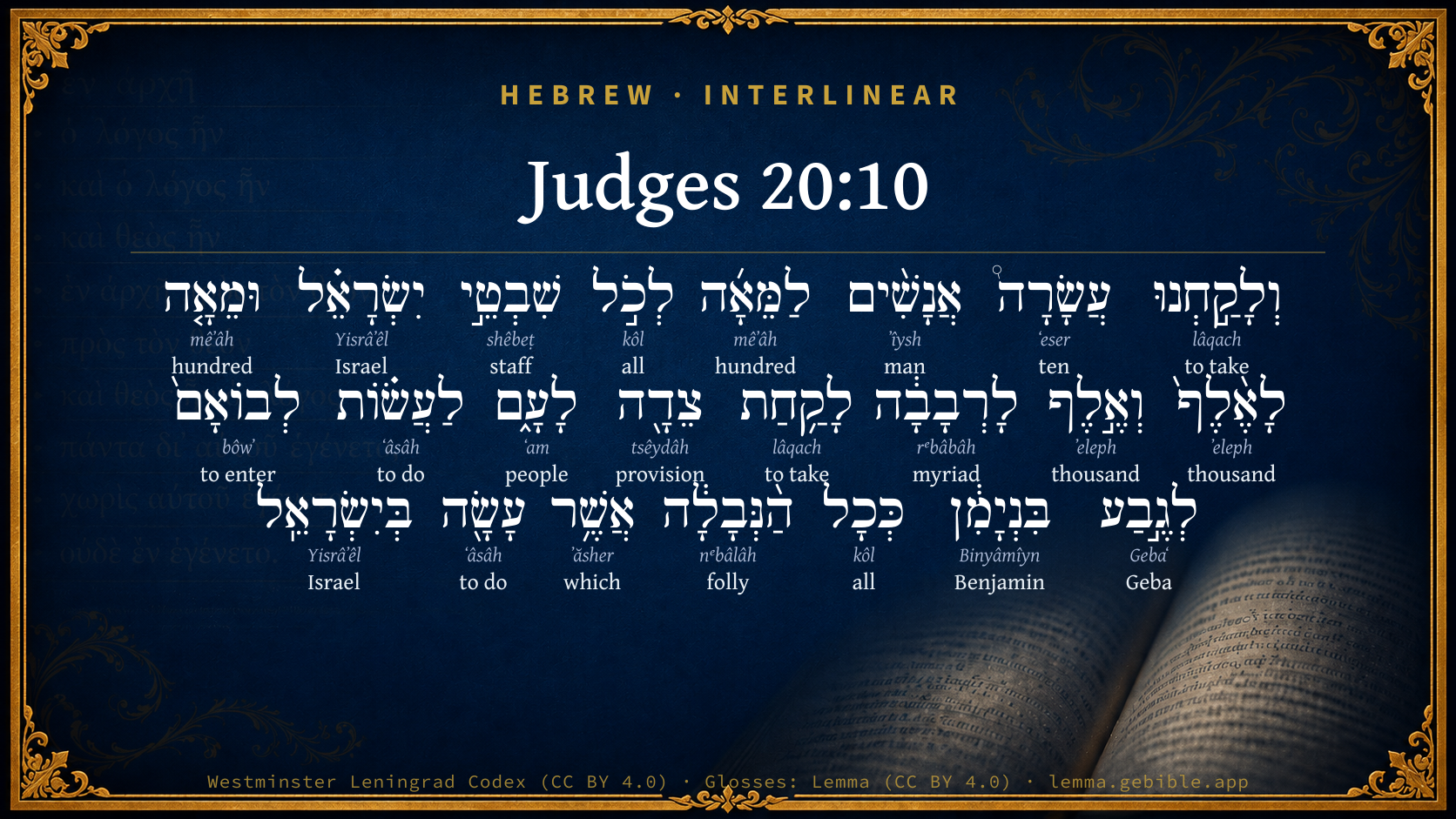
Hebrew (Westminster Leningrad Codex) Judges 20:10 appears in the Hebrew Old Testament. The text above is from the Westminster Leningrad Codex. Each word links to its Strong’s number, a concise gloss, and parsing drawn from the Open Scriptures Hebrew Bible morphology. Click any word for its full Brown-Driver-Briggs (BDB) entry.
Download image
Cite this verse

Judges 20:10 (World English Bible). Public Domain. Lemma interlinear Bible study tool, https://lemma.gebible.app/v/judges/20/10.

Show BibTeX & RIS
BibTeX
RIS
English Translation
and we will take ten men of one hundred throughout all the tribes of Israel, and one hundred of one thousand, and a thousand out of ten thousand, to get food for the people, that they may do, when they come to Gibeah of Benjamin, according to all the folly that they have worked in Israel.
World English Bible · Public Domain
Download a study sheet

One document with this verse’s original text, its word-by-word gloss line, the meaning frame, cross-references with their text, attributed commentary, and full source and license credits — printable, and it pastes into notes with its structure intact.

This verse Autodidact and up

Study sheet (.html) Plain text (.txt)

A passage Seminary Student

Up to 50 verses in one chapter. A passage sheet keeps up to 6 commentary sources and 12 cross-references per verse, in the order this page ranks them, and says so on the sheet whenever that leaves anything out. Ask for a single verse and you get the Autodidact verse sheet above.

Everything on this page stays free to read, with no account — the sheet is a download of what is already on screen, not access to it.

Want to remove ads? Support Godless Engineer
Compare translations 3

The same verse in 3 English versions, stacked beneath the original-language interlinear above. Click any original word for its lexicon entry.

Each is an independent rendering of the whole verse — the interlinear is not word-aligned to these translations.

Highlighted words mark where these versions differ — a whole-verse word diff, not a word-by-word alignment.

  • World English Bible Public Domain
    and we will take ten men of one hundred throughout all the tribes of Israel, and one hundred of one thousand, and a thousand out of ten thousand, to get food for the people, that they may do, when they come to Gibeah of Benjamin, according to all the folly that they have worked in Israel.
  • King James Version Public Domain
    And we will take ten men of an hundred throughout all the tribes of Israel, and an hundred of a thousand, and a thousand out of ten thousand, to fetch victual for the people, that they may do, when they come to Gibeah of Benjamin, according to all the folly that they have wrought in Israel.
  • unfoldingWord Literal Text CC BY-SA 4.0
    Now we will take ten men of a hundred from all of the tribes of Israel, and a hundred from a thousand, and a thousand from a myriad, to get provision for the people, to do at their coming to Gibeah in Benjamin according to all of the outrage that it did in Israel.”

unfoldingWord Literal Text — © unfoldingWord, licensed CC BY-SA 4.0. Word-aligned USFM3 via Door43 (git.door43.org/unfoldingWord/en_ult).

Versions to compare (up to 4)

3 of 4 selected

Show all 18 translations

Every available English version of this verse, each an independent rendering of the whole verse.

  • World English Bible Public Domain
    and we will take ten men of one hundred throughout all the tribes of Israel, and one hundred of one thousand, and a thousand out of ten thousand, to get food for the people, that they may do, when they come to Gibeah of Benjamin, according to all the folly that they have worked in Israel.
  • Berean Standard Bible Public Domain
    We will take ten men out of every hundred from all the tribes of Israel, and a hundred out of every thousand, and a thousand out of every ten thousand, to supply provisions for the army when they go to Gibeah in Benjamin to punish them for the atrocity they have committed in Israel.”
  • Majority Standard Bible Public Domain
    We will take ten men out of every hundred from all the tribes of Israel, and a hundred out of every thousand, and a thousand out of every ten thousand, to supply provisions for the army when they go to Gibeah in Benjamin to punish them for the atrocity they have committed in Israel.”
  • King James Version Public Domain
    And we will take ten men of an hundred throughout all the tribes of Israel, and an hundred of a thousand, and a thousand out of ten thousand, to fetch victual for the people, that they may do, when they come to Gibeah of Benjamin, according to all the folly that they have wrought in Israel.
  • American Standard Version (1901) Public Domain
    and we will take ten men of a hundred throughout all the tribes of Israel, and a hundred of a thousand, and a thousand out of ten thousand, to fetch victuals for the people, that they may do, when they come to Gibeah of Benjamin, according to all the folly that they have wrought in Israel.
  • Revised Version (1885) Public Domain
    and we will take ten men of an hundred throughout all the tribes of Israel, and an hundred of a thousand, and a thousand out of ten thousand, to fetch victual for the people, that they may do, when they come to Gibeah of Benjamin, according to all the folly that they have wrought in Israel.
  • Geneva Bible (1599) Public Domain
    And we wil take ten men of the hundreth throughout al the tribes of Israel, and an hundreth of the thousand, and a thousand of ten thousand to bring vitaile for the people that they may do (when they come to Gibeah of Beniamin) according to all the villeny, that it hath done in Israel.
  • Douay-Rheims (1899) Public Domain
    We will take ten men of a hundred out of all the tribes of Israel, and a hundred out of a thousand, and a thousand out of ten thousand, to bring victuals for the army, that we might fight against Gabaa of Benjamin, and render to it for its wickedness, what it deserveth.
  • Young's Literal Translation Public Domain
    and we have taken ten men of a hundred, of all the tribes of Israel, and a hundred of a thousand, and a thousand of a myriad, to receive provision for the people, to do, at their coming to Gibeah of Benjamin, according to all the folly which it hath done in Israel.'
  • Literal Standard Version CC BY-SA 4.0
    And we have taken ten men of one hundred, of all the tribes of Israel, and one hundred of a thousand, and a thousand of a myriad, to receive provision for the people, to do, at their coming to Gibeah of Benjamin, according to all the folly which it has done in Israel.”
  • Unlocked Literal Bible CC BY-SA 4.0
    We will take ten men of a hundred throughout all the tribes of Israel, and one hundred of a thousand, and one thousand of ten thousand, to get provisions for these people, so that when they come to Gibeah in Benjamin, they may punish them for the wickedness they committed in Israel.”
  • unfoldingWord Literal Text CC BY-SA 4.0
    Now we will take ten men of a hundred from all of the tribes of Israel, and a hundred from a thousand, and a thousand from a myriad, to get provision for the people, to do at their coming to Gibeah in Benjamin according to all of the outrage that it did in Israel.”
  • Darby Bible Public Domain
    and we will take ten men of a hundred throughout all the tribes of Israel, and a hundred of a thousand, and a thousand of ten thousand, to bring provisions for the people, that when they come they may requite Gib'e-ah of Benjamin, for all the wanton crime which they have committed in Israel."
  • World Messianic Bible Public Domain
    and we will take ten men of one hundred throughout all the tribes of Israel, and one hundred of one thousand, and a thousand out of ten thousand to get food for the people, that they may do, when they come to Gibeah of Benjamin, according to all the folly that the men of Gibeah have done in Israel.”
  • Webster's Bible Public Domain
    And we will take ten men of a hundred throughout all the tribes of Israel, and a hundred of a thousand, and a thousand out of ten thousand, to fetch provisions for the people, that they may do, when they come to Gibeah of Benjamin, according to all the folly that they have wrought in Israel.
  • Free Bible Version CC BY-SA 4.0
    We'll take ten men from a hundred from all the Israelite tribes, then a hundred from a thousand, then a thousand from ten thousand, to arrange food for the army, so when the troops reach Gibeah in Benjamin, they can pay them back for all these disgusting things they've done in Israel.”
  • Bible in Basic English Public Domain
    And we will take ten men out of every hundred, through all the tribes of Israel, a hundred out of every thousand, a thousand out of every ten thousand, to get food for the people, so that they may give to Gibeah of Benjamin the right punishment for the act of shame they have done in Israel.
  • JPS Tanakh (1917) Public Domain
    and we will take ten men of a hundred throughout all the tribes of Israel, and a hundred of a thousand, and a thousand out of ten thousand, to fetch victuals for the people, that they may do, when they come to Gibeah of Benjamin, according to all the wantonness that they have wrought in Israel.'

Literal Standard Version (2020), Covenant Press — licensed CC BY-SA 4.0. Text via the HelloAO Bible API (eBible.org). Unlocked Literal Bible (unfoldingWord) — licensed CC BY-SA 4.0. Text via the HelloAO Bible API (eBible.org). unfoldingWord Literal Text — © unfoldingWord, licensed CC BY-SA 4.0. Word-aligned USFM3 via Door43 (git.door43.org/unfoldingWord/en_ult). Free Bible Version, Dr. Jonathan Gallagher — licensed CC BY-SA 4.0. Text via the HelloAO Bible API (eBible.org).

Word by word

More ways to search: Search by grammar → Find every occurrence → Compare this word →

Practice this passage: Drill this verse → Learn its vocabulary →

צֵדָ֖ה
tsêydâh
H6720
“provision”
Noun, Common, Both, Singular, Absolute
Part of Speech
Noun
Type
Common
Gender
Both
Number
Singular
State
Absolute
Full BDB Definition

Origin: from H6718

TWOT: 1886b

provision, food
  1. וְלָקַ֣חְנוּ lâqach H3947 “and · to take” Conjunction + Verb, Qal, Sequential Perfect, 1st Person, Common, Plural
  2. עֲשָׂרָה֩ ʻeser H6235 “ten” Adjective, Cardinal number, Masculine, Singular, Absolute
  3. אֲנָשִׁ֨ים ʼîysh H376 “men” Noun, Common, Masculine, Plural, Absolute
  4. לַמֵּאָ֜ה mêʼâh H3967 “to/for the · hundred” Preposition, Determined + Adjective, Cardinal number, Both, Singular, Absolute
  5. לְכֹ֣ל kôl H3605 “to/for · all of” Preposition + Noun, Common, Masculine, Singular, Construct
  6. שִׁבְטֵ֣י shêbeṭ H7626 “staffs of” Noun, Common, Masculine, Plural, Construct
  7. יִשְׂרָאֵ֗ל Yisrâʼêl H3478 “Israel” Noun, Proper
  8. וּמֵאָ֤ה mêʼâh H3967 “and · hundred” Conjunction + Adjective, Cardinal number, Both, Singular, Absolute
  9. לָאֶ֨לֶף֙ ʼeleph H505 “to/for the · thousand” Preposition, Determined + Adjective, Cardinal number, Both, Singular, Absolute
  10. וְאֶ֣לֶף ʼeleph H505 “and · thousand” Conjunction + Adjective, Cardinal number, Both, Singular, Absolute
  11. לָרְבָבָ֔ה rᵉbâbâh H7233 “to/for the · myriad” Preposition, Determined + Noun, Common, Feminine, Singular, Absolute
  12. לָקַ֥חַת lâqach H3947 “to take” Preposition + Verb, Qal, Infinitive Construct
  13. לָעָ֑ם ʻam H5971 “to/for the · people” Preposition, Determined + Noun, Common, Masculine, Singular, Absolute
  14. לַעֲשׂ֗וֹת ʻâsâh H6213 “to do” Preposition + Verb, Qal, Infinitive Construct
  15. לְבוֹאָם֙ bôwʼ H935 “to enter · them” Preposition + Verb, Qal, Infinitive Construct + Suffix, Personal, 3rd Person, Masculine, Plural
  16. לְגֶ֣בַע Gebaʻ H1387 “to/for · Geba” Preposition + Noun, Proper
  17. בִּנְיָמִ֔ן Binyâmîyn H1144 “Benjamin” Noun, Proper
  18. כְּכָל kôl H3605 “like/as · all of” Preposition + Noun, Common, Masculine, Singular, Construct
  19. הַ֨נְּבָלָ֔ה nᵉbâlâh H5039 “the · folly” Particle, Definite Article + Noun, Common, Feminine, Singular, Absolute
  20. אֲשֶׁ֥ר ʼăsher H834 “which” Particle, Relative
  21. עָשָׂ֖ה ʻâsâh H6213 “to do” Verb, Qal, Perfect, 3rd Person, Masculine, Singular
  22. בְּיִשְׂרָאֵֽל Yisrâʼêl H3478 “in/at · Israel” Preposition + Noun, Proper

About this verse

These counts appear in no published source. They are computed here, from the morphology-tagged text and Lemma’s own curated glosses. What Lemma adds →

23
words
17
distinct lemmas
Historical
section

Notable vocabulary

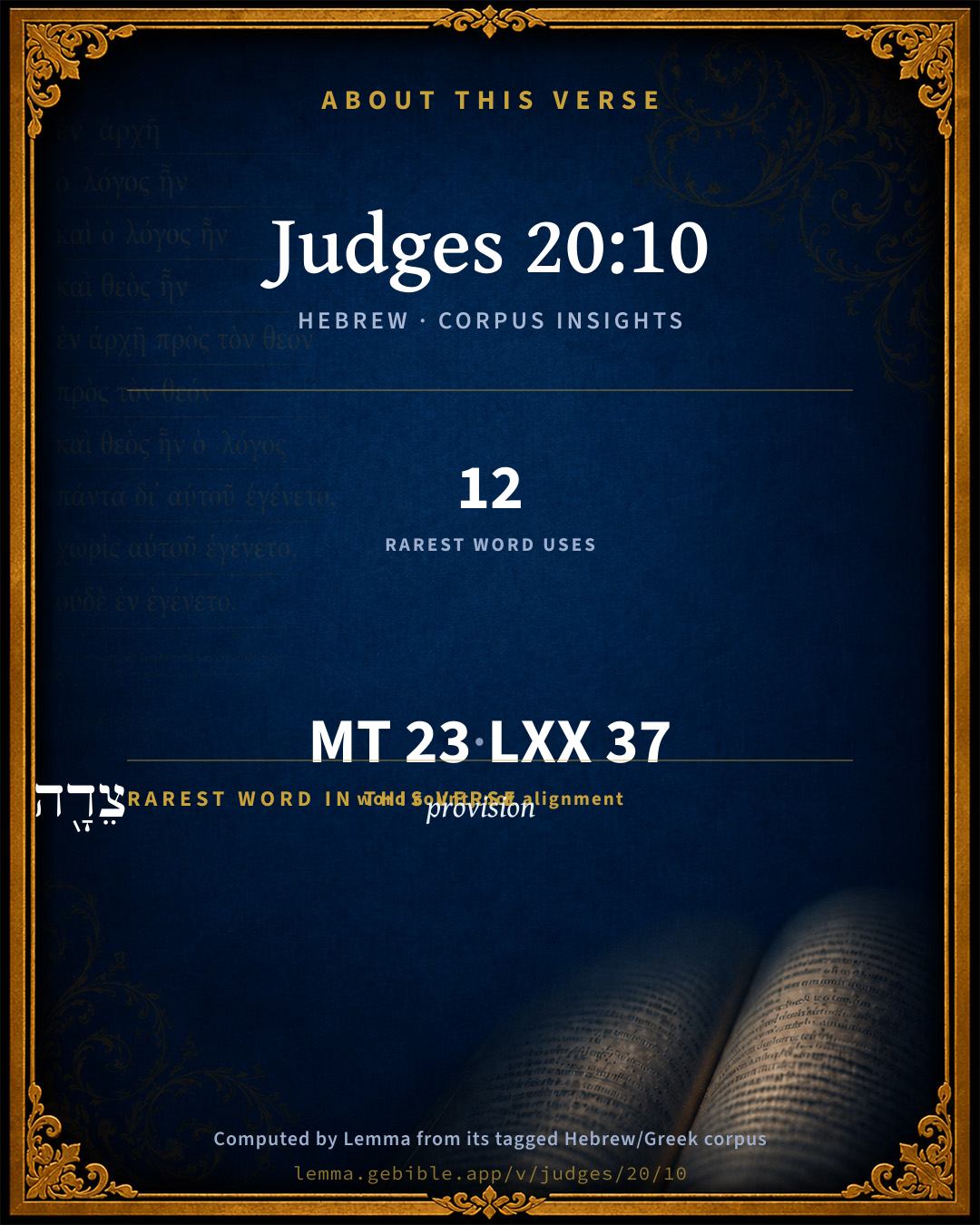
The rarest word here is צֵדָ֖ה provision H6720 — appearing just 12 times in the whole Hebrew Bible.

Shared distinctive vocabulary

צֵדָ֖ה provision H6720 occurs in 11 verses of the Hebrew Bible. Also found in:

Grammatical profile

  • 5 verbs
  • 12 nouns
  • 5 adjectives
  • 1 particle

Verb forms

  • וְלָקַ֣חְנוּ Qal · Sequential Perfect
  • לָקַ֥חַת Qal · Infinitive Construct
  • לַעֲשׂ֗וֹת Qal · Infinitive Construct
  • לְבוֹאָם֙ Qal · Infinitive Construct
  • עָשָׂ֖ה Qal · Perfect

Repetition

Words recur within this verse — often emphatic in Hebrew:

  • וְלָקַ֣חְנוּ to take H3947 ×2
  • לַמֵּאָ֜ה hundred H3967 ×2
  • לְכֹ֣ל all H3605 ×2
  • יִשְׂרָאֵ֗ל Israel H3478 ×2
  • לָאֶ֨לֶף֙ thousand H505 ×2
  • לַעֲשׂ֗וֹת to do H6213 ×2

Hebrew & Septuagint length

In English translation the verse runs 56 words from the Hebrew and 53 from the Septuagint (LXX English) — closely comparable.

A rough comparison of the two English renderings, which tokenize alike — not a word-level alignment.

Word counts can differ between the Hebrew and the Greek without any difference in meaning — e.g. the Hebrew direct-object marker אֵת has no separate Greek word, and Greek often adds the article ὁ.

In the original languages it is 23 Hebrew tokens and 37 Greek tokens — but the two are counted differently (Hebrew bundles its prefixes and suffixes into one token; the Greek is in lemma form), so that isn’t a like-for-like length.

Hebrew and Greek witnesses Masoretic Hebrew ↔ Greek Septuagint

The same verse in the two great witnesses to the Old Testament, shown verse-for-verse.

These are two independent witnesses, not word-aligned to each other, and the Septuagint is shown in lemma (dictionary) form.

Hebrew Judges 20:10 Masoretic · Westminster Leningrad Codex

וְלָקַ֣חְנוּ עֲשָׂרָה֩ אֲנָשִׁ֨ים לַמֵּאָ֜ה לְכֹ֣ל שִׁבְטֵ֣י יִשְׂרָאֵ֗ל וּמֵאָ֤ה לָאֶ֨לֶף֙ וְאֶ֣לֶף לָרְבָבָ֔ה לָקַ֥חַת צֵדָ֖ה לָעָ֑ם לַעֲשׂ֗וֹת לְבוֹאָם֙ לְגֶ֣בַע בִּנְיָמִ֔ן כְּכָל הַ֨נְּבָלָ֔ה אֲשֶׁ֥ר עָשָׂ֖ה בְּיִשְׂרָאֵֽל

and we will take ten men of one hundred throughout all the tribes of Israel, and one hundred of one thousand, and a thousand out of ten thousand, to get food for the people, that they may do, when they come to Gibeah of Benjamin, according to all the folly that they have worked in Israel.

World English Bible · Public Domain

Greek LXX Judges 20:10 Septuagint · lemma form

πλήν λαμβάνω δέκα ἀνήρ ὁ ἑκατόν εἰς πᾶς φυλή ἰσραήλ καί ἑκατόν ὁ χίλιοι καί χίλιοι ὁ μύριοι λαμβάνω ἐπισιτισμός ὁ ποιέω ἔρχομαι αὐτός εἰς γαβαα βενιαμίν ποιέω αὐτός κατά πᾶς ὁ ἀπόπτωμα ὅς ποιέω ἐν ἰσραήλ

Moreover we will take ten men for one hundred for all the tribes of Israel, and one hundred for a thousand, and a thousand for ten thousand, to take provision, to cause them to come to Gabaa of Benjamin, to do to it according to all the abomination, which they wrought in Israel.

LXX2012 (modern English Septuagint) · Public Domain

On this verse, The Cambridge Bible for Schools and Colleges discusses the Septuagint’s reading. Read the note in Commentary ↓

Hebrew: Westminster Leningrad Codex (CC BY 4.0). Greek: Septuagint (public domain); English from LXX2012 (modern English Septuagint) (Public Domain). How the Septuagint differs from the Hebrew →

Targum (Aramaic paraphrase)

1

The Targum is the ancient Jewish Aramaic paraphrase of the Hebrew Scriptures — an interpretive translation, not the Hebrew text itself. Onkelos (literal) and Pseudo-Jonathan (expansive) render the Torah, and Jonathan the Prophets. Coverage is partial: where no permissively-licensed English translation exists for a verse, only the Aramaic is shown. This is verse-level text, not a word-by-word alignment to the Hebrew.

  1. Targum Jonathan Prophets (Joshua–Malachi)
    וּנְדַבֵּר עַשְׂרָא גַבְרִין לִמְאָה לְכָל שִׁבְטַיָא דְיִשְׂרָאֵל וּמְאָה לְאַלְפָא וְאַלְפָא לְרִבּוֹתָא לְמִיסַב זְוָדִין לְעַמָא לְמֶעֱבַּד לְאַיְתָיוּתְהוֹן לְגִבְעָתָא דְבֵית בִּנְיָמִין כְּכָל קְלָנָא דְאִתְעֲבִיד בְּיִשְׂרָאֵל:

    (no public-domain English translation for this verse)

    Targum Jonathan — Aramaic: “Mikraot Gedolot” (public domain). English: “Sefaria Community Translation” (CC0 1.0 (public-domain dedication)); “London "Chaldee Paraphrase," 1871” (public domain). Text via Sefaria.

Commentary

Notes on Judges 20:10 from classic Christian and Jewish commentators (each source and its license shown beneath its notes). The classic Christian expositions comment on the surrounding passage and are grouped to its opening verse, so a note may address several verses; the Jewish commentaries on the Tanakh (Rashi and others) are per-verse, so they appear only where the commentator wrote on this verse.

Lemma curates 59 commentaries, every one of them public domain or Creative Commons licensed, each selected and text-cleaned for this edition rather than reprinted as found. About our sources →

Trapp's Complete Commentary

John Trapp

Jdg 20:10 And we will take ten men of an hundred throughout all the tribes of Israel, and an hundred of a thousand, and a thousand out of ten thousand, to fetch victual for the people, that they may do, when they come to Gibeah of Benjamin, according to all the folly that they have wrought in Israel.

Ver. 10. To fetch victual for the people.] For, Animantis cuiusque vita in fuga est, saith the philosopher: Were it not for the repair of nutrition, the natural life would soon be extinguished.

John Trapp, A Commentary or Exposition upon All the Books of the Old and New Testament (1647–1656) — public domain. Text from a community e-Sword module.

Geneva Bible (1599)

Geneva Bible translators

These only should have the charge to provide for vittles for the rest.

Geneva Bible (1599) marginal notes — public domain. Text via Bolls.life.

Adam Clarke's Commentary

Verse 10. Ten men of a hundred] Expecting that they might have a long contest, they provide suttlers for the camp; and it is probable that they chose these tenths by lot.

Adam Clarke's Commentary on the Bible (1810–1826) — public domain. Text from a community e-Sword/MySword module.

Ellicott's Commentary for English Readers

(10) Ten men of an hundred.—A tenth of the nation, chosen probably by lot, is to be responsible for the commissariat. They do not anticipate any other difficulty.

A Bible Commentary for English Readers, edited by Charles John Ellicott (1878–1897) — public domain. Text from a community e-Sword module.

The Cambridge Bible for Schools and Colleges

gen. ed. J. J. S. Perowne

10. ten men … ten thousand) All this merely amounts to ‘one man in ten’; 40,000 are to forage for the 360,000. We are reminded of the circumstantial diffuseness of P, e.g. Num_1:2; Num_1:20; Num_1:22 etc.; see Driver, Introd, p. 130. The style of the verse is remarkably poor; e.g. the single prep. lamedh = to is used nine times in a variety of senses; and the text is corrupt. The rendering that they may do when they come smooths over the awkwardness of the Hebr. The LXX. cod. A suggests a slight change and transposes the words, reading for the people that come to do to G. etc. The trouble lies in the expression for when they come (or that come); Moore and Budde would omit it as a gloss on the people; indeed there is no other way of obtaining a satisfactory sentence. The connexion is much improved by transposing the two halves of the v. and connecting with Jdg_20:9 : we will go up against it by lot, to do to G. of B. according to … in Israel; and we will take ten men … to fetch victual for the people (Moore). Geba (see marg.) is a mistake for Gibeah, cf. Jdg_20:33.

The Cambridge Bible for Schools and Colleges (gen. ed. J. J. S. Perowne; Cambridge University Press, 1878–1918) — public domain. Text from a community e-Sword module.

John Gill's Exposition

And we will take ten men of an hundred, throughout all the tribes of Israel,.... Excepting that of Benjamin which was not with them, not any of them:

and a hundred out of a thousand, and a thousand out of ten thousand; in all 40,000, out of the 400,000:

to fetch victual for the people; ten men were to provide food for ninety, and one hundred men for nine hundred, and 1000 men for 9000, in all 40,000, for 360,000; these were either to go to their own tribes and habitations, or to the towns and cities adjacent, to procure food for this large army; for they came from their homes without any provision, not knowing that the affair would keep them long; but perceiving that it would require time before it could be determined, they judged it the wisest method for some to be appointed to take care of provision for the army, that it might not be scattered about on that account, but pursue the war with vigour till satisfaction was obtained:

that they might do, when they came to Gibeah of Benjamin, according to all the folly that they have wrought in Israel; punish with death the delinquents, and chastise the inhabitants, and especially the magistrates, for their connivance at such wicked persons among them, and negligence of doing their duty.

John Gill's Exposition of the Whole Bible (1746–1763) — public domain (CC PDM 1.0). Text via the HelloAO Bible API.

Albert Barnes' Notes on the Bible

In order to make it possible for the force of Israel to keep the field, and do to the men of Gibeah what their wickedness deserved, every tenth man (40,000 in all) was appointed to find provisions for the whole army.

Albert Barnes' Notes on the Bible (1834–1885) — public domain. Text from a community e-Sword/MySword module.

Matthew Poole's English Annotations

That they may do according to all the folly that they have wrought; that we may punish them as such a wickedness deserves.

In Israel: this is added as an aggravation, that they should do that in Israel, or among God’s peculiar people, which was esteemed abominable even among the heathen.

Matthew Poole's English Annotations on the Holy Bible (1683–1685) — public domain. Text from a community e-Sword/MySword module.

John Wesley's Explanatory Notes

According, &c. - That we may punish them as such a wickedness deserves. In Israel - This is added as an aggravation, that they should do that in Israel, or among God's peculiar people, which was esteemed abominable even among the Heathen.

John Wesley, Explanatory Notes Upon the Whole Bible (1754–1765) — public domain. Text via the GEBible commentary corpus.

unfoldingWord translationNotes

Door43 World Missions Community

ten men of a hundred ... one hundred of a thousand ... one thousand of ten thousand

"10 men out of 100 ... 100 out of 1,000 ... 1,000 out of 10,000" (See: Numbers)

provisions

food and other things the people need

assembled against the city

"came together to attack the city"

translationWords

tribe

Israel

Benjamin

punish

evil

assembly

unfoldingWord translationNotes — © Distant Shores Media and the Door43 World Missions Community, licensed CC BY-SA 4.0. Source: git.door43.org/Door43/en_tn.

Rashi

Rabbi Shlomo Yitzchaki (Rashi)

When taking action in their engagement in this engagement with Givas Binyomin, as befits their entirely loathsome, etc.

Rashi on the Tanakh — English translations: “The Judaica Press complete Tanach with Rashi, translated by A. J. Rosenberg” (CC BY 4.0); “Pentateuch with Rashi's commentary by M. Rosenbaum and A.M. Silbermann, 1929-1934” (public domain); “The Metsudah Tanach series, Lakewood, N.J” (CC BY 4.0); and “The Book of Joshua, Metsudah Publications, 1997” (CC BY 4.0). Text via Sefaria.

Lesson kit

Teaching starters — assembled from the data on this page, not authored interpretation. Every prompt links to the verse data it draws on. Edit before teaching.

Judges, in the Historical, opens this verse with 23 words (17 distinct Hebrew lemmas). Its most distinctive word is tsêydâh (“provision”). A historical commentator’s framing appears above. Read the whole chapter for the surrounding context.

Discussion questions

  1. How does “provision” (tsêydâh) shape what this verse is saying?
  2. How does Genesis 27:3, which shares the word «provision», read alongside this verse?
  3. What does the repetition of “to take” (2× in this one verse) do in this verse?
  4. These translations render this verse differently. What is at stake in choosing one wording over another?
  5. «וְלָקַ֣חְנוּ» is a Qal Sequential Perfect verb. How does that grammatical form shape the action described?
  6. Compare how Trapp's Complete Commentary and Geneva Bible (1599) read this verse. Where do they agree or differ?

Things to notice

Reading settings

Reading text

Shown beneath each verse's original-language words.

Old Testament
Old Testament edition

Read the OT as the Masoretic Hebrew (MT) or the Greek Septuagint (LXX).

English shown for the Greek Septuagint (in the Hebrew ↔ Greek comparison).

Comparing translations? Open the Compare panel on any verse page to stack up to four side by side.