
Psalms 90:4

Hebrew (Westminster Leningrad Codex) Psalms 90:4 appears in the Hebrew Old Testament. The text above is from the Westminster Leningrad Codex. Each word links to its Strong’s number, a concise gloss, and parsing drawn from the Open Scriptures Hebrew Bible morphology. Click any word for its full Brown-Driver-Briggs (BDB) entry.
Download image
Cite this verse

Psalms 90:4 (World English Bible). Public Domain. Lemma interlinear Bible study tool, https://lemma.gebible.app/v/psalms/90/4.

Show BibTeX & RIS
BibTeX
RIS
English Translation
For a thousand years in your sight Are but as yesterday when it is past, As a watch in the night.
World English Bible · Public Domain
Download a study sheet

One document with this verse’s original text, its word-by-word gloss line, the meaning frame, cross-references with their text, attributed commentary, and full source and license credits — printable, and it pastes into notes with its structure intact.

This verse Autodidact and up

Study sheet (.html) Plain text (.txt)

A passage Seminary Student

Up to 50 verses in one chapter. A passage sheet keeps up to 6 commentary sources and 12 cross-references per verse, in the order this page ranks them, and says so on the sheet whenever that leaves anything out. Ask for a single verse and you get the Autodidact verse sheet above.

Everything on this page stays free to read, with no account — the sheet is a download of what is already on screen, not access to it.

Want to remove ads? Support Godless Engineer
Compare translations 3

The same verse in 3 English versions, stacked beneath the original-language interlinear above. Click any original word for its lexicon entry.

Each is an independent rendering of the whole verse — the interlinear is not word-aligned to these translations.

Highlighted words mark where these versions differ — a whole-verse word diff, not a word-by-word alignment.

  • World English Bible Public Domain
    For a thousand years in your sight Are but as yesterday when it is past, As a watch in the night.
  • King James Version Public Domain
    For a thousand years in thy sight are but as yesterday when it is past, and as a watch in the night.
  • unfoldingWord Literal Text CC BY-SA 4.0
    For a thousand years in your eyes like the day before when it has passed, and a watch in the night.

unfoldingWord Literal Text — © unfoldingWord, licensed CC BY-SA 4.0. Word-aligned USFM3 via Door43 (git.door43.org/unfoldingWord/en_ult).

Versions to compare (up to 4)

3 of 4 selected

Show all 18 translations

Every available English version of this verse, each an independent rendering of the whole verse.

  • World English Bible Public Domain
    For a thousand years in your sight Are but as yesterday when it is past, As a watch in the night.
  • Berean Standard Bible Public Domain
    For in Your sight a thousand years are but a day that passes, or a watch of the night.
  • Majority Standard Bible Public Domain
    For in Your sight a thousand years are but a day that passes, or a watch of the night.
  • King James Version Public Domain
    For a thousand years in thy sight are but as yesterday when it is past, and as a watch in the night.
  • American Standard Version (1901) Public Domain
    For a thousand years in thy sight Are but as yesterday when it is past, And as a watch in the night.
  • Revised Version (1885) Public Domain
    For a thousand years in thy sight are but as yesterday when it is past, and as a watch in the night.
  • Geneva Bible (1599) Public Domain
    For a thousande yeeres in thy sight are as yesterday when it is past, and as a watch in the night.
  • Douay-Rheims (1899) Public Domain
    For a thousand years in thy sight are as yesterday, which is past. And as a watch in the night,
  • Young's Literal Translation Public Domain
    For a thousand years in Thine eyes `are' as yesterday, For it passeth on, yea, a watch by night.
  • Literal Standard Version CC BY-SA 4.0
    For one thousand years in Your eyes [are] as yesterday, || For it passes on, indeed, [as] a watch by night.
  • Unlocked Literal Bible CC BY-SA 4.0
    For a thousand years in your sight are as yesterday when it is past, and as a watch in the night.
  • unfoldingWord Literal Text CC BY-SA 4.0
    For a thousand years in your eyes like the day before when it has passed, and a watch in the night.
  • Darby Bible Public Domain
    For a thousand years, in thy sight, are as yesterday when it is past, and [as] a watch in the night.
  • World Messianic Bible Public Domain
    For a thousand years in your sight are just like yesterday when it is past, like a watch in the night.
  • Webster's Bible Public Domain
    For a thousand years in thy sight are but as yesterday when it is past, and as a watch in the night.
  • Free Bible Version CC BY-SA 4.0
    In your eyes, a thousand years are like a day that's already gone; like a few passing hours of the night.
  • Bible in Basic English Public Domain
    For to you a thousand years are no more than yesterday when it is past, and like a watch in the night.
  • JPS Tanakh (1917) Public Domain
    For a thousand years in Thy sight are but as yesterday when it is past, and as a watch in the night.

Literal Standard Version (2020), Covenant Press — licensed CC BY-SA 4.0. Text via the HelloAO Bible API (eBible.org). Unlocked Literal Bible (unfoldingWord) — licensed CC BY-SA 4.0. Text via the HelloAO Bible API (eBible.org). unfoldingWord Literal Text — © unfoldingWord, licensed CC BY-SA 4.0. Word-aligned USFM3 via Door43 (git.door43.org/unfoldingWord/en_ult). Free Bible Version, Dr. Jonathan Gallagher — licensed CC BY-SA 4.0. Text via the HelloAO Bible API (eBible.org).

Word by word

More ways to search: Search by grammar → Find every occurrence → Compare this word →

Practice this passage: Drill this verse → Learn its vocabulary →

וְאַשְׁמוּרָ֥ה
ʼashmurâh
H821
“and · watch”
Conjunction + Noun, Common, Feminine, Singular, Absolute
Part of Speech
Conjunction + Noun
Type
Common
Gender
Feminine
Number
Singular
State
Absolute
Full BDB Definition

Origin: from H8104

TWOT: 2414e

watch (a period of time), night-watch
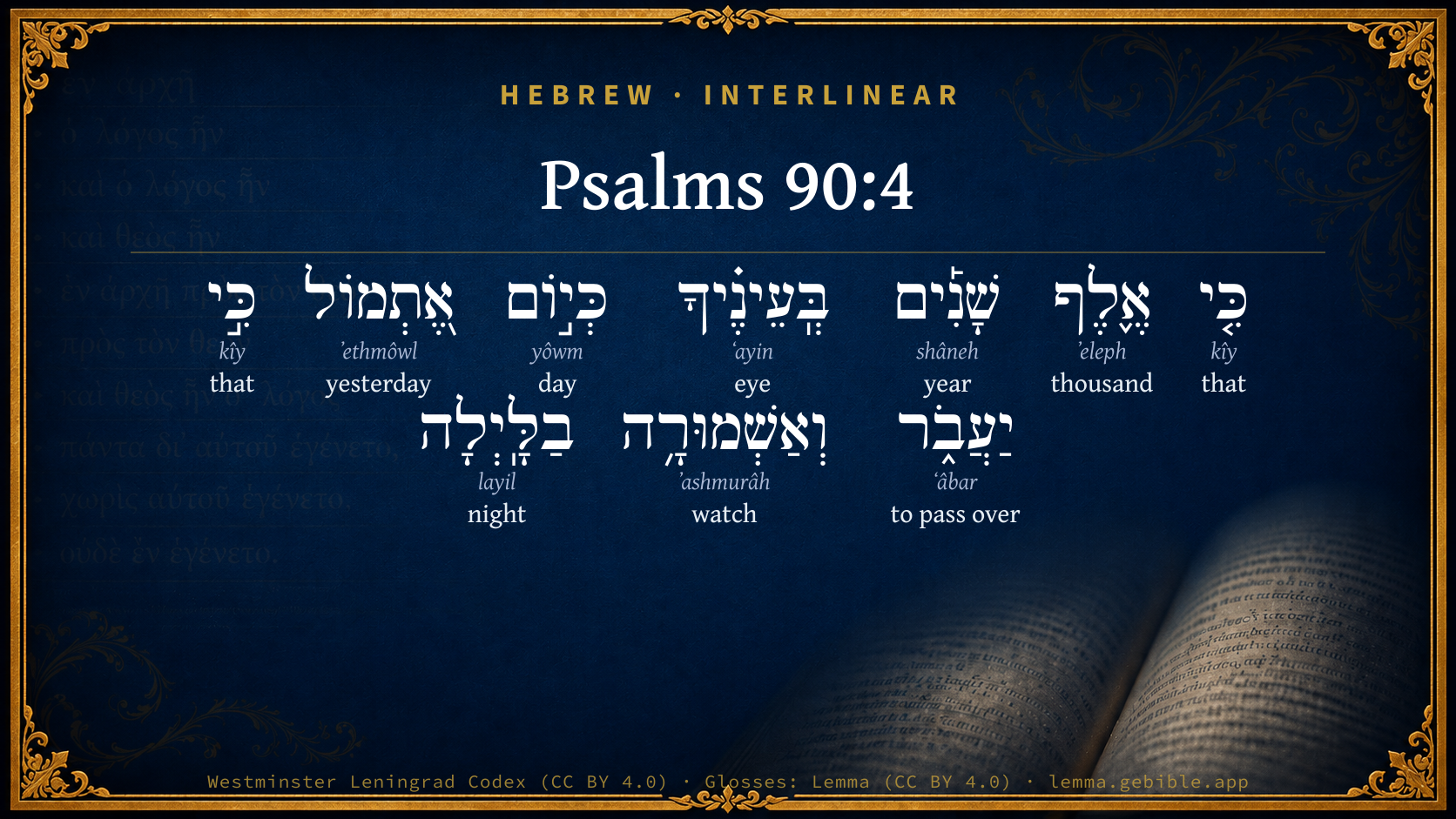
  1. כִּ֤י kîy H3588 “that” Conjunction
  2. אֶ֪לֶף ʼeleph H505 “thousand” Adjective, Cardinal number, Both, Singular, Absolute
  3. שָׁנִ֡ים shâneh H8141 “years” Noun, Common, Feminine, Plural, Absolute
  4. בְּֽעֵינֶ֗יךָ ʻayin H5869 “in/at · eyes · your” Preposition + Noun, Common, Both, Dual, Construct + Suffix, Personal, 2nd Person, Masculine, Singular
  5. כְּי֣וֹם yôwm H3117 “like/as · day” Preposition + Noun, Common, Masculine, Singular, Absolute
  6. אֶ֭תְמוֹל ʼethmôwl H865 “yesterday” Noun, Common, Masculine, Singular, Absolute
  7. כִּ֣י kîy H3588 “that” Conjunction
  8. יַעֲבֹ֑ר ʻâbar H5674 “to pass over” Verb, Qal, Imperfect, 3rd Person, Masculine, Singular
  9. בַלָּֽיְלָה layil H3915 “in/at the · night” Preposition, Determined + Noun, Common, Masculine, Singular, Absolute

About this verse

These counts appear in no published source. They are computed here, from the morphology-tagged text and Lemma’s own curated glosses. What Lemma adds →

10
words
9
distinct lemmas
Wisdom
section

Notable vocabulary

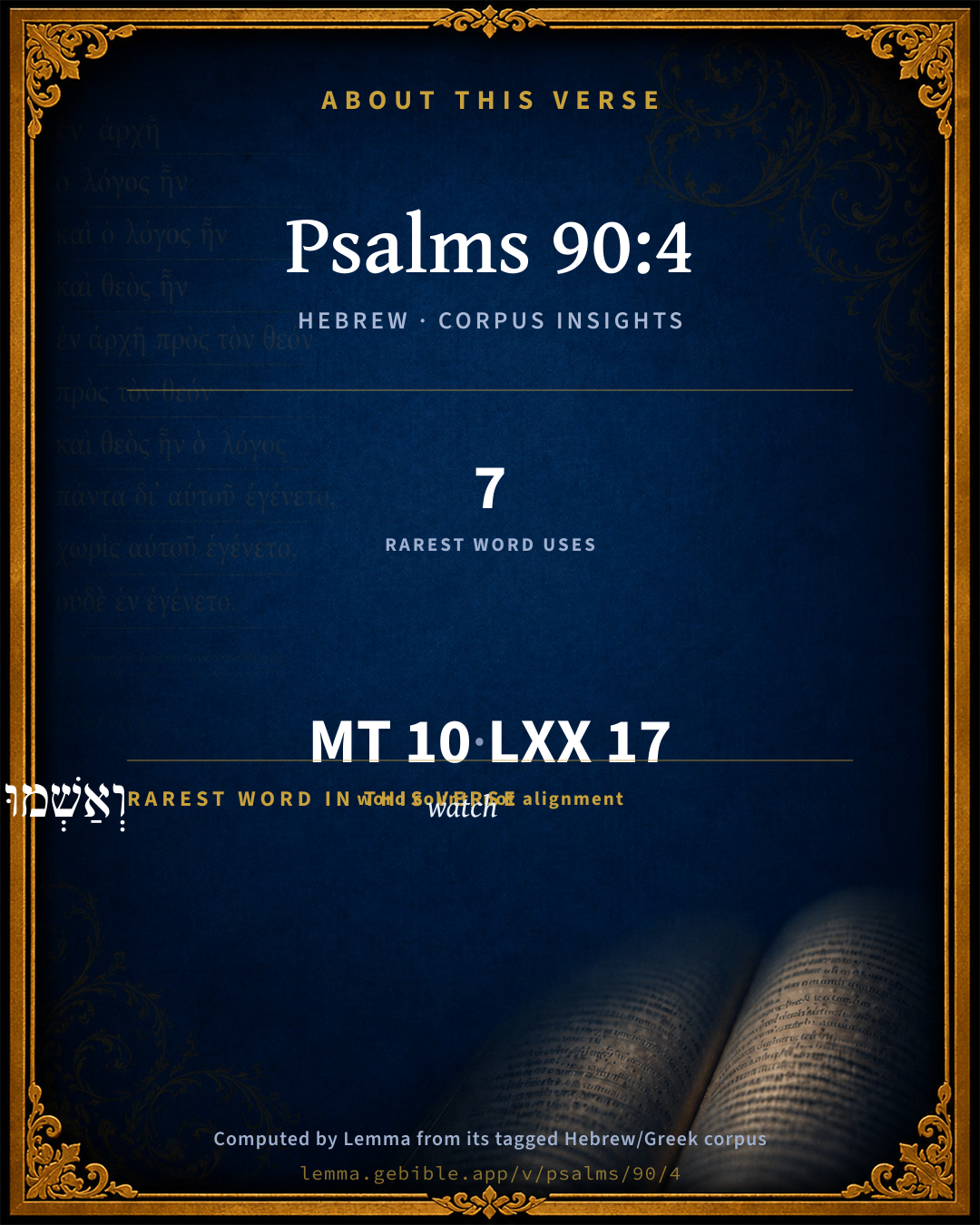
The rarest word here is וְאַשְׁמוּרָ֥ה watch H821 — appearing just 7 times in the whole Hebrew Bible.

Shared distinctive vocabulary

וְאַשְׁמוּרָ֥ה watch H821 occurs in 7 verses of the Hebrew Bible. Also found in:

Grammatical profile

  • 1 verb
  • 6 nouns
  • 1 adjective
  • 2 conjunctions

Verb forms

  • יַעֲבֹ֑ר Qal · Imperfect

Repetition

A word recurs within this verse — often emphatic in Hebrew:

  • כִּ֤י that H3588 ×2

Hebrew & Septuagint length

In English translation the verse runs 21 words from the Hebrew and 21 from the Septuagint (LXX English) — the same length.

A rough comparison of the two English renderings, which tokenize alike — not a word-level alignment.

Word counts can differ between the Hebrew and the Greek without any difference in meaning — e.g. the Hebrew direct-object marker אֵת has no separate Greek word, and Greek often adds the article ὁ.

In the original languages it is 10 Hebrew tokens and 17 Greek tokens — but the two are counted differently (Hebrew bundles its prefixes and suffixes into one token; the Greek is in lemma form), so that isn’t a like-for-like length.

Cross-references

5

Topical passages linked to Psalms 90:4 in the Treasury of Scripture Knowledge — connected by theme and wording, ordered by reader-vote popularity; previews shown in the World English Bible.

  • 2 Peter 3:8 But don't forget this one thing, beloved, that one day is with the Lord as a thousand years, and a thousand years as one day.
  • Psalms 39:5 Behold, you have made my days handbreadths. My lifetime is as nothing before you. Surely every man stands as a breath." Selah.
  • Matthew 24:43 But know this, that if the master of the house had known in what watch of the night the thief was coming, he would have watched, and would not have allowed his house to be broken into.
  • Luke 12:38 They will be blessed if he comes in the second or third watch, and finds them so.
  • Matthew 14:25 In the fourth watch of the night, Jesus came to them, walking on the sea.

Cross-references courtesy of OpenBible.info (CC BY 4.0).

Hebrew and Greek witnesses Masoretic Hebrew ↔ Greek Septuagint

The same verse in the two great witnesses to the Old Testament, shown verse-for-verse.

You’re reading Greek Psalm 89 (Hebrew Psalm 90). The Septuagint counts the superscription, so verse numbers can differ from the Hebrew — chapter-level alignment, not verse-by-verse. Numbering follows Rahlfs.

These are two independent witnesses, not word-aligned to each other, and the Septuagint is shown in lemma (dictionary) form.

Hebrew Psalms 90:4 Masoretic · Westminster Leningrad Codex

כִּ֤י אֶ֪לֶף שָׁנִ֡ים בְּֽעֵינֶ֗יךָ כְּי֣וֹם אֶ֭תְמוֹל כִּ֣י יַעֲבֹ֑ר וְאַשְׁמוּרָ֥ה בַלָּֽיְלָה

For a thousand years in your sight Are but as yesterday when it is past, As a watch in the night.

World English Bible · Public Domain

Greek LXX Greek Psalm 89:4 Septuagint · lemma form

ὅτι χίλιοι ἔτος ἐν ὀφθαλμός σύ ὡς ὁ ἡμέρα ὁ ἐχθές ὅστις διαἔρχομαι καί φυλακή ἐν νύξ

For a thousand years in your sight are as the yesterday which is past, and as a watch in the night.

LXX2012 (modern English Septuagint) · Public Domain

On this verse, Ellicott's Commentary for English Readers discusses the Septuagint’s reading. Read the note in Commentary ↓

Hebrew: Westminster Leningrad Codex (CC BY 4.0). Greek: Septuagint (public domain); English from LXX2012 (modern English Septuagint) (Public Domain). How the Septuagint differs from the Hebrew →

Commentary

Notes on Psalms 90:4 from classic Christian and Jewish commentators (each source and its license shown beneath its notes). The classic Christian expositions comment on the surrounding passage and are grouped to its opening verse, so a note may address several verses; the Jewish commentaries on the Tanakh (Rashi and others) are per-verse, so they appear only where the commentator wrote on this verse.

Lemma curates 59 commentaries, every one of them public domain or Creative Commons licensed, each selected and text-cleaned for this edition rather than reprinted as found. About our sources →

The Cambridge Bible for Schools and Colleges

gen. ed. J. J. S. Perowne

4. The precise connexion of the thought is obscure. Some commentators connect Psa_90:4 with Psa_90:2, treating Psa_90:3 as a parenthesis. ‘Thou art eternal, for lapse of time makes no difference to Thee.’ But it seems preferable to connect Psa_90:4 directly with Psa_90:3. ‘Thou sweepest away one generation after another, for the longest span of human life is but a day in Thy sight: though a man should outlive the years of Methuselah, it is as nothing in comparison with eternity.’

when it is past] Strictly, when it is on the point of passing away. A whole millennium to God, as He reviews it, is but as the past day when it draws towards its close,—a brief space with all its events still present and familiar to the mind. Cp. 2Pe_3:8, where the converse truth is also affirmed; Sir_18:10.

and as a watch in the night] A climax. Said I like the past day? Nay, time no more exists for God than it does for the unconscious sleeper. The Israelites divided the night into three watches (Lam_2:19; Jdg_7:19; 1Sa_11:11). The division into four watches mentioned in the N.T. was of Roman origin.

How could the profound truth that time has no existence to the Divine mind be more simply and intelligibly expressed? To God there is no before and after; no past and future; all is present. To Him ‘was, and is, and will be, are but is.’ It is only the weakness of the finite creature that ‘shapes the shadow, Time.’

The Cambridge Bible for Schools and Colleges (gen. ed. J. J. S. Perowne; Cambridge University Press, 1878–1918) — public domain. Text from a community e-Sword module.

Trapp's Complete Commentary

John Trapp

Psa 90:4 For a thousand years in thy sight [are but] as yesterday when it is past, and [as] a watch in the night.

Ver. 4. For a thousand years in thy sight, &c.] q.d. Live men a longer or shorter space, Serius aut citius, thou endest their days; and in comparison of thine eternity, Puncture est quod vivimus et puncto minus, it is a small span of time that the longest liver hath upon earth, 2Pe 3:8 Psa 39:5. Non multum sane abest a nihilo. Some would hence infer, that the day of judgment shall last a thousand years; fides sit penes authores.

When it is past] We judge better of the shortness of time, when it is past.

And as a watch in the night] Which is but three hours’ time; for soldiers divide the night into four watches, and our life is full of the darkness of error and terror.

John Trapp, A Commentary or Exposition upon All the Books of the Old and New Testament (1647–1656) — public domain. Text from a community e-Sword module.

The Biblical Illustrator

Joseph S. Exell

Psa_90:4

For a thousand years in Thy sight are but as yesterday when it is past, and as a watch in the night.

Gods estimate of time

1. Let us set this truth before our minds: that which seems a long season to man seems a very brief season to God.

(1) God has lived for ever. Farther back than our strongest thought can travel, farther back than our swiftest wing or fancy can fly, and there our God was. As a drop in the boundless ocean, so is a cycle of a thousand years in the view of Him who is alike without beginning of days and end of years.

(2) If God estimates the years by the magnitude of His empire, by the multiplicity of His cares, by the wide sweep of His eternal purposes, then no wonder that with God a thousand years are but as yesterday when it is past.

(3) Our Father in Heaven has an unspeakable blessedness. He is infinitely wise, holy, and good. He is love. His tender mercies are over all His works. He tastes for ever the perfect joy of creating bliss, and conferring it upon others.

2. I proceed to point out the practical uses of this truth.

(1) It helps our deep awe and holy reverence. The fear of the Lord is the beginning of wisdom, as surely as love to God is the very summit of perfection.

(2) One way of keeping the world in its proper subordinate place is to more frequently fasten our attention on these subjects,--the power and grandeur of God, the eternity of His being, the perfection of His character, the boundlessness of His empire. These things have power to lift our minds on high.

(3) Lastly and chiefly: the practical use of this text is to strengthen our patience, and to cherish in us the assurance that, however long delayed, the purposes of God will be accomplished, the promises of God will be fulfilled. (C. Vince.)

The long day of God

With the Deity, such a vast existence indicates only vast events. And these events must necessarily assume the form of a progress in which the present shall become the cause of the morrow, for any other method would either make eternity a monotone, or else a reckless succession like the results of chance, the throwing of dice, or the forms assumed in the kaleidoscope. In ages and centuries where the mind has become aroused into that action which is called civilization, it is utterly impossible to believe in God except as being the Supreme Activity. Assuming, then, this Divine activity, we may the more readily assert that the endless events of this God will assume the form of a progress. This assumption of a universal law is justified by the fact proclaimed in many special laws. The acorn passes to leaf, to twig, to bush, to sapling, to tree, to the great monarch of the forest. In its long life each year is a progress, each day being the cause in part of the next day. Its second year so multiplies the leaves that they breathe in a double quantity of air in behalf of the third year, and the roots of the second year so redouble the nutriment on hand that they also order an advance of the whole plant for the next springtime. All that we see around us in the organic form is acting under a law of progress, hence it does not seem hasty if we conclude that all the events coming from the Divine activity are occurring in the form of a progression, the present being a result of the past and a cause of the future. If, as we all believe, man is an image of the Creator, we may read in the human mind a confirmation of the idea that God is expressing Himself in a continuous series of events, for in such a career only does man, Gods image, find happiness. The idea that God once acted should be crowded out by the idea that He is now acting. The world is a chain in which all the links are equally valuable, because each one is an inseparable part--a part without which there is no value in the chain. Hence you stand as much in the presence of God to-day as stood the earth when God was planting the Garden of Eden for the first sons of man. It may be that the external world, with all its forms and laws, is nothing else than the spiritual God, expressing Himself in visible and audible and tangible forms, in order that our souls may possess some outward revelation of the Deity. The light that makes myriads of colours, the sound that is divided up into music, the height and depth that are emblems to us of infinity, the grandeur of the star depths, and the millions of years consumed in their orbits, may be the only ladders upon which our humble feet can climb to any belief in a God. The laws of the universe, instead of concealing a God, do reveal Him, for they are the footprints of One whose form cannot otherwise be traced As the delicate wire of Franklin revealed an agency of which he had only dreamed--as it became a Jacobs ladder upon which the invisible angels came down from the clouds--so the whole material world must be concluded as the path where God bursts from His invisible spirit-life out upon the sight of His children. Hence the laws of Nature are not indications that there is no God, or that there once was, but they are the places and the times when and where this Creator continually confesses His presence. The thousand-year day of God seems to argue that His children will not be limited to the earthly mornings and evenings, but will rise to where they can, like their Heavenly Father, see the past and the present, rise to where the love and memory dimmed by a few years have many returns to the souls torn asunder in this vale. If in Gods sight the children of earth stand near together, so that Paul and Wesley mingle their eloquence, and Magdalen and Guyon mingle their love, and Lovejoy and Lincoln their liberty and blood, then this thousand-year day which so mingles things separated on earth should be mans day also beyond the tomb, that there, in blest companionship, souls may meet which toiled here for one end, but who never saw the faces about to follow them, nor saw the golden harvest destined to spring from their blood and tears. If to God the graves of Paul and Fenelon, of Magdalen and the Dairymans Daughter, of Lovejoy and Wiberforce, are all close together; under the same flowers and same Divine presence, there should be a realm beyond where those sleeping souls should wake to consciousness of their blended lives. (D. Swing.)

The Biblical Illustrator, edited by Joseph S. Exell (c. 1880s–1900s) — public domain. Text from a community e-Sword module.

Joseph Benson's Commentary

Psa 90:4. For a thousand years — If we should now live so long, (as some of our progenitors nearly did,) in thy sight — In thy account, and therefore in truth; which is opposed to the partial and false judgment of men, who think time long because they do not understand eternity; or, in comparison of thy endless duration, are but as yesterday, when it is past — Which is emphatically added, because time seems long when it is to come, but when it is passed, and men look back upon it, it seems very short and contemptible. And as a watch in the night — Which lasted but three or four hours.

Joseph Benson's Commentary on the Old and New Testaments (1811–1818) — public domain. Text from a community e-Sword module.

J. A. Alexander on Psalms

Joseph Addison Alexander

4. (Psa 90:4) For a thousand years in thine eyes (are) as yesterday when it is past and a watch in the night. However long human life may appear to man himself, it is in God's sight evanescent and contemptible. Even the patriarchal measure, which so often approximated to a thousand years, was in God's sight like a single day in man's, or rather like a mere subdivision of it, a third part of the night, which was divided by the ancient Hebrews into three watches. See above, on Psa 63:6. That this division was as old as Moses, may be seen from Exo 14:24. When it is past, or passing. It might also be translated, for it passes, i.e. no less hastily and swiftly. This verse is quoted and amplified, but without any change of meaning, 2Pe 3:8.

Joseph Addison Alexander, The Psalms Translated and Explained (1850) — public domain. Text from a community e-Sword module.

Geneva Bible (1599)

Geneva Bible translators

Though man thinks his life long, which is indeed most short, yea though it were a thousand years: yet in God’s sight it is as nothing, and as the watch that lasteth but three hours.

Geneva Bible (1599) marginal notes — public domain. Text via Bolls.life.

Adam Clarke's Commentary

Verse 4. For a thousand years in thy sight] As if he had said, Though the resurrection of the body may be a thousand (or any indefinite number of) years distant; yet, when these are past, they are but as yesterday, or a single watch of the night. They pass through the mind in a moment, and appear no longer in their duration than the time required by the mind to reflect them by thought. But, short as they appear to the eye of the mind, they are nothing when compared with the eternity of God! The author probably has in view also that economy of Divine justice and providence by which the life of man has been shortened from one thousand years to threescore years and ten, or fourscore.

Adam Clarke's Commentary on the Bible (1810–1826) — public domain. Text from a community e-Sword/MySword module.

Ellicott's Commentary for English Readers

(4) A thousand years.—This verse, which, when Peter II. was written (see New Testament Commentary), had already begun to receive an arithmetical treatment, and to be made the basis for Millennarian computations, merely contrasts the unchangeableness and eternity of the Divine existence and purpose with the vicissitudes incident to the brief life of man. To One who is from the infinite past to the infinite future, and Whose purpose runs through the ages, a thousand years are no more than a yesterday to man:

“And all our yesterdays have lighted fools

The way to dusty death;”

or even as a part of the night passed in sleep:

“A thousand years, with Thee they are no more

Than yesterday, which, ere it is, is spent.

Or, as a watch by night, that course doth keep,

And goes and comes, unwares to them that sleep.”

FRANCIS BACON.

The exact rendering of the words translated in the Authorised Version, “when it passeth,” is doubtful. The LXX. have, “which has passed;” and the Syriac supports this rendering. For the “night watches,” see Note, Psa_63:6.

A Bible Commentary for English Readers, edited by Charles John Ellicott (1878–1897) — public domain. Text from a community e-Sword module.

John Gill's Exposition

For a thousand years in thy sight are but as yesterday,.... Which may be said to obviate the difficulty in man's return, or resurrection, from the dead, taken from the length of time in which some have continued in the grave; which vanishes, when it is observed, that in thy sight, esteem, and account of God, a thousand years are but as one day; and therefore, should a man lie in the grave six or seven thousand years, it would be but as so many days with God; wherefore, if the resurrection is not incredible, as it is not, length of time can be no objection to it. Just in the same manner is this phrase used by the Apostle Peter, and who is thought to refer to this passage, to remove an objection against the second coming of Christ, taken from the continuance of things as they had been from the beginning, and from the time of the promise of it: see Pe2 3:4, though the words aptly express the disproportion there is between the eternal God and mortal man; for, was he to live a thousand years, which no man ever did, yet this would be as yesterday with God, with whom eternity itself is but a day, Isa 43:13, man is but of yesterday, that has lived the longest; and were he to live a thousand years, and that twice told, it would be but "as yesterday when it is past"; though it may seem a long time to come, yet when it is gone it is as nothing, and can never be fetched back again:

and as a watch in the night; which was divided sometimes into three, and sometimes into four parts, and so consisted but of three or four hours; and which, being in the night, is spent in sleep; so that, when a man wakes, it is but as a moment with him; so short is human life, even the longest, in the account of God; See Gill on Mat 14:25.

John Gill's Exposition of the Whole Bible (1746–1763) — public domain (CC PDM 1.0). Text via the HelloAO Bible API.

Albert Barnes' Notes on the Bible

For a thousand years in thy sight - Hebrew, “In thy eyes;” that is, It so appears to thee - or, a thousand years so seem to thee, however long they may appear to man. The utmost length to which the life of man has reached - in the case of Methuselah - was nearly a thousand years Gen 5:27; and the idea here is, that the longest human life, even if it should be lengthened out to a thousand years, would be in the sight of God, or in comparison with his years, but as a single day.

Are but as yesterday when it is past - Margin, “he hath passed them.” The translation in the text, however, best expresses the sense. The reference is to a single day, when we call it to remembrance. However long it may have appeared to us when it was passing, yet when it is gone, and we look back to it, it seems short. So the longest period of human existence appears to God.

And as a watch in the night - This refers to a portion of the night - the original idea having been derived from the practice of dividing the night into portions, during which a watch was placed in a camp. These watches were, of course, relieved at intervals, and the night came to be divided, in accordance with this arrangement, into parts corresponding with these changes. Among the ancient Hebrews there were only three night-watches; the first, mentioned in Lam 2:19; the middle, mentioned in Jdg 7:19; and the third, mentioned in Exo 14:24; 1Sa 11:11. In later times - the times referred to in the New Testament - there were four such watches, after the manner of the Romans, Mar 13:35. The idea here is not that such a watch in the night would seem to pass quickly, or that it would seem short when it was gone, but that a thousand years seemed to God not only short as a day when it was past, but even as the parts of a day, or the divisions of a night when it was gone.

Albert Barnes' Notes on the Bible (1834–1885) — public domain. Text from a community e-Sword/MySword module.

Matthew Poole's English Annotations

A thousand years, if we should now live so long, as some of our progenitors well nigh did. As he compared man’s duration with God’s in respect of its beginning, Psa 90:2, so here he compareth them in respect of the end or continuance.

In thy sight; in thy account, and therefore in truth; which is opposed to the partial and false judgment of men, who think time long because they do not understand eternity; or in comparison of thy endless duration.

When it is past; which is emphatically added; because time seems long when it is to come, but when it is past, and men look backward upon it, it seems very short and contemptible, and men value one hour to come more than a thousand years which are past.

A watch, which lasted but for three or four hours; for the night was anciently divided into three or four watches. See Jdg 7:19; Mar 6:48; 13:35; Luk 12:38.

In the night; which also hath its weight; for the silence and slumbers of the night make time seem shorter than it doth in the day.

Matthew Poole's English Annotations on the Holy Bible (1683–1685) — public domain. Text from a community e-Sword/MySword module.

The Treasury of David

Charles H. Spurgeon

Ver. 4. For a thousand years in thy sight are but as yesterday when it is past. A thousand years! This is a long stretch of time. How much may be crowded into it, —the rise and fall of empires, the glory and obliteration of dynasties, the beginning and the end of elaborate systems of human philosophy, and countless events, all important to household and individual, which elude the pens of historians. Yet this period, which might even be called the limit of modern history, and is in human language almost identical with an indefinite length of time, is to the Lord as nothing, even as time already gone. A moment yet to come is longer than "yesterday when it is past", for that no longer exists at all, yet such is a chiliad to the eternal. In comparison with eternity, the most lengthened reaches of time are mere points, there is in fact, no possible comparison between them.

And as a watch in the night, a time which is no sooner come than gone. There is scarce time enough in a thousand years for the angels to change watches; when their millennium of service is almost over it seems as though the watch were newly set. We are dreaming through the long night of time, but God is ever keeping watch, and a thousand years are as nothing to him. A host of days and nights must be combined to make up a thousand years to us, but to God, that space of time does not make up a whole night, but only a brief portion of it. If a thousand years be to God as a single night watch, what must be the life time of the Eternal!

Ver. 4. A thousand years, etc. As to a very rich man a thousand sovereigns are as one penny; so, to the eternal God, a thousand years are as one day. —John Albert Bengel, 1687-1752.

Ver. 4. The Holy Ghost expresses himself according to the manner of men, to give us some notion of an infinite duration, by a resemblance suited to our capacity. If a thousand years be but as a day to the life of God, then as a year is to the life of man, so are three hundred and sixty-five thousand years to the life of God; and as seventy years are to the life of man, so are twenty-five millions five hundred and fifty thousand years to the life of God. Yet still, since there is no proportion between time and eternity, we must dart our thoughts beyond all these, for years and days measure only the duration of created things, and of those only that are material and corporeal, subject to the motion of the heavens, which makes days and years. —Stephen Charnock.

Ver. 4. As yesterday when it is past, and as a watch in the night. He corrects the previous clause with an extraordinary abbreviation. For he says that the whole space of human life, although it may be very long, and reach a thousand years, yet with God it is esteemed not only as one day, which has already gone, but is scarcely equal to the fourth part of a night. For the nights were divided into four watches, which lasted three hours each. And indeed by the word night, it is meant that human affairs in this life are involved in much darkness, many errors, dangers, terrors, and sorrows. —Mollerus.

Ver. 4. As a watch in the night. The night is wont to appear shorter than the day, and to pass more swiftly, because those who sleep, says Euthymius, notice not the lapse of time. On account of the darkness also, it is less observed; and to those at work the time seems longer, than to those who have their work done. —Lorinus.

Ver. 4. A watch in the night. Sir John Chardin observes in a note on this verse, that as the people of the East have no clocks, the several parts of the day and of the night, which are eight in all, are given notice of. In the Indies, the parts of the night are made known as well by instruments of music in great cities, as by the rounds of the watchmen, who with cries, and small drums, give them notice that a fourth part of the night is passed. Now as these cries awaked those who had slept, all that quarter part of the night, it appeared to them but as a moment. —Harmer's Observations.

Ver. 4. —The ages and the dispensations, the promise to Adam, the engagement with Noah, the oath to Abraham, the covenant with Moses— these were but watches, through which the children of men had to wait amid the darkness of things created, until the morning should dawn of things uncreated. Now is "the right far spent, and the day at hand." —Plain Commentary.

Ver. 4.

1. Contemplate the lengthened period with all its events.

2. Consider what He must be to whom all this is as nothing.

3. Consider how we stand towards Him.

Psalms 90:5*

Charles H. Spurgeon's The Treasury of David (1869–1885) — public domain. Psalms only. Text from a community e-Sword/MySword module.

Whedon's Commentary on the Bible

Daniel D. Whedon

4. A thousand years—Longer than the life of Adam or Methuselah.

Yesterday when it is past—Which we remember but indifferently, and only by the few commonplace events which transpired.

Watch in the night—A synonyme of brevity. On the Hebrew watches, see on Psa_63:6

Daniel D. Whedon (gen. ed.), Commentary on the Old and New Testaments (1874–1909) — public domain. Text from a community e-Sword module.

The Pulpit Commentary

For a thousand years in thy sight are but as yesterday. Time has no relation to God; it does not exist for him. "One day is with the Lord as a thousand years, and a thousand years as one day" (2Pe_3:8) Therefore we must not judge his methods of working by our own. When it is past; rather, as it passes. And as a watch in the night. To the sleeper a night watch seems gone in a moment.

God"s estimate of a thousand years.

Note

I THE GROUND OF THIS ESTIMATE. It is the eternity of God. He who is from everlasting to everlasting God, the Eternal. There never was a period in which he was not. He is more permanent than the most changeless things.

1. History teaches us this. Push back so far as we can into the remote past, there we find the sure proof of the Divine existence and work.

2. Science teaches it yet more powerfully. Whether we investigate the old rocks beneath our feet, or gaze upon the stars on high, both alike tell of vast ages, millenniums upon millenniums, in which they have had their being, and alike they proclaim God.

3. Revelation affirms the same.

II ITS REASONABLENESS. Human analogies help us here. For our ideas of time are:

1. According to our own length of life. To short-lived creatures, such as the insects, a day appears a vast stretch of time; but to us, the days of whose years are three score years and ten, and perhaps four score years, a day is scarcely any time at all. We think a great deal of half a century, but what would one like Methuselah have thought of it? Only an insignificant fraction of his life, not needing to be much counted of. The angels of God also, what are our centuries to them? Above all, God the Eternal, how could it be otherwise than that a thousand years should be to him as one day?

2. According to the magnitude and multiplicity of those matters which demand and occupy our attention. There are people who live in very limited spheres, and who have scarcely anything to do the idle rich, and many more. Their one idea is how to kill time; they hardly know how to get through it their days are miserably long. But take the man of affairs, who has large responsibilities resting upon him, the statesman, the merchant, the governor of wide areas and of great numbers of men; these have so much to attend to that the days are all too short and too few, and are gone long before they can accomplish what they have to do. Apply this to the idea of God. How vast his dominion! how infinite the demands upon his thought and energy! To him, therefore, a thousand years would be as one day.

3. Happiness or misery also cannot but affect our estimate of time. The sufferer tossed with pain, the prisoner in his dungeon, the exile, the miserable ones of all kinds, how long, how wearisome, are their days! (Job_7:4 Psa_130:6 Luk_16:23-25) On the other hand, the happy ones, how time flies with them! And God is the blessed God blessed and only Potentate." All that. can contribute to his joy is present to him increasingly; the evil that exists is but the evolution of good. Why should he not be blessed? Our sad days of pain, therefore, which seem to us like a thousand years, he knows not, but only the joy which reverses such estimate of time.

III ITS BENEFICENT REMINDERS. All truths of Scripture have practical bearings, and this one assuredly has.

1. It deepens in us the spirit of holy reverence. (Psa_8:3, Psa_8:4)

2. It loosens the power of this world over us. What poor things are all the world"s gifts, when seen in the light of God the Eternal!

3. It bids us be patient, and not fret ourselves at the seemingly slow progress of good.

4. It ministers unspeakable consolation. We die, and leave our loved ones and our work; but God ever liveth, and they are in his charge. S.C.

The Pulpit Commentary (1880–1919), ed. H.D.M. Spence-Jones & Joseph S. Exell — public domain. Text from a community e-Sword module.

John Wesley's Explanatory Notes

Past - Indeed time seems long when it is to come, but when it is past, very short and contemptible. A watch - Which lasted but three or four hours.

John Wesley, Explanatory Notes Upon the Whole Bible (1754–1765) — public domain. Text via the GEBible commentary corpus.

Rashi

Rabbi Shlomo Yitzchaki (Rashi)

For a thousand years are in Your eyes A thousand years of man are like one day of the Holy One, blessed be He, and part of the night with it; for one day of the Holy One, blessed He, and a little of the night of the Holy One, blessed be He, are a thousand years, for the text does not say that the day of the Holy One, blessed be He, is like a thousand years, but that when a little of the night elapses with it, then His day is complete, and it is a thousand years. Therefore, Adam died within a thousand [years] for had he lived a thousand [years] it would be more than the day of the Holy One, blessed be He. Perhaps the amount of that watch equals the time from the death of Adam until a thousand years, but we do not know how much that watch was, except from conjecture. I found [this]: For a thousand years are in Your eyes, etc. And when repentance came into Your thoughts from the beginning, You judged well and created it. Now those years were appropriate for it because people’s days were many, so that a thousand years were in Your eyes like one passing day, which passed and was gone, with a little of the night with it, for You said to Adam (Gen. 2:17): “for on the day you eat of it, you will surely die,” and he lived nine hundred and thirty years. We find that a thousand years equal one whole day and a little of the night with it.

like yesterday, which passed Which already passed.

Rashi on the Tanakh — English translations: “The Judaica Press complete Tanach with Rashi, translated by A. J. Rosenberg” (CC BY 4.0); “Pentateuch with Rashi's commentary by M. Rosenbaum and A.M. Silbermann, 1929-1934” (public domain); “The Metsudah Tanach series, Lakewood, N.J” (CC BY 4.0); and “The Book of Joshua, Metsudah Publications, 1997” (CC BY 4.0). Text via Sefaria.

Lesson kit

Teaching starters — assembled from the data on this page, not authored interpretation. Every prompt links to the verse data it draws on. Edit before teaching.

Psalms, in the Wisdom, opens this verse with 10 words (9 distinct Hebrew lemmas). Its most distinctive word is ʼashmurâh (“watch”). A historical commentator’s framing appears above. Read the whole chapter for the surrounding context.

Discussion questions

  1. How does “watch” (ʼashmurâh) shape what this verse is saying?
  2. How does Exodus 14:24, which shares the word «watch», read alongside this verse?
  3. What does the repetition of “that” (2× in this one verse) do in this verse?
  4. These translations render this verse differently. What is at stake in choosing one wording over another?
  5. «יַעֲבֹ֑ר» is a Qal Imperfect verb. How does that grammatical form shape the action described?
  6. Compare how The Cambridge Bible for Schools and Colleges and Trapp's Complete Commentary read this verse. Where do they agree or differ?

Things to notice

Reading settings

Reading text

Shown beneath each verse's original-language words.

Old Testament
Old Testament edition

Read the OT as the Masoretic Hebrew (MT) or the Greek Septuagint (LXX).

English shown for the Greek Septuagint (in the Hebrew ↔ Greek comparison).

Comparing translations? Open the Compare panel on any verse page to stack up to four side by side.