Joshua 22:21

Hebrew (Westminster Leningrad Codex) Joshua 22:21 appears in the Hebrew Old Testament. The text above is from the Westminster Leningrad Codex. Each word links to its Strong’s number, a concise gloss, and parsing drawn from the Open Scriptures Hebrew Bible morphology. Click any word for its full Brown-Driver-Briggs (BDB) entry.
Download image
Cite this verse

Joshua 22:21 (World English Bible). Public Domain. Lemma interlinear Bible study tool, https://lemma.gebible.app/v/joshua/22/21.

Show BibTeX & RIS
BibTeX
RIS
English Translation
Then the children of Reuben and the children of Gad and the half-tribe of Manasseh answered, and spoke to the heads of the thousands of Israel,
World English Bible · Public Domain
Download a study sheet

One document with this verse’s original text, its word-by-word gloss line, the meaning frame, cross-references with their text, attributed commentary, and full source and license credits — printable, and it pastes into notes with its structure intact.

This verse Autodidact and up

Study sheet (.html) Plain text (.txt)

A passage Seminary Student

Up to 50 verses in one chapter. A passage sheet keeps up to 6 commentary sources and 12 cross-references per verse, in the order this page ranks them, and says so on the sheet whenever that leaves anything out. Ask for a single verse and you get the Autodidact verse sheet above.

Everything on this page stays free to read, with no account — the sheet is a download of what is already on screen, not access to it.

Want to remove ads? Support Godless Engineer
Compare translations 3

The same verse in 3 English versions, stacked beneath the original-language interlinear above. Click any original word for its lexicon entry.

Each is an independent rendering of the whole verse — the interlinear is not word-aligned to these translations.

Highlighted words mark where these versions differ — a whole-verse word diff, not a word-by-word alignment.

  • World English Bible Public Domain
    Then the children of Reuben and the children of Gad and the half-tribe of Manasseh answered, and spoke to the heads of the thousands of Israel,
  • King James Version Public Domain
    Then the children of Reuben and the children of Gad and the half tribe of Manasseh answered, and said unto the heads of the thousands of Israel,
  • unfoldingWord Literal Text CC BY-SA 4.0
    And the sons of Reuben and the sons of Gad and half of the tribe of Manasseh answered and spoke with the heads of the thousands of Israel:

unfoldingWord Literal Text — © unfoldingWord, licensed CC BY-SA 4.0. Word-aligned USFM3 via Door43 (git.door43.org/unfoldingWord/en_ult).

Versions to compare (up to 4)

3 of 4 selected

Show all 18 translations

Every available English version of this verse, each an independent rendering of the whole verse.

  • World English Bible Public Domain
    Then the children of Reuben and the children of Gad and the half-tribe of Manasseh answered, and spoke to the heads of the thousands of Israel,
  • Berean Standard Bible Public Domain
    Then the Reubenites, the Gadites, and the half-tribe of Manasseh answered the leaders of the clans of Israel:
  • Majority Standard Bible Public Domain
    Then the Reubenites, the Gadites, and the half-tribe of Manasseh answered the leaders of the clans of Israel:
  • King James Version Public Domain
    Then the children of Reuben and the children of Gad and the half tribe of Manasseh answered, and said unto the heads of the thousands of Israel,
  • American Standard Version (1901) Public Domain
    Then the children of Reuben and the children of Gad and the half-tribe of Manasseh answered, and spake unto the heads of the thousands of Israel,
  • Revised Version (1885) Public Domain
    Then the children of Reuben and the children of Gad and the half tribe of Manasseh answered, and spake unto the heads of the thousands of Israel,
  • Geneva Bible (1599) Public Domain
    Then the children of Reuben and the children of Gad, and halfe the tribe of Manasseh answered, and saide vnto the heads ouer the thousands of Israel,
  • Douay-Rheims (1899) Public Domain
    And the children of Ruben, and of Gad, and of the half tribe of Manasses answered the princes of the embassage of Israel:
  • Young's Literal Translation Public Domain
    And the sons of Reuben, and the sons of Gad, and the half of the tribe of Manasseh, answer and speak with the heads of the thousands of Israel:
  • Literal Standard Version CC BY-SA 4.0
    And the sons of Reuben, and the sons of Gad, and the half-tribe of Manasseh, answer and speak with the heads of the thousands of Israel:
  • Unlocked Literal Bible CC BY-SA 4.0
    Then the tribes of Reuben, Gad, and the half tribe of Manasseh replied in answer to the heads of the clans of Israel:
  • unfoldingWord Literal Text CC BY-SA 4.0
    And the sons of Reuben and the sons of Gad and half of the tribe of Manasseh answered and spoke with the heads of the thousands of Israel:
  • Darby Bible Public Domain
    And the children of Reuben and the children of Gad and the half tribe of Manasseh answered and said to the heads of the thousands of Israel,
  • World Messianic Bible Public Domain
    Then the children of Reuben and the children of Gad and the half-tribe of Manasseh answered, and spoke to the heads of the thousands of Israel,
  • Webster's Bible Public Domain
    Then the children of Reuben, and the children of Gad, and the half-tribe of Manasseh answered, and said to the heads of the thousands of Israel,
  • Free Bible Version CC BY-SA 4.0
    Then the tribes of Reuben and Gad, and the half-tribe of Manasseh answered the Israelite leaders,
  • Bible in Basic English Public Domain
    Then the children of Reuben and the children of Gad and the half-tribe of Manasseh said in answer to the heads of the families of Israel,
  • JPS Tanakh (1917) Public Domain
    Then the children of Reuben and the children of Gad and the half-tribe of Manasseh answered, and spoke unto the heads of the thousands of Israel:

Literal Standard Version (2020), Covenant Press — licensed CC BY-SA 4.0. Text via the HelloAO Bible API (eBible.org). Unlocked Literal Bible (unfoldingWord) — licensed CC BY-SA 4.0. Text via the HelloAO Bible API (eBible.org). unfoldingWord Literal Text — © unfoldingWord, licensed CC BY-SA 4.0. Word-aligned USFM3 via Door43 (git.door43.org/unfoldingWord/en_ult). Free Bible Version, Dr. Jonathan Gallagher — licensed CC BY-SA 4.0. Text via the HelloAO Bible API (eBible.org).

Word by word

More ways to search: Search by grammar → Find every occurrence → Compare this word →

Practice this passage: Drill this verse → Learn its vocabulary →

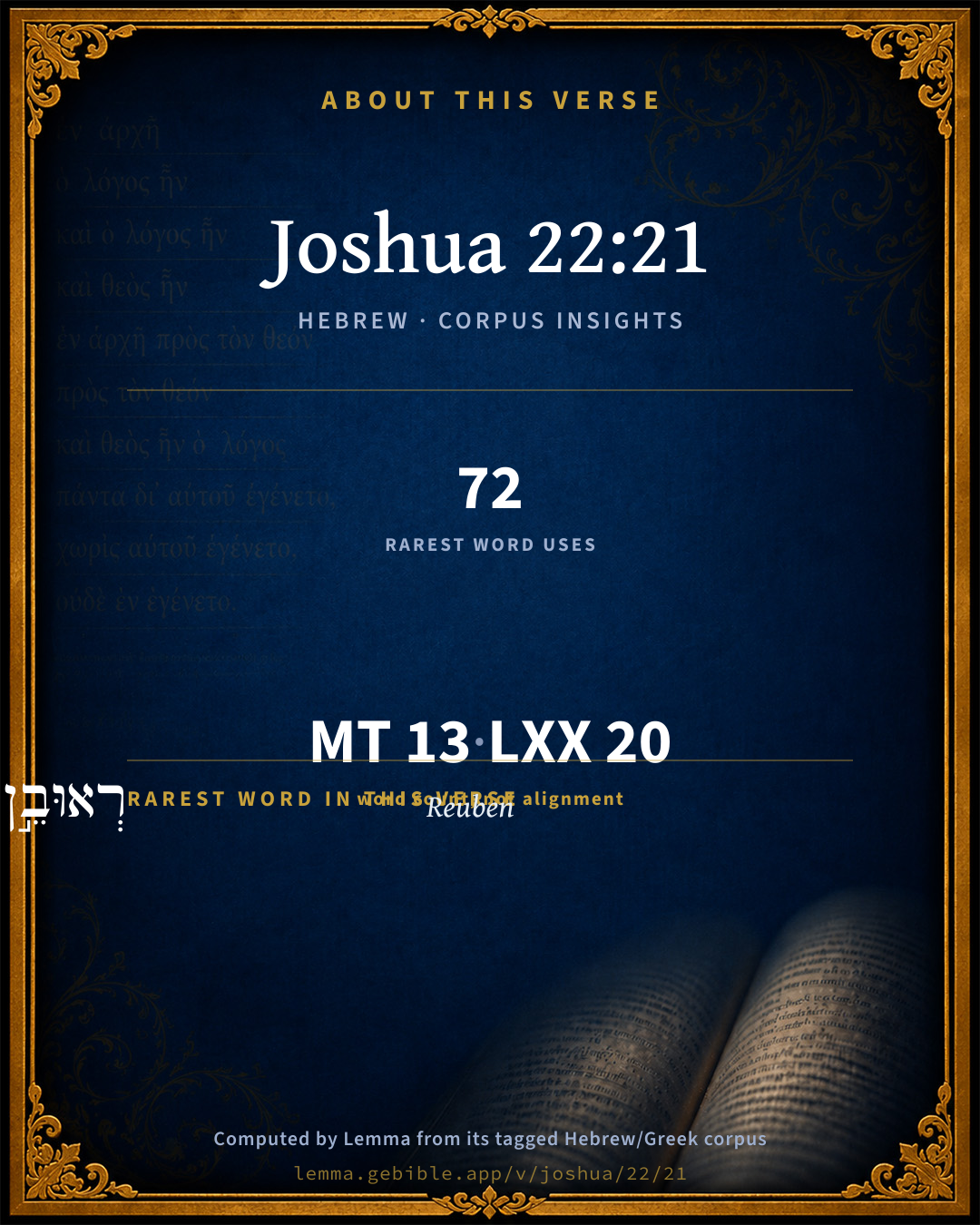
רְאוּבֵ֣ן
Rᵉʼûwbên
H7205
“Reuben”
Noun, Proper
Part of Speech
Noun
Type
Proper
Full BDB Definition

Origin: from the imperative of H7200 and H1121

TWOT: None

Reuben = "behold a son" - the eldest son of Jacob by Leah - the tribe descended from Reuben - the territory inhabited by the tribe of Reuben
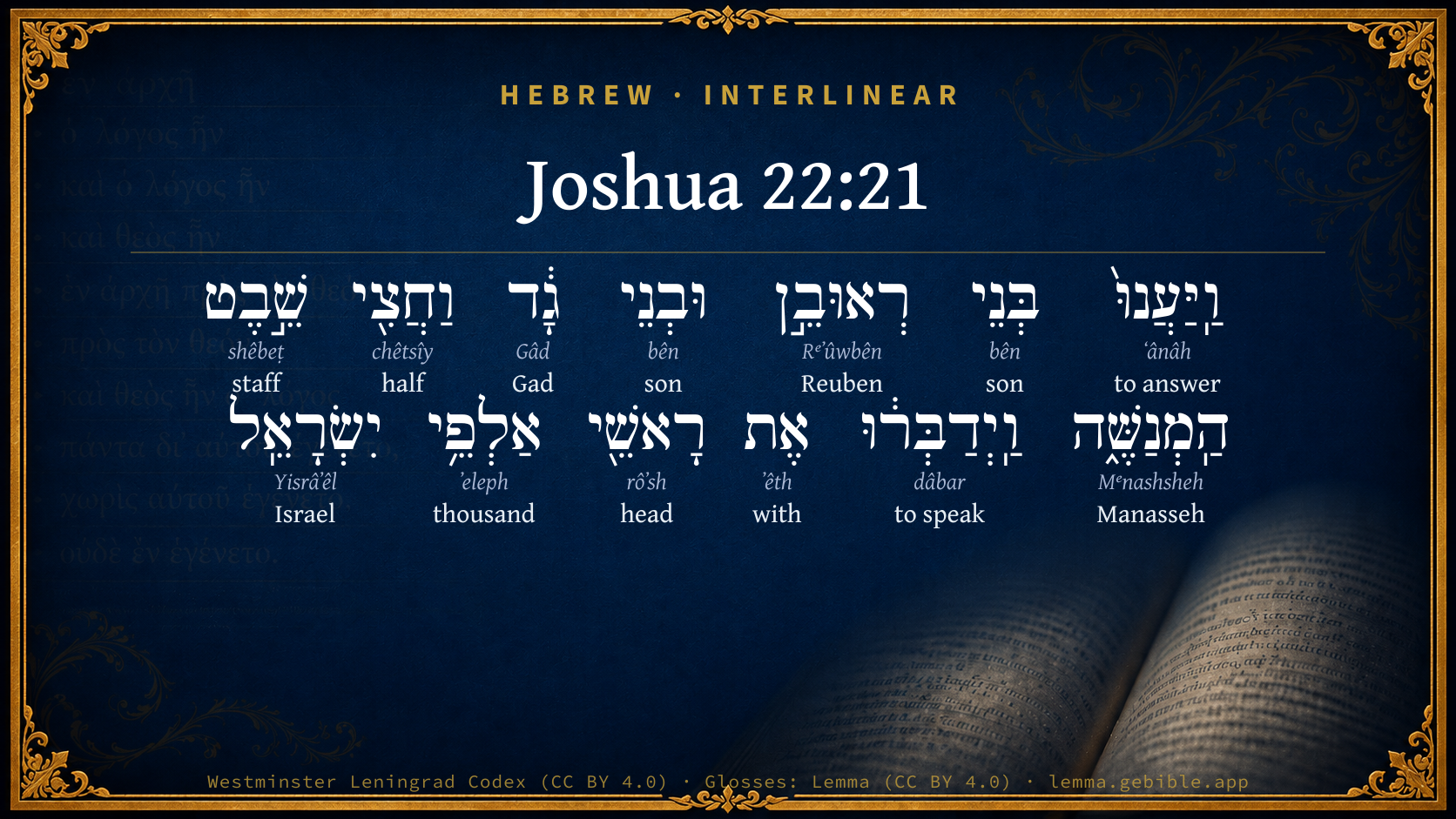
  1. וַֽיַּעֲנוּ֙ ʻânâh H6030 “and · to answer” Conjunction + Verb, Qal, Sequential Imperfect, 3rd Person, Masculine, Plural
  2. בְּנֵי bên H1121 “sons of” Noun, Common, Masculine, Plural, Construct
  3. וּבְנֵי bên H1121 “and · sons of” Conjunction + Noun, Common, Masculine, Plural, Construct
  4. גָ֔ד Gâd H1410 “Gad” Noun, Proper
  5. וַחֲצִ֖י chêtsîy H2677 “and · half of” Conjunction + Noun, Common, Masculine, Singular, Construct
  6. שֵׁ֣בֶט shêbeṭ H7626 “staff of” Noun, Common, Masculine, Singular, Construct
  7. הַֽמְנַשֶּׁ֑ה Mᵉnashsheh H4519 “the · Manasseh” Particle, Definite Article + Noun, Proper
  8. וַֽיְדַבְּר֔וּ dâbar H1696 “and · to speak” Conjunction + Verb, Piel, Sequential Imperfect, 3rd Person, Masculine, Plural
  9. אֶת ʼêth H854 “with” Preposition
  10. רָאשֵׁ֖י rôʼsh H7218 “heads of” Noun, Common, Masculine, Plural, Construct
  11. אַלְפֵ֥י ʼeleph H505 “thousand” Adjective, Cardinal number, Both, Plural, Construct
  12. יִשְׂרָאֵֽל Yisrâʼêl H3478 “Israel” Noun, Proper

About this verse

These counts appear in no published source. They are computed here, from the morphology-tagged text and Lemma’s own curated glosses. What Lemma adds →

13
words
12
distinct lemmas
Historical
section

Grammatical profile

  • 2 verbs
  • 9 nouns
  • 1 adjective
  • 1 preposition

Verb forms

  • וַֽיַּעֲנוּ֙ Qal · Sequential Imperfect
  • וַֽיְדַבְּר֔וּ Piel · Sequential Imperfect

Repetition

A word recurs within this verse — often emphatic in Hebrew:

  • בְּנֵי son H1121 ×2

Hebrew & Septuagint length

In English translation the verse runs 26 words from the Hebrew and 28 from the Septuagint (LXX English) — closely comparable.

A rough comparison of the two English renderings, which tokenize alike — not a word-level alignment.

Word counts can differ between the Hebrew and the Greek without any difference in meaning — e.g. the Hebrew direct-object marker אֵת has no separate Greek word, and Greek often adds the article ὁ.

In the original languages it is 13 Hebrew tokens and 20 Greek tokens — but the two are counted differently (Hebrew bundles its prefixes and suffixes into one token; the Greek is in lemma form), so that isn’t a like-for-like length.

Cross-references

9

Topical passages linked to Joshua 22:21 in the Treasury of Scripture Knowledge — connected by theme and wording, ordered by reader-vote popularity; previews shown in the World English Bible.

  • Exodus 18:21–25 Moreover you shall provide out of all the people able men, such as fear God: men of truth, hating unjust gain; and place such over them, to be rulers of thousands, rulers of hundreds, rulers of fifties, and rulers of tens.
  • Proverbs 15:1 A gentle answer turns away wrath, But a harsh word stirs up anger.
  • Proverbs 16:1 The plans of the heart belong to man, But the answer of the tongue is from Yahweh.
  • Proverbs 18:13 He who gives answer before he hears, That is folly and shame to him.
  • Proverbs 24:26 An honest answer Is like a kiss on the lips.
  • Micah 5:2 But you, Bethlehem Ephrathah, Being small among the clans of Judah, Out of you one will come forth to me that is to be ruler in Israel; Whose goings forth are from of old, from everlasting.
  • Acts 11:4 But Peter began, and explained to them in order, saying,
  • James 1:19 So, then, my beloved brothers, let every man be swift to hear, slow to speak, and slow to anger;
  • 1 Peter 3:15 But sanctify the Lord God in your hearts; and always be ready to give an answer to everyone who asks you a reason concerning the hope that is in you, with humility and fear:

Cross-references courtesy of OpenBible.info (CC BY 4.0).

Hebrew and Greek witnesses Masoretic Hebrew ↔ Greek Septuagint

The same verse in the two great witnesses to the Old Testament, shown verse-for-verse.

These are two independent witnesses, not word-aligned to each other, and the Septuagint is shown in lemma (dictionary) form.

Hebrew Joshua 22:21 Masoretic · Westminster Leningrad Codex

וַֽיַּעֲנוּ֙ בְּנֵי רְאוּבֵ֣ן וּבְנֵי גָ֔ד וַחֲצִ֖י שֵׁ֣בֶט הַֽמְנַשֶּׁ֑ה וַֽיְדַבְּר֔וּ אֶת רָאשֵׁ֖י אַלְפֵ֥י יִשְׂרָאֵֽל

Then the children of Reuben and the children of Gad and the half-tribe of Manasseh answered, and spoke to the heads of the thousands of Israel,

World English Bible · Public Domain

Greek LXX Joshua 22:21 Septuagint · lemma form

καί ἀποκρίνω ὁ υἱός ρουβην καί ὁ υἱός γαδ καί ὁ ἥμισυς φυλή μανασσή καί λαλέω ὁ χιλίαρχος ἰσραήλ λέγω

And the sons of Ruben, and the sons of Gad, and the half tribe of Manasse answered, and spoke to the captains of the thousands of Israel, saying,

LXX2012 (modern English Septuagint) · Public Domain

On this verse, Haydock's Catholic Bible Commentary discusses the Septuagint’s reading. Read the note in Commentary ↓

Hebrew: Westminster Leningrad Codex (CC BY 4.0). Greek: Septuagint (public domain); English from LXX2012 (modern English Septuagint) (Public Domain). How the Septuagint differs from the Hebrew →

Targum (Aramaic paraphrase)

1

The Targum is the ancient Jewish Aramaic paraphrase of the Hebrew Scriptures — an interpretive translation, not the Hebrew text itself. Onkelos (literal) and Pseudo-Jonathan (expansive) render the Torah, and Jonathan the Prophets. Coverage is partial: where no permissively-licensed English translation exists for a verse, only the Aramaic is shown. This is verse-level text, not a word-by-word alignment to the Hebrew.

  1. Targum Jonathan Prophets (Joshua–Malachi)
    וַאֲתִיבוּ בְּנֵי רְאוּבֵן וּבְנֵי גָד וּפַלְגוּת שִׁבְטָא דִמְנָשֶׁה וּמַלִילוּ עִם רֵישֵׁי אַלְפַיָא דְיִשְׂרָאֵל:

    (no public-domain English translation for this verse)

    Targum Jonathan — Aramaic: “Mikraot Gedolot” (public domain). English: “Sefaria Community Translation” (CC0 1.0 (public-domain dedication)); “London "Chaldee Paraphrase," 1871” (public domain). Text via Sefaria.

Commentary

Notes on Joshua 22:21 from classic Christian and Jewish commentators (each source and its license shown beneath its notes). The classic Christian expositions comment on the surrounding passage and are grouped to its opening verse, so a note may address several verses; the Jewish commentaries on the Tanakh (Rashi and others) are per-verse, so they appear only where the commentator wrote on this verse.

Lemma curates 59 commentaries, every one of them public domain or Creative Commons licensed, each selected and text-cleaned for this edition rather than reprinted as found. About our sources →

Trapp's Complete Commentary

John Trapp

Jos 22:21 Then the children of Reuben and the children of Gad and the half tribe of Manasseh answered, and said unto the heads of the thousands of Israel,

Ver. 21. Answered, and said.] They did not bristle and set up the crest, but sought to give satisfaction to their offended brethren. It must be our endeavour neither to give offence carelessly, nor to take offence causelessly: but to "show out of a good conversation our works with meekness of wisdom." {Jas 3:13}

John Trapp, A Commentary or Exposition upon All the Books of the Old and New Testament (1647–1656) — public domain. Text from a community e-Sword module.

Tyndale Open Study Notes

Tyndale Open Resources

22:21-34 The eastern tribes defended their action.

Tyndale Open Study Notes — © Tyndale Open Resources, licensed CC BY-SA 4.0. Text via the HelloAO Bible API.

Jamieson, Fausset & Brown

Robert Jamieson, A. R. Fausset & David Brown

Then the children of Reuben . . . answered--repudiating, in the strongest terms, the alleged crime, and deponing that so far from entertaining the intention imputed to them, their only object was to perpetuate the memory of their alliance with Israel [Jos 22:24-25], and their adherence to the worship of Israel's God [Jos 22:26-27].

Jamieson, Fausset & Brown — Commentary Critical and Explanatory on the Whole Bible (1871) — public domain (CC PDM 1.0). Text via the HelloAO Bible API.

Adam Clarke's Commentary

Verse 21. Then the children of Reuben - answered] Though conscious of their own innocency they permitted Phinehas to finish his discourse, though composed of little else than accusations; there was a decency in this, and such a full proof of good breeding, as does them the highest credit. There are many public assemblies in the present day which lay claim to the highest refinement, who might take a very useful lesson from these Reubenites and their associates.

Adam Clarke's Commentary on the Bible (1810–1826) — public domain. Text from a community e-Sword/MySword module.

John Calvin's Commentaries

21. Then the children of Reuben, etc The state of the case turns on the definition. For the children of Reuben, Gad, and Manasseh, explain that they had a different intention, and thus exculpate themselves from the charge, inasmuch as the nature of the proceeding was quite different from what the others supposed. In not making a disturbance, nor picking a quarrel for the injustice done, to them they give an example of rare modesty, which is held forth for our imitation; so that if at any time anything we have rightly done happen to be unjustly and falsely blamed by those not acquainted with its nature, we may deem it sufficient to refute the censure only so far as may be necessary for clearing ourselves. Moreover, that the more credit may be given to them, and that they may the better attest their integrity, they, by a solemn protest, put far from them the wickedness of which they were suspected. For there is force and meaning in the reduplication, The Lord God of gods, the Lord God of gods, by which they with vehemence affirm, how faithfully they desire to persevere in the doctrine of the Law, and how greatly they abhor all contrary superstitions. But as their intention was not patent to men, and every one explained it variously, according to his own sense, they appeal to the judgment of God, and offer to submit to punishment if he decide that they had attempted anything wickedly. And to prove that they are not like hypocrites who, with abandoned wickedness, appeal to God a hundred times as judge even when they are convicted in their own minds, they not only bring forward conscience, but at the same time declare, that the whole people will be witness; as if they had said, that it will be made palpable by the fact itself, that they never had any intention of devising any new form of worship; and they rightly explain, how the altar would have been unlawful, namely, if they had built it for the purpose of offering sacrifice. For the Law did not condemn the mere raising of heaps of stones, but only enjoined that sacrifices should be offered in one place, for the purpose of retaining the people in one faith, lest religion should be rent asunder, lest license should be given to human presumption, and thus every man might turn aside to follow his own fictions. We thus see how an explanation of the nature of the deed removes the detestation which the ten tribes had conceived of it.

It is not strictly correct, though appropriate enough, for the rudeness of sense, to place our God above all gods. For it is impossible to compare him with others, seeing that no others actually exist. Hence, in order to avoid the apparent absurdity, some interpreters substitute angels for gods; this meaning holds in some cases, though not in all. It ought not, however, to seem harsh when he who is the one sole supreme being is called the God of gods, inasmuch as he has no equal, standing forth conspicuous above all other height, and so, by his glory, obscuring and annihilating all names of deity which are celebrated in the world. Hence this mode of speaking ought to be viewed with reference to the common sense of the vulgar.

John Calvin's Commentaries (1540-1563) — public domain. Text from the Calvin Translation Society English edition (1840s-50s) via the Christian Classics Ethereal Library (ccel.org). Calvin's coverage is partial (roughly two-thirds of the Bible); uncommented books and verses are honest gaps, never fabricated. The 19th-century editor's footnotes and remarks are omitted so the notes are faithfully Calvin's own voice.

The Cambridge Bible for Schools and Colleges

gen. ed. J. J. S. Perowne

21–31. Defence of the Two Tribes and a Half

21. Then the children of Reuben] The two tribes and a half proceed to defend themselves and to shew that their object was in all respects the very reverse of that imputed to them.

The Cambridge Bible for Schools and Colleges (gen. ed. J. J. S. Perowne; Cambridge University Press, 1878–1918) — public domain. Text from a community e-Sword module.

John Gill's Exposition

The Lord God of gods, the Lord God of gods,.... They first set out in their answer with asserting their firm belief of Jehovah, the God of Israel, being the supreme God, God over all; over all that are called gods, whether angels, of whom Kimchi and Ben Melech interpret it; or civil magistrates and judges of the earth, who bare the same name; nor are the gods of the Gentiles to be spoken of with Jehovah, the God of Israel, who is the supreme Being, self-existent, the Being of beings, eternal and immutable, all which is contained in his name Jehovah; now this is repeated by them for the confirmation of their faith in this great article of it, and shows the steadiness of it, and to express their earnest and vehement affection for this truth, and to clear themselves from any imputation of idolatry, or thought of it, or doing anything that might have a tendency to it:

he knoweth; he is the omniscient God, the searcher of the hearts and the trier of the reins of the children of men; he knows our cordial belief of this truth, the integrity of our hearts, the intention of our minds, that we never had a thought in us of departing from his worship, and of setting up an altar beside his in opposition to it:

and Israel he shall know; our brethren the Israelites that dwell in the land of Canaan, whose representatives you are, shall know, not only by our present declaration, but by our future conduct, and strict adherence to the pure worship of God in time to come, that it was never our view by what we have done to depart from it:

if it be in rebellion, or if in transgression against the Lord; with a design to rebel against his word, and transgress his command:

save us not this day; this is said with respect to God, and as an apostrophe to him, as Jarchi, Kimchi, and Abarbinel observe; as expressing their desire to have no mercy shown them by him, but that vengeance might be taken on them by him, to whom all things were naked and open, and who full well knew whether they were guilty or not; or else the address is to Phinehas, and the princes, that they would rise up and put them to death by sword, if this appeared to be the case; or that all the other tribes would rise up, and make war against them, and cut them off with the edge of the sword, and not spare them.

John Gill's Exposition of the Whole Bible (1746–1763) — public domain (CC PDM 1.0). Text via the HelloAO Bible API.

Haydock's Catholic Bible Commentary

Israel. Septuagint, "answered the Chiliarchs of Israel," who had spoken by the mouth of their president. They repel the charge with earnestness. (Haydock)

George Leo Haydock (1774–1849), Haydock's Catholic Family Bible and Commentary, 1859 edition — public domain. Excludes Psalms (Douay-Rheims chapter numbering differs from Protestant) and Deuterocanonical books (Catholic canon only).

Matthew Poole's English Annotations

Either, first, properly, each was a governor of a thousand; for there were among them divers rulers, some of tens, some of hundreds, and some of thousands; or rather, secondly, improperly, and indefinitely, i.e. of the people of Israel, which consist of so many thousands more than you, whose authority therefore you owe a reverence to. For by comparing Jos 22:14, these seem to be greater persons than those that were rulers of thousands.

Matthew Poole's English Annotations on the Holy Bible (1683–1685) — public domain. Text from a community e-Sword/MySword module.

The Pulpit Commentary

The thousands. See above, ver. 14.

Ver. 21-34. Its Vindication

The Reubenites and Gadites easily vindicate their conduct. They have had no intention of setting up a rival altar, for they do not mean to offer any sacrifices except in the place appointed by God. Their altar is to be simply a memorial. They have built it under a sort of apprehension that possibly, in times to come, their children might be led, in ungrateful forgetfulness of the past, to forsake the Lord and His service. The Reubenites and Gadites teach us a wholesome lesson. It is incumbent on us to strive, as they did, to keep alive the memory of the great things which God has done for us, that we may not fall under the reproach addressed by Christ to His disciples: "How is it that ye do not remember?". (Mar_8:18) Christ knows how prone we are to forgetfulness. He has therefore given us two great aids to memory Holy Scripture and the sacraments. Nothing can ever take the place of the Scriptures. These alone give us the full story of redemption. But it was needful that that story should be brought before us also in a symbolic form, which should appeal vividly to the heart. Baptism and the Lord"s Supper supply this necessity for the Church. "As often as ye eat this bread and drink this wine, ye do show the Lord"s death till he come," says the Master. (1Co_11:26) The bread which we break is the communion of the body of Christ, broken for our sins. The cup which we bless is the communion of His blood, shed for our offences. Thus does the Lord"s Supper recall to us the sacrifice of Calvary, as the altar of the Reubenites and Gadites brought to their remembrance the tabernacle sacrifices. But they had not, and we have not, to offer for ourselves upon this altar of remembrance, for there can be no other sacrifice than that offered once for all upon the cross. The Mass, by its pretension to be a real sacrifice, belies the true meaning of the Eucharist. The church which celebrates it commits exactly the error into which the tribes beyond Jordan would have fallen, if they had presumed to offer upon their altar sacrifices which could be legitimately presented only upon the one altar of the nation. Let us be on our guard against materialising the sacraments, and so offering to God a worship which must be abhorrent to Him, since it seeks acceptance in virtue of another than the one efficient and perfect sacrifice. E. DE P.

The Pulpit Commentary (1880–1919), ed. H.D.M. Spence-Jones & Joseph S. Exell — public domain. Text from a community e-Sword module.

Keil & Delitzsch

C. F. Keil & F. Delitzsch

In utter amazement at the suspicion expressed by the delegates of the congregation, the two tribes and a half affirm with a solemn oath, that it never entered into their minds to build an altar as a place of sacrifice, to fall away from Jehovah. The combination of the three names of God-El, the strong one; Elohim, the Supreme Being to be feared; and Jehovah, the truly existing One, the covenant God (Jos 22:22), - serves to strengthen the invocation of God, as in Psa 50:1; and this is strengthened still further by the repetition of these three names. God knows, and let Israel also know, sc., what they intended, and what they have done. The אם which follows is the usual particle used in an oath. "Verily (it was) not in rebellion, nor in apostasy from Jehovah," sc., that this was done, or that we built the altar. "Mayst Thou not help us to-day," sc., if we did it in rebellion against God. An appeal addressed immediately to God in the heat of the statement, and introduced in the midst of the asseveration, which was meant to remove all doubt as to the truth of their declaration. The words which follow in Jos 22:23, "that we have built," etc., continue the oath: "If we have done this, to build us an altar, to turn away from the Lord, or to offer thereon burnt-offering, meat-offering, or peace-offering, may Jehovah himself require it (דּרשׁ, as in Deu 18:19; cf. Sa1 20:16). Another earnest parenthetical adjuration, as the substance of the oath, is continued in Jos 22:24. "But truly (לא ואם, with an affirmative signification) from anxiety, for a reason (lit. on account of a thing) have we done this, thinking (לאמר, since we thought) in time to come your sons might say to our sons, What have ye to do with Jehovah, the God of Israel?" i.e., He does not concern you; He is our God. "Jehovah has made the Jordan a boundary between us and your sons; ye have no part in Jehovah. Thus your sons might make our sons cease to fear Jehovah," i.e., might make them desist from the worship of Jehovah (for the infinitive form ירא instead of the abbreviated form לרא used in Sa1 18:29, there are analogies in יצק in Eze 24:3, and לישׁון, Ecc 5:11, whereas יראה is the only form used in the Pentateuch). There was some reason for this anxiety. For, inasmuch as in all the promises and laws Canaan alone (the land on this side of the Jordan, Num 34:1-12) is always mentioned as the land which Jehovah would give to His people for their inheritance, it was quite a possible thing that at some future time the false conclusion might be drawn from this, that only the tribes who dwelt in Canaan proper were the true people of Jehovah.

Keil & Delitzsch — Biblical Commentary on the Old Testament (1861–1891) — public domain (CC PDM 1.0). Text via the HelloAO Bible API. (Old Testament only.)

Kretzmann's Popular Commentary

Paul E. Kretzmann

The Explanation made and Accepted

v. 21. Then the children of Reuben and the children of Gad and the half tribe of Manasseh answered, in defending themselves against the reproach and charge made against them, and said unto the heads of the thousands of Israel,

v. 22. The Lord God of gods, the Lord God of gods, or, God, God Jehovah, repeated for the sake of impressiveness, in the form of a solemn oath, He knoweth, and Israel, he shall know; if it be in rebellion, or if in transgression against the Lord, or, Surely not in rebellion and surely not in disloyalty toward Jehovah was this done. And in order to remove every doubt concerning the truth of their assertion, they include an imprecation upon themselves in case their words should be found false: (Save us not this day,) namely, if it was done in apostasy. The oath is now continued,

v. 23. That we have built us an altar to turn from following the Lord, with idolatrous intention, or if to offer thereon burnt offering or meat-offering, or if to offer peace-offerings thereon, in flagrant disobedience against the Lord’s command, let the Lord Himself require it, by visiting the transgressors with His punishment;

v. 24. and if we have not rather done it for fear of this thing, saying, In time to come your children, those of the Israelites west of Jordan, might speak unto our children, saying, What have ye to do with the Lord God of Israel?

v. 25. For the Lord hath made Jordan a border between us and you, ye children of Reuben and children of Gad; ye have no part in the Lord; so shall your children make our children cease from fearing the Lord. So it was their anxiety for their children and for the latter’s possible exclusion from the worship of Jehovah, the true God, which had prompted the two and one half tribes to erect the great altar on the bank of the Jordan.

v. 26. Therefore we said, Let us now prepare to build us an altar, not for burnt offering, nor for sacrifice,

v. 27. but that it may be a witness between us and you and our generations after us, that we might do the service of the Lord before Him, have the right to appear at the Tabernacle and worship Jehovah, with our burnt offerings and with our sacrifices and with our peace-offerings; that your children may not say to our children in time to come, Ye have no part in the Lord.

v. 28. Therefore said we that it shall be, when they should so say to us or to our generations in time to come, that we may say again, Behold the pattern, copy, likeness, of the altar of the Lord which our fathers made, not for burnt offerings nor for sacrifices; but it is a witness between us and you.

v. 29. God forbid that we should rebel against the Lord, and turn this day from following the Lord, to build an altar for burnt offerings, for meat-offerings, or for sacrifices, beside the altar of the Lord, our God, that is before His Tabernacle. So this copy of Jehovah’s altar was simply to serve as a witness of the fact that the tribes on both sides of Jordan worshiped the same God.

v. 30. And when Phinehas, the priest, and the princes of the congregation and heads of the thousands of Israel which were with him heard the words that the children of Reuben and the children of Gad and the children of Manasseh spake, it pleased them, the explanation satisfied them in every way.

v. 31. And Phinehas, the son of Eleazar, the priest, said unto the children of Reuben and to the children of Gad and to the children of Manasseh, This day we perceive that the Lord is among us, the entire nation, because ye have not committed this trespass against the Lord, the disloyalty of which the western tribes suspected them; now ye have delivered the children of Israel out of the hand of the Lord, for He would surely have visited the iniquity of the offending tribes upon the whole people if they had been guilty.

v. 32. And Phinehas, the son of Eleazar, the priest, and the princes returned from the children of Reuben and from the children of Gad out of the land of Gilead, east of Jordan, unto the Land of Canaan, the Land of Promise in the narrower sense, to the children of Israel, the ten western tribes, and brought them word again.

v. 33. And the thing pleased the children of Israel; and the children of Israel blessed God, thanking Him for adjusting the matter in such a satisfactory way, and did not intend, had no further thought, to go up against them in battle, to destroy, devastate, the land wherein the children of Reuben and Gad dwelt.

v. 34. And the children of Reuben and the children of Gad called the altar Ed; for it shall be a witness between us that the Lord is God. The entire sentence served as the name of the altar, for it should be regarded as a continual witness, for all times, that the tribes east of Jordan also accepted Jehovah as the one true God. It is well-pleasing to God if Christians are zealous for His honor, but He also expects us to discuss matters which may lead to quarrels in a proper, brotherly manner, lest we harm some one by an unjust suspicion.

Paul E. Kretzmann, Popular Commentary of the Bible (1921–1924) — public domain. Text from a community e-Sword module.

unfoldingWord translationNotes

Door43 World Missions Community

If it was in rebellion ... let Yahweh make us pay for it

The three tribes are making two hypothetical statements that they insist are not true. They did not build the altar to worship another god. (See: Hypothetical Situations)

translationWords

tribe

God

Yahweh

faith

burnt offering

grain offering

peace offering

unfoldingWord translationNotes — © Distant Shores Media and the Door43 World Missions Community, licensed CC BY-SA 4.0. Source: git.door43.org/Door43/en_tn.

Lesson kit

Teaching starters — assembled from the data on this page, not authored interpretation. Every prompt links to the verse data it draws on. Edit before teaching.

Joshua, in the Historical, opens this verse with 13 words (12 distinct Hebrew lemmas). Its most distinctive word is Rᵉʼûwbên (“Reuben”). A historical commentator’s framing appears above. Read the whole chapter for the surrounding context.

Discussion questions

  1. The word Rᵉʼûwbên carries the sense “Reuben.” How does it shape the verse?
  2. How does Exodus 18:21–25, which shares this passage’s theme, read alongside this verse?
  3. What does the repetition of “son” (2× in this one verse) do in this verse?
  4. These translations render this verse differently; the difference is in the English rendering, not the original. What questions does that raise?
  5. «וַֽיַּעֲנוּ֙» is a Qal Sequential Imperfect verb. How does that grammatical form shape the action described?
  6. Compare how Trapp's Complete Commentary and Tyndale Open Study Notes read this verse. Where do they agree or differ?

Things to notice

Reading settings

Reading text

Shown beneath each verse's original-language words.

Old Testament
Old Testament edition

Read the OT as the Masoretic Hebrew (MT) or the Greek Septuagint (LXX).

English shown for the Greek Septuagint (in the Hebrew ↔ Greek comparison).

Comparing translations? Open the Compare panel on any verse page to stack up to four side by side.