
Numbers 1:46

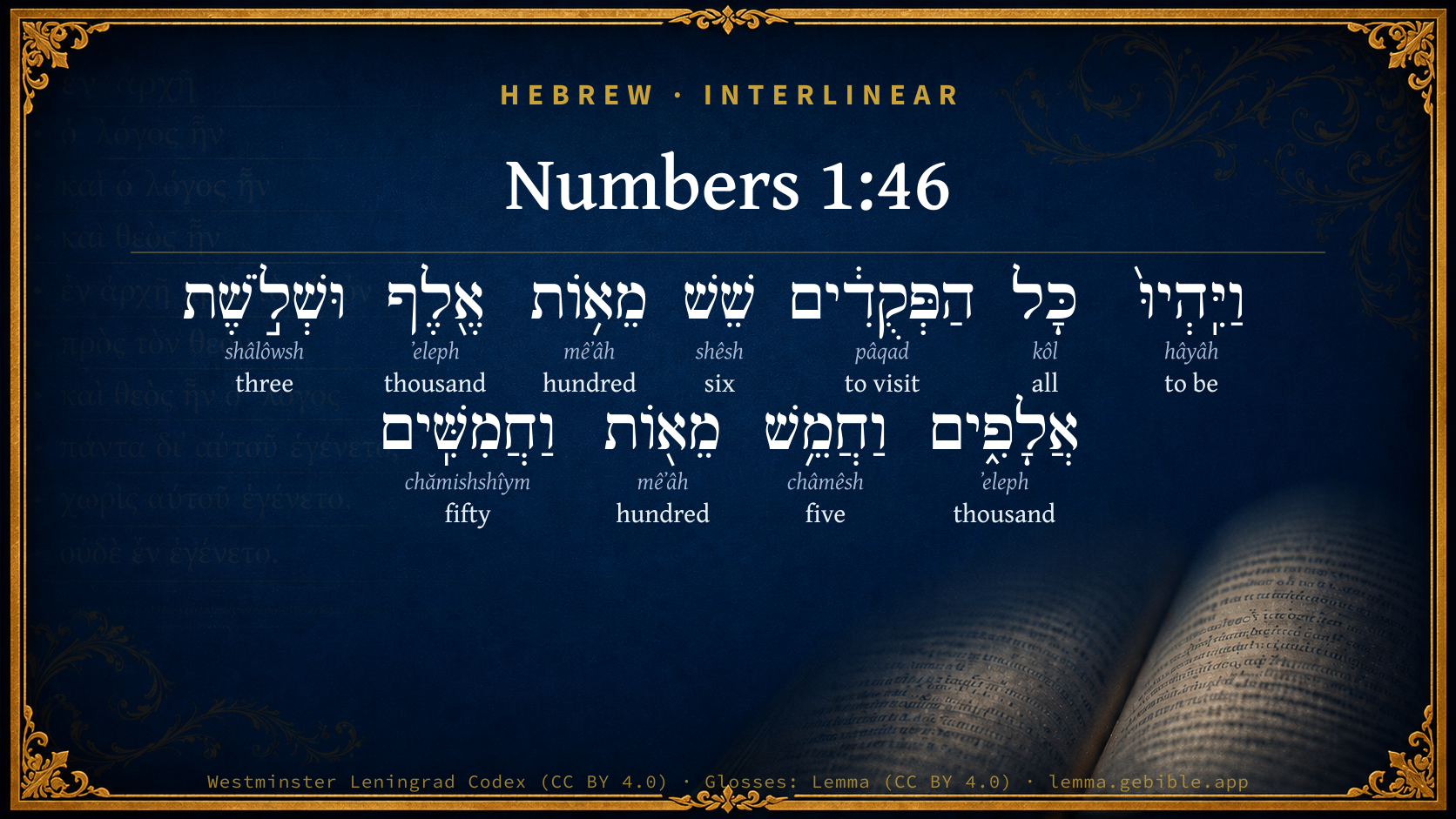
Hebrew (Westminster Leningrad Codex) Numbers 1:46 appears in the Hebrew Old Testament. The text above is from the Westminster Leningrad Codex. Each word links to its Strong’s number, a concise gloss, and parsing drawn from the Open Scriptures Hebrew Bible morphology. Click any word for its full Brown-Driver-Briggs (BDB) entry.
Download image
Cite this verse

Numbers 1:46 (World English Bible). Public Domain. Lemma interlinear Bible study tool, https://lemma.gebible.app/v/numbers/1/46.

Show BibTeX & RIS
BibTeX
RIS
English Translation
even all those who were numbered were six hundred three thousand five hundred fifty.
World English Bible · Public Domain
Download a study sheet

One document with this verse’s original text, its word-by-word gloss line, the meaning frame, cross-references with their text, attributed commentary, and full source and license credits — printable, and it pastes into notes with its structure intact.

This verse Autodidact and up

Study sheet (.html) Plain text (.txt)

A passage Seminary Student

Up to 50 verses in one chapter. A passage sheet keeps up to 6 commentary sources and 12 cross-references per verse, in the order this page ranks them, and says so on the sheet whenever that leaves anything out. Ask for a single verse and you get the Autodidact verse sheet above.

Everything on this page stays free to read, with no account — the sheet is a download of what is already on screen, not access to it.

Want to remove ads? Support Godless Engineer
Compare translations 3

The same verse in 3 English versions, stacked beneath the original-language interlinear above. Click any original word for its lexicon entry.

Each is an independent rendering of the whole verse — the interlinear is not word-aligned to these translations.

Highlighted words mark where these versions differ — a whole-verse word diff, not a word-by-word alignment.

  • World English Bible Public Domain
    even all those who were numbered were six hundred three thousand five hundred fifty.
  • King James Version Public Domain
    Even all they that were numbered were six hundred thousand and three thousand and five hundred and fifty.
  • unfoldingWord Literal Text CC BY-SA 4.0
    And all the counted ones 603,550.

unfoldingWord Literal Text — © unfoldingWord, licensed CC BY-SA 4.0. Word-aligned USFM3 via Door43 (git.door43.org/unfoldingWord/en_ult).

Versions to compare (up to 4)

3 of 4 selected

Show all 18 translations

Every available English version of this verse, each an independent rendering of the whole verse.

  • World English Bible Public Domain
    even all those who were numbered were six hundred three thousand five hundred fifty.
  • Berean Standard Bible Public Domain
    And all those counted totaled 603,550.
  • Majority Standard Bible Public Domain
    And all those counted totaled 603,550.
  • King James Version Public Domain
    Even all they that were numbered were six hundred thousand and three thousand and five hundred and fifty.
  • American Standard Version (1901) Public Domain
    even all they that were numbered were six hundred thousand and three thousand and five hundred and fifty.
  • Revised Version (1885) Public Domain
    even all they that were numbered were six hundred thousand and three thousand and five hundred and fifty.
  • Geneva Bible (1599) Public Domain
    And all they were in nomber sixe hudreth and three thousande, fiue hundreth and fiftie.
  • Douay-Rheims (1899) Public Domain
    Were six hundred and three thousand five hundred and fifty men.
  • Young's Literal Translation Public Domain
    yea, all those numbered are six hundred thousand, and three thousand, and five hundred and fifty.
  • Literal Standard Version CC BY-SA 4.0
    indeed, all those numbered are six hundred thousand and three thousand and five hundred and fifty.
  • Unlocked Literal Bible CC BY-SA 4.0
    They counted 603,550 men.
  • unfoldingWord Literal Text CC BY-SA 4.0
    And all the counted ones 603,550.
  • Darby Bible Public Domain
    all they that were numbered were six hundred and three thousand five hundred and fifty.
  • World Messianic Bible Public Domain
    all those who were counted were six hundred three thousand five hundred fifty.
  • Webster's Bible Public Domain
    Even all they that were numbered, were six hundred thousand and three thousand and five hundred and fifty.
  • Free Bible Version CC BY-SA 4.0
    The sum total of those registered was 603,550.
  • Bible in Basic English Public Domain
    Were six hundred and three thousand, five hundred and fifty.
  • JPS Tanakh (1917) Public Domain
    even all those that were numbered were six hundred thousand and three thousand and five hundred and fifty.

Literal Standard Version (2020), Covenant Press — licensed CC BY-SA 4.0. Text via the HelloAO Bible API (eBible.org). Unlocked Literal Bible (unfoldingWord) — licensed CC BY-SA 4.0. Text via the HelloAO Bible API (eBible.org). unfoldingWord Literal Text — © unfoldingWord, licensed CC BY-SA 4.0. Word-aligned USFM3 via Door43 (git.door43.org/unfoldingWord/en_ult). Free Bible Version, Dr. Jonathan Gallagher — licensed CC BY-SA 4.0. Text via the HelloAO Bible API (eBible.org).

Word by word

More ways to search: Search by grammar → Find every occurrence → Compare this word →

Practice this passage: Drill this verse → Learn its vocabulary →

וַחֲמִשִּֽׁים
chămishshîym
H2572
“and · fifty”
Conjunction + Adjective, Cardinal number, Both, Plural, Absolute
Part of Speech
Conjunction + Adjective
Type
Cardinal number
Gender
Both
Number
Plural
State
Absolute
Full BDB Definition

Origin: multiple of H2568

TWOT: TWOT- 686c

fifty - fifty (cardinal number) - a multiple of fifty (with other numbers) - fiftieth (ordinal number)
  1. וַיִּֽהְיוּ֙ hâyâh H1961 “and · to be” Conjunction + Verb, Qal, Sequential Imperfect, 3rd Person, Masculine, Plural
  2. כָּל kôl H3605 “all of” Noun, Common, Masculine, Singular, Construct
  3. הַפְּקֻדִ֔ים pâqad H6485 “the · visited” Particle, Definite Article + Verb, Qal, Participle Passive, Masculine, Plural, Absolute
  4. שֵׁשׁ shêsh H8337 “six” Adjective, Cardinal number, Feminine, Singular, Absolute
  5. מֵא֥וֹת mêʼâh H3967 “hundred” Adjective, Cardinal number, Both, Plural, Absolute
  6. אֶ֖לֶף ʼeleph H505 “thousand” Adjective, Cardinal number, Both, Singular, Absolute
  7. וּשְׁלֹ֣שֶׁת shâlôwsh H7969 “and · three” Conjunction + Adjective, Cardinal number, Masculine, Singular, Construct
  8. אֲלָפִ֑ים ʼeleph H505 “thousand” Adjective, Cardinal number, Both, Plural, Absolute
  9. וַחֲמֵ֥שׁ châmêsh H2568 “and · five” Conjunction + Adjective, Cardinal number, Feminine, Singular, Absolute
  10. מֵא֖וֹת mêʼâh H3967 “hundred” Adjective, Cardinal number, Both, Plural, Absolute

About this verse

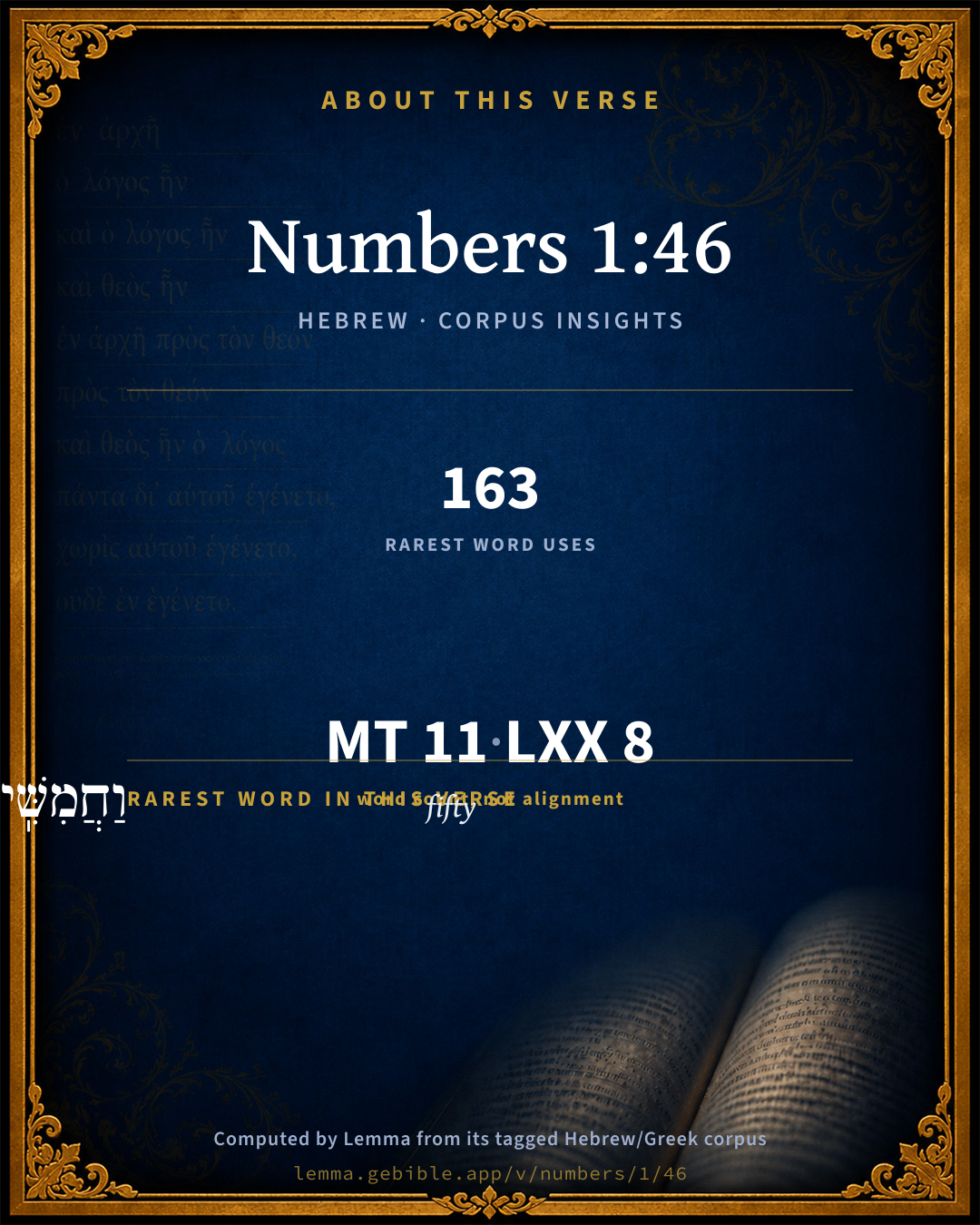
These counts appear in no published source. They are computed here, from the morphology-tagged text and Lemma’s own curated glosses. What Lemma adds →

11
words
9
distinct lemmas
Pentateuch
section

Grammatical profile

  • 2 verbs
  • 1 noun
  • 8 adjectives

Verb forms

  • וַיִּֽהְיוּ֙ Qal · Sequential Imperfect
  • הַפְּקֻדִ֔ים Qal · Participle Passive

Repetition

Words recur within this verse — often emphatic in Hebrew:

  • מֵא֥וֹת hundred H3967 ×2
  • אֶ֖לֶף thousand H505 ×2

Hebrew & Septuagint length

In English translation the verse runs 14 words from the Hebrew and 11 from the Septuagint (LXX English) — closely comparable.

A rough comparison of the two English renderings, which tokenize alike — not a word-level alignment.

Word counts can differ between the Hebrew and the Greek without any difference in meaning — e.g. the Hebrew direct-object marker אֵת has no separate Greek word, and Greek often adds the article ὁ.

In the original languages it is 11 Hebrew tokens and 8 Greek tokens — but the two are counted differently (Hebrew bundles its prefixes and suffixes into one token; the Greek is in lemma form), so that isn’t a like-for-like length.

Cross-references

21

Topical passages linked to Numbers 1:46 in the Treasury of Scripture Knowledge — connected by theme and wording, ordered by reader-vote popularity; previews shown in the World English Bible.

  • Exodus 12:37 The children of Israel traveled from Rameses to Succoth, about six hundred thousand on foot who were men, besides children.
  • Exodus 38:26 a beka a head, that is, half a shekel, after the shekel of the sanctuary, for everyone who passed over to those who were numbered, from twenty years old and upward, for six hundred three thousand five hundred fifty men.
  • Numbers 26:51 These are those who were numbered of the children of Israel, six hundred one thousand seven hundred thirty.
  • Numbers 2:32 These are those who were numbered of the children of Israel by their fathers' houses. All who were numbered of the camps according to their hosts were six hundred three thousand five hundred fifty.
  • Genesis 12:2 I will make of you a great nation. I will bless you, and make your name great. You will be a blessing.
  • Genesis 13:16 I will make your offspring as the dust of the earth, so that if a man can number the dust of the earth, then your seed may also be numbered.
  • Genesis 15:5 Yahweh brought him outside, and said, "Look now toward the sky, and count the stars, if you are able to count them." He said to Abram, "So shall your seed be."
  • Genesis 17:6 I will make you exceeding fruitful, and I will make nations of you. Kings will come out of you.
  • Genesis 22:17 that in blessing I will bless you, and in multiplying I will multiply your seed as the stars of the heavens, and as the sand which is on the seashore. Your seed will possess the gate of his enemies.
  • Genesis 26:3 Sojourn in this land, and I will be with you, and will bless you. For to you, and to your seed, I will give all these lands, and I will establish the oath which I swore to Abraham your father.
  • Genesis 28:14 Your seed will be as the dust of the earth, and you will spread abroad to the west, and to the east, and to the north, and to the south. In you and in your seed will all the families of the earth be blessed.
  • Genesis 46:3–4 He said, "I am God, the God of your father. Don't be afraid to go down into Egypt; for there I will make of you a great nation.
  • Numbers 23:10 Who can count the dust of Jacob, Or number the fourth part of Israel? Let me die the death of the righteous, Let my last end be like his!
  • Deuteronomy 10:22 Your fathers went down into Egypt with seventy persons; and now Yahweh your God has made you as the stars of the sky for multitude.
  • 2 Samuel 24:9 Joab gave up the sum of the numbering of the people to the king: and there were in Israel eight hundred thousand valiant men who drew the sword; and the men of Judah were five hundred thousand men.
  • 1 Kings 4:20 Judah and Israel were many as the sand which is by the sea in multitude, eating and drinking and making merry.
  • 1 Chronicles 21:5 Joab gave up the sum of the numbering of the people to David. All those of Israel were one million one hundred thousand men who drew sword: and in Judah were four hundred seventy thousand men who drew sword.
  • 2 Chronicles 13:3 Abijah joined battle with an army of valiant men of war, even four hundred thousand chosen men: and Jeroboam set the battle in array against him with eight hundred thousand chosen men, who were mighty men of valor.
  • 2 Chronicles 17:14–19 This was the numbering of them according to their fathers' houses: Of Judah, the captains of thousands: Adnah the captain, and with him mighty men of valor three hundred thousand;
  • Hebrews 11:11–12 By faith, even Sarah herself received power to conceive, and she bore a child when she was past age, since she counted him faithful who had promised.
  • Revelation 7:4–9 I heard the number of those who were sealed, one hundred forty-four thousand, sealed out of every tribe of the children of Israel:

Cross-references courtesy of OpenBible.info (CC BY 4.0).

Hebrew and Greek witnesses Masoretic Hebrew ↔ Greek Septuagint

The same verse in the two great witnesses to the Old Testament, shown verse-for-verse.

These are two independent witnesses, not word-aligned to each other, and the Septuagint is shown in lemma (dictionary) form.

Hebrew Numbers 1:46 Masoretic · Westminster Leningrad Codex

וַיִּֽהְיוּ֙ כָּל הַפְּקֻדִ֔ים שֵׁשׁ מֵא֥וֹת אֶ֖לֶף וּשְׁלֹ֣שֶׁת אֲלָפִ֑ים וַחֲמֵ֥שׁ מֵא֖וֹת וַחֲמִשִּֽׁים

even all those who were numbered were six hundred three thousand five hundred fifty.

World English Bible · Public Domain

Greek LXX Numbers 1:46 Septuagint · lemma form

ἑξακόσιοι χιλιάς καί τρισχίλιοι καί πεντακόσιοι καί πεντήκοντα

six hundred thousand and three thousand and five hundred and fifty.

LXX2012 (modern English Septuagint) · Public Domain

Hebrew: Westminster Leningrad Codex (CC BY 4.0). Greek: Septuagint (public domain); English from LXX2012 (modern English Septuagint) (Public Domain). How the Septuagint differs from the Hebrew →

Targum (Aramaic paraphrase)

2

The Targum is the ancient Jewish Aramaic paraphrase of the Hebrew Scriptures — an interpretive translation, not the Hebrew text itself. Onkelos (literal) and Pseudo-Jonathan (expansive) render the Torah, and Jonathan the Prophets. Coverage is partial: where no permissively-licensed English translation exists for a verse, only the Aramaic is shown. This is verse-level text, not a word-by-word alignment to the Hebrew.

  1. Targum Onkelos Torah (Genesis–Deuteronomy)
    וַהֲווֹ כָּל מִנְיָנַיָא שִׁית מְאָה וּתְלָתָא אַלְפִין וַחֲמֵשׁ מְאָה וְחַמְשִׁין

    (no public-domain English translation for this verse)

    Targum Onkelos — Aramaic: “Onkelos Genesis” (public domain); “Onkelos Exodus” (public domain); “Onkelos Leviticus” (public domain); “Onkelos Numbers” (public domain); “Onkelos Deuteronomy” (public domain). English: “Sefaria Community Translation” (CC0 1.0 (public-domain dedication)); “J.W. Etheridge. The Targums of Onkelos and Jonathan Ben Uzziel on the Pentateuch. London: Longmans, Green, 1862” (public domain). Text via Sefaria.

  2. Targum Pseudo-Jonathan Torah (Genesis–Deuteronomy)
    וַהֲווֹ כָּל סְכוּמֵי שִׁית מְאָה וּתְלַת אַלְפִין וַחֲמֵשׁ מְאָה וְחַמְשִׁין

    And all the sums (of the numbered of the Beni Israel) were six hundred and three thousand five hundred and fifty.

    Targum Pseudo-Jonathan — Aramaic: “Targum Jonathan on Genesis” (public domain); “Targum Jonathan on Exodus” (public domain); “Targum Jonathan on Leviticus” (public domain); “Targum Jonathan on Numbers” (public domain); “Targum Jonathan on Deuteronomy” (public domain). English: “The Targum of Jonathan ben Uzziel, trans. J. W. Etheridge, London, 1862” (public domain). Text via Sefaria.

Commentary

Notes on Numbers 1:46 from classic Christian and Jewish commentators (each source and its license shown beneath its notes). The classic Christian expositions comment on the surrounding passage and are grouped to its opening verse, so a note may address several verses; the Jewish commentaries on the Tanakh (Rashi and others) are per-verse, so they appear only where the commentator wrote on this verse.

Lemma curates 59 commentaries, every one of them public domain or Creative Commons licensed, each selected and text-cleaned for this edition rather than reprinted as found. About our sources →

Adam Clarke's Commentary

Verse 46. All they that were numbered were six hundred thousand and three thousand and five hundred and fifty.] What an astonishing increase from seventy souls that went down into Egypt, Ge 46:27, about 215 years before, where latterly they had endured the greatest hardships! But God's promise cannot fail (Ge 16:5;) and who can resist his will, and bring to naught his counsel? That a comparative view may be easily taken of the state of the tribes, I shall produce them here from the first census mentioned in the first chapter of this book, in their decreasing proportion, beginning with the greatest and proceeding to the least; and in the second census, mentioned Nu 26:1-65, where the increase of some and the decrease of others may be seen in one point of view. It may be just remarked, that except in the case of Gad in this chapter, and Reuben in Nu 26:7, all the numbers are what may be called whole or round numbers, beginning with thousands, and ending with hundreds, Gad and Reuben alone ending with tens; but the Scripture generally uses round numbers, units and fractions being almost constantly disregarded.

1st census,

ch. i.

2d census,

ch. xxvi.

1. Judah

74,600

76,500

2. Dan

62,700

64,400

3. Simeon

59,300

22,200

4. Zebulun

57,400

60,500

5. Issachar

54,400

64,300

6. Naphtali

53,400

45,400

7. Reuben

46,500

43,730

8. Gad

45,650

40,500

9. Asher

41,500

53,400

10. Ephraim

40,500

32,500

11. Benjamin

35,400

45,600

12. Manasseh

32,200

52,700

Total

603,550

601,730

Thus we find Judah, the most populous tribe, and Manasseh the least so; the difference between them being so great as 42,400, for which no very satisfactory reason can be assigned.

In the second census, mentioned Nu 26:34, Judah still has the pre-eminency; and Simeon, the third in number before, is become the least. Now we see also that the little tribe of Manasseh occupies the seventh place for number. Seven of the tribes had an increase; five a decrease. Manasseh had an increase of 20,500; Judah, 1,900; Issachar, 9,900; Zebulun, 3,100; Benjamin, 10,200; Dan, 1,700; Asher, 11,900.

On the contrary there was a decrease in Reuben of 2,770; in Simeon, 37,100; Gad, 5,150; Ephraim, 8,000; Naphtali, 8,000. Decrease in the whole, 61,020 effective men. See Clarke on Nu 26:51; but balanced with the increase, the decrease was upon the whole 1,820.

On the subject of these enumerations, and the manner in which this vast multitude sprang in about four generations from seventy-five persons, Scheuchzer has some valuable calculations, though liable to some objections, which I shall take the liberty to insert, as they tend to throw considerable light upon the subject.

"We find in the writings of Moses three enumerations of the Jewish people, that follow each other pretty closely: -

The first, which was made at their departure from Egypt, Ex 12:37, amounted to .....

600,000

One year after, to ........

603,550

On entering the land of Canaan, to .....

601,730

If we add to the number .....

603,550

that of the Levites given us in Nu 3:39, and which amounted to .....

22,000

We shall have for the sum total .....

625,550

We find the same number, on adding that of each tribe given us in detail, which is the best proof of the exactness of the calculation.

"I think I shall afford the reader some degree of pleasure by presenting him, in this place, the number of each tribe separately, beginning at their earliest ancestors. We shall see, by this means, how faithfully God fulfilled the promise he had made to Abraham, as well as the great utility of the mathematics for the right understanding of the Holy Scriptures. I shall begin with a Genealogical Table of that family which God so wonderfully blessed; and to it I shall afterward add each separate tribe, following the calculation of Reyher, (Math. Mos., p. 222.) And we shall see that the fourth generation, taken with the third, produces the very number mentioned in the text.

Children of JACOB by LEAH. Ge 46:15.

REUBEN

Hanoch

Phallu

Hezron

Carmi

46,500. Nu 1:21.

SIMEON

Jemuel

Jamin

Ohad

Jachin

Zohar

Shaul

59,300. Nu 1:23.

LEVI

Gershon

Libni

Shemei

7,500. Nu 3:22.

Kohath

Amram

Izehar

Hebron

Uzziel

8,600. Nu 3:26.

Merari

Mahli

Mushi

6,200. Nu 3:34.

JUDAH

Shelah

Pharez

Zerah

Hesron

Hamul

74,600. Nu 1:27.

ISSACHAR

Tola

Phuvah

Job

Shimron

54,400. Nu 1:29.

ZEBULUN

Sered

Elon

Jahleel

57,400. Nu 1:31.

DINAH

Children of JACOB by ZILPAH. Ge 46:18.

GAD

Zilphion

Haggai

Shuni

Ezbon

Eri

Arodi

Areil

45,650. Nu 1:25.

ASHER

Jimnah

Isuah

Isui

Beriah

Heber

Malchiel

41,500. Nu 1:41.

Children of JACOB by RACHEL. Ge 46:22.

JOSEPH

Manasseh

Ephraim

32,200

40,500

BENJAMIN

Belah

Becher

Ashbel

Gerah

Naaman

Ehi

Rosh

Muppim

Huppim

Ard

35,400. Nu 1:37.

Children of JACOB by BILHAH. Ge 46:25.

DAN

Hushim

62,700. Nu 1:39.

NAPHTALI

Jahzeel

Guni

Jezer

Shillem

53,400. Nu 1:43.

I. - REUBEN 46,500

"Let us now descend to the particular enumeration of each tribe. REUBEN had four sons: now if we suppose that one of these four sons had seven, and that each of the other three had eight, we shall find the number 31 for the first Egyptian generation. If we afterward suppose that each of these 31 sons had five sons, the second generation will amount to 155, which, multiplied by 15, will produce 2,325 for the third generation; and these, multiplied by 19, will make 44,175 for the fourth; so that the third, together with the fourth, will make 46,500. We shall have the same product if the given sum, 46,500, be divided by the most probable number of children, for example, by the number 19; we shall then have 2,447 for the third generation; which sum being deducted from the sum total, there will remain 44,053 for the fourth generation, which is exactly the number that is produced in multiplying 2,440 of the third generation by 18, and the other 7 by 19. If we wish to make the same calculation with respect to the preceding generations, i. e., divide them by the most probable number of children, we shall have the following sums: -

Sons of Reuben .........

4

I. Generation ..........

31

II. Ditto ...............

215

III. Ditto ...............

2,583

IV. Ditto ...............

43,917

Amount of generations III and IV ...

46,500

II. - SIMEON 59,300

"SIMEON had six sons. Let us suppose that each of the three first had six children, and each of the three others seven, we shall have thirty-nine for the first generation. If we multiply 31 of this number by 9, and 8 by 10, we shall have for the second generation 359; of which number, if we multiply 355 by 11, and 4 by 12, the third generation will give us 3,953. Let us then multiply 3,948 of these by 14, and 5 of them by 15, and we shall have for the fourth 55,347. The third and fourth, added together, will make 59,300.

III. - LEVI 22,300

"Gershon, Levi's eldest son, had two children: let us give to one of these 16 children, and to the other 17, and we shall have 33 for the second generation; 28 of which, multiplied by 15, and 5 by 16, will produce 500 for the third. Multiply each by 14, and these will produce 7,000; and the third and fourth together, 7,500.

"Kohath, Levi's second son, had four sons, which form the first line. Give to one of them 10 sons, and 11 to each of the other three, for the second generation there will be 43. Multiply them by 10, there will be 430 for the third; these, multiplied by 19 for the fourth, will produce the number of 8,170. The third and fourth added together make 8,600.

"Merari, the third son of Levi, had two sons. Give 10 children to each of them, there will then be 20 for the second generation. Now if we say that 10 of these 20 had each 15 sons, and each of the others 16, we shall have 310, which, multiplied by 19, will give us 5,890 for the fourth; and the two last together, 6,200. This may be seen by the following example: -

Gershonites

Kohathites

Merarites

I. Generation ..

2

4

2

II. Ditto ...

33

43

20

III. Ditto ...

500

430

310

IV. Ditto ...

7,000

8,170

5,890

"Amount of generations III. and IV.: Gershonites, 7,500; Kohathites, 8,600; and Merarites, 6,200 - total number of Levites, 22,300.

IV. - JUDAH 74,600

"The sons of Judah were Shelah, Pharez, and Zerah. His grandsons by Pharez were Hezron and Hamul. Hezron had two sons. Suppose each of them had six children, which will make 12 for the first generation; to eight of whom allow eight children, and nine to each of the others, and there will be 100 for the second generation. To 92 of these then give 18 children, and 19 to the eight others; this will produce for the third generation 1,808. If we then suppose that 1,800 of these had each 18 children, and that each of the other eight had 19, the fourth generation will be 32,552, which, added to the product of the third, will make the descendants of Hezron amount to 34,360.

"Hamul had two sons, who, multiplied by 10, produce the number of 20 for the second generation: these, multiplied by 20, will make 400 for the third, and these again by 25 will produce 10,000 for the fourth. And thus the two last generations will amount together to the number of 10,400.

"If we allow five sons to Shelah, and six to Zerah, we shall have 11 for the first generation. To three of whom allow 10 children and 11 to the other eight, this will give us 118 for the second. To 113 of these give 14, and 15 to the other five, and 1,657 will be produced for the third. Give 17 to 1,643, and 18 to the 14 remaining, and for the fourth there will be 28,183. The third and fourth added together will produce the number of 29,840.

"According to this calculation, all these generations will amount to the following numbers: -

Hezronites ...............

34,360

Hamulites ...............

10,400

Shelanites and Zarhites ...

29,840

74,600

V. - ISSACHAR 54,400

"ISSACHAR had five sons. Suppose that three of them had each five children, and the other two, six, we shall have 27 for the first generation. If we then imagine that of these 19 had each nine sons, and each of the other eight 10, the second generation will be 251. Now 241 of these, multiplied by 12, will produce 2,892, and the 10 others, multiplied by 13, will make 130; consequently the third generation will amount to 3,022. If 3,018 of these had each 17 sons, and each of the other four had 18, the fourth generation will be 51,378; the third and fourth generations, then, will produce a number of 54,400.

VI. - ZEBULUN 57,400

"Zebulun had three sons. If we suppose that two of them had in all fourteen children, and the third, six, here will be 20 for the first generation. The second will produce 143, on multiplying 17 by 7, and 3 by 8. If we multiply 135 by 16, and 8 by 17, the third will amount to 2,296. By multiplying the third by 24, the fourth will give us 55,104. The two last will produce, together, 57,400.

VII. - GAD 45,650

"Gad had seven sons.

I. Generation: multiply 3 by 9, and 4 by 10, there will be .....

67

II. Ditto multiply 61 by 7, and 6 by 8 .....

475

III. Ditto multiply 471 by 8, and 4 by 9 ....

3,804

IV. Ditto multiply 3,802 by 11, and 2 by 12 ..

41,846

Amount of generations III and IV ....

45,650

VIII. - ASHER 41,500

"The sons of Asher, Jimnah, Ishua, and Isui, multiplied by 8, produce for the

I. Generation ...............

24

II. Ditto multiply 24 by 8 .....

192

III. Ditto multiply 182 by 11, and 10 by 12 ..

2,122

IV. Ditto multiply 2,118 by 12, and 4 by 13 ..

25,468

Amount of generations III and IV ....

27,590

"Heber and Malchiel were sons of Beriah. Now these two sons multiplied by 5, give us for

I. Generation ...............

10

II. Ditto multiply 10 by 11 .....

110

III. Ditto multiply by 9 .....

990

IV. Ditto multiply by 12 .....

11,880

Amount of generations III and IV .....

12,870

"Another son of Beriah had in the

I. Generation ...............

1

II. Ditto multiply by 8 .....

8

III. Ditto multiply by 10 .....

80

IV. Ditto multiply by 12 .....

960

Amount of generations III and IV ..

1,040

All these generations added together amount to ..

41,500

IX.-JOSEPH

MANASSEH 32,200

I. Generation ...............

10

II. Ditto multiply 6 by 13, and 4 by 14 .....

134

III. Ditto multiply 132 by 12, and 2 by 13 ....

1,610

IV. Ditto multiply by 19 .....

30,590

Amount of generations III and IV .....

32,200

EPHRAIM 40,500

I. Generation ...............

16

II. Ditto multiply by 10 .....

160

III. Ditto multiply 152 by 12, and 8 by 13 ....

1,928

IV. Ditto multiply 1,916 by 20, and 12 by 21 .

38,572

Amount of generations III and IV .....

40,500

X. - BENJAMIN 35,400

"He had 10 sons; two of whom, multiplied by 9, and the other 8 by 10, will give for the

I. Generation ...............

98

II. Ditto multiply 95 by 9, and 3 by 10 .....

885

III. Ditto multiply by 5 .....

4,425

IV. Ditto multiply by 7 .....

30,975

Amount of generations III and IV .....

35,400

XI. - DAN 62,700

I. Generation ...............

11

II. Ditto multiply by 12 .....

132

III. Ditto multiply by 19 .....

2,508

IV. Ditto multiply by 24 .....

60,192

Amount of generations III and IV .....

62,700

XII. - NAPHTALI 53,400

"He had 4 sons, the half of whom, multiplied by 7, and the other half by 6, give us for the

I. Generation ...............

26

II. Ditto multiply 16 by 11, and 10 by 12 ....

296

III. Ditto multiply 288 by 12, and 8 by 13 ....

3,560

IV. Ditto multiply by 14 .....

49,840

Amount of generations III and IV .....

53,400

Total number of all the tribes

I. Reuben .....

46,500

II. Simeon .....

59,300

III. Levi .....

22,300

IV. Judah .....

74,600

V. Issachar .....

54,400

VI. Zebulun .....

57,400

VII. Gad .....

45,650

VIII. Asher .....

41,500

IX. Manasseh .....

32,200

Ephraim .....

40,500

X. Benjamin .....

35,400

XI. Dan .....

62,700

XII. Naphtali .....

53,400

Total

625,850

"And indeed, without counting the Levites, the number of the Israelites (Nu 1:46) amounts to ..

603,550

The Levites (Nu 3:39) amount to .....

22,300

The whole number together, as above ....

625,850"

In the above calculations, Scheuchzer and Reyher take for granted,

1. That from the going down to Egypt to the exodus there were four generations.

2. That the first two generations had died in Egypt.

3. That the promise of God in multiplying them as the stars of heaven, had taken place particularly in the two last generations.

4. That these two last generations alone form the aggregate sums given in the sacred text.

5. That their method of accounting for this aggregate through the four generations, is not only perfectly natural and mathematical, but strictly accordant with the promises made by God to them, as the sum of each tribe sufficiently proves.

6. That the whole account shows the truth of the Divine promise, the great accuracy of the Jewish lawgiver, and a proof of the inspiration of the sacred writings.

But even to these calculations and deductions there may be objections, e. g. "Scheuchzer gives to 2,508 families of Dan, 24 male children, each above the age of 20: we may fairly allow an equal number of females, and add 5 more under 20, See the note at "Ex 12:37", and we have 53 children on the average through all the families of a tribe; whilst to 4,425 families of Benjamin are allotted 7 males aged 20, and adding 7 females at 5 children, we have 19 children in each family; a tolerable number; but apparently more reasonable than the other." - ANON.

Adam Clarke's Commentary on the Bible (1810–1826) — public domain. Text from a community e-Sword/MySword module.

Ellicott's Commentary for English Readers

(46) Six hundred thousand and three thousand and five hundred and fifty.—It is obvious that the odd numbers were not reckoned. In Num_11:21 as in Exo_12:37, the whole number is reckoned roughly at six hundred thousand.

A Bible Commentary for English Readers, edited by Charles John Ellicott (1878–1897) — public domain. Text from a community e-Sword module.

John Gill's Exposition

Even all they that were numbered,.... Of whom an account was taken, and their names set down in a book or register: were 603,550; which was exactly the number of them, when taken about seven months before this, when they were assessed for defraying the expenses of the tabernacle, Exo 38:26; so that it should seem not one person had died during that time; for though there were three that died a violent death in that compass of time, yet two of them were of the tribe of Levi, not now numbered; and the other was not an Israelite by the father's side; see Lev 10:1; but it is not very probable, among such a vast number of people, that not one above twenty years of age should die in that time: some therefore are of opinion, that the tribe of Levi was numbered before, though not now; and that there was such an increase in that time among the other tribes as to equal the number of males of twenty years and upwards, in that tribe taken into the service of God, by which they were no losers.

; but it is not very probable, among such a vast number of people, that not one above twenty years of age should die in that time: some therefore are of opinion, that the tribe of Levi was numbered before, though not now; and that there was such an increase in that time among the other tribes as to equal the number of males of twenty years and upwards, in that tribe taken into the service of God, by which they were no losers.

Numbers 1:47

num 1:47

num 1:47

num 1:47But the Levites,.... The tribe of Levi were excepted from this muster, they being employed in a kind of warfare, and therefore not to be engaged in another:

after the tribe of their fathers, were not numbered among them: the rest of the tribes; the reason follows.

John Gill's Exposition of the Whole Bible (1746–1763) — public domain (CC PDM 1.0). Text via the HelloAO Bible API.

The Pulpit Commentary

Six hundred thousand and three thousand and five hundred and fifty. See Exo_38:26. As the adult male Levites numbered about 10, 000, this represents an increase of 13, 000 since the exodus. Some thousands had died through the Divine displeasure, but, on the other hand, the natural mortality may have ceased. It was evidently in the purpose of God that all who crossed the Red Sea should also enter their promised land.

The Pulpit Commentary (1880–1919), ed. H.D.M. Spence-Jones & Joseph S. Exell — public domain. Text from a community e-Sword module.

Lesson kit

Teaching starters — assembled from the data on this page, not authored interpretation. Every prompt links to the verse data it draws on. Edit before teaching.

Numbers, in the Pentateuch, opens this verse with 11 words (9 distinct Hebrew lemmas). Its most distinctive word is chămishshîym (“fifty”). A historical commentator’s framing appears above. Read the whole chapter for the surrounding context.

Discussion questions

  1. How does “fifty” (chămishshîym) shape what this verse is saying?
  2. How does Exodus 12:37, which shares this passage’s theme, read alongside this verse?
  3. What does the repetition of “hundred” (2× in this one verse) do in this verse?
  4. The translations on this page render this verse differently — a whole-verse word diff, not a word-by-word alignment. What might account for the different wordings?
  5. «וַיִּֽהְיוּ֙» is a Qal Sequential Imperfect verb. How does that grammatical form shape the action described?
  6. Compare how Adam Clarke's Commentary and Ellicott's Commentary for English Readers read this verse. Where do they agree or differ?

Things to notice

Reading settings

Reading text

Shown beneath each verse's original-language words.

Old Testament
Old Testament edition

Read the OT as the Masoretic Hebrew (MT) or the Greek Septuagint (LXX).

English shown for the Greek Septuagint (in the Hebrew ↔ Greek comparison).

Comparing translations? Open the Compare panel on any verse page to stack up to four side by side.