
2 Chronicles 1:2

Hebrew (Westminster Leningrad Codex) 2 Chronicles 1:2 appears in the Hebrew Old Testament. The text above is from the Westminster Leningrad Codex. Each word links to its Strong’s number, a concise gloss, and parsing drawn from the Open Scriptures Hebrew Bible morphology. Click any word for its full Brown-Driver-Briggs (BDB) entry.
Download image
Cite this verse

2 Chronicles 1:2 (World English Bible). Public Domain. Lemma interlinear Bible study tool, https://lemma.gebible.app/v/2-chronicles/1/2.

Show BibTeX & RIS
BibTeX
RIS
English Translation
Solomon spoke to all Israel, to the captains of thousands and of hundreds, and to the judges, and to every prince in all Israel, the heads of the fathers' [houses].
World English Bible · Public Domain
Download a study sheet

One document with this verse’s original text, its word-by-word gloss line, the meaning frame, cross-references with their text, attributed commentary, and full source and license credits — printable, and it pastes into notes with its structure intact.

This verse Autodidact and up

Study sheet (.html) Plain text (.txt)

A passage Seminary Student

Up to 50 verses in one chapter. A passage sheet keeps up to 6 commentary sources and 12 cross-references per verse, in the order this page ranks them, and says so on the sheet whenever that leaves anything out. Ask for a single verse and you get the Autodidact verse sheet above.

Everything on this page stays free to read, with no account — the sheet is a download of what is already on screen, not access to it.

Want to remove ads? Support Godless Engineer
Compare translations 3

The same verse in 3 English versions, stacked beneath the original-language interlinear above. Click any original word for its lexicon entry.

Each is an independent rendering of the whole verse — the interlinear is not word-aligned to these translations.

Highlighted words mark where these versions differ — a whole-verse word diff, not a word-by-word alignment.

  • World English Bible Public Domain
    Solomon spoke to all Israel, to the captains of thousands and of hundreds, and to the judges, and to every prince in all Israel, the heads of the fathers' [houses].
  • King James Version Public Domain
    Then Solomon spake unto all Israel, to the captains of thousands and of hundreds, and to the judges, and to every governor in all Israel, the chief of the fathers.
  • unfoldingWord Literal Text CC BY-SA 4.0
    And Solomon said to all Israel, to the chiefs of thousands and of hundreds, and to the judges, and to every prince of all Israel, the heads of the fathers.

unfoldingWord Literal Text — © unfoldingWord, licensed CC BY-SA 4.0. Word-aligned USFM3 via Door43 (git.door43.org/unfoldingWord/en_ult).

Versions to compare (up to 4)

3 of 4 selected

Show all 18 translations

Every available English version of this verse, each an independent rendering of the whole verse.

  • World English Bible Public Domain
    Solomon spoke to all Israel, to the captains of thousands and of hundreds, and to the judges, and to every prince in all Israel, the heads of the fathers' [houses].
  • Berean Standard Bible Public Domain
    Then Solomon spoke to all Israel, to the commanders of thousands and of hundreds, to the judges, and to every leader in all Israel—the heads of the families.
  • Majority Standard Bible Public Domain
    Then Solomon spoke to all Israel, to the commanders of thousands and of hundreds, to the judges, and to every leader in all Israel—the heads of the families.
  • King James Version Public Domain
    Then Solomon spake unto all Israel, to the captains of thousands and of hundreds, and to the judges, and to every governor in all Israel, the chief of the fathers.
  • American Standard Version (1901) Public Domain
    And Solomon spake unto all Israel, to the captains of thousands and of hundreds, and to the judges, and to every prince in all Israel, the heads of the fathers' `houses'.
  • Revised Version (1885) Public Domain
    And Solomon spake unto all Israel, to the captains of thousands and of hundreds, and to the judges, and to every prince in all Israel, the heads of the fathers’ houses.
  • Geneva Bible (1599) Public Domain
    And Salomon spake vnto all Israel, to the captaines of thousandes, and of hundreths, and to the iudges, and to all the gouernours in all Israel, euen the chiefe fathers.
  • Douay-Rheims (1899) Public Domain
    And Solomon gave orders to all Israel, to the captains of thousands, and of hundreds, and to the rulers, and to the judges of all Israel, and the heads of the families:
  • Young's Literal Translation Public Domain
    And Solomon saith to all Israel, to heads of the thousands, and of the hundreds, and to judges, and to every honourable one of all Israel, heads of the fathers,
  • Literal Standard Version CC BY-SA 4.0
    And Solomon says to all Israel, to heads of the thousands, and of the hundreds, and to the ones judging, and to every honorable one of all Israel, heads of the fathers,
  • Unlocked Literal Bible CC BY-SA 4.0
    Solomon spoke to all Israel, to the commanders of thousands and of hundreds, and to the judges, and to every prince in all Israel, the heads of the fathers' houses.
  • unfoldingWord Literal Text CC BY-SA 4.0
    And Solomon said to all Israel, to the chiefs of thousands and of hundreds, and to the judges, and to every prince of all Israel, the heads of the fathers.
  • Darby Bible Public Domain
    And Solomon spoke to all Israel, to the captains of thousands and of hundreds, and to the judges, and to all the princes of all Israel, the chief fathers;
  • World Messianic Bible Public Domain
    Solomon spoke to all Israel, to the captains of thousands and of hundreds, to the judges, and to every prince in all Israel, the heads of the fathers’ households.
  • Webster's Bible Public Domain
    Then Solomon spoke to all Israel, to the captains of thousands and of hundreds, and to the judges, and to every governor in all Israel, the chief of the fathers.
  • Free Bible Version CC BY-SA 4.0
    Solomon sent for all the Israelite leaders, to the commanders of thousands and of hundreds, to the judges, and to every family leader.
  • Bible in Basic English Public Domain
    And Solomon sent word to all Israel, to the captains of thousands and of hundreds and to the judges and to every chief in all Israel, heads of their families.
  • JPS Tanakh (1917) Public Domain
    And Solomon spoke unto all Israel, to the captains of thousands and of hundreds, and to the judges, and to every prince in all Israel, the heads of the fathers' houses.

Literal Standard Version (2020), Covenant Press — licensed CC BY-SA 4.0. Text via the HelloAO Bible API (eBible.org). Unlocked Literal Bible (unfoldingWord) — licensed CC BY-SA 4.0. Text via the HelloAO Bible API (eBible.org). unfoldingWord Literal Text — © unfoldingWord, licensed CC BY-SA 4.0. Word-aligned USFM3 via Door43 (git.door43.org/unfoldingWord/en_ult). Free Bible Version, Dr. Jonathan Gallagher — licensed CC BY-SA 4.0. Text via the HelloAO Bible API (eBible.org).

Word by word

More ways to search: Search by grammar → Find every occurrence → Compare this word →

Practice this passage: Drill this verse → Learn its vocabulary →

נָשִׂ֥יא
nâsîyʼ
H5387
“chief”
Noun, Common, Masculine, Singular, Absolute
Part of Speech
Noun
Type
Common
Gender
Masculine
Number
Singular
State
Absolute
Full BDB Definition

Origin: from H5375

TWOT: 1421b , 1421c

one lifted up, chief, prince, captain, leader - rising mist, vapour
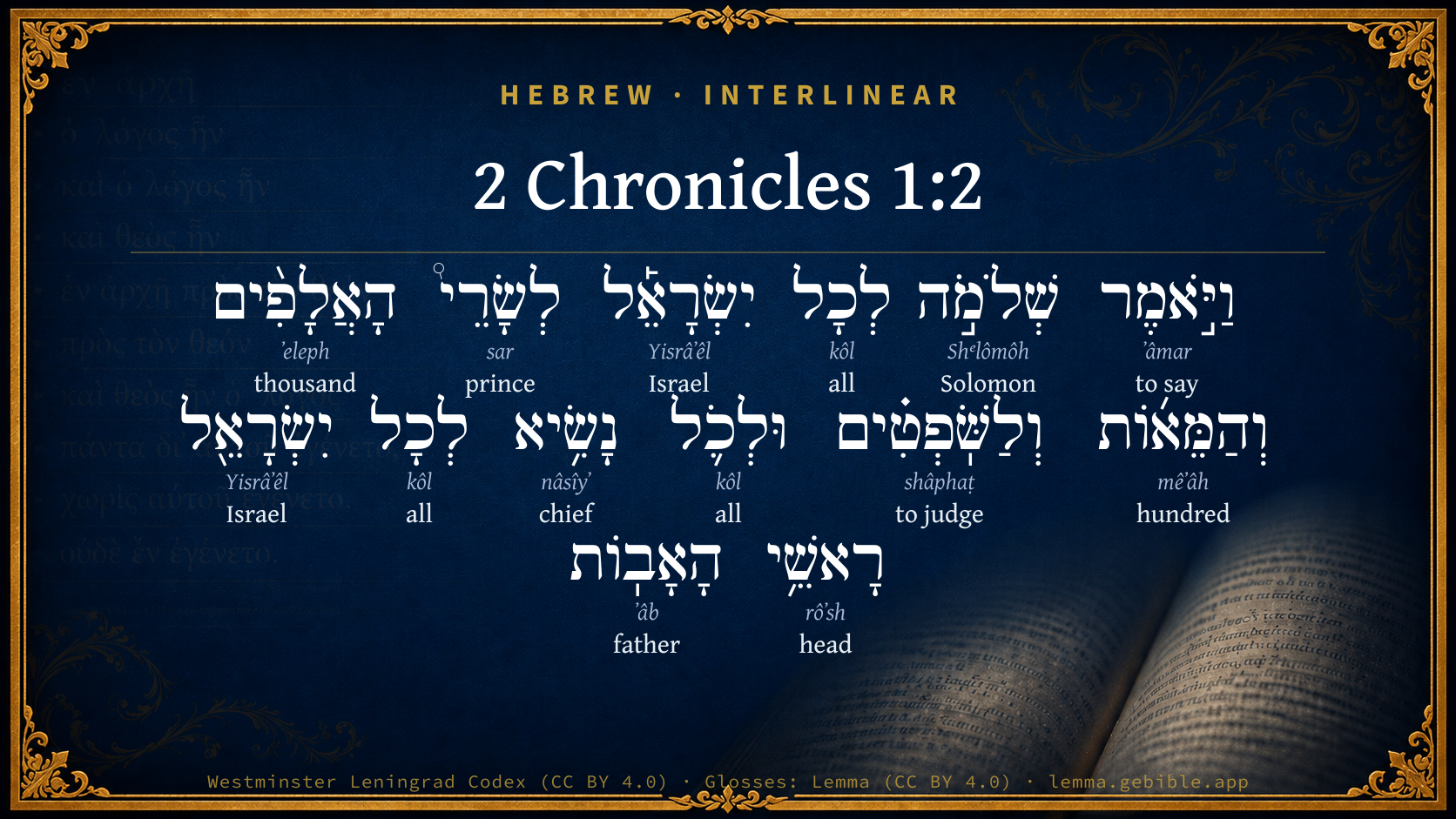
  1. וַיֹּ֣אמֶר ʼâmar H559 “and · to say” Conjunction + Verb, Qal, Sequential Imperfect, 3rd Person, Masculine, Singular
  2. שְׁלֹמֹ֣ה Shᵉlômôh H8010 “Solomon” Noun, Proper
  3. לְכָל kôl H3605 “to/for · all of” Preposition + Noun, Common, Masculine, Singular, Construct
  4. יִשְׂרָאֵ֡ל Yisrâʼêl H3478 “Israel” Noun, Proper
  5. לְשָׂרֵי֩ sar H8269 “to/for · princes of” Preposition + Noun, Common, Masculine, Plural, Construct
  6. הָאֲלָפִ֨ים ʼeleph H505 “the · thousand” Particle, Definite Article + Adjective, Cardinal number, Both, Plural, Absolute
  7. וְהַמֵּא֜וֹת mêʼâh H3967 “and · the · hundred” Conjunction + Particle, Definite Article + Adjective, Cardinal number, Both, Plural, Absolute
  8. וְלַשֹּֽׁפְטִ֗ים shâphaṭ H8199 “and · to/for the · judging” Conjunction + Preposition, Determined + Verb, Qal, Participle Active, Masculine, Plural, Absolute
  9. וּלְכֹ֛ל kôl H3605 “and · to/for · all of” Conjunction + Preposition + Noun, Common, Masculine, Singular, Construct
  10. לְכָל kôl H3605 “to/for · all of” Preposition + Noun, Common, Masculine, Singular, Construct
  11. יִשְׂרָאֵ֖ל Yisrâʼêl H3478 “Israel” Noun, Proper
  12. רָאשֵׁ֥י rôʼsh H7218 “heads of” Noun, Common, Masculine, Plural, Construct
  13. הָאָבֽוֹת ʼâb H1 “the · fathers” Particle, Definite Article + Noun, Common, Masculine, Plural, Absolute

About this verse

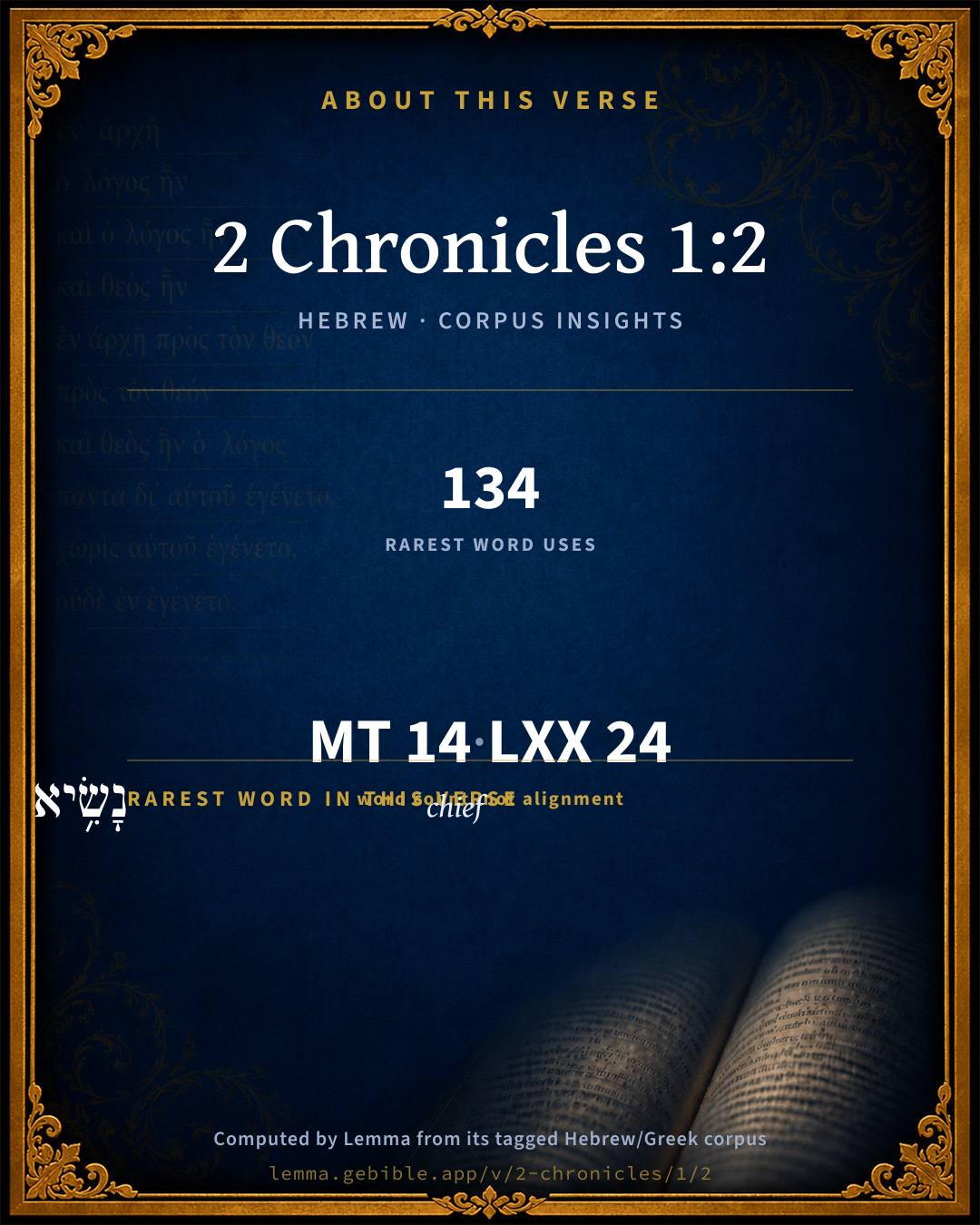
These counts appear in no published source. They are computed here, from the morphology-tagged text and Lemma’s own curated glosses. What Lemma adds →

14
words
11
distinct lemmas
Historical
section

Grammatical profile

  • 2 verbs
  • 10 nouns
  • 2 adjectives

Verb forms

  • וַיֹּ֣אמֶר Qal · Sequential Imperfect
  • וְלַשֹּֽׁפְטִ֗ים Qal · Participle Active

Repetition

Words recur within this verse — often emphatic in Hebrew:

  • לְכָל all H3605 ×3
  • יִשְׂרָאֵ֡ל Israel H3478 ×2

Hebrew & Septuagint length

In English translation the verse runs 30 words from the Hebrew and 34 from the Septuagint (LXX English) — closely comparable.

A rough comparison of the two English renderings, which tokenize alike — not a word-level alignment.

Word counts can differ between the Hebrew and the Greek without any difference in meaning — e.g. the Hebrew direct-object marker אֵת has no separate Greek word, and Greek often adds the article ὁ.

In the original languages it is 14 Hebrew tokens and 24 Greek tokens — but the two are counted differently (Hebrew bundles its prefixes and suffixes into one token; the Greek is in lemma form), so that isn’t a like-for-like length.

Cross-references

11

Topical passages linked to 2 Chronicles 1:2 in the Treasury of Scripture Knowledge — connected by theme and wording, ordered by reader-vote popularity; previews shown in the World English Bible.

  • 1 Chronicles 28:1 David assembled all the princes of Israel, the princes of the tribes, and the captains of the companies who served the king by division, and the captains of thousands, and the captains of hundreds, and the rulers over all the substance and possessions of the king and of his sons, with the officers, and the mighty men, even all the mighty men of valor, to Jerusalem.
  • 1 Chronicles 27:1 Now the children of Israel after their number, the heads of fathers' [houses] and the captains of thousands and of hundreds, and their officers who served the king, in any matter of the divisions which came in and went out month by month throughout all the months of the year--of every division were twenty-four thousand.
  • 1 Chronicles 13:1 David consulted with the captains of thousands and of hundreds, even with every leader.
  • 1 Chronicles 15:3 David assembled all Israel at Jerusalem, to bring up the ark of Yahweh to its place, which he had prepared for it.
  • 1 Chronicles 15:12 and said to them, You are the heads of the fathers' [houses] of the Levites: sanctify yourselves, both you and your brothers, that you may bring up the ark of Yahweh, the God of Israel, to [the place] that I have prepared for it.
  • 1 Chronicles 24:4 There were more chief men found of the sons of Eleazar than of the sons of Ithamar; and [thus] were they divided: of the sons of Eleazar there were sixteen, heads of fathers' houses; and of the sons of Ithamar, according to their fathers' houses, eight.
  • 1 Chronicles 24:31 These likewise cast lots even as their brothers the sons of Aaron in the presence of David the king, and Zadok, and Ahimelech, and the heads of the fathers' [houses] of the priests and of the Levites; the fathers' [houses] of the chief even as those of his younger brother.
  • 1 Chronicles 29:1 David the king said to all the assembly, Solomon my son, whom alone God has chosen, is yet young and tender, and the work is great; for the palace is not for man, but for Yahweh God.
  • 2 Chronicles 29:20 Then Hezekiah the king arose early, and gathered the princes of the city, and went up to the house of Yahweh.
  • 2 Chronicles 30:2 For the king had taken counsel, and his princes, and all the assembly in Jerusalem, to keep the Passover in the second month.
  • 2 Chronicles 34:29–30 Then the king sent and gathered together all the elders of Judah and Jerusalem.

Cross-references courtesy of OpenBible.info (CC BY 4.0).

Hebrew and Greek witnesses Masoretic Hebrew ↔ Greek Septuagint

The same verse in the two great witnesses to the Old Testament, shown verse-for-verse.

These are two independent witnesses, not word-aligned to each other, and the Septuagint is shown in lemma (dictionary) form.

Hebrew 2 Chronicles 1:2 Masoretic · Westminster Leningrad Codex

וַיֹּ֣אמֶר שְׁלֹמֹ֣ה לְכָל יִשְׂרָאֵ֡ל לְשָׂרֵי֩ הָאֲלָפִ֨ים וְהַמֵּא֜וֹת וְלַשֹּֽׁפְטִ֗ים וּלְכֹ֛ל נָשִׂ֥יא לְכָל יִשְׂרָאֵ֖ל רָאשֵׁ֥י הָאָבֽוֹת

Solomon spoke to all Israel, to the captains of thousands and of hundreds, and to the judges, and to every prince in all Israel, the heads of the fathers' [houses].

World English Bible · Public Domain

Greek LXX 2 Chronicles 1:2 Septuagint · lemma form

καί εἶπον σαλωμών πρός πᾶς ἰσραήλ ὁ χιλίαρχος καί ὁ ἑκατόνταρχος καί ὁ κριτής καί πᾶς ὁ ἄρχων ἐναντίον ἰσραήλ ὁ ἄρχων ὁ πατριά

And Solomon spoke to all Israel, to the captains of thousands, and to the captains of hundreds, and to the judges, and to all the rulers over Israel, even the heads of the families;

LXX2012 (modern English Septuagint) · Public Domain

Hebrew: Westminster Leningrad Codex (CC BY 4.0). Greek: Septuagint (public domain); English from LXX2012 (modern English Septuagint) (Public Domain). How the Septuagint differs from the Hebrew →

Commentary

Notes on 2 Chronicles 1:2 from classic Christian and Jewish commentators (each source and its license shown beneath its notes). The classic Christian expositions comment on the surrounding passage and are grouped to its opening verse, so a note may address several verses; the Jewish commentaries on the Tanakh (Rashi and others) are per-verse, so they appear only where the commentator wrote on this verse.

Lemma curates 59 commentaries, every one of them public domain or Creative Commons licensed, each selected and text-cleaned for this edition rather than reprinted as found. About our sources →

Trapp's Complete Commentary

John Trapp

2Ch 1:2 Then Solomon spake unto all Israel, to the captains of thousands and of hundreds, and to the judges, and to every governor in all Israel, the chief of the fathers.

Ver. 2. Then Solomon spake unto all Israel.] As David had done before him. {1Ch 28:1; 1Ch 29:1}

John Trapp, A Commentary or Exposition upon All the Books of the Old and New Testament (1647–1656) — public domain. Text from a community e-Sword module.

Tyndale Open Study Notes

Tyndale Open Resources

1:2-6 Solomon’s journey to Gibeon, reported in 1 Kgs 3:4, is here elaborated. This great public venture was closely associated with Solomon taking the throne. The event included military commanders and clan leaders. It took place in Gibeon because the Tabernacle was there, as was the great bronze altar where sacrifices were regularly offered.

Tyndale Open Study Notes — © Tyndale Open Resources, licensed CC BY-SA 4.0. Text via the HelloAO Bible API.

Geneva Bible (1599)

Geneva Bible translators

That is, he proclaimed a solemn sacrifice, and commanded that all should be at the same.

Geneva Bible (1599) marginal notes — public domain. Text via Bolls.life.

Adam Clarke's Commentary

Verse 2. Then Solomon spake] This is supposed to have taken place in the second year of his reign.

Adam Clarke's Commentary on the Bible (1810–1826) — public domain. Text from a community e-Sword/MySword module.

Ellicott's Commentary for English Readers

(2) Then Solomon spake unto all Israel.—Or, commanded all Israel (1Ch_21:17; 2Sa_16:11; 2Ki_1:11; Vulg., prœcepit).

To the captains of thousands . . . chief of the fathers.—This is an apposition, explaining what is meant by “all Israel” in the first clause, viz., the national representatives. The account in Kings allows only one verse for the sacrifice, and so omits to mention that the princes took part in it (1Ki_3:4). The fact, however, is likely in itself. (Comp. the similar assemblies under David, 1Ch_13:1; 1Ch_23:2; 1Ch_28:1.)

Every governor.—Heb. nûsî’, prince, emir of a tribe, or chief of a clan. (Comp. Gen_23:6; Num_7:10; 1Ki_8:1.)

The chief of the fathers.—The heads of the clans. This defines the preceding phrase.

(2-6) Solomon and the national assembly repair to the Mosaic tabernacle at Gibeon, and sacrifice upon the great altar of burnt offering. (Comp. 1Ki_3:4, which the present section supplements and explains.)

A Bible Commentary for English Readers, edited by Charles John Ellicott (1878–1897) — public domain. Text from a community e-Sword module.

The Cambridge Bible for Schools and Colleges

gen. ed. J. J. S. Perowne

2. every governor] R.V. every prince.

the chief of the fathers] R.V. the heads of the fathers’ houses.

The Cambridge Bible for Schools and Colleges (gen. ed. J. J. S. Perowne; Cambridge University Press, 1878–1918) — public domain. Text from a community e-Sword module.

John Gill's Exposition

Then Solomon spake unto all Israel,.... To their representatives about going to Gibeon to sacrifice, as the next words show: so Jarchi and Kimchi observe:

to the captains of thousands, and of hundreds, to the judges, and to every governor in all Israel, the chief of the fathers; whom he had convened on this occasion; though some think this is the same congregation gathered by his father, by whom he was anointed and made king, and that he spoke of this to them before they broke up, Ch1 28:1 which seems not so probable, since it was after the death of his father, after he had been king some time, and even after his marriage with Pharaoh's daughter, that what follows was done, see Kg1 3:1.

John Gill's Exposition of the Whole Bible (1746–1763) — public domain (CC PDM 1.0). Text via the HelloAO Bible API.

Albert Barnes' Notes on the Bible

The narrative here corresponds with 1Ki 3:4; but is very much fuller. We learn from the present passage:

(1) that Solomon’s sacrifice at Gibeon was a great public festivity, to which he collected vast numbers of the people;

(2) that it was made upon the brass altar of Bezaleel, which

(3) stood before the tabernacle; and

(4) that Solomon’s vision was on the night of his sacrifice. Consult the marginal references

2Ch 1:5

Sought unto it - i. e., “frequented it” - “were in the habit of making use of it.”

Albert Barnes' Notes on the Bible (1834–1885) — public domain. Text from a community e-Sword/MySword module.

Matthew Poole's English Annotations

Then Solomon spake, to wit, concerning his intention of going to Gibeon, and that they should attend him thither, as the next verse shows.

Matthew Poole's English Annotations on the Holy Bible (1683–1685) — public domain. Text from a community e-Sword/MySword module.

The Pulpit Commentary

This verse and the following four supersede the one verse, 1Ki_3:4; and the five together give us, of course, a much fuller view of the events of the sacrifice. Our present verse purports to show the representative components of "all Israel" in a fourfold classification. Captains of thousands and of hundreds (see first 1Ch_13:1 1Ch_27:1 1Ch_28:1; and then (Exo_18:21, Exo_18:25; Num_31:14, Num_31:48, Num_31:52, Num_31:54; Deu_1:15; 1Sa_8:12 1Sa_17:18 1Sa_18:13 1Sa_22:7; 2Sa_18:1; 2Ki_11:9, 2Ki_11:15, 2Ki_11:19) The judges. The office and the person of the judge were held in high honour among the Jewish people from the first, and perhaps, also, with a noteworthy uniformity, even in the more degenerate periods of their history. Their commencement in patriarchal simplicity can be easily imagined, and receives illustration from such passages as Job_29:7, Job_29:8, 9 32:9. Their more formal development may be considered to date from the crisis related in Exo_18:14-24. And the allusions to the judge and his office thenceforward sustain our impression of the honour in which they were held, arising, no doubt, largely from the deep-felt necessity for them, the more society crystallized (Num_25:5; Deu_16:18 Deu_19:17 Deu_21:2; Jos_8:33 1Ch_23:24 1Ch_26:29; 2Ch_19:8-10) In 1Ch_23:24 we are told how David set apart "six thousand Levites" to be "officers and judges." Every governor. The word employed here (aycin;) is rendered by five different words in our Authorized Version: "prince", (Gen_17:20, passim) "ruler", (Exo_16:22, passim) "captain", (Num_2:3, passim) "chief" Num_3:24, passim), and "governor" in the present passage only. It is evidently a term of generic signification, used of a king (1Ki_11:34; Eze_12:10) of leaders of the Ishmaelites; (Gen_17:20) of the captains of the tribes of Israel; (Num_7:11) of the chiefs of families; (Num_3:24) while the use of it (Gen_23:6) to set forth the position of Abraham as one raised to eminence so high and undisputed that it might be clearly said to be God"s doing, is sufficient to determine its central signification. The chief of the fathers; i.e. the heads of the fathers. The first occurrence of the expression, "the heads of their fathers" houses", (Exo_6:14) and of "the heads of the fathers of the Levites according to their families", (Exo_6:25) sufficiently explains the original and perfectly natural meaning of the phrase. The great importance and significance of the position of the heads "of families" and "of houses" and" of fathers" in early patriarchal times must necessarily have declined by the time of Solomon, when the nation had received so much more of civil form and system. But the name remained, and the family and social position did not fail to make themselves felt, and finally the official recognition of them in David"s time is evidenced by 1Ch_27:1, and in Solomon"s time both by the present passage and 2Ch_5:2 with its parallel, 1Ki_8:1. Our present use of the expression ought probably to show it, in close apposition with the foregoing words, "to all Israel" (wrongly translated "in all Israel" in the Authorized Version) and which itself is a repetition of the "to all Israel" in the beginning of the verse. Although the existing Hebrew pointing of the verse does not favour the supposition, it may be that the writer means to emphasize Solomon"s summons as made both to the kingdom as such, and to the people also as a united people. We are not, indeed, told here, in so many words, what it was that Solomon said "to all Israel." But there can be no doubt as to his object, as betrayed in the first clause of the following verse.

The Pulpit Commentary (1880–1919), ed. H.D.M. Spence-Jones & Joseph S. Exell — public domain. Text from a community e-Sword module.

John Wesley's Explanatory Notes

Spake - Concerning his intention of going to Gibeon, and that they should attend him thither.

John Wesley, Explanatory Notes Upon the Whole Bible (1754–1765) — public domain. Text via the GEBible commentary corpus.

unfoldingWord translationNotes

Door43 World Missions Community

General Information:

It may be helpful to reorder the events in these verses as in the UDB. (See: Order of Events)

spoke to all Israel, to the commanders ... heads of the fathers' house

Here "all of Israel" means those people mentioned afterwards. They represent all of Israel. AT: "spoke to the commanders ... heads of the father's house"

the commanders of thousands and of hundreds

Possible meanings are 1) these numbers represent the exact amount of soldiers that these commanders led. AT: "the commanders of 1,000 soldiers and the commanders of 100 soldiers" or 2) the words translated as "thousands" and "hundreds" do not represent exact numbers, but are the names of larger and smaller military divisions. AT: "the commanders of large military divisions and the commanders of smaller military divisions" (See: Numbers)

to every prince in all Israel, the heads of the fathers' houses

Here "the heads of the fathers' houses" further describe the princes. AT: "to every prince in all Israel, that is, the heads of the fathers' houses"

to every prince

Here "prince" means leaders in general. They are not necessarily the sons of the king. AT: "to every leader"

the heads of the fathers' houses

Here "heads" is a metaphor for the most important part. And "houses" represents families. AT: "the leaders of the families in Israel" (See: Metaphor and Metonymy)

Kiriath Jearim

A little town about 9 miles west of Jerusalem. (See: How to Translate Names)

pitched a tent

"set up a tent"

the bronze altar made by Bezalel son of Uri son of Hur

This can be stated in active form. AT: "the bronze altar that Bezalel son of Uri son Hur made" (See: Active or Passive)

Bezalel son of Uri son of Hur

These are names of men. (See: How to Translate Names)

translationWords

Israel

command

judge, judges

prince

head

ancestor

house

high place

Gibeon

tent of meeting

God

Moses

servant

desert

ark of the covenant

Jerusalem

bronze

altar

tabernacle

assembly

unfoldingWord translationNotes — © Distant Shores Media and the Door43 World Missions Community, licensed CC BY-SA 4.0. Source: git.door43.org/Door43/en_tn.

Rashi

Rabbi Shlomo Yitzchaki (Rashi)

And Solomon said to all Israel And who were those referred to as “all Israel”? They were the leaders of the thousands, as it is written (I Chron. 28:1): “And David assembled all the leaders of Israel.” And what did he say to them? That they should come with him to the high place that was in Gibeon.

Rashi on the Tanakh — English translations: “The Judaica Press complete Tanach with Rashi, translated by A. J. Rosenberg” (CC BY 4.0); “Pentateuch with Rashi's commentary by M. Rosenbaum and A.M. Silbermann, 1929-1934” (public domain); “The Metsudah Tanach series, Lakewood, N.J” (CC BY 4.0); and “The Book of Joshua, Metsudah Publications, 1997” (CC BY 4.0). Text via Sefaria.

Lesson kit

Teaching starters — assembled from the data on this page, not authored interpretation. Every prompt links to the verse data it draws on. Edit before teaching.

2 Chronicles, in the Historical, opens this verse with 14 words (11 distinct Hebrew lemmas). Its most distinctive word is nâsîyʼ (“chief”). A historical commentator’s framing appears above. Read the whole chapter for the surrounding context.

Discussion questions

  1. What does “chief” (nâsîyʼ) contribute to the verse as a whole?
  2. How does 1 Chronicles 28:1, which shares this passage’s theme, read alongside this verse?
  3. What does the repetition of “all” (3× in this one verse) do in this verse?
  4. The translations on this page render this verse differently — a whole-verse word diff, not a word-by-word alignment. What might account for the different wordings?
  5. «וַיֹּ֣אמֶר» is a Qal Sequential Imperfect verb. How does that grammatical form shape the action described?
  6. Compare how Trapp's Complete Commentary and Tyndale Open Study Notes read this verse. Where do they agree or differ?

Things to notice

Reading settings

Reading text

Shown beneath each verse's original-language words.

Old Testament
Old Testament edition

Read the OT as the Masoretic Hebrew (MT) or the Greek Septuagint (LXX).

English shown for the Greek Septuagint (in the Hebrew ↔ Greek comparison).

Comparing translations? Open the Compare panel on any verse page to stack up to four side by side.