
Numbers 3:43

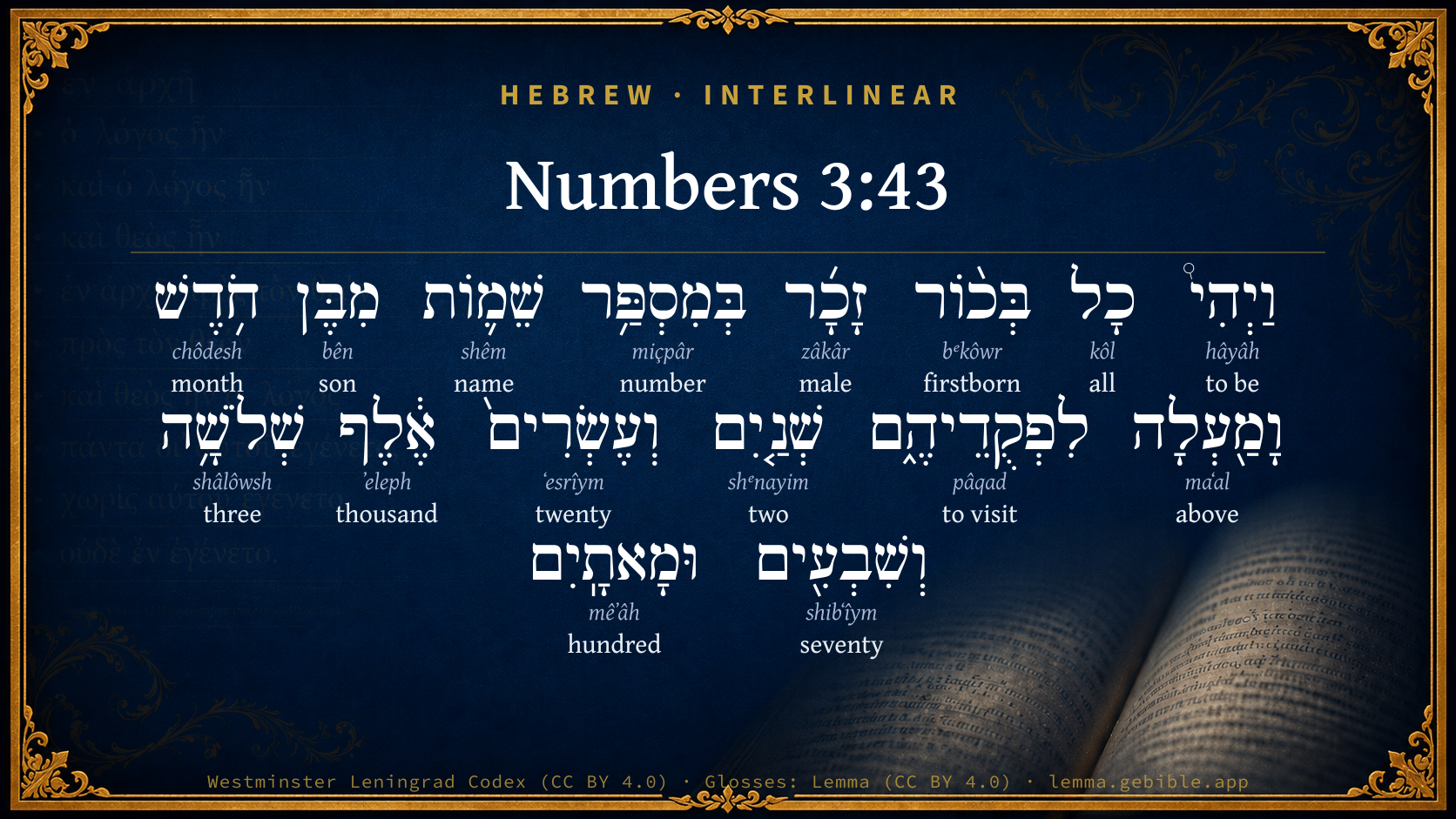
Hebrew (Westminster Leningrad Codex) Numbers 3:43 appears in the Hebrew Old Testament. The text above is from the Westminster Leningrad Codex. Each word links to its Strong’s number, a concise gloss, and parsing drawn from the Open Scriptures Hebrew Bible morphology. Click any word for its full Brown-Driver-Briggs (BDB) entry.
Download image
Cite this verse

Numbers 3:43 (World English Bible). Public Domain. Lemma interlinear Bible study tool, https://lemma.gebible.app/v/numbers/3/43.

Show BibTeX & RIS
BibTeX
RIS
English Translation
All the firstborn males according to the number of names, from a month old and upward, of those who were numbered of them, were twenty-two thousand two hundred seventy-three.
World English Bible · Public Domain
Download a study sheet

One document with this verse’s original text, its word-by-word gloss line, the meaning frame, cross-references with their text, attributed commentary, and full source and license credits — printable, and it pastes into notes with its structure intact.

This verse Autodidact and up

Study sheet (.html) Plain text (.txt)

A passage Seminary Student

Up to 50 verses in one chapter. A passage sheet keeps up to 6 commentary sources and 12 cross-references per verse, in the order this page ranks them, and says so on the sheet whenever that leaves anything out. Ask for a single verse and you get the Autodidact verse sheet above.

Everything on this page stays free to read, with no account — the sheet is a download of what is already on screen, not access to it.

Want to remove ads? Support Godless Engineer
Compare translations 3

The same verse in 3 English versions, stacked beneath the original-language interlinear above. Click any original word for its lexicon entry.

Each is an independent rendering of the whole verse — the interlinear is not word-aligned to these translations.

Highlighted words mark where these versions differ — a whole-verse word diff, not a word-by-word alignment.

  • World English Bible Public Domain
    All the firstborn males according to the number of names, from a month old and upward, of those who were numbered of them, were twenty-two thousand two hundred seventy-three.
  • King James Version Public Domain
    And all the firstborn males by the number of names, from a month old and upward, of those that were numbered of them, were twenty and two thousand two hundred and threescore and thirteen.
  • unfoldingWord Literal Text CC BY-SA 4.0
    And it happened that every firstborn male by the number of the names from a son of a month and upward, according to their counted ones, 22,273.

unfoldingWord Literal Text — © unfoldingWord, licensed CC BY-SA 4.0. Word-aligned USFM3 via Door43 (git.door43.org/unfoldingWord/en_ult).

Versions to compare (up to 4)

3 of 4 selected

Show all 18 translations

Every available English version of this verse, each an independent rendering of the whole verse.

  • World English Bible Public Domain
    All the firstborn males according to the number of names, from a month old and upward, of those who were numbered of them, were twenty-two thousand two hundred seventy-three.
  • Berean Standard Bible Public Domain
    The total number of the firstborn males a month old or more, listed by name, was 22,273.
  • Majority Standard Bible Public Domain
    The total number of the firstborn males a month old or more, listed by name, was 22,273.
  • King James Version Public Domain
    And all the firstborn males by the number of names, from a month old and upward, of those that were numbered of them, were twenty and two thousand two hundred and threescore and thirteen.
  • American Standard Version (1901) Public Domain
    And all the first-born males according to the number of names, from a month old and upward, of those that were numbered of them, were twenty and two thousand two hundred and threescore and thirteen.
  • Revised Version (1885) Public Domain
    And all the firstborn males according to the number of names, from a month old and upward, of those that were numbered of them, were twenty and two thousand two hundred and threescore and thirteen.
  • Geneva Bible (1599) Public Domain
    And all the first borne males rehearsed by name (from a moneth olde and aboue) according to their nomber were two and twentie thousand, two hundreth seuentie and three.
  • Douay-Rheims (1899) Public Domain
    And the males by their names, from one month and upward, were twenty-two thousand two hundred and seventy-three.
  • Young's Literal Translation Public Domain
    And all the first-born -- male -- by the number of names, from a son of a month and upward, of their numbered ones, are two and twenty thousand two hundred and seventy and three.
  • Literal Standard Version CC BY-SA 4.0
    And every firstborn male, by the number of names, from a son of a month and upward, of their numbered ones, are twenty-two thousand two hundred and seventy-three.
  • Unlocked Literal Bible CC BY-SA 4.0
    He counted all the firstborn males by name, aged one month old and older. He counted 22,273 men.
  • unfoldingWord Literal Text CC BY-SA 4.0
    And it happened that every firstborn male by the number of the names from a son of a month and upward, according to their counted ones, 22,273.
  • Darby Bible Public Domain
    And all the firstborn males, by the number of the names, from a month old and upward, according to their numbering, were twenty-two thousand two hundred and seventy-three.
  • World Messianic Bible Public Domain
    All the firstborn males according to the number of names from a month old and upward, of those who were counted of them, were twenty-two thousand two hundred seventy-three.
  • Webster's Bible Public Domain
    And all the first-born males by the number of names, from a month old and upward, of those that were numbered of them, were twenty and two thousand two hundred and seventy and three.
  • Free Bible Version CC BY-SA 4.0
    The sum total of the firstborn males a month old or more, registered by name, was 22,273.
  • Bible in Basic English Public Domain
    Every first son from a month old and over was numbered by name, and the number came to twenty-two thousand, two hundred and seventy-three.
  • JPS Tanakh (1917) Public Domain
    And all the first-born males according to the number of names, from a month old and upward, of those that were numbered of them, were twenty and two thousand two hundred and threescore and thirteen.

Literal Standard Version (2020), Covenant Press — licensed CC BY-SA 4.0. Text via the HelloAO Bible API (eBible.org). Unlocked Literal Bible (unfoldingWord) — licensed CC BY-SA 4.0. Text via the HelloAO Bible API (eBible.org). unfoldingWord Literal Text — © unfoldingWord, licensed CC BY-SA 4.0. Word-aligned USFM3 via Door43 (git.door43.org/unfoldingWord/en_ult). Free Bible Version, Dr. Jonathan Gallagher — licensed CC BY-SA 4.0. Text via the HelloAO Bible API (eBible.org).

Word by word

More ways to search: Search by grammar → Find every occurrence → Compare this word →

Practice this passage: Drill this verse → Learn its vocabulary →

זָכָ֜ר
zâkâr
H2145
“male”
Adjective, Adjective, Masculine, Singular, Absolute
Part of Speech
Adjective
Type
Adjective
Gender
Masculine
Number
Singular
State
Absolute
Full BDB Definition

Origin: from H2142

TWOT: 551e

male (of humans and animals) (noun masculine) - male (of humans) (adjective)
  1. וַיְהִי֩ hâyâh H1961 “and · to be” Conjunction + Verb, Qal, Sequential Imperfect, 3rd Person, Masculine, Singular
  2. כָל kôl H3605 “all of” Noun, Common, Masculine, Singular, Construct
  3. בְּכ֨וֹר bᵉkôwr H1060 “firstborn” Noun, Common, Masculine, Singular, Absolute
  4. בְּמִסְפַּ֥ר miçpâr H4557 “in/at · number of” Preposition + Noun, Common, Masculine, Singular, Construct
  5. שֵׁמ֛וֹת shêm H8034 “names” Noun, Common, Masculine, Plural, Absolute
  6. מִבֶּן bên H1121 “from · son of” Preposition + Noun, Common, Masculine, Singular, Construct
  7. חֹ֥דֶשׁ chôdesh H2320 “month” Noun, Common, Masculine, Singular, Absolute
  8. וָמַ֖עְלָה maʻal H4605 “and · above · toward” Conjunction + Adverb + Suffix, Demonstrative
  9. לִפְקֻדֵיהֶ֑ם pâqad H6485 “to/for · visited · them” Preposition + Verb, Qal, Participle Passive, Masculine, Plural, Construct + Suffix, Personal, 3rd Person, Masculine, Plural
  10. שְׁנַ֤יִם shᵉnayim H8147 “two” Adjective, Cardinal number, Masculine, Dual, Absolute
  11. וְעֶשְׂרִים֙ ʻesrîym H6242 “and · twenty” Conjunction + Adjective, Cardinal number, Both, Plural, Absolute
  12. אֶ֔לֶף ʼeleph H505 “thousand” Adjective, Cardinal number, Both, Singular, Absolute
  13. שְׁלֹשָׁ֥ה shâlôwsh H7969 “three” Adjective, Cardinal number, Masculine, Singular, Absolute
  14. וְשִׁבְעִ֖ים shibʻîym H7657 “and · seventy” Conjunction + Adjective, Cardinal number, Both, Plural, Absolute
  15. וּמָאתָֽיִם mêʼâh H3967 “and · hundred” Conjunction + Adjective, Cardinal number, Both, Dual, Absolute

About this verse

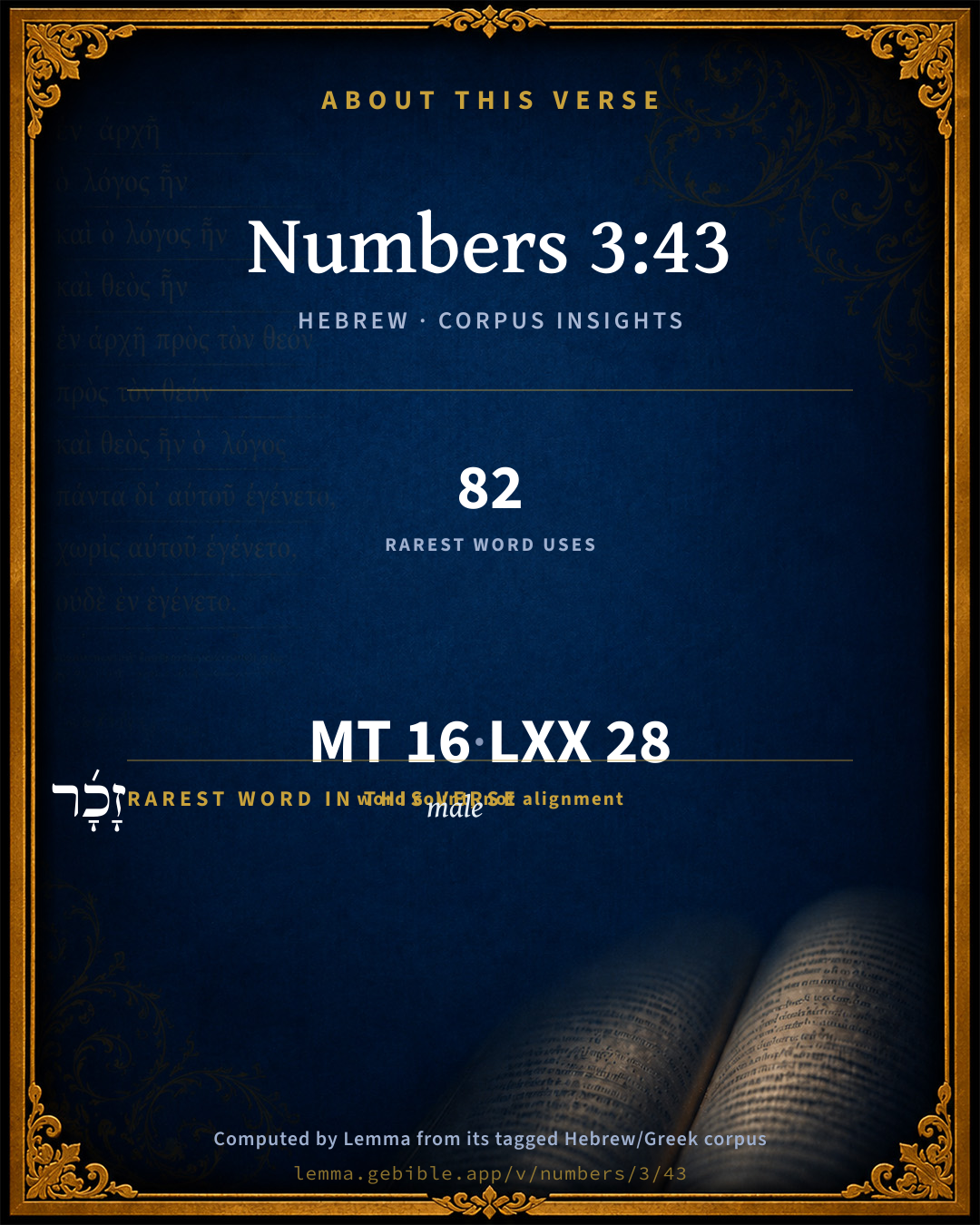
These counts appear in no published source. They are computed here, from the morphology-tagged text and Lemma’s own curated glosses. What Lemma adds →

16
words
16
distinct lemmas
Pentateuch
section

Grammatical profile

  • 2 verbs
  • 6 nouns
  • 7 adjectives
  • 1 adverb

Verb forms

  • וַיְהִי֩ Qal · Sequential Imperfect
  • לִפְקֻדֵיהֶ֑ם Qal · Participle Passive

Hebrew & Septuagint length

In English translation the verse runs 29 words from the Hebrew and 27 from the Septuagint (LXX English) — closely comparable.

A rough comparison of the two English renderings, which tokenize alike — not a word-level alignment.

Word counts can differ between the Hebrew and the Greek without any difference in meaning — e.g. the Hebrew direct-object marker אֵת has no separate Greek word, and Greek often adds the article ὁ.

In the original languages it is 16 Hebrew tokens and 28 Greek tokens — but the two are counted differently (Hebrew bundles its prefixes and suffixes into one token; the Greek is in lemma form), so that isn’t a like-for-like length.

Cross-references

1

Topical passages linked to Numbers 3:43 in the Treasury of Scripture Knowledge — connected by theme and wording, ordered by reader-vote popularity; previews shown in the World English Bible.

  • Numbers 3:39 All who were numbered of the Levites, whom Moses and Aaron numbered at the commandment of Yahweh, by their families, all the males from a month old and upward, were twenty-two thousand.

Cross-references courtesy of OpenBible.info (CC BY 4.0).

Hebrew and Greek witnesses Masoretic Hebrew ↔ Greek Septuagint

The same verse in the two great witnesses to the Old Testament, shown verse-for-verse.

These are two independent witnesses, not word-aligned to each other, and the Septuagint is shown in lemma (dictionary) form.

Hebrew Numbers 3:43 Masoretic · Westminster Leningrad Codex

וַיְהִי֩ כָל בְּכ֨וֹר זָכָ֜ר בְּמִסְפַּ֥ר שֵׁמ֛וֹת מִבֶּן חֹ֥דֶשׁ וָמַ֖עְלָה לִפְקֻדֵיהֶ֑ם שְׁנַ֤יִם וְעֶשְׂרִים֙ אֶ֔לֶף שְׁלֹשָׁ֥ה וְשִׁבְעִ֖ים וּמָאתָֽיִם

All the firstborn males according to the number of names, from a month old and upward, of those who were numbered of them, were twenty-two thousand two hundred seventy-three.

World English Bible · Public Domain

Greek LXX Numbers 3:43 Septuagint · lemma form

καί γίγνομαι πᾶς ὁ πρωτότοκος ὁ ἀρσενικός κατά ἀριθμός ἐκ ὄνομα ἀπό μηνιαῖος καί ἐπάνω ἐκ ὁ ἐπίσκεψις αὐτός δύο καί εἴκοσι χιλιάς τρεῖς καί ἑβδομήκοντα καί διακόσιοι

And all the male firstborn in number by name, from a month old and upwards, were according to their numbering twenty-two thousand and two hundred and seventy-three.

LXX2012 (modern English Septuagint) · Public Domain

Hebrew: Westminster Leningrad Codex (CC BY 4.0). Greek: Septuagint (public domain); English from LXX2012 (modern English Septuagint) (Public Domain). How the Septuagint differs from the Hebrew →

Targum (Aramaic paraphrase)

2

The Targum is the ancient Jewish Aramaic paraphrase of the Hebrew Scriptures — an interpretive translation, not the Hebrew text itself. Onkelos (literal) and Pseudo-Jonathan (expansive) render the Torah, and Jonathan the Prophets. Coverage is partial: where no permissively-licensed English translation exists for a verse, only the Aramaic is shown. This is verse-level text, not a word-by-word alignment to the Hebrew.

  1. Targum Onkelos Torah (Genesis–Deuteronomy)
    וַהֲווֹ כָל בּוּכְרַיָא דִכְרַיָא בְּמִנְיַן שְׁמָהָן מִבַּר יַרְחָא וּלְעֵלָא לְמִנְיָנֵיהוֹן עַשְׂרִין וּתְרֵין אַלְפִין מָאתָן וְשַׁבְעִין וּתְלָתָא

    (no public-domain English translation for this verse)

    Targum Onkelos — Aramaic: “Onkelos Genesis” (public domain); “Onkelos Exodus” (public domain); “Onkelos Leviticus” (public domain); “Onkelos Numbers” (public domain); “Onkelos Deuteronomy” (public domain). English: “Sefaria Community Translation” (CC0 1.0 (public-domain dedication)); “J.W. Etheridge. The Targums of Onkelos and Jonathan Ben Uzziel on the Pentateuch. London: Longmans, Green, 1862” (public domain). Text via Sefaria.

  2. Targum Pseudo-Jonathan Torah (Genesis–Deuteronomy)
    וַהֲווֹן כָּל בּוּכְרַיָא דוּכְרַיָא בִּסְכוּם מִנְיַין שְׁמָהָן מִבַּר יַרְחָא וּלְעֵילָא לִסְכוּם מִנְיָינֵיהוֹן עַשְרִין וּתְרֵין אַלְפִין וּמָאתָן וְשַׁבְעִין וּתְלָתָא

    all the firstborn of the sons of Israel: the sum of their number was twenty-two thousand two hundred and seventy-three.

    Targum Pseudo-Jonathan — Aramaic: “Targum Jonathan on Genesis” (public domain); “Targum Jonathan on Exodus” (public domain); “Targum Jonathan on Leviticus” (public domain); “Targum Jonathan on Numbers” (public domain); “Targum Jonathan on Deuteronomy” (public domain). English: “The Targum of Jonathan ben Uzziel, trans. J. W. Etheridge, London, 1862” (public domain). Text via Sefaria.

Commentary

Notes on Numbers 3:43 from classic Christian and Jewish commentators (each source and its license shown beneath its notes). The classic Christian expositions comment on the surrounding passage and are grouped to its opening verse, so a note may address several verses; the Jewish commentaries on the Tanakh (Rashi and others) are per-verse, so they appear only where the commentator wrote on this verse.

Lemma curates 59 commentaries, every one of them public domain or Creative Commons licensed, each selected and text-cleaned for this edition rather than reprinted as found. About our sources →

Adam Clarke's Commentary

Verse 43. All the first-born males - were twenty and two thousand two hundred and threescore and thirteen.] Thus we find there were 273 first-born beyond the number of the Levites. These are ordered, Nu 3:46, to be redeemed; and the redemption price is to be five shekels each, Nu 3:47, about 15s. And this money, amounting to 1,365 shekels, equal to £204 15s. English, he took of the first-born of Israel, Nu 3:50. But how was this collected among 22,273 persons? Rabbi Solomon Jarchi says, "to prevent contention, Moses took 22,000 slips of parchment, and wrote on each a son of Levi, and 273 others, on which he wrote five shekels; then he mixed them in a basket, and each man took out one; those who drew the slips on which five shekels were written, paid the money; the others went free." This is a most stupid and silly tale, for such a mode of settlement never could have been resorted to by an intelligent people. It would have been much more simple to have paid it out of a general fund; and it is very likely that in this way the expense was defrayed.

This species of redeeming of men is referred to by St. Peter, 1Pe 1:18-19: "Ye know that ye were not redeemed with corruptible things, as silver and gold, from your vain conversation, received by tradition from your fathers; but with the precious (τιμιω αιματι, valuable) blood of Christ, as of a lamb without blemish and without spot," c. And it is not the first-born only which are thus redeemed, for he, by the grace of God, tasted death for EVERY man Heb 2:9. Reader, give glory to God that such a ransom has been paid for thy soul, and see that, redeemed from thy vain conversation, thy empty, fruitless, and graceless observances, on which thou hast built thy hopes of salvation, thou walk in newness of life, giving thy whole soul with thankfulness unto the Father who hath translated thee from darkness, and placed thee in the kingdom of his beloved Son. To Him be glory and dominion for ever and ever! Amen.

Adam Clarke's Commentary on the Bible (1810–1826) — public domain. Text from a community e-Sword/MySword module.

Ellicott's Commentary for English Readers

(43) Twenty and two thousand two hundred and threescore and thirteen.—The extremely small number of the firstborn in proportion to a male population of 600,000 of twenty years of age and upwards—i.e., to a population of about 1,000,000 males—has been a fruitful source of difficulty, and, in some cases, a ground for the rejection of the historical truth of the narrative, which involves, it has been alleged, the incredible conclusion that there was only one firstborn to forty-four males. It might suffice, in answer to those who urge this difficulty as a ground for rejecting the truth of the narrative, to reply that it is difficult, if not impossible, to conceive that a writer who has recorded, or, according to the theory in question, invented so many complicated calculations, should have inserted amongst them one which is fraught with so much apparent improbability. Many solutions of the problem have been proposed which relieve the apparent disproportion of the number of the firstborn not only of its alleged impossibility, but even of improbability. Some have urged that we are constrained by every principle of analogy to restrict the firstborn sons to those who were under twenty years of age, and who had not been included in the census which had been already taken. The destruction of the firstborn of the Egyptians was clearly subject to a somewhat similar limitation. Pharaoh himself was, in all probability, a firstborn son; and in regard to the Egyptians generally there does not appear to have been above one death in each house (Exo_12:30), although there must have been very many houses in which the father (and it may be the grandfather) as well as the son was a firstborn child. Another opinion is that by the firstborn in every family we are to understand the firstborn in every household, including the children of concubines and slaves. When due allowance has been made, on either of these hypotheses, for the average proportion of the sexes, the average number of early deaths, and also for the limitation of the term firstborn to those who were the firstborn on the side of the father as well as of the mother, it has been contended that the number of the firstborn is consistent with the supposition that each family of the Israelites consisted of about eight or nine children—a supposition which, considering how prolific the Hebrew women are said to have been, cannot be regarded as deserving of rejection on the ground of its incredibility. The most probable solution of the difficulty, however, appears to be that which is given in the Introduction.

A Bible Commentary for English Readers, edited by Charles John Ellicott (1878–1897) — public domain. Text from a community e-Sword module.

John Gill's Exposition

And the Lord spake unto Moses,.... After the number was taken, and gave him directions what to do upon it:

saying; as follows.

John Gill's Exposition of the Whole Bible (1746–1763) — public domain (CC PDM 1.0). Text via the HelloAO Bible API.

Albert Barnes' Notes on the Bible

This result, when compared with the number of male adults (603,550, compare Num 2:32), is small, the usual proportion of first-born sons to a total male population being about one in four: and the explanation offered is that the law of Exo 13:1-2, prescribed a dedication of those only who should be firstborn “thenceforward”.

On the other hand, the number is very large to be born among two millions of persons in a single year; and it must be admitted, that some unusual causes must have been concerned. Such, not to mention the divine blessing, may be found in the sudden development of national energies which would immediately ensue on the Exodus. Before that event, the miserable estate of the people, and especially the inhuman order for the destruction of their first-born, would check very seriously the ratio of marriages and births; and this ratio would naturally, when the check was removed, exhibit a sudden and striking increase.

Albert Barnes' Notes on the Bible (1834–1885) — public domain. Text from a community e-Sword/MySword module.

The Pulpit Commentary

Twenty and two thousand two hundred and threescore and thirteen. These were the first-born of the twelve tribes; but who were included under the designation "first-born" is a matter of grave dispute. The smallness of their number (not much above one per cent. of the whole population) has given rise to several conflicting theories, all of which seem to be artificial, arbitrary, and therefore unsatisfactory. It is urged by some that the expression "every male that openeth the womb" must be strictly pressed, and that there would be no "first-born" in those families (which form a considerable majority) in which either a girl was born first, or the eldest, being a boy, had died. It is further urged that only those first-horn would be counted who were not themselves fathers of families. These considerations will indeed reduce the probable numbers very largely, but not to the required amount. Others, again, give an entirely different turn to the difficulty by urging that as the command in Exodus 13. I was prospective only, so at this time only the first-born since the exodus were counted. This makes it necessary to assume an altogether unprecedented birth-rate during that short period. One other explanation strives to satisfy the arithmetical conditions of the problem by assuming that the whole of the Divine legislation in this matter was in reality directed against the worship of Moloch, and was designed to prevent the offering of first-born to him by redeeming them unto himself. As the rites of Moloch only demanded young children of tender age, only such were counted in this census. It may, indeed, be very probably concluded that their heavenly Father did claim these first-born, partly in order to save them from Moloch, because the people would thereafter be exposed to the fascination of that horrid superstition; but there is no proof whatever that they were acquainted with it at this time. These cruel rites, together with many other heathen abominations, are forbidden in Lev_18:21 and Deu_18:10, in view of the entry into Canaan, where they were practiced. The prophet Amos, when he reproaches them with having "carried the tabernacle of" their "Moloch" even in the wilderness, (Amo_5:26) absolves them by implication from any darker superstition; and the highly rhetorical passage Eze_20:26 seems to refer to the consequences of disobedience at a later date, and can hardly be pressed against the entire silence of the Pentateuch. Anyhow it does not seem possible, on the strength of a supposed intention on the part of God of which no trace appears in the text, to impose a narrow and arbitrary limit upon the plain command to number "all the first-born, from a month old and upward." If we turn from these speculations to the reason and ground of the matter as stated by God himself, it will appear much more simple. It was distinctly on the ground of their preservation from the destroying angel in Egypt that the first-born of Israel were claimed as God"s peculium now (see verse 13). The command in Exo_13:1 was no doubt prospective, but the sanctification of the first-born was based upon the deliverance itself; and this command was intended not to limit that sanctification for the present, but to continue it for the future. Now if we turn to Exo_12:29, Exo_12:30, and ask who the first-born were whom the destroying angel cut off, we see plainly enough that they included the eldest son, being a child, in every house; that every family lost one, and only one. On the one hand, Pharaoh himself was in all probability a firstborn, but he was not in any personal danger, because he ranked and suffered as a father, not as a son. On the other hand, the majority of families in which the first-born was a daughter, or had died, did not therefore escape: "there was not a house where there was not one dead.

Taking this as the only sure ground to go upon, we may conclude with some confidence that the first-born now claimed by God in-eluded all the eldest sons in the families of Israel who were not themselves the heads of houses. These were the destroyed in Egypt these the redeemed in Israel. How they came to be so few in proportion is a matter in itself of extremely slight importance, and dependant, perhaps, upon causes of which no record was left.

The Pulpit Commentary (1880–1919), ed. H.D.M. Spence-Jones & Joseph S. Exell — public domain. Text from a community e-Sword module.

Lesson kit

Teaching starters — assembled from the data on this page, not authored interpretation. Every prompt links to the verse data it draws on. Edit before teaching.

Numbers, in the Pentateuch, opens this verse with 16 words (16 distinct Hebrew lemmas). Its most distinctive word is zâkâr (“male”). A historical commentator’s framing appears above. Read the whole chapter for the surrounding context.

Discussion questions

  1. How does “male” (zâkâr) shape what this verse is saying?
  2. Numbers 3:39 shares this passage’s theme. How do the two illuminate each other?
  3. The translations on this page render this verse differently — a whole-verse word diff, not a word-by-word alignment. What might account for the different wordings?
  4. The verb «וַיְהִי֩» is Qal Sequential Imperfect. How does its form color the action?
  5. Reading how Adam Clarke's Commentary and Ellicott's Commentary for English Readers read this verse, where do the two commentators agree and where do they part?

Things to notice

Reading settings

Reading text

Shown beneath each verse's original-language words.

Old Testament
Old Testament edition

Read the OT as the Masoretic Hebrew (MT) or the Greek Septuagint (LXX).

English shown for the Greek Septuagint (in the Hebrew ↔ Greek comparison).

Comparing translations? Open the Compare panel on any verse page to stack up to four side by side.