
Numbers 2:16

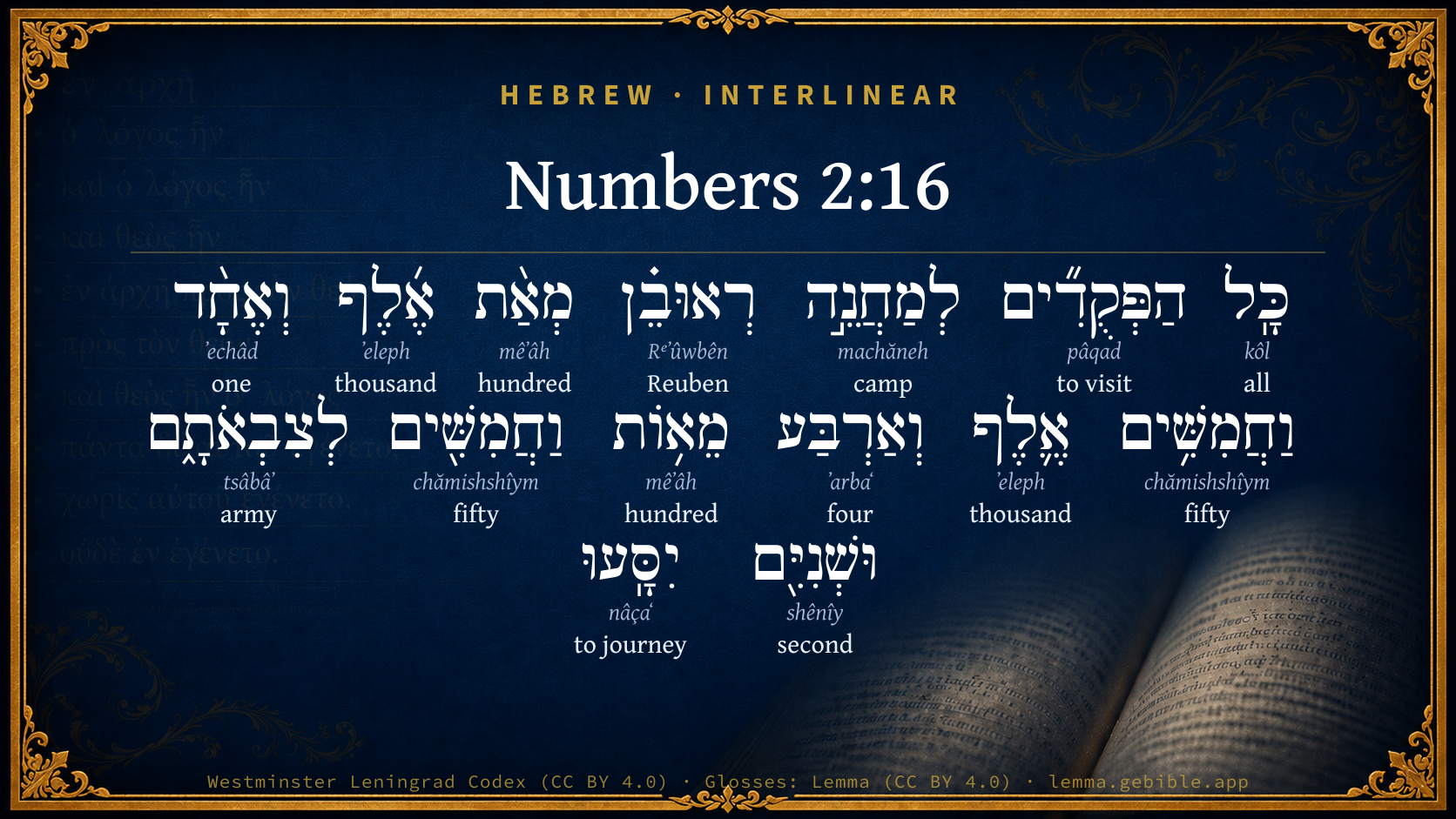
Hebrew (Westminster Leningrad Codex) Numbers 2:16 appears in the Hebrew Old Testament. The text above is from the Westminster Leningrad Codex. Each word links to its Strong’s number, a concise gloss, and parsing drawn from the Open Scriptures Hebrew Bible morphology. Click any word for its full Brown-Driver-Briggs (BDB) entry.
Download image
Cite this verse

Numbers 2:16 (World English Bible). Public Domain. Lemma interlinear Bible study tool, https://lemma.gebible.app/v/numbers/2/16.

Show BibTeX & RIS
BibTeX
RIS
English Translation
"All who were numbered of the camp of Reuben were one hundred fifty-one thousand four hundred fifty, according to their hosts. They shall set out second.
World English Bible · Public Domain
Download a study sheet

One document with this verse’s original text, its word-by-word gloss line, the meaning frame, cross-references with their text, attributed commentary, and full source and license credits — printable, and it pastes into notes with its structure intact.

This verse Autodidact and up

Study sheet (.html) Plain text (.txt)

A passage Seminary Student

Up to 50 verses in one chapter. A passage sheet keeps up to 6 commentary sources and 12 cross-references per verse, in the order this page ranks them, and says so on the sheet whenever that leaves anything out. Ask for a single verse and you get the Autodidact verse sheet above.

Everything on this page stays free to read, with no account — the sheet is a download of what is already on screen, not access to it.

Want to remove ads? Support Godless Engineer
Compare translations 3

The same verse in 3 English versions, stacked beneath the original-language interlinear above. Click any original word for its lexicon entry.

Each is an independent rendering of the whole verse — the interlinear is not word-aligned to these translations.

Highlighted words mark where these versions differ — a whole-verse word diff, not a word-by-word alignment.

  • World English Bible Public Domain
    "All who were numbered of the camp of Reuben were one hundred fifty-one thousand four hundred fifty, according to their hosts. They shall set out second.
  • King James Version Public Domain
    All that were numbered in the camp of Reuben were an hundred thousand and fifty and one thousand and four hundred and fifty, throughout their armies. And they shall set forth in the second rank.
  • unfoldingWord Literal Text CC BY-SA 4.0
    All the counted ones of the camp of Reuben 151,450 according to their armies. And they will set out second.

unfoldingWord Literal Text — © unfoldingWord, licensed CC BY-SA 4.0. Word-aligned USFM3 via Door43 (git.door43.org/unfoldingWord/en_ult).

Versions to compare (up to 4)

3 of 4 selected

Show all 18 translations

Every available English version of this verse, each an independent rendering of the whole verse.

  • World English Bible Public Domain
    "All who were numbered of the camp of Reuben were one hundred fifty-one thousand four hundred fifty, according to their hosts. They shall set out second.
  • Berean Standard Bible Public Domain
    The total number of men in the divisions of the camp of Reuben is 151,450; they shall set out second.
  • Majority Standard Bible Public Domain
    The total number of men in the divisions of the camp of Reuben is 151,450; they shall set out second.
  • King James Version Public Domain
    All that were numbered in the camp of Reuben were an hundred thousand and fifty and one thousand and four hundred and fifty, throughout their armies. And they shall set forth in the second rank.
  • American Standard Version (1901) Public Domain
    All that were numbered of the camp of Reuben were a hundred thousand and fifty and one thousand and four hundred and fifty, according to their hosts. And they shall set forth second.
  • Revised Version (1885) Public Domain
    All that were numbered of the camp of Reuben were an hundred thousand and fifty and one thousand and four hundred and fifty, according to their hosts. And they shall set forth second.
  • Geneva Bible (1599) Public Domain
    All the nomber of the campe of Reuben were an hundreth and one and fiftie thousande, and foure hundreth and fiftie according to their armies, and they shall set foorth in the seconde place.
  • Douay-Rheims (1899) Public Domain
    All that were reckoned up in the camp of Ruben, were a hundred and fifty-one thousand four hundred and fifty, by their troops: they shall march in the second place.
  • Young's Literal Translation Public Domain
    All those numbered of the camp of Reuben `are' a hundred thousand, and one and fifty thousand, and four hundred and fifty, by their hosts; and they journey second.
  • Literal Standard Version CC BY-SA 4.0
    All those numbered of the camp of Reuben [are] one hundred thousand and fifty-one thousand and four hundred and fifty, by their hosts; and they journey second.
  • Unlocked Literal Bible CC BY-SA 4.0
    The number of all the men assigned to the camp of Reuben, according to their divisions, is 151,450. They will set out second.
  • unfoldingWord Literal Text CC BY-SA 4.0
    All the counted ones of the camp of Reuben 151,450 according to their armies. And they will set out second.
  • Darby Bible Public Domain
    All that were numbered of the camp of Reuben were a hundred and fifty-one thousand four hundred and fifty, according to their hosts. And they shall set forth second.
  • World Messianic Bible Public Domain
    “All who were counted of the camp of Reuben were one hundred fifty-one thousand four hundred fifty, according to their armies. They shall set out second.
  • Webster's Bible Public Domain
    All that were numbered in the camp of Reuben were a hundred thousand and fifty and one thousand and four hundred and fifty, throughout their armies: and they shall move forward in the second rank.
  • Free Bible Version CC BY-SA 4.0
    So the total number of men in the area of the camp of Reuben is 151,450. They shall march out in second place.
  • Bible in Basic English Public Domain
    The number of all the armies of Reuben together came to a hundred and fifty-one thousand, four hundred and fifty. They go forward second.
  • JPS Tanakh (1917) Public Domain
    all that were numbered of the camp of Reuben being a hundred thousand and fifty and one thousand and four hundred and fifty, according to their hosts; and they shall set forth second.

Literal Standard Version (2020), Covenant Press — licensed CC BY-SA 4.0. Text via the HelloAO Bible API (eBible.org). Unlocked Literal Bible (unfoldingWord) — licensed CC BY-SA 4.0. Text via the HelloAO Bible API (eBible.org). unfoldingWord Literal Text — © unfoldingWord, licensed CC BY-SA 4.0. Word-aligned USFM3 via Door43 (git.door43.org/unfoldingWord/en_ult). Free Bible Version, Dr. Jonathan Gallagher — licensed CC BY-SA 4.0. Text via the HelloAO Bible API (eBible.org).

Word by word

More ways to search: Search by grammar → Find every occurrence → Compare this word →

Practice this passage: Drill this verse → Learn its vocabulary →

רְאוּבֵ֗ן
Rᵉʼûwbên
H7205
“Reuben”
Noun, Proper
Part of Speech
Noun
Type
Proper
Full BDB Definition

Origin: from the imperative of H7200 and H1121

TWOT: None

Reuben = "behold a son" - the eldest son of Jacob by Leah - the tribe descended from Reuben - the territory inhabited by the tribe of Reuben
  1. כָּֽל kôl H3605 “all of” Noun, Common, Masculine, Singular, Construct
  2. הַפְּקֻדִ֞ים pâqad H6485 “the · visited” Particle, Definite Article + Verb, Qal, Participle Passive, Masculine, Plural, Absolute
  3. לְמַחֲנֵ֣ה machăneh H4264 “to/for · camp of” Preposition + Noun, Common, Both, Singular, Construct
  4. מְאַ֨ת mêʼâh H3967 “hundred” Adjective, Cardinal number, Both, Singular, Construct
  5. אֶ֜לֶף ʼeleph H505 “thousand” Adjective, Cardinal number, Both, Singular, Absolute
  6. וְאֶחָ֨ד ʼechâd H259 “and · one” Conjunction + Adjective, Cardinal number, Masculine, Singular, Absolute
  7. וַחֲמִשִּׁ֥ים chămishshîym H2572 “and · fifty” Conjunction + Adjective, Cardinal number, Both, Plural, Absolute
  8. אֶ֛לֶף ʼeleph H505 “thousand” Adjective, Cardinal number, Both, Singular, Absolute
  9. וְאַרְבַּע ʼarbaʻ H702 “and · four” Conjunction + Adjective, Cardinal number, Feminine, Singular, Absolute
  10. מֵא֥וֹת mêʼâh H3967 “hundred” Adjective, Cardinal number, Both, Plural, Absolute
  11. וַחֲמִשִּׁ֖ים chămishshîym H2572 “and · fifty” Conjunction + Adjective, Cardinal number, Both, Plural, Absolute
  12. לְצִבְאֹתָ֑ם tsâbâʼ H6635 “to/for · armies · their” Preposition + Noun, Common, Both, Plural, Construct + Suffix, Personal, 3rd Person, Masculine, Plural
  13. וּשְׁנִיִּ֖ם shênîy H8145 “and · second” Conjunction + Adjective, Ordinal number, Masculine, Plural, Absolute
  14. יִסָּֽעוּ nâçaʻ H5265 “to journey” Verb, Qal, Imperfect, 3rd Person, Masculine, Plural

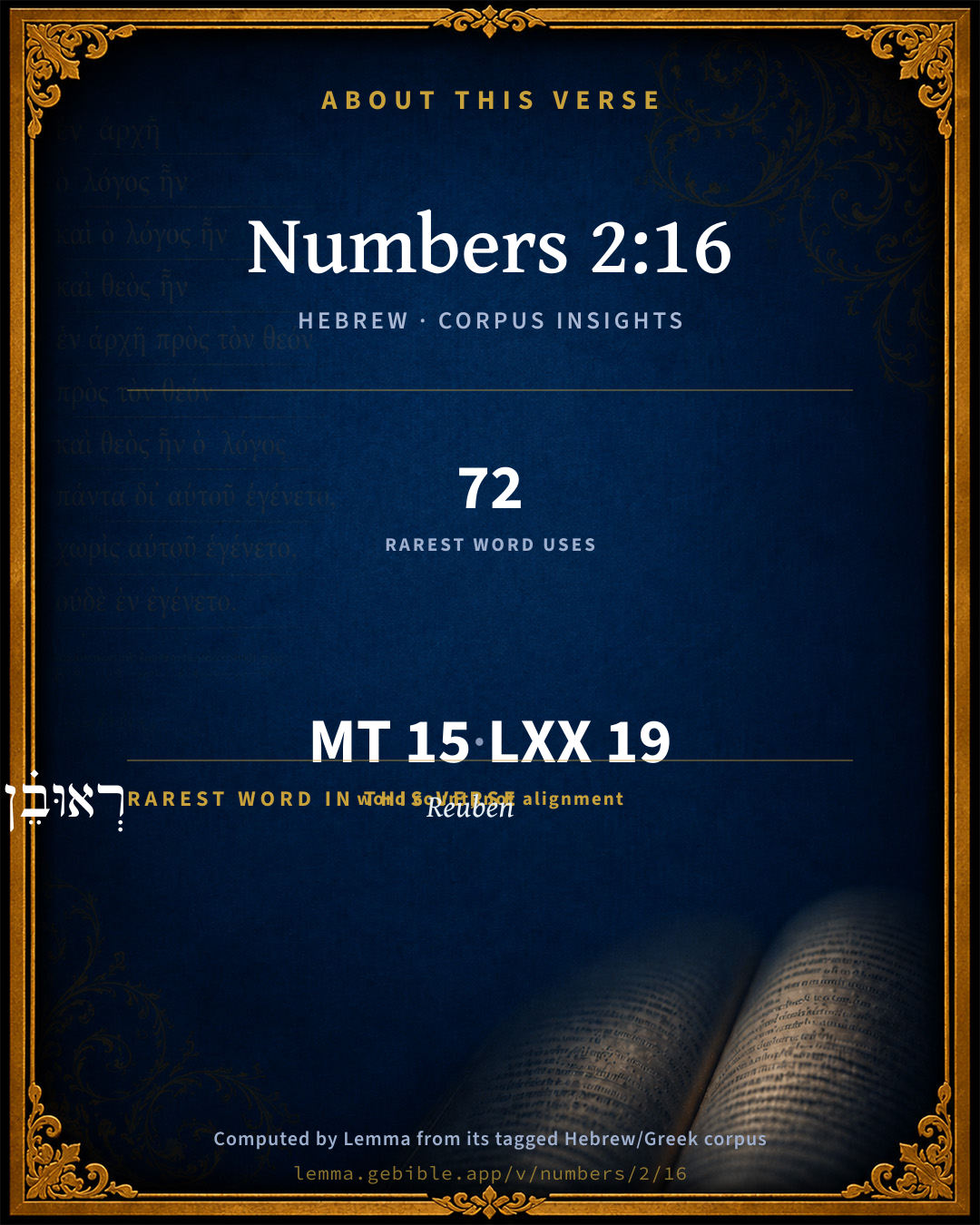
About this verse

These counts appear in no published source. They are computed here, from the morphology-tagged text and Lemma’s own curated glosses. What Lemma adds →

15
words
12
distinct lemmas
Pentateuch
section

Grammatical profile

  • 2 verbs
  • 4 nouns
  • 9 adjectives

Verb forms

  • הַפְּקֻדִ֞ים Qal · Participle Passive
  • יִסָּֽעוּ Qal · Imperfect

Repetition

Words recur within this verse — often emphatic in Hebrew:

  • מְאַ֨ת hundred H3967 ×2
  • אֶ֜לֶף thousand H505 ×2
  • וַחֲמִשִּׁ֥ים fifty H2572 ×2

Hebrew & Septuagint length

In English translation the verse runs 26 words from the Hebrew and 30 from the Septuagint (LXX English) — closely comparable.

A rough comparison of the two English renderings, which tokenize alike — not a word-level alignment.

Word counts can differ between the Hebrew and the Greek without any difference in meaning — e.g. the Hebrew direct-object marker אֵת has no separate Greek word, and Greek often adds the article ὁ.

In the original languages it is 15 Hebrew tokens and 19 Greek tokens — but the two are counted differently (Hebrew bundles its prefixes and suffixes into one token; the Greek is in lemma form), so that isn’t a like-for-like length.

Cross-references

4

Topical passages linked to Numbers 2:16 in the Treasury of Scripture Knowledge — connected by theme and wording, ordered by reader-vote popularity; previews shown in the World English Bible.

  • Numbers 10:18 The standard of the camp of Reuben set forward according to their hosts: and over his host was Elizur the son of Shedeur.
  • Numbers 2:9 All who were numbered of the camp of Judah were one hundred eighty-six thousand four hundred, according to their divisions. They shall set out first.
  • Numbers 2:24 "All who were numbered of the camp of Ephraim were one hundred eight thousand one hundred, according to their divisions. They shall set out third.
  • Numbers 2:31 "All who were numbered of the camp of Dan were one hundred fifty-seven thousand six hundred. They shall set out last by their standards."

Cross-references courtesy of OpenBible.info (CC BY 4.0).

Hebrew and Greek witnesses Masoretic Hebrew ↔ Greek Septuagint

The same verse in the two great witnesses to the Old Testament, shown verse-for-verse.

These are two independent witnesses, not word-aligned to each other, and the Septuagint is shown in lemma (dictionary) form.

Hebrew Numbers 2:16 Masoretic · Westminster Leningrad Codex

כָּֽל הַפְּקֻדִ֞ים לְמַחֲנֵ֣ה רְאוּבֵ֗ן מְאַ֨ת אֶ֜לֶף וְאֶחָ֨ד וַחֲמִשִּׁ֥ים אֶ֛לֶף וְאַרְבַּע מֵא֥וֹת וַחֲמִשִּׁ֖ים לְצִבְאֹתָ֑ם וּשְׁנִיִּ֖ם יִסָּֽעוּ

"All who were numbered of the camp of Reuben were one hundred fifty-one thousand four hundred fifty, according to their hosts. They shall set out second.

World English Bible · Public Domain

Greek LXX Numbers 2:16 Septuagint · lemma form

πᾶς ὁ ἐπισκέπτω ὁ παρεμβολή ρουβην ἑκατόν πεντήκοντα εἷς χιλιάς καί τετρακόσιοι καί πεντήκοντα σύν δύναμις αὐτός δεύτερος ἐκαἴρω

All who were numbered of the camp of Ruben, were one hundred and fifty-one thousand and four hundred and fifty: they with their forces shall proceed in the second place.

LXX2012 (modern English Septuagint) · Public Domain

Hebrew: Westminster Leningrad Codex (CC BY 4.0). Greek: Septuagint (public domain); English from LXX2012 (modern English Septuagint) (Public Domain). How the Septuagint differs from the Hebrew →

Targum (Aramaic paraphrase)

2

The Targum is the ancient Jewish Aramaic paraphrase of the Hebrew Scriptures — an interpretive translation, not the Hebrew text itself. Onkelos (literal) and Pseudo-Jonathan (expansive) render the Torah, and Jonathan the Prophets. Coverage is partial: where no permissively-licensed English translation exists for a verse, only the Aramaic is shown. This is verse-level text, not a word-by-word alignment to the Hebrew.

  1. Targum Onkelos Torah (Genesis–Deuteronomy)
    כָּל מִנְיָנַיָא לְמַשְׁרִית רְאוּבֵן מְאָה וְחַמְשִׁין וְחַד אַלְפִין וְאַרְבַּע מְאָה וְחַמְשִׁין לְחֵילֵיהוֹן בְּתִנְיֵתָא נַטְלִין

    (no public-domain English translation for this verse)

    Targum Onkelos — Aramaic: “Onkelos Genesis” (public domain); “Onkelos Exodus” (public domain); “Onkelos Leviticus” (public domain); “Onkelos Numbers” (public domain); “Onkelos Deuteronomy” (public domain). English: “Sefaria Community Translation” (CC0 1.0 (public-domain dedication)); “J.W. Etheridge. The Targums of Onkelos and Jonathan Ben Uzziel on the Pentateuch. London: Longmans, Green, 1862” (public domain). Text via Sefaria.

  2. Targum Pseudo-Jonathan Torah (Genesis–Deuteronomy)
    כָּל סְכוּם מִנְיָינָא לְמַשִׁרְיַת רְאוּבֵן מְאָה וְחַמְשִׁין וְחַד אַלְפִין וְאַרְבַּע מְאָה וְחַמְשִׁין לְחֵילֵיהוֹן בְּתִנְיֵיתָא נַטְלִין

    All the sum of the numbered ones of the camp of Reuben, one hundred and fifty one thousand four hundred and fifty by their hosts; and they went forward secondly,

    Targum Pseudo-Jonathan — Aramaic: “Targum Jonathan on Genesis” (public domain); “Targum Jonathan on Exodus” (public domain); “Targum Jonathan on Leviticus” (public domain); “Targum Jonathan on Numbers” (public domain); “Targum Jonathan on Deuteronomy” (public domain). English: “The Targum of Jonathan ben Uzziel, trans. J. W. Etheridge, London, 1862” (public domain). Text via Sefaria.

Commentary

Notes on Numbers 2:16 from classic Christian and Jewish commentators (each source and its license shown beneath its notes). The classic Christian expositions comment on the surrounding passage and are grouped to its opening verse, so a note may address several verses; the Jewish commentaries on the Tanakh (Rashi and others) are per-verse, so they appear only where the commentator wrote on this verse.

Lemma curates 59 commentaries, every one of them public domain or Creative Commons licensed, each selected and text-cleaned for this edition rather than reprinted as found. About our sources →

John Gill's Exposition

And all that were numbered in the camp of Reuben were an hundred thousand and fifty and one thousand and four hundred and fifty,

throughout their armies,.... 151,450 men. Putting Reuben's host, and the hosts of Simeon and Gad together, Num 2:13, which was much lesser than the preceding camp, being 34,500 fewer in number:

and they shall set forth in the second rank: they in journeying moving next to the camp of Judah, and before the tabernacle; for though, while encamped, the camp of Reuben lay on the south, or right side of it, yet, when marching, went before it.

John Gill's Exposition of the Whole Bible (1746–1763) — public domain (CC PDM 1.0). Text via the HelloAO Bible API.

unfoldingWord translationNotes

Door43 World Missions Community

The number of all the men ... is 151,450

"The number of all the men ... is one hundred and fifty-one thousand four hundred and fifty." This number includes all of the men in the tribes that camped under the standard of Reuben. AT: "The number of all the men camped under the standard of Reuben, according to their divisions, is 151,450" (See: Numbers and Assumed Knowledge and Implicit Information)

They will set out second

This means that when the Israelite camp moves, the camp of Reuben will start walking out after the camp of Judah goes out. AT: "When travelling, the camp of Reuben will start walking second" or "When the Israelites leave, those tribes will leave next" (See: Ordinal Numbers and Assumed Knowledge and Implicit Information)

translationWords

Reuben

unfoldingWord translationNotes — © Distant Shores Media and the Door43 World Missions Community, licensed CC BY-SA 4.0. Source: git.door43.org/Door43/en_tn.

Lesson kit

Teaching starters — assembled from the data on this page, not authored interpretation. Every prompt links to the verse data it draws on. Edit before teaching.

Numbers, in the Pentateuch, opens this verse with 15 words (12 distinct Hebrew lemmas). Its most distinctive word is Rᵉʼûwbên (“Reuben”). A historical commentator’s framing appears above. Read the whole chapter for the surrounding context.

Discussion questions

  1. The word Rᵉʼûwbên carries the sense “Reuben.” How does it shape the verse?
  2. How does Numbers 10:18, which shares this passage’s theme, read alongside this verse?
  3. What does the repetition of “hundred” (2× in this one verse) do in this verse?
  4. The translations on this page render this verse differently — a whole-verse word diff, not a word-by-word alignment. What might account for the different wordings?
  5. «הַפְּקֻדִ֞ים» is a Qal Participle Passive verb. How does that grammatical form shape the action described?
  6. Compare how John Gill's Exposition and unfoldingWord translationNotes read this verse. Where do they agree or differ?

Things to notice

Reading settings

Reading text

Shown beneath each verse's original-language words.

Old Testament
Old Testament edition

Read the OT as the Masoretic Hebrew (MT) or the Greek Septuagint (LXX).

English shown for the Greek Septuagint (in the Hebrew ↔ Greek comparison).

Comparing translations? Open the Compare panel on any verse page to stack up to four side by side.