
Deuteronomy 7:9

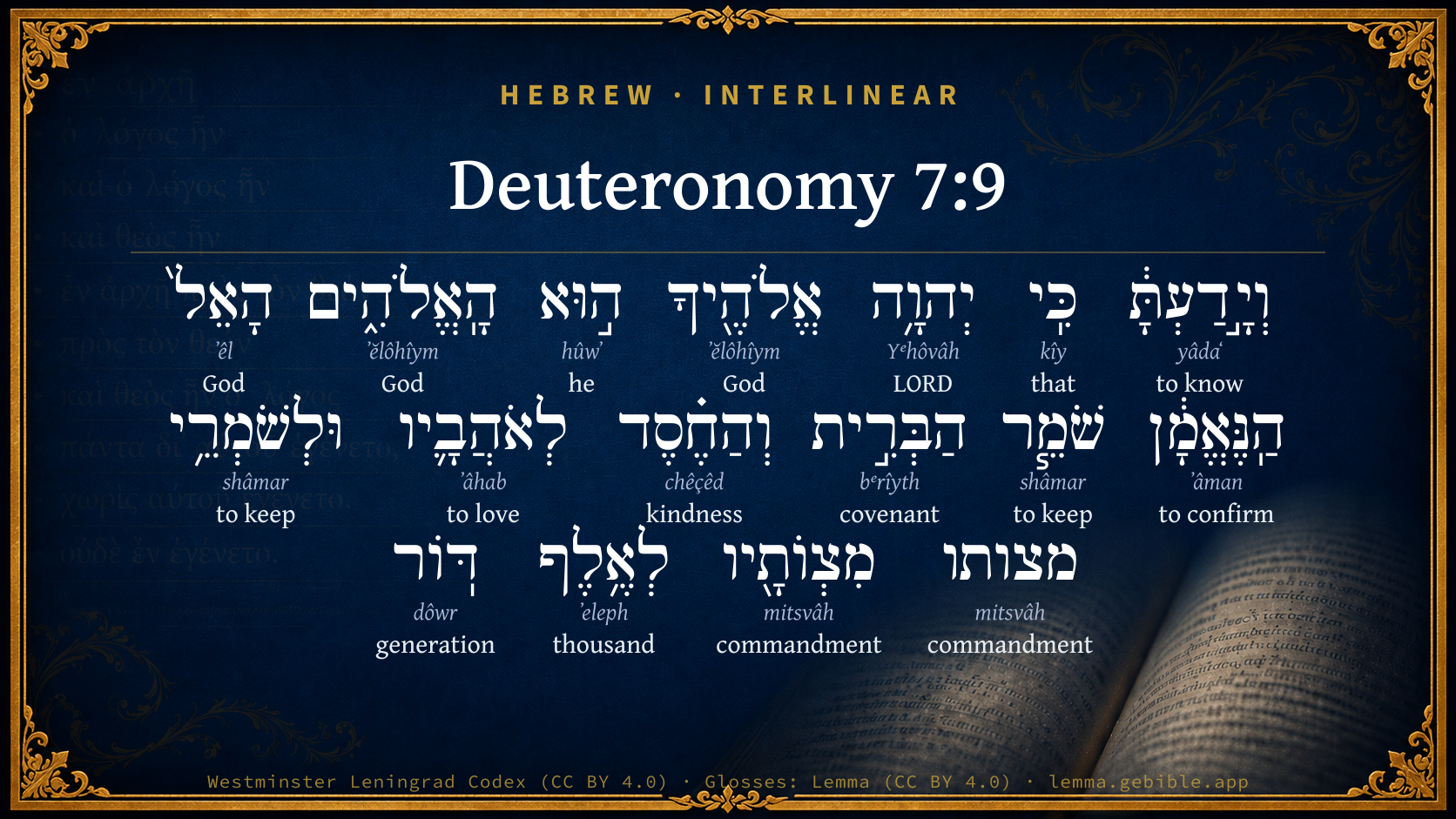
Hebrew (Westminster Leningrad Codex) Deuteronomy 7:9 appears in the Hebrew Old Testament. The text above is from the Westminster Leningrad Codex. Each word links to its Strong’s number, a concise gloss, and parsing drawn from the Open Scriptures Hebrew Bible morphology. Click any word for its full Brown-Driver-Briggs (BDB) entry.
Download image
Cite this verse

Deuteronomy 7:9 (World English Bible). Public Domain. Lemma interlinear Bible study tool, https://lemma.gebible.app/v/deuteronomy/7/9.

Show BibTeX & RIS
BibTeX
RIS
English Translation
Know therefore that Yahweh your God, he is God, the faithful God, who keeps covenant and loving kindness with them who love him and keep his commandments to a thousand generations,
World English Bible · Public Domain
Download a study sheet

One document with this verse’s original text, its word-by-word gloss line, the meaning frame, cross-references with their text, attributed commentary, and full source and license credits — printable, and it pastes into notes with its structure intact.

This verse Autodidact and up

Study sheet (.html) Plain text (.txt)

A passage Seminary Student

Up to 50 verses in one chapter. A passage sheet keeps up to 6 commentary sources and 12 cross-references per verse, in the order this page ranks them, and says so on the sheet whenever that leaves anything out. Ask for a single verse and you get the Autodidact verse sheet above.

Everything on this page stays free to read, with no account — the sheet is a download of what is already on screen, not access to it.

Want to remove ads? Support Godless Engineer
Compare translations 3

The same verse in 3 English versions, stacked beneath the original-language interlinear above. Click any original word for its lexicon entry.

Each is an independent rendering of the whole verse — the interlinear is not word-aligned to these translations.

Highlighted words mark where these versions differ — a whole-verse word diff, not a word-by-word alignment.

  • World English Bible Public Domain
    Know therefore that Yahweh your God, he is God, the faithful God, who keeps covenant and loving kindness with them who love him and keep his commandments to a thousand generations,
  • King James Version Public Domain
    Know therefore that the LORD thy God, he is God, the faithful God, which keepeth covenant and mercy with them that love him and keep his commandments to a thousand generations;
  • unfoldingWord Literal Text CC BY-SA 4.0
    And you shall know that Yahweh your God, he God, the faithful God, who keeps covenants and faithfulness for a thousand generations with those who love him and keep his commandments,

unfoldingWord Literal Text — © unfoldingWord, licensed CC BY-SA 4.0. Word-aligned USFM3 via Door43 (git.door43.org/unfoldingWord/en_ult).

Versions to compare (up to 4)

3 of 4 selected

Show all 18 translations

Every available English version of this verse, each an independent rendering of the whole verse.

  • World English Bible Public Domain
    Know therefore that Yahweh your God, he is God, the faithful God, who keeps covenant and loving kindness with them who love him and keep his commandments to a thousand generations,
  • Berean Standard Bible Public Domain
    Know therefore that the LORD your God is God, the faithful God who keeps His covenant of loving devotion for a thousand generations of those who love Him and keep His commandments.
  • Majority Standard Bible Public Domain
    Know therefore that the LORD your God is God, the faithful God who keeps His covenant of loving devotion for a thousand generations of those who love Him and keep His commandments.
  • King James Version Public Domain
    Know therefore that the LORD thy God, he is God, the faithful God, which keepeth covenant and mercy with them that love him and keep his commandments to a thousand generations;
  • American Standard Version (1901) Public Domain
    Know therefore that Jehovah thy God, he is God, the faithful God, who keepeth covenant and lovingkindness with them that love him and keep his commandments to a thousand generations,
  • Revised Version (1885) Public Domain
    Know therefore that the LORD thy God, he is God; the faithful God, which keepeth covenant and mercy with them that love him and keep his commandments to a thousand generations;
  • Geneva Bible (1599) Public Domain
    That thou mayest knowe, that the Lord thy God, he is God, the faithfull God which keepeth couenant and mercie vnto them that loue him and keepe his commandements, euen to a thousand generations,
  • Douay-Rheims (1899) Public Domain
    And thou shalt know that the Lord thy God, he is a strong and faithful God, keeping his covenant and mercy to them that love him, and to them that keep his commandments, unto a thousand generations:
  • Young's Literal Translation Public Domain
    `And thou hast known that Jehovah thy God He `is' God, the faithful God, keeping the covenant, and the kindness, to those loving Him, and to those keeping His commands -- to a thousand generations,
  • Literal Standard Version CC BY-SA 4.0
    And you have known that He, your God YHWH, [is] God, the faithful God keeping the covenant and the kindness with those loving Him and with those keeping His commands, for one thousand generations,
  • Unlocked Literal Bible CC BY-SA 4.0
    Therefore know that Yahweh your God—he is God, the faithful God, who keeps covenants and faithfulness for a thousand generations with those who love him and keep his commandments,
  • unfoldingWord Literal Text CC BY-SA 4.0
    And you shall know that Yahweh your God, he God, the faithful God, who keeps covenants and faithfulness for a thousand generations with those who love him and keep his commandments,
  • Darby Bible Public Domain
    And thou shalt know that Jehovah thy God, he is God, the faithful ùGod, who keepeth covenant and mercy to a thousand generations with them that love him and keep his commandments;
  • World Messianic Bible Public Domain
    Know therefore that the LORD your God himself is God, the faithful God, who keeps covenant and loving kindness to a thousand generations with those who love him and keep his commandments,
  • Webster's Bible Public Domain
    Know therefore that the LORD thy God, he is God, the faithful God, who keepeth covenant and mercy with them that love him and keep his commandments to a thousand generations:
  • Free Bible Version CC BY-SA 4.0
    That's why you can be sure that the Lord your God is the true God, the faithful God who keeps his agreement based on trustworthy love to a thousand generations of those who love him and keep his commandments.
  • Bible in Basic English Public Domain
    Be certain, then, that the Lord your God is God; whose faith and mercy are unchanging, who keeps his word through a thousand generations to those who have love for him and keep his laws;
  • JPS Tanakh (1917) Public Domain
    Know therefore that the LORD thy God, He is God; the faithful God, who keepeth covenant and mercy with them that love Him and keep His commandments to a thousand generations;

Literal Standard Version (2020), Covenant Press — licensed CC BY-SA 4.0. Text via the HelloAO Bible API (eBible.org). Unlocked Literal Bible (unfoldingWord) — licensed CC BY-SA 4.0. Text via the HelloAO Bible API (eBible.org). unfoldingWord Literal Text — © unfoldingWord, licensed CC BY-SA 4.0. Word-aligned USFM3 via Door43 (git.door43.org/unfoldingWord/en_ult). Free Bible Version, Dr. Jonathan Gallagher — licensed CC BY-SA 4.0. Text via the HelloAO Bible API (eBible.org).

Word by word

More ways to search: Search by grammar → Find every occurrence → Compare this word →

Practice this passage: Drill this verse → Learn its vocabulary →

הַֽנֶּאֱמָ֔ן
ʼâman
H539
“the · confirming”
Particle, Definite Article + Verb, Niphal, Participle Active, Masculine, Singular, Absolute
Part of Speech
Particle + Verb
Stem
Niphal
Form
Participle Active
Gender
Masculine
Number
Singular
State
Absolute
Full BDB Definition

Origin: a primitive root

TWOT: 116

to support, confirm, be faithful - (Qal) - to support, confirm, be faithful, uphold, nourish - foster-father (substantive) - foster-mother, nurse - pillars, supporters of the door - (Niphal) - to be established, be faithful, be carried, make firm - to be carried by a nurse - made firm, sure, lasting - confirmed, established, sure - verified, confirmed - reliable, faithful, trusty - (Hiphil) - to stand firm, to trust, to be certain, to believe in - stand firm - trust, believe
  1. וְיָ֣דַעְתָּ֔ yâdaʻ H3045 “and · to know” Conjunction + Verb, Qal, Sequential Perfect, 2nd Person, Masculine, Singular
  2. כִּֽי kîy H3588 “that” Conjunction
  3. יְהוָ֥ה Yᵉhôvâh H3068 “LORD” Noun, Proper
  4. אֱלֹהֶ֖יךָ ʼĕlôhîym H430 “God(s) · your” Noun, Common, Masculine, Plural, Construct + Suffix, Personal, 2nd Person, Masculine, Singular
  5. ה֣וּא hûwʼ H1931 “he” Pronoun, Personal, 3rd Person, Masculine, Singular
  6. הָֽאֱלֹהִ֑ים ʼĕlôhîym H430 “the · God(s)” Particle, Definite Article + Noun, Common, Masculine, Plural, Absolute
  7. הָאֵל֙ ʼêl H410 “the · God” Particle, Definite Article + Noun, Common, Masculine, Singular, Absolute
  8. שֹׁמֵ֧ר shâmar H8104 “keeping” Verb, Qal, Participle Active, Masculine, Singular, Absolute
  9. הַבְּרִ֣ית bᵉrîyth H1285 “the · covenant” Particle, Definite Article + Noun, Common, Feminine, Singular, Absolute
  10. וְהַחֶ֗סֶד chêçêd H2617 “and · the · kindness” Conjunction + Particle, Definite Article + Noun, Common, Masculine, Singular, Absolute
  11. לְאֹהֲבָ֛יו ʼâhab H157 “to/for · loving · him” Preposition + Verb, Qal, Participle Active, Masculine, Plural, Construct + Suffix, Personal, 3rd Person, Masculine, Singular
  12. וּלְשֹׁמְרֵ֥י shâmar H8104 “and · to/for · keeping” Conjunction + Preposition + Verb, Qal, Participle Active, Masculine, Plural, Construct
  13. מצותו mitsvâh H4687 “commandments · his” Noun, Common, Feminine, Plural, Construct + Suffix, Personal, 3rd Person, Masculine, Singular
  14. מִצְוֺתָ֖יו mitsvâh H4687 “commandments · his” Noun, Common, Feminine, Plural, Construct + Suffix, Personal, 3rd Person, Masculine, Singular
  15. לְאֶ֥לֶף ʼeleph H505 “to/for · thousand” Preposition + Adjective, Cardinal number, Both, Singular, Absolute
  16. דּֽוֹר dôwr H1755 “generation” Noun, Common, Masculine, Singular, Absolute

About this verse

These counts appear in no published source. They are computed here, from the morphology-tagged text and Lemma’s own curated glosses. What Lemma adds →

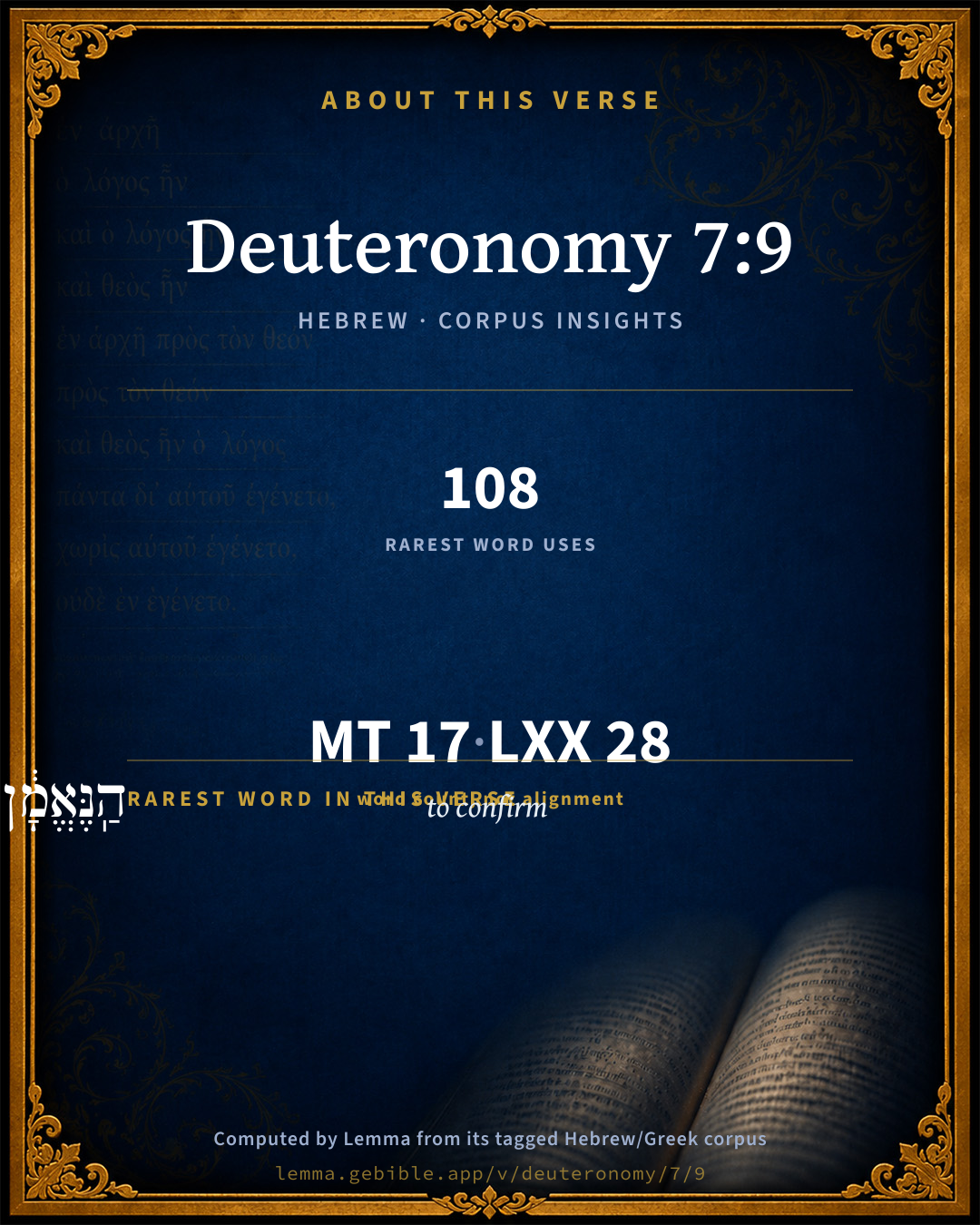
17
words
14
distinct lemmas
Pentateuch
section

Grammatical profile

  • 5 verbs
  • 9 nouns
  • 1 adjective
  • 1 pronoun
  • 1 conjunction

Verb forms

  • וְיָ֣דַעְתָּ֔ Qal · Sequential Perfect
  • הַֽנֶּאֱמָ֔ן Niphal · Participle Active
  • שֹׁמֵ֧ר Qal · Participle Active
  • לְאֹהֲבָ֛יו Qal · Participle Active
  • וּלְשֹׁמְרֵ֥י Qal · Participle Active

Repetition

Words recur within this verse — often emphatic in Hebrew:

  • אֱלֹהֶ֖יךָ God H430 ×2
  • שֹׁמֵ֧ר to keep H8104 ×2
  • מצותו commandment H4687 ×2

Hebrew & Septuagint length

In English translation the verse runs 31 words from the Hebrew and 36 from the Septuagint (LXX English) — closely comparable.

A rough comparison of the two English renderings, which tokenize alike — not a word-level alignment.

Word counts can differ between the Hebrew and the Greek without any difference in meaning — e.g. the Hebrew direct-object marker אֵת has no separate Greek word, and Greek often adds the article ὁ.

In the original languages it is 17 Hebrew tokens and 28 Greek tokens — but the two are counted differently (Hebrew bundles its prefixes and suffixes into one token; the Greek is in lemma form), so that isn’t a like-for-like length.

Cross-references

26

Topical passages linked to Deuteronomy 7:9 in the Treasury of Scripture Knowledge — connected by theme and wording, ordered by reader-vote popularity; previews shown in the World English Bible.

  • Hebrews 10:23 let us hold fast the confession of our hope unyieldingly. For he who promised is faithful.
  • 2 Timothy 2:13 If we are faithless, He remains faithful. He can't deny himself.
  • 2 Thessalonians 3:3 But the Lord is faithful, who will establish you, and guard you from the evil one.
  • Daniel 9:4 I prayed to Yahweh my God, and made confession, and said, Oh, Lord, the great and dreadful God, who keeps covenant and loving kindness with those who love him and keep his commandments,
  • 1 Corinthians 1:9 God is faithful, through whom you were called into the fellowship of his Son, Jesus Christ, our Lord.
  • Nehemiah 1:5 and said, I beg you, Yahweh, the God of heaven, the great and awesome God, who keeps covenant and loving kindness with those who love him and keep his commandments:
  • 1 Thessalonians 5:24 Faithful is he who calls you, who will also do it.
  • Romans 8:28 We know that all things work together for good for those who love God, to those who are called according to his purpose.
  • Deuteronomy 5:10 and showing loving kindness to thousands of those who love me and keep my commandments.
  • Exodus 20:6 and showing loving kindness to thousands of those who love me and keep my commandments.
  • Isaiah 49:7 Thus says Yahweh, the Redeemer of Israel, [and] his Holy One, to him whom man despises, to him whom the nation abhors, to a servant of rulers: Kings shall see and arise; princes, and they shall worship; because of Yahweh who is faithful, [even] the Holy One of Israel, who has chosen you.
  • Genesis 17:7 I will establish my covenant between me and you and your seed after you throughout their generations for an everlasting covenant, to be a God to you and to your seed after you.
  • 2 Corinthians 1:18 But as God is faithful, our word toward you was not "Yes and no."
  • 1 John 1:9 If we confess our sins, he is faithful and righteous to forgive us the sins, and to cleanse us from all unrighteousness.
  • James 1:12 Blessed is the man who endures temptation, for when he has been approved, he will receive the crown of life, which the Lord promised to those who love him.
  • Hebrews 6:18 that by two immutable things, in which it is impossible for God to lie, we may have a strong encouragement, who have fled for refuge to take hold of the hope set before us.
  • Psalms 119:75 Yahweh, I know that your judgments are righteous, That in faithfulness you have afflicted me.
  • Deuteronomy 4:35 To you it was shown, that you might know that Yahweh he is God; there is none else besides him.
  • 1 Chronicles 16:15 Remember his covenant forever, The word which he commanded to a thousand generations,
  • Titus 1:2 in hope of eternal life, which God, who can't lie, promised before eternal times;
  • Hebrews 11:11 By faith, even Sarah herself received power to conceive, and she bore a child when she was past age, since she counted him faithful who had promised.
  • Exodus 34:6–7 Yahweh passed by before him, and proclaimed, "Yahweh! Yahweh, a merciful and gracious God, slow to anger, and abundant in loving kindness and truth,
  • 1 Corinthians 8:3 But if anyone loves God, the same is known by him.
  • 1 Corinthians 10:3 and all ate the same spiritual food;
  • Lamentations 3:23 They are new every morning; great is your faithfulness.
  • Psalms 146:6 Who made heaven and earth, The sea, and all that is in them; Who keeps truth forever;

Cross-references courtesy of OpenBible.info (CC BY 4.0).

Hebrew and Greek witnesses Masoretic Hebrew ↔ Greek Septuagint

The same verse in the two great witnesses to the Old Testament, shown verse-for-verse.

These are two independent witnesses, not word-aligned to each other, and the Septuagint is shown in lemma (dictionary) form.

Hebrew Deuteronomy 7:9 Masoretic · Westminster Leningrad Codex

וְיָ֣דַעְתָּ֔ כִּֽי יְהוָ֥ה אֱלֹהֶ֖יךָ ה֣וּא הָֽאֱלֹהִ֑ים הָאֵל֙ הַֽנֶּאֱמָ֔ן שֹׁמֵ֧ר הַבְּרִ֣ית וְהַחֶ֗סֶד לְאֹהֲבָ֛יו וּלְשֹׁמְרֵ֥י מצותו מִצְוֺתָ֖יו לְאֶ֥לֶף דּֽוֹר

Know therefore that Yahweh your God, he is God, the faithful God, who keeps covenant and loving kindness with them who love him and keep his commandments to a thousand generations,

World English Bible · Public Domain

Greek LXX Deuteronomy 7:9 Septuagint · lemma form

καί γιγνώσκω ὅτι κύριος ὁ θεός σύ οὗτος θεός θεός πιστός ὁ φυλάσσω διαθήκη καί ἔλεος ὁ ἀγαπάω αὐτός καί ὁ φυλάσσω ὁ ἐντολή αὐτός εἰς χίλιοι γενεά

You shall know therefore, that the Lord your God, he is God, a faithful God, who keeps covenant and mercy for them that love him, and for those that keep his commandments to a thousand generations,

LXX2012 (modern English Septuagint) · Public Domain

Hebrew: Westminster Leningrad Codex (CC BY 4.0). Greek: Septuagint (public domain); English from LXX2012 (modern English Septuagint) (Public Domain). How the Septuagint differs from the Hebrew →

Targum (Aramaic paraphrase)

2

The Targum is the ancient Jewish Aramaic paraphrase of the Hebrew Scriptures — an interpretive translation, not the Hebrew text itself. Onkelos (literal) and Pseudo-Jonathan (expansive) render the Torah, and Jonathan the Prophets. Coverage is partial: where no permissively-licensed English translation exists for a verse, only the Aramaic is shown. This is verse-level text, not a word-by-word alignment to the Hebrew.

  1. Targum Onkelos Torah (Genesis–Deuteronomy)
    וְתִדַע אֲרֵי יְיָ אֱלָהָךְ הוּא אֱלֹהִים אֱלָהָא מְהֵימְנָא נָטֵר קְיָמָא וְחִסְדָא לְרַחֲמוֹהִי וּלְנָטְרֵי פִקוֹדוֹהִי לְאַלְפֵי דָרִין

    (no public-domain English translation for this verse)

    Targum Onkelos — Aramaic: “Onkelos Genesis” (public domain); “Onkelos Exodus” (public domain); “Onkelos Leviticus” (public domain); “Onkelos Numbers” (public domain); “Onkelos Deuteronomy” (public domain). English: “Sefaria Community Translation” (CC0 1.0 (public-domain dedication)); “J.W. Etheridge. The Targums of Onkelos and Jonathan Ben Uzziel on the Pentateuch. London: Longmans, Green, 1862” (public domain). Text via Sefaria.

  2. Targum Pseudo-Jonathan Torah (Genesis–Deuteronomy)
    וְתִנְדְּעוּן אֲרוּם יְיָ אֱלָהָכוֹן הוּא דַיָינָא תַקִּיפָא וּמְהֵימְנָא נְטִיר קְיָימָא וְטִיבוּ לְרַחֲמוֹי צַדִּיקַיָא וּלְנַטְרֵי פִּיקוּדוֹי לְאַלְפֵי דָרִין

    Know therefore that the Lord your God is a Judge, strong and faithful, keeping covenant and mercy with them who love Him and keep His commandments unto a thousand generations,

    Targum Pseudo-Jonathan — Aramaic: “Targum Jonathan on Genesis” (public domain); “Targum Jonathan on Exodus” (public domain); “Targum Jonathan on Leviticus” (public domain); “Targum Jonathan on Numbers” (public domain); “Targum Jonathan on Deuteronomy” (public domain). English: “The Targum of Jonathan ben Uzziel, trans. J. W. Etheridge, London, 1862” (public domain). Text via Sefaria.

Commentary

Notes on Deuteronomy 7:9 from classic Christian and Jewish commentators (each source and its license shown beneath its notes). The classic Christian expositions comment on the surrounding passage and are grouped to its opening verse, so a note may address several verses; the Jewish commentaries on the Tanakh (Rashi and others) are per-verse, so they appear only where the commentator wrote on this verse.

Lemma curates 59 commentaries, every one of them public domain or Creative Commons licensed, each selected and text-cleaned for this edition rather than reprinted as found. About our sources →

Trapp's Complete Commentary

John Trapp

Deu 7:9 Know therefore that the LORD thy God, he [is] God, the faithful God, which keepeth covenant and mercy with them that love him and keep his commandments to a thousand generations;

Ver. 9. The faithful God.] The God of Amen. {Psa 31:6} "The Amen, the faithful and true witness," {Rev 3:14} that "will not suffer his faithfulness to fail, nor alter the thing that is gone out of his lips," {Psa 89:33} all his precepts, predictions, promises, menaces, being the issue of a most faithful and righteous will, void of the least insincerity or falsehood. "Thou spakest also with thy mouth, and hast fulfilled it with thy hand, as it is this day," saith Solomon in his prayer. {1Ki 8:24} Neither could ever any day or age produce one instance to the contrary. The promises are ancient, {Tit 1:1-2} and yet they never failed; nor the menaces. {Zep 3:5}

John Trapp, A Commentary or Exposition upon All the Books of the Old and New Testament (1647–1656) — public domain. Text from a community e-Sword module.

The Biblical Illustrator

Joseph S. Exell

Deu_7:9

Them that love Him and keep His commandments.

Love God, and keep His commandments

The love of God, according to the Scripture notion of it, is a duty easy to be comprehended. And the text before us, which attaches so great a reward to this grace, does, at the same time, show us what it means in saying that God keepeth covenant and mercy with them that love Him and keep His commandments. For the latter words fix and ascertain the meaning of the former, and give us to understand that he who keepeth Gods commandments is he that loveth Him. Nor are the laws and commandments of God, by the keeping of which is evidenced our love of Him, so hard to be understood. For He hath marked out the great lines of our duty by His works of creation and providence, and hath clearly filled them up in His holy Scriptures. By these He hath showed thee, O man, what is good. I proceed to the main design of this discourse, which is, to lay before you the reasons and motives of loving and obeying God, which the text offers, from His nature and promises. The name of God implies all that is excellent and adorable; and here, in the first place, by the title of Lord added to it, directs our view to His dominion and sovereignty, by which He hath a right to our submission and obedience. We were created by His power, and are sustained by His providence We are born the subjects of His kingdom, which ruleth over all; and are the children of the family of which He is the great Father and Lord; who allots to everyone his rank and condition in it, and expects from all an account of their works. Our passage through life is compared to a voyage over a great ocean where we must wander and be lost, without somewhat to direct us through it. But our safe and certain direction is the law of God, in which we have not less reason to rejoice than they who go down to the sea in ships and do business in great waters have in beholding and observing the signs and constellations by which they govern their course over the face of the deep. For mariners, who sail in such tempestuous weather that neither sun nor stars in many days appear, are not in a state of greater perplexity and danger than man would be left in without the laws and commandments which God has set forth, as so many lights and signs from heaven to guide him securely through this voyage of life. We read that, in certain climates of the world, the gales that spring from the land carry a refreshing smell out to sea, and assure the watchful pilot that he is approaching to a desirable and fruitful coast when as yet he cannot discern it with his eyes. And, to take up once more the comparison of life to a voyage, in like manner it fares with those who have steadily and religiously pursued the course which heaven pointed out to them. We shall sometimes find by their conversation towards the end of their days, that they are filled with hope, and peace, and joy, which, like those refreshing gales and reviving odours to the seaman, are breathed forth from paradise upon their souls, and give them to understand with certainty that God is bringing them unto their desired haven. But to return to our proper argument. The wisdom of God is incapable of being misled itself, and His goodness of misleading us; and therefore the precepts which He hath given for the government of our lives must be excellently framed to the perfection and happiness of our nature. His laws, which enjoin the worship and honour of Himself, which command us to honour our parents, to do justice, and to love mercy, which forbid us to injure the life, the peace, the property of our neighbour, are evidently framed for the general good of mankind. And this we are mostly willing to allow. But there are some cases which the laws of God treat as sinful, wherein we are fondly apt to imagine that the injunction is rigorous which forbids us to follow the bent of our inclinations, when, as appears to us, no injury is done to others. Yet God is gracious, alike in His restraints and in His allowances. Some things which He hath forbidden prove injurious to others, if not directly, yet in their consequences. Some waste our time, divert our thoughts from worthy objects, and prevent our usefulness, to which God and society have a right; some consume our substance, to which our families, or the poor, have a claim; some impair the health of the body, which we have no right to destroy, and which, being lost, men become uncomfortable to themselves, dissatisfied with others, and disposed, perhaps, even to repine against that providence which hath left them to reap the fruits of their own folly. In the meanwhile those better principles and purer sentiments of the mind, without which religion and virtue cannot subsist, grow weak and faint, or are blotted out. Evil courses, in the expressive language of Scripture, take away the heart; that is, they deprive men of their judgment and darken their understanding; it may be, in the affairs of the world, but most undoubtedly in those things which are spiritually discerned. We are in this life as children in a state of education, training up for another condition of being, of which, at present, we know but little; only, we are assured that flesh and blood cannot inherit the kingdom of God; that its enjoyments are of a spiritual nature, corresponding more with the faculties of the soul than with the present constitution of the body. The restraints, therefore, under which we are laid, and which seem grievous to us, as children, are parts, no doubt, of a wise and gracious discipline, which is to qualify us for a heavenly inheritance, and is so necessary a preparation for it that we cannot otherwise see God or enter into the joy of our Lord. Reason, therefore, in some particulars, and in others faith, which is the evidence of things not seen, will assure the mind of the Christian that every branch of the law of God is most worthy to be honoured and obeyed, as proceeding from infinite loving kindness and goodness to man. Is anyone, then, who professes himself the servant of the Lord, called by Him to a trial of his obedience, wherein some hardship or peril must be undergone? Let him call to mind how much harder trials they who loved and feared God formerly have undergone; let him consider how great things men of noble and ingenuous natures will do, even for an earthly commander; and let him recollect that he is serving a Master who never faileth to succour those who trust in Him, and in whose service he cannot lose the promised reward. For He is the faithful God who keepeth covenant and mercy. And here I am led to the last observation proposed, namely, the encouragement to obedience arising from this consideration, that the Almighty is our Deliverer, who hath visited and redeemed His people by His blessed Son Jesus Christ. (T. Townson, D. D.)

The Biblical Illustrator, edited by Joseph S. Exell (c. 1880s–1900s) — public domain. Text from a community e-Sword module.

MacLaren's Expositions of Holy Scripture

Alexander MacLaren

Deuteronomy

GOD’S FAITHFULNESS

Deu 7:9.

‘Faithful,’ like most Hebrew words, has a picture in it. It means something that can be {1} leant on, or {2} builded on.

This leads to a double signification-{1} trustworthy, and that because {2} rigidly observant of obligations. So the word applies to a steward, a friend, or a witness. Its most wonderful and sublime application is to God. It presents to our adoring love-

I. God as coming under obligations to us.

A marvellous and blessed idea. He limits His action, regards Himself as bound to a certain line of conduct.

1. Obligations from His act of creation.

‘A faithful Creator,’ bound to take care of those whom He has made. To supply their necessities. To satisfy their desires. To give to each the possibility of discharging its ideal.

2. Obligations from His past self.

‘God is faithful by whom ye were called,’ therefore He will do all that is imposed on Him by His act of calling.

He cannot begin without completing. There are no abandoned mines. There are no half-hewn stones in His quarries, like the block at Baalbec. And this because the divine nature is inexhaustible in power and unchangeable in purpose.

3. Obligations from His own word.

A revelation is presupposed by the notion of faithfulness. It is not possible in heathenism. ‘Dumb idols,’ which have given their worshippers no promises, cannot be thought of as faithful. By its grand conception of Jehovah as entering into a covenant with Israel, the Old Testament presents Him to our trust as having bound Himself to a known line of action. Thereby He becomes, if we may so phrase it, a constitutional monarch.

That conception of a Covenant is the negation of caprice, of arbitrary sovereignty, of mystery. We know the principles of His government. His majestic ‘I wills’ cover the whole ground of human life and needs for the present and the future. We can go into no region of life but we find that God has defined His conduct to us there by some word spoken to our heart and binding Him.

4. Obligations from His new Covenant and highest word in Jesus Christ.

‘He is faithful and just to forgive us our sins.’

II. God as recognising and discharging these obligations.

That He will do so comes from His very nature. With Him there is no change of disposition, no emergence of unseen circumstances, no failure or exhaustion of power.

That He does so is matter of fact. Moses in the preceding context had pointed to facts of history, on which he built the ‘know therefore’ of the text. On the broad scale the whole world’s history is full of illustrations of God’s faithfulness to His promises and His threats. The history of Judaism, the sorrows of nations, and the complications of national events, all illustrate this fact.

The personal history of each of us. The experience of all Christian souls. No man ever trusted in Him and was ashamed. He wills that we should put Him to the proof.

III. God as claiming our trust.

He is faithful, worthy to be trusted, as His deeds show.

Faith is our attitude corresponding to His faithfulness. Faith is the germ of all that He requires from us. How much we need it! How firm it might be! How blessed it would make us!

The thought of God as ‘faithful’ is, like a precious stone, turned in many directions in Scripture, and wherever turned it flashes light. Sometimes it is laid as the foundation for the confidence that even our weakness will be upheld to the end, as when Paul tells the Corinthians that they will be confirmed to the end, because ‘God is faithful, through whom ye were called into the fellowship of His Son’ {1Co 1:9}. Sometimes there is built on it the assurance of complete sanctification, as when he prays for the Thessalonians that their ‘whole spirit and soul and body may be preserved blameless unto the coming of our Lord’ and finds it in his heart to pray thus because ‘Faithful is He that calleth you, who will also do it’ {1Th 5:24}. Sometimes it is presented as the steadfast stay grasping which faith can expect apparent impossibilities, as when Sara ‘judged Him faithful who had promised’ {Heb 11:11}. Sometimes it is adduced as bringing strong consolation to souls conscious of their own feeble and fluctuating faith, as when Paul tells Timothy that ‘If we are faithless, He abideth faithful; for He cannot deny Himself’ {2Ti 2:13}. Sometimes it is presented as an anodyne to souls disturbed by experience of men’s unreliableness, as when the apostle heartens the Thessalonians and himself to bear human untrustworthiness by the thought that though men are faithless, God ‘is faithful, who shall establish you and keep you from evil’ {2Th 3:2 - 2Th 3:3}. Sometimes it is put forward to breathe patience into tempted spirits, as when the Corinthians are comforted by the assurance that ‘God is faithful, who will not suffer you to be tempted above that ye are able’ {1Co 10:13}. Sometimes it is laid as the firm foundation for our assurance of pardon, as when John tells us that ‘If we confess our sins, He is faithful and just to forgive us our sins’ {1Jn 1:9}. And sometimes that great attribute of the divine nature is proposed as holding forth a pattern for us to follow, and the faith in it as tending to make us in a measure steadfast like Himself, as when Paul indignantly rebuts his enemies’ charge of levity of purpose and vacillation, and avers that ‘as God is faithful, our word toward you is not yea and nay’ {2Co 1:18}.

Alexander MacLaren, Expositions of Holy Scripture (1904–1910) — public domain. Text from a community e-Sword module.

Tyndale Open Study Notes

Tyndale Open Resources

7:9 A faithful God is absolutely dependable and can be leaned upon. Abraham was commended as being righteous because he believed God; he was wholly dependent upon God’s faithfulness (Gen 15:6). • Contrasted with human agents, who often break their pledges, the Lord faithfully keeps his covenant.

Tyndale Open Study Notes — © Tyndale Open Resources, licensed CC BY-SA 4.0. Text via the HelloAO Bible API.

Geneva Bible (1599)

Geneva Bible translators

And so put difference between him and idols.

Geneva Bible (1599) marginal notes — public domain. Text via Bolls.life.

Ellicott's Commentary for English Readers

(9-11) These verses are a direct comment upon the second commandment. The “thousands of them that love Him” are here expanded into a “thousand generations.” The “hatred,” too, is the same thing denoted there: “Thou shalt therefore keep the commandments.”

A Bible Commentary for English Readers, edited by Charles John Ellicott (1878–1897) — public domain. Text from a community e-Sword module.

The Cambridge Bible for Schools and Colleges

gen. ed. J. J. S. Perowne

9. Know therefore] A frequent formula in D in Sg. and Pl. Deu_4:39 (+ and lay it to thine heart), Deu_8:5 (A.V. and thou shalt consider in thine heart), Deu_9:3; Deu_9:6 (A.V. understand therefore), Deu_11:2 (and know ye); cp. Deu_29:4 Pl. (a heart to know); the passages where the object is other gods and the meaning therefore is to have experience of them, Deu_13:6; Deu_13:13, Deu_28:64 (Sg.), and Deu_11:28 (Pl.), also Deu_29:26; Deu_32:17; and in a similar sense, of other nations Deu_28:33; Deu_28:36 (Sg.), and of the diseases of Egypt Deu_7:15 (Sg.); and of manna Deu_8:3; Deu_8:16 (Sg.); also of God proving His people in order to know, i.e. find out, what was in their heart, Deu_8:2 (Sg.), Deu_13:3 (Pl.). These passages and their contexts show that D uses the verb to know with the same practical force, especially in religious matters, with which Hosea uses it. ‘It is not to know so as to see the fact of, but to know so as to feel the force of; knowledge not as acquisition and mastery, but as impression, passion. To quote Paul’s distinction, it is not so much the apprehending as the being apprehended. It leads to a vivid result—either warm appreciation, or change of mind or practical effort.… It is knowledge that is followed by shame, or by love, or by reverence, or by the sense of a duty … it closely approaches the meaning of our conscience.’ (The Twelve Prophets, i. 322: see the whole chapter there on the subject.)

he is God] the God, or God indeed, Deu_4:35; Deu_4:39, Deu_10:17; affirming not the soleness (Dillm.) so much as the reality of Jehovah’s deity, as shown (the vv. go on) in His working in history.

faithful] A participle with gerundive force, who shows Himself One to be trusted, i.e. by His deeds.

keepeth covenant and mercy] The conjunction shows that the Heb. word trans, mercy, ḥesed, is, as especially in Hosea, more than an affection; it is a relation and duty better rendered by loyal love. But see Driver’s note in loco.

that love him] See on Deu_6:5.

a thousand generations] ‘a rhetorical amplification, rather than an exact interpretation, of the thousands of Exo_20:6’ [Deu_5:10] (Driver).

9, 10. A free paraphrase of the Second Commandment.

The Cambridge Bible for Schools and Colleges (gen. ed. J. J. S. Perowne; Cambridge University Press, 1878–1918) — public domain. Text from a community e-Sword module.

John Gill's Exposition

The only true and living God, and not the idols of the Gentiles, who are false and lifeless ones, and therefore not the proper objects of adoration:

the faithful God, which keepeth covenant and mercy; as appeared by fulfilling the promise made to their fathers, in bringing them out of Egypt, and now them to the borders of the land of Canaan given them for an inheritance:

with them that love him, and keep his commandments, to a thousand generations; see Exo 20:6 which are not the causes or conditions of his covenant and mercy, nor of his keeping them, but descriptive of the persons that enjoy the benefit thereof.

John Gill's Exposition of the Whole Bible (1746–1763) — public domain (CC PDM 1.0). Text via the HelloAO Bible API.

Haydock's Catholic Bible Commentary

Strong. Hebrew el, means also God. He requires us to imitate his perfections as much as we are able. Being faithful, he will comply with his covenant exactly, and will punish those who neglect it. (Calmet)

George Leo Haydock (1774–1849), Haydock's Catholic Family Bible and Commentary, 1859 edition — public domain. Excludes Psalms (Douay-Rheims chapter numbering differs from Protestant) and Deuterocanonical books (Catholic canon only).

Matthew Poole's English Annotations

The faithful God; true to his word, and constant in performing all his promises.

Matthew Poole's English Annotations on the Holy Bible (1683–1685) — public domain. Text from a community e-Sword/MySword module.

Whedon's Commentary on the Bible

Daniel D. Whedon

9. The Lord thy God — Mark the emphasis which is constantly placed upon the expression Jehovah thy God — the God.

Daniel D. Whedon (gen. ed.), Commentary on the Old and New Testaments (1874–1909) — public domain. Text from a community e-Sword module.

The Pulpit Commentary

To a thousand generations; rather, to the thousandth generation. As God is faithful to his covenant, and will show mercy and do good to those that love him, whilst on those who hate him he will bring terrible retribution, the people are warned by this to take heed against rebellion and apostasy from him. (comp. Exo_20:5)

Vers. 9, 10. Lessons from history.

I A LESSON IN GOD"S GOODNESS. In putting Israel into possession of the land of promise after so long a period of waiting, and at the cost of so much miracle, God gave the nation an irrefragable proof of his covenant-keeping faithfulness. How many difficulties, to the human eye, stood in the way of the fulfillment of that promise! And by what nice adjustments of providence, and what a subtly linked succession of events, was the fulfillment at length brought about! Israel had to be taken down to Egypt, there preserved till it grew and multiplied, passed through the iron furnace of affliction, brought up again with a mighty hand and a stretched-out arm, conducted and provided for in the wilderness, legislated for and organized, strengthened to overcome its enemies. At what an expenditure of wisdom and power was all this accomplished! And how much forbearance and tenderness had to be shown to the people themselves in the course of their rebellious history! Faithfulness was thus emblazoned on every part of God"s dealings with them. Another and greater promise, which hung still longer in suspension, has been fulfilled in the coming of that "Seed" in whom already all families of the earth are beginning to be blessed (Gen_22:18; Gal_3:16) This fulfillment, above all, demonstrates that Jehovah, he is God, the faithful God, keeping covenant with them that love him.

II A LESSON IN GOD"S SEVERITY. (Ver. 10.) That had been taught to Israel by many passages in their own history. They had seen God"s judgments upon Pharaoh. They had experienced his severity in the plagues, etc., which had swept their own camp in punishment of disobedience. They had witnessed a whole generation turned back to perish in the wilderness. The lesson was now to be taught them by the destruction of these wicked nations. And as if to burn it more deeply, and forever, into their minds and consciences, the sword of execution was put into their own hands. The two lessons need to be read together. God"s severity, divorced from the discoveries of his grace, might appear to the on-looker harsh and cruel, whereas, as Bible history shows, judgment is "his strange work". (Isa_28:21) On the other hand, the remembrance of his severity is needed to prevent the abuse of his goodness. J.O. (Rom_11:22)

Vers. 9-16. The Divine veracity.

Moses here speaks of the Divine faithfulness to those that love him, and also to those that hate him. Those who love him will have his mercy unto a thousand generations; those who hate him will have their hatred returned. He will repay such to their face.

Let us look at the Divine veracity in the two aspects of blessing and of judgment.

I GOD"S GRATITUDE FOR MAN"S LOVE. God has a love of sovereignty, as we have just seen, which has no reason but itself; and he has also a love of gratitude for love shown to him. It is of this Moses here speaks. It is thus expressed elsewhere: "I love them that love me." And here notice

1. When we love God we try to keep his commandments. This is exactly what Christ, incarnate Love, claimed. "If ye love me, keep my commandments." Love is the spirit in which Law should be kept, and through which Law becomes blessedness.

2. Obedience secures blessing. God promised Israel certain temporal blessings: increase of the nation and fertility of soil and increase of their flocks and herds. And, in the rude age in which they lived, it was needful to encourage them by such very sensible signs. This is not so needful now. The blessing comes now in more spiritual ways, but still it comes in the wake of obedience. Answers to prayer are still doubted by men who doubt God"s existence and reign, but they are most thoroughly believed in by believers. The blessing comes to those who look for it.

3. It is expected to characterize generations. For this is the greatest blessing of all when the succeeding generation grows up true to God. It is this form of the Divine faithfulness which is most sought that even to a "thousand generations" they may remain true to him.

II GOD"S RIGHTEOUS WRATH AT MAN"S HATRED. Under a righteous government, hatred should have its retribution just as well as love its reward. So is it with God. Men may hate him, and when he repays them to their face they are getting only their due. God is as faithful in his threatenings as in his promises. Why should he not be so? And his hatred can have but one issue-destruction! How needful, then, to lay down the arms of our rebellion l If our hard hearts cherish any hatred towards him, the sooner we repent of this the better, and take refuge in his love. He waits to be gracious; but, should we despise his mercy and still do him the injustice to hate him, we must prepare for encountering his righteous wrath. R.M.E.

The Pulpit Commentary (1880–1919), ed. H.D.M. Spence-Jones & Joseph S. Exell — public domain. Text from a community e-Sword module.

Keil & Delitzsch

C. F. Keil & F. Delitzsch

By this was Israel to know that Jehovah their God was the true God, the faithful God, who keeps His covenant, showing mercy to those who love Him, even to the thousandth generation, but repaying those who hate Him to the face. This development of the nature of God Moses introduces from Exo 20:5-6, as a light warning not to forfeit the mercy of God, or draw upon themselves His holy wrath by falling into idolatry. To this end He emphatically carries out still further the thought of retribution, by adding להאבידו, "to destroy him" (the hater), and וגו יאהר לא, "He delays not to His hater (sc., to repay him); He will repay him to his face." "To the face of every one of them," i.e., that they may see and feel that they are smitten by God (Rosenmller).

Keil & Delitzsch — Biblical Commentary on the Old Testament (1861–1891) — public domain (CC PDM 1.0). Text via the HelloAO Bible API. (Old Testament only.)

unfoldingWord translationNotes

Door43 World Missions Community

General Information:

Moses continues to tell the people of Israel Yahweh's words as if the Israelites are one person. (See: Forms of You)

for a thousand generations

"for 1,000 generations" (See: Numbers)

repays those who hate him to their face

This idiom means "repays them quickly and openly so that they know God has punished them." (See: Idiom)

he will not be lenient on whoever hates him

The words "not be lenient" are an understatement to emphasize that Yahweh will severely punish. AT: "Yahweh will severely punish everyone who hates him" (See: Litotes)

translationWords

Yahweh

God

faithful

covenant

generation

love

command

face

statute

decree

unfoldingWord translationNotes — © Distant Shores Media and the Door43 World Missions Community, licensed CC BY-SA 4.0. Source: git.door43.org/Door43/en_tn.

Rashi

Rabbi Shlomo Yitzchaki (Rashi)

לאלף דור TO A THOUSAND GENERATIONS — But elsewhere (5:10) it states: to thousands of generations! The explanation is: Here where it is connected with (refers to) "those who keep His commandments" it states that God's grace is extended to a thousand generations; but there where it is associated with "those who love Him" it states that it is extended to thousands of generations (Sotah 31a);

לאהביו are those who do the commandments out of love.

ולשמרי מצותיו are those who do them out of fear.

Rashi on the Tanakh — English translations: “The Judaica Press complete Tanach with Rashi, translated by A. J. Rosenberg” (CC BY 4.0); “Pentateuch with Rashi's commentary by M. Rosenbaum and A.M. Silbermann, 1929-1934” (public domain); “The Metsudah Tanach series, Lakewood, N.J” (CC BY 4.0); and “The Book of Joshua, Metsudah Publications, 1997” (CC BY 4.0). Text via Sefaria.

Ramban (Nachmanides)

Rabbi Moshe ben Nachman (Ramban / Nachmanides)

KNOW THEREFORE from the [circumstances of the] departure from Egypt THAT THE ETERNAL THY G-D, HE IS G-D Who created heaven and earth, as I have explained. And know furthermore from this that He is THE FAITHFUL G-D Whose word shall not return void, and WHO KEEPETH THE COVENANT AND MERCY WITH THEM THAT LOVE HIM, AND KEEP HIS COMMANDMENTS, who fear His Name, TO A THOUSAND GENERATIONS of their seed, just as He kept for you the covenant of your fathers. And know further that He repayeth them that hate Him the recompense of their wickedness to the face of each one of them to destroy them, just as He destroyed the Egyptians and did not delay [in bringing punishment] to them. Now this attribute that he mentioned is true forever. Thus although there is a wicked man that prolongeth his life in his evil-doing, it happens to him only because of this above-mentioned attribute that He is the Keeper of Mercy, and he [the wicked] has done some good which must be recompensed. If so, there are among the attributes of the Holy One, blessed be He, but two ways [of dealing with people]: He repays good for good, and evil for evil.It is possible that those that hate Him [mentioned here as destined to be destroyed without delay] are those confirmed sinners who deny His existence and have no merit at all. As the Rabbis have said: “Rabbi Yashiyah said: Because of three things the Holy One, blessed be He, is long-suffering to the wicked in this world: they may repent, or they have observed commandments for which the Holy One, blessed be He, repays them their recompense in this world, or perhaps righteous people will descend from them. For so we find that He was long-suffering with Ahaz, and Hezekiah came from him; so also to Amon, 21:19-22. and Josiah came from him; and so also to Shimei, and Mordecai came from him.” Thus all these [three above categories] are not included in [the term] those that hate Him. Now there is a secret in the expression ‘el panav’ (to his face) [And He repayeth ‘them’ that hate Him ‘el panav’ — “to his face”] ], why does it change to the singular [to ‘his’ face, to destroy ‘him’]? Ramban alludes to the secret of the transmigration of the soul, so that at some future generation the recompense is still to “the face” of the sinner after he has been rewarded for the good he has done (Abusaula). as applying to a wicked man who has a good [i.e., a happy and prosperous] life. And then he returns to say, Thou shalt therefore keep the commandment etc., meaning: “therefore keep the commandment, and the statutes, and the ordinances so that you should not be among those who hate Him, who are destroyed, but instead you should be of those that love Him and keep His commandments who are remembered for good and for life.”Eikev

Ramban (Nachmanides) on the Tanakh — English translation: “Commentary on the Torah by Ramban (Nachmanides). Translated and annotated by Charles B. Chavel. New York, Shilo Pub. House, 1971-1976” (CC BY 4.0). Text via Sefaria.

Lesson kit

Teaching starters — assembled from the data on this page, not authored interpretation. Every prompt links to the verse data it draws on. Edit before teaching.

Deuteronomy, in the Pentateuch, opens this verse with 17 words (14 distinct Hebrew lemmas). Its most distinctive word is ʼâman (“to confirm”). A historical commentator’s framing appears above. Read the whole chapter for the surrounding context.

Discussion questions

  1. The word ʼâman carries the sense “to confirm.” How does it shape the verse?
  2. How does Hebrews 10:23, which shares this passage’s theme, read alongside this verse?
  3. What does the repetition of “God” (2× in this one verse) do in this verse?
  4. These translations render this verse differently; the difference is in the English rendering, not the original. What questions does that raise?
  5. «וְיָ֣דַעְתָּ֔» is a Qal Sequential Perfect verb. How does that grammatical form shape the action described?
  6. Compare how Trapp's Complete Commentary and The Biblical Illustrator read this verse. Where do they agree or differ?

Things to notice

Reading settings

Reading text

Shown beneath each verse's original-language words.

Old Testament
Old Testament edition

Read the OT as the Masoretic Hebrew (MT) or the Greek Septuagint (LXX).

English shown for the Greek Septuagint (in the Hebrew ↔ Greek comparison).

Comparing translations? Open the Compare panel on any verse page to stack up to four side by side.