
Numbers 2:32

Hebrew (Westminster Leningrad Codex) Numbers 2:32 appears in the Hebrew Old Testament. The text above is from the Westminster Leningrad Codex. Each word links to its Strong’s number, a concise gloss, and parsing drawn from the Open Scriptures Hebrew Bible morphology. Click any word for its full Brown-Driver-Briggs (BDB) entry.
Download image
Cite this verse

Numbers 2:32 (World English Bible). Public Domain. Lemma interlinear Bible study tool, https://lemma.gebible.app/v/numbers/2/32.

Show BibTeX & RIS
BibTeX
RIS
English Translation
These are those who were numbered of the children of Israel by their fathers' houses. All who were numbered of the camps according to their hosts were six hundred three thousand five hundred fifty.
World English Bible · Public Domain
Download a study sheet

One document with this verse’s original text, its word-by-word gloss line, the meaning frame, cross-references with their text, attributed commentary, and full source and license credits — printable, and it pastes into notes with its structure intact.

This verse Autodidact and up

Study sheet (.html) Plain text (.txt)

A passage Seminary Student

Up to 50 verses in one chapter. A passage sheet keeps up to 6 commentary sources and 12 cross-references per verse, in the order this page ranks them, and says so on the sheet whenever that leaves anything out. Ask for a single verse and you get the Autodidact verse sheet above.

Everything on this page stays free to read, with no account — the sheet is a download of what is already on screen, not access to it.

Want to remove ads? Support Godless Engineer
Compare translations 3

The same verse in 3 English versions, stacked beneath the original-language interlinear above. Click any original word for its lexicon entry.

Each is an independent rendering of the whole verse — the interlinear is not word-aligned to these translations.

Highlighted words mark where these versions differ — a whole-verse word diff, not a word-by-word alignment.

  • World English Bible Public Domain
    These are those who were numbered of the children of Israel by their fathers' houses. All who were numbered of the camps according to their hosts were six hundred three thousand five hundred fifty.
  • King James Version Public Domain
    These are those which were numbered of the children of Israel by the house of their fathers: all those that were numbered of the camps throughout their hosts were six hundred thousand and three thousand and five hundred and fifty.
  • unfoldingWord Literal Text CC BY-SA 4.0
    These the counted ones of the sons of Israel according to the house of their fathers. All the counted ones of the camps according to their armies 603,550.

unfoldingWord Literal Text — © unfoldingWord, licensed CC BY-SA 4.0. Word-aligned USFM3 via Door43 (git.door43.org/unfoldingWord/en_ult).

Versions to compare (up to 4)

3 of 4 selected

Show all 18 translations

Every available English version of this verse, each an independent rendering of the whole verse.

  • World English Bible Public Domain
    These are those who were numbered of the children of Israel by their fathers' houses. All who were numbered of the camps according to their hosts were six hundred three thousand five hundred fifty.
  • Berean Standard Bible Public Domain
    These are the Israelites, numbered according to their families. The total of those counted in the camps, by their divisions, was 603,550.
  • Majority Standard Bible Public Domain
    These are the Israelites, numbered according to their families. The total of those counted in the camps, by their divisions, was 603,550.
  • King James Version Public Domain
    These are those which were numbered of the children of Israel by the house of their fathers: all those that were numbered of the camps throughout their hosts were six hundred thousand and three thousand and five hundred and fifty.
  • American Standard Version (1901) Public Domain
    These are they that were numbered of the children of Israel by their fathers' houses: all that were numbered of the camps according to their hosts were six hundred thousand and three thousand and five hundred and fifty.
  • Revised Version (1885) Public Domain
    These are they that were numbered of the children of Israel by their fathers’ houses: all that were numbered of the camps according to their hosts were six hundred thousand and three thousand and five hundred and fifty.
  • Geneva Bible (1599) Public Domain
    These are the summes of the childre of Israel by ye houses of their fathers, all the nomber of ye host, according to their armies, six hundreth and three thousand, fiue hundreth and fiftie.
  • Douay-Rheims (1899) Public Domain
    This is the number of the children of Israel, of their army divided according to the houses of their kindreds and their troops, six hundred and three thousand five hundred and fifty.
  • Young's Literal Translation Public Domain
    These `are' those numbered of the sons of Israel by the house of their fathers; all those numbered of the camps by their hosts `are' six hundred thousand, and three thousand, and five hundred and fifty.
  • Literal Standard Version CC BY-SA 4.0
    These [are] those numbered of the sons of Israel by the house of their fathers; all those numbered of the camps by their hosts [are] six hundred thousand and three thousand and five hundred and fifty.
  • Unlocked Literal Bible CC BY-SA 4.0
    These are the Israelites, numbered according to their families. All those counted in their camps, by their divisions, are 603,550.
  • unfoldingWord Literal Text CC BY-SA 4.0
    These the counted ones of the sons of Israel according to the house of their fathers. All the counted ones of the camps according to their armies 603,550.
  • Darby Bible Public Domain
    These are those that were numbered of the children of Israel, according to their fathers' houses: all those that were numbered of the camps, according to their hosts, were six hundred and three thousand five hundred and fifty.
  • World Messianic Bible Public Domain
    These are those who were counted of the children of Israel by their fathers’ houses. All who were counted of the camps according to their armies were six hundred three thousand five hundred fifty.
  • Webster's Bible Public Domain
    These are those who were numbered of the children of Israel by the house of their fathers. All those that were numbered of the camps throughout their hosts, were six hundred thousand and three thousand and five hundred and fifty.
  • Free Bible Version CC BY-SA 4.0
    This sums up the registration of the Israelites, carried out by family. The final total of those counted in the camps by their tribal division was 603,550.
  • Bible in Basic English Public Domain
    These are all who were numbered of the children of Israel, in the order of their fathers' families: all the armies in their tents together came to six hundred and three thousand, five hundred and fifty.
  • JPS Tanakh (1917) Public Domain
    These are they that were numbered of the children of Israel by their fathers' houses; all that were numbered of the camps according to their hosts were six hundred thousand and three thousand and five hundred and fifty.

Literal Standard Version (2020), Covenant Press — licensed CC BY-SA 4.0. Text via the HelloAO Bible API (eBible.org). Unlocked Literal Bible (unfoldingWord) — licensed CC BY-SA 4.0. Text via the HelloAO Bible API (eBible.org). unfoldingWord Literal Text — © unfoldingWord, licensed CC BY-SA 4.0. Word-aligned USFM3 via Door43 (git.door43.org/unfoldingWord/en_ult). Free Bible Version, Dr. Jonathan Gallagher — licensed CC BY-SA 4.0. Text via the HelloAO Bible API (eBible.org).

Word by word

More ways to search: Search by grammar → Find every occurrence → Compare this word →

Practice this passage: Drill this verse → Learn its vocabulary →

וַחֲמִשִּֽׁים
chămishshîym
H2572
“and · fifty”
Conjunction + Adjective, Cardinal number, Both, Plural, Absolute
Part of Speech
Conjunction + Adjective
Type
Cardinal number
Gender
Both
Number
Plural
State
Absolute
Full BDB Definition

Origin: multiple of H2568

TWOT: TWOT- 686c

fifty - fifty (cardinal number) - a multiple of fifty (with other numbers) - fiftieth (ordinal number)
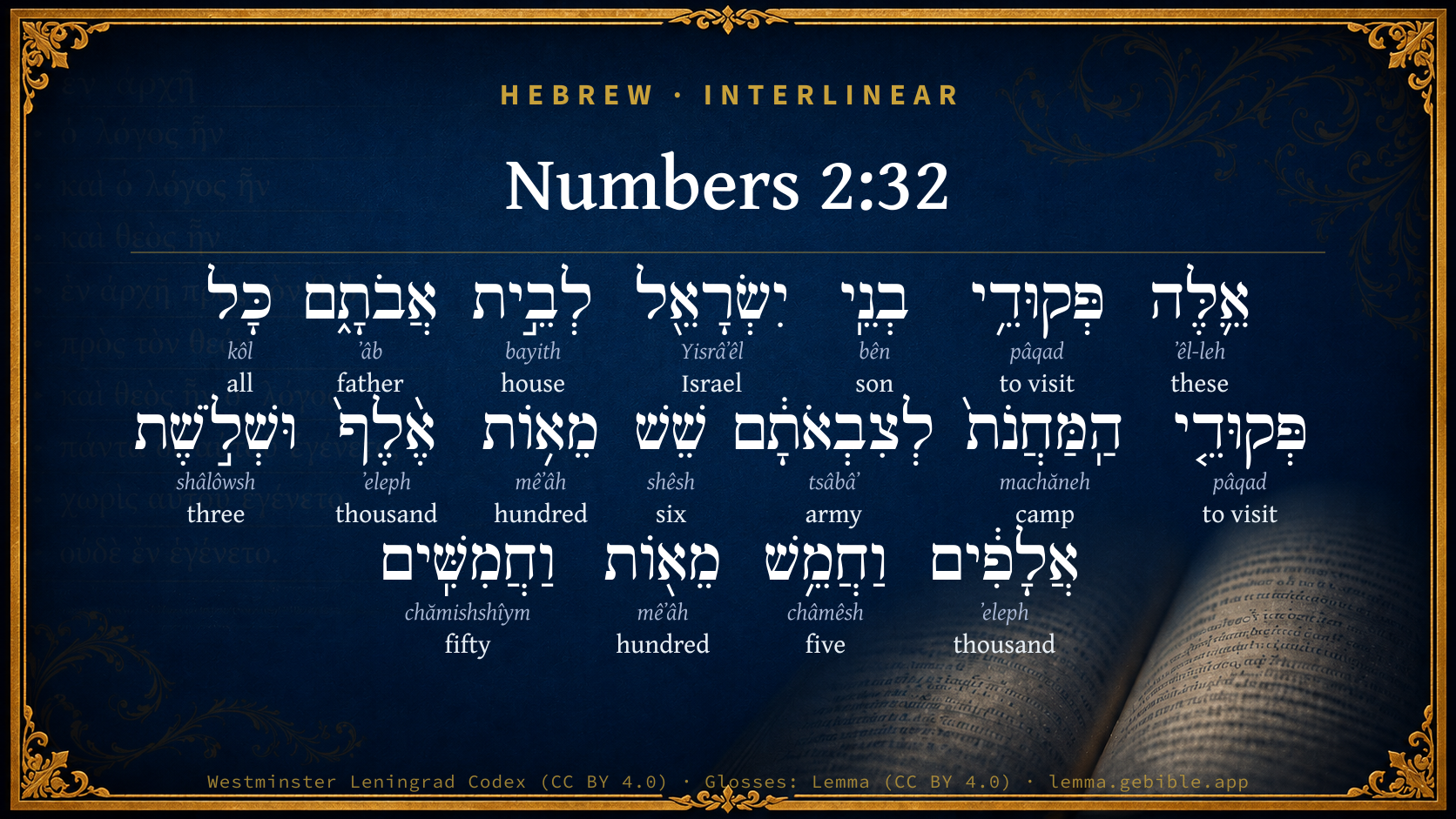
  1. אֵ֛לֶּה ʼêl-leh H428 “these” Pronoun, Demonstrative, Common, Plural
  2. פְּקוּדֵ֥י pâqad H6485 “visited” Verb, Qal, Participle Passive, Masculine, Plural, Construct
  3. בְנֵֽי bên H1121 “sons of” Noun, Common, Masculine, Plural, Construct
  4. יִשְׂרָאֵ֖ל Yisrâʼêl H3478 “Israel” Noun, Proper
  5. לְבֵ֣ית bayith H1004 “to/for · house of” Preposition + Noun, Common, Masculine, Singular, Construct
  6. אֲבֹתָ֑ם ʼâb H1 “fathers · their” Noun, Common, Masculine, Plural, Construct + Suffix, Personal, 3rd Person, Masculine, Plural
  7. כָּל kôl H3605 “all of” Noun, Common, Masculine, Singular, Construct
  8. פְּקוּדֵ֤י pâqad H6485 “visited” Verb, Qal, Participle Passive, Masculine, Plural, Construct
  9. הַֽמַּחֲנֹת֙ machăneh H4264 “the · camps” Particle, Definite Article + Noun, Common, Both, Plural, Absolute
  10. לְצִבְאֹתָ֔ם tsâbâʼ H6635 “to/for · armies · their” Preposition + Noun, Common, Both, Plural, Construct + Suffix, Personal, 3rd Person, Masculine, Plural
  11. שֵׁשׁ shêsh H8337 “six” Adjective, Cardinal number, Feminine, Singular, Absolute
  12. מֵא֥וֹת mêʼâh H3967 “hundred” Adjective, Cardinal number, Both, Plural, Absolute
  13. אֶ֨לֶף֙ ʼeleph H505 “thousand” Adjective, Cardinal number, Both, Singular, Absolute
  14. וּשְׁלֹ֣שֶׁת shâlôwsh H7969 “and · three” Conjunction + Adjective, Cardinal number, Masculine, Singular, Construct
  15. אֲלָפִ֔ים ʼeleph H505 “thousand” Adjective, Cardinal number, Both, Plural, Absolute
  16. וַחֲמֵ֥שׁ châmêsh H2568 “and · five” Conjunction + Adjective, Cardinal number, Feminine, Singular, Absolute
  17. מֵא֖וֹת mêʼâh H3967 “hundred” Adjective, Cardinal number, Both, Plural, Absolute

About this verse

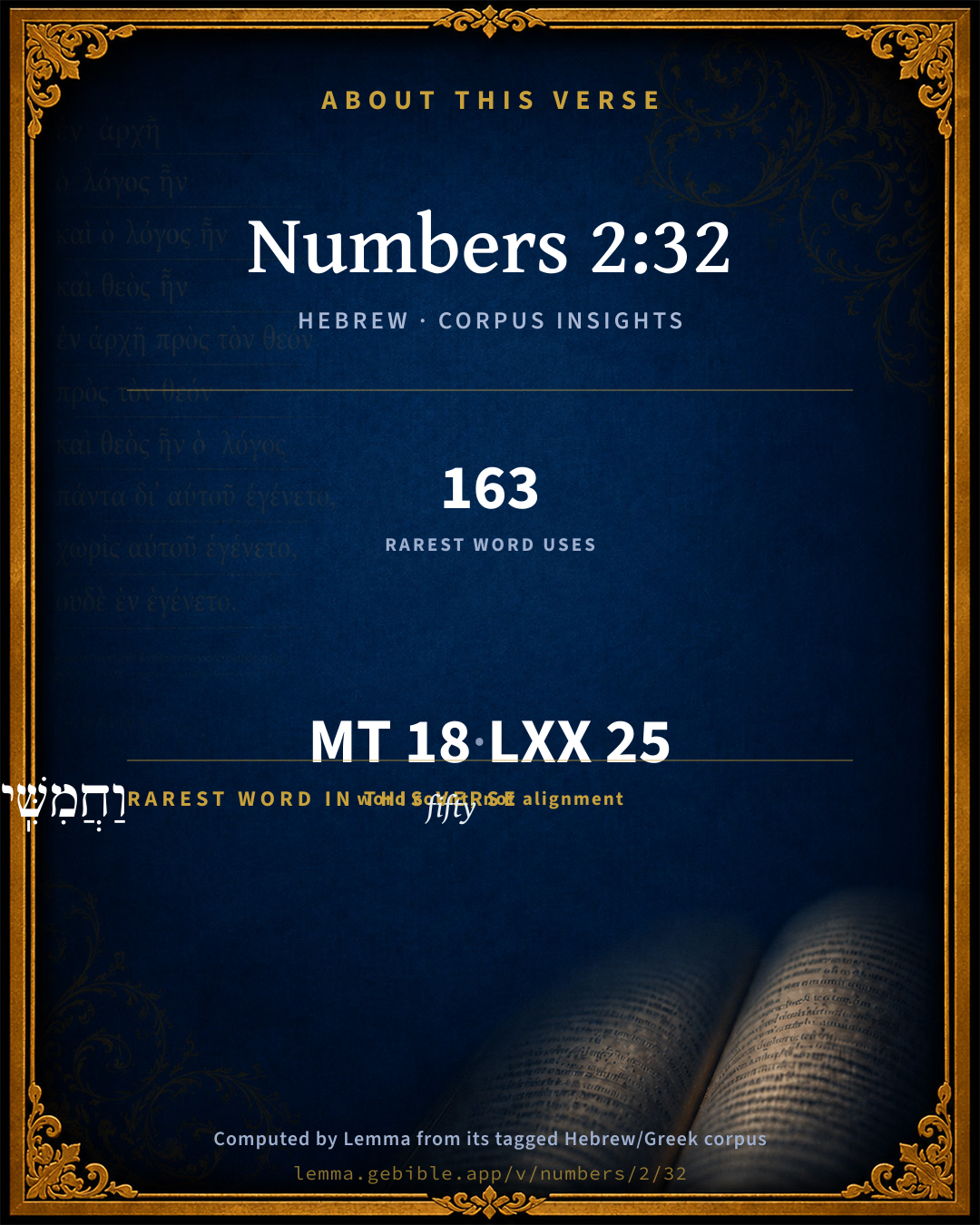
These counts appear in no published source. They are computed here, from the morphology-tagged text and Lemma’s own curated glosses. What Lemma adds →

18
words
15
distinct lemmas
Pentateuch
section

Grammatical profile

  • 2 verbs
  • 7 nouns
  • 8 adjectives
  • 1 pronoun

Verb forms

  • פְּקוּדֵ֥י Qal · Participle Passive
  • פְּקוּדֵ֤י Qal · Participle Passive

Repetition

Words recur within this verse — often emphatic in Hebrew:

  • פְּקוּדֵ֥י to visit H6485 ×2
  • מֵא֥וֹת hundred H3967 ×2
  • אֶ֨לֶף֙ thousand H505 ×2

Hebrew & Septuagint length

In English translation the verse runs 34 words from the Hebrew and 35 from the Septuagint (LXX English) — closely comparable.

A rough comparison of the two English renderings, which tokenize alike — not a word-level alignment.

Word counts can differ between the Hebrew and the Greek without any difference in meaning — e.g. the Hebrew direct-object marker אֵת has no separate Greek word, and Greek often adds the article ὁ.

In the original languages it is 18 Hebrew tokens and 25 Greek tokens — but the two are counted differently (Hebrew bundles its prefixes and suffixes into one token; the Greek is in lemma form), so that isn’t a like-for-like length.

Cross-references

6

Topical passages linked to Numbers 2:32 in the Treasury of Scripture Knowledge — connected by theme and wording, ordered by reader-vote popularity; previews shown in the World English Bible.

  • Numbers 1:46 even all those who were numbered were six hundred three thousand five hundred fifty.
  • Exodus 38:26 a beka a head, that is, half a shekel, after the shekel of the sanctuary, for everyone who passed over to those who were numbered, from twenty years old and upward, for six hundred three thousand five hundred fifty men.
  • Exodus 12:37 The children of Israel traveled from Rameses to Succoth, about six hundred thousand on foot who were men, besides children.
  • Numbers 2:9 All who were numbered of the camp of Judah were one hundred eighty-six thousand four hundred, according to their divisions. They shall set out first.
  • Numbers 11:21 Moses said, The people, among whom I am, are six hundred thousand footmen; and you have said, I will give them flesh, that they may eat a whole month.
  • Numbers 26:51 These are those who were numbered of the children of Israel, six hundred one thousand seven hundred thirty.

Cross-references courtesy of OpenBible.info (CC BY 4.0).

Hebrew and Greek witnesses Masoretic Hebrew ↔ Greek Septuagint

The same verse in the two great witnesses to the Old Testament, shown verse-for-verse.

These are two independent witnesses, not word-aligned to each other, and the Septuagint is shown in lemma (dictionary) form.

Hebrew Numbers 2:32 Masoretic · Westminster Leningrad Codex

אֵ֛לֶּה פְּקוּדֵ֥י בְנֵֽי יִשְׂרָאֵ֖ל לְבֵ֣ית אֲבֹתָ֑ם כָּל פְּקוּדֵ֤י הַֽמַּחֲנֹת֙ לְצִבְאֹתָ֔ם שֵׁשׁ מֵא֥וֹת אֶ֨לֶף֙ וּשְׁלֹ֣שֶׁת אֲלָפִ֔ים וַחֲמֵ֥שׁ מֵא֖וֹת וַחֲמִשִּֽׁים

These are those who were numbered of the children of Israel by their fathers' houses. All who were numbered of the camps according to their hosts were six hundred three thousand five hundred fifty.

World English Bible · Public Domain

Greek LXX Numbers 2:32 Septuagint · lemma form

οὗτος ὁ ἐπίσκεψις ὁ υἱός ἰσραήλ κατά οἶκος πατριά αὐτός πᾶς ὁ ἐπίσκεψις ὁ παρεμβολή σύν ὁ δύναμις αὐτός ἑξακόσιοι χιλιάς καί τρισχίλιοι πεντακόσιοι πεντήκοντα

This is the numbering of the children of Israel according to the houses of their families: all the numbering of the camps with their forces, was six hundred and three thousand, five hundred and fifty.

LXX2012 (modern English Septuagint) · Public Domain

Hebrew: Westminster Leningrad Codex (CC BY 4.0). Greek: Septuagint (public domain); English from LXX2012 (modern English Septuagint) (Public Domain). How the Septuagint differs from the Hebrew →

Targum (Aramaic paraphrase)

2

The Targum is the ancient Jewish Aramaic paraphrase of the Hebrew Scriptures — an interpretive translation, not the Hebrew text itself. Onkelos (literal) and Pseudo-Jonathan (expansive) render the Torah, and Jonathan the Prophets. Coverage is partial: where no permissively-licensed English translation exists for a verse, only the Aramaic is shown. This is verse-level text, not a word-by-word alignment to the Hebrew.

  1. Targum Onkelos Torah (Genesis–Deuteronomy)
    אִלֵין מִנְיָנֵי בְנֵי יִשְׂרָאֵל לְבֵית אֲבָהַתְהוֹן כָּל מִנְיָנֵי מַשִׁרְיָתָא לְחֵילֵיהוֹן שִׁית מְאָהּ וּתְלָתָא אַלְפִין וַחֲמֵשׁ מְאָה וְחַמְשִׁין

    (no public-domain English translation for this verse)

    Targum Onkelos — Aramaic: “Onkelos Genesis” (public domain); “Onkelos Exodus” (public domain); “Onkelos Leviticus” (public domain); “Onkelos Numbers” (public domain); “Onkelos Deuteronomy” (public domain). English: “Sefaria Community Translation” (CC0 1.0 (public-domain dedication)); “J.W. Etheridge. The Targums of Onkelos and Jonathan Ben Uzziel on the Pentateuch. London: Longmans, Green, 1862” (public domain). Text via Sefaria.

  2. Targum Pseudo-Jonathan Torah (Genesis–Deuteronomy)
    אִלֵין סְכוּם מִנְיָנֵי בְּנֵי יִשְרָאֵל לְבֵית אֲבָהַתְהוֹן כָּל מִנְיָינֵי מַשִׁרְיָיתָא לְחֵילֵיהוֹן שִׁית מְאָה וּתְלָתָא אַלְפִין וַחֲמֵשׁ מְאָה וְחַמְשִׁין

    This is the amount of the numbers of the Beni Israel, according to the house of their fathers; all the sums of the camps by their hosts were six hundred and three thousand five hundred and fifty.

    Targum Pseudo-Jonathan — Aramaic: “Targum Jonathan on Genesis” (public domain); “Targum Jonathan on Exodus” (public domain); “Targum Jonathan on Leviticus” (public domain); “Targum Jonathan on Numbers” (public domain); “Targum Jonathan on Deuteronomy” (public domain). English: “The Targum of Jonathan ben Uzziel, trans. J. W. Etheridge, London, 1862” (public domain). Text via Sefaria.

Commentary

Notes on Numbers 2:32 from classic Christian and Jewish commentators (each source and its license shown beneath its notes). The classic Christian expositions comment on the surrounding passage and are grouped to its opening verse, so a note may address several verses; the Jewish commentaries on the Tanakh (Rashi and others) are per-verse, so they appear only where the commentator wrote on this verse.

Lemma curates 59 commentaries, every one of them public domain or Creative Commons licensed, each selected and text-cleaned for this edition rather than reprinted as found. About our sources →

The Biblical Illustrator

Joseph S. Exell

Num_2:32-34

They pitched by their standards.

Contentment and obedience

I. Contentment with the divine appointment.

1. We are incompetent to determine our own place and duty.

(1) Our ignorance.

(a) Of ourselves;

(b) of the future.

(2) Our proneness to self-indulgence.

2. We have ample grounds for confidence in the determinations of God for us.

(1) His knowledge.

(2) His wisdom.

(3) His kindness.

II. Obedience to the divine commands.

1. All Gods commands are binding, because they are all right.

2. All Gods commands are benevolent. Obedience is blessed as well as binding. (W. Jones.)

The two banners:

We can easily guess how in days of ancient warfare the standard was of much practical use. When it moved forward, then the warriors took up sword and shield and also advanced. When it halted, then they prepared to encamp around the station of their own particular standard. The devices of these old flags suggested a kind of primitive heraldry, and they knew where at once to find their loaders, or to rally for the last desperate defence! As in thought we float along the stream of history, we recall the brazen eagles of Rome, clasping which the legionaries took that solemn oath of fidelity which taught to the soldiers of Jesus that word Sacrament, which to us means so much! Then we may remember how the cloak of St. Martin became the standard of the Frankish host, or how the sacred banner of mediaeval France was the renowned Oriflamme. In Englands history, too, we have the story of the great car which, surmounted by three flags, was the central point of the bloody Battle of the Standard; or we may sorrowfully think of that sad day when our country was torn asunder by internal strife, and the unfortunate Charles, king and martyr, raised his royal standard on a stormy day on the Castle Hill at Nottingham, and which was that very day blown down by the furious blasts--a sad and ominous beginning, which proved too truly prophetic. Lastly, there flashes across our memory that familiar story of Nelson ordering the flag of old England to be nailed to the mast, which has become a proverbial expression for pluck and resolution! But these legends of old times have for the Christian a lesson. There is a great conflict going on around us, a spiritual warfare of most real and eternal significance. Between the Church, which is the army of Christ, and the dark hosts of hell, the struggle seems daily to wax hotter and become more intense. The leaders on either side display their banners. That of Satan, says an old writer, is set up in the market-place of Babylon. It is inscribed with the alluring words, riches, pleasures, honours; but these inscriptions are not to be trusted. Were they rightly inscribed they would assuredly bear instead, impiety, idolatory, impurity, injustice, and hatred against God. But these true names he conceals with a dazzling magic, so that men are caught unawares by his false promises! Under the standard of the Evil One are gathered together and assembled by him both evil spirits and bad men. These he sends forth throughout the whole world, that they should deceive and ruin the souls of men. To each of his adherents he gives a banner, a net, arid chains. The flag that they may allure, the net that they may capture, the fetters that they may bind fast their captives. But see on yonder side. From that dark valley, up those steep slopes, there comes a mighty host. Many drop off, many fall back, but still they pour on upwards. The sunlight of heaven rests on their helms, and before them comes borne aloft a mighty banner. It is the Standard of Jesus. Eighteen hundred years ago it was set up in the valley of humiliation at Jerusalem. Now He, the King of Humility, the Prince of Peace, is in the midst of His people, whose ranks He gazes on with loving eye. On His banner there is written, in letters of light and truth, the words, repentance, a Christian life, paradise, heaven! Our Lord Jesus also sends His ministering servants throughout the world--angels, apostles, priests, and all who seek the saving of mens souls and the welfare of their bodies; bidding them teach the emptiness of earthly treasures, the true riches of penitence and faith; and that they should instruct all to persevere with patience till the golden gates are in view. The soldiers of Jesus advance, holding on high His banner, knocking at the door of all hearts, and saying, Repent, for the kingdom of God is nigh; Take My yoke upon you, and ye shall find rest. These invitations are given in various ways, and by different methods; sometimes by good thoughts infused by the Divine Spirit into the soul, sometimes by useful words and pious writings, sometimes by good examples. Through all these ways and channels the Saviour speaks to us. They who listen, they who obey, follow His standard. Thus, with many alternations, the great battle goes forward, with its separate host on either side and its two standards. Under which will you fight? (J. W. Hardman, LL. D.)

.

The Biblical Illustrator, edited by Joseph S. Exell (c. 1880s–1900s) — public domain. Text from a community e-Sword module.

Keil & Delitzsch

C. F. Keil & F. Delitzsch

In Num 2:32 we have the whole number given, 603,550 men, not including the Levites (Num 2:33, see at Num 1:49); and in Num 2:34 the concluding remark as to the subsequent execution of the divine command-an anticipatory notice, as in Exo 12:50; Exo 40:16, etc.

Keil & Delitzsch — Biblical Commentary on the Old Testament (1861–1891) — public domain (CC PDM 1.0). Text via the HelloAO Bible API. (Old Testament only.)

Geneva Bible (1599)

Geneva Bible translators

Which were of twenty years and above.

Geneva Bible (1599) marginal notes — public domain. Text via Bolls.life.

John Gill's Exposition

These are those that were numbered of the children of Israel by the house of their fathers,.... As the number was taken by Moses and Aaron, assisted by twelve princes of the tribe, who were now constituted captains over them, as so many hosts or armies:

all those that were numbered of the camp throughout their hosts: of the four camps, of Judah, Reuben, Ephraim, and Dan, throughout the respective tribes or hosts that belonged to each of them:

were six hundred thousand and three thousand and five hundred and fifty; 603,550 men, which is exactly the sum total of them, as taken Num 1:46. It is a large number, considering in how short a time, and that great part of it a state of bondage, from seventy persons, they rose unto it; but the spiritual Israel of God, consisting of his people of all nations, is a number which no man can number, Rev 7:9; besides, the number of the sealed ones, of every tribe, Num 2:4; Now this encampment of the people of Israel was an emblem of the form and order of the spiritual Israel or church of God, under the Gospel dispensation. Christ in human nature is the tabernacle, who is in the midst of his people by his gracious presence; as the heart and life of the congregation of his saints, in whom they all centre and terminate, and where he sits enthroned as King of saints; and as the Levites encamped in four squadrons next unto the tabernacle, all around it, to these answer the living creatures in Eze 1:5; which design the ministers of the word, who are in the highest place in the church, between Christ and the congregation, and are near to him, to be supplied by him; then encamped the whole body of the people of Israel by their standards, with their ensigns, to whom answer the wheels in Eze 1:15; and the twenty four elders in Rev 4:4; all which show the church to be militant, and that there is an order in Gospel churches, which makes them both comely and terrible, Sol 6:4; and may teach every member to abide by his standard, and follow his ensign and ensign bearer, Isa 11:10.

John Gill's Exposition of the Whole Bible (1746–1763) — public domain (CC PDM 1.0). Text via the HelloAO Bible API.

unfoldingWord translationNotes

Door43 World Missions Community

All those counted

This can be stated in active form. AT: "Moses and Aaron counted them all" (See: Active or Passive)

by their divisions

Here "their" refers to the people of Israel.

are 603,550

"are six hundred and three thousand five hundred and fifty" (See: Numbers)

translationWords

Israel

Moses

Aaron

Levi

people group

Yahweh

command

unfoldingWord translationNotes — © Distant Shores Media and the Door43 World Missions Community, licensed CC BY-SA 4.0. Source: git.door43.org/Door43/en_tn.

Ibn Ezra

Rabbi Abraham ibn Ezra

These are the numbers of Bnei Yisroel. “And so they traveled” (v. 34) as they were on the day they were counted. This means that in the twenty days not one of them died, and this was miraculous.

Ibn Ezra on the Tanakh — English translations: “Sefaria Community Translation” (CC0 1.0 (public-domain dedication)); “Yalkut, Sifsei Chachomim Chumash, Metsudah Publications, 2009” (CC BY 4.0); and “Commentary of Ibn Ezra on Isaiah - trans. by M. Friedlander, 1873” (public domain). Text via Sefaria.

Lesson kit

Teaching starters — assembled from the data on this page, not authored interpretation. Every prompt links to the verse data it draws on. Edit before teaching.

Numbers, in the Pentateuch, opens this verse with 18 words (15 distinct Hebrew lemmas). Its most distinctive word is chămishshîym (“fifty”). A historical commentator’s framing appears above. Read the whole chapter for the surrounding context.

Discussion questions

  1. How does “fifty” (chămishshîym) shape what this verse is saying?
  2. How does Numbers 1:46, which shares this passage’s theme, read alongside this verse?
  3. What does the repetition of “to visit” (2× in this one verse) do in this verse?
  4. The translations on this page render this verse differently — a whole-verse word diff, not a word-by-word alignment. What might account for the different wordings?
  5. «פְּקוּדֵ֥י» is a Qal Participle Passive verb. How does that grammatical form shape the action described?
  6. Compare how The Biblical Illustrator and Keil & Delitzsch read this verse. Where do they agree or differ?

Things to notice

Reading settings

Reading text

Shown beneath each verse's original-language words.

Old Testament
Old Testament edition

Read the OT as the Masoretic Hebrew (MT) or the Greek Septuagint (LXX).

English shown for the Greek Septuagint (in the Hebrew ↔ Greek comparison).

Comparing translations? Open the Compare panel on any verse page to stack up to four side by side.