2 Kings 14:7

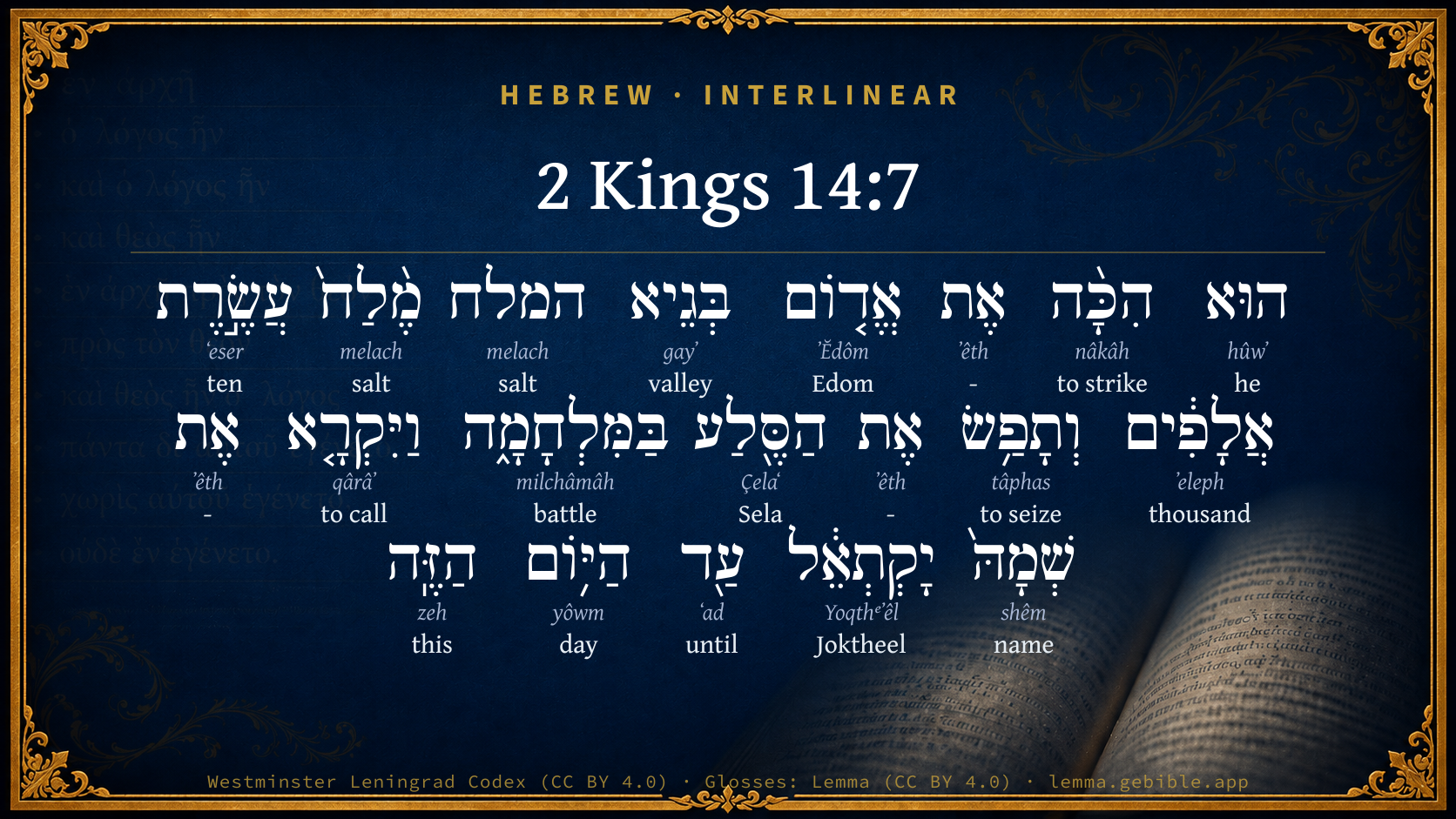
Hebrew (Westminster Leningrad Codex) 2 Kings 14:7 appears in the Hebrew Old Testament. The text above is from the Westminster Leningrad Codex. Each word links to its Strong’s number, a concise gloss, and parsing drawn from the Open Scriptures Hebrew Bible morphology. Click any word for its full Brown-Driver-Briggs (BDB) entry.
Download image
Cite this verse

2 Kings 14:7 (World English Bible). Public Domain. Lemma interlinear Bible study tool, https://lemma.gebible.app/v/2-kings/14/7.

Show BibTeX & RIS
BibTeX
RIS
English Translation
He killed of Edom in the Valley of Salt ten thousand, and took Sela by war, and called the name of it Joktheel, to this day.
World English Bible · Public Domain
Highlights
  • 1 first appearance in the Hebrew Bible
Full analysis ↓
Download a study sheet

One document with this verse’s original text, its word-by-word gloss line, the meaning frame, cross-references with their text, attributed commentary, and full source and license credits — printable, and it pastes into notes with its structure intact.

This verse Autodidact and up

Study sheet (.html) Plain text (.txt)

A passage Seminary Student

Up to 50 verses in one chapter. A passage sheet keeps up to 6 commentary sources and 12 cross-references per verse, in the order this page ranks them, and says so on the sheet whenever that leaves anything out. Ask for a single verse and you get the Autodidact verse sheet above.

Everything on this page stays free to read, with no account — the sheet is a download of what is already on screen, not access to it.

Want to remove ads? Support Godless Engineer
Compare translations 3

The same verse in 3 English versions, stacked beneath the original-language interlinear above. Click any original word for its lexicon entry.

Each is an independent rendering of the whole verse — the interlinear is not word-aligned to these translations.

Highlighted words mark where these versions differ — a whole-verse word diff, not a word-by-word alignment.

  • World English Bible Public Domain
    He killed of Edom in the Valley of Salt ten thousand, and took Sela by war, and called the name of it Joktheel, to this day.
  • King James Version Public Domain
    He slew of Edom in the valley of salt ten thousand, and took Selah by war, and called the name of it Joktheel unto this day.
  • unfoldingWord Literal Text CC BY-SA 4.0
    He, he struck Edom in the Valley of Salt, 10,000, and he captured Sela in battle. And he called its name Joktheel, to this day.

unfoldingWord Literal Text — © unfoldingWord, licensed CC BY-SA 4.0. Word-aligned USFM3 via Door43 (git.door43.org/unfoldingWord/en_ult).

Versions to compare (up to 4)

3 of 4 selected

Show all 18 translations

Every available English version of this verse, each an independent rendering of the whole verse.

  • World English Bible Public Domain
    He killed of Edom in the Valley of Salt ten thousand, and took Sela by war, and called the name of it Joktheel, to this day.
  • Berean Standard Bible Public Domain
    Amaziah struck down 10,000 Edomites in the Valley of Salt. He took Sela in battle and called it Joktheel, which is its name to this very day.
  • Majority Standard Bible Public Domain
    Amaziah struck down 10,000 Edomites in the Valley of Salt. He took Sela in battle and called it Joktheel, which is its name to this very day.
  • King James Version Public Domain
    He slew of Edom in the valley of salt ten thousand, and took Selah by war, and called the name of it Joktheel unto this day.
  • American Standard Version (1901) Public Domain
    He slew of Edom in the Valley of Salt ten thousand, and took Sela by war, and called the name of it Joktheel, unto this day.
  • Revised Version (1885) Public Domain
    He slew of Edom in the Valley of Salt ten thousand, and took Sela by war, and called the name of it Joktheel, unto this day.
  • Geneva Bible (1599) Public Domain
    He slew also of Edom in the valley of salt ten thousand, and tooke the citie of Sela by warre, and called the name thereof Ioktheel vnto this day.
  • Douay-Rheims (1899) Public Domain
    He slew of Edom h in the valley of the Saltpits ten thousand men, and took the rock by war, and called the name thereof Jectehel, unto this day.
  • Young's Literal Translation Public Domain
    He hath smitten Edom, in the valley of salt -- ten thousand, and seized Selah in war, and `one' calleth its name Joktheel unto this day,
  • Literal Standard Version CC BY-SA 4.0
    He has struck ten thousand of Edom in the Valley of Salt, and seized Selah in war, and [one] calls its name Joktheel to this day,
  • Unlocked Literal Bible CC BY-SA 4.0
    He killed ten thousand soldiers of Edom in the Valley of Salt; he also took Sela in war and called it Joktheel, which is what it is called to this day.
  • unfoldingWord Literal Text CC BY-SA 4.0
    He, he struck Edom in the Valley of Salt, 10,000, and he captured Sela in battle. And he called its name Joktheel, to this day.
  • Darby Bible Public Domain
    He smote of Edom in the valley of salt ten thousand, and took Sela in the war, and called the name of it Joktheel to this day.
  • World Messianic Bible Public Domain
    He killed ten thousand Edomites in the Valley of Salt, and took Sela by war, and called its name Joktheel, to this day.
  • Webster's Bible Public Domain
    He slew of Edom in the valley of Salt ten thousand, and took Selah by war, and called the name of it Joktheel to this day.
  • Free Bible Version CC BY-SA 4.0
    Amaziah killed ten thousand Edomites in the Valley of Salt. He attacked and captured Sela and renamed it Joktheel, which is what it is called to this very day.
  • Bible in Basic English Public Domain
    He put to the sword twelve thousand men of Edom in the Valley of Salt, and took Sela in war, naming it Joktheel, as it is to this day.
  • JPS Tanakh (1917) Public Domain
    He slew of Edom in the Valley of Salt ten thousand, and took Sela by war, and called the name of it Joktheel, unto this day.

Literal Standard Version (2020), Covenant Press — licensed CC BY-SA 4.0. Text via the HelloAO Bible API (eBible.org). Unlocked Literal Bible (unfoldingWord) — licensed CC BY-SA 4.0. Text via the HelloAO Bible API (eBible.org). unfoldingWord Literal Text — © unfoldingWord, licensed CC BY-SA 4.0. Word-aligned USFM3 via Door43 (git.door43.org/unfoldingWord/en_ult). Free Bible Version, Dr. Jonathan Gallagher — licensed CC BY-SA 4.0. Text via the HelloAO Bible API (eBible.org).

Word by word

More ways to search: Search by grammar → Find every occurrence → Compare this word →

Practice this passage: Drill this verse → Learn its vocabulary →

יָקְתְאֵ֔ל
Yoqthᵉʼêl
H3371
“Joktheel”
Noun, Proper
Part of Speech
Noun
Type
Proper
Full BDB Definition

Origin: probably from the same as H3348 and H410

TWOT: None

Joktheel = "the blessedness of God" - a city in the low country of Judah named next to Lachish - the name given to the cliff which was the stronghold of Edom by king Amaziah after capturing it; also called 'Selah' and 'Petra'
  1. הוּא hûwʼ H1931 “he” Pronoun, Personal, 3rd Person, Masculine, Singular
  2. הִכָּ֨ה nâkâh H5221 “to strike” Verb, Hiphil, Perfect, 3rd Person, Masculine, Singular
  3. אֶת ʼêth H853 “-” Particle, Direct Object
  4. אֱד֤וֹם ʼĔdôm H123 “Edom” Noun, Proper
  5. בְּגֵיא gayʼ H1516 “in/at · valley” Preposition + Noun, Proper
  6. המלח melach H4417 “salt” Noun, Proper
  7. מֶ֨לַח֙ melach H4417 “salt” Noun, Proper
  8. עֲשֶׂ֣רֶת ʻeser H6235 “ten” Adjective, Cardinal number, Masculine, Singular, Construct
  9. אֲלָפִ֔ים ʼeleph H505 “thousand” Adjective, Cardinal number, Both, Plural, Absolute
  10. וְתָפַ֥שׂ tâphas H8610 “and · to seize” Conjunction + Verb, Qal, Perfect, 3rd Person, Masculine, Singular
  11. אֶת ʼêth H853 “-” Particle, Direct Object
  12. הַסֶּ֖לַע Çelaʻ H5554 “the · Sela” Particle, Definite Article + Noun, Proper
  13. בַּמִּלְחָמָ֑ה milchâmâh H4421 “in/at the · battle” Preposition, Determined + Noun, Common, Feminine, Singular, Absolute
  14. וַיִּקְרָ֤א qârâʼ H7121 “and · to call” Conjunction + Verb, Qal, Sequential Imperfect, 3rd Person, Masculine, Singular
  15. אֶת ʼêth H853 “-” Particle, Direct Object
  16. שְׁמָהּ֙ shêm H8034 “name · her” Noun, Common, Masculine, Singular, Construct + Suffix, Personal, 3rd Person, Feminine, Singular
  17. עַ֖ד ʻad H5704 “until” Preposition
  18. הַיּ֥וֹם yôwm H3117 “the · day” Particle, Definite Article + Noun, Common, Masculine, Singular, Absolute
  19. הַזֶּֽה zeh H2088 “the · this” Particle, Definite Article + Pronoun, Demonstrative, Masculine, Singular

About this verse

These counts appear in no published source. They are computed here, from the morphology-tagged text and Lemma’s own curated glosses. What Lemma adds →

20
words
17
distinct lemmas
Historical
section

Notable vocabulary

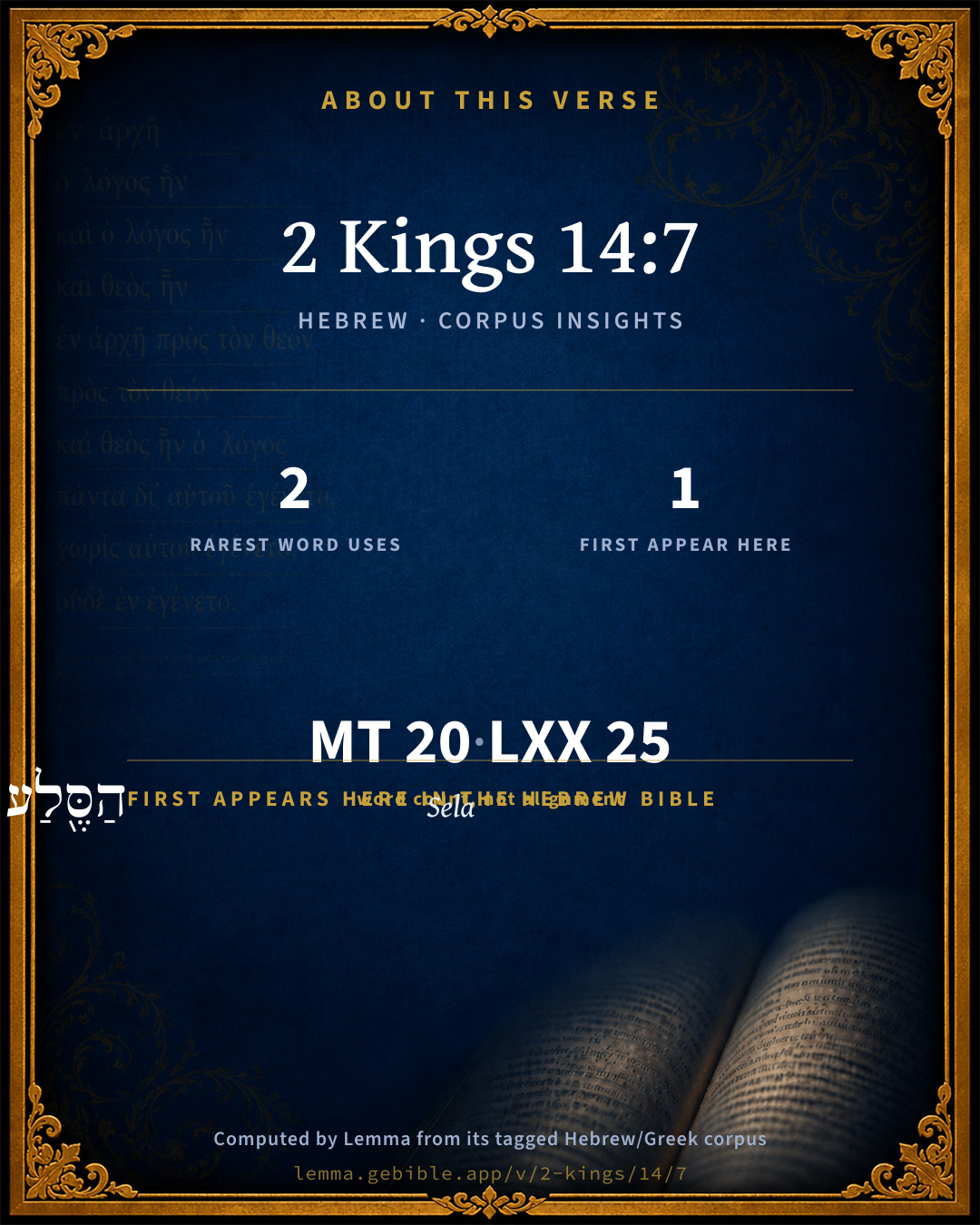
The rarest word here is יָקְתְאֵ֔ל Joktheel H3371 — appearing just 2 times in the whole Hebrew Bible.

First appearance in Scripture

This word makes its first canonical appearance in the Hebrew Bible here:

  • הַסֶּ֖לַע Sela H5554

Shared distinctive vocabulary

יָקְתְאֵ֔ל Joktheel H3371 occurs in 2 verses of the Hebrew Bible. Also found in:

Grammatical profile

  • 3 verbs
  • 9 nouns
  • 2 adjectives
  • 2 pronouns
  • 1 preposition
  • 3 particles

Verb forms

  • הִכָּ֨ה Hiphil · Perfect
  • וְתָפַ֥שׂ Qal · Perfect
  • וַיִּקְרָ֤א Qal · Sequential Imperfect

Repetition

A word recurs within this verse — often emphatic in Hebrew:

  • המלח salt H4417 ×2

Hebrew & Septuagint length

In English translation the verse runs 26 words from the Hebrew and 26 from the Septuagint (LXX English) — the same length.

A rough comparison of the two English renderings, which tokenize alike — not a word-level alignment.

Word counts can differ between the Hebrew and the Greek without any difference in meaning — e.g. the Hebrew direct-object marker אֵת has no separate Greek word, and Greek often adds the article ὁ.

In the original languages it is 20 Hebrew tokens and 25 Greek tokens — but the two are counted differently (Hebrew bundles its prefixes and suffixes into one token; the Greek is in lemma form), so that isn’t a like-for-like length.

Cross-references

7

Topical passages linked to 2 Kings 14:7 in the Treasury of Scripture Knowledge — connected by theme and wording, ordered by reader-vote popularity; previews shown in the World English Bible.

  • 2 Samuel 8:13 David got him a name when he returned from smiting the Syrians in the Valley of Salt, even eighteen thousand men.
  • Joshua 15:38 and Dilean, and Mizpeh, and Joktheel,
  • 1 Chronicles 18:12 Moreover Abishai the son of Zeruiah struck of the Edomites in the Valley of Salt eighteen thousand.
  • Psalms 60:1 God, you have rejected us. You have broken us down. You have been angry. Restore us, again.
  • 2 Kings 8:20–22 In his days Edom revolted from under the hand of Judah, and made a king over themselves.
  • 2 Chronicles 25:11–12 Amaziah took courage, and led forth his people, and went to the Valley of Salt, and struck of the children of Seir ten thousand.
  • Isaiah 16:1 Send you the lambs for the ruler of the land from Selah to the wilderness, to the mountain of the daughter of Zion.

Cross-references courtesy of OpenBible.info (CC BY 4.0).

Hebrew and Greek witnesses Masoretic Hebrew ↔ Greek Septuagint

The same verse in the two great witnesses to the Old Testament, shown verse-for-verse.

These are two independent witnesses, not word-aligned to each other, and the Septuagint is shown in lemma (dictionary) form.

Hebrew 2 Kings 14:7 Masoretic · Westminster Leningrad Codex

הוּא הִכָּ֨ה אֶת אֱד֤וֹם בְּגֵיא המלח מֶ֨לַח֙ עֲשֶׂ֣רֶת אֲלָפִ֔ים וְתָפַ֥שׂ אֶת הַסֶּ֖לַע בַּמִּלְחָמָ֑ה וַיִּקְרָ֤א אֶת שְׁמָהּ֙ יָקְתְאֵ֔ל עַ֖ד הַיּ֥וֹם הַזֶּֽה

He killed of Edom in the Valley of Salt ten thousand, and took Sela by war, and called the name of it Joktheel, to this day.

World English Bible · Public Domain

Greek LXX 2 Kings 14:7 Septuagint · lemma form

αὐτός πατάσσω ὁ εδωμ ἐν γαιμελε δέκα χιλιάς καί συνλαμβάνω ὁ πέτρα ἐν ὁ πόλεμος καί καλέω ὁ ὄνομα αὐτός καθοηλ ἕως ὁ ἡμέρα οὗτος

He struck of Edom ten thousand in the valley of salt, and took the Rock in the war, and called its name Jethoel until this day.

LXX2012 (modern English Septuagint) · Public Domain

On this verse, The Cambridge Bible for Schools and Colleges discusses the Septuagint’s reading. Read the note in Commentary ↓

Hebrew: Westminster Leningrad Codex (CC BY 4.0). Greek: Septuagint (public domain); English from LXX2012 (modern English Septuagint) (Public Domain). How the Septuagint differs from the Hebrew →

Targum (Aramaic paraphrase)

1

The Targum is the ancient Jewish Aramaic paraphrase of the Hebrew Scriptures — an interpretive translation, not the Hebrew text itself. Onkelos (literal) and Pseudo-Jonathan (expansive) render the Torah, and Jonathan the Prophets. Coverage is partial: where no permissively-licensed English translation exists for a verse, only the Aramaic is shown. This is verse-level text, not a word-by-word alignment to the Hebrew.

  1. Targum Jonathan Prophets (Joshua–Malachi)
    הוּא מְחָא יַת אֱנַשׁ אֱדוֹם בְּגֵי מֶלַח עַסְרָא אַלְפִין וּכְבַשׁ יַת כְּרַכָּא בִּקְרָבָא וּקְרָא יַת שְׁמָה יַקְתְאֵל עַד יוֹמָא הָדֵין:

    (no public-domain English translation for this verse)

    Targum Jonathan — Aramaic: “Mikraot Gedolot” (public domain). English: “Sefaria Community Translation” (CC0 1.0 (public-domain dedication)); “London "Chaldee Paraphrase," 1871” (public domain). Text via Sefaria.

Commentary

Notes on 2 Kings 14:7 from classic Christian and Jewish commentators (each source and its license shown beneath its notes). The classic Christian expositions comment on the surrounding passage and are grouped to its opening verse, so a note may address several verses; the Jewish commentaries on the Tanakh (Rashi and others) are per-verse, so they appear only where the commentator wrote on this verse.

Lemma curates 59 commentaries, every one of them public domain or Creative Commons licensed, each selected and text-cleaned for this edition rather than reprinted as found. About our sources →

Jamieson, Fausset & Brown

Robert Jamieson, A. R. Fausset & David Brown

HE SMITES EDOM. (Kg2 14:7)

He slew of Edom in the valley of salt ten thousand--In the reign of Joram the Edomites had revolted (see Kg2 8:20). But Amaziah, determined to reduce them to their former subjection, formed a hostile expedition against them, in which he routed their army and made himself master of their capital.

the valley of salt--that part of the Ghor which comprises the salt and sandy plain to the south of the Dead Sea.

Selah--literally, "the rock"; generally thought to be Petra.

Joktheel--that is, "given" or "conquered by God." See the history of this conquest more fully detailed (Ch2 25:6-16).

Jamieson, Fausset & Brown — Commentary Critical and Explanatory on the Whole Bible (1871) — public domain (CC PDM 1.0). Text via the HelloAO Bible API.

Trapp's Complete Commentary

John Trapp

2Ki 14:7 He slew of Edom in the valley of salt ten thousand, and took Selah by war, and called the name of it Joktheel unto this day.

Ver. 7. In the valley of Salt.] Near to the Lake Asphaltites, which yielded much salt. {a} See 2Sa 8:13.

Ten thousand.] Besides ten thousand more whom he cast down from a rock; {2Ch 25:11-12} not to make himself and the soldiers sport with, as the cruel Spaniards have dealt by the poor Indians, - but because they still stood out, as it is likely.

And took Selah.] Or, Petra, {see Isa 16:1} the chief city of Arabia Petraea, called afterwards Philadelphia by Ptolemy Philadelph, who repaired it. {b} Amaziah calleth it Jockteel, i.e., obedience to God, or the congregation of God, as Pagnine expoundeth it.

{a} Justin.

{b} Jun. Lap.

John Trapp, A Commentary or Exposition upon All the Books of the Old and New Testament (1647–1656) — public domain. Text from a community e-Sword module.

Joseph Benson's Commentary

2Ki 14:7. He slew of Edom — That is, of the Edomites, or the children of Seir, as they are called 2Ch 25:1. The Edomites, after having been subject to Judah from the time of David, who subdued them, revolted in the days of Jehoram, (2Ki 8:10,) and now Amaziah endeavoured to reduce them: and having, at the command of God, abandoned the help of the Israelites, although he had purchased it with a large sum, (2Ch 25:7-10,) he and the men of Judah gained a great victory over them, and made the following slaughter. In the valley of Salt — Which was in the land of Edom. And took Selah — Or, the rock, as the word signifies. This city, called by other authors Petra, which also means a rock, was the metropolis of all that part of Arabia, termed from hence Arabia Petræa, or Arabia the rocky. And called the name of it Joktheel — Which word signifies, the obedience of God; so he named it, either, because, having taken it, he established in it, as some think, the laws and statutes of Moses; or rather, because he considered it as given him by God, as a reward of his obedience to God’s message by the prophet, requiring him to dismiss all the forces which he had hired of the Israelites.

Joseph Benson's Commentary on the Old and New Testaments (1811–1818) — public domain. Text from a community e-Sword module.

Tyndale Open Study Notes

Tyndale Open Resources

14:7 10,000 Edomites: Amaziah’s victory, mentioned only briefly here, is discussed in detail in 2 Chr 25:5-15. Despite granting Amaziah this victory, God chastised him both for hiring Israelite mercenaries and for carrying home Edomite gods and worshiping them. • The Valley of Salt was about three miles south of the Dead Sea. • Sela is traditionally identified as a site in the rocks and cliffs near Petra in modern Jordan. The capture of this highly defensible location demonstrated that Amaziah’s victory was God-given.

Tyndale Open Study Notes — © Tyndale Open Resources, licensed CC BY-SA 4.0. Text via the HelloAO Bible API.

Geneva Bible (1599)

Geneva Bible translators

Or, the tower, or rock, 2 Chron. 25:32.

For the Idumeans, whom David had brought to subjection, did rebel in the time of Jehoram son of Jehoshaphat.

Geneva Bible (1599) marginal notes — public domain. Text via Bolls.life.

Adam Clarke's Commentary

Verse 7. He slew of Edom to the valley of salt] This war is more circumstantially related in 2Ch 25:5, c. The Idumeans had arisen in the reign of Joram king of Judah, and shaken off the yoke of the house of David. Amaziah determined to reduce them to obedience he therefore levied an army of three hundred thousand men in his own kingdom, and hired a hundred thousand Israelites, at the price of one hundred talents. When he was about to depart at the head of this numerous army, a prophet came to him and ordered him to dismiss the Israelitish army, for God was not with them: and on the king of Judah expressing regret for the loss of his hundred talents, he was answered, that the Lord could give him much more than that. He obeyed, sent back the Israelites, and at the head of his own men attacked the Edomites in the valley of salt, slew ten thousand on the spot, and took ten thousand prisoners, all of whom he precipitated from the rock, or Selah, which was afterwards called Joktheel, a place or city supposed to be the same with Petra, which gave name to Arabia Petraea, where there must have been a great precipice, from which the place took its name of Selah or Petra.

Adam Clarke's Commentary on the Bible (1810–1826) — public domain. Text from a community e-Sword/MySword module.

Ellicott's Commentary for English Readers

(7) He slew.—Rather, he it was that smote.

The valley of salt.—Comp. 2Sa_8:13. El-Ghôr, the salt plain of the Dead Sea, which Amaziah would traverse in marching against Edom.

Ten thousand.—The number slain in one conflict.

Selah.—Heb., the Sèlac, i.e., the crag. The Hebrew name of the famous rock-hewn town of Petra.

By war.—Or, in the battle. After the decisive engagement, Amaziah’s troops forced their way through the narrow defile leading to the Edomite capital, probably meeting no great resistance.

Joktheel.—A town of Judah bore this name (Jos_15:38). The name probably means God’s ward, referring to the wonderful strength of the natural position of the town. Others explain, subjugated of God.

Unto this day—i.e., unto the time when the original document was written, from which the writer derived this notice.

The reduction of the capital implies that of the country. The defeat of Jehoram (2Ki_8:20, seq.) was thus avenged. Chronicles gives a more detailed account of the re-conquest of Edom, and its consequences (2Ch_25:5-16). it is there related that Amaziah hired a large force of mercenaries from the northern kingdom, but sent them home again at the bidding of a prophet. On their way back they attacked and plundered certain of the cities of Judah. The fall of Selah was followed by a massacre of captives. The gods of Edom, which Amaziah carried off, proved a snare to him. (See the Notes on the passage.)

A Bible Commentary for English Readers, edited by Charles John Ellicott (1878–1897) — public domain. Text from a community e-Sword module.

The Cambridge Bible for Schools and Colleges

gen. ed. J. J. S. Perowne

7. He slew of Edom] The Chronicler in 2Ch_25:5-10 gives an account of Amaziah’s military preparations, before the expedition against Edom. He tells us that he gathered and marshalled his men of war, from twenty years old and upward, to the number of 300,000 choice men. To these he hired mercenary troops out of Israel, another 100,000. But a man of God forbade him to take the Israelites with him, as the Lord was not with Israel. Though grieved at the loss of the hundred talents, which he had paid for this body of allies, Amaziah separated them and sent them back again, wherefore their anger was greatly kindled against Judah, and they returned home in great wrath. After this with his own troops only Amaziah undertook the war with Edom, in which he was successful. According to Josephus (Ant. IX. 9. 1) the first planned expedition was against the Amalekites and Gebalites as well as the Edomites. On Gebal, a city of Phœnicia, see note on 1Ki_5:18.

in the valley of salt] The R.V. prints both ‘Valley’ and ‘Salt’ with capitals to mark it as a proper name. The LXX. has a transliteration of the two words Γεμελέδ. The Valley of Salt lay at the south of the Dead Sea, and was on the border of the Edomite territory. We read that the Edomites had revolted from Judah in the days of Joram (2Ki_8:20-22), and it seems they had not as yet been reduced to subjection.

ten thousand] Beside the 10,000 slain in the battle, the Chronicler mentions 10,000 more who were taken captive, and cast headlong from the rock so ‘that they all were broken in pieces’ (2Ch_25:12).

and took Selah [R.V. Sela] by war] Sela which signifies ‘a rock’ is probably the city which was known in later times as ‘Petra’. It was a city of Edom, not far from Mount Hor, about 2 days’ journey northward from the top of the gulf of Akabah. The Chronicler says nothing about Sela, but mentions ‘the rock’ as the place from which the 10,000 captives were cast down. It may have been from the height on which Sela stood and took its name, that the execution of the captives took place.

called the name of it Joktheel] This name, which is a trisyllable (Jokthe-él) is interpreted by Gesenius as ‘a Deo subactum’. It might with propriety be given by Amaziah to a city won by him after the direction which God had given him to put away the Israelite mercenaries. He would consider that the victory was a direct gift from God.

unto this day] That Sela continued to be called Jokteel at the time when the book of Kings was compiled is in the highest degree improbable. We know that Edom reconquered some of the lost territory very soon (2Ch_28:17) and during the captivity made inroads into the south of Judah as far as Hebron (Joseph. Ant. xii. 8.6). But in this passage the compiler takes the words of an earlier writer, exactly as they stood, and that earlier record was made before Sela was recovered and before the name Joktheel had fallen into disuse.

The Cambridge Bible for Schools and Colleges (gen. ed. J. J. S. Perowne; Cambridge University Press, 1878–1918) — public domain. Text from a community e-Sword module.

John Gill's Exposition

And Jehoash the king of Israel sent to Amaziah the king of Judah,.... By the return of his messengers:

saying, the thistle that was in Lebanon sent to the cedar that was in Lebanon; intending by this proverbial way of speaking to humble the pride of Amaziah; comparing him to a thistle or thorn, a low, mean, abject, weak, prickly, and troublesome shrub, and himself to a cedar, a tree high and lofty, strong, large, and spreading:

saying, give thy daughter to my son to wife; signifying, that if in a peaceable manner he had desired to contract affinity with him, and so establish mutual friendship, he should have despised him as being as much below him as the thistle is below a cedar; and therefore should still more despise and defy him, who addressed him in an hostile manner, and in such haughty language:

and there passed by a wild beast that was in Lebanon, and trod down the thistle; and so there was an end put at once to its pride and ambition, and to its treaty with the cedar; intimating hereby, that his soldiers would as easily vanquish and destroy the army of Amaziah as a wild beast can destroy a thistle.

John Gill's Exposition of the Whole Bible (1746–1763) — public domain (CC PDM 1.0). Text via the HelloAO Bible API.

Albert Barnes' Notes on the Bible

Amaziah’s Idumaean war is treated at length by the writer of Chronicles (marginal reference).

The “Valley of Salt” is usually identified with the broad open plain called the Sabkah, at the southern end of the Dead Sea - the continuation of the Ghor or Jordan gorge. At the north-western corner of this plain stands a mountain of rock-salt, and the tract between this mountain and the sea is a salt-marsh. Salt springs also abound in the plain itself, so that the name would be fully accounted for. It is doubted, however, whether the original of the word “valley,” commonly used of clefts and ravines, can be applied to such a sunk plain as the Sabkah; and it is certainly most unlikely that 10,000 prisoners would have been conveyed upward of eighty miles (the distance of the Sabkah from Petra), through a rough and difficult country, only in order to be massacred. On the whole, it is perhaps most probable that the “Valley of Salt” yet remains to be discovered, and that its true position was near Selah or Petra (see Jdg 1:36 note). Amaziah gave to Petra the name Joktheel, “subdued by God,” in a religious spirit as an acknowledgment of the divine aid by which his victory was gained. The name failed to take permanent hold on the place, because the Edomites, on not long afterward recovering their city, restored the old appellation (2Ch 28:17; compare Isa 16:1, and Amo 1:11).

Unto this day - The writer of Kings evidently gives the exact words of his document, composed not later than the reign of Ahaz, before whose death the Edomites had recovered Petra.

Albert Barnes' Notes on the Bible (1834–1885) — public domain. Text from a community e-Sword/MySword module.

Haydock's Catholic Bible Commentary

Edom, who had rebelled under Joram, chap. viii. 20. The particulars of this war are given, 2 Paralipomenon xxv. 5. Josephus ([Antiquities?] ix. 9.) says, Amasias designed also to attack Amalec and Gebal in the same country. --- Pits. Called the woody vale, Genesis xiv. 8., (Menochius) south-west of the Dead Sea, (Adrichomius) or rather to the south of Palmyra, towards Bosra, 3 Kings ix. 18. --- Rock. Petra, the capital of the country, formerly called Rekem Arke, or Hagor. Most of the houses are hewn out of the rock. Hebrew Sela signifies "a rock;" and many think that this was some other place, whence the Idumeans were hurled down, after the victory. Amasias gave it the name of Jectehel, "obedience of God," in memory of his having obtained this success, in consequence of his having obeyed the prophet, and sent away 100,000, for whom he had paid 100 talents to the king of Israel.

George Leo Haydock (1774–1849), Haydock's Catholic Family Bible and Commentary, 1859 edition — public domain. Excludes Psalms (Douay-Rheims chapter numbering differs from Protestant) and Deuterocanonical books (Catholic canon only).

Matthew Poole's English Annotations

Of Edom, i.e. of the Edomites, or the children of Seir, as they are called, 2Ch 25:11; either because they dwelt in Seir; see Gen 36:8; or because these people were confederates. And he invaded these people because they were subjects to his kingdom, from which they had revolted in Joram’s days, 2Ki 8:20.

The valley of salt; which was the land of Edom; of which see 2Sa 8:13; Psa 60:1.

Selah, or,

the rock; the chief city of that part of Arabia, called by other authors Petra, which signifies a rock, because it was built upon a rock, 2Ch 25:12.

Joktheel, which signifies the obedience of God, i.e. given him by God as a reward of his obedience to God’s message by the prophet, 2Ch 25:8,9.

Matthew Poole's English Annotations on the Holy Bible (1683–1685) — public domain. Text from a community e-Sword/MySword module.

Whedon's Commentary on the Bible

Daniel D. Whedon

7. Slew of Edom — The Edomites had cast off the yoke of Judah in the days of Jehoram, (2Ki_8:20,) and had so strengthened themselves that, according to 2Ch_25:5-6, Amaziah considered it necessary to lead an army of four hundred thousand men against them. See the parallel passage in Chronicles for a fuller record of this Edomite war.

Valley of salt — The broad, open plain at the lower end of the Dead Sea, which virtually forms the southern termination of the Ghor, or great Jordan valley. It is appropriately called the Salt Valley from the salt mountain at its northwestern extremity, and the brackish springs and streams that are found in it. In this same valley David once smote the Edomites. See note on 2Sa_8:13.

Selah — More properly written, as in Isa_16:1, Sela; Hebrew, שׂלע, or השׂלע, the rock. The capital city of the Edomites, situated in Mount Seir, two days’ journey south of the Valley of Salt, at the eastern base of Mount Hor. By the Greek writers it is called Petra. Strabo and Pliny describe it as a narrow valley, shut in by precipitous rocks and inaccessible mountains, but having a stream running through it fed by copious fountains and supplying water for the irrigation of gardens. After the Mohammedan conquest its site was long unknown, but, discovered A.D. 1812 by Burckhardt, it has since been many times visited and described by travellers. Its site and ruins are represented as among the most wonderful things of the Orient. It is a city whose most imposing remains consist of tombs and temples sculptured in the solid rock. And not the least remarkable thing, according to Robinson, is the colour of the rocks. “They present an endless variety of bright and living hues, from the deepest crimson to the softest pink, verging also sometimes to orange and yellow.” The principal entrance to the city is from the east, through a wild, deep chasm, called the Sik, varying in width from twelve to fifty feet. At a point where this chasm takes a sharp turn stands the celebrated structure called the Khazneh, which, says Palmer, “in beauty of form and colouring surpasses all the other tombs and temples. The facade is of a deep but delicate rose colour, and that of the uncut rock around it varies from every shade of red to chocolate.” This writer plausibly conjectures that it represents “the museum of Petra, the philharmonic institution of the place.” The other principal remains are the theatre, the tomb with three rows of columns, the ruined bridges, and the triumphal arch. “In looking at the wonders of this ancient city,” writes Robinson, “one is at a loss whether most to admire the wildness of the position and natural scenery, or the taste and skill with which it was fashioned into a secure retreat, and adorned with splendid structures, chiefly for the dead.”

Called the name of it Joktheel — The name signifies subdued by God, but does not seem to have been commonly applied to the place for any considerable length of time, for it does not again occur, and Isaiah calls the place by its old name, Sela. 2Ki_16:1. The phrase unto this day, indicates, therefore, that this record of Amaziah’s conquest was written during the Jewish rule over Edom, and before the time of Ahaz, when the Edomites had again thrown off the Hebrew yoke. 2Ch_28:17.

Daniel D. Whedon (gen. ed.), Commentary on the Old and New Testaments (1874–1909) — public domain. Text from a community e-Sword module.

The Pulpit Commentary

He slew of Edom in the valley of salt ten thousand. Edom had revolted from Judah and recovered complete independence in the reign of Jehoram, about fifty years previously. (2Ki_8:20) Since that time the two countries had remained at peace. Now, however, Amaziah resolved upon a great effort to resubjugate them. According to Josephus ("Ant. Jud:," 9:9. and Chronicles, (2Ch_25:5) he levied an army of 400, 000 men 300, 000 Jews, and 100, 000 hired Israelites with which he marched against the three nations of the Amalekites, the Idumaeans, and the Gabalites. Rebuked by a prophet for want of faith in calling to his aid the wicked Israelites, he consented to dismiss them, and made the invasion at the head of his own troops only. These were carefully organized, (2Ch_25:5) and met with a great success. Ten thousand of his enemies fell in battle, and an equal number were made prisoners. These last were barbarously put to death by being precipitated from the top of a rock. (2Ch_25:12) "The valley of salt," the scene of the battle, is probably identified with the sunken plain, now called Es Sabkah, at the southern extremity of the Dead Sea. This is "a large flat of at least six miles by ten, occasionally flooded" (Tristram), but dry in the summertime. It is full of salt springs, and is bounded on the west and northwest by a long ridge of pure salt, known as the Khasm Usdum, so that the name "valley of salt" would be very appropriate. And took Selah by war. Selah with the article (has-Selah) can only be the Idumaean capital, which the Greeks called Petra (Petra or hJ Petra), and which is one of the most remarkable sites in the world. In the rocky mountains which form the eastern boundary of the Arabah or sandy slope reaching from the edge of the Sabkah to the Red Sea, amid cliffs of gorgeous colors, pink and crimson and purple, and ravines as deep and narrow as that of Proffers, partly excavated in the rook, partly emplaced upon it, stood the Edomite town, difficult to approach, still more difficult to capture, more like the home of a colony of sea-gulls than that of a number of men. Petra is graphically described by Dean Stanley ("Sinai and Palestine," pp. 88-92), and has also received notice from Robinson ("Researches," vol. it. pp. 518-538), Highten ("Dictionary of the Bible," vol. 3. p. 1191), and others. And called the name of it Joktheel; i.e. "subdued by God." The name took no permanent hold. Selah is still "Sela" in Isaiah, (Isa_16:1) Obadiah (ver. 3), and Jeremiah. (Jer_49:16) It is known only as "Petra" to the Greeks and Romans. Unto this day; i.e. to the time of the writer who composed the account of Amaziah"s reign for the "Book of the Kings," and whoso words the author of Kings transcribes here as so often elsewhere.

The Pulpit Commentary (1880–1919), ed. H.D.M. Spence-Jones & Joseph S. Exell — public domain. Text from a community e-Sword module.

John Wesley's Explanatory Notes

Joktheel - Which signifies, the obedience of God, that is, given him by God as a reward of his obedience to God's message by the prophet, 2 Chron. xxv, 8, 9.

John Wesley, Explanatory Notes Upon the Whole Bible (1754–1765) — public domain. Text via the GEBible commentary corpus.

Scofield Reference Notes

C. I. Scofield

Edom

See 2Ch 25:5-16.

The Scofield Reference Bible (1917 edition), notes by C. I. Scofield — public domain. Text from a community e-Sword module.

Rashi

Rabbi Shlomo Yitzchaki (Rashi)

And named it Yokseil. For it set his teeth on edge, as it is written, “After Amatzyohu came from killing the Edomites, he brought the gods of the children of Seir, etc., for deities, he would bow down to them, etc.,” and the prophet rebuked him and said to him, “I know that God has made a plan to destroy you.” Now what was the advice? That He persuaded him to incite the king of Yisroel.

Rashi on the Tanakh — English translations: “The Judaica Press complete Tanach with Rashi, translated by A. J. Rosenberg” (CC BY 4.0); “Pentateuch with Rashi's commentary by M. Rosenbaum and A.M. Silbermann, 1929-1934” (public domain); “The Metsudah Tanach series, Lakewood, N.J” (CC BY 4.0); and “The Book of Joshua, Metsudah Publications, 1997” (CC BY 4.0). Text via Sefaria.

Lesson kit

Teaching starters — assembled from the data on this page, not authored interpretation. Every prompt links to the verse data it draws on. Edit before teaching.

2 Kings, in the Historical, opens this verse with 20 words (17 distinct Hebrew lemmas). Its most distinctive word is Yoqthᵉʼêl (“Joktheel”). A historical commentator’s framing appears above. Read the whole chapter for the surrounding context.

Discussion questions

  1. How does “Joktheel” (Yoqthᵉʼêl) shape what this verse is saying?
  2. The word “Sela” first appears here in Scripture. What is being introduced at this debut?
  3. Joshua 15:38 shares the word «Joktheel» with this verse. How do the two illuminate each other?
  4. “salt” occurs 2× in this one verse. What is the effect of the repetition?
  5. These translations render this verse differently; the difference is in the English rendering, not the original. What questions does that raise?
  6. The verb «הִכָּ֨ה» is Hiphil Perfect. How does its form color the action?
  7. Reading how Jamieson, Fausset & Brown and Trapp's Complete Commentary read this verse, where do the two commentators agree and where do they part?

Things to notice

Reading settings

Reading text

Shown beneath each verse's original-language words.

Old Testament
Old Testament edition

Read the OT as the Masoretic Hebrew (MT) or the Greek Septuagint (LXX).

English shown for the Greek Septuagint (in the Hebrew ↔ Greek comparison).

Comparing translations? Open the Compare panel on any verse page to stack up to four side by side.