
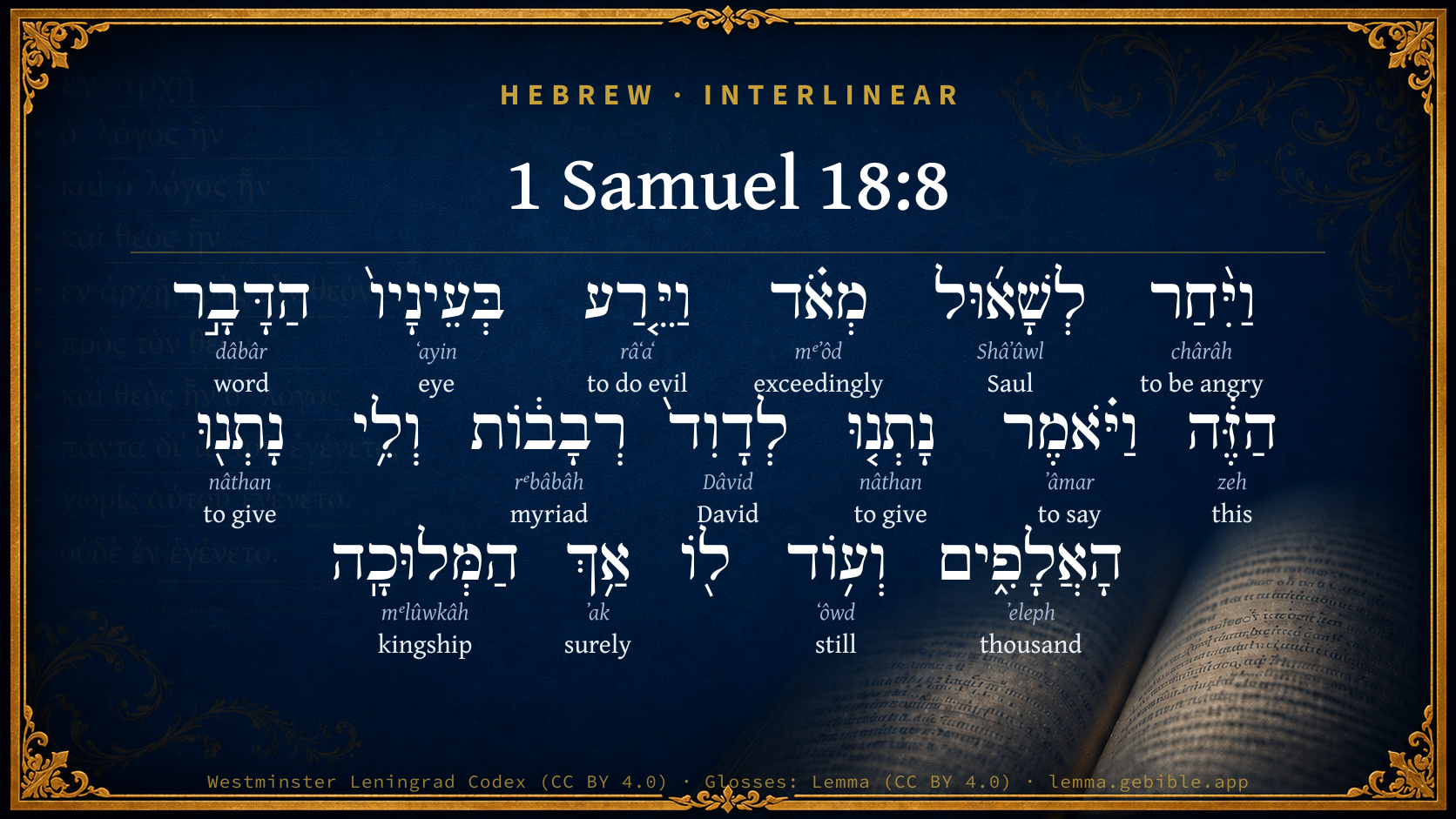
1 Samuel 18:8

Hebrew (Westminster Leningrad Codex) 1 Samuel 18:8 appears in the Hebrew Old Testament. The text above is from the Westminster Leningrad Codex. Each word links to its Strong’s number, a concise gloss, and parsing drawn from the Open Scriptures Hebrew Bible morphology. Click any word for its full Brown-Driver-Briggs (BDB) entry.
Download image
Cite this verse

1 Samuel 18:8 (World English Bible). Public Domain. Lemma interlinear Bible study tool, https://lemma.gebible.app/v/1-samuel/18/8.

Show BibTeX & RIS
BibTeX
RIS
English Translation
Saul was very angry, and this saying displeased him; and he said, They have ascribed to David ten thousands, and to me they have ascribed but thousands: and what can he have more but the kingdom?
World English Bible · Public Domain
Download a study sheet

One document with this verse’s original text, its word-by-word gloss line, the meaning frame, cross-references with their text, attributed commentary, and full source and license credits — printable, and it pastes into notes with its structure intact.

This verse Autodidact and up

Study sheet (.html) Plain text (.txt)

A passage Seminary Student

Up to 50 verses in one chapter. A passage sheet keeps up to 6 commentary sources and 12 cross-references per verse, in the order this page ranks them, and says so on the sheet whenever that leaves anything out. Ask for a single verse and you get the Autodidact verse sheet above.

Everything on this page stays free to read, with no account — the sheet is a download of what is already on screen, not access to it.

Want to remove ads? Support Godless Engineer
Compare translations 3

The same verse in 3 English versions, stacked beneath the original-language interlinear above. Click any original word for its lexicon entry.

Each is an independent rendering of the whole verse — the interlinear is not word-aligned to these translations.

Highlighted words mark where these versions differ — a whole-verse word diff, not a word-by-word alignment.

  • World English Bible Public Domain
    Saul was very angry, and this saying displeased him; and he said, They have ascribed to David ten thousands, and to me they have ascribed but thousands: and what can he have more but the kingdom?
  • King James Version Public Domain
    And Saul was very wroth, and the saying displeased him; and he said, They have ascribed unto David ten thousands, and to me they have ascribed but thousands: and what can he have more but the kingdom?
  • unfoldingWord Literal Text CC BY-SA 4.0
    And it burned greatly to Saul, and this thing was bad in his eyes. And he said, “They have given myriads to David, but to me they have given thousands. And only the kingship is yet for him!”

unfoldingWord Literal Text — © unfoldingWord, licensed CC BY-SA 4.0. Word-aligned USFM3 via Door43 (git.door43.org/unfoldingWord/en_ult).

Versions to compare (up to 4)

3 of 4 selected

Show all 18 translations

Every available English version of this verse, each an independent rendering of the whole verse.

  • World English Bible Public Domain
    Saul was very angry, and this saying displeased him; and he said, They have ascribed to David ten thousands, and to me they have ascribed but thousands: and what can he have more but the kingdom?
  • Berean Standard Bible Public Domain
    And Saul was furious and resented this song. “They have ascribed tens of thousands to David,” he said, “but only thousands to me. What more can he have but the kingdom?”
  • Majority Standard Bible Public Domain
    And Saul was furious and resented this song. “They have ascribed tens of thousands to David,” he said, “but only thousands to me. What more can he have but the kingdom?”
  • King James Version Public Domain
    And Saul was very wroth, and the saying displeased him; and he said, They have ascribed unto David ten thousands, and to me they have ascribed but thousands: and what can he have more but the kingdom?
  • American Standard Version (1901) Public Domain
    And Saul was very wroth, and this saying displeased him; and he said, They have ascribed unto David ten thousands, and to me they have ascribed but thousands: and what can he have more but the kingdom?
  • Revised Version (1885) Public Domain
    And Saul was very wroth, and this saying displeased him; and he said, They have ascribed unto David ten thousands, and to me they have ascribed but thousands: and what can he have more but the kingdom?
  • Geneva Bible (1599) Public Domain
    Therefore Saul was exceeding wroth, and the saying displeased him, and he sayde, They haue ascribed vnto Dauid ten thousand, and to me they haue ascribed but a thousand, and what can he haue more saue the kingdome?
  • Douay-Rheims (1899) Public Domain
    And Saul was exceeding angry, and this word was displeasing in his eyes, and he said: They have given David ten thousands, and to me they have given but a thousand; what can he have more but the kingdom?
  • Young's Literal Translation Public Domain
    And it is displeasing to Saul exceedingly, and this thing is evil in his eyes, and he saith, `They have given to David myriads, and to me they have given the thousands, and more to him `is' only the kingdom;'
  • Literal Standard Version CC BY-SA 4.0
    And it is exceedingly displeasing to Saul, and this thing is evil in his eyes, and he says, “They have given myriads to David, and they have given the thousands to me, and what more [is there] for him but the kingdom?”
  • Unlocked Literal Bible CC BY-SA 4.0
    Saul was very angry, and this song displeased him. He said, “They have ascribed to David ten thousands, but they have ascribed only thousands to me. What more can he have but the monarchy?”
  • unfoldingWord Literal Text CC BY-SA 4.0
    And it burned greatly to Saul, and this thing was bad in his eyes. And he said, “They have given myriads to David, but to me they have given thousands. And only the kingship is yet for him!”
  • Darby Bible Public Domain
    And Saul was very wroth, and that saying was evil in his sight; and he said, They have ascribed to David ten thousands, but to me they have ascribed the thousands; and [what] is there more for him but the kingdom?
  • World Messianic Bible Public Domain
    Saul was very angry, and this saying displeased him. He said, “They have credited David with ten thousands, and they have only credited me with thousands. What can he have more but the kingdom?”
  • Webster's Bible Public Domain
    And Saul was very wroth, and the saying displeased him; and he said, They have ascribed to David ten thousands, and to me they have ascribed thousands; and what can he have more but the kingdom?
  • Free Bible Version CC BY-SA 4.0
    What they were singing made Saul very angry as he didn't think it was right. He said to himself, “They've given David credit for killing tens of thousands, but only thousands to me. All that's left is to give him the kingdom!”
  • Bible in Basic English Public Domain
    And Saul was very angry and this saying was unpleasing to him; and he said, They have given David credit for tens of thousands, and to me for only thousands: what more is there for him but the kingdom?
  • JPS Tanakh (1917) Public Domain
    And Saul was very wroth, and this saying displeased him; and he said: 'They have ascribed unto David ten thousands, and to me they have ascribed but thousands; and all he lacketh is the kingdom!'

Literal Standard Version (2020), Covenant Press — licensed CC BY-SA 4.0. Text via the HelloAO Bible API (eBible.org). Unlocked Literal Bible (unfoldingWord) — licensed CC BY-SA 4.0. Text via the HelloAO Bible API (eBible.org). unfoldingWord Literal Text — © unfoldingWord, licensed CC BY-SA 4.0. Word-aligned USFM3 via Door43 (git.door43.org/unfoldingWord/en_ult). Free Bible Version, Dr. Jonathan Gallagher — licensed CC BY-SA 4.0. Text via the HelloAO Bible API (eBible.org).

Word by word

More ways to search: Search by grammar → Find every occurrence → Compare this word →

Practice this passage: Drill this verse → Learn its vocabulary →

רְבָב֔וֹת
rᵉbâbâh
H7233
“myriads”
Noun, Common, Feminine, Plural, Absolute
Part of Speech
Noun
Type
Common
Gender
Feminine
Number
Plural
State
Absolute
Full BDB Definition

Origin: from H7231

TWOT: 2099d

multitude, myriad, ten thousand
  1. וַיִּ֨חַר chârâh H2734 “and · to be angry” Conjunction + Verb, Qal, Sequential Imperfect, 3rd Person, Masculine, Singular
  2. לְשָׁא֜וּל Shâʼûwl H7586 “to/for · Saul” Preposition + Noun, Proper
  3. מְאֹ֗ד mᵉʼôd H3966 “exceedingly” Adverb
  4. וַיֵּ֤רַע râʻaʻ H7489 “and · to do evil” Conjunction + Verb, Qal, Sequential Imperfect, 3rd Person, Masculine, Singular
  5. בְּעֵינָיו֙ ʻayin H5869 “in/at · eyes · his” Preposition + Noun, Common, Both, Dual, Construct + Suffix, Personal, 3rd Person, Masculine, Singular
  6. הַדָּבָ֣ר dâbâr H1697 “the · word” Particle, Definite Article + Noun, Common, Masculine, Singular, Absolute
  7. הַזֶּ֔ה zeh H2088 “the · this” Particle, Definite Article + Pronoun, Demonstrative, Masculine, Singular
  8. וַיֹּ֗אמֶר ʼâmar H559 “and · to say” Conjunction + Verb, Qal, Sequential Imperfect, 3rd Person, Masculine, Singular
  9. נָתְנ֤וּ nâthan H5414 “to give” Verb, Qal, Perfect, 3rd Person, Common, Plural
  10. לְדָוִד֙ Dâvid H1732 “to/for · David” Preposition + Noun, Proper
  11. נָתְנ֖וּ nâthan H5414 “to give” Verb, Qal, Perfect, 3rd Person, Common, Plural
  12. הָאֲלָפִ֑ים ʼeleph H505 “the · thousand” Particle, Definite Article + Adjective, Cardinal number, Both, Plural, Absolute
  13. וְע֥וֹד ʻôwd H5750 “and · still” Conjunction + Adverb
  14. אַ֥ךְ ʼak H389 “surely” Particle, Accusative
  15. הַמְּלוּכָֽה mᵉlûwkâh H4410 “the · kingship” Particle, Definite Article + Noun, Common, Feminine, Singular, Absolute

About this verse

These counts appear in no published source. They are computed here, from the morphology-tagged text and Lemma’s own curated glosses. What Lemma adds →

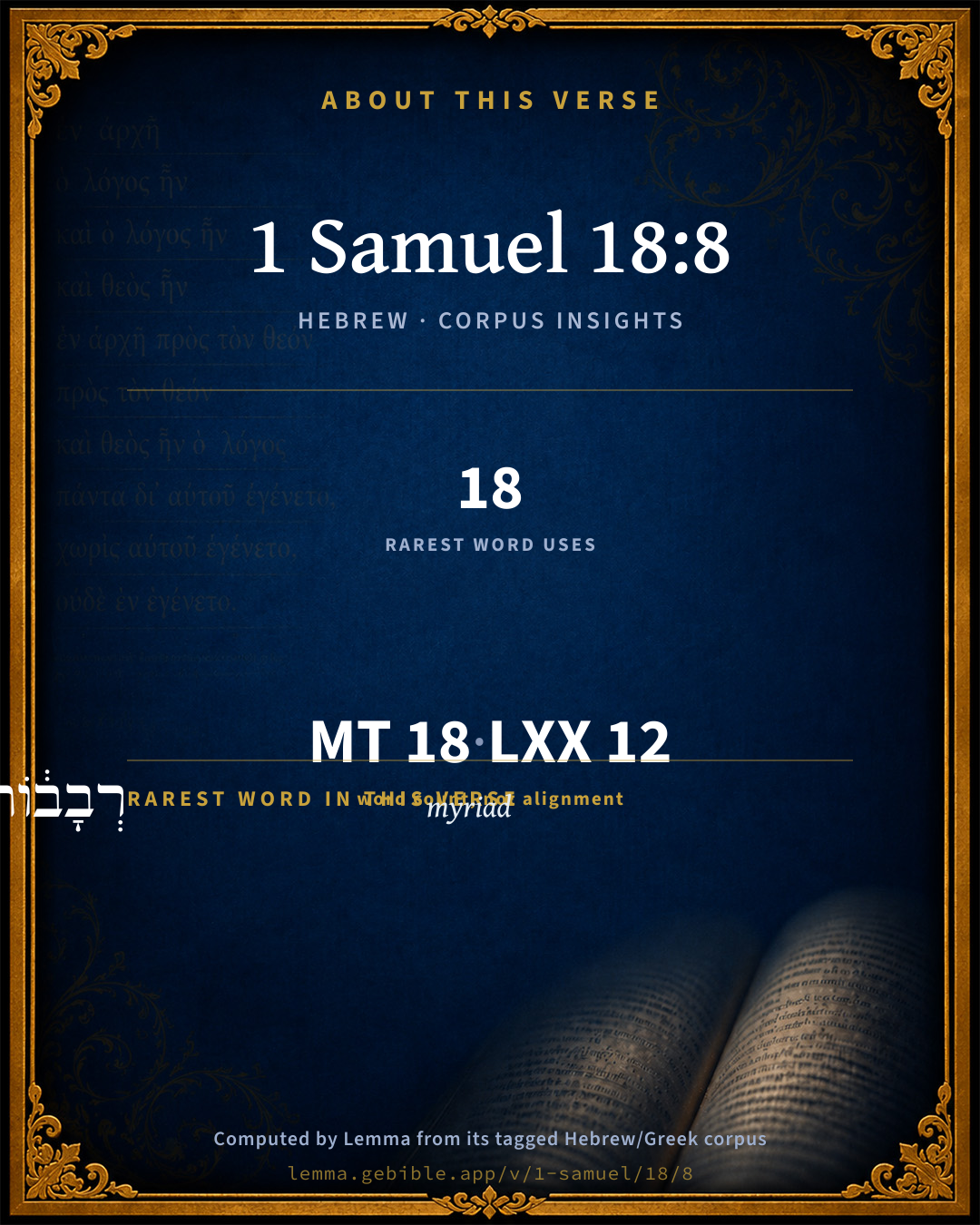
18
words
15
distinct lemmas
Historical
section

Notable vocabulary

The rarest word here is רְבָב֔וֹת myriad H7233 — appearing just 18 times in the whole Hebrew Bible.

Shared distinctive vocabulary

רְבָב֔וֹת myriad H7233 occurs in 16 verses of the Hebrew Bible. Also found in:

Grammatical profile

  • 5 verbs
  • 6 nouns
  • 1 adjective
  • 1 pronoun
  • 2 prepositions
  • 2 adverbs
  • 1 particle

Verb forms

  • וַיִּ֨חַר Qal · Sequential Imperfect
  • וַיֵּ֤רַע Qal · Sequential Imperfect
  • וַיֹּ֗אמֶר Qal · Sequential Imperfect
  • נָתְנ֤וּ Qal · Perfect
  • נָתְנ֖וּ Qal · Perfect

Repetition

A word recurs within this verse — often emphatic in Hebrew:

  • נָתְנ֤וּ to give H5414 ×2

Hebrew & Septuagint length

In English translation the verse runs 36 words from the Hebrew and 38 from the Septuagint (LXX English) — closely comparable.

A rough comparison of the two English renderings, which tokenize alike — not a word-level alignment.

Word counts can differ between the Hebrew and the Greek without any difference in meaning — e.g. the Hebrew direct-object marker אֵת has no separate Greek word, and Greek often adds the article ὁ.

In the original languages it is 18 Hebrew tokens and 12 Greek tokens — but the two are counted differently (Hebrew bundles its prefixes and suffixes into one token; the Greek is in lemma form), so that isn’t a like-for-like length.

Cross-references

12

Topical passages linked to 1 Samuel 18:8 in the Treasury of Scripture Knowledge — connected by theme and wording, ordered by reader-vote popularity; previews shown in the World English Bible.

  • 1 Samuel 15:28 Samuel said to him, Yahweh has torn the kingdom of Israel from you this day, and has given it to a neighbor of yours who is better than you.
  • Proverbs 13:10 Pride only breeds quarrels, But with ones who take advice is wisdom.
  • 1 Samuel 20:31 For as long as the son of Jesse lives on the earth, you shall not be established, nor your kingdom. Therefore now send and bring him to me, for he shall surely die.
  • Esther 3:5 When Haman saw that Mordecai didn't bow down, nor did him reverence, then was Haman full of wrath.
  • James 4:5 Or do you think that the Scripture says in vain, "The Spirit who lives in us yearns jealously"?
  • Proverbs 27:4 Wrath is cruel, And anger is overwhelming; But who is able to stand before jealousy?
  • Numbers 11:1 The people were as murmurers, [speaking] evil in the ears of Yahweh: and when Yahweh heard it, his anger was kindled; and the fire of Yahweh burnt among them, and devoured in the uttermost part of the camp.
  • Numbers 22:34 Balaam said to the angel of Yahweh, I have sinned; for I didn't know that you stood in the way against me: now therefore, if it displease you, I will get me back again.
  • 1 Samuel 13:14 But now your kingdom shall not continue: Yahweh has sought him a man after his own heart, and Yahweh has appointed him to be prince over his people, because you have not kept that which Yahweh commanded you.
  • 1 Samuel 16:13 Then Samuel took the horn of oil, and anointed him in the midst of his brothers: and the Spirit of Yahweh came mightily on David from that day forward. So Samuel rose up, and went to Ramah.
  • 1 Kings 2:22 King Solomon answered his mother, Why do you ask Abishag the Shunammite for Adonijah? ask for him the kingdom also; for he is my elder brother; even for him, and for Abiathar the priest, and for Joab the son of Zeruiah.
  • Ecclesiastes 4:4 Then I saw all the labor and achievement that is the envy of a man's neighbor. This also is vanity and a striving after wind.

Cross-references courtesy of OpenBible.info (CC BY 4.0).

Hebrew and Greek witnesses Masoretic Hebrew ↔ Greek Septuagint

The same verse in the two great witnesses to the Old Testament, shown verse-for-verse.

These are two independent witnesses, not word-aligned to each other, and the Septuagint is shown in lemma (dictionary) form.

Hebrew 1 Samuel 18:8 Masoretic · Westminster Leningrad Codex

וַיִּ֨חַר לְשָׁא֜וּל מְאֹ֗ד וַיֵּ֤רַע בְּעֵינָיו֙ הַדָּבָ֣ר הַזֶּ֔ה וַיֹּ֗אמֶר נָתְנ֤וּ לְדָוִד֙ רְבָב֔וֹת וְלִ֥י נָתְנ֖וּ הָאֲלָפִ֑ים וְע֥וֹד ל֖וֹ אַ֥ךְ הַמְּלוּכָֽה

Saul was very angry, and this saying displeased him; and he said, They have ascribed to David ten thousands, and to me they have ascribed but thousands: and what can he have more but the kingdom?

World English Bible · Public Domain

Greek LXX 1 Samuel 18:8 Septuagint · lemma form

καί ὁράω σαούλ ὡς αὐτός συνἵημι σφόδρα καί εὐλαβέομαι ἀπό πρόσωπον αὐτός

And it seemed evil in the eyes of Saul concerning this matter, and he said, To David they have given ten thousands, and to me they have given thousands. And what more can he have but the kingdom?

LXX2012 (modern English Septuagint) · Public Domain

On this verse, Haydock's Catholic Bible Commentary discusses the Septuagint’s reading. Read the note in Commentary ↓

Hebrew: Westminster Leningrad Codex (CC BY 4.0). Greek: Septuagint (public domain); English from LXX2012 (modern English Septuagint) (Public Domain). How the Septuagint differs from the Hebrew →

Targum (Aramaic paraphrase)

1

The Targum is the ancient Jewish Aramaic paraphrase of the Hebrew Scriptures — an interpretive translation, not the Hebrew text itself. Onkelos (literal) and Pseudo-Jonathan (expansive) render the Torah, and Jonathan the Prophets. Coverage is partial: where no permissively-licensed English translation exists for a verse, only the Aramaic is shown. This is verse-level text, not a word-by-word alignment to the Hebrew.

  1. Targum Jonathan Prophets (Joshua–Malachi)
    וּתְקֵיף לְשָׁאוּל לַחֲדָא וּבְאֵשׁ בְּעֵינוֹהִי פִּתְגָמָא הָדֵין וַאֲמַר יְהָבוּ לְדָוִד רִיבְוָן וְלִי יְהָבוּ אַלְפַיָא וּמִכְּעַן לָא אִשְׁתָּאֲרַת לֵיהּ אֱלָהֵין מַלְכוּתָא:

    (no public-domain English translation for this verse)

    Targum Jonathan — Aramaic: “Mikraot Gedolot” (public domain). English: “Sefaria Community Translation” (CC0 1.0 (public-domain dedication)); “London "Chaldee Paraphrase," 1871” (public domain). Text via Sefaria.

Commentary

Notes on 1 Samuel 18:8 from classic Christian and Jewish commentators (each source and its license shown beneath its notes). The classic Christian expositions comment on the surrounding passage and are grouped to its opening verse, so a note may address several verses; the Jewish commentaries on the Tanakh (Rashi and others) are per-verse, so they appear only where the commentator wrote on this verse.

Lemma curates 59 commentaries, every one of them public domain or Creative Commons licensed, each selected and text-cleaned for this edition rather than reprinted as found. About our sources →

Trapp's Complete Commentary

John Trapp

1Sa 18:8 And Saul was very wroth, and the saying displeased him; and he said, They have ascribed unto David ten thousands, and to me they have ascribed [but] thousands: and [what] can he have more but the kingdom?

Ver. 8. And Saul was very wroth.] But without cause: for, as Chrysostom observeth, {a} the women ascribed to Saul more than he deserved, - for he suffered the Philistine to vaunt himself forty days together, and yet cowardly sat still, - and to David less than was his due: but that they ascribed anything to him, was not his doing, or desire; as Saul might very well gather by his modest behaving himself all along.

And the saying displeased him.] He gave way to that devilish vice of envy, which was henceforth as a fire in his bosom, as a worm continually gnawing upon his entrails.

“ Invidia Siculi non invenere tyranni

Maius tormentum. ” - Horat.

Caligula, Nero, and Valentinian, the emperors, are infamous in history {b} for their envy; the property whereof is virtutem eminentem odisse, et odio melioris favere deteriori. Tiberius, that tiger, laid hold with his teeth on all the excellent spirits of his times, that he alone might seem to excel.

And what can he have more but the kingdom?] He now begins to suspect, belike, that David was the man that should be king in his room. Now kings love not co-rivals.

{a} Chrysost., Hom. de Saul et David.

{b} Sueton. Marcellin.

John Trapp, A Commentary or Exposition upon All the Books of the Old and New Testament (1647–1656) — public domain. Text from a community e-Sword module.

Tyndale Open Study Notes

Tyndale Open Resources

18:8-15 Saul came to view David as a threat rather than an ally and would do anything to get rid of him.

Tyndale Open Study Notes — © Tyndale Open Resources, licensed CC BY-SA 4.0. Text via the HelloAO Bible API.

Ellicott's Commentary for English Readers

(8) What can he have more but the kingdom?—In this foreboding utterance of Saul there was involved not only a conjecture which the result confirmed, but a deep inward truth: if the king stood powerless before the subjugators of his kingdom at so decisive a period as this, and a shepherd boy came and decided the victory, this was an additional mark of his rejection.—V. Gerlach, quoted in Keil.

Some years had passed since he first heard from the lips of his old prophet-friend the Divine sentence of his rejection from the kingdom. In that sad period he had doubtless been on the look-out for the one destined by the Invisible King to be his successor. This dread expectation of ruin and dethronement had been a powerful factor in the causes which had led to the unhingement of Saul’s mind. Was not this gifted shepherd boy—now the idol of the people—the future hope of Israel?

A Bible Commentary for English Readers, edited by Charles John Ellicott (1878–1897) — public domain. Text from a community e-Sword module.

John Gill's Exposition

And Saul was very wroth, and the saying displeased him,.... Partly because they called him plain Saul, and not King Saul; did not give him his royal title, which might serve to strengthen his suspicion, after suggested; and chiefly because they attributed a greater number of slain to David than to him, as follows:

and he said, they have ascribed unto David ten thousands, and to me they ascribed but thousands; and so had given more honour to an inferior officer than to the commander-in-chief, more to a subject than to a sovereign:

and what can he have more but the kingdom? there is nothing left out of their song, and nothing remains to be given him but that; some think that Saul knew, by the prudent behaviour of David, and the favour he was in with God and men, and by these commendations of the women, that the kingdom would be his; and that the words of Samuel were true, and would be confirmed, that the kingdom would be rent from him, and given to his neighbour better than he. This clause, with Sa1 18:9, is left out of the Greek version, according to the Vatican copy.

John Gill's Exposition of the Whole Bible (1746–1763) — public domain (CC PDM 1.0). Text via the HelloAO Bible API.

Albert Barnes' Notes on the Bible

What can he have ... - Rather, “There is only the kingdom left for him.” Compare for the same sentiment, 1Ki 2:22. “A kingdom (says Camden) brooketh no companion, and majesty more heavily taketh injuries to heart.”

Albert Barnes' Notes on the Bible (1834–1885) — public domain. Text from a community e-Sword/MySword module.

Haydock's Catholic Bible Commentary

A thousand. These women were guilty of an indiscretion, through excess of zeal, as it is always displeasing for the sovereign to hear any of his subjects preferred before him. (St. Chrysostom, hom. i. de Saul.) --- The jealousy of Saul was the more excited, as he had been threatened with the loss of his kingdom, and perceived in David all the qualifications of a king. A malo principe tanquam successor timetur quisquis est dignior. (Pliny in Traj.) --- But was David responsible for what was spoken in his praise? (Calmet) --- The Vatican Septuagint omit what follows till ver. 12. "And Saul feared David, (13) and he removed," &c. The Alexandrian copy agrees with the Vulgate. (Haydock) --- Those who are proud, cannot bear the praises of others. (Worthington)

George Leo Haydock (1774–1849), Haydock's Catholic Family Bible and Commentary, 1859 edition — public domain. Excludes Psalms (Douay-Rheims chapter numbering differs from Protestant) and Deuterocanonical books (Catholic canon only).

Matthew Poole's English Annotations

What greater honour can they give him but that of the kingdom? Or thus, And moreover. this will not rest here, they will certainly give him the kingdom; they will translate the crown from me to him. Or thus, And moreover, the kingdom certainly belongs to him, i.e. I now perceive that this is the favourite of God, and of the people; this is that man after God’s own heart, to whom Samuel told me that God would transfer my kingdom.

Matthew Poole's English Annotations on the Holy Bible (1683–1685) — public domain. Text from a community e-Sword/MySword module.

Whedon's Commentary on the Bible

Daniel D. Whedon

8. Saul was very wroth — His passionate nature could not brook such insinuations without yielding to foul thoughts and deepest envy,

What can he have more but the kingdom — Immediately there flashes upon him the suspicion that this son of Jesse is that neighbour of whom Samuel had spoken, (1Sa_15:28,) who was destined to supersede him on the throne.

Daniel D. Whedon (gen. ed.), Commentary on the Old and New Testaments (1874–1909) — public domain. Text from a community e-Sword module.

The Pulpit Commentary

Vers. 8, 9. What can he have more? etc. Literally, "And there is beside for him only the kingdom. Though many years had passed since Samuel pronounced Saul"s deposition, and the choice of another in his, (1Sa_15:28) yet it was not a thing that a king could ever forget. No doubt he had often looked out for signs of the person destined to be his successor; and now, when he had stood powerless before the enemy, a shepherd boy had stepped forth and given him the victory. And this stripling, taken to be his companion in arms, had shown so great qualities that the people reckoned him at ten times Saul"s worth. Had Saul been the high-minded man he was when appointed to the kingdom, (1Sa_11:13) he would have thrust such thoughts from him. But his mind had become cankered with discontent and brooding thoughts, and so he eyed David from that day and forward. In many nations the eye of an envious man is supposed to have great power of injury. Here it means that Saul cast furtive glances at David full of malice and ill will.

The Pulpit Commentary (1880–1919), ed. H.D.M. Spence-Jones & Joseph S. Exell — public domain. Text from a community e-Sword module.

unfoldingWord translationNotes

Door43 World Missions Community

They have ascribed

"They have credited"

What more can he have but the monarchy?

This rhetorical question can be translated as a statement. AT: "The only thing left for him to have is the kingship." (See: Rhetorical Question)

translationWords

anger

unfoldingWord translationNotes — © Distant Shores Media and the Door43 World Missions Community, licensed CC BY-SA 4.0. Source: git.door43.org/Door43/en_tn.

Rashi

Rabbi Shlomo Yitzchaki (Rashi)

He is lacking. What more is he lacking, that he needs to acquire?

Only the kingship. He needs nothing else but the kingship.

Rashi on the Tanakh — English translations: “The Judaica Press complete Tanach with Rashi, translated by A. J. Rosenberg” (CC BY 4.0); “Pentateuch with Rashi's commentary by M. Rosenbaum and A.M. Silbermann, 1929-1934” (public domain); “The Metsudah Tanach series, Lakewood, N.J” (CC BY 4.0); and “The Book of Joshua, Metsudah Publications, 1997” (CC BY 4.0). Text via Sefaria.

Lesson kit

Teaching starters — assembled from the data on this page, not authored interpretation. Every prompt links to the verse data it draws on. Edit before teaching.

1 Samuel, in the Historical, opens this verse with 18 words (15 distinct Hebrew lemmas). Its most distinctive word is rᵉbâbâh (“myriad”). A historical commentator’s framing appears above. Read the whole chapter for the surrounding context.

Discussion questions

  1. The word rᵉbâbâh carries the sense “myriad.” How does it shape the verse?
  2. How does Genesis 24:60, which shares the word «myriad», read alongside this verse?
  3. What does the repetition of “to give” (2× in this one verse) do in this verse?
  4. The translations on this page render this verse differently — a whole-verse word diff, not a word-by-word alignment. What might account for the different wordings?
  5. «וַיִּ֨חַר» is a Qal Sequential Imperfect verb. How does that grammatical form shape the action described?
  6. Compare how Trapp's Complete Commentary and Tyndale Open Study Notes read this verse. Where do they agree or differ?

Things to notice

Reading settings

Reading text

Shown beneath each verse's original-language words.

Old Testament
Old Testament edition

Read the OT as the Masoretic Hebrew (MT) or the Greek Septuagint (LXX).

English shown for the Greek Septuagint (in the Hebrew ↔ Greek comparison).

Comparing translations? Open the Compare panel on any verse page to stack up to four side by side.