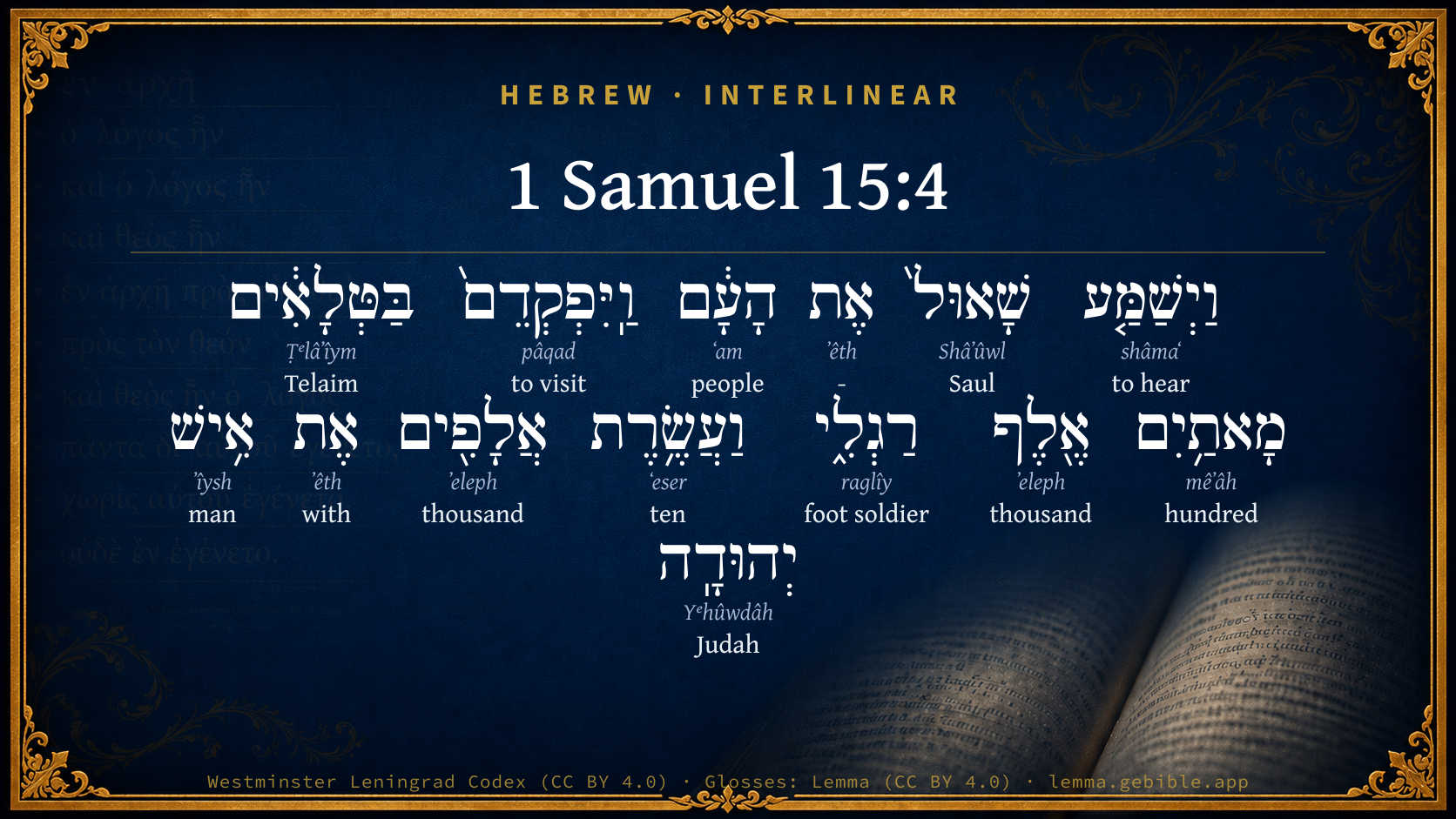
1 Samuel 15:4

Hebrew (Westminster Leningrad Codex) 1 Samuel 15:4 appears in the Hebrew Old Testament. The text above is from the Westminster Leningrad Codex. Each word links to its Strong’s number, a concise gloss, and parsing drawn from the Open Scriptures Hebrew Bible morphology. Click any word for its full Brown-Driver-Briggs (BDB) entry.
Download image
Cite this verse

1 Samuel 15:4 (World English Bible). Public Domain. Lemma interlinear Bible study tool, https://lemma.gebible.app/v/1-samuel/15/4.

Show BibTeX & RIS
BibTeX
RIS
English Translation
Saul summoned the people, and numbered them in Telaim, two hundred thousand footmen, and ten thousand men of Judah.
World English Bible · Public Domain
Highlights
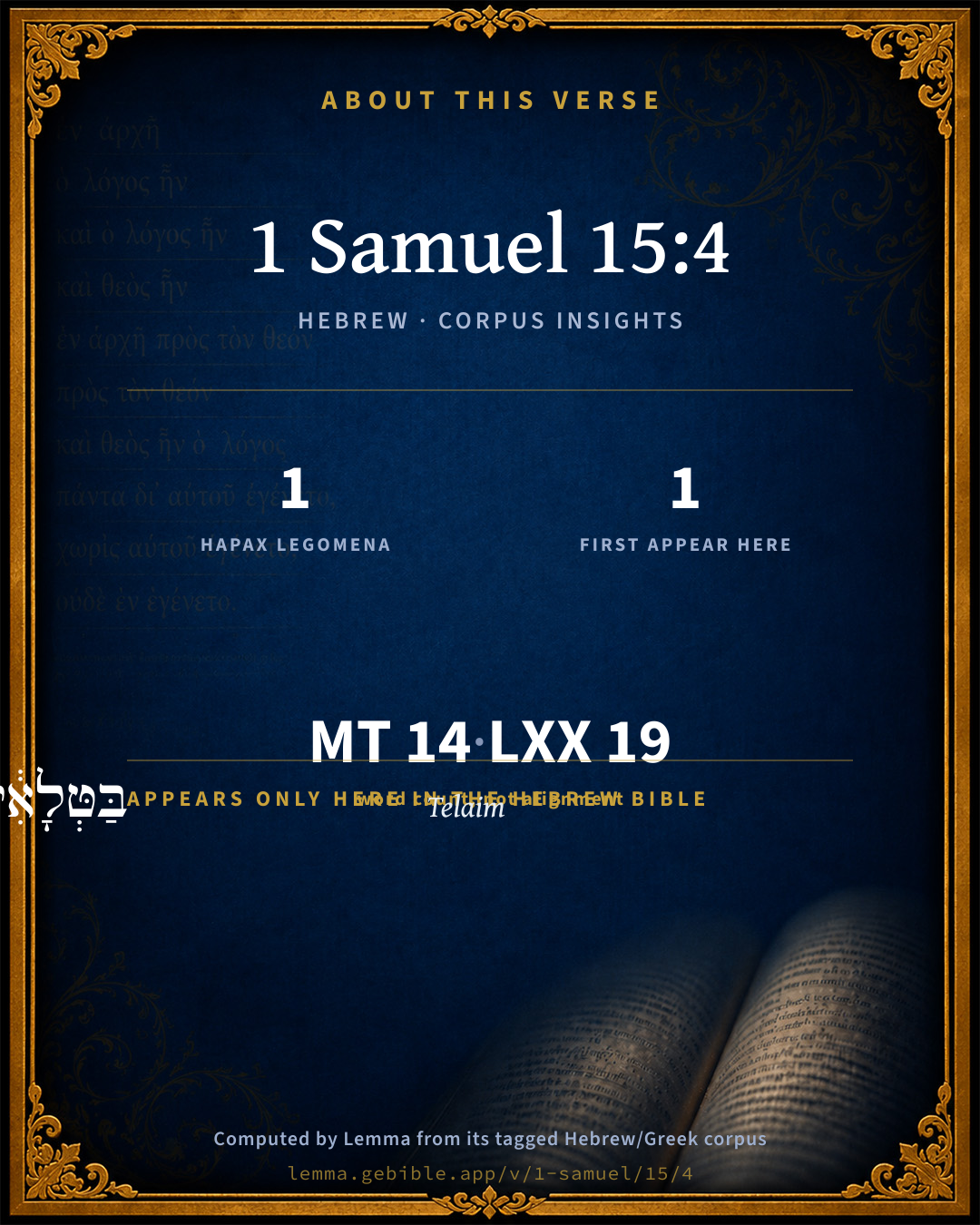
  • 1 hapax legomenon — only here in the Hebrew Bible
  • 1 first appearance in the Hebrew Bible
Full analysis ↓
Download a study sheet

One document with this verse’s original text, its word-by-word gloss line, the meaning frame, cross-references with their text, attributed commentary, and full source and license credits — printable, and it pastes into notes with its structure intact.

This verse Autodidact and up

Study sheet (.html) Plain text (.txt)

A passage Seminary Student

Up to 50 verses in one chapter. A passage sheet keeps up to 6 commentary sources and 12 cross-references per verse, in the order this page ranks them, and says so on the sheet whenever that leaves anything out. Ask for a single verse and you get the Autodidact verse sheet above.

Everything on this page stays free to read, with no account — the sheet is a download of what is already on screen, not access to it.

Want to remove ads? Support Godless Engineer
Compare translations 3

The same verse in 3 English versions, stacked beneath the original-language interlinear above. Click any original word for its lexicon entry.

Each is an independent rendering of the whole verse — the interlinear is not word-aligned to these translations.

Highlighted words mark where these versions differ — a whole-verse word diff, not a word-by-word alignment.

  • World English Bible Public Domain
    Saul summoned the people, and numbered them in Telaim, two hundred thousand footmen, and ten thousand men of Judah.
  • King James Version Public Domain
    And Saul gathered the people together, and numbered them in Telaim, two hundred thousand footmen, and ten thousand men of Judah.
  • unfoldingWord Literal Text CC BY-SA 4.0
    And Saul made the people hear, and he mustered them at Telaim, 200,000 footsoldiers and 10,000 men of Judah.

unfoldingWord Literal Text — © unfoldingWord, licensed CC BY-SA 4.0. Word-aligned USFM3 via Door43 (git.door43.org/unfoldingWord/en_ult).

Versions to compare (up to 4)

3 of 4 selected

Show all 18 translations

Every available English version of this verse, each an independent rendering of the whole verse.

  • World English Bible Public Domain
    Saul summoned the people, and numbered them in Telaim, two hundred thousand footmen, and ten thousand men of Judah.
  • Berean Standard Bible Public Domain
    So Saul summoned the troops and numbered them at Telaim—200,000 foot soldiers and 10,000 men of Judah.
  • Majority Standard Bible Public Domain
    So Saul summoned the troops and numbered them at Telaim—200,000 foot soldiers and 10,000 men of Judah.
  • King James Version Public Domain
    And Saul gathered the people together, and numbered them in Telaim, two hundred thousand footmen, and ten thousand men of Judah.
  • American Standard Version (1901) Public Domain
    And Saul summoned the people, and numbered them in Telaim, two hundred thousand footmen, and ten thousand men of Judah.
  • Revised Version (1885) Public Domain
    And Saul summoned the people, and numbered them in Telaim, two hundred thousand footmen, and ten thousand men of Judah.
  • Geneva Bible (1599) Public Domain
    And Saul assembled ye people, and nombred them in Telaim, two hundreth thousande footemen, and ten thousand men of Iudah.
  • Douay-Rheims (1899) Public Domain
    So Saul commanded the people, and numbered them as lambs: two hundred thousand footmen, and ten thousand of the men of Juda.
  • Young's Literal Translation Public Domain
    And Saul summoneth the people, and inspecteth them in Telaim, two hundred thousand footmen, and ten thousand `are' men of Judah.
  • Literal Standard Version CC BY-SA 4.0
    And Saul summons the people, and inspects them in Telaim, two hundred thousand footmen, and ten thousand [are] men of Judah.
  • Unlocked Literal Bible CC BY-SA 4.0
    Saul summoned the people and numbered them at the city of Telaim—two hundred thousand men on foot, and ten thousand men of Judah.
  • unfoldingWord Literal Text CC BY-SA 4.0
    And Saul made the people hear, and he mustered them at Telaim, 200,000 footsoldiers and 10,000 men of Judah.
  • Darby Bible Public Domain
    And Saul summoned the people, and numbered them in Telaim, two hundred thousand footmen, and ten thousand men of Judah.
  • World Messianic Bible Public Domain
    Saul summoned the people, and counted them in Telaim, two hundred thousand footmen and ten thousand men of Judah.
  • Webster's Bible Public Domain
    And Saul assembled the people, and numbered them in Telaim, two hundred thousand footmen, and ten thousand men of Judah.
  • Free Bible Version CC BY-SA 4.0
    Saul called up his army at Telem. There were 200,000 Israelite infantry and 10,000 men from Judah.
  • Bible in Basic English Public Domain
    And Saul sent for the people and had them numbered in Telaim, two hundred thousand footmen and ten thousand men of Judah.
  • JPS Tanakh (1917) Public Domain
    And Saul summoned the people, and numbered them in Telaim, two hundred thousand footmen, and ten thousand men of Judah.

Literal Standard Version (2020), Covenant Press — licensed CC BY-SA 4.0. Text via the HelloAO Bible API (eBible.org). Unlocked Literal Bible (unfoldingWord) — licensed CC BY-SA 4.0. Text via the HelloAO Bible API (eBible.org). unfoldingWord Literal Text — © unfoldingWord, licensed CC BY-SA 4.0. Word-aligned USFM3 via Door43 (git.door43.org/unfoldingWord/en_ult). Free Bible Version, Dr. Jonathan Gallagher — licensed CC BY-SA 4.0. Text via the HelloAO Bible API (eBible.org).

Word by word

More ways to search: Search by grammar → Find every occurrence → Compare this word →

Practice this passage: Drill this verse → Learn its vocabulary →

בַּטְּלָאִ֔ים
Ṭᵉlâʼîym
H2923
“in/at the · Telaim”
Preposition, Determined + Noun, Proper
Part of Speech
Preposition + Noun
Type
Proper
Full BDB Definition

Origin: from the pl. of H2922

TWOT: None

Telaim = "lambs" - a place in Judah where Saul mustered his forces before attacking Amalek; site unknown
  1. וַיְשַׁמַּ֤ע shâmaʻ H8085 “and · to hear” Conjunction + Verb, Piel, Sequential Imperfect, 3rd Person, Masculine, Singular
  2. שָׁאוּל֙ Shâʼûwl H7586 “Saul” Noun, Proper
  3. אֶת ʼêth H853 “-” Particle, Direct Object
  4. הָעָ֔ם ʻam H5971 “the · people” Particle, Definite Article + Noun, Common, Masculine, Singular, Absolute
  5. וַֽיִּפְקְדֵם֙ pâqad H6485 “and · to visit · them” Conjunction + Verb, Qal, Sequential Imperfect, 3rd Person, Masculine, Singular + Suffix, Personal, 3rd Person, Masculine, Plural
  6. מָאתַ֥יִם mêʼâh H3967 “hundred” Adjective, Cardinal number, Both, Dual, Absolute
  7. אֶ֖לֶף ʼeleph H505 “thousand” Adjective, Cardinal number, Both, Singular, Absolute
  8. רַגְלִ֑י raglîy H7273 “foot soldier” Adjective, Adjective, Masculine, Singular, Absolute
  9. וַעֲשֶׂ֥רֶת ʻeser H6235 “and · ten” Conjunction + Adjective, Cardinal number, Masculine, Singular, Construct
  10. אֲלָפִ֖ים ʼeleph H505 “thousand” Adjective, Cardinal number, Both, Plural, Absolute
  11. אֶת ʼêth H854 “with” Preposition
  12. אִ֥ישׁ ʼîysh H376 “man of” Noun, Common, Masculine, Singular, Construct
  13. יְהוּדָֽה Yᵉhûwdâh H3063 “Judah” Noun, Proper

About this verse

These counts appear in no published source. They are computed here, from the morphology-tagged text and Lemma’s own curated glosses. What Lemma adds →

14
words
13
distinct lemmas
Historical
section

Notable vocabulary

1 hapax legomenon — a word that appears only here in the entire Hebrew Bible:

  • בַּטְּלָאִ֔ים Telaim H2923

First appearance in Scripture

This word makes its first canonical appearance in the Hebrew Bible here:

  • בַּטְּלָאִ֔ים Telaim H2923

Shared distinctive vocabulary

רַגְלִ֑י foot soldier H7273 occurs in 12 verses of the Hebrew Bible. Also found in:

Grammatical profile

  • 2 verbs
  • 5 nouns
  • 5 adjectives
  • 1 preposition
  • 1 particle

Verb forms

  • וַיְשַׁמַּ֤ע Piel · Sequential Imperfect
  • וַֽיִּפְקְדֵם֙ Qal · Sequential Imperfect

Repetition

A word recurs within this verse — often emphatic in Hebrew:

  • אֶ֖לֶף thousand H505 ×2

Hebrew & Septuagint length

In English translation the verse runs 19 words from the Hebrew and 22 from the Septuagint (LXX English) — closely comparable.

A rough comparison of the two English renderings, which tokenize alike — not a word-level alignment.

Word counts can differ between the Hebrew and the Greek without any difference in meaning — e.g. the Hebrew direct-object marker אֵת has no separate Greek word, and Greek often adds the article ὁ.

In the original languages it is 14 Hebrew tokens and 19 Greek tokens — but the two are counted differently (Hebrew bundles its prefixes and suffixes into one token; the Greek is in lemma form), so that isn’t a like-for-like length.

Cross-references

3

Topical passages linked to 1 Samuel 15:4 in the Treasury of Scripture Knowledge — connected by theme and wording, ordered by reader-vote popularity; previews shown in the World English Bible.

  • Joshua 15:24 Ziph, and Telem, and Bealoth,
  • 1 Samuel 11:8 He numbered them in Bezek; and the children of Israel were three hundred thousand, and the men of Judah thirty thousand.
  • 1 Samuel 13:15 Samuel arose, and got him up from Gilgal to Gibeah of Benjamin. Saul numbered the people who were present with him, about six hundred men.

Cross-references courtesy of OpenBible.info (CC BY 4.0).

Hebrew and Greek witnesses Masoretic Hebrew ↔ Greek Septuagint

The same verse in the two great witnesses to the Old Testament, shown verse-for-verse.

These are two independent witnesses, not word-aligned to each other, and the Septuagint is shown in lemma (dictionary) form.

Hebrew 1 Samuel 15:4 Masoretic · Westminster Leningrad Codex

וַיְשַׁמַּ֤ע שָׁאוּל֙ אֶת הָעָ֔ם וַֽיִּפְקְדֵם֙ בַּטְּלָאִ֔ים מָאתַ֥יִם אֶ֖לֶף רַגְלִ֑י וַעֲשֶׂ֥רֶת אֲלָפִ֖ים אֶת אִ֥ישׁ יְהוּדָֽה

Saul summoned the people, and numbered them in Telaim, two hundred thousand footmen, and ten thousand men of Judah.

World English Bible · Public Domain

Greek LXX 1 Samuel 15:4 Septuagint · lemma form

καί παραἀγγέλλω σαούλ ὁ λαός καί ἐπισκέπτομαι αὐτός ἐν γάλγαλα τετρακόσιοι χιλιάς τάγμα καί ὁ ἰούδας τριάκοντα χιλιάς τάγμα

And Saul summoned the people, and he numbered them in Galgala, four hundred thousand regular troops, and Juda thirty thousand regular troops.

LXX2012 (modern English Septuagint) · Public Domain

On this verse, Trapp's Complete Commentary discusses the Septuagint’s reading. Read the note in Commentary ↓

Hebrew: Westminster Leningrad Codex (CC BY 4.0). Greek: Septuagint (public domain); English from LXX2012 (modern English Septuagint) (Public Domain). How the Septuagint differs from the Hebrew →

Targum (Aramaic paraphrase)

1

The Targum is the ancient Jewish Aramaic paraphrase of the Hebrew Scriptures — an interpretive translation, not the Hebrew text itself. Onkelos (literal) and Pseudo-Jonathan (expansive) render the Torah, and Jonathan the Prophets. Coverage is partial: where no permissively-licensed English translation exists for a verse, only the Aramaic is shown. This is verse-level text, not a word-by-word alignment to the Hebrew.

  1. Targum Jonathan Prophets (Joshua–Malachi)
    וּכְנַשׁ שָׁאוּל יַת עַמָא וּמַנִינוּן בְּאִימְרֵי פִסְחַיָא מָאתָן אַלְפִין גַבְרָא רִגְלָאֵי וְעַסְרָא אַלְפִין יַת אֱנַשׁ יְהוּדָה:

    (no public-domain English translation for this verse)

    Targum Jonathan — Aramaic: “Mikraot Gedolot” (public domain). English: “Sefaria Community Translation” (CC0 1.0 (public-domain dedication)); “London "Chaldee Paraphrase," 1871” (public domain). Text via Sefaria.

Commentary

Notes on 1 Samuel 15:4 from classic Christian and Jewish commentators (each source and its license shown beneath its notes). The classic Christian expositions comment on the surrounding passage and are grouped to its opening verse, so a note may address several verses; the Jewish commentaries on the Tanakh (Rashi and others) are per-verse, so they appear only where the commentator wrote on this verse.

Lemma curates 59 commentaries, every one of them public domain or Creative Commons licensed, each selected and text-cleaned for this edition rather than reprinted as found. About our sources →

Trapp's Complete Commentary

John Trapp

1Sa 15:4 And Saul gathered the people together, and numbered them in Telaim, two hundred thousand footmen, and ten thousand men of Judah.

Ver. 4. And numbered them in Telaim.] Called also Telem, a town of Judah. {Jos 15:24} Not in Gilgala, as Josephus hath it, after the Septuagint.

Two hundred thousand footmen.] Not forty thousand only of Israel, and thirty thousand of Judah; as Josephus, but not truly.

John Trapp, A Commentary or Exposition upon All the Books of the Old and New Testament (1647–1656) — public domain. Text from a community e-Sword module.

The Preacher's Complete Homiletical Commentary

Joseph S. Exell (gen. ed.)

CRITICAL AND EXPOSITORY NOTES—

1Sa_15:4. “Telaim.” Most likely the same as Telem (Jos_15:21; Jos_15:24), a city lying on the eastern border of Judah, and therefore near the territory of the Amalekites. “Ten thousand men of Judah.” “This implies that the two hundred thousand were from the other tribes.” (Keil.) “The separate mention of the men of Judah shows how little union there was between Judah and Ephraim even at this time; a circumstance which throws light upon the whole after history. (See 2Sa_11:11). The presence of these men arose, no doubt, from their tribe being the chief sufferers from the inroads of the Amalekites.” (Biblical Commentary.)

1Sa_15:6. “Kenites.” A tribe first mentioned in Gen_15:19. “Their origin is hidden from us, but we may fairly infer that they were a branch of the larger nation of Midian, from the fact that Jethro, who in Exo_2:15, etc., is represented as priest or prince of Midian, and is in Jdg_1:16; Jdg_4:11, as distinctly said to have been a Kenite … They were therefore descended immediately from Abraham by his wife Keturah, and in this relationship and the connection with Moses we find the key to their continued alliance with Israel. The important services rendered by the sheikh of the Kenites to Moses during a time of great pressure and difficulty, were rewarded by a promise of firm friendship between the two nations (Num_10:32). And this promise was gratefully remembered long after (1Sa_15:6). The connection then commenced lasted as firmly as a connection could last between a settled people like Israel and one whose tendencies were so nomadic as the Kenites. They seem to have accompanied the Israelites in their wanderings (Num_24:21-22, etc.) … But these over, they forsook the neighbourhood of the towns and betook themselves to freer air—to ‘the wilderness of Judah, which is to the south of Arad’ (Jdg_1:16), where ‘they dwelt among the people’ of the district—the Amalekites, who wandered in that dry region, and among whom they were living when Saul made his expedition there.” (Smith’s Biblical Dictionary.)

1Sa_15:7. “Havilah—Shur.” “Havilah, according to Gen_25:18, the boundary of the Ishmaelites, probably therefore in the south-east on the border of Arabia Petrea and Arabia Felix.… Shur is the present wilderness of Jifar, the portion of the Arabian desert bordering on Egypt, into which the Israelites entered after the exodus (Exo_15:22). Saul thus smote the Amalekites through their territory from south-east towards the west and north-west.” (Erdmann.)

1Sa_15:8. “Agag.’ “Evidently a reduplicate variety of the Egyptian Hak (ruler). This was the common title of the Amalekite king. Saul spared him probably to enjoy the glory of displaying so distinguished a captive. Josephus distinctly asserts that the beauty and tallness of his body made so fine an appearance, and Saul admired it so much, that he thought him worthy of preservation (cf. 1Ki_20:32-34).” (Jamieson.) “All the people.” “That is, speaking generally, some survived, of course; the Amalekites appear afterwards, 1Sa_27:8; 1Sa_30:1; 2Sa_8:12. Their complete annihilation is mentioned in 1Ch_4:43.” (Erdmann.)

1Sa_15:9. “Fatlings.” Literally of the second tort. Kimchi and others understand the word to denote animals of the second birth, which were thought better than others.

1Sa_15:13. “Samuel came to Saul.” “In the place (Gilgal) where he had solemnly pledged Saul and the people to unconditional obedience, he now executes judgment for disobedience to the Divine will.” (Erdmann.) “I have performed,” etc. “Self-will and rashness have hitherto been Saul’s chief faults. He now seems to add falsehood and hypocrisy.” (Biblical Commentary.)

1Sa_15:15. “The people spared,” etc. “The falsehood and hypocrisy of these words lay upon the very surface; for even if the cattle spared were really intended as sacrifices to the Lord, not only the people, but Saul also, would have had their own interests in view (vid. 1Sa_15:9), since the flesh of thank-offerings was appropriated to sacrificial meals.” (Keil.) “Every word uttered by Saul seems to indicate the breaking down of his moral character. There is something thoroughly mean in his attempt to shift the responsibility of what was done from his own kingly shoulders to those of the people, One feels that after the scene so forcibly described in this chapter, Saul must have forfeited his own self-respect, and that his downward career was henceforth almost inevitable.” (Biblical Commentary.)

1Sa_15:17. “When thou wast little.” “The reference here to Saul’s own words (1Sa_9:21), is beyond doubt. It is the humiliating reminder to the haughty Saul of the low position whence he had been elevated to the headship of Israel, and of the modesty and humility which he then possessed.” (Erdmann.)

1Sa_15:18. “Sinners.” “As though God would justify his commission to destroy them. So it is said of the men of Sodom, that they were sinners before the Lord.” (Biblical Commentary.)

1Sa_15:19. “Fly upon.” “Expressive of eagerness, passionate craving.” (Erdmann.)

1Sa_15:21. “The Lord thy God.” “As if he had been showing honour to Samuel, as well as to God, when he was disobeying both.” (Wordsworth.) “As if he had more zeal for the glory of God than was felt by Samuel.” (Biblical Commentary.)

1Sa_15:22. “Hath the Lord,” etc. “This fundamental ethical truth is affirmed, with unmistakable reference to these words of Samuel, in the classical passages Psa_50:8-14; Psa_51:18-19; Isa_1:11; Mic_6:6-8; Hos_6:6; Jer_6:20.” (Erdmann.) “There is a poetical rhythm in the original, which gives it the tone of a Divine oracle uttered by the Spirit of God, imparting to it an awful solemnity, and making it sink deep in the memory of the hearers in all generations.” (Wordsworth.)

1Sa_15:23. Literally, “Rebellion is the sin of soothsaying, and opposition is heathenism and idolatry.”

MAIN HOMILETICS OF THE PARAGRAPHS.—1Sa_15:4-9; 1Sa_15:13-23

SAUL’S SECOND ACT OF DISOBEDIENCE

I. God will not accept a partial obedience to any of His commands. There is nothing strange or unreasonable in this. If a human ruler gives a command, he will not be satisfied if the person to whom he gives it obeys it just so far as it suits his convenience or agrees with his fancy and no farther. Anything less than a whole obedience is no obedience in the estimation of a fellow-creature. If a soldier receives an order from his general to execute a certain military movement, he is not expected to consult his own wishes or his own judgment, but he must sink his own will entirely in the will of his superior, and fulfil his command to the very letter. However stern may be the work to be done, whatever sacrifice of personal feeling may be involved, anything less than an observance of the commandment in its entirety will be counted as grave a crime as the non-observance of the whole. If a father directs his son to perform a given task, and the son executes about half of that which is required of him, the father will consider that his command has been disobeyed. If this is the case with human superiors, it cannot be expected that the Holy and All-wise God, whose commands—however stern they may sometimes seem—are always perfectly just and good, will be satisfied with less than an entire obedience to His commands. He is surrounded by ten thousand faithful and mighty angelic servants, who render to him a perfect and unquestioning service, and although imperfect and sinful creatures cannot offer to Him a service equal to theirs, yet there are Divine commands which men are able to carry out to the letter, and which they must so carry out if they would not incur the penalty of disobedient servants of the Most High. Such a command was that which was here given to Saul—it was one which he could obey—one for the non-observance of which he could not plead inability—one which he did not attempt to say he was unable to perform. His partial obedience was rejected—his non-observance of all the details of the Divine command was accounted as direct an act of defiance of God’s directions as if he had taken no action whatever against the Amalekites. And so God will ever account compliance with His commands, which is measured not by His requirements but by man’s inclinations.

II. Where the condition is not fulfilled which is included in the Divine plan of blessing, God repents, not by changing His mind, but by changing His method in relation to the sinner. It is obvious that God cannot undergo a change of disposition or of motive. He is perfect in goodness, and therefore, in all His dealings with His creatures He must always have their welfare in view. He must always be willing to do for them that which is best for their highest interests. It is not possible for the Ruler of the world to act from any of the unworthy motives which sometimes influence men in their conduct towards each other. And being as infinite in wisdom as He is in goodness, He can have no better plans than His original plans, no second thoughts which are better than His first. When, therefore, God speaks of Himself as repenting, He speaks of a change of His dealings with a man, which are the result of a change in that man’s attitude towards Himself. Such a change is quite compatible with an unchangeable character and disposition, and is, indeed, the result of it. To men of the same character God’s attitude is the same now as it was ages ago, and it will be the same to the end of time, and when a man’s relations to God are altered it is in consequence of a change in himself, and not in the unchangeable God. There was no change in God when, in consequence of Saul’s non-compliance with the conditions of kingship, God rejected him from being king over Israel. He had been anointed by “the Lord to be captain over His inheritance” (1Sa_10:1)—in other words to be His vicegerent in Israel, and when he refused to act in that capacity God proved His own unchangeableness by changing His method of dealing with him. A purpose of blessing on the part of God towards men always includes a condition to be fulfilled on their part, and a purpose of judgment always includes a continuance on the part of the sinner of the conduct which has provoked the judgment. This is the explanation of the repentance of God in relation to the men of the old world, and in relation to the Ninevites. In the first case God sent judgment because the offenders refused to repent, and in the second instance He revoked His sentence of judgment because the men of Nineveh were willing to forsake their sins and return to Him for pardon. (See Gen_6:5-6; Jon_3:10).

III. Obedience is better than the offering to God of any other sacrifice.

1. Because it is a sacrifice of far higher value. Obedience is the giving up of the will to the will of another—it is therefore the sacrifice of the whole man. When a man has given himself thus to God, he has offered to Him all that he has to offer—all his powers of soul and body as well as all his material possessions. This was the sacrifice which Adam offered to his Maker before he sinned, and this is the offering which has been for ages offered to God by His sons who have never at any time resisted His will. This is far more precious, and therefore far more acceptable to the Lord, than “thousands of rams, or ten thousand rivers of oil” (Mic_6:7), because it is a spiritual and moral sacrifice.

2. It is a sacrifice which can be offered at any time and in any place. The sacrifices of the Levitical law were required to be offered in certain places. A man who desired to sacrifice to the Lord could only do so by coming up to the place appointed, and hence his offerings could only be made at intervals. But obedience is a sacrifice which can always be rendered to God—an expression of love to Him which can be made everywhere and always.

3. It is a sacrifice which every man can offer for himself. Even in Israel there might have been men at times too poor to be able to bring the least costly material offering to the altar of the Lord; but none is ever too poor to offer his will to God—to give himself up to His guidance and submit to His commands. And this is a sacrifice in which there is no need of the intervention of a third person—an offering in which every man can be his own priest.

4. It is the sacrifice which alone can make any other sacrifice acceptable. All other offerings without this are “vain oblations,” and even “an abomination” (Isa_1:13) unto Him who owns “every beast of the forest and the cattle upon a thousand hills” (Psa_50:10). To expect a Holy and Spiritual Being to be willing to accept anything less than the offering of the heart, is to expect Him to be satisfied with less than would often content a fellow-creature. Many a man would spurn a gift which was not an outcome of inward feeling, and yet God’s creatures sometimes act as if they thought their Maker could be bribed by such an offering.

OUTLINES AND SUGGESTIVE COMMENTS

1Sa_15:6. Thus does every good thing reward itself; nothing remains forgotten; often in later centuries the seed sown in an old past yet everywhere comes up gloriously, and children and children’s children derive advantage from the good done by their fathers.—Schlier.

He that is not less in mercy than in justice, as he challenged Amalek’s sin of their succeeding generations so he derives the recompense of Jethro’s kindness unto his far descended issue.

… If we sow good works, succession shall reap them, and we shall be happy in making them so.… It is the manner of God, first to separate before He judge, as a good husbandman weeds his corn ere it be ripe for the sickle, and goes to the fan ere he goes to the fire.… Why should we not imitate God, and separate ourselves, that we may not be judged; separate not one Kenite from another, but every Kenite from among the Amalekites, else if we will needs live with Amalek we cannot think much to die with him.—Bp. Hall.

1Sa_15:13. Here is a proof that a man may be blinded by his own self-will, and that he may imagine that his own way is right, while it is leading him to the gates of death.—Wordsworth.

Could Saul think that Samuel knew of the asses that were lost, and did not know of the oxen and sheep that were spared?… Much less, when we have to do with God Himself, should dissimulation presume either of safety or of secresy. Can the God that made the heart not know it? Can He that comprehends all things be shut out of our close corners? Saul was otherwise crafty enough, yet herein his simplicity is palpable. Sin can besot even the wisest man; and there was never but folly in wickedness … No man brags so much of holiness as he who wants it. True obedience is joined ever with humility and fear of unknown errors. Falsehood is bold, and can say, “I have fulfilled the commandment of the Lord.”—Bp. Hall.

1Sa_15:14. Let us aim after such a walk and conversation as that we can be natural in our demeanour, and not artificial and forced; such a life as will bear inspection behind the scenes, and as will not compel those who watch for souls to ask, as they look around, What meaneth this or that?… and while asking the question to feel the sad truth of the matter to be, that the thing which calls forth the question is in our own case, as it was in Saul’s, only so much spared of that which God has commanded us to subdue and destroy, so much permitted to live which God had required us to conquer and to slay.—Miller.

1Sa_15:16. We must not look to what hypocrites say of themselves, but to what God’s word says of them.—S. Schmid.

1Sa_15:17. Observe the contrast between Saul and Paul. Saul of Gibeah lost an earthly kingdom by pride, but Saul of Tarsus gained a heavenly kingdom by humility (1Co_15:10).—Wordsworth.

There is an ingratitude in every sin, and that is to be considered. Good turns aggravate unkindness, and our offences are increased by our obligations.—Trapp.

1Sa_15:20. Men are apt to cry out with Saul, “I have obeyed the commandment of the Lord; but, alas, when it comes to be examined, how have they obeyed Him?… Possibly they have, with Saul, destroyed the Amalekites; have constantly and openly opposed the declared enemies of religion. Moreover, perhaps, whatever was vile and refuse that they have destroyed utterly. Whatever sins did not easily beset them, nor offer them strong temptations, these sins they have both heartily avoided themselves, and severely condemned in other men. But the best of the sheep and of the oxen, the things which were dear to them, like a right hand or a right eye, these they could not spare.… And yet, as Saul endeavoured to transfer the blame upon the people, so, in the other case also, it is not the men themselves, it is not their reason and judgment, that chooses the sin, but their inferior appetites, their passions and affections choose it for them, and drive them into it, even perhaps in a manner against their wills.—Dr. S. Clark.

1Sa_15:22-23. It was as much as to say that the sum and substance of Divine worship consisted in obedience, with which it should always begin, and that sacrifices were, so to speak, simple appendices, the force and worth of which were not so great as obedience to the precepts of God.—Calvin.

All conscious disobedience is actually idolatry, because it makes self-will, the human I, into a God. So that all manifest opposition to the word and commandment of God is, like idolatry, a rejection of the true God.—Keil.

This saying of Samuel came literally true in Saul’s case. Through disobedience he was forsaken of God, and became a prey to the Evil Spirit, and was led on in time to resort to witchcraft (1Sa_27:7), and perhaps to consult seraphim (see 1Sa_19:13). Here is a solemn warning for these latter days.—Wordsworth.

When the Lord expressly says “Thou shalt,” and His rational creature dares to persist in saying “I will not,” whether the contest be about an apple or a kingdom, it is stubbornness and rebellion.—Scott.

May we then take good care that, even when we mean to render the Lord service or obedience, we yet beware of our choice and fancy, and follow only the traces of the Divine will. Obedience is the mother-grace, the parent of all virtues. It makes the eye see, the ear hear, the heart think, the memory remember, the mouth speak, the foot go, the hand work, and the whole man do that, yea that alone, which is conformed to the will of God … It is impossible for him who is not obedient to God to lay any command upon men. That is what these words (“The Lord hath rejected thee,”) and the aim of God therein mean. The authorities must not proceed from their own will and notion, but in everything must take God’s word and will for their rule. If He does not drive apostate rulers from their position, like as He did Nebuchadnezzar, but leaves them ruling, as He also did Saul for a while, yet they are and remain rejected in His sight, and vainly write themselves “by the grace of God,” when He Himself does not so acknowledge them.—Berlenberger Bible.

God rejects Saul from being king over Israel who had rejected God from being King over Saul.—T. Adams.

Every ceremonial law is moral; the outward act is never enjoined but for the sake of the inward thing, what it pictures—represents. Never is there body without spirit. But the fleshly sense would have none of the spirit, and laid hold solely of the body, which, thus isolated, became a corpse.—Hengstenberg.

It is a holier and a better thing to do one’s duty, than to make duties for one’s self and then set about them.—Spurgeon.

Why was sacrifice good, but because it was commanded? What difference was there betwixt slaughter and sacrifice but obedience?—Bp. Hall.

Saul lived to give in his own person the painful but the clearest evidence of the identity, as far as concerns a common origin and principle of action, which may exist between two very different crimes … The same disposition which evinced itself in those acts of rebellion, which he committed all the while he was crying down witchcraft, induced him to do the very thing which he censured when occasion pressed … The security against our being guilty of any particular form of transgression is not that we condemn it, but that the evil principle within us which excites to its commission, is subdued and removed by Divine grace.—Miller.

1Sa_15:4-23. The fall of King Saul shows:

(1) How unrepented and only whitewashed sin at the first severe temptation breaks out as manifest and criminal self-seeking.

(2) How this self-seeking is so blinding as to tell itself and others the lie that it is a labour for the Lord.—J. Disselhoff.

We may see in the history of Saul how important it is that we should make the most of the opportunities which God sets before us. There came to the son of Kish a tidal time of favour, which, if he had only recognised and improved it might have carried him, not only to greatness, but to goodness. But he proved faithless to the trust committed to him, and became in the end a worse man than he would have been if no such privileges had been conferred upon him.… His career is a melancholy illustration of the truth of the Saviour’s words: “From him that hath not, shall be taken away even that he hath.”—Dr. W. M. Taylor.

The Preacher's Complete Homiletical Commentary (gen. ed. Joseph S. Exell; Funk & Wagnalls, c. 1892) — public domain (pre-1929). A full-Bible homiletical/sermon-outline anthology covering 65 of 66 books (2 John is absent from the source module). Text from a community e-Sword module.

Tyndale Open Study Notes

Tyndale Open Resources

15:4 Telaim: Possibly Telem (Josh 15:24).

Tyndale Open Study Notes — © Tyndale Open Resources, licensed CC BY-SA 4.0. Text via the HelloAO Bible API.

Geneva Bible (1599)

Geneva Bible translators

Or, knew their number by the lambs which they brought.

Geneva Bible (1599) marginal notes — public domain. Text via Bolls.life.

Jamieson, Fausset & Brown

Robert Jamieson, A. R. Fausset & David Brown

Saul gathered the people together--The alacrity with which he entered on the necessary preparations for the expedition gave a fair, but delusive promise of faithfulness in its execution.

Telaim--or Telem, among the uttermost cities of the tribe of Judah towards the coast of Edom (Jos 15:21, Jos 15:24).

Jamieson, Fausset & Brown — Commentary Critical and Explanatory on the Whole Bible (1871) — public domain (CC PDM 1.0). Text via the HelloAO Bible API.

Adam Clarke's Commentary

Verse 4. Two hundred thousand - and ten thousand] The Septuagint, in the London Polyglot, have FOUR HUNDRED thousand companies of Israel, and THIRTY thousand companies of Judah. The Codex Alexandrinus has TEN thousand of each. The Complutensian Polyglot has TWO HUNDRED thousand companies of Israel, and TEN thousand of Judah. And Josephus has FOUR HUNDRED thousand of Israel, and THIRTY thousand of Judah. All the other versions are the same with the Hebrew text; and there is no difference in the MSS.

Adam Clarke's Commentary on the Bible (1810–1826) — public domain. Text from a community e-Sword/MySword module.

Ellicott's Commentary for English Readers

(4) In Telaim.—Identical with Telem (Jos_15:24), a place on the south border of Judah, near the region where the Amalekites chiefly dwelt.—Kimchi Telaim, however, signifies “lambs;” probably “Beth,” house of, is to be understood. Thus it was no town, but the “place or house of lambs”—some open spot, where, at the proper season, the lambs were collected from the pastures in the wilderness.—Dean Payne Smith.

Ten thousand men of Judah.—Again the numbers of this great tribe are out of proportion to the numbers furnished by the rest of the tribes. (See Note on 1Sa_11:8.)

A Bible Commentary for English Readers, edited by Charles John Ellicott (1878–1897) — public domain. Text from a community e-Sword module.

The Cambridge Bible for Schools and Colleges

gen. ed. J. J. S. Perowne

4. in Telaim] Nowhere else mentioned, unless it is the same as Telem (Jos_15:24), the position of which in the southern border of Judah suits the circumstances. The name means “lambs,” and was probably derived from the pastures in the neighbourhood.

ten thousand men of Judah] This implies that the 200,000 foot-soldiers were from the other tribes. See note on 1Sa_11:8.

The Cambridge Bible for Schools and Colleges (gen. ed. J. J. S. Perowne; Cambridge University Press, 1878–1918) — public domain. Text from a community e-Sword module.

John Gill's Exposition

And Saul gathered the people together,.... Or "made them to hear" (r), by the sound of a trumpet; or by sending heralds into all parts of the land to proclaim the above order of the Lord, and summon them to come to him, perhaps at Gilgal; so the Septuagint version, and Josephus (s):

and numbered them in Telaim; thought to be the same with Telem, a place in the tribe of Judah, Jos 15:24, the word signifies "lambs"; hence the Vulgate Latin version is,"he numbered them as lambs;''and the Jews (t) say, because it was forbid to number the children of Israel, which was the sin of David; therefore every man had a lamb given him, and so the lambs were numbered, by which it was known what was the number of the people; and the Targum says, this was done with the passover lambs, it being now the time of the passover; but the numbering here made was not of the people of the land in general, and so there was no occasion of such a precaution, only a numbering and mustering of the army when got together and rendezvoused in one place: the sum of which is here given:

two hundred thousand footmen and ten thousand men of Judah; which last were reckoned separately, as distinct from the other tribes of Israel, to show their obedience to Saul, who was of another tribe, though the kingdom was promised to theirs; but R. Isaiah observes, that the reason why so few of the men of Judah came, in comparison of the other tribes, was, because they envied the government being in one of the tribe of Benjamin, when they thought it should have been in one of theirs; the number is greatly increased in the Septuagint version, which makes the whole to be 400,000, and 30,000 men of Judah; and so Josephus (u).

(r) "audire fecit", Vatablus, Drusius. (s) Antiqu. l. 6. c. 7. sect. 2. (t) T. Bab. Yoma, fol. 22. 2. Jarchi in loc. (u) Ut supra. (Antiqu. l. 6. c. 7. sect. 2.)

John Gill's Exposition of the Whole Bible (1746–1763) — public domain (CC PDM 1.0). Text via the HelloAO Bible API.

Albert Barnes' Notes on the Bible

Telaim - Probably the same as “Telem” Jos 15:24, one of the uttermost cities of Judah, toward the coast of Edom. The name means “lambs,” and was probably so called from the numerous flocks.

Two hundred thousand ... - A wonderful contrast with the six hundred men who composed his whole army before 1Sa 13:15, and a proof how completely for a time the Philistines had been driven back. The separate mention of the men of Judah shows how little union there was between Juduh and Ephraim even at this time; a circumstance which throws light upon the whole after history.

Albert Barnes' Notes on the Bible (1834–1885) — public domain. Text from a community e-Sword/MySword module.

Haydock's Catholic Bible Commentary

As lambs. This comparison is very common, Isaias xl. 11., and Ezechiel xxxiv. 2. But many translate the Hebrew "in Telaim." St. Jerome reads Hebrew c, as, instead of b, in, with greater propriety. Septuagint and Josephus, "in Galgal," which in effect would have been the most proper place for rendezvous. (Calmet) --- Footmen. Vatican Septuagint, "400,000 ranks or standards, (Josephus, men) and Juda 30,000."

George Leo Haydock (1774–1849), Haydock's Catholic Family Bible and Commentary, 1859 edition — public domain. Excludes Psalms (Douay-Rheims chapter numbering differs from Protestant) and Deuterocanonical books (Catholic canon only).

Matthew Poole's English Annotations

Who are particularly noted here, as also Zec 11:8, either as select persons of extraordinary strength and courage; or to commend that tribe, which, though the kingdom had been promised to their own tribe, yet were forward in serving and obeying a king of another, and that a far meaner tribe.

Matthew Poole's English Annotations on the Holy Bible (1683–1685) — public domain. Text from a community e-Sword/MySword module.

Whedon's Commentary on the Bible

Daniel D. Whedon

4. Telaim — Probably the same as Telem, mentioned, Jos_15:24, among the cities in the extreme south of Judah. Its site has not been identified. The Targum and Vulgate translate the word, and read lambs. The Septuagint and Josephus strangely read Gilgal.

Two hundred thousand footmen — A very large army was necessary in order to fight successfully the powerful Amalekites, for they were spread over a large district, and were chief of the hostile nations. Num_24:20.

Daniel D. Whedon (gen. ed.), Commentary on the Old and New Testaments (1874–1909) — public domain. Text from a community e-Sword module.

The Pulpit Commentary

Telaim. Kimchi identifies this with Telem, (Jos_15:24) a place on the southern border of Judah near the country of the Amalekites. But as telaim means "lambs," more probably beth, "house," is to be understood; and so it was no town, but the "place of lambs," i.e. some open spot where at the proper season the lambs were collected from the pastures in the wilderness. Ten thousand men of Judah. A very small number compared with the hosts of Israel, especially as Judah was most exposed to the Amalekite, raids (but see on 1Sa_11:8. A large army was necessary, because the Bedouin race, though offering little direct resistance, would be very difficult to overtake

The Pulpit Commentary (1880–1919), ed. H.D.M. Spence-Jones & Joseph S. Exell — public domain. Text from a community e-Sword module.

Keil & Delitzsch

C. F. Keil & F. Delitzsch

Saul summoned the people to war, and mustered them (those who were summoned) at Telaim (this was probably the same place as the Telem mentioned in Jos 15:24, and is to be looked for in the eastern portion of the Negeb). "Two hundred thousand foot, and ten thousand of the men of Judah:" this implies that the two hundred thousand were from the other tribes. These numbers are not too large; for a powerful Bedouin nation, such as the Amalekites were, could not possibly be successfully attacked with a small army, but only by raising the whole of the military force of Israel.

Sa1 15:5

He then advanced as far as the city of the Amalekites, the situation of which is altogether unknown, and placed an ambush in the valley. ויּרב does not come from ריב, to fight, i.e., to quarrel, not to give battle, but was understood even by the early translators as a contracted form of ויּארב, the Hiphil of ארב. And modern commentators have generally understood it in the same way; but Olshausen (Hebr. Gramm. p. 572) questions the correctness of the reading, and Thenius proposes to alter בּנּחל ויּרב into מלחמה ויּערך. נחל refers to a valley in the neighbourhood of the city of the Amalekites.

Sa1 15:6-7

Saul directed the Kenites to come out from among the Amalekites, that they might not perish with them (אספך, imp. Kal of אסף), as they had shown affection to the Israelites on their journey out of Egypt (compare Num 10:29 with Jdg 1:16). He then smote the Amalekites from Havilah in the direction towards Shur, which lay before (to the east of) Egypt (cf. Gen 25:18). Shur is the desert of Jifar, i.e., that portion of the desert of Arabia which borders upon Egypt (see at Gen 16:7). Havilah, the country of the Chaulotaeans, on the border of Arabia Petraea towards Yemen (see at Gen 10:29).

Sa1 15:8-9

Their king, Agag, he took alive (on the name, see at Num 24:7), but all the people he banned with the edge of the sword, i.e., he had them put to death without quarter. "All," i.e., all that fell into the hands of the Israelites. For it follows from the very nature of the case that many escaped, and consequently there is nothing striking in the fact that Amalekites are mentioned again at a later period (Sa1 27:8; Sa1 30:1; Sa2 8:12). The last remnant was destroyed by the Simeonites upon the mountains of Seir in the reign of Hezekiah (Ch1 4:43). Only, king Agag did Saul and the people (of Israel) spare, also "the best of the sheep and oxen, and the animals of the second birth, and the lambs and everything good; these they would not ban." משׁנים, according to D. Kimchi and R. Tanch. , are לבטן שׁניים, i.e., animalia secundo partu edita, which were considered superior to the others (vid., Roediger in Ges. Thes. p. 1451); and כּרים, pasture lambs, i.e., fat lambs. There is no necessity, therefore, for the conjecture of Ewald and Thenius, משׁמנּים, fattened, and כּרמים, vineyards; nor for the far-fetched explanation given by Bochart, viz., camels with two humps and camel-saddles, to say nothing of the fact that camel-saddles and vineyards are altogether out of place here. In "all that was good" the things already mentioned singly are all included. המּלאכה, the property; here it is applied to cattle, as in Gen 33:14. נמבזה = נבזה, despised, undervalued. The form of the word is not contracted from a noun מבזה and the participle נבזה (Ges. Lehrgeb. p. 463), but seems to be a participle Niph. formed from a noun מבזה. But as such a form is contrary to all analogy, Ewald and Olshausen regard the reading as corrupt. נמס (from מסס): flowing away; used with reference to diseased cattle, or such as have perished. The reason for sparing the best cattle is very apparent, namely selfishness. But it is not so easy to determine why Agag should have been spared by Saul. It is by no means probable that he wished thereby to do honour to the royal dignity. O. v. Gerlach's supposition, that vanity or the desire to make a display with a royal slave was the actual reason, is a much more probable one.

Keil & Delitzsch — Biblical Commentary on the Old Testament (1861–1891) — public domain (CC PDM 1.0). Text via the HelloAO Bible API. (Old Testament only.)

unfoldingWord translationNotes

Door43 World Missions Community

the people

"the army"

numbered them

"counted them"

city of Telaim

a city in southern Judah (See: How to Translate Names)

two hundred thousand men on foot, and ten thousand men of Judah

"200,000 men on foot, and 10,000 men of Judah" (See: Numbers)

translationWords

Judah

Amalek

unfoldingWord translationNotes — © Distant Shores Media and the Door43 World Missions Community, licensed CC BY-SA 4.0. Source: git.door43.org/Door43/en_tn.

Rashi

Rabbi Shlomo Yitzchaki (Rashi)

Shaul summoned. An expression of announcing [meaning the same] as in. וַיִזָּעֵק שָׁאוּל

And he counted them with lambs. He told each one to take a lamb from the king's flocks, and afterwards he counted the lambs, because it is forbidden to count Jewish people. for it is stated concerning them, '[which] are too numerous to count.'

Rashi on the Tanakh — English translations: “The Judaica Press complete Tanach with Rashi, translated by A. J. Rosenberg” (CC BY 4.0); “Pentateuch with Rashi's commentary by M. Rosenbaum and A.M. Silbermann, 1929-1934” (public domain); “The Metsudah Tanach series, Lakewood, N.J” (CC BY 4.0); and “The Book of Joshua, Metsudah Publications, 1997” (CC BY 4.0). Text via Sefaria.

Lesson kit

Teaching starters — assembled from the data on this page, not authored interpretation. Every prompt links to the verse data it draws on. Edit before teaching.

1 Samuel, in the Historical, opens this verse with 14 words (13 distinct Hebrew lemmas). Its most distinctive word is Ṭᵉlâʼîym (“Telaim”). A historical commentator’s framing appears above. Read the whole chapter for the surrounding context.

Discussion questions

  1. How does “Telaim” (Ṭᵉlâʼîym) shape what this verse is saying?
  2. This verse holds 1 word here found nowhere else in the Hebrew Bible. What might the rare word draw attention to?
  3. The word “Telaim” first appears here in Scripture. What is being introduced at this debut?
  4. Exodus 12:37 shares the word «foot soldier» with this verse. How do the two illuminate each other?
  5. “thousand” occurs 2× in this one verse. What is the effect of the repetition?
  6. These translations render this verse differently; the difference is in the English rendering, not the original. What questions does that raise?
  7. The verb «וַיְשַׁמַּ֤ע» is Piel Sequential Imperfect. How does its form color the action?
  8. Reading how Trapp's Complete Commentary and The Preacher's Complete Homiletical Commentary read this verse, where do the two commentators agree and where do they part?

Things to notice

  • 1 word in this verse appears nowhere else in the Hebrew Bible.
  • 1 word makes its first canonical appearance in Scripture here.
  • This verse counts 14 Hebrew ↔ 19 Greek words.
  • These translations choose different wording for 15 words in this verse.
  • “thousand” occurs 2× in this single verse.

Reading settings

Reading text

Shown beneath each verse's original-language words.

Old Testament
Old Testament edition

Read the OT as the Masoretic Hebrew (MT) or the Greek Septuagint (LXX).

English shown for the Greek Septuagint (in the Hebrew ↔ Greek comparison).

Comparing translations? Open the Compare panel on any verse page to stack up to four side by side.