
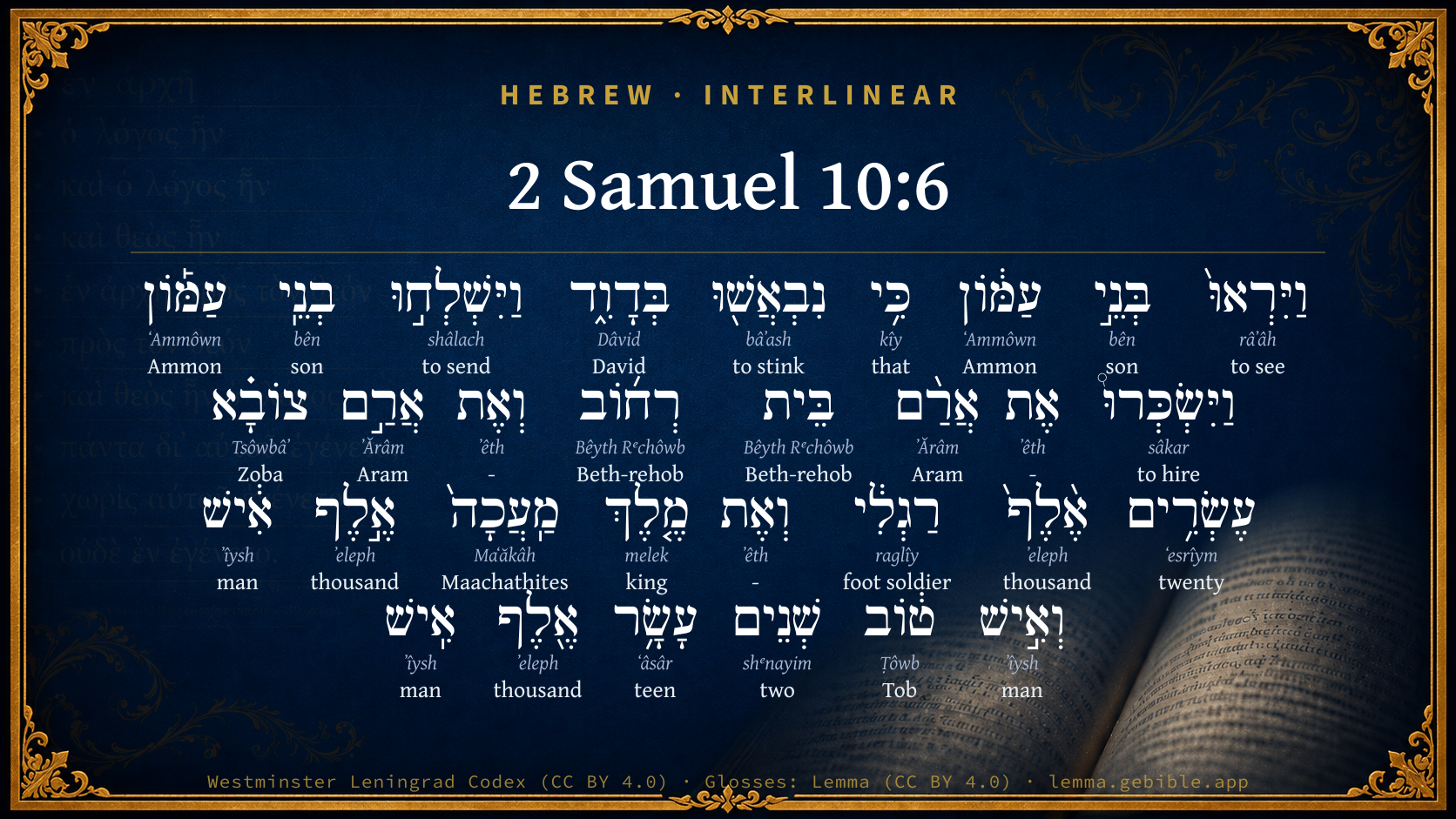
2 Samuel 10:6

Hebrew (Westminster Leningrad Codex) 2 Samuel 10:6 appears in the Hebrew Old Testament. The text above is from the Westminster Leningrad Codex. Each word links to its Strong’s number, a concise gloss, and parsing drawn from the Open Scriptures Hebrew Bible morphology. Click any word for its full Brown-Driver-Briggs (BDB) entry.
Download image
Cite this verse

2 Samuel 10:6 (World English Bible). Public Domain. Lemma interlinear Bible study tool, https://lemma.gebible.app/v/2-samuel/10/6.

Show BibTeX & RIS
BibTeX
RIS
English Translation
When the children of Ammon saw that they were become odious to David, the children of Ammon sent and hired the Syrians of Beth Rehob, and the Syrians of Zobah, twenty thousand footmen, and the king of Maacah with one thousand men, and the men of Tob twelve thousand men.
World English Bible · Public Domain
Download a study sheet

One document with this verse’s original text, its word-by-word gloss line, the meaning frame, cross-references with their text, attributed commentary, and full source and license credits — printable, and it pastes into notes with its structure intact.

This verse Autodidact and up

Study sheet (.html) Plain text (.txt)

A passage Seminary Student

Up to 50 verses in one chapter. A passage sheet keeps up to 6 commentary sources and 12 cross-references per verse, in the order this page ranks them, and says so on the sheet whenever that leaves anything out. Ask for a single verse and you get the Autodidact verse sheet above.

Everything on this page stays free to read, with no account — the sheet is a download of what is already on screen, not access to it.

Want to remove ads? Support Godless Engineer
Compare translations 3

The same verse in 3 English versions, stacked beneath the original-language interlinear above. Click any original word for its lexicon entry.

Each is an independent rendering of the whole verse — the interlinear is not word-aligned to these translations.

Highlighted words mark where these versions differ — a whole-verse word diff, not a word-by-word alignment.

  • World English Bible Public Domain
    When the children of Ammon saw that they were become odious to David, the children of Ammon sent and hired the Syrians of Beth Rehob, and the Syrians of Zobah, twenty thousand footmen, and the king of Maacah with one thousand men, and the men of Tob twelve thousand men.
  • King James Version Public Domain
    And when the children of Ammon saw that they stank before David, the children of Ammon sent and hired the Syrians of Bethrehob and the Syrians of Zoba, twenty thousand footmen, and of king Maacah a thousand men, and of Ishtob twelve thousand men.
  • unfoldingWord Literal Text CC BY-SA 4.0
    And the sons of Ammon saw that they had made themselves stink to David. So the sons of Ammon sent and hired Aram of Beth Rehob and Aram of Zoba, 20,000 footsoldiers, and the king of Maacah, 1,000 men, and a man of Tob, 12,000 men.

unfoldingWord Literal Text — © unfoldingWord, licensed CC BY-SA 4.0. Word-aligned USFM3 via Door43 (git.door43.org/unfoldingWord/en_ult).

Versions to compare (up to 4)

3 of 4 selected

Show all 18 translations

Every available English version of this verse, each an independent rendering of the whole verse.

  • World English Bible Public Domain
    When the children of Ammon saw that they were become odious to David, the children of Ammon sent and hired the Syrians of Beth Rehob, and the Syrians of Zobah, twenty thousand footmen, and the king of Maacah with one thousand men, and the men of Tob twelve thousand men.
  • Berean Standard Bible Public Domain
    When the Ammonites realized that they had become a stench to David, they hired twenty thousand Aramean foot soldiers from Beth-rehob and Zoba, as well as a thousand men from the king of Maacah and twelve thousand men from Tob.
  • Majority Standard Bible Public Domain
    When the Ammonites realized that they had become a stench to David, they hired twenty thousand Aramean foot soldiers from Beth-rehob and Zoba, as well as a thousand men from the king of Maacah and twelve thousand men from Tob.
  • King James Version Public Domain
    And when the children of Ammon saw that they stank before David, the children of Ammon sent and hired the Syrians of Bethrehob and the Syrians of Zoba, twenty thousand footmen, and of king Maacah a thousand men, and of Ishtob twelve thousand men.
  • American Standard Version (1901) Public Domain
    And when the children of Ammon saw that they were become odious to David, the children of Ammon sent and hired the Syrians of Beth-rehob, and the Syrians of Zobah, twenty thousand footmen, and the king of Maacah with a thousand men, and the men of Tob twelve thousand men.
  • Revised Version (1885) Public Domain
    And when the children of Ammon saw that they were become odious to David, the children of Ammon sent and hired the Syrians of Beth-rehob, and the Syrians of Zobah, twenty thousand footmen, and the king of Maacah with a thousand men, and the men of Tob twelve thousand men.
  • Geneva Bible (1599) Public Domain
    And when the children of Ammon sawe that they stanke in the sight of Dauid, the children of Ammon sent and hired the Aramites of the house of Rehob, and the Aramites of Zoba, twentie thousande footemen, and of King Maacah a thousand men, and of Ish-tob twelue thousande men.
  • Douay-Rheims (1899) Public Domain
    And the children of Ammon seeing that they had done an injury to David, Bent and hired the Syrians of Rohob, and the Syrians of Soba, twenty thousand footmen, and of the king of Maacha a thousand men, and of Istob twelve thousand men.
  • Young's Literal Translation Public Domain
    And the Bene-Ammon see that they have been abhorred by David, and the Bene-Ammon send and hire Aram of Beth-Rehob, and Aram of Zoba, twenty thousand footmen, and the king of Maacah `with' a thousand men, and Ish-Tob `with' twelve thousand men;
  • Literal Standard Version CC BY-SA 4.0
    And the sons of Ammon see that they have been abhorred by David, and the sons of Ammon send and hire Aram of Beth-Rehob, and Aram of Zoba, twenty thousand footmen, and the king of Maacah [with] one thousand men, and Ish-Tob [with] twelve thousand men;
  • Unlocked Literal Bible CC BY-SA 4.0
    When the people of Ammon saw that they had become a stench to David, the people of Ammon sent messengers and hired the Arameans of Beth Rehob and Zobah, twenty thousand foot soldiers, and the king of Maacah with a thousand men, and the men of Tob with twelve thousand men.
  • unfoldingWord Literal Text CC BY-SA 4.0
    And the sons of Ammon saw that they had made themselves stink to David. So the sons of Ammon sent and hired Aram of Beth Rehob and Aram of Zoba, 20,000 footsoldiers, and the king of Maacah, 1,000 men, and a man of Tob, 12,000 men.
  • Darby Bible Public Domain
    And the children of Ammon saw that they had made themselves odious to David; and the children of Ammon sent and hired the Syrians of Beth-Rehob, and the Syrians of Zoba, twenty thousand footmen, and the king of Maacah [with] a thousand men, and the men of Tob twelve thousand men.
  • World Messianic Bible Public Domain
    When the children of Ammon saw that they had become odious to David, the children of Ammon sent and hired the Syrians of Beth Rehob and the Syrians of Zobah, twenty thousand footmen, and the king of Maacah with one thousand men, and the men of Tob twelve thousand men.
  • Webster's Bible Public Domain
    And when the children of Ammon saw that they had made themselves odious before David, the children of Ammon sent and hired the Syrians of Beth-rehob, and the Syrians of Zoba, twenty thousand footmen, and of king Maacah a thousand men, and of Ish-tob twelve thousand men.
  • Free Bible Version CC BY-SA 4.0
    When the Ammonites realized they had become like a bad smell to David, they sent a request to the Arameans and hired twenty thousand of their foot soldiers from Beth Rehob and Zobah, as well as one thousand men from the king of Maakah, and also twelve thousand men from Tob.
  • Bible in Basic English Public Domain
    And when the children of Ammon saw that they had made themselves hated by David, they sent to the Aramaeans of Beth-rehob and Zobah, and got for payment twenty thousand footmen, and they got from the king of Maacah a thousand men, and from Tob twelve thousand.
  • JPS Tanakh (1917) Public Domain
    And when the children of Ammon saw that they were become odious to David, the children of Ammon sent and hired the Arameans of Beth-rehob, and the Arameans of Zobah, twenty thousand footmen, and the king of Maacah with a thousand men, and the men of Tob twelve thousand men.

Literal Standard Version (2020), Covenant Press — licensed CC BY-SA 4.0. Text via the HelloAO Bible API (eBible.org). Unlocked Literal Bible (unfoldingWord) — licensed CC BY-SA 4.0. Text via the HelloAO Bible API (eBible.org). unfoldingWord Literal Text — © unfoldingWord, licensed CC BY-SA 4.0. Word-aligned USFM3 via Door43 (git.door43.org/unfoldingWord/en_ult). Free Bible Version, Dr. Jonathan Gallagher — licensed CC BY-SA 4.0. Text via the HelloAO Bible API (eBible.org).

Word by word

More ways to search: Search by grammar → Find every occurrence → Compare this word →

Practice this passage: Drill this verse → Learn its vocabulary →

בֵּית
Bêyth Rᵉchôwb
H1050
“Beth-rehob”
Noun, Proper
Part of Speech
Noun
Type
Proper
Full BDB Definition

Origin: from H1004 and H7339

TWOT: None

Beth-rehob = "house of the street" - a place in Dan on road to Hamath
  1. וַיִּרְאוּ֙ râʼâh H7200 “and · to see” Conjunction + Verb, Qal, Sequential Imperfect, 3rd Person, Masculine, Plural
  2. בְּנֵ֣י bên H1121 “sons of” Noun, Common, Masculine, Plural, Construct
  3. עַמּ֔וֹן ʻAmmôwn H5983 “Ammon” Noun, Proper
  4. כִּ֥י kîy H3588 “that” Conjunction
  5. נִבְאֲשׁ֖וּ bâʼash H887 “to stink” Verb, Niphal, Perfect, 3rd Person, Common, Plural
  6. בְּדָוִ֑ד Dâvid H1732 “in/at · David” Preposition + Noun, Proper
  7. וַיִּשְׁלְח֣וּ shâlach H7971 “and · to send” Conjunction + Verb, Qal, Sequential Imperfect, 3rd Person, Masculine, Plural
  8. בְנֵֽי bên H1121 “sons of” Noun, Common, Masculine, Plural, Construct
  9. עַמּ֡וֹן ʻAmmôwn H5983 “Ammon” Noun, Proper
  10. וַיִּשְׂכְּרוּ֩ sâkar H7936 “and · to hire” Conjunction + Verb, Qal, Sequential Imperfect, 3rd Person, Masculine, Plural
  11. אֶת ʼêth H853 “-” Particle, Direct Object
  12. אֲרַ֨ם ʼĂrâm H758 “Aram” Noun, Proper
  13. רְח֜וֹב Bêyth Rᵉchôwb H1050 “Beth-rehob” Noun, Proper
  14. וְאֶת ʼêth H853 “and · -” Conjunction + Particle, Direct Object
  15. אֲרַ֣ם ʼĂrâm H758 “Aram” Noun, Proper
  16. צוֹבָ֗א Tsôwbâʼ H6678 “Zoba” Noun, Proper
  17. עֶשְׂרִ֥ים ʻesrîym H6242 “twenty” Adjective, Cardinal number, Both, Plural, Absolute
  18. אֶ֨לֶף֙ ʼeleph H505 “thousand” Adjective, Cardinal number, Both, Singular, Absolute
  19. רַגְלִ֔י raglîy H7273 “foot soldier” Adjective, Adjective, Masculine, Singular, Absolute
  20. וְאֶת ʼêth H853 “and · -” Conjunction + Particle, Direct Object
  21. מֶ֤לֶךְ melek H4428 “king of” Noun, Common, Masculine, Singular, Construct
  22. מַֽעֲכָה֙ Maʻăkâh H4601 “Maachathites” Noun, Proper
  23. אֶ֣לֶף ʼeleph H505 “thousand” Adjective, Cardinal number, Both, Singular, Absolute
  24. אִ֔ישׁ ʼîysh H376 “man” Noun, Common, Masculine, Singular, Absolute
  25. וְאִ֣ישׁ ʼîysh H376 “and · man of” Conjunction + Noun, Common, Masculine, Singular, Construct
  26. ט֔וֹב Ṭôwb H2897 “Tob” Noun, Proper
  27. שְׁנֵים shᵉnayim H8147 “two” Adjective, Cardinal number, Masculine, Dual, Absolute
  28. עָשָׂ֥ר ʻâsâr H6240 “teen” Adjective, Cardinal number, Masculine, Singular, Absolute
  29. אֶ֖לֶף ʼeleph H505 “thousand” Adjective, Cardinal number, Both, Singular, Absolute
  30. אִֽישׁ ʼîysh H376 “man” Noun, Common, Masculine, Singular, Absolute

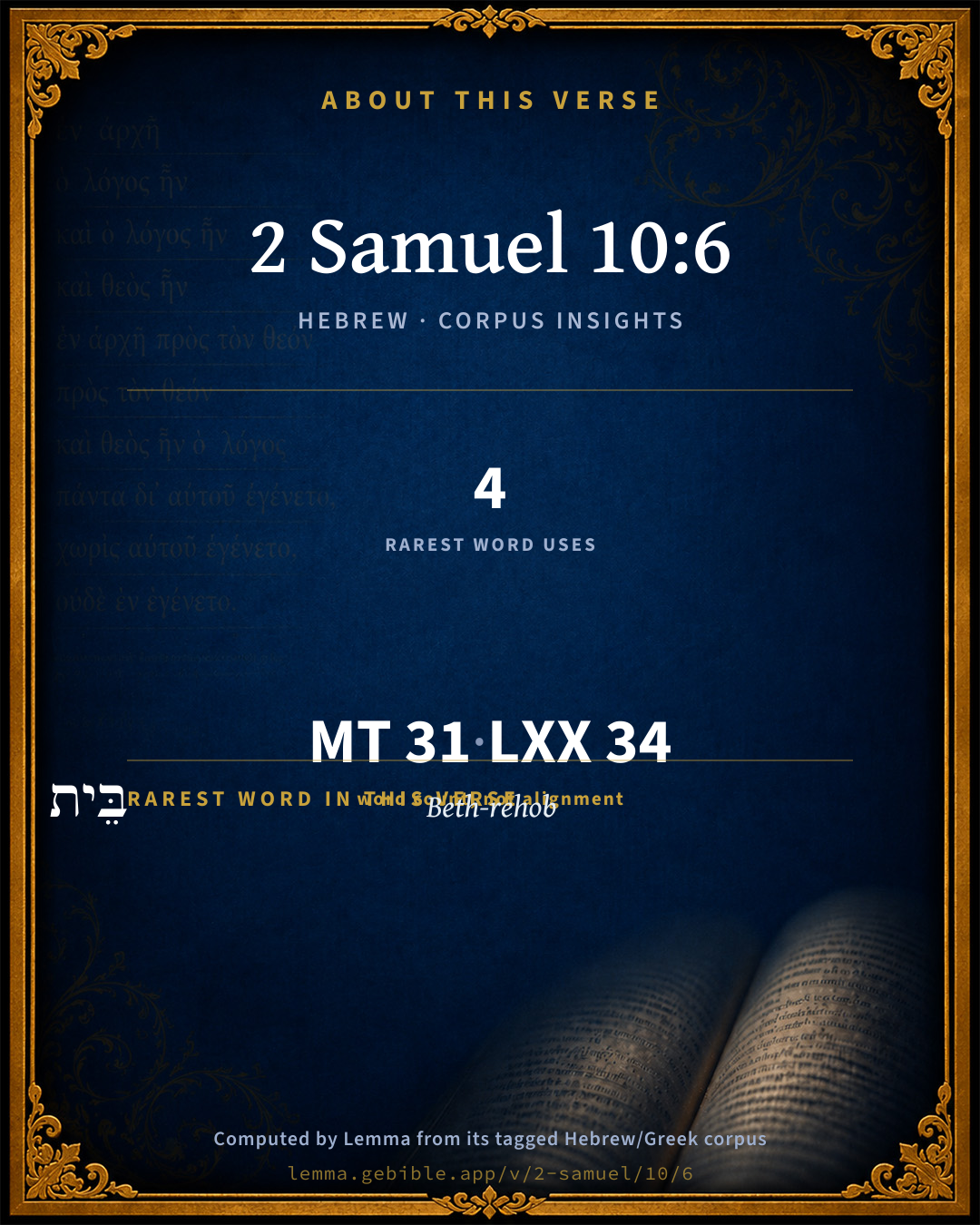
About this verse

These counts appear in no published source. They are computed here, from the morphology-tagged text and Lemma’s own curated glosses. What Lemma adds →

31
words
21
distinct lemmas
Historical
section

Notable vocabulary

The rarest word here is בֵּית Beth-rehob H1050 — appearing just 4 times in the whole Hebrew Bible.

Shared distinctive vocabulary

בֵּית Beth-rehob H1050 occurs in 2 verses of the Hebrew Bible. Also found in:

Grammatical profile

  • 4 verbs
  • 16 nouns
  • 7 adjectives
  • 1 conjunction
  • 3 particles

Verb forms

  • וַיִּרְאוּ֙ Qal · Sequential Imperfect
  • נִבְאֲשׁ֖וּ Niphal · Perfect
  • וַיִּשְׁלְח֣וּ Qal · Sequential Imperfect
  • וַיִּשְׂכְּרוּ֩ Qal · Sequential Imperfect

Repetition

Words recur within this verse — often emphatic in Hebrew:

  • אֶ֨לֶף֙ thousand H505 ×3
  • אִ֔ישׁ man H376 ×3
  • בְּנֵ֣י son H1121 ×2
  • עַמּ֔וֹן Ammon H5983 ×2
  • אֲרַ֨ם Aram H758 ×2
  • בֵּית Beth-rehob H1050 ×2

Hebrew & Septuagint length

In English translation the verse runs 50 words from the Hebrew and 50 from the Septuagint (LXX English) — the same length.

A rough comparison of the two English renderings, which tokenize alike — not a word-level alignment.

Word counts can differ between the Hebrew and the Greek without any difference in meaning — e.g. the Hebrew direct-object marker אֵת has no separate Greek word, and Greek often adds the article ὁ.

In the original languages it is 31 Hebrew tokens and 34 Greek tokens — but the two are counted differently (Hebrew bundles its prefixes and suffixes into one token; the Greek is in lemma form), so that isn’t a like-for-like length.

Cross-references

15

Topical passages linked to 2 Samuel 10:6 in the Treasury of Scripture Knowledge — connected by theme and wording, ordered by reader-vote popularity; previews shown in the World English Bible.

  • 2 Samuel 8:3 David struck also Hadadezer the son of Rehob, king of Zobah, as he went to recover his dominion at the River.
  • 2 Samuel 8:5 When the Syrians of Damascus came to help Hadadezer king of Zobah, David struck of the Syrians two and twenty thousand men.
  • Genesis 34:30 Jacob said to Simeon and Levi, "You have troubled me, to make me odious to the inhabitants of the land, among the Canaanites and the Perizzites. I am few in number. They will gather themselves together against me and strike me, and I will be destroyed, I and my house."
  • Judges 11:3 Then Jephthah fled from his brothers, and lived in the land of Tob: and there were gathered vain fellows to Jephthah, and they went out with him.
  • Judges 11:5 It was so, that when the children of Ammon made war against Israel, the elders of Gilead went to get Jephthah out of the land of Tob;
  • Judges 18:28 There was no deliverer, because it was far from Sidon, and they had no dealings with any man; and it was in the valley that lies by Beth Rehob. They built the city, and lived therein.
  • 1 Samuel 27:12 Achish believed David, saying, He has made his people Israel utterly to abhor him; therefore he shall be my servant forever.
  • Exodus 5:21 and they said to them, "May Yahweh look at you, and judge, because you have made us a stench to be abhorred in the eyes of Pharaoh, and in the eyes of his servants, to put a sword in their hand to kill us."
  • Deuteronomy 3:14 Jair the son of Manasseh took all the region of Argob, to the border of the Geshurites and the Maacathites, and called them, even Bashan, after his own name, Havvoth Jair, to this day.)
  • Joshua 13:11–13 and Gilead, and the border of the Geshurites and Maacathites, and all Mount Hermon, and all Bashan to Salecah;
  • 1 Samuel 13:4 All Israel heard say that Saul had struck the garrison of the Philistines, and also that Israel was had in abomination with the Philistines. The people were gathered together after Saul to Gilgal.
  • 2 Samuel 8:12 of Syria, and of Moab, and of the children of Ammon, and of the Philistines, and of Amalek, and of the spoil of Hadadezer, son of Rehob, king of Zobah.
  • 1 Chronicles 19:6–7 When the children of Ammon saw that they had made themselves odious to David, Hanun and the children of Ammon sent one thousand talents of silver to hire them chariots and horsemen out of Mesopotamia, and out of Arammaacah, and out of Zobah.
  • Proverbs 25:8 Don't be hasty in bringing charges to court. What will you do in the end when your neighbor shames you?
  • Isaiah 8:9–10 Make an uproar, O you peoples, and be broken in pieces! And give ear, all you of far countries: gird yourselves, and be broken in pieces! Gird yourselves, and be broken in pieces!

Cross-references courtesy of OpenBible.info (CC BY 4.0).

Hebrew and Greek witnesses Masoretic Hebrew ↔ Greek Septuagint

The same verse in the two great witnesses to the Old Testament, shown verse-for-verse.

These are two independent witnesses, not word-aligned to each other, and the Septuagint is shown in lemma (dictionary) form.

Hebrew 2 Samuel 10:6 Masoretic · Westminster Leningrad Codex

וַיִּרְאוּ֙ בְּנֵ֣י עַמּ֔וֹן כִּ֥י נִבְאֲשׁ֖וּ בְּדָוִ֑ד וַיִּשְׁלְח֣וּ בְנֵֽי עַמּ֡וֹן וַיִּשְׂכְּרוּ֩ אֶת אֲרַ֨ם בֵּית רְח֜וֹב וְאֶת אֲרַ֣ם צוֹבָ֗א עֶשְׂרִ֥ים אֶ֨לֶף֙ רַגְלִ֔י וְאֶת מֶ֤לֶךְ מַֽעֲכָה֙ אֶ֣לֶף אִ֔ישׁ וְאִ֣ישׁ ט֔וֹב שְׁנֵים עָשָׂ֥ר אֶ֖לֶף אִֽישׁ

When the children of Ammon saw that they were become odious to David, the children of Ammon sent and hired the Syrians of Beth Rehob, and the Syrians of Zobah, twenty thousand footmen, and the king of Maacah with one thousand men, and the men of Tob twelve thousand men.

World English Bible · Public Domain

Greek LXX 2 Samuel 10:6 Septuagint · lemma form

καί ὁράω ὁ υἱός αμμων ὅτι κατααἰσχύνω ὁ λαός δαυίδ καί ἀποστέλλω ὁ υἱός αμμων καί μισθόω ὁ συρία βαιθροωβ εἴκοσι χιλίας πεζός καί ὁ βασιλεύς μααχα χίλιοι ἀνήρ καί ιστωβ δώδεκα χιλίας ἀνήρ

And the children of Ammon saw that the people of David were ashamed; and the children of Ammon sent, and hired the Syrians of Baethraam, and the Syrians of Suba, and Roob, twenty thousand footmen, and the king of Amalec with a thousand men, and Istob with twelve thousand men.

LXX2012 (modern English Septuagint) · Public Domain

Hebrew: Westminster Leningrad Codex (CC BY 4.0). Greek: Septuagint (public domain); English from LXX2012 (modern English Septuagint) (Public Domain). How the Septuagint differs from the Hebrew →

Targum (Aramaic paraphrase)

1

The Targum is the ancient Jewish Aramaic paraphrase of the Hebrew Scriptures — an interpretive translation, not the Hebrew text itself. Onkelos (literal) and Pseudo-Jonathan (expansive) render the Torah, and Jonathan the Prophets. Coverage is partial: where no permissively-licensed English translation exists for a verse, only the Aramaic is shown. This is verse-level text, not a word-by-word alignment to the Hebrew.

  1. Targum Jonathan Prophets (Joshua–Malachi)
    וַחֲזוֹ בְנֵי עַמוֹן אֲרֵי אִתְגָרִיאוּ בְדָוִד וּשְׁלַחוּ בְנֵי עַמוֹן וַאֲגָרוּ יַת אֲרַם בֵּית רְחוֹב וְיַת אֲרַם צוֹבָא עַסְרִין אַלְפִין גְבַר רִגְלֵי וְיַת מֶלֶךְ מַעֲכָה אֲלַף גְבַר וְאִישׁ טוֹב תְּרֵי עֲסַר אַלְפִין גַבְרָא:

    (no public-domain English translation for this verse)

    Targum Jonathan — Aramaic: “Mikraot Gedolot” (public domain). English: “Sefaria Community Translation” (CC0 1.0 (public-domain dedication)); “London "Chaldee Paraphrase," 1871” (public domain). Text via Sefaria.

Commentary

Notes on 2 Samuel 10:6 from classic Christian and Jewish commentators (each source and its license shown beneath its notes). The classic Christian expositions comment on the surrounding passage and are grouped to its opening verse, so a note may address several verses; the Jewish commentaries on the Tanakh (Rashi and others) are per-verse, so they appear only where the commentator wrote on this verse.

Lemma curates 59 commentaries, every one of them public domain or Creative Commons licensed, each selected and text-cleaned for this edition rather than reprinted as found. About our sources →

Matthew Henry's Commentary

Here we have, I. The preparation which the Ammonites made for war, Sa2 10:6. They saw they had made themselves very odious to David and obnoxious to his just displeasure. This they might easily have foreseen when they abused his ambassadors, which was no other than a challenge to war, and a bold defiance of him. Yet, it seems, they had not considered how unable they were, with their thousands, to meet his; for now they found themselves an unequal match, and were forced to hire forces of other nations into their service. Thus sinners daringly provoke God, and expose themselves to his wrath, and never consider that he is stronger than they, Co1 10:22. The Ammonites gave the affront first, and they were the first that raised forces to justify it. Had they humbled themselves, and begged David's pardon, probably an honorary satisfaction might have atoned for the offence. But, when they were thus desperately resolved to stand by what they had done, they courted their own ruin.

II. The speedy descent which David's forces made upon them, Sa2 10:7. When David heard of their military preparations, he sent Joab with a great army to attack them, Sa2 10:7. Those that are at war with the Son of David not only give the provocation, but begin the war; for he waits to be gracious, but they strengthen themselves against him, and therefore, if they turn not, he will whet his sword, Psa 7:12. God has forces to send against those that set his wrath at defiance (Isa 5:19), which will convince them, when it is too late, that none ever hardened his heart against God and prospered. It was David's prudence to carry the war into their country, and fight them at the entering in of the gate of their capital city, Rabbah, as some think, or Medeba, a city in their borders, before which they pitched to guard their coast, Ch1 19:7. Such are the terrors and desolations of war that every good prince will, in love to his people, keep it as much as may be at a distance from them.

III. Preparations made on both sides for an engagement. 1. The enemy disposed themselves into two bodies, one of Ammonites, which, being their own, were posted at the gate of the city; the other of Syrians, whom they had taken into their pay, and who were therefore posted at a distance in the field, to charge the forces of Israel in the flank or rear, while the Ammonites charged them in the front, Sa2 10:8. 2. Joab, like a wise general, was soon aware of the design, and accordingly divided his forces: the choicest men he took under his own command, to fight the Syrians, whom probably he knew to be the better soldiers, and, being hired men, better versed in the arts of war, Sa2 10:9. The rest of the forces he put under the command of Abishai his brother, to engage the Ammonites, Sa2 10:10. It should seem, Joab found the enemy so well prepared to receive them that his conduct and courage were never so tried as now.

IV. Joab's speech before the battle, Sa2 10:11, Sa2 10:12. It is not long, but pertinent, and brave. 1. He prudently concerts the matter with Abishai his brother, that the dividing of the forces might not be the weakening of them, but that, which part soever was borne hard upon, the other should come in to its assistance. He supposes the worst, that one of them should be obliged to give back; and in that case, upon a signal given, the other should send a detachment to relieve it. Note, Mutual helpfulness is brotherly duty. If occasion be, thou shalt help me, and I will help thee. Christ's soldiers should thus strengthen one another's hands in their spiritual warfare. The strong must succour and help the weak. Those that through grace are conquerors over temptation must counsel, and comfort, and pray for, those that are tempted. When thou art converted, strengthen thy brethren, Luk 22:32. The members of the natural body help one another, Co1 12:21. 2. He bravely encourages himself, and his brother, and the rest of the officers and soldiers, to do their utmost. Great dangers put an edge upon true courage. When Joab saw the front of the battle was against him, both before and behind, instead of giving orders to make an honourable retreat, he animated his men to charge so much more furiously: Be of good courage and let us play the men, not for pay and preferment, for honour and fame, but for our people, and for the cities of our God, for the public safety and welfare, in which the glory of God is so much interested. God and our country was the word. "Let us be valiant, from a principle of love to Israel, that are our people, descended from the same stock, for whom we are employed, and in whose peace we shall have peace; and from a principle of love to God, for they are his cities that we are fighting in the defence of." The relation which any person or thing stands in to God should endear it to us, and engage us to do our utmost in its service. 3. He piously leaves the issue with God: "When we have done our part, according to the duty of our place, let the Lord do that which seemeth to him good." Let nothing be wanting in us, whatever the success be; let God's work be done by us, and then God's will be done concerning us. When we make conscience of doing our duty we may, with the greatest satisfaction, leave the event with God, not thinking that our valour binds him to prosper us, but that still he may do as he pleases, yet hoping for his salvation in his own way and time.

V. The victory Joab obtained over the confederate forces of Syria and Ammon, Sa2 10:13, Sa2 10:14. He provided for the worst, and put the case that the Syrians and Ammonites might prove too strong for him (Sa2 10:11), but he proved too strong for them both. We do not hinder our success by preparing for disappointment. The Syrians were first routed by Joab, and then the Ammonites by Abishai; the Ammonites seem not to have fought at all, but, upon the retreat of the Syrians, to have fled into the city. It is a temptation to soldiers to fly when they have a city at their backs to fly to. It is one thing when men may either fight or fly and another thing when they must either fight or die.

Matthew Henry's Commentary on the Whole Bible (1708–1710) — public domain (CC PDM 1.0). Text via the HelloAO Bible API.

Jamieson, Fausset & Brown

Robert Jamieson, A. R. Fausset & David Brown

THE AMMONITES OVERCOME. (Sa2 10:6-14)

when the children of Ammon saw that they stank before David--To chastise those insolent and inhospitable Ammonites, who had violated the common law of nations, David sent a large army under the command of Joab, while they, informed of the impending attack, made energetic preparations to repel it by engaging the services of an immense number of Syrian mercenaries.

Beth-rehob--the capital of the low-lying region between Lebanon and Anti-Lebanon.

Zoba--(see on Sa2 8:3).

of king Maacah--His territories lay on the other side of Jordan, near Gilead (Deu 3:14).

Ish-tob--that is, "the men of Tob"--the place of Jephthah's marauding adventures (see also Ch1 19:6; Psa 60:1, title). As the Israelite soldiers poured into the Ammonite territory, that people met them at the frontier town of Medeba (Ch1 19:7-9), the native troops covering the city, while the Syrian mercenaries lay at some distance encamped in the fields. In making the attack, Joab divided his forces into two separate detachments--the one of which, under the command of his brother, Abishai, was to concentrate its attack upon the city, while he himself marched against the overwhelming host of mercenary auxiliaries. It was a just and necessary war that had been forced on Israel, and they could hope for the blessing of God upon their arms. With great judgment the battle opened against the mercenaries, who could not stand against the furious onset of Joab, and not feeling the cause their own, consulted their safety by flight. The Ammonites, who had placed their chief dependence upon a foreign aid, then retreated to entrench themselves within the walls of the town.

Jamieson, Fausset & Brown — Commentary Critical and Explanatory on the Whole Bible (1871) — public domain (CC PDM 1.0). Text via the HelloAO Bible API.

The Cambridge Bible for Schools and Colleges

gen. ed. J. J. S. Perowne

6–14. Defeat of the Ammonites and their Syrian allies

6. that they stank] Lit. that they had made themselves stink: had brought themselves into evil odour, or, made themselves odious. Ancient history records many wars undertaken to avenge insults offered to ambassadors, whose persons have always been considered sacred by the law of nations: e.g. the war between Rome and Tarentum which led to the invasion of Italy by Pyrrhus. See also Cicero, pro lege Manil. c. 5.

hired] For a thousand talents of silver according to 1Ch_19:6, a sum variously estimated at from £250,000 to £500,000. For other instances of the employment of mercenary troops see 2Ki_7:6; 2Ch_25:6.

Beth-rehob] Beth-rehob (= house of Rehob) or Rehob (2Sa_10:8), the capital of this Syrian kingdom, can hardly be the Beth-rehob near Dan mentioned in Jdg_18:28, which was in Israelite territory. It is better to place it at Ruhaibeh, 25 miles N.E. of Damascus, or to identify it with Rehoboth by the river (Gen_36:37), the site of which is fixed a few miles below the junction of the Chaboras with the Euphrates. In this case the Mesopotamians mentioned in the parallel passage in 1 Chron. may be the same as the Syrians of Beth-rehob.

the Syrians of Zoba] See note on ch. 2Sa_8:3.

and of king Maacah] Rather, and the king of Maacah. This small Syrian kingdom was in the neighbourhood of Geshur, adjoining the province of Argob in the north-east of Bashan (Deu_3:14), somewhere to the east of the wild and rocky region now called El-Lejah. Some however would place it on the south-west slope of Hermon at the sources of the Jordan. See notes on Jos_12:5; Jos_13:13.

and of Ish-tob] Rather, and the men of Tob, the district in which Jephthah took refuge (Jdg_11:3). It seems to have been somewhere north or east of Gilead, between Syria and the country of the Ammonites.

The text of Chronicles differs from that of Samuel in several points. (a) It mentions the price paid to the Syrians, a thousand talents of silver, and names Medeba as the rendezvous where their forces assembled. (b) The names of the countries from which the mercenaries were drawn are given as Mesopotamia, Maacah, and Zobah. Beth-rehob may be included under Mesopotamia (2Sa_10:6, note). Tob is not mentioned; perhaps it was a dependency of Zobah, and is included under it. The contingent sent by each is not specified. (c) The total number of 32,000 besides the men of Maacah, agrees with the numbers here; but the reading chariots in the present text of 1Ch_19:7 can scarcely be right. 32,000 chariots would be a force of unexampled magnitude. See 1Ki_10:26; 2Ch_12:3; 2Ch_14:9. The text of Samuel also seems to be defective, as the force doubtless had some cavalry and chariots and did not consist of infantry only.

The Cambridge Bible for Schools and Colleges (gen. ed. J. J. S. Perowne; Cambridge University Press, 1878–1918) — public domain. Text from a community e-Sword module.

Trapp's Complete Commentary

John Trapp

2Sa 10:6 And when the children of Ammon saw that they stank before David, the children of Ammon sent and hired the Syrians of Bethrehob, and the Syrians of Zoba, twenty thousand footmen, and of king Maacah a thousand men, and of Ishtob twelve thousand men.

Ver. 6. Saw that they stank before David.] Who could not but be very sensible, they knew, of their odious indignity done to his ambassadors, and would surely revenge it; as there was never any prince so poor and despicable that would put up such an affront: and shall Jesus Christ? I think not. Julian, for instance, paid for his petulancy.

And of Ishtob.] Which signifieth, A good man; but this was such another for true goodness as our late Bishop Goodman, who died a professed Papist, Feb. 19, 1655, soon after whom followed, to the great grief of all good men, that most reverend Archbishop Ussher, an Ishtob indeed, who better deserved the surname of Bonus Good, than ever did Phocion the Athenian. {a}

{a} Cleri debonestamentum, Godf. Goodman. Praesulum decus ille Jacobus Armachanus. - Gatak. Cinnus, cap. 5.

John Trapp, A Commentary or Exposition upon All the Books of the Old and New Testament (1647–1656) — public domain. Text from a community e-Sword module.

Joseph Benson's Commentary

2Sa 10:6. When the children of Ammon saw that they stank, &c, — They wanted not intelligence how heinously David resented the barbarous usage of his ambassadors; which is expressed by a phrase signifying that they were become very odious to him.

Joseph Benson's Commentary on the Old and New Testaments (1811–1818) — public domain. Text from a community e-Sword module.

Keil & Delitzsch

C. F. Keil & F. Delitzsch

When the Ammonites saw that they had made themselves stinking before David, and therefore that David would avenge the insult offered to the people of Israel in the persons of their ambassadors, they looked round for help among the powerful kings of Syria. They hired as auxiliaries (with a thousand talents of silver, i.e., nearly half a million of pounds sterling, according to Ch1 19:6) twenty thousand foot from Aram-Beth-Rehob and Aram-Zoba, and one thousand men from the king of Maacah, and twelve thousand troops from the men of Tob. Aram-Beth-Rehob was the Aramaean kingdom, the capital of which was Beth-rehob. This Beth-rehob, which is simply called Rehob in v. 8, is in all probability the city of this name mentioned in Num 13:21 and Jdg 18:28, which lay to the south of Hamath, but the exact position of which has not yet been discovered: for the castle of Hunin, in the ruins of which Robinson imagines that he has found Beth-rehob Bibl. Researches, p. 370), is to the south-west of Tell el Kadi, the ancient Laish-Dan, the northern boundary of the Israelitish territory; so that the capital of this Aramaean kingdom would have been within the limits of the land of Israel, - a thing which is inconceivable. Aram-Naharaim is also mentioned in the corresponding text of the Chronicles, and for that reason many have identified Beth-Rehob with Rehoboth, on "the river" (Euphrates), mentioned in Gen 36:37. But this association is precluded by the fact, that in all probability the latter place is to be found in Rachabe, which is upon the Euphrates and not more than half a mile from the river (see Ritter, Erdk. xv. p. 128), so that from its situation it can hardly have been the capital of a separate Aramaean kingdom, as the government of the king of Zoba extended, according to Sa2 10:16, beyond the Euphrates into Mesopotamia. On Aram-Zoba, see at Sa2 8:3; and for Maacah at Deu 3:14. אישׁ־טוב is not to be taken as one word and rendered as a proper name, Ish-Tob, as it has been by most of the earlier translators; but אישׁ is a common noun used in a collective sense (as it frequently is in the expression ישׂראל אישׁ), "the men of Tob." Tob was the district between Syria and Ammonitis, where Jephthah had formerly taken refuge (Jdg 11:5). The corresponding text of the Chronicles (Ch1 19:6-7) is fuller, and differs in several respects from the text before us. According to the Chronicles, Hanun sent a thousand talents of silver to hire chariots and horsemen from Aram-Naharaim, Aram-maacah, and Zobah. With this the Ammonites hired thirty-two thousand receb (i.e., chariots and horsemen: see at Sa2 8:4), and the king of Maacah and his people. They came and encamped before Medeba, the present ruin of Medaba, two hours to the south-east of Heshbon, in the tribe of Reuben (see at Num 21:30, compared with Jos 13:16), and the Ammonites gathered together out of their cities, and went to the war. The Chronicles therefore mention Aram-Naharaim (i.e., Mesopotamia) as hired by the Ammonites instead of Aram-Beth-Rehob, and leave out the men of Tob. The first of these differences is not to be explained, as Bertheau suggests, on the supposition that the author of the Chronicles took Beth-rehob to be the same city as Rehoboth of the river in Gen 36:37, and therefore substituted the well-known "Aram of the two rivers" as an interpretation of the rarer name Beth-rehob, though hardly on good ground. For this conjecture does not help to explain the omission of "the men of Tob." It is a much simpler explanation, that the writer of the Chronicles omitted Beth-rehob and Tob as being names that were less known, this being the only place in the Old Testament in which they occur as separate kingdoms, and simply mentioned the kingdoms of Maacah and Zoba, which frequently occur; and that he included "Aram of the two rivers," and placed it at the head, because the Syrians obtained succour from Mesopotamia after their first defeat. The account in the Chronicles agrees with the one before us, so far as the number of auxiliary troops is concerned. For twenty thousand men of Zoba and twelve thousand of Tob amount to thirty-two thousand, besides the people of the king of Maacah, who sent a thousand men according to the text of Samuel. But according to that of the Chronicles, the auxiliary troops consisted of chariots and horsemen, whereas only foot-soldiers are mentioned in our text, which appears all the more remarkable, because according to Sa2 8:4, and Ch1 18:4, the king of Zoba fought against David with a considerable force of chariots and horsemen. It is very evident, therefore, that there are copyists' errors in both texts; for the troops of the Syrians did not consist of infantry only, nor of chariots and horsemen alone, but of foot-soldiers, cavalry, and war-chariots, as we may see very clearly not only from the passages already quoted in Sa2 8:4 and Ch1 18:4, but also from the conclusion to the account before us. According to Sa2 10:18 of this chapter, when Hadarezer had reinforced his army with auxiliaries from Mesopotamia, after losing the first battle, David smote seven hundred receb and forty thousand parashim of Aram, whilst according to the parallel text (Ch1 19:18) he smote seven thousand receb and forty thousand foot. Now, apart from the difference between seven thousand and seven hundred in the case of the receb, which is to be interpreted in the same way as a similar difference in Sa2 8:4, the Chronicles do not mention any parashim at all in Sa2 10:18, but foot-soldiers only, whereas in Sa2 10:7 they mention only receb and parashim; and, on the other hand, there are no foot-soldiers given in Sa2 10:18 of the text before us, but riders only, whereas in Sa2 10:6 there are none but foot-soldiers mentioned, without any riders at all. It is evident that in both engagements the Syrians fought with all three (infantry, cavalry, and chariots), so that in both of them David smote chariots, horsemen, and foot.

Keil & Delitzsch — Biblical Commentary on the Old Testament (1861–1891) — public domain (CC PDM 1.0). Text via the HelloAO Bible API. (Old Testament only.)

Tyndale Open Study Notes

Tyndale Open Resources

10:6 Aramean foot soldiers: See 8:5-6. • Beth-rehob and Zobah: See 8:3, 12. • the land of Tob (literally the man of Tob) possibly refers to a vassal king and region under Hadadezer’s sovereignty.

Tyndale Open Study Notes — © Tyndale Open Resources, licensed CC BY-SA 4.0. Text via the HelloAO Bible API.

Geneva Bible (1599)

Geneva Bible translators

That they had deserved David’s displeasure, for the injury done to his ambassadors.

Or, Syrians.

Geneva Bible (1599) marginal notes — public domain. Text via Bolls.life.

Adam Clarke's Commentary

Verse 6. The children of Ammon saw that they stank] That is, that their conduct rendered them abominable. This is the Hebrew mode of expressing such a feeling. See Ge 34:30.

The Syrians of Bethrehob] This place was situated at the extremity of the valley between Libanus and Anti-libanus. The Syrians of Zoba were subject to Hadadezer. Maacah was in the vicinity of Mount Hermon, beyond Jordan, in the Trachonitis.

Ish-tob] This was probably the same with Tob, to which Jephthah fled from the cruelty of his brethren. It was situated in the land of Gilead.

Adam Clarke's Commentary on the Bible (1810–1826) — public domain. Text from a community e-Sword/MySword module.

Ellicott's Commentary for English Readers

(6) Saw that they stank.—The Hebrew, translated literally, shows that they were conscious that this was by their own fault—“that they had made themselves stink,” and is so rendered in 1Ch_19:6.

Hired.—Chronicles gives the amount of the subsidy, 1,000 talents of silver, a sum variously estimated at from £125,000 to twice that amount. It shows at once the wealth of Ammon, the importance of the auxiliaries, and the grave character of the war.

Syrians of Beth-rehob.—Called simply Rehob in 2Sa_10:8. This has been understood of several different places. It can hardly have been the Rehob (or Beth-rehob) of Num_13:21; Jdg_18:28, since that was near Laish, and within the territory of the Israelites. Some identify it with “Ruhaibeh,” twenty-five miles N.E. of Damascus; but it is more likely to have been “Rehoboth by the river” (i.e., near the Euphrates) of Gen_36:37, as this corresponds with “out of Mesopotamia’ in the parallel passage 1Ch_19:6, the situation of which is not more definitely known.

Zoba.—See Note on 2Sa_8:3.

King Maacah.—Read, King of Maacah, as in Chronicles. For the situation of the country see Deu_3:14; Jos_12:5. It furnished only one thousand auxiliaries.

Ish-tob.—Translated, men of Tob, the first syllable not being a part of the proper name. Jephthah here found refuge when exiled by his countrymen (Jdg_11:3; Jdg_11:5). It was probably just east of Gilead, between Syria and the land of Ammon; it is not mentioned in Chronicles.

The total number of auxiliaries mentioned in 1Ch_19:7, thirty-two thousand, is the same as given here, Maacah being omitted from the number; but the composition of the force is different. Here only infantry are mentioned, there only chariots and cavalry. It is plain from the result of the battle (2Sa_10:18 in both places) that all three arms of the service were employed; either, therefore, some words have dropped out from both texts, or else the writer in each case did not care to go into details. Chronicles mentions that the allies mustered in Medeba, a place on a hill in the Belka plain, about four miles south-east of Heshbon, and well fitted strategically to repel an attack upon Rabbah. It had been originally assigned to the tribe of Reuben (Jos_13:9).

A Bible Commentary for English Readers, edited by Charles John Ellicott (1878–1897) — public domain. Text from a community e-Sword module.

John Gill's Exposition

And when the children of Ammon saw that they stank before David,.... Or had made themselves odious to him, as it is rendered in Ch1 19:6; were abominable to him, that he was incensed against them, and enraged at them, and was determined to be avenged on them for the affront given, of which they had certain information: but instead of seeking to appease him, and give him satisfaction for the affront:

the children of Ammon sent, and hired the Syrians of Bethrehob; a place near Hamath, Num 13:21; there was a city of this name in the tribe of Asher, out of which the Canaanites could not be driven, and perhaps now inhabited by Syrians, or by a people so called, Jos 19:28,

and the Syrians of Zoba, twenty thousand footmen: that is, out of both places; this place Hadadezer was king of, with whom David had fought before, and beat, and who owed him a grudge on that account, and was ready to assist the Ammonites against him, Sa2 8:3,

and of King Maacah a thousand men; that is, of the king of Maacah, which was a place in the tribe off Manasseh, from whence the inhabitants could not be expelled, Jos 13:11; and seems now to have been inhabited by Syrians, and therefore is called Syriamaachah, Ch1 19:6,

and of Ishtob twelve thousand men; which is thought to be the same with the land of Tob, whither Jephthah fled, and dwelt in it, when ill used by his brethren, Jdg 11:3; these mercenary soldiers were in all thirty three thousand men; Ch1 19:6, it is said, chariots and horsemen, even thirty two thousand; these were hired with a thousand talents of silver.

John Gill's Exposition of the Whole Bible (1746–1763) — public domain (CC PDM 1.0). Text via the HelloAO Bible API.

Albert Barnes' Notes on the Bible

Stank ... - A strong figure for to be odious or detested. Compare the marginal references

The Syrians of Beth-rehob - If identical with the Mesopotamians of 1Ch 19:6, Beth-rehob is the same as Rehoboth by the river Gen 36:37. Others think Beth-rehob (Rehob, 2Sa 10:8) the same as the Rehob and Beth-rehob of Num 13:21, near Hamath (perhaps the modern ruin of Hunin). If so, Beth-rehob, as well as Tob, must have been a colony of Aram Naharaim (compare the numbers in 1Ch 19:7 and here).

Syrians of Zoba - Compare 1Sa 14:47 note.

King Maacah - Read the “King of Maacah” 1Ch 19:6-7. For the position of Maacah, see Deu 3:14; Jos 12:5. It appears to have been a very small state, since its king only brought a thousand men into the field.

Ish-tob - See the margin. Tob was the district where Jephthah fled when driven out by the Gileadites.

Albert Barnes' Notes on the Bible (1834–1885) — public domain. Text from a community e-Sword/MySword module.

Haydock's Catholic Bible Commentary

Rohob, the capital, between Libanus and Antibanus. --- Soba was subject to Adarezer, chap. viii. 3. --- Maacha, at the foot of Hermon. --- Istob (Hebrew ish tob) signifies, the man, or prince, or "the master of Tob," (Calmet) where Jephte lived, Judges xi. 5. (Du Hamel) (Salien) --- Josephus thinks that Istob is the name of a fourth king, who, together with the king of Micha, brought 22,000 into the field. The first he styles king "of the Mesopotamians," (1 Paralipomenon xix. 6.) which Salien explains of the country between Abana and Pharphar, the two great rivers of Syria, (4 Kings v. 12,) though, on this occasion, he allows that Adarezer hired forces from the utmost parts beyond the Euphrates. (Haydock)

George Leo Haydock (1774–1849), Haydock's Catholic Family Bible and Commentary, 1859 edition — public domain. Excludes Psalms (Douay-Rheims chapter numbering differs from Protestant) and Deuterocanonical books (Catholic canon only).

Matthew Poole's English Annotations

Beth-rehob, near Hamath, Num 13:21.

Zoba; of which see 1Sa 14:47; 2Sa 8:3.

Of king Maacah, i. e. of that part of Syria which was under king Maacah; for Syria was a large country, and there were divers kings in the several parts of it. This part was near Gilead. See Deu 3:14.

Of Ish-tob; or, of the men of Tob, the country where Jephthah dwelt, Jdg 11:3. Besides these, they hired others out of Aram-naharaim, or Mesopotamia, as appears from 1Ch 19:6; Psa 60:1. And all these were forward enough to combine against David, both to revenge their former losses and reproaches, and to give check to his growing greatness.

Matthew Poole's English Annotations on the Holy Bible (1683–1685) — public domain. Text from a community e-Sword/MySword module.

Whedon's Commentary on the Bible

Daniel D. Whedon

6. Stank — Were held in abomination. See note on 1Sa_13:4.

Sent and hired the Syrians — In the note on 2Sa_8:3, we have argued that probably this act of the Syrians in helping the Ammonites in their war against Israel was the occasion of David’s Aramean wars. The mere fact that this account occurs in a subsequent chapter does not prove that the events themselves were in the like chronological sequence. The conquest of Ammon is also mentioned in that chapter, (2Sa_10:12;) but it could have been no conquest previous to this one, for if David had subdued them before the death of Nahash, how could he have presumed to send this embassy of condolence to Hanun? And, further, if the complete subjugation into which David reduced Hadarezer and his people were previous to this, is it not strange that in this more detailed narrative there is no mention of their revolting from their allegiance?

Beth-rehob — Called also in 2Sa_10:8, Rehob; a district lying probably southwest of Damascus, and north of Lake Merom. See on Jdg_18:28.

Of king Maacah — Rather, of the king of Maacah, Maacah being the name of the place, not of the king. The region of Maacah seems to have bordered on Beth-rehob, and extended southward from Mount Hermon. See on Jos_12:5.

Ish-tob — Rather, men of Tob. Tob was the district northeast of Gilead into which Jephthah fled when driven from his father’s house. See margin, and Jdg_11:3. In 1Ch_19:6, we are told that the Ammonites derived help from Mesopotamia also, and, according to our interpretation of chap. viii, at a later stage of this same war with Syria, when the Syrians of Damascus interfered to succour Hadarezer, they were also smitten before the army of Israel, and thus all these confederate principalities of Syria became subject to David. Thus the fragmentary narratives of chaps. viii and x of this book of Samuel, and the parallel passages in 1 Chronicles, make up at best only a broken and disconnected account of David’s Syrian wars; and therefore, for want of sufficient data, we may not expect to clear up all discrepancies in numbers that appear between the separate accounts.

Daniel D. Whedon (gen. ed.), Commentary on the Old and New Testaments (1874–1909) — public domain. Text from a community e-Sword module.

The Pulpit Commentary

That they stank. (see notes on 1Sa_13:4 1Sa_27:12) As the Hebrew literally means, had made themselves stink, the Revised Version rightly translates "had made themselves odious." The children of Ammon sent and hired the Syrians. From 1Ch_19:6 we learn that his mercenaries from Aram cost Hanun a thousand talents of silver, or nearly five hundred thousand pounds a vast sum, especially considering the great relative value of silver in those days. The mercenaries, moreover, were gathered out of numerous districts of Aram from Rehob, Zoba, Beth-Maacah, and Tob; the margin being right in rendering "the men of Tob," instead of "Ish-tob." So, too, the Revised Version, "The men of Tob twelve thousand men." It was to this land that Jephthah fled. (Jud_1:11:3) The whole number of the allies was thirty-three thousand, with which total the parallel place agrees, as they are described there as "thirtytwo thousand, and the King of Maacah and his people," who are here said to have been a thousand strong. The text, however, there must be corrupt, as it describes them all as horsemen (Authorized Version, "chariots;"; 1Ch_19:7) here footmen only are mentioned, with which the narrative agrees (see note on ver. 18).

Vers. 6-19.

International quarrels.

The facts are:

1. The Ammonites, discovering the displeasure of David, hire mercenariesof the neighbouring peoples.

2. As a countermovement, David sends out a strong force under Joab.

3. The opposing forces coming into contact, Joab arranges that he shouldconfront the Syrians, while Abishai deals with the Ammonites.

4. Joab, exhorting Abishai to courage, in dependence on God, arranges also for mutual support, in case of need, in their respective attacks.

5. On the Syrians yielding to the assault of Joab, the Ammonites also fleefrom before Abishai, whereupon Joab returns to Jerusalem.

6. Another effort of the Syrians under Hadarezer, aided by others from beyond the Euphrates, draws out David at the head of a large army to the eastern side of Jordan.

7. A great battle, issuing in the complete defeat of the Syrians; the tributarykings under Hadarezer make peace with Israel and serve them. We have here a record of quarrels and entanglements, which to the eye of a sacred historian have a bearing on the development of the kingdom of Israel, and consequently on the ultimate advent of the "Prince of the kings of the earth." In that respect the events form a section of the intricate movements of Providence for the furtherance of spiritual interests, and they have their natural place in the Divine moral order, allowing for human freedom, as truly as the formation of the igneous and sedimentary rocks have in the physical order. The narrative may thus be taken as typical of a class. But we may regard the record as suggesting, or illustrating, truths which, while prominent in international quarrels, have also a wider application to human life in general. These chiefly are as follows.

I THE MAINTENANCE OF HONOUR IS A DUTY. It was right for David to resent the indignity and insult. Meekness and gentleness are qualities consistent with assertion of what is due to self as a man, as a ruler, as a representative of a people and of a Divine institution. A king"s honour is his strength, because of the trust of his people, the sentiment of loyalty, the force of his decrees, his silent restraint of the turbulent, and, in David"s case, also because of the Divine institution of his government. How kings and individuals may best maintain their honour is a question to be decided by the circumstances of the case; in some way the holiest and kindest may do it and ought to do it.

II THE REPROACH AND DISPLEASURE OF THE JUST IS ITSELF THE BEGINNING OF PUNISHMENT. That the Ammonites "stank before David a monarch so wise, just, and generous was a brand on them of demerit, and the natural forerunner of chastisement to come. Whoever by his deeds falls righteously under the displeasure of a just man, is ipso facto branded as base, is classed by his own conscience and all honourable observers as a criminal. This changing of the face of the just towards the wicked is the primary social punishment of sin ordained by God, and, as the gathering clouds precede the storm, it is the token of further providential chastisements. The course of nature in the long run follows in the course of moral right.

III SINFUL FOLLY IS SURE TO BRING ON PERPLEXITIES AND PERILS. No doubt there was great mirth in the court of Hanun when the Hebrew ambassadors were half shorn of their beards and apparel. But the mirth was as "the crackling of thorns under a pot". (Ecc_7:6) It was soon found that this cheap mirth was, in fact, dearly bought; for the displeasure of so mighty a king as David was soon discovered to mean for them great perplexity and peril. So is it with all sin, which is a sort of moral madness. It may give passing gratification, and all may seem secure, but it leads to perplexities and perils from which there is no escape as long as a Righteous One sits on his throne. The irony of the preacher is painfully true. (Ecc_11:9)

IV ONE EVIL DEED REQUIRES OTHER DEVICES TO SUSTAIN IT. The sinful folly of the Ammonites necessitated the device of hiring mercenary troops to ward off the blow that was impending as a consequence of their sin. It is quite true that in any progressive life action must be sustained by action, but in the case of evil doing the device is to stave off something which ought not to come, and which would not be feared but for the previous wrong. Sin cannot remain sole. If there is not immediate repentance there will be an effort to get out of the self-caused difficulties by other questionable means. The liar has to take ceaseless precautions because of his lie. The man who rejects Christ is conscious of much uneasiness, and has to exercise ingenuity to escape this consequence. Troops of mercenaries are hired.

V WELL STORED RESOURCES ADMIT OF PROMPT ACTION IN EMERGENCIES. David had during the five years of his reign paid great attention to the administration of the affairs of his kingdom, and, as a consequence, he was now able at once to avail himself of the resources that had been treasured up. He sent "Joab, and all the host of mighty men" (ver. 7). The fruits of prescience and care were now available without confusion or delay. In kingdoms, as in homes and in business, providence and orderly arrangement give great advantages for action when unexpected and trying events transpire. The same is true of early education and culture, of Church organization, of the personal spiritual life. The world is evil; events at cross purposes with our plans and adverse to our peace will arise; it is "impossible but that offences come." The moral is, lay up in store continuously, and so be ready for action, and therefore ready for victory.

VI SOUND PRINCIPLES PERTAINING TO CONDUCT AFFORD MORAL SUPPORT IN TIMES OF GREAT STRESS AND DANGER.

Joab showed the better side of his nature when he exhorted Abishai, in face of the foe, to act as a man for the honour and safety of his people and cities, leaving the consequences in the hands of God (ver. 12). Not for military display, not for aggrandizement, not for personal gain, but to vindicate a people whose head had been insulted, this was the principle on which the battle should be fought. In this was duty; consequences were with God, who cares for the just. History reveals instances in which men have been made strong by the just principle for which they contended. A righteous cause is itself equivalent to an armed force, both in the moral tone it gives to those engaged in it, and in the secret depression of those on the other side. It would be interesting to trace out the physical bearings of moral influences. Let us see to it that out" great efforts are under the guidance of clear moral principles.

VII IN THE CONFLICTS OF LIFE AN ASSURANCE OF MUTUAL HELPFULNESS IS A HELP AGAINST DISASTER. The arrangement for mutual help in case of pressure (ver. 11) was helpful, in that it anticipated a possible evil, and it inspired each with the courage that comes of sympathy and support. In human affairs, secular and religious, the possibility of disaster must be taken into account, because of personal imperfection and of the unascertained forces against us. We do not possess the knowledge by which we can always dispose of our strength in the right quarter, and, even when we do possess it, there may be sudden moral paralysis. None of us contend alone, or for self only. Hence we can be mutually helpful, as were Joab and Abishai. More of this in things sacred and secular would save from many a disaster.

VIII UNWISE ALLIANCES LEAD ON TO SERIOUS ENTANGLEMENTS. The Syrians lent themselves for gain (ver. 6) to an alliance with the Ammonites. This compact, destitute of sound principle, involved the Syrians in what appeared to them to be the necessity of maintaining their reputation in spite of defeat; and hence further arrangements were made with Syrians "beyond the river." A Syrian war, with the whole of Israel"s army under the leadership of the invincible David, was the consequence. Such difficulties arise when men make unholy alliances against a just cause. If men cannot unite without evil it is better to stand aloof. Nature has formed certain elements to combine, and others to keep apart. Whoever tries to put together what is contrary to nature will get into difficulty. Whoever forms an unholy alliance in human affairs, national or personal, is seeking to bring about advantages which it is in the course of moral order to prevent; and sooner or later greater embarrassments will arise. In moral matters simplicity and direct submission to the moral order are true wisdom.

IX ADVERSE BEGINNINGS MAY, FOR THE JUST, ISSUE IN GOOD ENDINGS. It is a pain and annoyance to David to have his friendliness so wantonly rejected (ver. 4), but the event issued in the extension of his power and the surer peace of his people (vers. 18, 19). Man has the beginnings of things in his hand, but a Mightier One works them up towards issues of his own. The persecution of the early Church resulted in the wider diffusion of the gospel. The rejection of Christ by the Jewish nation is to issue in a greater glory. Many things in our personal experience may pain and injure us, but by stirring up our strength, by awakening more trust in God and leading to greater caution and courage, we may in the end achieve conquests once never thought of.

Vers. 6-11. (MEDEBA.) (1Ch_19:6-12)

An agreement of mutual help.

the Syrians be too strong for me, then thou shalt help me: but if the children of Ammon be too strong for thee, then I will come and help thee" (ver. 11).

1. On perceiving the effect of their treatment of David s ambassadors (ver.6; "That they had made themselves odious,", (1Ch_19:6) the Ammonites obtained, for "a thousand talents of silver," the aid of the Syrians of Beth-rehob and of Zobah (under Hadarezer, the most powerful of David"s adversaries), the King of Maacah and the men of Tob; "who came and pitched before Medeba", (1Ch_19:7) twenty miles southwest cf Rabbah, with their infantry, cavalry, and war chariots. "And the children of Ammon gathered themselves together from their cities" to the capital (Rabbah), and put themselves in battle array before the gate.

2. Hearing of their warlike preparations, David had sent forth "all the host,the mighty men," under Joab, (2Sa_3:22-30) who now found himself between the two hostile forces; and, selecting a portion of the army, placed himself opposite to the Syrians, whilst he left the rest, under Abishai, to cover his rear and hold the Ammonites in check. He doubtless hoped to defeat the enemy in successive engagements.

3. But fearing a simultaneous attack, he made an agreement with hisbrother, that if either of them were worsted, the other should hasten to his relief. Such an agreement is prudent, needful, and beneficial among those also who are engaged in spiritual warfare against the enemies of the kingdom of God. It

I CONFIRMS AN OBVIOUS DUTY. For it is plainly the duty of

brethren:

1. To consider each other"s condition, to sympathize with each other"s weakness and distress, and not to be concerned about themselves alone. "Not looking each of you to his own things," etc. (Php_2:4; 1Co_10:24)

2. To make use of their power, to "strengthen their brethren," especially when taking part in the same conflict as themselves. The strong should help the weak.

3. To afford them help, opportunely, promptly, with all their might, and even at much sacrifice and hazard to themselves. If the ungodly "helped every one his neighbour; and every one said to his brother, Be of good courage", (Isa_41:6) much more ought the godly to do the Same."but if ye will not do so, behold ye have sinned against the Lord: and he sure your sin will find you out". (Num_32:23) And the agreement to render mutual help in time of need makes the obligation to do so more distinct, impressive, and effective.

II CONTEMPLATES A POSSIBLE REVERSE. "If the Syrians be too strong for me," etc.; indicating a conviction of:

1. The great power of the enemy and the serious nature of the struggle. (1Sa_13:1-7) It would he madness to despise them.

1. The possibility of failure in the wisest plans and disappointment in the most sanguine expectations. "We do not hinder our successes by preparing for disappointment." Although those who "contend earnestly for the faith

2. once for all delivered to the saints" cannot be generally and permanently defeated, yet particular organizations, methods, and hopes may be overthrown. None, however strong, can be certain of never needing help; whilst the promise of help furnishes the weak with a special claim to it.

3. The necessity of taking every precaution for repairing defect in the weakest part, lest it should issue in disaster to the whole. "Bear ye one another"s burdens, and so fulfil the Law of Christ". (Gal_6:2)

III CONDUCES TO SIGNAL SUCCESS. By:

1. Giving them to feel their mutual dependence, and bringing them intocloser union in the spirit of a common enterprise.

2. Affording assurance of the advantages arising from cooperation toward a common end. These advantages are inestimable. "Two are better than one And if one prevail against him, two shall withstand him; and a threefold cord is not quickly broken". (Ecc_4:9-12)

3. Inspiring them with increased confidence arising therefrom; and incitingthem to greater individual effort than they might otherwise have put forth on behalf of each other and their common safety, welfare, and honour. Both the Syrians and Ammonites were routed (vers. 13, 14). "It was, perhaps, the first time in his life that Hadarezer suffered defeat" (Ewald); and this defeat was followed ere long by another (by David at Helam) still more overwhelming; so that "all the kings that were servants to Hadarezer made peace with Israel, and served them," etc. D. (vers. 15-19; 2Sa_8:3, 2Sa_8:4)

The Pulpit Commentary (1880–1919), ed. H.D.M. Spence-Jones & Joseph S. Exell — public domain. Text from a community e-Sword module.

Kretzmann's Popular Commentary

Paul E. Kretzmann

The First Defeat of the Enemies

v. 6. And when the children of Ammon saw that they stank before David, that they had become hateful to him 1Sa 13:4, the children of Ammon sent and hired the Syrians of Beth-rehob, and the Syrians of Zoba, 2Sa 8:3-5, twenty thousand footmen, and of King Maacah, on the northern border of Bashan, a thousand men, and of Ishtob, of the men of Tob, a district east or northeast of the Ammonite territory, twelve thousand men. It was a mighty army of infantry, cavalry, and mar-chariots.

v. 7. And when David heard of it, he sent Joab and all the host of the mighty men, literally, "the whole host, the mighty men," the veterans of the many wars in which David had engaged.

v. 8. And the children of Ammon came out, namely, from the strong fortifications of their capital city, and put the battle in array at the entering in of the gate, they formed their battle-front immediately before the city; and the Syrians of Zoba, and of Rehob, and Ishtob, and Maacah, their auxiliaries or allies, were by themselves in the field, in the broad Plain of Medeba, the two armies preferring to maneuver separately.

v. 9. When Joab saw that the front of the battle was against him before and behind, that he could be attacked by the Syrians in the front, by the Ammonites in the rear, he chose of all the choice men of Israel, the best men of his veteran army, and put them in array against the Syrians, whom he evidently considered the more dangerous enemies;

v. 10. and the rest of the people he delivered in to the hand of Abishai, his brother, that he might put them in array against the children of Ammon. Thus Joab was covered in his rear when he attacked the Syrians and might have support if he needed it.

v. 11. And he said, if the Syrians be too strong for me, for he intended to attack and defeat the Syrians first, then thou shalt help me; but if the children of Ammon be too strong for thee, then I will come and help thee. All depended upon the quickness and the force of the double blow as Joab had planned it.

v. 12. Be of good courage, Abishai himself should be of a fearless temper of mind, and let us play the men for our people, true leaders in warlike action, and for the cities of our God, for the cities of Israel, for which they were contending, were really the gift of God to His people; and the Lord do that which seemeth Him good. "These words express trust in God combined with unconditional submission,"

v. 13. And Joab drew nigh, and the people that were with him, unto the battle against the Syrians, in a quick and vigorous attack against their well-disciplined forges; and they fled before him, their lines broke at the first onslaught.

v. 14. And when the children of Ammon saw that the Syrians were fled, then fled they also before Abishai, and entered in to the city, they retired into their fortifications. So Joab returned from the children of Ammon, and came to Jerusalem. His was a brilliant exploit, but not a decisive defeat of the Syrians. The siege of Rabbah he did not undertake, either because the season was too far advanced, or because he did not have the materials for such a siege. Both Joab and Abishai, trusting in the God of Israel, had done their duty, for a just war may well be carried on by believers.

Paul E. Kretzmann, Popular Commentary of the Bible (1921–1924) — public domain. Text from a community e-Sword module.

unfoldingWord translationNotes

Door43 World Missions Community

they had become a stench to David

The phrase "become a stench" is a metaphor for "they had become offensive." AT: "they had become offensive like a bad smell to David" (See: Metaphor)

Beth Rehob ... Zobah ... Maacah ... Tob

These are the names of places. (See: How to Translate Names)

twenty thousand ... a thousand ... twelve thousand

"20,000 ... 1,000 ... 12,000" (See: Numbers)

to their city gate

Here "the city" refers to Rabbah, the capital city of the Ammonites.

translationWords

Ammon

messenger

Aram

Joab

gate

unfoldingWord translationNotes — © Distant Shores Media and the Door43 World Missions Community, licensed CC BY-SA 4.0. Source: git.door43.org/Door43/en_tn.

Lesson kit

Teaching starters — assembled from the data on this page, not authored interpretation. Every prompt links to the verse data it draws on. Edit before teaching.

2 Samuel, in the Historical, opens this verse with 31 words (21 distinct Hebrew lemmas). Its most distinctive word is Bêyth Rᵉchôwb (“Beth-rehob”). A historical commentator’s framing appears above. Read the whole chapter for the surrounding context.

Discussion questions

  1. The word Bêyth Rᵉchôwb carries the sense “Beth-rehob.” How does it shape the verse?
  2. Judges 18:28 shares the word «Beth-rehob» with this verse. How do the two illuminate each other?
  3. “thousand” occurs 3× in this one verse. What is the effect of the repetition?
  4. These translations render this verse differently; the difference is in the English rendering, not the original. What questions does that raise?
  5. The verb «וַיִּרְאוּ֙» is Qal Sequential Imperfect. How does its form color the action?
  6. Reading how Matthew Henry's Commentary and Jamieson, Fausset & Brown read this verse, where do the two commentators agree and where do they part?

Things to notice

Reading settings

Reading text

Shown beneath each verse's original-language words.

Old Testament
Old Testament edition

Read the OT as the Masoretic Hebrew (MT) or the Greek Septuagint (LXX).

English shown for the Greek Septuagint (in the Hebrew ↔ Greek comparison).

Comparing translations? Open the Compare panel on any verse page to stack up to four side by side.