2 Kings 3:4

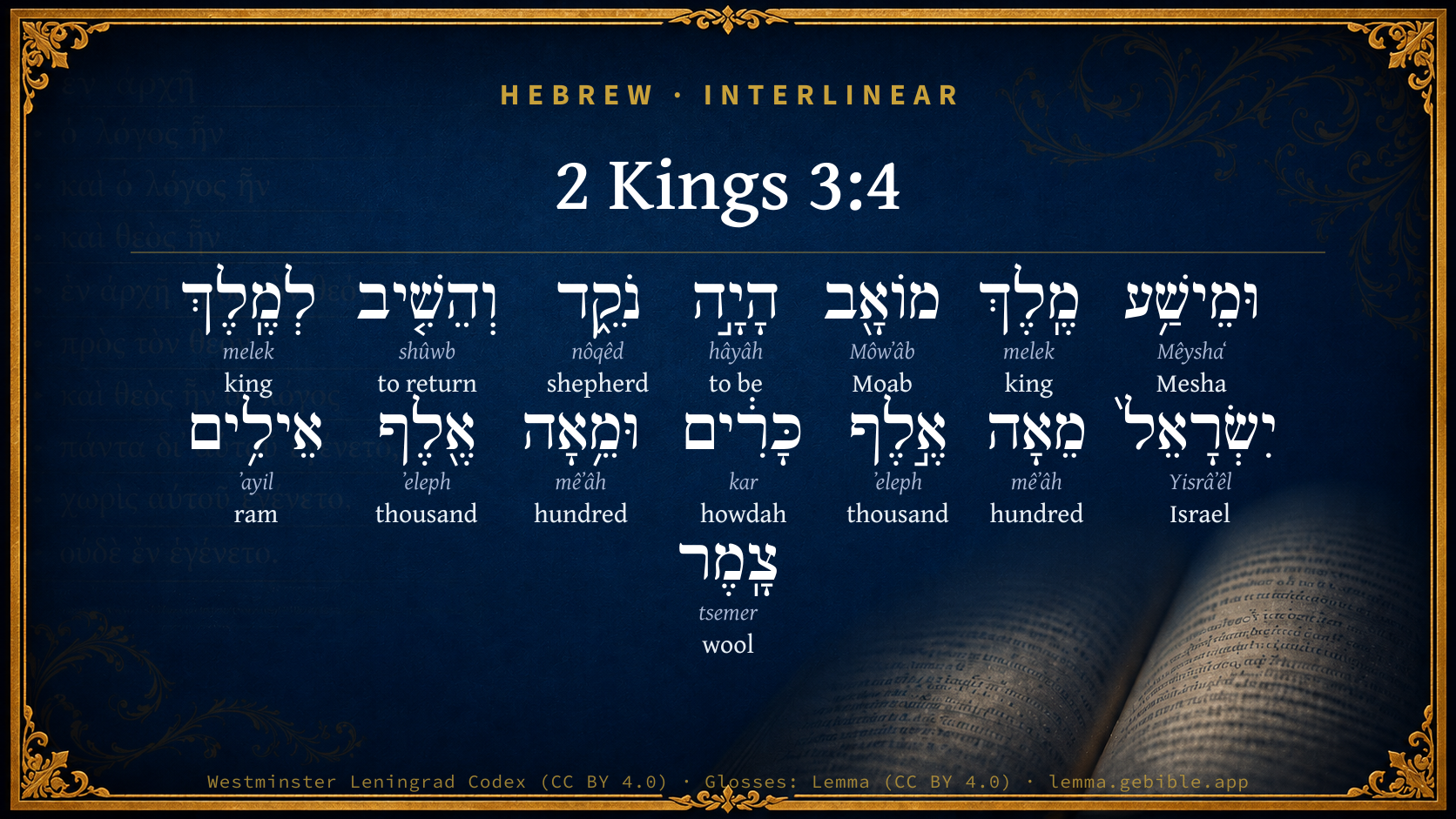
Hebrew (Westminster Leningrad Codex) 2 Kings 3:4 appears in the Hebrew Old Testament. The text above is from the Westminster Leningrad Codex. Each word links to its Strong’s number, a concise gloss, and parsing drawn from the Open Scriptures Hebrew Bible morphology. Click any word for its full Brown-Driver-Briggs (BDB) entry.
Download image
Cite this verse

2 Kings 3:4 (World English Bible). Public Domain. Lemma interlinear Bible study tool, https://lemma.gebible.app/v/2-kings/3/4.

Show BibTeX & RIS
BibTeX
RIS
English Translation
Now Mesha king of Moab was a sheep-master; and he rendered to the king of Israel the wool of one hundred thousand lambs, and of one hundred thousand rams.
World English Bible · Public Domain
Highlights
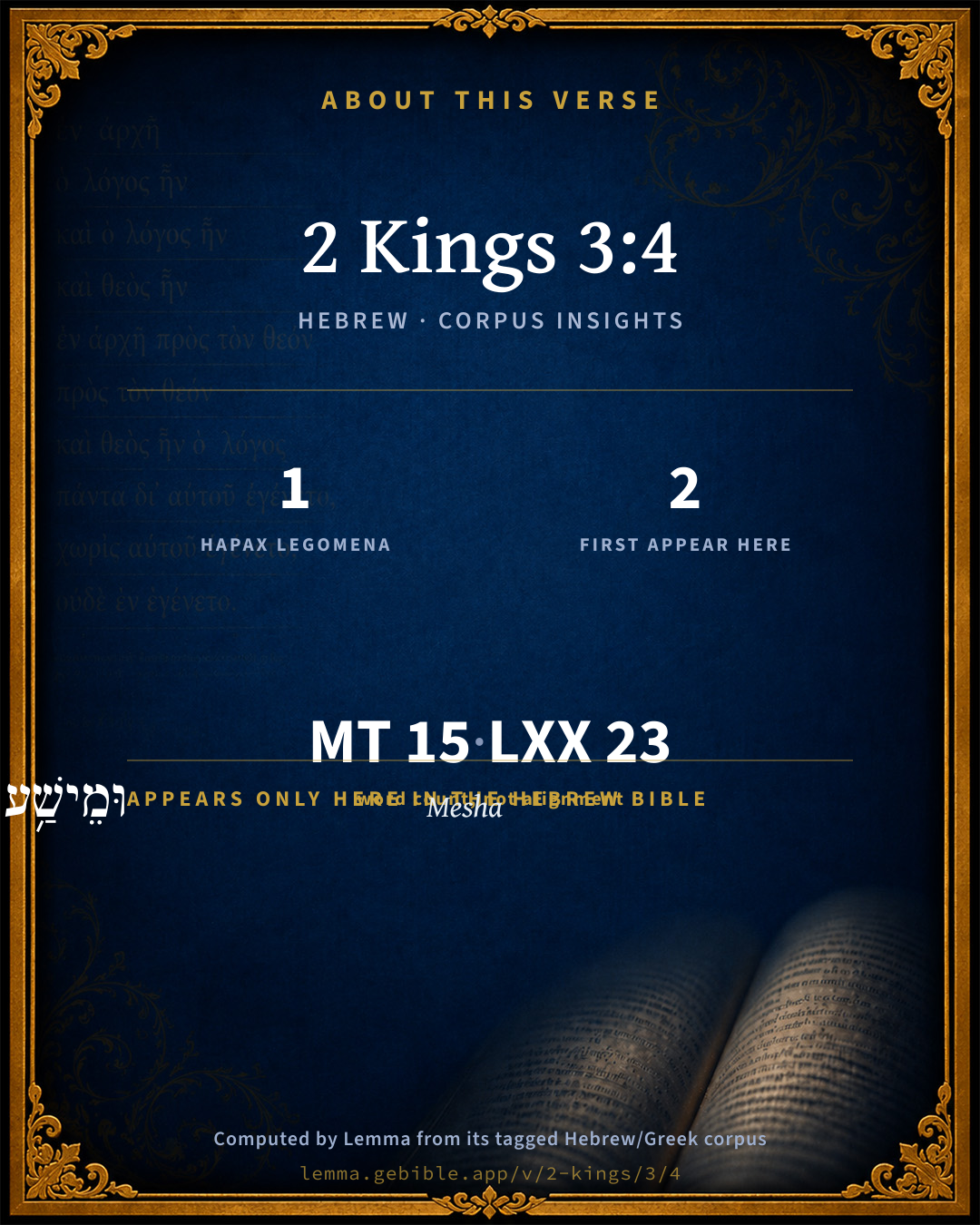
  • 1 hapax legomenon — only here in the Hebrew Bible
  • 2 first appearances in the Hebrew Bible
Full analysis ↓
Download a study sheet

One document with this verse’s original text, its word-by-word gloss line, the meaning frame, cross-references with their text, attributed commentary, and full source and license credits — printable, and it pastes into notes with its structure intact.

This verse Autodidact and up

Study sheet (.html) Plain text (.txt)

A passage Seminary Student

Up to 50 verses in one chapter. A passage sheet keeps up to 6 commentary sources and 12 cross-references per verse, in the order this page ranks them, and says so on the sheet whenever that leaves anything out. Ask for a single verse and you get the Autodidact verse sheet above.

Everything on this page stays free to read, with no account — the sheet is a download of what is already on screen, not access to it.

Want to remove ads? Support Godless Engineer
Compare translations 3

The same verse in 3 English versions, stacked beneath the original-language interlinear above. Click any original word for its lexicon entry.

Each is an independent rendering of the whole verse — the interlinear is not word-aligned to these translations.

Highlighted words mark where these versions differ — a whole-verse word diff, not a word-by-word alignment.

  • World English Bible Public Domain
    Now Mesha king of Moab was a sheep-master; and he rendered to the king of Israel the wool of one hundred thousand lambs, and of one hundred thousand rams.
  • King James Version Public Domain
    And Mesha king of Moab was a sheepmaster, and rendered unto the king of Israel an hundred thousand lambs, and an hundred thousand rams, with the wool.
  • unfoldingWord Literal Text CC BY-SA 4.0
    Now Mesha, the king of Moab, was a sheep breeder. And he rendered to the king of Israel 100, 000 lambs and 100, 000 rams wool.

unfoldingWord Literal Text — © unfoldingWord, licensed CC BY-SA 4.0. Word-aligned USFM3 via Door43 (git.door43.org/unfoldingWord/en_ult).

Versions to compare (up to 4)

3 of 4 selected

Show all 18 translations

Every available English version of this verse, each an independent rendering of the whole verse.

  • World English Bible Public Domain
    Now Mesha king of Moab was a sheep-master; and he rendered to the king of Israel the wool of one hundred thousand lambs, and of one hundred thousand rams.
  • Berean Standard Bible Public Domain
    Now Mesha king of Moab was a sheep breeder, and he would render to the king of Israel a hundred thousand lambs and the wool of a hundred thousand rams.
  • Majority Standard Bible Public Domain
    Now Mesha king of Moab was a sheep breeder, and he would render to the king of Israel a hundred thousand lambs and the wool of a hundred thousand rams.
  • King James Version Public Domain
    And Mesha king of Moab was a sheepmaster, and rendered unto the king of Israel an hundred thousand lambs, and an hundred thousand rams, with the wool.
  • American Standard Version (1901) Public Domain
    Now Mesha king of Moab was a sheep-master; and he rendered unto the king of Israel the wool of a hundred thousand lambs, and of a hundred thousand rams.
  • Revised Version (1885) Public Domain
    Now Mesha king of Moab was a sheepmaster; and he rendered unto the king of Israel the wool of an hundred thousand lambs, and of an hundred thousand rams.
  • Geneva Bible (1599) Public Domain
    Then Mesha King of Moab had store of sheepe, and rendred vnto the King of Israel an hundreth thousande lambes, and an hundreth thousande rammes with the wooll.
  • Douay-Rheims (1899) Public Domain
    Now Mesa, king of Moab, nourished many sheep, and he paid to the king of Israel a hundred thousand lambs, and a hundred thousand rams with their fleeces.
  • Young's Literal Translation Public Domain
    And Mesha king of Moab was a sheep-master, and he rendered to the king of Israel a hundred thousand lambs, and a hundred thousand rams, `with' wool,
  • Literal Standard Version CC BY-SA 4.0
    And Mesha king of Moab was a sheep-master, and he rendered to the king of Israel one hundred thousand lambs and one hundred thousand rams, [with] wool,
  • Unlocked Literal Bible CC BY-SA 4.0
    Now Mesha king of Moab bred sheep. He had to give to the king of Israel 100,000 lambs and the wool of 100,000 rams.
  • unfoldingWord Literal Text CC BY-SA 4.0
    Now Mesha, the king of Moab, was a sheep breeder. And he rendered to the king of Israel 100, 000 lambs and 100, 000 rams wool.
  • Darby Bible Public Domain
    And Mesha king of Moab was a sheepmaster, and rendered to the king of Israel a hundred thousand lambs and a hundred thousand rams, with the wool.
  • World Messianic Bible Public Domain
    Now Mesha king of Moab was a sheep breeder; and he supplied the king of Israel with one hundred thousand lambs and the wool of one hundred thousand rams.
  • Webster's Bible Public Domain
    And Mesha king of Moab was a sheep-master, and rendered to the king of Israel a hundred thousand lambs, and a hundred thousand rams, with the wool.
  • Free Bible Version CC BY-SA 4.0
    Mesha, king of Moab, was a sheep breeder. He used to provide a tribute to the king of Israel of one hundred thousand lambs and the wool of one hundred thousand rams.
  • Bible in Basic English Public Domain
    Now Mesha, king of Moab, was a sheep-farmer; and he gave regularly to the king of Israel the wool from a hundred thousand lambs and a hundred thousand sheep.
  • JPS Tanakh (1917) Public Domain
    Now Mesha king of Moab was a sheep-master; and he rendered unto the king of Israel the wool of a hundred thousand lambs, and of a hundred thousand rams.

Literal Standard Version (2020), Covenant Press — licensed CC BY-SA 4.0. Text via the HelloAO Bible API (eBible.org). Unlocked Literal Bible (unfoldingWord) — licensed CC BY-SA 4.0. Text via the HelloAO Bible API (eBible.org). unfoldingWord Literal Text — © unfoldingWord, licensed CC BY-SA 4.0. Word-aligned USFM3 via Door43 (git.door43.org/unfoldingWord/en_ult). Free Bible Version, Dr. Jonathan Gallagher — licensed CC BY-SA 4.0. Text via the HelloAO Bible API (eBible.org).

Word by word

More ways to search: Search by grammar → Find every occurrence → Compare this word →

Practice this passage: Drill this verse → Learn its vocabulary →

וּמֵישַׁ֥ע
Mêyshaʻ
H4338
“and · Mesha”
Conjunction + Noun, Proper
Part of Speech
Conjunction + Noun
Type
Proper
Full BDB Definition

Origin: a variation for H4337

TWOT: None

Mesha = "deliverance" - the king of Moab in the time of Ahab and Jehoram
  1. מֶֽלֶךְ melek H4428 “king of” Noun, Common, Masculine, Singular, Construct
  2. מוֹאָ֖ב Môwʼâb H4124 “Moab” Noun, Proper
  3. הָיָ֣ה hâyâh H1961 “to be” Verb, Qal, Perfect, 3rd Person, Masculine, Singular
  4. נֹקֵ֑ד nôqêd H5349 “shepherd” Noun, Common, Masculine, Singular, Absolute
  5. וְהֵשִׁ֤יב shûwb H7725 “and · to return” Conjunction + Verb, Hiphil, Sequential Perfect, 3rd Person, Masculine, Singular
  6. לְמֶֽלֶךְ melek H4428 “to/for · king of” Preposition + Noun, Common, Masculine, Singular, Construct
  7. יִשְׂרָאֵל֙ Yisrâʼêl H3478 “Israel” Noun, Proper
  8. מֵאָה mêʼâh H3967 “hundred” Adjective, Cardinal number, Both, Singular, Absolute
  9. אֶ֣לֶף ʼeleph H505 “thousand” Adjective, Cardinal number, Both, Singular, Absolute
  10. כָּרִ֔ים kar H3733 “howdahs” Noun, Common, Masculine, Plural, Absolute
  11. וּמֵ֥אָה mêʼâh H3967 “and · hundred” Conjunction + Adjective, Cardinal number, Both, Singular, Absolute
  12. אֶ֖לֶף ʼeleph H505 “thousand” Adjective, Cardinal number, Both, Singular, Absolute
  13. אֵילִ֥ים ʼayil H352 “rams” Noun, Common, Masculine, Plural, Absolute
  14. צָֽמֶר tsemer H6785 “wool” Noun, Common, Masculine, Singular, Absolute

About this verse

These counts appear in no published source. They are computed here, from the morphology-tagged text and Lemma’s own curated glosses. What Lemma adds →

15
words
12
distinct lemmas
Historical
section

Notable vocabulary

1 hapax legomenon — a word that appears only here in the entire Hebrew Bible:

  • וּמֵישַׁ֥ע Mesha H4338

First appearance in Scripture

These words make their first canonical appearance in the Hebrew Bible here:

  • וּמֵישַׁ֥ע Mesha H4338
  • נֹקֵ֑ד shepherd H5349

Shared distinctive vocabulary

נֹקֵ֑ד shepherd H5349 occurs in 2 verses of the Hebrew Bible. Also found in:

Grammatical profile

  • 2 verbs
  • 9 nouns
  • 4 adjectives

Verb forms

  • הָיָ֣ה Qal · Perfect
  • וְהֵשִׁ֤יב Hiphil · Sequential Perfect

Repetition

Words recur within this verse — often emphatic in Hebrew:

  • מֶֽלֶךְ king H4428 ×2
  • מֵאָה hundred H3967 ×2
  • אֶ֣לֶף thousand H505 ×2

Hebrew & Septuagint length

In English translation the verse runs 29 words from the Hebrew and 34 from the Septuagint (LXX English) — closely comparable.

A rough comparison of the two English renderings, which tokenize alike — not a word-level alignment.

Word counts can differ between the Hebrew and the Greek without any difference in meaning — e.g. the Hebrew direct-object marker אֵת has no separate Greek word, and Greek often adds the article ὁ.

In the original languages it is 15 Hebrew tokens and 23 Greek tokens — but the two are counted differently (Hebrew bundles its prefixes and suffixes into one token; the Greek is in lemma form), so that isn’t a like-for-like length.

Cross-references

10

Topical passages linked to 2 Kings 3:4 in the Treasury of Scripture Knowledge — connected by theme and wording, ordered by reader-vote popularity; previews shown in the World English Bible.

  • Genesis 26:13–14 The man grew great, and grew more and more until he became very great.
  • 2 Samuel 8:2 He struck Moab, and measured them with the line, making them to lie down on the ground; and he measured two lines to put to death, and one full line to keep alive. The Moabites became servants to David, and brought tribute.
  • Genesis 13:2 Abram was very rich in cattle, in silver, and in gold.
  • 1 Chronicles 18:2 He struck Moab; and the Moabites became servants to David, and brought tribute.
  • 2 Chronicles 26:10 He built towers in the wilderness, and hewed out many cisterns, for he had much cattle; in the lowland also, and in the plain: [and he had] farmers and vineyard keepers in the mountains and in the fruitful fields; for he loved farming.
  • Job 1:3 His possessions also were seven thousand sheep, three thousand camels, five hundred yoke of oxen, five hundred she-donkeys, and a very great household; so that this man was the greatest of all the children of the east.
  • Job 42:12 So Yahweh blessed the latter end of Job more than his beginning. He had fourteen thousand sheep, six thousand camels, one thousand yoke of oxen, and a thousand female donkeys.
  • Psalms 60:8 Moab is my wash basin. I will throw my shoe on Edom. I shout in triumph over Philistia."
  • Psalms 108:9–10 Moab is my wash pot. I will toss my sandal on Edom. I will shout over Philistia."
  • Isaiah 16:1–2 Send you the lambs for the ruler of the land from Selah to the wilderness, to the mountain of the daughter of Zion.

Cross-references courtesy of OpenBible.info (CC BY 4.0).

Hebrew and Greek witnesses Masoretic Hebrew ↔ Greek Septuagint

The same verse in the two great witnesses to the Old Testament, shown verse-for-verse.

These are two independent witnesses, not word-aligned to each other, and the Septuagint is shown in lemma (dictionary) form.

Hebrew 2 Kings 3:4 Masoretic · Westminster Leningrad Codex

וּמֵישַׁ֥ע מֶֽלֶךְ מוֹאָ֖ב הָיָ֣ה נֹקֵ֑ד וְהֵשִׁ֤יב לְמֶֽלֶךְ יִשְׂרָאֵל֙ מֵאָה אֶ֣לֶף כָּרִ֔ים וּמֵ֥אָה אֶ֖לֶף אֵילִ֥ים צָֽמֶר

Now Mesha king of Moab was a sheep-master; and he rendered to the king of Israel the wool of one hundred thousand lambs, and of one hundred thousand rams.

World English Bible · Public Domain

Greek LXX 2 Kings 3:4 Septuagint · lemma form

καί μωσα βασιλεύς μωαβ εἰμί νωκηδ καί ἐπιστρέφω ὁ βασιλεύς ἰσραήλ ἐν ὁ ἐπαναστάσις ἑκατόν χιλιάς ἀρνός καί ἑκατόν χιλιάς κριός ἐπί πόκος

And Mosa king of Moab was a sheep-master, and he rendered to the king of Israel in the beginning of the year, one hundred thousand lambs, and one hundred thousand rams, with the wool.

LXX2012 (modern English Septuagint) · Public Domain

On this verse, Adam Clarke's Commentary discusses the Septuagint’s reading. Read the note in Commentary ↓

Hebrew: Westminster Leningrad Codex (CC BY 4.0). Greek: Septuagint (public domain); English from LXX2012 (modern English Septuagint) (Public Domain). How the Septuagint differs from the Hebrew →

Targum (Aramaic paraphrase)

1

The Targum is the ancient Jewish Aramaic paraphrase of the Hebrew Scriptures — an interpretive translation, not the Hebrew text itself. Onkelos (literal) and Pseudo-Jonathan (expansive) render the Torah, and Jonathan the Prophets. Coverage is partial: where no permissively-licensed English translation exists for a verse, only the Aramaic is shown. This is verse-level text, not a word-by-word alignment to the Hebrew.

  1. Targum Jonathan Prophets (Joshua–Malachi)
    וּמֵישַׁע מַלְכָּא דְמוֹאָב הֲוָה מָרֵי גֵיתִין וּמְתִיב תּוּקְרָבָא לְמַלְכָּא דְיִשְׂרָאֵל שְׁנָא בִּשְׁנָא מְאָה אַלְפִין תּוֹרִין דְפִטְמָא וּמְאָה אַלְפִין דִכְרִין דְרַעְיָא:

    (no public-domain English translation for this verse)

    Targum Jonathan — Aramaic: “Mikraot Gedolot” (public domain). English: “Sefaria Community Translation” (CC0 1.0 (public-domain dedication)); “London "Chaldee Paraphrase," 1871” (public domain). Text via Sefaria.

Commentary

Notes on 2 Kings 3:4 from classic Christian and Jewish commentators (each source and its license shown beneath its notes). The classic Christian expositions comment on the surrounding passage and are grouped to its opening verse, so a note may address several verses; the Jewish commentaries on the Tanakh (Rashi and others) are per-verse, so they appear only where the commentator wrote on this verse.

Lemma curates 59 commentaries, every one of them public domain or Creative Commons licensed, each selected and text-cleaned for this edition rather than reprinted as found. About our sources →

Jamieson, Fausset & Brown

Robert Jamieson, A. R. Fausset & David Brown

MESHA, KING OF MOAB, REBELS. (Kg2 3:4-5)

Mesha king of Moab, &c.--As his dominions embraced an extensive pasture country, he paid, as annual tribute, the wool of a hundred thousand lambs and a hundred thousand rams. It is still common in the East to pay custom and taxes in the fruits or natural produce of the land.

Jamieson, Fausset & Brown — Commentary Critical and Explanatory on the Whole Bible (1871) — public domain (CC PDM 1.0). Text via the HelloAO Bible API.

Trapp's Complete Commentary

John Trapp

2Ki 3:4 And Mesha king of Moab was a sheepmaster, and rendered unto the king of Israel an hundred thousand lambs, and an hundred thousand rams, with the wool.

Ver. 4. And Mesha king of Moab.] Mesha signifieth Salvation, a fit name for a king. But this man might as ill deserve it, as did Antiochus, surnamed Soter, that is, a saviour: not for any great good he did, but because he did not much harm.

With the wool.] It was grown to a proverb among our forefathers, Curia Romana non petit ovem sine lana. {a}

{a} Rain., De Idol. Rom., p. 272.

John Trapp, A Commentary or Exposition upon All the Books of the Old and New Testament (1647–1656) — public domain. Text from a community e-Sword module.

Joseph Benson's Commentary

2Ki 3:4. Mesha, king of Moab, was a sheep-master — The riches, not only of private men, but also of kings, in ancient times, consisted much in sheep and cattle. And this king of Moab had abundance of them, which imboldened and enabled him to rebel against his sovereign. And rendered to the king of Israel a hundred thousand lambs, &c. — This was a prodigious number, and as they were rendered unshorn, they were the more valuable. But we are to consider that these countries abounded with sheep; insomuch that Solomon offered one hundred and twenty thousand at the dedication of the temple, 2Ch 7:5; and the Reubenites drove from the Hagarenes one hundred and fifty thousand, 1Ch 5:7.

Joseph Benson's Commentary on the Old and New Testaments (1811–1818) — public domain. Text from a community e-Sword module.

Whedon's Commentary on the Bible

Daniel D. Whedon

THE WAR WITH MESHA, KING OF MOAB, 2Ki_3:4-27.

Peculiar interest has become attached to the biblical history of Mesha, king of Moab, by reason of the recently discovered (1870) inscription of this king on a monumental stone at Dibon. To this we have already made reference in the note on 1Ki_16:23. In the inscription Mesha claims to have captured a city from the king of Israel, and to have had various successes and victories, which we may suppose probably occurred during the reign of Ahaziah. The chief value of the inscription is the confirmation it affords to the Old Testament history. For an account of the discovery of this Moabite monument, together with translations and commentary, see Recovery of Jerusalem, pp. 389-402; Bibliotheca Sacra, for 1870, pp. 625-646.

4. Sheepmaster — The word is rendered shepherd in Amo_1:1, and, according to some writers, means literally a marker, and serves to designate a shepherd, because it was his custom to mark his sheep in order to distinguish them. Mesha was evidently rich in sheep, and the hills and valleys of Moab, like those of Gilead on the north, (Num_32:1,) were well adapted to the pasturage of numerous flocks and herds.

A hundred thousand lambs — “Much curious information might easily be presented with respect to ancient, and even modern, tributes in cattle. A curious instance is that of the Cappadocians, of whom Strabo relates that they used to deliver every year, as tribute to the Persians, fifteen hundred horses, two thousand mules, and fifty thousand sheep. This Moabite tribute seems very heavy, and doubtless it was so felt by them while it lasted; but in the same degree was it valuable to the crown of Israel; and the internal taxation, to which resort must have been had to make up for this lapse of external revenue, doubtless made the expedition eventually undertaken for the purpose of reducing the Moabites highly popular in Israel.” — Kitto.

A hundred thousand rams, with the wool — Literally, A hundred thousand rams’ wool; that is, the wool of a hundred thousand rams. This number of rams would be, as many have remarked, a strange proportion for the number of lambs named; hence we understand with Thenius that the tribute was a hundred thousand fat sheep or lambs, (כרים,) and the wool of an equal number of rams, but not the rams themselves. Some understand that the tribute of both lambs and rams was paid in wool.

Daniel D. Whedon (gen. ed.), Commentary on the Old and New Testaments (1874–1909) — public domain. Text from a community e-Sword module.

The Preacher's Complete Homiletical Commentary

Joseph S. Exell (gen. ed.)

CRITICAL AND EXPLANATORY NOTES.—

2Ki_3:4. An annual tribute on Moab—The custom is common in the East to pay custom or taxes with the products of the land. For a Moabitish king, with rich pastures in his own territory, and also in the Arabian wilderness, this was but a small tribute to pay. 2Ki_3:6-7. Confederation of Jehoram and Jehoshaphat—This was effected “at the same time” (2Ki_3:6) as Jehoram began his reign and Moab rebelled; and the confederation was with the design of crushing Moab. The king of Israel “numbered,” or mustered, a considerable army from his subjects throughout “all Israel,” and invited the king of Judah to join him in the campaign.

2Ki_3:8. The way through the wilderness of Edom—i.e., not crossing the Jordan, but marching down by the Dead Sea to its southern extremity, and thence up through the wilderness, and over the mountains of Edom, approaching Moab from the south. Moab was best fortified on its northern boundary; besides which, to reach Moab by a northerly route they would have had to risk a collision with the Syrians, whereas Edom was at this time ruled by a deputy, whom Jehoshaphat had appointed (1Ki_22:47).

2Ki_3:9. Seven days’ journey—It was a weary route over the desert region south of the Dead Sea, while also “the deep rocky valley of Ashy” (Keil) was most difficult of penetration. They found, to their distress, that the Wady of this valley was dry. 2Ki_3:10-11. Jehoram despairs; Jehoshaphat seeks a prophet of Jehovah.

2Ki_3:11. Which poured water on the hands of Elijah—i.e., “who was about Elijah daily as his servant, and who is certainly the most reliable prophet, since he [Elijah] is gone” (Thenius). The phrase, פֹה אֱלִישַׁע, “Here is Elisha,” means that he was in the camp or close at hand. Perhaps, as Keil suggests, the prophet, led by Divine impulse, had come near the armies to guide their kings in the hour of embarrassment and despair. Elisha’s ministry might now convert Jehoram from idolatrous sympathies, by showing him the true God.

2Ki_3:13. Elisha said to Jehoram, “What have I to do with thee?”—Elisha meets him with sternness to rebuke his pride and impiety, and then ironically refers him to the idols for which he bad deserted Jehovah. “NAY”—אַל—i.e., not—not so; do not so answer and refuse me; or, It will not help me to go to the prophets of Baal.

2Ki_3:15. Now bring me a minstrel—To soothe and elevate his mind into preparedness to heed the voice of God’s spirit within him. On יַד יְהֹוָה, “the hand of the Lord,” see Notes on 1Ki_18:46.

2Ki_3:19. Mar every good piece of land—כָּאַב, to inflict pain; grieve the land.

2Ki_3:20. Came water by the way of Edom—Occasioned by sudden rains supernaturally given, which fell on the mountain heights of Edom, and quickly filled the Wady, and overflowed into the “ditches.”

HOMILETICS OF 2Ki_3:4-20

THE POWER OF A GOOD MAN IN EXTREMITY

On the death of Ahab the Moabites rebelled against Israel, and refused any longer to pay the heavy tribute they had been accustomed to render. During the short and unwarlike reign of the unfortunate Ahaziah, nothing was done to chastise the Moabites for their revolt; but as soon as Jehoram seized the sceptre, he organized an expedition against Moab to compel the payment of the accustomed tribute. The whole undertaking would have ended in terrible disaster and loss, but for the timely intervention of the despised Elisha. It is in extremity that man discovers his own helplessness, and learns to venerate and love that God who is a present help in trouble.

I. That the most carefully planned enterprise may be unexpectedly reduced to great extremity (2Ki_3:4-9). Israel, Judah, and Edom united their armies, and marched, a formidable host, against the revolted Moabites, led in person by the monarch of each nation. A route was selected which, by attacking the Moabites from the South, was intended to take them by surprise, as they would hardly expect an attack from Israel in that quarter. The plot was well laid—success was certain—the Moabites would be driven into immediate submission; when suddenly the advancing host found itself menaced by a danger more distressing than that of the mightiest army—there was no water for man or beast! Of what avail now was their multitude of warriors, and the imposing splendour of their equipment? Their numbers aggravated the suffering, and their proud display added to the ignominy of the failure. The most consummate strategist is often baffled by unlooked-for difficulties. History furnished a melancholy example in Napoleon Bonaparte’s invasion of Russia and his disastrous retreat from Moscow.

II. That in a time of extremity the help of a good man is anxiously sought (2Ki_3:10-12).

1. Heathenism is powerless to help in extremity. Jehoram yields at once to despair, and can see no possible way of deliverance (2Ki_3:6). What an acknowledgment of the imbecility of his gods! Idolatry had no comfort for the sorrowing, no resources in times of difficulty. It breeds a spirit of sullen and forlorn fatalism.

2. The worshipper of Jehovah knows where to go for help (2Ki_3:11). How different is the conduct of the two kings! Jehoram wrings his hands in utter helplessness; Jehoshaphat calls for a prophet. The believer in Jehovah has resources to fall back upon in adversity of which the world knoweth not. A tender-hearted doctor once said to a patient who was suffering excruciating pain, “It is a brave heart that bears all this so grandly.” “Ah! no, Doctor,” was the meek and gentle response, “it is not the brave heart at all; Jesus bears it all for me.”

3. In extremity goodness commands the homage of greatness. “So the king of Israel and Jehoshaphat and the king of Edom went down to him” (2Ki_3:12). They did not summon Elisha into the royal presence, as was the case with Micaiah (1Ki_22:9). They were in distress. It was not a time to stand on ceremony, or to make a vain display of royal pomp and greatness. They eagerly and humbly sought the help of the man of God. True worth will triumph in the end, however much it may be ignored and vilified; and will command the respect even of its enemies.

III. That a time of extremity affords an opportunity for a good man to exalt the Lord.

1. He is fearless in reproving wrong. Elisha repudiates Jehoram’s claim to any consideration, and tells him to go “to the prophets of his father and to the prophets of his mother” (2Ki_3:13). He has already discovered the powerlessness of his national idol; and keenly as he must have felt the rebuke of the man of God at this time, he could not but admit its justice. No opportunity for reproving wrong should be neglected, and circumstances sometimes arise in which such neglect would be specially reprehensible.

2. He acknowledges the good in whomsoever found. “Were it not that I regard the presence of Jehoshaphat, the king of Judah, I would not look towards thee, nor see thee” (2Ki_3:14). One sovereign is condemned, while another is commended, as if to show that no disrespect is intended to the royal office, but that sin must be reproved, whether found in the person of the sovereign, or in that of the meanest subject. “What shall not be done for a Jehoshaphat? For his sake shall those two other princes, and their vast armies, live and prevail. It is in the power of one good man to oblige a world. We receive true though insensible favours from the presence of the righteous. Next to being good, it is happy to converse with them that are so; if we be not better by their example, we are blest by their protection.”

3. He recognizes the Divine source of all true help (2Ki_3:15). Elisha calls for music to soothe and tranquillize his mind, and prepare himself for the reception of Divine communications. He was fully aware that God, and God only, could render help in such an extremity. Help is found, not in the multitude of an host, not in the power of the crown, not in the charms of song and the grandeur of sacrifice, not in the goodness and greatness of the individual instrument, but only in God. This cannot be too frequently iterated, or too constantly acknowledged.

4. He is favoured with revelations of the Divine intentions (2Ki_3:16-19). Not only is water promised to relieve their present distress, but the kings are assured of victory over the Moabites. The good man is privileged to know more of the Divine mind than can be understood by the ungodly. “The secret of the Lord is with them that fear Him; and He will shew them His covenant” (Psa_25:14).

IV. That Divine aid in extremity is not sought in vain (2Ki_3:20). It seemed very unlikely that the dry channels of the Edom valley should be filled with water. The air was still, the sky was clear, not a shred of rain-cloud was visible; and the work of the busy multitude in digging trenches seemed a mockery. Faith in Elisha and in the God of Elisha was put to the test. Evening sank into night, and night gave place to morning. But “at the hour of the morning sacrifice, no sooner did the blood of that oblation gush forth, than the streams of water gushed forth into their new channels, and filled the country with a refreshing moisture. Elijah fetched down his fire at the hour of the evening sacrifice; Elisha fetched up his water at the hour of the morning sacrifice. How seasonably doth the wisdom of God pick out that instant wherein He might at once answer both Elisha’s prophecy and His people’s prayers.” The Lord will never disappoint His people’s confidence. It is in extremity that He most signally displays His power and goodness.

LESSONS:—

1. Extremity reveals the helplessness of man.

2. Calls for special Divine interference.

3. Teaches the most wholesome lessons.

GERM NOTES ON THE VERSES

2Ki_3:4. When kings and lords fall away from God, then their subjects must fall away from them. And when the fathers are disobedient to God, the children and servants must also be disobedient to them, for their punishment.

2Ki_3:10-11. What are the greatest monarchs of the world, if they want but water to their mouths! What can their crowns and plumes and rich arms avail them, when they are abridged but of that which is the drink of beasts? With dry tongues and lips do they now confer of their common misery. Jehoram deplores the calamity into which they were fallen; Jehoshaphat asks for a prophet. Every man can bewail a misery; every man cannot find the way out of it. Not without some specialty from God does Elisha follow the camp; else that had been no element for a prophet. Little did the good king of Judah think that God was so near him. Purposely was this holy seer sent for the succour of Jehoshaphat and his faithful followers when they were so far from dreaming of their delivery that they knew not of a danger. It would be wide with the best men if the eye of Divine Providence were not open upon them, when the eye of their care is shut towards it. How well did Elisha in the wars! The strongest squadron of Israel was within that breast; all their armour of proof had not so much safety and protection as his mantle.—Bp. Hall.

—In need and distress the state of a man’s heart is brought to light. Jehoram falls into despair, he does not know what counsel to take, nor how to help himself. Instead of seeking the Lord and calling to Him for help, he accuses Him and cast the reproach upon Him that He means to destroy three kings at once. Jehoshaphat, who had always bent his heart to seek God (2Ch_19:3), does not wring his hands in despair, but is quiet and composed. He thinks within himself, The Lord has neither now, nor ever, withdrawn Himself from His people. Therefore he trusts, and asks for a prophet of the Lord.—Lange.

2Ki_3:10. Despair. I. A natural fruit of idolatry. II. Shows the helplessness of man. III. Is ever ready to throw the blame of misfortune on others.

2Ki_3:12. “The word of the Lord is with him.” A true prophet. I. Is easily recognized by all lovers of truth. II. Is invested with Divine authority. III. Is eagerly and humbly consulted in time of need.

—So long as men are free from distress and danger, they ask nothing about the ministers of the gospel, they take no notice of them, they wish to have nothing to do with them, they throw their faithful warnings to the wind; but when an accident or a death occurs, then they are glad to see the despised preacher, and they desire to make use of his services and his prayers. Three kings descend from their elevation and come humbly and with petitions to the man who was once a servant of Elijah, of whom they had not even known so much as that he had joined the expedition. So now emperors and kings bow the knee before Him who came to His own and His own received Him not, who did not have a place to lay His head, but who is now confessed to be the Lord, to the glory of God the Father.—Wurt. Summ.

2Ki_3:13-14. The vain pretences of idolatry. I. Truthfully rebuked. II. Unmistakably apparent in times of difficulty. III. Invalidate all claim for help.

2Ki_3:13. How sharply dares the man of God to chide his sovereign, the king of Israel! The liberty of the prophets was no less singular than their calling; he that would borrow their tongue must show their commission. As God reproved kings for their sakes, so did not they stick to reprove kings for His sake. Thus much freedom they must leave to their successors, that we might not spare the vices of them whose persons we must spare.—Bp. Hall.

—Elisha stood before the Lord, the living God; Jehoram before the calf-god. That was not only a difference in religious views and opinions, but also an entirely different standpoint in life. Where there is a life in God, there there can be no fellowship with those who have denied and abandoned the living God: the two ways diverge directly and decidedly. The relation in which a man stands to God is decisive for his relation to other men; it divides from some by a separation which is just as wide as the communion into which it brings him with others is close.—Starke.

2Ki_3:14. He who has renounced God and His word can make no claim to esteem, even though he be a king. Fidelity to God and holding fast to His word are what make a man truly estimable, even though he were the poorest and lowliest. God does not let the righteous perish with the unrighteous; it rather comes to pass that, for the sake of a single righteous man, many godless persons are saved and preserved.—Lange.

2Ki_3:15. The power of music. I. Soothes and tranquillizes the soul ruffled by contact with wrong. II. Prepares the heart for the reception of Divine blessing. III. Finds its loftiest use in the worship of God.

—Who wonders not to hear a prophet call for a minstrel in the midst of that mournful distress of Israel and Judah? Who would not have expected his charge of tears and prayers rather than of music? How unseasonable are songs to a heavy heart! It was not for their ears, it was for his own bosom, that Elisha called for music; that his spirits, after their zealous agitation, might be sweetly composed, and put into a meet temper for receiving the calm visions of God. None but a quiet breast is capable of Divine revelations; nothing is more powerful to settle a troubled heart than a melodious harmony.—Bp. Hall.

2Ki_3:16-19. The Lord gives beyond what we pray for, beyond what we understand; He not only saves from need and danger, but He also gives the victory besides, out of pure undeserved grace. That is the fundamental feature of all Divine promises. The Lord not only does not deal with us according to our sins, but He gives us, besides that, the victory.—Lange.

2Ki_3:16. Preparatory work. I. Necessary in all Divine arrangements. II. Must be done because commanded, not always because it is understood. III. Is an evidence of genuine faith. IV. Its value will be made apparent (2Ki_3:20).

2Ki_3:17-18. The methods of Divine relief. I. Often unseen and mysterious. II. Inevitably sure. III. Superabundant in supply (2Ki_3:18).

2Ki_3:19. This is by no means a mere prophecy, as Wordsworth says, a simple prediction of what the allied armies would inflict on Moab; but a command as plain and positive as that by which he had formerly authorized the destruction of the idolatrous Canaanites. So utter a destruction of the Moabites did the Lord now authorize, that He even suspended the law of Deu_20:19, which forbade the destruction of the fruit trees of the enemy. This felling of the good trees would be to the surviving Moabites a memorable woe. Their ruined cities they might speedily rebuild, and unstop their wells, or dig new ones, and clear the land of stones; but years must pass before new fruit trees could be reared.—Whedon.

The Preacher's Complete Homiletical Commentary (gen. ed. Joseph S. Exell; Funk & Wagnalls, c. 1892) — public domain (pre-1929). A full-Bible homiletical/sermon-outline anthology covering 65 of 66 books (2 John is absent from the source module). Text from a community e-Sword module.

Keil & Delitzsch

C. F. Keil & F. Delitzsch

War of Joram, in Alliance with Jehoshaphat, against the Moabites. - Kg2 3:4, Kg2 3:5. The occasion of this war was the rebellion of the Moabites, i.e., the refusal to pay tribute to Israel since the death of Ahab. Mesha the (vassal-) king of Moab was a possessor of flocks, and paid to the king of Israel 100,000 lambs and 100,000 rams; not merely at the commencement of each new reign (Cler.), but as a yearly tribute (השׁיב, to bring again = to bring repeatedly, as in Num 18:9, etc.). This yearly tribute could not be exorbitant for the land of the Moabites, which abounded in good pasture, and was specially adapted for the rearing of flocks. The payment of tribute in natural objects and in the produce of the land was very customary in ancient times, and is still usual among the tribes of Asia.

(Note: Pecunia ipsa a pecore appellabatur. Etiam nunc in tabulis Censoriis pascua dicuntur omnia, ex quibus populus reditus habet, quia diu hoc solum vectigal fuit. Mulctatio quoque nonnisi ovium boumque impendio dicebatur. - Plinii h. nat. xviii. 3.)

נוקד signifies both a shepherd (Amo 1:1) and also a possessor of flocks. In Arabic it is properly the possessor of a superior kind of sheep and goats (vid., Boch. Hieroz. i. p. 483f. ed. Ros.). צמר may either be taken as a second object to השׁיב, or be connected with אילים htiw as an accusative of looser government (Ewald, 287, h.). In the first case the tribute would consist of the wool (the fleeces) of 100,000 lambs and 100,000 rams; in the second, of 100,000 lambs and the wool of 100,000 rams. In support of the latter we may quote Isa 16:1, where lambs are mentioned as tribute.

Kg2 3:5-7

The statement concerning the rebellion of the Moabites, which has already been mentioned in Kg2 1:1, is repeated here, because it furnished the occasion for the expedition about to be described. Ahaziah had been unable to do anything during his short reign to renew the subjugation of Moab; Joram was therefore anxious to overtake what had been neglected immediately after his ascent of the throne. He went to Samaria ההוּא בּיּום, at that time, namely, when he renewed his demand for the tribute and it was refused (Thenius), and mustered all Israel, i.e., raised an army out of the whole kingdom, and asked Jehoshaphat to join in the war, which he willingly promised to do (as in Kg1 22:4), notwithstanding the fact that he had been blamed by prophets for his alliance with Ahab and Ahaziah (Ch2 19:2 and Ch2 20:37). He probably wished to chastise the Moabites still further on this occasion for their invasion of Judah (2 Chron 20), and to do his part by bringing them once more under the yoke of Israel, to put it out of their power to make fresh incursions into Judah.

Kg2 3:8

In reply to Joram's question, "By which way shall we advance (against Moab)?" Jehoshaphat decided in favour of "the way through the desert of Edom." There were two ways by which it was possible to enter the land of the Moabites; namely, either by going above the Dead Sea, and crossing the Jordan and the boundary river Arnon, and so entering it from the north, or by going round the southern point of the Dead Sea, and advancing through the northern portion of the mountains of Edom, and thus entering it from the south. The latter way was the longer of the two, and the one attended with the greatest difficulties and dangers, because the army would have to cross mountains which were very difficult to ascend. Nevertheless Jehoshaphat decided in its favour, partly because, if they took the northern route, they would have the Syrians at Ramoth in Gilead to fear, partly also because the Moabites, from their very confidence in the inaccessibility of their southern boundary, would hardly expect any attack from that side, and might therefore, if assailed at that point, be taken off their guard and easily defeated, and probably also from a regard to the king of Edom, whom they could induce to join them with his troops if they took that route, not so much perhaps for the purpose of strengthening their own army as to make sure of his forces, namely, that he would not make a fresh attempt at rebellion by a second invasion of the kingdom of Judah while Jehoshaphat was taking the field against the Moabites.

Kg2 3:9-12

But however cleverly this plan may have been contrived, when the united army had been marching round for seven days and was passing through the deep rocky valley of the Ahsy,

(Note: The usual route from southern Judaea to the land of the Moabites, which even the Crusaders and more recent travellers took, runs round the Dead Sea up to the mouth of the Wady ed Deraah or Kerak, and then up this wady to Kerak (vid., Rob. ii. p. 231). The allied kings did not take this route however, but went through the Wady el Kurahy or es-Safieh, which opens into the southern end of the Dead Sea, and which is called the Wady el Ahsy farther up in the mountains, by Seetzen (R. ii. pp. 355,356) erroneously the Wady el Hssa (Rob. ii. p. 488), a ravine through which Burckhardt passed with the greatest difficulty (Syrien, ii. p. 673). That they advanced by this route is a necessary inference from the fact, that when they first suffered from want of water they were on the border of the Moabitish territory, of which this very wady forms the boundary (Kg2 3:21; see Burckh. p. 674, and Rob. Pal. ii. p. 555), and the water came flowing from Edom (Kg2 3:20). Neither of these circumstances is applicable to the Wady el Kerak. - Still less can we assume, with O. v. Gerlach, that they chose the route through the Arabah that they might approach Moab from the south, as the Israelites under Moses had done. For it would have been impossible for them to reach the border of Moab by this circuitous route. And why should they go so far round, with the way through Edom open to them?)

which divided the territories of Edom and Moab, it was in the greatest danger of perishing from want of water for men and cattle, as the river which flows through this valley, and in which they probably hoped to find a sufficient supply of water, since according to Robinson (Pal. ii. pp. 476 and 488) it is a stream which never fails, was at that time perfectly dry.

In this distress the hearts of the two kings were manifested. - Kg2 3:10-12. Joram cried out in his despair: "Woe, that Jehovah has called these three kings, to give them into the hand of Moab!" (כּי, that, serves to give emphasis to the assurance; see Ewald, 330, b.) Jehoshaphat, on the other hand, had confidence in the Lord, and inquired whether there was no prophet there, through whom they could seek counsel of the Lord (as in Kg1 22:7); whereupon one of the servants of the Israelitish king answered that Elisha was there, who had poured water upon the hands of Elijah, i.e., had been with him daily as his servant, and therefore could probably obtain and give a revelation from god. Elisha may perhaps have come to the neighbourhood of the army at the instigation of the Spirit of God, because the distress of the kings was to be one means in the hand of the Lord, not only of distinguishing the prophet in the eyes of Joram, but also of pointing Joram to the Lord as the only true God. The three kings, humbled by the calamity, went in person to Elisha, instead of sending for him.

Kg2 3:13-14

In order still further to humble the king of Israel, who was already bowed down by the trouble, and to produce some salutary fruit of repentance in his heart, Elisha addressed him in these words: "What have I to do with thee? Go to the (Baal-) prophets of thy father and thy mother! Let them help thee." When Joram replied to this in a supplicatory tone: על, no, pray (as in Rut 1:13), i.e., speak not in this refusing way, for the Lord has brought these three kings - not me alone, but Jehoshaphat and the king of Edom also - into this trouble; Elisha said to him with a solemn oath (cf. Kg1 17:1): "If I did not regard Jehoshaphat, I should not look at thee and have respect to thee," i.e., I should not deign to look at thee, much less to help thee.

Kg2 3:15-17

He then sent for a minstrel, to collect his mind from the impressions of the outer world by the soft tones of the instrument, and by subduing the self-life and life in the external world to become absorbed in the intuition of divine things. On this influence of music upon the state of the mind, see the remark on Sa1 16:16, and Passavant's Untersuchungen ber den Lebens-magnetismus, p. 207 (ed. 2). - As the minstrel was playing, the hand of the Lord came upon him (והיה according to the later usage for ויהי, as in Sa1 17:48, etc.; compare Ewald, 345, b., and יהוה יד as in Kg1 18:46), so that he said in the name of the Lord: "Make this valley full of trenches (עשׂה, inf. abs. for the imperative; for גּבים גּבים see Ges. 108, 4); for thus saith the Lord, ye will see neither wind nor rain, and this valley will be filled with water, that ye may be able to drink, and your flocks and your cattle." גּבים are trenches for collecting water (vid., Jer 14:3), which would suddenly flow down through the brook-valley. This large quantity of water came on the (following) morning "by the way of Edom" (Kg2 3:20), a heavy fall of rain or violent storm having taken place, as is evident from the context, in the eastern mountains of Edom, at a great distance from the Israelitish camp, the water of which filled the brook-valley, i.e., the Wady el Kurahy and el Ahsy (see at Kg2 3:9) at once, without the Israelites observing anything either of the wind, which always precedes rain in the East (Harmar, Beobb. i. pp. 51, 52), or of the rain itself. מקניכם are the flocks intended for slaughtering, בּהמתּכם the beasts of burden.

Kg2 3:18-19

Elisha continued: "and this is too little for Jehovah (the comparative force of נקל is implied in the context, especially in the alternating combination of the two clauses, which is indicated by ו...ו, see Ewald, 360, c.): He will also give Moab into your hand, and ye will smite all the fortified and choice cities, fell all the good trees (fruit-trees), stop up all the springs of water, and spoil all the good fields with stones." מבצר and מבחור are intended to produce a play upon words, through the resemblance in their sound and meaning (Ewald, 160, c.). In the announcement of the devastation of the land there is an allusion to Deu 20:19-20, according to which the Israelites were ordered to spare the fruit-trees when Canaan was taken. These instructions were not to apply to Moab, because the Moabites themselves as the arch-foes of Israel would not act in any other way with the land of Israel if they should gain the victory. הכאב, to add pain, is a poetical expression for spoiling a field or rendering it infertile through the heaping up of stones.

Kg2 3:20-23

The water came in the morning at the time of the morning sacrifice (see Kg1 18:36), to indicate that the Lord was once more restoring His favour to the people on account of the sacrifice presented to Him in His temple.

The help of God, which preserved the Israelitish army from destruction, also prepared destruction for the Moabites. Kg2 3:21-23. On hearing the report of the march of the allied kings, Moab had raised all the men that were capable of bearing arms, and stationed them on the frontier. In the morning, when the sun had risen above the water, the Moabites saw the water opposite to them like blood, and said: "That is blood: the (allied) kings have destroyed themselves and smitten one another; and now to the spoil, Moab!" Coming with this expectation to the Israelitish camp, they were received by the allies, who were ready for battle, and put to flight. The divine help consisted, therefore, not in a miracle which surpassed the laws of nature, but simply in the fact that the Lord God, as He had predicted through His prophet, caused the forces of nature ordained by Him to work in the predetermined manner. As the sudden supply of an abundance of water was caused in a natural way by a heavy fall of rain, so the illusion, which was so fatal to the Moabites, is also to be explained in the natural manner indicated in the text. From the reddish earth of the freshly dug trenches the water collected in them had acquired a reddish colour, which was considerably intensified by the rays of the rising sun, so that when seen from a distance it resembled blood. The Moabites, however, were the less likely to entertain the thought of an optical delusion, from the fact that with their accurate acquaintance with the country they knew very well that there was no water in the wady at that time, and they had neither seen nor heard anything of the rain which had fallen at a great distance off in the Edomitish mountains. The thought was therefore a natural one, that the water was blood, and that the cause of the blood could only have been that their enemies had massacred one another, more especially as the jealousy between Israel and Judah was not unknown to them, and they could have no doubt that Edom had only come with them as a forced ally after the unsuccessful attempt at rebellion which it had made a short time before; and, lastly, they cannot quite have forgotten their own last expedition against Judah in alliance with the Edomites and Ammonites, which had completely failed, because the men composing their own army had destroyed one another. But if they came into collision with the allied army of the Israelites under such a delusion as this, the battle could only end in defeat and in a general flight so far as they were concerned.

Kg2 3:24-25

The Israelites followed the fugitives into their own land and laid it waste, as Elisha had prophesied (Kg2 3:25 compared with Kg2 3:19). The Chethb ויבו־בהּ is to be read בהּ ויּבו (for ויּבוא as in Kg1 12:12): and (Israel) came into the land and smote Moab. The Keri ויּכּוּ is a bad emendation. הכּות is either the infinitive construct used instead of the infin. absolute (Ewald, 351, c.), or an unusual form of the inf. absol. (Ewald, 240, b.). עד־השׁאיר, till one (= so that one only) left its stones in Kir-chareseth. On the infinitive form השׁאיר see at Jos 8:22. The suffix in אבניה probably points forward to the following noun (Ewald, 309, c.). The city called חרשׂת קיר here and Isa 16:7, and חרשׂ קיר in Isa 16:11 and Jer 48:31, Jer 48:36, i.e., probably city of potsherds, is called elsewhere מואב קיר, the citadel of Moab (Isa 15:1), as the principal fortress of the land (in the Chaldee Vers. דמואב כרכּא), and still exists under the name of Kerak, with a strong castle build by the Crusaders, upon a lofty and steep chalk rock, surrounded by a deep and narrow valley, which runs westward under the name of Wady Kerak and falls into the Dead Sea (vid., Burckhardt, Syr. pp. 643ff., C. v. Raumer, Pal. pp. 271,272). This fortress the allied kings besieged. "The slingers surrounded and smote it," i.e., bombarded it.

Kg2 3:26

When the king of Moab saw that the battle was too strong for him, he attempted to fight a way through the besiegers with 700 men with drawn swords (להבקיע, lit., to split them) to the king of Edom, i.e., on the side which was held by this king, from whom he probably hoped that he should meet with the weakest resistance.

Kg2 3:27

But when this attempt failed, in his desperation he took his first-born son, who was to succeed him as king, and offered him as a sacrifice upon the wall, i.e., in the sight of the besiegers, not to the God of Israel (Joseph. Ephr. Syr., etc.), but to his own god Camos (see at Kg1 11:7), to procure help from him by appeasing his wrath; just as the heathen constantly sought to appease the wrath of their gods by human sacrifices on the occasion of great calamities (vid., Euseb. praepar. ev. iv. 16, and E. v. Lasaulx, die Shnopfer der Griechen und Rmer, pp. 8ff.). - "And there was (came) great wrath upon Israel, and they departed from him (the king of Moab) and returned into their land." As על קצף היה is used of the divine wrath or judgment, which a man brings upon himself by sinning, in every other case in which the phrase occurs, we cannot understand it here as signifying the "human indignation," or ill-will, which broke out among the besieged (Budd., Schulz, and others). The meaning is: this act of abomination, to which the king of the Moabites had been impelled by the extremity of his distress, brought a severe judgment from God upon Israel. The besiegers, that is to say, felt the wrath of God, which they had brought upon themselves by occasioning human sacrifice, which is strictly forbidden in the law (Lev 18:21; Lev 20:3), either inwardly in their conscience or in some outwardly visible signs, so that they gave up the further prosecution of the siege and the conquest of the city, without having attained the object of the expedition, namely, to renew the subjugation of Moab under the power of Israel.

Keil & Delitzsch — Biblical Commentary on the Old Testament (1861–1891) — public domain (CC PDM 1.0). Text via the HelloAO Bible API. (Old Testament only.)

The Expositor's Bible

THE INVASION OF MOAB

2Ki_3:4-27

"What reinforcement we may gain from hope, If not, what resolution from despair."

-MILTON, "Paradise Lost, " 1:190

AHAZIAH, as Elijah had warned him, never recovered from the injuries received in his fall through the lattice, and after his brief and luckless reign died without a child. He was succeeded by his brother Jehoram ("Jehovah is exalted"), who reigned for twelve years.

Jehoram began well. Though it is said that he did that which was evil in the sight of the Lord, we are told that he was not so guilty as his father or his mother. He did not, of course, abolish the worship of Jehovah under the cherubic symbol of the calves; no king of Israel thought of doing that, and so far as we know neither Elijah, nor Elisha, nor Jonah, nor Micaiah, nor any genuine prophet of Israel before Hosea, ever protested against that worship, which was chiefly disparaged by prophets of Judah like Amos and the nameless seer. But Jehoram at least removed the Matstsebah or stone obelisk which had been reared in Baals honor in front of his temple by Ahab, or by Jezebel in his name. In this direction, however, his reformation must have been exceedingly partial, for until the sweeping measures taken by Jehu the temple and images of Baal still continued to exist in Samaria under his very eyes, and must have been connived at if not approved.

The first great measure which occupied the thoughts of Jehoram was to subdue the kingdom of Moab, which had been restored to independence by the bravery of the great pastoral-king Mesha; or at any rate to avenge the series of humiliating defeats which Mesha had inflicted on his brother Ahaziah. A war of forty years duration had ended in the complete success of Moab. The loss of a tribute of the fleeces of one hundred thousand lambs and one hundred thousand rams was too serious to be lightly faced. Jehoram laid his plans well. First he ordered a muster of all the men of war throughout his kingdom, and then appealed for the cooperation of Jehoshaphat and his vassal-king of Edom. Both kings consented to join him. Jehoshaphat had already been the victim of a powerful and wanton aggression on the part of King Mesha, {2Ch_20:1-30} froth which he had been delivered by the panic of his foes in the Valley of Salt. Though the king of Edom had, on that occasion, been an ally of Mesha, the forces of Edom had fallen the first victims of that internecine panic. Both Judah and Edom, therefore, had grave wrongs to avenge, and eagerly seized the opportunity to humble the growing pride of the people of Chemosh. The attack was wisely arranged. It was determined to advance against Moab from the south, through the territory of Edom, by a rough and mountainous track, and, as far as possible, to take the nation by surprise. The combined host took a seven days circuit round the south of the Dead Sea, hoping to find an abundant supply of water in the stream which flows through the Wady-el-Ahsa, which separates Edom from Moab. But owing to recent droughts the wady was waterless, and the armies, with their horses, suffered all the agonies of thirst. Jehoram gave way to despair, bewailing that Jehovah should have brought together these three kings to deliver them a helpless prey into the hands of Moab. But the pious Jehoshaphat at once thinks of "inquiring of the Lord" by some true prophet, and one of Jehorams courtiers informs him that no less a person than Elisha, the son of Shaphat, who had been the attendant of Elijah, is with the host: We are surprised to find that his presence in the camp had excited so little attention as to be unknown to the king; but Jehoshaphat, on hearing his name, instantly acknowledged his prophetic inspiration. So urgent was the need, and so deep the sense of Elishas greatness, that the three kings in person went on an embassy "to the servant of him who ran before the chariot of Ahab." Their humble appeal to him produced so little elation in his mind that, addressing Jehoram, who was the most powerful, he exclaimed, with rough indignation: "What have I to do with thee? Get thee to the prophets of thy father,"-nominal prophets of Jehovah who will say to thee smooth things and prophesy deceits, as four hundred of them did to Ahab" and to the Baal-prophets of thy mother." Instead of resenting this scant respect Jehoram, in utmost distress, deprecated the prophets anger, and appealed to his pity for the peril of the three armies. But Elisha is not mollified. He tells Jehoram that but for the presence of Jehoshaphat he would not so much as look at him: so completely was the destiny of the people mixed up with the character of their kings! Out of respect for Jehoshaphat Elisha will do what he can. But all his soul is in a tumult of emotion. For the moment he can do nothing. He needs to be calmed from his agitation by the spell of music, and bids them send a minstrel to him. The harper came, and as Elisha listened his soul was composed, and "the hand of the Lord came upon him" to illuminate and inspire his thoughts. The result was that he bade them dig trenches in the dry wady, and promised that, though they should see neither wind nor rain, the valley should be filled with water to quench the thirst of the fainting armies, their horses and their cattle. After this God would also deliver the Moabites into their hand; and they were bidden to smite the cities, fell the trees, stop the wells, and mar the smiling pasture lands, which constituted the wealth of Moab, with stones. That the hosts of Judah and Israel and jealous Edom should be prone to afflict this awfully devastating vengeance on a power by which they had been so severely defeated on past occasions, and on which they had so many wrongs and blood-feuds to avenge, was natural; but it is surprising to find a prophet of the Lord giving the commission to ruin the gifts of God and spoil the innocent labors of man, and thus to inflict misery on generations yet unborn. The behest is directly contrary to rules of international war which have prevailed even between non-Christian nations, among whom the stopping or poisoning of wells and the cutting down of fruit trees, has been expressly forbidden. It is also against the rules of war laid down in Deuteronomy. {Deu_20:19-20} Such, however, was the command attributed to Elisha; and, as we shall see, it was fulfilled, and seems to have led to disastrous consequences.

Cheered by the promise of Divine aid which the prophet had given them, the host retired to rest. The next morning at day-dawn, when the minchah of fine flour, oil, and frankincense was offered, {Lev_2:1. Comp. 1Ki_18:36} water, which, according to the tradition of Josephus, had fallen at three days distance on the hills of Edom, came flowing from the south and filled the wady with its refreshing streams.

The incident itself is highly instructive. It throws light both upon the general accuracy of the ancient narrative, and on the fact that events to which a directly supernatural coloring is given are in many instances not so much supernatural as providential. The deliverance of Israel was due, not to a portent wrought by Elisha, but to the pure wisdom which he derived from the inspiration of God. When the counsels of princes were of none effect, and for lack of the spirit of counsel the people were perishing, his mind alone, illuminated by a wisdom from on high, saw what was the right step to take. He bade the soldiers dig trenches in the dry torrent bed, -which was the very step most likely to ensure their deliverance from the torment of thirst, and which would be done under similar circumstances to this day. They saw neither wind nor rain; but there had been a storm among the farther hills, and the swollen watercourses discharged their overflow into the trenches of the wady which were ready prepared for them, and offered the path of least resistance.

Moab, meanwhile, had heard of the advance of the three kings through the territories of Edom. The whole military population had mustered in arms, and stood on the frontier, on the other side of the dry wady, to oppose the invasion. For they knew this would be a struggle of life and death, and that if defeated they would have no mercy to expect. When the sun rose, and its first rays burned on the wady, which had been dry on the previous evening, the water which, unknown to the Moabites, had filled the trenches in the night looked red as blood. Doubtless it may have been stained, as Ewald says, by the red soil which gave its name to the red land of the "red king, Edom"; but as it gleamed under the dawn the Moabites thought that those seemingly crimson pools had been filled with the blood of their enemies, who had fallen by each others swords. Their own recent experience when Jehoshaphat met them in the Valley of Salt showed them how easy it was for temporary allies to be seized by panic, and to fight among themselves.

The army of their invaders was composed of heterogeneous and mutually conflicting elements. Between Israel and Judah there had been nearly a century of war, and only a brief reunion; and Edom, recently the willing and natural ally of Moab, was not likely to fight very zealously for Judah, which had reduced her to vassalage. So the Moabites said to one another, as they pointed to the unexpected apparition of those red pools: "This is blood. The kings are surely destroyed, and they have smitten each man his fellow. Moab to the spoil!" They rushed down tumultuously on the camp of Israel, and found the soldiers of Jehoram ready to receive them. Taken by surprise, for they had expected no resistance, they were hurled back in utter confusion and with immense slaughter. The three kings pushed their advantage to the utmost. They went forward into the land, driving and smiting the Moabites before them, and ruthlessly carrying out the command attributed to Elisha. They beat down the cities-most of which in a land of flocks and herds were little more than pastoral villages; they rendered the green fields useless with stones; they filled up all the wells with earth; they felled every fruit-bearing tree of any value. At last only one stronghold, Kirharaseth, the chief fenced town of Moab, held out against them. Even this fortress was sore bested. The slingers, for which Israel, and specially the tribe of Benjamin, was so famous, advanced to drive its defenders from the battlements. King Mesha fought with undaunted heroism. He decided to take the seven hundred warriors who were left to him, and cut his way through the besieging host to the king of Edom. He thought that even now he might persuade the Edomites to abandon this new and unnatural alliance, and turn the battle against their common enemies. But the numbers against him were too strong, and he found the plan impossible. Then he formed a dreadful resolution, dictated to him by the extremity of his despair. His inscription at Karcha shows that he was a profound and even fanatical believer in Chemosh, his god. Chemosh could still deliver him. If Chemosh was, as Mesha says in his inscription, "angry with his land"-if, even for a time, he allowed his faithful people and his devoted king to be afflicted-it could not be for any lack of power on his part, but only because they had in some way offended him, so that he was wroth, or because he had gone on a journey, or was asleep, or deaf. {1Ki_18:27. Comp. Psa_35:23; Psa_44:23; Psa_83:1, etc.} How could he be appeased? Only by the offering of the most precious of all the kings possessions; only by the self-devotion of the crown-prince, on whom were centered all the nations hopes. Mesha would force Chemosh to help him for very shame. He would offer to Chemosh a human sacrifice, the sacrifice of his eldest son that should have reigned in his stead. Doubtless the young prince gave himself up as a willing offering, for that was essential to the holocaust being valid and acceptable.

So upon the wall of Kirharaseth, in the sight of all the Moabites, and of the three invading armies, the brave and desperate hero of a hundred fights, who had inflicted so many reverses upon these enemies, and received so many at their hands, but who, having liberated his country, now saw all the efforts of his life ruined at one blow-took his eldest son, kindled the sacrificial fire, and then and there solemnly offered that horrible burnt-offering.

And it proved effectual, though far otherwise than Mesha had expected. He was delivered; and, doubtless, if ever he reared, at Kirharaseth or elsewhere, another memorial stone, he would have attributed his deliverance to his national god. But here, in the annals of Elisha, the result is hurried over, and a veil is, so to speak, dropped upon the dreadful scene with the one ambiguous expression, "And there was great wrath against Israel: and they departed from him, and returned to their own land."

The phrase awakens but does not satisfy our curiosity. We are not certain of the translation or of the meaning. It may be, as in the margin of the Revised Version, "there came great wrath upon Israel." But wrath from whom? and on what account? The word "wrath" all but invariably denotes divine wrath; but we cannot imagine (as some critics do) that any Israelite of the schools of the prophets would sanction the notion that the chosen people were allowed to suffer from the kindled wrath of Chemosh. Can we then suppose that the desperate act of King Mesha was a proof that Israel, who was no doubt the most interested and the most remorseless of the invaders, had pressed the Moabites too hard, and carried his vengeance much too far? That is by no means impossible. The prophet Amos denounces upon Moab in after years the doom that fire should devour the palaces of Kirioth, and that Moab should perish with shoutings, and all his royal line be cut off, for the far less offence of having burned into lime the bones of the king of Edom. {Amo_2:1-3} The command of Elisha did not exempt the Israelites from their share of moral responsibility. Jehu was commissioned to be an executioner of vengeance upon the house of Ahab. Yet Jehu is expressly condemned by the prophet Hosea for the tiger-like ferocity and horrible thoroughness with which he had carried out his destined work. Only one other explanation is possible. If "wrath" here has the unusual sense of human indignation, the clause can only imply that the armies of Judah and Edom were roused to anger by the unpitying spirit which Israel had displayed. The horrible tragedy enacted upon the wall of Kirharaseth awoke their consciences to the sense of human compassion. These, after all, were fellow-men-fellow-men of kindred blood to their own-whom they had driven to straits so frightful as to cause a king to burn his own heir alive as a mute appeal to his god in the hour of overwhelming ruin. They had done enough:

"Sunt laerimae rerum et mentem mortalia tangunt."

They hastily broke up the league, dissolved the alliance, returned horror-stricken to their own land. They left Moab indeed in possession of his last fortress, but they had reduced his territory to a wilderness before they retired and called it peace.

William Robertson Nicoll, ed., The Expositor's Bible (London: Hodder & Stoughton, 1887–1910) — public domain. 65 of 66 books (1 Corinthians is not separately keyed, as that volume carries no machine-parseable verse references); section-level commentary keyed to the opening verse. Introductory and overview sections not keyed to a specific passage are excluded.

Tyndale Open Study Notes

Tyndale Open Resources

3:4-27 The joint war of Israel and Judah against Moab was the setting for one of Elisha’s miracles.

3:4-5 The Moabite rebellion (see 1:1) began with the withholding of the annual tribute. The Moabite Stone (Mesha Stela) records details of Israel’s domination of northern Moab in the days of Omri and Ahab, a subservience that continued into the reigns of Ahaziah and Joram.

Tyndale Open Study Notes — © Tyndale Open Resources, licensed CC BY-SA 4.0. Text via the HelloAO Bible API.

Geneva Bible (1599)

Geneva Bible translators

This was done after that David had made the Moabites tributaries to his successors.

Geneva Bible (1599) marginal notes — public domain. Text via Bolls.life.

Adam Clarke's Commentary

Verse 4. Was a sheepmaster] The original is נקד naked, of which the Septuagint could make nothing, and therefore retained the Hebrew word νωκηδ: but the Chaldee has מרי גיתי marey githey, "a sheepmaster;" Aquila has ποιμνιοτροφος; and Symmachus, τρεφων βοσκηματα; all to the same sense. The original signifies one who marks or brands, probably from the marking of sheep. He fed many sheep, &c., and had them all marked in a particular way, in order to ascertain his property.

A hundred thousand lambs] The Chaldee and Arabic have a hundred thousand fat oxen.

Adam Clarke's Commentary on the Bible (1810–1826) — public domain. Text from a community e-Sword/MySword module.

Ellicott's Commentary for English Readers

(4) The revolt of Moab, continued from 2Ki_1:1. Ahaziah did not reign two full years, and his accident seems to have prevented any attempt on his part to reduce the Moabites.

Mesha.—The name means “deliverance, salvation,” and occurs on the monument set up by this king, describing his victories and buildings. (See Note on 2Ki_1:1.)

A sheep-master.—Heb., nôqçd (Amo_1:1). In Arabic, naqad means a kind of sheep of superior wool; naqqâd, the owner or shepherd of such sheep. The land of Moab is mountainous, but well watered, and rich in fertile valleys, and thus specially suited for pasture; and the Arabian wilderness lay open to the Moabite shepherds and their flocks.

Rendered.—Used to render (waw conversive of the perfect); scil., year by year. This tribute is referred to in Isa_16:1.

With the wool.—Rather, in wool (an accusative of limitation). The word rendered “lambs” (kârîm) means lambs fatted for food. The expression “in wool,” therefore, relates only to the rams. Mesha’s annual tribute was paid in kind, and consisted of a hundred thousand fatted lambs and the fleeces of a hundred thousand rams. This was a heavy burden for a country no larger than the county of Huntingdon. (Comp. Mesha’s own allusions to the “oppression” of Moab by Omri and Ahab, 2Ki_1:1, Note.) The LXX. adds, ἐν τῇ ἐπαναστάσει (“in the revolt”); implying that the present rebellion was distinct from that of 2Ki_1:1, and that this tribute was imposed as an indemnity for the former revolt. The addition is probably due to a transcriber.

A Bible Commentary for English Readers, edited by Charles John Ellicott (1878–1897) — public domain. Text from a community e-Sword module.

The Cambridge Bible for Schools and Colleges

gen. ed. J. J. S. Perowne

4. And Mesha king of Moab] This name for the king of Moab occurs in the first line of the Moabite stone. In that inscription the Moabite king mentions his successes against Omri and Omri’s successor and speaks of forty years as the time during which the conflict between Israel and Moab continued. Now Omri reigned six years (1Ki_16:23) and Ahab’s reign lasted twenty-two years (1Ki_16:29) while Ahaziah reigned one or two years more. Thus the whole period of forty years would not be covered unless we take in the reign of Jehoram. The Moabite inscription naturally represents only the Moabite successes, but the Scripture narrative shews that the victory over Omri had been followed by a defeat in the days of Ahab.

a sheepmaster] The LXX. transliterates the word writing Νωκήδ. It occurs only here and in Amo_1:1. The other Greek versions and the Targum give the meaning. The Moabite country by its character, valleys with fertile hill-sides and streams of water running through them, was eminently suited for a pastoral people; and from the nature of the tribute imposed it seems likely that all the wealth of the Moabites was in their cattle.

rendered unto the king of Israel] At the division of the kingdoms, Moab would fall to the share of the ten tribes, as it joined on to the south of the tribe of Reuben. Perhaps the tribute at first had not been so heavy as is here described, but had been increased on account of the struggles of Moab to throw off their yoke.

an hundred thousand lambs, and an hundred thousand rams, with the wool] R.V. the wool of an hundred thousand lambs, and of an hundred thousand rams. There is nothing in the Hebrew for ‘with’. The construction is: ‘he rendered these animals, the wool’. So that it seems best to take the last word as explanatory of what has preceded, and to understand that what the Moabite king gave of these numerous animals was the fleece only. The LXX. understood it so, and gives ἐπὶ πόκων, as we might say fleece-wise. That version however adds in the verse, without any warrant of the original, ἐν τῇ ἐπαναστάσει = in the revolt, as if to explain that this large payment had been made only on one occasion. But this is wholly without evidence, and the Hebrew would lead us to think that the payment was made every year, and this is implied in Isa_16:1, ‘Send ye the lamb’, i.e. the tribute of lambs. This being so, it is more likely that the fleeces were sent than the live stock. Indeed there would be little meaning in adding ‘the wool’ if the flocks were to be sent alive. It should be mentioned however that Josephus supports the A.V. saying μνριάδας εἴκοσι προβάτων σὺν τοῖς πόκοις.

The Cambridge Bible for Schools and Colleges (gen. ed. J. J. S. Perowne; Cambridge University Press, 1878–1918) — public domain. Text from a community e-Sword module.

John Gill's Exposition

But it came to pass, when Ahab was dead, that the king of Moab rebelled against the king of Israel. Who then was Ahaziah; but either through the pusillanimity of his temper, or the sickness that attended him, or the shortness of his reign, he took no steps to the reduction of him, or to oblige him to pay his tribute, which he neglected to do, and is meant by his rebellion.

But it came to pass, when Ahab was dead, that the king of Moab rebelled against the king of Israel. Who then was Ahaziah; but either through the pusillanimity of his temper, or the sickness that attended him, or the shortness of his reign, he took no steps to the reduction of him, or to oblige him to pay his tribute, which he neglected to do, and is meant by his rebellion.

2 Kings 3:6

kg2 3:6

kg2 3:6

kg2 3:6And King Jehoram went out of Samaria the same time, As soon as he came to the throne:

and numbered all Israel; who were fit to bear arms, got them together at some certain place, and mustered them, and prepared for a war with Moab, to reduce them.

John Gill's Exposition of the Whole Bible (1746–1763) — public domain (CC PDM 1.0). Text via the HelloAO Bible API.

Albert Barnes' Notes on the Bible

Moab, the region immediately east of the Dead Sea and of the lower Jordan, though in part suited for agriculture, is in the main a great grazing country. Mesha resembled a modern Arab Sheikh, whose wealth is usually estimated by the number of his flocks and herds. His tribute of the wool of 100, 000 lambs was a tribute in kind, the ordinary tribute at this time in the East.

Mesha is the monarch who wrote the inscription on the “Moabite stone” (2Ki 1:1 note). The points established by the Inscription are:

1. That Moab recovered from the blow dealt by David 2Sa 8:2, 2Sa 8:12, and became again an independent state in the interval between David’s conquest and the accession of Omri;

2. That Omri reconquered the country, and that it then became subject to the northern kingdom, and remained so throughout his reign and that of his son Ahab, and into the reign of Ahab’s son and successor, Ahaziah;

3. That the independence was regained by means of a war, in which Mesha took town after town from the Israelites, including in his conquests many of the towns which, at the original occupation of the holy land, had passed into the possession of the Reubenites or the Gadites, as Baal-Meon Num 32:38, Kirjathaim Num 32:37, Ataroth Num 32:34, Nebo Num 32:38, Jahaz Jos 13:18, etc.;

4. That the name of Yahweh was well known to the Moabites as that of the God of the Israelites; and

5. That there was a sanctuary of Yahweh at Nebo, in the Trans-Jordanic territory, where “vessels” were used in His service.

Albert Barnes' Notes on the Bible (1834–1885) — public domain. Text from a community e-Sword/MySword module.

Haydock's Catholic Bible Commentary

Nourished. Hebrew noked, a term which the Septuagint leave untranslated, means literally, "marked" with some colour by the master. Aut pecori signum, aut numeros impressit acervo. (Georg. i.)

Sheep, Symmachus, "large cattle." --- Fleeces; is it commonly supposed every year. This mode of tribute was more usual than paying money. The Moabites were chiefly employed in feeding sheep and cattle; so that it is not wonderful that they should have such great numbers. Dejotarus is represented not only as "a noble Tetrarch, but also as a diligent husbandman and herdsman," pecuarius: (Cicero) which last is the idea which some attach to Mesa.

George Leo Haydock (1774–1849), Haydock's Catholic Family Bible and Commentary, 1859 edition — public domain. Excludes Psalms (Douay-Rheims chapter numbering differs from Protestant) and Deuterocanonical books (Catholic canon only).

Matthew Poole's English Annotations

A sheep-master; a man of great wealth, (which in those times and places consisted much in cattle,) which enabled and emboldened him to rebel against his sovereign lord.

Matthew Poole's English Annotations on the Holy Bible (1683–1685) — public domain. Text from a community e-Sword/MySword module.

The Pulpit Commentary

Vers. 4-27. THE WAR WITH MOAB. The historian goes back to the origin of the war. He had already, in 2Ki_1:1, mentioned the revolt of Moab at the death of Ahab; but he now recalls his readers" attention to the fact, and to some extent explains it and accounts for it. Moab had been treated oppressively had been forced to pay an extraordinarily heavy tribute and was in a certain sense driven into rebellion (vers. 4, 5). Jehoram, when he came to the kingdom, determined to make a great effort to put the rebellion down, and to re-establish the authority of Israel over the revolted people His relations with Jehoshaphat of Israel were so close that he had no difficulty in persuading him to join in the war. He was also able to obtain the alliance of the King of Edom. Thus strengthened, he made no doubt of being successful, and confidently invaded the country (vers. 6-9). The course of the war is then related (vers. 10-27).

Vers. 4, 5.

Rebellion not to be entered upon with a light heart.

We are not sufficiently acquainted with the position of Moab under Israel, or with the extent of the Moabite resources, or with the grounds of just complaint which they may have had, to determine whether this particular rebellion was justifiable or no. But we can clearly see from the narrative that rebellion is a very grave matter, one to be very carefully considered, and only to be adventured upon under a combination of circumstances that very rarely occurs.

I THERE MUST BE GREAT AND SERIOUS GRIEVANCES. Whether the tribute exacted by Israel from Moab was excessive and unduly burdensome, or even absolutely intolerable, depends on the actual wealth of the country in flocks and herds, which is a point whereon we have no sufficient information. But it is clear that a tribute may be excessive; nay, may be so oppressive as to justify revolt. There is a point beyond which a country"s resources cannot be strained, and no subject people is bound to wait until the last straw has broken its back. Systematic insult and injury, determined misgovernment without prospect of alleviation, severe oppression, absolutely exhaustive taxation, are grievances against which a subject people may fairly rebel, and appeal to the arbitrament of arms. But the weight of the grievances endured is not the only factor in the equation.

II THERE MUST ALSO BE A REASONABLE PROSPECT OF SUCCESS. Probably ten rebellions have been crushed for one that has succeeded. It is difficult to calculate chances beforehand; and hope is apt to "tell a flattering tale." To have a good cause is certainly not enough, fortune being too often on the side, not of justice and right, but of "big battalions." No cause could be much better than that of the gladiators who revolted under Spartacus; but Rome crushed them, and quenched the flames of their rebellion in blood, within the specs of two years from the time of its breaking out. The war of the Fronds was equally justifiable from a moral point of view; but it was hopeless from the first, and ought never to have been adventured on. On the other hand, the rebellion of the Jews against Antiochus Epiphanes, and that of the Swiss against Gessler, which might well have seemed hopeless to those who initiated them, succeeded. The issue in every case is in the hand of God, with whom, as Judas Maccabaeus said, "it is all one to deliver with a great multitude or a small company; for the victory of battle standeth not in the multitude of an host, but strength cometh from heaven". (RAPC 1Ma 3:18, 19) Still, in every case, probabilities ought to be seriously weighed, consequences thoughtfully considered. In nine cases out of ten, it is better to "bear the ills we have than fly to others that we know not of." War is such a terrible evil, the source of such incalculable mischief and wretchedness, that almost everything should be borne before the appeal is made to it.

III THERE SHOULD BE A REASONABLE CONVICTION THAT THE ADVANTAGES OF SUCCESS WILL OUTWEIGH THE EVILS OF THE STRUGGLE NECESSARY FOR ACHIEVING IT. An oppressed nationality will, perhaps, always expect this to be the case, and will turn a deaf ear to those who urge the prudential consideration. But it may be worth attending to nevertheless. It will be too late, if the discovery be made after the struggle is over, that "le jeu ne valait pus la chandelle." A nation may, after long years of bitter conflict, shake off a foreign yoke, but may emerge from the strife so weakened, so exhausted, so impoverished, that its new life is not worth living. The evils of the struggle are certain; the benefits of independence are problematical. Subject nationalities should consider well, before they break into revolt, not only the chances of success, but the probable balance of loss and gain supposing that ultimately success is achieved.

Vers. 4-12.

Forgetting God, and its results.

We see from these verses how very partial was Jehoram"s reformation. He put away the image of Baal, but he experienced no change of heart. Outward observances of religion, outward conformity to God"s Law, are of little use, if the heart is not right within. Observe how Jehoram shows his entire forgetfulness or disregard of God.

I BY HIS MUSTERING OF THE PEOPLE. The King of Moab had risen in rebellion against him. What is Jehoram"s first act? Is it to seek help or guidance from God? No; he goes forth and musters all Israel. He relied for safety upon the strength of his army. He forgot the chariots of Israel, and the horsemen thereof." He forgot the judgments that had come upon Ahaziah for his disregard of God.

II BY SEEKING HUMAN HELP AND GUIDANCE. He goes and seeks the help of Jehoshaphat King of Judah. "Wilt thou go up with me to battle?" From him also he seeks guidance. "Which way shall we go up?" There is no word of turning to God for direction. How very like the manner in which we act still! We seek guidance anywhere but from God. We ask of public opinion, of men of the world, of godless neighbors, "Which way shall we go up?" No wonder that our plans are so often failures, and that anxiety and trouble fill our hearts. Far better that we should turn to the Lord, as Moses did, and say, "If thy presence go not with us, carry us not up hence." Where God"s guidance is not sought, God"s blessing cannot be expected. So Jehoram found. He and Jehoshaphat were joined by the King of Edom, and, as the three kings and their armies journeyed through the wilderness, there was no water for the host and for the cattle that followed them. Jehoram thinks of God then. He remembers there is such a thing as an overruling providence. But how does he think of him? Only to throw upon God the blame of his own actions. He says, Alas! that the Lord hath called these three kings together, to deliver them into the hand of Moab!" So we have heard men blame God for the consequences of their own acts. Like Jehoram, they will have none of God"s counsel, they follow their own way, and then they grumble at God because he lets them eat of the fruit of their own way, and be filled with their own devices. Then, in their trouble and difficulty, Jehoshaphat inquires for a prophet of the Lord. Jehoram never thought of it. Elisha is discovered, and the three kings do not wait to send for him, but go down in person, and together, to consult with him. What a beautiful testimony that is which Jehoshaphat bears to Elisha, "The word of the Lord is with him"! That was the secret of Elisha"s power. C.H.I.

Vers. 4, 5.

King Mesha"s rebellion.

The general causes of this rebellion are considered on 2Ki_1:1. The victories recorded on the Moabite Stone as achieved by the favor of Chemosh belong probably to the earlier stages of the revolt. They can hardly have followed the crushing destruction of vers. 24, 25. Prior, also, to the expedition of this chapter, must be placed the attempt to overwhelm Jehoshaphat by the combined forces of the Moabites, Ammonites, Edomites, etc., (2Ch 20) which seems to be the invasion described in Psalm 83. The language alike of the history and of the psalm in the description of that invasion which, like the present struggle, ended in supernatural defeat shows how dangerous an enemy an independent kingdom of Moab would have been to Judah, and how necessary it was, in the interests of the covenant nation, that this rival power should, on its first upspringing, he effectually broken. Jehoram"s action was overruled to bring about this effectual humbling of Moab, though, for his own humiliation, Moab does not seem ever to have been brought again under the yoke of Israel; Great as were the severities of the war, they were not greater than Moab, as a conquering power, meted out to others (see Moabite Stone), and would still have meted out had she been victor. J.O.

The Pulpit Commentary (1880–1919), ed. H.D.M. Spence-Jones & Joseph S. Exell — public domain. Text from a community e-Sword module.

John Wesley's Explanatory Notes

A sheep-master - A man of great wealth (which in those times and places consisted much in cattle) which enabled and emboldened him to rebel against his sovereign.

John Wesley, Explanatory Notes Upon the Whole Bible (1754–1765) — public domain. Text via the GEBible commentary corpus.

unfoldingWord translationNotes

Door43 World Missions Community

He had to give to the king of Israel 100,000 lambs and the wool of 100,000 rams

Mesha had to give these things to the king of Israel because his kingdom was controlled by the king of Israel. The full meaning of this statement can be made explicit. AT: "Every year he was forced to give 100,000 lambs and the wool from 100,000 rams to the king of Israel, because his kingdom was controlled by the king of Israel" (See: Assumed Knowledge and Implicit Information)

100,000 lambs ... 100,000 rams

"one hundred thousand lambs ... one hundred thousand rams" (See: Numbers)

to mobilize all Israel for war

"to prepare the people of Israel for war." Here "all Israel" refers to all of the Israelite soldiers. AT: "to mobilize all of the Israelite soldiers for war" (See: Synecdoche)

translationWords

Moab

ewe

lamb

die

rebel

unfoldingWord translationNotes — © Distant Shores Media and the Door43 World Missions Community, licensed CC BY-SA 4.0. Source: git.door43.org/Door43/en_tn.

Rashi

Rabbi Shlomo Yitzchaki (Rashi)

Owned many flocks. [Targum Yonoson renders,] “owner of livestock.”

Wooly rams. [Targum Yonoson renders,] “pasture-fed rams,” with their wool.

Rashi on the Tanakh — English translations: “The Judaica Press complete Tanach with Rashi, translated by A. J. Rosenberg” (CC BY 4.0); “Pentateuch with Rashi's commentary by M. Rosenbaum and A.M. Silbermann, 1929-1934” (public domain); “The Metsudah Tanach series, Lakewood, N.J” (CC BY 4.0); and “The Book of Joshua, Metsudah Publications, 1997” (CC BY 4.0). Text via Sefaria.

Lesson kit

Teaching starters — assembled from the data on this page, not authored interpretation. Every prompt links to the verse data it draws on. Edit before teaching.

2 Kings, in the Historical, opens this verse with 15 words (12 distinct Hebrew lemmas). Its most distinctive word is Mêyshaʻ (“Mesha”). A historical commentator’s framing appears above. Read the whole chapter for the surrounding context.

Discussion questions

  1. How does “Mesha” (Mêyshaʻ) shape what this verse is saying?
  2. 1 word here appears nowhere else in the Hebrew Bible. Why might the author reach for such rare wording?
  3. 2 words make their first appearance in Scripture here. What does this debut establish?
  4. How does Amos 1:1, which shares the word «shepherd», read alongside this verse?
  5. What does the repetition of “king” (2× in this one verse) do in this verse?
  6. These translations render this verse differently; the difference is in the English rendering, not the original. What questions does that raise?
  7. «הָיָ֣ה» is a Qal Perfect verb. How does that grammatical form shape the action described?
  8. Compare how Jamieson, Fausset & Brown and Trapp's Complete Commentary read this verse. Where do they agree or differ?

Things to notice

  • 1 word in this verse appears nowhere else in the Hebrew Bible.
  • 2 words make their first canonical appearance in Scripture here.
  • This verse counts 15 Hebrew ↔ 23 Greek words.
  • These translations choose different wording for 10 words in this verse.
  • “king” occurs 2× in this single verse.

Reading settings

Reading text

Shown beneath each verse's original-language words.

Old Testament
Old Testament edition

Read the OT as the Masoretic Hebrew (MT) or the Greek Septuagint (LXX).

English shown for the Greek Septuagint (in the Hebrew ↔ Greek comparison).

Comparing translations? Open the Compare panel on any verse page to stack up to four side by side.