
Numbers 4:48

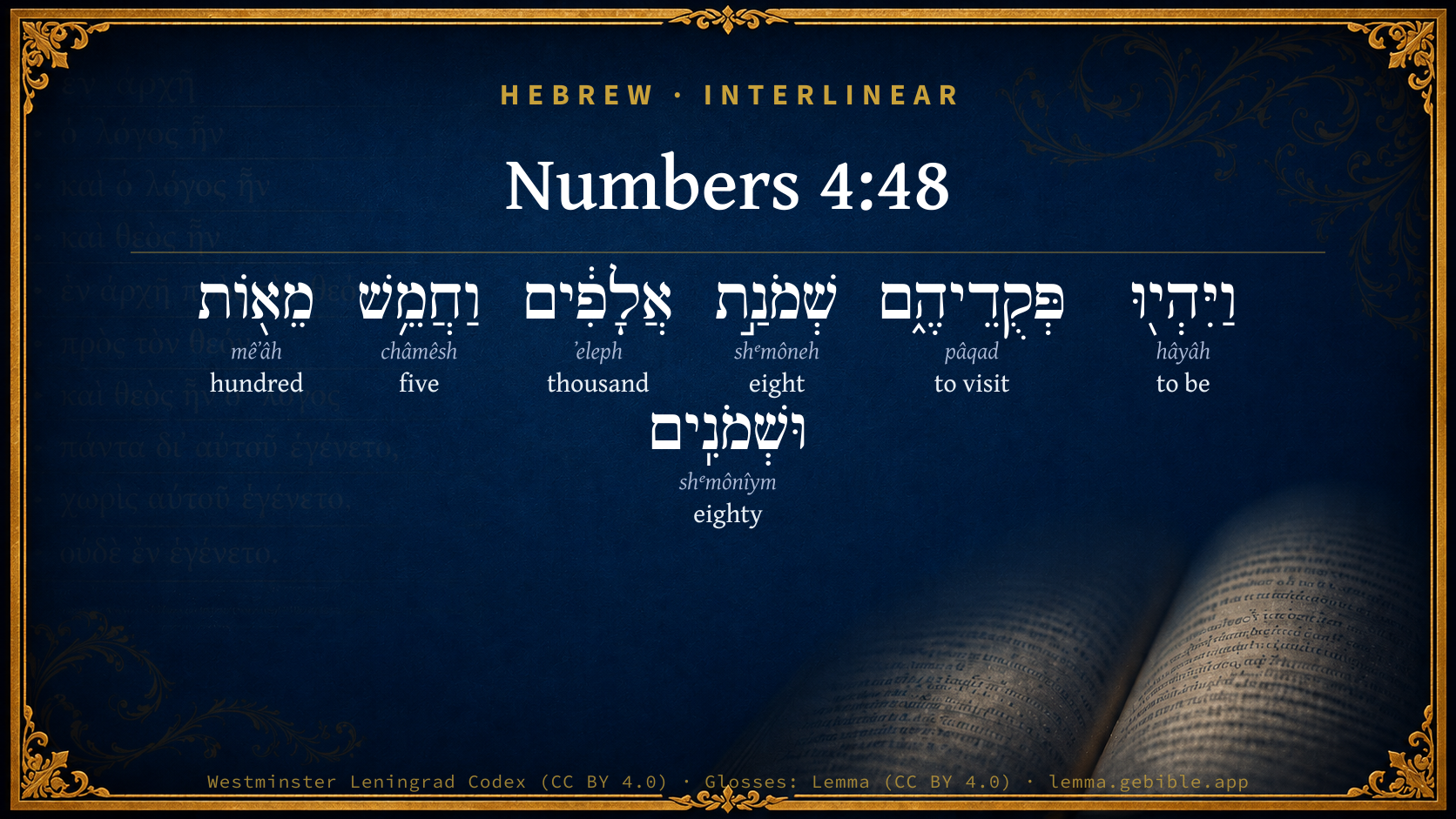
Hebrew (Westminster Leningrad Codex) Numbers 4:48 appears in the Hebrew Old Testament. The text above is from the Westminster Leningrad Codex. Each word links to its Strong’s number, a concise gloss, and parsing drawn from the Open Scriptures Hebrew Bible morphology. Click any word for its full Brown-Driver-Briggs (BDB) entry.
Download image
Cite this verse

Numbers 4:48 (World English Bible). Public Domain. Lemma interlinear Bible study tool, https://lemma.gebible.app/v/numbers/4/48.

Show BibTeX & RIS
BibTeX
RIS
English Translation
even those who were numbered of them, were eight thousand five hundred eighty.
World English Bible · Public Domain
Download a study sheet

One document with this verse’s original text, its word-by-word gloss line, the meaning frame, cross-references with their text, attributed commentary, and full source and license credits — printable, and it pastes into notes with its structure intact.

This verse Autodidact and up

Study sheet (.html) Plain text (.txt)

A passage Seminary Student

Up to 50 verses in one chapter. A passage sheet keeps up to 6 commentary sources and 12 cross-references per verse, in the order this page ranks them, and says so on the sheet whenever that leaves anything out. Ask for a single verse and you get the Autodidact verse sheet above.

Everything on this page stays free to read, with no account — the sheet is a download of what is already on screen, not access to it.

Want to remove ads? Support Godless Engineer
Compare translations 3

The same verse in 3 English versions, stacked beneath the original-language interlinear above. Click any original word for its lexicon entry.

Each is an independent rendering of the whole verse — the interlinear is not word-aligned to these translations.

Highlighted words mark where these versions differ — a whole-verse word diff, not a word-by-word alignment.

  • World English Bible Public Domain
    even those who were numbered of them, were eight thousand five hundred eighty.
  • King James Version Public Domain
    Even those that were numbered of them, were eight thousand and five hundred and fourscore,
  • unfoldingWord Literal Text CC BY-SA 4.0
    and their counted ones were 8,580.

unfoldingWord Literal Text — © unfoldingWord, licensed CC BY-SA 4.0. Word-aligned USFM3 via Door43 (git.door43.org/unfoldingWord/en_ult).

Versions to compare (up to 4)

3 of 4 selected

Show all 18 translations

Every available English version of this verse, each an independent rendering of the whole verse.

  • World English Bible Public Domain
    even those who were numbered of them, were eight thousand five hundred eighty.
  • Berean Standard Bible Public Domain
    And the number of men was 8,580.
  • Majority Standard Bible Public Domain
    And the number of men was 8,580.
  • King James Version Public Domain
    Even those that were numbered of them, were eight thousand and five hundred and fourscore,
  • American Standard Version (1901) Public Domain
    even those that were numbered of them, were eight thousand and five hundred and fourscore.
  • Revised Version (1885) Public Domain
    even those that were numbered of them, were eight thousand and five hundred and fourscore.
  • Geneva Bible (1599) Public Domain
    So the nombers of them were eight thousand, fiue hundreth and foure score.
  • Douay-Rheims (1899) Public Domain
    Were in all eight thousand five hundred and eighty.
  • Young's Literal Translation Public Domain
    even their numbered ones are eight thousand and five hundred and eighty;
  • Literal Standard Version CC BY-SA 4.0
    even their numbered ones are eight thousand and five hundred and eighty;
  • Unlocked Literal Bible CC BY-SA 4.0
    They counted 8,580 men.
  • unfoldingWord Literal Text CC BY-SA 4.0
    and their counted ones were 8,580.
  • Darby Bible Public Domain
    even those that were numbered of them, were eight thousand five hundred and eighty.
  • World Messianic Bible Public Domain
    even those who were counted of them, were eight thousand five hundred eighty.
  • Webster's Bible Public Domain
    Even those that were numbered of them, were eight thousand and five hundred and eighty.
  • Free Bible Version CC BY-SA 4.0
    The sum total was 8,580.
  • Bible in Basic English Public Domain
    Came to eight thousand, five hundred and eighty.
  • JPS Tanakh (1917) Public Domain
    even those that were numbered of them, were eight thousand and five hundred and fourscore.

Literal Standard Version (2020), Covenant Press — licensed CC BY-SA 4.0. Text via the HelloAO Bible API (eBible.org). Unlocked Literal Bible (unfoldingWord) — licensed CC BY-SA 4.0. Text via the HelloAO Bible API (eBible.org). unfoldingWord Literal Text — © unfoldingWord, licensed CC BY-SA 4.0. Word-aligned USFM3 via Door43 (git.door43.org/unfoldingWord/en_ult). Free Bible Version, Dr. Jonathan Gallagher — licensed CC BY-SA 4.0. Text via the HelloAO Bible API (eBible.org).

Word by word

More ways to search: Search by grammar → Find every occurrence → Compare this word →

Practice this passage: Drill this verse → Learn its vocabulary →

וּשְׁמֹנִֽים
shᵉmônîym
H8084
“and · eighty”
Conjunction + Adjective, Cardinal number, Both, Plural, Absolute
Part of Speech
Conjunction + Adjective
Type
Cardinal number
Gender
Both
Number
Plural
State
Absolute
Full BDB Definition

Origin: mult from H8083

TWOT: 2411b

eighty, fourscore - eighty (as cardinal number) - eightieth (as ordinal number) - in combination with other numbers
  1. וַיִּהְי֖וּ hâyâh H1961 “and · to be” Conjunction + Verb, Qal, Sequential Imperfect, 3rd Person, Masculine, Plural
  2. פְּקֻדֵיהֶ֑ם pâqad H6485 “visited · them” Verb, Qal, Participle Passive, Masculine, Plural, Construct + Suffix, Personal, 3rd Person, Masculine, Plural
  3. שְׁמֹנַ֣ת shᵉmôneh H8083 “eight” Adjective, Cardinal number, Masculine, Singular, Construct
  4. אֲלָפִ֔ים ʼeleph H505 “thousand” Adjective, Cardinal number, Both, Plural, Absolute
  5. וַחֲמֵ֥שׁ châmêsh H2568 “and · five” Conjunction + Adjective, Cardinal number, Feminine, Singular, Absolute
  6. מֵא֖וֹת mêʼâh H3967 “hundred” Adjective, Cardinal number, Both, Plural, Absolute

About this verse

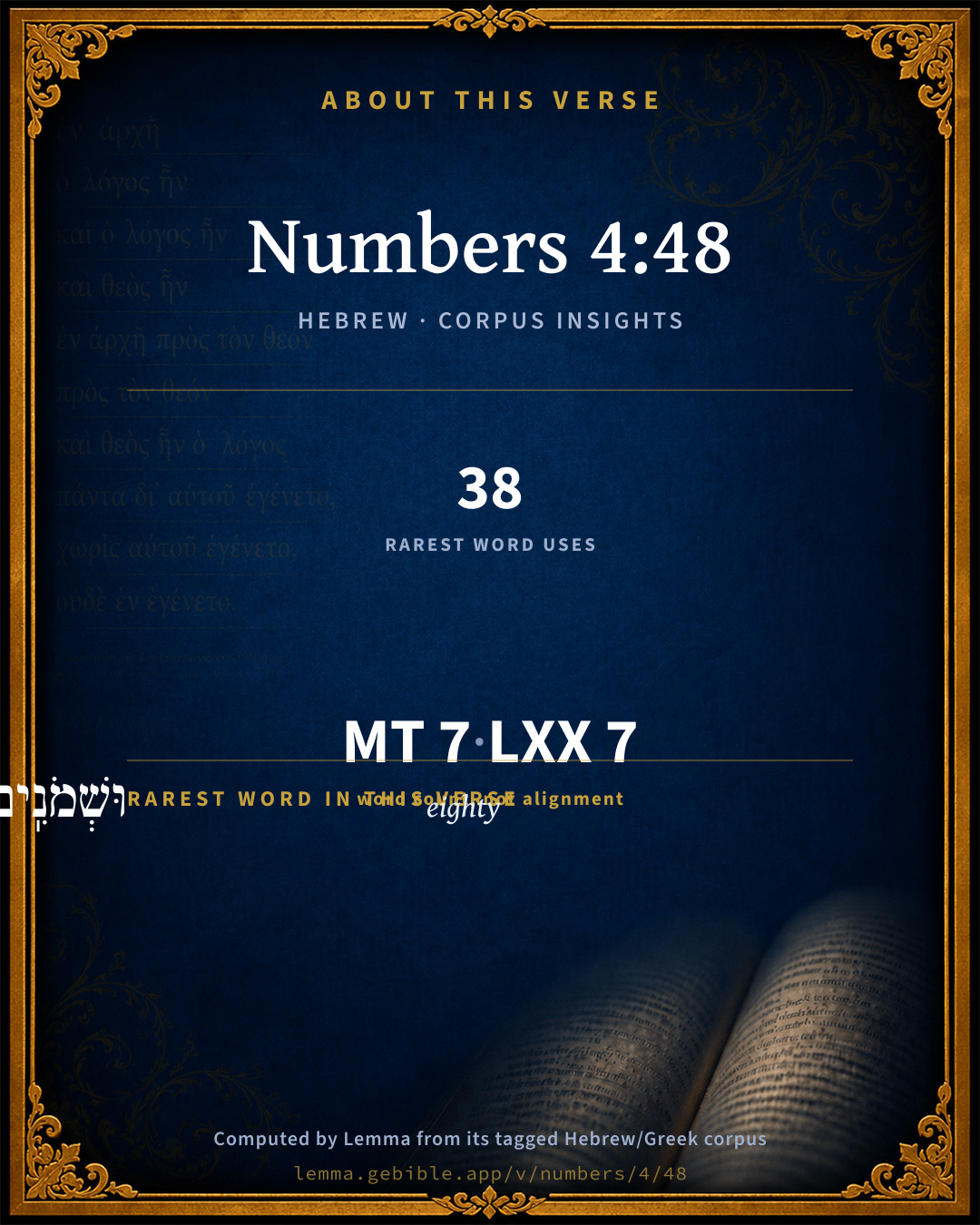
These counts appear in no published source. They are computed here, from the morphology-tagged text and Lemma’s own curated glosses. What Lemma adds →

7
words
7
distinct lemmas
Pentateuch
section

Shared distinctive vocabulary

וּשְׁמֹנִֽים eighty H8084 occurs in 37 verses of the Hebrew Bible. Also found in:

Grammatical profile

  • 2 verbs
  • 5 adjectives

Verb forms

  • וַיִּהְי֖וּ Qal · Sequential Imperfect
  • פְּקֻדֵיהֶ֑ם Qal · Participle Passive

Hebrew & Septuagint length

In English translation the verse runs 13 words from the Hebrew and 12 from the Septuagint (LXX English) — closely comparable.

A rough comparison of the two English renderings, which tokenize alike — not a word-level alignment.

Word counts can differ between the Hebrew and the Greek without any difference in meaning — e.g. the Hebrew direct-object marker אֵת has no separate Greek word, and Greek often adds the article ὁ.

In the original languages it is 7 Hebrew tokens and 7 Greek tokens — but the two are counted differently (Hebrew bundles its prefixes and suffixes into one token; the Greek is in lemma form), so that isn’t a like-for-like length.

Cross-references

4

Topical passages linked to Numbers 4:48 in the Treasury of Scripture Knowledge — connected by theme and wording, ordered by reader-vote popularity; previews shown in the World English Bible.

  • Numbers 3:39 All who were numbered of the Levites, whom Moses and Aaron numbered at the commandment of Yahweh, by their families, all the males from a month old and upward, were twenty-two thousand.
  • Matthew 7:14 How narrow is the gate, and restricted is the way that leads to life! Few are those who find it.
  • Matthew 20:16 So the last will be first, and the first last. For many are called, but few are chosen."
  • Matthew 22:15 Then the Pharisees went and took counsel how they might entrap him in his talk.

Cross-references courtesy of OpenBible.info (CC BY 4.0).

Hebrew and Greek witnesses Masoretic Hebrew ↔ Greek Septuagint

The same verse in the two great witnesses to the Old Testament, shown verse-for-verse.

These are two independent witnesses, not word-aligned to each other, and the Septuagint is shown in lemma (dictionary) form.

Hebrew Numbers 4:48 Masoretic · Westminster Leningrad Codex

וַיִּהְי֖וּ פְּקֻדֵיהֶ֑ם שְׁמֹנַ֣ת אֲלָפִ֔ים וַחֲמֵ֥שׁ מֵא֖וֹת וּשְׁמֹנִֽים

even those who were numbered of them, were eight thousand five hundred eighty.

World English Bible · Public Domain

Greek LXX Numbers 4:48 Septuagint · lemma form

καί γίγνομαι ὁ ἐπισκέπτω ὀκτακισχίλιοι πεντακόσιοι ὀγδοήκοντα

And they that were numbered were eight thousand five hundred and eighty.

LXX2012 (modern English Septuagint) · Public Domain

Hebrew: Westminster Leningrad Codex (CC BY 4.0). Greek: Septuagint (public domain); English from LXX2012 (modern English Septuagint) (Public Domain). How the Septuagint differs from the Hebrew →

Targum (Aramaic paraphrase)

2

The Targum is the ancient Jewish Aramaic paraphrase of the Hebrew Scriptures — an interpretive translation, not the Hebrew text itself. Onkelos (literal) and Pseudo-Jonathan (expansive) render the Torah, and Jonathan the Prophets. Coverage is partial: where no permissively-licensed English translation exists for a verse, only the Aramaic is shown. This is verse-level text, not a word-by-word alignment to the Hebrew.

  1. Targum Onkelos Torah (Genesis–Deuteronomy)
    וַהֲווֹ מִנְיָנֵיהוֹן תְּמַנְיָא אַלְפִין וַחֲמֵשׁ מְאָה וְתַמְנָן

    (no public-domain English translation for this verse)

    Targum Onkelos — Aramaic: “Onkelos Genesis” (public domain); “Onkelos Exodus” (public domain); “Onkelos Leviticus” (public domain); “Onkelos Numbers” (public domain); “Onkelos Deuteronomy” (public domain). English: “Sefaria Community Translation” (CC0 1.0 (public-domain dedication)); “J.W. Etheridge. The Targums of Onkelos and Jonathan Ben Uzziel on the Pentateuch. London: Longmans, Green, 1862” (public domain). Text via Sefaria.

  2. Targum Pseudo-Jonathan Torah (Genesis–Deuteronomy)
    וַהֲווֹ סְכוּמְהוֹן תְּמַנְיָא אַלְפִין וַחֲמֵשׁ מְאָה וְתַמְנָן

    was eight thousand five hundred and eighty.

    Targum Pseudo-Jonathan — Aramaic: “Targum Jonathan on Genesis” (public domain); “Targum Jonathan on Exodus” (public domain); “Targum Jonathan on Leviticus” (public domain); “Targum Jonathan on Numbers” (public domain); “Targum Jonathan on Deuteronomy” (public domain). English: “The Targum of Jonathan ben Uzziel, trans. J. W. Etheridge, London, 1862” (public domain). Text via Sefaria.

Commentary

Notes on Numbers 4:48 from classic Christian and Jewish commentators (each source and its license shown beneath its notes). The classic Christian expositions comment on the surrounding passage and are grouped to its opening verse, so a note may address several verses; the Jewish commentaries on the Tanakh (Rashi and others) are per-verse, so they appear only where the commentator wrote on this verse.

Lemma curates 59 commentaries, every one of them public domain or Creative Commons licensed, each selected and text-cleaned for this edition rather than reprinted as found. About our sources →

Trapp's Complete Commentary

John Trapp

Num 4:48 Even those that were numbered of them, were eight thousand and five hundred and fourscore.

Ver. 48. Eight thousand, &c.] What a poor few were these to the other tribes! God’s portion is ever the least.

John Trapp, A Commentary or Exposition upon All the Books of the Old and New Testament (1647–1656) — public domain. Text from a community e-Sword module.

Ellicott's Commentary for English Readers

(48) Eight thousand and five hundred and fourscore.—This number of men between the ages of twenty and fifty bears a just proportion to that of all the males from a month old and upwards—viz., 22,000.

A Bible Commentary for English Readers, edited by Charles John Ellicott (1878–1897) — public domain. Text from a community e-Sword module.

Matthew Poole's English Annotations

Which number was much inferior to any other tribe, for the reasons mentioned on Num 3:39.

Matthew Poole's English Annotations on the Holy Bible (1683–1685) — public domain. Text from a community e-Sword/MySword module.

The Pulpit Commentary

Those that were numbered of them were eight thousand and five hundred and fourscore. The census of each family is described in the same form of words with much particularity. No doubt it was carried out with extreme solicitude, as made for a purpose especially sacred and important. The results are remarkable in more ways than one. The following table presents the numbers in each family above one month, and between the ages of thirty and fifty.

Kohath, 8600 2750 percent 32

Gershon, 7500 2630 percent 35

Merari, 6200 3200 percent 51

22, 800 8580 percent 38

The first conclusion which naturally arises from these figures is, that after all the numbering must have been made by tens, and not by individuals. As it was impossible that 3000 persons could be employed in carrying the various portions of the tabernacle, it may be that each group of ten undertook a unit of responsibility. The second consideration is, that the average of men between thirty and fifty in all Levi is higher than modern statistics show (it is said to be twenty-five per cent. now in the whole population), although not very materially. The third is, that this average is very unequally distributed, rising to a most remarkable proportion in the case of Merari. It is quite clear that something must have disturbed the relative numbers as between the Merarites and the other families. It has been suggested that the small number of male Levites generally, and the small number of male Kohathites, between thirty and fifty especially, may have been caused by heavy losses incurred in carrying out the Divine sentence upon the worshippers of the golden calf (Num_5:1-4: REMOVAL OF THE UNCLEAN.

Vers. 5-10: RESTITUTION OF TRESPASS,

Vers. 11-31: JEALOUSY PURGED.

Chapter 6:1-21: NAZARITES DEDICATED.

Numbers 22-27: BLESSING OF THE PEOPLE.

Whether these portions of the Divine legislation are connected with the surrounding narrative

(1) by an order of time, as having been given at this point, or

(2) by a harmony of subject, as completing on its inward side the perfection of the camp, or whether

(3) their insertion here was in a sense accidental, and not now to be accounted for, must remain uncertain.

Against

(1) it must be observed that there is a decided break in the order of time at the beginning of chapter 7; against

(2) that a large part of the Levitical enactments might have been added here with an equal propriety.

Vers. 1-4. The necessity of putting away sin.

In this section we have, spiritually, the necessary sentence of banishment upon those defiled with sin, and the duty of separating them. Consider, therefore

I THAT NO LEPER MIGHT STAY IN THE CAMP OF ISRAEL; HE MUST BE "WITHOUT." Even so it is the necessary fate of the sinner, who is the true leper, a fate which God himself, as we may reverently believe, cannot alter, that he must be for ever separated from the company of all pure and holy beings. (Heb_12:14 Rev_21:27 Rev_22:15) Until he is healed he may be with, but not of, the people of God; numbered with them indeed, and following the earthly fortunes of the Church, as the lepers in the wilderness; but really separated from them, and this the more profoundly because of the outward proximity. If a sinner could go to heaven as a sinner, even there he would be a banished man, beholding the joy of the saints from outside with a sense of difference, of farness, which would itself be hell.

II THAT NO ONE UNCLEAN THROUGH ANY ISSUE MIGHT STAY IN THE CAMP OF ISRAEL. And this was more severe, because it was a much more common and much less dreadful case than leprosy, being in most cases neither very apparent nor very permanent; yet this also entailed banishment while it lasted. Even so all habits of sin, however little shocking to the natural mind, exclude the sinner until he be healed from the true fellowship of the saints. They are indeed "natural" enough to the fallen soul, as these issues are natural to our present body of humiliation, but they are not therefore harmless. One sinful habit, however common amongst men, would disqualify and unfit the soul for the companionship of heaven, and so would entail an inward and real exile even there. A habit of lying is one of the commonest outcomes of human life as it is; but "whatsoever... maketh a lie" must be "without.

III THAT NO ONE EVEN WHO HAD TOUCHED A DEAD BODY MIGHT STAY IN THE CAMP OF ISRAEL. The defilement of death passed over with the taint of it upon all that came in contact with the dead. Even so that contact, to which we are daily and hourly exposed, with those dead in trespasses and sins is enough to unfit us for fellowship with pure and holy beings. If only the taint, the subtle contagion, the imperceptible communication of spiritual death pass upon us, as it almost must in daily intercourse with the world, it separates pro tanto from the communion of saints. It must be purged by the daily prayer of repentance and supply of grace ere we can be at home and at one with the really holy. And note that these three forms of uncleanness

(1) leprosy, which was rare and dreadful;

(2) issues, which are common and little noticed:

(3) the taint of death, which was imperceptible save to God represent in a descending scale the three forms of sin which separate from God and his saints, viz.

(1) open and notorious wickedness;

(2) sinful habits such as spring out of ordinary life, and are little regarded;

(3) the subtle taint of spiritual death caught by careless contact with the evil world.

IV THAT IT WAS THE DUTY OF ISRAEL a duty to be discharged at cost of much inconvenience; a duty in which all must help, not sparing their own TO PUT AWAY ALL WHO WERE KNOWN TO BE POLLUTED FROM THE CAMPS. Even so it is the duty of the Churches of Christ to separate open sinners from their communion, not only lest others be defiled, but lest God be offended. (Mat_18:17 1Co_5:2, 1Co_5:11, 13 2Th_3:6) And note that many unclean may have remained in the camp, whose uncleanness was not suspected, or could not be proved; but if so, they alone were responsible. Even so there be very many evil men in the Church who cannot now be separated; but if the principle be zealously vindicated, the Church shall not suffer. (Mat_13:47, 49 1Co_11:19 2Ti_2:20)

HOMILIES BY W. BINNIE Vers. 1-4. The expulsion and restoration of the unclean.

The host has now been marshaled. The several tribes have taken the places allotted to them in relation to the tabernacle and to one another. They are about to set forth on the march from the wilderness of Sinai. Before the signal is given, certain final instructions for the regulation of the camp have yet to be delivered, and this about the removal of unclean persons is one of them. The general intention of it is intimated in the terms employed. The host is to be so ordered, both in the camp and on the march, as to make it a living picture of the Church, and the Church"s relation to God. It is to be made manifest that he dwells and walks among the covenant people, (Lev_26:11, Lev_26:12) that he is of pure eyes, and cannot suffer evil to dwell with him. Accordingly, there must in no wise abide in the camp any man or woman that is unclean. Persons afflicted with uncleanness must be removed, and live outside of the sacred precinct. Such is the law here laid down.

I IN ATTRIBUTING TO THIS LAW A RELIGIOUS INTENTION, I DO NOT FORGET THAT A LOWER AND MORE PROSAIC INTERPRETATION HAS SOMETIMES BEEN PUT ON IT. There are commentators who remind one of the man with the muck-rake in the "Pilgrim"s Progress." They have no eye except for what is earthly. To them the removal of the unclean is simply a sanitary measure. I freely admit that there was a sanitary intention. The sequestering of lepers, the early and "extramural" burial of the dead these are valuable sanitary provisions, and it is plain that this law would lead to them. But I need not wait to prove that the law looks higher, and that its paramount intention is moral and spiritual.

II Passing on, therefore, to the RELIGIOUS INTENTION Of this law, observe who exactly are excluded by it from the comp. They are of three sorts, viz., lepers, persons affected with issues of various kinds, and persons who had come in contact with the dead. This does not by any means exhaust the catalogue of defilements noted in the Levitical law. But these were the gravest. Only these three disabled from residence in the comp. My reason for calling attention to this point you will understand when I mention that these three uncleannesses, so prominent in the law of Moses, received the same kind of prominence in the gracious ministry of Christ. Read the story of the leper; (Mar_1:41) of the woman with the issue of blood; (Mar_5:27-30) of the raising of Jairus" daughter and the widow"s son at Nain. (Mar_5:41 and Luk_7:14) In no one of these passages is the Levitical law named. Much the greater number of those who read or hear them fail to perceive that in Christ"s mode of performing the miracles there was any reference to what the law had said about the defiling quality of the evils on which his gracious power was put forth. That there truly was a reference surely needs no proof. No Jew ever forgot what the penalty would be if he suffered himself to be in contact with a dead body, with a leper, with a person having an issue of blood. Certainly our Lord did not forget. Nor would it be doing justice to the truth to say that our Lord touched as he did, notwithstanding the defilement thereby contracted, and its troublesome consequences. He, of set purpose, sought occasion to put himself in contact with every one of the three causes of defilement noted in the law. Keeping this in mind, let us ask the meaning of the law.

1. The general intention. It was to be a memorial of the truth that our nature is deeply infected with sin, and that sin disables all in whom it is found for enjoying the fellowship of God here and hereafter. In this Levitical statute, I admit, the lesson is not taught explicitly. There was nothing morally wrong in any one of the three sources of defilement named. The teaching is by symbol a kind of object lesson and not the less impressive on that account.

2. The meaning of the several symbols.

(1) Defilement by the dead. Why is this? Because death is the wages of sin. (Gen_2:17 Gen_3:19) Compare the representation of death which pervades Psalm 90 prayer of Moses.

(2) Defilement by leprosy. A touching symbol. It admonishes us that sin, besides being blameworthy and deserving of death, is a vile thing, to be loathed and recoiled from, as men loathe and recoil from a leper; contagious also, and apt to spread.

(3) Of the third symbol I need say only this, that it reminds us that sin is a hereditary evil. (Psa_51:5)

3. The relation of this law to Christ and his work. That it has a relation has been already pointed out. The relation may be conceived of thus: The law is the dark ground on which the redemptive work of Christ unfolds the brightness of its grace. Christ did not keep aloof from the evils which afflict our fallen nature, and which perpetually remind us how deep our fall has been. He took occasion to put himself in contact with them. He touched the leprous man. Not that leprosy was sweet to him; it was to him as loathsome as to any man in Palestine that day. Nevertheless, he touched the leprous man, and the leprosy fled before the power of that touch. Leprosy, wasting issues, death these are the memorials and tokens of the sin that is the fatal heritage of our fallen race; and one who would know our need of redemption cannot do better than meditate on them as they are set forth in the Levitical law. Leprosy, wasting issues, death these evils our blessed Lord went up to in his ministry; he touched them, and their flight the instant that they felt his touch gave, and continues still to give, assurance to men that he is indeed the Saviour. He can forgive sin; he can make us clean; he is the resurrection and the life. B.

HOMILIES BY E.S. PROUT Vers. 1-4. The public exclusion of the unclean.

This law, like many others, in part a sanitary law; but also educational in spiritual truth, and typical of eternal realities. Two truths taught:

I THE HOLINESS OF GOD. This lesson, so hard to the Israelites, was impressed on them in many ways, e.g., sacred men ministering in sacred places, on sacred days, etc. This holy God dwelt in the midst of their tents, and walked among them. (Lev_26:11, Lev_26:12) The God of life and purity was utterly alien from death and impurity. Defilement, whether willful or unavoidable, could not be tolerated in his presence. If the polluted are retained, God withdraws. Sin is "the abominable thing" which God hates. He is "of purer eyes than to behold evil". (Jer_44:4 Hab_1:13)

II THE EXCOMMUNICATING POWER OF SIN. The consequences to the excluded Hebrews, though limited, were by no means light. They had to suffer loss of privileges, ceremonial and spiritual, and a sense of humiliation from the notoriety of their position. For the time they were out of communion with God and his people. Thus sin has an isolating power. Apart from an act of ecclesiastical excommunication or Divine judgment, its tendency is to separate us from the people of God through want of sympathy. We cease to enjoy their privileges even if not debarred from them. We lose self-respect when sin is exposed, if not before. We are out of communion with God, into whose presence we cannot truly come with sin indulged in our hearts. (Psa_66:18 Eze_14:3) God"s salvation is from sin, not in sin. No wonder, therefore, that the impure are sentenced

(1) to excommunication from the Church on earth, (1Co_5:9-13, etc.)

(2) to exclusion from the Church in heaven.. P. (Rev_21:27)

HOMILIES BY D. YOUNG Vers. 1-4. Things that defile.

The book up to this point is occupied with the counting and discipline of the people, both those for war and those for tabernacle service. Now the cleansing of the camp is to be attended to.

I THE CLASSES WHO WERE DECLARED UNCLEAN. Certainly we must not be too curious in our inquiries here, or we may soon pass the verge of what is edifying. But there are some points of note with regard to all three classes. The leper. Why should he be declared unclean? Perhaps as suffering from a more manifest disease than others, maybe a peculiarly offensive one, and one of the most difficult to cure. These are conjectures which give a little light, but the great reason for ceremonial uncleanness in the case of human beings, as in the case of lower animals, is to be found in Jehovah"s positive injunction. Leprosy was thus to be one of the great types in the body of the defiling effect of sin upon the soul. It is clear that in the course of ages the idea got fixed in the Israelite mind that the cure of leprosy was to be considered as a cleansing. Jesus commanded his apostles to heal the sick, cleanse the lepers. The leper was not a common victim, but singled out to impress the fact that the ultimate cause which produces disease is a strange and polluting thing; no necessary element in human nature, though now it be actually present in us all. The person with an issue. Thus uncleanness is connected with birth as well as with death. Whenever a child is born, a being is brought into the world, which certainly will add something to the evil in it, though possibly it may add much to the good. The saintliest of believers has had in hint the possibilities of the worst of unbelievers. Human nature is truly the creation of God, fearfully and wonderfully made; but there is also the fact of birth from sinful human parents to be remembered. This is a great mystery, to be delicately handled; but the uncleanness here indicated may be taken as intended to remind parents how one generation transmits not only nature, but sinful nature, to another. The person defiled by the dead. There is great. significance in being made unclean by the dead. Of all things in the world that manifest the effects of sin, this is the greatest death. By sin came death. All lesser results lead up to this. A dead body, in one sense as sacred a thing as there is in the world, is yet also one of the most unclean. As long as there is life there is something to protest against the reign of sin, and resist it; but life being gone, sin riots and revels in the corruption of what was once fair and strong. The coffin and the gravestone hide, but they only hide. It was one of our Lord"s most terrible words to the Pharisees to compare them to whited sepulchers.

II THE LINE OF SEPARATION. There are large details in Leviticus respecting all these instances of uncleanness (chapters 12-15). The line of separation was clearly marked, sternly enforced. To go out of the camp meant much personal inconvenience, perhaps pain suffering added on to existing suffering. Imagine the mother tending her sick child, waiting its expiring breath, closing its eyes, composing its body, then compelled to go without the comp. This typical ceremonial uncleanness indicates the sharp separation, between good and bad mere The word of God accords in all its references to this. There are two classes, and only two the clean and the unclean, the sheep and the goats, the wheat and tares, the children of God and the children of wrath. It also indicates the extent to which discipline can be carried in the Church of Christ on earth. There are some offences so plain that the guilty may at once be cut off from outward communion. But there may be others quite as unworthy who yet do and must escape, because their life makes no crying scandal. Many a professed and long-continued adherent to the true Church is, nevertheless, as worldly, hard, and selfish as any of the ungodly. God reckons all such outside the comp. He alone has the knowledge and authority to reckon. Learn then the danger of all spiritual uncleanness. That so much was declared typically unclean, shows that spiritual uncleanness is a very great danger. The boundary between the Church and the world cannot be too strictly kept. Since we are all advancing to death, it is proof of the power of sin in our nature. We are all unclean with the worst of uncleanness. It only waits for us to feel all the evil, and the way is clear to the remedy. Y. (1Jn_1:7-10)

The Pulpit Commentary (1880–1919), ed. H.D.M. Spence-Jones & Joseph S. Exell — public domain. Text from a community e-Sword module.

Lesson kit

Teaching starters — assembled from the data on this page, not authored interpretation. Every prompt links to the verse data it draws on. Edit before teaching.

Numbers, in the Pentateuch, opens this verse with 7 words (7 distinct Hebrew lemmas). Its most distinctive word is shᵉmônîym (“eighty”). A historical commentator’s framing appears above. Read the whole chapter for the surrounding context.

Discussion questions

  1. What does “eighty” (shᵉmônîym) contribute to the verse as a whole?
  2. Genesis 5:25 shares the word «eighty» with this verse. How do the two illuminate each other?
  3. The translations on this page render this verse differently — a whole-verse word diff, not a word-by-word alignment. What might account for the different wordings?
  4. The verb «וַיִּהְי֖וּ» is Qal Sequential Imperfect. How does its form color the action?
  5. Reading how Trapp's Complete Commentary and Ellicott's Commentary for English Readers read this verse, where do the two commentators agree and where do they part?

Things to notice

Reading settings

Reading text

Shown beneath each verse's original-language words.

Old Testament
Old Testament edition

Read the OT as the Masoretic Hebrew (MT) or the Greek Septuagint (LXX).

English shown for the Greek Septuagint (in the Hebrew ↔ Greek comparison).

Comparing translations? Open the Compare panel on any verse page to stack up to four side by side.