Isaiah 7:23

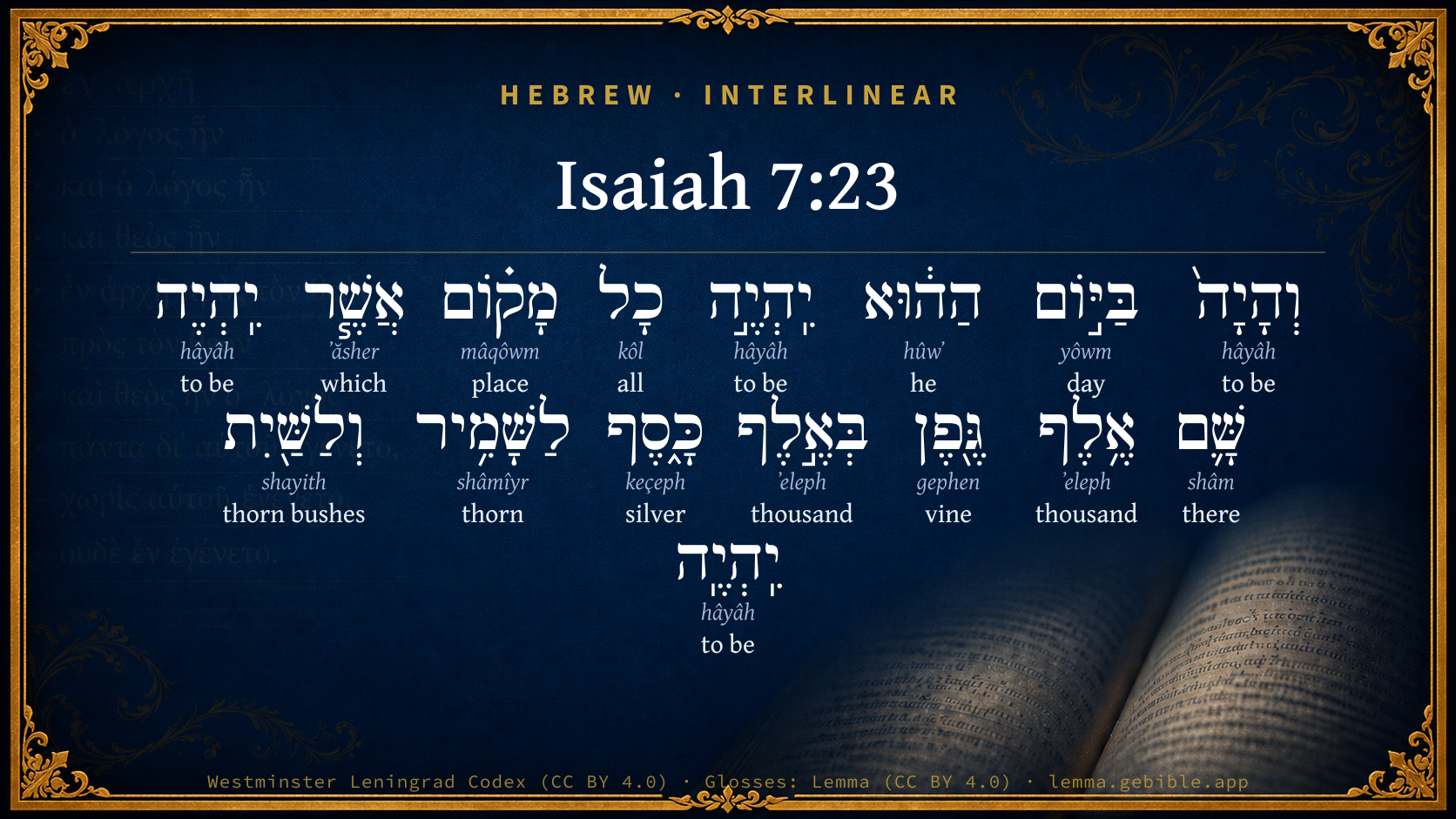
Hebrew (Westminster Leningrad Codex) Isaiah 7:23 appears in the Hebrew Old Testament. The text above is from the Westminster Leningrad Codex. Each word links to its Strong’s number, a concise gloss, and parsing drawn from the Open Scriptures Hebrew Bible morphology. Click any word for its full Brown-Driver-Briggs (BDB) entry.
Download image
Cite this verse

Isaiah 7:23 (World English Bible). Public Domain. Lemma interlinear Bible study tool, https://lemma.gebible.app/v/isaiah/7/23.

Show BibTeX & RIS
BibTeX
RIS
English Translation
It will happen in that day that every place where there were a thousand vines at a thousand silver shekels, shall be for briers and thorns.
World English Bible · Public Domain
Download a study sheet

One document with this verse’s original text, its word-by-word gloss line, the meaning frame, cross-references with their text, attributed commentary, and full source and license credits — printable, and it pastes into notes with its structure intact.

This verse Autodidact and up

Study sheet (.html) Plain text (.txt)

A passage Seminary Student

Up to 50 verses in one chapter. A passage sheet keeps up to 6 commentary sources and 12 cross-references per verse, in the order this page ranks them, and says so on the sheet whenever that leaves anything out. Ask for a single verse and you get the Autodidact verse sheet above.

Everything on this page stays free to read, with no account — the sheet is a download of what is already on screen, not access to it.

Want to remove ads? Support Godless Engineer
Compare translations 3

The same verse in 3 English versions, stacked beneath the original-language interlinear above. Click any original word for its lexicon entry.

Each is an independent rendering of the whole verse — the interlinear is not word-aligned to these translations.

Highlighted words mark where these versions differ — a whole-verse word diff, not a word-by-word alignment.

  • World English Bible Public Domain
    It will happen in that day that every place where there were a thousand vines at a thousand silver shekels, shall be for briers and thorns.
  • King James Version Public Domain
    And it shall come to pass in that day, that every place shall be, where there were a thousand vines at a thousand silverlings, it shall even be for briers and thorns.
  • unfoldingWord Literal Text CC BY-SA 4.0
    And it will happen in that day, it will be, every place where a thousand vines at a thousand of silver were there, it will become briar and thorn.

unfoldingWord Literal Text — © unfoldingWord, licensed CC BY-SA 4.0. Word-aligned USFM3 via Door43 (git.door43.org/unfoldingWord/en_ult).

Versions to compare (up to 4)

3 of 4 selected

Show all 18 translations

Every available English version of this verse, each an independent rendering of the whole verse.

  • World English Bible Public Domain
    It will happen in that day that every place where there were a thousand vines at a thousand silver shekels, shall be for briers and thorns.
  • Berean Standard Bible Public Domain
    And on that day, in every place that had a thousand vines worth a thousand shekels of silver, only briers and thorns will be found.
  • Majority Standard Bible Public Domain
    And on that day, in every place that had a thousand vines worth a thousand shekels of silver, only briers and thorns will be found.
  • King James Version Public Domain
    And it shall come to pass in that day, that every place shall be, where there were a thousand vines at a thousand silverlings, it shall even be for briers and thorns.
  • American Standard Version (1901) Public Domain
    And it shall come to pass in that day, that every place, where there were a thousand vines at a thousand silverlings, shall be for briers and thorns.
  • Revised Version (1885) Public Domain
    And it shall come to pass in that day, that every place, where there were a thousand vines at a thousand silverlings, shall even be for briers and thorns.
  • Geneva Bible (1599) Public Domain
    And at the same day euery place, wherein shalbe a thousand vines, shalbe at a thousand pieces of siluer: so it shalbe for the briers and for the thornes.
  • Douay-Rheims (1899) Public Domain
    And it shall come to pass in that day, that every place where there were a thousand vines, at a thousand pieces of silver, shall become thorns and briers.
  • Young's Literal Translation Public Domain
    And it hath come to pass, in that day, Every place where there are a thousand vines, At a thousand silverlings, Is for briers and for thorns.
  • Literal Standard Version CC BY-SA 4.0
    And it has come to pass in that day, || Every place where there are one thousand vines, || At one thousand pieces of silver, || Is for briers and for thorns.
  • Unlocked Literal Bible CC BY-SA 4.0
    At that time, where there were a thousand vines worth a thousand silver shekels, there will be nothing but briers and thorns.
  • unfoldingWord Literal Text CC BY-SA 4.0
    And it will happen in that day, it will be, every place where a thousand vines at a thousand of silver were there, it will become briar and thorn.
  • Darby Bible Public Domain
    And it shall come to pass in that day, [that] every place, where there were a thousand vines at a thousand silver pieces, shall become briars and thorns:
  • World Messianic Bible Public Domain
    It will happen in that day that every place where there were a thousand vines worth a thousand silver shekels, will be for briers and thorns.
  • Webster's Bible Public Domain
    And it shall come to pass in that day, that every place shall be, where there were a thousand vines at a thousand pieces of silver, it shall even be for briers and thorns.
  • Free Bible Version CC BY-SA 4.0
    At that time everywhere that once had a thousand vines worth a thousand shekels will only have brambles and thorns.
  • Bible in Basic English Public Domain
    And it will be in that day that in every place where before there were a thousand vines valued at a thousand shekels of silver, there will be nothing but blackberries and thorns.
  • JPS Tanakh (1917) Public Domain
    And it shall come to pass in that day, that every place, where there were a thousand vines at a thousand silverlings, shall even be for briers and thorns.

Literal Standard Version (2020), Covenant Press — licensed CC BY-SA 4.0. Text via the HelloAO Bible API (eBible.org). Unlocked Literal Bible (unfoldingWord) — licensed CC BY-SA 4.0. Text via the HelloAO Bible API (eBible.org). unfoldingWord Literal Text — © unfoldingWord, licensed CC BY-SA 4.0. Word-aligned USFM3 via Door43 (git.door43.org/unfoldingWord/en_ult). Free Bible Version, Dr. Jonathan Gallagher — licensed CC BY-SA 4.0. Text via the HelloAO Bible API (eBible.org).

Word by word

More ways to search: Search by grammar → Find every occurrence → Compare this word →

Practice this passage: Drill this verse → Learn its vocabulary →

וְלַשַּׁ֖יִת
shayith
H7898
“and · to/for the · thorn bushes”
Conjunction + Preposition, Determined + Noun, Common, Masculine, Singular, Absolute
Part of Speech
Conjunction + Preposition + Noun
Type
Common
Gender
Masculine
Number
Singular
State
Absolute
Full BDB Definition

Origin: from H7896

TWOT: 2380c

thorn bushes
  1. וְהָיָה֙ hâyâh H1961 “and · to be” Conjunction + Verb, Qal, Sequential Perfect, 3rd Person, Masculine, Singular
  2. בַּיּ֣וֹם yôwm H3117 “in/at the · day” Preposition, Determined + Noun, Common, Masculine, Singular, Absolute
  3. הַה֔וּא hûwʼ H1931 “the · he” Particle, Definite Article + Pronoun, Personal, 3rd Person, Masculine, Singular
  4. יִֽהְיֶ֣ה hâyâh H1961 “to be” Verb, Qal, Imperfect, 3rd Person, Masculine, Singular
  5. כָל kôl H3605 “all of” Noun, Common, Masculine, Singular, Construct
  6. מָק֗וֹם mâqôwm H4725 “place” Noun, Common, Masculine, Singular, Absolute
  7. אֲשֶׁ֧ר ʼăsher H834 “which” Particle, Relative
  8. יִֽהְיֶה hâyâh H1961 “to be” Verb, Qal, Imperfect, 3rd Person, Masculine, Singular
  9. שָּׁ֛ם shâm H8033 “there” Adverb
  10. אֶ֥לֶף ʼeleph H505 “thousand” Adjective, Cardinal number, Both, Singular, Absolute
  11. גֶּ֖פֶן gephen H1612 “vine” Noun, Common, Both, Singular, Absolute
  12. בְּאֶ֣לֶף ʼeleph H505 “in/at · thousand” Preposition + Adjective, Cardinal number, Both, Singular, Absolute
  13. כָּ֑סֶף keçeph H3701 “silver” Noun, Common, Masculine, Singular, Absolute
  14. לַשָּׁמִ֥יר shâmîyr H8068 “to/for the · thorn” Preposition, Determined + Noun, Common, Masculine, Singular, Absolute
  15. יִֽהְיֶֽה hâyâh H1961 “to be” Verb, Qal, Imperfect, 3rd Person, Masculine, Singular

About this verse

These counts appear in no published source. They are computed here, from the morphology-tagged text and Lemma’s own curated glosses. What Lemma adds →

16
words
12
distinct lemmas
Prophets
section

Notable vocabulary

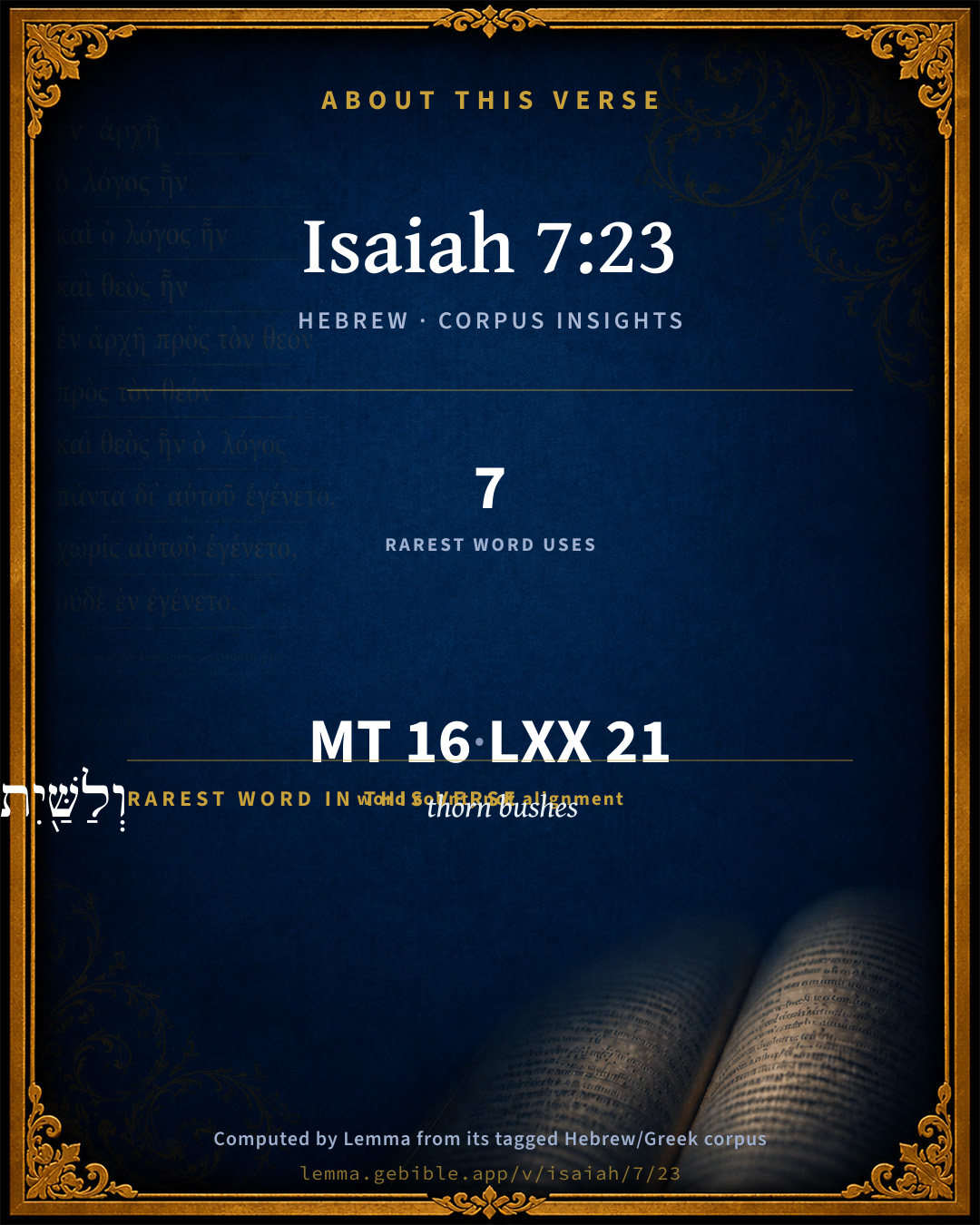
The rarest word here is וְלַשַּׁ֖יִת thorn bushes H7898 — appearing just 7 times in the whole Hebrew Bible.

Shared distinctive vocabulary

וְלַשַּׁ֖יִת thorn bushes H7898 occurs in 7 verses of the Hebrew Bible. Also found in:

Grammatical profile

  • 4 verbs
  • 7 nouns
  • 2 adjectives
  • 1 pronoun
  • 1 adverb
  • 1 particle

Verb forms

  • וְהָיָה֙ Qal · Sequential Perfect
  • יִֽהְיֶ֣ה Qal · Imperfect
  • יִֽהְיֶה Qal · Imperfect
  • יִֽהְיֶֽה Qal · Imperfect

Repetition

Words recur within this verse — often emphatic in Hebrew:

  • וְהָיָה֙ to be H1961 ×4
  • אֶ֥לֶף thousand H505 ×2

Hebrew & Septuagint length

In English translation the verse runs 26 words from the Hebrew and 30 from the Septuagint (LXX English) — closely comparable.

A rough comparison of the two English renderings, which tokenize alike — not a word-level alignment.

Word counts can differ between the Hebrew and the Greek without any difference in meaning — e.g. the Hebrew direct-object marker אֵת has no separate Greek word, and Greek often adds the article ὁ.

In the original languages it is 16 Hebrew tokens and 21 Greek tokens — but the two are counted differently (Hebrew bundles its prefixes and suffixes into one token; the Greek is in lemma form), so that isn’t a like-for-like length.

Cross-references

6

Topical passages linked to Isaiah 7:23 in the Treasury of Scripture Knowledge — connected by theme and wording, ordered by reader-vote popularity; previews shown in the World English Bible.

  • Isaiah 5:6 I will lay it a wasteland. It won't be pruned nor hoed, But it will grow briers and thorns. I will also command the clouds that they rain no rain on it."
  • Song of Solomon 8:11–12 Solomon had a vineyard at Baal Hamon. He leased out the vineyard to keepers. Each was to bring a thousand shekels of silver for its fruit.
  • Matthew 21:33 "Hear another parable. There was a man who was a master of a household, who planted a vineyard, set a hedge about it, dug a winepress in it, built a tower, leased it out to farmers, and went into another country.
  • Isaiah 32:12–14 They shall strike on the breasts for the pleasant fields, for the fruitful vine.
  • Jeremiah 4:26 I saw, and, behold, the fruitful field was a wilderness, and all the cities of it were broken down at the presence of Yahweh, [and] before his fierce anger.
  • Hebrews 6:8 but if it bears thorns and thistles, it is rejected and near being cursed, whose end is to be burned.

Cross-references courtesy of OpenBible.info (CC BY 4.0).

Hebrew and Greek witnesses Masoretic Hebrew ↔ Greek Septuagint

The same verse in the two great witnesses to the Old Testament, shown verse-for-verse.

These are two independent witnesses, not word-aligned to each other, and the Septuagint is shown in lemma (dictionary) form.

Hebrew Isaiah 7:23 Masoretic · Westminster Leningrad Codex

וְהָיָה֙ בַּיּ֣וֹם הַה֔וּא יִֽהְיֶ֣ה כָל מָק֗וֹם אֲשֶׁ֧ר יִֽהְיֶה שָּׁ֛ם אֶ֥לֶף גֶּ֖פֶן בְּאֶ֣לֶף כָּ֑סֶף לַשָּׁמִ֥יר וְלַשַּׁ֖יִת יִֽהְיֶֽה

It will happen in that day that every place where there were a thousand vines at a thousand silver shekels, shall be for briers and thorns.

World English Bible · Public Domain

Greek LXX Isaiah 7:23 Septuagint · lemma form

καί εἰμί ἐν ὁ ἡμέρα ἐκεῖνος πᾶς τόπος ὅς ἐάν οὖς χίλιοι ἄμπελος χίλιοι σίκλος εἰς χέρσος εἰμί καί εἰς ἄκανθα

And it shall come to pass in that day, for every place where there shall be a thousand vines at a thousand shekels, they shall become barren land and thorns.

LXX2012 (modern English Septuagint) · Public Domain

Hebrew: Westminster Leningrad Codex (CC BY 4.0). Greek: Septuagint (public domain); English from LXX2012 (modern English Septuagint) (Public Domain). How the Septuagint differs from the Hebrew →

Targum (Aramaic paraphrase)

1

The Targum is the ancient Jewish Aramaic paraphrase of the Hebrew Scriptures — an interpretive translation, not the Hebrew text itself. Onkelos (literal) and Pseudo-Jonathan (expansive) render the Torah, and Jonathan the Prophets. Coverage is partial: where no permissively-licensed English translation exists for a verse, only the Aramaic is shown. This is verse-level text, not a word-by-word alignment to the Hebrew.

  1. Targum Jonathan Prophets (Joshua–Malachi)
    וִיהֵי בְּעִדָנָא הַהִיא יְהֵי כָל אֲתַר דִיהוֹן תַּמָן אֶלֶף גוּפְנִין שַׁוְיָן בְּאֶלֶף מָנִין כְּסַף לְהוֹבָאֵי וּבוּר יְהֵי:

    And it shall come to pass in that time, that every place shall be, where there were a thousand vines for a thousand silverlings, it shall even be for briers and thorns.

    Targum Jonathan — Aramaic: “Mikraot Gedolot” (public domain). English: “Sefaria Community Translation” (CC0 1.0 (public-domain dedication)); “London "Chaldee Paraphrase," 1871” (public domain). Text via Sefaria.

Commentary

Notes on Isaiah 7:23 from classic Christian and Jewish commentators (each source and its license shown beneath its notes). The classic Christian expositions comment on the surrounding passage and are grouped to its opening verse, so a note may address several verses; the Jewish commentaries on the Tanakh (Rashi and others) are per-verse, so they appear only where the commentator wrote on this verse.

Lemma curates 59 commentaries, every one of them public domain or Creative Commons licensed, each selected and text-cleaned for this edition rather than reprinted as found. About our sources →

Trapp's Complete Commentary

John Trapp

Isa 7:23 And it shall come to pass in that day, [that] every place shall be, where there were a thousand vines at a thousand silverlings, it shall [even] be for briers and thorns.

Ver. 23. Where there were a thousand vines.] Which once were to the sensual Jews an occasion of drunkenness and forgetfulness of God. {Isa 5:11-12} A Lapide on Isa 5:2, telleth us that at Herbipolis in Germany there are abundance of vineyards, so that they have more wine there than water; and such huge wine vessels, that the vintners have doors in the sides of them whereby they enter, as Diogenes did into his tub, to make them clean and fit for their use.

Shall be briers and thorns.] Agri quondam vitibus consiti, erunt obsiti vepribus, et dumetis densissimis hirsuti.

John Trapp, A Commentary or Exposition upon All the Books of the Old and New Testament (1647–1656) — public domain. Text from a community e-Sword module.

Keil & Delitzsch

C. F. Keil & F. Delitzsch

The prophet repeats this three times in Isa 7:23-25 : "And it will come to pass in that day, every place, where a thousand vines stood at a thousand silverlings, will have become thorns and thistles. With arrows and with bows will men go, for the whole land will have become thorns and thistles. And all the hills that were accustomed to be hoed with the hoe, thou wilt not go to them for fear of thorns and thistles; and it has become a gathering-place for oxen, and a treading-place for sheep." The "thousand silverlings" ('eleph ceseph, i.e., a thousand shekels of silver) recall to mind Sol 8:11, though there it is the value of the yearly produce, whereas here the thousand shekels are the value of a thousand vines, the sign of a peculiarly valuable piece of a vineyard. At the present time they reckon the worth of a vineyard in Lebanon and Syria according to the value of the separate vines, and generally take the vines at one piastre (from 2nd to 3rd) each; just as in Germany a Johannisberg vine is reckoned at a ducat. Every piece of ground, where such valuable vines were standing, would have fallen a prey to the briers. People would go there with bow and arrow, because the whole land had become thorns and thistles (see at Isa 5:12), and therefore wild animals had made their homes there. And thou (the prophet addresses the countryman thus) comest not to all the hills, which were formerly cultivated in the most careful manner; thou comest not thither to make them arable again, because thorns and thistles deter thee from reclaiming such a fallow. They would therefore give the oxen freedom to rove where they would, and let sheep and goats tread down whatever grew there. The description is intentionally thoroughly tautological and pleonastic, heavy and slow in movement. The writer's intention is to produce the impression of a waste heath, or tedious monotony. Hence the repetitions of hâyâh and yihyeh. Observe how great the variations are in the use of the future and perfect, and how the meaning is always determined by the context. In Isa 7:21, Isa 7:22, the futures have a really future sense; in Isa 7:23 the first and third yihyeh signify "will have become" (factus erit omnis locus), and the second "was" (erat); in Isa 7:24 יבוא means "will come" (veniet), and tihyeh "will have become" (facta erit terra); in Isa 7:25 we must render yē‛âdērūn, sarciebantur (they used to be hoed). And in Isa 7:21, Isa 7:22, and Isa 7:23, hâyâh is equivalent to fiet (it will become); whilst in Isa 7:25 it means factum est (it has become). Looked at from a western point of view, therefore, the future tense is sometimes a simple future, sometimes a future perfect, and sometimes an imperfect or synchronistic preterite; and the perfect sometimes a prophetic preterite, sometimes an actual preterite, but the sphere of an ideal past, or what is the same thing, of a predicted future.

This ends Isaiah's address to king Ahaz. He does not expressly say when Immanuel is to be born, but only what will take place before he has reached the riper age of boyhood - namely, first, the devastation of Israel and Syria, and then the devastation of Judah itself, by the Assyrians. From the fact that the prophet says no more than this, we may see that his spirit and his tongue were under the direction of the Spirit of God, who does not descend within the historical and temporal range of vision, without at the same time remaining exalted above it. On the other hand, however, we may see from what he says, that the prophecy has its human side as well. When Isaiah speaks of Immanuel as eating thickened milk and honey, like all who survived the Assyrian troubles in the Holy Land; he evidently looks upon and thinks of the childhood of Immanuel as connected with the time of the Assyrian calamities. And it was in such a perspective combination of events lying far apart, that the complex character of prophecy consisted. The reason for this complex character was a double one, viz., the human limits associated with the prophet's telescopic view of distant times, and the pedagogical wisdom of God, in accordance with which He entered into these limits instead of removing them. If, therefore, we adhere to the letter of prophecy, we may easily throw doubt upon its veracity; but if we look at the substance of the prophecy, we soon find that the complex character by no means invalidates its truth. For the things which the prophet saw in combination were essentially connected, even though chronologically separated. When, for example, in the case before us (chapters 7-12), Isaiah saw Asshur only, standing out as the imperial kingdom; this was so far true, that the four imperial kingdoms from the Babylonian to the Roman were really nothing more than the full development of the commencement made in Assyria. And when he spoke of the son of the virgin (chapter 7) as growing up in the midst of the Assyrian oppressions; this also was so far true, that Jesus was really born at a time when the Holy Land, deprived of its previous abundance, was under the dominion of the imperial power, and in a condition whose primary cause was to be traced to the unbelief of Ahaz. Moreover, He who became flesh in the fulness of time, did really lead an ideal life in the Old Testament history. He was in the midst of it in a pre-existent presence, moving on towards the covenant goal. The fact that the house and nation of David did not perish in the Assyrian calamities, was actually to be attributed, as chapter 8 presupposes, to His real though not His bodily presence. In this way the apparent discrepancy between the prophecy and the history of the fulfilment may be solved. We do not require the solution proposed by Vitringa, and recently appropriate by Haneberg - namely, that the prophet takes the stages of the Messiah's life out of the distant future, to make them the measure of events about to take place in the immediate future; nor that of Bengel, Schegg, Schmieder, and others - namely, that the sign consisted in an event belonging to the immediate future, which pointed typically to the birth of the true Immanuel; nor that of Hofmann, who regards the words of the prophet as an emblematical prediction of the rise of a new Israel, which would come to the possession of spiritual intelligence in the midst of troublous times, occasioned by the want of intelligence in the Israel of his own time. The prophecy, as will be more fully confirmed as we proceed, is directly Messianic; it is a divine prophecy within human limits.

Keil & Delitzsch — Biblical Commentary on the Old Testament (1861–1891) — public domain (CC PDM 1.0). Text via the HelloAO Bible API. (Old Testament only.)

Tyndale Open Study Notes

Tyndale Open Resources

7:23-25 Farmers faced near total disaster. Fertile agricultural fields (lush vineyards) would revert to wild grazing lands dominated by worthless plants (briers and thorns; see 5:6).

Tyndale Open Study Notes — © Tyndale Open Resources, licensed CC BY-SA 4.0. Text via the HelloAO Bible API.

Jamieson, Fausset & Brown

Robert Jamieson, A. R. Fausset & David Brown

where there were, &c.--where up to that time there was so valuable a vineyard as to have in it a 1000 vines, worth a silverling (shekel, about 2s. 3d.; a large price) each, there shall be only briers (Sol 8:11). Vineyards are estimated by the number of the vines, and the goodness of the kind of vine. Judea admits of a high state of cultivation, and requires it, in order to be productive; its present barrenness is due to neglect.

Jamieson, Fausset & Brown — Commentary Critical and Explanatory on the Whole Bible (1871) — public domain (CC PDM 1.0). Text via the HelloAO Bible API.

Ellicott's Commentary for English Readers

(23) Where there were a thousand vines at a thousand silverlings.—The words seem to contain an allusive reference to Son_8:11, and are therefore worth noting as bearing on the date of that book. There, however, the sum represents the annual produce of the vineyard, here the rent of the vines at a shekel each, a high rent apparently, and indicating a choice quality of vine. The costly vineyards of the hills of Judah should be left to run wild without a keeper (Isa_5:10), and thorns and briers would rapidly cover it. “Silverling” was an old English word for any silver coin, and appears in Tyndale’s version of Act_19:19, and Coverdale’s of Jdg_9:4; Jdg_16:5; here it stands for “shekel.” The modern rent is said to be a piastre (2d.) for each vine; the shekel was worth 2s. 3 d. (Kay).

A Bible Commentary for English Readers, edited by Charles John Ellicott (1878–1897) — public domain. Text from a community e-Sword module.

The Cambridge Bible for Schools and Colleges

gen. ed. J. J. S. Perowne

23. a thousand vines at a thousand silverlings] i.e. “silver shekels.” Schrader reckons the silver shekel as equal to about half-a-crown of our money, which would make the price of the vineyard about £125. But the estimate neglects the important element of variation in the purchasing power of money. The traveller Burckhardt, who found it the custom in Syria to estimate the value of a vineyard according to the number of vines, tells us that good vines are valued at less than three pence each.

23–25. The most costly vineyards, requiring the most sedulous cultivation, are overrun by thorns and thistles, cf. ch. Isa_5:6.

The Cambridge Bible for Schools and Colleges (gen. ed. J. J. S. Perowne; Cambridge University Press, 1878–1918) — public domain. Text from a community e-Sword module.

John Gill's Exposition

And it shall come to pass in that day; that every place shall be,.... Barren and unfruitful, for want of men to till the ground:

where there were a thousand vines at a thousand silverlings; which were so good, as to be sold or let out for so many silver shekels (m); or the fruit of them came to such a price; see Sol 8:11,

it shall even be for briers and thorns; for want of persons to stock the ground and cultivate it.

(m) Which was about two shillings and sixpence of our money.

John Gill's Exposition of the Whole Bible (1746–1763) — public domain (CC PDM 1.0). Text via the HelloAO Bible API.

Albert Barnes' Notes on the Bible

The remainder of this chapter is a description of great desolation produced by the invasion of the Assyrians. “Where there were a thousand vines.” Where there was a valuable vineyard. In every place, that is, that was well cultivated and valuable.

At a thousand silverlings - The word rendered ‘silvertings’ here - כסף keseph - denotes, properly, silver, of any amount. But it is also used to denote the silver coin which was in use among the Jews, the shekel. Perhaps this was the only silver coin which, in early times, they possessed, and hence, the word shekel is omitted, and so many pieces of silver are mentioned. Thus, in Gen 20:16, Abimelech says, that he had given Abraham, a thousand of silver’ - that is, a thousand shekels. The shekel was worth about two shillings of our money. It is probable that a vineyard would be valued, in proportion to the number of vines that could be raised on the smallest space; and the meaning is here, that the land that was most fertile, and that produced the most, would be desolate, and would produce only briers and thorns. The land in Judea admits of a high state of cultivation, and requires it, in order to make it productive. When neglected, it becomes as remarkably sterile. At present, it generally bears the marks of great barrenness and sterility. It is under the oppression of Turkish power and exactions; and the consequence is, that, to a traveler, it has the appearance of great barrenness. But, in the high state to which the Jews brought it, it was eminently fertile, and is capable still of becoming so, if it should be placed under a government that would encourage agriculture and bestow freedom. This is the account which all travelers give of it now.

Albert Barnes' Notes on the Bible (1834–1885) — public domain. Text from a community e-Sword/MySword module.

Haydock's Catholic Bible Commentary

Pieces. Sicles. This was the price of the best vineyards, Canticle of Canticles viii. 2. (Calmet) --- Now people may hunt in them. (Haydock) --- The subjects of Achaz were much reduced. (Calmet)

George Leo Haydock (1774–1849), Haydock's Catholic Family Bible and Commentary, 1859 edition — public domain. Excludes Psalms (Douay-Rheims chapter numbering differs from Protestant) and Deuterocanonical books (Catholic canon only).

Matthew Poole's English Annotations

A thousand vines at a thousand silverings; or, pieces of silver, as the same word is commonly rendered. Whereby we may understand either,

1. So many pounds; a pound for each vineyard, to wit, for the annual rent. Or,

2. So many shekels, which word is most commonly understood, when no particular kind of coin is expressed, as 2Sa 18:11,12; Mt 26:15; and then the meaning is, not that the thousand vineyards were let for a thousand shekels, a vineyard for a shekel, which is a contemptible price; but that each of the thousand vineyards might have been sold or let for a thousand shekels, which was the yearly rent of some excellent vineyards, as may be gathered from Son 8:11; except we understand this not of so many vineyards, as other interpreters do, but of so many single vines, as the word properly and generally signifies, planted together in one large vineyard, which may be here meant by the place of the river, and then each vine may be valued at a shekel. But this place may possibly be otherwise rendered, and that exactly according to the Hebrew text, every place where there are a thousand vines, shall be for a thousand pieces of silver, i.e. it shall be valued or offered, either to be let, or rather to be sold, at that price; which was a very low price, and therefore fitly signifies the greatness of the desolation.

It shall even be for briers and thorns, because it shall be utterly neglected, and therefore overspread with them. Or, yea,

it shall be for briers and thorns. No man will either buy or hire it upon any terms.

Matthew Poole's English Annotations on the Holy Bible (1683–1685) — public domain. Text from a community e-Sword/MySword module.

Whedon's Commentary on the Bible

Daniel D. Whedon

23. Where there were, etc. — Where there were abundant and flourishing vineyards, and one vineyard had a thousand vines, worth each a silverling, or silver shekel, (about fifty-five or sixty cents.) Vineyards were estimated by the number of the vines and the quality of wine they produced. All these vineyards shall be overrun with briers, etc. — a wild waste for the fierce animals. And because of this fact hunters shall flock here with their weapons; or, perhaps the better meaning is, that men — the few men that are left — cannot go out into the fields in safety without their bows and arrows. Isa_7:25 adds the hilltops, hitherto fully cultivated with the hoe, (inaccessible to the plough,) as also to be neglected and going to briers and thorns in the coming time of depopulation, and only cattle shall venture upon them in search of pasturage; and lesser cattle, that is, sheep and goats, shall join them.

The threat to Ahaz is ideally fulfilled. The desolation, when it comes, shall be wrought in a short time; in just as short a time as the striking down of Rezin and Pekah is to be done — a time measured by the morally unconscious years of the typical child-life in Isa_7:15-16; a picture, too, in anticipation of the poverty-struck condition as to means of subsistence, in that coming awful final time of Jewish nationality, A.D. 70.

Daniel D. Whedon (gen. ed.), Commentary on the Old and New Testaments (1874–1909) — public domain. Text from a community e-Sword module.

The Pulpit Commentary

A thousand vines at a thousand silverlings. By "silverlings" our translators mean "pieces of silver," probably shekels. "A thousand vines at a thousand shekels" may mean either a thousand vines worth that amount, or a thousand vines rented at that sum annually. (comp. Son_8:11) The latter would point to vineyards of unusual goodness, since the shekel is at least eighteen pence, and the present rent of a vineyard in Palestine is at the rate of a piastre for each vine, or 2 The general meaning would seem to be that not even the best vineyards would be cultivated, but would lie waste, and grow only "briers and thorns."

The Pulpit Commentary (1880–1919), ed. H.D.M. Spence-Jones & Joseph S. Exell — public domain. Text from a community e-Sword module.

John Wesley's Explanatory Notes

Of silver - Each of the thousand vineyards might have been sold or let for a thousand shekels, which was the yearly rent of some excellent vineyards.

John Wesley, Explanatory Notes Upon the Whole Bible (1754–1765) — public domain. Text via the GEBible commentary corpus.

J. A. Alexander on Isaiah

Joseph Addison Alexander

Having described the desolation of the country indirectly, by saying what the food of the inhabitants should be, the Prophet now describes it more directly, by predicting the growth of thorns and briers, even in spots which had been sedulously cultivated, for example the most valuable vineyards. “And it shall be (or come to pass) in that day (that) every place, where there shall be a thousand vines at (or for) a thousand silver-lings (pieces or shekels of silver), shall be for (or become) thorns and briers, or shall be (given up) to the thorn and to the brier.” Most writers seem to confine the threatening to the thorns and briers, and to regard the thousand silver-lings as a part of the description of a valuable vineyard, though they differ on the question whether this was the price for which the vineyard might be sold, or its annual rent, as in Son 8:11, where, however, it is said to be the price of the fruit, and the number of vines is not mentioned. Henderson computes that it was nearly one-half more than the price at which the vineyards of Mount Lebanon were sold in 1811, according to Burckhardt, namely a piastre for each vine.

Joseph Addison Alexander, The Prophecies of Isaiah (1846–1847; New York: Scribner, 1870–1878) — public domain. Text from a community e-Sword module.

unfoldingWord translationNotes

Door43 World Missions Community

General Information:

Isaiah continues to describe the time when the army from Assyria will attack the land of Israel.

there were a thousand vines ... briers and thorns

"there were 1,000 vines." That is, when Isaiah wrote, there were vineyards, in some of which were 1,000 vines or more each. He says that these vineyards will become full of briers and thorns. (See: Numbers)

a thousand silver shekels

"1000 silver shekels." A shekel is a silver coin worth 4 days wage. AT: "1,000 silver coins" (See: Numbers and Biblical Money)

briers and thorns

The words "briers" and "thorns" both refer to useless, thorny plants. It is not necessary to translate both words. AT: "thorn bushes" or "brier bushes" (See: Doublet)

because all the land will be briers and thorns

Why the hunters come to these lands can be made explicit. AT: "because there will be nothing in these lands but briers, thorns, and wild animals" (See: Assumed Knowledge and Implicit Information)

They will stay away from all the hills that were cultivated with the hoe

This can be stated in active form. AT: "People will stay away from the hills where they once prepared the soil to plant crops" (See: Active or Passive)

translationWords

vine

silver

bow and arrow

ewe

unfoldingWord translationNotes — © Distant Shores Media and the Door43 World Missions Community, licensed CC BY-SA 4.0. Source: git.door43.org/Door43/en_tn.

Rashi

Rabbi Shlomo Yitzchaki (Rashi)

And it shall come to pass on that day that the land will be desolate, there will be a place where there were, before the coming of the armies.

a thousand vines worth a thousand pieces of silver will be for the worms and the thorns, for their owners will abandon them and flee, and they will be overgrown by thorns and worms and scorpions.

Rashi on the Tanakh — English translations: “The Judaica Press complete Tanach with Rashi, translated by A. J. Rosenberg” (CC BY 4.0); “Pentateuch with Rashi's commentary by M. Rosenbaum and A.M. Silbermann, 1929-1934” (public domain); “The Metsudah Tanach series, Lakewood, N.J” (CC BY 4.0); and “The Book of Joshua, Metsudah Publications, 1997” (CC BY 4.0). Text via Sefaria.

Ibn Ezra

Rabbi Abraham ibn Ezra

היה═יהיה Was; comp. ישיר (Exod. 15:1) sang, יעשו They made (Ps. 106:19).

שמיר ושית Two kinds of thorns. This figure refers to the hosts of Assyria that destroyed the land year after year.

Ibn Ezra on the Tanakh — English translations: “Sefaria Community Translation” (CC0 1.0 (public-domain dedication)); “Yalkut, Sifsei Chachomim Chumash, Metsudah Publications, 2009” (CC BY 4.0); and “Commentary of Ibn Ezra on Isaiah - trans. by M. Friedlander, 1873” (public domain). Text via Sefaria.

Lesson kit

Teaching starters — assembled from the data on this page, not authored interpretation. Every prompt links to the verse data it draws on. Edit before teaching.

Isaiah, in the Prophets, opens this verse with 16 words (12 distinct Hebrew lemmas). Its most distinctive word is shayith (“thorn bushes”). A historical commentator’s framing appears above. Read the whole chapter for the surrounding context.

Discussion questions

  1. What does “thorn bushes” (shayith) contribute to the verse as a whole?
  2. How does Isaiah 5:6, which shares the word «thorn bushes», read alongside this verse?
  3. What does the repetition of “to be” (4× in this one verse) do in this verse?
  4. These translations render this verse differently; the difference is in the English rendering, not the original. What questions does that raise?
  5. «וְהָיָה֙» is a Qal Sequential Perfect verb. How does that grammatical form shape the action described?
  6. Compare how Trapp's Complete Commentary and Keil & Delitzsch read this verse. Where do they agree or differ?

Things to notice

Reading settings

Reading text

Shown beneath each verse's original-language words.

Old Testament
Old Testament edition

Read the OT as the Masoretic Hebrew (MT) or the Greek Septuagint (LXX).

English shown for the Greek Septuagint (in the Hebrew ↔ Greek comparison).

Comparing translations? Open the Compare panel on any verse page to stack up to four side by side.